R E S E A R C H A R T I C L E
Open Access
How does context influence collaborative
decision-making for health services planning,
delivery and evaluation?
Anna R Gagliardi
1*, Fiona Webster
2, Melissa C Brouwers
3, Nancy N Baxter
4, Antonio Finelli
1and Steven Gallinger
1Abstract
Background:Collaboration among researchers (clinician, non-clinician) and decision makers (managers, policy-makers, clinicians), referred to as integrated knowledge translation (IKT), enhances the relevance and use of research, leading to improved decision-making, policies, practice, and health care outcomes. However IKT is not widely practiced due to numerous challenges. This research explored how context influenced IKT as a means of identifying how IKT could be strengthened.
Methods:This research investigated IKT in three health services programs for colon cancer screening, prostate cancer diagnosis, and the treatment of pancreatic cancer. Qualitative methods were used to explore contextual factors that influenced how IKT occurred, and its impact. Data were collected between September 1, 2012 and May 15, 2013 from relevant documents, observation of meetings, and interviews with researchers and decision-makers, analyzed using qualitative methods, and integrated.
Results:Data were analyzed from 39 documents, observation of 6 meetings, and 36 interviews. IKT included interaction at meetings, joint undertaking of research, and development of guidelines. IKT was most prevalent in one program with leadership, clear goals, dedicated funding and other infrastructural resources, and an embedded researcher responsible for, and actively engaged in IKT. This program achieved a variety of social, research and health service outcomes despite mixed individual views about the value of IKT and the absence of a programmatic culture of IKT. Participants noted numerous challenges including lack of time and incentives, and recommendations to support IKT. A conceptual framework of factors that influence IKT and associated outcomes was generated, and can be used by others to plan or evaluate IKT.
Conclusions:The findings can be applied by researchers, clinicians, managers or policy-makers to plan or improve collaborative decision-making for health services planning, delivery, evaluation or quality improvement. Further research is needed to explore whether these findings are widespread, and further understand how IKT can be optimized.
Keywords:Integrated knowledge translation, Health services research, Collaboration, Qualitative methods
* Correspondence:[email protected] 1University Health Network, Toronto, Canada
Full list of author information is available at the end of the article
Background
For some time it has been known that interaction be-tween knowledge producers and users is an influential means by which to generate practice-relevant knowledge and enable evidence-informed practice [1-3]. The im-perative to improve evidence-informed decision making for health care planning, delivery, evaluation and improve-ment has prompted broader recognition of the need for such partnerships, and the conduct of research on how to optimize researcher-research user collaboration. Now more commonly referred to as integrated knowledge translation (IKT), this involves the development of a relationship between researchers and decision-makers (clinicians, managers, policy-makers, etc.) for the pur-pose of engaging in a mutually beneficial project or pro-gram of research [4]. It is distinguished from knowledge translation due to its emphasis on partnership or col-laboration [5]. Decision-making research shows that complex problems require input from individuals with different but relevant expertise and perspectives to formulate, execute, and evaluate solutions [6]. Collaboration -like that promoted through IKT approaches - involves ongoing, dynamic interactions among researchers and decision-makers and represents an ideal means by which to address complex problems [7]. Proposed benefits of IKT include research questions that are more practice and policy relevant, and feasible to address; adaptable findings that are received by a primed and receptive audience; and an increase in mutual understanding of roles and values among researchers and decision-makers [4].
Empirical research has demonstrated concrete benefits of IKT. Interviews with researcher and National Health Services decision-maker partners of nine initiatives in the United Kingdom revealed that all achieved improved clinical care through a variety of IKT approaches [8]. An exploratory study of a university partnership with pro-fessionals in six Scottish health authorities revealed that communication improved, training was offered, and pro-fessionals reported enhanced skill and confidence, and a number of changes in their practice [9]. Early evaluation of an Australian obesity prevention network involving researchers at three universities and professionals at 78 community organizations found that the initiative re-sulted in the joint generation of best practice guidance and delivery of numerous professional development ses-sions [10]. Qualitative evaluation of an academic-primary healthcare collaborative initiative in the United Kingdom resulted in improved communication between agencies, identification of competency and knowledge deficits, and development and implementation of a tailored training program [11].
Despite this evidence of its positive impact on use of re-search, and improved health care planning, delivery and outcomes, we lack a thorough and shared understanding
of its value and how to achieve it. In particular, IKT is challenged by the time and resources required for inter-action; differential timelines between researchers and decision-makers; few professional and academic incentives tied to performance; and lack of interest, knowledge and skill to engage in IKT [4,6,12,13]. The need to foster IKT was recognized in both nursing and primary care sec-tors in Australia and the United Kingdom; among emer-gency medicine professionals from 16 countries; and by representatives of 33 research funding agencies in Canada, Australia, France, the Netherlands, Scandinavia, the United Kingdom, and United States [11,12,14,15]. A survey of health policy experts representing 30 European countries found that there were no explicit IKT mecha-nisms in most respondent countries other than a few ex-amples where researchers were embedded in government research institutes or members of advisory committees [16]. The Canadian Academy of Health Sciences held a series of discussions with national leaders in 2004 and 2005 to address the lack of IKT for health services re-search and issued several recommendations, including the need for an audit of current and required capacity for IKT [13].
Existing research offers limited insight on approaches or strategies for operationalizing IKT. Reflection by those involved in a researcher-primary care partnership resulted in several recommendations to facilitate IKT including identifying partners with pre-established links to ease and expedite interaction; establishing clear expectations about role, scope and contribution to foster trust and avoid role confusion and misconceptions; fostering dialogue; and assessing progress to implement changes as needed [17]. A case study based on three health service delivery pro-grams found that IKT was dynamic and highly influenced by the complex context within which decisions were being made including social and political norms [18]. Therefore, rather than imposing external or rigid IKT structures and processes, the investigators suggested that IKT could be optimized by first examining naturalistic interaction that takes place in a given program or organization to identify how IKT could be supported. They proposed that, by con-sidering contextual influencing factors, both barriers and facilitators, existing mechanisms could be enhanced, and IKT may be more likely to be accepted and applied.
and resources, capacity for organizational change, and social, political and legal factors [21]. The Promoting Action on Research Implementation in Health Services (PARIHS) framework captures several of these factors, and has been used as the basis for planning or evaluating interventions, and the factors that influence their success [22]. The PARIHS framework suggests that the nature of evidence, the context in which it is applied, and facilitation of the implementation or adoption process together influ-ence research use. Research in clinical settings highlighted the importance of context relative to evidence and facili-tation, and that context includes micro (individual) and meso (organizational) level factors [23,24]. According to PARIHS context is comprised of an organizational culture that is receptive to change, leadership that supports the involvement of individual staff, and evaluation and feed-back mechanisms [22-24].
Empirical evidence shows that IKT improves health-care planning, delivery, evaluation and quality improve-ment but due to a variety of challenges is not widely practiced. Further research is needed to reveal how IKT can be promoted and supported. Context refers to a broad array of factors that can influence the practice or success of interventions, but the contextual factors that influence IKT have not been examined. The purpose of this research has therefore been to identify contextual factors influencing IKT in different healthcare planning or improvement programs and, based on the findings, generate a conceptual framework by which others could plan, promote, strengthen or evaluate IKT.
Methods Approach
This research took place in the setting of Ontario, Canada and employed a qualitative approach to explore the use and impact of IKT, including how researchers interacted with decision-makers and how their research or know-ledge about research was used by decision-makers. This was examined in three health services programs that sought to improve underuse of an organized colon cancer screening program, overuse of prostate cancer screening, and high mortality of pancreatic cancer. Qualitative re-search is useful when there is a need to develop a rich and thorough appreciation of the contextual factors that influ-ence views and behaviour when there has been little prior research [25]. Rigour was optimized by integrating data (“triangulation) collected in variety of ways (interviews, observation, documents) from different sources (decision-makers, researchers); sampling participants with various characteristics that could influence their views; fully ana-lyzing and interpreting data including deviant cases; checking findings with participants; demonstrating re-sponses from an array of participants by including an anonymous identification code with exemplary quotes;
and comparison of independently-derived thematic coding across two individuals [26]. Rigour was further ensured by complying with Relevance, Appropriateness, Transparency and Soundness (RATS) principles for the reporting of qualitative research [27] as the citation in Additional file 1. Ethics approval for this study was acquired from the University Health Network which required that partici-pants provide written informed consent prior to being interviewed. Those observed at meetings provided unani-mous oral consent before the start of the meeting. In this study IKT was defined as interaction among researchers and decision-makers for program planning or evaluation, or research.
Theoretical framework
There is no single or comprehensive theory or model that encompasses the influencing contextual factors, pro-cesses and outcomes of IKT so the goal of this research was to generate, rather than prove existing theory. Natur-alistic mechanisms of IKT in the involved programs, asso-ciated outcomes and, in particular, contextual factors that emerged from the data were compiled in a conceptual framework of contextual factors that influence IKT prac-tice and impact. To analyze data and identify unique findings, emerging contextual factors were examined ac-cording to the components of the PARIHS framework including culture (normative views and behaviour), leadership (visibly involved in activities and actively en-gage staff ), and evaluation (feedback is provided to staff on performance and improvement) [22].
Sampling and recruitment
saturation was achieved, meaning no further unique themes emerged from successive interviews as determined by discussion between two independent reviewers [25].
Data collection and analysis
Data was collected between September 1, 2012 and May 15, 2013. Document analysis: Content analysis is used to describe phenomena in written, verbal or visual commu-nication [28]. The content of strategic plans, reports, ar-ticles, meeting minutes, web sites and other documents referred to, or provided by participants were examined using directed content analysis techniques [29]. This means that the explicit content was coded for direct or in-direct instances of collaboration. Data were extracted by a trained research assistant from relevant documents using a structured guide that included document name, loca-tion, type, purpose and date of publicaloca-tion, authors and roles, and any direct or indirect evidence of researcher-decision-maker collaboration or influence of researchers on decisions. The principal investigator re-examined all documents to confirm collected data. Field Notes: Field work included the observation of meetings to identify whether and how researchers interacted with decision-makers, and were involved in influencing decisions. Coor-dinators of relevant committees were contacted to request access to meetings. Data were collected by a trained re-search assistant who attended all meetings and used a structured guide to document meeting purpose, location, duration, number and role of participants, nature of inter-action, and researcher involvement in or influence on de-cisions. Field notes were summarized to describe observed interaction or mention of interaction between researchers and decision-makers during meetings. Interviews: Groun-ded theory was used to collect and analyze interviews data [30]. This means that ideas emerged inductively from the data and were then compared with existing theory, rather than using theory to structure data collection which can restrict exploration and miss relevant themes. Interview candidates were contacted by email with an invitation and consent form. Semi-structured interviews were conduc-ted by a trained research assistant via telephone, audio-recorded and transcribed verbatim. Participants were asked four questions –to describe their understanding of IKT, IKT activities in which they were involved, chal-lenges of IKT, and recommendations for how it could be promoted and enabled. Mean length of interviews was 29.47 minutes (median 29.10, range 16.01 to 57.11). Interview transcripts were analyzed iteratively using con-stant comparison to identify, code and organize themes [31,32]. Initially, open coding was performed to get a ge-neral feel for the content of the data, then more select-ive coding was performed after core concepts began to emerge. Three members of the research team independ-ently read and coded the first three interview transcripts,
then met to compare their analyses and developed a code-book that guided subsequent analysis of remaining tran-scripts. Data Integration: Data from interviews, field work and document analysis were integrated using relational analysis [33]. Key findings from each mechanism of data collection were listed (program description by lead key in-formants, document analysis, observation, interviews). All unique components were categorized as IKT processes, outcomes or contextual factors which were further orga-nized as individual or organizational level contextual fac-tors, and then as sub-categories. The integrated findings were summarized both textually and visually. Contextual factors influencing IKT that emerged from the study were compared with the components of the PARIHS frame-work [22-24]. A summary of the analysis was prepared, shared with the study team (“member checking”), and re-fined based on their feedback.
Results
Overview of clinical programs
the molecular mechanism of disease which might lead to prevention or early identification of disease. It was described by the lead key informant as an “upcoming priority”.
Document analysis–interaction through meetings, research, guideline development
Documents examined (27 colorectal, 8 prostate, 4 pan-creatic) included strategic plans or proposals, meeting minutes, meeting or workshop summary reports, pro-gram evaluations, clinical practice guidelines and pub-lished research papers. There was no explicit description of interaction between researchers and decision-makers. However, physicians and physician-researchers were named as co-authors on a few documents relevant to prostate cancer diagnosis and pancreatic cancer treatment; and managers, physicians, physician researchers and PhD researchers were named as co-authors on several docu-ments relevant to colorectal cancer screening. This im-plies that IKT took place, more so for the colorectal program, in the form of interaction at formal meetings, collaboration for research, and joint guideline develop-ment. Details of timing, frequency, level of interaction and impact (other than publications or reports) were lacking.
Meeting observation–researchers supported and influenced decision-making
No meetings were observed relevant to prostate or pan-creatic cancer because none were scheduled during the study period. Six meetings relevant to the colorectal con-text were observed. Physician researchers who were embedded as staff in, or affiliated with or appointed to programs or committees appeared to be involved in decision-making and in guiding decision-making in a variety of ways. They did so by having summarized avail-able evidence for review at the meeting, describing and commenting on the quantity and quality of the evi-dence, interpreting the evidence and whether and how it was relevant or could be applied, and raising issues or implications, or offering suggestions to guide further decision-making. They also offered examples based on their own clinical experience, recommendations from pub-lished guidelines, and known risk factors from pubpub-lished
research. While the impact of these efforts could not be discerned, formal meetings at which researchers were present appeared to offer opportunities for IKT to occur.
Interviews–numerous contextual factors challenge IKT
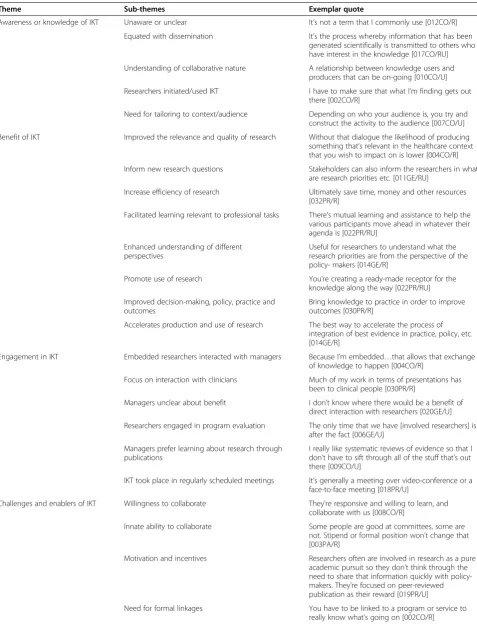
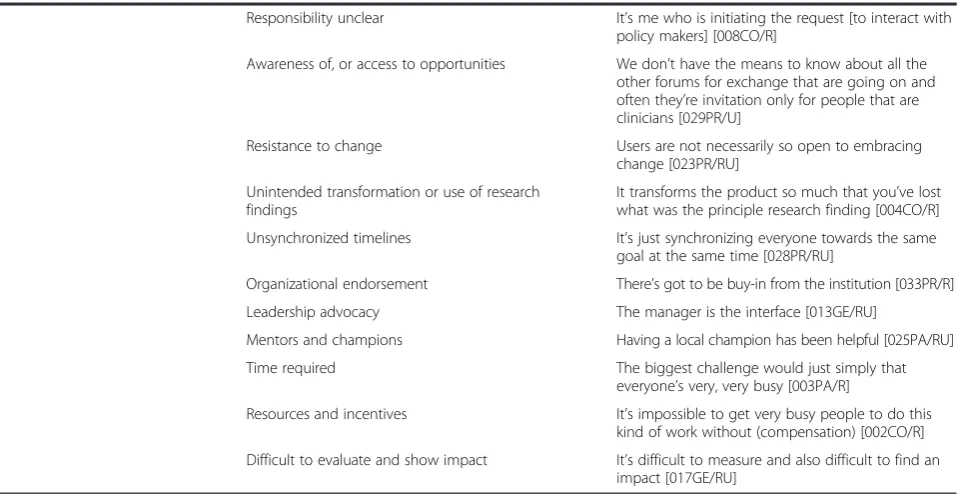
Of 77 individuals invited to participate in interviews, 36 consented and were interviewed (Table 1), nine declined, and 32 did not respond. Key findings are described here, and exemplar quotes from participants supporting these themes are summarized in Table 2. Views expressed by interview participants were similar across the three pro-grams. Most participants understood that the purpose of IKT was to promote the use of research in practice. However, they described IKT in terms of traditional dis-semination involving one-way transfer of knowledge ra-ther than an interactive or collaborative process. Most participants thought that IKT resulted in mutual learning and professional benefit for researchers and decision-makers, and greater understanding of differing pers-pectives. IKT was thought to enhance the efficiency of conducting research, and the quality and relevance of re-search leading to greater and accelerated use of rere-search that improved the decision-making process, and subse-quent policy, practice and health care outcomes. Physician researchers who were embedded in or formally affiliated with a program were more likely to report interaction with decision-makers compared with external researchers with-out any form of affiliation. Most interaction occurred be-tween physician researchers or managers and physician end-users. When it occurred, IKT largely took place at regularly scheduled committee meetings. Managers ex-pressed little interest in, or uncertainty about the purpose of engaging researchers. If this occurred, it was most likely at the end of a project. Instead they relied on published re-search, valuing currency and explicitly stated relevance in such reports.
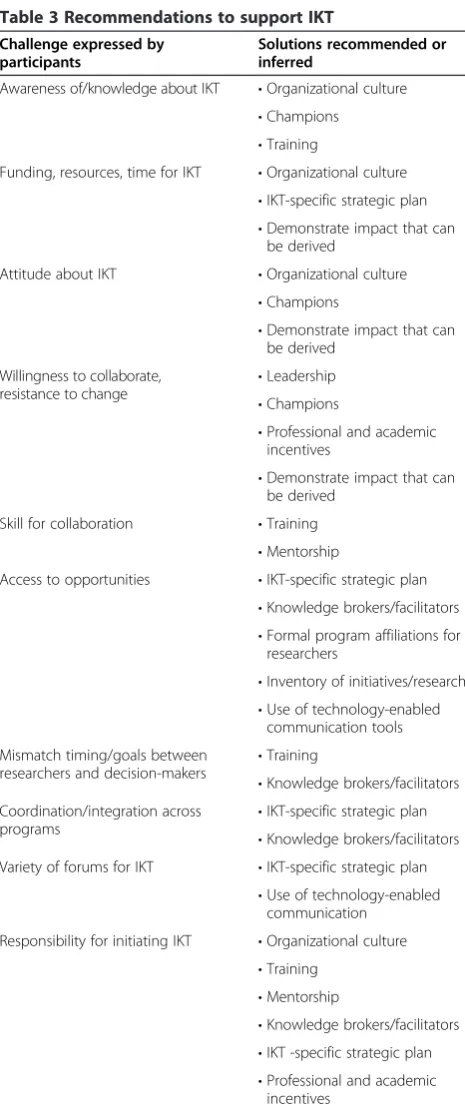
[image:5.595.56.537.627.725.2]IKT was challenged by multiple factors that included interest in, and skills for collaboration; organizational recognition of, and support for IKT through leadership, mentors, champions and brokers; a mismatch in timing and goals between researchers and decision-makers; lim-ited funding, resources and time for IKT; lack of coord-ination or integration across programs even within a
Table 1 Professional role of study participants
Program Researchers Decision-makers Total
Clinician Non-clinician Clinician Manager
Colorectal 4 3 2 3 12
Prostate 7 1 - 3 11
Pancreatic 5 1 - - 6
General Context* 3 - - 4 7
Total 19 5 2 10 36
Table 2 Interview themes
Theme Sub-themes Exemplar quote
Awareness or knowledge of IKT Unaware or unclear It’s not a term that I commonly use [012CO/R]
Equated with dissemination It’s the process whereby information that has been
generated scientifically is transmitted to others who have interest in the knowledge [017CO/RU]
Understanding of collaborative nature A relationship between knowledge users and producers that can be on-going [010CO/U]
Researchers initiated/used IKT I have to make sure that what I’m finding gets out there [002CO/R]
Need for tailoring to context/audience Depending on who your audience is, you try and construct the activity to the audience [007CO/U]
Benefit of IKT Improved the relevance and quality of research Without that dialogue the likelihood of producing
something that’s relevant in the healthcare context that you wish to impact on is lower [004CO/R]
Inform new research questions Stakeholders can also inform the researchers in what
are research priorities etc. [011GE/RU]
Increase efficiency of research Ultimately save time, money and other resources
[032PR/R]
Facilitated learning relevant to professional tasks There’s mutual learning and assistance to help the various participants move ahead in whatever their agenda is [022PR/RU]
Enhanced understanding of different perspectives
Useful for researchers to understand what the research priorities are from the perspective of the policy- makers [014GE/R]
Promote use of research You’re creating a ready-made receptor for the
knowledge along the way [022PR/RU]
Improved decision-making, policy, practice and outcomes
Bring knowledge to practice in order to improve outcomes [030PR/R]
Accelerates production and use of research The best way to accelerate the process of integration of best evidence in practice, policy, etc. [014GE/R]
Engagement in IKT Embedded researchers interacted with managers Because I’m embedded…that allows that exchange of knowledge to happen [004CO/R]
Focus on interaction with clinicians Much of my work in terms of presentations has been to clinical people [030PR/R]
Managers unclear about benefit I don’t know where there would be a benefit of
direct interaction with researchers [020GE/U]
Researchers engaged in program evaluation The only time that we have [involved researchers] is after the fact [006GE/U]
Managers prefer learning about research through publications
I really like systematic reviews of evidence so that I don’t have to sift through all of the stuff that’s out there [009CO/U]
IKT took place in regularly scheduled meetings It’s generally a meeting over video-conference or a face-to-face meeting [018PR/U]
Challenges and enablers of IKT Willingness to collaborate They’re responsive and willing to learn, and
collaborate with us [008CO/R]
Innate ability to collaborate Some people are good at committees, some are
not. Stipend or formal position won’t change that [003PA/R]
Motivation and incentives Researchers often are involved in research as a pure
academic pursuit so they don’t think through the need to share that information quickly with policy-makers. They’re focused on peer-reviewed publication as their reward [019PR/U]
Need for formal linkages You have to be linked to a program or service to
single organization; and resistance to change. Decision-makers thought that researchers did not reach out to them, while researchers said they experienced difficulty accessing decision-makers and opportunities for inter-action. Participants were asked to suggest strategies for overcoming challenges, and promoting and enabling IKT (Table 3). They said that IKT could be strengthened by recognizing it as an explicit organizational priority along with IKT-specific strategic plans, designated lea-ders, resources and regular forums to support it, provid-ing researchers with formal affiliations and opportunities for interaction, and enabling it through education, bro-kers and an inventory of research. They thought that greater awareness of the impact of IKT might promote its use. A few contradictions were identified. For ex-ample, there was disagreement on whether more meetings to enable IKT were desirable, and a few participants rec-ommended the use of technology-enabled communica-tion. While some participants said that researchers should be embedded in every standing committee, others said that evidence could instead be acquired from published literature, or that researchers were biased, or that they may have a role only at the end of a program to evaluate its impact.
Summary of integrated findings
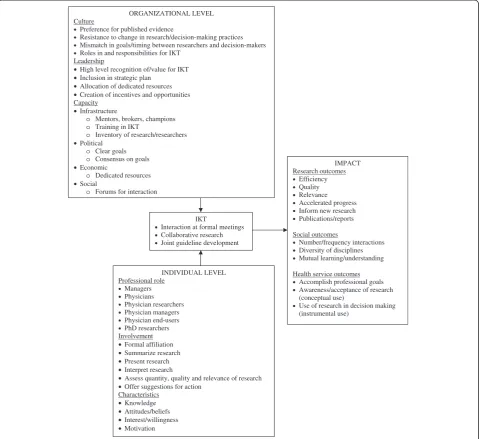
Contextual factors that influenced the type, prevalence and impact of IKT are summarized in Figure 1. Docu-ment analysis identified that naturalistic or typical means of IKT across the three programs included collaborative research, joint guideline development and, most often,
[image:7.595.60.541.101.349.2]interaction at formal or regularly scheduled meetings. Observation of meetings identified that researchers ac-tively contributed to decision making in a variety of ways including summarizing, presenting, interpreting and com-menting on the quantity, quality and relevance of evi-dence, and whether and how it could inform decisions. More documents and meetings were available for the colorectal program compared with either the prostate or pancreatic program. This was largely due to key differ-ences in program characteristics. The colorectal program was funded by the government so there were dedicated resources to operationalize and evaluate the program. In-frastructure was in place including leadership and admin-istrative support from a centralized office. The program also appeared to have a clear, specific and agreed upon focus. Various stakeholders had roles and were engaged in standing committees, including one researcher committee, one clinician committee, and several interdisciplinary committees which featured greater professional diversity compared with the prostate and pancreatic programs. Thus there were ongoing forums for interaction. In par-ticular, the colorectal program featured an embedded scientist who participated in most of the committees and was specifically hired to contribute to program plan-ning and evaluation. Given the level of support and ac-tivity in the colorectal program, the impact of IKT was apparent as several types of outcomes. With respect to so-cial outcomes, the number and frequency of interactions and diversity of engaged disciplines appeared greater than the other programs as did research outcomes including number of products and publications. With respect to
Table 2 Interview themes(Continued)
Responsibility unclear It’s me who is initiating the request [to interact with
policy makers] [008CO/R]
Awareness of, or access to opportunities We don’t have the means to know about all the other forums for exchange that are going on and often they’re invitation only for people that are clinicians [029PR/U]
Resistance to change Users are not necessarily so open to embracing
change [023PR/RU]
Unintended transformation or use of research findings
It transforms the product so much that you’ve lost what was the principle research finding [004CO/R]
Unsynchronized timelines It’s just synchronizing everyone towards the same
goal at the same time [028PR/RU]
Organizational endorsement There’s got to be buy-in from the institution [033PR/R]
Leadership advocacy The manager is the interface [013GE/RU]
Mentors and champions Having a local champion has been helpful [025PA/RU]
Time required The biggest challenge would just simply that
everyone’s very, very busy [003PA/R]
Resources and incentives It’s impossible to get very busy people to do this
kind of work without (compensation) [002CO/R]
health service outcomes, evidence was both used and generated in program planning, delivery and evaluation, though desired clinical outcomes such as increased use of screening were not achieved. Interviews largely con-firmed that leadership, infrastructure, political support in the form of clear, agreed-upon goals, dedicated resources,
and opportunities for social interaction all contributed to greater IKT and associated impact in the colorectal pro-gram. However, in all three programs some tensions were evident that represent IKT challenges. These included individual willingness to take part in IKT, lack of insti-tutional incentives or recognition for IKT, ambiguous responsibility for IKT, and cultural factors that created mismatches in decision maker and researcher goals, and a reliance on more traditional forms of sharing or acquiring evidence. Thus it is notable that the more estab-lished, IKT-active program achieved a variety of outcomes based on leadership, clear goals, dedicated funding and other infrastructural resources, and an embedded resear-cher responsible for, and actively engaged in IKT, despite mixed individual views about the value of IKT and the ab-sence of a programmatic culture of IKT.
Conceptual analysis of integrated findings
[image:8.595.57.290.85.642.2]Study findings confirmed several components of the PARIHS framework. The PARIHS framework suggests that research use is influenced by context, where con-text is defined as a culture receptive to change, leader-ship support, and feedback to staff. In this research both culture and leadership appeared to be associated with IKT and associated outcomes, though feedback to staff was not evident as either an influencing factor, IKT process or an outcome. Cultural factors that were relevant to this re-search included reliance on published evidence; resistance to change on the part of both researchers and decision-makers; mismatch between the goals and timing of re-searchers and decision-makers; and lack of clarity around IKT roles and responsibilities. While leadership was ap-parent in the colorectal program, in part accounting for IKT activity, participants of this and other programs re-commended other forms of leadership or leadership ac-tivities including high level recognition for IKT as an organizational priority described in strategic plans, in-centives for IKT, and greater opportunities for interaction. Study findings revealed several additional contextual factors that influenced IKT beyond the components of PARIHS. These included organizational capacity, which could be further categorized according to socio-political (clear goals, consensus on goals), economic (dedicated funding, resources and infrastructure such as space, ad-ministrative support) and social (formal and informal interaction, affiliated or embedded roles, diversity of en-gaged disciplines) factors that either enabled or challenged IKT. Findings also confirm the relevance of contextual factors at the individual (knowledge, beliefs, motivation) and organizational (culture, leadership, capacity) levels. It is notable that in this study leadership and capacity (infra-structure, funding, clear goals), in the absence of a strong IKT culture, were sufficient to achieve tangible outcomes including a variety of social, research and health service
Table 3 Recommendations to support IKT
Challenge expressed by participants
Solutions recommended or inferred
Awareness of/knowledge about IKT •Organizational culture
•Champions
•Training
Funding, resources, time for IKT •Organizational culture
•IKT-specific strategic plan
•Demonstrate impact that can be derived
Attitude about IKT •Organizational culture
•Champions
•Demonstrate impact that can be derived
Willingness to collaborate, resistance to change
•Leadership
•Champions
•Professional and academic incentives
•Demonstrate impact that can be derived
Skill for collaboration •Training
•Mentorship
Access to opportunities •IKT-specific strategic plan
•Knowledge brokers/facilitators
•Formal program affiliations for researchers
•Inventory of initiatives/research
•Use of technology-enabled communication tools
Mismatch timing/goals between researchers and decision-makers
•Training
•Knowledge brokers/facilitators Coordination/integration across
programs
•IKT-specific strategic plan
•Knowledge brokers/facilitators Variety of forums for IKT •IKT-specific strategic plan
•Use of technology-enabled communication
Responsibility for initiating IKT •Organizational culture
•Training
•Mentorship
•Knowledge brokers/facilitators
•IKT -specific strategic plan
outcomes, which also elaborated the PARIHS description of outcomes beyond the general term of research use.
Discussion
This study was conducted to examine how context in-fluences IKT and, in so doing, generate a conceptual framework of factors that influence IKT practice and outcomes that could be used to strengthen IKT and guide ongoing research. Regular meetings of researchers, decision-makers and end-users were the most common forum for IKT. Meetings were most prevalent in the pro-gram that featured some contextual factors identified by PARIHS [22-24], in particular leadership and capacity (infrastructure, dedicated funding, clear goals) and several additional contextual factors and associated outcomes
identified by this research, and which achieved a variety of social, research and health service outcomes. The ad-ditional contextual factors unique to this research have been captured by sociological theories including social, political, and economic factors that may influence individ-ual beliefs and practices, or programmatic support for IKT [34]. The outcomes achieved by the more established and IKT-active program included use of research consid-ered as conceptual (awareness, acceptance) and instru-mental (decision-making) [35]. Findings were captured in a conceptual framework of factors that influence IKT practice and outcomes. Recommendations were issued for a variety of strategies that could support and op-timize IKT. Recommendations were similar to factors that enabled collaboration in literature on management
IKT
•Interaction at formal meetings
•Collaborative research
•Joint guideline development
INDIVIDUAL LEVEL Professional role
• Managers
• Physicians
• Physician researchers
• Physician managers
• Physician end-users
• PhD researchers Involvement
•Formal affiliation
•Summarize research
•Present research
•Interpret research
•Assess quantity, quality and relevance of research
•Offer suggestions for action Characteristics
•Knowledge
•Attitudes/beliefs
•Interest/willingness
•Motivation
IMPACT Research outcomes
• Efficiency
• Quality
• Relevance
• Accelerated progress
• Inform new research
• Publications/reports
Social outcomes
• Number/frequency interactions
• Diversity of disciplines
• Mutual learning/understanding
Health service outcomes
• Accomplish professional goals
• Awareness/acceptance of research (conceptual use)
• Use of research in decision making (instrumental use)
ORGANIZATIONAL LEVEL Culture
• Preference for published evidence
• Resistance to change in research/decision-making practices
• Mismatch in goals/timing between researchers and decision-makers
• Roles in and responsibilities for IKT Leadership
•High level recognition of/value for IKT
•Inclusion in strategic plan
•Allocation of dedicated resources
•Creation of incentives and opportunities Capacity
•Infrastructure
o Mentors, brokers, champions
o Training in IKT
o Inventory of research/researchers
•Political
o Clear goals
o Consensus on goals
•Economic
o Dedicated resources
•Social
[image:9.595.59.539.90.529.2]o Forums for interaction
networks, interprofessional health services research, team-work, knowledge translation, communities of practice, and quality improvement collaboratives [36].
The interpretation and application of study findings may be limited by several issues. Few documents and meetings were available for two of three programs, how-ever, that data was retained to compare the lack of de-velopment of those programs and in associated IKT given the limited nature of certain contextual factors such as program funding, leadership, infrastructure and joint goals. We also may not have interviewed all rele-vant stakeholders associated with each program, partly due to non-response. However we did sample for inter-views according to program and professional role within each program so findings likely captured a variety of views that may have been influenced by these factors, and interview data was supplemented with information from content analysis of documents and meeting obser-vation. The chosen programs may not have revealed a variety of IKT activity or possible factors influencing IKT given that two contexts were not well established or active. Further research of a similar nature but in add-itional programs would extend these findings and fur-ther examine the influence of context on the prevalence, nature and outcomes of IKT.
Study findings confirm those of a case study that eval-uated three health service delivery programs which found that IKT was highly influenced by the complex context within which decisions were made including social and political issues [18]. It is recommended that these context-ual factors be considered when tailoring or implementing programs or interventions [16]. Other research that evalu-ated the influence of context focused on the implementa-tion or adopimplementa-tion of clinical practices in primary, acute and long-term care settings [37,38]. The conceptual frame-work generated here provides organizations with a means of planning or evaluating contextual issues specific to the use and impact of IKT. Existing research offers limited insight on the approaches or strategies by which to ope-rationalize IKT. Suggestions generated by other resear-chers included identifying partners with pre-established links to ease and expedite interaction; establishing clear expectations about role, scope and contribution to foster trust and avoid role confusion and misconceptions; foster-ing dialogue; and assessfoster-ing progress to implement changes as needed [17]. These findings add to that body of know-ledge by offering a detailed framework of individual and organizational contextual factors to consider.
A key role appeared to be that of an embedded scien-tist. This was identified as one of the few mechanisms for enabling IKT in a survey of health policy experts representing 30 European countries [16]. This individual was an active participant in planning committees, gener-ated and contributed to research, and offered information
and insight that influenced decisions about program plan-ning and evaluation. Further research should explore the role of embedded scientists to elaborate on the scope of such roles, how they can be supported and their impact. While this research did identify contextual factors that in-fluenced IKT along with challenges and suggested en-ablers, it identified few naturalistic IKT activities upon which to build, an approach theorized to result in greater acceptance and sustained use of IKT [18]. When it oc-curred, most interaction took place at committee meet-ings, and through joint development of guidelines and collaborative research. Team meetings and teleconfer-ences were also the main IKT activity in an international network of over 60 researchers, trainees and decision-maker partners from Canada, the United States, the United Kingdom, Asia, Europe and Australia after its first three years of operation [39]. Views expressed by middle and high level managers suggest they prefer pub-lished research over interaction with researchers, and non-embedded researchers noted that it was difficult to access opportunities for collaboration. Overall, most indi-viduals had a limited understanding of IKT and how it could be achieved, and disagreed on whether more meet-ings were desirable. Other research has identified these and other challenges, including a lack of incentives for undertaking IKT [4,6,12,13]. That was certainly evident here. Research is needed to further understand this ten-sion between lack of time and incentives for interaction, and the need for interaction to support IKT. Such re-search may reveal options other than meetings by which to achieve IKT.
Conclusion
Regular meetings of researchers, decision-makers and end-users were the most common forum for IKT across all programs. Meetings were most prevalent in the pro-gram with leadership, clear goals, dedicated funding and other infrastructural resources, and an embedded re-searcher responsible for, and actively engaged in IKT. This program achieved a variety of social, research and health service outcomes despite mixed individual views about the value of IKT and the absence of a program-matic culture of IKT. Together with challenges and en-ablers identified by participants, this study generated a conceptual framework of factors that influence IKT practice and outcomes which can be used by others to plan or evaluate IKT. Further research is needed to ex-plore whether these findings are widespread, and un-derstand how IKT can be optimized. However, these findings can be applied by researchers, clinicians, man-agers or policy-makers to plan or improve collaborative decision-making for health services planning, delivery, evaluation or quality improvement.
Additional files
Additional file 1:Relevance, Appropriateness, Transparency and Soundness (RATS) principles for the reporting of qualitative research.
Additional file 2:Overview of Clinical Contexts.
Competing interests
The authors declare that they have no competing interests.
Authors’contributions
ARG conceived the study, acquired funding, coordinated all aspects of its conduct including training and oversight of the research assistant who collected data and independent review of all data analyses, and prepared this manuscript. All authors contributed to study planning and data interpretation, and reviewed and approved the final version of this manuscript. In particular, FW provided guidance on qualitative study design and analysis; NNB, AF and SG identified relevant documents, meetings and stakeholders as key informants for three contexts; and MCB also suggested documents, meetings and stakeholders as sources of data.
Acknowledgements
This research was conducted with funding from the Cancer Care Ontario– Ontario Institute of Cancer Research Health Services Research Program– Knowledge Translation Research Network, which took no role in the study.
Author details
1University Health Network, Toronto, Canada.2University of Toronto, Toronto,
Canada.3McMaster University, Hamilton, Canada.4St. Michael’s Hospital,
Toronto, Canada.
Received: 13 February 2014 Accepted: 21 October 2014
References
1. Innvaer S, Vist G, Trommald M, Oxman A:Health policy-makers’perceptions of their use of evidence: a systematic review.J Health Serv Res Policy2002, 7:239–244.
2. Ouimet M, Landry R, Amara N, Belkhodja O:What factors induce health care decision-makers to use clinical guidelines? Evidence from provincial
health ministries, regional health authorities and hospitals in Canada. Soc Sci Med2006,62:964–976.
3. Lomas J:Using‘linkage and exchange’to move research into policy at a Canadian foundation.Health Aff2000,19:236–240.
4. Kothari A, Wathen CN:A critical second look at integrated knowledge translation.Health Policy2013,109(2):187–191.
5. Bowen SJ, Graham ID:From knowledge translation to engaged scholarship: Promoting research relevance and utilization.Arch Phys Med Rehabil2013,94(1 Suppl):S3–S8.
6. Denis JL, Hebert Y, Langley A, Lozeau D, Trottier LH:Explaining diffusion patterns for complex health care innovations.Health Care Manage Rev 2002,27(3):60–73.
7. Dooley KL:A complex adaptive systems model of organization change. Nonlinear Dynamics Psychol Life Sci1997,1(1):69–97.
8. Oborn E, Barrett M, Prince K, Racko G:Balancing exploration and exploitation in transferring research into practice: a comparison of five knowledge translation entity archetypes.Implement Sci2013,8:104. 9. Wilkinson H, Gallagher M, Smith M:A collaborative approach to defining
the usefulness of impact: lessons from a knowledge exchange project involving academics and social work practitioners.Evid Policy2012, 8(3):311–327.
10. Allender S, Nichols M, Foulkes C, Reynolds R, Waters E, King L, Gill T, Armstrong R, Swinburn B:The development of a network for community-based obesity prevention: the CO-OPS Collaboration.BMC Public Health 2011,11:132.
11. Tee S, Bockle E:Closing the gap–A partnership approach to community care education for long term conditions.Nurse Edu Today 2012,32:822–828.
12. King G, Currie M, Smith L, Servais M, McDougall J:A framework of operating models for interdisciplinary research programs in clinical service organizations.Eval Program Plan2008,31:160–173.
13. Hall JG, Buchan A, Cribb A, Drummond J, Gyles C, Hicks TP, McWilliam C, Paterson B, Ratner PA, Skarakis-Doyle E, Solomon P:A meeting of the minds: interdisciplinary research in the health sciences in Canada. CMAJ2006,175(7):763–771.
14. Dayan PS, Osmond M, Kuppermann N, Lang E, Klassen T, Johnson D, Strauss S, Hess E, Schneider S, Afilalo M, Pusic M:Development of the capacity necessary to perform and promote knowledge translation research in emergency medicine.Acad Emerg Med2004,14(11):978–983.
15. Tetroe JM, Graham ID, Foy R, Robinson N, Eccles MP, Wensing M, Durieux P, Legare F, Nielson CP, Adily A, Ward JE, Porter C, Shea B, Grimshaw JM: Health research funding agencies’support and promotion of knowledge translation: an international study.Milbank Q2008,86(1):125–155. 16. Ettelt S, Mays N:Health service research in Europe and its use for informing policy.J Health Serv Res Policy2011,16(suppl 2):48–60. 17. Hofmeyer A, Scott C, Lagendyk L:Researcher-decision-maker partnerships
in health services research: Practical challenges, guiding principles. Health Serv Res2012,12:280.
18. Ward V, Smith S, House A, Hamer S:Exploring knowledge exchange: a useful framework for practice and policy.Soc Sci Med2012,74(3):297–304. 19. Ilott I, Gerrish K, Pownall S, Eltringham S, Booth A:Exploring scale-up,
spread and sustainability: an instrumental case study tracing an innovation to enhance dysphagia care.Implement Sci2013,8:128. 20. McDonald KM:Considering context in quality improvement interventions
and implementation: concepts, frameworks and application.Acad Pediat 2013,13(6S):S45–S53.
21. Flottorp SA, Oxman AD, Krause J, Musila NR, Wensing M, Godycki-Cwirko M, Baker R, Eccles MP:A checklist for identifying determinants of practice: A systematic review and synthesis of frameworks and taxonomies of factors that prevent or enable improvements in healthcare professional practice.Implement Sci2013,8:35.
22. Rycroft-Malone J, Kitson A, Harvey G, McCormack B, Seers K, Titchen A, Estabrooks C:Ingredients for change: revisiting a conceptual framework. Qual Saf Health Care2002,11:174–180.
23. Cummings GG, Estabrooks CA, Midodzi WK, Wallin L, Hayduk L:Influence of organizational characteristics and context on research utilization. Nurs Res2007,56(4S):S24–S39.
25. Auerbach CF, Silverstein LB:Qualitative Data: An Introduction to Coding and Analysis.New York: New York University Press; 2003.
26. Barbour RS:Checklists for improving rigour in qualitative research: a case of the tail wagging the dog?BMJ2011,322(7294):1115–1117.
27. Clark JP:How to peer review a qualitative manuscript.InPeer Review in Health Sciences.2nd edition. Edited by Godlee F, Jefferson T. London: BMJ Books; 2003.
28. Elo S, Kyngas H:The qualitative content analysis process.J Adv Nurs2008, 62(1):107–115.
29. Hsieh HF, Shannon SE:Three approaches to qualitative content analysis. Qual Health Res2005,15(9):1277–1288.
30. Strauss A, Corbin J:Basics of Qualitative Research: Grounded Theory Procedures and Techniques.Newbury Park, CA: Sage; 1990.
31. Strauss AL:Qualitative Analysis for Social Scientists.Cambridge: Cambridge University Press; 2003.
32. Pope C, Ziebland S, Mays N:Analysing qualitative data.Br Med J2000, 320:114–116.
33. Robinson OC:Relational analysis: An add-on technique for aiding data integration in qualitative research.Qual Res Psychol2011,8(2):197–209. 34. Macionis J, Gerber L:Sociology, Seventh Canadian Edition.Don Mills: Pearson
Education Canada; 2010.
35. Squires JE, Estabrooks CA, Scott SD, Cummings GG, Hayduk L, Kang SH, Stevens B:The influence of organizational context on the use of research by nurses in Canadian pediatric hospitals.BMC Health Serv Res2013, 13:351.
36. Gagliardi AR, Dobrow MJ, Wright FC:How can we improve cancer care? A review of interprofessional collaboration models and their use in clinical management.Surg Oncol2011,20(3):146–154.
37. Sharp ND, Pineros SL, Hsu C, Starks H, Sales AE:A qualitative study to identify barriers and facilitators to implementation of pilot interventions in the Veterans Health Administration (VHA) Northwest Network. Worldviews Evid Based Nurs2004,1(2):129–139.
38. Cammer A, Morgan D, Stewart N, McGilton K, Rycroft-Malone J, Dopson S, Estabrooks C:The hidden complexity of long-term care: how context mediates knowledge translation and use of best practices.Gerontologist 2013, doi: 10.1093/geront/gnt068.
39. Kothari A, Sibbald S, Wathen CN:PreVAiL. Partnership Evaluation Report: Phase1. Preventing Violence Across the Lifespan Research Network.London ON: University of Western Ontario; 2013.
40. Kothari A, MacLean L, Edwards N, Hobbs A:Indicators at the interface: managing policymaker-researcher collaboration.Knowledge Manage Res Pract2011,9:203–214.
doi:10.1186/s12913-014-0545-x
Cite this article as:Gagliardiet al.:How does context influence collaborative decision-making for health services planning, delivery and evaluation?BMC Health Services Research201414:545.
Submit your next manuscript to BioMed Central and take full advantage of:
• Convenient online submission
• Thorough peer review
• No space constraints or color figure charges
• Immediate publication on acceptance
• Inclusion in PubMed, CAS, Scopus and Google Scholar
• Research which is freely available for redistribution