
Theses Thesis/Dissertation Collections
5-1-2007
Optimization of a new digital image compression
algorithm based on nonlinear dynamical systems
Anurag R. Sinha
Follow this and additional works at:http://scholarworks.rit.edu/theses
This Thesis is brought to you for free and open access by the Thesis/Dissertation Collections at RIT Scholar Works. It has been accepted for inclusion in Theses by an authorized administrator of RIT Scholar Works. For more information, please [email protected].
Recommended Citation
OPTIMIZATION
OF
A
NEW
DIGITAL
IMAGE
COMPRESSION
ALGORITHM
BASED
ON
NONLINEAR
DYNAMICAL
SYSTEMS
BY
ANURAG
R
SINHA
A THESIS SUBMITTED IN PARTIAL FULFILLMENT OF THE REQUIREMENTS FOR THE DEGREE OF
MASTER OF SCIENCE
IN
ELECTRICAL ENGINEERING
Approved by:
Prof.
THESIS ADVISOR – DR. CHANCE M. GLENN SR.
Prof.
THESIS COMMITTEE MEMBER – DR. SOHAIL A. DIANAT
Prof.
HEAD OF DEPARTMENT, ELECTRICAL ENGINEERING – DR. VINCENT AMUSO
DEPARTMENT OF ELECTRICAL ENGINEERING, THE KATE GLEASON COLLEGE OF ENGINEERING
LIBRARY RIGHTS STATEMENT
In presenting the thesis “OPTIMZATION OF A NEW DIGITAL IMAGE COMPRESSION ALGORITHM BASED ON NONLINEAR DYNAMICAL SYSTEMS” in partial fulfillment of the requirements for an advance degree at the Rochester Institute of Technology, I agree that permission for copying as provided for by the Copyright Law of the U.S. (Title 17, U.S. code) of this thesis for scholarly purposes may be granted by the Librarian. It is understood that any copying or publication of this thesis for financial gain shall not be allowed without my written permission. I hereby grant permission to the RIT Library to copy my thesis for scholarly purposes.
___________________________________________ Anurag R Sinha
_____________________________________ Date
PREFACE
Over the years the need for compression of Audio/Video/Image data has been increasing exponentially due to several technological advances in data communication and file storage base. Although our current communication standards and protocols support variegated types and formats of data with multiple bitrates and advanced data encryption technologies which facilitate transmission of data with acceptable attenuation losses, issues such as exhaustible data storage media, fixed bandwidth, transmission speed over a channel etc. has caused a quite a considerable retardation in technological growth.
Uncompressed Data (graphics, audio and video) requires considerable storage capacity and transmission bandwidth. Although there has been rapid progress in storage capacity of storage media, processing/compilation time of processes/compilers, and digital communication system performance, demand for data compression and data‐transmission bandwidth continues to acts as a bane on technological growth. While compression/bandwidth conservation theories are going at a snail’s pace, the recent growth of data intensive multimedia‐based web
applications has made it even more imminent to come up with efficient ways to encode signals and images
The table I below [1]shows the qualitative transition from simple text to full‐motion video data and the disk space, transmission bandwidth, and transmission time needed to store and transmit such uncompressed data.
Multimedia Data Size/Duration Bits/Pixel or Bits/Sample
Uncompressed Size
(B for bytes)
Transmission Bandwidth (b for bits)
Transmission Time (using a
28.8K Modem)
A page of text 11'' x 8.5'' Varying
resolution 4‐8 KB
32‐64
Kb/page 1.1 ‐ 2.2 sec Telephone
quality speech 10 sec 8 bps 80 KB 64 Kb/sec 22.2 sec
Grayscale Image 512 x 512 8 bpp 262 KB 2.1
Mb/image 1 min 13 sec
Color Image 512 x 512 24 bpp 786 KB 6.29
Mb/image 3 min 39 sec
Medical Image 2048 x 1680 12 bpp 5.16 MB 41.3 Mb/image
SHD Image 2048 x 2048 24 bpp 12.58 MB 100 Mb/image
58 min 15 sec
Full‐motion Video
640 x 480, 1 min
(30
frames/sec)
24 bpp 1.66 GB 221 Mb/sec 5 days 8 hrs
Table 1 ‐ Qualitative Transition Data from simple text to full‐motion video
The Example above gives several of our issues a subtle definition. Some of them are mentioned below:
a. A Need for sufficient storage space. b. Large Transmission Bandwidth
c. A very large transmission time for Data (especially video).
So if we consider an option of successful compression of say for ratio of 32:1, the space,
bandwidth, and transmission time requirements can be reduced by a factor of 32, provided the compressed data still exhibits acceptable quality.
TABLE
OF
CONTENTS
PREFACE
ABSTRACT………08
1. INTRODUCTION………09
1.1Compression Theories………09
1.2What a New Compression Algorithm has to bring to the table………10
2. CHAOS THEORY – AN INTRODUCTION………11
2.1CHAOS DYNAMICS CONCEPTS……… 11
2.1.1 Chaos Dynamics & Fractal Geometry………11
2.1.2 Applications in Modern World………..14
2.2OSCILLATOR INTRODUCTION……….15
2.2.1 The Colpitts Oscillator………..15
2.3CHAOS DYNAMAC THEORY………....18
2.3.1 Chaos and Waveform Dynamics – Audio Waveforms……….18
2.3.1.1Background……….18
2.3.1.2Chaotic Dynamics………18
2.3.1.3Example……….19
3. DYNAMAC COMPRESSION………..21
3.1GENERATING WAVEFORMS USING OSCILLATORS……….21
3.2FOURIER SERIES WAVEFORM CLASSIFICATION………22
3.2.1 Fourier Series Classification – An Introduction……….23
3.2.2 Waveform Classification ………..24
3.2.3 CCO Waveform Types – Families & Sub‐Families……….26
3.2.4 Advantages of FSWC……….26
3.3COMPRESSION THEORY……….27
3.3.1 Algorithm Description………..27
3.3.2 Waveform Type match using a New Classification Algorithm (To be discussed in detail in the next chapter)………29
3.3.3 The DYI File………..30
3.4THE ADAPTIVE HUFFMAN ALGORITHM………..30
3.4.1 The Huffman Algorithm – An Introduction & Application……30
3.4.2 Design of A DYNAMAC compatible Adaptive Huffman Algorithm………..31
4. OPTIMIZATION THEORY………..32
4.1DYNAMAC OPTIMIZATION………..………32
4.1.1 Shortcomings in the Current Compression Algorithm………..32
4.1.2 A Brief Description of Optimization Measures………33
4.2THE ENTROPY APPROACH………33
4.2.1 Entropy & Randomness of Data – An Introduction……….33
[image:6.612.89.539.92.709.2]4.2.2.1Probability Distribution Function (PDF) & Scott’s
Rule……….39
4.2.2.2Entropy……….43
4.2.3 Conclusion ………..44
4.3THE PSNR ‐ A MEASURE OF QUALITY………..45
4.3.1 Peak Signal to Noise Ratio – An Introduction………..45
4.3.2 Calculation of PSNR – Parameters & Values……….45
4.3.3 Conclusions & Expectations from a Comparative Study………47
4.4ENTROPY VS. PSNR……….47
4.4.1 ENTROPY & PSNR – A Comparative Study………..47
4.4.2 Results & Inference……….47
5. OPTIMIZATION THEORY II – THE CCO MATRIX……….50
5.1THE ENTROPY OF CCO MATRIX………..50
5.1.1 The Impact of Entropy Study & Current Classification of Waveforms………51
5.1.2 Conclusions………..51
5.2UNDER/NON UTILIZED WAVEFORMS………..51
5.2.1 Histogram of a Compressed Image……….51
5.2.2 Under/Non Utilized Waveforms – Detection & Analysis…….54
5.2.3 Conclusions……….56
5.3WAVEFORM EFFICIENCY – A THEORETICAL PERSPECTIVE……….56
5.3.1 What is Image‐Wise‐Waveform‐Efficiency?...56
5.3.2 The Square Wave – Introduction & Application………58
5.3.3 The CCO Matrix – New Waveform Inception & Results………61
6. THE CHANNEL ‐ A REAL WORLD PERSPECTIVE……….62
6.1DYNAMAC Data Streaming……….62
6.1.1 The DYNAMAC Protocol……….62.
6.1.2 A Java Based Application for Streaming DYNAMAC data (Citations & Copyright Luis A Caceres Chong)……….65
6.2De‐Compression Theory………67
6.2.1 A Client Perspective………..67
6.2.2 Advantages of DRM friendly data………67
7. THE DYNAMAC THEORY – APPLICATIONS………..68
7.1COMPRESSION APPLICATIONS……….68
7.1.1 IPTV………..68
7.1.2 Online Media Sharing………..69
7.1.3 An alternative Approach to Data Security – DRM……….69
7.2BIO‐MEDICAL APPLICATIONS……….70
7.2.1 X‐RAY Pattern Recognition – An FSWC approach……….70
8. EXAMPLES……….71
9. REFERENCES……….83
ABSTRACT
In this paper we discuss the formulation, research and development of an Optimization process for a New compression algorithm known as DYNAMAC, which has its basis in the non‐linear systems theory. We establish that by increasing the measure of randomness of the signal, the peak signal to noise ratio and in turn the quality of compression can be improved to a great extent. This measure, ENTROPY through exhaustive testing will be linked to peak signal to noise ratio (PSNR ‐ a measure of quality) and by various discussions and inferences we will establish that this measure would independently drive the compression process towards optimization. We will also introduce an Adaptive Huffman Algorithm (reference) to add to the compression ratio of the current algorithm without incurring any losses during transmission (Huffman being a lossless scheme)
1. INTRODUCTION
1.1 COMPRESSION THEORIES
One of the most common attribute of an image is that the adjacent/neighboring pixels (mainly used during masking) contain considerable amount of information which could be termed as ‘redundant’.
After indication those locations/pixels/values, a very simple task to achieve compression would be merely to remove/reduce the redundancy of data used for representation. This line of thought represents two very important theories for compression viz. redundancy and
irrelevancy reduction. They can be further subdivided [1]in to:
a. Spatial Redundancy or correlation between neighboring pixel values.
b. Spectral Redundancy or correlation between different color planes or spectral bands.
c. Temporal Redundancy or correlation between adjacent frames in a sequence of images (in video applications).
Besides the above mentioned theories, the Compression algorithms can also be classified in to their respective classes based on the compression outcome or the type of coding scheme utilized[1].
a. Lossless compression – As the name suggests, this kind of compression is classified based on the outcome of compression. The reconstructed image at the receiver end is numerically identical to the original image.
b. Lossy compression – In this kind of compression, the reconstructed image contains some kind of degradation compared to the original image. Generally, this happens if the coder, instead of replacing the redundant information with lower order byte data, just discards it and hence the name lossless coding.
c. Predictive Coding – In this scheme, a predictive algorithm is developed and maintained at the receiver end wherein, considering the information already sent or locally
available is used to predict the future values. The difference between the prediction and the original values is then coded. (E.g. DPCM – Differential Pulse Code Modulation.)
d. Transform coding – In this scheme, the coder first transforms the image from its spatial domain representation to some other domain and then the transform coefficients are coded. Quite obviously this provides a better compression ration than predictive method as only coefficients. On the contrary the Big‐O factor is comparatively huge.
An example[1] of a conventional coder used for some of the above mentioned theories.
Figure 1 – Conventional coder
Source Encoder Quantizer Entropy Encoder
Input
Signal/Image
Compressed
1.2 WHAT A NEW COMPRESSION ALGORITHM BRINGS TO THE TABLE
a. Higher compression ratios facilitate lower disk usage and hence more conservation of available disk space.
b. Lower data size facilitates a faster transmission time.
c. A faster encoding time and decoding time, in a more cumulative environment of the channel, assets the transmission system.
d. In a web Media based environment, lower data size even in the order of a few bytes would exponentially increasing the buffering and streaming times.
e. In a web Mail based environment, lower attachment sizes would facilitate a more efficient Workspace/Inbox management.
f. For intelligent hardware integrated systems, the amount of data which can be stored on the onboard processor for rapid access is defined by the amount of data the onboard chip needs. For bulky or process intensive processors, a requirement for more data leads to a larger processor storage module which makes the system bulky and volatile for long term use. A compression algorithm would provide major relief in the data management for integrated hardware systems.
2. CHAOS THEORY – AN INTRODUCTION
2.1 CHAOS DYNAMICS CONCEPTS
CHAOS THEORY
[2]
In mathematics and physics, chaos theory describes the behavior of certain nonlinear
dynamical systems that under certain conditions exhibit dynamics that are sensitive to initial conditions (popularly referred to as the butterfly effect). As a result of this sensitivity, the behavior of chaotic systems appears to be random, because of an exponential growth of errors in the initial conditions. This happens even though these systems are deterministic in the sense that their future dynamics are well defined by their initial conditions, and there are no random elements involved. This behavior is known as deterministic chaos,
or simply chaos.
Chaotic behavior has been observed in the laboratory in a variety of systems including electrical circuits, lasers, oscillating chemical reactions, fluid dynamics, mechanical and magneto
mechanical devices. Observations of chaotic behavior in nature include the dynamics of satellites in the solar system, the time[8] evolution of the magnetic field of celestial bodies, population growth in ecology, the dynamics of the action potentials in neurons, and molecular vibrations. Everyday examples of chaotic systems include weather and climate.[1] There is some controversy over the existence of chaotic dynamics in the plate tectonics and in economics. Systems that exhibit mathematical chaos are deterministic and thus orderly in some sense; this technical use of the word chaos is at odds with common parlance, which suggests complete disorder. (See the article on mythological chaos for a discussion of the origin of the word in mythology, and other uses.) A related field of physics called quantum chaos theory studies non‐ deterministic systems that follow the laws of quantum mechanics.
As well as being orderly in the sense of being deterministic, chaotic systems usually have well defined statistics. For example, the Lorenz system pictured is chaotic, but has a clearly defined structure.
2.1.1 CHAOS DYNAMICS & FRACTAL GEOMETRY
For a dynamical system to be classified as chaotic, most scientists will agree that it must have the following properties: [2]
Sensitivity to initial conditions [12]means that each point in such a system is arbitrarily closely approximated by other points with significantly different future trajectories. Thus, an arbitrarily small perturbation of the current trajectory may lead to significantly different future behavior. Sensitivity to initial conditions is popularly known as the "butterfly effect", so called because of the title of a paper given by Edward Lorenz in 1972 to the American Association for the
Advancement of Science in Washington, D.C. entitled Predictability: Does the Flap of a
Butterfly’s Wings in Brazil set off a Tornado in Texas? The flapping wing represents a small change in the initial condition of the system, which causes a chain of events leading to large‐ scale phenomena. Had the butterfly not flapped its wings, the trajectory of the system might have been vastly different.
Sensitivity to initial conditions [2]is often confused with chaos in popular accounts. It can also be a subtle property, since it depends on a choice of metric or the notion of distance in the phase space of the system. For example, consider the simple dynamical system produced by repeatedly doubling an initial value (defined by the mapping on the real line from x to 2x). This system has sensitive dependence on initial conditions everywhere, since any pair of nearby points will eventually become widely separated. However, it has extremely simple behavior, as all points except 0 tend to infinity. If instead we use the bounded metric on the line obtained by adding the point at infinity and viewing the result as a circle, the system no longer is sensitive to initial conditions. For this reason, in defining chaos, attention is normally restricted to systems with bounded metrics, or closed, bounded invariant subsets of unbounded systems.
Even for bounded systems[2], sensitivity to initial conditions is not identical with chaos. For example, consider the two‐dimensional torus described by a pair of angles (x,y), each ranging between zero and 2π. Define a mapping that takes any point (x,y) to (2x, y + a), where a is any number such that a/2π is irrational. Because of the doubling in the first coordinate, the
mapping exhibits sensitive dependence on initial conditions. However, because of the irrational rotation in the second coordinate, there are no periodic orbits, and hence the mapping is not chaotic according to the definition above.
Topologically mixing [2]means that the system will evolve over time so that any given region or open set of its phase space will eventually overlap with any other given region. Here, "mixing" is really meant to correspond to the standard intuition: the mixing of colored dyes or fluids is an example of a chaotic system.
ATTRACTORS
[2]
Some dynamical systems are chaotic everywhere (see e.g. Anosov diffeomorphisms) but in many cases chaotic behavior is found only in a subset of phase space. The cases of most interest arise when the chaotic behavior takes place on an attractor, since then a large set of initial conditions will lead to orbits that converge to this chaotic region.
Figure 2 ‐
For insta consistin pendulum motion w curve is c nested e
STRAN
While mo points an
strange a
three‐dim attractor probably gives rise attractor logistic m
Strange a in some d a repellin of fixed p Julia sets
The Poin continuo applies to dimensio The initia the n‐bod
Phase diagra
nce, in a sys g of informa m against its will be plotte called an orb llipses about
NGE ATTR
ost of the m nd circle‐like
attractors, a mensional m r. The Lorenz y because no e to a very in r is the Rössl map.
attractors oc discrete syst ng structure points ‐ Julia s typically ha
caré‐Bendix ous dynamica
o discrete sy onal systems al conditions dy problem)
am for a damp
stem describ ation about s velocity. A ed as a simp bit. Our pend
t the origin.
RACTORS
[otion types e curves calle
ttractors tha model of the
z attractor [1 ot only was it nteresting pa er Map, wh
ccur in both tems (such a called a Juli sets can be ave a fractal
xson theorem al system if i ystems, whic s.
s of three or ) can be arra
ped driven pe
bing a pendu position and pendulum a le closed cur dulum has a
[2]
mentioned ed limit cycle
at can have g Lorenz weat 15]is perhap
t one of the attern which ich experien
continuous as the Hénon
a set which thought of structure.
m [9]shows t it has three ch can exhib
more bodie anged to pro
endulum, wit
ulum, the ph d velocity. O at rest will be
rve. When s n infinite nu
above give r
es, chaotic m great detail ther system ps one of the first, but it i h looks like t nces period‐t
dynamical s n map)[22]. forms at the as strange r
that a strang or more dim bit strange at
es interacting oduce chaoti
h double per
ase space m ne might plo e plotted as
uch a plot fo umber of suc
rise to very s motion gives and comple gives rise to e best‐know
is one of the he wings of two doublin
systems (suc Other discre e boundary b
epellers. Bot
ge attractor mensions. Ho
ttractors in t
g through gr c motion.
iod motion[2]
might be two ot the positio
a point, and orms a close ch orbits, for
simple attrac rise to what exity. For inst o the famous n chaotic sys e most comp a butterfly. g route to ch
ch as the Lor ete dynamic between bas th strange at
can only aris owever, no s
two or even
ravitational a ]
‐dimensiona
on of a d one in peri
d curve, the rming a penc
ctors, such a t are known tance, a sim s Lorenz stem diagra plex and as s Another suc haos, like th
renz system) al systems h sins of attrac ttractors and
se in a such restrict
one
attraction (s al,
odic e
cil of
as as ple
ms, such ch
e
) and have
ction d
ion
MATHEMATICAL THEORY
[2,9]
Sarkovskii's theorem [2]is the basis of the Li and Yorke (1975) proof that any one‐dimensional system which exhibits a regular cycle of period three will also display regular cycles of every other length as well as completely chaotic orbits.
Mathematicians have devised many additional ways to make quantitative statements about chaotic systems. These include: fractal dimension of the attractor, Lyapunov exponents, recurrence plots, Poincaré maps, bifurcation diagrams, Transfer operator
MINIMUM
COMPLEXITY
OF
A
CHAOTIC
SYSTEM
Figure 3 ‐ Bifurcation diagram of a logistic map, displaying chaotic behavior past a threshold[2]
Simple systems can also produce chaos without relying on differential equations. An example is the logistic map, which is a difference equation (recurrence relation) that describes population growth over time.
Even the evolution of simple discrete systems, such as cellular automata, can heavily depend on initial conditions. Stephen Wolfram has investigated a cellular automaton with this property, termed by him rule 30.[2]
A minimal model for conservative (reversible) chaotic behavior is provided by Arnold's cat map.
2.1.2 APPLICATIONS IN MODERN WORLD
Chaos theory is applied in many scientific disciplines: mathematics, biology, computer science, economics, engineering, finance, philosophy, physics, politics, population dynamics,
psychology, and robotics.[2]
Examples of chaotic systems[2] Arnold's cat map
Bouncing Ball Chua's circuit Double pendulum Dynamical billiards Economic bubblev Hénon map Horseshoe map Logistic map Lorenz attractor Rössler Map Standard map
Swinging Atwood's Machine
One of the most important devices for generating such Chaotic Oscillations (Also used for generating Oscillations used in the compression algorithm) is the Colpitts Oscillator.
2.2 OSCILLATOR INTRODUCTION
2.2.1 COLPITTS OSCILLATOR
[2]
A Colpitts oscillator, named after its inventor Edwin H. Colpitts[8], is one of a number of designs for electronic oscillator circuits. One of the key features of this type of oscillator is its simplicity and robustness. It is not difficult to achieve satisfactory results with little effort.
A Colpitts oscillator is the electrical dual of a Hartley oscillator. In the Colpitts circuit, two
capacitors and one inductor determine the frequency of oscillation. The Hartley circuit uses two inductors (or a tapped single inductor) and one capacitor. (Note: The capacitor can be a variable device by using a Variac/Varactor)
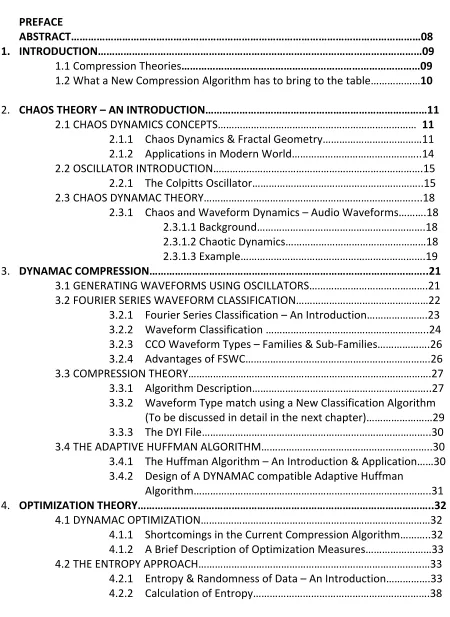
The following schematic is an example using an NPN transistor in the common base configuration. [2]
Figure 4 – NPN Transistor ‐ CB
Frequency of oscillation is roughly 50 MHz:
[image:15.612.283.472.542.668.2]
The follo Figure 5 –
The bipo gain at th The idea
Given the real circu transisto
ANALY
One met neglectin oscillatio the frequ An ideal the sectio
wing schem – NPN Trans
lar transisto he oscillation
l frequency
e values in t uit will oscilla
r and possib
YSIS
hod of oscill ng any reacti on is possible uency of osc
model is sho on above. Fo
atic is a com sistor ‐ CC
or could be r n frequency of oscillation
[2 he circuit ab ate at a sligh bly other stra
Fig lator analysi ive compone e. This metho
illation. own to the r or initial ana
mmon collect
eplaced with .
n is given by
]
bove, the eq htly lower fre
ay capacitan
gure 7 ‐ Colpi is is to deter ents. If the im od will be us
right. This co alysis, parasi
tor version o
h a JFET or o
y this equatio
uation pred equency due nces.
itts oscillato rmine the inp
mpedance y sed here to d
onfiguration tic elements
of the same
other active
on: [2]
icts a freque e to junction
or model[2]
put impedan yields a nega
determine c
models the s and device
oscillator:[2
device capa
ency of roug n capacitanc
nce of an inp ative resistan conditions of
common co e non‐linearit
2]
ble of produ
hly 58 MHz. ces of the
put port nce term,
f oscillation
ollector circu ty’s will be
ucing
The
and
ignored. approxim Ignoring
Where v1
v2 = i2Z2[2
Where Z2
currents:
i2 = i1 + is
Where is
Where g
Where Z1
Zin = Z1 +
The inpu which is
Rin = gmZ
If Z1 and
impedan
If an indu negative frequenc
These terms mations, acce the inducto
[2] 1 is the input
2]
2 is the impe
:
is the curre
m [2]is the tr
1 is the impe
Z2 + gmZ1Z2
t impedance proportiona
Z1Z2
Z2 are comp
ces for Z1 an
uctor is conn resistance i cy of oscillat
s can be incl eptable com r, the input
t voltage an
edance of C2
nt supplied
ransconduct
edance of C1
e[2] appears al to the prod
plex [2]and o nd Z2 are sub
nected[2] to s greater tha ion is as give
luded later i mparison with
impedance c
d i1 is the inp
. The curren
by the trans
tance of the
1. Solving for
s as the two duct of the t
of the same s bstituted, Rin
the input, t an the resist en in the pre
n a more rig h experimen can be writt
put current.
nt flowing int
sistor. is is a d
transistor. T
r v2 and subs
capacitors i two impedan
sign, Rin will n is
he circuit wi tance of the evious sectio
gorous analy ntal results is
en as
The voltage
to C2 is i2, w
dependent c
The input cu
stituting abo
n series with nces:
be a negativ
ill oscillate if inductor an on.
ysis. Even wit s possible.
e v2 is given b
hich is the s
current sour
rrent i1 is giv
ove yields
h an interest
ve resistance
f the magnit nd any stray
th these
by
um of two
rce given by
ven by
ting term, Ri
e. If the
ude of the elements. T
in
For the e roughly 4
This valu oscillatio capacitan If the two becomes and a neg
Rin = − gm
2.3 CH
2.3.1 C
2.3.1.1
DYNAMA foundatio systems t capable o sequence chaotic o needed t than the chaotic o matching for digita to show t mechanis2.3.1.2
Chaotic s been sho provide e typical ch from a st
example osci 40 mS. Given
e should be on is more lik
nce.
o capacitors s a Hartley o gative resist
mω2L1L2
AOS DYN
CHAOS W
1 BACKGR
AC (dy‐NAM‐ on of the pro that can be of producing e, such as th oscillation th to specify th size of the d oscillator’s a
g arbitrary d al images [1] the potentia sms.
2 CHAOTI
systems have own to
efficient ope haotic system tandard elec
illator above n all other va
sufficient to kely for large
are replace scillator. In t tance given b
NAMAC T
WAVEFORM
ROUND
‐ac) stands f ocess lies in governed by g diverse wa hat derived f hat matches e initial cond digital seque
bility to prod igital sequen . We introdu al it has for c
C DYNAM
e been studi
eration [2] an m is the Colp ctrical circuit
e, the emitte alues, the in
o overcome er values of t
d by inducto that case, th by: [2]
HEORY(A
M DYNAM
for dynamics the realizat y mathemat aveform shap
from image d it within an ditions need ence, compre
duce diverse nce segment uce this new comparative
MICS
ied for years
nd have app pitts oscillato t architectur
er current is put resistan
any positive transconduc
ors and mag he input imp
Applicatio
MICS – A
s‐based algo ions that (a) ical expressi pes. The pre data, can be acceptable ded to repro ession is ach e waveform
ts. There are w nonlinear d e improveme
s in physics a
plications in v or. These se re that is use
roughly 1 m nce is roughly
e resistance i ctance and/o
gnetic coupli pedance is th
on Theory
UDIO WA
orithmic com ) chaotic osc ions, and (b) emise is this: replaced by error toleran duce the ch hieved. Furth
shapes, we e a number o dynamics‐ba ents given a
and enginee
various engi ts of equatio ed widely in
mA. The trans y[2]
in the circuit or smaller va
ng is ignored he sum of th
y)
AVEFORM
mpression. Th cillators are d ) chaotic osc
a segment y the initial c
nce. If the si aotic oscillat her, if we im
increase the of compress ased algorith deeper stud
ering. Chaoti
neering disc ons are actu engineering
sconductanc
t. By inspect alues of
d, the circuit e two induct
M
[4]
he basic dynamical cillators are
of a digital conditions of
ze of the da tion are sma mprove the
e probability sion algorith hm and attem dy of its
c processes
ciplines [3],[4 ually derived g [5]. The
ce is
tion,
t tors
f a ta aller
y of ms mpt
have
equation form: [4]
Where ic
are empi we integ get a set state‐spa waveform
2.3.1.3
Our first subseque were suf image va definition the origin PSNR =
ns are a three
is the forwa irically deriv
rate these e of time dep ace plot as se ms in figure
3 FULL IM
example in ent decomp ficiently diff ariation. For n of the mea nal image an
√
e‐dimension
ard transisto ed factors fo equations for pendant wav een in the fi
1(b)[4].
MAGE EXA
Figure 4, sho ressed versi ferent than e
each case[4 an square er nd is the n [8]. We s
nal set of no
LdiL dt V
C dv dt Cdv
dt
or collector c or the transi rward in tim veforms iL t
gure 1(a)[4]
AMPLE
ows the com ons for diffe each other in 4] we ran the
rror that is M new decomp
how the ave
nlinear ordin
v R
iL
v R Cdv
dt iL
current defin stor and RL i
me from a set
, V t , V t
and section
mparisons of erent compr
n order to de e algorithm f
MSE = ∑ pressed imag erage values
nary differen
RL iL
VEE
R
i ned by
s the series t of initial co
t that can b ns of the cor
f two differe ession ratios emonstrate for Ns = 16,
∑
ge, and the p for these m
ntial equatio
1
resistance o onditions iL
e plotter ve responding t
nt images w s. We chose the algorith Ns = 32, Ns =
, ,
peak signal t measures for
ons that hav
1 where γ a of the induct
, V , V w rsus time or time‐depen
with their two images hms viable gi = 64. We use
, where to noise ratio
R, G and B. e the
nd α tor. If we r as a
dant
s that iven e the
Figure 8. Image Compressed using the DYNAMAC algorithm at three different compression rations showing the mean‐square error and peak signal‐to‐noise ratio.
OTHER DATA TYPES
It is clear that given digital sequences with smooth relationships, the DYNAMAC algorithm will work. The compression metrics will be different depending on the format of data such as Audio, Video or Image. For example, for 16‐bit stereo audio files there four components to the D‐bite D = [D1, D2, D3, D4], with there being three 16‐bit integers and one 4‐bit integer, for a total of 52 bits. A 64‐point sequence for one channel would be 1024 bits, so the compression ratio would be 19:7:1.
3. DYNAMAC COMPRESSION
3.1 GENERATING WAVEFORMS USING OSCILLATORS
Using a typical Oscillator such as the Colpitts Chaotic Oscillator several waveforms are generated to contribute in forming the CCO Matrix (See 2.2 for more details). The non‐linear characteristics of a Chaotic oscillator are our objective for using such a system.
[image:21.612.100.517.272.547.2]
Figure 9 ‐ STATE SPACE PLOT[4]
The time dependant waveforms generated using the Oscillator are then arranged in the CCO Matrix and through several techniques like intermultiplication or replacement of a certain set from the whole row to get different variations of the waveforms. These 32 different types (12 + Variations) constitute the CCO Matrix.
Integrati we get a plot or as
3.2 FO
3.2.1 F
Chaotic o fact by u the trans chaotic o calculatin waveform and com having a sequenti
ng the Oscill set of time s the corresp
URIER SE
FOURIER S
oscillations t utilizing sets sform proce oscillations,
ng the chao ms are pre‐c
bination. Th 16‐bit reso al search p
Fig
lator equatio dependant w ponding tim
ERIES WA
SERIES CL
tend to have of these wa ess. Essentia and the com otic oscillatio calculated a here are thi olution. The
process that
gure 10 ‐ TIM
ons forward waveforms t e dependan
AVEFORM
LASSIFICA
e a high mea aveforms in ally, it is a c mbination of ons from in nd stored. T rty‐two diffe e best match t seeks out
ME DEPENDA
in time from that can be p nt waveform
M CLASSIF
ATION – I
sure of time the CCO ma ollection of f those wave
itial conditio This also allo erent wavef
hing wavefo t the wavef
ANT PLOT O
m a set of in plotted vers as seen in t
FICATION
INTRODU
e diversity. T atrix. The C digital wave eforms in di ons and ma ows greater orms, each orm from th
form with
F WAVEFOR
itial conditio us time or a he figures a
UCTION
[17The D‐transf CCO matrix i eforms deriv
fferent man athematical r variation in
comprised o he CCO mat
minimal er
RMS[4]
ons iL , V , s a state‐spa bove.
7]
form exploit is at the hea ved from va nners. Inste expressions n oscillation of 216 data p
rix is found ror. The F
, V ace
procedure is an attempt to reduce the number of search iterations needed to find the optimal waveform.
3.2.2 WAVEFORM CLASSIFICATION
Fourier series waveform classification (FSWC) is based upon the fundamental notion of the Fourier series decomposition of waveforms, namely,
∑
∞ =+ +
=
1
1 1
0 cos sin
) (
n
n
n n t B n t
A A
t
v ω ω , (8)
where An and Bn are the Fourier coefficients for the sine‐cosine form of the series. A digital
sequence can be generated from the coefficients. If we designate M to be the number of bits for the quantization of each coefficient[17], and N to be the number of coefficients used for An
and Bn, then we designate a given encoding as M‐N FSWC. Suppose we have the waveform
shown in fig. 3. This waveform could be pulled from the CCO matrix, or could be part of a digital audio, video, or image set of data, or any other digital sequence for that matter.
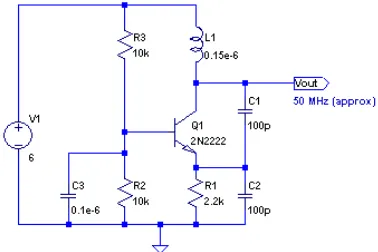
Fig. 11 ‐ Digital waveform used to demonstrate a 3‐3 FSWC decomposition
The corresponding [18]3‐3 FSWC decomposition is shown in fig. 4. There are a total of six coefficients each having a 3‐bit resolution, therefore resulting in an 18‐bit sequence for this waveform, that is,
3 3 2 2 1
1 B A B A B
Ab b b b b b
b= . Just as the accuracy of the series increases with the
number of coefficients, so does the uniqueness of the binary sequence as its length increases.
.
Fig.12. 3‐3 FSWC sequence showing the formulation of the 18‐bit sequence b = 100010110010010010[17].
3.2.3 CCO WAVEFORM TYPES – FAMILIES & SUB‐FAMILIES
[17][image:24.612.171.445.274.541.2]
oscillation type number 4, while fig. 14 shows their respective 3‐3 FSWC coefficients and 18‐bit binary sequences.
Fig. 13. Three 128‐point waveforms [17]extracted from type number 4 of the CCO matrix.
[image:25.612.170.448.150.374.2]
[image:26.612.187.428.75.472.2]
Fig.14. The FSWC decomposition [17]of each waveform from fig. 5, and their corresponding 18‐ bit binary sequences.
3.2.4 ADVANTAGES OF FSWC
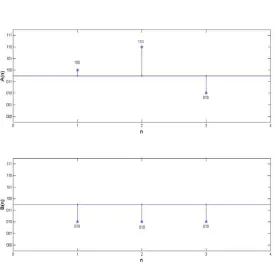
according to the 10‐bit family structure. Fig. 15 shows a histogram, or FSWC spectrum, of the number of CCO matrix waveforms that fall into the 1024 different families for Nc = 128. This
spectrum indicates the total number of waveforms in a given 10‐bit family that are necessary to search through in order to find the best match. In this case the maximum number of elements in a given family is 1,570, in contrast to having to search through 65,336 waveforms using the old method. In some cases, a particular family may have no members. In that case the nearest neighbor (or extended family) is used for the search criteria.
Fig.15. 3‐3 FSWC spectrum showing a 10‐bit pre‐classification family profile the CCO matrix where Nc = 128.
3.3 COMPRESSION THEORY
3.3.1 ALGORITHM DESCRIPTION
[4]
[image:27.612.136.480.210.496.2]
digital sequence, such as that derived from audio, video, and image data, can be replaced by the initial conditions of a chaotic oscillation that matches it within an acceptable error
tolerance. Symbolically, we can describe DYNAMAC operator as −1
D , where is the original digital sequence, C is the combined chaotic Oscillation matrix, and is the matrix ordering sequence. If we call l(.)a length function, then if l
( ) ( )
d <l x then compression occurs. Wereproduce the digital sequence by x′=D−1
(
d,C,k)
.[4] The error is defined asε =x−x′, [4]and total error over the sequence is Ε=∑Ns
ε , where Ns is the length of the digital sequence. If E = 0,
then the compression is lossless.
The key to high compression ratios and high image quality is to the chaotic oscillator’s ability to produce diverse waveform shapes. By doing so, we increase the probability of matching
arbitrary digital sequence segments. The images that we examine are in bitmap format, where each R,G, and B component is specified by 8‐bit integers. So then, each segment of the image is 8x3xNs bits long. For this particular image each 64‐point [4]segment represents 1,536 bits
Figure 17. DYNAMAC™ [4]compression engine block diagram.
3.3.2 WAVEFORM TYPE MATCH USING NEW CLASSIFICATION
ALGORITHM
The key to the algorithm is in finding a proper match to the input digital sequence xp[n] using a combined chaotic oscillation represented by c[n]. Figure 3 is a block diagram of the algorithm. The combined chaotic oscillation matrix, or CCO matrix, stores 32 oscillation types that can be accessed by submitting a type number, Nt, an oscillation starting point, Ni, and an oscillation length, Nc. The resulting chaotic oscillation will then be decimated [17]down to the length of xp[n]. This new oscillation will be called cn[n]. The RMS error between xp[n] and cn[n] is calculated. Oscillations having the smallest error value will be chosen as replacements for xp[n]. The information needed to reproduce the chosen chaotic oscillation can be distilled down to two 16‐bit integers and one 4‐bit integer we call digital bites, or D‐bites. Specifically, D = [D1, D2, D3]. Since there are three digital sequences connected with an RGB image, and each component requires its own D‐bite, DR, DG, DB, then each image segment requires 108 bits. In this example, the compression ratio is 1536:108 or 14.2:1. The new file, which we’ve called .dyn files, are stored as [HEADER],DR1,DG1,DB1,DR2,DG2,DB2,DR3,DG3,DB3,…,DRN,DGN,DBN, where N =
LxW/Ns.
With the new classification algorithm, instead of going through each and every single piece of waveform data, if the input waveform can be identified as belonging to a particular class, only those waveforms have to be scanned for the closest match. This procedure due it repetitive nature can also yield 2‐3 classes which have similar characteristics as the input waveform and hence when there are more options to choose from, there is a better match.
Digital Sequence Initialization
file
Sequence
Parser
C
Combined Chaotic Oscillation Matrix CO
Decimator
Scaling Δ
∑
(.)1
f x
Ns p
Input Buffer
x[n]
xp[n]
Ns Ns
cn[n]
ε[n]
c[n]
Nc
εf
D-bite
xpmin, xpmax
Nt Ni Nc
D = [D1,D2,D3]
Fixed Storage
Ns Ns
Ni Nt
Nc
[image:29.612.98.533.76.330.2]
3.3.3 THE DYI FILE
The amount information needed to recreate the chosen chaotic oscillation can be distilled down to two 16‐bit integers and one 4‐bit integer we call digital bites, or D‐bites. The D‐bites contain three different digital sequences corresponding to the colorspace RGB respectively.
D = [D1, D2, D3]
Every single one of these components would require its own D‐bite i.e D1 (Red), D2(Green), D3(Blue) for representation. The size of each of the segments would be 108 bits. For e.g. if the compression ratio is 1536:108 (see example in section 2.3.1.3) or 14:2:1, the new file which we would call as the DYI (DYNAMAC Image File) file would be stored as the following sequence.
[HEADER],DR1,DG1,DB1,DR2,DG2,DB2,DR3,DG3,DB3,…,DRN,DGN,DBN, where N = LxW/Ns.
3.4 THE ADAPTIVE HUFFMAN ALGORITHM
3.4.1 THE HUFFMAN ALGORITHM – AN INTRODUCTION &
APPLICATION
In general parlance, Huffman Coding is an Entropy Coding Algorithm[2] which results in a lossless data compression. In this particular technique we use a variable length code table for encoding a source symbol (such as a character in a file) where the variable‐length code table has been derived in a methodical way based on the estimated probability of occurrence for each possible value of the source symbol.
In other words [6]for any code that stands unique for more than one case, meaning that the code is uniquely decodable, the sum of the probability of occurrences across all symbols is always less than or equal to one. Generally the sum is strictly equal to one; as a result, the code is termed a complete code. If this is not the case, a similar code can be quite easily derived which has an equivalent code. This is done by adding extra symbols (with associated null probabilities), to make the code complete while keeping it biunique.
A commercial study would reveal the effectiveness of the Huffman algorithm to double or more the compression ratio of an already existent compression algorithm without inducing any losses in the input data. Also due to its tree/ladder structure, the decoding of such an algorithm would be of lower complexity as well.
3.4.2 D
ALGOR
An adapt of ladder algorithm
For e.g. if adding a inducing any alien
DESIGN O
RITHM
tive version r elimination m
f the stand a Huffman blo any losses i n substantial
F
OF A DYNA
of the HUFF ns to facilitat
alone Compr ock to the co n the data. B loss in the D
Figure 42 – A
AMAC CO
FMAN algorit te a ‘doublin
ression ratio ode will dou By lossless, i DYI data
Addition of a
OMPATIB
thm[6] was d ng’ of the co
o achieved b uble the com n our contex
a Huffman M
BLE ADAP
designed for mpression r
y DYNAMAC mpression rat xt we mean
Module to DY
PTIVE HUF
r DYNAMAC ation alread
C turns out a tio of the alg that it woul
YNAMAC
FFMAN
with lower dy achieved b
around 1:8, gorithm with
d not introd level by
4. OPTIMIZATION THEORY
4.1 DYNAMAC OPTIMIZATION
4.1.1 SHORTCOMINGS OF THE CURRENT COMPRESSION ALGORITHM
After validation and test of the efficacy of our compression algorithm, it was obvious to ascertain, following a conventional thought process, the advantages and the disadvantages of our current algorithm. That would in‐turn lead us to a crossroads of further research and investigation into fields such as quality improvement, speed of the algorithm and compression ratio.
After preliminary testing, various parameters were marked out which were more or less eligible for improvement. Some of those parameters are mentioned as below.
1. The Compression ratio, although impressive in its own right, could be increased twin‐fold of more using one of the more conventionally used add on “Lossless” compression techniques such as Huffman, Lempel‐Ziv etc. Is there a possibility of an adaptive version of such an algorithm to asset our compression?
2. If we are measuring improvement, will a passive measure such as PSNR suffice?
3. The PSNR measure being passive could only be used for “Post‐Analysis”. In short it would show post compression whether the algorithm was improved due to arbitrary changes in the Matrix or the algorithm itself, but there lies the obvious disadvantage. It cannot “drive” the compression to improvement. What are the measures which can be considered for such a task?
4. The arbitrary arrangement of waveforms generated from various oscillators, did in‐fact give us compression, but there being a lack of order in their arrangement or a mathematical motive, there is a definite possibility that given a measure for driving the compression algorithm, there would be a set of new waveforms which would perform better than the current set. If this line of thought is indeed true, what are the plausible methods for generating these waveforms.
5. A simple Histogram analysis would show that there are certain types of waveforms which don’t get utilized in the compression process compared the other ones. If these are termed as under‐utilized or non‐utilized waveforms, what kind of methods can be employed for reducing such under‐utilization?
7. The current scanning process, where the algorithm scans the entire CCO matrix for the most appropriate match for the image waveform, results in scanning the matrix individually every time for every single image waveform. The complexity of such a scanning processing is a little too large and can be optimized.
7.1 Is there a possibility of an alternate scanning algorithm, if the image waveform “TYPE” is detected before‐hand?
7.2 Would “CLASSIFICATION OF WAVEFORMS IN FAMILIES” and re‐structuring the CCO Matrix improve the speed of the algorithm, as instead of searching the whole matrix, the algorithm has to search only one family post detection of image waveform type?
8. Is there a possibility of certain waveforms performing better for a certain set of images? If there exists such a dependency, does the current configuration of CCO waveforms suffice and if not what kind of waveforms are necessary for fulfilling such dependencies?
4.1.2 A BRIEF DESCRIPTION OF THE OPTIMIZATION MEASURES
The Optimization measure per se represents those measures which would be independently able to ascertain certain parameters pivotal for Compression algorithm Pre/Post Compression. Some of the properties these "measures" were intended to display were as follows.
For ease of explanation, let’s denote our measure as “
η
”.
•
The measure should be relevant to the existing mathematical set of calculations viz. Real World Space and should not display any non‐linear or irregular properties of irrational or other sets.
• The measure should be an independent constant with respect to the compression algorithm in order to facilitate a stand‐alone analysis of the compression algorithm or the Compression Matrix.
• The measure should perform in accordance to one of the Post analysis tools for quality such as PSNR to reconfirm its validity for the analysis case.
4.2 THE ENTROPY APPROACH
4.2.1 ENTROPY & RANDOMNESS OF DATA – AN INTRODUCTION
INFORM
In inform of the un
It can be commun fundame commun message Equivalen recipient The conc Commun
DEFINIT
The infor values {x
Where[6 I( a p
CHARAC
Informat (Define Continuit T bMATION
EN
mation theor ncertainty as
interpreted nicate the tru
ental mathem nication: the
out of all th
ntly, the Sha t is missing w cept was intr nication".[6]
TION
rmation ent
x1...xn} is defi
6]
X) is the info nd
(xi) = Pr(X=x
CTERIZATIO
tion entropy
ty[6] he measure y a very sma
NTROPY
y, the SHAN
ssociated wit
d as the aver ue value of t matical limit shortest ave he possibiliti
annon entro when they d roduced by C
tropy of a d ined to be
ormation co
i) is the prob
ON
can be char
an
should be c all amount s
NNON ENTRO
th a random
age shortest the random v t on the best
erage numb es is the Sha
py is a meas o not know t Claude E. Sh
iscrete rand
ntent or self
bability mass
racterized by
nd
continuous — hould only c
OPY [5]or IN
m variable.
t message le variable to a t possible los er of bits tha annon entro
sure of the a the value of annon in his
dom variable
f‐informatio
s function of
y the followi
— i.e., chang change the e
NFORMATIO
ength, in bits a recipient. T ssless data c at can be se
py.[6]
average infor f the random s 1948 pape
e X, that can
on of X, whic
f X.
ing desidera
)[5
ging the valu entropy by a
N ENTROPY
s, that can b This represe compression nt to comm
rmation con m variable.
r "A Mathem
n take the r
[2]
ch is itself a r
ta:[6]
5]
ue of one of small amou
Y[5] is a meas
e sent to nts a n of any
unicate one
ntent the
matical Theo
range of pos
random vari
the probab unt.
sure
ory of
ssible
iable;
Symmetr T Maximum If e Additive[ T re T It sy A w th th o Fo T Shannon
where K
EXAMP
ry[6]
he measure
m[6]
f all the outc ntropy incre
[6]
he amount egarded as b his last func t demands t ystems if we Assume that we mentally he entropy c he probabilit
f boxes. or positive in
rivially, this
shows that
is a constan
LE
should be u
comes are e eases with th
of entropy being divided ctional relati
hat the entr e know how we have an divide this e can be calcu
ty of finding
ntegers bi w
also implies [6]
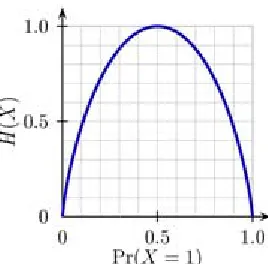
any definiti
t correspond
Figu it co
unchanged if
equally likely he number o
y should be d into parts. onship char ropy of a sys
the sub‐syst ensemble o ensemble in ulated as a s
g oneself in
where b1 + …
that the en
on of entrop
[6]
ding to a cho
re 18 – Entr ming up hea
f the outcom etc.
y, then entro of outcomes
e the same
acterizes the stem can be tems interac of n element nto k boxes um of indivi that particu
+ bk = n,
tropy of a ce
py satisfying
oice of meas
opy of a Coi ads
mes xi are re‐
opy should b .
independe
e entropy of e calculated ct with each ts with a unif
(sub‐system idual entrop ular box PLU
ertain outco
g these assum
surement un
in toss as a f
‐ordered.
be maximal.
ntly of how
f a system w from the en other. form distrib ms) with bi e
pies of the b US the entro
me is zero:
mptions will
nits.
function of t
. In this case
[5
w the proce
with sub‐syst ntropy of its
ution on the lements in e oxes weighe py of the sy
[6]
be of the fo
the probabil e, the
]
ess is
tems. s sub‐
em. If each, ed by ystem
orm:
[image:35.612.54.188.612.744.2]
[2]Consid
The entr (that is, i uncertain of the co
However likely to average e
The extre uncertain
PROPER
The Shan
• A • It
ASPECT
DATA C
Entropy compres using Hu algorithmLIMITA
Although source, t A source symbol is
der tossing a
opy of the u if heads and nty as it is m oin delivers a
r, if we know come up th each toss of
eme case is nty. The ent
RTIES
nnon entrop
Adding or rem
t can be conf
TS
COMPRE
effectively sion possibl ffman, Lemp ms is often u
ATIONS O
h entropy is his informat that always s depends o
a coin which
unknown re d tails both most difficult
a full 1 bit of
w the coin is han the othe f the coin de
that of a do ropy is zero:
y satisfies th
moving an ev
firmed using
SSION
bounds the e, which ca pel‐Ziv or ar sed as a rou
OF ENTRO
s often used tion content s generates on the alpha
may or may
sult of the n have equal t to predict t f information
s not fair, th er. The redu
livers less th
ouble‐heade : each toss o
he following
vent with pr
g the Jensen
e performan an be realize
rithmetic cod ugh estimate
OPY AS IN
d as a char t is not abso the same sy bet. Conside
y not be fair
next toss of probabilities the outcome n.[2]
ere is less u uced uncerta han a full 1 b
d coin which of the coin d
properties:
robability ze
[
inequality t
nce of the ed in theory ding. The pe e of the entr
NFORMAT
racterization lute: it depe ymbol has e er a source t
.
the coin is s 1/2). This e of the next
ncertainty. ainty is qua bit of inform
h never com elivers no in
ro does not
[2].
that
strongest y by using t erformance o
opy of a blo
TION CON
of the info ends crucially ntropy of 0, that produce
maximized is the situat t toss; the re
Every time, ntified in lo ation.
mes up tails. nformation.
contribute t
lossless (or he typical s of existing d ck of data.
NTENT
[2]
ormation co y on the pro but the def es the string
if the coin i tion of maxi esult of each
one side is ower entrop
Then there
to the entro
[2].
nearly loss set or in pra data compre
ontent of a obabilistic m finition of w g ABABABAB
s fair mum h toss
more y: on
is no
in which letters a sequence entropy r
However become not know every bo If there probabili correspo book wh books, bu of langua knowing that the theoretic of a seq program rate of a such prog
DATA
A
A commo source (e
where pi
selecting
rate is:
where i previous
For a sec
A is always s independe e is consider rate is 0 bits
r, if we use artificially lo wable exactl ok ever pub are N publi ity of each b onds to assig henever one ut it is not so age in gene
the probab complexity cal generaliz quence inde for a univer a sequence f gram, but it
AS
A
MARK
on way to de each charact
i is the proba
g a character
is a state (c character (s
cond order M
followed by ent, the ent red as "AB A s per charact
very large ow. This is b ly; it is only blished as a s
ished books book is 1/N, gning each b e wants to r o useful for eral: it is no ility distribu of the proba zation of this ependent of
rsal compute for a given
may not be
KOV
PROCE
efine entrop ter is selecte
ability of i. F r is depende
certain prece s).
Markov sourc
y B and vice v tropy rate o AB AB AB AB
ter.
blocks, the ecause in re y an estimat
sequence, w s, and each
and the en book a uniqu refer to the
characterizi ot possible t ution, that is abilistic mod s idea that a f any partic er that outp model, plus the shortes
ESS
py for text is ed independ
[6]
For a first‐or ent only on
eding chara
ce, the entro
versa. If the of the sequ B..." with sym
n the estim eality, the pr te. For exam with each sym
book is on tropy (in bit ue identifier book. This ng the infor to reconstru , the comple del must be allows the co cular proba puts the sequ
the codebo st.
s based on th ent of the la
rder Markov the immedi
cters) and p
opy rate is
probabilisti uence is 1 b mbols as tw
mate of per‐ robability dis mple, suppos mbol being t ly published ts) is ‐log2 N
r and using is enormou mation cont uct the book ete text of a considered. onsideration bility mode uence. A cod ook (i.e. the
he Markov m ast character
v source (on iately preced
[6]
pi(j) is the p
ic model con bit per char wo‐character
character e stribution of se one cons the text of a d once, the
N. As a pract it in place o usly useful f tent of an in k from its id all the books . Kolmogoro n of the info
l; it conside de that achi
probabilisti
model of tex rs), the bina
e in which t ding charact
robability o
nsiders�
![Figure 9 ‐ STATE SPACE PLOT[4]](https://thumb-us.123doks.com/thumbv2/123dok_us/117679.11393/21.612.100.517.272.547/figure-state-space-plot.webp)
![Fig. 13. Three 128‐point waveforms [17]extracted from type number 4 of the CCO matrix.](https://thumb-us.123doks.com/thumbv2/123dok_us/117679.11393/25.612.170.448.150.374/fig-three-point-waveforms-extracted-from-number-matrix.webp)
![Fig.14. The FSWC decomposition [17]of each waveform from fig. 5, and their corresponding 18‐bit binary sequences.](https://thumb-us.123doks.com/thumbv2/123dok_us/117679.11393/26.612.187.428.75.472/fig-fswc-decomposition-waveform-their-corresponding-binary-sequences.webp)
![Figure 17. DYNAMAC™ [4]compression engine block diagram.](https://thumb-us.123doks.com/thumbv2/123dok_us/117679.11393/29.612.98.533.76.330/figure-dynamac-compression-engine-block-diagram.webp)
![Figure – choice an19 Histogramd that choicems of 1000 pe perturbed bpseudorandomy a factor of m2 Gaussian n2[3] numbers for 3 bin widthss : the data‐basedb](https://thumb-us.123doks.com/thumbv2/123dok_us/117679.11393/43.612.84.536.266.372/figure-histogramd-choicems-perturbed-bpseudorandomy-gaussian-numbers-widthss.webp)
