R E S E A R C H
Open Access
Generation, analysis and functional annotation of
expressed sequence tags from the ectoparasitic
mite
Psoroptes ovis
Stewart TG Burgess
*, Alasdair J Nisbet, Fiona Kenyon and John F Huntley
Abstract
Background:Sheep scab is caused byPsoroptes ovis and is arguably the most important ectoparasitic disease affecting sheep in the UK. The disease is highly contagious and causes and considerable pruritis and irritation and is therefore a major welfare concern. Current methods of treatment are unsustainable and in order to elucidate novel methods of disease control a more comprehensive understanding of the parasite is required. To date, no full genomic DNA sequence or large scale transcript datasets are available and prior to this study only 484P. ovis expressed sequence tags (ESTs) were accessible in public databases.
Results:In order to further expand upon the transcriptomic coverage ofP. ovis thus facilitating novel insights into the mite biology we undertook a larger scale EST approach, incorporating newly generated and previously
describedP. ovistranscript data and representing the largest collection ofP. ovis ESTs to date. We sequenced 1,574 ESTs and assembled these along with 484 previously generatedP. ovisESTs, which resulted in the identification of 1,545 uniqueP. ovissequences. BLASTX searches identified 961 ESTs with significant hits (E-value < 1E-04) and 584 novelP. ovisESTs. Gene Ontology (GO) analysis allowed the functional annotation of 880 ESTs and included predictions of signal peptide and transmembrane domains; allowing the identification of potentialP. ovis excreted/ secreted factors, and mapping of metabolic pathways.
Conclusions:This dataset currently represents the largest collection ofP. ovis ESTs, all of which are publicly available in the GenBank EST database (dbEST) (accession numbers FR748230 - FR749648). Functional analysis of this dataset identified important homologues, including house dust mite allergens and tick salivary factors. These findings offer new insights into the underlying biology ofP. ovis, facilitating further investigations into mite biology and the identification of novel methods of intervention.
Background
Sheep scab, caused by the mite Psoroptes ovisis,
argu-ably, the most important ectoparasitic disease of sheep in the UK in terms of both animal welfare and financial impact. In continental Europe and in the USA, psoroptic mange is also a welfare problem in cattle and is becom-ing increasbecom-ingly common in cattle in the UK [1]. Psor-optic mange is highly contagious, causing considerable pruritis and irritation [2]. Current disease control strate-gies are heavily reliant upon chemotherapy; however concerns over residues, eco-toxicity and the develop-ment of parasite resistance threaten the sustainability of
current control strategies and have highlighted interest in the development of alternative control methods [3]. Such approaches require a more comprehensive under-standing of both the parasite and its interaction with the host.
P. ovisis a non-burrowing, surface exudate feeder cap-able of consuming serous fluids, lymph and red blood cells [4]. Mites survive on the surface of the skin and do not appear to penetrate beyond the stratum corneum, the outermost layer of the skin [5]. The available evi-dence suggests that mites abrade the stratum corneum and deposit allergens as they progress - the combination of mechanical skin abrasion, mite allergen deposition and increased self-grooming behaviour by the host in response to the pruritis caused by the mites triggers the * Correspondence: [email protected]
Division of Parasitology, Moredun Research Institute, Pentlands Science Park, Bush Loan, Edinburgh, UK
subsequent activation of a cutaneous inflammatory response [6,7] providing an exudate which supplies the
mite with a food source [8]. Establishment of a P. ovis
infestation is therefore the result of a complex interac-tion between the host and the mite, during which the mite appears to initiate reactions conducive to its own establishment and maintenance [9]. The skin lesions are induced by mite-derived pro-inflammatory factors, a likely source of which is mite excretory/secretory pro-ducts, including potent enzymes and allergens (reviewed in [8]). While several sheep scab mite products have been identified, including a number of enzymes and homologues of allergens of the house dust mite (HDM), Dermatophagoides pteronyssinus and the scabies mite Sarcoptes scabiei, their functions remain largely unknown [10].
Prior infestation with sheep scab mites alters the pro-gression of subsequent infestations and reductions in lesion size have been observed in secondary infestations in sheep, suggesting that vaccination against the parasite
may be feasible [11]. Vaccination with P. ovis extracts
has resulted in a 15-fold reduction in mite numbers and a 4-fold reduction in lesion size [12,13]. However, iden-tification of the individual proteins involved in protec-tive immunity has not yet been achieved. The lack of availableP. ovis sequence information is hampering vac-cine candidate discovery, whether that process is through the pragmatic or rational routes. To date, no
full genomic DNA sequence has been available for P.
ovisand this is the case for most related mite species, i. e.Dermatophagoides pteronyssinusandSarcoptes scabiei, where the main focus has been on the generation and analysis of expressed sequence tags (ESTs). To date,
only 484 P. ovisESTs have been available in the public
databases [14] and, in order to further our
understand-ing of the biology of P. ovis, we have now generated a
complementary DNA (cDNA) library and have underta-ken a larger scale EST approach and incorporated these
newly generated and previously-described P. ovisESTs
with new bioinformatic analyses to identify further novel mite-expressed genes. This paper describes this approach, which represents the largest such resource for P. ovis, along with the functional annotation of the ESTs to further our understanding of this economically important parasite.
Results and Discussion cDNA library and EST analysis
1574 ESTs were derived from a normalised cDNA library constructed from a pool of mixed life stages and mixed sex mites (Library 1). To this dataset we added a
further 484 P. ovis ESTs previously generated at the
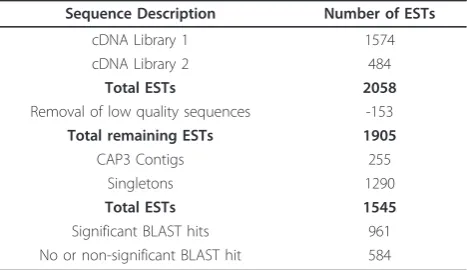
Moredun Research Institute (Library 2) [14], giving a total of 2,058 ESTs (Table 1). Filtering for low quality
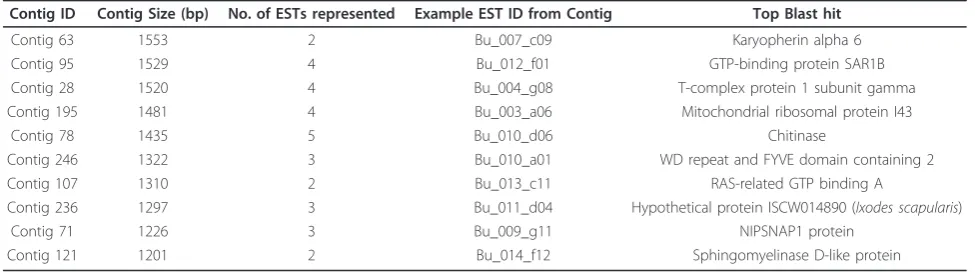
sequences resulted in the removal of 153 ESTs, leaving 1905 sequences for assembly of contigs (93% sequencing efficiency). CAP3 contig assembly resulted in the identi-fication of 255 contiguous sequences (consisting of 2 or more ESTs) and 1290 singletons giving a total of 1545 unique sequences (Table 1). Overall sequence length including both contigs and singletons ranged from 187 bp - 1553 bp, with a mean length of 700 bp (con-tigs: mean length = 800 bp, range = 397 bp - 1553 bp; singletons: mean length = 675 bp, range = 187 bp - 922 bp). All new ESTs generated here were submitted to the EST database (dbEST) at GenBank under the accession numbers FR748230 - FR749648. BLAST analysis of the 1545 assembled ESTs identified 961 (62%) with signifi-cant BLAST hits. Of these, 192 represented contiguous sequences, whilst the remaining 769 were singletons; summary details of the largest contigs (Top 10) are described in Table 2. E-values for the 961 ESTs ranged from 1.0E-4 to 3.6E-180. The mean percentage similarity score between and EST and its closest homologue was 68.4%, ranging from 36% - 100%. The most abundant phylum associated with the top BLAST hits was that of the arthropoda, including insects, i.e.Drosophila mela-nogaster, a number of ticks, i.e. Ixodes scapularis(deer tick) and other mites, i.e.Blomia tropicalis, D. pteronys-sinus andD. farinae. The top BLAST hit species was I. scapularis which represents the most closely related
organism toP. ovisfor which a fully sequenced genome
exists. The remaining 584 ESTs with either no BLAST
hit or non-significant hits may represent novel P. ovis
transcripts, of as yet undefined function.
Functional annotation ofP. ovisESTs
[image:2.595.305.539.111.246.2]Gene Ontology (GO) term annotation and mapping In order to gain a functional understanding of the assembled ESTs Gene Ontology (GO) annotation was associated with each of the sequences within the blas-t2go application [15-17]. This process involved mapping
Table 1P. ovisEST analysis and breakdown of processing stages
Sequence Description Number of ESTs
cDNA Library 1 1574
cDNA Library 2 484
Total ESTs 2058
Removal of low quality sequences -153
Total remaining ESTs 1905
CAP3 Contigs 255
Singletons 1290
Total ESTs 1545
Significant BLAST hits 961 No or non-significant BLAST hit 584
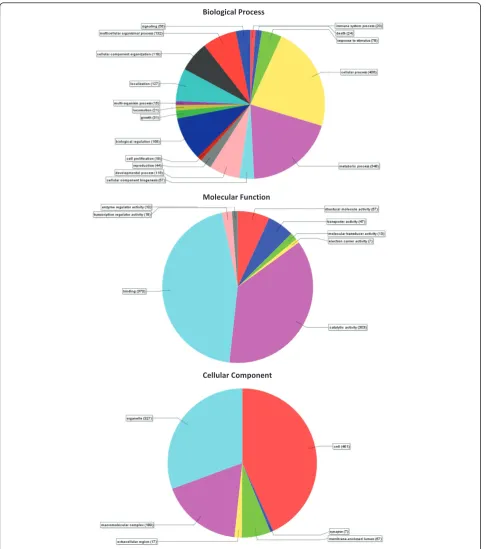
the BLAST hits against known GO terms and then further annotation of the selected GO terms by integrat-ing data from a range of sources includintegrat-ing; InterPro to derive protein families and domains; Enzyme Commis-sion (EC) codes to determine distinct functional enzyme class data and Kyoto Encylopedia of Genes and Gen-omes (KEGG) to identify enriched signalling pathways. Of the 961 ESTs with significant BLAST hits, 880 were associated with GO terms. The majority of sequences were associated with more than one GO term (n = 743), with some being associated with as many as 50 indivi-dual GO terms. Only 81 ESTs (8.4%) could not be mapped to a particular GO annotation. The GO terms were split over the 3 main categories [Biological Process (BP), Molecular Function (MF) and Cellular Component (CC)] with the majority in the BP and MF categories. In order to visualise the GO terms represented by the ESTs we mapped the second level GO terms across all three categories (BP, MF and CC) and these are pre-sented as percentage pie-charts in Figure 1. In the BP category the majority of second level GO terms were associated with either cellular (23%) or metabolic pro-cesses (20%), in the MF category the majority of GO terms were associated with either catalytic activity (37%) or binding processes (45%) and in the CC category most were associated either with the cell (43%) or organelle (31%). Also of note in the BP category were terms asso-ciated with locomotion, reproduction, growth, biological regulation, developmental process, immune system pro-cess and response to stimulus. In the MF category a number of sequences were found to be associated with enzyme and transcriptional regulator activity and mole-cular transducer activity. A multi-level GO term analysis provided further insights into EST function, revealing the nature of the binding and catalytic activities high-lighted at the second level of GO terms in the MF cate-gory. A number of enzyme classes were identified including protein kinases, ligases, oxidoreductases, hydrolases and endopeptidases. Amongst the binding
activities identified were ATP, GTP, RNA and DNA binding, as well as zinc ion binding, co-factor binding and cytoskeletal protein binding. Multi-level GO term analysis of the BP category revealed a number of inter-esting associations, of particular note were reproductive developmental processes, signalling pathways, cell devel-opment, cytoskeleton organisation, nervous system development, proteolysis and response to stress and che-mical stimulus. Multi-level analysis of the CC category revealed a number of sequences with terms associated with the cytosol, nucleoplasm, cytoskeleton, plasma membrane, lipid particles and integral membrane molecules.
Identification of excreted/secreted proteins
[image:3.595.55.543.100.236.2]Interpro consists of a collection of protein family and domain signatures and can be used for the automatic annotation of proteins [18]. The Interproscan software tool allows the scanning of protein sequences against the Interpro database using a range of profile-based hid-den Markov models (pHMM) and positional specific score matrix protocols and in this way overcomes the problems inherent in single database searches [19]. Of the 961 ESTs with significant BLAST hits, Interpro was able to map 849, leaving 112 with no further protein domain mapping. 533 ESTs were found with both GO term mapping and Interpro mapping, providing both gene onotology and protein domain information, whilst 316 ESTs were successfully mapped by Interpro but not to a specific GO. Interproscan incorporates searches for structural and functional annotation of protein sequences, along with prediction of signal peptide sequences (SignalP) and transmembrane helices (TMHMM) [18,20,21]. Potential secretory proteins, secreted through the classical pathway, can be identified through the presence of a signal peptide sequence [22]. This sequence targets proteins for translocation across the ER membrane and is an N-terminal peptide, typi-cally 15-30 amino acids long which is cleaved during translocation [22]. Not all proteins with SPs are secreted
Table 2 Details of the largest contigs from theP. ovisEST dataset
Contig ID Contig Size (bp) No. of ESTs represented Example EST ID from Contig Top Blast hit
Contig 63 1553 2 Bu_007_c09 Karyopherin alpha 6
Contig 95 1529 4 Bu_012_f01 GTP-binding protein SAR1B
Contig 28 1520 4 Bu_004_g08 T-complex protein 1 subunit gamma
Contig 195 1481 4 Bu_003_a06 Mitochondrial ribosomal protein I43
Contig 78 1435 5 Bu_010_d06 Chitinase
Contig 246 1322 3 Bu_010_a01 WD repeat and FYVE domain containing 2
Contig 107 1310 2 Bu_013_c11 RAS-related GTP binding A
Contig 236 1297 3 Bu_011_d04 Hypothetical protein ISCW014890 (Ixodes scapularis)
Contig 71 1226 3 Bu_009_g11 NIPSNAP1 protein
Contig 121 1201 2 Bu_014_f12 Sphingomyelinase D-like protein
Biological Process
Molecular Function
[image:4.595.57.544.87.637.2]Cellular Component
and some may become integrated into the plasma mem-brane, i.e. transmembrane [22]. This type of profiling can help to identify potentially secreted/excreted pep-tides and can aid in the identification of signalling path-ways and potential diagnostic or therapeutic targets [20]. Interproscan revealed the presence of 173 ESTs with predicted signal peptides (SP) and 191 sequences with a predicted transmembrane domain (TMD). By filtering the SP sequences against the TMD sequences we were able to identify 74 ESTs with a predicted SP but no
TMD, thus representing potential P. ovis excretory/
secretory proteins. A further 183 ESTs were identified with predicted SP and TMDs along with a predicted gly-cophosphatidylinositol (GPI) anchor sequence thus
representing potential P. ovisexcreted/secreted outer
membrane proteins. A final group of 129 ESTs was identified with no predicted SP but with predicted TMD and GPI anchor sequence and this group may represent P. ovis outer membrane proteins. The identification of a
number ofP. ovis sequences predicted to encode either
secreted or membrane integrated proteins is an impor-tant step in the elucidation of mite factors as potential therapeutic targets. By their nature, secreted and/or membrane bound factors are more likely than cytosolic factors to be encountered by the host immune system and may therefore represent valid therapeutic or diag-nostic targets. AsP. ovis is a non-burrowing mite it is thought to rely on the action of a number of proteases to trigger a host inflammatory response to produce an inflammatory exudate, upon which it is then able to feed [8]. It is highly likely that some of these proteases are either secreted or excreted, for example the HDM protein Der p 2 (of which Pso o 2 is a homologue) has been shown to be derived from cells which line the mite gut and has been found in mite faecal pellets [23]. Further interrogation of these ESTs may lead to the identification of novelP. ovis E/S factors and therefore new therapeutic or diagnostic targets.
Enzyme code annotation
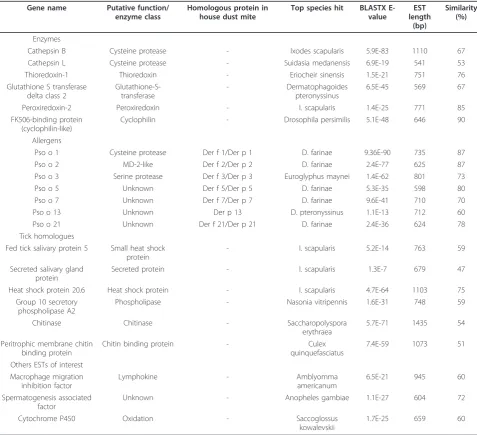
Of the 961 ESTs with significant BLAST hits, 223 (23%) mapped to a specific Enzyme Commission (EC) code. Of these, 126 mapped to unique EC codes and a num-ber of enzyme classes were represented, including oxi-doreductases (n = 52), transferases (n = 50), hydrolases (n = 99), lysases (n = 4), isomerases (n = 5) and ligases (n = 13) (Table 3). Thirty nine ESTs mapped to a single EC code, 3.6.5.3, which represents protein-synthesising GTPases. These enzymes are involved in mRNA tion into protein by the ribosome and include transla-tion initiatransla-tion factors. This process is involved in the regulation of gene expression by controlling translation rates and therefore could be involved in a number of processes including the control of stage-specific gene
expression in P. ovis[24]. A number ofP. ovisenzyme
activities have previously been identified; most of these are proteolytic and involve cysteine, metalloproteinases and aspartyl proteases [25]. These enzymes are able to digest a number of key protein substrates, including fibronectin, haemoglobin, and fibrinogen and may be involved in mite feeding [25]. Amongst the ESTs ana-lysed here we have confirmed the presence of these enzyme classes and also identified transcripts encoding a number of additional proteases, namely dipeptidase (n = 1), aminopeptidase (n = 1), serine-type carboxypepti-dases (n = 3), metallocarboxypeptidase (n = 1), metal-loendopeptidases (n = 2), threonine endopeptidases (n = 6) and two further proteases (nedd88 and a prolyl
endo-peptidase). The cathepsins identified here represent P.
oviscysteine proteases and may have roles in mite diges-tive processes as has been shown for a cathepsin L-like molecule potentially involved in meal digestion in the cattle tick Rhipicephalus microplus[26]. Digestive sys-tem-derived proteases are likely to be important in food processing in the mite and, as with the aspartyl protei-nase Na-APR-1 of hookworms, may therefore represent highly effective vaccine candidates. In addition, mite derived cysteine proteinase molecules may also interact with host keratinocyte-derived cystatin-A, which is a cysteine protease inhibitor produced as part of the host cutaneous immune response to mite-derived allergens [27].
Additional EC classes identified included thioredoxins, glutathione S transferases (GSTs), peroxiredoxins and cyclophilins (immunophilins). Thioredoxins and peroxir-edoxins are antioxidant enzymes which could form a part of the mites defence against reactive oxygen species (ROS) generated during the host inflammatory response. Homologous enzymes have been identified in HDMs and have been implicated in the scavenging of ROS and depression of superoxide dismutase, glutathione peroxi-dise and catalase activities [28,29].
A number of GSTs were identified from the P. ovis
ESTs described here and these include delta, mu and alpha classes. GSTs catalyse a variety of enzymatic reac-tions but perhaps the most relevant is the detoxification and breakdown of xenobiotic substances and these enzymes may be involved in the mites’defence against a range of environmental and host derived compounds. For example, increased transcription of mu, and delta
class GSTs has been demonstrated in S. scabieimites
following exposure to the acaricidal compound perme-thrin [30]. GSTs have also been shown to react strongly with host IgE and IgG suggesting a further role in the development of the allergic immune response [31-33].
domains may increase mite survival by blocking host immune molecules or by interfering with proteolytic actions, as has been previously described for a TIL
domain-containing peptide from the cattle tick
Rhipice-phalus microplus[35]. This factor may also regulate the actions of proteases secreted by the mites themselves. The physiology of the skin and the integrity of an effec-tive skin barrier are maintained by the correct balance of protease and anti-protease activities [36] -the disrup-tion of barrier funcdisrup-tion through the interrupdisrup-tion of the fine balance in protease activity may represent one means by which mites achieve allergen infiltration and thus immune activation. The identification here of a
number of additional enzyme classes from P. ovis has
further expanded our current understanding of the enzymatic repertoire of this economically important ectoparasite and this knowledge will aid in the identifi-cation of novel means of targetingP. ovisand interfering with the host-parasite relationship.
Allergen homologues
A number of P. ovisantigens/allergens have previously
been identified through their homology with molecules
from other mite species, for example the HDM,D.
[image:6.595.59.537.99.534.2]pter-onyssinusand the scabies miteS. scabiei[37,38]. Among these are homologues of the HDM allergens Der p 1 (termed Pso o 1), Der p 2 (Pso o 2), Der p 5 (Pso-der p V-1), Der p 7 (Pso-gp7-1), Der p 10 (tropomyosin), Der p 11 (paramyosin) and Der p 14 (M177/apolipophorin/
Table 3 Summary of EST dataset
Gene name Putative function/ enzyme class
Homologous protein in house dust mite
Top species hit BLASTX E-value
EST length
(bp)
Similarity (%)
Enzymes
Cathepsin B Cysteine protease - Ixodes scapularis 5.9E-83 1110 67
Cathepsin L Cysteine protease - Suidasia medanensis 6.9E-19 541 53
Thioredoxin-1 Thioredoxin - Eriocheir sinensis 1.5E-21 751 76
Glutathione S transferase delta class 2
Glutathione-S-transferase
- Dermatophagoides
pteronyssinus
6.5E-45 569 67
Peroxiredoxin-2 Peroxiredoxin - I. scapularis 1.4E-25 771 85
FK506-binding protein (cyclophilin-like)
Cyclophilin - Drosophila persimilis 5.1E-48 646 90
Allergens
Pso o 1 Cysteine protease Der f 1/Der p 1 D. farinae 9.36E-90 735 87
Pso o 2 MD-2-like Der f 2/Der p 2 D. farinae 2.4E-77 625 87
Pso o 3 Serine protease Der f 3/Der p 3 Euroglyphus maynei 1.4E-62 801 73
Pso o 5 Unknown Der f 5/Der p 5 D. farinae 5.3E-35 598 80
Pso o 7 Unknown Der f 7/Der p 7 D. farinae 9.6E-41 710 70
Pso o 13 Unknown Der p 13 D. pteronyssinus 1.1E-13 712 60
Pso o 21 Unknown Der f 21/Der p 21 D. farinae 2.4E-36 624 78
Tick homologues
Fed tick salivary protein 5 Small heat shock protein
- I. scapularis 5.2E-14 763 59
Secreted salivary gland protein
Secreted protein - I. scapularis 1.3E-7 679 47
Heat shock protein 20.6 Heat shock protein - I. scapularis 4.7E-64 1103 75 Group 10 secretory
phospholipase A2
Phospholipase - Nasonia vitripennis 1.6E-31 748 59
Chitinase Chitinase - Saccharopolyspora
erythraea
5.7E-71 1435 54
Peritrophic membrane chitin binding protein
Chitin binding protein - Culex
quinquefasciatus
7.4E-59 1073 51
Others ESTs of interest Macrophage migration
inhibition factor
Lymphokine - Amblyomma
americanum
6.5E-21 945 60
Spermatogenesis associated factor
Unknown - Anopheles gambiae 1.1E-27 604 72
Cytochrome P450 Oxidation - Saccoglossus
kowalevskii
1.7E-25 659 60
vitellogenin) [25,39]. Whilst confirming the presence of
these homologous genes in P. ovis, the EST analysis
described here has also led to the identification of addi-tional HDM homologues, namely Der p 21 (Pso o 21), Der p 3 (Pso o 3) and Der p 13 (Pso o 13) which may
represent P. ovis allergens (Table 3). The action of a
number of these allergens has been widely described in the literature for HDMs (for a review see [10]), however, homologues of Der p 3 and Der p 21 have not been pre-viously described in P. ovis. Der p 21 is a 15 kDa aller-genic protein which is excreted in HDM faecal pellets and has been associated with allergic asthma [40]. HDM Der p 3 allergen is a 30 kDa serine protease with tryp-sin-like activity that is able to enzymatically digest the complement components C3 and C5, generating the anaphylatoxins C3a and C5a, thus contributing to the pathogenesis of allergic disease [41]. We have previously demonstrated the involvement of the complement sys-tem in the host response to P. ovis[6] and the
identifi-cation of a Der p 3 homologue in P. ovis adds further
support to this finding. The identification of a Der p 21 homologue is a significant finding and could indicate a
novel mechanism by which P. ovis interacts with the
host immune response. The confirmation of the pre-sence of these highly conserved allergens across a num-ber of mite species indicates that they are likely to perform functions that are crucial to mite biology and survival, which marks them out as prime targets for intervention.
Tick homologues
The species with the highest representative number of
top BLAST hits was the deer tickIxodes scapularis. In
recent years a large number of ESTs have been recorded for this parasitic tick in public databases, and it probably represents the most studied, closely related species to
the P. ovis. We identified a number of homologues of
tick proteins including four homologues of tick secreted salivary gland proteins, ten tick heat shock proteins including a homologue of the fed tick salivary protein 5 (FTSP5), which has been shown to be upregulated in a number of invertebrate pathologies and may be involved in the response to hypoxia and oxidative stress [42,43], and a Group 10 secretory phospholipase A2 (PLA2G10) homologue (Table 3). Of particular interest is the pre-sence of homologues of fed-tick and secreted salivary gland proteins, as the secretion of proteins and potential allergens byP. ovishas been postulated, but not proven to date, neither has the existence of a salivary gland or similar structure. The identification of P. ovis salivary proteins representing possible allergens is intriguing from a control perspective as their secretory nature makes it highly likely that these molecules would be seen by the host immune response. Further investigation of these factors may identify secretory/excretory
pathways inP. ovis that could be exploited as diagnostic or therapeutic targets. Additional ESTs which may have a bearing on key aspects of mite biology included a homologue of a tick chitinase and other chitin mole-cules, one of which shared homology with a peritrophic membrane (PM) chitin binding protein. The PM is com-posed of chitins and proteins and forms a film-like structure which separates food from the midgut tissue in a number of arthropod species [44]. Therefore this PM molecule could potentially play a role in the forma-tion of the mite gut digestive architecture. We also iden-tified 4 homologues of tick cuticle proteins and it is likely that these are involved in the development of the mite exoskeleton.
Additional ESTs of interest
A number of other mite proteins that could be involved in the host-parasite interaction in sheep scab were also identified, including a homologue of macrophage migra-tion inhibimigra-tion factor (MIF) from the lone star tick Amblyomma americanum. In humans, MIF encodes a lymphokine involved in cell-mediated immunity and the regulation of inflammatory responses [45]. Homologues of MIF have been identified in a number of parasites
including the malaria parasitePlasmodium falciparum
[46] and are thought to play a role in manipulation of the host immune response to enhance parasite survival in a number of species of helminth parasites. A homolo-gue of a schistosome major egg antigen was also identi-fied and this may prove to be of interest as egg development factors represent potential therapeutic tar-gets [47]. Other factors found included four ESTs involved in spermatogenesis and sperm motility, these factors could form future targets for chemical/therapeu-tic control of sheep scab as disease pathogenesis relies upon successive rounds of mite reproduction [7]. Of interest was the discovery of 23 homologues of cyto-chrome subunit proteins (2.4% of the total ESTs), including a number of cytochrome P450 (CYP) factors which are one of the major factors involved in drug metabolism [48]. These may be involved in the proces-sing of substances and compounds that are toxic to the mites, i.e. acaricidal compounds, and may therefore be important from the perspective of parasite drug resis-tance. The increasing dependency on macrocyclic lac-tone compounds to treat sheep scab combined with their continued use in the treatment of gastrointestinal nematode infections means that the future development of resistance to these compounds is inevitable. Resis-tance to the insecticidal compounds flumethrin and
pro-petamphos has already been reported in P. ovis and
resistance to ivermectin has also been recently reported [49-51]. A better understanding of the mechanisms
involved in the processing of toxic compounds by P.
and may also enable the identification of genetic mar-kers of resistance in the mite population.
KEGG pathways
To identify signalling and metabolic pathways enriched
within the P. ovisEST set, annotated sequences were
mapped against the KEGG pathway database [52]. This analysis identified 78 enriched pathways within the cur-rent P. ovistranscriptome, ranging from pathways with
a single member represented by a P. ovis EST, i.e.
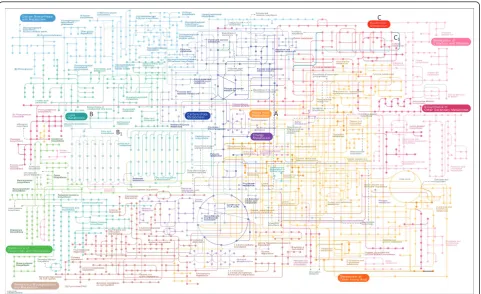
N-Glycan biosynthesis, to the purine metabolism pathway represented by 21 individualP. ovis ESTs (Table 4). Fig-ure 2 shows a representation of the mapping of the
pep-tides inferred from the P. ovistranscriptome to known
metabolic pathways and highlights the complex biology of this parasite. From within this map individual path-ways of interest can be identified and include metabolic pathways for amino acids, lipids, energy, nucleotides and carbohydrates and also a number of pathways involved in xenobiotic biodegradation and metabolism. Of parti-cular interest are pathways involved in amino acid meta-bolism, which represents 11 individual pathways; oxidative phosphorylation (the pathway in which the most individual members were identified), fatty acid and drug metabolism. Amino acids are critical components of mite biology and it is clear from the pathways
high-lighted here that amino acid metabolism in P. ovis
involves a multitude of enzymes spread over many sepa-rate and interconnected pathways. The most enriched pathway identified here was that of oxidative phosphory-lation. This is a metabolic pathway involved in the oxi-dation of nutrients to produce ATP as an energy
resource [53]. We identified a number of predicted P.
ovis enzymes involved in this pathway indicating its
importance to the fundamental biology of the mite. The synthesis and metabolism of fatty acids is a crucial stage
in the growth and development of all parasites and the
fatty acid metabolism pathway was enriched in the P.
ovis transcriptome, with 6 potential P. ovis enzymes
identified as being involved in this process.
Two predictedP. ovis enzymes identified here were a
flavin-containing monooxygenase (FMO) and a uridine
5’-diphospho-glucuronosyltransferase
(UDP-glucurono-syltransferase, UGT). Both enzymes are involved in the catalysis and processing of xenobiotics and are crucial for the elimination of toxic foreign chemicals and drugs from the body [54,55]. Pathway enrichment analysis of P. ovisESTs has two distinct advantages, the first is to enable the identification of the signalling pathways involved in the basic mite biology and the second is to give greater confidence in these findings as they are based upon functional groupings of ESTs and not on single ESTs in isolation. We have described the identifi-cation of members of a number of key biological path-ways in the mite and we have also described these pathways in the context of a much greater pathway, the P. ovismetabolome.
Conclusions
Here we have described the generation and analysis of 1545 unique and assembled EST sequences for the ecto-parasitic mite P. ovisfrom a mixed pool of all life and sex stages. This is by far the largest such resource avail-able for this parasite so far. The majority of these sequences (961 ESTs, 62%) showed similarity to known genes allowing an in depth functional analysis of theP.
ovistranscriptome. 584 ESTs (38%) showed no similarity
to known sequences, these may represent novel, as yet uncharacterisedP. ovistranscripts and this finding high-lights the current dearth of mite EST sequences avail-able in the public databases. During this study we identified a number of important homologues, including HDM allergens and tick salivary factors which offer new insights into the underlying biology of the mite and also into the host-parasite relationship. It is anticipated that further exploration of the host:parasite relationship in sheep scab will enable the development of new methods of parasite control, i.e. identification of homologous mite allergens suitable for use as vaccine candidates and may also aid development of novel drug targets.
The generation of this EST resource will also enable
the production ofP. oviscDNA microarrays for further
[image:8.595.55.290.546.700.2]analysis of gene expression in these mites and other clo-sely related species. This resource will also allow the transcriptional analysis of different life cycles stages, i.e. egg, larva, nymphal stages and adults and analysis of the consequences of drug exposure, thus facilitating investi-gations into mite virulence and drug resistance mechanisms.
Table 4 Top 10 enriched KEGG pathways and number of ESTs represented
KEGG Pathway No. ofP. ovisESTs represented
Oxidative phosphorylation 24
Purine metabolism 21
Biosynthesis of alkaloids 21 Biosynthesis of plant hormones 15
Methane metabolism 10
Biosynthesis of phenylpropanoids 9 Valine, leucine and isoleucine
degradation
8
Biosynthesis of terpenoids and steroids 7 Glcerophospholipid metabolism 7
Fatty acid metabolism 6
Methods
P. ovismite collection
Ethical approval for this study was obtained from the Moredun Research Institute Experiments Committee and animals were monitored daily in accordance with
guidelines agreed with the UK Home Office. P. ovis
mites (a mixed population consisting of adults, nymphs and larvae) were harvested from infected donor animals maintained at the Moredun Research Institute as pre-viously described [6] and care taken to remove contami-nating skin debris by extensive washing. For the
construction of the P. ovis cDNA library 800 mg of
mites were immediately snap frozen in liquid nitrogen and stored at -80°C for later RNA extraction.
Extraction of total RNA fromP. ovis
Total RNA was isolated from mites as described pre-viously [41]. RNA samples were further purified using a
Qiagen RNeasy kit, following the manufacturer’s RNA
cleanup protocol and on-column DNase I digestion for 15 minutes at room temperature, before elution into
RNase free dH2O.P. ovisRNA yield was assessed on a
ND-1000 Nanodrop spectrophotometer (Thermo Scien-tific, UK) and RNA sample quality assessed on an Agi-lent Bioanalyser (AgiAgi-lent, UK) and RNA Integrity Number (RIN) obtained for each sample. The RIN value is based on a ratio score of the 18s and 28s ribosomal RNA (rRNA) peaks, unfortunately RINs could not be
obtained from the P. ovis RNA because, as is the case
for many arthropods, the 28s rRNA species in P. ovis
migrates with the 18s rRNA [56]. However the presence of a clean prominent peak for the 18s rRNA and no
obvious degradation product indicated that the P. ovis
RNA was of both high quality and purity.
Construction of aP. ovismite cDNA library
A normalised P. ovis cDNA library was constructed
from total RNA extracted as detailed above (Eurofins B1
A B
C
[image:9.595.58.540.88.382.2]C1
MWG, Germany). The cloning vector used was pBluescript II sk+ and the cloning sites were 5’EcoRI and 3’BamHI, incorporating 5’and 3’adapter sequences. The bacterial strain used was NEB 10-beta. The library titre was esti-mated to be 1150 cfu/μl, the total number of clones was estimated to be 2.3 million and the average insert size was ~0.9 kb. Normalisation was carried out by denaturation and subsequent reassociation of the cDNA strands.
Sequencing of clones
The cDNA inserts of randomly selected clones were amplified by polymerase chain reaction (PCR) using M13 primers and sequence was obtained for 1574 randomly selected clones (Eurofins MWG, Germany). A further 484P. ovis ESTs generated in a previous study by our group (accession numbers in the NCBI dbEST database from BQ834597.1 - BQ835080.1) were then added to the 1574 ESTs described above resulting in a total of 2,058 sequences for downstream analysis [14].
Bioinformatical analysis
Sequences were checked and filtered to remove low quality sequence data (EST length < 100 bp), vector and adaptor sequences and to mask polyA sequence using the vector tools at EMBL-EBI (http://www.ebi.ac.uk/ Tools/sss/ncbiblast/vectors.html). ESTs with an overlap of > 50 bp were assembled into contiguous sequences
“contigs” using the CAP3 sequence assembly program
[57]. In order to identify homologs of the assembledP.
ovis EST sequences, all singletons and contigs were
BLAST searched against the Genbank non-redundant nucleotide and amino acid databases using the BLASTX and BLASTN algorithms within the blast2go application [15-17,58]. Sequences with non-significant or no BLAST
score [Expectation (E) value≤1.0E-4 and/or no BLAST
hit] were excluded from further analysis. E-value describes the number of hits expected by chance when searching a database of a particular size, the lower the E-value the more significant the match [58].
Functional classification ofP. ovisESTs
Putative biological functions and gene ontology classifi-cations (GO) were assigned to the unique ESTs using the mapping and annotation functions in the blast2go package [15-17]. In addition ESTs were mapped to metabolic pathways and where available Enzyme Com-mission (EC) codes and Interproscan IDs assigned using the respective options in blast2go [15-17]. Potential sig-nal peptide domains were identified using the Sigsig-nalP 3.0 server, using both the Neural Networks and Hidden Markov Models algorithm [59] and predicted transmem-brane domains were identified using the TMHMM 2.0 server (http://www.cbs.dtu.dk/services/TMHMM/) both from within the blast2go package.
Acknowledgements
This study was funded by the Department for Environment, Food and Rural Affairs (DEFRA), UK under project OD0553. The authors would like to express their gratitude to Eurofins MWG for construction of the normalizedP. ovis cDNA library and for sequencing of the cDNA clones. We would also like to thank Alex Lainson & Raja Yaga of the Moredun Bioinformatics Division for their bioinformatics support and BLAST analysis and the Moredun Clinical Division for their continued help and expertise.
Authors’contributions
STGB designed the study, performed and processed samples and data analysis and wrote the manuscript. AJN participated in the study design and data analysis and helped prepare the manuscript. FK generated aP. ovis cDNA library, helped with data interpretation and preparation of the manuscript. JFH conceived and designed the study, participated in the analysis and helped prepare the manuscript. All authors have read and approved the manuscript
Competing interests
The authors declare that they have no competing interests.
Received: 14 June 2011 Accepted: 22 July 2011 Published: 22 July 2011
References
1. Jones J, Jenkins T, Webb L, Davies A, Bates P:Psoroptic mange in cattle in south Wales.Vet Rec2008,162:460.
2. Kirkwood AC:History, biology and control of sheep scab.Parasitol Today 1986,2:302-307.
3. Nisbet AJ, Huntley JF:Progress and opportunities in the development of vaccines against mites, fleas and myiasis-causing flies of veterinary importance.Parasite Immunol2006,28:165-172.
4. DeLoach JR, Wright FC:Ingestion of rabbit erythrocytes containing 51Cr-labeled hemoglobin by Psoroptes spp. (Acari: Psoroptidae) that originated on cattle, mountain sheep, or rabbits.J Med Entomol1981,18:345-348. 5. Mathieson BR, Lehane MJ:Ultrastructure of the alimentary canal of the
sheep scab mite, Psoroptes ovis (Acari: Psoroptidae).Vet Parasitol2002, 104:151-166.
6. Burgess ST, Frew D, Nunn F, Watkins CA, McNeilly TN, Nisbet AJ, Huntley JF: Transcriptomic analysis of the temporal host response to skin infestation with the ectoparasitic mite Psoroptes ovis.BMC Genomics2010,11:624. 7. van den Broek AH, Huntley JF:Sheep scab: the disease, pathogenesis and
control.J Comp Pathol2003,128:79-91.
8. Hamilton KA, Nisbet AJ, Lehane MJ, Taylor MA, Billingsley PF:A physiological and biochemical model for digestion in the ectoparasitic mite, Psoroptes ovis (Acari: Psoroptidae).Int J Parasitol2003,33:773-785. 9. Sinclair AN, Filan SJ:Confirmation of degenerative effects on psoroptic
mites from scab lesions.Vet Rec1991,129:492.
10. Thomas WR, Smith W:House-dust-mite allergens.Allergy1998,53:821-832. 11. Bates P:Differences between primary and secondary infestations with
the sheep scab mite, Psoroptes ovis.Vet Rec2000,146:528-529. 12. Smith WD, Bates P, Pettit DM, Van Den Broek A, Taylor MA:Attempts to
immunize sheep against the scab mite, Psoroptes ovis.Parasite Immunol 2002,24:303-310.
13. Smith WD, van den Broek A, Huntley J, Pettit D, Machell J, Miller HR, Bates P, Taylor M:Approaches to vaccines for Psoroptes ovis (sheep scab).Res Vet Sci2001,70:87-91.
14. Kenyon F, Welsh M, Parkinson J, Whitton C, Blaxter ML, Knox DP:Expressed sequence tag survey of gene expression in the scab mite Psoroptes ovis–allergens, proteases and free-radical scavengers.Parasitology2003, 126:451-460.
15. Conesa A, Gotz S:Blast2GO: A comprehensive suite for functional analysis in plant genomics.Int J Plant Genomics2008,2008:619832. 16. Conesa A, Gotz S, Garcia-Gomez JM, Terol J, Talon M, Robles M:Blast2GO: a
universal tool for annotation, visualization and analysis in functional genomics research.Bioinformatics2005,21:3674-3676.
17. Gotz S, Garcia-Gomez JM, Terol J, Williams TD, Nagaraj SH, Nueda MJ, Robles M, Talon M, Dopazo J, Conesa A:High-throughput functional annotation and data mining with the Blast2GO suite.Nucleic Acids Res 2008,36:3420-3435.
19. Kelly RJ, Vincent DE, Friedberg I:IPRStats: visualization of the functional potential of an InterProScan run.BMC Bioinformatics2010,11(Suppl 12): S13..
20. Emanuelsson O, Brunak S, von Heijne G, Nielsen H:Locating proteins in the cell using TargetP, SignalP and related tools.Nat Protoc2007, 2:953-971.
21. Krogh A, Larsson B, von Heijne G, Sonnhammer EL:Predicting transmembrane protein topology with a hidden Markov model: application to complete genomes.J Mol Biol2001,305:567-580. 22. Hegde RS, Bernstein HD:The surprising complexity of signal sequences.
Trends Biochem Sci2006,31:563-571.
23. Park GM, Lee SM, Lee IY, Ree HI, Kim KS, Hong CS, Yong TS:Localization of a major allergen, Der p 2, in the gut and faecal pellets of
Dermatophagoides pteronyssinus.Clin Exp Allergy2000,30:1293-1297. 24. Preiss T, M WH:Starting the protein synthesis machine: eukaryotic
translation initiation.Bioessays2003,25:1201-1211.
25. Kenyon F, Knox D:The proteinases of Psoroptes ovis, the sheep scab mite–their diversity and substrate specificity.Vet Parasitol2002, 105:317-325.
26. Clara RO, Soares TS, Torquato RJ, Lima CA, Watanabe RO, Barros NM, Carmona AK, Masuda A, Vaz ISJ, Tanaka AS:Boophilus microplus cathepsin L-like (BmCL1) cysteine protease: Specificity study using a peptide phage display library.Vet Parasitol2011.
27. Kato T, Takai T, Mitsuishi K, Okumura K, Ogawa H:Cystatin A inhibits IL-8 production by keratinocytes stimulated with Der p 1 and Der f 1: biochemical skin barrier against mite cysteine proteases.J Allergy Clin Immunol2005,116:169-176.
28. Chuang CY, Chang CH, Huang YL:Thioredoxin mediates remodeling factors of human bronchial epithelial cells upon interaction with house dust mite-stimulated eosinophils.Inhal Toxicol2009,21:153-167. 29. Karabulut AB, Atambay M, Karaman U, Kilic E, Yazar S, Saraymen R, Daldal N:
House dust-mites: effect on antioxidant enzyme activities.Med Sci Monit 2006,12:CR378-381.
30. Mounsey KE, Pasay CJ, Arlian LG, Morgan MS, Holt DC, Currie BJ, Walton SF, McCarthy JS:Increased transcription of Glutathione S-transferases in acaricide exposed scabies mites.Parasit Vectors2010,3:43.
31. Armstrong RN:Glutathione S-transferases: reaction mechanism, structure, and function.Chem Res Toxicol1991,4:131-140.
32. O’Neill GM, Donovan GR, Baldo BA:Cloning and characterization of a major allergen of the house dust mite, Dermatophagoides pteronyssinus, homologous with glutathione S-transferase.Biochim Biophys Acta1994,1219:521-528.
33. Dougall A, Holt DC, Fischer K, Currie BJ, Kemp DJ, Walton SF:Identification and characterization of Sarcoptes scabiei and Dermatophagoides pteronyssinus glutathione S-transferases: implication as a potential major allergen in crusted scabies.Am J Trop Med Hyg2005,73:977-984. 34. Sarrias MR, Gronlund J, Padilla O, Madsen J, Holmskov U, Lozano F:The
Scavenger Receptor Cysteine-Rich (SRCR) domain: an ancient and highly conserved protein module of the innate immune system.Crit Rev Immunol2004,24:1-37.
35. Sasaki SD, de Lima CA, Lovato DV, Juliano MA, Torquato RJ, Tanaka AS: BmSI-7, a novel subtilisin inhibitor from Boophilus microplus, with activity toward Pr1 proteases from the fungus Metarhizium anisopliae. Exp Parasitol2008,118:214-220.
36. Ovaere P, Lippens S, Vandenabeele P, Declercq W:The emerging roles of serine protease cascades in the epidermis.Trends Biochem Sci2009, 34:453-463.
37. Lee AJ, Machell J, Van Den Broek AH, Nisbet AJ, Miller HR, Isaac RE, Huntley JF:Identification of an antigen from the sheep scab mite, Psoroptes ovis, homologous with house dust mite group I allergens. Parasite Immunol2002,24:413-422.
38. Nisbet AJ, Halliday AM, Parker L, Smith WD, Kenyon F, Knox DP, Huntley JF: Psoroptes ovis: identification of vaccine candidates by
immunoscreening.Exp Parasitol2008,120:194-199.
39. Huntley JF, Machell J, Nisbet AJ, Van den Broek A, Chua KY, Cheong N, Hales BJ, Thomas WR:Identification of tropomyosin, paramyosin and apolipophorin/vitellogenin as three major allergens of the sheep scab mite, Psoroptes ovis.Parasite Immunol2004,26:335-342.
40. Weghofer M, Dall’Antonia Y, Grote M, Stocklinger A, Kneidinger M, Balic N, Krauth MT, Fernandez-Caldas E, Thomas WR, van Hage M,et al:
Characterization of Der p 21, a new important allergen derived from the gut of house dust mites.Allergy2008,63:758-767.
41. Maruo K, Akaike T, Ono T, Okamoto T, Maeda H:Generation of anaphylatoxins through proteolytic processing of C3 and C5 by house dust mite protease.J Allergy Clin Immunol1997,100:253-260.
42. Hong M, Kwon JY, Shim J, Lee J:Differential hypoxia response of hsp-16 genes in the nematode.J Mol Biol2004,344:369-381.
43. Strayer A, Wu Z, Christen Y, Link CD, Luo Y:Expression of the small heat-shock protein Hsp16-2 in Caenorhabditis elegans is suppressed by Ginkgo biloba extract EGb 761.FASEB J2003,17:2305-2307.
44. Richards AG, Richards PA:The peritrophic membranes of insects.Annu Rev Entomol1977,22:219-240.
45. Lue H, Kleemann R, Calandra T, Roger T, Bernhagen J:Macrophage migration inhibitory factor (MIF): mechanisms of action and role in disease.Microbes Infect2002,4:449-460.
46. Dobson SE, Augustijn KD, Brannigan JA, Schnick C, Janse CJ, Dodson EJ, Waters AP, Wilkinson AJ:The crystal structures of macrophage migration inhibitory factor from Plasmodium falciparum and Plasmodium berghei. Protein Sci2009,18:2578-2591.
47. Abouel-Nour MF, Lotfy M, Attallah AM, Doughty BL:Schistosoma mansoni major egg antigen Smp40: molecular modeling and potential immunoreactivity for anti-pathology vaccine development.Mem Inst Oswaldo Cruz2006,101:365-372.
48. Danielson PB:The cytochrome P450 superfamily: biochemistry, evolution and drug metabolism in humans.Curr Drug Metab2002,3:561-597. 49. Synge BA, Bates PG, Clark AM, Stephen FB:Apparent resistance of P ovis
to flumethrin.Vet Rec1995,137:51.
50. Clark AM, Stephen FB, Cawley GD, Bellworthy SJ, Groves BA:Resistance of the sheep scab mite Psoroptes ovis to propetamphos.Vet Rec1996, 139:451.
51. Lekimme M, Farnir F, Marechal F, Losson B:Failure of injectable ivermectin to control psoroptic mange in cattle.Vet Rec2010,167:575-576. 52. Kanehisa M, Goto S:KEGG: kyoto encyclopedia of genes and genomes.
Nucleic Acids Res2000,28:27-30.
53. Gautheron DC:Mitochondrial oxidative phosphorylation and respiratory chain: review.J Inherit Metab Dis1984,7(Suppl 1):57-61.
54. Cashman JR:Structural and catalytic properties of the mammalian flavin-containing monooxygenase.Chem Res Toxicol1995,8:166-181.
55. King CD, Rios GR, Green MD, Tephly TR:UDP-glucuronosyltransferases. Curr Drug Metab2000,1:143-161.
56. Winnebeck EC, Millar CD, Warman GR:Why does insect RNA look degraded?J Insect Sci2010,10:159.
57. Huang X, Madan A:CAP3: A DNA sequence assembly program.Genome Res1999,9:868-877.
58. Altschul SF, Gish W, Miller W, Myers EW, Lipman DJ:Basic local alignment search tool.J Mol Biol1990,215:403-410.
59. Bendtsen JD, Nielsen H, von Heijne G, Brunak S:Improved prediction of signal peptides: SignalP 3.0.J Mol Biol2004,340:783-795.
doi:10.1186/1756-3305-4-145
Cite this article as:Burgesset al.:Generation, analysis and functional annotation of expressed sequence tags from the ectoparasitic mite Psoroptes ovis.Parasites & Vectors20114:145.
Submit your next manuscript to BioMed Central and take full advantage of:
• Convenient online submission
• Thorough peer review
• No space constraints or color figure charges
• Immediate publication on acceptance
• Inclusion in PubMed, CAS, Scopus and Google Scholar
• Research which is freely available for redistribution