EUROPEAN ECONOMIC COMMUNITY EUROPEAN ATOMIC ENERGY COMMUNITY
COMMISSION
Report on the Development
of the Social Situation
in the Community in 19.73
(Addendum to the 'Seventh General Report
on the Activities of the European Communities'
in accordance with Article 122
Contents
A - Introduction 7
B - Outline of activities by the Commission of the European Communities
in the social field in 1973 15
C - Development of the Social Situation in 1973 45
Chapter I - Employment (including migrant workers) Chapter II - Vocational training
Chapter III - Industrial Relations
Chapter IV - Working conditions and labour law Chapter V - Wages and asset-Ownership Chapter VI - Housing
Chapter VII - Family affairs Chapter VIII - Social Services Chapter IX - Social security
Chapter X - Industrial safety, medicine and hygiene Chapter XI - Protection of health and of the environment
D - The Development of the Social Situation in figures Index of Graph and Tables in the Text
Index of Key Words Summary of Contents
SOCIAL REP. 1973
47
69
84 107
. 119
141 154 165 175
188
198
211
1.:
1.
The niost important achievement of 1973 in the social fieid .. was the adoption by the CounCil of .a .. Resolution embod)ri.ng its support for a ~r9gramnieof
Social Action to be carried out over the neXt three ye'ars which sets out th~ obje'ctives to be attained, . th~ measures to be implemented and the priority actions.. '
.
The importance of this programme lies not only in what it sets out to 'achieve over the next three years from 1974-197'6 through comprehensive' and radical social reform; it also represents the first attempt by the Community to draw up a coherent social policy setting out in a purposeful way the .initial practical steps on the road towards the ultimate goal .of European Social Union. Clearly the precise nature of such a Union forms part of the broader issue of European Union generally. The Community Social Action Prograffim~. however, is geared to the relatively near future-the actions that can and should be achieved over the next three years to make the Comrriunity a b~tter pl~ce .in whlch to ~ork and to live.: In this context, particular attention is given to the situation ofthe more vulnerable sections of ~he population such as ~grants, the handi<;:apped, the el~erly, and schoolle~vers who have particular difficulties in regard to employment. · Measures to eliminate discrimination against women in job opportunities, promotion, and pay are also included .. Account has also been taken of the problems of people suffering from chronic poverty. · · · ·
2 •. ;. Towards the end of 1973, the plight of thes.e.weaker groups within our
Com-munity was highlighted even more by the threat. to employment and living standards brought about by both the effects of the shortage of supply, and later the encreased cost of energy.
The Commission, at the· request of the Council, is preparing ~ report on th~ con-sequences of tlie fuel situation on employment and a study bn the systems for adjustment of wages to the development of the' cost· of living. The report will contain an assessment on employmen,t prospects for ~974. and .will consider the possibilities of action both by individual Member States and the Community as.a whole. ·The extent to which the Social Fund· might be utili~ed in this context will
also be examined. . r
3. The solution of the social problems arising from the energy situation will, obviously, be a major preoccupation in the Community in the months ahead.
It is usually the weaker groups of the population which suffer most in time .of hardship. This accentuates the need to press ahead with measures, such as those contained in the Social Action Programme, to effect fundamental social reform in the Community.
The new European Social Fund, which entered its first full year of operation in 1973, has an essential role to play in the framework of the Action Programme. As one of the major instruments available for achieving the social objectives of the Community, the Social Fund must be able to provide the support necessary to carry out a number of the individual measures proposed. The Commission is committed to developing the potential of the Social Fund on the basis of the principle of Community solidarity and in close cooperation with other interested Community Institutions, Member States and the Social Partners.
4. The Commission drew up a discussion document~Guidelines for a Social Action Programme-published in April 1973 as a basis for consultations with the Institutions of the Community and the Social Partners on the nature and content of a Community Social Action Programme. Following these consultations, both formal and informal, the Commission drew up its definitive programme in October 1973 and transmitted it to the other Community Institutions together with a draft Council Resolution relating to the main objectives and actions contained in the Social Action Programme. The Council agreed the political content of its Resolution on 11 December 1973, and approved the final wording on 21 January 1974.
5. The Resolution outlines the individual reforms which the Community intends to carry out over the next three years, 1974-1976. Furthermore, it sets down a time-table of decision-making which commits the Council to taking a decision on each implementing proposal submitted by the Commission within five months aft:er the completion of the normal consultation process with the European Parliament and the Economic and Social Committee.
:'J~.:--'1 ~,\' ··n.l~~-·n :·~·.f.c':-\~-;._ ... ;-. .!1. .. ! -1 :·_ ~~::::i_ ·.· ... 1 · .: ~·· ..;r.·.~: v ')! : ..• ;::.; ! . . ~-:~~.;Ji) ~.s.:t' ;;:;.r-;fr:J:'·:;.:;..._··J ~orr .. ::,:r:w .s <,rJ i,~);~~< ::~ :~· ... t:- .. ·~;_ --;:,.r i ' .. } 6 ·on:1 "I:P~;.s,c;~pe. s>l~~h~·.x,ctfJiBus. !a~~~.<!.I}l' c;pn~~m~<:L in. th~,J{ysRll,l,~<?P..,o! :~~e~~qun<;~~ reflects the three broad objectives expressed in the Communique issued· at the end of the Paris Summit (19/21 October 1972):
(i) Full and better employment; .
(ii) Improvement of living. and working conditions;
SOCIAL ACTION PROGRAMME 1974-1976 11
7. · During the last quarter of 1973 the Commission submitted ·a group of seven actions which make up the first stage of the three year programme. These relate to: {i) assistance from the European Social Fund for migrant workers and handicapped
workers;
(ii) an action programme for handicapped workers;
(iii) more effective legal application in the Member States of the principle' of ·equal ·
pay for men and women; ·
(iv) the designation as an immediate objective in each Member State of the ap-plication of the principle of the standard 40 hour working week by 1975, and the principle of the 4 weeks annual paid holiday by 1976;
(v) . the setting up of a European Foundation for the improvement of the environ~ ment and living and working conditions;
(vi) the protection of workers by the approximation of the Member States' legisla-. tion on mass dismissals;
(vii) the setting up of a European General Safety Committee and the extension of the competence of the Mines Safety and Health Committee.
8. The Commission announced its intention to submit a further group of three proposals before 1 April 1974 to be decided by the Council, in accordance with the time limit mentioned in paragraph 5 above, by the end of the year (second stage):
These relate to:
(i) a first action programme for migrant workers;
(ii) the setting up of a European Vocational Training Centre;
(iii) the protection of workers' acquired rights in the case of changes of ownership of companies, and particularly in the case of mergers.
9. Finally the Council has specified in its Resolution nine other priorities in the Social Action Programme on which it wishes proposals to be drawn up by the Commission during 1974 (third stage). They relate to the following objectives:
(i) Improved consultations between Member States on their employment policies and better cooperation between national employment services;
(ii) The establishment of a comprehensive programme for migrant workers:;·· · (iii) The implementation of a common vocational training policy;
(1~)" ;E;fuality<'b6fw'eeil'hl~ri'i~d.1
JlofHert
11in' iicC'~~~-"-t<PeYrlployfu'eni, 5'¥brkihtj
con-11ditions, training and promotion; ·
· (v) Coordination of policies of social protection in the Member States; (vi) Improved standards on health and safety at work;
(vii) Preparation of a programme for pilot schemes to combat poverty;
· (ix) The increased participation of management and labour in the economic and social decisions of the Coinmuni1y · · .
10. The successful implementation of the Social Action Programme will require the full support of Member State Governments and the Social Partners as well as the Community Institutions. Commission policy is not in any way directed towards the centralization of the solution of all social problems or harmonization for its own sake. Social problems differ in nature and degree in the various· Member States as indeed do social systems. In the Commission's view the r6le of Community Action is directed towards establishing minimum social standards capable of being regularly improved. For this reason the social poliCy of the Community should be regarded as a worthwhile aim in itself and not just as a means of counteracting the social ill effects of economic progress. · ·
11.
The
Council Resolution lays down the inain guidelines for the Community's work in the social field during the period ahead but does not, of course, constitute a limit to such activity. The Commission retains its right of initiative to make proposals when it thinks fit, even regarding matters to which the Council did not attach a priority in its Resolution. Such proposals, for example, could well i'nclude the protection of workers against the abuses of temporary employment agencies. Naturally this right of initiative also applies to matters which the Council did not include in its Resolution such as the promotion of national systems of income maintenance for workers undergoing retraining. The schemes envisaged . would encourage workers to undertake training that would not only be of great benefit to them but also protect them against loss of earnings during such training. In addition the Commission intends to pursue various studies, as announced in the Social Action Programme, such as the levels of minimum wages in the Community and the provision of soeial housing. These studies may well lead to proposals being submitted to the Council.12. The Commission will continue its practice of closely following social" trends in the Community such as for example those brought about by the energy situation referred to in paragraph 2 above and will not fail to make proposals to the Council where unexpect~d problems arise for which it considers that action at a Community level would be appropriate and effective.
SOCIAL ACTION PROGRAMME 1974-1976 13
prevention and care of social diseases. For that reason the Commission will examine these areas in order to consider possible scope of Community action in the field of public health.
14. In a Community of 255 million people, there is a wide diversity of priorities, needs and ambitions in the Social field, which a Community Social Action Programme must take account of and meet in a practical and relevant way. In the Commis sion's view the way this can be achieved most effectively is through the fullest possible consultations with other Community Institutions and with the Social Partners. Only by establishing this level of participation can the Community ensure the attainment of its social objectives.
15. Whilst it is obvious that social policy must remain at the centre of the Com-munity's attack on social problems, it is essential that all other Community policies must continue to include a strong social content which aims not only at improving the quality of life and standards of living of our people but also pays special attention to the needs of the most vulnerable sections of the population.
Furthermore, in the opinion of the Commission, the Community will in future have to allocate an increasing proportion of its budget to the achievement of a coherent and progressive social policy-a view shared by the European Parliament. By 1977, when the Community will dispose of all its own financial resources, the European Parliament will have a major contribution to make to the development of Community solidarity, on which all progress in social policy will ultimately depend.
SOCIAL REP. 1973
B. Outline of activities
by
the Commission
of the European Communities
General aspects
16. For the Commission the social year has been dominated by the preparation of a Social Action Programme in response to the mandate laid down by the Heads of State or Government at the Summit Conference in Paris in October 1972. The first step was the drawing up in April of guidelines of a Social Action Programme
in which the Commission set out its basic ideas and philosophy. These guidelines served as a basis for discussion with other Community Institutions and the Social Partners.
These discussions not only corresponded with the spirit of the Summit Communique but were of great assistance to the Commission in concentrating on proposals in its final programme that were not only imaginative and ambitious but, perhaps even more important, relevant to the important social issues of our Community.
This work was completed in October and the draft Social Action Programme setting out the Commission's priorities and its timetable of work over the period 1974-76 was examined by the Council of Social Ministers on 11 December 1973. At this meeting the Council approved of the substance of the Commission's pro-gramme and decided on a Resolution, which was adopted by the Council on 21 January 1974.
The Council Resolution noted that the Commission has submitted during the last quarter of 1973 its proposals for a group of seven actions which make up the first stage of the three year programme. These relate to:
1 . assistance from the European Social Fund for migrant workers and handicapped workers,
2. an action programme for handicapped workers in an open market economy, 3. the setting up of a European General Industrial Safety Committee and the
extension of the competence of the Mines Safety and Health Committee, 4. a Directive providing for the approximation of legislation of Member States
concerning the application of the principle of equal pay for men and women, 5. the designation as an immediate objective of the overall application of the
principle of the standard 40-hour working week by the end of 1975, and the principle of 4 weeks annual paid holiday by the end of 1976,
6. the setting up of a European Foundation for the improvement of the environ-ment and living and working conditions,
7. a Directive on the approximation of the Member States' legislation on mass dismissals.
Furthermore the Council Resolution also noted that the Commission intends to submit three further proposals in the first quarter of 1974. These will include a first action programme for migrant workers, a proposal to set up a European Vocational Training Centre and a draft Directive on the harmonization of laws with regard to the retention of workers' acquired rights in the case of changes of ownership of companies and particularly in the case of mergers.
The Council also decided to select nine priorities for which the Commission is due to submit further proposals before the end of 1974. These include a comprehensive programme for migrant workers, proposals relating to a common vocational training policy and the establishment of a programme for the progressive involvement of workers in the life of firms. Furthermore the Council has also called on the Commission to draw up before the end of 1974 a programme of pilot studies as means of combating poverty which could be undertaken in the course of 1975 and 1976.
The Council of Ministers has undertaken to act on each Commission proposal necessary to implement each part of the programme within five months of the normal consultation procedures with the European Parliament and the Economic and Social Committee, or, if such consultations have not taken place, at the latest nine months from the date of transmission of the proposals to the Council.
Towards the end of the year the development of the energy crisis posed a threat to employment and living standards in our Community. Its existence has highlighted even more the need for the continuing social progress outlined in the Social Action Programme. The Commission has been requested to make a report on the situation and its possible effect on employment which could serve as the basis of concrete proposals.
The Commission's activities in the social field were also marked by the implementa-tion of the new European Social Fund which entered its first full year of operaimplementa-tion in 1973. The scope of this Fund was increased not only to take account of the enlargement of the Community but also to provide increased financial assistance to regions or industries in difficulty.
Social aspects of the common and Community policies1
17. In 1973 the short-term and medium-term economic policies emphasized employ-ment problems. It appeared necessary to intensify activities designed to resolve
1 A comprehensive and detailed table of the social aspects of the Community's various policies
SOCIAL ACTIVITIES OF THE COMMISSION IN 1973 19
regional imbalances and to adapt vocational training and retraining to the needs of sectors in which the expansion of demand will be concentrated. In addition, the Commission's Annual Report on the Economic Situation in the Community (1973) stresses the need, in the face of persistent inflationary trends, to ensure that real incomes and the standard of living in the Community rise whilst, at the same time, guaranteeing those strata of the population with the lowest incomes as far-reaching a protection as possible.
Regional policy too has numerous social aspects, above all with respect to employment, and the improvement in working and living conditions. It also implies a close link between intervention measures taken by the European Social Fund, the EAGGF, the EIB and the future Regional Development Fund. In its Memorandum on the industrial and technological policy programme, the Commission states clearly that the 'employment aims of industrial policy, of social and regional policies coincide' and proposes numerous measures to achieve these objectives. Furthermore, the Scientific and Technological Programme, adopted by the Commission on 25 July 1973, emphasized the need in the social sector for a medical research programme: training of research workers and clinical specialists and various research programmes, which must begin before 1 April 197!!.
Concern for a better quality of life led the Commission to formulate, on 10 April, the Environmental Programme of the European Communities. The creation of better working conditions within firms, which is one of the programme's objectives, will be based on a number of measures in the fields of hygiene, medicine and safety. The programme also envisages the establishment of a European Foundation for the long-term study of factors which will improve the quality of life whether it be a matter of environment or of living and working conditions.
In order to strengthen consumer protection the Commission, on 25 September 1973, decided to establish a Consumers' Consultative Committee: its first meeting took place on 19/20 November 1973. Furthermore, at the beginning of December, the Commission adopted a Consumer Information and Protection Programme. The social measures taken by the Commission, in the fields of agriculture, sea fisheries, transport, construction and the coal and steel industries are described in detail below.
The promotion of employment
18. Employment problems are increasingly acquiring a Community dimension. Developments in commercial policy, international monetary trends, the prospects for monetary integration and the hopes for a Community regio11al policy all have
a great effect on employment. In addition, there has been a profound change in attitudes to employment within the Community. It is realized that comprehensive regulations are not enough to remove the structural causes of unemployment and that inter-regional mobility poses a serious threat to the balance and vitality of certain regions of the Community and consequently to its overall balance. The promotion of employment now means that the considerable disparity between jobs offered and persons available must be reduced, both as regards the qualifica-tions required and as regards siting. The creation of new jobs in the regions and the preparation of workers for new types of job by means of an active employ-ment policy (including occupational training) constitute the two prongs of the attack. The purpose of this attack is, firstly, to set up, in close cooperation with member countries, machinery for information and analysis making it possible to detect employment problems in time and, secondly, to develop the use of the instruments already available to contribute to the promotion of employment in the Community.
Free movement of workers
19. In order to develop assisted employment of workers and to ensure better clearing of employment supply and demand in the Community, an initial exchange of Italian and German officials responsible for the workers' employment was organized between 1 March and 31 August under the aegis of the Commission.
When it adopted the SEDOC system (Systeme Europeen de Diffusion des Offres et Demandes d'Emplois en Compensation Internationale),1 the Commission
made provision for an adjustment period of two years in order to enable its depart-ments and those in the Member States to satisfy the requiredepart-ments resulting from application of the system. The Commission is formulating an audio-visual training programme for the competent national and European officials and has established within its departments an administrative unit to study the programme for process-ing the data to be gathered under the SEDOC.
In addition the Commission in conjunction with the Technical Committee is making preparations to process the first data communicated to it under the Community outline it adopted on 14 December 1972.1
Pending adoption by the Council of a suitable legal instrument, the Technical Committee for the Free Movement of Workers has given its approval to a pro-visional procedure designed to bring about exchanges of information, cooperation
SOCIAL ACTIVITIES OF THE COMMISSION IN 1978 21
and mutual assistance between Member States' administrations, the social protec-tion of workers hired by temporary employment agencies and operating beyond the frontiers of the country in which their head office is situated.
In the context of the coordination of national policies on foreign workers the Commission has set up an ad hoc working party of representatives of the Member States to assist it in framing suitable proposals in this field.
European Social Fund
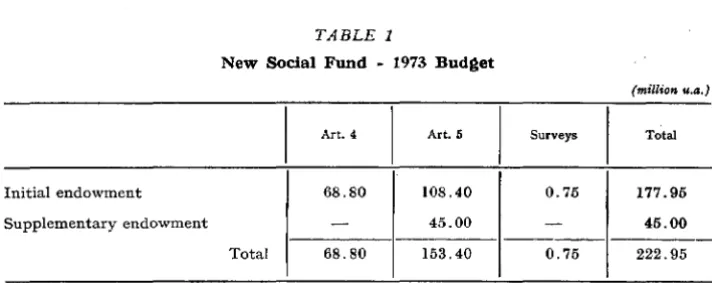
20. The new Social Fund was established in 1972 and 1973 was its first full year of operation. The appropriations, initially set at 177.95 million units of account, were increased by 45.00 million units by a Council decision of 21 September 1973.
TABLE 1
New Social Fund - 1973 Budget
(million u.a.)
Art. 4 Art. 5 Surveys Total
Initial endowment 68.80 108.40 0.75 177.95 Supplementary endowment
-
45.00-
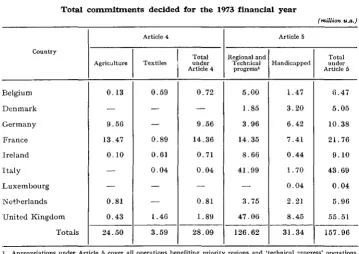
45.00 Total 68.80 153.40 0.75 222.95The first report on the activities of the new Social Fund, which deals with 1972, was forwarded to the Council on 19 October 1973, in accordance with the decision creating the Fund. The Commission considered that it would be advisable to present the second report, which covers 1973, during the early months of 1974. The amount of assistance applied for from the new Fund for activities to be carried out in 1973 under Articles 4 and 5 of the Council decision of 1 February 1971 totalled around 320 million u.a. Of this 28.09 million u.a. was granted under Article 4 (agriculture 24.50 million u.a., textile industry 3.59 million u.a.) and 157.96 mil-lion u.a. under Article 5 (of which 31.33 milmil-lion u.a. was earmarked for the handicapped).l
1 After carrying forward 1972 appropriations (4.56 million u.a.) to the 1973 financial year.
[image:14.451.46.402.255.396.2]During the financial year under consideration the Commission reviewed applica-tions involving a total of around 400 million u.a. and, after consulting the European Social Fund Committee, approved them as far as the financial resources available allowed.1 The total amount of assistance thus approved is 186.05 million u.a.,
allocated as shown in Table 2 below.
After obtaining the opinion of the Social Fund Committee, the Commission also addressed to the Council on 22 November two proposals for granting assistance from the Fund under Article 4 to handicapped persons and migrant workers.
TABLE 2
Total commitments decided for the 1973 financial year
(million u.a.)
Article 4 Article 5
Country
Agriculture
I
I
Total Regional andI
I
TotalTextiles under Technical Handicapped under
Article 4 progress1 Article 5
Belgium 0.13 0.59 0.72 5.00 l. 47 (] .47
Denmark - - - l. 85 3.20 5.05
Germany 9.5G - 9.56 3.96 6.42 10.38
France 13.47 0.89 14.36 14.35 7.41 21.76
Ireland 0. 10 0.61 0. 71 8.66 0.44 9.10
Italy - 0.04 0.04 41.99 l. 70 43.69
Luxembourg - -
-
- 0.04 0.04NetPerlands 0.81 - 0.81 3.75 2.21 5.96
United Kingdom 0.43 1.46 1. 89 47.06 8.45 55.51
Totals 24.50 3.59 28.09 126.62 31.34 157.96
·1 Appropriations under Article 5 cover all operations benefiting priority regions and 'technical progress' operationsJ
as these two aspects which are very often interrelated cannot be broken down in a simple table.
In any event, aid committed for operations of a clearly regional nature greatly exceeded the minimum percentage
laid down in Article 2, Title I of Council Regulation (EEC) No 2396/71 of 8 November 1971. . ,,, .
In pursuance of Article 7 of Council Regulation (EEC) No 2396/71, the Commission has carried out a number of studies closely related to the search for a solution to the
[image:15.450.45.404.204.458.2]SOCIAL ACTIVITIES OF THE COMMISSION IN 1973 23
problems raised by the intervention of the new Social Fund. The studies were designed to determine the ways in which the Fund's intervention could be ef-ficiently carried out in agricultural areas, including the formulation of a strategy for developing the textile sector. They also dealt with the qualitative improvement of vocational retraining facilities for handicapped persons and with the formulation of pilot training programmes for vocational retraining officers. The Commission also allocated credits to a further series of studies and pilot schemes relating to new training methods for officers involved in the retraining of agricultural workers, handicapped persons and migrant workers.
In pursuance of Regulation (EEC) No 2397/711 on aid from the Fund, the Commis-sion adopted a regulation laying down a maximum level of assistance from the Fund for certain purposes. 2
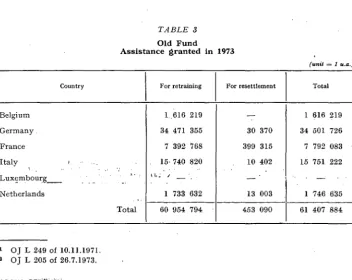
The former Social Fund has continued its activities pursuant to Article 125 of the EEC Treaty, iri accordance with general implementing Regulation (EEC) No 2396f7i.l The total amount of assistance applied for in 1973 is approximately 60 million u.a. The total amount of Fund aid granted was 61.41 million u.a., broken down as follows: 34.50 million u.a. were granted to Germany, 1.62 million to Belgium,
Country
Belgium Germany France
Italy I 1
Lux~mbourg_
-Netherlands
1 OJ L 249 of 10.11.1971. a OJ L 205 of 26.7.1973.
SOCIAL REP'.''ig73'·
TABLE 3
Old Fund
Assistance granted in 1973
For retraining
I
For resettlementI
1..616 219
-34 471 355 30 370
7 392 768 399 315
15· 740 820 10 402
..
>·' t t. ~ I
- ·
--·
1 733 632 13 003
...
Total 60 954 794 453 090
{tmit = I u.a.)
Total
1 616 219
34 501 726
7 792 083
15 751 222
-1 746 635
[image:16.452.42.394.303.583.2]7. 79 million to France, 15.75 million to Italy, and 1. 75 million u.a. to the Netherlands. Of the total amount only 0.45 million u.a. was granted for resettlement purposes. Community aid for redundant workers from the Italian sulphur mines1 totalled
214 000 u.a. paid to the Italian Government in the 1973 financial year.
Finally, for the 1974 financial year, the European Social Fund has a budget of 327.8 million u.a. Of this 98.8 million u.a. are for assistance granted under Article 4, 168.4 million u.a. for activities under Article 5, 60.0 million for activities under the former Fund and 0.6 million for studies and pilot schemes.
Retraining and re-employment of workers
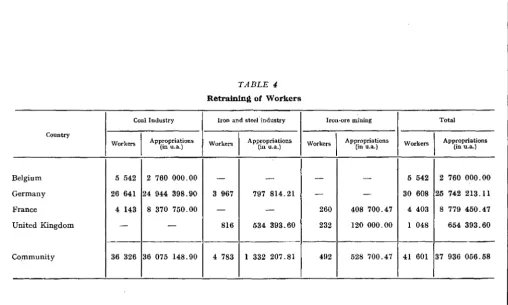
21. The appropriations made available for the retraining of workers in the ECSC industries increased appreciably compared to previous years. Between 1 January and 31 December 1973 a total of 37.94 million u.a. were set aside for the retraining of 41 600 workers (see Table 4).
The most important Community intervention measures in the past year involved the coal industry.
In Germany the rationalization of the coal industry was much faster. In France and Belgium the programmes were carried out in accordance with set plans. In the iron and steel sector retraining measures were reduced, although a slight increase on the previous year was noted. Appropriations in this sector cover two cases in Germany and two in the United Kingdom.
In the French iron-ore mining sector the applications filed were for increases in appropriations already granted. A new application was made to have appropria-tions made available for the United Kingdom.
In the past year there have been no significant amendments to retraining methods. The Commission however concluded an agreement with the British Government which provides for aid to be granted under Article 56(2) of the ECSC Treaty to workers in the iron and steel industry, and also began talks with the British Govern-ment with a view to concluding an agreeGovern-ment to help workers in the coal industry.
Redevelopment of undertakings and re-employment
22. During 1973 the Commission, by means of redevelopment loans for eight invest-ment schemes, encouraged the creation of about 2 450 jobs in various regions where
~ 0
>
r-:D m :0~
Country Belgium Germany FranceUnited Kingdom
Community
-Coal Industry
Workers
I
Appropriations (in u.a.)5 542 2 760 000.00
26 641 24 944 398.90
4 143 8 370 750.00
-
-36 326 -36 075 148.90
TABLE 4
Retraining of Workers
Iron and steel. industry
Workers
I
Appropriations (in u.a.)-
-3 967 797 814.21
-
-816 534 393.60
4 783 1 332 207.81
-Iron-ore mining
Workers
I
Appropriations (in u.a.) WorkersI
-
-
5 542- - 30 608
260 408 700.47 4 403
232 120 000.00 1 048
492 528 700.47 41 601
Total
Appropriations (in u.a.)
2 760 000.00
25 742 213.11
8 779 450.47
654 393.60
37 936 056.58 (/)
g
>
t"'~
<
::j [image:18.642.68.576.51.356.2]ECSC industries are located. The obligation incumbent upon the recipients of these loans to retrain former workers in the coal and iron and steel industries guarantees that priority will be given to resettling about 1 300 people in the factories financed in this way.
Other activities in connection with employment
23. Studies and research have continued to dwell on employment problems in the light of the possible means of intervention made available by the Social Action Programme and by the new Social Fund. Thus the Commission has forwarded to the Council and to the Standing Committee on Employment a report drawn up by a working party of independent experts on the relationship between employ-ment policy and economic and monetary union. There is a direct link between the main conclusions reached in the report and the current discussions on regional policy. Some of its other conclusions were used in the preparation of the Action Programme. In addition, a report on manpower problems in 1973 has been completed; it exan1ines probable labour market trends for the coming months. Studies concerning employment forecasts have been focused on medium-term forecasts of the demand of labour for each sector or branch of activity broken down by demands for employment classified according to the skills of the applicant. The Member States' experts met in July to carry out an initial review of national statistics already available.
The employment of young people, especially those looking for their first job, was a priority in the action programme. These proposals will involve both aid from the Social Fund and the exchange programme for young workers.
The Commission completed its evaluation of the results of the survey concerning female wage-earners in the private sector of the six original Member States. The national reports on the survey and the synopsis will be supplemented by a comparison of the situations in the three new Member States. All this documentation should upderpin the work of the ad hoc working party which assists the Commission in
framing proposals onemploy~ent and working conditions for women which must be drawn .up b~tween .t;19wand the end_ of 1974 in accordance with the commitments of the Social Programme.
informa-SOCIAL ACTIVITIES OF THE COMMISSION IN 1973 27
tion and has taken part in work on the employment of women in the OECD and the Council of Europe.
Vocational guidance and training activities
'.
24. In March1 the Council adopted its position on the action programme submitted
by the Commission concerning 'first measures to implement a common policy of vocational training'. 2 It approved a number of priority measures, such as the
improvement in exchanges of information and experience, a solution to the training problems facing such people as migrant workers, or handicapped persons and certain sectors of the economy (such as agriculture, road transport). Other measures designed, for example, to develop vocational training in certain regions, will be implemented under the Social Action Programme, which makes special provision for the establishment in 1974 of a European Vocational Training Centre.
The Commission paid particular attention to the training of training officers. In February, in conjunction with the ILO International Centre for Advanced Technical and Vocational Training in Turin, the Commission organized a seminar for adult training cadres." Following the seminar held in 1972 at Heidelberg the Commission organized, from 10 to 14 December, at the Retraining Centre in Mulhouse, a second seminar for training cadres concerned with the vocational retraining of handicapped adults. These two seminars brought together persons with responsibility for training in public administrations, employers' and workers' organizations, research and vocational training bodies and adult retraining and vocational training centres. The Commission also helped to organize two other seminars, one in conjunction with the International Institute· for 'youth' and educational television on 'Television and vocational training' (Munich, 5-9 February 1973), the other, in conjunction with the European Centre for Promotion and Training in Agricultural and Rural Areas on 'The Activity of the European Social Fund in the Community's priority agricultural regions' (Freyung, 9-13 April1973).
The Commission will be pursuing its vocational guidance programme with the ·aim· of achieving closer cooperation between the' 'vocational 'giiidaiice 'services in" the Member States. · It has, in particUlar, brganized in-training' periods:'for' thbsed directing these services.
1 236th session of 26 and 27 March 1973.
2 Sixth General Report, point 200.
3 Bull. EC 2-1973, point 2209.
General social security matters and European social budget
25. In the social security field the Commission in general concentrated on possible ways and means of improving social protection within the context of the Action Programme. It undertook preliminary studies enabling it to put forward practical proposals in 1974. The studies previously begun have continued. A new edition of the comparative social security tables for both the general and the mining systems was updated to 1 July 1972. Another special brochure concerning the three new Member States was published and brought up to date. In addition a number of studies completed last year have given supplementary details on the situations in these States. The study on the scope of application of social security to individuals was withheld to coordinate its finding with the Social Action Pro-gramme.
The second volume of the medical information memoranda on occupational diseases on the European list provided for in the Commission Recommendation of 23 July 19621 was completed. Further studies on the relations between the medical
profession and social security, the cost of hospital treatment and of the consumption of pharmaceuticals in the new member countries are being carried out. A draft review of the European list of occupational diseases is in preparation by the Com-mission.
Following the decisions taken on 9 November 1972 by the Council of Ministers (Social Affairs), the Commission was able, in conjunction with national experts, to begin to draw up the first European social budget which was to specify the actual contents of the social accounts (social security, war pensions, social assistance and voluntary awards by employers} and to deal retrospectively with the period 1970-72. It will also forecast for the period 1973-75. Beginning in the spring of 1973 the Commission held three meetings with government experts to jointly define the scope and contents of national reports which would serve as a basis for the projected first European social budget.
On the basis of these reports, the Commission is preparing a draft summary report. After examination this draft will become the first European social budget during the first half of 1974. Its publication will be rapidly followed by that of the national reports.
SOCIAL ACTIVITIES OF THE COMMISSION IN 1973 29
Social security for migrant workers
26. Regulations (EEC) No 1408/71 and No 574/72 on social security arrangements for migrant workers, to which technical adjustments had been made,1 entered
into force in the new Member States on 1 April 1973.
The Administrative Committee has revised the forms for migrant workers and for social security bodies to enable them to be used in the enlarged Community.2 The
decisions which the Committee has taken since 1959 for the purpose of inter-preting and applying Regulations No 3 and No 4 were examined to assess their relevance to the application and interpretation of Regulations No 1408(71 and No 574/72. A batch of new decisions3 and the statutes of the Administrative
Committee4 were adopted.
At the invitation of the German authorities a seminar for social security officials from the Member States was organized in Augsburg in October to enable them to study in detail the application of Community provisions to pensions insurance. Article 39 of the Supplementary Protocol to the Ankara Agreement stipulated the Council of Association shall, before the end of 1973, lay down provisions concern-ing the social security of Turkish workers who move within the Community. The Commission, after consulting the Administrative Committee, has forwarded to the Council of Ministers a memorandum on which this article would be imple-mented.
As :·egards the negotiations with the Maghreb countries begun in 1973 the Commis-sion's mandate from the Council extends to social security arrangements for workers from these countries who move within the Community.
The Court of Justice delivered eight judgments on the interpretation of the Com-munity's social security arrangements for migrant workers.&
Industrial relations
27. At numerous meetings throughout the year to prepare the Social Action Pro-gramme the Commission closely associated the employers' and trade union
organiza-1 Sixth General Report, point 208, and OJ L 74 of 27.3.1972, OJ L 2 of 1.1.1973, OJ L 306 of
31.12.1972 and OJ L 86 of 31.3.1973.
2 OJ L 363 of 30.12.1973.
3 OJ C 75 of 19.9.1973.
• OJ C 68 of 21.8.1973.
6 Cases 73[72, 78/72, 82/72, 13/73, 35/73, 51/73, 110/73, 140[73.
tions in all stages of the work. They were consulted on the likely consequences of the conclusions of the Summit Conference for the Community's social policy, on the preliminary documents drawn up by the Commission on this question, on the 'Guidelines for the Social Action Programme' adopted by the Commission on 18 April,! on the Social Programme itself, on the draft Council Resolution concerning the programme and, finally, on the priority measures proposed.
A proposal for a Council Recommendation to the Member States on the subject of the application of the principle of the 40-hours week and four weeks annual holiday was addressed to the Council in December.
As a result of enlargement of the Community it was necessary to adjust the pro-cedures and work of joint committees with equal representation of the parties con-cerned and of the consultative anfl mixed committees. Consequently, existing contractual provisions had to be updated. Numerous meetings were devoted to matters of vocational training and safety.
The Joint Committe on Agricultural Wage-earners is preparing reports and opinions on further education for heads of undertakings and for agricultural wage-earners. In addition, after formulating an opinion on the safety of farm tractors, it is pursuing its examination of the construction and utilization of other dangerous machines in this sector. Finally, it suggested the organization of a Community week on safety in agriculture.
The Joint Committee on Sea Fishing concentrated on the social security arrange-ments for sea fishermen and has delivered an opinion on this matter. Following the conclusions of the Venice symposium dealing, in particular, with vocational training, the Committee is framing opinions on particular aspects: training pro-grammes, finance, methods, permanent training, equivalence of degrees and diplomas, teaching aids. Two opinions were issued on the preparation, in '1974, Gf a study on the circumstances surrounding accidents at work and possible ways of coordinating assistance at sea. The Committee also studied life-jackets to be worn during work periods, physical aptitude conditions, firefighting and safety standards in the construction of fishing boats.
In the transport sector the work already undertaken was continued. The aim of consultations between labour and management in the field pf inland waterway transport was to evolve an instrument for supervising the social regulations planned by the Commission and proposed to the Council.
Working parties:on road transport are drawing up a set of criteria for cabins and sleeping berths in vehicles used in the transport of goods (including dangerous
SOCIAL ACTIVITIES OF THE COMMISSION IN I973 .31
goods) and persons. A coherent working programme for each of these two types of transport has been discussed by the representatives of labour and management. The joint consultations in the railway sector have continued with a view to the harmonization of certain social provisions contained in the Council Decision of 13 May 1965.1
Finally, consultations between representatives of labour and management were organized in the maritime and harbour sectors with a view to establishing joint committees and adopting a working programme.
As regards the harmonization of national laws relating to commercial agents, the Commission has consulted government experts in the new Member States and, as a result, a proposal for a directive will be forwarded shortly to the Council. The joint committees in the coal and steel sector and their working parties held
several meetings at which their restructuring, the results of previous studies, and their future working programme were discussed.
Continuing its negotiations with a view to the setting up of other committees, the Commission had numerous contacts with employers' organizations, particularly in the fields of construction, furniture, energy, public services, teaching, banks and insurance, footwear and engineering.
As a result of expert studies information will be available on the working conditions in several sectors and it will be possible to study ways of achieving harmonization in several sectors such as energy, shipbuilding, postal services and mining. As regards overall relations with workers' and employers' organizations, the Com-mission not only considers that the committees are a suitable forum for the nego-tiations to improve working conditions, moreover it hopes that they will constitute an instrument for concerted action at branch of industry level, for both economic and social matters enabling all aspects of the future of the various branches to be debated as is the current national practice.
The Commission consulted inter alia both labour and management representatives
on 24 October on the transition to the second stage of economic and monetary union and on the economic situation.
Wages and working conditions
28. The Commission forwarded to the Council on 31 July 1973 its progress report on the application, as at 31 December 1972, of the principle of equal pay for men
1 OJ 88 of 24.5.1965.
and women. In its conclusions the Commission proposed a set of practical measures designed to eliminate the shortcomings and inadequacies which still exist despite progress achieved since 1958. These measures concern, in particular, the institu-tion of infringement proceedings (Article 169 of the EEC Treaty) against a number of Member States which have not yet carried out the formal and direct obligations imposed upon them by Article 119, the preparation of a new Community instrument laying down legal measures which would make it easier for public authorities to implement the principle of equal pay (a proposal for a directive based on Arti-cle 100 was sent to the Council on 19 November 1973), and the proposal put to labour and management representatives that they meet at European level to negotiate a framework agreement on a number of matters concerning collective bargaining at national level. This report deals only with the Community's six founder States. A report on the situation in the three new Member States will be completed early in 1974.
The report on the legal provisions in member countries for the benefit of workers in the event of dismissal, along with the Commission's conclusions as regards harmonization of these provisions, which was submitted to the Council,l was extended to include the three new Member States. In addition the Commission amended its initial proposal for a directive on the approximation of legislation in the Member States relating to collective dismissal; forwarded to the Council in November 1972, in order to take account of the opinions delivered by the Euro-pean Parliament and by the Economic and Social Committee.
With the preparatory work now completed,2 the Commission, in cooperation
with the relevant national centres, will from 1 January 1974 onward, begin to collate and systematically utilize collective bargaining agreements in 13 industrial sectors. Any renewal of or amendment to these agreements will be taken into consideration as it occurs. In this way, the Commission will be able to carry out its initial analyses by the end of 1974.
The Commission forwarded to the Council a proposed regulation on the provisions concerning conflicts of laws in Community industrial relations. The European Parliament and the Economic and Social Committee delivered favourable opinions on this proposal. The Commission is examining the legal possibilities of extending its provisions to nationals of non-member countries carrying out a professional activity on the territory of a Member State of the Community.
In conjunction with experts from the Member States and from trade union and employers' organizations, the Commission pursued its study of the social
1 Sixth General Report, point 211.
SOCIAL ACTIVITIES OF THE COMMISSION IN ·1973 33
problems posed by cross~frontier mergers1 wliich .were given priority in the Social Action Programme. As its first step it submitted to the Council a proposed directive to enable workers to retain ·rights already acquired.· The Commission updated the comparative tables on working hours in the selected industrial branches in the EEC and in the ECSC industries (normal working hours, annual holidays, paid public holidays). The harmonized tables showing the situation at 30 April 1973 were published. In addition, the Commission sponsored a study of cultural holidays by national experts. This work,· concerned with the original Six, will be extended to embrace the new Member States and incorporated in a synoptic report.
In accordance with the proposals contained in the Social Action Programme, the Commission examined the situation in job enrichment and plans to organize in 1974 a symposium of labour and management representatives and experts in this field.
On
7 December, the Commission transmitted to the Council, in coruiection with the Social Action Programme, a proposal to establish a European Foundation for the improvement of living and working conditions.Housing
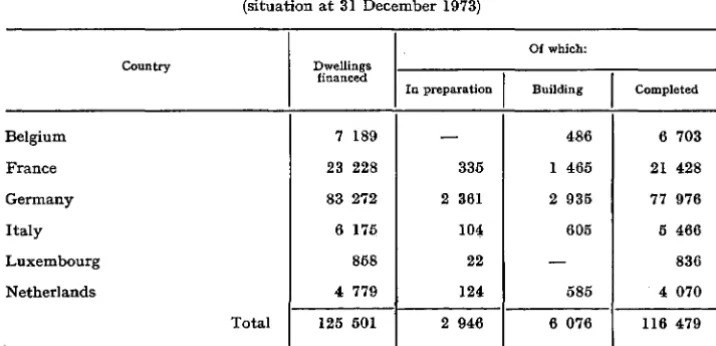
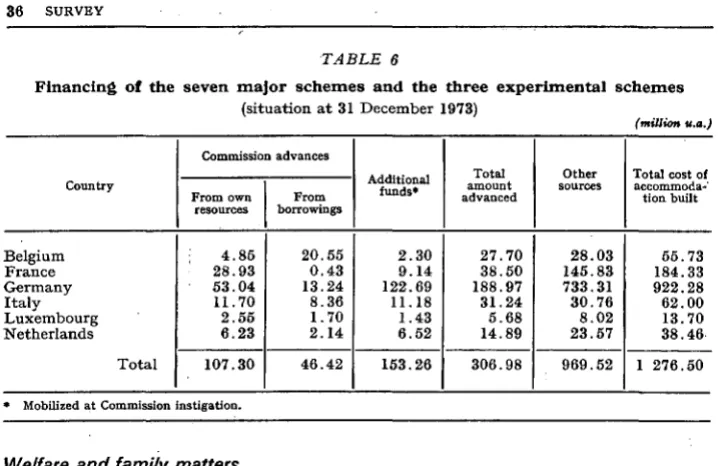
29. The building of houses for workers in ECSC industries was again financed under Scheme VII of which the first portion totalling 13 000 000 u.a.1 has been almost
entirely utilized. The Tables on pages 34 and 363 show how finance was allocated
among the three experimental and the seven major schemes: by31 December 1973 125 501 dwellings had been financed, of which approximately 60% are for renting and 40% for owner-occupation. At the same date the number of completed dwellings came to 116 479.
The experimental programme, relevant to the first phase of the seventh programme dealing with the modernization of existing dwellings, has been carried out in the majority of the participating countries. The final Report of the International Council of Experts on the results will be published at the beginning of 1974.
1 Sixth General Report, point 210. ll See Sixth General Report, point 212. a See Tables 5 and 6, and graph.
As regards the second portion of Scheme VII for which the Commission decided on 22 December 1972 to earmark a total of 20 million u.a., contacts were made during 1973 with the parties concerned including the new Member States for the first time. Thus the Commission was able to decide on 17 December 1973, on the financial allocations amongst the nine Member States by reconciling requests with financing possibilities.
The Commission has gathered information on accommodation for migrant workers from the Governments on the progress made by the Member States in implementing the Commission's recommendation on housing for workers and their families moving within the Community.1 A fourth report which covered the veriod from
1 January to 31 December 1972 will be distributed in 1974.
Among priorities specified in the working programme for the application of Arti-cle 118 of the EEC Treaty there is a study of the housing conditions of migrant workers. In order to collect the necessary information the Commission, in co-operation with research institutes will prepare a sociological survey, the results of which would be forwarded to the Governments and local authorities.
TABLE 5
Work on the seven major schemes and the three experimental schemes
(situation at 31 December 1973)
Of which:
Country Dwellings
financed
In preparation
I
BuildingI
CompletedBelgium 7 189
-
486 6 703France 23 228 335 1 465 21 428
Germany 83 272 2 361 2 935 77 976
Italy 6 175 104 605 5 466
Luxembourg 858 22
-
836Netherlands 4 779 124 585 4 070
Total 125 501 2 946 6 076 116 479
[image:27.451.50.408.343.516.2]en 0 0
>
r ::c m :a~
31-1-1956 31-1-1957 :u.J.J9!lR ~JI-1-t!):,931-1-1960 31-1-1961
31-t-1962
31-1-1963
31-t-196~
31-1-1965
31-1-1966
31-1-1967 31-ll-1967 31-ll-1966 31-ll-1900 31-12-1970 31-ll-1971
10 000 20 000
GRAPH
ECSC subsidized housing financed and completed
lEI
fSl
El
r
-r
Dwellings fmanced
Dwellings completed
2 000 units
j;;f
~
!Hif~
·
rafi
.
J
;;,f!JiKI;f;j
i,J
;
.
t;;K
.
j;
,
t,;i;;l;l
.
j
;.
r . l
TABLE 6
Financin~ of the seven major schemes and the three experimental schemes
(situation at 31 December 1973)
(millitm ... )
Commission advances
Additional Total Other Total cost of Country funds• amount sources accommoda ... ·
From own
I
From advanced tion builtresources borrowings
Belgium 4.85 20.55 2.30 27.70 28.03 55.73
France 28.93 0.43 9.14 38.50 145.83 184.33
Germany 53.04 13.24 122.69 188.97 733.31 922.28
Italy 11.70 8.36 11.18 :n.24 30.76 62.00
Luxembourg 2.55 1. 70 1.43 5.68 8.02 13.70
Netherlands 6.23 2.14 6.52 14.89 23.57 38.46
Total 107.30 46.42 153.26 306.98 969.52 I 276.50
• Mobilized at Commission instigation.
Welfare and family matters
30. From 4 to 6 December the Commission organized in Brussels a European seminar for about ·40 social workers specialized in dealing with migrant workers and their families. The aim was tG foster contact with social workers from the new member countries. The .Commission· cooperated in European meetings and symposia organized by specialist bodies on social aspects of migration. In addition, it invited the Governments of Member States to report on action taken on migrant workers between 1971 and 1973 by these social services1 so that it could draw
up a fifth report.
The Commission included new Member States in its scope of studies. A case in point was the almost complete study on the social problems of elderly people. A specialist institute was commissioned to produce a system for analyzing efficiently the 'Fourth World', i.e. the population sectors which fail to benefit from improved living standards in the Community countries.
The prin~ipal measures taken by new ~ember States' social services and their -policies on families were recorded. Contacts were established with organizations working in these fields. The Commission participated in the 13th Conference of European Ministers responsible for family matters. The Conference was primarily ·Concerned, with the prevention 01 social maladjustment among young peopl~.
[image:29.450.50.409.59.292.2]SOCIAL ACTIVITIES OF THE COMMISSION IN IG78 37
Common health and safety policy
Handicapped persons
31. On the basis ofthe interim report drawn up in 19721 the Commission has adopted
and submitted to the Council a six-year action programme entitled 'Employment of the handicapped in a free market economy'. A further seminar for rehabilitation officials was held in Mulhouse between 10 and 14 December 1973. It made an outstanding contribution to prepari.!lg the implementation of this programme. Community action however could not be restricted solely to handicaps compatible with normal work. Problems raised by the most serious illnesses and. injuries were dealt with on the basis of clinical data and medical rehabilitation. The study and information sessions on 'the traumatology of work' held in Luxembourg in April contributed to existing knowledge and practical experience of traumatic lesions.
Industrial medicine
32. The Commission after consulting labour and management representatives, and government experts, adopted themes for two new research programmes: 'Trauma-tology-Rehabilitation' and 'Ergonomics'. The latter programme may start at the beginning of 197 4. The current research programme on chronic respiratory diseases will be rounded off by the participation of British scientists whose projects have been studied by the Commission's departments and advisory committees. The epidemiological studies of pulmonary diseases have been considerably enriched by the contribution of British research. The Working Party on Rehabilitation published a guide to the rehabilitation of chronic inadequacies which is intended for doctors specializing in industrial medicine and rehabilitation centres.
Community ergonomic research was extended by forming a new iron mines research team and publishing results obtained by ergonomic teams working in the coal and steel sectors. The Working Party on ECSC medical services initiated a study of methods of assessing industrial noise, It began, in conjunction with the Infor-mation and Safety Centre of the International Labour Organization (ILO), to give industrial medical specialists more information. The standardization of ergonometric tests was supplemented by a new edition of the 'Aide-memoire'. This included new techniques for the functional investigation into the respiratory system in the fields of preventive medicine and detection.
1 Sixth General Report, point 215.
Industrial health
33. The third research programme on health in mines, which was adopted by the Commission on 28 July 1971, began to register its first practical achievements in 1973. On 27 September the Commission approved the allocation of 1 900 441.83 u.a. to finance 32 projects which covered most research programme sectors and particularly the technical prevention of dust in mines. Some of the projects concern combating dust levels during production, the measurement and physics of dust, and the epidemiology of miners' pneumoconioses. One project concerns ventilation. in iron mines and is linked with conditions of hygiene in underground workings.
The working parties set up to survey this kind of research met in Hasselt in March to study the new techniques of seam infusion, in May in Briey to examine progress in the prevention of leakages of nitrous gases in iron mines, in June in Verneuil-en-Halatte for an information session on recent work and projects on the measurement of dust levels, in Berlin in October to clarify the problem of the use of additives (wetting agents and evaporation retarders) in the campaign against dust emission. A record of the information sessions on the technical prevention of dust in mines held in October 1972 was published.1
Under the second research programme on the technical prevention of air pollution in the iron and steel industry the Commission approved the allocation of 640 674.56 u.a. for the financing of four schemes, thus bringing total allocations under this programme to 3 749 310.15 u.a. A brochure published in 1973 recounts the progress of this research programme.• It was decided to organize information sessions on this subject in Luxembourg in September 1974.
The Commission, in order to extend the second research programme decided to promulgate a third five-year programme pursuant to Article 55 of the ECSC Treaty, on the 'technical prevention of pollution in the iron and steel industry'. A total of 10 million u.a. will be allocated to this programme. In addition to methods for preventing air pollution it will include research into the prevention of water pollution and into industrial noise abatement. This programme will start early in 1974.
Industrial safety
34. The Commission has arranged for a series of case studies permitting detailed comparisons between industrial· accidents suffered by national and by foreign
1 Publication EUR 4957 (Office for Official Publications of the European Communities).
SOCIAL ACTIVITIES OF THE COMMISSION IN 1973 39
workers in 1972. These studies cover 12 undertakings belonging to four different industrial branches and employing 260 000 workers, 20% of whom are migrant workers._
The technical preparatory work on the- harmonization of safety signs and notices in undertakings was completed, as was the comparative study of the structures and responsibilities of safety services in the enterprise. These studies must be extended to include the new member countries before any concrete implementation can be envisaged.
The production of a Community accident prevention film, which will deal with the transport and handling of dangerous and heavy products, was organized in conjunction with the nine member countries.
Work continued on framing a European code of good practice in agriculture. Safety requirements for the construction and use of a range of agricultural machinery were defined. Preparatory work on the use of pesticides is under way and a start has been made on the examination of electrical equipment on farms.
The in-training programme for factory inspectors which was organized in 1973 was adapted to the enlarged Community. Accordingly, representatives of the original and new member countries met for the first time to discuss general problems in industrial safety and medicine. Fifty high-level officials participated in this programme.
On 12 September the Commission took two decisions relating to mine safety pro-grammes. The first allocated 234 332 u.a. to a joint research programme on the rescue of trapped miners by large-diameter boreholes which was put forward by CERCHAR (the study and research centre of the Charbonnages de France) and by Bergbau-Forschung of Essen, and the second allocated 317 027 u.a. to the joint research programme on triggered barriers presented by CERCJ:IAR, the Versuchsgrubengesellschaft mbH in Dortmund and Iniex at Liege. The two programmes will continue the work begun in 1969.
The Committees of Experts in Mine Safety met in February in Luxembourg and in May in Verneuil-en-Halatte to discuss mine fires and in December in Dortmund to discuss explosives and explosions. ·
Steel Industry Safety and Health Commission
35. The Commission met on two occa.Sions in Luxembourg. On 15 January it adopted the overall conclusions arrived at by the Working Party on Rescue and gave it a mandate to review and update its document every two years. On 10 July the Commission adopted its Fourth Report to the European Parliament and. also
the conclusions arrived at by the Working Party on Oxygen on hoses for oxygen. Finally, it discussed its future programme details.
During the year the following documents were distributed: the British Steel Corpor-ation's prevention policy; adoption and use of measures to protect personnel; design, construction, installation and use of pressurized oxygen equipment; rescue; bibliography; transport and handling.
Mines Safety and Health Commission
36. In 1973 the Mines Safety and Health Commission approved the following documents:
(i) amendments to the memo on the relevant information to be sought during surveys on fire-damp and dust explosions;
(ii) roof control: the interim report on the statistical comparison of fatal and serious accidents caused by rock falls between 1969 and 1971 in the enlarged Community;
(iii) as regards mine fires: the comparison of specifications arid testing methods for belt conveyors.
The following work was completed by the working parties and will be submitted to the Safety and Health Commission: methods and common criteria for testing the fire-resistance of conveyor belts in the enlarged Community; haulage powered by linear-motors; directives on the conditions under which exemption from raising the maximum permitted fire-damp limit may be granted.
The Mines Safety and Health Commission studied the most recent cases of group accidents and has sent a working party of experts to coal mines where disasters have occurred as a result of instantaneous outburst and rock bursts. It has also examined British methods of safety improvement including a mobile exhibition.
It supported the preparation and implementation of safety campaigns in three coal-mining areas in continental Europe.
Information sessions prepared at the request of miners' trade unions on comparative working and safety conditions were held in Newcastle (United Kingdom) between 17 and 20 September 1973.
Finally, the Safety and Health Commission favoured the extension of its responsi-bility to all underground mines and the entire extractive industry.