EUROPEAN ECONOMIC COMMUNITY EUROPEAN ATOMIC ENERGY COMMUNITY
COMMISSION
Report on the Development
of the Social Situation
in the Community in 1974
(Addendum to the 'Eighth General Report on the Activities of the European Communities' in accordance with Article 122
of the EEC Treaty)
A - Introduction 5
B - Outline of activities by the Commission of the European Communities in the social field
in 1974 15
C - Development of the Social Situation in 1974 37
Chapter I - Employment (including migrant workers) 39
Chapter II - Vocational training 65
Chapter Ill -Industrial relations 80
Chapter IV -Working conditions and labour law 106
Chapter V - Wages and asset formation 120
Chapter VI - Housing 141
Chapter VII - Family affairs 152
Chapter VIII- Social services 164
Chapter IX - Social security 175
Chapter X - Industrial safety, medicine, and hygiene 191 Chapter XI 1 Protection of health and of the environment 203 D- The Development of the Social Situation in figures (with observations) 215
I - Population 218
II - Education and research 224
I l l - Employment 228
IV- Industrial relations and working conditions 237
V - Incomes-labour costs 245
VI - Standard of living 251
VII- Housing 254
VIII- Health 258
IX- Social protection 262
X - Social accounts 266
Index of Graph and Tables in the Text 271
Index of Key Words 273
Summary of contents 279
inflationary tendencies, rising unemployment in nearly all Member States and balance of payments difficulties in most of them. By the end of 1974, total unemployment in the countries of the European Communities had reached a peak of almost four million persons out of work, and consumer prices increased during the course of 1974 in some countries by nearly 20% and even more. This deterioration of the economic and social conditions, which to a certain extent has been aggravated by the new situation in the energy sector, has been felt particularly by certain industrial sectors and special groups of the total and the working populations.
The sectors mostly suffering from the slowing-down of demand and activity included the motor vehicle, textile, clothing and building industries, and among the categories of workers threatened by unemployment there was an increasing number of young and older workers, women and-by the end of the year-also migrant workers. The accelerated price increase, on the other hand, had a growing impact on the economi-cally weaker groups of the population, and more especially the non-active people irrespective of their entitlement to social benefits, such as the unemployed, handicapped, sick, those suffering from employment injuries and occupational diseases, the retired and others, as well as workers with lower wages and salaries.
·These difficulties underline the need for strong and vigorous action in the social field
as foreseen in the Social Action Programme agreed by the Council at the end of 1973, for which 1974 was the first year of implementation.
2. This necessity has also been recognized at the Summit meeting of the Heads of Government of the nine Member States held in Paris on 9 and 10 December 1974, at which they declared that they 'reaffirm the importance which they attach to implementation of the measures listed in the Social Action Programme approved by the Council in its Resolution of 21 January 1974'. This declaration reflects the confidence of all Member States in the Social Action Programme, and in its potential in the war against rising unemployment and increasing prices with all the inevitable side-effects.
3. The various reforms envisaged by the Social Action Programme are to be realized in stages in the period from 1974 to 1976. During 1974 the Commission, together with the other Community institutions and the Economic and Social Committee,
oured to carry out the individual measures according to the timetable laid down in the abovementioned resolution.
Indeed, by the end of 1974 the Council had decided on seven of the nine proposals which had been submitted to it by the Commission before 1 April 1974. At the
Council meeting on 10 June 1974 the first three proposals were adopted concerning: (a) The two decisions and the regulation on action by the European Social Fund
(Article 4) foi migrant workers and for handicapped persons;
(b) the resolution establishing the initial Community Action Programme for the vocational rehabilitation of handicapped persons;
(c) the two decisions on the setting up of an Advisory Committee on Safety and Health Protection at work, and on the extension of the responsibilities of the Mines Safety and Health Commission to all mineral-extracting industries.
As a result of these decisions the progressive road to the attainment of a comprehensive social policy at Community level and of a strengthened Community solidarity amongst the Member States has been opened, and the means by which the road can be travelled have been indicated. The new possibilities, particularly for the Social Fund, have provoked immediate reaction, since they have enabled the Commission to carry out some worthwhile projects already during the 1974 financial year.
4. The Council agreed on a further four proposals of the Commission at its meeting on 17 December 1974:
(d) The directive on the approximation of the laws of the Member States relating to the application of the principle of equal pay for men and women contained in Article 119 of the EEC Treaty;
(e) the directive on the approximation of the laws of the Member States relating to mass dismissals;
(f) the regulation establishing a European Centre for the Development of Vocational Training;
(g) the regulation on the creation of a European Foundation for the Improvement of Working and Living Conditions.
The first two of these decisions are of special importance in that the Council by adopting them has accepted the principle of setting minimum standards in certain social fields by the approximation of national legislations. In fact, the first of the two directives
agreed on by the Council intends to generalize minimum protection standards for women in respect of their right for equal pay, not only by laying down that discrimina-tions still existing in laws or agreements and contracts have to be eliminated, and that the right to pursue equal pay for equal work cannot be frustrated by dismissal, but
also by providing that supervision· of the application of this right has to be ensured by national law.
The second directive, on the other hand, is aimed at achieving greater security of employment of workers by providing that arbitrary mass dismissals cannot be undertaken without a system of prior consultation and notification that will go some to alleviating the consequences of dismissals.
5. The establishment of a European Centre for the Development of Vocational Training will expedite the progressive attainment of the principal objectives of a common vocational training policy, and in particular the approximation of training standards in the member countries. The creation of the Foundation, on the other hand, will stimulate not only more intensive study and concertation, but also more precise analyses and scientific research on all factors affecting the living and working environment. Both the European vocational training ·centre and the Foundation for the Improvement of Working and Living Conditions are extremely useful and necessary instruments for achieving some of the main objectives of the Treaties within the Community.
6. The remaining two proposals have not as yet been adopted by the Council. They are, however, already being discussed by the Council Committees, and it may be expected that a decision on them will be taken at one of the next meetings of the Council of Labour and Social Ministers that will take place in the course of 1975.
These two proposals concern:
(h) a recommendation regarding the application of the principle of the 40-hour week and four weeks annual paid holidays;
(i) a directive on approximation of the le~slations of the Member States on the retention of the rights and advantages of employees in the case of mergers, take-overs and amalgamations.
The proposal for a Council Recommendation is aimed at achieving minimum standards for working hours (the 40-hour week by the end of 1975) and annual paid holidays
(four weeks by the end of 1976) throughout the Community. It was subsequently examined by the European Parliament and the Economic and Social Committee. In the light of their contributions,· an amended proposal has been submitted to the Council and awaits deci~ion.
The draft Directive on the approximation of national legislations on 'acquired rights' of the workers will have far-reaching consequences on the labour law in some of the Member States. Therefore a very intensive procedure of consultation with the Com-munity institutions and others has been an essential pre-requisite before the Council will take its decision.
7. In accordance with the priorities laid down in the Council Resolution concerning the Social Action Programme, the Commission drew up during 1974 a series of new proposals. These were achieved as a result of continuous consultations, which were both formal and informal. The deterioration of the labour market as mentioned above and increasing inflationary tendencies, both of which had a particular impact on the more vulnerable groups of the population, influenced considerably the attitude of the Commission when drafting the actions to be proposed.
The majority of this series of proposals will be submitted to the Council during the first quarter of 1975.
8. In the framework of the first objective of the Social Action Programme-'attainingfull and better e1J!ployment in the Community'-the main proposals which have been or are being prepared include:
(a) The establishment of appropriate consultations between Member States on their
employment policies and the ·promotion of better cooperation by national
employment services.
The need for an improved system of consultation and cooperation between the governments and the employment services has been underlined by the develop-ment of the employdevelop-ment situation in the course of the year. It is for this reason that the Commission has already taken initial action by forming an ad hoc
group of Directors-General for Employment in the Member States which has already met on several occasions to discuss the most urgent current problems concerning employment.
(b) On 18 December 1974 the Commission adopted the Action Programme in favour of migrant workers and their families.
This Programme deals with all the crucial problems connected with migration, the living and working conditions as well as the social and educational problems of migrant workers and their families, both nationals and non-nationals of the Community. One of the main objectives of this programme is the progressive elimination of all existing discriminations against the migrants coming from third countries in living and working conditions, once they have been legally admitted to employment in the Community. To achieve this, the coordination of migration policies of Member States is urgently required.
Another objective of this programme is the granting of some civic and political rights to the migrants: it proposes that all migrants should have the right to participate in local elections, at the latest by 1980, in accordance with conditions still to be defined.
The Commission will, in the course of 1975 and 1976, propose to the Council quite a number of new activities in the various fields concerning the migrant
workers and their families (free movement and employment, social security, health, education and vocational training, social services, housing ... ). This action is now even more urgent, given the difficult economic circumstances of this present time. For this reason. the Commission feels it appropriate that the Community should endeavour to strengthen migrants' rights to equal treatment.
(c) A memorandum on measures to achieve equality between men and women at work. This memorandum is a comprehensive examination of the whole range of areas where action is needed in order to improve the status of women at work. It covers employment, vocational guidance and training, working conditions, social scurity and social services.
Some of the conclusions drawn will need a longer term strategy for their completion. But as an immediate step, the memorandum is accompanied by a draft directive aimed at eliminating any existing discrimination of women in the legislation in the Member States as regards access to employment and vocational training, promotion and working conditions,
9. With regard to the second objective 'Improvement of living and working conditions
so as to make possible their harmonization while the improvement is being main-tained', the Commission has prepared-in accordance with the priorities laid down by the Council in its Resolution-the following activities:
(d) Appropriate consultations between Member States on their social protection policies.
The preparatory work has already been completed: a special working party of 18 highly qualified individual experts, nine of whom represent the national Governments, is to assist the Commission in developing a common long-term perspective and a coherent framework for the diverse Community measures being prepared in the field of social protection. In this context, attention is drawn to the statement made at the Paris Summit Conference on 9 and 10 De-cember 1974, where the Heads of Government have made it 'their objective to harmonize the degree of social security afforded by the various Member States, while maintaining progress but without requiring that the social systems obtained in all Member States should be identical.'
(e) An initial programme on health and safety at work.
The prevention of employment injuries and occupational diseases is another very important aspect of the 'quality of life'; the establishment of an initial programme on health and safety at work on the basis of and in collaboration with the Joint Committees and the Advisory Committee on Safety and Health set up by the Council decision of 10 June 1974, has been recognized therefore as a priority action. This programme will provide the basic framework for the preparation of specific activities to be carried out in stages.
(f) A programme of pilot schemes and studies to combat poverty in the Community. The purpose of this limited programme of pilot schemes is to develop clearer perceptions as to the causes of poverty and to encourage Member States them-selves to develop new techniques to overcome severe deprivation where it exists. (g) Finally, a memorandum on 'humanization at work' is to be submitted to the
Council during 1975.
In order to facilitate the preparation of this memorandum, the Commission organized a conference of experts on 'Work organization, technological develop-ment and motivation of the Individual' in Brussels over the period 5 to 7 N ovem-ber 1974. Further discussions with the representatives of both sides of industry are still to take place before the initial proposal will be drafted. The memp-randum will try to indicate steps that should be taken in order to offer to the workers greater job satisfaction and increased involvement in decision-making, both in private enterprises and in the public sector.
10. Although not included in the list of priority actions laid down in the Council Resolution, the Commission has communicated to the Council on 4 December 1974:
(h) the first European Social Budget.
The main purpose of this Social Budget is to give a greater knowledge of the present trends in the Member States up to the end of 1975 in the development of expenditures (and the financing of them) for several sectors of social policy, and especially social security. As the forecasts from 1973 to 1975 have been made on the assumption of existing legislation and on the basis of the economic forecasts made before the energy crisis, the Commission has proposed to the Council to update the data used in this first Social Budget by taking into account new legal measures taken in the meantime as well as the profound economic and social changes caused by the new circumstances; at the same time the Budget should be
extended to the year 1976. ·
11. The Conference on future European Social Policy, which was held in Brussels on 16 December 1974 and which was attended by the Ministers of Labour of the Member States of the Community, representatives of the Commission as well as those of workers' and employers' organizations, provided a new impetus towards the third
broad objective of the Social Action Programme, namely to 'increase the involvement of management and labour in the economic and social decisions of the Community, and that of the workers in the operation of an enterprise'.
(i) One important conclusion reached was the unanimous decision to reactivate the Standing Committee on Employment as soon as possible in order to discuss the very urgent problems still to be solved in the field of employment.
This Committee, in fact, has not been convoked for more than two years. A first meeting of the enlarged Standing Committee of Employment for the Community of the Nine took place during February 1975; it had an intensive exchange of views regarding two Commission proposals for actions in the field of employment: the action programme in favour of migrant workers and the intervention of the European Social Fund in favour of industries strongly affected by the economic crisis.
(J) At this Conference, moreover, both the employers' and the workers' represent:-atives were encouraged to hold joint sectoral meetings so that they could coordinate their efforts in respect of problems arising in the various industrial branches.
The Commission, for its part, will shortly submit a communication to the Council concerning the convocation of such joint meetings particularly in those branches where the economic activity has declined.
12. It is emphasized that the Commission considers that the guidelines laid down in the Council Resolution of 21 January 1974 do not constitute a limit to the Com-munity's activity in the social field and that the Commission always retains its right of initiative to make proposals as and when necessary. In the present situation, where serious employment problems affect certain regions, industries and categories of workers, it is proposed to use part of the resources available to the European Social Fund (Article 4) where the employment situation has been particularly affected by the present economic crisis. In the opinion of the Commission, this new measure should be sufficiently flexible to allow a continual adaptation of the affected industries to the changing situations.
13. By the beginning of 1975, the Commission had already formulated proposals to cover almost one half of the actions enumerated in the Social Action Programme. The renewed emphasis on social policy stressed at the latest Paris Summit Conference encouraged the Commission who will endeavour to elaborate concrete proposals for the majority of actions still outstanding during the course of 1975, with the aim of implementing the complete Social Action Programme before the end of 1976 and within the stipulated time-limit.
Those actions still to be covered include the fields of social security (extension of protection, 'dynamization' of social benefits), the employment problems of special groups of workers (young school-leavers, elderly persons), the social integration of the handicapped, incomes and asset formation, public health, housing as well as implementing proposals arising from the general programmes for migrant workers, for women at work, and for protection against radiation and of the environment.
14. In 1974 the social problems reached such dimensions that it has become more
than ever essential that all Community policies are directed to the achievement of the three main social objectives determined at the first Paris Summit Conference in 1972. The main targets of economic and monetary policy at national as well as Community level are therefore essentially the fight against inflation and rising unemployment. Furthermore, many social problems existing in the countries of the Community could be alleviated by a coordinated regional policy. The decisions of the Heads of Government at the latest Summit Conference to put the European Regional Develop-ment Fund into effect from 1 January 1975 were therefore warmly welcomed by the Commission.
15. The gradual and successful implementation of the Social Action Programme which is to continue throughout 1975 and 1976 is certainly a major step towards the establishment of a real European Social Union. Social problems evolve as a result of the ever-changing desires and demands of society, and it is necessary to consider the ment Fund into effect from 1 January 1975 were warmly welcomed by the Commission.
The Commission is already well aware that it is necessary to consider the important question of how the Community policy in the social field is to be developed after 1976. Initial reflections have already been made, further consultations are necessary. The Commission will submit to the other Community institutions the results of all these deliberations in good time in order to permit common discussions leading to decisions on the future European social policy.
B. Outline of activities
by
16. The social year has been dominated by the preparation of a number of concrete proposals for submission to the Council in accordance with the timetable set out in the Social Action Programme adopted by the Council in its Resolution of 21 January 1974.
The Council took its first opportunity to take decisions on these proposals at a meeting of Social Ministers in June. It was decided to approve three proposals relating to the opening up of Article 4 of the Social Fund for handicapped workers and migrant workers; the establishment of a General Safety Committee; and the adoption of a programme aimed at the successful integration of handicapped workers into normal working life.
Further decisions were taken at a second Council meeting towards the end of the year when the Council agreed to adopt a directive calling for the harmonization of legislation on equal pay for men and women and a directive on mass dismissals aimed at offering greater protection to workers when threatened with unemployment. The Council also agreed to the establishment of two new bodies, one a European Centre for the Development of Vocational Training, the other a European Foundation for the Improvement of Living and Working Conditions.
Decisions in all these areas virtually completed the first part of the Social Action Programme. The next stage was the submission by the Commission of proposals on a number of other actions which the Council established as priorities. These include the vitally important action programme for all migrant workers whether they are Community nationals or citizens of non-member countries. This programme contains a number of specific proposals for action by the Community.
The programme envisages the implementation of voting rights by 1980 for all migrants in the local elections of Member States and improvements in the social security situation of migrants from non-member countries aimed at progressively bringing about equality of treatment of all people who live and work in the Community.
In accordance with the Council priorities the Commission is in the final stages of preparing a number of actions that will be ready for decision by the Council during 1975. These include a comprehensive programme on equality of treatment for men and women at work. Among the measures being prepared is a new Community instrument aimed at eliminating discrimination against women in access to employ-ment and vocational training.
Similarly, in other fields work has begun on extending social protection within the framework of social security policy, and a programme of pilot projects to promote the alleviation of poverty has been prepared to act as a stimulus to the efforts of Member States in this field.
Unfavourable developments in the economic situation during the year posed serious problems for employment in the Member States.
The first need was to examine the effects that economic disruptions would have on the Community and more particularly on the more vulnerable sections of the population. Early in the year the Commission drew up a report on the possible reper-cussions of the energy crisis on employment, drawing attention to the role of the Social Fund in providing better employment opportunities for workers through training and retraining. The increasing importance of the Social Fund has been under-lined throughout the year not only by the growing volume of assistance it provides in training but in the widening scope of its activities.
Employment was also a major issue at the Conference of Heads of Government which met in Paris on 9 and 10 December, where the continuing importance of a vigorous social policy was reaffirmed.
This theme was again taken up by the important Tripartite Conference held in Brussels on 16 December, when the Commission's paper on 'Prospects for a European Social Policy' became the focal point for a constructive debate between representa-tives of the Governments, Commission and the two sides of industry.
The problem of unemployment is clearly a matter for the involvement of all interests within the Community, and particularly important is the active involvement of the two sides of industry in the search for solutions. In this respect the Commission wel-comes the decision to reconvene the Standing Committee on Employment, the first meeting of which is expected early in the new year.
Social aspects of Community policies in other areas
17. As regards economic policy the Commission was primarily concerned with the problems associated with inflation and the uncertainty surrounding developments in the economy and the employment situation, these problems having been aggravated by the energy crisis. On several occasions the Commission stressed that the fight against inflation had priority over other economic policy objectives and that all sections of the economy and society would have to help in the fight. Since, however, standards of living will probably be affected by the present situation, it is important that sacrifices should be spread equitably among the various sections of the popula-tion. For this reason it was considered advisable to improve protection against unemployment risks and to adopt specific measures on behalf of workers whose jobs are threatened.
I
Proposals have therefore been submitted in the field of industrial policy relating to sectors with serious social problems (e.g. paper, textiles). Likewise, initial proposals have been made for the implementation of the environmental action programme and the consumer protection programme, which both aim to achieve a better quality of
life for the people ofthe Community. ·
The promotion of employment
18. In the second half of the year further general inflation and the first repercussions of the energy crisis reversed employment trends, which were thereafter characterized by a slowing down of the recruitment of workers and by increased unemployment. The Commission undertook a study of the market situation and actively promoted coordination of the national measures already taken in Germany, France and Italy.
Sector-by-sector studies of medium-term employment forecasts were carried out, with provision for a statistical breakdown according to levels of qualification. The results of these studies have been discussed by experts from the Member States. Work also continued on the processing of current employment statistics and short-term employ-ment forecasts. Furthermore, the senior officials concerned with employemploy-ment in the Member States met to lay the foundations for concerting employment policies, in order to define the priorities and, in particular, clarify the operation of the European Social Fund.
European Social Fund
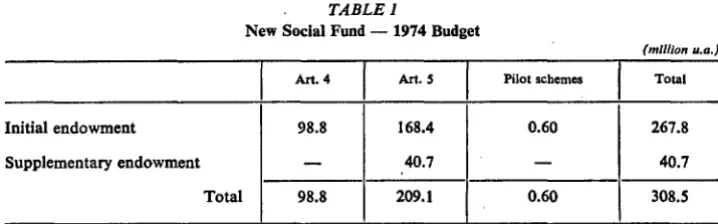
[image:16.446.34.393.460.572.2]19. Under Article 5 of the Decision of 1 February 1971, the appropriations for the new European Social Fund had been initially set at 168.4 million units of account. However, acting on a proposal from the Commission, the Council agreed, by a decision taken in September, to carry forward to the current budgetary year the special appropriation of 40.7 million units of account which had been made available in 1973 for the purposes of Article 4 and to transfer this sum to Article 5 for 1974:
TABLE 1
New Social Fund - 1974 Budget
(million u.a.)
Art. 4 Art. s Pilot schemes Total
Initial endowment 98.8 168.4 0.60 267.8
Supplementary endowment
-
40.7-
40.7Total 98.8 209.1 0.60 308.5
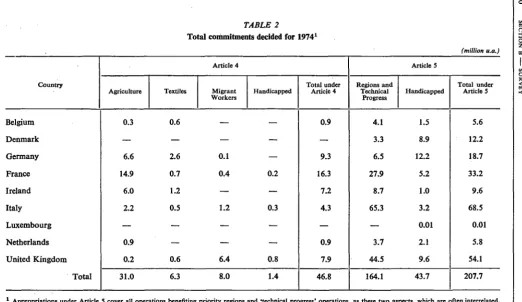
TABLE 2
Total commitments decided for 19741
(million u.a.)
Article 4 Article 5
Country Total under Regions and Total under
Agriculture Textiles Migrant Handicapped Article 4 Technical Handicapped Article 5
Workers Progress
Belgium 0.3 0.6 -
-
0.9 4.1 1.5 5.6Denmark
-
- --
-
3.3 8.9 12.2Germany 6.6 2.6 0.1
-
9.3 6.5 12.2 18.7France 14.9 0.7 0.4 0.2 16.3 27.9 5.2 33.2
Ireland 6.0 1.2 -
-
7.2 8.7 1.0 9.6Italy 2.2 0.5 1.2 0.3 4.3 65.3 3.2 68.5
Luxembourg
-
-
-
-
--
0.01 0.01Netherlands 0.9
-
--
0.9 3.7 2.1 5.8United Kingdom 0.2 0.6 6.4 0.8 7.9 44.5 9.6 54.1
· Total 31.0 6.3 8.0 1.4 46.8 164.1 43.7 207.7
- - - -L _ _ _
:g
1 Appropriations under Article S cover all operations benefiting priority regions and 'technical progress' operations, as these two aspects, which arc often interrelated, n cannot be broken down in a simple table. The third report on the activities of the new European Social Fund during 1974, to be published in the spring of 1975, will>
provide all other relevant information.,....
:Il
m
::a
~
CD ...
~
gJ (')
::l
~
=
I
[image:17.644.69.591.54.356.2]The second report on the activities of the new Social Fund, covering 1973, was for-warded to the Council and to Parliament, in accordance with the decision setting up the Fund.
On 10 June 1974 the Council, acting on a proposal from the Commission, took two decisions on the granting of assistance from the Fund, under Article 4 of the Decision of I February 1971, towards certain specific measures on behalf of handicapped persons and migrant workers.
The amount of assistance applied for from the new Fund for operations to be carried out in 1974 under Articles 4 and 5 of the Council Decision of I February 1971 totalled 406.8 million u.a., of which 46.7 million u.a. was granted under Article 4 (agriculture 31.0 million u.a., textile industry 6.3 million u.a., migrant workers 8.0 million u.a., handicapped persons 1.4 million u.a.), and 207.7 million u.a. under Article 5 (of which 164.1 million u.a. was earmarked for assistance to declining regions, industries affected by technical progress, or groups of undertakings in difficulties, and the remainder, amounting to 43.6 million u.a., for handicapped persons).
During the financial year under consideration the Commission examined applications involving a total of approximately 406.8 million u.a. and, after consulting the Com-mittee of the European Social Fund, approved these applications as far as the finan-cial resources available permitted. The total amount of assistance thus granted is 254.5 million u.a., allocated as shown in table 2.
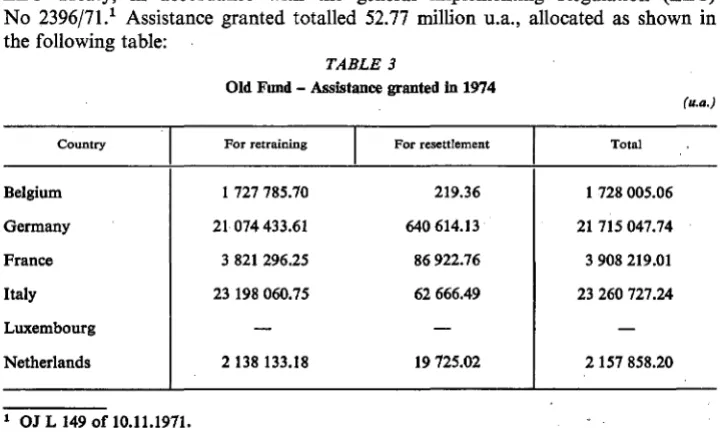
20. The former Social Fund has continueq its activities under Article 125 of the EEC Treaty, in accordance with the general implementing Regulation (EEC) No 2396/71.1 Assistance granted totalled 52.77 million u.a., allocated as shown in
the following table:
Country
Belgium Germany France Italy Luxembourg Netherlands
1 OJ L 149 of 10.11.1971.
SOCIAL REP. 1974
TABLE 3
Old Fund- Assistance granted in 1974
For retraining
I
For resettlement 1 727 785.70 219.36 21 074 433.61 640 614.13 3 821 296.25 86 922.76 23 198 060.75 62 666.492 138 133.18 19 725.02
Total
1 728 005.06 21 715 047.74 3 908 219.01 23 260 727.24
2157 858.20
[image:18.442.31.391.362.580.2]Community assistance for redundant workers dismissed from the Italian sulphur mines1 totalled 146 492.8 u.a. paid to the Italian Government in 1974.
Finally, for 1975 the European Social Fund has a budget of 320 million u.a., of which 110 million u.a. have been allocated for assistance under Article 4 and 210 mil-lion u.a. for assistance under Article 5. Following consideration by Parliament an additional 35 million u.a. for Article 5 was added, bringing the total of resources for the Fund to 355 million u.a. There are also 13.4 million u.a. for the operations of the 'old Fund' and 0.9 million u.a. for the carrying out of studies or pilot schemes.
21. More than 95% of the assistance granted from the European Social Fund is for the launching and development of vocational training programmes in the Member States. In order to ensure a full return on the growing resources of the Fund, the Commission has set about defining criteria for the assessment of their effectiveness; in this task the Commission has the help of a group of national experts, who have analysed a number of Social Fund projects.
22. New interventions by the Social Fund were also proposed by the Commission during 1974 and specific decisions under Article 4, 2 the one relating to migrant workers
and the other to handicapped persons, 3 were taken by the Council. Both decisions came into force on 14 July.
Pursuant to Article 7 of the Regulation implementing the Council Decision on the reform of the European Social Fund, the Commission has initiated a number of pilot schemes and studies mainly concerned with the integration of migrant workers, the readaptation of handicapped persons, 3 training in the data-processing field, multi-skill training in certain sectors and the reintegration into employment of women aged over 35.
Towards the end of the year the Commission organized a seminar on data processing and the training of adults. Discussion centred mainly on staff training problems posed by the changeover to computerized systems and the development of computer applica-tions. The purpose of this seminar was to provide the Commission with a factual basis on which to decide whether specific interventions by the Social Fund in this sector would be appropriate.
1 OJ 246 of 31.12.1966; Report on the Development of the Social situation in the Community in
1973, point 20.
2 OJ L 185 of 9.7.1974.
a Bull. EC 6-1974, points 2211 and 2212.
Retraining and re-employment of workers
23. The United Kingdom Government and the Commission concluded an agree-ment under Article 56(2)(b) of the ECSC Treaty providing for assistance to miners affected by pit closures in the United Kingdom. The agreement provides for the same type of assistance towards retraining and re-employment as the agreements concluded with other Member States of the Community.
The shortage of young miners has meant that, of all the forms of assistance available, only those have been used which make possible the transfer of young miners to other collieries and those available for unemployed workers, which enable elderly miners, whose re-employment would pose serious problems, to retire early. Although the assistance granted per miner is linked to wage trends, the total amount of assistance has levelled off because of the slowing down of pit closures as a result of the energy shortage.
Redevelopment of undertakings and re-employment
24. During 1974 the Commission granted redevelopment loans to the amount of92.5 million u.a. in order to help create about 7 500 jobs in various regions where ECSC industries are located. The obligation incumbent upon the recipients of these loans to retrain former workers in the coal and iron and steel industries guarantees that priority will be given to resettling about 3 750 people in the undertakings financed in this way.
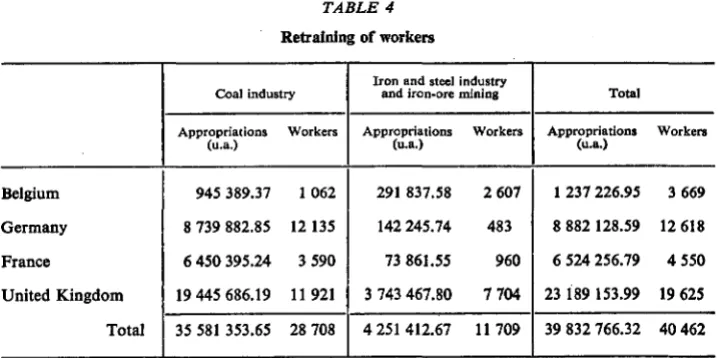
TABLE 4
Retraining of workers
Iron and steel industry
Coal industry and iron-ore mining Total
Appropriations Workers Appropriations Workers Appropriations Workers
(u.a.) (u.a.) (u.a.)
Belgium 945 389.37 1 062 291 837.58 2 607 1 237 226.95 3 669 Germany 8 739 882.85 12135 142 245.74 483 8 882 128.59 12 618 France 6 450 395.24 3 590 73 861.55 960 6 524 256.79 4 550 United Kingdom 19 445 686.19 11 921 3 743 467.80 7 704 23 189 153.99 19 625 Total 35 581 353.65 28 708 4 251 412.67 11 709 39 832 766.32 40462
[image:20.443.35.394.388.567.2]Free movement of workers
25. The positive outcome of the experimental exchange, organized in 1973,1 of
Italian and German civil servants working in employment offices led the Commission to act as patron for the second such exchange and to assume part of the financial cost, this being in line with efforts to develop assisted placement and the clearing of supply and demand within the Community by providing both workers and employers with adequate information.
For the users of SEDOC1 (European international vacancy clearance system) the Commission has prepared an audiovisual programme which will be ready by the end of the year and will help in the training sessions for national and European civil servants so that the system can be operational in 1975. The version of SEDOC adapted for the United Kingdom has also been completed.
Pursuant to Regulation (EEC) No 1612/68 on freedom of movement for workers, the Member States carried out a first exchange of data under the Community system adopted by the Commission on 14 December 1972.
As regards the problems relating to temporary employment, the Member States have, for the first time, exchanged data under the system adopted by the Technical Com-mittee on Freedom of Movement for Workers in its Opinion of 19 February 1974; such data should contribute to a better understanding of this phenomenon and should ensure improved social protection for workers sent out by temporary employment agencies to jobs in other Member States.
The Advisory Committee on Freedom of Movement for Workers met on two occa-sions to examine the draft programme concerning migrant workers. It also approved a draft regulation on the admission of workers from other Member States to leading positions in trade union organizations.
Lastly, the Court of Justice has given judgment in two cases, one (Case 9/74) on equality of treatment in the matter of general education, and the other (Case 167/73) on the regulation concerning freedom of movement in sea and air transport.
Other activities in connection with employment
26. In accordance with the priorities laid down in the Council Resolution concerning a Social Action Programme, the Commission, with assistance from both sides of industry and an ad hoc group, is at present drafting a memorandum to the Council on the measures needed to ensure equality of men and women in respect of access to employment, training, promotion and working conditions. This Memorandum will
1 Report on the Development of the Social Situation in the Community in 1973, point 19.
be accompanied by a draft Directive on the implementation of the principle of equal treatment for men and women in all matters relating to employment with a view to removing all remaining forms of discrimination against women.
Among the initiatives relating to female employment, the Social Action Programme also includes the establishment of a Community Documentation and Information Centre for the purpose of helping to alter the image of working women in the minds of all those concerned-employers, trade unions, public bodies, educational services, women's organizations, journalists, etc. To this end, a preparatory study has already been carried out.
Vocational training
27. An essential part of the Social Action Programme is the implementation of a common vocational training policy. On 17 December the Council approved a regula-tion setting up a European Centre for the Development of Vocaregula-tional Training which will start operating in 1975. This Centre will have the task of cooperating with the Commission in promoting the development of vocational training and continuous education. The governing body will be a Board on which not only the Community institutions but also workers' and employers' organizations will be represented.
A specific programme approved by the Council in June was concerned with the reintegration into employment of handicapped persons by means of vocational training or retraining measures. Provision was made for assistance from the Social Fund and for the setting up of an Advisory Committee with the task of helping to draw up plans for action at Community level.
The action programme for migrant workers included recommendations for improve-ment of the preliminary technical and vocational training given to such workers.
· The draft Commission Memorandum contained provisions relating to basic and advanced vocational training for women.
Among other work carried out, mention must be made of a fact-finding survey on training facilities in southern Italy, the results of which will be available in 1975, and a study of the legal aspects, the organization and the operation of the apprentice-ship system in the Member States. Lastly, in order to increase public awareness of the problems and the work done by the Community in this field, the Commission published the first few numbers of an information bulletin on vocational training.
Work continued as usual on promoting exchanges of young workers within the Com-munity; the Commission is preparing a second joint programme, which should make possible an expansion of such exchange activities in the various sectors of the economy.
General social security matters and European Social Budget
28. In the social security field steps were taken to implement the Social Action Programme. Priority measures included coordination of the social protection policies of the Member States; for this purpose the Commission has decided to set up a group of experts which will begin work in 1975.
Another priority was the implementation, in cooperation with the Member States, of specific measures to combat poverty, including the preparation of pilot schemes. With this end in mind, the Commission organized meetings of experts and in June a seminar was held, in which representatives of public and private organizations took part. Thus the Commission was able to draw up a programme of pilot schemes for 1975 and 1976 on which a Council decision is awaited. Other measures in the social action programme concern the extension of social security to cover everybody, which is the subject of a document at present being examined by the Government experts, and the 'dynarnization' of social security benefits (i.e., linking them to the rise in real incomes), work on which is in progress.
29. At the request of several Member States and in accordance with the Recommen-dation of 23 July 1962, the Commission initiated exchanges of information on a number of problems relating to compensation for certain occupational diseases. In Brussels in September the Commission also organized a medical seminar on the pro-blems posed in an industrial environment by the toxicity of vinyl chloride monomer.
A study is also being made of the relationships between social security and social assistance, and the comparative tables on social security systems now operating in the nine Member States have been updated to 1 July 1974. In addition, the Corn-mission has put its Directorate-General for Economic and Financial Affairs and its Directorate-General for Social Affairs to work on a preliminary study relating to a Community system of assistance towards unemployment benefits.
The Commission, with the assistance of the Government experts, has completed the task of drawing up the first European Social Budget. On the basis of the reports supplied by the Member States, it has produced this first Budget in the form of a summary report. The Social Budget will thus show trends in the Member States from 1970 to 1975 in respect of expenditure and receipts in the sectors covered (social security, social assistance or other social work, benefits for the victims of political events or natural disasters), taking both an overall and a sectoral approach. The Budget accordingly represents the first stage in the development of social forecasts at European level. This first Social Budget was forwarded in December for consideration to the Council, whose Decision of 9 November 19721 led to its preparation. As
regards social security in agriculture, the Commission has worked out, with the help of
1 At its 214th meeting.
a group of experts, a number of proposals which will be forwarded to the Council in the course of the coming months.
Social security for migrant workers
30. The Commission set to work on adaptation of the Community rules1 governing
social security arrangements for migrant workers to trends in current nationallegisla-tion2 and to the international monetary situation. 3 Certain gaps which had been revealed by practical experience were also filled.
In accordance with the aims of the Council Resolution of 21 January 1974, the Com-mission will submit a proposal to the Council for the review of the system of paying · family benefits to family members who have remained in the migrant worker's
country of origin.
As regards migrant workers from non-member countries, on 10 June 1974 the Council adopted the Community Delegation's recommendations on the decision to be taken by the Association Council between the European Economic Community and Turkey regarding implementation of Article 39 of the Supplementary Protocol to the Ankara Agreement. 4
For negotiations with the Maghreb countries the Council has further extended the Commission's mandate so that the social security schemes applying to Maghreb workers within the Community may be coordinated.
In addition to several decisions on the interpretation of Community rules taken by the Administrative Committee on Social Security for Migrant Workers, 5 the Court of Justice gave judgment in seven cases on requests for a preliminary ruling.6
Activities on behalf of migrant workers and their families
31. Before the end of 1974 the Commission submitted to the Council a first action programme on behalf of migrant workers and their families. This programme con-tains proposals for measures to assist migrant workers both from within the Commu-nity and from non-member countries in fields such as social security, housing and the
1 OJ L 149 of 5.7.1971 (Regulation (EEC) No 1408/71) and OJ L 74 of27.3.1972 (Regulation (EEC)
No 574/72).
2 OJ L 152 of 4.6.1974 (Regulation (EEC) No 1392/74).
3 OJ L 283 of 19.9.1974 (Regulation (EEC) No 2639/74).
4 Report on the Development of the Social Situation in the Community in 1973, point 26. 5 OJ C 86 of 20.7.1974, OJ C 99 of 23.8.1974, OJ C 105 of 14.9.1974, OJ C 126 of 10.10.1974,
OJ C 131 of25.10.1974.
6 Cases 184/13, 187/73, 191/13, 24/74, 35/74, 39/74 and 40/74, [1973] and [1974] Recueil.
education of their children. Proposals have also been made with a view to increasing the coordination of Member States' policies towards migrant workers from non-member countries.
In addition to the work relating to migrants which is mentioned in connection with the various aspects of social policy, the Commission had a study carried out on the Consultative Committees of migrants operating under the auspices of municipal councils and brought its assitance to various national or European organizations concerned with help to migrant workers.
Wages and working conditions
32. In the field of wages and salaries, the Commission sent to the Council on 23 July its progress report on the implementation, as at 31 December 1973, of the prin-ciple of equal pay for men and women in Denmark, Ireland and the United Kingdom. In its conclusions the Commission acknowledges the efforts made and the results already achieved, varying though they are, in these three Member States in respect of implementation of the principle of equal pay. It is clear, however, that the position is not yet fully satisfactory in any of the three countries, as could only be expected, especially since the initial position presented many problems. With regard to these three countries the Commission has therefore confirmed the guidelines laid down in the conclusions to its report on 31 December 19721 and has particularly stressed the
need for the whole range of practical measures proposed.
The proposal for a directive on approximation of the legislations of Member States concerning the principle of equal pay, as advocated in the conclusions to the above-mentioned report and forwarded to the Council in accordance with the Social Action Programme, 2 was discussed by the Economic and Social Committee on 28 March and
by Parliament on 29 April. Both these institutions, while suggesting amendments, decided in favour of the proposed Directive. In order to take account of their opinions, a revised version of the proposal was forwarded to the Council, which approved it on 17 December 1974.
Furthermore, on 19 November the Commission sent to the Council a working docu-ment on the systems for adapting wages and salaries to the cost of Iiving3
•
In addition, on 17 December the Council also approved a directive designed to protect workers in the event of mass dismissals. 1
1 Report on the Development of the Social Situation in the Community in 1973, point 28.
2 Idem., point 16.
3 Bull. EC 11-1974, point 2220.
33. On 31 May the Commission submitted to the Council a proposal for a directive on the retention of rights and privileges by workers in the event of mergers, transfers and amalgamations of undertakings.
The Commission forwarded to the Council a report on certain technical aspects of working hours (country-by-country comparisons, paid and unpaid breaks and absences).
In the light of the Opinions given by the ESC and by Parliament, the Commission amended its draft regulation on the establishment of a European Foundation for the Improvement of Living and Working Conditions. The Council approved it on 17 December.
Industrial relations
34. The European employers' and workers' organizations were consulted on the
following matters: the setting up of a European Centre for the Development of Vocational Training; a proposal for a directive on the retention of rights and privileges by workers in the event of mergers, transfers and amalgamations of undertakings; an action programme for migrant workers; a set of measures designed to ensure equality between men and women as regards access to employment, vocational training and career advancement and as regards terms of employment, including pay; a first action programme relating to hygiene, industrial safety, workers' health, and job improve-ment, with special reference to those sectors where working conditions seem most arduous.
35. In connection with the collection and analysis of the collective bargaining agreements, 1 the representatives of the competent national centres met to find a joint solution to the problems arising at national level during this initial phase of drawing up the European Card Index of Collective Agreements.
36. In spite of the Commission's efforts to set up new joint committees whose work would facilitate the conclusion of European collective agreements, it is proving difficult to achieve rapid results. Respect for the autonomy of the two sides of industry and the confused situations arising when sectoral regroupings take place at European level, both on the workers' side and on the employers' side, are liable to delay the setting up of a broader system of sectoral relations. At the present stage of the Social Action Programme, the function of these committees is to examine how the pro-gramme can be implemented in each sector and, in conjunction with this, to study the problems affecting employment, harmonization of terms of employment, safety, vocational training, etc. It was with this in mind that the Commission departments
1
Report on the Development of the Social Situation in the Community in 1973, point 28.
dealing with social affairs went about their work in this field. Notable results1 were achieved in this connection within the seven existing joint committees and those now coming into operation.
On 25 July the Commission decided to lay down new rules of procedure for the Joint Committee on Sea Fishing and the Joint Committee on Agricultural Wage-earners so that they could deliver opinions on their own initiative and encourage contacts and cooperation between the parties represented. 2 As a result of suggestions by these Committees, an agricultural safety week was organized and, in the case of sea fishing, the means of medical, technical and meteorological assistance at sea were coordinated.
Housing
37. The building of low-cost housing for workers in ECSC industries was further financed and the second instalment of Scheme VII fully committed. For the first time, the financing operations included the modernization and, on an exceptional basis, the purchase of existing housing, special account being taken of the results of the 'Modernization of housing' experimental scheme, which the Commission has just decided to publish.
Almost the entire amount of 20 000 000 u.a. constituting this second portion was allocated in accordance with the priorities laid down by the Commission: housing for the new steel complexes in coastal regions, housing as part of the restructuring scheme for coalfields or traditional steel-producing centres, housing for migrant workers and the modernization of existing housing within the framework of urban renewal.
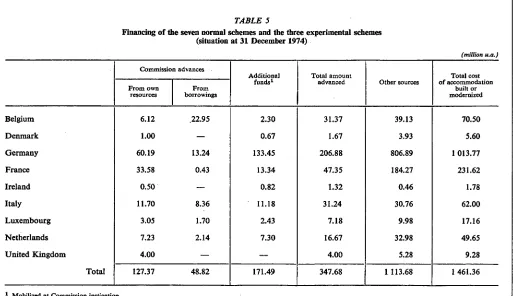
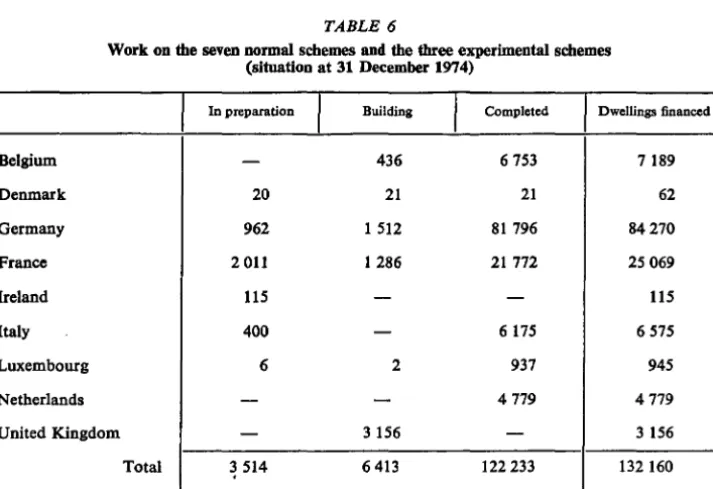
Tables 5 and 6 give details of implementation of the seven normal schemes and the three experimental schemes. In the three new Member States ECSC housing schemes were integrated into local authority schemes.
On 15 November the Commission decided to launch an eighth ECSC housing scheme, consisting of two operational instalments covering the periods 1975/76 and 1977/78. The Commission earmarked 25 million u.a. for the first instalment, the objectives of which are appreciably the same as those of Scheme VII, althqugh made more urgent by the new lease of life being given to the coal industry as a result of the oil crisis.
Since the part of the Social Action Programme dealing with housing provides for pilot schemes to assist particularly under-privileged groups, above all migrant workers and handicapped persons, two schemes were undertaken in 1974. The fourth report on action on the 1965 Recommendation3 was completed and will be distributed shortly.
1 Bull. EC 4-1974, point 2213; Bull. EC 6-1974, point 2229 and Bull. EC 11-1974, points 2224 to 2231.
2 OJ L 243 of 25.9.1974. 3 OJ 137 of 27.7.1965.
·:;::::>"'" _______ -
--en
0
0
>
.... :n m :0-
"'
...
"'"
Belgium Denmark Germany France Ireland Italy Luxembourg Netherlands United Kingdom Total 1 Mobilized at Commission instigation.TABLE 5
Financing of the seven normal schemes and the three experimental schemes (situation at 31 December 1974)
Commission advances
Additional Total amount
I
funds1 advanced Other sources
From own From
resources borrowings
6.12 22.95 2.30 31.37 39.13
1.00
-
0.67 1.67 3.9360.19 13.24 133.45 206.88 806.89
33.58 0.43 13.34 47.35 184.27
0.50
-
0.82 1.32 0.4611.70 8.36 11.18 31.24 30.76
3.05 1.70 2.43 7.18 9.98
7.23 2.14 7.30 16.67 32.98
4.00
-
-
4.00 5.28127.37 48.82 171.49 347.68 1113.68
-(million u.a.)
Total cost of accommodation built or modernized 70.50 5.60 1 013.77 231.62 1.78 62.00 17.16 49.65 9.28 1 461.36
~
t"" >B
~
gm
I
~z
~
[image:28.642.65.578.51.347.2]TABLE 6
Work on the seven normal schemes and the three experimental schemes (situation at 31 December 1974)
Belgium Denmark Germany France Ireland Italy Luxembourg Netherlands United Kingdom Total
In preparation
20 962 2011 115 400 6 3 514
Social services and family matters
Building 436 21 1 512 1286 2 3 156 6 413
Completed Dwellings financed
6 753 7 189
21 62
81 796 84270 21 772 25 069 115 6 175 6 575
937 945
4 719 4779
3 156 122 233 132 160
38. Since the Social Action Programme accords priority to improvement in the
living conditions of migrant workers and their families, the Commission organized in Munich a European seminar which was attended by about forty social workers who were specialists in this field. The fact that the European Social Fund is now empow-ered to support aid for the training of social workers and of teachers for migrant children is likely to promote progress in these areas.
On a more general level, comparison of the social work measures taken in the Member States to assist in particular the most underprivileged sectors of the population was continued and contacts were made with the European representatives of the Inter-national Federation of Social Workers. Cooperation with COFACE (European Com-munities Committee of Family Organizations) mainly involved the family aspects of the Social Action Programme. In connection with the problems of female employ-ment, the question of day-nurseries and other childminding facilities was examined.
[image:29.448.52.409.68.312.2]n
( •lluatton at)
>
r-;D
m
31·1·1956
;-a ~ <D
... 31+1957
""
31-1-1958
3t.l-1959
31-1-1960
31-1-1961
31-1-1962
31-1-1963
31-1-1~
3t-1-t965
31-1-1966 31-1-1967
31-12-1967
31-12-1968
31-12-1969
31-12-1970
31-\_2-1971
31-12-1972 31-12-1~73 31·1H974
GEl
II
B
I I
D...runp linancod
Dwellings completed
2 000 units
·.·.z_.:~~t%=;~
·
;;.q~
~lmt:=~:t:xtmJw ==::::· ··=·=:mfi~,,
':w.j;:}]\;]:~;;;j:::::; ~=l~a:;:?:L'I~:W1~:Zt::=::.f::;,:f:X:l::s:l~:~:l~::::t:~:::F~:=I=:=:.::f::::::J:~:f.'!:<F='"·I
-~~~];~~~ ~:::::I.r::E:l;Simi'&::J:::.~ :W.I?;;.,-1;}.)-n'.l' ·=t~4~~r-~
:::.~:t=:=:e =::;;::• :..;;-;: =~~:l~ii:~Ua:t-· ,,.,.,.~~llM@Dl~J:~::I":::'tM~miltltm:t:::::I:@E4=~:f::~f=:;;;tmtf:;U:Is=::~t~·
:ft:~:-· -~~,::1~)$~'::.:
'~->."IM:0
10000 :1()000 30000 40.000 50 000 60 000 70 000 80 000 90 000 100000 110 000 120000 130 OQO 140 000
Common health and safety policy
Handicapped persons
39. On 27 June 1974 the Council adopted a Resolution establishing a first Com-munity action programme for the vocational retraining of handicapped persons. 1 The Commission took the first measures to implement this programme. A study was also undertaken on the standards of housing for physically handicapped persons and, in addition, an experimental programme for the adaptation of housing to the needs of such handicapped persons is under consideration.
Industrial medicine, health and safety
40. Information sessions dealing with the 'Quality of the environment in the iron and steel industry - Results and prospects' were held in Luxembourg from 24 to 26 September. The 500 people attending the sessions confirmed the importance attached by the industry to the campaign against nuisances.
Two new ECSC research programmes were adopted in 1974: one concerns the 'Technical prevention of pollution in the iron and steel industry', to which I 0 million u.a. were allocated, and the other concerns ergonomics and readaptation, to which 9 million u.a. were allocated. The Commission decided to grant financial aid to a first tranche of projects contained in these programmes and also to projects provided for in the previously adopted programmes on 'Chronic respiratory ailments' and 'Industrial health in the mining industry'. Finally, aid was granted to mine safety research programmes on triggered barriers and mine fires.
The in-service training programme for factory inspectors was continued in 1974.
In accordance with the Resolution concerning a Social Action Programme, 2 the Commission proposed a first Community programme of measures regarding safety, health and health protection at work.
'Steel Industry Safety and Health Commission
41. The Steel Industry Safety and Health Commission met on 6 March and 12 July and approved codes of good practice for the tapping of pig-iron at blast furnaces and for filters, storage tanks and measuring instruments used in oxygen lines. A survey has begun among iron and steel undertakings in the Community and elsewhere regarding the pressure system used in oxygen lines. Finally, a documentary film illustrating the principles of accident and disease prevention was made and approved, as was also a check list relating to the organization of prevention in undertakings.
1 OJ C 80 of 9.7.1974.
s OJ C 13 of 12.2.1974.
Mines Safety and Health Commission
42. On 10 June the Council decided to entrust the Mines Safety and Health Com-mission with the responsibility for the prevention campaign in all the extractive industries. 1 The Commission began its study of its new responsibilities, and also
approved the following in 1974: directives for constructors of winning and tunnelling machines with a view to reducing dust formation; the information reports on protec-tion against coal-dust explosions by means of explosion barriers and the propulsion of conveyer trains by linear motors; and two reports concerning the testing of textile-ply belt conveyer and hydraulic transmission fluids.
Advisory Committee on Safety, Hygiene and Health Protection at Work
43. The Council decided to set up this Committee on 10 June1 and is at present
deciding on the nomination of members.
Paul Finet Foundation
44. Between its establishment in 1965 and the end of 1974 the Administrative Board of the Paul Finet Foundation examined 5 750 applications and granted financial aid in 4 100 cases, totalling around Bfrs 32 500 000, towards the studies of orphans of workers in the ECSC industries who had lost their lives owing to an industrial accident or occupational disease.
Health and Safety protection (Euratom)
45. The protection of workers and the public against radiation remains an important problem in tackling which the Commission, under the relevant articles of the Euratom Treaty, is in a position to play a decisive role. The general review procedure for Community radiation protection standards has entered its final stage and the Council is examining the Commission draft for the last time before adopting it as a directive. Virtually continuous training is necessary in order to keep abreast of radiation protec-tion concepts and techniques. On 28 and 29 November the Commission organized in Brussels a scientific symposium for workers exposed to ionizing and non-ionizing radiations. On 12 and 13 November it also organized, in conjunction with the ENPI in Rome, a seminar on chromosomal aberrations as irradiation indicators.
Draft recommendations for the Member States concerning health protection for persons exposed to laser beams and microwaves were drawn up and are expected to contribute to the harmonization of legislations in what is still an unregulated area. The technical harmonization programmes for personal dosimetry continued. Two information guides, one concerning the main principles of individual supervision and the other concerning personal thermoluminescent dosimetry, were approved.
1 OJ L 185 of9.7.1974.