Determinants of Students’ Acceptance and Use of Learning Resources on
CD-ROM
JANELLE ROSE(1)
[email protected] James Cook University, Cairns
Australia
JACQUELIN MCDONALD
University of Southern Queensland, Toowoomba Australia
Abstract
As Universities adapt to change and become leaders in the application of technologies as learning tools, they must not neglect the impact of this change on students. The purpose of this study is to identify the determinant variables that classify students as accepting or resisting the adoption of learning resources delivered solely on CD-ROM. Based on the results of a self-administered questionnaire to undergraduate business law students, five statements representing four variables significantly discriminated between the two groups, namely perceived usefulness, study performance, compatibility and perceived ease of use. We recommend a transition program that retains some print-based learning resources and a training program to assist students to acquire electronic study skills through the period of change.
Key words: educational technology, technology acceptance, resistance, technological
innovation
(1) Janelle Rose formally Janelle McPhail
Introduction
Academia has experienced a number of global and educational changes, including globalisation, increasing use of technology, preparing students for lifelong learning and
facilitate active learning. The changing environment has meant that the experience of being a student has altered because of the application of technology in teaching and learning. However, Hunt, Eagle and Philip (2004, p. 75) suggest that the rush to embrace technology ‘as the new savior of education’ has lead to an over-enthusiastic, and largely uncritical
application of technology, that has tended to neglect the impact of change on the students.
In the light of these changes in the educational context, and the application of technology, Thurlow, Lengel and Tomic (2004, p. 9) argue that:
There is no doubt that those of us who are involved in education are facing the
management of change. With the expansion of computer technology, we are
witnessing dramatic changes in teaching and learning. How can we help our students
to engage with a force that is clearly significant in their present and future lives? For
our students the speed of change and its repercussions are a bewildering scenario.
In a recent study of student acceptance of technology as a delivery mechanism compared with traditional methods, Hunt et al., (2004, p. 81) found that overall, students showed the greatest preference for traditional teaching modes with which they were most familiar. They also found that these findings were consistent with the findings of Saddler-Smith and Riding (1999) in their study of cognitive style and instructional preferences. However, Hunt et al., (2004, p. 82) note that a sizable group of students have a positive attitude to the use of technology for education. Other research also shows that not all students find the use of technology ‘bewildering.’ A first-year undergraduate student cited in Thurlow et al., (2004, p. 3) says that ‘my generation of students is very upbeat. They’re all interested in new technology and innovations. I believe we’ll probable be the ones to make a difference in the
world.’ Given this range of findings, further research is required to investigate student
acceptance of technology for teaching and learning.
The purpose of this paper is to identify the determinant variables that classify students as accepting or resisting the adoption of learning resources provided solely on CD-ROM.
CD-ROM Trial – Undergraduate Law Course
Faculties at an Australian University. The technology initiative that the study in based on includes the provision of learning resources provided solely on CD-ROM to extend the learning opportunities offered by the traditional external and on-campus offering.
Until the implementation of the CD-ROM initiative in 2003, the Law course had been delivered externally as a print-based package; with web access to supporting materials. The CD-ROM incorporated links to a study schedule, various readings and study learning resources linked to each topic, assessment details, lecture presentation, data base resources and a library tutorial. The CD-ROM contained multimedia and digital enhancements of the previously existing print-based distance learning package. The CD-ROM also provided online links to web based services such as communication avenues (student enquiries), library and the online course homepage that provided students with discussion avenues and the communication of ‘just in time’ resources from the lecturer.
With the provision of learning resources provided solely on CD-ROM, components of the external educational materials included the purchase of a textbook; the core content on the CD-ROM and access to online discussion groups and resources via a WebCT online platform. On-campus students attended lectures and tutorials and were strongly recommended to purchase the CD-ROM. One of the changes that students found significant was the delivery of core content on the CD-ROM, rather than the provision of print-based content.
Acceptance or Resistance of Learning Resources on CD-ROM
With the proliferation of instructional technologies used in educational delivery, and the tremendous investment in both time and money to develop, deliver, and manage these technologies, it is critical for Universities to understand that not all end users, such as students express an enthusiastic response to these instructional technologies. This less than positive response by end users is usually referred to as ‘resistance to technological innovation’ (Scholder Ellen, Bearden, & Sharma, 1991, p. 297). For the purpose of this study
innovation is defined as ‘an idea, practice or product perceived to be new by the relevant individual or group’ (Neal, Quester & Hawkins, 2004, p. 471). Therefore students would be
continuous innovation and other students as a dynamically continuous innovation (Neal et. al., 2004).
Most studies have focussed on the factors that lead to successful innovation and adoption of
technologies (Davis, 1989; Taylor & Todd, 1995; Venkatesh, Morris, Davis, & Davis, 2003), however focussing on factors that differentiate end user adopters from those that display some level of resistance towards the adoption of technologies are far fewer in the literature (McPhail & Ogunmokun, 2004), and even less in the educational context. Identifying the factors that differentiate end users is critical to the success of the innovation. Not all final users may perceive the benefits in the same way as the organisation and thus the resistance of end users (students) to the innovation may require the organisation to support two or more separate delivery modes to achieve their goal (McPhail & McDonald, 2004; Scholder Ellen et al., 1991).
To classify the students into two groups, their level of acceptance or resistance to learning resources provided solely on CD-ROM was measured using four bi-polar adjectives on a seven-point scale to reflect at one end of the scale, students’ resistance to change and on the other end their acceptance of the CD-ROM. Resistance to change is defined as “… an evaluative response to maintain the status quo…” (Scholder Ellen et al., 1991, p. 298). Resistance to change varies in intensity from indifference, to rejection, to organised resistance. The adjectives used to reflect resistance were, ‘bad’; ‘useless’; ‘worthless’ and ‘negative’. Acceptance refers “…to adopting the innovation and continuing to use it” (Sheth, Mittal, & Newman, 1999, p. 323). To measure acceptance of the CD-ROM, adjectives at the other end of the scale were, ‘good’; ‘useful’; ‘valuable’; ‘positive’.
Variables Predicting Students Acceptance or Resistance of Learning Resources on CD-ROM
Drawing on literature from the following areas, namely, diffusion of innovation (Rogers, 1995), technology acceptance (Davis, Bagozzi, & Warshaw, 1989; Venkatesh et al., 2003),
social cognitive theory (Bandura, 1977), motivation theory (Vallerand, 1997; Venkatesh, 2000), and situational influences (Belk, 1974) seven relevant variables suited to the context of this study were identified. Each of these are briefly outlined below in the context of this study.
Perceived usefulness reflects the belief that using the CD-ROM will enhance performance
(Davis et al., 1989). The CD-ROM learning environment will be convenient to use in different locations, provide more control, students will be able to complete tasks more quickly and it will improve the quality of their learning experience.
Perceived ease of use is the degree to which students believe that using the learning
resource would be free of effort (mental and physical). Effort is a finite resource that students allocate across a range of activities that they are responsible for in their personal and work environments (Davis, 1989). If the CD-ROM learning resource is perceived as being easy to navigate, understand, operate and study from the screen, then all else being equal, students are more likely to study directly from the CD-ROM.
Compatibility refers to the degree to which the CD-ROM learning resource is perceived as
being consistent with the existing values, previous skills and experiences and current study needs of students (Moore & Benbasat, 1995; Rogers, 1995; Taylor & Todd, 1995).
Self-efficacy in the context of this study refers to a belief in one’s perceived capability and
confidence to successfully perform specific study tasks using the CD-ROM learning resource. Past research has demonstrated that confidence in one’s computer related abilities and knowledge can be expected to form a base for students’ judgment about how easy or difficult it may be to study from the CD-ROM (Bandura, 1977; Venkatesh, 2000).
Study performance in this study to a form of perceived risk and relates to a specific type
Gatignon & Robertson, 1991). In the context of this research, study performance will be investigated by issues such as whether students feel overwhelmed and fear they will miss important learning resources on the CD-ROM and if they expected that the study environment would have a negative influence on their expected overall performance in the
course.
Situational influences are defined as “…all of those factors particular to a time and place
which do not follow from knowledge of personal and stimulus attributes and which have a systematic effect on current behaviour” (Belk, 1974, p. 157). For example, if students experience technical difficulty loading additional software, slow loading of information to screen, and slow downloading of information for printing, this will result in students feeling they have low behaviour control and consequently will be reluctant to use the CD-ROM again for these purposes. They may seek to have the materials on the CD-ROM printed by a professional printer, thus avoiding the use of the CD-ROM. Time is another dimension that relates to printing of learning resources from the CD-ROM (Bobbitt & Dabholkar, 2001). As a result of waiting for information to load and materials to print, students become frustrated, perceive they have little control and see using the CR-ROM as a waste of their valuable study time.
Multimedia enhancements are additional learning tools. For example, Introduction to Law
Multimedia (ILM) learning objects and specially designed law case briefs that provide extrinsic and intrinsic motivation (Vallerand, 1997) for students to use the CD-ROM learning resource. These learning objects improve the students’ experience by making it more enjoyable, a stimulating study environment and provide additional study benefits.
Research Methodology
‘strongly disagree’ to 5 ‘strongly agree’. Demographic and usage level questions were also included in the questionnaire.
An online questionnaire was administered to all external students, with two reminder emails
to improve the response rate. The questionnaire was self-administered to all on-campus students in a lecture setting in week three. Three weeks into the semester was selected as the administration point, as by this stage all students had access to the CD-ROM for two or more weeks thus providing each student with adequate time to experience the CD-ROM learning resources.
Research Findings
Respondent Profile
The overall response rate was 45% (262), with 129 student respondents studying on-campus
and 133 studying in external mode. Respondents ranged in age from 17 to over 50 years of age with 37% of respondents in the 17-20 age bracket, followed by 18% of respondents in the 21-25 age bracket. A higher proportion of respondents were female (66%). Some 52% of student respondents indicated that they were enrolled full-time with the remainder enrolled part-time. Of the students that responded 67% were in the early stage of their degree program with less than five courses completed.
Nearly all students indicated they had no difficulties in accessing the Law CD. Over 85% of students had used the Law CD greater then three times during the first three weeks of the course. In the next section the results of the discriminant analysis is reported.
Discriminant Analysis Findings
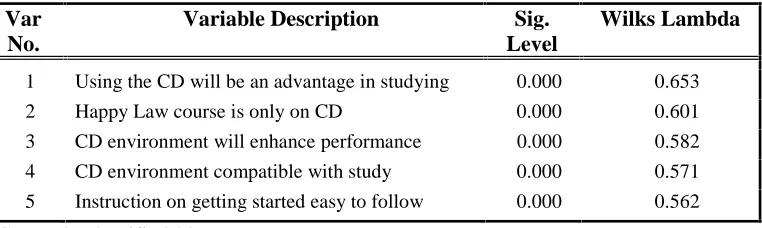
analysis shown in table 1 identify the following five variable items as differentiating between students’ acceptance or resistance to adopting learning resources on CD-ROM:
1. Overall, using the Law CD will be advantageous to me in studying this course. (perceived usefulness – var1)
2. I am happy that the Law course is only available on CD. (perceived usefulness – var2) 3. The CD study environment will enhance my performance in this course. (study
performance – var3)
4. Study materials provided on CD are compatible with the way I like to study. (compatibility – var4)
5. Instructions on getting started on the Law CD are easy to follow. (perceived ease of use – var5)
As shown in table 1, the overall classification accuracy of the discriminant function was 80.9 per cent, with 80.1 per cent of students in the resistance group and 81.2 per cent of students in the acceptance group successfully classified. This suggests that the variable items
[image:8.595.88.469.462.576.2]are good discriminators of students’ acceptance or resistance to adopting learning resources on CD-ROM. The Wilks’ Lambda (0.562) was significant at the 0.000 level, indicating that the two groups were significantly different in terms of the discriminating variable items. The discriminant function had a canonical correlation of 0.662, with 44 per cent of the variance explained by the function.
Table 1 - Summary of the Predictor Variable Items in Discriminant Analysis
Var No.
Variable Description Sig. Level
Wilks Lambda
1 Using the CD will be an advantage in studying 0.000 0.653
2 Happy Law course is only on CD 0.000 0.601
3 CD environment will enhance performance 0.000 0.582
4 CD environment compatible with study 0.000 0.571
5 Instruction on getting started easy to follow 0.000 0.562
Correctly classified 80.9%
Overall Wilks’ Lambda = 0.562, d.f. = 5, p < 0.000 Canonical correlation = 0.662
% of variance explained by the function = 44%
Relative Importance of the Discriminating Variable Items
(1999), ‘standardized coefficients allow only an ordinal interpretation of variable importance. The coefficients are not appropriate in assessing the relative discriminatory power of the variables included in the analysis’.
As there are a number of limitations associated with the standardised discriminant coefficients, there have been suggestions to use alternative methods for assessing the relative discriminatory power of independent variables. For example, Hair et al., (1998) suggested the use of discriminant loadings (i.e. the correlations between each independent variable and the discriminant function) as an alternative approach to evaluate relative discriminatory power. Green et al., (1988, p. 525) and cited recently by Ogunmokun et al., (1999) recommended a more appropriate measure of relative discriminatory power or importance by using the following equation:
__ __ Ij = [kj (Xj1 - Xj2)]
where: Ij = the importance value of the jth variable
kj = unstandardised discriminant coefficient for the jth variable
__
Xjk = mean of the jth variable for the kth group
Further, Green et al., (1988) as cited by Ogunmokun et al., (1999) recommended the computation of the relative importance weights of each variable to provide a more valid and useful interpretation of the relative discriminatory power of the independent variables. The relative importance value of a variable shows the importance of the particular variable relative to the sum of the importance values of all variables (Green et al., 1988). The relative importance (Rj) of a variable can be determined by the following equation (Green et al., 1988,
p. 525):
Ij__
Rj = n
¦ Ij j = 1
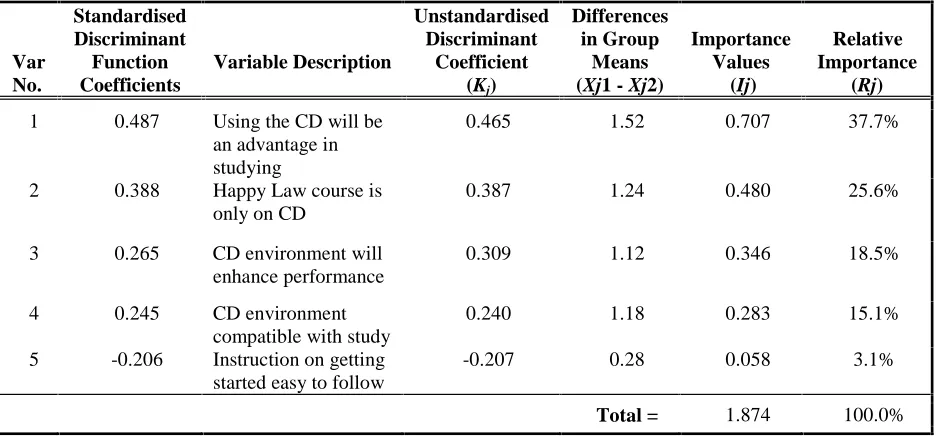
Table 2 - Relative Importance of Predictor Variables Items in selecting between Students’ Acceptance and Resistance to Adopting Learning Resource on CD-ROM
Var No. Standardised Discriminant Function Coefficients Variable Description Unstandardised Discriminant Coefficient
(Kj)
Differences in Group
Means (Xj1 - Xj2)
Importance Values (Ij) Relative Importance (Rj)
1 0.487 Using the CD will be an advantage in studying
0.465 1.52 0.707 37.7%
2 0.388 Happy Law course is only on CD
0.387 1.24 0.480 25.6%
3 0.265 CD environment will
enhance performance
0.309 1.12 0.346 18.5%
4 0.245 CD environment
compatible with study
0.240 1.18 0.283 15.1%
5 -0.206 Instruction on getting started easy to follow
-0.207 0.28 0.058 3.1%
Total = 1.874 100.0%
According to the results presented in table 2, five variable items have been identified as discriminating between students that accept or resist adopting learning resources being provided solely on CD-ROM. The first two variable items (variables one and two) relate to perceived usefulness and account for 63.3 per cent of the relative importance of the total
discrimination. The first variable item captures an overall measure of perceived usefulness that is, the convenience, quality of the learning experience, speed and control over the learning process while variable item two focuses on students’ willingness to accept learning resources packaged in a more useful manner to suit their learning style. Students that have recognised the usefulness of the CD-ROM learning resource have a greater acceptance of this innovation and are more likely to adopt and even seek out other courses that have learning resources offered in this mode.
For students belonging to the resistance group, their perception of the lack of usefulness of the CD-ROM could have a major influence on future study if further learning resources are provided in this mode. However, the extent of their negative perception may decrease over the semester with further use of the CD-ROM and thus if this study was repeated near the end of the semester, the students that are indifferent towards the CD-ROM may accept the learning resource innovation. For those students that want to maintain the status quo, their perception of the usefulness of the CD-ROM learning resource is not likely to change and thus they will avoid future courses offered in this mode. Implications of this behaviour are
The third variable item that discriminates between the two groups accounts for 18.5 per cent of the relative importance of the total discrimination and captures an aspect of the variable study performance. For students assigned to the acceptance group, they perceive that this
innovative study environment will enhance their performance in the course. Changing from print-based learning resources to CD-ROM poses little risk to this group and thus they are more accepting of other courses offered in this way. However those students in the resistance group perceive that there could be some level of risk to their study performance in the course and thus would prefer the learning resources to be provided in print-base. The perceptions of these students could change with further exposure to the CD-ROM during the semester, however to reduce their immediate risk some students reported seeking out second hand learning resources in print form. The perceptions of these students that have reverted back to print-based learning resources will not change in the short term. The implication of this behavioural approach for the University is addressed in the final section.
The next variable item represents an aspect of compatibility and accounts for 15.1 per cent of the relative importance of the total discrimination. The perspective held by students belonging to the acceptance group is that learning resources provided on CD-ROM are more consistent with the way they like to study. We could expect that this group of students are more confident in computer related skills and have some experience in this new technology innovative environment. For students in the resistance group, many have not yet made the transition to working solely from the screen and thus demonstrate some degree of resistance to this learning resource innovation. With time the less resistant students will make the transition, with other students wanting to maintain the status quo and thus they will seek out
more tradition modes of delivery.
highly resistant students need tangible support in the form of print-based written directions on getting started.
Conclusion and Implications
Results of the discriminant analysis based on classifying students into two groups, acceptance or resistance of adopting learning resources provided solely on CD-ROM, identified five variable items that discriminated between these two groups. The first two variable items related to perceived usefulness and accounted for 63.3 per cent of the relative importance of the total discrimination. The perceived usefulness of the learning resources on CD-ROM was found to be an important variable that influenced students in the acceptance group to view the delivery mode favourably and have a strong desire to adopt future courses delivered in this innovative manner. However with further core compulsory courses to be offered on CD-ROM in the future, management urgently must consider strategies to deal with students belonging to the resistance group. For students that are indifferent or mildly resistant, the added value to their total learning experience with learning resources provided on CD-ROM must to explained and communicated through the appropriate channels. The enhancements to the core product features should initially be communicated in terms of those factors important to students. At a later stage the augmented features and their importance to the learning experience could be outlined. Preparing students prior to the delivery of learning resources on CD-ROM will certainly reduce their initially resistance.
For highly resistant students, a dual mode of delivery should be considered whereby a print-based version is also provided. For students to experience a number of the learning
enhancements they will need to use the CD-ROM, however they will not be disadvantaged if they do not use them and thus their perceived level of study risk will be minimised. Failing to consider the needs of the highly resistant students could result in these students moving their study to another University that offers a mode of study more suited to their needs. This dual mode delivery strategy is in line with previous research recommendations (McPhail & McDonald, 2004; Scholder Ellen et al., 1991).
students that are unaccustomed to a computer environment would perceive the CD-ROM learning resource as a discontinuous innovation (Zemsky & Massy 2004; Sheth et al., 1999). In contrast to introducing a new product into the market and initially targeting customers who would perceive the innovation as continuous, University management must consider the
diversity of skills and experience of all students. For students that would perceive the CD-ROM learning resource as a discontinuous innovation, a transition program that involves some print-based learning resources and a training program to assist students to acquire electronic study skills is strongly recommended.
The main findings from this research indicate that there is a group of students that prefer the traditional delivery mode and that not all students are eager to embrace the use of technology in educational delivery. These findings support the earlier work by Hunt et al., (2004) and Saddler-Smith and Riding (1999) and extend the previous research by identifying specific variable items that discriminate between two groups of students that accept or resist adopting learning resources on CD-ROM.
The findings from this study are restricted to the perceptions students initially reported after only a few weeks of using the learning resources provided solely on CD-ROM. After students gained further experience over the course of the semester, the level of resistance may not be as strong. We therefore recommend that when conducting future studies of this kind that data are collected early and late in the semester to determine the change in student perceptions towards technological innovations.
References
Bandura, A. (1977). Self-Efficacy: Towards a Unifying Theory of Behavioral Change. Psychological Review, 84, 191-215.
Belk, R. W. (1974). An Exploratory Assessment of Situational Effects in Buyer Behavior. Journal of Marketing Research, 11, 156-163.
Bobbitt, L. M., & Dabholkar, P. A. (2001). Integrating Attitudinal Theories to Understand and Predict Use of Technology-Based Self-Service: The Internet as an Illustration. International Journal of Service Industry Management, 12(5), 423-450.
Cooper, D. (2004). Bosses find MBAs fail on executive skill, The Australian, September 16. Davis, F. D. (1989). Perceived usefulness, perceived ease of use, and user acceptance of
information technology. MIS Quarterly, September, 319-340.
Davis, F. D., Bagozzi, R. P., & Warshaw, P. R. (1989). User acceptance of computer technology: a comparison of two theoretical models. Management Science, 35(8), 982-1003.
Gatignon, H., & Robertson, T. S. (1991). Innovative decision processes. In T. S. Robertson & H. H. Kassarjian (Eds.), Handbook of Consumer Behavior (pp. 316-348). Englewood Cliffs, New Jersey: Prentice Hall.
Green, P. E., Tull, D. S., & Albaum, G. (1988). Research for Marketing Decisions (5 ed.). Englewood Cliffs, New Jersey: Prentice-Hall.
Hair, J. F., Anderson, R. E., Tatham, R. T., & Black, W. C. (1998). Multivariate Data Analysis (5 ed.). Upper Saddle River, New Jersey: Prentice-Hall International.
Hunt, L., Eagle, L. & Kitchen, P. (2004). Balancing Marketing Education and Information Technology: Matching Needs or Needing a Better Match? Journal of Marketing Education, Vol. 26 No. 1, April, 75-88.
Laurillard, D. (2002). Rethinking University Teaching: A Conversational Framework for the Effective Use of Learning Technologies, (2nd edn). London: Routledge Falmer.
McPhail, J. D., & McDonald, J. (2004). Predicting undergraduate students’ acceptance and use of learning resources on CD-ROM: Test of an extended technology acceptance model. Paper presented at the Academy of World Business Marketing and Management Development Conference, Gold Coast, Australia, 148-157.
McPhail, J. D., & Ogunmokun, G. (2004). Determinants of senior consumers’ usage level of self-service banking technologies. Paper presented at the American Society of Business and Behavioral Science Seventh Annual International Conference, Cairns, Australia, 592-599.
Moore, G. C., & Benbasat, I. (1995). Integrating diffusion of innovations and theory of reasoned action models to predict utilization of information technology by end-users. In K. Kautz & J. Pries-Heje (Eds.), Diffusion and Adoption of Information Technology (pp. 132-146). London: Chapman and Hall.
Neal, C., Quester,P. & Hawkins, D. (2004). Consumer Behaviour: Implications for Marketing Strategy (4 ed). Australia: McGraw-Hill.
Ogunmokun, G. O., Shaw, R. N., & FitzRoy, P. T. (1999). Determinants of strategic planning in small business: An exploratory investigation of small business organisations in Australia. International Journal of Management, 16(2), 190-202.
Rogers, E.M. (1995). Diffusion of Innovations, 4th edn, The Free Press, New York, NY. Sadler-Smith, E., & Riding. R. (1999). Cognitive style and instructional preferences.
Instructional Science, 27, 355-71.
Scholder Ellen, P., Bearden, W. O., & Sharma, S. (1991). Resistance to technology innovations: an examination of the role of self-efficacy and performance satisfaction. Journal of the Academy of Marketing Science, 19(4), 297-307.
Sheth, J. N., Mittal, B., & Newman, B. I. (1999). Consumer Behavior. Orlando, FL: The Dryden Press.
Taylor, S., & Todd, P. (1995). Understanding information technology usage:a test of competing models. Information Systems Research, 6(2), 144-176.
Thurlow, C., Lengel, L., & Tomic, A. (2004). Computer Mediated Communication: Social Interaction and the Internet. London, Sage Publications.
Vallerand, R. J. (1997). Towards a hierarchical model of intrinsic and extrinsic motivation. Advanced Experimential Social Psychology, 29, 271-360.
Venkatesh, V. (2000). Determinants of Perceived Ease of Use: Integrating Control, Intrinsic Motivation, and Emotion into the Technology Acceptance Model. Information Systems Research, 11(4), 342-365.
Venkatesh, V., Morris, M. G., Davis, G. B., & Davis, F. D. (2003). User Acceptance of Information Technology: Towards a Unified View. MIS Quarterly, 27(3), 425-478. Zemsky, R & Massy, W. (2004). Thwarted Innovation: What Happened to e-Learning and