Copyright © 2002, American Society for Microbiology. All Rights Reserved.
Equine Infectious Anemia Virus Envelope Evolution In Vivo during
Persistent Infection Progressively Increases Resistance to In Vitro
Serum Antibody Neutralization as a Dominant Phenotype
Laryssa Howe,
1Caroline Leroux,
2† Charles J. Issel,
3and Ronald C. Montelaro
1,2*
Department of Infectious Disease and Microbiology, Graduate School of Public Health,1and Department of Molecular
Genetics and Biochemistry, School of Medicine,2University of Pittsburgh, Pittsburgh, Pennsylvania 15261, and
Department of Veterinary Sciences, Gluck Equine Research Center, University of Kentucky, Lexington, Kentucky 405463
Received 10 April 2002/Accepted 25 July 2002
Equine infectious anemia virus (EIAV) infection of horses is characterized by well-defined waves of viremia associated with the sequential evolution of distinct viral populations displaying extensive envelope gp90 variation; however, a correlation of in vivo envelope evolution with in vitro serum neutralization phenotype remains undefined. Therefore, the goal of the present study was to utilize a previously defined panel of natural variant EIAV envelope isolates from sequential febrile episodes to characterize the effects of envelope variation during persistent infection on viral neutralization phenotypes and to define the determinants of EIAV envelope neutralization specificity. To assess the neutralization phenotypes of the sequential EIAV envelope variants, we determined the sensitivity of five variant envelopes to neutralization by a longitudinal panel of immune serum from the source infected pony. The results indicated that the evolution of the EIAV envelope sequences observed during sequential febrile episodes produced an increasingly neutralization-resistant phenotype. To further define the envelope determinants of EIAV neutralization specificity, we examined the neutralization properties of a panel of chimeric envelope constructs derived from reciprocal envelope domain exchanges between selected neutralization-sensitive and neutralization-resistant envelope variants. These results indi-cated that the EIAV gp90 V3 and V4 domains individually conferred serum neutralization resistance while other envelope segments in addition to V3 and V4 were evidently required for conferring total serum neutral-ization sensitivity. These data clearly demonstrate for the first time the influence of sequential gp90 variation during persistent infection in increasing envelope neutralization resistance, identify the gp90 V3 and V4 domains as the principal determinants of antibody neutralization resistance, and indicate distinct complex cooperative envelope domain interactions in defining sensitivity to serum antibody neutralization.
Equine infectious anemia virus (EIAV) is a member of the lentivirus subfamily of retroviruses; it causes a rapid and dy-namic disease in persistently infected horses that is in marked contrast to the slowly progressive degenerative diseases typi-cally associated with infections by other human and animal lentiviruses (23). Natural or experimental EIAV infections of horses follow a characteristic progression of disease during the first year from acute, to chronic (recurring disease cycles), to long-term inapparent carrier, as the result of a complex and lengthy development of enduring and broadly controlling vi-rus-specific host immunity that suppresses viral replication to subclinical levels (13, 14, 23). Therefore, the EIAV system provides a useful model lentivirus system for examining the nature and role of antigenic variation during persistent infec-tion, investigating the dynamic interaction with host immune responses, and defining the critical components in the devel-opment of immunologic control of lentivirus replication and disease.
Several studies have demonstrated that the control of EIAV
replication and disease is directly related to host immune re-sponses and not to the attenuation of the infecting virus (16, 18, 26). For example, immune suppression of inapparent car-riers by dexamethasome treatment can cause a recrudescence of disease associated with increased levels of viremia (9, 18, 32), and transfer of whole blood from inapparent carriers to naive horses usually results in infection and disease in the recipients (16, 32). In addition, Perryman et al. have reported that experimental infection of immunodeficient foals with EIAV causes an aggressively progressive fatal disease, emphat-ically demonstrating the potential virulence of EIAV in the absence of host immune responses (26). Equally important, but probably less well recognized, is the observation that inap-parent carriers of EIAV are protected from subsequent expo-sure to virus by horsefly transmission in the field or by exper-imental intravenous inoculation in the laboratory (16, 17). Therefore, the ability of the equine immune system to rou-tinely achieve lifelong control of a persistent virulent lentivirus infection and protection from reexposure provides an impor-tant natural animal lentivirus model for enduring, broadly pro-tective immunity that can overcome the diverse array of im-mune escape mechanisms used by lentiviruses.
The development of host immune responses in immunocom-petent equids experimentally infected with EIAV has been examined in detail (12, 22, 34). These studies demonstrate that
* Corresponding author. Mailing address: Department of Molecular Genetics and Biochemistry, University of Pittsburgh School of Medi-cine, W1144 Biomedical Science Tower, Pittsburgh, PA 15261. Phone: (412) 648-8869. Fax: (412) 383-8859. E-mail: [email protected].
† Present address: UMR 754 INRA-UCBL-ENVL, Re´trovirus et Pathologie Compare´e, Lyon, France.
10588
on November 8, 2019 by guest
http://jvi.asm.org/
the characteristic progression to an inapparent carrier stage of EIAV infection is associated with an evolution of humoral and cellular immune responses during the first 8 to 10 months postinfection into a mature, steady-state immunity that effec-tively controls EIAV replication and restricts viral infection predominantly to tissue reservoirs (14). Paralleling the devel-opment of enduring broadly protective immunity, neutralizing antibodies to the infecting virus are first detected 2 to 3 months postinfection and their levels continue to increase for up to 10 months before reaching a steady state that is maintained in-definitely (12, 13). In addition to the progressive increases in serum neutralization titer during the first year post infection, Rwambo et al. (28) have reported a steady increase in the breadth of serum antibody neutralization specificity in experi-mentally infected ponies during the first year postinfection, presumably reflecting an accumulation of antibody responses to variant EIAV envelope quasispecies that evolve during this period. However, the role of neutralizing antibodies in achiev-ing and sustainachiev-ing control of EIAV replication remains con-troversial (10, 11, 31).
Extensive studies of EIAV recovered from experimentally infected equids during chronic disease have revealed a unique population of viral envelope quasispecies associated with each disease cycle, apparently reflecting the sequential evolution of antigenic variants that temporarily escape the prevailing host immune responses (20, 21, 25). Interestingly, a similar rate and extent of EIAV envelope evolution have been reported in progressor and nonprogressor ponies experimentally infected with a reference EIAV strain, suggesting ongoing viral varia-tion and immune selecvaria-tion in the absence of clinical symptoms and relatively low levels of systemic virus replication (19). These data indicate that antigenic variants of EIAV are prob-ably produced in tissue reservoirs that are rich in infected macrophages (liver and spleen) as a result of ongoing virus replication and evolution, even in the face of robust host im-mune responses.
Detailed serologic and genetic characterizations of the evo-lution of EIAV populations during chronic EIAV have dem-onstrated a close correlation between changes in viral neutral-ization specificity and variations in the sequence of the viral SU and TM proteins, respectively designated gp90 and gp45, that are observed in viral populations associated with sequential disease cycles (15, 20, 25, 29, 36). These studies of EIAV envelope variation have led to an identification of conserved and variable domains in the heavily glycosylated gp90 glyco-protein and have suggested that the presence of a hypervari-able principal neutralizing domain (PND) in the V3 segment of the gp90 envelope glycoprotein (1, 19, 20). Despite the extensive information available on the nature of EIAV enve-lope variation during persistent infection and the differences in serum antibody neutralization phenotypes among viral vari-ants, there is to date no definitive information on the neutral-ization determinants of EIAV envelope proteins or the effects of natural envelope variation in these determinants on viral neutralization sensitivity. A higher-resolution definition of EIAV envelope neutralization determinants could provide im-portant fundamental information to further our understanding of the effects of specific envelope variations on antigenic and immunogenic properties and to aid in design and evaluation of vaccine strategies for this virus.
We report here a series of experiments with the specific aim of defining neutralization determinants of EIAV gp90 lope protein and of evaluating the influence of natural enve-lope variation during persistent infection on viral neutraliza-tion properties. For these studies, we have used a novel panel of longitudinal immune serum samples and well-defined EIAV envelope variants isolated from sequential febrile episodes in a comprehensively studied experimentally infected pony (12, 13, 19, 20). The results of these studies reveal new basic informa-tion about the antigenic architecture of EIAV envelope glyco-proteins and the influence of longitudinal natural envelope variation on EIAV neutralization properties.
MATERIALS AND METHODS
Experimental infections, clinical evaluation, and virus and serum isolations.
Four outbred ponies were experimentally inoculated intravenously with 10350%
tissue culture infectious doses (TCID50) of the reference pathogenic biological
clone, EIAVPV(20). The clinical progression, viral evolution, and host immune
responses of these experimentally infected ponies have been extensively de-scribed previously (12, 13, 19, 20). The EIAV envelope variants used in this study were isolated during sequential disease cycles observed in pony 564 (see Fig. 1) and were characterized in detail by cloning and gene sequencing, as described by Leroux et al. (20). A comparison of the deduced amino acid sequences of the gp90 variable domains of the respective variant viral envelope quasispecies se-lected for this study is summarized in Fig. 2 (see below). Sese-lected immune serum samples taken from pony 564 and the three other experimentally infected ponies (ponies 561, 562, and 567) at monthly intervals and during disease cycles over a 36-month observation period were used in this study to define the neutralization phenotypes of the EIAV envelope variants derived from pony 564.
Construction and titer determination of variant envelope quasispecies in the EIAVUKmolecular clone.To compare the neutralization properties of the
vari-ant envelopes, the gp90 segment of the representative predominvari-ant envelope clone associated with each of the first five disease cycles observed in pony 564 was
substituted into the common reference EIAVUKproviral backbone (8) using the
pLG338.30 vector (GenBank accession no. AF016316). The predominant viral
envelope from the first febrile episode was the reference EIAVPV(20) and is
designated the gp90I variant envelope provirus in this paper. The variant enve-lope proviral clones containing the predominant gp90 quasispecies from the second, third, and fourth disease cycles in pony 564 were generated by restriction
enzyme fragment exchanges using uniqueNcoI andBstXI restriction sites
com-mon to these variant envelope clones. Thus, the respectiveNcoI-BstXI fragments
(containing the V1 to V8envregions) of clones p564II.21, p564III.35, and
p564IV.9 (20) were used to replace the corresponding fragment of pEIAVUKto
produce the respective variant envelope proviruses designated gp90II, gp90III, and gp90IV. The envelope variant V provirus was generated by digesting clone
p564V.6 withHindIII and then ligating the digested fragment containing the V3
to V8envsegment into the corresponding segment of EIAVUK. The in vitro
replication properties of each of the variant envelope proviral DNAs were then
assessed by individually transfecting a 4-g sample of purified DNA from each of
the resultingenvvariant proviral clones into 105fetal equine kidney (FEK) cells
as specified by the manufacturer of the GenePorter Transfection kit (GTS, San Diego, Calif.). Virus production was monitored by weekly measurements of the reverse transcriptase activity in the supernatants of the transfected cells by using
a standard micro-RT assay (20). The TCID50s of supernatants from transfected
FEK cell cultures were then determined in a standardized infectious-center assay that uses a cell-based enzyme-linked immunosorbent assay detection system to study FEK cells (12).
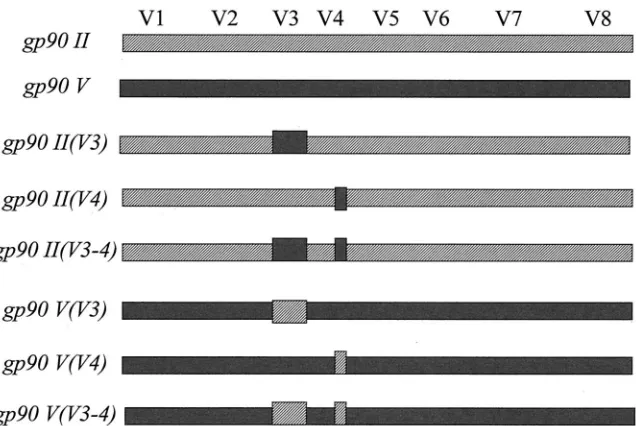
Construction of chimeric envelopes between neutralization-sensitive and -re-sistant EIAV envelope variants.Based on the observed in vitro neutralization phenotypes of the variant envelope proviruses, the gp90II and gp90V proviruses were chosen as reference neutralization-sensitive and -resistant envelopes, re-spectively. To elucidate the gp90 neutralization determinants, reciprocal chi-meric envelopes exchanging defined variable domains were constructed as de-picted in Fig. 4 and tested for their neutralization properties against the panel of reference immune serum from pony 564. To generate the desired mutations in the V3 and/or V4 regions, internal primers containing overlapping sequence
mutations were used with external primers flanking theBlpI andBstXI restriction
enzyme sites. The PCR amplification was performed by using the Expand High Fidelity PCR system (Roche, Indianapolis, Ind.), 0.025 mM each
deoxynucleo-VOL. 76, 2002 EIAV ENVELOPE EVOLUTION 10589
on November 8, 2019 by guest
http://jvi.asm.org/
side triphosphate, 0.1M each primer, and 1.5l of original template or purified
PCR fragments in a final volume of 100l. The following conditions were used:
4 min at 95°C, after which 0.4l of Expand High Fidelity enzyme was added; 1
min at 95°C, 1.5 min at 50°C, and 1 min at 72°C for 35 cycles; and finally 10 min
at 72°C for one cycle. The resulting 1.6-kbenvfragments were digested withBlpI
andBstXI prior to ligation with T4 ligase (New England Biolabs, Beverly, Mass.)
into the vector containing the EIAVUK genome (GeneBank accession no.
AF016316) with the corresponding 1.6-kb fragment removed. The ligation
prod-ucts were used to transform competentEscherichia coliDH5␣cells (Invitrogen,
Carsbad, Calif.). Clones from each of the new chimera constructs were screened
byBamHI restriction enzyme digestion for the presence of the insert and
se-quenced as previously described (20) to confirm the correct envelope sequence. The correct clones for each of the desired variable region substitutions were transfected into FEK cells and monitored by micro-RT assays for virus produc-tion, as described above.
Serum antibody neutralization assays.The neutralization activity of the panel of reference immune serum from the experimentally infected ponies against the variant and chimeric envelope proviruses was determined as described previously
by Hammond et al. (12) using a standard viral infectious-center assay. Briefly, 105
FEK cells were added to each well of a 24-well tissue culture plate and allowed to adhere overnight at 37°C. The desired serum samples were heat inactivated before use in the assay. Twofold serial dilutions of each of the serum samples were incubated in the presence of 100 IU of the selected chimeric virus at 37°C for 1 h. The serum-virus mixture was then added to the cells and again incubated overnight at 37°C. An overlay of 0.8% carboxmethylcellulose was added to the infected cultures, which were then incubated for a further 7 days at 37°C. The cells were then fixed and permeablized. Reference immune serum from an EIAV-infected horse (Lady) was used as a primary antibody, followed by an affinity-purified, horseradish peroxidase-conjugated goat anti-horse immuno-globulin G (Sigma, St. Louis, Mo.). The peroxidase substrate 3-amino-9-ethyl-carbazole (Sigma) in a sodium acetate buffer (pH 5.5) supplemented with
H2O2was used to visualize the EIAV infectious centers. The number of
infec-tious centers was determined, and the 50% reciprocal neutralization titer of each serum sample was determined by linear-regression analysis. Each neutralization assay was repeated at least twice to determine standard error values.
Neutral-ization titers were compared using a pairedt-test analysis to determine statistical
significance.
RESULTS
Clinical progression and viral envelope evolution in exper-imentally infected ponies.To determine the effect of in vivo EIAV envelope variation on neutralization sensitivity in vitro, we utilized a unique panel of viral variants and immune serum samples collected from a group of four ponies experimentally infected with a reference pathogenic biological clone, EIAVPV. The clinical progression, viral evolution, and host immune response maturation in these ponies over a 36-month obser-vation period have been described in detail previously (12, 13, 19, 20). Pony 564 was used as a source of EIAV envelope variants for the current study. The clinical and virologic pro-files observed for pony 564 are summarized in Fig. 1. As de-scribed by Leroux et al. (20), analyses of the circulating EIAV population associated with each of the sequential waves of viremia and disease cycles observed in pony 564 revealed a distinct population of variant envelope quasispecies, appar-ently reflecting a dynamic but undefined host immune selec-tion of EIAV envelope species. Thus, to examine the role of EIAV-specific neutralizing antibodies in envelope variation, we selected a representative predominant variant envelope from the various clones isolated during each of the first five disease cycles in pony 564. A comparative summary of the variable domains of the deduced variant envelope gp90 amino acid sequences for the panel of sequential virus envelope qua-sispecies is presented in Fig. 2. These sequence data indicate a unique envelope for each of the five reference envelope gp90 species, with each quasispecies having distinct signature V3 and V4 domains. For convenience, the individual variant
en-FIG. 1. Clinical and virological profile of pony 564 experimentally infected with EIAVPV. Pony 564 was experimentally infected with 103TCID50 of the biological clone EIAVPV. Rectal temperature (solid line, rightyaxis) and platelet count (dashed line, second leftyaxis) were monitored regularly for 36 months after infection as standard measures of disease. Febrile episodes (arrows) occurred at 18 (I), 34 (II), 80 (III), 106 (IV), 337 (V), and 378 (VI) days postinfection and were defined by a rectal temperature above 39°C in conjunction with a reduction in the number of platelets below 100,000/l of whole blood and other characteristic clinical symptoms. Quantification of the virus load (shaded circles, first lefty axis) was performed on the viral RNA extracted from plasma during disease cycles and at periodic time points during the observation period. Adapted from reference 13.
on November 8, 2019 by guest
http://jvi.asm.org/
[image:3.587.69.519.72.300.2]velope species are designated by the disease cycle from which they were isolated; e.g., gp90II is the representative predomi-nant envelope quasispecies observed during the second disease cycle in pony 564.
Influence of sequential gp90 variation on serum antibody neutralization properties.To determine the effects of the ob-served evolution of gp90 sequences on serum antibody neu-tralization properties, we inserted each of the five gp90 vari-ants depicted in Fig. 2 into theenvgene of a common reference provirus, EIAVUK, as described in Materials and Methods. The replication properties of each of the variant envelope proviruses were then examined by parallel transfections of FEK cells with each proviral DNA. All of the variant envelope proviral constructs were replication competent in FEK cells and appeared to replicate with similar kinetics (data not shown), despite the observed differences in gp90 sequences. These observations demonstrate the functional competence of the variant gp90 sequences in the context of the EIAVUK provirus and validate the use of these proviruses in compara-tive neutralization assays.
We next analyzed the neutralization properties of each of the variant envelope proviruses in our standard in vitro neu-tralization assay using FEK cell targets and selected
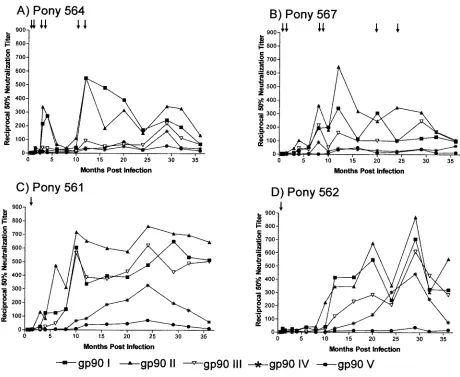
longitu-dinal serum samples collected from the host pony 564 and the other three experimentally infected ponies. The results of these serum neutralization assays are summarized in Fig. 3. As observed previously (12, 13), neutralizing-antibody activity be-came detectable against the infecting EIAV gp90I between 2 and 3 months postinfection in most of the experimentally in-fected ponies and its level continued to increase during the next 10 months. Interestingly, serum neutralization titers against EIAV gp90I were sustained at somewhat higher levels in the two nonprogressor ponies that experienced only the single acute disease cycle than in the two progressor ponies that experienced multiple disease cycles. In general, steady-state serum neutralization titers averaged about 1:500 in non-progressor ponies and about 1:200 in non-progressors over the 3-year observation period. These data demonstrate a sustained neutralizing-antibody response targeted to the infecting gp90I envelope contained in the EIAVPVinoculum, even though this envelope species is not detectable after the initial acute disease cycle (20).
We next determined the evolution of the neutralization properties of the sequential viral envelope gp90 variants from pony 564 in the context of the EIAVUKprovirus, initially using longitudinal serum samples from the source pony 564 (Fig.
FIG. 2. Comparison of deduced amino acid gp90 variable region sequences of the predominant quasispecies of EIAV isolates from pony 564 during sequential disease cycles. The region of the SU envelope gene was sequenced from EIAVPVviral stock and plasma viral RNA obtained during disease cycles I to V of EIAVPV-infected pony 564 (20). Based on the sequence data, the predominant quasispecies from each disease cycle were determined and variable regions V1 through V8 were compared. Only the amino acid residues different from EIAVPVare reported. Dots indicate residues identical to the EIAVPVsequence. Dashes indicate amino acid deletions, and boldface type indicates potential N-glycosylation sites (NXS/T). Shaded bars indicate the previously defined neutralizing epitopes ENT, DNT, and CNT(1). Adapted from reference 20.
VOL. 76, 2002 EIAV ENVELOPE EVOLUTION 10591
on November 8, 2019 by guest
http://jvi.asm.org/
3A). The results of these neutralization assays with most of the pony 564 serum samples indicated that the gp90I and gp90II envelopes were substantially more sensitive to neutralization than were the envelope variants gp90III, gp90IV, and gp90V. This differential neutralization sensitivity is exemplified by the 12-month immune serum from pony 564, which displayed a neutralization titer of 1:600 against the gp90I and gp90II en-velope proviruses but failed to yield detectable neutralization activity against the other three gp90 variant envelopes. The relative resistance of the gp90III, gp90IV, and gp90V envelope variants to neutralization by the serum antibody responses that evolved during persistent infection of pony 564 is highlighted by the fact that most of the immune serum samples from the 3-year observation period failed to display substantial neutral-ization titers against these envelope variants; transient serum neutralization was in general observed only with serum sam-ples taken around 30 months postinfection, and this activity was not detectable by 36 months postinfection. Taken to-gether, these data indicate that that the evolution of the EIAV
envelope during persistent infection in pony 564 resulted in increased resistance to host serum-neutralizing antibodies.
We next sought to determine if the variant envelope neu-tralization sensitive and resistant phenotypes defined by the pony 564 immune serum samples would also be evident with longitudinal immune serum samples from the other three ex-perimentally infected ponies. We have previously reported a similar development of broadly neutralizing antibodies in ex-perimentally infected ponies, regardless of the number or se-verity of disease cycles (28). Figure 3B to D summarizes the neutralization properties of the envelope variants against het-erologous longitudinal serum samples from the three other persistently infected ponies. As observed with the homologous pony 564 immune serum samples, the envelope variants display a spectrum of sensitivity to neutralization by the heterologous immune serum samples. In all three ponies, the gp90I and gp90II variants were neutralized by all serum samples taken after about 8 months postinfection, although the level of neu-tralization differed among the ponies, as expected for an
out-FIG. 3. Serum neutralization properties of sequential EIAV envelope variants isolated from pony 564. The mean reciprocal 50% neutralizing-antibody titers in the sera of two progressor ponies, 564 (A) and 567 (B), and two nonprogressor ponies, 561 (C) and 562 (D), obtained at regular intervals, were determined against the panel of envelope variants in a common EIAVUKprovirus by using an infectious-center assay as detailed in Materials and Methods. Arrows indicate disease cycles. Data presented are representative of two independent experiments run in duplicate.
on November 8, 2019 by guest
http://jvi.asm.org/
[image:5.587.62.522.73.450.2]bred population and the independent EIAV variation ob-served in individual infected ponies. In marked contrast, the gp90V envelope variant was resistant to neutralization by all of the heterologous test serum samples, regardless of the time postinfection in each pony. These data indicated that the amino acid variations in the gp90V envelope from the parental gp90I envelope (Fig. 2) sequences impart a remarkable resis-tance to antibody neutralization. The gp90III and gp90IV en-velope variants displayed neutralization phenotypes with the heterologous immune serum that were intermediate between the very sensitive gp90I and gp90II and the resistant gp90V envelopes. The gp90III envelope was efficiently neutralized by serum from pony 561 and had intermediate neutralization properties with serum from ponies 562 and 567, usually with neutralizing activities increasing with serum samples obtained later. The gp90IV envelope was somewhat more resistant to serum neutralization by serum from ponies 561 and 562 than was the gp90III envelope and was completely resistant to neu-tralization by any of the serum samples from pony 567. Thus, these cumulative serum neutralization data from the heterol-ogous serum samples reveal an increasing neutralization sen-sitivity in the order of gp90II⬎gp90I⬎gp90III⬎gp90IV⬎
gp90V. Conversely, the viral envelopes in general developed increasing neutralization resistance during the persistent infec-tion.
Characterization of gp90 neutralization determinants. To date, the envelope determinants of EIAV neutralization prop-erties are undefined. The combination of in vivo-derived neu-tralization-sensitive and neutralization-resistant gp90 variants and immune serum from pony 564 provided a unique set of reagents to define the contribution of defined variable domains to the neutralization phenotype. For these studies, the gp90II variant was selected as a representative neutralization-sensitive
envelope and the gp90V variant was selected as the neutral-ization-resistant envelope. Using these two envelope variants, we constructed a panel of chimeric envelopes that exchanged either V3 domains, V4 domains, or both V3 and V4 domains, as summarized in Fig. 4. Thus, insertion of the gp90V V3 or V4 domain into the gp90II envelope variant provirus were used to test the ability of these envelope domains to confer resistance to neutralization by the reference immune serum. In a recip-rocal manner, insertion of the gp90II V3 or V4 domain into the gp90V envelope provirus were used to determine the ability of these variable segments to confer sensitivity to neutralization by the reference immune serum. The V3 domain was chosen for these exchanges, since it has been proposed as a principal neutralizing domain based on its extensive variation during persistent infection and its reactivity with two neutralizing mouse monoclonal antibodies (1). The V4 domain was se-lected for exchange to specifically examine the effects of vari-ation observed between the gp90II and gp90V sequences that resulted in a shift in a putative N-linked glycosylation site (20). To determine the functional competence of the chimeric en-velope proviruses depicted in Fig. 4, the replication properties of each chimeric provirus was assayed by transfection of FEK cells with proviral DNA (Fig. 5). The results of these assays demonstrated that all of the chimeric envelope proviruses rep-licated to similar levels to that of the parental envelope vari-ants, except for the gp90V(V3) construct, which was replica-tion defective. The observed replicareplica-tion properties of the various chimeric envelope proviruses in transfection experi-ments were consistent in infection assays of FEK cells used to determine the TCID50of each viral stock (data not shown). Thus, with the exception of the gp90V(V3) chimeric envelope provirus, the similar replication properties of the various
chi-FIG. 4. Schematic representation of the variable-region exchange chimeric envelope constructs. Neutralization-sensitive envelope from pony 564 febrile episode II (hatched bars) and neutralization-resistant envelope from pony 564 febrile episode V (solid bars) were used as reference envelope species for the variable-region exchanges. The names of the new variable-region exchange chimeric viruses are listed in italics at the left of each construct, starting with the name of the backbone followed by the exchanged variable region in parentheses. The gp90 envelope variable regions V1 to V8 are schematically identified above the bars.
VOL. 76, 2002 EIAV ENVELOPE EVOLUTION 10593
on November 8, 2019 by guest
http://jvi.asm.org/
[image:6.587.134.452.71.284.2]meric envelope proviruses confirmed their utility for the com-parative serum antibody neutralization assays.
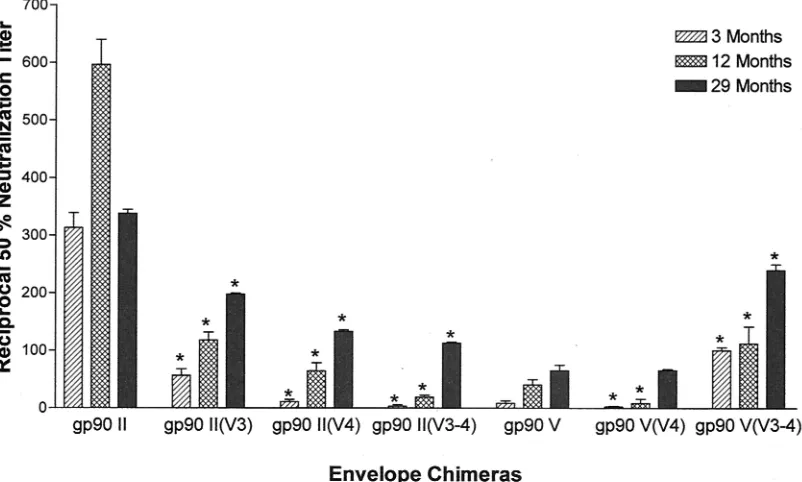
The neutralization properties of the two parental envelope variants and each chimeric envelope virus were determined using a longitudinal panel of immune serum samples taken from pony 564 at 3, 12, and 29 months postinfection to simu-late each of the three phases of infection. Using our standard in vitro neutralization assay, the reciprocal 50% neutralization
[image:7.587.45.285.69.215.2]titer of each envelope construct was determined against each reference immune serum in FEK cells. The neutralization data are summarized in Fig. 6. As observed above, the gp90II en-velope variant was consistently neutralization sensitive to the three reference serum samples (average titers of 1:340 to 1:600), while the gp90V envelope variant was consistently more neutralization resistant to the same serum treatments (average titers of 1:10 to 1:60). Substitution of the parental envelope with either of the neutralization-resistant gp90V vari-able domains V3 and V4 into the neutralization-sensitive gp90II envelope resulted in a marked reproducible decrease in the serum neutralization titer compared to the parental gp90II envelope variant for each reference immune serum. For exam-ple, the insertion of the V3 domain of gp90V into the gp90II envelope [gp90II(V3) in Fig. 6] decreased the average neutral-ization titer observed with the 12-month serum from 1:600 for the gp90II envelope to only 1:125 for the chimeric envelope. Similarly, insertion of the V4 domain of gp90V into the gp90II envelope [gp90II(V4) in Fig. 6] decreased the average neutral-ization titer with the 12-month serum from 1:600 to 1:75. For reference, it should be noted that the neutralization titer of the 12-month serum against the gp90V envelope variant was about 1:50. Interestingly, insertion of both the V3 and V4 domains of gp90V into the gp90II envelope [gp90II(V3-4) in Fig. 6] de-creased the sensitivity to serum neutralization only slightly more than the single-domain substitutions, more closely re-sembling the gp90V envelope variant resistance levels. For example, the 12-month serum average neutralization titer was 1:25 against the gp90II(V3-4) chimera, compared to the 1:50 average titer observed against the gp90V envelope variant.
FIG. 5. Replication kinetics of the variable-region exchange chi-meric envelope proviruses. Equal amounts of DNA of each of the chimeric envelope constructs, depicted in Fig. 4, were individually transfected into FEK cells in duplicate. Supernatants from each trans-fected culture were collected at regular intervals over a 30-day period. The levels of reverse transcriptase (RT) present in the samples at each time point were measured in a microRT assay as described in Mate-rials and Methods.
FIG. 6. Serum neutralization properties of variable-region chimeric envelope proviral constructs. Three serum samples from pony 564 were selected to test the effect of exchanging specific variable regions on in vitro neutralization phenotypes as described in Materials and Methods. The 50% neutralizing-antibody titers were determined for 3, 12, and 29 months postinfection for each of the replication-competent variable-region exchange chimeric viruses. Each experiment was run in duplicate and repeated twice. Asterisks indicate the neutralizing antibody titers that are significantly different (Pⱕ0.05) from the parental backbone at that specific time point.
on November 8, 2019 by guest
http://jvi.asm.org/
[image:7.587.94.495.435.676.2]Thus, these data demonstrated that the gp90 V3 and gp90 V4 domains individually were able to confer a level of serum antibody neutralization resistance similar to that observed with the gp90V envelope.
In a reciprocal set of experiments, we tested the ability of neutralization-sensitive gp90II domain substitutions into the neutralization-resistant gp90V envelope to confer sensitivity to neutralization by the panel of reference immune serum. As shown in Fig. 6, insertion of the V4 domain of gp90II into the gp90V envelope [gp90V(V4) construct] failed to increase se-rum neutralization sensitivity compared to that for the gp90V envelope variant. Because of the replication-defective nature of the gp90V(V3) chimeric envelope, it was not possible to assess the effects of a V3 substitution on gp90V envelope neutraliza-tion sensitivity. However, analysis of the gp90V(V3-4) chimeric envelope (Fig. 6), in which both the V3 and V4 domains of gp90II were inserted into the gp90V envelope, indicated an increase in serum neutralization sensitivity, as reflected by the observed increase in the average serum neutralization titer of the chimeric envelope compared to the parental gp90V enve-lope. For example, the 12-month serum neutralization titer for the gp90V(V3-4) chimeric envelope was 1:130, compared to the 1:50 neutralization titer observed for the parental gp90V envelope. However, it is important to note that even the dou-ble-domain substitution did not increase serum neutralization sensitivity to the levels observed for the gp90II envelope, for which the 12-month serum displayed a 1:600 average neutral-ization titer. Thus, these data indicate an unexpected lack of reciprocity in the influence of the gp90 V3 and V4 domains on serum antibody neutralization sensitivity and suggest that en-velope sequences outside of these two domains also contribute to the overall envelope neutralization phenotypes.
DISCUSSION
The recurrent nature of EIAV disease cycles coupled with the development of distinct quasispecies provides a unique system to study the dynamic interactions between evolving lentivirus populations and neutralizing-antibody responses. In this study, we investigated how the in vivo evolution of novel envelope quasispecies, specifically within the gp90 variable re-gions V3 and V4, affect neutralization specificity. The results of these studies provide new insights into the dynamic interplay between envelope evolution during persistent infection and the viral neutralization phenotype and the nature of the envelope determinants of antibody neutralization resistance and sensi-tivity.
The evolution of novel envelope quasispecies during sequen-tial disease cycles in experimentally infected horses has been well documented (20, 35). During persistent EIAV infection, amino acid variations accumulate predominantly within the antigenically dominant gp90 variable regions, and these varia-tions have been associated with the distinct neutralization phe-notypes associated with EIAV isolates. It has been proposed that the modifications seen within the envelope variable re-gions contribute to viral persistence, in particular by tempo-rarily evading established neutralizing-antibody responses. However, the direct influence of the defined clonal in vivo variation within the gp90 region on in vitro neutralization specificity remains largely undefined. The present study for the
first time reveals that the evolution of envelope observed dur-ing five sequential disease cycles in an experimentally infected pony over a 12-month period markedly increased the overall neutralization resistance of the gp90 proteins to both homol-ogous and heterolhomol-ogous immune serum. The high level of neutralization resistance observed with the gp90V envelope is a unique observation and suggests that while changes in neu-tralization specificity may contribute to persistence and the recurring disease cycles during chronic disease, the evolution of predominantly neutralization-resistant viral envelopes may be a major factor in maintaining a long-term persistence in inapparent carriers in the face of robust and broadly neutral-izing host serum antibodies. It is important that this model be tested in more detail by characterizing the neutralization phe-notypes of other serial EIAV isolates obtained from experi-mental infections and to extend this type of study to other lentivirus systems.
Based on structural and antigenic similarities to the V3 domain of human immunodeficiency virus type 1IIIB (HIV-1IIIB) and reactivity, we have previously defined the V3 seg-ment of EIAV gp90 as the PND of the virus. The PND des-ignation was supported further by studies that localized two linear determinants targeted by two highly type-specific neu-tralizing mouse monoclonal antibodies within the V3 domain (1). However, subsequent studies from our laboratory compar-ing neutralization determinants of laboratory strains of EIAV indicated the importance of gp90 sequences outside of the PND in defining overall neutralization properties (7). The present studies now extend these observations and conclusively reveal that both the V3 and V4 domains can equally confer antibody neutralization resistance when inserted into a neu-tralization-sensitive envelope. In fact, the V4 domain substitu-tion actually conferred a greater level of neutralizasubstitu-tion resis-tance than did the parallel V3 domain substitution. The ability of the two independent domain substitutions to confer neu-tralization resistance indicates that gp90 sequences outside the V3 domain can in fact serve as major determinants of envelope neutralization sensitivity. These observations suggest that gp90 neutralization resistance may be determined by a cooperative interaction between the V3 and V4 domains. The proposed interaction of the EIAV gp90 V3 and V4 domains is further supported by the observation that the gp90V(V3) chimera was replication defective, thus indicating a required compatibility between the V3 and V4 domains of gp90. These observations with EIAV are similar to studies with simian immunodefi-ciency virus and HIV-1, indicating required compatibility be-tween distinct variable domains, suggesting functional interac-tions (5).
The mechanism(s) by which the V3 and V4 domains indi-vidually confer equal levels of neutralization resistance to an otherwise neutralization sensitive envelope is undefined. Our current working model is that the V3 domain is indeed the predominant target for neutralizing serum antibodies but that V3 domain accessibility is determined by a conformational interaction with the V4 domain of gp90. In this regard, it is interesting that the amino acid differences between the respec-tive V4 domains of the neutralization-sensirespec-tive (gp90II) and -resistant (gp90V) gp90 envelopes alter the location of single glycosylation site in the V4 domain. Thus, it is conceivable that the location of this single V4 glycosylation site affects the
VOL. 76, 2002 EIAV ENVELOPE EVOLUTION 10595
on November 8, 2019 by guest
http://jvi.asm.org/
accessibility of V3 neutralization epitopes to serum antibodies. Modification of glycosylation sites by deletion, addition, or relocation is a common result of envelope variations observed in various lentiviruses, including EIAV. The current observa-tions lend support to the concept that the characteristic vari-ations in envelope glycosylation patterns influence neutraliza-tion properties by shielding sensitive neutralizaneutraliza-tion epitopes from serum antibodies.
As with the V4 domain, the mechanism by which the V3 domain of the neutralization-resistant gp90V confers resis-tance to the sensitive gp90II envelope is uncertain. The respec-tive V3 domains differ in amino acid sequences within the previously defined neutralizing epitope Ent and in the position of the upstream potential N-linked glycosylation site. It is ceivable that either or both of these modifications could con-tribute to the neutralization resistance, even in an envelope containing a sensitive V4 domain.
The present studies defined the V3 and V4 domains as determinants of neutralization resistance, but the reciprocal studies of determinants of neutralization sensitivity were not as clearly defined. An assessment of the ability of the sensitive gp90II V3 domain to confer neutralization sensitivity to the resistant gp90V envelope was not feasible because of the rep-lication-defective nature of the gp90V(V3) chimera. However, the parallel single insertion of the sensitive gp90 envelope V4 into the resistant gp90V envelope failed to increase the sensi-tivity of the envelope to serum neutralization. The double V3 and V4 insertion into the gp90V envelope did confer partial serum neutralization sensitivity, but only at a level that was about one-fourth of that of the parental gp90II envelope. These observations once again indicate that the resistance is a dominant phenotype, in that the resistant gp90V V3 or V4 domain was the dominant determinant in the presence of sen-sitive domains from gp90II. The fact that the double V3 and V4 substitution only partially conferred neutralization sensitiv-ity further suggests that gp90 envelope domains outside of these V3 and V4 domains are also contributing to envelope resistance. In this regard, it should be noted that additional sequence variations exist between the neutralization-sensitive gp90II and neutralization-resistant gp90V envelopes. These include one to three amino acid differences in the V2, V5, V6, V7, and V8 domains, some of which alter the respective gly-cosylation patterns in the respective domains (Fig. 2). Thus, it is likely that one or more of these additional envelope varia-tions contribute to neutralization resistance, reflecting a com-plex of neutralization determinants at distant but conforma-tionally interactive sites.
A number of studies of EIAV envelope variation have dem-onstrated a distinct envelope quasispecies population associ-ated with sequential disease cycles in experimentally infected equids (20, 35). The dynamic and diverse nature of EIAV envelope variation in vivo strongly suggests a highly active immune selection, including neutralizing antibodies. The present studies extend our understanding of at least one role of EIAV envelope variation in persistence in that the envelope evolution is driven toward neutralization resistance that can be optimized by multiple, synergistic envelope determinants via changes in neutralization epitopes and in domains that can sequester these sensitive sites. Based on this hypothesis, it may be implied that host neutralizing antibodies can play a
domi-nant role in immune control of EIAV replication during early stages of infection (chronic EIA) while viral envelopes are neutralization sensitive, but that the sustained immune sup-pression of neutralization-resistant envelope variants present in long-term inapparent carriers is probably due to cellular immune responses. The primary role of the broadly neutraliz-ing antibodies that are associated with mature immunity in EIAV-infected horses is then to protect against natural EIAV exposure by horsefly bites and to eliminate any neutralization-sensitive viral quasispecies that may arise in the tissue reser-voirs of infection. In this way, humoral and cellular immune responses act in a timely synergistic manner to gain and then sustain control of EIAV infection and subsequent exposure, a lesson from nature relevant to vaccine development.
The observed evolution in EIAV toward a neutralization-resistant phenotype appears to support the concept that enve-lope variations observed during persistent lentivirus infection result from immune selections that increase antibody neutral-ization resistance, providing an important mechanism of per-sistence in the face of competent host immunity. In this regard, Burns et al. first reported the development of broadly neutral-ization-resistant envelope variants in monkeys experimentally infected with the reference molecular clone SIVmac239(3). This seminal paper has been followed by several other published studies demonstrating a temporal relationship between enve-lope sequence changes and increases in neutralization resis-tance for viruses that evolve in monkeys during the course of persistent SIV infection (3, 4, 27). Similarly, the evolution from neutralization-sensitive to -resistant envelope phenotypes has been documented in persistent infections of monkeys with SHIV constructs containing the HIV-1 envelope (6, 24, 30, 33). Experiments on immune selection and changes in neutraliza-tion phenotypes in HIV-1-infected patients are generally com-plicated by the lack of knowledge of the infecting viral strain and time of infection and by the low levels of in vitro serum antibody neutralization characteristic of primary HIV-1 tralization. However, a recent study did characterize the neu-tralization phenotypes of two HIV-1IIIB variants that were isolated from a laboratory worker accidentally infected with the neutralization-sensitive HIV-1IIIBstrain (2). Compared to the original virus in the viral inoculum, the viral isolates dis-played an increased resistance to neutralization over time. The emergence of neutralization-resistant virus preceded disease development in this laboratory worker, perhaps indicating the role of neutralizing antibodies in humoral immune control. Thus, these limited observations indicate the need for more detailed studies of the evolution of animal and human lentivi-rus neutralization properties during persistent infection to pro-vide a more definitive characterization of functional outcome of the dynamic interaction between evolving lentivirus enve-lopes and host immune response.
ACKNOWLEDGMENTS
This research was supported by grant RO1 AI25850 from the Na-tional Institutes of Health (R.C.M.) and by funds from the Lucille P. Markey Charitable Trust (C.J.I.) and the Kentucky Agricultural Ex-periment Station (C.J.I.).
We acknowledge Brian McKeon for excellent technical assistance in these studies, and we thank Kelly Stefano Cole and Frank Jenkins for a critical reading of the manuscript and for helpful suggestions.
on November 8, 2019 by guest
http://jvi.asm.org/
REFERENCES
1.Ball, J. M., K. E. Rushlow, C. J. Issel, and R. C. Montelaro.1992. Detailed mapping of the antigenicity of the surface unit glycoprotein of equine
infec-tious anemia virus by using synthetic peptide strategies. J. Virol.66:732–742.
2.Beaumont, T., A. van Nuenen, S. Broersen, W. A. Blattner, V. V. Lukashov, and H. Schuitemaker.2001. Reversal of human immunodeficiency virus type 1 IIIB to a neutralization-resistant phenotype in an accidentally infected
laboratory worker with a progressive clinical course. J. Virol.75:2246–2252.
3.Burns, D. P., C. Collignon, and R. C. Desrosiers.1993. Simian immunode-ficiency virus mutants resistant to serum neutralization arise during
persis-tent infection of rhesus monkeys. J. Virol.67:4104–4113.
4.Chackerian, B., L. M. Rudensey, and J. Overbaugh.1997. Specific N-linked and O-linked glycosylation modifications in the envelope VI domain of simian immunodeficiency virus variants that evolve in the host alter
recog-nition by neutralizing antibodies. J. Virol.71:7719–7727.
5.Chen, M., C. Shi, V. Kalia, S. B. Tencza, R. C. Montelaro, and P. Gupta.
2001. HIV gp120 V(1)/V(2) and C(2)-V(3) domains glycoprotein
compati-bility is required for viral replication. Virus Res.79:91–101.
6.Cheng-Mayer, C., A. Brown, J. Harouse, P. A. Luciw, and A. J. Mayer.1999. Selection for neutralization resistance of the simian/human immunodefi-ciency virus SHIVSF33A variant in vivo by virtue of sequence changes in the extracellular envelope glycoprotein that modify N-linked glycosylation. J.
Vi-rol.73:5294–5300.
7.Cook, R. F., S. L. Berger, K. E. Rushlow, J. M. McManus, S. J. Cook, S. Harrold, M. L. Raabe, R. C. Montelaro, and C. J. Issel.1995. Enhanced sensitivity to neutralizing antibodies in a variant of equine infectious anemia virus is linked to amino acid substitutions in the surface unit envelope
glycoprotein. J. Virol.69:1493–1499.
8.Cook, R. F., C. Leroux, S. J. Cook, S. L. Berger, D. L. Lichtenstein, N. N. Ghabrial, R. C. Montelaro, and C. J. Issel.1998. Development and charac-terization of an in vivo pathogenic molecular clone of equine infectious
anemia virus. J. Virol.72:1383–1393.
9.Craigo, J. K., C. Leroux, L. Howe, J. D. Steckbeck, S. J. Cook, C. J. Issel, and R. C. Montelaro.2002. Transient immune-suppression of inapparent-carriers infected with a principal neutralizing domain-deficient EIAV induces neu-tralizing antibodies and lowers steady-state viral replication. J. Gen. Virol.
83:1353–1359.
10.Fujimiya, Y., L. E. Perryman, and T. B. Crawford.1979. Leukocyte cytotox-icity in a persistent virus infection: presence of direct cytotoxcytotox-icity but absence of antibody-dependent cellular cytotoxicity in horses infected with equine
infectious anemia virus. Infect. Immun.24:628–636.
11.Gerencer, M., I. Valpotic, B. Jukic, M. Tomaskovic, and I. Basic.1989. Qualitative analyses of cellular immune functions in equine infectious
ane-mia show homology with AIDS. Arch. Virol.104:249–257.
12.Hammond, S. A., S. J. Cook, D. L. Lichtenstein, C. J. Issel, and R. C. Montelaro.1997. Maturation of the cellular and humoral immune responses to persistent infection in horses by equine infectious anemia virus is a
complex and lengthy process. J. Virol.71:3840–3852.
13.Hammond, S. A., F. Li, B. M. McKeon, Sr., S. J. Cook, C. J. Issel, and R. C. Montelaro.2000. Immune responses and viral replication in long-term in-apparent carrier ponies inoculated with equine infectious anemia virus. J.
Vi-rol.74:5968–5981.
14.Harrold, S. M., S. J. Cook, R. F. Cook, K. E. Rushlow, C. J. Issel, and R. C. Montelaro.2000. Tissue sites of persistent infection and active replication of equine infectious anemia virus during acute disease and asymptomatic
in-fection in experimentally infected equids. J. Virol.74:3112–3121.
15.Hussain, K. A., C. J. Issel, K. L. Schnorr, P. M. Rwambo, and R. C. Montelaro. 1987. Antigenic analysis of equine infectious anemia virus (EIAV) variants by using monoclonal antibodies: epitopes of glycoprotein
gp90 of EIAV stimulate neutralizing antibodies. J. Virol.61:2956–2961.
16.Issel, C. J., W. V. Adams, Jr., L. Meek, and R. Ochoa.1982. Transmission of equine infectious anemia virus from horses without clinical signs of disease.
J. Am. Vet. Med. Assoc.180:272–275.
17.Issel, C. J., and L. D. Foil.1984. Studies on equine infectious anemia virus
transmission by insects. J. Am. Vet. Med. Assoc.184:293–297.
18.Kono, Y., K. Hirasawa, Y. Fukunaga, and T. Taniguchi.1976. Recrudes-cence of equine infectious anemia by treatment with immunosuppressive
drugs. Natl. Inst. Anim. Health Q. (Tokyo)16:8–15.
19.Leroux, C., J. K. Craigo, C. J. Issel, and R. C. Montelaro.2001. Equine
infectious anemia virus genomic evolution in progressor and nonprogressor
ponies. J. Virol.75:4570–4583.
20.Leroux, C., C. J. Issel, and R. C. Montelaro.1997. Novel and dynamic evolution of equine infectious anemia virus genomic quasispecies associated with sequential disease cycles in an experimentally infected pony. J. Virol.
71:9627–9639.
21.Lichtenstein, D. L., C. J. Issel, and R. C. Montelaro.1996. Genomic quasi-species associated with the initiation of infection and disease in ponies
experimentally infected with equine infectious anemia virus. J. Virol.70:
3346–3354.
22.McGuire, T. C., D. B. Tumas, K. M. Byrne, M. T. Hines, S. R. Leib, A. L. Brassfield, K. I. O’Rourke, and L. E. Perryman.1994. Major
histocompat-ibility complex-restricted CD8⫹cytotoxic T lymphocytes from horses with
equine infectious anemia virus recognize Env and Gag/PR proteins. J. Virol.
68:1459–1467.
23.Montelaro, R., J. M. Ball, and K. Rushlow.1993. Equine retroviruses, p.
257–360.InJ. A. Levy (ed.), The Retroviridae. Plenum Press, New York,
N.Y.
24.Narayan, S. V., S. Mukherjee, F. Jia, Z. Li, C. Wang, L. Foresman, C. McCormick-Davis, E. B. Stephens, S. V. Joag, and O. Narayan.1999. Char-acterization of a neutralization-escape variant of SHIVKU-1, a virus that causes acquired immune deficiency syndrome in pig-tailed macaques.
Virol-ogy256:54–63.
25.Payne, S. L., F. D. Fang, C. P. Liu, B. R. Dhruva, P. Rwambo, C. J. Issel, and R. C. Montelaro.1987. Antigenic variation and lentivirus persistence: vari-ations in envelope gene sequences during EIAV infection resemble changes
reported for sequential isolates of HIV. Virology161:321–331.
26.Perryman, L. E., K. I. O’Rourke, and T. C. McGuire.1988. Immune re-sponses are required to terminate viremia in equine infectious anemia
len-tivirus infection. J. Virol.62:3073–3076.
27.Rudensey, L. M., J. T. Kimata, E. M. Long, B. Chackerian, and J. Over-baugh.1998. Changes in the extracellular envelope glycoprotein of variants that evolve during the course of simian immunodeficiency virus SIVMne infection affect neutralizing antibody recognition, syncytium formation, and macrophage tropism but not replication, cytopathicity, or CCR-5 coreceptor
recognition. J. Virol.72:209–217.
28.Rwambo, P. M., C. J. Issel, W. V. Adams, Jr., K. A. Hussain, M. Miller, and R. C. Montelaro.1990. Equine infectious anemia virus (EIAV) humoral responses of recipient ponies and antigenic variation during persistent
in-fection. Arch. Virol.111:199–212.
29.Rwambo, P. M., C. J. Issel, K. A. Hussain, and R. C. Montelaro.1990. In vitro isolation of a neutralization escape mutant of equine infectious anemia
virus (EIAV). Arch. Virol.111:275–280.
30.Si, Z., M. Cayabyab, and J. Sodroski.2001. Envelope glycoprotein determi-nants of neutralization resistance in a simian-human immunodeficiency virus
(SHIV-HXBc2P 3.2) derived by passage in monkeys. J. Virol.75:4208–4218.
31.Tschetter, J. R., K. M. Byrne, L. E. Perryman, and T. C. McGuire.1997. Control of equine infectious anemia virus is not dependent on ADCC
me-diating antibodies. Virology230:275–280.
32.Tumas, D. B., M. T. Hines, L. E. Perryman, W. C. Davis, and T. C. McGuire.
1994. Corticosteroid immunosuppression and monoclonal
antibody-medi-ated CD5⫹T lymphocyte depletion in normal and equine infectious
anae-mia virus-carrier horses. J. Gen. Virol.75:959–968.
33.Ye, Y., Z. H. Si, J. P. Moore, and J. Sodroski.2000. Association of structural changes in the V2 and V3 loops of the gp120 envelope glycoprotein with acquisition of neutralization resistance in a simian-human immunodeficiency
virus passaged in vivo. J. Virol.74:11955–11962.
34.Zhang, W., S. M. Lonning, and T. C. McGuire.1998. Gag protein epitopes recognized by ELA-A-restricted cytotoxic T lymphocytes from horses with
long-term equine infectious anemia virus infection. J. Virol.72:9612–9620.
35.Zheng, Y. H., T. Nakaya, H. Sentsui, M. Kameoka, M. Kishi, K. Hagiwara, H. Takahashi, Y. Kono, and K. Ikuta.1997. Insertions, duplications and substitutions in restricted gp90 regions of equine infectious anaemia virus during febrile episodes in an experimentally infected horse. J. Gen. Virol.
78:807–820.
36.Zheng, Y. H., H. Sentsui, T. Nakaya, Y. Kono, and K. Ikuta.1997. In vivo dynamics of equine infectious anemia viruses emerging during febrile epi-sodes: insertions/duplications at the principal neutralizing domain. J. Virol.
71:5031–5039.
VOL. 76, 2002 EIAV ENVELOPE EVOLUTION 10597