
University of Southern Queensland
Department of Mathematics and Computing
Faculty of Sciences
Performance issues for VOIP in Access Networks
A dissertation submitted by
Jishu Das Gupta
In partial fulfilment of the requirements for the degree of
Masters of Computing
Supervisor: Associate Professor R. G. Addie
Performance (QoS) issues in Access Network for VOIP
JD 1
Abstract
The is a general consensus that the Quality of Service (QoS) of Voice over Internet Protocol (VOIP) is of growing importance for research and study.
In this dissertation we investigate the performance of VOIP and the impact of resource limitations in the performance of Access Networks. The impact of VOIP performance in access networks is particularly important in regions where Internet resources are limited and the cost of improving these resources is prohibitive.
It is clear that perceived VOIP performance, as measured by mean opinion score in experiments where subjects are asked to rate communication quality, is determined by end-to-end delay on the communication path, delay variation, packet loss, echo, the coding algorithm in use and noise. These performance indicators can be measured and the contribution in the access network can be estimated. The relation between MOS and technical measurement is less well understood. We investigate the contribution of the access network to the overall performance of VOIP services and the ways in which access networks can be designed to improve VOIP performance. Issues of interest include the choice of coding rate, dynamic variation of coding rate, packet length, methods of controlling echo, and the use of Active Queue Management (AQM) in Access Network routers.
Performance (QoS) Issue in Access Network for VOIP
JD 2
Certification
I certify that the ideas, experimental work, results, analysis, software and conclusions reported in this dissertation are entirely my own effort, except where otherwise acknowledged. I also certify that the work is original and has not been previously submitted for any other award, except where otherwise acknowledged.
--- ---
Signature of Candidate Date
--- ---
Signature of Supervisor Date
--- ---
Performance (QoS) issues in Access Network for VOIP
JD 3
Acknowledgement
This dissertation would not have become what it is without the help of several people. First of all, I would like to thank my Principle Supervisor Assoc. Prof. Dr. Ron Addie for providing me with useful suggestions about the overall structure and contents of my thesis and for helping me with several simulation experiments.
Special thanks go to Dr. Karla Ziri-Castro for providing me feedback and suggestion with the project and dissertation writing and Zhi Li for providing support with the Network Simulator.
Performance (QoS) Issue in Access Network for VOIP
JD 4
Table of Contents
Abstract...1
Certification ...2
Acknowledgement ...3
Table of Contents...4
List of Figures...9
List of Tables ... 11
List of Tables ... 11
1. Introduction ... 13
1.1. Motivation ... 14
1.2. Research Issues ... 16
1.3. Organization... 20
2. VOIP Components ... 21
2.1. What is IP? ... 22
2.2. What is VOIP? ... 22
2.3. IP Technology... 24
2.4. The Access Network... 25
2.5. What is MOS? ... 27
2.6. Codecs ... 28
2.7. Concatenation and Transcoding... 31
Performance (QoS) issues in Access Network for VOIP
JD 5
2.9. SIP (Session Initiation Protocol)... 35
2.10. H.323 ... 36
2.11. Echo cancellation ... 37
2.12. Packet Loss ... 38
2.13. Delay... 40
2.14. Delay Variation (Jitter) ... 40
3. Advantages & Disadvantages of VOIP... 43
3.1. Credentials of Voice over Internet Protocol ... 44
3.1.1. Price Advantage...45
3.1.2. New and profitable area for ISPs...45
3.1.3. Benefits for traditional telephone service providers. ...45
3.1.4. Potential value in the transition to next-generation networks...45
3.2. VOIP Limitations... 46
3.3. Summary ... 48
4. Customer & Business Perception of VOIP Technology ... 51
4.1. Basics: ... 52
4.2. IP Telephony versus PSTN ... 53
4.3. Summary of Perception: ... 55
4.3.1. How traditional long distance works?...55
4.3.2. How long distance works with VOIP?...55
4.4. Overview... 55
4.4.1. What is IP Telephony good for? ...57
Performance (QoS) Issue in Access Network for VOIP
JD 6
5. Factors that Impact the QoS of VOIP... 61
5.1. Speech quality ... 62
5.1.1. Speech coding ...63
5.1.2. Packetization efficiency ...66
5.1.3. Silence suppression...66
5.1.4. Error concealment...67
5.1.5. Jitter buffer implementation...68
5.1.6. Codec tandem performance ...69
5.2. Delay... 70
5.2.1. Codec delay ...71
5.2.2. IP terminal buffering delay...72
5.2.3. Packetization/buffering delays ...73
5.2.4. Network transmission delays...73
5.2.5. Delay variation ...74
5.2.6. End to End delay ...74
5.3. Loss... 77
5.4. Echo... 79
5.4.1. Echo from H.323-based terminals ...79
5.4.2. Echo from the PSTN ...80
5.5. Noise ... 81
5.5.1. Environmental (acoustic) noise ...81
5.5.2. Idle channel noise ...81
5.5.3. Noise contrast and comfort noise ...81
Performance (QoS) issues in Access Network for VOIP
JD 7
5.6.1. Delay and Echo...83
5.6.2. Loss and Noise ...85
5.6.3. Encoding...86
6. Improving VOIP: An Engineering Challenge ... 87
6.1. AQM... 89
6.2. Speech Coding ... 90
6.3. Packetization (Packet Loss) ... 92
6.4. Silence Suppression ... 93
6.5. Echo... 94
6.6. Jitter Buffer and Adaptive Alpha... 95
6.7. Simulation and Scientific Experiment ... 96
6.8.1. Experiment 1: ...99
6.8.2. Experiment 2: ...102
6.8.3. Experiment 3: ...105
7. Signalling... 113
7.1. Background ... 114
7.2. The Basics ... 114
7.3. Architecture... 117
7.4. SIP Signalling ... 118
7.4.1. SIP Methods ...119
7.4.2. Addressing and naming ...120
7.4.3. Locating a Server...120
Performance (QoS) Issue in Access Network for VOIP
JD 8
7.5. SIP and H.323... 121
8. Conclusion and Further Development... 125
8.1. Conclusion ... 126
8.2. Future Work... 127
Nomenclature (Classification) ... 130
Bibliography ... 134
Appendix... 142
A. Experiment 1 ... 142
B. Experiment 2 ... 148
Performance (QoS) issues in Access Network for VOIP
JD 9
List of Figures
Figure 1.1 VOIP in Service [4] ...17
Figure 1.2 Simplified diagram of an IP telephone system [4] ...18
Figure 2.1 Typical Network ... 25
Figure 2.2 Effect of codec concatenation on an MOS [4]. ...29
Figure 2.3 Effects of transcoding [4]...29
Figure 2.4 Relational Diagram. ...31
Figure 2.5 Diffserv Architecture [19]. ...35
Figure 4.1 (IP terminal (computer) to IP terminal)[32] ...53
Figure 4.2 (IP terminal to phone or phone to IP terminal) [32] ...54
Figure 4.3 (Phone to Phone) [32] ...54
Figure 5.1 Packet delay Distribution [27]...77
Figure 5.2 Mean Opinion Score Diagram...85
Figure 6.1 A pictorial representation of AQM [46]... 89
Figure 6.3 Impact of Delay on quality [31] ...94
Figure 6.4 Real life picture of a typical network... 97
Figure 6.5 Basic Model for Simulation ...97
Figure 6.6 Model for Simulation with Diffserv extensions ...98
Figure 6.7: The NAM outlook... 99
Performance (QoS) Issue in Access Network for VOIP
JD 10
Figure 6.9 Experiment 1 xgraph output ... 101
Figure 6.10 Experiment 2 diagram ... 103
Figure 6.11 Experiment 2 xgraph output ... 104
Figure 6.12 Experiment 2 xgraph output with tuning ... 105
Figure 6.13 Experiment 3 diagram ... 107
Figure 6.14 Experiment 3 xgraph output ... 109
Figure 6.15 Experiment 3B xgraph output with simple tuning... 109
Figure 7.1 SIP basic session initiation flow between two SIP clients [52]... 116
Performance (QoS) issues in Access Network for VOIP
JD 11
List of Tables
Table 1.1: Heterogeneous Traffic Behaviour [1] ... 15
Table 2.1 Different Codecs and their characteristics... 28
Table 2.2. H.323 Protocols Suite...37
Table 3.1. Comparison of traditional and IP telephone services [7]. ... 46
Table 5.1. Voice codecs with coding Techniques [36]...63
Chapter 1
Chapter 1: Introduction
JD 14
1.1. Motivation
In just over a decade, the Internet has grown to over 40,000 sites and 3,000,000 hosts [1]. The startling growth of Internet technology, coupled with the relatively low deployment cost of IP networks, has pushed for an integrated “IP-based core” - a single network for data, video and voice access. However, the diverse service-requirements and novel traffic characteristics of the emerging Internet applications have posed many technical challenges that the Internet community must address in the near future, as the emerging multimedia applications begin to constitute an ever-increasing fraction of Internet traffic. High quality interactive voice and video applications can tolerate little delay variation and packet loss. Based on the ITU-T publication in [1] Table 1.1 contrasts the traffic characteristics and
service requirements of the traditional data applications and multimedia applications.
Applications Traffic Behaviour
QoS Requirements
Electronic mail (SMTP),
file transfer (FTP),
remote terminal (Telnet)
Small, batch file transfers.
Very tolerant of delay & loss.
Bandwidth requirement: Low.
Best effort.
HTML web browsing A series of
small, bursty file transfers.
Tolerant of moderate delay & loss.
Bandwidth requirement: Low to moderate. Best effort. Client-server Business Applications Many small two-way transactions, “chatty”.
Sensitive to loss & delay.
Bandwidth requirement: Low to moderate.
Best effort, must be stable & reliable. IP-based voice (VOIP) Constant bit
rate or bursty traffic (with silence suppression).
Very sensitive to delay & jitter. Sensitive to loss.
Performance (QoS) issues in Access Network for VOIP
JD 15
Requires predictable delay & loss.
IP-based Real-time Video
Constant or variable bit rate
(Depending on the codec).
Extremely sensitive to delay & jitter, and loss.
Bandwidth requirement: High, e.g. 384 Kbps.
Requires predictable delay & loss.
Table 1.1: Heterogeneous Traffic Behaviour and QoS Requirements of Internet Applications [1]
Chapter 1: Introduction
JD 16
1.2. Research Issues
Quality Of Service (QoS) is a defined level of performance in a data communications system [2]. As an example, to ensure that real time voice and video are delivered without annoying blips, a guaranteed bandwidth is required. The plain old telephone system (POTS) has delivered the highest quality of service for years, because there is a dedicated channel between parties. However, when data is broken into packets that travel through the same routers in the LAN or WAN with all other data, QoS mechanisms are the only way to guarantee quality by giving real time data priority over non-real time data [3].
In a recent paper of Bur Goode [4] it was mentioned that, during the recent Internet stock bubble, articles in the trade press frequently said that, in the near future, telephone traffic
would be just another application running over the Internet. Such statements gloss over many engineering details that prevent voice from being just another Internet application. A large number of factors are involved in making a high-quality VOIP call. These factors include the speech codec, packetization delay, packet loss, delay (coding, transmission, propagation and queuing), delay variation, and the network architecture to provide QoS. Other factors involved in making a successful VOIP call include the call setup signalling protocol, call admission control, security concerns, and the ability to traverse Network Access Translation (NAT*) [2]and firewalls.
*Short for Network Address Translation, an Internet standard that enables a local-area network (LAN) to use one set of IP addresses for internal traffic and a second set of addresses for external traffic. A NAT box located where the LAN meets the Internet makes all necessary IP address translations.
NAT serves three main purposes:
Provides a type of firewall by hiding internal IP addresses
Enables a company to use more internal IP addresses. Since they're used internally only, there's no possibility of conflict with IP addresses used by other companies and organizations.
Performance (QoS) issues in Access Network for VOIP
JD 17
[image:19.612.121.513.391.609.2]Although VOIP involves the transmission of digitized voice in packets, the telephone itself may be analog or digital. The voice may be digitized and encoded either before or concurrently with packetization. Figure 1.1 shows a business in which a PBX is connected to VOIP gateway as well as to the local telephone company central office. The VOIP gateway allows telephone calls to be completed through the IP network. Local calls can still be completed through the telephone company as in the past. The business may use the IP network to make all calls between its VOIP gateway connected sites or it may choose to split the traffic between the IP network and the PSTN based on a least-cost routing algorithms configured in the PBX. VOIP calls are not restricted to telephones served directly by the IP network. We refer to VOIP calls to telephones served by the PSTN as “off-net” calls. Off-net calls must be routed over the IP network to a VOIP/PSTN gateway near the destination telephone.
Figure 1.1 VOIP in Service [4]
Chapter 1: Introduction
JD 18
[image:20.612.122.530.222.442.2]network. IP phones are connected to a LAN. Voice calls can be made locally over the LAN. The IP phones include codecs that digitize and encode (as well as decode) the speech. The IP phones also Packetsize and Depacketize the encoded speech. Calls between different sites can be made over the wide area IP network. Proxy servers perform IP phone registration and coordinate call signalling, especially between sites. Connections to the PSTN can be made through VOIP gateways.
Figure 1.2 Simplified diagram of an IP telephone system [4]
* SIP : The Session Initiation Protocol (SIP) is an Internet Engineering Task Force (IETF) standard protocol for initiating an interactive user session that involves multimedia elements such as video, voice, chat, gaming, and virtual reality.
Performance (QoS) issues in Access Network for VOIP
JD 19
Figure 1.2 is a representation of a large network. For ascertaining the real problems we need to understand and investigate one simple link of this large network. For this issue we can focus on the point where the congestion (bottleneck) occurs. This will also facilitate us to develop an accurate understanding for the entire network. Since paths are made of links, understanding congestion in a path through the internet largely reduces to understanding congestion in one link. A simulation experiment investigating certain approaches to performance management in an access network will be presented in Chapter 6.
* Proxy Server: In an enterprise that uses the Internet, a proxy server is a server that acts as an intermediary between a workstation user and the Internet so that the enterprise can ensure security, administrative control, and caching service. A proxy server is associated with or part of a gateway server that separates the enterprise network from the outside network and a firewall server that protects the enterprise network from outside intrusion.
Chapter 1: Introduction
JD 20
1.3. Organization
In this Masters project we investigate and discuss the factors involved in making a high-quality VOIP call and the engineering tradeoffs that must be made between delay and the efficient use of bandwidth. After a discussion of codec selection and the delay budget, we shall discuss various techniques to achieve network quality of service. Since call setup is very important, the dissertation also presents an overview of several VOIP call signalling protocols, including H.323 and SIP.
Our first chapter describes the motivation and research issues and also elaborates the organization of the reminder of the dissertation. Chapter two mostly covers the general definition of the different components of VOIP. Chapter three focuses on the different
Chapter 2
VOIP
Chapter 2: VOIP Components
JD 22
The rational of the Chapter 2 is to provide a clear picture of the components of VOIP. In this chapter we have presented the definition and the basic understanding of the different essential parts of the VOIP.
2.1. What is IP?
IP (Internet Protocol) is the method used to send data from one computer to another via the Internet; each data message is split into small parcels known as packets. IP Telephony covers the technologies that use this packet-switched approach to exchange voice, video, and other kinds of communication. VOIP is a part of all these technologies. Previously these have been carried using the circuit-switched connections on the voice orientated PSTN. The result of this is a converged IP-based network that provides a common transport platform for voice, video and data traffic [5].
2.2. What is VOIP?
Performance (QoS) issues in Access Network for VOIP
JD 23
VOIP proponents expect an opportunity to provide a more flexible and feature-rich network at a significantly lower cost. The interest in VOIP arises out of the following factors:
Short-term: Cheaper long distance calls, especially international calls.
Mid- to Long-term: More efficient converged infrastructure for all types of traffic, simpler network and service management, and service access.
Long-term: Open platform for telecom services and greater opportunities for innovation.
[7]
According to Bur Goode [4], although the Internet Protocol, is the most widespread of communication protocols, its main applications have been restricted to non-real time data, e.g. email, FTP, etc. Presently, in order to take the advantage of ubiquity of IP-based network and the bandwidth economies offered by packet transport, a whole new set of protocols and mechanisms is being introduced to carry real time traffic over such networks. Examples are – Multi Protocol Label Switching (MPLS), IP version 6 (IPv6), RSVP, Diffserv, IntServ. VOIP, as a technology, benefits from all such protocols and mechanisms. The VOIP technology can be used for PC to PC, PC to Phone and Phone to Phone telephony as well as for facsimile and video communication [4].
The building blocks of a VOIP network are – IP protocols, voice coding, delay control, public network interfaces and the SIP (IETF) and H.323 (ITU-T) standards. For signalling (setting up and clearing down calls) service users connect into the packet network via access networks at the originating and terminating ends [8]. Functionally, the customer premises
Chapter 2: VOIP Components
JD 24
2.3. IP Technology
IP determines the format of packets, also called datagrams, and in particular, provides the addressing for routing. Most services combine IP with one of two higher-level protocols, Transmission Control Protocol (TCP), which establishes a virtual connection between a destination and a source or User Datagram Protocol (UDP). UDP is more important than TCP for VOIP. In particular, for VOIP, retransmission of lost packets is inappropriate. TCP always retransmits lost packets, but UDP does not. IP by itself is something like the postal system. It allows you to address a package and drop it in the system, but there's no direct link between you and the recipient. TCP/IP, on the other hand, establishes a connection between two hosts so that they can send messages back and forth for a period of time [2].
Performance (QoS) issues in Access Network for VOIP
JD 25
Here we should mention that the IP ‘pipe’ is the base carrier for both the TCP and UDP data. TCP retransmits the data if it is lost or destroyed. These characteristics give TCP an outstanding performance in the wide network. But retransmission is pointless for real time services because by the time a packet is retransmitted it will probably be out of date. For real time services, UDP is more appropriate.
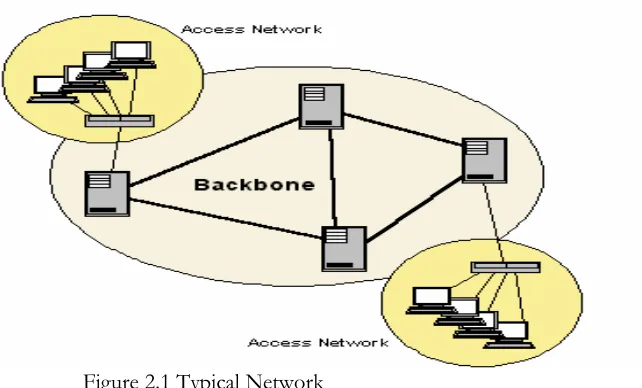
2.4. The Access Network
The access network is the network to which customer premises equipment is directly connected, providing local services or wide area services via a Wide Area Network (WAN) [9].
[image:27.612.221.542.401.595.2]Access networks connect to the "backbone," which is a network comprised of high-speed lines between major switching points. The switching points could be buildings on a campus or cities in a country.
Figure 2.1 Typical Network
Chapter 2: VOIP Components
JD 26
For future multimedia services, one of the most crucial issues is building an access network that can accommodate multimedia services [1]. The access network is defined as a network entity providing access capabilities for various service applications (a wide variety of types of user terminals) to access various service providers (specific service nodes) located at the edges of the core networks. ITU-T is playing a leading role in studying GII for ITU-T standardization, and has the responsibility of studying architectural frameworks for telecommunications transport networks, including access networks and core networks. These studies should lead to versatile solutions for access networks which support a wide range of services, rather than a few restricted solutions. The studies will also lead to identifying new interfaces for various types of customer access networks and interfaces within the access networks to support GII and open networking concepts [10].
Although access networks provide only the first and last few kilometres of connectivity, because of the lower level of concentration of traffic, they make up a high proportion of the
cost of communication. Also upgrading access networks e.g. from cable based communication to optical fibre, is very difficult & expensive. For this reason we will be forced to use all available technologies to get the best performance we can, from access networks for many years to come.
Difficulties of provisioning and design of access networks are more severe in regions of low population density such as regional and rural Australia and rural regions elsewhere. This is for the simple reason that the cables and ducts which physically comprise the network are longer & therefore more expensive and this cost must be borne by, or on behalf of, a smaller group of clients.
Performance (QoS) issues in Access Network for VOIP
JD 27
2.5. What is MOS?
In voice communications, particularly Internet telephony, the Mean Opinion Score (MOS) provides an aggregate numerical measure of the quality of human speech at the destination end of the circuit. The scheme uses subjective tests (opinion scores) that are mathematically averaged to obtain a quantitative indicator of overall quality.
Predictive codecs are commonly used in voice communications [11] because they conserve bandwidth. But they also degrade voice fidelity. The best codecs provide the most bandwidth conservation while producing the least degradation of the signal [12]. In addition, packetization delay is increased by the use of highly compressed coding, unless shorter packets are used. If shorter packets are used, the advantage of a highly compressed code is partially lost because of high level of overhead.
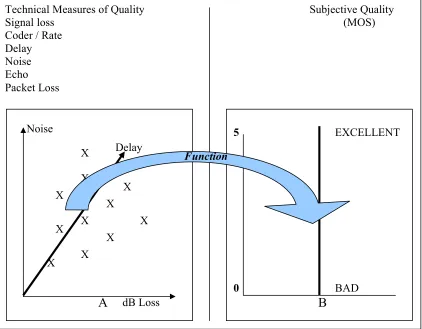
Technical quality like loss, delay, distortion, noise and echo can be measured by the technology. But subjective measures of quality are not possible to measure by the technology and for that we need MOS.
To determine MOS, a number of listeners rate the quality of test sentences read aloud over the communications circuit by male and female speakers. A listener gives each sentence a rating as follows:
(1) Bad;
(2) Poor;
(3) Fair;
(4) Good;
Chapter 2: VOIP Components
JD 28
The MOS is the arithmetic mean of all the individual scores, and can range from 1 (worst) to 5 (best) [2] [4].
2.6. Codecs
There are many codecs available for digitizing speech. Table 2.1 gives some of the characteristics of a few standard codecs. This data is based on the ITU-T standard [13].
Table 2.1 Different Codecs and their characteristics
Performance (QoS) issues in Access Network for VOIP
[image:31.612.116.539.56.280.2]JD 29
Figure 2.2 Effect of codec concatenation on an MOS [4].
Figure 2.3 Effects of transcoding [4].
Chapter 2: VOIP Components
JD 30
Figure 2.4. illustrates the underlying problem addressed by MOS experiments. Overall quality must be determined by technical, measurable, qualities such as loss (Loss of Volume, in dB), noise, delay, etc. However, there is no technical way of measuring quality. We can estimate quality by asking users to rate the quality of a series of calls. Because of random variation from one subject to another it is essential to repeat such experiments among times in order to obtain a sufficiently accurate measurement.
Measuring the quality of one particular voice call serves little purpose. However, measuring the quality of a voice call with known technical characteristics – for delay, dB loss, etc, is useful. In effect, in this way we can estimate the function depicted in Figure 2.4. This function, which gives the MOS of a call in terms of its technical parameters, can be reapplied many times over.
Performance (QoS) issues in Access Network for VOIP
[image:33.612.116.538.60.389.2]JD 31
Figure 2.4 Relational Diagram.
2.7. Concatenation and Transcoding
The best packet network design codes the speech once near the speaker and decodes it once near the listener. Concatenation of low-bit-rate speech codecs, as well as the Transcoding of speech in the middle of the transmission path, degrades speech quality. Figure 2.2, from [4], shows the MOS of several codecs with and without concatenation. (A MOS of 5 is excellent, 4 is good, 3 is fair, 2 is poor, and 1 is very bad. Note that G.729 x 2 means that speech coded with G.729 was decoded and then recoded with G.729 before reaching the final decoder. G.729 x 3 means that three G.729 codecs were concatenated in the speech path between the speaker and listener [4].) Fig. 2.3 shows the MOS resulting from the interworking of different codecs, possibly in a Transcoding situation.
Technical Measures of Quality Subjective Quality
Signal loss (MOS)
Chapter 2: VOIP Components
JD 32
Since transcoding clearly reduces quality it would be preferable to avoid it whenever possible. Nowadays, end-to-end digital transmission, at least across the core network, is widely available. However, it will be desirable to negotiate the coder used at each end when setting us a connection and avoid any transcoding.
These may be cases, however, where the two terminals can not support the same coding
algorithm. An important example is communication between a mobile phone (which uses an efficient coding) and a commercial phone (which communicates in analogue to a G.711 coder at the local exchange). Transcoding occurs regularly in this situation and will continue to be necessary for a period of time after VOIP is used in the same context.
2.8. DiffServ
DIFFerentiated SERVices is an architecture for guaranteed or at least managed quality of service (QoS) in IP networks under standardization by the IETF. Operating at layer 3 (IP) only, DiffServ uses the IP type of service (TOS) field as the DiffServ [14]. The DS code point uses 6 bits from the total 8 bits of the TOS field. DiffServ does not provide traffic engineering or hard quality of service similar to ATM. One possible approach is that service
providers will use MPLS within the network and use DiffServ at the edges of the network for classification and assignment to the right connection [2].
Performance (QoS) issues in Access Network for VOIP
JD 33
defined mapping between DSCP values and PHBs. Standardized PHBs recommend a DSCP mapping, but network operators may choose alternative mappings. In some cases it is necessary or desirable to identify a particular PHB in a protocol message, such as a message negotiating bandwidth management or path selection, especially when such messages pass between management domains. Examples where work is in progress include communication between bandwidth brokers, and MPLS support of diffserv. In certain cases, what needs to be identified is not an individual PHB, but a set of PHBs.
DiffServ [16], on the other hand, supports the needs of various applications by using a simple classification scheme [4]. This classification scheme helps the voice packet to be identified and thereby to obtain better performance when the data is transmitted over the internet. The DiffServ approach has several advantages over its predecessor, IntServ [17]:
• DiffServ is simpler than IntServ and does not require end-to-end signaling (no RVSP).
• DiffServ is efficient since classification and PHBs are based on class rather than per-flow information. Since the numbers of service classes are limited by the size of DS Codepoint field, and the amount of state information is proportional to the number of classes instead of number of flows, DiffServ approach is more scalable than IntServ.
• DiffServ requires minimal changes to the current network infrastructure.
Chapter 2: VOIP Components
JD 34
considering the aggregated traffic flows and conditioning the ingoing traffic at the edge of the network. Hence, the DiffServ approach permits to provide QoS employing a small, well defined, set of building blocks enabling a large variety of services. These building blocks include a small set of per-hop forwarding behaviours, packet classification and traffic conditioning functions such as marking, shaping and policing [18]. In particular, the marking function measures the temporal properties of the packet stream, in a particular service class, against a traffic profile specified in a traffic conditioning specification (TCS) for this class, which represents a traffic contract between the customer (or the administration requiring a service for a traffic aggregate) and the Service Provider. In this manner, the meter determines if a packet is in-profile or out-profile according to whether it is conforming or not to the TCS.
Performance (QoS) issues in Access Network for VOIP
[image:37.612.123.508.59.305.2]JD 35
Figure 2.5 Diffserv Architecture [19].
2.9. SIP (Session Initiation Protocol)
Primarily used for voice over IP (VOIP) calls, SIP can also be used for video or any media type; for example, SIP has been used to set up multi-player Quake games [20]. With SIMPLE extensions for Instant Messenger and Network presence, SIP is also used for instant messaging [21].
SIP is a text-based protocol that is based on HTTP and MIME, which makes it suitable and very flexible for integrated voice-data applications. SIP is designed for real-time transmission, uses fewer resources and is considerably less complex than H.323, the signaling protocol defined by the ITU for establishing voice and video conference calls across the internet [22]. SIP’s addressing scheme uses URLs and is human readable; An example of a SIP based address is:
Chapter 2: VOIP Components
JD 36
protocol (RTP) for actual transport. The RTP packets are then packaged in UDP datagram for delivery. Windows XP was the first version of Windows to natively support SIP for PC-based phone applications, and numerous vendors make SIP desktop phones [23] [20].
A SIP proxy is a server in a SIP-based IP telephony environment. It is required in large companies with numerous telephone numbers or when the Internet is the long distance
transport. The SIP proxy takes over call control from the terminals and serves as a central repository for address translation (name to IP address).
The SIP proxy server provides similar functionality to a gatekeeper in an H.323 environment or a soft switch in an MGCP/MEGACO environment. SIP supports both stateless and stateful connections. A stateless connection establishes the call and then politely gets out of the way. A call stateful proxy stores all signaling events for the duration of the call. Some SIP proxy servers deposit cookies in the IP phone/terminal as a method of providing state information.
2.10.
H.323
Performance (QoS) issues in Access Network for VOIP
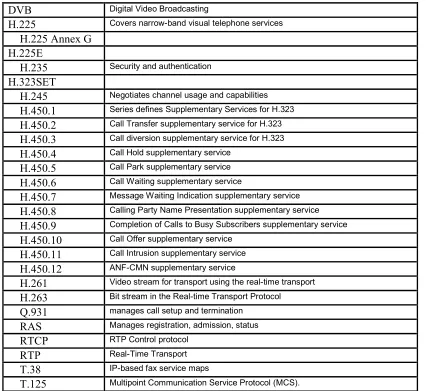
JD 37
media streams. Table 2.2 [24], tells us about the H.323 protocol suite group and its different components.
DVB Digital Video Broadcasting
H.225 Covers narrow-band visual telephone services
H.225 Annex G
H.225E
H.235 Security and authentication
H.323SET
H.245 Negotiates channel usage and capabilities
H.450.1 Series defines Supplementary Services for H.323
H.450.2 Call Transfer supplementary service for H.323
H.450.3 Call diversion supplementary service for H.323
H.450.4 Call Hold supplementary service
H.450.5 Call Park supplementary service
H.450.6 Call Waiting supplementary service
H.450.7 Message Waiting Indication supplementary service
H.450.8 Calling Party Name Presentation supplementary service
H.450.9 Completion of Calls to Busy Subscribers supplementary service
H.450.10 Call Offer supplementary service
H.450.11 Call Intrusion supplementary service
H.450.12 ANF-CMN supplementary service
H.261 Video stream for transport using the real-time transport
H.263 Bit stream in the Real-time Transport Protocol
Q.931 manages call setup and termination
RAS Manages registration, admission, status
RTCP RTP Control protocol
RTP Real-Time Transport
T.38 IP-based fax service maps
[image:39.612.111.537.123.514.2]T.125 Multipoint Communication Service Protocol (MCS).
Table 2.2. H.323 Protocols Suite
2.11. Echo cancellation
Chapter 2: VOIP Components
JD 38
generally noticeable, and 50ms is annoying. To eliminate it, the carriers put echo cancellers on their switch ports and in their long-distance trunks.
Echo cancellation is built into high-speed modems. Since telephone system echo cancellation is optimized for voice, the modem emits a 2100Hz signal to cancel it, allowing the modem's own cancellers to be used, which is more effective.
Echo cancellation may be built into a speakerphone to cancel the echo caused by the microphone picking up sound from the speaker. Since echo cancellation is not built into sound cards, making a PC-to-PC voice call using regular speakers and a microphone causes echo. Headsets help eliminate this problem.
Echo cancellation uses extremely sophisticated DSP circuits that are able to isolate the echo and transmit a reverse frequency to cancel it [25].
Video conferencing gives rise to echo when the audio signal from speakers is packed up by microphones and retransmitted. Because of the multiplicity of speakers and microphones this type of echo is difficult to control, and requires dedicated commercial hardware.
2.12. Packet Loss
Packet loss is caused by the discarding of data packets in a network when a device (switch, router, etc.) is overloaded and cannot accept any incoming data at a given moment. High-level transport protocols such as TCP/IP ensure that all the data sent in a transmission is received properly at the other end [25], however transmission will introduce significant delay, usually more than acceptable. For this reason VOIP will usually be sent via UDP
Performance (QoS) issues in Access Network for VOIP
JD 39
Above some threshold rate, VOIP network packet loss introduces audio distortions that cause voice quality to decrease as the rate of packet loss increases. That said, on any particular connection this general effect can be modified by:
• The distribution of the lost packets
• The packet loss concealment (PLC) algorithm in use
Early work on VOIP generally repeated the assertion that packet loss did not become a significant problem until it reached a 5 percent rate. This assertion provided poor guidance.
According to [6], packet loss is a normal phenomenon in packet networks. Loss can be caused by many different reasons: overloaded links, excessive collisions on a LAN, physical media errors and others.
Audio Codec’s also may take into account the possibility of packet loss; especially since RTP data is transferred over the unreliable UDP layer. The typical CODEC performs one of several functions that make an occasional packet loss unnoticeable to the user. For example, a CODEC may choose to use the packet received just before the lost packet instead of the lost one, or perform more sophisticated interpolation to eliminate any clicks or interruptions in the audio stream.
Chapter 2: VOIP Components
JD 40
2.13. Delay
In modern digital telecommunication networks, delay is a key performance parameter which should be minimized. Although the delay of IP networks may exceed the typical delay of the PSTN, the degradation caused by additional delay might be compensated for by benefits provided by new network and service capabilities. These tradeoffs need to be quantified.
Delay can have two effects on voice performance. Firstly, it increases the subjective effect of any echo impairment. Secondly, as indicated in Recommendation G.114, even when echo is controlled, one-way delays above 150 ms can interfere with the dynamics of voice conversation, depending upon the type of conversation and degree of interaction. Recommendations G.114 and G.131 give additional information regarding effects of delay
and echo.
In addition, delay can impair the performance of particular voice band data applications. Total delay of hybrid Internet/PSTN networks should be limited, even with the use of echo control. Recommendation G.114 should be consulted for additional information [26] [22].
2.14. Delay Variation (Jitter)
Performance (QoS) issues in Access Network for VOIP
JD 41
average delay or minimum delay). This meaning is frequently used by computer scientists and frequently (but not always) refers to variation in delay.
Jitter buffer is one of the key issues which help us to control the balance between delay and loss. If we increase the jitter buffer it will reduce loss but will increase the delay. Again if we decrease the jitter buffer it will increase loss but will decrease delay. However,
removing jitter requires collecting packets and holding them long enough to allow the slowest packets to arrive in time to be played in the correct sequence. This causes additional delay. The two conflicting goals of minimizing delay and removing jitter have engendered various schemes to adapt the jitter buffer size to match the time varying requirements of network jitter removal. This adaptation has the explicit goal of minimizing the size and delay of the jitter buffer while at the same time preventing buffer underflow caused by jitter.
Chapter 3
Advantages &
Disadvantages
Chapter 3: Advantages and Disadvantages of VOIP
JD 44
The focal point of Chapter 3 is the discussion of the Advantages and disadvantage of the VOIP. Here we have discussed the advantages as well as the limitation of the IP telephony.
3.1. Credentials of Voice over Internet Protocol
VOIP is under pressure as well as the PSTN [4], [3], [28]. In today’s internet, handing voice traffic is not a big deal for the core network. It has enough capability to handle the voice data flow [4]. However, performance degradation in the access network requires further work.
Performance (QoS) issues in Access Network for VOIP
JD 45
3.1.1. Price Advantage.
Given current price regulations on toll telephone services in the world, VOIP toll charges are only about one-third to one half the costs of traditional telephone charges [29]. Although VOIP telephone providers cannot guarantee that voice quality will match that of traditional telephone service, the price advantage alone remains attractive enough to draw customers to VOIP phone services.
3.1.2. New and profitable area for ISPs.
VOIP telephone services provide an opportunity for Internet service providers to earn higher profits, especially those ISPs new to the telecommunications market. This new opportunity has fostered a new class of additional parties in the world: Internet telephone service providers.
3.1.3. Benefits for traditional telephone service providers.
Although VOIP has made inroads into the toll telephone service market, total demand for traditional toll telephone services has actually increased. Both domestic and international calls more than doubled within last few years [29]. Because most VOIP toll telephone traffic must use the local telephone networks, the increase in VOIP services has brought an increase in local telephone network usage as well. Thus, the growth of VOIP services has actually increased profits for traditional telephone service providers.
3.1.4. Potential value in the transition to next-generation networks.
Chapter 3: Advantages and Disadvantages of VOIP
JD 46
Recently, some of world’s large-scale intranets have begun integrating phone and data services into the same network through VOIP, reducing telecommunications costs by eliminating the use of a separate phone network.
Traditional telephone service IP telephone service
Circuit-switching technology Packet-switching technology Uses synchronous time-division
multiplexing in transmission resulting in lower channel utilization
Uses asynchronous time-division
multiplexing in transmission, resulting in higher channel utilization
When network congestion occurs, calls will be blocked, but once call connection is established, the voice signal will not be lost
When network congestion occurs, calls can be blocked or IP packets can be lost, resulting in reduced voice quality Uses the G.711 Pulse Code Modulation
voice-encoding scheme without
compression and achieves a transmission speed of 64 Kbps
Usually uses voice-compression encoding, with the bit rate of encoded voice data ranging from as high as 64 Kbps to as low as 5.3 Kbps
Short end-to-end transfer delay except in satellite communications and limited delay variation
Relatively long end-to-end transfer delay and significant delay variation
Guaranteed good voice quality Voice quality affected significantly by the IP network’s quality of service; absent specific measures, voice quality cannot be guaranteed
Given the separate network built to provide telephone services, reducing operational costs is difficult
Sharing network resources by combining with data and other multimedia services on the same IP network helps reduce
[image:48.612.113.542.149.503.2]operational costs
Table 3.1. Comparison of traditional and IP telephone services [7].
3.2. VOIP Limitations
Performance (QoS) issues in Access Network for VOIP
JD 47
speaking, the end-to-end delay of a link should be less than 120 ms, jitter should be less than 100 ms, and packet loss should be less than 1 percent [3]. Ideally, there should be no packet loss for VOIP; a packet loss is one of the key issues in the QoS of the IP telephony.
The main problem with VOIP at present is the lack of guaranteed QoS. There are different types of delay involved in the transmission of the IP packets on VOIP. From [4] we can
focus on the different types of delay that are involved in the VOIP QoS. End-to-end delay includes delay due to codec processing as well as propagation delay. ITU-T Recommendation G.114 [26] recommends the following one-way transmission time limits for connections with adequately controlled echo (complying with G.131 [22]):
• 0 to 150 ms: acceptable for most user applications;
• 150 to 400 ms: acceptable for international connections;
• > 400 ms: unacceptable for general network planning purposes; however, it is recognized that in some exceptional cases this limit will be exceeded.
In the internet the Core Network is strong enough to handle the large amount of data and voice packets but when we consider the Access Network there remains a problem that
occurs when big data chunk start moving its place. The codec plays also an important role in the quality of the service of VOIP. Coder performance generally follows bit rate (the higher the better). But in the VOIP environment more than one coder may be used on any end-to-end connection since the converging networks (digital cellular, broadband access, VOIP, PSTN, etc.) may use different coders. Therefore, in considering coder performance it is important to consider the effects of processing speech through them multiple times. Such processing is normally referred to as coder tandeming although when the multiple encode-decode episodes involve different coders the term transcoding is often used [30].
Chapter 3: Advantages and Disadvantages of VOIP
JD 48
3.3. Summary
The future success of VOIP will be strongly influenced by customer opinions of call quality and how this quality compares with that of the public switched telephone network (PSTN). Here we can get a picture, which will consider how different components of a VOIP system can have an impact on a customer’s perception of quality. The challenge is to design an efficient solution which delivers a ‘just-good-enough’ quality level for a particular application.
The unreliable nature of the Internet and initial product offerings, where cost savings were often gained at the expense of quality, has led to an image that VOIP is of a worse quality than circuit-switched networks. The ‘poor quality’ image has, to some extent, accompanied
Performance (QoS) issues in Access Network for VOIP
JD 49
Although this appears to be a superfluous statement, all too often VOIP solutions fail to meet key requirements such as use of the recommended delay thresholds or inclusion of the correct telephony filtering or level control. This ultimately results in the customer receiving poor service.
For a VOIP system the three most significant influences on a user’s perception of quality
are:
· the performance of the VOIP device,
· the performance of the underlying network,
· the end-to-end delay.
Chapter 4
Customer &
Business
Perception of
VOIP
Chapter 4: Perception of VOIP Technology
JD 52
Basic operation of any technology will give a better idea of the investigated result. The entire chapter is mostly focused on the step by step basic operation of the VOIP in contrast of the PSTN.
4.1. Basics:
The basic steps for transmitting voice over an IP network are as follows [32]:
i. Audio from microphone or line input is A/D (Audio/Digital) converted at audio input device.
ii. Samples are copied into a memory buffer in blocks of frame length.
iii. The IP Telephony application estimates the energy levels of the block of samples if silence suppression is active.
iv. Silence detector decides whether the block is to be treated as silence or part of a talk spurt.
v. If the block is a talk spurt it is coded with the selected algorithm.
vi. Header information is added to the block.
vii. The block with headers is written into a socket interface.
viii. The packet is transferred over a physical network and received by the peer.
ix. The header information is removed, block of audio is decoded using the same algorithm with which it was encoded, and samples are written into a buffer.
x. The block samples are copied from the buffer to the audio output device.
Performance (QoS) issues in Access Network for VOIP
JD 53
4.2. IP Telephony versus PSTN
The primary technical difference between the Internet and the PSTN is their switching architectures. The Internet uses dynamic routing (based on non-geographic addressing) versus the PSTN, which uses static switching (based on geographic telephone numbering). Furthermore, the Internet’s ‘intelligence’ is very much decentralized, or distributed, as against the PSTN which bundles transport and applications resulting in intelligence residing at central points in the network.
The PSTN is a circuit switched network. It dedicates a fixed amount of bandwidth for each conversion and thus quality is guaranteed. When a caller places a typical call, they pick up the phone and hear the dial tone, dial a number, the telephone exchange establishes a
connection, and the intended recipient of the call, and the caller, can talk to each other. When callers place an IP Telephony call, they pick up the phone and hear the dial tone from the PBX, dial the number, which is then forwarded to the nearest IP Telephony gateway located between the PBX and a TCP/IP network. The IP Telephony gateway modulates voice into IP packets and sends them on their way over the TCP/IP network as if they were typical data packets. Upon receiving the IP encoded voice packets, the remote IP Telephony gateway reassembles them into analogue signals to the recipient through the PBX. So, how does IP Telephony fit in, and meet, with business requirements? There are three basic business scenarios for IP Telephony [32].
[image:55.612.132.520.589.657.2]Chapter 4: Perception of VOIP Technology
JD 54
In Figure 4.1 both the subscriber A and B are using a computer attached to an IP network as terminals. Voice is compressed and decompressed by the PC software. At present this case is not common but it is excepted to become more common & eventually should be the dominant case.
In Figure 4.2 one of the subscribers is using a computer for IP-voice and the other uses a
phone on a PSTN /ISDN network. A gateway on the edge of the IP network translates IP-voice to IP-voice and takes care of the signaling between the two networks.
Figure 4.2 (IP terminal to phone or phone to IP terminal) [32]
In Figure 4.3 both subscribers are using conventional phones, and the IP network is used for the long distance connection. Gateways on both ends take care of traffic and signaling translation between the networks.
[image:56.612.124.552.258.352.2] [image:56.612.123.503.459.602.2]Performance (QoS) issues in Access Network for VOIP
JD 55
4.3. Summary of Perception:
4.3.1. How traditional long distance works?
We pick up our phone and dial a long distance phone number; the call goes through our local telephone company to our long distance provider who charges us a connection fee and per minute charge, billed monthly in our long distance phone bill.
4.3.2. How long distance works with VOIP?
We pick up our phone and dial a long distance phone number, the call goes through our local telephone company to a VOIP provider, and this is a local call. The call then goes over the Internet to the receiver’s local calling area, where a local call is placed (by the VOIP provider) to complete the connection. We have just circumvented our long distance company, and eliminated our long distance phone bill.
4.4. Overview
Chapter 4: Perception of VOIP Technology
JD 56
standard telephones over great distances without going over the ‘Long Distance’ telephone network. A call goes over the local PSTN to the nearest gateway server, which digitizes the analogue voice signal, compresses it into IP packets, and moves it onto the Internet for transport to a gateway server at the receiving end. This server converts the digital IP signal back to analogue and completes the call locally. With its support for computer-to-telephone calls, telephone-to-computer calls and telephone-to-telephone calls, VOIP represents a significant step towards the integration of voice and data networks.
Originally regarded as a novelty, Internet Telephony is attracting more and more users because it offers tremendous cost savings relative to the PSTN. Users can bypass long distance carriers and their per-minute usage rates and run their voice traffic over the Internet for a flat monthly Internet-access fee. VOIP provides a competitive threat to the providers of traditional telephone services that, at the very least, will stimulate improvements in cost and function throughout the industry.
Although the use of voice over packet networks is relatively limited at present, there is considerable user interest. Projection made in 2002 estimated that the compound annual growth rate for IP-enabled telephone equipment would be 132% over the period from 1997 to 2002 (from $47.3M in 1997 to $3.16B by 2002) [24]. This projection appears now to be over optimistic.
Performance (QoS) issues in Access Network for VOIP
JD 57
exists a window of opportunity for developers to bring their products to market, and for consumers to realize significant savings.
4.4.1. What is IP Telephony good for?
The most significant benefit of IP Telephony, and driver of its evolution, is money saving. The second is easy implementation of innovative services. These reasons alone would be attractive to any business contemplating installation of the technology into their business. In future Internet Service Providers (ISP’s) may use a single infrastructure for providing both Internet access and IP Telephony. Only data orientated switches could be deployed for switching data as well as packetized voice. Multiplexing data and voice could also result in better bandwidth utilization than in today’s voice or nothing links. Not only the ISP’s but also their customers will benefit from lower costs.
4.5. The Vision
Chapter 4: Perception of VOIP Technology
JD 58
voice messages can be accessed from the same mailbox as email and fax messages); and fax server software (where software, running in servers connected to modems and computer-based fax cards, were used to replace traditional fax machines) being taken up in increasing numbers [34].
Despite these developments, technology suppliers are still a long way from being able to
deliver a combination of media (voice, fax, email, Web information) to a single device down a single phone/data line or wireless connection, using CTI techniques supported throughout the industry.
Even the ‘multi-application communications servers’, that have emerged recently, and which combine applications, such as telephony switching, voice mail, fax, IVR, call transfer, call conferencing, email and Web access on a single platform, still typically rely on separate connections to the voice and data worlds; as well as two separate voice and data wires to the user’s desktop. What is set to change all this and bring about a true communications revolution in the workplace is Internet Protocol (IP). IP is already being used widely within the enterprise for data traffic, with enormous strides being made to improve the quality of voice over the Internet as well as huge investments being made in IP public network infrastructure. It is for this reason, that technology suppliers are now in almost universal agreement that IP, and not CTI, is the catalyst that will bring us closer to the ideal of a single connection to the outside world for voice and data traffic; and a single connection to the desktop or wireless device [35].
Performance (QoS) issues in Access Network for VOIP
JD 59
Chapter 5
Factors that
Impact the
Chapter 5: Factors that Impact the QoS of VOIP
JD 62
This Chapter considers how different factors of a VOIP system can have an impact on a customer’s perception of quality. The identification of the specific problems will help us on our investigation. The challenge is to design an efficient solution which delivers a ‘just-good-enough’ quality level for a particular application.
5.1. Speech quality
One reason for choosing VOIP is its potential to deliver voice and data services more efficiently than the PSTN. Good speech quality is critical in order to deliver a commercially viable VOIP system. However, there is a technical challenge in delivering high-quality speech while achieving high network efficiency. It is possible to create a high quality system, but low-bandwidth allocations typically result in some reduction in speech quality. The challenge is to deliver ‘just-good-enough’ speech quality at a specific bit rate. There are various ways to trade bandwidth and speech quality to meet a target quality level, but there is no definitive answer on how this is to be achieved. Based on the ITU-T Recommendations this section describes those aspects of a VOIP system design which have greatest bearing on the user perceived speech quality:
speech coding,
Packetization efficiency,
silence suppression,
error-concealment methods,
jitter buffer implementation,
Performance (QoS) issues in Access Network for VOIP
JD 63
5.1.1. Speech coding
Most domestic PSTN networks operate with speech sampled at 8 kHz and an 8-bit nonlinear quantization scheme according to ITU-T G.711 [36]. This encodes at 64 kbit/s and introduces little audible distortion for most types of signal. In a number of applications, however, a much lower bit rate is desirable either because capacity is limited (e.g. mobile) or to maximize the amount of traffic that can be carried over a trunk connection. Current ITU-T recommendations include codecs that compress to as low as 5.3 kbit/s, although quality at this bit rate is well below that of G.711. To maximize interoperability it is usual for VOIP gateways and clients to offer one or more standard codecs. Table 5.1 lists some common, standardized, voice codecs with their associated bit rates.
Codec Bit Rate (kbit/s) Coding Technique
G. 711 64 Pulse code modulation (PCM)
G. 726 40 to 16 Adaptive differential PCM (ADPCM) G. 728 16 Low-delay codec excited linear prediction
G. 729 8 Algebraic code-excited linear prediction (ACELP) G. 723.1 6.3/5.3 Multi-pulse-excited long term predictor
[image:65.612.112.532.341.452.2](MP-MLQ)/ACELP)
Table 5.1. Voice codecs with coding Techniques [36].
Chapter 5: Factors that Impact the QoS of VOIP
JD 64
above, and is comparable with the more recent, though computationally intensive, GSMEFR at 12.2 kbit/s and G.728 (CELP) at16 kbit/s.
Given a demand for high quality, it is clear that choosing the lowest bit rate codec will not suit a large proportion of today’s VOIP market. Therefore most systems tend to offer G.711 and at least one low bit rate codec. This allows the operator some flexibility to trade
between quality and bandwidth — potentially on a per-call basis. Saving bandwidth is no longer the key reason why IP telephony is cheaper. IP bandwidth is cheap & getting cheaper. In some situation Bandwidth is still important.
The paper [28] of Carmen Peláez-Moreno, Ascensión Gallardo-Antolín, and Fernando Díaz-de-María, suggests that Voice codecs included in the H.323 protocol suite such as G.723.1 and G.729 are now the most commonly used ones even though for many years the PSTN operated strictly with the standard G. 711 [28]. Alternative codecs are emerging; the authors of [28] have investigated the G.723.1 standard codec because, together with the G.729, it is the most widely used in the VOIP environment [38]. Furthermore, G.723.1 seems to be more sensitive to packet loss, mainly due to its relatively slow frame rate (33.3 frames per second). A low frame rate implies that a considerable portion of voice is missing when a packet is lost. With the purpose of providing a better understanding of the coder technology, front-end, there follows an outline of the most relevant features of this codec. For a detailed description, we refer the reader to the standard recommendation [39].
Performance (QoS) issues in Access Network for VOIP
JD 65
quality: G.729 and G.726 give 4.0 and 4.3, respectively. G.723.1 uses a frame length of 240 samples (30 ms) and an additional look ahead of 60 samples (7.5 ms), resulting in a total algorithmic delay of 37.5 ms. The frame is divided into four subframes of samples. A window of 180 samples is centred on every subframe and a tenth-order linear prediction (LP) analysis is performed. The prediction coefficients obtained in this way are used to implement a short-term filter.
Chapter 5: Factors that Impact the QoS of VOIP
JD 66
5.1.2. Packetization efficiency
A further consideration when choosing a codec is how much speech can be placed in an IP packet. This is partly dictated by a codec’s frame size. For example, GSM uses a fixed 20-ms frame and therefore packets must be a multiple of 20 20-ms, whereas G.711 can be any length. The amount of speech placed in a packet has a direct impact on the underlying network efficiency. VOIP is inefficient for small voice packets while large voice packets lead to long delays — which is inappropriate for real-time communications. Typically packets contain between 10 to 30 ms of speech which provides a practical trade-off between network efficiency and increased delay. Some increase in bandwidth overhead is justified by the economic benefits of running a single combined voice and data network [41]. Packetization efficiency reduces as the rate of the codecs reduces. As an example if a VOIP packet size is 128 Kbytes G.711 will process that data faster then G.729 as the rate of G.711 codec is higher then the G.729. A slow coder will take more time then a faster coder to generate a packet for delivery and that will create more packetization inefficiency.
5.1.3. Silence suppression
Performance (QoS) issues in Access Network for VOIP
JD 67
generate a signal to fill in the silent periods. This generated signal is called comfort noise. Without comfort noise the telephone system feels dead to the end user, but a mismatch in noise between when the person is and is not talking is distracting and leads to an impression of poor quality. Also the background noise may be part of the message – e.g. the sound of a kitchen or a restaurant.
When choosing to develop a VAD an understanding of the application is critical. For example, a VAD that labels more of the signal as speech, suppressing transmission only when the talker is definitely silent, will deliver higher quality than a more aggressive VAD. This is of course balanced by a slight increase in bandwidth, but there can still be a significant saving over a system without DTX [1].
5.1.4. Error concealment
Chapter 5: Factors that Impact the QoS of VOIP
JD 68
packet loss rates. The range of scores occurs because a lost packet may coincide with a critical or non-critical part of the voice stream [1].
5.1.5. Jitter buffer implementation
A jitter buffer is needed to smooth over the distribution of packet delay that is characteristic of IP. It is important to note that a gateway’s or host’s jitter buffer has an impact on the system’s delay and speech quality. A careful balance is needed between adding too much delay, which impairs conversation, and dropping packets, which reduces the speech quality [2].
Performance (QoS) issues in Access Network for VOIP
JD 69
normal conversation. This suggests that delay changes should be made in small steps and kept to a minimum during a conversation or the perceived system quality will be reduced [3].
5.1.6. Codec tandem performance
When designing any voice transmission system it is important to know how well it will work with existing networks [7]. It is not enough to simply establish a connection; there is a need both to ensure adequate speech quality and to minimize delay. Typically where networks join, the speech traffic is passed as 64-kbit/s PCM. If the originating system has coded the speech in another format, decoding is required. This results in a transcoding or tandeming of speech codecs. Generally the quality of the combination cannot be better than the poorest link, and may be noticeably worse if two or more low bit rate codecs are included. The order is also important. Because these systems distort speech in a nonlinear way, G.729 followed by EFR* will not produce exactly the same quality as EFR followed by G.729. Delay also increases significantly with tandeming. For example, mobile networks introduce delays of around 100 ms each way. A mobile-to-mobile call with a VOIP trunk could easily e
![Figure 1.1 VOIP in Service [4]](https://thumb-us.123doks.com/thumbv2/123dok_us/321748.64136/19.612.121.513.391.609/figure-voip-in-service.webp)
![Figure 1.2 Simplified diagram of an IP telephone system [4]](https://thumb-us.123doks.com/thumbv2/123dok_us/321748.64136/20.612.122.530.222.442/figure-simplified-diagram-ip-telephone.webp)
![Figure 2.2 Effect of codec concatenation on an MOS [4].](https://thumb-us.123doks.com/thumbv2/123dok_us/321748.64136/31.612.116.539.56.280/figure-effect-codec-concatenation-mos.webp)
![Figure 2.5 Diffserv Architecture [19].](https://thumb-us.123doks.com/thumbv2/123dok_us/321748.64136/37.612.123.508.59.305/figure-diffserv-architecture.webp)
![Table 3.1. Comparison of traditional and IP telephone services [7].](https://thumb-us.123doks.com/thumbv2/123dok_us/321748.64136/48.612.113.542.149.503/table-comparison-traditional-ip-telephone-services.webp)
![Figure 4.1 (IP terminal (computer) to IP terminal)[32]](https://thumb-us.123doks.com/thumbv2/123dok_us/321748.64136/55.612.132.520.589.657/figure-ip-terminal-computer-to-ip-terminal.webp)
![Figure 4.2 (IP terminal to phone or phone to IP terminal) [32]](https://thumb-us.123doks.com/thumbv2/123dok_us/321748.64136/56.612.123.503.459.602/figure-ip-terminal-to-phone-phone-ip-terminal.webp)