MAKING GENERALISATIONS IN GEOMETRY: STUDENTS’
VIEWS ON THE PROCESS. A CASE STUDY
Oleksiy Yevdokimov
University of Southern Queensland, Australia
The paper presents results of the research focused on studying students’ abilities to make generalisations in geometry. Students’ activities in a classroom have been analysed through the evaluation of their inquiry work on different tasks that required deductive reasoning and non-routine approach to carry out possible generalisations. Cognitive processes regarding to different geometrical structures are described and analysed in detail. The special emphasis has been given to students’ obstacles while making generalisations.
Generalising activity has traditionally been given significant attention both in schools and in research. Within the literature, different types of generalisation are distinguished, e.g. empirical and theoretical generalisations (Davydov, 1990). At the same time there are many papers dealing with various aspects of generalising process in the different areas of mathematics education. Radford (2001) identifies three levels of generalisation in algebra (factual, contextual and symbolic generalizations). Ainley et al (2003) note that the importance of generalising as an algebraic activity is widely recognised within research on the learning and teaching of algebra. Undoubtedly, generalising activities in geometry are very important in research on the learning and teaching of geometry as well. Moreover, taking into account the great role of visualisation and perception in the learning geometry, investigation students’ abilities to make generalisations of different concepts, definitions, properties and ways of their development are of significant interest for researchers in mathematics education.
DESCRIPTION OF THE STUDY
We would like to put into consideration some types of generalisation, which, on the one hand, can be successfully used in stimulation students’ inquiry activities while learning geometry, on the other hand, they are good didactical tools for investigation students’ abilities to generalise. The following three types of generalisation were considered in the research: 1. Generalisation of definitions of different geometrical objects; 2. Generalisation of geometrical object’s properties by giving up one or some features; 3. Creative generalisation.
investigate and identify the ways students establish essential features of the property and differ them from non-essential ones while generalising, i.e. if they give up one or some features of the property of geometrical object whether it always leads to correct generalisation of that property. In the case of the third type of generalisation, in opposite to the second type, students had to change either some features of the property or geometrical object itself instead of giving them up. Creative generalisations were the most complex ones for students to work on and teacher’s help was an acceptable, but not necessary condition.
During the teaching year several experienced school teachers observed prospective candidates (9th and 10th Year, 15 and 16 years old respectively) for study the author’s course on geometry of a triangle. All students, who were involved in the selection process, had their learning profile on mathematics. When the selection procedure was over, two groups of students were organised. The first group consisted of 30 students with average mathematics abilities, in the second one there were 20 gifted in mathematics students. For the groups formation we used the following criteria. We regarded a student as gifted in mathematics (not necessarily talented or genius), if he/she had successfully shown himself/herself during the year before at least in two positions out of the following three ones: 1. Deep understanding advanced theoretical material given by a teacher or studied on his/her own; 2. Solving/proving difficult problems; 3.Posing original and new for himself/herself problems. Students, who did not fit in the mentioned above conditions, however, having overall satisfactory marks in mathematics formed the other group. All students had taken an extended course on elementary geometry before, however, no any part of the course was aimed specially on problem posing skills. Teaching programme of the course consisted of six modules of theoretical material with solving of 54 problems, 9 problems per each module. In the end of the course 24 tasks on generalisation (4 of the first type, 8 of the second type and 12 of the third type respectively) were proposed for both groups of students.
ANALYSIS OF THE PROPOSED GENERALISATIONS
We would like to stress that each task of a certain type had its own priorities in the research. Tasks of the first type were intentionally similar in their content and format in order that students had possibility for training and discussion of their results with teacher’s help on this stage if necessary. Tasks of the second type were different, from simple to hard ones, for a problem itself and its generalised conjecture. The similar situation was with the third type tasks. Moreover, being important part of the research, the students’ work on the second type tasks was preparation to strengthen their activity and improve their understanding on the last stage, where tasks on creative generalisation were the key tools. Also, tasks complexity was taken into account according to Williams & Clarke (1997) Framework of Complexity. Following the study we start with a first type task. A number of the task shows this task was from the first stage of the observation part and its consideration was the second at this stage.
Task 1.2
Two triangles, isosceles and equilateral, are given. Which of these geometrical objects is more general than another? Give the reasons.
Students with average mathematics abilities distinguished all features of definition of each geometrical object, after that they compared every feature of these objects separately, finding out which feature gives a more general case. Their actions are shown in the Table 1.
Isosceles triangle Equilateral triangle
1. triangle
2. two sides are equal
1. triangle
2. three sides are equal, i.e. two sides are equal and the third side is equal to two others
Table 1: Average mathematics abilities students’ actions
According to the written above, they used the following strategy for comparing two geometrical objects in the context of their possible one to another generalisation.
Strategy 1
A geometrical object is more general than another, if its definition fits under conditions of the other object’s definition.
However, most of the gifted in mathematics students used another strategy in the task:
Strategy 2
If definition of a geometrical object does not fit under conditions of the other object’s definition, then that other object should be more general one.
one because two parts of the statement relate to the different geometrical objects just as the first strategy consists of two parts of the statement for the same geometrical object. We observed that most of gifted in mathematics students chose Strategy 2 due to their abilities to work on the task analysing several features of the same object or even of the different objects simultaneously: all angles of an equilateral triangle are equal to 60o, but it is not necessary for an isosceles triangle, all sides of an equilateral triangle are equal to each other and, again, it is not a necessary condition for an isosceles triangle, etc. Full results of this task are given in Table 2 below.
Groups of students Using 1st
strategy
Using 2nd strategy
Students with average abilities in mathematics
26 students -
Gifted in mathematics students 7 students 17 students
Table 2: Using different strategies by students in both groups
It is interesting to note that 4 students in the first group couldn’t propose anything, at the same time in the second group 3 students proposed the first strategy only, 13 ones proposed the second strategy only and 4 students did both of them. Thus, gifted in mathematics students used both strategies in the task with their preference to Strategy 2 just as students with average mathematics abilities took into consideration only Strategy 1. At the end of discussion students had been asked to provide their answers for this task in arbitrary form. Gifted in mathematics students used both forms of the answers (symbolical and graphical ones, see Figure 1 and Figure 2 respectively).
equilateral triangle ⇒ isosceles triangle
isosceles triangle ⇒ equilateral triangle
Figure 1: Symbolical form of the answers
Isosceles triangles
Figure 2: Graphical form of the answers
However, most of the students with average mathematics abilities gave their answers in a verbal form (orally) or its written version, i.e. “an isosceles triangle is a more general geometrical object than an equilateral triangle”.
In the second type tasks we paid great attention to using visual thinking in generalising process. Consider the following task on the basis of Pompeiu’s property:
Task 2.5
If an arbitrary point P lies on the plane of equilateral triangle ABC, then a triangle can always be constructed from the segments PA, PB, PC, taking into account the case of a degenerated triangle. In what way could you generalise this property?
Definitely the possible generalisation of the property could be quite clearly revealed in the words ‘point P lies on the plane of equilateral triangle ABC’, but after analysis of students’ drawings we were surprised to conclude that a clear indication of that generalisation disappeared (Figure 3) and students in both groups experienced difficulties at this stage. It was a surprise for students that a drawing of the task was a visual help for solution only, not for generalising process. Most of students in both groups were aware that solution of any task should contribute to more or less extent to finding the ways for its generalisation and further solution of generalised conjecture. However, quite often they couldn’t argue that idea clearly in different tasks.
B
A C
P
Figure 3: Students’ drawing for Task 2.5
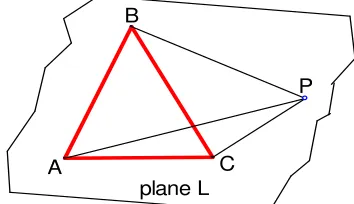
As a hint we proposed the following drawing (Figure 4) for students, who hadn’t made correct generalisation of Pompeiu’s property after making its solution (there were such students in both groups, 13 and 2 students respectively).
plane L B
A C
[image:5.595.227.404.500.602.2]P
Figure 4: A hint-drawing for Task 2.5
a b c x y z O A C B F K P a b c x y z O A C B F K P
An equilateral triangle is an essential feature of the problem,…, without it statement of the problem is not true, hence, this feature is a non-essential one for possible generalisation. (It was said when the problem had been solved – note of the author.) But, moving point P in all directions, it is unclear whether the property will remain the same. Therefore, the position of point P is an essential feature for generalisation. (Student X)
However, students with average abilities in mathematics carried out generalising process with consideration all features of the properties, giving them up one after another. They didn’t distinguish essential and non-essential features in the tasks and tried to solve all conjectures constructed without taking into account that some of them could be incorrect. Moreover, some students didn’t understand how a certain feature could be given up for generalising. On the other hand, several times we observed that some of the gifted students moved in the direction of particular cases instead of generalisation. Below is such an example of “generalisation”:
We can always choose the point P in order that the sides PA, PB, and PC of a triangle, their lengths, of course, wouldn’t be three successive terms of an arithmetic progression. (Student Y)
The following task was given on the basis of Carnot’s property:
Task 2.7
Let ABC be a triangle that has been drawn by you. Find out how the sum of the lengths of perpendiculars dropped from the circumcentre to the triangle’s sides depends on circumradius and inradius. How could you generalise this property?
x yz O A C B F K P
Figure 5: Three possible drawings for Task 2.7
was attempt to generalise a circumcentre location. In this case general conjecture was the following (a task drawing is given in the middle of Figure 5):
It seems to me it would be interesting to consider how sum of lengths of perpendiculars dropped from an arbitrary point (in the plane of this triangle – note of the author) to the triangle’s sides looks like. (Student Z)
Gifted in mathematics students had advantage in making generalisations of the second type because it was often connected with solution and other group of students couldn’t solve some problems from the tasks. At the same time difference in students’ abilities to generalise was not so significant. In both groups students made similar generalisations for most of tasks, only approaches were different.
At the solution stage the following task on creative generalisations seemed even easier than Task 2.5 and Task 2.7.
Task 3.8
All angle bisectors of a triangle intersect in one point. How could you generalise this property? Give as many conjectures as you can.
Indeed, it is not a hard problem for solution, but our aim was to stimulate students’ creative approaches for possible generalisations. This is a nice example where a plenty of different properties are hidden behind the simplicity of the statement (Yevdokimov, 2007). Many of them can be found through generalising process. However, the strategy of using essential and non-essential features as most of gifted students did in the second type tasks on generalisation couldn’t bring them to the desired result here.
Following Sierpinska (2003) we observed students’ difficulties in achieving a balance between visual and analytic thinking while making generalisations. Most of gifted in mathematics students distinguished, though intuitively, visual and analytic generalisation. In their understanding visual generalisation could be related to a geometrical object and to some of its properties as well, but analytic generalisation – only to properties of a geometrical object. Therefore, they proposed to consider a geometrical object and its different features separately and clarify in which way an object itself could be changed. Of course, it is necessary to note if a geometrical object is characterised by the only feature then changing of an object or changing of its feature leads to the same result. Gifted students used both kinds of generalisation in their work, though analytic generalisation caused much more difficulties for them due to its more complex structure. In the case of visual generalisation they changed a geometrical object immediately. It is interesting to note that in the tasks on creative generalisations students with average abilities in mathematics preferred to make visual generalisations.
CONCLUDING REMARKS
some geometrical objects and/or their features simultaneously (in a task as well as in the suggested conjecture), e.g. Lemoine point and the point of intersection of angle bisectors in Task 3.8, etc. Also, we often observed that solutions of the suggested conjectures were not perceived by students as generalised ones for the tasks even among the gifted students. In other words, some well known properties from the third type tasks were not understood as particular cases of generalisations already made. However, gifted students much more used generalisations in their argumentation because they easier perceived giving certain features up and creating new features instead them. We would like to emphasise significant individual difference in students’ abilities for generalisation in both groups. Nevertheless significant difference between the groups in abilities to generalise occurred in the work with the third type tasks only. As for solving and proving of the suggested conjectures the final result was more predictable: the group of gifted students had great advantage in such activities. However, we would like to stress that students’ abilities to make generalisation of any statement without its preliminary investigation and solution were not considered in detail at the study. Also, in learning geometry we have to pay much more attention to the needs of students with average mathematics abilities. They are not so bad in constructive actions and making suggestions. Undoubtedly that further work in this direction can bring a number of such students nearer to potentially gifted in mathematics students, at least in comparison with their abilities in mathematics.
References
Ainley, J., Wilson, K. and Bills, L. (2003). Generalising the context and generalising the calculation. In N.A.Pateman, B.J.Dougherty and J.T.Zilliox (Eds) Proceedings of the 2003 Joint Meeting of PME and PMENA, USA, Vol.2, 9-16.
Davydov, V. (1972/1990). Types of generalisation in instruction: Logical and psychological problems in the structuring of school curricula. (Soviet studies in mathematics education, Vol.2, J.Kilpatrick, Ed., J.Teller, Trans.). Reston, VA: NCTM.
Radford, L. (2001). Factual, contextual and symbolic generalizations in algebra. In M. van den Heuvel-Panhuizen (Ed.) Proceedings of PME25, Utrecht, Freudenthal Institute, Vol.4, 81-88.
Sierpinska, A. (2003). Visualization is in the mind of the beholder. Proceedings of the Southern Hemisphere Symposium on Undergraduate Mathematics Teaching: Remarkable Delta03, Queenstown, New Zealand.
Williams, G. & Clarke, D. (1997). The complexity of mathematics tasks. Mathematics: creating the future. N.Scott and H.Hollingsworth: Victoria. AAMT: 451-457.