ISSN 2286-4822 www.euacademic.org
Impact Factor: 3.4546 (UIF) DRJI Value: 5.9 (B+)
Students’ Errors in Solving Problem: A Case Study
based on the Concept “Didactical Contract”
NGUYEN PHU LOC1
BUI PHUONG UYEN
School of Education, Can Tho University VIETNAM
Abstract:
The concept “didactical contract” was introduced by Guy Brousseau in 1980. This concept now has used to learn students’ errors and to explain the error causes which students commit. In this paper, we presented the research results which we obtained through a case study in analytic geometry in space; in which 309 high school students were assigned to solve a problem and their errors occurred because of a didactical contract.
Key words: Didactical contract, error of students, problem solving, mathematics education
INTRODUCTION
Guy Brousseau in 1980 to learn students’ errors and to explain the error causes which students commit.
THEORETICAL BACKGROUND
Didactical Contract
“Students tend to make any information or limitation clear using what the teacher, whether consciously or unconsciously, produces in his teaching activity. We think about the most common habits in teaching, and we define a didactical contract as the specific behavior that students expect from teachers and teachers expect from students too” (Brousseau, 1980, pp.127-128).
The didactical contract gives rules during the learning process; it is in fact a whole made of expectations and behavior of students and teachers towards knowledge. It states, in a not explicit way most of the times, what students and teacher have to do, their roles and their responsibilities one to another.
A didactical contract has the following features: 1) It is about knowledge;
2) For every kind of knowledge, there exists a didactical contract;
3) In order to understand knowledge, we have to break the contract;
4) It is implicit;
5) A contract indicates acting rules of teachers and students.
Error in solving problem
Error in solving problem is an error caused by improperly implementing mathematical rules; by applying the incorrect mathematical formulas, mathematical theorems; or by misunderstanding concepts, theorems; by misunderstanding an assignment, or by making mistake in calculation and presenting problem solution (Loc & Hoc, 2014; Loc & Kha, 2015).
STATEMENT OF RESEARCH PROBLEM AND RESEARCH OBJECTIVES
In process of learning analytic geometry in space, students learn how to solve many types of task relating to write the equation of a plane with given conditions. In this study, we were concerning about the type of task as follows: “In space Oxyz, write the equation of a plane passing through three points A(x1, y1,z1) , B (x2, y2, z2) and C(x3, y3, z3)” (P1). In textbooks
and exercise books, A, B and C in this problem always are distinct and non-collinear (*)
For (P1), students can use the following strategies to solve:
The strategy 1 (S1)
- Step 1: Choose vector pair
(
AB
,
AC
)
to be vector pair ofdirection of plane (ABC);
- Step 2: Find the coordinates of normal vector of plane
(ABC):
n
;- Step 3: The equation of plane (ABC): ax + by + cz + d = 0
was determined due to the coordinates of
n
and point A.The strategy 2 (S2):
- Step 1: The general equation of plane (ABC): ax + by + cz
- Step 2: Compute a, b, c, d of (1) due to the coordinates of
A, B and C.
From (*), (S1) and (S2), we have hypothesis as follows:
H: For solving (P1), there exists a rule of didactical contract: Students don’t verify whether three points A, B, C are collinear or not; therefore, students will commit errors in the case of A, B and C collinear,
METHODOLOGY
Problem used to verify
In order to verify the above two hypotheses, we assign students the following problem:
In the space Oxyz, given four points: A(4, 1, 2) , B(5 , -2, 1), C (3, 4, 3) and D(1, -2, 5). Write the general equation of the following planes:
1. Plane (ABD) 2. Plane (ABC)”. (P2) Note: A, B and D are non collinear; A, B and C are collinear.
Subjects: 309 grade 12th students (academic year 2014 -2015)
from two schools: The High school “Thực hành Sư phạm” (Can Tho University, Vietnam) and the High school “Nguyễn Thị
Định” (Bến Tre province, Vietnam). (see Table 1).
Data collecting and analyzing: These participants were assigned the problem (P) to solve. After the students finished doing the above problem, we analyzed their solutions to the problem.
Table 1. Students investigated
School Class The number of
students
High school Thực hành Sư phạm (Cantho University)
12A1, 12A2, 12B1, 12B2 144
RESULTS AND DISCUSSION
Analyzing the solutions of students
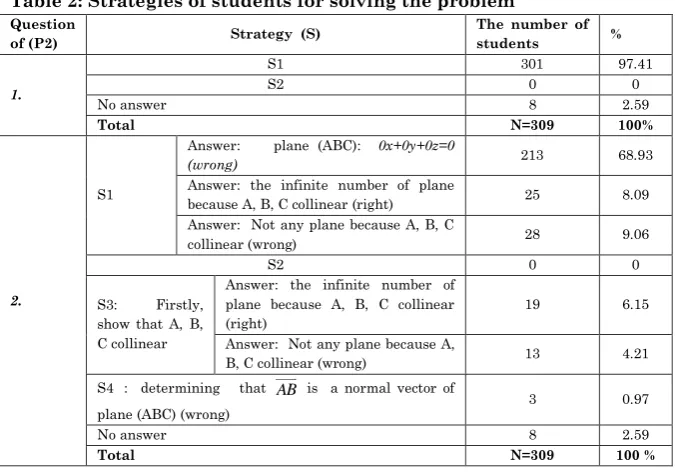
Based on the students’ results of doing exercise, we could summarize the strategies which students applied to solve. (see Table 2)
Table 2: Strategies of students for solving the problem Question
of (P2) Strategy (S)
The number of
students %
1.
S1 301 97.41
S2 0 0
No answer 8 2.59
Total N=309 100%
2.
S1
Answer: plane (ABC): 0x+0y+0z=0
(wrong) 213 68.93
Answer: the infinite number of plane
because A, B, C collinear (right) 25 8.09 Answer: Not any plane because A, B, C
collinear (wrong) 28 9.06
S2 0 0
S3: Firstly, show that A, B, C collinear
Answer: the infinite number of plane because A, B, C collinear (right)
19 6.15
Answer: Not any plane because A,
B, C collinear (wrong) 13 4.21
S4 : determining that AB is a normal vector of
plane (ABC) (wrong) 3 0.97
No answer 8 2.59
Total N=309 100 %
CONCLUSION
The above case study showed that students applied the known strategies to solve the type of a task familiar to them according to things which they thought that the teacher expected; in other words, there was a didactical contract; in a learning situation which the didactical contract was broken down, they made errors. Due to these errors of students, the teacher would have opportunities to help his students justify their knowledge.
REFERENCES
Brousseau, G. (1970-1990, translated book 2002 ), Theory of Didactical Situations in Mathematics - Didactique des Mathématiques, 1970–1990, Dordrecht: Kluwer Academic publisher.
Loc, N.P. (2008). Giáo trình Các xu hướng dạy học không truyền thống, Can Tho University (unpublished)
Loc, N. P. & Hoc, T.C.T. (2014). A Survey Of 12th Grade Students’ Errors In Solving Calculus Problems.
International Journal of Scientific & Technology Research, Volume 3, Issue 6, June 2014 ISSN 2277-8616. Loc, N.P. & Kha, N.T. (2015). Students’ errors in solving problems on coordinate methods in space: Results from
an investigation in Vietnam, European Academic
Research, Vol.III, Issue 2/May_2005
Marzano,R., (1992). A different kinds of classroom- Teaching with dimensions of learning. Alexandria, Va: Association for Supervision and Curriculum Development.