This is a repository copy of
Parallel Compensatory Evolution Stabilizes Plasmids across
the Parasitism-Mutualism Continuum
.
White Rose Research Online URL for this paper:
http://eprints.whiterose.ac.uk/91018/
Version: Published Version
Article:
Harrison, Ellie, Guymer, David, Spiers, Andrew J et al. (2 more authors) (2015) Parallel
Compensatory Evolution Stabilizes Plasmids across the Parasitism-Mutualism Continuum.
Current Biology. 2034–2039. ISSN 0960-9822
https://doi.org/10.1016/j.cub.2015.06.024
[email protected]
https://eprints.whiterose.ac.uk/
Reuse
Items deposited in White Rose Research Online are protected by copyright, with all rights reserved unless
indicated otherwise. They may be downloaded and/or printed for private study, or other acts as permitted by
national copyright laws. The publisher or other rights holders may allow further reproduction and re-use of
the full text version. This is indicated by the licence information on the White Rose Research Online record
for the item.
Takedown
If you consider content in White Rose Research Online to be in breach of UK law, please notify us by
Report
Parallel Compensatory Evolution Stabilizes Plasmids
across the Parasitism-Mutualism Continuum
Highlights
d
Compensatory evolution stabilized plasmids across a
parasitism-mutualism continuum
d
Selection repeatedly targeted the same genes in
independently evolving populations
d
Mutations in a global regulatory system, gacA/gacS,
ameliorated the plasmid cost
d
Evolved genotypes had reduced the translational demand
caused by the plasmid
Authors
Ellie Harrison, David Guymer, Andrew
J. Spiers, Steve Paterson, Michael A.
Brockhurst
Correspondence
[email protected]
In Brief
Harrison et al. show that parallel
regulatory mutations of large effect in
bacteria rapidly compensated for the cost
of plasmid carriage to stabilize both
parasitic and mutualistic resistance
plasmids. The findings help to explain the
widespread occurrence of resistance
plasmids and their role in horizontal gene
transfer.
Harrison et al., 2015, Current Biology25, 2034–2039 August 3, 2015ª2015 The Authors
Current Biology
Report
Parallel Compensatory Evolution Stabilizes
Plasmids across the Parasitism-Mutualism Continuum
Ellie Harrison,1David Guymer,1Andrew J. Spiers,2Steve Paterson,3and Michael A. Brockhurst1,*
1Department of Biology, University of York, York YO10 5DD, UK 2SIMBIOS Centre, Abertay University, Dundee DD1 1HG, UK
3Institute of Integrative Biology, University of Liverpool, Liverpool L69 7ZB, UK
*Correspondence:[email protected] http://dx.doi.org/10.1016/j.cub.2015.06.024
This is an open access article under the CC BY license (http://creativecommons.org/licenses/by/4.0/).
SUMMARY
Plasmids drive genomic diversity in bacteria via
horizontal gene transfer [
1, 2
]; nevertheless,
explain-ing their survival in bacterial populations is
chal-lenging [
3
]. Theory predicts that irrespective of their
net fitness effects, plasmids should be lost: when
parasitic (costs outweigh benefits), plasmids should
decline due to purifying selection [
4–6
], yet under
mutualism (benefits outweigh costs), selection
fa-vors the capture of beneficial accessory genes by
the chromosome and loss of the costly plasmid
backbone [
4
]. While compensatory evolution can
enhance plasmid stability within populations [
7–15
],
the propensity for this to occur across the
para-sitism-mutualism continuum is unknown. We
experi-mentally evolved
Pseudomonas fluorescens
and its
mercury resistance mega-plasmid, pQBR103 [
16
],
across an environment-mediated
parasitism-mutu-alism continuum. Compensatory evolution stabilized
plasmids by rapidly ameliorating the cost of plasmid
carriage in all environments. Genomic analysis
re-vealed that, in both parasitic and mutualistic
treat-ments, evolution repeatedly targeted the
gacA
/
gacS
bacterial two-component global regulatory
system while leaving the plasmid sequence intact.
Deletion of either
gacA
or
gacS
was sufficient to
completely ameliorate the cost of plasmid carriage.
Mutation of
gacA
/
gacS
downregulated the
expres-sion of
17% of chromosomal and plasmid genes
and appears to have relieved the translational
de-mand imposed by the plasmid. Chromosomal
cap-ture of mercury resistance accompanied by plasmid
loss occurred throughout the experiment but very
rarely invaded to high frequency, suggesting that
rapid compensatory evolution can limit this process.
Compensatory evolution can explain the widespread
occurrence of plasmids and allows bacteria to retain
horizontally acquired plasmids even in environments
where their accessory genes are not immediately
useful.
RESULTS AND DISCUSSION
We combined experimental evolution, whole-genome sequencing, and gene expression analysis to examine the dynamics and mechanisms of bacteria-plasmid adaptation along a parasitism-mutualism continuum in the environmental bacteriumPseudomonas fluorescensSBW25 [17] and a naturally associated 425-kb mega-plasmid, pQBR103 [18]. pQBR103 carries a Tn5042 transposon containing a mercury resistance operon,mer, which allows the bacterial host to detoxify mer-cury-contaminated environments by reducing toxic mercuric ions to elemental mercury [16]. In the absence of mercury, pQBR103 imposes a large fitness cost on P. fluorescens
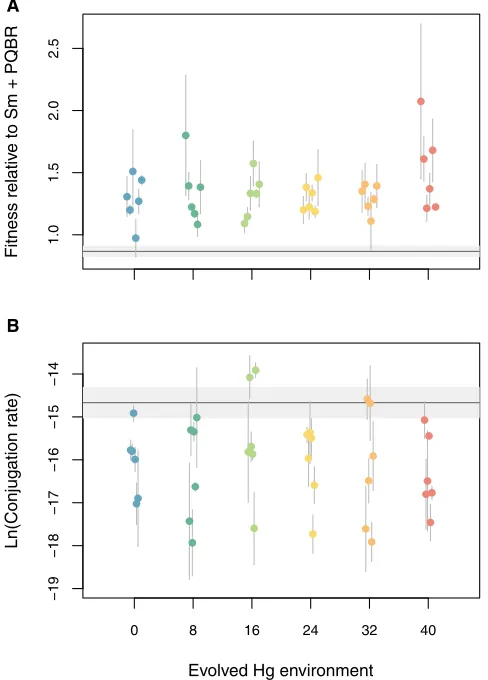
SBW25 when measured in lab media, in soil or in planta [18, 19]. This combined with an appreciable rate of segregational loss and a comparatively low rate of conjugation [19] means that pQBR103 cannot counteract the action of purifying selec-tion and should theoretically go extinct in mercury-free environ-ments [20]. We established 36 populations of SBW25-pQBR103 that we propagated by serial transfer for c.450 bacterial genera-tions under six mercury treatments (i.e., six replicates per treat-ment) spanning the parasitism-mutualism continuum (0, 8, 16, 24, 32, and 40 mM HgCl2; Figure S1). Plasmids remained at
high prevalence in all treatments containing >8 mM HgCl2. In
0 mM HgCl2where there was no benefit to plasmid carriage,
prevalence was highly variable, but we only observed complete loss of the plasmid in one case. In the five populations that re-tained the plasmid, prevalence was on average 40.2% by the end of the experiment (Figure S2). We observed frequent trans-position of Tn5042 to the bacterial chromosome accompanied by loss of the plasmid across all treatments, confirming that such genetic rearrangements were possible in our experiment (Figure S2). However, the appearance of these genotypes was often transient, and in only a single population, at 8mM HgCl2,
did a chromosomal copy of Tn5042 invade to appreciable fre-quency and coexist in the population with plasmid-bearing strains. To determine the fitness response to selection, at the end of the experiment, we directly competed three randomly selected bacteria-plasmid clones from each population against the ancestral plasmid-containing strain in their selection environ-ments (Figure 1A). Large increases in fitness (between 10.7% ± 15.2% SE and 120% ± 62.4% SE) were observed in all treatments, confirming that substantial evolutionary adaptation had occurred across the parasitism-mutualism continuum. Conjugation rates of
the evolved bacteria-plasmid clones remained low or declined in all treatments (Figure 1B), suggesting that plasmids were not persisting through conjugation in this experiment.
To determine the genetic bases of the observed adaptation, we obtained the whole-genome sequence for one randomly selected clone from each population (i.e., six independent evolved clones per treatment). Four evolved clones were found to have acquired hypermutability, carrying single-nucleotide polymorphisms (SNPs) in themutL or mutS mismatch repair loci, and between 70 and 189 mutations in total. Excluding these hypermutators, evolved clones contained between one and six
mutations, and these mutations were further analyzed. Of these, 78.1% were non-synonymous, and 13.5% were in non-coding regions. All except one of the observed mutations occurred on the bacterial chromosome; the sole exception was a duplication of the Tn5042 transposon, containing themeroperon, on the plasmid, but, surprisingly, this occurred in a clone evolved in the 0 mM HgCl2 treatment. No significant associations were
observed between either the total number (chi-square test5,7=
8.83, p = 0.12) or the type (i.e., non-synonymous, synonymous, or intergenic; chi-square test10,19= 8.74, p = 0.56) of mutations
and mercury treatment. These data indicate that evolutionary change of the bacterium alone was sufficient for adaptation across the parasitism-mutualism continuum.
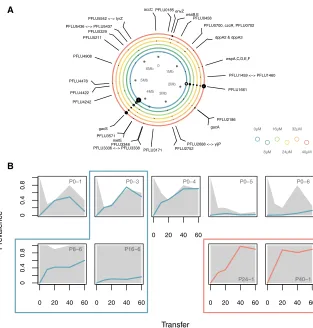
We observed strikingly parallel evolution at the operon, locus, and nucleotide levels both within and between treatments ( Fig-ure 2A and Table S1). Of the 95 non-synonymous mutations identified, we observed 74 cases of operon-level parallelism, 68 cases of locus-level parallelism, and 14 cases of nucleo-tide-level parallelism (i.e., precisely the same mutational change occurred at the same nucleotide position in multiple indepen-dently evolved clones). Nucleotide-level parallelism was identi-fied in five loci, comprising three open reading frames (ORFs) and two intergenic regions. Three loci in particular displayed exceptionally high rates of parallel evolution: PFLU1661 (18 out of 32 clones locus parallelism; 4 out of 32 clones nucleotide parallelism at two sites),gacA(PFLU2189; 5 out of 32 clones lo-cus parallelism; 2 out of 32 clones nucleotide parallelism), and
gacS(PFLU3777; 20 out of 32 clones locus parallelism; 3 out of 32 clones nucleotide parallelism). PFLU1661 is a hypothetical structural gene believed to contribute to cell-wall biogenesis and sits within the wsw operon [21] (wrinkly spreader cell-wall biogenesis), whereas the sensor kinasegacSand its cognate response regulatorgacAform a two-component regulatory sys-tem that controls the biosynthesis of a wide range of secondary metabolites [22, 23]. Further sequencing, both of evolved clones that had naturally lost the plasmid during the experiment and evolved clones from plasmid-free control lines, revealed that while mutations in PFLU1661 were observed in both the plasmid-free and the plasmid-containing clones, we only ever observed mutations ingacAorgacSin the plasmid-containing clones. This suggests that mutations in this regulatory system may have played a causal role in the adaptation of the bacterium to the plasmid. To examine the dynamics of evolution atgacA/
gacS, we tracked the allele frequency dynamics at these loci by FreqSeq [24] in two subsets of our experimental populations: first, in the populations containing each of the nucleotide-level parallel mutations at these loci since such highly parallel evolu-tion is likely to reflect adaptive substituevolu-tions; and second, in the populations from the 0mM HgCl2treatment in which the
plasmid persisted, where we hypothesized that compensatory evolution atgacA/gacSmay have contributed to the observed plasmid dynamics. Consistent with strong selection for rapid compensatory evolution operating on the nucleotide parallel mu-tations, these arose early in the experiment and, in four out of five cases, rapidly swept to high frequency among the plasmid-bearing population (Figure 2B). Among populations from the 0mM HgCl2treatment that retained the plasmid, the frequencies
of mutations in gacSclosely tracked the plasmid dynamics in three out of five populations. This strongly suggests an important
A
[image:4.603.52.296.104.444.2]B
Figure 1. Phenotypic Evolution of Fitness and Conjugation Rate
(A) Fitness of evolved plasmid-containing clones from each mercury environ-ment relative to the plasmid-containing ancestor assayed in their evolved mercury environment. Points represent means for three randomly selected clones for each population with error bars showing SE. The gray line shows the fitness of the ancestral strain, with the gray shading showing SE (n = 6). Fitness increased in all treatments relative to the ancestor (pairwise contrasts: all p < 0.0163), although no significant difference was observed between treat-ments (t71,34= 1.481, p = 0.148).
role for compensatory evolution atgacSin preventing extinction of the plasmid in these populations. However, it is possible that plasmid hitchhiking on other beneficial chromosomal mutations could also have contributed to the observed plasmid dynamics in this treatment [4, 20].
Twenty-five unique mutations were observed in gacA/gacS
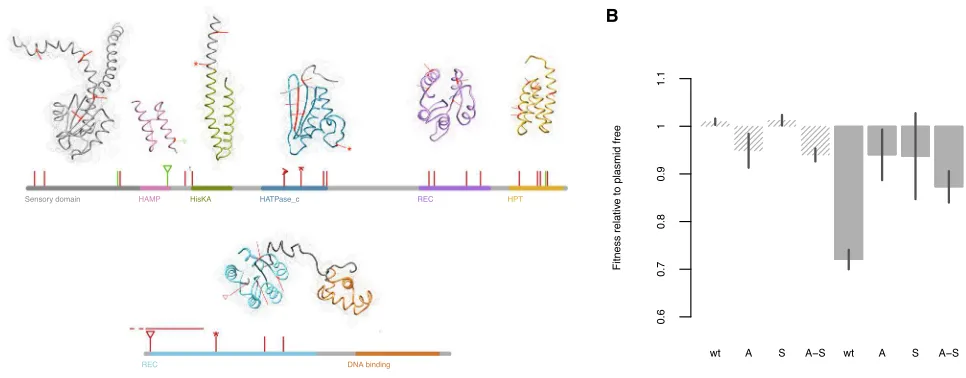
located across all predicted domains of the two proteins (Figure 3A), with the exception of the C-terminal DNA-binding domain ofgacA. All but 3 of the 25 unique mutations were pre-dicted [25] to have deleterious effects on protein function, including three nonsense mutations and one deletion spanning over half of thegacAgene. The three remaining mutations not predicted to alter function were located within the HAMP, HPT, and extracellular sensory domains of GacS, with one SNP in the HAMP domain arising in parallel three times in evolved clones (plus a fourth time in one of the hypermutator clones). Such nucleotide-level parallelism is strongly suggestive of adaptation and furthermore suggests that these mutations were in fact likely to have altered protein function. Together these data suggest that the observed mutations would have caused loss of function of the GacA/GacS two-component regulatory system.
To directly test whether loss of GacA/GacS function plays a role in ameliorating the cost of plasmid carriage, we constructed gene deletion knockout mutants ofgacA, gacS, andgacA/gacS
in the ancestral background. We measured the competitive fitness relative to SBW25 of the knockout mutants and the wild-type, both with and without the plasmid. In the competi-tions conducted without the plasmid, the knockout mutants
A
[image:5.603.64.377.97.425.2]B
Figure 2. Genomic Evidence for Parallel Compensatory Evolution
(A) Summary of mutations identified in evolved clones (excluding hypermutator clones) across treatments. Rings represent the SBW25 bacterial genome, with each ring representing an evolved mercury treatment. Mutations are shown as dots, with the size of the dot representing the number of times mutations appear at each locus across replicate lines. Gray dots denote nucleotide level parallelism (NLP). Plots of individual replicates are shown inFigure S3.
(B) Allele frequency dynamics ofgacSandgacA mutations in plasmid-retaining populations from the 0mM HgCl2treatment and in populations ex-hibiting NLP. Plots show individual populations, with plasmid prevalence shown in gray and lines showing the frequency ofgacS(blue) andgacA (red) mutations. Boxes denote NLP mutations shared between populations.
showed equal or reduced relative fitness compared to the wild-type, indicating that mutations in these genes are not involved in general adaptation to the lab environment. Crucially, however, in the competitions conducted with the plasmid, the knockout mutants were significantly fitter than the wild-type ( Fig-ure 3B): whereas the plasmid imposed a 27% fitness cost upon the wild-type (t2.42 = 12.45, p = 0.0025), we observed
no appreciable cost of plasmid carriage in the knockout mutants (p > 0.168 for all three mutants). This confirms that loss of func-tion of the GacA/GacS two-component regulator is sufficient to completely ameliorate the cost of plasmid carriage.
To further understand the gene-regulatory consequences of plasmid acquisition that may have contributed to the cost of the plasmid in the ancestor and the effects of subsequent compen-satory evolution, we performed a microarray analysis of gene expression in ancestral and evolved strains. We extracted RNA from mid-log phase cultures of ancestral SBW25, ancestral SBW25-pQBR103, and six randomly selected evolved clones from the 0 and 40mM HgCl2treatments, each of which carried
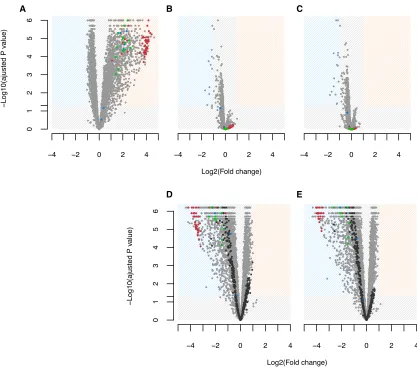
a mutation in thegacAorgacSgenes. In the ancestral genetic background, plasmid carriage was associated with widespread upregulation of chromosomal genes (Figure 4A). Out of 6,018 bacterial genes, 1,005 genes or 16.7% of the genome were signif-icantly upregulated in SBW25-pQBR103 compared to plasmid-free SBW25, whereas only six were significantly downregulated (five proteins of unknown function, PFLU2260, PFLU2594, PFLU2776, PFLU3162, and PFLU3545, and one TetR family transcriptional regulator, PFLU3214). Functional analysis of the upregulated gene set revealed significant enrichment of ten gene ontology (GO) categories, all of which are involved in protein production. Indeed, over 90% of all the chromosomal genes associated by annotation with translation, protein folding, tRNA aminoacylation, rRNA binding, and ribosomes were within the significantly upregulated gene set. The most highly upregu-lated genes were those encoding structural components of the
ribosome; the relative expression of these genes was on average 13.7-fold that of the plasmid-free ancestor (Figure 4A). In contrast, these changes appear to be reversed in the evolved clones. Bacterial gene expression profiles of clones from both se-lection environments were highly similar to those of the plasmid-free ancestor (Figures 4B and 4C) and correspondingly showed significant downregulation when compared to the plasmid-con-taining ancestor (Figures 4D and 4E). Evolved changes in expres-sion of plasmid genes followed a similar pattern to that of the chromosomal genes, with17.1% of plasmid genes downregu-lated in evolved compared to ancestral bacteria-plasmid clones with no significant differences between 0mM and 40mM HgCl2
treatments (Figures 4D and 4E). No enriched functions could be identified among this plasmid gene set due to sparse functional annotation of pQBR103 genes. Taken together, these data sug-gest that the plasmid caused increased translational demand during exponential growth but that this negative effect of plasmid carriage was ameliorated by compensatory mutations in the evolved clones. Other thangacA/gacS, no other mutational tar-gets were shared between the six evolved clones tested (high-lighted inTable S1). Therefore, both the observed reversion in evolved clones to ancestral levels of chromosomal gene expres-sion and the downregulation of plasmid genes were likely associ-ated with loss of GacA/GacS function.
The gacA/gacS two-component regulatory system is highly conserved among gamma-proteobacteria [26, 27] and posi-tively regulates the production of many extracellular proteins in response to environmental stimuli [28]. This regulation is medi-ated through several small RNAs that bind to and inhibit the RNA-binding proteins RsmE and RsmA [27], relieving post-tran-scriptional repression [29]. The loss of GacA/GacS function leaves in place post-transcriptional repression by RsmE and RsmA and is likely therefore to reduce overall translational
demand within the cell. Moreover, it appears that loss of GacA/ GacS function also resulted in downregulation of a large set of plasmid genes. As newly acquired plasmid genes are likely to be poorly adapted to the host cell, it is possible that some of these plasmid gene products may have had cytotoxic effects on the bacterial cell [30], which were alleviated by downregulation of their expression. Further research will be required to determine the precise mechanism of the cost of plasmid carriage in this sys-tem and specifically whether any of the downregulated plasmid gene products were cytotoxic [30]. Loss-of-function mutants in
gacA/gacShave been isolated both in nature [31] and in the lab-oratory [22]. Indeed, elevated mutation rates and frequent rever-sion in gacA/gacS have been reported in Pseudomonas sp. PCL1171 [32] and associated with Xer site-specific recombinase activity inP. fluorescensF113 in the rhizosphere [33]. ThegacA/
gacStwo-component system may therefore represent contin-gency loci, where an elevated mutation rate is adaptive, allowing rapid phenotypic switching in response to environmental unpre-dictability [34]. In natural communities, where bacteria are likely to frequently encounter novel mobile genetic elements that impose increased translational demand upon the cell, the high evolvability of gacA/gacS may be advantageous, offering an evolutionary solution to the immediate costs of plasmid carriage. We demonstrate that rapid compensatory evolution can stabi-lize plasmids by reducing the cost of plasmid carriage. We observed exceptionally parallel evolution, including multiple in-stances of nucleotide-level parallelism, due to the requirement for just a single bacterial regulatory mutation of large effect to completely ameliorate a 425-kb plasmid. This extends the importance of parallel compensatory evolution in understanding plasmid stability [8, 14] by showing that this evolutionary process can occur in parallel across a wide gradient of environmental con-ditions comprising the entire parasitism-mutualism continuum.
[image:6.603.62.545.99.288.2]A B
Figure 3. Functional Consequences of thegacAandgacSMutations
(A) Representation of the protein sequences of GacS and GacA, including predicted domains. Unique amino acid changes are marked with asterisks denoting nonsense mutations, triangles showing parallel mutations appearing in more than one evolved clone, and arrows showing deletions. Mutations predicted as having negative effects on protein function are shown in red, with those predicted as being neutral in green. We had low confidence in the full-length GacS structural prediction; therefore, structural analysis was performed by domain.
Contrary to theory [4], although capture of the Tn5042 by the chromosome and accompanying loss of the plasmid occurred throughout the experiment, these genotypes very rarely invaded to high frequency, suggesting that rapid compensatory evolution may limit this process and should be accounted for in theoretical models (cf. [8]). Therefore, horizontally acquired plasmids can quickly be stabilized and retained by bacteria even in environ-ments where their accessory genes are not immediately useful, helping to explain the widespread occurrence of plasmids in nat-ural bacterial communities.
EXPERIMENTAL PROCEDURES
Populations were initiated from single colonies of SBW25-pQBR103. Six repli-cate populations were established for each of six mercury treatments (0, 8, 16, 24, 32, and 40mM HgCl2) and propagated by 1% serial transfer for 60 transfers in 30-ml glass microcosms containing 6 ml King’s B (KB) liquid media. At the end of the experiment (or at the last transfer where bacteria-plasmid clones were observed), three bacteria-plasmid clones were isolated at random from
each population. Competitive fitness and conjugation rate were estimated for three clones per population. One bacteria-plasmid clone per population was genome sequenced using Illumina MiSeq. Reads were aligned using Bowtie and variants identified using GATK, SNPeff, and Breakdancer. Func-tional characterization of SNPs was determined using PROVEAN, and protein structures were determined in Phyre2. Additionally, one plasmid-free bacterial clone from each 0mM HgCl2population was genome sequenced and for six clones evolved without plasmids for 60 transfers in 0mM HgCl2, thegacA,
gacS, and PFLU1661 genes were sequenced by Sanger sequencing. Allele frequencies of selectedgacAorgacSmutations were analyzed using the Freq-Seq amplicon sequencing strategy at transfers 20, 40, and 60. Gene expres-sion was assayed using microarrays to compare three randomly chosen clones from the 0 and 40mM HgCl2treatments, the plasmid-free ancestor, and the plasmid-containing ancestor. Statistical and functional analyses were performed in R. Full methods are given in theSupplemental Information.
ACCESSION NUMBERS
The accession number for the sequencing data reported in this paper is European Nucleotide Archive: PRJEB8710. The accession number for the microarray data reported in this paper is ArrayExpress: A-MTAB-554.
A B C
[image:7.603.96.513.98.467.2]D E
Figure 4. Transcriptional Consequences of Plasmid Carriage and Compensatory Evolution
(A–E) Top panels show gene expression relative to the plasmid-free ancestor for the plasmid-containing ancestor (A) and clones evolved in 0mM HgCL2(B) and in 40mM HgCL2(C). Lower panels show expression of clones evolved in 0mM HgCL2(D) and 40mM HgCL2(E) relative to the plasmid-containing ancestor. The colored areas define regions of significant (*p < 0.05) differential expression (>2-fold change). Points represent individual genes on the chromosome (light gray) and plasmid (dark gray). Chromosomal genes annotated as the enriched GO functions ‘‘ribosome’’ (red), ‘‘aminoacyl-tRNA ligase activity’’ (blue), and ‘‘rRNA binding’’ (green) are highlighted.
SUPPLEMENTAL INFORMATION
Supplemental Information includes Supplemental Experimental Procedures, three figures, and one table and can be found with this article online at
http://dx.doi.org/10.1016/j.cub.2015.06.024.
ACKNOWLEDGMENTS
This work was supported by funding from the European Research Council under the European Union’s Seventh Framework Programme awarded to M.A.B. (FP7/2007-2013 ERC grant StG-2012-311490–COEVOCON) and by a Standard Grant from the Natural Environment Research Council UK awarded to M.A.B., S.P., and A.J.S. (NE/H005080). We would like to thank three anon-ymous reviewers for their constructive comments on the manuscript and the staff at the NERC Biomolecular Analysis Facility, University of Liverpool, who performed the whole-genome sequencing.
Received: April 20, 2015 Revised: May 25, 2015 Accepted: June 10, 2015 Published: July 16, 2015
REFERENCES
1.Thomas, C.M., and Nielsen, K.M. (2005). Mechanisms of, and barriers to, horizontal gene transfer between bacteria. Nat. Rev. Microbiol.3, 711–721.
2.Jain, R., Rivera, M.C., Moore, J.E., and Lake, J.A. (2003). Horizontal gene transfer accelerates genome innovation and evolution. Mol. Biol. Evol.20, 1598–1602.
3.Harrison, E., and Brockhurst, M.A. (2012). Plasmid-mediated horizontal gene transfer is a coevolutionary process. Trends Microbiol.20, 262–267.
4.Bergstrom, C.T., Lipsitch, M., and Levin, B.R. (2000). Natural selection, in-fectious transfer and the existence conditions for bacterial plasmids. Genetics155, 1505–1519.
5.Levin, B.R. (1993). The accessory genetic elements of bacteria: existence conditions and (co)evolution. Curr. Opin. Genet. Dev.3, 849–854.
6.Sørensen, S.J., Bailey, M., Hansen, L.H., Kroer, N., and Wuertz, S. (2005). Studying plasmid horizontal transfer in situ: a critical review. Nat. Rev. Microbiol.3, 700–710.
7.Bouma, J.E., and Lenski, R.E. (1988). Evolution of a bacteria/plasmid association. Nature335, 351–352.
8.San Millan, A., Pen˜a-Miller, R., Toll-Riera, M., Halbert, Z.V., McLean, A.R., Cooper, B.S., and MacLean, R.C. (2014). Positive selection and compen-satory adaptation interact to stabilize non-transmissible plasmids. Nat. Commun.5, 5208.
9.Dahlberg, C., and Chao, L. (2003). Amelioration of the cost of conjugative plasmid carriage in Eschericha coli K12. Genetics165, 1641–1649.
10.Dionisio, F., Conceic¸a˜o, I.C., Marques, A.C.R., Fernandes, L., and Gordo, I. (2005). The evolution of a conjugative plasmid and its ability to increase bacterial fitness. Biol. Lett.1, 250–252.
11.Modi, R.I., and Adams, J. (1991). Coevolution in bacterial - plasmid popu-lations. Evolution45, 656–667.
12.Modi, R.I., Wilke, C.M., Rosenzweig, R.F., and Adams, J. (1991). Plasmid macro-evolution: selection of deletions during adaptation in a nutrient-limited environment. Genetica84, 195–202.
13.San Millan, A., Santos-Lopez, A., Ortega Huedo, R., Bernabe-Balas, C., Kennedy, S.P., and Gonzalez-Zorn, B. (2015). Small-plasmid-mediated antibiotic resistance is enhanced by increases in plasmid copy number and bacterial fitness. Antimicrob. Agents Chemother.59, 3335–3341.
14.Hughes, J.M., Lohman, B.K., Deckert, G.E., Nichols, E.P., Settles, M., Abdo, Z., and Top, E.M. (2012). The role of clonal interference in the evolu-tionary dynamics of plasmid-host adaptation. MBio3, e00077–e12.
15.San Millan, A., Toll-Riera, M., Qi, Q., and MacLean, R.C. (2015). Interactions between horizontally acquired genes create a fitness cost in Pseudomonas aeruginosa. Nat. Commun.6, 6845.
16.Tett, A., Spiers, A.J., Crossman, L.C., Ager, D., Ciric, L., Dow, J.M., Fry, J.C., Harris, D., Lilley, A., Oliver, A., et al. (2007). Sequence-based analysis of pQBR103; a representative of a unique, transfer-proficient mega plasmid resident in the microbial community of sugar beet. ISME J.1, 331–340.
17.Bailey, M.J., Lilley, A.K., Thompson, I.P., Rainey, P.B., and Ellis, R.J. (1995). Site directed chromosomal marking of a fluorescent pseudomonad isolated from the phytosphere of sugar beet; stability and potential for marker gene transfer. Mol. Ecol.4, 755–763.
18.Lilley, A.K., and Bailey, M.J. (1997). Impact of plasmid pQBR103 acquisi-tion and carriage on the phytosphere fitness of Pseudomonas fluorescens SBW25: burden and benefit. Appl. Environ. Microbiol.63, 1584–1587.
19. Hall, J.P.J., Harrison, E., Lilley, A.K., Paterson, S., Spiers, A.J., and Brockhurst, M.A. (2015). Environmentally co-occurring mercury resistance plasmids are genetically and phenotypically diverse and confer variable context-dependent fitness effects. Environ. Microbiol.http://dx.doi.org/ 10.1111/1462-2920.12901.
20.Harrison, E., Wood, A.J., Dytham, C., Pitchford, J.W., Truman, J., Spiers, A., Paterson, S., and Brockhurst, M.A. (2015). Bacteriophages limit the ex-istence conditions for conjugative plasmids. MBio6, e00586–15.
21.McDonald, M.J., Gehrig, S.M., Meintjes, P.L., Zhang, X.-X., and Rainey, P.B. (2009). Adaptive divergence in experimental populations of Pseudomonas fluorescens. IV. Genetic constraints guide evolutionary trajectories in a parallel adaptive radiation. Genetics183, 1041–1053.
22.Bull, C.T., Duffy, B., Voisard, C., De´fago, G., Keel, C., and Haas, D. (2001). Characterization of spontaneous gacS and gacA regulatory mutants of Pseudomonas fluorescens biocontrol strain CHAO. Antonie van Leeuwenhoek79, 327–336.
23.Cheng, X., de Bruijn, I., van der Voort, M., Loper, J.E., and Raaijmakers, J.M. (2013). The Gac regulon of Pseudomonas fluorescens SBW25. Environ. Microbiol. Rep.5, 608–619.
24.Chubiz, L.M., Lee, M.-C., Delaney, N.F., and Marx, C.J. (2012). FREQ-Seq: a rapid, cost-effective, sequencing-based method to determine allele fre-quencies directly from mixed populations. PLoS ONE7, e47959.
25.Choi, Y., Sims, G.E., Murphy, S., Miller, J.R., and Chan, A.P. (2012). Predicting the functional effect of amino acid substitutions and indels. PLoS ONE7, e46688.
26.Haas, D., Blumer, C., and Keel, C. (2000). Biocontrol ability of fluorescent pseudomonads genetically dissected: importance of positive feedback regulation. Curr. Opin. Biotechnol.11, 290–297.
27.Vakulskas, C.A., Potts, A.H., Babitzke, P., Ahmer, B.M.M., and Romeo, T. (2015). Regulation of bacterial virulence by Csr (Rsm) systems. Microbiol. Mol. Biol. Rev.79, 193–224.
28.Sonnleitner, E., and Haas, D. (2011). Small RNAs as regulators of primary and secondary metabolism in Pseudomonas species. Appl. Microbiol. Biotechnol.91, 63–79.
29.Heeb, S., Blumer, C., and Haas, D. (2002). Regulatory RNA as mediator in GacA/RsmA-dependent global control of exoproduct formation in Pseudomonas fluorescens CHA0. J. Bacteriol.184, 1046–1056.
30.Baltrus, D.A. (2013). Exploring the costs of horizontal gene transfer. Trends Ecol. Evol.28, 489–495.
31.van den Broek, D., Bloemberg, G.V., and Lugtenberg, B. (2005). The role of phenotypic variation in rhizosphere Pseudomonas bacteria. Environ. Microbiol.7, 1686–1697.
32.van den Broek, D., Chin-A-Woeng, T.F.C., Bloemberg, G.V., and Lugtenberg, B.J.J. (2005). Molecular nature of spontaneous modifications in gacS which cause colony phase variation in Pseudomonas sp. strain PCL1171. J. Bacteriol.187, 593–600.
33.Martı´nez-Granero, F., Capdevila, S., Sa´nchez-Contreras, M., Martı´n, M., and Rivilla, R. (2005). Two site-specific recombinases are implicated in phenotypic variation and competitive rhizosphere colonization in Pseudomonas fluorescens. Microbiology151, 975–983.