This is a repository copy of
Many-body localization in periodically driven systems
.
White Rose Research Online URL for this paper:
http://eprints.whiterose.ac.uk/88190/
Version: Accepted Version
Article:
Ponte, P, Papic, Z, Huveneers, F et al. (1 more author) (2015) Many-body localization in
periodically driven systems. Physical Review Letters, 114 (14). ARTN 140401. ISSN
0031-9007
https://doi.org/10.1103/PhysRevLett.114.140401
[email protected] https://eprints.whiterose.ac.uk/
Reuse
Unless indicated otherwise, fulltext items are protected by copyright with all rights reserved. The copyright exception in section 29 of the Copyright, Designs and Patents Act 1988 allows the making of a single copy solely for the purpose of non-commercial research or private study within the limits of fair dealing. The publisher or other rights-holder may allow further reproduction and re-use of this version - refer to the White Rose Research Online record for this item. Where records identify the publisher as the copyright holder, users can verify any specific terms of use on the publisher’s website.
Takedown
If you consider content in White Rose Research Online to be in breach of UK law, please notify us by
Many-body localization in periodically driven systems
Introduction.
The dynamics of closed quantum many-body systems driven out of equilibrium has been the subject of intense investigation over the pastdecade [1, 2]. Many-body systems with local
Hamilto-nians broadly fall into two classes with distinct dynam-ical properties: ergodic systems, which reach local thermal equilibrium as a result of the Hamiltonian evolution, and non-ergodic ones which fail to thermalize. Thermalization in isolated ergodic systems can be linked to the properties of individual many-body eigenstates that are locally thermal [3–5].
While a complete classification of non-ergodic systems remains an open problem, it has recently been estab-lished that many-body localization [6–17] provides a ro-bust mechanism of ergodicity breaking in systems with quenched disorder. Many-body localized (MBL) systems are characterized by an extensive number of quasi-local conservation laws [13, 14], which strongly restrict quan-tum dynamics and prevent energy transport and thermal-ization. MBL systems have universal dynamical prop-erties, such as the logarithmic-in-time growth of entan-glement entropy for initial product states [9, 11–15], in contrast to ergodic and Bethe-ansatz-integrable systems where entanglement spreads linearly in time [18–20].
In this paper, we study disordered many-body systems with local time-dependent Hamiltonians H(t) that vary periodically in time, H(t + T) = H(t). The properties of periodically driven systems are determined by the unitary Floquet operator Fˆ , i.e., the evolution operator over one period:
Z T
Fˆ = T exp{_i H(t)dt}, (1) 0
where T exp denotes a time-ordered exponential. In
the eigenstate basis | a), F ˆ takes the form F ˆ =
PD a=1 e−i | a)( a|, where V is the Hilbert space
di-mension, and the quasi-energies 9a can be chosen to lie
in the interval [0; 2 ). One can introduce an effective Floquet Hamiltonian HF as F ˆ = e−iHF , with eigenstates
| a) and eigenvalues 9a +2 na, where na is an arbitrary
integer. Generally it is not known whether there exists a choice of na which brings HF into a sum of local terms,
and therefore the Floquet problem cannot be reduced to the study of time-independent local Hamiltonians. It is the goal of this paper to explore different regimes of the Floquet dynamics in disordered many-body systems.
We consider a generic class of periodically driven 1D
models with quenched disorder, and find that, as system’s
parameters are varied, two distinct phases are realized, which differ in the structure of their Floquet eigenstates, as well as in dynamical properties. One of them is the MBL phase in which the Floquet eigenstates at arbitrary quasi-energy obey the area-law for entanglement entropy, similar to the ground states in gapped systems. Level re-pulsion is absent, and the statistics of quasi-energy levels follows the Poisson statistics. Further, in the limit of an infinite system, the eigenstates with similar quasi-energies typically have different local properties, thus the eigenstate thermalization hypothesis (ETH) [3–5] breaks down. The second phase is the delocalized (ergodic) phase. Here the Floquet eigenstates have an extensive, volume-law entanglement; the quasi-energy levels repel, and their statistics is described by Circular Orthogonal Ensemble (COE). ETH holds in this phase, and the Floquet eigenstates have identical local properties, described by an infinite-temperature Gibbs ensemble.
The two phases can furthermore be distinguished by their dynamical properties, e.g., the time evolution of the system prepared in a product state, which can be efficiently simulated numerically. In the MBL phase, the Pedro Ponte,1,2 Z. Papié,1,3 François Huveneers4, and Dmitry A. Abanin1,3
1 Perimeter Institute for Theoretical Physics, Waterloo, ON N2L 2Y5, Canada
2 Department of Physics and Astronomy, University of Waterloo, Ontario, N2L 3G1, Canada
3 Institute for Quantum Computing, Waterloo, ON N2L 3G1, Canada and
4 CEREMADE, Universite Paris-Dauphine, France
(Dated: October 31, 2014)
We consider disordered many-body systems with periodic time-dependent Hamiltonians in one spatial dimension. By studying the properties of the Floquet eigenstates, we identify two distinct phases: (i) a many-body localized (MBL) phase, in which almost all eigenstates have area-law entanglement entropy, and the eigenstate thermalization hypothesis (ETH) is violated, and (ii) a delocalized phase, in which eigenstates have volume-law entanglement and obey the ETH. MBL phase exhibits logarithmic in time growth of entanglement entropy for initial product states, which distinguishes it from the delocalized phase. We propose an effective model of the MBL phase in terms of an extensive number of emergent local integrals of motion (LIOM), which naturally explains the spectral and dynamical properties of this phase. Numerical data, obtained by exact diagonalization and time-evolving block decimation methods, suggests a direct transition between the two phases. Our results show that many-body localization is not destroyed by sufficiently weak periodic driving.
2
states retain local memory of the initial state, and local observables at long times are correlated with their initial values. Similar to MBL systems with time-independent Hamiltonians, entanglement entropy grows logarithmically in time. This behavior reflects the presence of emergent local integrals of motion [13, 14], which we explicitly construct following Ref. [21] (see also Ref. [22]). In contrast, in the delocalized phase local observables relax
to their “equilibrium” values at long times, which are given
by the infinite-temperature Gibbs ensemble. In this case, entanglement spreads much faster, and we find a behaviour consistent with the linear growth of entan-glement.
Our results complement previous works [23–26], which considered translationally invariant driven systems, as well as Ref. [27], where the behaviour of disordered many-body systems under local driving was studied.
Model.
Our system is a 1D spin 1/2 chain with open boundary conditions. Following Refs. [23, 24], wecon-sider a driving protocol in which the system’s Hamilto
-nian is periodically switched between two operators, H0 and H1, both of which are sums of local terms. An ex-ample of a disordered Hamiltonian H0, which describes an MBL phase and acts for time T0, is
H0 = E hi zi + Jz zi zi+1, (2) i
states. As a
delocalizing
Hamiltonian H1 we
choose = E
xi x i+1 + y i yi+1, (3)
which acts for time T1 such that the driving period is
T = T0 + T1. The associated Floquet operator is given by:
Fˆ = e−iH0T0e−iH1T1. (4)
The protocol describes an MBL system periodically
”kicked” with a delocalizing perturbation H1, and can be
viewed as a many-body generalization of a periodically kicked rotor model [28–34]. Recent work has argued that a similar protocol for translationally-invariant Hamiltonians results in an infinite-temperature state at long times, and therefore a non-local Floquet operator
[25]. We fix Jx = Jz = 1/4, T0 = 1, W = 2.5 and tune the
strength of the kick – T1 – observing a transition at critical T1 between an MBL phase (small T1 < T1) and
an ergodic phase (T1 > T1). We note that the model
(2,3) always has one conserved quantity, the z
-projection of the total spin, Sz = ENi=1 zi . However, we
have checked that this global conservation law is not essential for the existence of MBL and ergodic phases, by studying other models where Sz is not conserved.
0 . 0
[image:3.612.324.542.56.195.2]0 . 5 1 . 0 1 . 5 2 . 0 2 . 5 3 . 0 3 . 5 4 . 0 T1
FIG. 1. Disorder-averaged level statistics parameter h7
i
as afunction of the “kick” strength T1. At small values of T1,
h
7i
≈
0.386, indicating Poisson statistics of quasi-energy levels (nolevel repulsion). At larger T1 the system undergoes a transition
into a delocalized phase with h7
i
≈
0.53, consistent with COE
[25]. Data is for system sizes L = 10, 12, 14, and averaging is performed over 1000 disorder realizations.
where random fields hi are uniformly
distributed in the
interval [
—
W; W]. The eigenstates of H0 are
product
Properties of Floquet eigenstates.
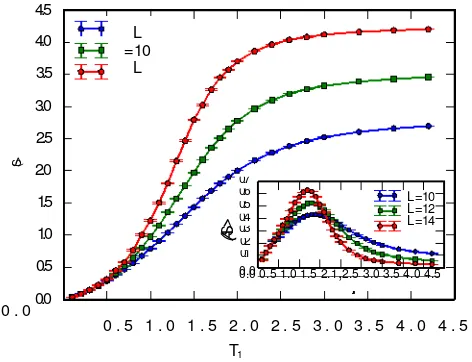
We first explore the properties of the Floquet eigenstates O ) and quasi-energy spectrum E [0; 2 ), using exact diagonalization (ED). By computing the consecutive quasi-energy gaps = +1 — , we characterize the level statistics by their ratio r = min( , +1)/max( , +1) [8, 25]. The averaged value of r serves as a probe of ergodicity breaking: it allows one to distinguish between the Poisson and Wigner-Dyson level statistics. In Fig. 1 we show (r) averaged over all quasi-energy spacings and over 1000 disorder realizations, for several system sizes. At small kick period T1, (r) becomes increasingly close to the Poisson-statistics value (r)POI 0.386 as the systemsize is increased. This indicates the absence of level re-pulsion and suggests that ergodicity is broken at small T1 and the system is in the MBL phase. At large T1 pa-rameter (r) is approximately equal to 0.53, which is close
to the COE value, (r)COE 0.527 [25]. This suggests
that at large T1 the system delocalizes. The (r) curves for different system sizes cross at T1 0.9, suggesting
a phase transition between MBL and ergodic phases. A drift of the crossing point towards smaller T1 is observed, similar to the time-independent case [10].
To further distinguish the nature of the two phases, we study the entanglement properties of the Floquet eigen-states. The expectation from the static case is that MBL eigenstates should obey an area law for entanglement
0.54 0.52 0.50 0.48 0.46 0.44 0.42 0.40 0.38
L =10
L =12
(
r
val-3
0 . 0
0 . 5 1 . 0 1 . 5 2 . 0 2 . 5 3 . 0 3 . 5 4 . 0 4 . 5 T1
FIG. 2. Averaged entanglement entropy (
S
) and itsfluctua-tions (
S
) (inset) as a function ofT
1. The scaling of entropyand its fluctuations with system size
L
are consistent with theexistence of an MBL and a delocalized phase for small and
large
T
1, respectively.effects. We have also directly tested the ETH and its violation in the MBL phase in the Floquet eigenstates, finding behaviour consistent with the existence of two phases [37] (see also Ref. [38], where ETH for driven er-godic systems was tested).
100 101 102 103 104 105
n
ues of T1 lends further support to the existence of two phases. At T1
„,
<
T1 k, (S) is much smaller than the value expected for random vectors in the Hilbert space,
STh L/2 ln 2 [35], which signals ergodicity breaking. Moreover, at T1
<
0.6 the entanglement entropy grows very weakly with system size, consistent with area-law in 1D. On the contrary, at large T1 > T 1 k ,(S) approachesSTh, indicating that almost all eigenstates are essentially random vectors in the Hilbert space, as expected in the ergodic phase.
It is also instructive to study the fluctuations of en-tanglement entropy, as they have been shown to provide a useful probe of the MBL-delocalization transition in
time-independent models [36]. The disorder-averaged
fluctuations of S, defined as S = \MS - (S))2) are expected
to be small deeply in the delocalized phase, as well as in the MBL phase: in the former case, almost all eigen-states are highly entangled, with S STh, with small
fluctuations around this value, while in the latter case, S
obeys area-law and is therefore small, as are its stateto-state fluctuations. In contrast, at the transition S has a broad distribution [13, 36], and therefore its fluctuations are maximal. Thus, the localization-delocalization transition can be detected by the location of the peak in
S. Fig. 2(inset) shows S as a function of T1.
Entan-glement fluctuations S exhibit a maximum at T1 1.1 that
roughly agrees with T1 k
value found from analyzing level statistics; further, we observe a slight drift of the maximum with the system size, similar to the previous study of the static case [36]. We attribute the difference
between the position of the maximum in S and value
T1 determined from the level statistics, to the finite-size
FIG. 3. Dynamical properties: decay of magnetization at a
given site
I
= 1 for a N´eel initial configuration. Inset:Long-time magnetization remains non-zero in the MBL phase as the system size is increased. In the delocalized phase, magnetization decays to zero at long times. Averaging was performed over 6000 disorder realizations.
Dynamics.
We next study the dynamical properties of the model (2,3). We consider a standard quantum quench protocol: the system is initially prepared in a Néel (product) state | 0) of spins zi = ±1 at t = 0, and this stateis evolved under the Hamiltonian (2,3) at t > 0. This protocol is particularly easy to simulate using Krylov subspace projection methods [39] or time-evolving block decimation [40] method, both of which allow us to access larger systems beyond ED due to the sufficiently slow growth of entanglement in the MBL phase. For the TEBD algorithm we use a second order Trotter decomposition
with time step t = 0.1. The growth of the bond
dimension is controlled by requiring the neglected weight to be less than 10-7 at each Schmidt decomposition.
Local observables. We first focus on the evolution of local observables, and compute the expectation value of the spin on a given site I, z I (t), and its long-time limit ( zI (oo)) [21, 41, 42]. Fig.3 illustrates the time evolution
z
I(t) for the Néel initial state | 0) and site I = 1, and for
system sizes ranging from L = 10-14 (obtained via ED),
L = 16, 18 obtained using Krylov subspace projection, and L = 24, 30 obtained using TEBD. We find that the on-site magnetization remains finite at very long times even for the largest systems without any visible finite-size effects. This indicates that the MBL phase remains stable in the thermodynamic limit.
4.5 4.0 3.0 2.0 0.0 3.5 2.5 0.5 1.5 1.0 L =10 L =12 (A S > 0.7 0.6 0.5 0.4 0.3 0.0 ___________________________ 0.0 0.5 1.0 1.5 2.1,2.5 3.0 3.5 4.0 4.5
( 0 f (n 7 ) ) 0.2 0.1 L =10 L =12 L =14 (S> 0.8 0.6 0.4 0.0 0.2 1.0 L =12 L =14 L =16 L =18 L =24 L =30
(01 (c o))
0.6 0.4 0.8
0.2
0 __________________________ 0.
0.0 0.5 1.0 1.5 2.0 2.5 3.0 3.5 4.0 4.5 1.0
T1
[image:5.612.59.295.58.239.2] [image:5.612.335.552.133.306.2]4
1
00 101 102 103 104
[image:6.612.61.288.55.237.2]n
FIG. 4. Disorder-averaged entanglement entropy following a quantum quench, for the N´eel initial state. Data for system
sizes L = 12, 14 was obtained by ED, for L = 16, 18 using
Krylov subspace projection, and L = 24, 30 using TEBD.
Averaging performed over 6000 disorder realizations.
The long-time average
h
zI (
∞
)i
can be expressedin terms of the Floquet eigenstates as
h
zI (∞
)i
= flimt ot (
O
o(e)1
0o)
dt 0, which in terms of the " t
eigenstates
| i
readsE
h |
zI| i | h
0| i|
2 . The long-time value
h
zI (∞
)i
, calculated using ED, andav-eraged over 6000 disorder realizations, is illustrated in Fig. 3(inset). This quantity behaves differently in the two phases: at T
<
T1 ,h
z
I(
∞
)i
is positive and weaklyde-pendent on the system size, which shows that in the MBL phase the local memory of the initial state is retained. Deep in the ergodic phase, at T1 ,
h
zI (
∞
)i
0,re-flecting the decay of the initial magnetization and therefore a loss of the memory of the initial state.
Entanglement growth.
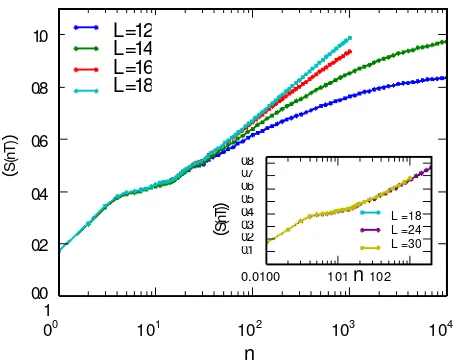
Finally, we explored the spreading of entanglement following a quantum quench, known to be a sensitive probe of many-body localization: in the MBL phase, entanglement grows logarithmically in time [9, 11–14], while in the ergodic phase, as well as in Bethe-ansatz-integrable systems, it grows linearly in time [18–20]. The disorder-averaged entanglement entropy as a function of time, calculated for fixed T1 = 0.4 and the symmetric bipartition, is shown in Fig. 4. Averaging was performed over 6000 disorder realizations. Entanglement initially rises from zero, followed by a plateau and a logarithmic growth for several decades in time,h
S(t)i
ln(t). This behavior is qualitatively similar to that found in the MBL phase in systems with time-independent Hamiltonians [11–14],which gives further support for the existence of the MBL phase in driven systems with strong disorder.
Local integrals of motion and effective
descrip-tion of the driven MBL phase.
In order to under-0.8
0.6
0.4
0.0 0.2
1.0 L =12
L =14 L =16 L =18
(
S(
nT
)
)
0.8
0.6
0.4
0.0100 101 n 102
0.7
0.5
0.3 0.2 0.1
L =18 L =24 L =30
(
S
(n
T
)
stand the spectral and dynamical properties of the MBL phase observed in the numerical simulations, we propose that this phase is characterized by an extensive number of local integrals of motion [13, 14]. First, we note that the area-law entanglement of the Floquet eigenstates sug-gests that they can be obtained from the product states (in the zi =
±
1 basis) by a quasi-local unitary transformation Uwhich brings the Floquet operator into a diagonal form in that basis: U FˆU† = ˆFdiag. Since L of the operators z i commute with ˆFdiag, we can introduce a set of L
“pseudospin” operators z
i = U† z
i U. These operators
commute with the Floquet operator [Fˆ, zi ] = 0, as well as
with each other [ zi, z j ] = 0. Operators z
i have
eigen-values
±
1 and therefore satisfy the relation ( zi )2 = 1; they can be viewed as z-components of some “effective” spins. We emphasize that the operators zi can be introduced forany driven system, but the special property of the MBL phase is that their support is localized near site i, and they affect remote physical degrees of freedom exponentially weakly. In terms of -operators, the operator F takes a simple form, as it can only depend on zi operators and
their products (but not on the xi , y i operators). It is
convenient to represent Fˆ as
Fˆ = e−iHeff({ z i }), (5)
where Heff(
{
zi
}
) is a real function of operators zi . (Sucha representation takes into account the fact that eigen-values of Fˆ have absolute value one). Further, since ( zi )2 = 1, Heff can generally be written as
Jijkz i z j z k +. . .
(6) It is natural to assume that in the MBL phase the couplings J between remote effective spins decay exponentially with distance, similar to the static case [13, 14]; we note that long-range interactions, in particular, would be inconsistent with Lieb-Robinson bounds on information propagation [43] satisfied by the operator Fˆ.
The effective model introduced above naturally explains the spectral and dynamical properties of the MBL phase established numerically, e.g., the absence of decay of the on-site magnetization at long times and the logarithmic growth of entanglement, which directly follows from Eqs.(5,6) and exponential decay of interactions between remote effective spins [12–14]. To provide further justification for the effective description (5,6), we have also numerically constructed [37] the local integrals of motion following Ref. [21]. These form an extensive set, although they are not identical to zi operators.
Discussion.
We have demonstrated the existence of two dynamical regimes in periodically driven systems de-scribed by local interacting Hamiltonians with quenched disorder. In particular, we have identified a many-body localized phase, in which ergodicity is broken. We arguedHeff (
{
zi
}
) =V
i
˜hi z
i +
E
ij Ji j
z
i
E
5
that the MBL phase is characterized by extensively many emergent, quasi-local conservation laws. This implies that the dynamics of Floquet MBL systems is described by an effective quasi-local time-independent Hamiltonian
H
eff,which is itself many-body-localized. This is in sharp contrast to the ergodic phase, where the Floquet Hamil-tonian does not have a quasi-local representation [25–27].
An interesting open question is whether the Magnus ex-pansion [44] converges in the MBL phase.
Another implication of our results is that MBL does not rely on global conservation laws. Further, MBL phase is robust under sufficiently weak periodic driving, and there exists a finite driving threshold above which transport is restored, and the system ultimately delocalizes. This may serve as an experimental signature of the many-body localization. An interesting subject for future research, relevant for experiments in disordered solid-state systems, is to study periodically driven MBL system weakly coupled to a thermal bath (we note that spectral properties of a static MBL system coupled to a bath were recently considered in Refs. [45, 46]).
Acknowledgements. We thank Anushya Chandran, David Huse, Isaac Kim, and Yuan Wan for enlightening discussions. We acknowledge support by Alfred Sloan Foundation and Early Researcher Award by the Govern-ment of Ontario (DA). Research at Perimeter Institute is supported by the Government of Canada through In-dustry Canada and by the Province of Ontario through the Ministry of Economic Development & Innovation.
Note added. During the completion of this manuscript, we became aware of a related recent work [47].
[1] A. Polkovnikov, K. Sengupta, A. Silva, and M. Vengalattore, Rev. Mod. Phys. 83, 863 (2011). [2] I. Bloch, J. Dalibard, and W. Zwerger, Rev. Mod.
Phys. 80, 885 (2008).
[3] J. M. Deutsch, Phys. Rev. A 43, 2046 (1991). [4] M. Srednicki, Phys. Rev. E 50, 888 (1994).
[5] M. Rigol, V. Dunjko, and M. Olshanii, Nature 452,854 (2008).
[6] D. Basko, I. Aleiner, and B. Altshuler, Annals of Physics 321, 1126 (2006).
[7] I. V. Gornyi, A. D. Mirlin, and D. G. Polyakov, Phys. Rev. Lett. 95, 206603 (2005).
[8] V. Oganesyan and D. A. Huse, Phys. Rev. B 75, 155111 (2007).
[9] M. Znidaric, T. Prosen, and P. Prelovsek, Phys. Rev. B 77, 064426 (2008).
[10] A. Pal and D. A. Huse, Phys. Rev. B 82, 174411 (2010). [11] J. H. Bardarson, F. Pollmann, and J. E. Moore, Phys.
Rev. Lett. 109, 017202 (2012).
[12] M. Serbyn, Z. Papié, and D. A. Abanin, Phys. Rev. Lett. 110, 260601 (2013).
[13] M. Serbyn, Z. Papié, and D. A. Abanin, Phys. Rev. Lett. 111, 127201 (2013).
[14] D. A. Huse, R. Nandkishore, and V. Oganesyan,
arxiv:1408.4297.
[15] R. Vosk and E. Altman, Phys. Rev. Lett. 110, 067204 (2013).
[16] B. Bauer and C. Nayak, J. Stat. Mech. (2013) P09005. [17] D. Pekker, G. Refael, E. Altman, E. Demler, and V.
Oganesyan, Phys. Rev. X 4, 011052 (2014).
[18] P. Calabrese and J. Cardy, J. Stat. Mech. P04010 (2005). [19] G. De Chiara, S. Montangero, P. Calabrese, and R.
Fazio, J. Stat. Mech. P03001 (2006).
[20] H. Kim and D. A. Huse, Phys. Rev. Lett. 111, 127205 (2013).
[21] A. Chandran, I. H. Kim, G. Vidal, and D. A. Abanin, arXiv:1407.8480 (2014).
[22] V. Ros, M. Mueller, and A. Scardicchio, arXiv:1406.2175 (2014).
[23] T. Prosen, Phys. Rev. Lett. 80, 1808 (1998).
[24] L. D’Alessio and A. Polkovnikov, Annals of Physics
333, 19 (2013).
[25] L. D’Alessio and M. Rigol, arXiv:1402.5141 (2014).
[26] A. Lazarides, A. Das, and R. Moessner, Phys. Rev. E 90, 012110 (2014).
[27] P. Ponte, A. Chandran, Z. Papié, and D. A. Abanin, arXiv:1403.6480 (2014).
[28] G. Casati and J. Ford, Stochastic Behavior in Classi-cal and Quantum Hamiltonian Systems, 1st ed., Vol. 93 (Springer Berlin Heidelberg, 1979).
[29] D. R. Grempel, R. E. Prange, and S. Fishman, Phys. Rev. A 29, 1639 (1984).
[30] F. L. Moore, J. C. Robinson, C. Bharucha, P. E. Williams, and M. G. Raizen, Phys. Rev. Lett. 73, 2974 (1994).
[31] G. Lemarié, J. Chabé, P. Szriftgiser, J. C. Garreau, B. Grémaud, and D. Delande, Phys. Rev. A 80, 043626 (2009).
[32] Fritz Haake, Quantum signatures of chaos, Springer-Verlag, Berlin, 2nd edition (1991).
[33] F. M. Izrailev and D. L. Shepelyanskii, Theor. Math. Phys. 43, 1586 (1980).
[34] T. Dittrich and R. Graham, Annals Phys. 200, 363 (1990).
[35] D. N. Page, Phys. Rev. Lett. 71, 1291 (1993).
[36] J. A. Kjäll, J. H. Bardarson, and F. Pollmann, Phys. Rev. Lett. 113, 107204 (2014).
[37] See Supplemental Online Material.
[38] H. Kim, T. N. Ikeda, and D. A. Huse, arXiv:1408.0535 (2014).
[39] R. B. Sidje, ACM Trans. Math. Softw., 24, 130 (1998). [40] G. Vidal, Phys. Rev. Lett. 91, 147902 (2003).
[41] R. Vasseur, S. A. Parameswaran, and J. E. Moore, arXiv:1407.4476 (2014).
[42] M. Serbyn, Z. Papi´c, and D. A. Abanin, arXiv:1408.4105 (2014).
[43] E. H. Lieb and D. Robinson, Commun. Math. Phys. 28, 251 (1972).
[44] W. Magnus, Pure Appl. Math 7, 649 (1954).
[45] R. Nandkishore, S. Gopalakrishnan, and D. A. Huse, Phys. Rev. B 90, 064203 (2014).
[46] S. Johri, R. Nandkishore, and R. N. Bhatt, arXiv:1405.5515 (2014).
Supplemental τnline Material for “Many
-body localization in periodically driven
systems”
Pedro Ponte, Z. Papié, Fran¸cois Huveneers, and Dmitry A. Abanin
Here we provide direct numerical tests of the eigen-state thermalization hypothesis (ETH) in driven MBL and delocalized phases. We also explicitly construct lo-cal integrals of motion in the MBL phase for the Floquet problem using the method of Ref. [21].
TESTING THE ETH
According to the ETH, in the delocalized phase the expectation value of a local operator
O
in all Floquet eigenstates should converge, in the thermodynamic limit, to the prediction of the canonical ensemble with infinite temperature1
O
∞ =D
where
D
is the Hilbert space dimension. We test ETHand its violation in the MBL phase by examining the de-viation of the expectation value of
O
in individual eigen-states,hOi
fromO
∞:O
=h|hOi
−
O
∞|i
,where averaging is performed over all Floquet eigenstates for each disorder realization, and then over different disorder realization. We expect this quantity to
approach zero in the delocalized phase, as L
∞
. Onthe other hand, in the MBL phase this quantity should remain finite as we extrapolate the chain size L to infinity.
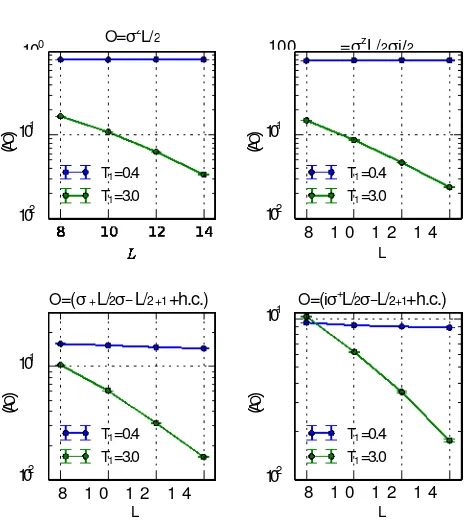
In Fig. 5 we show numerical results for local operators
O
that act on the two neighbouring sites in the middle of the chain and conserve Sz. We studiedthe following four operators:
O
1 = 0zL/2,O
2 = 0zL/20zL/2+1,O
3 = (0+L/20−L/2+1 + 0−L/20+L/2+1),O
4 = i(0+L/20−L/2+1−
0−L/20+L/2+1).As expected, in the MBL phase (T1 = 0.4),
h Oi
[image:9.612.324.558.116.377.2]changes weakly with system size suggesting that it remains finite in the thermodynamic limit. In the delocalized phase (T1 = 3.0),
O
approaches zero with increasing system size suggesting that each Floquet eigenstate behaves as an infinite temperature thermal state for local observables in the thermodynamic limit. We note that all four operators show nearly identical behaviour. Thus the direct test of the ETH is consistent with the presence of two phases with markedly different properties of their eigenstates.FIG. 5. Deviation of expectation values of local operators from their infinite-temperature values given by the canonical
ensemble. Different plots correspond to various choices of Sz
-preserving local operators 0 acting on the sites in the middle
of the chain, and Ti = 0.4, 3.0 correspond to MBL and
delocalized phases, respectively.
LOCAL INTEGRALS OF MOTION
=
+
(0)
2−L(1 0z 1)
8 10 12 14
6
Tr
O
,O= z
L/2
100
10-1
10-2
O=( + L/2 −L/2 +1 +h.c.)
10-1
10-2
8 1 0 1 2 1 4
L
100 = zL/ 2 i/2
10-1
10-2
8 1 0 1 2 1 4
L
O=(i +L/
2 −L/2+1+h.c.)
T1 =0.4
T1 =3.0
8 1 0 1 2 1 4
L
(A
O
)
(A
O
)
(A
O
)
T1 =0.4
T1 =3.0
10-1
(A
O
)
10-2
T1 =0.4
T1 =3.0
T1 =0.4
L
To further support the effective model of the
MBL phase introduced in the main text, we
now explicitly construct an extensive set of
quasi-local integrals of motion. Following Ref.
[21], we consider infinite-time average of the
operator 0z1, denoted by ¯ 0z1, which is
always an integral of motion. We now
demonstrate that in the MBL phase this
operator is a quasi-local integral of motion.
First, we note that operator ¯ 0z1 describes
the spreading of magnetization, initially
prepared on site 1. To illustrate this, consider
the infinite-temperature ensemble, in which
spin 1 was initially prepared in the up-state,
described by the density matrix
FIG. 6. Local integrals of motion in the MBL and delocalized phase. (Left) Median magnetization M1j as a function of
distance − j|. (Right) Median difference between the total norm N, and partial norm σ(j), divided by N. The exponential
decay of this quantity with distance | j −1| demonstrates that in the MBL phase (T1 = 0.4) operator ¯ z1 is a quasi-local
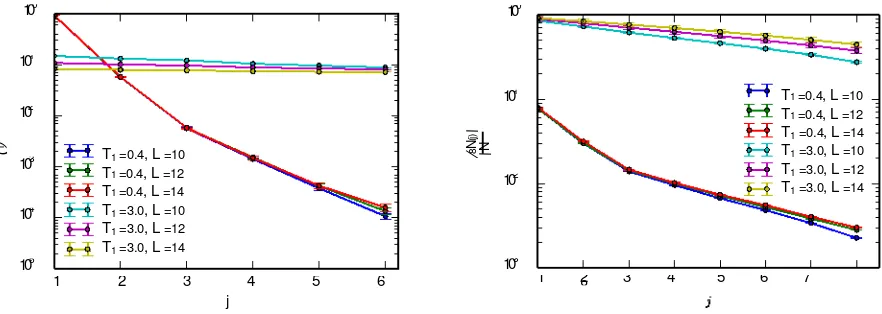
integral of motion. In the delocalized phase (T1 = 3), this operator becomes non-local.
expressed in terms of the operator ¯ z
1 as follows:
¯ = 2−L(1 + ¯ z 1),
where ¯ z
1 =
f
0T
1(z)(t)dt. Thus the spread-ing of the initial magnetization over the chain at long
times can be related to the properties of operator ¯ z
1
The long-time magnetization on site j is given by:
1
M1j = Tr(¯ zj) = 2L Tr
(
¯ z1 zj)
Fig. 6 illustrates that M11 is on the order of unity, but M1j
decays over several orders of magnitude as a function of |j
—1| in the MBL phase (T1 = 0.4). This is consistent with ¯ z
1 being a quasi-local operator. Conversely, in the
delocalized regime (T1 = 3), the magnetization is nearly uniformly spread over all sites j and has a stronger de-pendence on the chain size L, thus, operator ¯ z
1
becomes non-local.
To further test the quasi-locality of operator ¯ z 1 in the
MBL phase, we examined the partial norm
1
AT(j) = _ .Tr(¯ A¯ A),
23
where
¯ A _ 1 Tr a_z
2L−j A 1,
N −N(j)
N vs j, where AT = 2L1 Tr¯ z
1¯ z1 is the total
norm of the operator ¯ z
1. This quantity
describes how well the operator ¯ z
1 can be
approximated by operators with a finite support, and therefore tests whether this operator is quasi-local. It is evident from Fig. 6 that NN(j) approaches zero exponentially in distance |j — 1| in the MBL phase, indicating that the operator ¯ z
1 is indeed a quasi-local
integral of motion. We note that similar quasi-local integrals of motion, ¯ z
i , can be constructed for other
sites, i = 2, .., L, and they form an extensive set of LIOMs.
100
10-1
10-2
(
/11)
10-3
10-4
10-5
1 2 3 4 5 6
j
7
100
10-1
10-2
/
8
N
(j)
\
\
N
T1 =0.4, L =10
T1 =0.4, L =12
T1 =0.4, L =14
T1 =3.0, L =10
T1 =3.0, L =12
T1 =3.0, L =14
10-3
1 2 3 4 5 6 7 8
T1 =0.4, L =10
T1 =0.4, L =12
T1 =0.4, L =14
T1 =3.0, L =10
T1 =3.0, L =12
T1 =3.0, L =14
and A is the region containing sites 1 to j and A its com-plement. In Fig. 6 we illustrate the normalized difference
N (j)
![FIG. 1. Disorder-averaged level statistics parameter h[25].7i as a function of the “kick” strength T1](https://thumb-us.123doks.com/thumbv2/123dok_us/7904758.188705/3.612.324.542.56.195/fig-disorder-averaged-level-statistics-parameter-function-strength.webp)