“A COMPARATIVE STUDY TO ANALYZE THE EFFICACY OF
CONTRAST TRAINING PROGRAMME AND SPEED AGILITY
QUICKNESS TRAINING ON AGILITY PERFORMANCE OF ELITE
MALE FOOTBALL PLAYERS’’
Project Submitted toTHE TAMIL NADU DR. M.G.R MEDICAL UNIVERSITY
Towards the partial fulfilment of the requirement for the degree of
MASTER OF PHYSIOTHERAPY
(SPORTS PHYSIOTHERAPY)
REG NO: 271750123
CHERRAAN’S COLLEGE OF PHYSIOTHERAPY
CHERRAAN’S INSTITUTE OF HEALTH SCIENCES
CERTIFICATE
The work embodied in the thesis entitled A COMPARATIVE STUDY TO ANALYZE THE EFFICACY OF CONTRAST TRAINING PROGRAMME AND SPEED AGILITY QUICKNESS TRAINING ON AGILITY PERFORMANCE OF ELITE MALE FOOTBALL PLAYERS submitted to THE TAMIL NADU DR. M.G.R MEDICAL UNIVERSITY, Chennai-32 in the partial fulfilment of the requirement for the degree of Master Of Physiotherapy(SPORTS Physiotherapy) was carried out by candidate bearing register number271750123at Cherraan’s College Of Physiotherapy, Coimbatore under my supervision. This is an original work in part or full for any other degree/diploma at this or any other university/Institute. This thesis is fit to be considered at this or any other university/Institute. This thesis is fit to be considered for evaluation of Master of Physiotherapy.
________________
__________________
Signature of Supervisor
Signature of Principal
Mr.A.CHINNASAMY.M.P.T. Mrs. E .SELVARANI.M.P.T (Neuro)
ASSOCIATE PROFESSOR PRINCIPAL & PROFESSOR
Date
: ____________
Date
: _____________
Internal Examine……….
External Examiner……….
DECLARATION
The work embodied in this project entitled “A COMPARATIVE STUDY TO ANALYZE THE EFFICACY OF CONTRAST TRAINING PROGRAMME AND SPEED AGILITY QUICKNESS TRAINING ON AGILITY PERFORMANCE OF ELITE MALE FOOTBALL PLAYERS, was the original work carried out by me and has not been submitted in part or full for any other degree/diploma at this or any other institute/university. All the ideas and references have been duty acknowledgement
___________________ ______________________ Signature of supervisor
Signature of student
Mr. A. CHINNASAMY. M.P.T (SPORTS)
ASSOCIATE PROFESSOR
ACKNOWLEDGEMENT
First of all I express my sincere gratitude to the GOD ALMIGHTY, who has given me the required knowledge, wisdom, strength, & opportunity to do this project successfully.
This study will be an incomplete one without my gratitude towards my PARENTS& FRIENDS.
I want to acknowledge my sincere thanks to our CHAIRMAN, & all other staffs of
CHERRAAN INSTITUTE OF HEALTH SCIENCES, Coimbatore.
I would like to express my gratitude to our MRS. E. SELVARANI, MPT, PRINCIPAL&PROF for providing me constant support & motivation in the form of resources & inputs.
I would like to extend my thanks to all the teacher and staff of cheran college of physiotherapy, for their sincere support.
I owe my sincere thanks to Mr.A.CHINNASAMY.M.P.T my guide for his inspiration, assistance & support, from the inception of this research studies to its completion.
ABSTRACT
A COMPARATIVE STUDY TO ANALYZE THE EFFICACY OF CONTRAST TRAINING PROGRAMME AND SPEED AGILITY QUICKNESS TRAINING ON AGILITY PERFORMANCE OF ELITE MALE FOOTBALL PLAYERS
BACKGROUND: Football is a sport requiring high-intensity, intermittent, non-continuous exercise that includes agility, many sprints of different durations, rapid acceleration and jumping, among others. During the game players perform repeated bouts of low level activity such as walking, jogging or cruising in conjunction with high-intensity actions such as sprinting, jumping and directional changes. Agility has been indeed defined as a rapid whole-body movement with change of velocity or direction in response to a stimulus. To compare the effectiveness of change of direction drills with agility training versus speed agility quickness training on agility among elite male football players.
METHODOLOGY: A comparative study with pre and post test evaluation.30 Subjects aged under 19 years were divided into two groups, received contrast training(n1=15)and speed agility quickness training(n2=15).Initially the participants were screened based on the inclusion and exclusion criteria and also tested with Illinois agility test. Then the players underwent contrast training and speed agility quickness programme.
RESULT: The study concluded that both the groups significantly improved agility among the elite male football players, but speed agility and quickness programme improved agility efficiently than the contrast training.
CONCLUSION: The study concluded that both the groups significantly improved agility but Speed agility quickness improved agility efficiently than the contrast training.
INDEX
S. NO CHAPTERS
PAGE NO
I INTRODUCTION
1.1 Statement of the study 1.2 Need of the study 1.3 Aims
1.4 Objective of the study 1.5 Hypothesis
1.6 Operational definition
1 4 5 6 6 7 7
II REVIEW OF LITERATURE 9
III MATERIALS AND METHODOLOGY
3.1METHODOLOGY 3.1.1 Study design 3.1.2 Study settings 3.1.3 Study duration 3.1.4 Sample methods 3.1.5 Subjects
3.2 CRITERIA FOR SELECTION
3.2.1 Inclusion criteria 3.2.2 Exclusion criteria
3.3 MATERIALS 3.4 VARIABLES
3.5 MEASUREMENT TOOLS 3.6 PROCEDURE
3.7 TRAINING SESSION
IV DATA ANALYSIS AND RESULTS 35
V DISCUSSION 44
VI CONCLUSION 47
VII LIMITATION & RECOMMENDATION 49
VIII BIBLIOGRAPHY 51
LIST OF TABLES
SI NO CONTENTS PAGE NO
01
Within group analysis of agility in group A 38
02
Within group analysis of agility in group B 40
LIST OF GRAPHS
SI.NO CONTENTS PAGE NO
1
Graphical representation of within group analysis of group A.
39
2 Graphical representation of within group analysis of Group B
41
3 Graphical representation of between group analysis of group A and group B
1
2
CHAPTER I
INTRODUCTION
Success in soccer requires high levels of technical, tactical, psychological and physical skills including aerobic and anaerobic power, muscle strength, flexibility and agility(Chamari K et al,.2004).
During a soccer game, players perform repeated bouts of low-level activity such as walking, jogging or cruising in conjunction with high-intensity actions such as sprinting, jumping and directional changes(Rouissi.M et al.,2016).
The ability to sprint, accelerate and decelerate alongside change of direction is commonly known as agility. Agility has been, indeed, defined as a rapid whole-body movement with change of velocity or direction in response to a “stimulus”(Sheppard.JM et al.,2006).Referring to the model proposed by Young et al.(Markovic.G et al.,2007).
Change of Direction speed is influenced by several factors such as straight sprint (SS), leg muscle qualities (i.e. strength, power and reactive strength) and running technique. Therefore, in order to improve COD ability, many studies have proposed training programme with planned activities (closed skills) based on the development of these determinanSt factors.
In the last decades, the scientific literature has shown controversial findings in that regard. Indeed, some studies revealed that SS-based training enhanced COD performance (Polman et al., 2004).
Agility has been defined as the ability to maintain a controlled body position and rapidly change direction without a loss of balance, body control, or speed (Roozen et al., 2008).
The components of agility have been defined as balance, coordination, power, and speed (Angeli.C et al., 2006).
3
include increased body control during fast movements, increased intramuscular coordination, and decreased risk of injury or reinjures (Pauole et al., 2000).
Soccer is a sport requiring high-intensity, intermittent, noncontinuous exercise that includes agility, many sprints of different durations, rapid accelerations and jumping, among others(Little et al., 2006).
High speed agility contributes to about 11% of the total distance covered during a game, which determines to winning possession of the ball and to scoring of goals in soccer(Reilly et al.,2000).Preparation for agility and other performance training should involve both long- and short-term preparations. Long-term preparation may include a well-developed agility training program, while short-term preparation should include a warm-up(Behm et al.,2000).
Today, soccer is a highly demanding game in which the participants are subjected to numerous actions that require overall strength and power production, speed, agility, balance, stability, flexibility and the adequate level of endurance(Bloomfield et al.,2007), thus making the conditioning of players a complex process.
One of the goals is to minimize the unknown variables to the least possible number. Recently, acceleration, speed, and agility have been found to be independent, unrelated qualities that produce a limited transfer to each other(Little et al.,2005).
The next step is to investigate methods that produce the integral effects that can be used in the Conditioning of soccer players. But, we found that few studies have investigated the training methods that produce the integral effects on various abilities. Within the context of randomized intermittent, dynamic and skilled movement type sports (randomized intermittent, dynamic type sports [RIDS]).
The SAQ training method more frequently uses the programmed than random type conditioning after the SAQ continuum. One SAQ session is composed of 7 components, where the main part of the session, explosion and expression of potential, are
4
required to progress from fundamental movement patterns to highly positional specific movements (Yap et al.,2000).
A logical sequence in the learning process must not be neglected because it develops neural structures that are a prerequisite for elite-level upgrade. Consequently, elite players manipulate with their bodies without the loss of speed, balance, strength, and control. Also, with correct movement patterns (technique) and greater muscle power, they accelerate faster. Some studies (Baker et al., 2008) found that leg muscle power is a poor predictor of agility performance that emphasizes even more the integral influence within the vast range of capabilities. Agility is very important when it comes to soccer players (Robinson et al., 2004). Not only do they use it to outmaneuver the opposition but it also helps in preventing injuries. Optimal activation and inhibition of muscle fibers can prevent muscle tears and even more prevent the joints from injuries.
5
1.2 NEED OF THE STUDY:
Football is a sport requiring high-intensity, intermittent, non-continuous exercise that includes agility, many sprints of different durations, rapid acceleration and jumping, among others. During the game players perform repeated bouts of low level activity such as walking, jogging or cruising in conjunction with high-intensity actions such as sprinting, jumping and directional changes. There are two different protocol were followed for improvement of agility they are contrast training and speed agility quickness both of them would provide great result in agility.
Today, soccer is a highly demanding game in which the participants are subjected to numerous actions that require overall strength and power production, speed, agility, balance, stability, flexibility and the adequate level of endurance(Bloomfield et al.,2007), thus making the conditioning of players a complex process.
Soccer is a sport requiring high-intensity, intermittent, noncontinuous exercise that includes agility, many sprints of different durations, rapid accelerations and jumping, among others(Little et al., 2006).
Agility is very important when it comes to soccer players (Robinson et al., 2004). Not only do they use it to outmaneuver the opposition but it also helps in preventing injuries. Optimal activation and inhibition of muscle fibers can prevent muscle tears and even more prevent the joints from injuries. Since football player need agility skill to pass the ball between the players. There are many other protocols were followed but there was lack of evidence comparing two protocols (contrast training and speed agility quickness).
6
1.3 AIM OF THE STUDY:
To compare the effectiveness contrast training and speed agility quickness training on improving agility among elite male football players.
1.4 OBJECTIVE OF THE STUDY:
To find out the effectiveness of contrast training on improving agility among elite soccer player.
To find out the effectiveness of speed agility quickness on improving agility among elite male soccer player.
7
1.5 HYPOTHESIS
The following hypothesis is framed for this study.
NULL HYPOTHESIS:
There was no significant improvement on agility among elite male football player who receive contrast training.
There was no significant improvement on agility among elite male football player who receive speed agility quickness.
There was no significant difference between speed agility quickness and contrast training on agility among male elite football player.
ALTERNATIVE HYPOTHESIS:
There was significant improvement on agility among elite male football player who receive contrast training.
There was significant improvement on agility among elite male football player who receive speed agility quickness.
8
1.6 OPERATIONAL DEFINITION:
SPEED AGILITY QUICKNESS:
Speed agility quickness training method consolidates speed, agility and quickness through the range of soccer specialized exercise. All exercises are performed with optimal biomechanical movement structures, and consequently, energy and time saving are made. Power performance aside from major abilities has the need for optimal joint, dynamic balance, appropriate locomotor system and energy production from others.
CONTRAST TRAINING:
Contrast training consists in use of high and low load in same strength training session. The loads used in contrast training can engage different regimens of contractions.
AGILITY:
The ability to sprint, accelerate and decelerate alongside change of direction is commonly known as agility.
Agility has been defined as the ability to maintain a controlled body position and rapidly change direction without a loss of balance, body control, or speed.
ILLINOIS AGILITY TEST:
9
10
CHAPTER - II
REVIEW OF LITERATURE:
SECTION A: STUDIES RELATED TO CONTRAST TRAINING ON IMPROVING AGIITY
SECTION B: STUDIES RELATED TO SPEED AGIITY QUICKNESS ON IMPROVING AGILITY
11
SECTION A
STUDIES RELATED TO CONTRAST TRAINING ON IMPROVING
AGILITY
JOSE, et al.,(2010):
The purpose of this study was to analyze the short-term effects of complex and contrast training (CCT) on vertical jump (squat and countermovement jump), sprint (5 and 15 m), and agility (505 Agility Test) abilities in soccer players. Twenty-three young elite Portuguese soccer players (age 17.460.6 years) were divided into 2 experimental groups (G1,n= 9, and G2,n= 8) and 1 control group (G3,n= 6). Groups G1 and G2 have done their regular soccer training along with a 6-week strength training program of CCT,with 1 and 2 training sessions wk, respectively. G3 has been kept to their regular soccer training program. Each training session from the CCT program was organized in 3 stations in which a general exercise, a multiform exercise, and a specific exercise were performed. The load was increased by 5% from 1repetition maximum each 2 weeks. Obtained results allowed identifying (a) a reduction in sprint times over 5 and 15 m (9.2and 6.2% for G1 and 7.0 and 3.1%, for G2; p, 0.05) and (2) an increase on squat and jump (12.6% for G1 and 9.6% for G2; p, 0.05). The results suggested that the CCT induced the performance increase in 5 and 15 m sprint and in squat jump. Vertical jump and sprint performances after CCT program were not influenced by the number of CCT sessions per week (1 or 2sessionswk21). From the obtained results, it was suggested that the CCT is an adequate training strategy to develop soccer players’ muscle power and speed.
FELIPE GARCI´A-PINILLOS, et al.,(2014):12
twice a week as a part of their usual weekly training regime. This program included 3 exercises: 1 isometric and 2 plyometric, without external loads. These exercises progressed in volume throughout the training program. Performance in countermovement jump (CMJ), Balsom agility test (BAT), 5-, 10-, 20-, and 30-m sprint, and soccer kick were assessed before and after the training program. A 2-factor (group and time) analysis of variance revealed significant improvements (p, 0.001) in CMJ, BAT, and kicking speed in the experimental group players. Control group remained unchanged in these variables. Both groups significantly reduced sprint times over 5, 10, 20, and 30 m (p # 0.05). A significant correlation (r = 0.492, p , 0.001) was revealed between DBAT and Daverage kicking speed. Results suggest that a specific CT program without external loads is effective for improving soccer-specific skills such as vertical jump, sprint, agility, and kicking speed in young soccer players.
HUGUES JULLIEN,et al., (2008):13
Derrick E. Speirs, et al (2016)The purpose of this study was to investigate the effects of a 5-week lower-limb unilateral or bilateral strength program on measures of strength, sprinting, and change of direction speed. Eighteen academy rugby players (18.1 6 0.5 years, 97.4 6 11.3 kg, 183.7 6 11.3 cm) were randomly assigned to either a unilateral (UNI) or bilateral (BI) group. The UNI group squatted exclusively with the rear elevated split squat (RESS), whereas the BI group trained only with the bilateral back squat (BS). Both groups trained at a relative percentage of the respective 1 repetition maximum (1RM) twice weekly over a 5-week period. Subjects were assessed at baseline and post intervention for 1RM BS, 1RM RESS, 10-m sprint, 40-m sprint, and pro-agility. There was a significant main effect of time for 1RM BS (F1,16 = 86.5, p , 0.001), ES (0.84 , Cohen d , 0.92), 1RM RESS (F1,16 = 133.0, p , 0.001), ES (0.89 , Cohen d , 0.94), 40-m sprint (F1,16 = 14.4, p = 0.002), ES (0.47 , Cohen d , 0.67) and pro-agility (F1,16 = 55.9, p , 0.001), ES (0.77 , Cohen d , 0.89), but not 10-m sprints (F1,16 = 2.69, p = 0.121), ES (0.14 , Cohen d , 0.38). No significant interactions between group and time were observed for any of the dependent variables. This is the first study to suggest that BI and UNI training interventions may be equally efficacious in improving measures of lower-body strength, 40-m speed, and change of direction in academy level rugby players
Tania Spiteri, et al (2014):
14
COD tests were significantly correlated to maximal dynamic, isometric, concentric, and eccentric strength (r = 20.79 to 20.89), with eccentric strength identified as the sole predictor of COD performance. Agility performance did not correlate with any measure of strength (r = 20.08 to 20.36), whereas lower-body power demonstrated no correlation to either agility or COD performance (r = 20.19 to 20.46). These findings demonstrate the importance of multiple strength components for COD ability, highlighting eccentric strength as a deterministic factor of COD performance.
MEHREZ HAMMAMI, et al., (2018):
A study on effect of contrast strength and plyometric training on lower limb explosive performance, ability to change direction and neuro muscular adaptation in soccer players. The aim was to compare the effect of two different 8 weeks contrast training and plyometric training on change of direction and counter movement jump, leg peak power on a cycle ergometer. 40 soccer players were taken for study age 15, BMI 58.8 were divided into two groups. The result EMG parameter shows significant increase in both groups. The improvement of physical performance was better with 8 weeks of CST than with PT. They conclude that contrast training can be used as a effective method on improving ability to change direction among soccer players.
J STRENGTH, et al.,(2017):
15
SECTION B
STUDIES RELATED TO SPEED AGIITY QUICKNESS ON
IMPROVING AGILITY
MARIOJOVANOVIC, et al.,(2011):
The purpose of this study was to evaluate the effects of the speed, agility, quickness (SAQ) training method on power performance in soccer players. Soccer players were assigned randomly to 2 groups: experimental group (EG; n = 50) and control group (n = 50). Power performance was assessed by a test of quickness—the 5-msprint, a test of acceleration—the 10-m sprint, tests of maximal speed—the 20- and the 30-m sprint along with Bosco jump tests—squat jump, countermovement jump (CMJ), maximalCMJ, and continuous jumps performed with legs extended. The initial testing procedure took place at the beginning of the in-season period. The 8-week specific SAQ training program was implemented after which final testing took place. The results of the 2-way analysis of variance indicated that the Improved significantly (p ,0.05) in 5-m (1.43 vs. 1.39seconds) and in 10-m (2.15 vs. 2.07 seconds) sprints, and they also improved their jumping performance in countermovement(44.04 vs. 4.48 cm) and continuous jumps (41.08 vs. 41.39cm) performed with legs extended (p,0.05). The SAQ training program appears to be an effective way of improving some segments of power performance in young soccer players during the in-season period. Soccer coaches could use this information in the process of planning in-season training. Without proper planning of the SAQ training, soccer players will most likely be confronted with decrease in power performance during in-season period.
Zoran Milanović, et al (2013):
16
< 0.05) between pre and post training were evident for almost all measures of agility, with and without the ball, with the exception being the Sprint with backward and forward running. This suggests that SAQ training is an effective way of improving agility, with and without the ball, for young soccer players and can be included in physical conditioning programmes.
K Azmi, et al (2018):
. This study aimed to analyze the effect of speed, agility and quickness training program to increase in speed, agility and acceleration. This study was conducted at 26 soccer players and divided into 2 groups with 13 players each group. Group 1 was given SAQ training program, and Group 2 conventional training program for 8 weeks. This study used a quantitative approach with quasi-experimental method. The design of this study used a matching-only design. Data was collected by testing 30-meter sprint (speed), agility t-test (agility), and run 10 meters (acceleration) during the pretest and posttest. Furthermore, the data was analyzed using paired sample t-test and independent t-test. The results showed: that there was a significant effect of speed, agility and quickness training program in improving in speed, agility and acceleration. In summary, it can be concluded that the speed, agility and quickness training program can improve the speed, agility and acceleration of the soccer players.
M Karthick, et al (2016):
17
of confidence. The result of this speed, agility and kicking ability improved significantly due to effects of SAQ training with the limitation of ( diet, climate, life style ) status and previous training the result of the present study coincide findings of the investigation don by different experts in the field of sports sciences, Due to the influence of effects of SAQ training significantly improved selected physical fitness parameters and kicking ability of High School Level male Football Players.
MILANOVIC,et al., (2015):
The aim of study was to determine the effect of 12 week speed, agility and quickness (SAQ) training program on speed and flexibility in young soccer players. These results indicate that SAQ may be more effective for improving sprint performance for soccer players. But more research is required to determine ideal training methods for improving acceleration and flexibility in young soccer players.
TRECROCI, et al.,(2011):
The purpose of the study was to examine the effect od speed agility and quickness (SAQ) training on acceleration (5and 20m), change of direction and speed (CODS) and reactive agility preadolescent soccer players. These findings indicate SAQ training would positively affect cognitive skill and initial sprint acceleration through middle childhood, offering useful guideness to soccer coaches
J STRENGTH COND RES, et al ., (2007):
18
SECTION C
STUDIES REALTED TO ILLINOIS AGILITY TEST
Hachana, Y, et al (2013)
The purposes of this study were first to assess the reliability and criterion-related validity of the Illinois change of direction (COD) Illinois Agility Test (IAGT) and second to determine whether a relationship with power and speed exists. A total of 105 male team sport athletes participated in this investigation. Repeat measurements in 89 subjects out of the 105 were performed to assess the test-retest reliability and the 95% confidence interval (CI) of the difference in the score between paired observations (minimal detectable change [MDC]95) of the COD IAGT. The intraclass correlation coefficient and the SEM values for the COD IAGT test were 0.96 (95% CI, 0.85–0.98) and 0.19 seconds, respectively. The smallest worthwhile change (0.20 seconds) for the IAGT was greater than its SEM (0.19 seconds). The MDC95 value for the IAGT was 0.52 seconds. Criterion-related validity of the COD IAGT was assessed in the 105 subjects. They performed the COD IAGT and the T-test. Both tests were significantly correlated (r = 0.31 [95% CI, 0.24–0.39]; p , 0.05). The correlation between COD IAGT, acceleration, straight speed, and leg power was analyzed in all the 105 subjects. Pearson moment correlation revealed no association between acceleration and the COD IAGT. However, significant correlations were observed between the COD IAGT and leg power (r = 20.39 [95% CI, 20.26 to 20.44]; p , 0.05), and speed (r = 0.42[95% CI, 0.37–0.51]; p , 0.05). When controlling for speed with partial correlation, the significant relationship between the COD IAGT and leg power disappeared. In conclusion, the COD IAGT seems to be a reliable and valid test, whose performance is significantly related to speed rather than to acceleration and leg power.
Michele A. Raya, et al (2013):
19
Statistically significant differences were not found between the ESST (p = 0.10), T-Test (p = 0.09), and IAT (p = 0.23) when administered twice within a 24 to 48 h period. These tests were found to have excellent interrater reliability and moderate to good test-retest reliability. A good positive relationship exists between the IAT and T-Test (r = 0.76, p < 0.001) and a moderate negative relationship exists between the ESST and both the T-Test (r = 0.69, p < 0.001) and IAT (r = 0.65, p < 0.001). The results suggest that these tests are valid measures of agility that uniquely assess movement in different planes, thus providing a comprehensive assessment of high-level mobility.
Mehmet Kutlu, et al (2012):
The purpose of this study was both to develop a novel test to measure run, shuttle run and directional change agility, and soccer shots on goal with decision making and to compare it with other agility tests. Multiple comparisons and assessments were conducted, including test-retest, Illinois, Zig-Zag, 30 m, Bosco, T-drill agility, and Wingate peak power tests. A total of 113 Turkish amateur and professional soccer players and tertiary-level students participated in the study. Test-retest and inter-tester reliability testing measures were conducted with athletes. The correlation coefficient of the new test was .88, with no significant difference (p> 0.01> 0.01) between the test results obtained in the first and second test sessions. The results of an analysis of variance revealed a significant (p < 0.01) difference between the T-drill agility and power test results for soccer players. The new agility and skill test is an acceptable and reliable test when considering test-retest reliability and inter-rater reliability. The findings in this study suggest that the novel soccer-specific agility and shooting test can be utilized in the testing and identification of soccer players’ talents.
Michael G. Miller, et al (2006):
20
Mohammed Nawi Alanazi Homoud, et al (2015)
21
22
CHAPTER III
y
45 football players were screened for this study, on that, 30 elite male football players were selected based on the selection criteria.
Consent form had taken from patient
2 Group A and B
Pre and post measurement of ilianos agility test
GROUP A Contrast training
23
CHAPTER III
3.1METHODOLOGY
3.1.1 STUDY DESIGN:
The study was experimental design comparative with pre and posttest evaluation nature
3.1.2 STUDY SETTING:
The study was conducted at college students of- Cherran’s College of physiotherapy.
3.1.3 STUDY DURATION:
The study was conducted for 12 weeks
3.1.4 SAMPLING METHOD:
Subjects were selected by simple random method
3.1.5 SUBJECTS:
24
3.2 CRIERIA FOR SELECTION
3.2.1 INCLUSION CRITERIA
Elite football players. Age: 19-23 Gender :Male
Player With 2 Year Experience
Forward players
Mid field players
Defenders3.2.2 EXCLUSION CRITERIA
Recent injury in lower limb Goal keeper Sub elite players Muscle tears
Reduced cardiovascular endurance Players undergoing specific training
3
.3 MATERIALS:
Cone25
3.4 VARIABLES
INDEPENDENT VARIABLES:
Contrast training
Speed agility quickness program
DEPENDENT VARIABLE:
Agility
3.5 MEASURE MENT TOOLS:
Illinois agility testILLINOIS AGILITY TEST
Test is set up with four cones forming the agility area(10 meter long * 5meterswide ). Cone at point A, marking the start cone at B&C to mark the turning spots cone at point D to mark the finish. Place four cones in center of the testing. Area 3.3 meters apart. Player has to start lying face down with the hands at shoulder level. On the “go” command athlete begin and time starts when they cross the starting line. Get up and run the course in set path(left to right). On the turn spots B and C, Be sure to touch the cones with your hand. Trailis complete when you cross the finish line and when no cones are knocked over.
26
3.6 PROCEDURE:
The objective and need for study were clearly explained to the ethical committee of Cherraan’s college of physiotherapy and the permission was obtained. After that the study was planned to conduct at Cherran’s College of physiotherapy.
45 football players were screened for this study, on that, 30 elite male football players were selected based on the selection criteria. The selected players were informed in detail about the training procedure prior the study. They were asked to submit the written informed consent form.
The players were randomly allocated into two groups by using convenient sampling method. group A consisted of 15 players and they were received with contrast training. Group B consisted of 15 players and they were received with speed agility and quickness training.
The players received contrast training and SAQ training for three times a week for a period of 12 weeks.
27
3.7 TRAINING SESSION:
CONTRAST TRAINING:
The Group A consisted of 15 players and they were received with the training protocol of contrast training method.
STATION 1:
90 DEGREE SQUAT EXERCISES:
The players were instructed to maintain the position of squatting posture with the weight of about 85% of their repeated maximum of weighted disc on their shoulder.
5 METERS HIGH SKIPPING:
Followed by the squatting the players were instructed to perform a high sipping for a distance of about 5 meters.
5 METERS SPRINT:
Then the players were instructed to sprint for 5 meters. STATION 2:
CALF EXTENSION EXERCISE:
The players were instructed to stand on their toes with toes with weight on their shoulder of about 90% of individual RM on weighted disc
VERTICAL JUMP:
Then the players were instructed to jump on their toes
HIGH BALL HEADER:
Then the players were instructed to make a high ball header with their head.
STATION3:
LEG EXTENSION EXERCISE:
The players are instructed to extend their knee with resistance.
JUMP FROM SEATED POSITION:
After the completion of leg extension, the player has t ump from their seated position.
DROP JUMPS:
28
PROTOCOL FOR CONTRAST TRAINING:
S.NO STATION EXERCISE 1 RM ON
WEIGHTED DISC
1. 1st station 90degsquat exercise
5metershigh skipping 5meters sprint
85%
2. 2nd station Calf extension exercise
Vertical jumps High ball header
90%
3. 3rd station Legextension exercise
Jump from seated position
Drop jump
29
30
31
32
WEEKS STATION 1 STATION2 STATION 3
1,2 6 6 6
3,4 7 7 7
5,6 8 8 8
7,8 9 9 9
9,10 10 10 10
11,12 11 11 11
The numbers mentioned in the table represents the number of repetition that the exercise has to be done by the players.
SPEED AGILITY AND QUICKNESS TRAINING:
The group B consisted of 15 layer and they were received with the training protocol of SAQ training method.
The SAQ training consisted of following exercises Agility disc
Swerve development run Fast feet zig zag run Four turn four angle run Ball drops
33
AGILITY DISC:
10 agility discs were placed within a distance of 1.5 feet and the player were instructed to run without touching the disc with their knee towards their chest. The players has to cross al the discs.
SWERVE DEVELOPMENT RUN:
10 agility discs were placed within a distance of 1.5 feet and the players were instructed to run crossing the discs in the squatting position sideways. The squatting position has to be maintained by the player throughout the drill and has to cross all the discs.
FAST FEET ZIG ZAG RUN:
In this discs are placed at the distance of about 2meters in a zig- zag manner, the players were instructed to run the pathway of disc.
FOUR TURN FOUR ANGLE RUN:
Five discs were placed in the distance of 5meters forming square and adisc placed in te midpoint of the square. The players were instructed to run a from a point diagonally to the opposite end followed by running in border of square and to cross the square through the midpoint then to run along the border.
SIDE STEEPER DRILLS:
The agility disc was placed within a distance of 1.5 feet and the players were instructed to run in sideways without the disc with their knee towards their abdomen.
BALL DROPS:
34
SPEED AGILITY AND QUICKNESS PROTOCOL:
WEEK WARM UP REPITATION COOL DOWN
1. 10 10 10
2. 10 10 10
3. 10 15 10
4. 10 15 10
5. 10 20 10
6. 10 20 10
7. 10 25 10
8. 10 25 10
9. 10 30 10
10. 10 30 10
11. 10 35 10
12. 10 35 10
The number in this protocol represents the time duration in minutes of the warm up and cool down.
35
36
CHAPTER IV
DATA ANAYSIS AND RESULT
MEAN
𝑑̅ = ∑𝑑 𝑛
STANDARD DEVIATION
SD
=
√∑
(𝑑−𝑑)̅̅̅2𝑛−1
PAIRED “t” TEST
t
=
𝑑̅√𝑛𝑆.𝐷
Where,
𝑑̅ = calculated mean difference pre-test and post-test.
n = sample size. SD = standard deviation.
37 UNPAIRED “t” TEST
The unpaired t -test was used to compare the statistical significant difference between group A and group B
FORMULA
s
=
√
(𝑛1−1)𝑠𝐷12+(𝑛
2−1)𝑠𝐷22
𝑛1+𝑛2−2
t
=
𝑥̅1−𝑥̅2√𝑛11+1
𝑛2 𝑠
𝑛1 = total number of subject in group A.
𝑛2 = total number of subject in group B.
𝑥1 = difference between pre-test & post-test values of group A.
𝑥2 =difference between pre-test & post-test values of group B.
𝑥̅1 = mean difference between pre-test & post-test value of group A
38
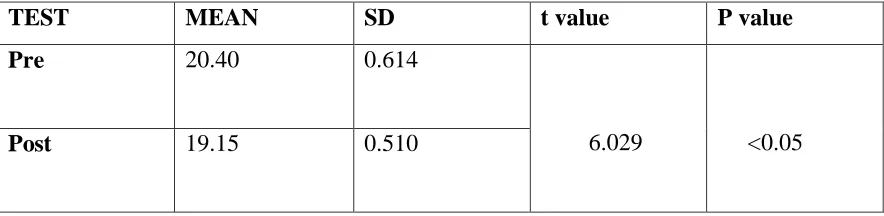
WITHIN GROUP ANALYSIS OF GROUP A:
TEST MEAN SD t value P value
Pre 20.40 0.614
6.029
<0.05
[image:47.612.104.546.116.224.2]Post 19.15 0.510
TABLE NO: 01: Within group analysis of agility in group A
39
GRAPH NO:01: Graphical representation of within group analysis of
group A.
20.4
19.15
18.4 18.6 18.8 19 19.2 19.4 19.6 19.8 20 20.2 20.4 20.6
40
WITHIN GROUPANALYSIS OF GROUP B
:TEST MEAN SD T value P value
PRE 20.54 0.643
10 .760 <0.05
POST 17.93 0.684
TABLENO:02: within group analysis of agility in group B
41
GRAPH NO: 02: Graphical representation of within group analysis of
Group B.
20.54
17.93
16.5 17 17.5 18 18.5 19 19.5 20 20.5 21
42
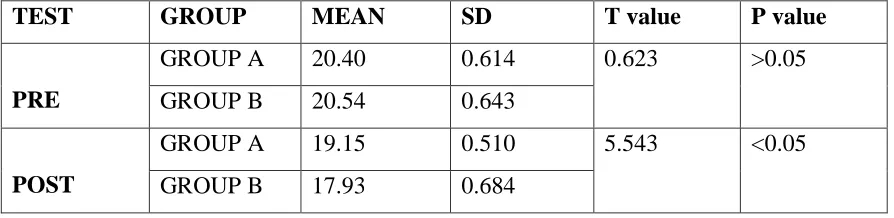
BETWEEN GROUP ANALYSIS :
TEST GROUP MEAN SD T value P value
PRE
GROUP A 20.40 0.614 0.623 >0.05 GROUP B 20.54 0.643
POST
GROUP A 19.15 0.510 5.543 <0.05 GROUP B 17.93 0.684
[image:51.612.102.549.120.229.2]
TABLE NO: 03: between group analysis of group A& group B
43
GRAPH NO: 03: Graphical representation of between group analysis of group A and group B
20.4
19.15 20.54
17.93
16.5 17 17.5 18 18.5 19 19.5 20 20.5 21
44
45
CHAPTER V
DISCUSSION
MARIOJOVANOVIC, et al. conducted a study to evaluate the effects of the speed, agility, quickness (SAQ) training method on power performance in soccer players. Soccer players were assigned randomly to 2 groups: experimental group (EG; n = 50) and control group (n = 50). Power performance was assessed by a test of quickness—the 5-msprint, a test of acceleration—the 10-m sprint, tests of maximal speed—the 20- and the 30-m sprint along with Bosco jump tests—squat jump, countermovement jump (CMJ), maximalCMJ, and continuous jumps performed with legs extended. The initial testing procedure took place at the beginning of the in-season period. The 8-week specific SAQ training program was implemented after which final testing took place. The results of the 2-way analysis of variance indicated that the Improved significantly (p ,0.05) in 5-m (1.43 vs. 1.39seconds) and in 10-m (2.15 vs. 2.07 seconds) sprints, and they also improved their jumping performance in countermovement(44.04 vs. 4.48 cm) and continuous jumps (41.08 vs. 41.39cm) performed with legs extended (p,0.05). The SAQ training program appears to be an effective way of improving some segments of power performance in young soccer players during the in-season period. Soccer coaches could use this information in the process of planning in-season training. Without proper planning of the SAQ training, soccer players will most likely be confronted with decrease in power performance during in-season period.
46
TRECROCI, et al. conducted the study to examine the effect of speed agility and quickness (SAQ) training on acceleration (5and 20m), change of direction and speed (CODS) and reactive agility preadolescent soccer players. These findings indicate SAQ training would positively affect cognitive skill and initial sprint acceleration through middle childhood, offering useful guideness to soccer coaches
MEHREZ HAMMAMI, et al. conducted study on effect of contrast strength and plyometric training on lower limb explosive performance, ability to change direction and neuro muscular adaptation in soccer players. The aim was to compare the effect of two different 8 weeks contrast training and plyometric training on change of direction and counter movement jump, leg peak power on a cycle ergometer. 40 soccer players were taken for study age 15, BMI 58.8 were divided into two groups. The result EMG parameter shows significant increase in both groups. The improvement of physical performance was better with 8 weeks of CST than with PT. They conclude that contrast training can be used as a effective method on improving ability to change direction among soccer players
47
48
CHAPTER VI
CONCLUSION
CONCLUSION:
The study was conducted to compare the two training protocol which would improve agility. The two training protocol were contrast training and speed, agility, quickness program. 30 subjects were divided into two group by convenient sampling method and received protocol for about 3 times a week for 12 weeks of durations. Both groups were tested with agility through ilinois agility test before commencement of training and after training.
49
50
CHAPTER VII
LIMITATION AND SUGGESTION
LIMITATIONS
It was a short duration study
Subjects with 19 year of age were included in this study. Only male player were selected.
Only elite player were selected.
Ilinois agility test were used to test agility of football player Selected male subjects were only given with contrast training
SUGGESTIONS:
Subjects above 19 year of age can also be included in the upcoming studies. The study can be done with female player.
Change of direction may added in order to improve agility quicker.
Other outcome measure can also be included to get more accuracy on agility. These intervention of speed agility quickness and contrast training can also
51
52
CHAPTER VIII
REFERENCES
1.
Chamari K, Hachana Y,Ahmed YV, Galy 0,SGHIRF,Chaetart JC, et al
.field and labor rotary testing in young elite soccer player. Vr J Sports
Med.2004;38(2):191-196.
2.
Rouissi M, chtara M, Owen A,Chaalali A, Chaouachi A,Gabbett T, et al.
Effect of leg domaninace on change of direction ability among young
soccer players. J sports sci 2016;34(6):542-548
3.
Sheppard JM, Young WB. Agility literature review: classifications, training and testing. J Sports Sci. 2006 Sep;24(9):919-324. Markovic G, Jukic I, Milanovic D, Metikos DEffects of sprint and plyometric training on muscle function and athletic performance. J Strength Cond Res. 2007 May;21(2):543-9
5. Polman R, Walsh D, Bloomfield J, Nesti M. Effective conditioning of female soccer players. J Sports Sci. 2004 Feb;22(2):191-203.
6. Miller MG1, Herniman JJ, Ricard MD, Cheatham CC, Michael TJ.
The effects of a 6-week plyometric training program on agility. J Sports Sci Med. 2006 Sep 1;5(3):459-65. eCollection 2006.
7. . Pauole Kainoa; Madole, Kent; Garhammer, John; Lacourse, Michael; Rozenek, Ralph Reliability and Validity of the T-Test as a Measure of Agility Journal of Strength and Conditioning Research
8. T J Gabbett Physiological characteristics of junior and senior rugby league players Br J Sports Med 2002;36:334–339
9. Little And Alun G. Williams Effects Of Differential Stretching Protocols During Warm-Ups On High-Speed Motor Capacities In Professional Soccer Players Journal of Strength and Conditioning Research, 2006, 20(1), 203–207
10.T. Reilly,J. Bangsbo &A. Franks Anthropometric and physiological predispositions for elite soccer Pages 669-683
53
12. David G. Behm, Duane C. Button, Jeremy C. Butt Factors Affecting Force Loss With Prolonged Stretchingcanadian Journal of Applied Physiology, 2001, Vol. 26, No. 3 : pp. 262-272
13.Burkett LN1, Phillips WT, Ziuraitis J The best warm-up for the vertical jump in college-age athletic men. J Strength Cond Res. 2005 Aug;19(3):673-6
14.Stone, Mike; Ramsey, Michael W; Kinser, Ann M; O'Bryant, Harold S; et al.Strength and Stretching: Acute and Chronic? The Potential Consequences Conditioning Journal; Lawrence Vol. 28, Iss. 6, (Dec 2006): 66-74.
15..Bloomfield J, Polman R, O'Donoghue P, McNaughton L. Effective speed and agility conditioning methodology for random intermittent dynamic type sports. J Strength Cond Res. 2007 Nov;21(4):1093-10
16. Gorostiaga EM1, Izquierdo M, Ruesta M, Iribarren J, González-Badillo JJ, Ibáñez J. Strength training effects on physical performance and serum hormones in young soccer playersEur J Appl Physiol. 2004 May;91(5-6):698-707. Epub 2003 Dec 24.
.
17.Helgerud J, Engen LC, Wisloff U, Hoff J. Aerobic endurance training improves soccer performance. Med Sci Sports Exerc. 2001 Nov;33(11):1925-31.
18.Krustrup P1, Mohr M, Ellingsgaard H, Bangsbo J. Physical demands during an elite female soccer game: importance of training status. Med Sci Sports Exerc. 2005 Jul;37(7):1242-8.
19. Yap, C. W., & Brown, L. E. (2000). Development of speed, agility, and quickness for the female soccer athlete. Strength & Conditioning Journal, 22(1), 9.
20. Baker d and newton R Comparison of Lower Body Strength, Power, Acceleration, Speed, Agility, and Sprint Momentum to Describe and Compare Playing Rank among Professional Rugby League Players in The Journal of Strength and Conditioning Research 22:153
20.Chatzopoulos DE1, Michailidis CJ, Giannakos AK, Alexiou KC, Patikas DA, Antonopoulos CB, Kotzamanidis CM. Postactivation potentiation effects after heavy resistance exercise on running speedJ Strength Cond Res. 2007 Nov;21(4):1278-81.
54
22.
Goran Markovic ,Igor Jukic Effects of Sprint and Plyometric Training on Muscle Function and Athletic Performance in The Journal of Strength and Conditioning Research 21(2):543-9 · June 200723.W B Young; R James; I Montgomery Is muscle power related to running speed with changed of direction? Journal of Sports Medicine and Physical Fitness; Sep 2002; 42, 3;
24.John B. Cronin' And Keir T. Hansen Strength And Power Predictors Of Sports Speed Journal of Strength and Conditioning Research, 2005, 19(2), 349-357 © 2005 National Strength & Conditioning Association
25.Becky M. Robinson Five-Week Program to Increase Agility, Speed, and Power in the Preparation Phase of a Yearly Training Plan © National Strength and Conditioning Association Volume 26, Number 5, pages 30–35
26.Kevin Thomas, 1 Duncan French, And Philip Hayes The Effect Of Two Plyometric Training Techniques On Muscular Power And Agility In Youth Soccer Players 23(1)/332–335 Journal of Strength and Conditioning Research 2009 National Strength and Conditioning Association
27.Jullien H, Bisch C, Largouët N, Manouvrier C, Carling CJ, Amiard V. Does a short period of lower limb strength training improve performance in field-based tests of running and agility in young professional soccer players? J Strength Cond Res. 2008 Mar;22(2):404-11. doi: 10.1519/JSC.0b013e31816601e5.
28.Gourgoulis V, Aggeloussis N, Kasimatis P, Mavromatis G, Garas A. Effect of a submaximal half-squat warm-up program on vertical jumping ability. J Strength Cond Res. 2003 May;17(2):342-4.
29. Young Warren B.; Jenner, Andrew; Griffiths, Kerrin Acute Enhancement of Power Performance from Heavy Load Squat. Journal of Strength and Conditioning Research: May 1998
55
31.
William P. Ebben, Randall L. Jensen, And Douglas O. Blackard Association Electromyography and Kinetic Analysis of Complex Training Variables journal of Strength and Conditioning Research, 200, 14(4), 451–456 q 2000 National Strength & Conditioning.32.Scott SL , Docherty D Acute effects of heavy preloading on vertical and horizontal jump performance. Journal of Strength and Conditioning Research [01 May 2004, 18(2):201-
.
33.Baker D. Acute effect of alternating heavy and light resistances on power output during upper-body complex power training 2003 Aug;17(3):493-7.
34.Loren Z.F. Chiu, Andrew C. Fry, Lawrence W. Weiss, Post activation Potentiation Response in Athletic and Recreationally Trained Individuals2Journal of Strength and Conditioning Research, 2003, 17(4), 671–677 q 2003 National Strength & Conditioning Association
35.Duncan N. French, William J. Kraemer, Changes in Dynamic Exercise Performance Following a Sequence of Preconditioning Isometric Muscle Actions Journal of Strength and Conditioning Research, 2003, 17(4), 678–685 q 2003 National Strength & Conditioning Association
36.David Docherty, MS, PhD, Dan Robbins, Complex Training Revisited: A Review of its Current Status as a Viable Training Approach © National Strength and Conditioning Association Volume 26, Number 6, pages 52–57
37.David DochertyDan Robbins Post-Activation Potentiation July 2005, Volume 35, Issue 7, pp 585–595
38.´ Z Hammami, Yassine Negra, Roy J. Shephard, and Mohamed Souhaiel Chelly The Effect Of Standard Strength Vs. Contrast Strength Training On The Development Of Sprint, Agility, Repeated Change Of Direction, And Jump In Junior Male Soccer Players Journal of Strength and Conditioning Research 2017 National Strength and Conditioning Association
56
57
CHAPTER X
ANNEXURE I
ASSESMENT CHART
Name :
Age :
Gender : Height : Weight :
BMI :
58
ANNEXURE II
CONSENT FORM
I………..aged………….Mrs., voluntarily consent to participate
The research named “A COMPARATIVE STUDY TO ANALYZE THE EFFICACY OF
CONTRAST TRAINING PROGRAMME AND SPEED AGILITY QUICKNESS TRAINING ON AGILITY PERFORMANCE OF ELITE MALE FOOTBALL PLAYERS
The researcher has explained me the treatment approach in brief, risk of participation and has Answered all the questions pertaining to the study to my satisfaction.
Signature of Subject Signature of Researcher
60
ANNEXURE IV
MASTER CHART 1
PRE TEST AND POST TEST VALUE OF GROUP A
S.NO PRETEST POST TEST
1. 20.12 19.02
2. 20.46 19.01
3. 21.08 19.22
4. 21.22 19.33
5. 20.76 18.98
6. 20.49 18.99
7. 19.88 19.42
8. 19.79 19.50
9. 20.06 19.02
10. 19.98 18.68
11. 18.99 18.02
12. 20.63 19.94
13. 20.94 19.94
14. 20.42 18.98
61
MASTER CHART 2
PRE AND POST TEST VALUE OF GROUP B
S.NO PRETEST POSTTEST
1. 21.08 19.42
2. 20.50 17.89
3. 20.99 17.88
4. 21.08 18.06
5. 19.88 17.88
6. 19.90 17.05
7. 20.06 17.88
8. 20.41 17.56
9. 20.55 17.44
10. 18.98 16.88
11. 20.63 17.48
12. 21.42 18.48
13. 20.46 17.98
14. 21.22 18.90
59
AN
NE
XU
RE
II
I
IL
LIN
OIS
AG
IL
IT
Y T
ES
T:
Te st i s s et up w ith four cone s form ing the ag ili ty are a(10 m ete r long * 5m ete rsw ide ). Cone a t poi nt A , m arki ng t he s ta rt c one a t B &C t o ma rk the turn ing spot s c one a t poi nt D to ma rk the fini sh. P la ce four c onesin c en te r of t he t est ing . A rea 3.3 me ters apa rt. P lay er ha s t o sta rt ly ing face down w ith t he h ands at s houl der l eve l. O n the “g o” c omm and a thl ete be gin a nd tim e s tart s w hen t hey cros s t he s ta rting lin e. G et up a nd run the
cours e i n set path(l eft to ri ght ). On t he t urn spot s B and C , B e s ure t o touc h the con es w ith y our hand. T