Commission of the European Communities
uciear science
and technology
The Community's
research and development programme
on radioactive waste
management and storage
Shared cost action
ANNUAL PROGRESS REPORT 1987
Commission of the European Communities
nuclear science
and technology
The Community's
research and development programme
on radioactive waste
management and storage
Shared cost action
ANNUAL PROGRESS REPORT 1987
Edited by:
J.M. Gandolfo
Published by the
COMMISSION OF THE EUROPEAN COMMUNITIES Directorate-General
Telecommunications, Information Industries and Innovation L-2920 Luxembourg
LEGAL NOTICE
Neither the Commission of the European Communities nor any person acting on behalf of the Commission is responsible for the use which might be made of the
following information
Cataloguing data can be found at the end of this publication
Luxembourg: Office for Official Publications of the European Communities, 1989
ISBN 92-825-9298-7 Catalogue number: CD-NA-11482-EN-C
© ECSC-EEC-EAEC, Brussels • Luxembourg, 1989
FOREWORD
This is the second Annual Progress Report of the European Community's 1985-1989 programme of research on radioactive waste management and disposal, carried out by public organisations and private firms in the community under cost-sharing contracts with the Commission of the European Communities.
The Council of the Ministers of the European Communities adopted the programme in March 1985 (1), considering : "The use of nuclear energy inevitably involves the production of radioactive waste; it is therefore essential to implement effective solutions to guarantee the safety and protection of man and the environment against the potential risks associated with the management of such waste".
The Council also recognised that the 1980-1984 programme of research on radioactive waste management and disposal, which was the second of its kind, "has enabled a large amount of information to be obtained which it is advisable to complete and validate by the implementation of research, development and demonstration actions representing the real waste management and disposal conditions which can be expected in the future". The main publications relating to the results of this second programme are listed in reference (2), and the main results in reference (3).
The 1985-1989 programme is therefore aiming at perfecting and demonstrating a system for managing the radioactive waste produced by the nuclear industry, ensuring, at the various stages, the best possible protection of man and the environment; its contents are as follows :
A. WASTE MANAGEMENT STUDIES AND ASSOCIATED R & D ACTIONS
TASK 1 : SYSTEMS STUDIES
TASK 2 : IMPROVEMENT OF RADIOACTIVE WASTE TREATMENT AND CONDITION-ING TECHNOLOGIES
TASK 3 : EVALUATION OF CONDITIONED WASTE AND QUALIFICATION OF ENGINEERED BARRIERS
TASK 4 : RESEARCH IN SUPPORT OF THE DEVELOPMENT OF DISPOSAL FACI-LITIES; SHALLOW BURIAL AND GEOLOGICAL DISPOSAL STUDIES TASK 5 : SAFETY OF GEOLOGICAL DISPOSAL
TASK 6 : JOINT ELABORATION OF RADIOACTIVE WASTE MANAGEMENT POLICIES
The Commission's participation to the cost of the programme amounts to 62 Million ECU for its five years duration.
The Commission is responsible for managing the programme.
In this task, the Commission is being assisted by the Management and Co-ordination Advisory Committee "Nuclear Fission Energy - Fuel Cycle/ Waste Processing and Disposal" (see annex I ) .
At the beginning of the 1985-1989 programme, the Commission issued a first call for research proposals dealing with tasks 2, 3, 4 and 5. Over 250 research proposals have been received at the closing date (15th June, 1985), trespassing in total several times the available budget, and only a fraction thereof could be accepted for negotiation. A second call for research proposals has been issued in 1986 with 31st October, 1986 as a closing date, over 160 research proposals
have been received and 146 contracts have been signed on the 31.12.1987. This report describes the work to be carried out under the research contracts already concluded before end of 1987, as well as the work performed and the results obtained.
For each contract, the Paragraph C "Progress of work and obtained results" has been prepared by the contractor, under the responsibility of the project leader. The Commission wished to express its gratitude to all scientists who have contributed to this report.
S. 0RL0WSKI
Head, Nuclear Fuel Cycle Division
References
(1) Council decision of 12th March, 1985 adopting a research and
development programme on the management and storage of radioactive waste (1985 to 1989)
O.J. No. L 83, 25.03.1985, p. 16
(2) Community R S D programme on radioactive waste management and storage - scientific reports - 2nd edition - report EUR 10745 EN (3) Radioactive waste management and disposal, proceedings of the
CONTENTS Page
PART A : WASTE MANAGEMENT STUDIES AND ASSOCIATED R & D ACTIONS
1) TASK NO. 1 : SYSTEMS STUDIES 5
- Assessment of decontamination and volume reduction
techniques for cladding hulls and fuel hardware wastes .. ó
- Comparative assessment of management alternatives for LWR
Waste 7
- Cost evaluation of alternative management schemes for LWR
Waste 8
- Cost evaluation of alternative management schemes for
zircaloy hulls °
- Cost and radiological impact of reactor waste in
below-ground vaults 10
- Derivation of weighting factors for cost and radiological
impact for use in comparison of waste management methods 11
- Comparison of waste management aspects of direct disposal
of spent fuel and reprocessing 12
- Drawing up of management routes for reactor waste based
on industrial practices in Italy and the F.R.G 14
- Waste management scenarios for LWR fuel cladding and
hulls 15
- Drawing-up -of management routes for reactor waste based
on industrial practices in France and Spain 16
- Comparison of waste management aspects of direct disposal
of spent fuel and reprocessing (CAP SCIENTIFIC) 17
- Comparison of waste management aspects of direct disposal
of spent fuel and reprocessing (CEN - FONTENAY) 20
- Cost and radiological impact assessment for the disposal
of reactor waste by shallow land burial 23
- Accounting method for radiation doses due to long-lived
2) TASK NO. 2 : IMPROVEMENT OF RADIOACTIVE WASTE TREATMENT AND
CONDITIONING TECHNOLOGIES 31
2.A. Waste from light water reactor : 33
- Immobilisation in cement of ion exchange resins arising from the purification of reagents used for
decontamina-tion of reactor circuits 36
- The treatment of radioactive effluents of PWR - Nuclear power plants by centrifugation
- Study of the industrial operation of plants for the solidification of radioactive waste with regard to quality assurance
- Cement solidification of spent ion-exchange resins arising at nuclear power plants
41
- Modified Sulfur Cement : a low porosity encapsulating
material for LLW, MLW and alpha Wastes ^5
49
- Conditioning of ashes from combustion plants in special
melting furnaces 55
59
2.B. Waste from reprocessing plants, plutonium fuel
fabrica-tion plants, and research centres 61
- Separation of actinides and long-lived fission products
from HLW at the EUREX plant MTR fuel reprocessing 63
- Conditioning of nuclear cladding waste by high
tempera-ture melting in cold crucible 70
- Hot Isostatic Pressing of Pu-Containing Ashes 75
- Utilisation of liquid membranes for the treatment of
reprocessing concentrate 78
- Treatment of radioactive wastes by a combination of
precipitation and crossflow membrane filtration 83
- Electrochemical ion-exchange/sorption for medium active
liquid waste treatment 88
- Conditioning of fuel hulls and structural materials by
high pressure compaction 93
- Solidification of tru-waste by embedding in a ceramic
matrix 96
- Decontamination of reprocessing concentrate by means of
inorganic ion exchange and extraction chromatography ... 100
- Immobilization of tritiated waste waters generated during
- Decontamination of Pu containing incinerator ashes 110
2.C. Optimization of vaste management at source 113
- Optimization of waste management at source 115
- Minimization of volume and Pu content of wastes from a
plutonium fuel fabrication plant 119
3) TASK NO. 3 : EVALUATION OF CONDITIONED WASTE AND QUALIFICATION
OF ENGINEERED BARRIERS 127
3.A. Medium-active waste form characterization 129
- Medium active waste form characterization : The
perfor-mance of cement-based systems 131
- Study of leaching mechanisms of ions incorporated in
cement of simple polymer 139
- Mechanisms and interaction phenomena influencing release
in low- and medium-level waste disposal systems 145
- Colloids related to low level and intermediate level
waste 148
- Near-field modelling in cement environments 154
- The influence of organic complexing agents upon the mobilization and migration of radionuclides from ILW
contained in cement and bitumen under near-field
condi-tions for a repository in a salt dome 158
- Investigation of LLW and MLW cement products resulting
from reprocessing 175
- The effects of radiation on intermediate level waste
forms 180
- Physico-chemical characterization of bitumized Eurochemic
Medium Level Waste 184
- Full scale leaching tests, lysimeter tests, scale effect 187
- Embedded wastes and leachates 190
- Testing the alteration of waste glasses under geological
storage conditions 214
- Radionuclide release from solidified High Level Waste ... 219
- Long term behaviour of tru-waste bearing ceramics 222
-
Characterization of HLW glass samples 224
- Laboratory and in-situ interaction between simulated
waste forms and clay 229
3.C. Other engineered barriers 233
- Nearfield behaviour of clay barriers and their
inter-action with concrete 235
- Corrosion testing of selected container materials for
disposal of HLW glass 241
- Corrosion of container and infrastructure Materials under
clay repository conditions 245
- Corrosion of carbon steel overpacks for the geological
disposal of radioactive waste 249
- Etude des propriétés physico-chimiques des éléments
transuraniens nécessaires à la compréhension des
proces-sus de retardement de la migration en champ proche dans
la géosphere 252
3.D. Development of tests for quality control and quality
inspection purposes 257
- Evaluation of non-destructive methods for
quality-checking of vitrified HLW 259
- Quality Assurance of radioactive waste packages by
compu-terized tomography 261
- Study of a non destructive testing method for packed
radioactive waste containers 265
- Development of test methods for quality control of LLW
and MLW in cement or ploymers 267
- Radioactive waste package assay facility 273
4) TASK N° 4 : RESEARCH IN SUPPORT OF THE DEVELOPMENT OF DISPOSAL
FACILITIES ; SHALLOW BURIAL AND GEOLOGICAL
DISPOSAL STUDIES 281
4.I.A. General survey of geological formations and
development of measuring techniques 285
- The 600m borehole project : Development of a surveillance method during dry-drilling of a 600m deep borehole in
salt and performance of geotechnical measurements in the
600m hole : 287
- Faults in clay : their detection and properties 291
- Methodology for application of electric and electro-magnetic borehole techniques for detailed exploration of
fractured rocks 298
- Development of a self-contained drill-hole
chromato-graphic probe 301
- Fracture mapping in clays 306
- Faults in clays : their detection and properties 310
- Evaluation and development of geohydrological surveying
methods in areas with saline groundwater 316
4.I.B. Geo-forecasting studies 319
- Geoprospective modelling 321
4.l.C. Rock mechanics 325
- Studies of disposal possibilities in geological
forma-tions : investigaforma-tions in a granite media 327
- Use of an underground cavity as a test facility for
radioactive waste disposal in clays 331
- In situ characterization of the behaviour of deep clay
layers 337
- Centrifuge modeling of salt domes 342
- Long-term rheological and transport properties of dry and
wet salt rock 345
- Study on fracturing and microfissuration of granite 349
- Further benchmark exercises to compare geomechanical
computer codes for salt (COSÀ II) 352
- Experimental study of the mechanical behaviour of
argil-laceous rock 366
4.2. Repositories and engineered barriers 369
4.2.À. Repository design and disposal techniques 371
- No particular research contracts have been concluded on
this subject 373
4.2.B.I. HLW container development (COMPAS) 375
- Assessment of structural performance of HLW containers
(COMPAS) 377
4.2.B.2. Backfilling and sealing of radioactive waste
repositories 381
- In situ reduced scale backfill and heater experiment .... 383
- Feasibility study for high level radioactive waste
disposal in deep boreholes drilled from the surface 386
- Trials and control of placing filling and sealing
mate-rials for deposits in scale models \. 392
- Sealing of fractures and boreholes 396
- Research on backfilling and sealing of rooms and
galle-ries in a repository in salt 405
- Crushed salt behaviour under effect of a heat source in
boreholes drilled in a salt mine 408
- Study of the thermal behaviour of clay-based buffer materials on reduced scale mock-ups and in an underground
laboratory 415
- Development of effective concepts for attenuating the
near field effects of HLW in argillaceous hard rocks .... 418
- The construction of laboratory scale mock-ups for studies
of back-filling shafts & tunnels with concrete 419
- Studies of historic concrete 421
- The development & application of mathematical modelling approaches to interactive effects for concrete backfill
in hard rock and argillaceous hosts 423
- Quality assurance aspects of waste emplacement and
backfilling in ILW and LLW repositories 425
- Research on swelling clays and bitumen as sealing materials for underground repositories for radioactive
waste 428
4.3. Radionuclide migration in the geosphere (MIRAGE) 433
4.3 A. Actinide and fission product geochemistry in natural
aquifer systems ,...., 435
- Characterization of the Boom clay and its multi-layered hydrogeologicai environment with a view to radionuclide
migration 437
- The rôle of organics in the migration of radionuclides in
the geosphere 441
- Âctinide migration phenomina in groundwater : colloid
generation and complexation with natural organics ... 444
- Study of the interactions between organic matter and
transuranium elements ». 449
- Diffusion, sorption and stability of radionuclide-organic
complexes in clays and clay-organic complexes 455
- Effects of natural organic substances on the geochemistry
of a radioactive waste repository 456
- Simulation of radionuclide exchange between aqueous and
mineral-organic phases 458
4.3.B. In situ migration experiments and development of
measuring techniques « 459
- In situ determination of the effects of organics on the mobility of radionuclides in controlled conditions of
groundwater flow 461
- Development and application of a retention properties measurement system. in a geological environment using radioactive tracers in the drill-hole (self-contained
probe FORALAB) 465
- Field verification of advanced transport models for
radionuclides in heterogeneous soils 468
- In situ study of radionuclide diffusion in clays by means
of the AUTOLAB probe 470
- In situ determination of the macropermeability of a clay formation in view of assessing leakage and mass transfer
in a deep argillaceous formation 474
Modelling of radionuclide migration in the geosphere :
natural analogue studies • ♦• 484
Study of migration processes in clay formations occurring
in nature 486
Natural analogues of radionuclide migration in granitic
rocks through the study of palaeohydrothermal alteration 489
Natural analogue studies of radionuclide migration 494
Longterm diffusion in rock :natural analogue 497 Natural analogue and microstructural studies in relation
to radionuclide retardation by rock matrix diffusion in
granite 500
*
Migration of uranium daughter radionuclides in natural
sediments •.. 504
Study of the migration of U, Th and REE in an intragra
nitic uranium deposit 508
4.3.D. Development of calculation tools for the description
of radionuclide migration 511
Modelling of migration phenomena in the Boom clay and of heat dissipation from a HLW repository in the multi
layered hydrogeological systems surrounding the Boom clay 513
Coupling between a geochemical model and a transport
model of dissolved elements 515
<?
Intercomparison of predictive computer programs for
radionuclide migration in the geosphere 523
Farfield modelling of radionuclide migration 529
Geochemical modelling 532
Geochemical databases 534
Migration of radionuclides by high density brines :
finalization of the METROPOL code 537
Study of the coupled thermohydromechanical effects on a
HLW repository in a granite geological formation 540
Transfer mechanisms of radionuclides in the geosphere ... 541
4.4. Shallow land burial 545
5) TASK N° 5 : SAFETY OF GEOLOGICAL DISPOSAL 549
5.1. PAGIS Project 553
- Performance evaluation of HLW waste disposal in
geolo-gical formations : Clay option 555
- Performance evaluation of HLW waste disposal in
geolo-gical formations PAGIS Phase 2 : Salt rock option 559
- Performance evaluation of HLW disposal in geological
formations PAGIS Phase 2 : Granite option 563
- Performance evaluation of HLW waste disposal in
geolo-gical formations PAGIS Phase 2 : Sub-seabed option 572
- Summary and review of PAGIS - Phase 2 574
5.2. PACOMA Project 577
- Performance evaluation of confinement for alpha-waste
repository in granite formations 579
- Performance assessment of confinements for MLW and
alpha-waste 580
- Acquisition of subjective data for use in models for
waste site assessments 585
- Performance assessment studies for intermediate level
waste at single site 588
- Safety evaluation of geological disposal concepts for low
and medium level wastes in rock salt 593
- Safety evaluation of geological disposal concepts for low
and medium level wastes in rock salt 596
- Assessment of radiological consequences and risk asso-ciated with the geological disposal of MLW and
alpha-waste in clay formations 603
- Assimilation of experimental data for validation of near-field computer models of underground radioactive
waste repositories 605
5.3. Support studies 609
6) TASK N° 6 : JOINT ELABORATION OF RADIOACTIVE WASTE MANAGEMENT
POLICIES 623
PART B : CONSTRUCTION AND/OR OPERATION OF UNDERGROUND
-EXPERIMENTAL FACILITIES OPEN TO COMMUNITY JOINT
ACTIVI-TIES 627
The HAW project : demonstration facility for high-level
radioactive waste disposal in the Asse salt mine 629
The HADES project : & pilot facility in the argillaceous
layer beneath the nuclear site at Mol 634
Dimensioning of lining of galleries excavated in deep
PART A
WASTE MANAGEMENT STUDIES AND
CHAPTER 1
TASK No. 1; SYSTEM STUDIES
A. Objective
To characterise the various overall management schemes for some waste categories with a view to evaluating their feasibility and availability and optimising their radiological and economic features.
B. Research topics dealt with under the 1980-1984 programme
Studies on the evaluation and comparison of various management modes for two well defined categories of waste have been performed during the last programme:
- Solid plutonium contaminated waste
- Alcaline liquid wash waste, arising during spent fuel reprocessing operations.
C. 1985-1989 programme
The system studies carried out are related to three subjects: - Assessment of management alternatives for reactor waste
- Assessment of management alternatives for hulls
- Comparison of waste management implications of spent fuel disposal and reprocessing.
Additionally, in order to allow comparison of management options with large differences in cost and radiation exposure, procedures are being developed to provide a rational base for comparative evaluations. In particular, two subjects are treated:
- Comparative weightings for cost and radiological parameters in the assessment of radioactive waste management options
- Accounting method of radiation doses due'to long-lived natural radio-nuclides and daughters
D. Programme implementation
For the system studies, groups of contractors (six for reactor waste, five for hulls, and four for the reprocessing - direct disposal compari-son) cooperate closely in assessing different possible management routes.
ASSESSMENT OF DECONTAMINATION AND VOLUME REDUCTION TECHNIQUES FOR CLAD-DING HULLS AND FUEL HARDWARE WASTES
Contractor; CEN/SCK, Mol, Belgium Contract N°; FI1W-0123
Working Period: November 1987 - March 1990 Period Covered: November 1987 - December 1987 Project Leader: Mr P. de Regge
A. Objectives and Scope
The objective is to contribute to the implementation of a joint study on management options for hulls and caps by drawing up two basic routes emphasizing the treatment/conditioning and packaging aspects.
A management route is defined as each assembly of co-ordinated actions by which the management of hulls and caps from their production to their disposal is implemented. Usually, these actions comprise treatment, conditioning, packaging, interim storage, transport and disposal opera-tions .
The management routes treated by CEN/SCK are compaction/conditioning/-packaging for the first route, and decontamination/cementation/compaction/conditioning/-packaging for the second route.
B. Work Programme
2.1. Waste characteristics and arisings. CEN/SCK participates in defining the reference waste composition.
2.2. Drawing up of basic management routes. CEN/SCK will extensively define two basic routes for hulls and caps management as input data for the subsequent cost and radiological impact assessment. Basical-ly, these two routes will comprise the following intermediate management steps :•
Route No. 1: hulls compaction/conditioning/packaging/interim storage prior to geological disposal;
Route No. 2: hulls decontamination/cementation/packaging/interim storage before disposal by shallow land burial.
2.3. Sensitivity studies. Once the two basic management routes extensi-vely described, sensitivity studies will be performed in order to determine the impact of some important parameters on:
- the waste product characteristics and arisings;
- the total volume of the treatment/conditioning facility buildings. 2.4. Assessment of the occupational exposure. For the two basic routes of concern, the occupational exposure will be determined for routine operations including manual operations for repairs and maintenance. This will consist in calculating the annual individual dose and the collective dose for 30 years operation.
COMPARATIVE ASSESSMENT OF MANAGEMENT ALTERNATIVES FOR LWR WASTE
Contractor; Belgatom S.A., Brussels, Belgium Contract N°: FI1W-0124
Working Period: November 1987 - January 1990 Period Covered: November 1987 - December 1987 Project Leader: Mr C. Renard
A. Objectives and Scope
The objective is to contribute to the implementation of a joint study on management options for LWR wastes by drawing up one basic route emphasizing the treatment/conditioning and packaging aspects.
A management route is defined as each assembly of co-ordinated actions by which the management of LWR wastes from their production to their disposal is implemented. Usually, these actions comprise treatment, conditioning, packaging, interim storage, transport and disposal opera-tions .
Belgatom will take care of a basic management route corresponding to Belgian concepts and practices.
B. Work Programme
2.1. Definition of primary waste inventories. Belgatom will define reference primary waste inventories resulting from normal operation of 900 MWe PWR's including:
- gaseous wastes
- liquid wastes (concentrates, sludges, ion exchange resins, decon-tamination liquors)
- filters
- technological solid wastes.
2.2. Definition of discharge limits, waste acceptance criteria and transport regulations. Discharge limits for the release of gaseous and liquid effluents into environment (inland site) will be propos-ed. As for waste acceptance criteria for disposal, it will be made use of the regulations already fixed or envisaged for shallow land burial in Belgium.
2.3. Drawing up of the basic management route. Belgatom will define one basic management route for reactor wastes according to the Belgian practices, considering a 20 GWe nuclear park (100% PWR's) and grouping of reactors by 4 units. The description of the basic management route will be sufficiently detailed to subsequently
enable their costing and the assessment of their related occupa-tional exposure.
2.4. Sensitivity studies. Once extensively described the basic management route, sensitivity studies will be performed in order to determine the Impact of some important parameters on:
- the conditioned waste product characteristics and quantities; - the major cost components.
COST EVALUATION OF ALTERNATIVE MANAGEMENT SCHEMES FOR LWR WASTE
Contractors : Contract N* : Duration of Contract:
Period Covered ' : Project Leaders :
TASK Ricerca & Sviluppo S.r.l. - Kraftanlagen AG FI1W-0125
from 01.10.87 to 31.12.89 from 01.10.87 to 31.12.87
G. THIELS (TASK R&S), F. STENERSEN (KAH)
A. OBJECTIVES AND SCOPE
A joint strategy study is being performed to assess a number of schemes for the treatment, conditioning, packaging, interim storage, transport and disposal of LWR wastes on the basis of economic and radiological criteria. In this context, TASK R&S and KAH are contributing towards the costing of five basic management routes and their variants evolving from the sensitivity studies.
The scope of the work is to assess the capital and operating costs of the various unit operations incorporated into each basic management scheme on the basis of the detailed process descriptions provided by the other participating organisations. Moreover, the plant and transport costs will be actualised to the operational start-up date of the plant utilising an appropriate economic assessment method, finally yielding a cost per unit volume of primary waste treated. The costing of the waste disposal itself
does not form part of the study.
During the second phase of the work, TASK R&S and KAH will contribute to the sensitivity studies. Their aim is to evaluate the impact of different basic parameters (e.g. discharge limits, process variables, duration of interim storage, plant capacity) on the overall management costs.
B. WORK PROGRAMME
2.1 Scope of the programme
2.2 Cost evaluation
2.2.1 List of possible intermediate management stages 2.2.2 Cost assessment procedure
2.2.3 Results
2.2.4 Sensitivity studies
O. PROGRESS OF WORK AND OBTAINED RESULTS
State of advancement
To perform the cost evaluation, a procedure is being elaborated, which consists of:
Determination of the various elements entering into the capital and operating costs of each management option;
- Actualisation of the costs and their conversion into an annual cost per unit volume;
- Scaling of costs with changing plant capacity.
COST EVALUATION OF ALTERNATIVE MANAGEMENT SCHEMES FOR ZIRCALOY HULLS
Contractors : TASK Ricerca & Sviluppo S.r.l. - Kraftanlagen AG
Contract N° : FI1W-0126 .
Duration of Contract: from 01.10.87 to 31.12.89
Period Covered : from 01.10.87 to 31.12.87
Project Leaders : G. THIELS (TASK R&S), F. STENERSEN (KAH)
A. OBJECTIVES AND SCOPE
A joint strategy study is being performed to assess a number of schemes for the treatment, conditioning, packaging, interim storage, transport and disposal of LWR hulls and caps on the basis of economic and radiological criteria. In this context, TASK R&S and KAH are contributing towards the costing of five basic management routes.
The scope of the work is to assess the capital and operating costs of the various unit operations incorporated into each basic management scheme' on the basis of the detailed process descriptions provided by the other participating organisations. Moreover, the plant and transport costs will be actualised to the operational start-up date of the plant utilising the "Present Worth" method, finally yielding a cost per unit volume of primary waste treated. The costing of the waste disposal itself does not form part ¡of the study.
During the second phase of the work, TASK R&S and KAH will scale the costs for plant capacities ranging from 6 to 60 GW(e).
B. WORK PROGRAMME
2.1 Scope of the programme
2.2 Cost evaluation
2.2.1 Management options to be costed (provisional) 2.2.2 Cost assessment procedure
2.2.3 Results 2.2.4 Cost scaling
Ô. PROGRESS OF WORK AND OBTAINED RESULTS
State of advancement
To perform the cost evaluation, a procedure is being elaborated, which consists of:
Determination of the various elements entering into the capital and operating costs of each management option;
- Actualisation of the costs and their conversion into an annual cost per unit volume;
COST AND RADIOLOGICAL IMPACT OF REACTOR WASTE IN BELOW-GROUNDS VAULTS
Contractor: Initec S.A., Madrid, Spain Contract N"; FI1W-0127
Working Period; December 1987 - May 1989 Period Covered; December 1987
Project Leader: M. Sanchez Delgado.
A. Objectives and Scope
As part of the joint study aiming at assessing management routes on the basis of economic and radiological criteria, INITEC will focus on the cost and radiological impact assessment for the final disposal phase of reactor wastes in below ground vaults.
The main goals of this project are:
- To determine the radiological impact both short-term and long-term associated to a storage facility of the below ground type for reactor wastes. The following main release pathways will be taken into acc-ount: ground water migration of radioactive elements, surface water releases and atmospheric releases. Three different stages will be considered in the life of the installation: operation of the facility, institutional control phase and free use of the land after termination of the license. Different scenarios will be assumed for each of the different stages, including normal operation scenarios as well as accidental scenarios.
- To determine the radiological burden to the facility operators.
- Cost assessment related to the disposal of LWR waste products in below ground vaults, including capital and operating costs.
B. Work Programme
2.2. Waste acceptance criteria will be established in terms of specific activity limits, matrix types, leaching rates, mechanical proper-ties, drum sizes etc.. so as to accomplish protection goals for the public.
2.3. Drawing up of storage facility layout and description of the opera-tions to be carried out (sorting of the waste products, waste conditioning provisions, general layout etc. ...) as detailed as needed for the cost and radiological impact assessment.
2.5. The impact of the package type (retrievable or not) on the volumes of waste to be disposed of will be assessed, as well as the impact of varying both the-volumes and categories of LWR wastes.
2.6. A cost assessment related to disposal of LWR waste products in below ground vaults will be carried out, including a relationship between disposal cost and quantities of various categories of waste pro-ducts, and scaling cost for variations of the nuclear park size. 2.7. The occupational exposure (annual individual dose and collective
dose) will be determined for normal and abnormal disposal opera-tions, for the latter case expressed as probability of occurrence, for each working place and 30 years of operation.
2.8. The radiological impact to the public will be assessed and indivi-dual and collective doses will be calculated. The disposal site environment will be defined as well as pathways and scenarios considered.
DERIVATION OF WEIGHTING FACTORS FOR COST AND RADIOLOGICAL IMPACT FOR USE IN COMPARISON OF VASTE MANAGEMENT METHODS
Contractor : National Radiological Protection Board, Chilton, Didcot, UK Contract No. : FI1W-0128 *
Duration of contract : 1 August 1987 - 31 December 1989 Period covered : 1 August 1987 - 31 December 1987
Project leader : Dr A D Wrixon
A. OBJECTIVES AND SCOPE
Methods of assessing the radiological impact of waste management options have reached the stage where it is possible to make detailed estimates of the doses and risks to workers and the public and, in
principle, to quantify the uncertainties in these estimates. It is also possible to quantify the direct financial costs of waste management. However, much less progress has been made on devising ways of weighting financial costs, social costs and the various components of radiological impact so that comparisons can be made between alternative waste'management options, on a rational and well-defined basis.
The objectives are to develop a methodology for devising weighting factors for the various components of radiological impact, financial costs and social costs of waste management methods and to demonstrate the
methodology by applying it in an example comparison of waste management options.
The research is being carried out jointly by the National Radiological Protection Board (NRPB) and the University of Surrey Psychology Department, acting under sub-contract to NRPB.
B. WORK PROGRAMME
2.1 Identification of the components of financial costs and radiological impact for which weighting factors are to be devised.
2.2 Identification of types of social costs which need to be considered via investigation of the criteria used by experts and decision makers, and of public attitudes, and review of methods of taking these social costs into account.
2.3 Development of a method for deriving weighting factors for the
COMPARISON OF WASTE MANAGEMENT ASPECTS OF DIRECT DISPOSAL OF SPENT FUEL AND REPROCESSING
Contractor: National Radiological Protection Board, Chilton, UK Contract No.: FI1W-0129
Duration if contract: November 87 - December 89
Project leaders: M D Hill, S F Mobbs (NRPB), and R Dodds (BNFL)
A OBJECTIVES AND SCOPE
The overall aim of the whole joint project is to compare, on the basis of the costs and radiological impact of the management and disposal of all the associated wastes, reprocessing of PWR fuel with its direct disposal by emplacement in a deep geological formation on land. For the reprocessing case, the wastes to be considered include gaseous and liquid effluents discharged routinely during reprocessing, solid low and intermediate level wastes arising at the reprocessing plant, and vitrified high level waste. The latter will also be assumed to be disposed of by emplacement in a deep geological formation. The study will include an analysis of the sensitivity of the results to variations in key assumptions, such as the time for which spent fuel is stored prior to reprocessing.
Radionuclide inventories will be provided for all the wastes arising from reprocessing, and estimates will be made of the costs of management and disposal of these wastes based on UK experience and studies. Vitrified high level waste will be assumed to be emplaced in a granite formation and solid low and intermediate level wastes in an intermediate depth repository in a clay formation. The radiological impact on the public of the management and disposal of all reprocessing wastes, and of direct disposal of spent fuel in a granite formation, will be assessed. The cost of direct disposal of spent fuel in a granite formation will also be estimated. .
B. WORK PROGRAMME
The study will be carried out jointly by the National Radiological Protection Board (NRPB) and British Nuclear Fuels pic (BNFL), acting under contract to NRPB. BNFL will be responsible for specifying the radionuclide content of all wastes and the design of waste treatment and storage facilities, together with estimates of financial costs. NRPB will carry out the assessments of radiological impact.
2.1 Direct Disposal of Spent Fuel
The quantity of fuel to be considered will be that arising in a hypothetical 20 GW(e) reactor park, consisting of PWRs, over a period of 30 years. The fuel will be assumed to be stored in a specifically : constructed facility, prior to packaging and disposal in a granite formation. The type of packaging assumed will be typical of those under consideration in countries with large research programmes on spent fuel disposal in granite. The financial costs of packaging, transport and disposal will be estimated. The components of radiological impact which ': will be calculated will be: individual and collective doses to the public during routine packaging; transport and disposal operations; risks to individuals in the post-disposal period; collective doses to local, regional and global populations in the post-disposal period, as a function of time and level of individual dose. The probability of occurrence of collective doses will also be considered. All the radiological impact calculations will be carried out using existing
models. For the post-disposal period, care will be taken to ensure consistency with the methods, models and data used in the PAG1S project and results will be given separately for naturally occurring radionuclides.
2.2 Reprocessing .
The quantity of fuel considered will be the same as that assumed in the assessment of direct disposal. Reprocessing will be assumed to occur 5 years after discharge of fuel from the reactor, and vitrification to occur after a period of several years storage of the liquid high level waste. The vitrified waste will be assumed to be stored for 50 years prior to disposal in a granite formation.
Detailed radionuclide inventories will be provided for all wastes, and financial costs will be estimated for all of the waste management operations involved, ie, treatment of liquid and gaseous effluents arising during reprocessing and vitrification; immobilisation, packaging and disposal of low and intermediate level wastes arising during processing and vitrification; storage of liquid and vitrified high level waste; transport and disposal of vitrified high level waste. For all of these operations, individual and collective doses to workers and the public will be calculated, including doses form potential accidents. Radiological impact in the post-disposal period will be calculated using the same general method as for disposal of spent fuel, again ensuring consistency with previous PAGIS work and on-going PACOMA studies. Vitrified waste will be assumed to be disposed of in a granite formation. Low and intermediate level waste will be assumed to be disposed of in a deep clay formation.
2.3 Sensitivity Analysis and Additional Calculations
The sensitivity of the results of the cost and radiological impact assessments to variations in key parameters and assumptions will be investigated. The variations considered will include:
i) quantity of spent fuel to be disposed of or reprocessed; ii) delaying reprocessing for at least 30 years;
iii) varied periods of storage of spent fuel and vitrified high level waste prior to disposal.
BRAWING-UP OF MANAGEMENT ROUTES FOR REACTOR WASTE BASED ON INDUSTRIAL PRACTICES IN ITALY AND THE F.R.G.
Contractors : GNS, Essen, F.R.G. and FRAMATOME, Paris, France. Contract N° : FI1W - 0130
Duration of contract : from January 1988 to April 1990 Period covered : December 1987
Project Leaders; K. Janberg, Y. Huet.
A. OBJECTIVES AND SCOPE
During the last years, reactor waste management practices have taken advantage of many improvements as far as processes, organization and safety are concerned. Within the framework of the EC programme, GNS and FRAMATOME take part in the present joint study the purpose of which is to
characterize various overall management schemes resulting from these new developments. The complete describing and analysis of each scheme will permit to evaluate its feasability and availability and optimizing its radiological and economic features.
The assessment of the different european management alternatives will make up basic data for the study. The identified schemes will be applied to a hypothetical 20 GWe reactor park consisting of light - water cooled reactor (PWR's and BWR's) and to low and intermediate radioactive waste issued from normal operating. After having analysed the base-case, sensitivity analysis will be carried out varying the most important parameters such as disposal criteria, waste characteristics, size of the nuclear park and discharge limits acting both on cost and radiological impact.
GNS and FRAMATOME have taken charge of providing the assessment of German and Italian practices. Both of these management routes will comprise waste inventories, regulations, treatment,conditioning,packaging, interim
storage, transport and final disposal operations, cost evaluations and radiological impact to workers and public. Sensitivity studies will be then performed.
B. WORK PROGRAMME
2.2. Definition of typical primary waste inventories resulting from normal operations of PWR's and BWR's.
2.3. Definition of discharge limits, waste acceptance criteria and transport regulations.
2.4. Drawing up of basic management routes taking into account treatment and conditioning variants.
2.5. Sensitivity studies on each basic management route. 2.6. Assessment of the related occupational exposure.
2.7. Assessment of the related radiological impact to the public (short and long term).
In this connection, FRAMATOME/GNS will take in charge partly tasks 2.2, 2.3 and 2.7 and wholly tasks 2.4, 2.5 and 2.6 for two basic
management routes relying on the German and Italian concepts and practices.
WASTE MANAGEMENT SCENARIOS FOR LWR FUEL CLADDING AND HULLS
Contractor : CEA - VALRHO - MARCOULE - FRANCE
Contrat n° : FI W-0131
Duration of contract : 28 months
Period covered : September 1987 - December 1988
Project leader : C. SOMBRET
A. OBJECTIVES AND SCOPE
The objective of this contract is to contribute to the implementation
of a joint study on management options for hulls and caps by drawing up
two basic routes emphasizing the treatment/conditioning and packaging
aspects.
The corresponding study is part of the joint study which aims at
assessing management routes for hulls and caps generated during
reprocessing of spent fuel on the basis of economic and radiological
criteria.
A management route is defined as each assembly of co-ordinated actions
by which the management of hulls and caps from their production to their
disposal is implemented. Usually, these actions comprise treatment,
condi-tioning, packaging, interim storage, transport and disposal operations.
Basic assumptions are :
- Light water reactors stock : 20 GWe
- Yield : 600 t.y'
1- Conditioning on production site
- 2 geographical sites : coastal and non costal
B. WORK PROGRAMME
The study directed towards 2 management routes based on direct
cementation and on melting, will take in charge the following tasks :
Definition of the characteristics and arisings of hulls and caps.
Drawing up of basic management routes taking into account treatment
and conditioning variants.
Sensitivity studies on each basic management route.
DRAWING-UP OF MANAGEMENT ROUTES FOR REACTOR WASTE BASED ON INDUSTRIAL PRACTICES IN FRANCE AND SPAIN
Contractor : SGN - St Quentin-en-Yvelines, France Contract No : FI 1W - 0132
Duration of the contract : September 1987 - December 1989 t
Period covered : September 1987 - December 1987 Project Leaders : B. de Wavrechin, C. Jaouen
A - OBJECTIVE AND SCOPE
The objective is to contribute to the implementation of a joint study on management options for LWR waste by drawing up two basic routes emphasi-zing the treatment/conditioning and packaging aspects. The assessment of management routes on the basis of economic and radiological criteria is based on the French and Spanish concepts and industrial practices.
Basic information and data related to the operating experience in France and in Spain, is made available by respectively EDF and INYPSA who cooperate with SGN as contractors. More specifically, the contribution of INYPSA applies to the study of the BWR waste management options based on the Spanish experience.
B - WORK PROGRAMME
2.1.1. Definition of typical primary waste inventories resulting from norm-al operation of 900 MWe PWR and BWR in France and Spain.
2.1.2. Definition of discharge limits, waste acceptance criteria and trans-port regulations.
2.1.3. Drawing up of two basic management routes according to the French and Spanish practices considering a 20 GWe nuclear pack (80?í PWR and 20?á BWR) and grouping reactors by four units.
2.1.4. Sensitivity studies to determine the impact of treatment and condi-tioning parameters on waste product characteristics and quantities, and the cost of major components.
2.1.5. Assessment of the occupational exposure.
2.1.6. Assessment of the radiological impact to the public from the radio-nuclide contents of each main effluent generated in the two basic management routes and thè variants.
COMPARISON OF WASTE MANAGEMENT ASPECTS OF DIRECT DISPOSAL OF SPENT
Contractor Contract No
Duration of Contract Period covered
Project Leader
FUEL AND REPROCESSING
CAP Scientific FI1W/0133
September 1987 to March 1987 September 1987 to December 1989 R S Laundy
A. Objectives and Scope
In comparing waste management aspects of direct disposal of spent fuel and reprocessing, a number of radiological and environmental impacts have to be taken into consideration. To assist in performing this comparison, computer models are invaluable for combining and structuring the data and presenting the trade-offs involved in optimisation of various factors.
As part of the work to be undertaken a computer model will be developed which will allow the trade-offs involved in direct disposal of spent fuel and reprocessing to be investigated. The processes that will be taken into account in the model will include storage, trans-port, conditioning for direct disposal, reprocessing and disposal. The costs and environmental impacts from these processes will be combined through a multi-attribute hierarchy by applying weights to the impacts. The model will allow sensitivity analysis to be performed on these weights and on other parameters such as the time for which spent fuel is stored prior to reprocessing.
The goals of the project are:
- To evaluate the radiological and economic impacts associated with direct disposal and reprocessing of spent fuel. This task will be carried out in conjunction with other contractors.
- To develop a model for investigating the trade-offs between the radiological and economic impacts.
B. Work Programme
B.1 Evaluation of radiological and economic impacts. B.2 Development of a model for investigating trade-offs.
C. Progress or Work and Obtained Results State of advancement
Work started on the project in December 1987. A data requirement paper has been produced and work is proceeding on designing the model.
Progress and results
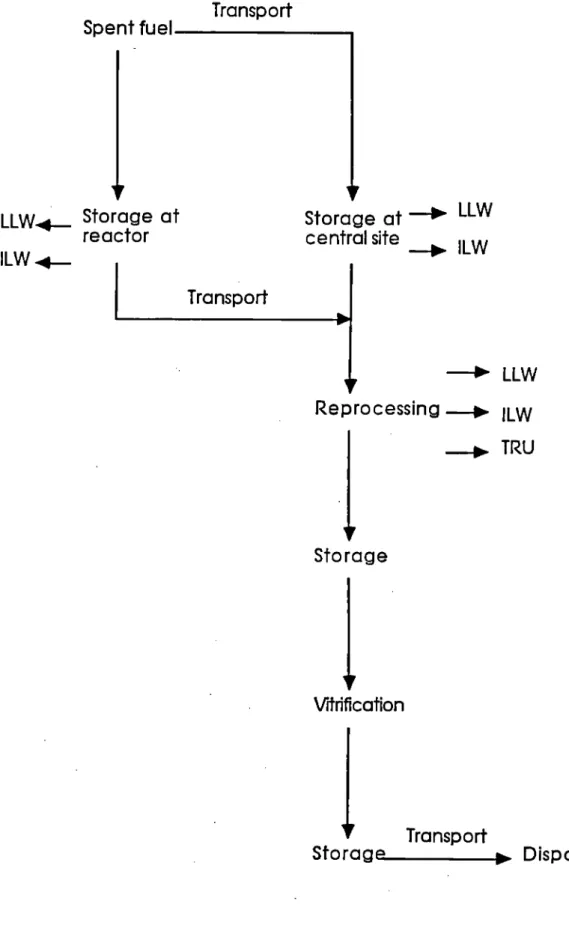
LLW
ILW
Spent fuel
Transport
Storage at
reactor
Interim storage
Conditioning/
Packaging
Storage at
central site
Pre-conditioning Pre-conditioning
Interim storage
LLW
ILW
Conditioning/ Transport
Packaging
►
Disposal
Transport
t
Figure
1
Schematic
diagram
of
direct
disposal
options
Spent fuel
Transport
LLW.
ILW.
Storage at
reactor
Storage at
central site
LLW
ILW
Transport
Reprocessing
LLW
ILW
TRU
Storage
Vitrification
Transport
Storage . »» Disposal
COMPARISON OF WASTE MANAGEMENT ASPECTS OF DIRECT DISPOSAL
OF SPENT FUEL AND REPROCESSING
Contractor : CEN FONTENAY AUX ROSES - CEA - FRANCE
Contract : N° FI 1 W.0131*
Duration fo contract : September I987 - December 1989
Period covered : September 1987 - December 1987
Project Leaders : G. MALET - J. MALHERBE
A. OBJECTIVES AND SCOPE
The overall aim of the whole joint project is to compare, on the basis of the costs and radiological impact of the management and disposal of all the associated wastes, reprocessing of Light Water Reactor fuel with its direct disposal by emplacement in a deep geological formation on land. For the reprocessing case, the wastes to be considered include gaseous and liquid effluents discharged routinely during reprocessing, solid low and intermediate level wastes arising at the reprocessing plant, and vitrified high level waste. The latter will also be assumed to be disposed of by emplacement in a deep geological formation. The study will include an analysis of the sensitivity of the results to variations in key assumptions, such as the time for which spent fuel is stored prior to reprocessing.
Three main management routes are considered :
- immediate reprocessing of spent fuel after 3 years of cooling in ponds : that is the French solution in operation at La Hague (UP.2 and later on UP.3) ;
- delayed reprocessing after a rather long time in intermediate storage (up to 50 years) ; storage in ponds, in cask or in a dry storage is possible ;
- no reprocessing : immediate disposal after short cooling time and possibly rod consolidation.
In the part of the project covered by this study the aim is to compare immediate reprocessing and delayed reprocessing according to the following points of view :
- technical ; - economical ;
- and radiological impact on population.
B. WORK PROGRAM.
The quantity of fuel to be considered will be that arising in a hypothetical 20 GW(e) reactor park consisting of PWRs, over a period of
30 years. The fuel is to be reprocessed either after a short cooling time, or after an interim storage time of up to 50 years in a plant with a 600 MTHM/year capacity.
The CEA study will only deal with the reprocessing option. The main items of the programm are as follows :
1. Data base and waste inventory
The 20 GWe nuclear park is assumed to consist of standard PWR reactors, the burn-up of the fuel being 33-000 MWd/MTHM.
The activities and thermal decay power of actinides, fission and activation products will be given in a first stage. Inventory of waste arising from reprocessing will also be determined.
2. Extended storage (work performed by SGN)
This part takes into account two successive steps : the first one is a storage at reactor (AR) and the second one is a centralised storage (AFR = away from reactor). For the AR concept only storage in ponds with dismantling under water will be studied (for consolidated and non-conso-lidated fuel).
3. Liquid waste treatment scenarios.
The inventories of reprocessing waste products will be determined taking into account the site characteristics (discharge limits) and the waste treatment scheme selected. Regarding this, three waste treatment schemes relying on the French, German and British concepts will be looked into as well as two sites (inland and coastal) for the location of the reprocessing plant of concern. Therefore, 6 variants of inventories will be studied. The British concept will be defined in co-operation with BNFL/NRPB.
4. Final disposal
Following these main scenarios, the conditioned waste arisings are classified in :
- LLW for which the final storage is in shallow land burial ; - MLW will be disposed of in geological formation ;
- HLW will be disposed of in geological formation after a cooling time from some years up to 50 years.
5. Transport (work performed by C0GEMA)
repro-6. Cost evaluation
The cost data concerning the different scenarios will be composed of costs from existing facilities or estimated costs from various projects (costs provided by SGN for the intermediate storage for exemple).
7. Radiological impact
The radiological impact to the public will be assessed in accordance with the methodology developed by CEA/IPSN. This study w i l l largely r e l y on the e x p e r i e n c e o b t a i n e d in t h e d i f f e r e n t French f a c i l i t i e s .
8. Sensitivity studies
The sensitivity studies will deal with variation of burn-up (up to 45.000 MWd/t), variation of the size of the nuclear park, the treatment of MOX fuels, the variation of the disposal criteria and discharge limits (coastal and inland sites) and the type of packaging.
COST AND RADIOLOGICAL IMPACT ASSESSMENT FOR THE DISPOSAL
OF REACTOR WASTE BY SHALLOW LAND BURIAL
Contractor : CEN FONTENAY AUX ROSES - CEA - FRANCE
Contract : N° FI 1 W 0135
Duration of contract : September 1987 -. December I989
Period covered : September I987 - December I987
Pro.ject leader : G. MALET - J. MALHERBE
A. OBJECTIVE AND SCOPE
The study is part of a joint study aiming at assessing management routes for LWR wastes on the basis of economic and radiological criteria.
A management route is defined as each assembly of co-ordinated actions by which the management of LWR wastes from their production to their disposal is implemented. Usually, these actions comprise treatment, conditioning, packaging, interim storage, transport and disposal opera-tions.
In the frame of these large programme, CEA is mainly involved in the final part of management routes : definitive storage. In cooperation with INITEC we shall develop two concepts of disposal for these reactor wastes : shallow land burial (French and Spanish storage) and mine disposal (Konrad mine type).
B. WORK PROGRAMME
In this context, the CEA-FAR will perform the following studies :
. definition of criteria acceptance in the case of a shallow land burial, with reference to ANDRA specifications ;
. drawing up of basic management routes
On the basis of inventories and criteria acceptance, we will define all the subsequent disposal operations by shallow land burial. Disposal flow-sheets for each relevant category of LWR waste products and engineered flow diagrams will also be provided.
. Sensitivity studies
. Cost assessment.
To perform the cost evaluation, an extensive description of the components entering the capital and operating costs for each main step will be carried out.
We will try to perform scaling of costs with changing disposal site capacity corresponding to variations of the nuclear park.
. Assessment of the occupational exposure.
The radiological impact assessment will consist in calculating the annual individual dose and the collective dose for 30 year operations and if possible, doses will be estimated for each working place.
. Assessment of the radiological impact to the public.
Disposal site environment will be defined and the different pathways and scenarios through which doses to population could occur in the near or far future will also be determined with reference to ANDRA experience.
ACCOUNTING METHOD FOR RADIATION DOSES DUE TO LONG-LIVED NATURAL RADIONUCLIDES AND DAUGHTERS
Contractor: Dornier System GmbH Contract No: FI1W/0136
Duration of contract: October 1987-March 1988 Project leader: Armin-Dietmar Karpf
A. OBJECTIVES AND SCOPE
This study is aimed at developing a method to evaluate radiation doses occurring in the very far future from possible current fuel and waste man-agement practices. This method is to be applied to facilitate decisions on different management schemes.
For the distant future it is justified to assume that the radioactive waste will have been mobilised and will have found many pathways to man-kind. But only the most long-lived radionuclides can contribute to these pathways. This excludes most of the fission products with their shorter half-lives. The remaining long-lived ones, however, are far less in number than the natural radionuclides which have been discarded earlier in the course of the fuel cycle. Hence for the far future the later should also be taken into account when assessing the future doses.
Since no absolute scales exist for the effects of radioactivity to man one always has to resort to a comparison with some natural source of radio-activity. In the present case the most related source would be the natural long-lived radionuclides in their original and undisturbed environment and their natural mobilisation by erosion and ground or surface waters.
Both the mobilisation of waste as well as that of natural radio-nuclides will result in a multitude of different pathways to man which all have to be considered if due account of all influences is required. Hence, this task cannot be solved with individual doses and hence one has to turn to collective ones.
B. WORK PROGRAMME
(i) Assessment of natural scenarios: Abundance of natural radio-nuclides, mechanisms of deposition, mechanisms of mobilisation, pathways to population and collective doses, future developments, validitation.
(ii) Assessment for use of natural radionuclides: Total needs, produced waste, fuel cycle scenarios, failure of repositories, hazards to population.
(iii) Global comparison of natural and used uranium: Collective dose comparisons.
(iv) Local comparisons for scaling purposes.
DRAWING-UP OF MANAGEMENT ROUTES FOR LWR HULLS BASED ON THE COMPACTION/-CEMENTATION AND COMPACTION/EMBEDDING IN GRAPHITE CONCEPTS
Contractor; NUKEM GmbH, Hanau, Federal Republic of Germany Contract N°; FI1W-0137
Working Period; October 1987 - December 1989 Period Covered; October 1987 - December 1987 Project Leader; Dr H.J. Wingender
A. Objectives and Scope
The study investigates management options for LWR hulls and caps by drawing up the two routes emphasising treatment/conditioning and packag-ing aspects.
The main objectives are to evaluate both management routes on technological, economical and radiological criteria. Therefore, the determination of operational and investment costs, the assessment of safety parameters like occupational exposure, effluents, incidents and material behaviour, and a detailed description of basic information
concerning data and methods have to be provided. In order to compare the two management routes, the result of the study will be traced back and recalculated for variations in key assumptions. The study takes into account the overall discharge limits arbitrarily imposed to the two different sites for an hypothetical 600 t/a reprocessing plant.
B. Work Programme
This part of the study will investigate the management routes of hulls and caps generated during the reprocessing of spent fuel, compris-ing treatment, conditioncompris-ing, packagcompris-ing, interim storage, transport and disposal operations.
2.2. NUKEM will partially take into charge task 2.2. and is only asked to discuss the data provided by another organisation participating within the joint study, so that a reference waste composition can be defined.
2.3. NUKEM will define two basic routes for hulls and caps management as input data for the subsequent cost and radiological impact assess-ment.
2.4. The sensitivity study will be performed to determine the impact of some important parameters on:
- waste product characteristics and arisings,
- total volume of the treatment/conditioning facility buildings. 2.5. NUKEM will provide data on the related disposal costs as far as
disposal of conditioned and packaged hulls in the Gorleben salt dome are concerned.
2.6. For the two basic routes concerned, NUKEM will determine the occupa-tional exposure due to routine operations including normal opera-tions for repair and maintenance.
C. Progress of Work and Obtained Results
First activities at the beginning of a project have to deal with collecting and inspection of basic information and data, in order to make the investigation fitting into previous and parallel activities. Due to the simultaneous preparation and elaboration in parallel groups, informa-tion necessary for evaluainforma-tion of the amounts and radiological data of the hulls and caps has not been achieved in the reporting period. Needed data
sets were discussed.
-COMPARISON OF WASTE MANAGEMENT ASPECTS OF DIRECT DISPOSAL AND REPROCESS-ING OF SPENT FUEL
Contractor; NUKEM GmbH, Hanau, Federal Republic of Germany Contract N°: FI1W-0138
Working Period: October 1987 - December 1989 Period Covered; October 1987 - December 1987 Project Leader: Dr H.J. Wingender
A. Objectives and Scope
The study investigates the waste management aspects of spent fuel storage in engineered structures, the final disposal in a salt dome repository and the disposal of low- and intermediate-level waste in the Konrad mine.
The main objectives are the determination of investment and opera-tional costs, the assessment of safety parameters like occupaopera-tional exposure, effluents, incidents and material behaviour, and the provision of detailed description of basic information concerning data and methods. In order to compare the reprocessing of Light Water Reactor fuel with direct disposal by emplacement in a deep geological formation, the study will provide the results in such a way and detail that they can be traced back or recalculated, and sensitivity analysis of the results to varia-tions in key assumpvaria-tions can be possible.
The study will follow the main basic scenario and variations, as specified for the joint study concerned with a hypothetical 20 GW(e) PWR park of 30 years operation period.
B. Work Programme
This part of the study will cover direct disposal. The program items are:
2.2. Spent fuel storage and preconditioning consists in evaluating basic data, storing prior to preconditioning, preconditioning (3 options), interim storage.
2.3. Conditioning for final disposal consists in determining the final conditioning procedures, installations, waste and safety aspects, transport to the final repository and repository features with respect to the spent fuel.
2.4. LLW/MLW disposal. The secondary waste is defined and compared with Konrad repository acceptance criteria. Repository structures, costs and safety aspects are treated.
C. Progress of Work and Obtained Results
CHAPTER 2
TASK No 2
Improvement of radioactive
waste treatment
CHAPTER 2
TASK No. 2 ; IMPROVEMENT OF RADIOACTIVE WASTE TREATMENT AND CONDITIONING TECHNOLOGIES
A. Objective
To optimize waste management by minimization of the volume, reduction of discharges and promotion of new conditioning processes for some types of wastes.
B.' Research topics dealt with under the 1980-1984 programme
Research on the treatment and conditioning of low- and medium-activity wastes mainly concerned :
- Denitration of highly acid waste, chemical precipitation, whether or not combined with ultrafiltration, and electrochemical reactions with a view to reducing the volume of low- and medium-activity wastes
- Mineral ion exchangers, solvent extraction and the selective preci-pitation of actinide and rare-earth oxalates for the separation of long-lived radionuclides from low- and medium-activity wastes.
Research on the treatment of solid waste contaminated with plutonium concerned the study and development of an incineration process making use of pyrolysis and the construction and acceptance of the following installations for experimental operation with radioactive materials :
- The ALONA pilot plant, which makes use of an acid-digestion treatment process
- A prototype high-temperature incinerator and incombustible waste can be decontaminated by special washing operations.
As regards high-activity waste (fuel claddings and dissolver residues), research was conducted on :
- The characterization of the properties of irradiated fuel claddings and dissolver residues in the case of both light water reactors and fast breeder reactors
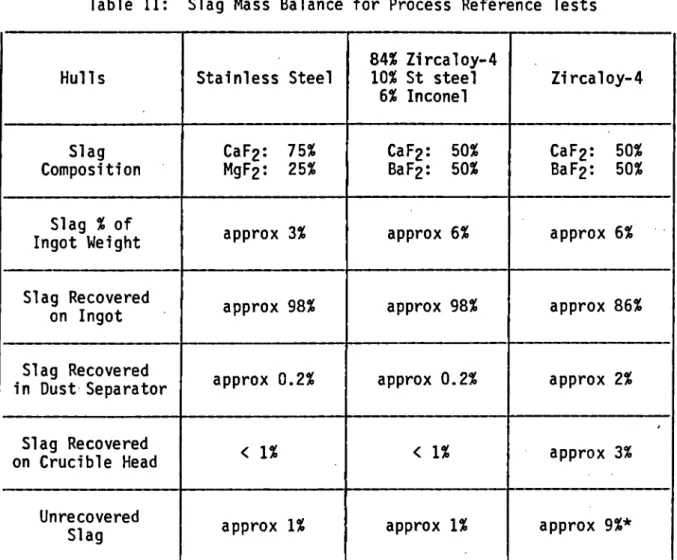
- The conditioning of fuel claddings by a method involving embedding in matrices made of lead alloys, high-density graphite or aluminium, ceramics and improved cement
- The immobilization of the claddings by melting, chemical conversion processes or embedding in glass
C. 1985-1989 programme
The research and other work to be carried out will cover :
a) Waste from light water reactors
- Reduction at source of radioactive waste and of discharges of radioactivity into the environment by better management of effluents and the possible