*For correspondence:mark. [email protected]
†These authors contributed equally to this work
Present address:‡Laboratory of Molecular Biology, National Institute of Diabetes and Digestive and Kidney Diseases, National Institutes of Health, Bethesda, United States; §Institute of Pharmacy and Biochemistry, Johannes Gutenberg-Universita¨t Mainz, Mainz, Germany
Competing interests:The authors declare that no competing interests exist.
Funding:See page 21
Received:25 April 2017 Accepted:02 December 2017 Published:15 December 2017
Reviewing editor: Antoine M van Oijen, University of Wollongong, Australia
Copyright Fisher et al. This article is distributed under the terms of theCreative Commons Attribution License,which permits unrestricted use and redistribution provided that the original author and source are credited.
The structural basis for dynamic DNA
binding and bridging interactions which
condense the bacterial centromere
Gemma LM Fisher
1†, Ce´sar L Pastrana
2†, Victoria A Higman
3†, Alan Koh
4,
James A Taylor
1‡, Annika Butterer
5§, Timothy Craggs
6, Frank Sobott
5,7,8,
Heath Murray
4, Matthew P Crump
3, Fernando Moreno-Herrero
2,
Mark S Dillingham
1*
1
DNA:protein Interactions Unit, School of Biochemistry, University of Bristol, Bristol,
United Kingdom;
2Department of Macromolecular Structures, Centro Nacional de
Biotecnologia, Consejo Superior de Investigaciones Cientificas, Madrid, Spain;
3School of Chemistry, University of Bristol, Bristol, United Kingdom;
4Centre for
Bacterial Cell Biology, Institute for Cell and Molecular Biosciences, Newcastle
University, Newcastle, United Kingdom;
5Biomolecular and Analytical Mass
Spectrometry Group, Department of Chemistry, University of Antwerp, Antwerpen,
Belgium;
6Department of Chemistry, University of Sheffield, Sheffield, United
Kingdom;
7Astbury Centre for Structural Molecular Biology, University of Leeds,
Leeds, United Kingdom;
8School of Molecular and Cellular Biology, University of
Leeds, Leeds, United Kingdom
Abstract
The ParB protein forms DNA bridging interactions aroundparSto condense DNA and earmark the bacterial chromosome for segregation. The molecular mechanism underlying the formation of these ParB networks is unclear. We show here that while the central DNA binding domain is essential for anchoring atparS, this interaction is not required for DNA condensation. Structural analysis of the C-terminal domain reveals a dimer with a lysine-rich surface that binds DNA non-specifically and is essential for DNA condensation in vitro. Mutation of either the dimerisation or the DNA binding interface eliminates ParB-GFP foci formation in vivo. Moreover, the free C-terminal domain can rapidly decondense ParB networks independently of its ability to bind DNA. Our work reveals a dual role for the C-terminal domain of ParB as both a DNA binding and bridging interface, and highlights the dynamic nature of ParB networks inBacillus subtilis. DOI: https://doi.org/10.7554/eLife.28086.001Introduction
Bacterial chromosomes are actively segregated and condensed by the ParABS system and condensin (Wang et al., 2014;Song and Loparo, 2015). InB. subtilis, this machinery is physically targeted to the origin proximal region of the chromosome by eight palindromic DNA sequences called parS
(consensus sequence 50-TGTTNCACGTGAAACA-30) to which the ParB (Spo0J) protein binds (Breier and Grossman, 2007;Lin and Grossman, 1998). These nucleoprotein complexes act as a positional marker of the origin and earmark this region for segregation in a manner somewhat analo-gous to eukaryotic centromeres and their binding partners.
ParB is an unusual DNA binding protein. In addition to sequence-specific interactions with the
behaviour is not well understood and a matter of active debate. Earlier models envisioned a lateral 1D spreading aroundparSto form a filament (Murray et al., 2006;Rodionov et al., 1999), princi-pally because spreading can be inhibited in a polar manner by ‘roadblocks’ placed to the side of
parSsequences. However, ParB foci appear to contain fewer proteins than are necessary to form a filament, and single molecule analyses using direct imaging (Graham et al., 2014) and magnetic tweezers (Taylor et al., 2015) have shown that binding of DNA by ParB is accompanied by conden-sation. These ‘networks’ were inferred to be dynamic and poorly-ordered, consisting of several DNA loops between distally bound ParB molecules. In cells, they are presumably anchored atparS sites by sequence-specific interactions but must also contain many interactions with non-specific DNA (nsDNA), as well as self-association interactions that bridge ParB protomers to form DNA loops. Modelling suggests that a combination of 1D spreading and 3D bridging interactions can explain the condensation activity and recapitulate the polar effect of roadblocks on ParB spreading (Broedersz et al., 2014). Recently, single-molecule imaging of the F-plasmid SopB led to a broadly similar model, defining ParB networks as fluid structures that localise aroundparSusing a ‘nucleation and caging’ mechanism (Sanchez et al., 2015). Despite these recent experiments converging on DNA bridging models to explain the ParB spreading phenomenon, the mechanism underpinning this behaviour remains unresolved. In particular, the relationship between these dynamic nucleopro-tein complexes and the molecular architecture of the ParB pronucleopro-tein is unclear and is the subject of the work presented here.
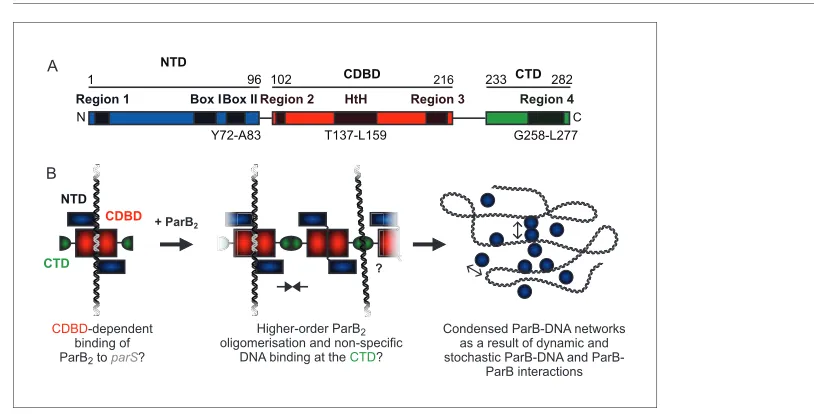
Genomically-encoded ParB proteins comprise three distinct domains (Figure 1AandFigure 1— figure supplement 1A,B and C). Our understanding of their structure is limited to the N-terminal domain (NTD) which binds ParA (Bouet and Funnell, 1999;Davey and Funnell, 1997;Davis et al., 1992;Radnedge et al., 1998) and the central DNA binding domain (CDBD) which bindsparS and possibly also nsDNA (Leonard et al., 2004;Schumacher and Funnell, 2005). A structure ofThermus thermophilus ParB lacking the C-terminal domain (CTD) revealed a compact dimer in which the helix-turn-helix (HtH) motifs were symmetrically arranged in a manner suitable for binding to the pal-indromicparS sequence (Figure 1—figure supplement 1D) (Leonard et al., 2004). Analysis of the
Region 1 Box IBox IIRegion 2 HtH Region 3 Region 4
CTD NTD
1 216 233 282
C N
CDBD 96 102
+ ParB2
CDBD-dependent binding of ParB2 to parS?
CDBD
CTD
NTD
Y72-A83 T137-L159 G258-L277
A
B
Condensed ParB-DNA networks as a result of dynamic and stochastic DNA and
ParB-ParB interactions Higher-order ParB2
oligomerisation and non-specific DNA binding at the CTD?
[image:2.612.162.569.395.602.2]?
Figure 1.A hypothetical model for ParB-mediated condensation of the origin of replication region. (A) Domains and regions as identified in (Bartosik et al., 2004;Kusiak et al., 2011). (B) ParB is thought to be anchored at
parS(grey) via the HtH motif found in the CDBD (red). ParB protomers self-associate via poorly defined
interactions and also make non-specific contacts with DNA segments, leading to the formation of ParB networks. In this work we have investigated the potential role of the CTD (green) in mediating ParB oligomerisation and non-specific DNA binding.
DOI: https://doi.org/10.7554/eLife.28086.002
The following figure supplement is available for figure 1:
CTD by analytical ultracentrifugation suggested that it also formed a dimer, and it was argued that this interface might promote spreading interactions. Recently, a structure of Helicobacter pylori
ParB, in which the protein was also truncated by removal of the CTD, showed a strikingly different conformation, where the NTD had moved away from the CDBD domain to form a tetrameric self-association interface (Figure 1—figure supplement 1E) (Chen et al., 2015). The CDBD was bound to aparShalf site, and it was argued that tetramerisation of the NTD could be responsible for bridg-ing interactions between specific and nsDNA bound to the CDBD.
In previous work, we hypothesised that ParB contains a second DNA binding locus for nsDNA that functions independently of the HtH motif (Figure 1B) (Taylor et al., 2015). This idea was attrac-tive to us for several reasons. Firstly, in a single DNA binding locus model, it is not straightforward to reconcile the strict localisation of ParB networks to just a fewparS sites (and their surroundings) with the limited discrimination between specific and nsDNA binding that is observed in vitro (a <10 fold apparent difference in affinity) (Taylor et al., 2015;Broedersz et al., 2014). Secondly, although binding toparSprotects the CDBD region from proteolysis, binding to nsDNA affords no such pro-tection, implying that it interacts elsewhere on the protein (Taylor et al., 2015). Thirdly, the dis-tantly-related ParB protein from plasmid P1 provides a precedent for a second DNA binding locus in a Type I centromere binding protein (albeit an additionalspecificDNA binding site), and highlights the CTD as the putative candidate region (Schumacher et al., 2007). However, the lack of any struc-tural information for the CTD of a genomically-encoded ParB prevents a rigorous comparison of the systems because the primary structure similarity in this region is negligible.
In this work, we have probed the role of the CDBD and CTD ofB. subtilisParB using a combina-tion of structural, biochemical, single molecule and in vivo approaches. We find that while the CDBD is responsible for specific recognition ofparS, the CTD provides both a second nsDNA binding site and a self-association interface that is important for bridging interactions and DNA condensation.
Results
The R149 residue within the HtH motif is essential for specific binding
to
parS
, but not required for non-specific binding and condensation
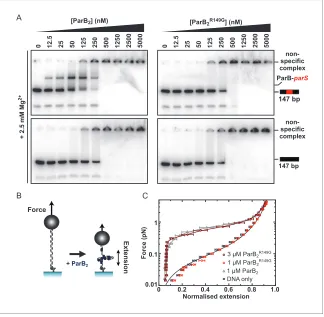
Genetic and structural analyses have suggested that residue R149 may be critically important for specific binding toparS at the HtH locus (Graham et al., 2014; Chen et al., 2015;Autret et al., 2001;Gruber and Errington, 2009). To probe the role of the HtH motif using biochemical techni-ques, we compared binding ofparSby wild type ParB and ParBR149Gusing electrophoretic mobility shift assays containing Mg2+cations (TBM-EMSA). As reported previously, inclusion of divalent
cati-ons in both the gel composition and running buffer enables the clear differentiation of specific and nsDNA-binding activities of ParB (Taylor et al., 2015). As expected, binding of wild type ParB to
parS-containing DNA produced a distinct band shift corresponding to the ParB2-parS complex, as
well as poorly migrating species at high [ParB] (Figure 2A). These latter complexes are also formed on DNA that does not containparS, and are therefore indicative of ParB bound to nsDNA flanking the centralparSsequence. ParB, and mutants thereof, were purified to homogeneity (Figure 2—fig-ure supplement 1A). EMSA experiments with ParBR149Gfail to produce the specific ParB2-parS
com-plex whereas the formation of nsDNA comcom-plexes is largely unaffected (Figure 2A). The retention of nsDNA binding activity in ParBR149Gis further supported by data using gels lacking Mg2+ions (TBE-EMSA) (Figure 2—figure supplement 1C), as well as a solution-based protein-induced fluorescence enhancement (PIFE) assay (Figure 2—figure supplement 1B), in which an increase in Cy3 intensity reports ParB binding. For wild type ParB, the data were fitted to the Hill equation yielding an appar-ent Kdof 361±14 nM and Hill coefficient of 3.2±0.3 in reasonable agreement with published data
(Lin and Grossman, 1998;Taylor et al., 2015). ParBR149Gproduced a similar binding isotherm yield-ing a moderately weaker Kdof 493±18 nM. This apparent Kdwas not significantly altered when the
Hill coefficient was not shared between datasets indicating the cooperativity of binding was not impaired in this ParB variant.
indicating that nsDNA binding is required for condensation. At a concentration sufficient for efficient condensation by wild type ParB (1mM), ParBR149Gdid not fully condense DNA, although fluctuations
of the DNA tether were consistent with minor condensation events that do not greatly affect the mean extension value measured (data not shown). However, at moderately elevated concentrations (3-fold), reversible condensation did occur and was qualitatively equivalent to wild type behaviour (Figure 2CandFigure 2—figure supplement 1D).
Together, these data show that mutation of the HtH motif effectively eliminates the ability of ParB to interact specifically with its cognateparSsite, while nsDNA binding and condensation is rela-tively unaffected. This is consistent either with the R149G mutation exclusively affecting nucleobase-specific contacts in the ParB-parScomplex, and/or with the idea that nsDNA binding may occur at a second DNA binding locus.
147 bp ParB-parS
A [ParB
2R149G] (nM)
0 12.
5
25 50 125 250 500 1250 2500 5000
[ParB2] (nM)
+
2.
5
mM
Mg
2+
0 12.
5
25 50 125 250 500 1250 2500 5000
non-specific complex
147 bp non-specific complex
B C
Normalised extension
F
o
rce
(p
N
)
0 0.2 0.4 0.6 0.8 1.0
0.01 0.1 1
1 M ParB2 3 M ParB2R149G
DNA only 1 M ParB2R149G
E
xte
n
si
o
n
[image:4.612.169.493.54.371.2]+ ParB2 Force
Figure 2.The R149 residue within the HtH motif is essential for specific binding toparS, but not required for non-specific binding and condensation. (A) Representative TBM-EMSAs for wild type ParB and ParBR149Gmonitoring binding ofparS-containing or non-specific 147 bp dsDNA. (B) Schematic of the magnetic tweezer assay used to monitor ParB-dependent DNA condensation. (C) Mean force-extension curves forparS-containing DNA molecules in the presence of wild type ParB and ParBR149G. Non-condensed DNA data is fitted to the worm-like chain model. Solid lines in condensed data are guides for the eye. Errors are the standard error of the mean of measurements on different molecules (N~15–35 molecules).
DOI: https://doi.org/10.7554/eLife.28086.004
The following figure supplement is available for figure 2:
Figure supplement 1.The R149 residue within the HtH motif is not required for non-specific binding and condensation.
The structure of
Bs
ParB CTD reveals a dimer with a putative DNA
binding interface
We next used solution NMR to determine the structure of the CTD alone (see Figure 3—source data 1for structure validation and statistics andFigure 3—figure supplement 1A for an assigned
1
[image:5.612.166.568.277.534.2]H-15N HSQC spectrum). The structure forms a well-defined dimer containing twoa-helices and two b-strands per monomer in a a1-b1-b2-a2 arrangement (Figure 3A and B). The dimer interface is formed via an intermolecular b-sheet and two domain-swapped C-terminal helices. Although this protein fold is somewhat similar to that seen in the plasmid P1 and SopB ParB proteins (Figure 3— figure supplement 1B,C and D) (Schumacher and Funnell, 2005;Schumacher et al., 2007), there are also significant differences especially in the N-terminal region: thea1 helix in the chromosomal ParB structure is replaced by an additional b-strand in the CTDs of P1 ParB and SopB. Analytical ultracentrifugation, native mass spectrometry and circular dichroism (CD) thermal melt scans further confirmed that the CTD was primarily dimeric in solution and measured a Tmof 68
˚
C (Figure3—fig-ure supplement 1E and F). NMR H-D exchange data revealed that the dimer exchanges slowly (which will be relevant to the interpretation of later experiments), with those most stable being the intermolecular H-bonds between the twob2 strands (data not shown; the half-lives range from 10 min to 4 hr). This secondary structure element is at the centre of the hydrophobic core which is
A
180o B
E D
-1 -2
-1 -2
-1
-1
-2
-2
F
180 180o
C
F
C C
E
D EE
co
n
serva
ti
o
n
high low
+ve -ve L277
L274 L240
L234
L270 -1 -2
Figure 3.Solution NMR structure of the dimeric ParB C-terminal domain. (A) Ensemble overlay of the 14 lowest-energy CTD structures. Red and blue depict separate monomers within the dimer. (B) Secondary structure elements are identified.a1 indicates the N-terminus of each monomer. (C) The hydrophobic core of Ile, Val, Leu and Phe residues. For clarity, portions of both monomers were removed. (D) Interdigitating Leu residues of both monomers form a leucine-zipper interaction. (E) Surface charge representation reveals a large electropositive region across theb-sheet face (orientation as in B, right hand side). Continuum electrostatics calculations used the PDB2PQR web server (Dolinsky et al., 2004) and the APBS plugin for PyMOL (Lerner and Carlson, 2006;
Baker et al., 2001). (F) Evolutionary conservation surface profile of the CTD of ParB prepared using ConSurf (Goldenberg et al., 2009;Celniker et al., 2013) (orientation as in E). The chemical shifts, restraints and structural co-ordinates have been deposited with the BMRB (34122) and PDB (5NOC).
DOI: https://doi.org/10.7554/eLife.28086.006
The following source data and figure supplement are available for figure 3:
Source data 1.NMR assignment, structure calculation and validation statistics. DOI: https://doi.org/10.7554/eLife.28086.008
made up of several Ile, Val and Phe residues in theb-sheet (Figure 3C). Thea1 helix forms a leucine zipper with thea2 helix, where alternating Leu residues interdigitate (Figure 3D). A striking feature of the structure is a highly electropositive face of the dimer arising from several conserved Lys resi-dues (Figure 3E and F) analogous to the plasmid-encoded SopB and P1 ParB proteins (Figure 3— figure supplement 1G,H and I).
The CTD binds DNA non-specifically via a lysine-rich surface
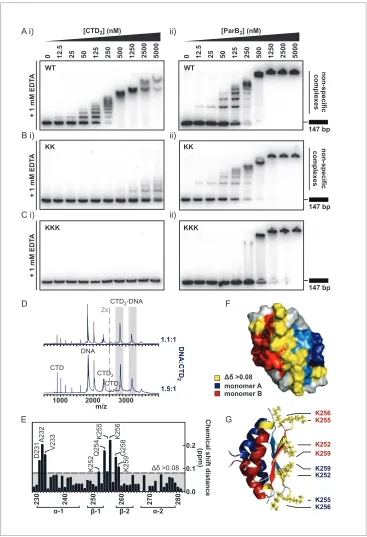
To test the idea that the lysine-rich surface we had observed might bind to DNA, we performed TBE-EMSAs with the isolated CTD. These showed that the CTD was indeed able to bind dsDNA (Figure 4Ai) resulting in the formation of a ‘ladder’ of bands of decreasing mobility. This is highly reminiscent of patterns formed by full length ParB under the same conditions (Figure 4Aii and (Taylor et al., 2015)) except for the presence of smaller gaps between the ‘rungs’ as would be expected for a protein of smaller size. The CTD was also shown to bind to hairpin oligonucleotides as short as 10 bp and to ssDNA (Figure 4—figure supplement 1Aand data not shown). We do not see substantial differences in the affinity of ParB for DNA substrates with different sequences and so this binding activity appears to be non-specific (data not shown). Native mass spectrometry of com-plexes formed between the CTD and a 15 bp duplex DNA revealed a stoichiometry of 1 DNA per dimer (Figure 4D). This is in contrast to the P1 ParB system where the CTD operates in a different binding mode, and can bind two 16-mers (Schumacher et al., 2007).
To further probe the putative DNA binding surface, we performed a titration of the 10 bp hairpin DNA against the isotopically-labelled CTD dimer (Figure 4E, assigned 1H-15N HSQC spectra are shown inFigure 4—figure supplement 1B). Residues with large chemical shift perturbations (CSPs, Dd> 0.08) are either directly involved in DNA-binding or undergo a conformational change as an indirect result of DNA-binding, and these were mapped onto the structure (Figure 4F). Two regions of interest were identified: D231-V233, and K252-K259, which are found on the intermolecular b -sheet face and proximal loop regions to form a large, concave and positively-charged interaction surface (Figure 4G).
To confirm that this surface was responsible for DNA binding we substituted several Lys residues with Ala and monitored the effect on DNA binding using EMSA and PIFE assays. In the first instance, a dual K255A/K257A substitution was studied in the context of both the CTD-only construct (CTDKK)
and the full length ParB protein (ParBKK). CTDKKdisplayed a greatly reduced affinity (~50 fold) for
DNA, but the binding was not completely abolished (Figure 4Bi). CD thermal melt analysis con-firmed that this defect was not attributable to global misfolding (Figure 4—figure supplement 1C). The full length ParBKKvariant showed a sigmoidal DNA binding isotherm in a PIFE assay, indicating
strong positive cooperativity as observed for wild type ParB but the apparent Kdwas 6-fold weaker
(Figure 4—figure supplement 1D). In EMSA assays, this variant showed no defect in specific bind-ing toparSas would be expected (Figure 4—figure supplement 1E). Somewhat more surprisingly however, these lysine substitutions appeared to have a negligible effect on nsDNA binding when assessed using the TBE-EMSA assays (Figure 4Bii). This may well reflect the complexity that arises when a partially defective nsDNA binding locus is physically attached to the wild type CDBD domain (which is still fully competent to bind DNA).
We next designed a triple K252A/K255A/K259A variant with the aim of fully dissipating the posi-tive charge density across the surface of the CTD, rather than only targeting the loop-proximal regions. EMSA analysis showed that DNA binding was completely abolished in CTDKKKup to con-centrations of 50mM (Figure 4CiandFigure 4—figure supplement 1F). CD thermal melt analysis showed that CTDKKKwas equivalently folded to wild type CTD at ambient temperatures, but with a reduced Tm(53
˚
C) indicating a moderate destabilising effect of the mutations (Figure 4—figuresup-plement 1G). Interestingly, analysis of full length ParBKKKshowed a clear and consistent defect in all nsDNA binding assays used. TBM-EMSA gels showed that ParB-parS complexes were still formed, although it should be noted that their yield was reduced relative to wild type (Figure 4—figure sup-plement 1I). TBE-EMSA gels showed a complete eradication of the discrete lower mobility bands which arise from nsDNA binding (Figure 4Cii). Moreover, nsDNA binding was undetectable using the PIFE analysis (Figure 4—figure supplement 1H). Interestingly, EMSA analysis showed that DNA-bound ParBKKKnetworks do still form as very low mobility species that assemble co-operatively
at high ParB concentrations. Given that the ParBKKKprotein retains a functional HtH motif, this
D E G F A i) K255 K252 K259 K256 G K252 K255 K256 K259 Ch emi cal sh ift d istan ce (p p m) DNA:C T D 2 1.1:1 1.5:1 CTD CTD4 DNA
CTD2-DNA
CTD2
1000 2000 3000 m/z
2x
-1 -1 -2
0.0 0.1 0.2
>0.08
230 240 250 260 270 280
D231 A 232 V 233 K 252 Q 254 K 255 K 256 G 258 K 259 -2 + 1 mM E DT A n o n -s p eci fi c co mp lexes 147 bp + 1 mM E DT A + 1 mM E DT A 147 bp n o n -s p eci fi c co mp lexes 147 bp 0 12. 5
25 50 125 250 500 1250 2500 5000 [CTD2] (nM)
WT
KK
KKK
0 12.
5
25 50 125 250 500 1250 2500 5000 [ParB2] (nM)
[image:7.612.168.535.51.588.2]WT KK KKK B i) C i) >0.08 monomer A monomer B ii) ii) ii)
Figure 4.The CTD binds DNA via a lysine-rich surface. (A–C) TBE-EMSAs for the titration of full length ParB and CTD against 147 bp DNA. Wild type and mutant proteins, K255A + K257A and K252A + K255A + K259A, are indicated. (D) Native mass spectrometry. Titrations of a 15 bp nsDNA hairpin against CTD were performed between ratios of 1.1:1 and 1.5:1 DNA:CTD2. Example spectra are shown with the DNA-CTD2complex shaded in grey. (E) Deviations in the assigned1H-15N HSQC spectra of CTD upon titration with a 10 bp hairpin DNA. (F) Chemical shift perturbations exceeding 0.08Ddare highlighted on the structure in yellow. (G) Lys residues thought most likely to bind to DNA are shown as sticks.
DOI: https://doi.org/10.7554/eLife.28086.009
The following figure supplement is available for figure 4:
Figure supplement 1.The CTD binds DNA via a lysine-rich surface.
sequence. This highlights the potential complexity of nsDNA binding in ParB which might involve synergistic binding by both the CDBD and CTD domains.
DNA binding by the CTD is essential for DNA condensation and
bridging in vitro
We next exploited our double- and triple-lysine mutant ParB proteins to test the role of the DNA-binding activity associated with the CTD in forming condensed ParB networks. These networks have been extensively characterised previously for wild type ParB using magnetic tweezers with single tethered DNA substrates (Taylor et al., 2015) and also in TIRF-based microscopy (Graham et al., 2014).
Unlike full length ParB, the CTD was not capable of condensing DNA tethers under any condition tested, even up to 5 mM CTD2concentrations and under applied forces as low as 0.02 pN (
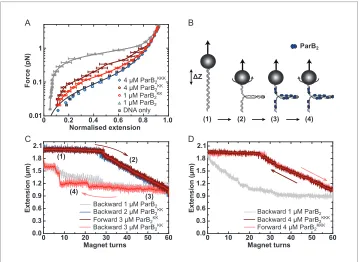
Fig-ure 1—figFig-ure supplement 1Ai). This is consistent with the expected requirement for multiple pro-tein-protein and/or protein-DNA interfaces to promote DNA looping and condensation. Incubation of full length ParBKKwith single DNA tethers resulted in defective DNA condensation compared to
wild type ParB (Figure 5A). When it was observed, condensation was sudden (rather than progres-sive, as for wild type ParB) and full condensation required the applied force to be dropped to an exceptionally low value (0.09 pN) (Figure 5—figure supplement 1Aii). The DNA molecules also showed unusually large steps when decondensed by force, suggesting that ParBKKwas infrequently stabilising in cis DNA-bridging interactions between isolated DNA regions (data not shown). Co-incubation of ParBKKKwith single DNA tethers under our standard experimental conditions resulted
in no measurable condensation events, even under applied forces as low as 0.02 pN and at elevated concentrations (Figure 5A and Figure 5—figure supplement 1Aiii). The average work done by ParB compared to the variant proteins during these condensation events was determined from the difference between the integral of the force-extension curve in the presence of the protein and that of DNA alone. This provides a means to quantitatively compare the condensation efficiency between mutants (Figure 5—figure supplement 1B). We also performed plectoneme stabilisation experi-ments (Figure 5B). In this assay, a single torsionally-constrained DNA molecule is positively super-coiled at a 4 pN force by applying 60 turns. ParB is then introduced and, after full buffer exchange, all turns are released whilst monitoring DNA extension. Any deviation of DNA extension from that expected of bare DNA is indicative of supercoiled regions being stabilised by ParB. ParBKKcould
stabilise DNA-bridging interactions between isolated DNA regions but this was often characterised by large steps in the DNA tether extension increase which is unlike the behaviour of wild type (Figure 5C and Figure 5—figure supplement 1C). ParBKKK was unable to stabilise plectoneme
structures showing that it cannot bridge DNA segmentsin trans(Figure 5DandFigure 5—figure supplement 1D).
The CTD can both inhibit the formation of, and decondense, ParB-DNA
networks in vitro
The CTD potentially acts as both an oligomerisation interface and also a site of nsDNA-binding. Therefore, we hypothesised that the CTD might have a dominant negative effect on full length ParB by competing for the DNA and protein interfaces that mediate the formation of ParB networks in the magnetic tweezers (MT).
Purified CTD completely inhibited the formation of the condensed state if pre-incubated with wild type ParB and DNA under the high stretching force regime (Figure 6AandFigure 6—figure supplement 1A). We also tested whether the introduction of free CTD to pre-condensed tethers was able to disrupt ParB-DNA networks. Condensed ParB networks were completely stable in a flow of free ParB on the timescale of these experiments, and the DNA tethers were also able to re-con-dense following force-induced decondensation (Figure 6Bi). However, the inclusion of excess free CTD rapidly disrupted ParB networks, with some degree of decondensation observed in 94% of all the molecules tested (Figure 6Bii). Moreover, those molecules which did not decondense
Figure 4 continued
spontaneously could be stretched by force, but were then unable to recondense when permissive forces were restored. This ability of the CTD to decondense ParB networks demonstrates that the protein-protein and/or protein:DNA interfaces that maintain the condensed state under a low force regime are dynamic (i.e. they are exchanging while the overall structure of the network is maintained).
We have shown above that the CTD binds tightly to nsDNA. Therefore, its ability to prevent con-densation and induce deconcon-densation might simply reflect competition for the nsDNA that becomes available during exchange of ParB:DNA interfaces. Indeed, we have shown previously that free DNA is a potent inducer of network decondensation in the MT apparatus (Taylor et al., 2015). To test the idea that the CTD dimerisation interface is also important for maintaining the condensed state, we repeated our experiments with the CTDKK and CTDKKKconstructs, which are defective and
appar-ently unable (respectively) to bind nsDNA. Both mutant proteins were as effective as wild type in preventing condensation (Figure 6CandFigure 6—figure supplement 1B), and both were able to induce decondensation in approximately 95% of all molecules tested (Figure 6Biii and D). This strongly suggests that CTD-dependent ParB network dissipation is primarily mediated by competi-tion for the CTD dimerisacompeti-tion interface and further confirms that the CTDKKKconstruct is folded. This
B
0.0 0.3 0.6 0.9 1.2 1.5 1.8 2.1
0 10 20 30 40 50 60
Magnet turns Normalised extension
F
o
rce
(p
N
)
0 0.2 0.4 0.6 0.8 1.0
0.01 0.1
1 M ParB2 4 M ParB2KK
DNA only 1 M ParB2KK
E
xte
n
si
o
n
(µm)
0.0 0.3 0.9 1.2 1.5 1.8 2.1
0 10 20 30 40 50 60
Magnet turns Backward 1 M ParB2
D
ParB2
(1) (2) (3) (4)
Z
(1) (2)
(4) A
C
Backward 1 M ParB2 Backward 4 M ParB2KKK Forward 4 M ParB2KKK 1
4 M ParB2KKK
(3)
Forward 3 M ParB2KK Backward 3 M ParB2KK Backward 2 M ParB2KK E
xte
n
si
o
n
(µm)
[image:9.612.168.527.52.314.2]0.6
Figure 5.DNA binding by the CTD is required for efficient DNA condensation in vitro. (A) Mean force-extension curves of DNA molecules co-incubated with ParB variants at the indicated concentrations. Non-condensed (protein-free) DNA data is fitted to the worm-like chain model. Solid lines in condensed data are guides for the eye. Errors are the standard error of the mean of measurements on different molecules (N~18–35 molecules). (B) Schematic of plectoneme stabilisation assay. A single torsionally-constrained DNA molecule was positively supercoiled at 4 pN force by applying 60 turns. This shortens the tether length due to the formation of plectonemes in the overwound DNA. ParB2is then introduced and all turns are released whilst monitoring DNA extension. Evidence for ParB-dependent plectoneme stabilisation is provided by hysteresis in the extension as a function of magnet turns as the supercoiling is removed. (C) Plectoneme stabilisation assay comparing bare DNA, wild type ParB and ParBKK. The double-mutant protein supported DNA bridging and occasionally large steps were observed in the backward trace (see text for discussion). (D) Plectoneme stabilisation assay comparing wild type ParB and ParBKKK. No activity was detected for the triple-mutant protein.
DOI: https://doi.org/10.7554/eLife.28086.011
The following figure supplement is available for figure 5:
competition presumably results from the formation of heteroligomers between full length ParB and the CTD, which disrupts interactions that are essential for condensation (Figure 6—figure supple-ment 1C).
C B ii)
Time (s) E xte n si o n (µm) F o rce (p N
) 0.0
0.3 0.6 0.9 1.2 1.5 1.8 0 1E-3 1 0.34 pN
150 300 450 600 750 900
2.1 + ParB
2 + 5X CTD2
A Co n d en sati o n rat io 0.0 0.2 0.6 0.4 0.8 1.0 ParB2 (1 µM) +CTD2 (5 µM)
+CTD2KKK (5 µM)
+CTD2KK (5 µM) Normalised extension F o rce (p N )
0 0.2 0.4 0.6 0.8 1.0 0.01
0.1 1
1 M ParB2
DNA only 1 M ParB2 +
5X CTD2
Normalised extension F o rce (p N )
0 0.2 0.4 0.6 0.8 1.0 0.01
0.1 1
1 M ParB2
DNA only 1 M ParB2 +
5X CTD2
KKK D Time (s) E xte n si o n (µm) F o rce (p N
) 0.0
0.3 0.6 0.9 1.2 1.5 1.8 0 1E-3 1 0.34 pN
150 300 450 600 750 900 2.1 B i) Flow Time (s) E xte n si o n (µm) F o rce (p N
) 0.0
0.3 0.6 0.9 1.2 1.5 1.8 0
1E-3 0.34 pN
150 300 450 600 750 900 2.1
1
+ ParB2 + 5X CTD2KKK
B iii)
+ ParB2
Re-condensation
[image:10.612.167.518.52.428.2]No re-condensation
Figure 6.The CTD of ParB both inhibits and disrupts ParB-dependent DNA condensation. (A) Mean force-extension curves for DNA molecules co-incubated with 1mM ParB2in the presence or absence of 5mM CTD2. Non-condensed (protein-free) DNA data is fitted to the worm-like chain model. Solid lines in condensed data are guides for the eye. (B) (i) ParB-DNA networks are stable in magnetic tweezers in the presence of 1mM ParB2. (ii) ParB-DNA complexes spontaneously decondense following the introduction of 1mM ParB2and 5mM free CTD2. (iii) ParB-DNA complexes spontaneously decondense following the introduction of 1mM ParB2and 5mM CTD2KKK. (C) Mean force-extension curves for DNA molecules co-incubated with 1mM ParB2in the presence or absence of 5 mM mutant CTD2KKK. Errors are the mean of measurements on different molecules (N > 40 molecules) (D) Condensation ratio (see Materials and methods for definition) for individual DNA condensation events involving the addition of CTD competitor variants to pre-condensed ParB-DNA networks.
DOI: https://doi.org/10.7554/eLife.28086.013
The following figure supplements are available for figure 6:
Figure supplement 1.The CTD of ParB both inhibits and disrupts ParB-dependent DNA condensation. DOI: https://doi.org/10.7554/eLife.28086.014
Figure supplement 2.Possible mechanisms to explain the dominant negative effect of the CTD on full length ParB.
The CTD is critical for the formation of ParB foci in vivo
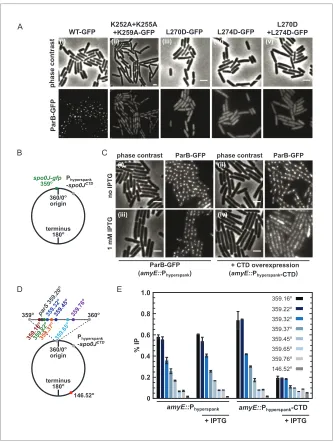
To test the importance of the CTD dimerisation and DNA binding interfaces in vivo, we compared the ability of wild type and mutant ParB-GFP proteins to form foci inB. subtiliscells when expressed from the endogenous locus. Wild type ParB-GFP formed discrete foci around oriC as expected (Murray et al., 2006;Graham et al., 2014;Autret et al., 2001; Real et al., 2005;Glaser et al., 1997; Lin et al., 1997; Lewis and Errington, 1997;Marston and Errington, 1999). In contrast, ParBKKK-GFP failed to form discrete foci (Figure 7Ai–ii) despite wild type expression (Figure 7—fig-ure supplement 1A). Interestingly, the triple-mutant protein appeared to localise non-specifically to the nucleoid, perhaps as a result of residual DNA binding by the HtH motifs, suggesting that ParBKKK-GFP retained the ability to dimerise. A caveat in interpreting this experiment is that, in
addi-tion to a complete eradicaaddi-tion of nsDNA binding by the CTD domain, the ParBKKK mutant protein
also showed a reduction inparS binding (Figure 4—figure supplement 1I). Therefore, we cannot exclude the possibility that defectiveparSbinding also contributes to the lack of ParB foci formation we have observed. A ParBL270D+L274Dconstruct, designed to prevent leucine zipper-mediated
dimer-isation of the CTD, was completely unable to form ParB foci (Figure 7Aiii–v) despite being expressed at approximately wild type levels (Figure 7—figure supplement 1B). The complete dele-tion of the CTD by truncadele-tion to E222 or E227 resulted in the same phenotype (data not shown).
Our attempts to purify recombinant ParBL270D+L274D failed because the protein was insoluble upon overexpression inE. coli. This raises the possible caveat that the loss of function associated with this dimerisation mutant in vivo might reflect mis-folding. Therefore, we also investigated whether the free CTD was able to interfere with dimerisation in vivo, thereby causing a dominant negative effect on ParB function. A B. subtilisstrain was engineered with a C-terminal gfpfusion replacing the endogenous spo0J and the unlabelled CTD-only gene inserted at an ectopic locus downstream of a Phyperspankpromoter, designed for high protein expression that is tightly-controlled
with IPTG (Figure 7B). Overexpression of the CTD caused ParB-GFP foci to become diffuse (Figure 7C), although expression levels of endogenous ParB-GFP were unaffected (Figure 7—figure supplement 1C).
ChIP-qPCR analysis allowed us to more directly characterise the effect of CTD expression upon ParB spreading (i.e. the enrichment of ParB at and widely aroundparS sites). Spreading was mea-sured around a singleparS site (359.20
˚
) and used a locus towards the terminus to monitor back-ground ‘enrichment’ (146.52˚
) (Figure 7D). As expected, in the absence of CTD expression, ParB was highly enriched not only atparSsites (~40 fold), but also for several kilobase pairs aroundparS(Figure 7E). Overexpression of CTD significantly decreased the signal aroundparS(up to~4 fold), indicating that it interferes with spreading. Western blotting of cells grown under equivalent condi-tions to the ChIP-qPCR assay and using the same batch of polyclonal anti-ParB antibody suggests that the CTD is not preferentially recognised over the endogenous full length ParB protein ( Fig-ure 7—figFig-ure supplement 1D). Note that the reduced signal observed for theparSfragment does not necessarily indicate defective specific binding, because the PCR product atparS is much larger than the 16 bpparSsite or the 24 bp footprint of a ParB dimer (Murray et al., 2006). We can con-clude that non-specific DNA interactions are reduced, but we are unable to say whether specific interactions are also reduced, or are maintained at wild type levels.
Finally, we determined the consequence of decreased ParB spreading in vivo induced by CTD overexpression by measuring the rate of DNA replication initiation. ParB normally inhibits the activity of Soj, a regulator of the master bacterial initiation protein DnaA (Murray and Errington, 2008). Marker frequency analysis showed that CTD overexpression stimulated the frequency of DNA repli-cation initiation, indicating that regulation of DnaA by Soj was adversely affected (Figure 7—figure supplement 1E). Together, these results are consistent with our in vitro observations, and support a model in which dynamic ParB-DNA networks are dependent upon ParB oligomerisation and DNA-binding interfaces in the CTD.
Discussion
property across chromosomal and plasmid segrosomes, yet the interaction interfaces involved have remained elusive, particularly for genomically-encoded systems (Graham et al., 2014). This is, in part, due to the variable structures of ParB proteins and their cognate centromere sequences, even within the type I subclass of which B. subtilis ParB is a member (Gerdes et al., 2000;
146.52o
359o 360o
359. 16 o 359. 22 o 359. 37 o 359. 65 o 359. 76 o 359. 45 o 359. 32 o parS 359. 20 o terminus 180o 360/0o origin Phyperspank
-spo0JCTD
spo0J-gfp 359o WT-GFP P arB-G F P p h ase co n trast ParB-GFP (amyE::Phyperspank)
+ CTD overexpression (amyE::Phyperspank-CTD) phase contrast ParB-GFP
1 mM IP T G n o I P T G
phase contrast ParB-GFP C (i) (ii) (iv) (iii) % IP 0.2 0.6 1.0 0.4
amyE::Phyperspank amyE::Phyperspank-CTD
+ IPTG + IPTG
0 359.16o 359.22o 0.8 E 359.32o 359.45o 359.65o 359.76o 359.37o 146.52o B D (i) L270D-GFP L274D-GFP L270D +L274D-GFP
(iii) (iv) (v)
K252A+K255A +K259A-GFP (ii) A terminus 180o 360/0o origin Phyperspank
[image:12.612.168.502.50.492.2]-spo0JCTD
Figure 7.DNA-binding and dimerisation by the CTD is critical for ParB function in vivo. (A) Variant ParB-GFP mutants form abnormal foci inB. subtilis. Cells were grown overnight in slow growth conditions before dilution (1:100) into fast growth media, and were allowed to achieve at least five mass doublings before observation by microscopy (N > 300 cells). Scale bar is 2mm. (B) Construct design for overexpression of the CTD in vivo. (C) CTD overexpression was induced by IPTG in the presence of chromosomally-encoded wild type ParB-GFP using the Phyperspankconstruct. Cells were grown as in A. (D) Construct design for ChIP-qPCR. (E) ChIP-qPCR assay for ParB spreading. Cells were grown slowly overnight, diluted (1:100) into fast growth media, and allowed to reach eight mass doublings before crosslinking with 1% formaldehyde. Background IP was measured at the terminus (146
˚
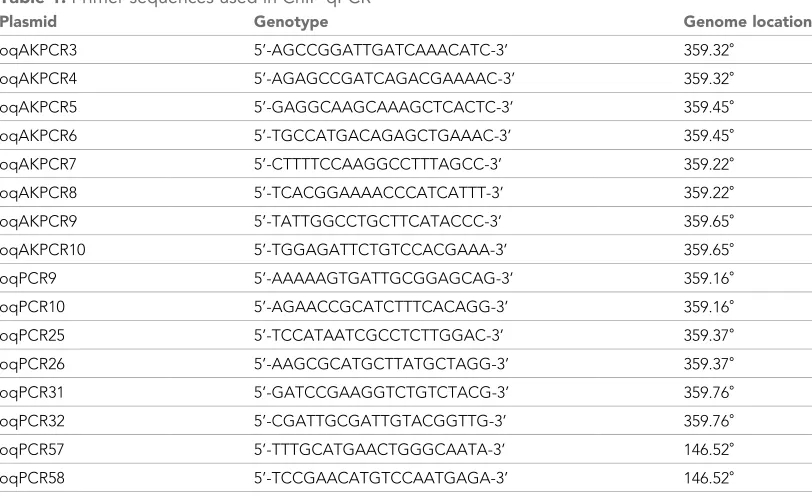
). Primer pairs produced 200–300 bp fragments.DOI: https://doi.org/10.7554/eLife.28086.016
The following figure supplement is available for figure 7:
Schumacher, 2008). Increasing evidence indicates that ParB spreading is the result of a DNA-bridg-ing activity mediated by ParB-ParB oligomerisation interfaces (Graham et al., 2014;Taylor et al., 2015;Broedersz et al., 2014;Sanchez et al., 2015;Sanchez et al., 2013). However, a complete understanding of the relationship between ParB structure and function has been hindered by the lack of any full length structure for a chromosomally-encoded ParB. Indeed, the organisation of the N-terminal (NTD), central DNA-binding (CDBD) and C-terminal (CTD) domains appears to be quite complex (Figure 1—figure supplement 1A,B and C; Figure 6—figure supplement 2A). For the type I ParB protein class, there is evidence to suggest that dimerisation and/or tetramerisation can occur at the NTD and CDBD, and that dimerisation can occur at the CTD (Leonard et al., 2004; Schumacher and Funnell, 2005;Chen et al., 2015). Alongside an ability to bind DNA both specifi-cally and non-specifispecifi-cally, a combination of some or all of these protein:protein interfaces must sup-port ParB spreading and network formation (Figure 6—figure supplement 2A).
To address the putative role of the CTD in spreading (Leonard et al., 2004), we resolved the first structure of a genomic ParB CTD. The structure revealed a conserved lysine-rich surface and we showed that this binds to DNA in an apparently non-specific manner. This novel DNA binding locus is distinct from the sequence-specific DNA binding site forparSformed by the classical HtH motif within the CDBD domain. In this respect, there are parallels with the plasmid-encoded ParB proteins P1 and SopB (Schumacher et al., 2007;Schumacher et al., 2010). In these systems, the CTDs share similar surface electrostatics in which a polar distribution of charged residues results in both posi-tively- and negaposi-tively- charged surfaces on opposite faces of the domain. In bothB. subtilis ParB and P1 ParB, the Lys/Arg rich surface has been shown to bind to DNA using structural or biochemi-cal techniques ([Schumacher and Funnell, 2005; Schumacher et al., 2007] and this work), but experiments with SopB do not support the idea that it shares this activity (Ah-Seng et al., 2009). The integrity of the CTD may also be important for stabilising the N-terminal region of the protein. When SopB was truncated ahead of the CTD, it could not bindsopC(the F-plasmid equivalent of
parS) (Kusukawa et al., 1987), and analogous results have been obtained withT. thermophilusand
B. subtilisParB ((Leonard et al., 2004) and unpublished observations).
Our CTD structure facilitated the design of separation of function mutations to test the impor-tance of the dimerisation and DNA binding activities using a variety of in vitro and in vivo readouts of ParB function. We showed that the DNA binding interface in the CTD is not required forparS
exchange between the CTD dimer and the full length ParB dimerin free solution. However, the situ-ation in the ParB network is very different, because the opposing force generated by the MT can dramatically increase the rate of exchange of bridging interactions that hold the DNA in a con-densed state. Ultimately, a direct demonstration of this idea will require a correlative measurement of DNA extension with the observation of ParB/CTD binding under conditions of controlled force, and this will be the subject of future studies. Taken together, our observations support the idea that the CTD is essential for both DNA binding and for ParB-ParB bridging interactions that support DNA condensation in vitro.
We propose that the presence of two DNA binding loci in ParB can help to explain how ParB net-works are anchored atparS in vivo. Importantly, this architecture resolves the paradoxical observa-tion that the apparent specificity forparSin vitro (<10 fold greater affinity forparSversus nsDNA) is insufficient to explain the strict localisation of ParB around just eight sites in a ~4 Mbp genome (Taylor et al., 2015;Broedersz et al., 2014). In a two DNA binding site model, specific and non-specific binding can be semi-independent activities that are architecturally-coupled only when ParB oligomerises into networks. This model can also explain why DNA condensation does not require
parS in vitro, whereas the absence of parS sites prevents the formation of ParB-DNA foci in vivo ((Graham et al., 2014;Taylor et al., 2015;Sanchez et al., 2015;Erdmann et al., 1999) and this work). In a test tube, whenever ParB is present at concentrations that licence oligomerisation, it is always in large stoichiometric excess over binding sites and all available DNA will be bound. In cells, the situation is very different because there is a limited pool of ParB (Graham et al., 2014). Specific interaction withparSpreferentially anchors the ParB network atparS, leaving a vast number of unoc-cupied sites. IfparSsites are absent in cells, ParB might still form networks, but these would not be anchored at specific sites and would therefore fail to form foci, as has been observed experimentally (Erdmann et al., 1999;Sullivan et al., 2009). A rigorous proof of these ideas will require a model-ling approach that will be the subject of future work.
Previously, high-resolution SIM and ChIP-seq data have suggested that ParB-DNA partition com-plexes involve stochastic and dynamic binding of ParB to both DNA and other ParB proteins, result-ing in the formation of fluid intra-nucleoid ‘ParB cages’ on DNA (Sanchez et al., 2015). This view is consistent with the disorder observed in MT assays (Taylor et al., 2015), and with the dominant neg-ative effect of the free CTD domain on ParB networks shown here. However, a recent structural study ofH. pylori ParB concluded that a novel tetramerisation interface within the NTD was also likely to be important in bridging (Chen et al., 2015;Song et al., 2017). Moreover, spreading could be facilitated byparS-dependent conformational changes that act as nucleation points for networks (Broedersz et al., 2014;Leonard et al., 2004). A more complete understanding of ParB network formation and its regulation will be required to underpin future studies on how ParB acts together with ParA and condensin to orchestrate efficient chromosome segregation.
Materials and methods
Plasmids and DNA substrate preparation
All mutagenesis used the pET28a-ParB expression vector as a template (Taylor et al., 2015). The R149G mutation was introduced by site-directed mutagenesis using a QuikChange II XL kit (Agilent Technologies). The full length ParB gene (1-849) with the K255A + K257A or K252A + K255A + K259A substitutions was produced synthetically (Life Technologies) and subcloned into pET28a using NcoI and BamHI restriction sites (Taylor et al., 2015). CTD only (217-282) con-structs were produced using PCR with primer overhangs incorporating 5’ PacI and 3’ XmaI restriction sites for subcloning (5’ GCGTAAGCCCCGGGCAGAATGTTCCACGTGAAACAAAG 3’ and 5’ -GCGTCATGTTAATTAATCATTATGATTCTCGTTCAGACAAAAG - 3’) into pET47b (Novagen) to pro-duce a protein with an N-terminal HRV 3C protease cleavable His-tag. The integrity of all DNA sequences was confirmed by direct sequencing (DNA Sequencing Service, University of Dundee).
Preparation of radiolabelled, 5’ Cy3-labelled and magnetic tweezer DNA substrates was as described (Taylor et al., 2015). 10 bp DNA hairpins were prepared by heating a self-complementary oligonucleotide (5’ - GCGTACATCATTCCCTGATGTACGC - 3’) in 10 mM Na2HPO4/NaH2PO4 pH
over multiple NAP-10 columns (GE Healthcare Life Sciences) before concentration in a centrifugal vacuum concentrator.
ParB overexpression and purification
ParB, and the variants R149G, K255A + K257A and K252A + K255A + K259A, were overexpressed and purified as described (Taylor et al., 2015). CTD, and mutants thereof, were His-tagged and purified to homogeneity as follows. Cell pellets, produced as described (Taylor et al., 2015), were resuspended in 20 mM Tris-HCl pH 7.5, 500 mM NaCl and 1 mM BME (TNB buffer) with the addition of 10 mM imidazole, 5% (v/v) glycerol and protease inhibitor cocktail set II (Millipore), before being snap-frozen and stored at 80
˚
C. Cells were lysed by sonication in the presence of 0.2 mg/ml lyso-zyme (Sigma). The lysate was clarified by centrifugation and loaded onto a 5 ml HisTrap HP column (GE Healthcare Life Sciences) equilibrated with TNB buffer +10 mM imidazole. CTD elution was achieved with a linear gradient of 10 mM to 500 mM imidazole. Peak fractions were assessed by SDS-PAGE and pooled accordingly. The tag was removed with HRV 3C protease (Thermo Scientific, Pierce) for 16 hr at 4˚
C during dialysis into TNB buffer +10 mM imidazole. The products were subse-quently loaded onto a HisTrap HP column whereby the cleaved CTD was collected in the flow-through volume, followed by concentration by centrifugation in Amicon Ultra-15 3 kDa MWCO spin filters (Millipore). This concentrate was loaded at 1 ml/min onto a Hiload 16/600 Superdex S75 gel filtration column (GE Healthcare Life Sciences) equilibrated with 50 mM Tris-HCl pH 7.5, 1 mM EDTA, 300 mM NaCl and 1 mM DTT (storage buffer). Appropriate peak fractions were pooled, fol-lowed by final concentration by centrifugation as described. Spectrophotometric grade glycerol (Alfa Aesar) was added to 10% (v/v). The final protein was then snap-frozen as aliquots and stored at 80˚
C. ParB concentration was determined by spectrophotometry using theoretical extinction coef-ficients of 7450 M 1cm 1and 2560 M 1cm 1for ParB and CTD respectively. ParB concentrationsin all assays refer to the dimeric state. The wild type, K255A + K257A and K252A + K255A + K259A variants of ParB behaved equivalently during purification, and run almost identically on preparative size exclusion columns (both in the context of the CTD and full length protein), suggesting that they are all dimeric. For structure determination by NMR, the CTD was dual isotopically (13C and 15N) labelled during overexpression in M9 media, as described previously (Williams et al., 2007), and subsequently purified as above.
CD spectroscopy
CD spectra were collected using a JASCO J-810 spectropolarimeter fitted with a Peltier temperature control (Jasco UK). 50mM protein samples were buffer exchanged into phosphate buffered saline (PBS; 8.2 mM NaH2PO4, 1.8 mM KH2PO4, 137 mM NaCl and 2.7 mM KCl (pH 7.4)) by 16 hr dialysis
at 4
˚
C using a membrane with a MWCO of 3.5 kDa. At 20 mM and using a 0.1 cm quartz cuvette, thermal stability data was acquired across a 190–260 nm absorbance scan (1 nm data pitch at a scan-ning speed of 100 nm/min) from 5˚
C to 90˚
C at 5˚
C increments. Raw data was normalised to molar ellipticity (MRE (deg.cm2.dmol 1)) using calculation of the concentration of peptide bonds and thecell path length. A buffer only baseline was subtracted from all datasets. All data for mutant variants was acquired alongside a wild type CTD control.
NMR
NMR datasets were collected at 35
˚
C, utilising a Varian VNMRS 600 MHz spectrometer with a cryo-genic cold-probe. The purified protein was buffer exchanged into PBS (10 mM NaH2PO4, 1.8 mMKH2PO4, 137 mM NaCl and 2.7 mM KCl (pH 6.1)) and concentrated to 1 mM.1H-15N HSQC,1H-13C
HSQC, HNCACB, CBCA(CO)NH, HNCA, HN(CO)CA, HNCO, CC(CO)NH, H(CCO)NH, HCCH-TOCSY,15N-NOESY-HSQC (150 ms mixing time),13C-NOESY-HSQC (140 ms mixing time) and
aro-matic13C-NOESY-HSQC (140 ms mixing time) experiments were collected on13C,15N-labelled CTD. 2D 1H-1H TOCSY and NOESY spectra were recorded on unlabelled protein. 13C,15N-labelled and unlabelled protein were mixed in equimolar amounts to create a mixed labelled sample used to record 3D13C,15N F1-filtered,13C,15N F3-edited13C-NOSEY-HSQC and 15N-NOESY-HSQC
experi-ments (Zwahlen et al., 1997). A hydrogen-deuterium (HD) exchange experiment was conducted by recording1H-15N HSQC experiments at several intervals following dissolution of freeze-dried protein
CTD and recording a1H-15N HSQC experiment after each addition. The final molar ratio of protein:
DNA was 1:1.25. All NMR data were processed using NMRPipe (Delaglio et al., 1995). Spectra were assigned using CcpNmr Analysis 2.4 (Vranken et al., 2005). Proton chemical shifts were refer-enced with respect to the water signal relative to DSS.
Heteronuclear NOE experiments showed residues 214–228 to be highly flexible. This was sup-ported by chemical shift analysis with TALOS+ (Shen et al., 2009) and the absence of any medium or long-range NOEs for these residues. Structure calculations were only conducted on residues 229– 280, as the unstructured tail made unfavourable energy contributions to the calculation which dis-torted the selection of ensembles of low-energy structures. Structure calculations were conducted using ARIA 2.3 (Rieping et al., 2007). 10 structures were calculated at each iteration except iteration 8, at which 200 structures were calculated. The 20 lowest energy structures from this iteration went on to be water refined. Spin diffusion correction was used during all iterations (Linge et al., 2004). Two cooling phases, each with 30,000 steps were used. Torsion angle restraints were calculated using TALOS+. Standard ARIA symmetry restraints for two monomers with C2 symmetry were included (Bardiaux et al., 2009). Structural rules were enabled, using the secondary structure pre-dictions made by TALOS+. The HD exchange experiment showed 29 NH groups to be protected after 8 min. Initial structure calculations were conducted without hydrogen bond restraints. Hydro-gen bond donors were then identified and corresponding hydroHydro-gen bond restraints included in later calculations. Calculations were conducted using a flat-bottom harmonic wall energy potential for the distance restraints until no consistent violations above 0.1 A˚ were observed. The final calculation was then performed using a log-harmonic potential (Nilges et al., 2008) with a softened force-field (Mareuil et al., 2015). Structures were validated using the Protein Structure Validation Software (PSVS) suite 1.5 (Bhattacharya et al., 2007) and CING (Doreleijers et al., 2012). The chemical shifts, restraints and structural co-ordinates have been deposited with the BMRB (34122) and PDB (5NOC).
EMSA experiments
The specific and nsDNA-binding activity of ParB was analysed by TBM- and TBE-PAGE as described (Taylor et al., 2015). Serial dilutions of ParB, to the indicated concentrations, were incubated with 20 nM 147 bpparSor ‘scrambled’ DNA (at a ratio of 1:19 labelled to unlabelled), 50 mM HEPES-KOH pH 7.5, 100 mM KCl, 2.5 mM MgCl2, 0.1 mg/ml BSA, 1 mM DTT and 2.5% (v/v) Ficoll in a 20ml
reaction volume. Where indicated, different length dsDNA substrates were used equivalently. Sam-ples were incubated at room temperature for 30 min followed by 5 min on ice. 10ml of each were loaded onto a 6% acrylamide/bis-acrylamide (29:1) gel in 90 mM Tris, 150 mM H3BO3(final pH 7.5),
supplemented with either 2.5 mM MgCl2(TBM) or 1 mM EDTA (TBE). Gels were pre-run at 150 V,
4
˚
C for 30 min in a buffer identical to their composition, and run post-loading at 150 V, 4˚
C for 1 hr. For imaging, gels were vacuum-dried, exposed to a phosphor screen and subsequently scanned by a Phosphor-Imager (Typhoon FLA 9500, GE Healthcare Life Sciences). Gels are representative of three biological replicate experiments.Protein induced fluorescence enhancement (PIFE) assay
ParB DNA-binding to non-specific substrates was analysed in a solution-based assay where a change of emitted Cy3 fluorescence acted as a reporter of ParB binding (Taylor et al., 2015). ParB was incu-bated with 20 nM 147 bp 5’-Cy3-labelled DNA, 50 mM HEPES-KOH pH 7.5, 100 mM KCl, 2.5 mM MgCl2, 0.1 mg/ml BSA and 1 mM DTT. Samples of 120ml were incubated at room temperature for
30 min before being transferred into a quartz cuvette for data collection. Cy3 fluorescence in each sample was measured by excitation at 549 nm and an emission scan between 560 and 600 nm (Cary Eclipse Fluorescence Spectrophotometer, Agilent Technologies). Peak maxima were calculated by the area under the curve function in GraphPad Prism software, and the increase in fluorescence cal-culated relative to a DNA only control. Where appropriate, data was fitted with a Hill equation.
Y¼Bmax ½ParB2
h
Kdh
appþ½ParB2
h (1)
Where Y is the measured increase in fluorescence, Bmaxis the maximal increase in fluorescence, h
is the Hill coefficient and Kdappis the apparent dissociation constant. When comparing wild type
(i.e. there was no evidence for changes in binding cooperativity as a result of the mutations studied). Standard errors for the fitted parameters were calculated in GraphPad Prism using three indepen-dent repeat experiments.
Magnetic tweezers
Instrument and samples
We used a home-made magnetic tweezers setup similar in design to that described inStrick et al. (1998),Carrasco et al. (2013)and detailed inPastrana et al. (2016). In brief, images of 1mm super-paramagnetic beads tethered to the surface of a glass slide by DNA constructs are acquired with a 100x oil immersion objective and a CCD camera. Real-time image analysis was used to determine the spatial coordinates of beads with nm accuracy inx,yandz. A step-by-step motor located above the sample moves a pair of magnets allowing the application of stretching forces to the bead-DNA system. Applied forces can be quantified from the Brownian excursions of the bead and the exten-sion of the DNA tether. Unless specified otherwise, data were acquired at 120 Hz and filtered down to 3 Hz for representation and analysis.
Fabrication of DNA substrates for MT experiments containing a singleparSsequence with biotins and digoxigenins at the tails was described inTaylor et al. (2015). The DNA substrates were incu-bated with 1mm streptavidin-coated beads (MyOne, Invitrogen) for 10 min. Then, the DNA-bead complex was injected in a liquid cell functionalised with anti-digoxigenin antibodies (Roche) and incubated for 10 min before applying force. In a first step, visual inspection allows identification and selection of tethered DNA molecules. Torsionally-constrained molecules and beads with more than a single DNA molecule were identified from its distinct rotation-extension curves. Double or multiple tethers were discarded for further analysis in this work. All the experiments were performed in a reaction buffer composed of 100 mM NaCl, 50 mM Tris-HCl or HEPES-KOH pH 7.5, 100mg/ml BSA and 0.1% Tween 20 (v/v).
CTD-induced decondensation
Once selected single torsionally-relaxed DNA molecules, 1mM ParB2was incubated for 2–3 min and
condensation was induced by decreasing the force to 0.34 pN. Immediately after this, one cell-vol-ume of reaction buffer containing 5 mM CTD and 1 mM ParB2, pre-incubated for 2–3 min, was
applied at a constant flow velocity of 16ml/min. In control experiments where only 1mM ParB2was
applied, the reaction was supplemented with a volume of storage buffer equal to that used in the CTD experiments and thus maintaining the ionic conditions.
To have a measurement of the degree of induced decondensation, we determined a condensa-tion ratio,Cr(Figure 6D), which was calculated simply as:
Cr¼ z0 z
z0 (2)
wherez0is the expected extension at 0.34 pN measured before ParB injection and z is the
equilib-rium extension after induced-decondensation. z was determined from average extensions of 120 data points at 390 s after the cell volume was completely exchanged. These data were acquired at 60 Hz and filtered down to 3 Hz.
Force-extension curves and work calculation
Force-extension curves were obtained by decreasing the applied force in steps from 4 pN to~0.02 pN for a total measuring time of 13 min. This procedure is initially performed for bare DNA mole-cules. Then, the force is reset to 4 pN and ParB variants are flown and incubated for 2 min before starting the measurement of a new force-extension curve using the same magnet positions in absence of proteins. In every case, the force applied to each bead was calculated from the force-extension data of bare DNA molecules.
The work done during condensation (DW) can be calculated by the difference in work between the force-extension curve in the presence of ParB variants and that of bare DNA (Equation 3), where
DW¼
Z zmax
0
FParB FDNA
ð Þdz (3)
Native mass spectrometry
Mass spectra were collected using a Synapt G2 HDMS T-wave ion mobility mass spectrometer (Waters) with nano-electrospray using in-house made gold-coated borosilicate capillaries. Protein only experiments required buffer exchange to 300 mM NH4Ac (pH 6.9) using Micro Bio-Spin P-6 Gel
columns (Bio-Rad). In analysis of CTD-DNA interactions, mixtures of CTD and 15 bp hairpin DNA were co-incubated for 5 min at 30
˚
C prior to buffer exchange. The sequence of the 15 bp DNA hair-pin was 5’- GCATAGCGTACATCATTCCCTGATGTACGCTATGC-3’. CTD samples were loaded at 10 or 50 mM. The following parameters were applied to preserve non-covalent interactions (Sobott et al., 2005;Konijnenberg et al., 2013): backing pressure ca. 5 mbar (adjusted with Spee-divalve), source pressure 5.810 3mbar, trap pressure 4.410 2mbar; capillary voltage 1.3–1.7kV, sampling cone 20–60 V, extraction cone 1 V, trap and transfer collision energy 10–25 V and 2–5 V, trap DC bias 35–45 V, IMS wave velocity 300–750 m/s, IMS wave height 40 V, helium cell gas flow 180 ml/min, IMS gas flow 90 ml/min (IMS gas cell pressure ca. 3.1 mbar) and source temperature 30
˚
C. The measured mass of CTD was 8096.1±0.2 Da, which matches well with the calculated value of 8096.1 Da. Molecular weights of multiply charged proteins, DNA and complexes were calculated using the MaxEnt1 function in MassLynx (Waters). For the error of the mass measurements in both directions, the MaxEnt peak width at half height was divided by 2. Both biological (new sample preparations from a fresh stock aliquot) and technical (repeat MS measurements of the same buffer exchanged complexes) repeats were undertaken.AUC
Sedimentation velocity experiments were conducted in an Optima XL-A analytical ultracentrifuge using an An-60 Ti rotor (Beckman) at 20
˚
C. 420ml volume solutions of 250mM ParB CTD were pre-pared in storage buffer with 10% (v/v) glycerol and loaded into a sedimentation velocity cell with sapphire windows and a buffer only reference channel. A rotor speed of 60,000 rpm was employed, with absorbance scans (A280) taken across a radial range of 5.85 to 7.25 cm at 2 min intervals to atotal of 200 scans. Data were fitted (baseline, meniscus, frictional coefficient (f0), and time- and radial-invariant noise) to a continuous c(s) distribution model using SEDFIT version 9.4, at a 95% con-fidence level (Schuck, 2000;Brown and Schuck, 2006). The partial specific volume (v) of the CTD and storage buffer density and viscosity were calculated using Sednterp (Hayes et al., 1995). Resid-uals are shown as a grayscale bitmap where the vertical axis lists each of the 200 scans (with scan one at the top) and the horizontal axis depicts radial position over which the data were fitted. Shade indicates variance between fitted and raw data.
In vivo fluorescence imaging
Nutrient agar (Oxoid) was used for routine selection and maintenance ofB. subtilisstrains. Supple-ments were added as required: chloramphenicol (5mg/ml), erythromycin (1mg/ml), kanamycin (2mg/ ml), spectinomycin (50mg/ml), tetracycline (10mg/ml), zeomycin (10mg/ml), and ampicillin (200mg/ ml). Cells were grown in defined minimal medium base (Spizizen minimal salts supplemented with Fe-NH4-citrate (1mg/ml), MgSO4(6 mM), CaCl2(100mM), MnSO4(130mM), ZnCl2(1mM), thiamine
(2mM)) supplemented with casein hydrolysate (200mg/ml) and/or various carbon sources (succinate (2.0%), glucose (2.0%)). Supplements were added as required: tryptophan (20mg/ml), erythromycin (1 mg/ml), spectinomycin (50 mg/ml), IPTG (1 mM). Standard techniques were used for strain con-struction (Harwood and Cutting, 1990).B. subtiliscompetent cells were transformed using an opti-mised two-step starvation procedure as described (Anagnostopoulos and Spizizen, 1961; Hamoen et al., 2002). All plasmids and strains were verified by sequencing.
To visualise cells, starter cultures were grown at 37