Supporting family carers in
home-based end-of-life care: using
participatory action research to
develop a training programme for
support workers and volunteers
Glenys Caswell,1 Beth Hardy,2 Gail Ewing,3 Sheila Kennedy,4
Jane Seymour5
AbstrAct
background Family carers are crucial in enabling dying people to stay at home, but are often not prepared for their caring role, receiving little support from formal health and social care services. It is increasingly likely that any help or support family carers receive will be provided by a third sector organisation on either a voluntary basis or by untrained carer support workers. Objectives To produce a training programme designed to equip carer support workers and volunteers with the basic skills and knowledge needed to support family carers.
Process of development Participatory action research, a collaborative form of working in which those who are affected by an issue take a lead role in the research, was used. Bereaved carers acting as research partners, support workers and representatives of third sector organisations took an active part in designing, developing, piloting and refining the programme in a number of interlinked stages. During development, the programme was piloted on four occasions and evaluated by 36 trainees and 3 trainers.
Final training programme The outcome of the project is an innovative, 1-day training programme, offering an introduction to supporting family carers who are looking after someone approaching the end of life. The use of participatory action research methods enabled the development of a programme that addresses support needs identified by bereaved carers and training needs identified by carer support workers. The finished programme includes all the materials necessary to run a training day for support workers and volunteers: facilitator's notes, trainee workbook, slides, promotional poster and pre-course reading for trainees. Knowledge of issues involved in end-of-life and
palliative care is not required, although some experience in delivering training is advisable. conclusion The programme evaluated well during development, but further research is required to examine the transfer of learning into the workplace.
IntrOductIOn
Most people in England die in hospital, but spend most of their final months of life in
their usual place of residence,1 which may
be a care home, although many people
continue to live in their own homes.2
For those living at home, many of their care needs are met by family members, which often represents a new experi-ence for family carers, who may not feel
ready to occupy such a role.3–5 Looking
after someone approaching the end of life can have a huge impact on family carers, who may find it stressful, exhausting and
lonely.3 6–9 In this paper, the term ‘family
carer’ refers to a person who takes on the responsibility of looking after someone approaching the end of life who needs support and assistance. The family carer gives such help without being paid and tends to come into the role through their personal relationship with the dying indi-vidual; such a relationship may be one of friendship, rather than kinship, and the term family carer is intended to
encom-pass all such relationships.9
Individuals caring for a family member or friend who is dying at home often believe that they are only doing what might be expected; this means that the nature and extent of the caring they do
is obscured from the outside world.9
To cite: Caswell G, Hardy B, Ewing G, et al. BMJ Supportive & Palliative Care Published Online First: [please include Day Month Year]. doi:10.1136/ bmjspcare-2017-001317
1School of Health Sciences,
University of Nottingham, Nottingham, UK
2Department of Health Sciences,
University of York, York, North Yorkshire, UK
3Centre for Family Research,
University of Cambridge, Cambridge, UK
4School of Health and Related
Research, University of Sheffield, Sheffield, UK
5School of Nursing and
Midwifery, University of Sheffield, Sheffield, UK
Correspondence to
Dr Glenys Caswell, NCARE, School of Health Sciences, University of Nottingham, Queen's MedicalCentre, Nottingham, NG7 2HA, UK; glenys. caswell@ nottingham. ac. uk
In addition, end-of-life care within families is often carried out with little formal support from health and social care services with reliance instead on informal support offered by the extended family, friends and
neighbours.10 Given the context of such care and the
lack of support for carers, it is unsurprising that looking after someone who is dying can be an emotionally and
physically demanding role to take on.10
The importance of the work that carers do is acknowledged among those working in the statutory services, but it remains the case that carers may have
many unmet practical and emotional needs.6 The
unmet needs will vary between individuals, but may include a need for information, for emotional and psychological support, for relationship support or
practical support.6 11 Research exploring the support
needs of carers has identified such needs as falling into two categories, namely support that allows the family carer to provide good care for their relative who is dying and support that relates directly to the carer’s
own health and well-being.6
In the current UK social and political context, it is increasingly likely that any help or support family carers receive will be provided by a third sector organi-sation on either a voluntary basis or by untrained carer
support workers, rather than by statutory services.10 12
The training needs of volunteers and support workers have not been well researched, although a number of studies have examined the implementation of training programmes for professionals who are caring for people at the end of life in institutional settings, with a particular emphasis on the utility of
train-the-trainer approaches.13–15 Family carers’ own need for
training in end-of-life care issues forms the theme of
another strand of research.14 16 The aim of one study
was to develop a training pack for community workers whose role included supporting families caring for sick children. The content of the pack was developed by experts with the assistance of the community workers, and the pack was evaluated by community workers and carers. Care was taken to ensure that content was culturally appropriate, with the telling of stories as a
key training resource, which evaluated well.17
This article reports on a participatory action research project that was designed to address the lack of training for volunteers and support workers who offer support for family carers in home-based end-of-life care. The aims of the project were twofold: first, to develop and pilot a training programme for volun-teers and support workers who help family carers; and second, to develop a resource pack for family carers. Participatory action research was used in the belief that people who had looked after a dying relative at home would best know what support they needed, whether they had received it or not. In addition, workers and volunteers whose roles could potentially encompass supporting family carers of people who are dying at
home would know what prior training and experience they had in relation to this type of supporting role.
The research, therefore, drew on the expertise of a range of stakeholders, including bereaved carers, carer support workers and third sector organisations such as Carers Federation, a Nottingham-based carer support agency, and Age UK Nottingham and
Nottingham-shire.18–20 It also drew on two prior research projects.
In one, a tool called the Carer Support Needs Assess-ment Tool (CSNAT) was developed, using focus groups and interviews with carers recruited through hospice at home care services. The CSNAT, which comprises 14 domains of support, provided a framework for
work on the training programme.6 The second project
was a peer education project on advance care plan-ning, which offered a model for this programme at
the outset.21 Ethical approval was obtained from the
Faculty of Medicine and Health Sciences Research Ethics Committee, for the inclusion of healthy volun-teers.
PArtIcIPAtOry ActIOn reseArch
Participatory action research (PAR) is conducted in a collaborative fashion and has been used in a variety of
fields, including healthcare,22 care of older people,23
education24 and in organisational and management
research.25 The idea of PAR is that individuals and
groups for whom the issue is important should have a genuine role in research and should be the ones to drive the focus and planning of the work. The rationale is that they are the people who know how their lives are affected and who have an interest in making improve-ments, with research providing evidence of how to do this. At its best, a PAR project will be driven at all stages of development, conduct and implementation by the interests of the participant group, with profes-sional researchers assisting in the process. In practice, it is rarely straightforward and it is unlikely that there will be equality of power and influence in the design
and conduct of a participatory research project.26 Lay
people are unlikely to have the same level of knowl-edge about research and its techniques that academics have, and the drive to carry out research will often come from universities or other research-focused insti-tutions.27
Notwithstanding the potential difficulties with regard to power, for this project, using PAR meant that those to whom the issue of support for family carers in home-based end-of-life care was important were key players and were involved in all stages of the research
process.28 The project was led by university-employed
of the advisory group, and they were participants at different stages, depending on their preferred level of involvement. All three had been involved with at least one research project previously, and all had been co-authors on a briefing paper about involvement
in research.29 They were also members of an active
patient and public involvement network based at the University of Sheffield. During the project, and in this paper, they are known as research partners.
MethOds
This section of the article describes the process of development of the programme. The project began with a meeting of the advisory group, comprising academics, research partners and representatives from the Carers Federation. We agreed that our aim was to produce a training programme that would be published so that it could be free at the point of use, and that it would be suitable for trainers to use with groups of varying sizes. The finished programme includes all the materials necessary to run a training day for support workers and volunteers: facilitator’s notes, trainee workbook, slides, promotional poster and pre-course reading for trainees. Knowledge of issues involved in end-of-life and palliative care is not required, although some experience in delivering training is advisable.
We developed, piloted and refined the training programme over a period of 2.5 years, and this involved a number of interlinked stages, which are described below. Although described in a linear fashion, the process was an iterative one that required different programme elements to be revisited and refined a number of times.
resource pack development
The first part of the programme to be developed was a resource pack for family carers. The pack comprises leaflets, booklets and websites that provide advice or information, which may be useful for family carers of people who are dying at home.
The resources selected were available as a mix of web-based and hard copy. This was deliberate, as some people do not use the internet and some prefer their reading to be on paper; two of our research partners
were not online at the time of the project.30 An initial
list of 43 resources were reviewed by research partners and carer support workers in terms of content, title, appearance, utility and ease of reading. A final list of 10 was put together and incorporated into the training programme.
training needs analysis
To establish what should be included in the training programme, we held two workshops in collaboration with Carers Federation, a third sector organisation ‘dedicated to supporting carers of all ages’ and collab-orator in the research (https://www. carersfederation. co. uk/). A form of purposive sampling was used to
select workshop participants, to ensure that all had
knowledge and experience relevant to the topic.31 The
first workshop comprised five carer support workers, who responded to an invitation to participate circu-lated by the organisation’s training manager. Vignettes were used to focus discussions on the training needs of
carer support workers.32
Work then began on the training programme, iden-tifying core topics to be included and mapping out a broad timetable. The second workshop involved four workers from three organisations; researchers distrib-uted invitations to existing and developing networks. This workshop focused on the expertise and knowl-edge already available in the represented organisa-tions, and participants offered informal feedback on the proposed programme content. A key response was
that the programme was too long at 2 days. Box 1
illus-trates some of the feedback provided by participants in workshop two.
developing the training programme
Following the second workshop, the training programme was refined into a 1-day programme. Extra activities and information were added so that trainers could decide how they wished to use the programme and tailor it to their trainee group and particular institutional circumstances. The programme incor-porated the 10 resources for carers, and the Carers Support Needs Assessment Tool (CSNAT) was used to
provide structure.33 A range of different approaches
to the delivery of teaching materials was built into the programme, including activities and discussions, case studies, taught elements, audio clips and video clips of bereaved carers talking about their experiences.
The video clips included one from Healthtalk. org
Box 1 Feedback from workshop two.
Issues for research team to consider in taking the programme forward:
► The kinds of situations in which contacts with carers in end-of-life contexts might occur
► Recruiting and identifying carers to be supported ► The term ‘carer’ and how to promote services
► Wider terminology, and how to work with carers when their own needs might not be a priority
► The amount of materials we expect to be downloaded in order to deliver the course
► Exit strategies in the programme ► Can we deliver the course over 1 day? ► Our vision for the supporter role
► Word the course title so that our audience is clear ► Empowering carers, increasing their confidence,
legitimising their concerns and problems, giving them tips and strategies to manage their situation
(http://www. healthtalk. org/ home), while others were filmed specifically for the programme and involved two research partners sharing their experiences and insights. The use of film enabled us to present cultur-ally appropriate stories that made sense to trainees and
could facilitate their learning.17
We developed each section of the programme sepa-rately, in consultation between members of the research team and the advisory group. The session on the prin-ciples of supporting offers an example that illustrates how the process worked.
Developing the principles of supporting session
The terms support and support work are commonly used in relation to social care services, but there is little clarity regarding what being a support worker involves, and little sense of this as a role involving a group of
workers with common aims and objectives.34 Despite
this, employment in a role that requires working with potentially vulnerable individuals must be underpinned by the principles of good practice, which acknowledge the rights and responsibilities of both the supported person and the supporter. The research team, therefore, developed a series of principles for discussion during the training, with the intention of engaging trainees in reflection about their role and how it should be carried out. In this way, we followed the advice of workshop two participants, who suggested that we should include our vision for the role of carer support worker.
These principles were mapped against the NICE
Quality Standard for End of Life Care and the Common Core Competences and Principles for Health and Social Care Workers Working with Adults at the End of Life.35
36 Debate among the research team refined the
princi-ples and honed the wording, but discussions at work-shop two were also key in identifying the principles
underpinning the role. Box 2 presents the final set of
principles.
Piloting and evaluation
Each session of the training programme was devel-oped in a similar way and thereafter followed an iter-ative process of piloting, evaluating and refining the programme. The programme was piloted on four
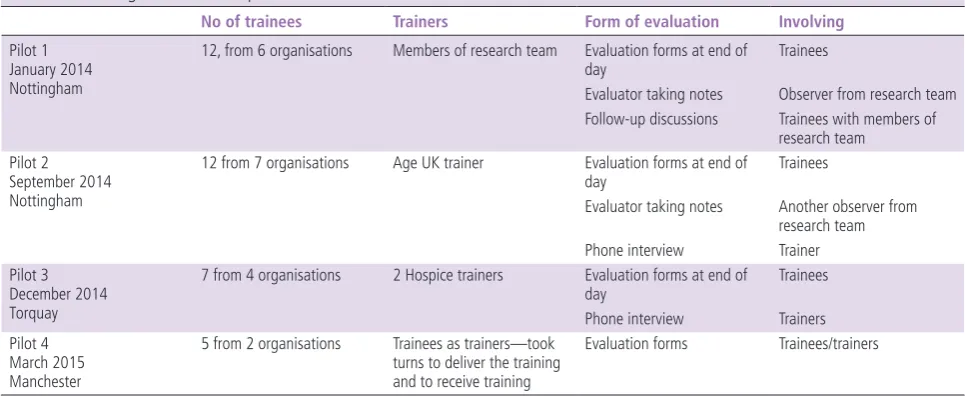
sepa-rate occasions; table 1 shows the stages of the piloting
process and the methods of evaluation used.
As the intention of evaluation was to improve the programme, we used a formative model based on that
of Weston et al.37 38 This involved different evaluation
techniques for the different pilots of the programme, although one method common to each was feedback from trainees. Feedback forms included a short ques-tionnaire and a number of open questions, inviting
trainees to reflect on the day. Table 2 shows some of
the evaluative comments made after the first three pilots of the programme.
Box 2 Principles of supporting.
The principles:
► The supporter is someone who will listen
► The supporter will have an awareness of the palliative approach to care.
► The supporter appreciates the wider context of ‘caring’ and recognises that carers may have a variety of responsibilities.
► The supporter understands that they are part of a larger team of people involved in supporting the carer and the person being cared for.
► The supporter will be aware of his or her own knowledge and skills.
► The supporter and carers are clear about the supporter’s role and that the relationship is constrained by
professional boundaries and contractual obligations. ► The supporter will work within the scope of their own
[image:4.595.56.539.58.256.2]organisation’s policies and procedures. Table 1 Piloting and evaluation process
No of trainees Trainers Form of evaluation Involving
Pilot 1 January 2014 Nottingham
12, from 6 organisations Members of research team Evaluation forms at end of
day Trainees
Evaluator taking notes Observer from research team Follow-up discussions Trainees with members of
research team Pilot 2
September 2014 Nottingham
12 from 7 organisations Age UK trainer Evaluation forms at end of
day Trainees
Evaluator taking notes Another observer from research team Phone interview Trainer Pilot 3
December 2014 Torquay
7 from 4 organisations 2 Hospice trainers Evaluation forms at end of
day Trainees
Phone interview Trainers Pilot 4
March 2015 Manchester
5 from 2 organisations Trainees as trainers—took turns to deliver the training and to receive training
After each pilot and evaluation, the programme was refined. By March 2015, we felt that the programme was approaching completion. It was then sent to four critical readers, who included one of the trainees from the first pilot and three people with specific expertise and knowledge in end-of-life care, for final comments. Researchers then liaised with the School of Health Sciences’ education and technology team, who produced a version of the training programme that was suitable for publishing online.
dissemination event
In February 2015, a dissemination event was attended by 32 interested individuals, representatives of organi-sations and stakeholders. We gave a presentation about the training programme and its development, and then round table discussions were held to gather sugges-tions about the way forward and how the programme should be published. The research partners took a leading role in the discussions, which were facilitated by the research team.
results
The final product is an innovative, introductory training programme for those who support carers
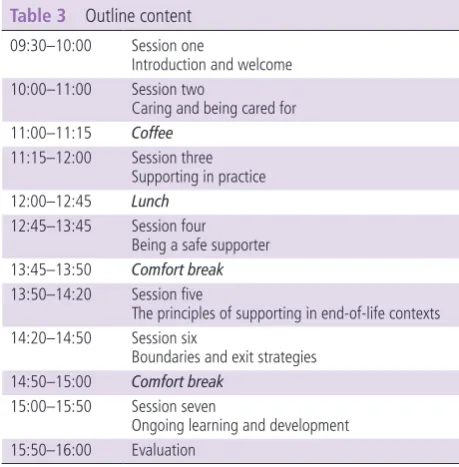
providing home-based end-of-life care. Table 3 shows
the outline content for a 1-day programme. It is designed to allow as much flexibility in delivery as possible so that trainers can adapt to local needs.
The programme, ‘Supporting carers in end of life care: an introductory programme’, was published on 8 September 2015 and is now freely available for use (http://www. nottingham. ac. uk/ helm/ dev/ end_ of_ life/).
Those who wish to view or use the programme are asked to complete a short registration form first; during the first year, 444 people signed up to access the programme.
PArtIcIPAtOry ActIOn revIsIted
The aim of this project was to develop a training programme to equip those supporting family carers providing home-based end-of-life care with the basic skills and knowledge necessary to take on such support with confidence. The intention was to do so through a collaborative participatory action research project, involving bereaved carers, individuals and organisa-tions who may be involved in supporting family carers. As other researchers have discovered, it is not neces-sarily straightforward to secure the participation of individuals who are not accustomed to research involvement, and that a degree of background work is required, for example, in terms of building new
networks and consolidating existing ones.22 25 Our
collaborators were busy people with many other calls
on their time. In addition, as Waterman et al
discov-ered in their work exploring the diffusion of innova-tions in healthcare practice, when the likely outcomes of research are unknown at the start, it is difficult to be sure what partners and collaborators are being asked to sign up to.22
As a research team, we believed that it is important for all voices to be heard in the research process and have
input into the finished product.22 That this happened
[image:5.595.306.536.46.280.2]in our project is testament to the level of commitment from our research partners, carer support workers and third sector organisations. Research partners gave
Table 2 Sample of evaluative comments Pilot 1 Very informative
Resources will be useful
Recognition of things we do well and value of support we give Would have liked more time to discuss—sometimes felt a little rushed
Sometimes felt a bit too general, more specifics would have been helpful
Informative discussions and ability to share best practice Opportunity to discuss difficult topic in appropriate manner without being too sad/upsetting
Pilot 2 Opportunity to think about emotional impact of caring in EOL situations
Presented in a way that did not leave you emotionally drained Whole day has been interesting and informative
More time for talking about how issues may affect people and make it more difficult to support people
The principles were a little confusing to get your head round Information on websites brill!
Reflecting on case studies and networking with participants Pilot 3 Thoroughly stimulating day, which excellently supported
underpinning knowledge of end-of-life carer issues
This would be perfect for carer support workers and dementia advisors in particular
The way the workbook was set out was clear Possibly address carers in a residential setting as well EOL, End of Life.
Table 3 Outline content 09:30–10:00 Session one
Introduction and welcome 10:00–11:00 Session two
Caring and being cared for 11:00–11:15 Coffee
11:15–12:00 Session three Supporting in practice 12:00–12:45 Lunch
12:45–13:45 Session four Being a safe supporter 13:45–13:50 Comfort break 13:50–14:20 Session five
The principles of supporting in end-of-life contexts 14:20–14:50 Session six
Boundaries and exit strategies 14:50–15:00 Comfort break
15:00–15:50 Session seven
[image:5.595.57.290.56.364.2]us key insights into the support that was available to them at the time they were providing care for a family member, and more importantly, with hindsight they recognised the kinds of support that were unavailable to them at the time but which would have been bene-ficial. Carer support workers and their organisations were able to provide insight on the training already available for workers, and how best workers could be prepared for supporting family carers in end-of-life contexts.
cOnclusIOn
In line with other work, we found that the inclusion of culturally relevant stories and the involvement of workers in developing the content, produced a
programme that trainees found accessible.17 The
research partners were active in the project at all stages, but it was still the case that the research was led by academics and that the impetus came from the
research team at the university.27 28
The result of the project is a training programme that is published online and is freely available for individuals and organisations to use. The programme evaluated well as a training session, but this tells us little about the use that trainees make of their new learning after the training day has ended. This high-lights the main limitation to the study, which is that we have no way of knowing how effective the programme will be in terms of improving support for family carers providing care for someone who is dying at home. Future research is therefore needed, including an implementation study to explore whether and how trainees take the learning from the classroom and transfer it into practice. Further work is also required to explore how carers experience the support they receive once their supporter has under-gone the training.
Acknowledgements The authors thank the research partners, advisory group, trainers in pilots, trainees and critical readers.
Contributors All named authors contributed to the project and to the writing of the paper. All authors approved the final version. GC worked as a researcher on the project, liaising with research partners, developing and piloting the training programme. She took the lead in drafting this paper, approved the version to be published and agreed to be accountable for the work. BH worked as a researcher on the project, liaising with research partners, developing and piloting the training programme. She has revised the paper, approved the version to be published and agreed to be accountable for the work. GE made a substantial contribution to the design of the project and worked on the development and piloting of the programme. She has revised the paper, approved the version to be published and agreed to be accountable for the work. SK made a substantial contribution to the design of the project and worked on the development and piloting of the programme. She has revised the paper, approved the version to be published and agreed to be accountable for the work. JS made a substantial contribution to the design of the project and worked on the development and piloting of the programme. She has revised the paper, approved the version to be published and agreed to be accountable for the work.
Funding This work was supported by the Dimbleby Marie Curie Grants Scheme, grant DCMC-RF-12-08.
Competing interests None declared.
Ethics approval University of Nottingham, Faculty of Medicine and Health Sciences Research Ethics Committee.
Provenance and peer review Not commissioned; externally peer reviewed.
Open Access This is an Open Access article distributed in accordance with the Creative Commons Attribution Non Commercial (CC BY-NC 4.0) license, which permits others to distribute, remix, adapt, build upon this work non-commercially, and license their derivative works on different terms, provided the original work is properly cited and the use is non-commercial. See: http:// creativecommons. org/ licenses/ by- nc/ 4. 0/
© Article author(s) (or their employer(s) unless otherwise stated in the text of the article) 2017. All rights reserved. No commercial use is permitted unless otherwise expressly granted.
ReFeReNCeS
1 National End of Life Care Intelligence Network what we know now in 2014. London: Public Health England, 2015. http:// www. endoflifecare- intelligence. org. uk/ resources/ publications/ what_ we_ know_ now_ 2014(accessed Dec 2016).
2 Robinson J, Gott M, Ingleton C. Patient and family experiences of palliative care in hospital: what do we know? An integrative review. Palliat Med 2014;28:18–33.
3 Kristjanson LJ, Aoun S. Palliative care for families: remembering the hidden patients. Can J Psychiatry 2004;49:359–65.
4 Harrop E, Byrne A, Nelson A. “It’s alright to ask for help”: findings from a qualitative study exploring the information and support needs of family carers at the end of life. BMC Palliat Care 2014;13.
5 Holm M, Carlander I, Fürst CJ, et al. Delivering and participating in a psycho-educational intervention for family caregivers during palliative home care: a qualitative study from the perspectives of health professionals and family caregivers. BMC Palliat Care 2015;14:16.
6 Ewing G, Grande G; National Association for Hospice at Home. Development of a Carer Support Needs Assessment Tool (CSNAT) for end-of-life care practice at home: a qualitative study. Palliat Med 2013;27:244–56.
7 Carduff E, Finucane A, Kendall M, et al. Understanding the barriers to identifying carers of people with advanced illness in primary care: triangulating three data sources. BMC Fam Pract 2014;15:48 http://www. biomedcentral. com/ 1471- 2296/ 15/ 48 8 Morris SM, King C, Turner M, et al. Family carers providing
support to a person dying in the home setting: a narrative literature review. Palliat Med 2015;29:487–95.
9 Knowles S, Combs R, Kirk S, et al. Hidden caring, hidden carers? Exploring the experience of carers for people with long-term conditions. Health Soc Care Community 2016;24:203–13.
10 Williams AM, Wang L, Kitchen P. Impacts of care-giving and sources of support: a comparison of end-of-life and non-end-of-life caregivers in Canada. Health Soc Care Community 2016;24:214–24.
11 Lambert SD, Harrison JD, Smith E, et al. The unmet needs of partners and caregivers of adults diagnosed with cancer: a systematic review. BMJ Support Palliat Care 2012;2:224–30. 12 Moriarty J, Manthorpe J, Cornes M, et al. Social care practice
13 Ersek M, Kraybill BM, Hansen NR. Evaluation of a train-the-trainer program to enhance hospice and palliative care in nursing homes. Journal of Hospice & Palliative Nursing 2006;8:42–9.
14 Kwak J, Salmon JR, Acquaviva KD, et al. Benefits of training family caregivers on experiences of closure during end-of-life care. J Pain Symptom Manage 2007;33:434–45.
15 Mayrhofer A, Goodman C, Smeeton N, et al. The feasibility of a train-the-trainer approach to end of life care training in care homes: an evaluation. BMC Palliat Care 2016;15:11. 16 Harding R, List S, Epiphaniou E, et al. How can informal
caregivers in cancer and palliative care be supported? An updated systematic literature review of interventions and their effectiveness. Palliat Med 2012;26:7–22.
17 Naicker SN, Richter L, Stein A, et al. Development and pilot evaluation of a home-based palliative care training and support package for young children in southern Africa. BMC Palliat Care 2016;15:41.
18 Kindon S, Pain R, Kesby M, Participatory research approaches and methods. Abingdon: Routledge, 2007.
19 Bergold J, Thomas S. Participatory research methods: a methodological approach in motion. Forum: Qualitative Social Research 2012;13 http://www. qualitative- research. net/ index. php/ fqs/ article/ view/ 1801/ 3334
20 Larkin M, Richardson E-L, Tabreman J. New partnerships in health and social care for an era of public spending cuts. Health and Social Care in the community 2012; 20: 199-207.10.111/j 2011:1365–2524. 01031.x.
21 Seymour JE, Almack K, Kennedy S, et al. Peer education for advance care planning: volunteers’ perspectives on training and community engagement activities. Health Expect 2013;16.
22 Waterman H, Marshall M, Noble J, et al. The role of action research in the investigation and diffusion of innovations in health care: the PRIDE project. Qual Health Res 2007;17:373–81.
23 Hanson E, Magnusson L, Nolan J, Nolan M. Developing a model of participatory research involving researchers, practitioners, older people and their family carers: an international collaboration. Journal of Research in Nursing 2006;11:325–42.
24 Sanders C, Seymour J, Clarke A, et al. Development of a peer education programme for advance end-of-life care planning. Int J Palliat Nurs 2006;12:216–23.
25 Burns D, Hyde P, Killett A, et al. Participatory organizational research: examining voice in the co-production of knowledge. Br J Manag 2014;25:133–44.
26 Singh AA, Richmond K, Burnes TR. Feminist participatory action research with transgender communities: fostering the practice of ethical and empowering research designs. Int J Transgend 2013;14:93–104.
27 Kesby M, Kindon S, Pain R. Participation as a form of power. In: Kindon S, Pain R, Kesby M, eds. Participatory research approaches and methods. Abingdon: Routledge, 2007:19–25. 28 Whyte WF. Introduction. In: Whyte WF, ed. Participatory
action research. Sage: Newbury Park, CA, 1991:7–15. 29 Kennedy S, Allcroft J, Allen-Perry D, et al. Older carers and
involvement in research: why, what and when? https://www. healthtalk. org/ research/ groups/ srcc/ documents/ projects/ srccproject- report- caring- older- carers. pdf
30 Age UK. Later life in the United Kingdom, 2016. http://www. ageuk. org. uk/ latest- news/ archive/ internet- use- amongst- older- people- shows- northsouth- divide/(accessed Dec 2016). 31 Mason J. Qualitative researching. 2nd ed. London: Sage, 2002. 32 Spalding NJ, Phillips T. Exploring the use of vignettes: from
validity to trustworthiness. Qual Health Res 2007;17:954–62. 33 Ewing G, Brundle C, Payne S, et al. The Carer Support Needs
Assessment Tool (CSNAT) for use in palliative and end-of-life care at home: a validation study. J Pain Symptom Manage 2013;46:395–405.
34 Manthorpe J, Martineau S. Support workers: their role and tasks. A scoping review. London: Department of Health, 2008. 35 NICE. End of life care for adults (QS13), 2011. https://www.
nice. org. uk/ guidance/ qs13(accessed Dec 2016).
36 NHS. Common core competences and principles for health and social care workers working with adults at the end of life. 2nd ed. Bristol: Skills for Care, 2014.
37 Weston C, McAlpine L, Bordonaro T. A model for understanding formative evaluation in instructional design. Educational Technology Research and Development 1995;43:29–48.
support workers and volunteers
research to develop a training programme for
end-of-life care: using participatory action
Supporting family carers in home-based
Seymour
Glenys Caswell, Beth Hardy, Gail Ewing, Sheila Kennedy and Jane
published online August 2, 2017
BMJ Support Palliat Care
17
http://spcare.bmj.com/content/early/2017/08/02/bmjspcare-2017-0013 Updated information and services can be found at:
These include:
References
#BIBL
17
http://spcare.bmj.com/content/early/2017/08/02/bmjspcare-2017-0013 This article cites 23 articles, 1 of which you can access for free at:
Open Access
http://creativecommons.org/licenses/by-nc/4.0/
non-commercial. See:
provided the original work is properly cited and the use is
non-commercially, and license their derivative works on different terms, permits others to distribute, remix, adapt, build upon this work
Commons Attribution Non Commercial (CC BY-NC 4.0) license, which This is an Open Access article distributed in accordance with the Creative
service
Email alerting
box at the top right corner of the online article.
Receive free email alerts when new articles cite this article. Sign up in the
Collections
Topic
Articles on similar topics can be found in the following collections(64)
Open access
Notes
http://group.bmj.com/group/rights-licensing/permissions To request permissions go to:
http://journals.bmj.com/cgi/reprintform To order reprints go to: