City, University of London Institutional Repository
Citation
:
Goold, P. and Bracha, (2016). Copyright Accidents. Boston University Law Review, 96(3), pp. 943-1091.This is the published version of the paper.
This version of the publication may differ from the final published
version.
Permanent repository link:
http://openaccess.city.ac.uk/20412/Link to published version
:
Copyright and reuse:
City Research Online aims to make research
outputs of City, University of London available to a wider audience.
Copyright and Moral Rights remain with the author(s) and/or copyright
holders. URLs from City Research Online may be freely distributed and
linked to.
City Research Online: http://openaccess.city.ac.uk/ [email protected]
1025
COPYRIGHT ACCIDENTS
OREN BRACHA*&PATRICK R.GOOLD**
INTRODUCTION ... 1026
I. COPYRIGHT ACCIDENTS ... 1030
A. The Accident Law Paradigm ... 1032
B. An Anatomy of the Copyright Accident ... 1037
II. SHOULD COPYRIGHT HAVE A NEGLIGENCE REQUIREMENT? ... 1040
A. A Unilateral Model ... 1041
B. A Bilateral Model ... 1045
C. Additional Considerations ... 1051
1. Third-Party Externalities ... 1051
2. Administrative Cost ... 1056
3. Error Cost ... 1058
D. Taking Stock ... 1060
E. Equitable Cultural Risk Allocation ... 1062
III. WHAT SHOULD BE DONE? ... 1070
A. The Implementation Options ... 1070
1. The Prima Facie Case ... 1070
2. Fair Use…. ... 1072
3. Proxy Rules for Negligence ... 1074
4. Taking Stock ... 1078
B. Modifying Fair Use ... 1080
C. Applying the Modified Fair Use Analysis ... 1081
1. The Orphan Works Project ... 1082
2. De Acosta v. Brown and Copyright Triangles ... 1085
3. Field v. Google Inc. and Opt-Out ... 1087
CONCLUSION ... 1090
* Howrey LLP and Arnold, White & Durkee Centennial Professor of Law, The University of Texas. We thank Ronen Avraham, Robert Bone, Christopher Buccafusco, Hanoch Dagan, John Golden, Wendy Gordon, Edward Lee, Peter Menell, Susan Morse, Ariel Porat, Pamela Samuelson, David Schwartz, Talha Syed, Rebecca Tushnet, participants of the IP Scholars Conference, the Copyright Scholarship Roundtable at the University of Pennsylvania Law School, the Inaugural Texas A&M Intellectual Property Scholars Roundtable, the Notice and Notice Failure in Intellectual Property Law Symposium at Boston University School of Law, and the editors of the Boston University Law Review for their invaluable discussions and comments on this Article. Responsibility for errors (and indeed any accidental copyright infringement!) lies with the authors.
INTRODUCTION
Palgrave Macmillan is a highly respected international publisher of academic texts. But strangely, many of their books start with an apology. Open one of their recently published books and within the first pages you are likely to find the following statement: “While every care has been taken to trace and acknowledge copyright, the publishers tender their apologies for any accidental infringement where copyright has proved untraceable.”1 In theory, Palgrave
should always obtain permission before printing copyrighted material, but in practice this is difficult. Frequently they wish to use some expressive material, but it is not clear who owns the rights or even if the work is protected by copyright at all. In these cases, they take “every care” to get the permission and avoid infringement but still sometimes accidents happen and they mistakenly print copyrighted material without authorization. Because copyright holds them responsible for these accidents regardless of how much they tried to prevent them, they offer this boilerplate apology up front. But this raises the question: Should they be legally responsible for all of these accidental infringements? The usual rule in tort law is you are only liable for accidents if you were negligent.2 Run someone over in your car and break their neck, spill
toxic waste in a town center,3 or let your dog bite a neighbor, and you are only
liable if you failed to take “reasonable care” to prevent the accident. So what’s so different about copyright accidents?
Copyright accidents are a ubiquitous and largely ignored problem.4 In all
areas of social life accidents are an enduring and ever-present feature. Frequently we engage in beneficial activities, which, as a byproduct, pose a risk of harm to others around us. Sometimes that risk materializes into a reality
1E.g., RALPH HALL, APPLIED SOCIAL RESEARCH: PLANNING, DESIGNING AND
CONDUCTING REAL-WORLD RESEARCH, at iv (2008); DAVID KIRK ET AL., THE
SOCIOCULTURAL FOUNDATIONS OF HUMAN MOVEMENT, at vii (1996); SOTIRIOS
SARANTAKOS,SOCIAL RESEARCH,at xxiii (4th ed. 2013); see also PENNIE STOYLES &PETER
PENTLAND,THE A TO Z OF INVENTIONS AND INVENTORS 2 (2006)(using similar language). Other publishers often adopt the same language. See, e.g., STEVEN A.FRIEZE, PERSONAL
INSOLVENCY:LAW IN PRACTICE,at iv (2004) (using similar language); JOHN T.MUGAMBWA ET AL.,COMMERCIAL AND BUSINESS ORGANISATIONS LAW IN PAPUA NEW GUINEA, at xi
(2007) (using this language).
2See Brown v. Kendall, 60 Mass. (6 Cush.) 292, 295-96 (1850); see also 2 DAN B.
DOBBS ET AL.,THE LAW OF TORTS §437,at 842(2011);JOHN C.P.GOLDBERG &BENJAMIN
C.ZIPURSKY,THE OXFORD INTRODUCTIONS TO U.S.LAW:TORTS 265-66 (2010) (stating strict liability exists at “the margins of tort” and is applicable in “a few special situations”).
3Ind. Harbor Belt R.R. v. Am. Cyanamid Co., 916 F.2d 1174 (7th Cir. 1990).
4See, e.g., Stephen E. Margolis, Law and Economics of Copyright Remedies, in
and others are injured, although we did not mean for that to happen.5 For
example, driving is a beneficial activity that is on balance good for society. But every time an individual gets behind the wheel of a car, there is a risk that she may crash into someone else and thus cause harm. Copyright is no different. Creating and distributing original expression benefits everyone, but it often comes with risk of infringing upon another’s copyright and harming their economic interests. Consider for example the documentary filmmaker who finds an old photograph. She wishes to use the photograph in her new film, but the photograph has no copyright information on it.6 At this point, she is aware
that using the photograph comes with a risk that it may infringe the copyright of another. If she goes ahead with the use, perhaps that risk will materialize and an aggrieved copyright owner will later appear. Alternatively, consider the computer programmer who incorporates into her program code that has been publicly licensed on open terms. Later it is discovered that the open-source code had become “tainted” with the copyrighted code of another and, by copying the open-source code, the programmer accidentally infringed the prior owner’s right.7 Or finally, think of a library that wishes to digitize a work in its
collection but cannot tell whether it is still under copyright.8 In all of these
cases we find someone who makes a socially beneficial use of an expressive work but creates a risk of infringement. The user does not intend to infringe copyright, but there is a probability that she might. As with all cases of accidental harm, the question for policy makers is: Who should bear the cost of the accident?9 Should it be the person who unintentionally caused it? Or should
it be the victim? In copyright, should it be the user or the owner who bears the harm?
5STEVEN SHAVELL,ECONOMIC ANALYSIS OF ACCIDENT LAW 1 (1987) (“[B]y ‘accidents’ I
mean harmful outcomes that neither injurers nor victims wished to occur—although either might have affected the likelihood or severity of the outcomes.”).
6See, e.g.,Int’l Documentary Ass’n & Film Indep., Comment Letter on the Matter of
Orphan Works and Mass Digitization 38 (May 21, 2014),
http://copyright.gov/orphan/comments/Docket2012_12/International-Documentary-Association%28IDA%29-Film-Independent%28FIND%29.pdf [https://perma.cc/8YNA-23TY]; PATRICIA AUFDERHEIDE & PETER JASZI, RECLAIMING FAIR USE: HOW TO PUT
BALANCE BACK IN COPYRIGHT 95 (2011) (stating that “including copyrighted material
accidently or incidentally in a documentary scene” was “the most galling of the copyright problems” faced by documentary filmmakers).
7See generally First Amended Complaint and Jury Demand, SCO Grp., Inc. v.
Autozone, Inc., No. 2:04-CV-237-RCJ-(GWF) (D. Nev. Aug. 14, 2009), 2009 WL 4834467.
8See, e.g.,Authors Guild, Inc. v. Hathitrust, 755 F.3d 87 (2d Cir. 2014).
9OLIVER WENDELL HOLMES,JR.,THE COMMON LAW 95-96 (1881) (stating the “general
Copyright law has so far responded to accidents through a rule of strict liability.10 It does not matter how much care you take to prevent the accidental
infringement; if you end up transgressing upon copyright entitlements, you will be held liable. Why is this so? A common answer is that copyright is a form of property right and, because property rights are vindicated against violation regardless of fault, the same should hold true in copyright.11 But this is no
answer at all. Copyright has no nature except the one Congress and the courts give it. Whether copyright infringement should require fault or not is a normative question. Answering it requires a serious normative analysis, not empty invocations about the nature of copyright. Other common justifications of copyright’s strict liability are hardly satisfying.12 Although strict liability has
been a deeply seated dogma of copyright for over a century, it has not always been so. Prior to the late nineteenth century copyright did in fact incorporate fault elements.13 Not only was fault a precondition for liability in some
instances, but also a number of safeguards—such as formalities and a narrow scope of the right—were in place to make accidental infringement a rare occasion.14 Paradoxically, these fault elements were phased out in the second
half of the nineteenth century, just as fault was becoming a fundamental element in tort law generally.15 This happened in a context of a highly
conceptualist property thought and under the influence of dominant treatise writers steeped in an understanding of copyright as an absolutist property
10 See, e.g., Buck v. Jewell-LaSalle Realty Co., 283 U.S. 191, 198 (1931); Shapiro,
Bernstein & Co. v. H.L. Green Co., 316 F.2d 304, 308 (2d Cir. 1963); De Acosta v. Brown, 146 F.2d 408, 411 (2d Cir. 1944).
11 See, e.g., Gener-Villar v. Adcom Grp., Inc., 509 F. Supp. 2d 117, 125 (D.P.R. 2007);
Plymouth Music Co. v. Magnus Organ Corp., 456 F. Supp. 676, 680 (S.D.N.Y. 1978); 4 MELVILLE B. NIMMER &DAVID NIMMER, NIMMER ON COPYRIGHT § 13.08 (2015); Kent Sinclair, Jr., Comment, Liability for Copyright Infringement—Handling Innocence in a
Strict-Liability Context, 58 CALIF. L. REV. 940, 945 (1970) (“The concept of absolute
liability . . . appears to have stemmed from the early view that no property was more emphatically a man’s own than his literary works, and that therefore they must be afforded legal protection to the same extent as his real or personal property.” (footnote omitted)).
12 See Dane S. Ciolino & Erin A. Donelon, Questioning Strict Liability in Copyright, 54
RUTGERS L.REV. 351, 353-54 (2002); Jacqueline D. Lipton, Cyberspace, Exceptionalism,
and Innocent Copyright Infringement, VAND.J.ENT.&TECH.L. 767, 775-84 (2011).
13 See Ciolino & Donelon, supra note 12, at 359-62; R. Anthony Reese, Innocent
Infringement in U.S. Copyright Law: A History, 30COLUM.J.L.&ARTS 133, 133-34 (2007).
14 Reese, supra note 13, at 145, 135-75.
15 On the rise of fault in tort, see 1 DOBBS ET AL.,supra note 2, § 123 (describing the
history from 1850 to present); GOLDBERG &ZIPURSKY, supra note 2, at 14-18; MORTON J.
HORWITZ,THE TRANSFORMATION OF AMERICAN LAW,1780-1860, at 97-101 (1977); Robert L. Rabin, The Historical Development of the Fault Principle: A Reinterpretation, 15 GA.L.
right.16 These trends are hardly popular today, but the dogma they created
remains.17
It is time to revisit this entrenched dogma of copyright. This Article questions whether strict liability is the appropriate liability rule for copyright accidents and what its alternatives might be. By identifying copyright accidents as a unique category, it turns the spotlight to a group of cases possessing distinctive features that merit special theoretical and doctrinal treatment. This framing also highlights the structural similarity between copyright accidents and their much more famous cousins: accidents governed by the law of tort. Tort law has a series of well-developed theoretical and doctrinal tools for dealing with such accidents.18 In this Article we apply these tools, mutatis
mutandis, to copyright accidents. We highlight the unique features of copyright accidents, evaluate which liability rule should apply to them, examine the doctrinal alternatives for applying the preferred liability rule, and demonstrate how appropriately modified copyright doctrine would work well in practice.
The Article argues that copyright accidents should be governed by a negligence principle. Comparing the available liability rules in several dimensions, we find that negligence is the superior alternative. The primary advantage of negligence is providing both copyright owners and users optimal incentives to invest in precautionary measures to prevent the infringement. Consequently, as in most tort accidents, the negligence rule is the most efficient way to reduce the social cost of copyright accidents. Furthermore, shifting the normative lens from efficiency to a principle of equitable distribution of cultural risk, we find that a negligence rule would enable broader and more equal access to opportunities for cultural expression. Given these benefits, we propose that a negligence test should be embedded into the fair use doctrine. In cases of accidental infringement, a use that otherwise would be infringing should be fair if the defendant can show she took all reasonable precautions to prevent the infringement. Through examples we demonstrate precisely how this modified fair use doctrine would apply to alleviate several systemic problems in copyright policy.
We undertake this inquiry in three parts. Part I introduces the concept of a copyright accident and explores the similarities between it and tort’s law of
16 See, e.g., Sinclair, supra note 11, at 945. On nineteenth century conceptualist property
thought, see HORWITZ,supra note 15, at 31-62. On the influence of natural property rights
theory on the copyright treatise writers, see Oren Bracha, The Statute of Anne: An American
Mythology, 47 HOUS.L.REV. 877, 913-16 (2010).
17 See Bracha, supra note 16, at 918 (“For the writers of those treatises, that paradigm
was still linked to the grand theoretical and historical narrative of copyright as a property right. . . . But during the twentieth century, that narrative fell into disuse and was gradually cast aside—a crutch no longer necessary for supporting the ownership of intellectual works paradigm it helped to construct.”).
18 See, e.g., MARK A.GEISTFELD,TORT LAW:ESSENTIALS 49-80 (2008); SHAVELL,supra
accidents. Part II examines what is the liability rule most appropriate for copyright accidents. After comparing strict liability with several variants of negligence, it concludes that simple negligence is the optimal rule from perspectives of both efficiency and equitable distribution of risk. Part III analyzes how a negligence principle should be applied in copyright doctrine. Comparing several alternatives, it finds that the preferable option is to modify the existing fair use doctrine to incorporate negligence. The Part concludes by demonstrating how the modified fair use doctrine would apply to specific cases of copyright accidents. Each of the cases represents a more general policy difficulty in copyright law, and the discussion demonstrates how the negligence principle embodied in the proposed doctrine can alleviate these difficulties. The specific policy issues are those of orphan works, copyright triangles, and opt-out options.
I. COPYRIGHT ACCIDENTS
Should copyright have a fault element as a precondition for liability? Before answering this question, a few clarifications are in order. First, our usage of the term fault must be specified. Fault is a slippery concept with many possible meanings. A common broad understanding of fault in tort is as an element of blameworthiness necessary for liability in addition to engaging in a proscribed conduct and causing harm.19 Under this usage, strict liability torts require only
that the defendant engaged in a proscribed conduct and, in some cases, that this conduct caused harm to the plaintiff.20 Under fault-based torts, by contrast,
engaging in a proscribed conduct even if it causes harm is insufficient to give rise to liability. Such torts require an additional element: that the defendant’s conduct was blameworthy under some standard applied to the specific circumstances of the case.21 Under such a capacious definition of fault,
copyright could be easily described as fault-based, as several commentators, including one of us, have argued.22 To establish copyright infringement, it is
19 JULES L.COLEMAN,RISKS AND WRONGS 212 (1st ed. 1992).
20 PETER CANE,RESPONSIBILITY IN LAW AND MORALITY 82 (2002); COLEMAN, supra note
19, at 212.
21 See, e.g., COLEMAN, supra note 19.
22 See Patrick R. Goold, Is Copyright Infringement a Strict Liability Tort?, 30 BERKELEY
TECH. L.J. 305 (2015); Wendy J. Gordon, The Concept of “Harm” in Copyright, in
INTELLECTUAL PROPERTY AND THE COMMON LAW 452 (Shyamkrishna Balganesh ed., 2013);
Steven Hetcher, The Fault Liability Standard in Copyright, in INTELLECTUAL PROPERTY AND THE COMMON LAW, supra, at 431 [hereinafter Hetcher, Fault Liability Standard]; Steven
Hetcher, The Immorality of Strict Liability in Copyright, 17 MARQ.INTELL.PROP.L.REV. 1, 2 (2013) [hereinafter Hetcher, Immorality]; cf. Shyamkrishna Balganesh, The Normativity of
Copying in Copyright Law, 62 DUKE L.J. 203, 206 (2012) (discussing how the
insufficient to show that the defendant copied from a protected work or even that his copying harmed the copyright owner. Copyright infringement requires in addition that the defendant’s actions fail some evaluative standards applied to the circumstances of the case, the two most important ones of which are the fair use standard23 and the requirement that the copying constitutes substantial
similarity.24 Copying, even harmful copying, is not infringement unless it rises
to the level of substantial similarity and fails to be fair use. Given these additional elements, copyright, as it exists today, seems to fit the broad definition of a fault-based cause of action.
We are concerned here, however, with a more specific meaning of the term fault. The fault standard we are focused on takes into account in its normative evaluation of the defendant’s action the fact that at the time of acting, the conduct involved only a probability—not a certainty—of engaging in a proscribed conduct or causing harm. In other words, we are interested in a fault standard that gives due weight to the factor of risk. We are interested in this specific brand of fault because our focus is on copyright accidents—situations that, by definition, involve only ex ante risk of a copyright injury.25 Existing
copyright does not already include a fault standard in this more concrete sense. As a rule, under current law an infringing act is not treated differently just because ex ante the defendant’s conduct involved only a risk of infringement. Existing copyright doctrines could be adjusted to take account of considerations of risk, but as they are conventionally applied today they do not.26
More specifically, our focus is on a negligence fault standard. Under a negligence standard the defendant’s conduct is evaluated for whether it lives up to an objectively defined criterion of reasonable conduct.27 This objective
evaluation of the reasonableness of the defendant’s conduct is usually understood as comparing or balancing the costs and benefits of defendant’s actions.28 For the reasons just explained, our interest is in a negligence
23 See 17 U.S.C. § 107 (2012).
24 NIMMER &NIMMER, supra note 11, § 13.03[A].
25 Seeinfra Sections I.A, I.B.
26 Indeed, we argue below that one major way of implementing a negligence standard in
copyright accident cases is incorporating the fault inquiry into the fair use analysis. Seeinfra
Section II.B.
27 See PETER CANE,THE ANATOMY OF TORT LAW 36(1997); COLEMAN, supra note 19, at
332.
28 The most famous example of which can be found in United States v. Carroll Towing
Co., 159 F.2d 169, 173 (2d Cir. 1947). See also Richard A. Posner, A Theory of Negligence, 1 J.LEGAL STUD. 29, 32 (1972). We do not mean to imply that a nonconsequentialist theory of negligence is impossible. But even deontological scholars have noted that negligence is usually discussed in terms of balancing of competing effects. See, e.g., Heidi M. Hurd, The
Deontology of Negligence,76 B.U. L. REV. 249, 249 (1996) (“It should be a great puzzle to
standard that, in balancing these costs and benefits, gives due weight to the fact that at the time of her actions the defendant’s conduct entailed only a risk of harm. There are other fault standards in tort, such as intention or recklessness.29 Indeed, the peripheral areas of copyright law that involve
explicitly articulated fault requirements include standards that seem closer to these other alternatives than to negligence. Criminal copyright liability requires willfulness30 and the range of statutory damages varies on the basis of the
infringement being willful or innocent.31 We do not mean to rule out the
desirability of applying such alternative fault standards in certain contexts of copyright infringement. Justifying a fault standard requires an articulation of a normative rationale for the standard and for its applicability to the case at point. We undertake this inquiry in regard to cases of copyright accidents where negligence seems the most appropriate standard. We leave the evaluation of other fault standards in other contexts for another day.32
A. The Accident Law Paradigm
Recall the example in the introduction of a computer programmer who unknowingly copies substantial parts of copyrighted code. Assume that under ordinary circumstances such copying should be deemed infringing. That is, assume that copyright in computer programs is generally justified, that what was copied was substantial enough to pass the infringement test applied by courts to computer programs33 and that the copying is not otherwise fair use.34
Given these assumptions, if the programmer simply knowingly copied the code, aware of a high probability that the code is under copyright and that the
and certainly most clearly, defined in the moral language common to consequentialists.”);
see also George P. Fletcher, Fairness and Utility in Tort Theory, 85 HARV.L.REV. 537
(1972) (associating the “paradigm of reasonableness” with the dominant instrumentalist and utilitarian philosophy in U.S. tort scholarship).
29 The common distinction is between state of mind fault standards, which require the
defendant to have a specific subjective attitude toward his harmful conduct, and standard of conduct fault, which requires that the defendant’s behavior fail an objective evaluative criterion, irrespective of his state of mind. Negligence is the prime example of the latter, while intention and recklessness are usually classified as members of the former group. See
CANE, supra note 27, at 36.
30 See 17 U.S.C. § 506(a) (2012). 31 Seeid. § 504(c)(2).
32 Some commentators have argued for an intentional fault standard in copyright. See,
e.g., Ciolino & Donelon, supra note 12, at 420-21; Lipton, supra note 12, at 801-08; see also Eva E. Subotnik, Intent in Fair Use,18 LEWIS &CLARK L.REV. 935 (2014).
33 See 17 U.S.C. § 102(b); Comput. Assocs. Int’l, Inc. v. Altai, Inc., 982 F.2d 693,
707-09 (2d Cir. 1992) (considering the necessity and efficiency of particular programming instructions coding in their infringement analysis).
34 See Sega Enters. Ltd. v. Accolade, Inc., 977 F.2d 1510, 1520-28 (9th Cir. 1992); see
owner is unlikely to permit the use, then it would be easy to agree that she had committed an infringement.
However, our case is not an ordinary one. In our example the programmer was not aware that she was engaged in unauthorized copying of a copyrighted work. There are many ways in which one could copy unknowingly. In our example the defendant copied code that is “tainted” by the proprietary code of another. The copied code was made available to the public by A its creator under a general license allowing copying and use as long as certain minimal conditions are met. Incorporated into this code, however, were substantial parts of another copyrighted program written by B, who never agreed to this copying or to further copying by others. Our programmer thus did not only knowingly and permissibly copy A’s code, but also unknowingly and impermissibly copied B’s code. Existing copyright law treats such copying by derivation the same as any other copying, and therefore it seems that the original conclusion does not change—our programmer should still be deemed an infringer.35 But
something has changed. Our example is different from a typical knowing infringement case because, from the point of view of the programmer, her actions created only a risk of infringement. To be sure, a reasonable person engaged in copying of publicly licensed code should know that there is some probability that the code is “contaminated” with proprietary unlicensed code. She should know, in other words, that her action creates a risk of infringement. As long as the probability of the occurrence of the infringement is not so high as to practically approach certainty, however, the programmer’s action only creates a risk. That it later turns out that the risk materialized and an unlicensed copying had occurred does not change the fact that ex ante, as far as the programmer knew or should have known, her action entailed only a risk. This is a paradigmatic case of a copyright accident.
How should such copyright accidents be dealt with? Should the legal treatment of otherwise infringing activities be any different when ex ante the relevant action entails only a risk of infringement? One familiar response is that no special legal treatment of such cases is necessary because voluntary exchanges will adequately dispose of the problem of optimal risk allocation. According to this view, the role of copyright law (as of other property regimes) is to adequately allocate entitlements to copyright owners and ensure that the entitlements are clear and easily applicable as to facilitate transactions between
35 See NIMMER &NIMMER, supra note 11, § 13.08[A]; 3 WILLIAM F.PATRY,PATRY ON
such owners and others.36 Those who wish to engage in activities within the
owner’s exclusive rights can negotiate voluntary transactions with them. In principle, the same wisdom applies to activities that impose a risk of copyright infringement. Those who wish to engage in such risk-inducing activities can enter voluntary transactions with copyright owners in order to optimally allocate the risk they create.
Recently, Avihay Dorfman and Assaf Jacob have eloquently explained why this response is inadequate in the context of copyright.37 The domain of
copyright, they argue, is much closer to “accident law” than to the “paradigm of trespass.”38 This is so because in the domain of copyright, as in the former
and unlike the latter, in many cases transaction costs of voluntary transactions between owners and others will be very high. As a result, simply creating clear entitlements that are infringed upon any voluntary transgression and relying on market transactions for their transfer as in the trespass context is not a viable option. Due to the high transaction costs, the market will not take care of it. Dorfman and Jacob trace the high transaction costs often associated with copyrighted works to what they call the circumstances of “intangible property.”39 These circumstances arise from a combination of the traits of
expressive works and the underlying legal framework.
There are four main features of expressive works that account for the high transaction costs associated with them.40 The first is elusive boundaries. It is
often hard to ascertain whether and when the boundaries of an expressive work have been transgressed. Commentators often blame these elusive boundaries
36 See, e.g., Avihay Dorfman & Assaf Jacob, Copyright as Tort, 12 THEORETICAL
INQUIRIES L. 59, 84-85 (2011) (describing situations in which the law seeks “to channel the parties into a market transaction”). Note that the view described in the text is not tantamount to saying that copyright entitlements should be absolute or unlimited. Copyright involves an optimal balance between the incentive benefit produced by exclusive rights and the inescapable access costs associated with such exclusive rights. One may concede that the scope of copyright’s exclusive rights must reflect this balance and yet argue that once this optimal scope is established accident situations should be dealt with by strict application of these rights aimed at facilitating private transactions.
37 Id. at 84-86 (explaining why a “use the market” approach fails to remedy copyright
accident “either because there is no market or because the costs of reaching an arm’s-length transaction are prohibitive”).
38 Id. at 86. This formulation may imply that, in the context of tangible property or at
least in the subset of cases covered by trespass today, the trespass approach is necessarily justified. This is not the position of Dorfman and Jacob and it is certainly not ours. We argue here that the accidents approach fits copyright while leaving open the possibility that it also fits various contexts of tangible property, including some that fall today within the trespass category.
39 Id.
on the law.41 A long list of features of copyright law—the denial of protection
to factual and functional subject matter, the scènes à faire doctrine that allows the copying of stock expressive elements, the substantial similarity requirement as a precondition for infringement, and the distinction between protected expression and unprotected ideas to name but a few—often make the determination of whether the protected boundaries of a copyrighted work had been transgressed a complex and uncertain enterprise.42 Arguing for a fault
standard in infringement on the basis of a reasonable mistake in applying the relevant law gives rise to a variety of thorny and complex questions. Here we prefer to avoid this minefield by bracketing the question of copyright accidents traceable to the uncertainties of applicable law. Even laying legal uncertainty aside, in a significant number of cases transgression upon the boundaries of copyrighted works remains hard and costly to ascertain. A classic illustration is our programmer example above. In cases such as this, it is difficult for the user to determine whether her planned use will involve any copying of protected expressive material, even before she considers whether that copying actually rises to the level of a legally prohibited transgression.
A second feature that makes transacting over copyright entitlements costly is the often uncertain legal status of the work.43 Even when one knows that she
is copying, it may be difficult to find out whether, as a factual matter, the copied work is under copyright protection. Consider the case of an artist who combines in her visual collage a found old black and white photograph that bears neither copyright notice nor any other meta-information. Is this photograph in the public domain or under copyright protection? Answering this question is likely to involve costly factual inquiries. These difficulties are exacerbated by the background rules of copyright including the very long copyright term and the fact that registration, affixing of notice, and recordation of assignments are all optional.44
Then there is the fact that in many cases, even when one can assume that the boundaries of a copyrighted work are being transgressed, there may be a
41 See, e.g.,Ciolino & Donelon, supra note 12, at 381-84; Lipton, supra note 12, at 776;
cf. Dorfman & Jacob, supra note 36, at 87-88.
42 Dorfman & Jacob, supra note 36, at 88 (listing examples in which “the protected
story, or to be more exact, the author’s rights in it, are not delineated in a very clear manner, the story’s spatial boundaries are missing, and there is no clear signal to the user about what is protected and what is not”).
43 Id. at 88-90 (recognizing that “unlike tangible property, where . . . a general
assumption of ownership over objects” is “prevalent and embedded in the system[,]” the same “general assumption of ownership over objects—in the area of copyrights . . . cannot hold”).
44 See Ciolino & Donelon, supra note 12, at 384-85; Dorfman & Jacob, supra note 36, at
plausible doubt about whether the use at issue is permitted by the owner.45
Many copyright owners are happy to allow various uses of their works. Take, for example, Google’s full digital reproduction of the text of books as a necessary step in making them digitally searchable by a search engine open to the public.46 Some copyright owners would object to such a use of their works,
others would be agnostic, and many others for a variety of reasons would endorse such a use.47 Sometimes the owner’s attitude would be clear from the
context or from meta-information attached to the work, but in many cases it would not. Copyright’s very weak filters fuel this difficulty. Because modern copyright extends to any work that shows minimal originality automatically upon fixation, a vast number of works are protected and there is much heterogeneity in the circumstances of the works, their owners, and the surrounding context.48 The result is that often the owner’s preference in regard
to a particular use is neither obvious nor trivial to ascertain.
Finally and relatedly, ascertaining the identity of the copyright owner— which might be the key for uncovering other pertinent information—may often be costly.49 Copies of expressive works often circulate without clearly
declaring their owners or how to find them. Again, this difficulty is exacerbated by copyright’s background rules, including its broad sweep, long duration, the complex rules of authorship and ownership, and the fact that registration, notice, and recordation of transfers are all voluntary.50
All of these circumstances mean that in many cases the costs associated with transactions over entitlements will be high and even prohibitive. Although this proposition is not always true, it is true often enough to make a sweeping reliance on market transactions unattractive.51 In this respect copyright is
45 Dorfman & Jacob, supra note 36, at 90-92 (calling this the “object sociability”
circumstance of intangible property).
46 See Authors Guild, Inc. v. Google Inc., 954 F. Supp. 2d 282 (S.D.N.Y. 2013), aff’d,
804 F.3d 202 (2d Cir. 2015), cert. denied, 84 U.S.L.W. 3357 (2016).
47 See Brief of Amici Curiae Academic Authors in Support of Defendant-Appellant and
Reversal at 1, Authors Guild, Inc. v. Google Inc., 721 F.3d 132 (2d Cir. 2013) (No. 12-3200-cv), 2012 WL 5902375 (expressing the position of academic authors who “want the Google Books project to continue to provide public access to snippets from our books and from those of other academic authors”); Oren Bracha, Standing Copyright on Its Head? The
Googlization of Everything and the Many Faces of Property, 85 TEX.L.REV. 1799, 1834
(2007).
48 Dorfman & Jacob, supra note 36, at 88-89; Christopher Sprigman, Reform(aliz)ing
Copyright, 57 STAN.L.REV. 485, 515-16 (2004) (discussing the effects of “unconditional
copyright”).
49 Dorfman & Jacob, supra note 36, at 92-93. 50 Bracha, supra note 47, at 1824-25.
51 To be sure, this point is not entirely new to copyright lawyers. Wendy Gordon argues
similar to tort law, which typically deals with the allocation of risks between individuals in situations where transaction costs of private agreements are high.52 But concluding, as Dorfman and Jacob do, that in such a case the law
should optimally allocate entitlements and risks between parties rather than count on voluntary transactions to do so53 is only the first step. This conclusion
does not answer the next question precipitated by it, namely: How should the law allocate the risk between relevant parties? At this point, the relationship between copyright accidents and tort’s law of accidents acquires new significance. The law of accidents provides not just the basic conclusion that a legal standard is required, but also a well-developed, normative-analytical framework for deciding what this standard should be. Before turning to the application of this framework to the copyright context in the next Part, a more detailed elaboration of the common structure of traditional accidents and copyright accidents is required.
B. An Anatomy of the Copyright Accident
What then are the essential characteristics of a copyright accident? First and foremost, copyright accidents occur when, at the time of the decision to copy, the user is aware only of a probability of infringement rather than a certainty. To be sure, absolute certainties are rare. Even someone who makes a verbatim copy of an in-print copyrighted novel bearing a recent copyright notice for purposes of direct commercial competition might argue that there is some
miniscule probability that the copyright owner would not mind and hence that an injury is not certain to follow. There is however a pragmatic line that divides cases where the probability of injury is high enough to be practically treated as a certainty from cases of substantial probability where ex ante the activity at issue poses only a risk of injury.
Cases of ex ante risk are ubiquitous in copyright and they come in different forms. Consider the following examples. A musician is sued for allegedly basing the tune of his composition on another popular song. The court determines as a factual finding that the musician did not consciously copy, but that, given the popularity of the original song and degree of similarity, the most plausible inference is that the musician unconsciously derived his tune from
Analysis of the Betamax Case and Its Predecessors,82 COLUM.L.REV.1600(1982).In this
interpretation, fair use exists to allow participants to bypass the market when voluntary transactions would lead to sub-optimal welfare results. Id. at 1601. However, as we show later, the current fair use doctrine does not achieve this goal in accident cases because it fails to take into account the fact that ex ante there is only risk of infringement. See infra notes 187-89 and accompanying text.
the original song.54 A filmmaker obtains permission to combine in the
soundtrack of his documentary about a 1970s underground singer several songs by said singer. After the documentary attains surprising success, a third party materializes and claims that the lyrics were actually largely copied by the singer from the third party’s unpublished poems and that as a result the documentary infringes his copyright.55 In her book manuscripts, a historian of
design includes photographs from 1930s European magazines of items designed in art deco style. The photographs as they appeared in the magazine contained neither notice nor any meta-information. After publication, the historian’s publisher receives a letter from a person claiming to be the heir of the photographer and copyright owner of the photographs and demanding substantial compensation for any past and future use of the images. An architect produces architectural plans for a client’s house. The plans are derived from rough drafts provided by the client. The client plausibly explains that she made the drafts. After the structure is built, a third-party architect files suit against the firm claiming that the drafts were actually made by him in the course of previous dealings with the client.
In all of these cases we have an injurer user and a victim copyright owner who suffers an injury. But in all of these cases ex ante—at the time of the relevant action from the point of view of the user—the action involved only a
probability of injury to the copyright owner. The user knew or at least should have known that his actions entailed a risk of an injury. But, just as in other accidents, it was only a risk, not a certainty, of which she should have been aware. In copyright accidents ex ante uncertainty is traceable to the incomplete information available to the user.56 If the actors in each of the examples above
had complete information about all relevant factors, including the work’s legal status, the fact of copying, and the identity and preference of the copyright owner, they would have certainty about the injury caused by their actions. The lack of such complete information is what makes the injury only a risk.
Now consider how the risk of infringement alters the normative evaluation of a user’s conduct. From an efficiency perspective, copyright is a measure for ensuring optimal incentives for creation under conditions where creators’ inability to exclude copiers and the low cost of copying compared to creation are likely to significantly erode these incentives.57 Copyright always comes,
however, with a price tag in the form of an inefficient restriction on access to existing works, both for purposes of consumption and for purposes of future
54 See Bright Tunes Music Corp. v. Harrisongs Music, Ltd., 420 F. Supp. 177 (S.D.N.Y.
1976).
55 The hypothetical is inspired by the different facts of Gomba Music, Inc. v. Avant, 62 F.
Supp. 3d 632 (E.D. Mich. 2014).
56 Arguably this is ultimately true of all accidents.
57 See Glynn S. Lunney, Jr., Reexamining Copyright’s Incentives-Access Paradigm, 49
creation.58 Therefore efficiency’s touchstone for optimal copyright is the
proper balance between copyright’s incentive benefits and access costs. More specifically, its creed is bestowing on the copyright owner only exclusive rights whose incentive benefit clearly outweighs their access cost.59 Returning
to our context, assume that in each of the examples of copyright accidents above the injury is such that if done under conditions of ex ante certainty, it should be deemed infringing. This means that including this action within the scope of the exclusive rights of the copyright owner generates more incentive benefit than access cost. It does not follow from this assumption, however, that the same cost/benefit analysis conducted when there is only a risk of injury would lead to the same conclusion. Looking at the question ex ante from the point of view of the injurer, now his action involves only a risk of injury and therefore a discounted expected harm. Being able to exclude others from a certain injurious action is worth more to the copyright owner and therefore generates more incentive for creation than being able to exclude others from actions that generate mere risks of the same injury. The discounted expected harm of the injurer’s actions, under conditions of risk and the corresponding discounted incentive benefit of prohibiting it, open for reevaluation copyright’s basic cost/benefit calculus.
At this point it should be easy to see that copyright accidents pose the dilemma famously described by Ronald Coase as standing at the heart of tort law.60 Coase argued that the question of social cost is not how to restrain A
who inflicts harm on B. Because potentially tortious acts often involve legitimate and useful activities that harm or risk harming others, restricting such activities is itself harmful.61 Restraining a factory from operating because
it inflicts harm on fishermen by polluting a stream inflicts harm on the factory by preventing (or raising the cost of) its manufacturing activity. The problem is one of “a reciprocal nature”: Should the law avoid the harm to B by inflicting harm on A, or vice versa?62 Copyright accidents (like accidents in general) are
a private case of this dilemma. Injurers, such as the musician, the documentarian, the historian, and the architect in the examples above, are engaged in beneficial activities that impose a risk of harm on others. Restraining such activities to avoid their risk will impose harm on those who engage in them and on those who benefit from them. “The problem is to avoid the more serious harm.”63 The feature that distinguishes accident cases is that,
having decided that certain activities are worth restraining when injurious
58 Id.
59 William W. Fisher III, Reconstructing the Fair Use Doctrine, 101 HARV. L.REV.
1659, 1703-04 (1988).
60 R.H. Coase, The Problem of Social Cost, 3 J.L.&ECON. 1 (1960). 61 Id. at 2
effects are certain to follow from them, it does not follow that the same activities are worth restraining when they entail only a risk of similar injurious effects. An action that entails a ten percent risk of copying someone’s work should be evaluated differently than an action that is certain to do so, just as taking a drive that entails a ten percent risk of hitting somebody is evaluated differently than taking the same drive when it is known for certain that someone will be hit.
The last general lesson from the realm of accident law, whose applicability becomes apparent once we reconceive the copyright accident as such, is the concept of cost-effective prevention. Accident law, the maxim is often repeated, is not about perfect prevention of harmful activities. The logic underlying this law is rather that of cost-effective prevention.64 The law is
shaped with the purpose of giving those actors who are best situated to prevent accidents incentives to invest optimally in their prevention; that is, to invest up to the point where the marginal benefit of prevention equals the marginal cost of the precautions. To put it bluntly, as Guido Calabresi did, we consciously tolerate a certain level of accidents because of our prediction that the cost of eliminating them will be much greater than the benefit.65 The same applies to
the law of copyright accidents. In each of the examples above the copyright injurers could have avoided the injury to the victim. They could have taken precautions, usually in the form of investment in uncovering the lacking information about the fact of copying, the work’s status, or the copyright owner’s identity and preference. Alternatively the injurer could have forgone his action altogether, thereby eliminating the risk associated with it. Each of these preventive measures, including forgoing the risk-inducing action, has a cost. As with accident law in general, the purpose of copyright accident law should not be the elimination of copyright accidents. Nor should it have a unitary focus on the user and the preventive measures available to him. The goal of copyright accident law should be giving all relevant actors optimal or cost-justified incentives for the prevention of accidents. Among other things, it is likely that the result of such a criterion will be tolerating ex post a certain amount of injurious activities that under non-accident circumstances are deemed infringing.
Armed with these basic insights from the realm of accident law—about risk, the optimal allocation of social cost, and optimal preventive incentives—we proceed to examine in detail the appropriate legal treatment of copyright accidents.
II. SHOULD COPYRIGHT HAVE A NEGLIGENCE REQUIREMENT?
Whether copyright accidents should be governed by a negligence standard is a normative question. Answering it requires a normative framework. The bulk
of our analysis adopts economic efficiency as its normative guiding light. At the end of this Part, however, we switch our normative lens from efficiency to several competing normative frameworks that share a family resemblance: self-determination, cultural democracy, and human flourishing. The analysis reveals that copyright accidents should be governed by a negligence rule. After comparing strict liability with several variants of negligence, we find that a simple negligence rule is optimal from both efficiency and equitable distribution of risk perspectives.
A. A Unilateral Model
Starting with brutally simplified assumptions, postulate that copyright accidents always involve a unilateral model and that the only available legal rules are strict liability and negligence. A unilateral model means that only one party—in this case, the injurer—can take effective precautions against the harm. As a result, the only relevant question is which legal rule will incentivize the injurer to invest optimally in accident prevention.
Under a strict liability rule, an injurer is liable whenever he engaged in a proscribed activity that caused damage to the victim.66 The strict liability rule
requires neither the balancing of the parties’ interests nor consideration of whether ex ante the injurer’s actions entailed only a risk. The translation of strict liability into copyright doctrine is straightforward. Under this rule a defendant would be liable whenever his action falls within the exclusive right of the copyright owner and is not shielded by one of copyright’s exemptions or defenses.67 That the infringement was an accident has no relevance under this
rule.
By contrast, establishing liability under a negligence rule requires more than showing that the injurer engaged in a proscribed conduct that caused harm. Here liability also requires that the injurer’s conduct fail a case-specific normative evaluation often referred to as the reasonable person standard.68
Within the efficiency framework it is universally accepted that the criterion for evaluating the injurer’s conduct under the reasonable person standard is comparing the costs and benefits of the preventive measures available to him
66 GOLDBERG &ZIPURSKY, supra note 2, at 90.
67 As explained above, existing copyright doctrine has an extra wrinkle that complicates
the traditional distinction between strict liability and negligence. Arguably, because copyright infringement is subject to case-specific balancing formulas embodied in the fair use doctrine and the improper appropriation requirement, it does not conform neatly to the definition of strict liability. Seesupra text accompanying notes 22-24. It is clear, however, that existing copyright does not subject infringement to a negligence standard because its balancing mechanisms do not take into account circumstances where ex ante there is a mere risk of infringement. Therefore, existing copyright may be described as a hybrid standard, located in between the ideal models of strict liability and negligence.
ex ante at the time of his conduct.69 The injurer is liable only if he failed to
take a cost-justified preventive measure. This criterion is operationalized through the famous Learned Hand formula commonly formalized as: B<PL.70
In this formula B represents the marginal cost (“the burden”) to the injurer of taking a certain precaution, L represents the marginal loss to the victim that would be avoided by that precaution, and P represents the probability of that loss occurring. Under the Hand formula an injurer is negligent, and therefore liable, only when she failed to take a precaution whose marginal benefit in reducing the expectancy of harm outweighs its marginal cost.71
Translating the negligence standard into copyright terms requires some explication. As in the general Hand formula, the negligence calculus must be applied ex ante, meaning, at the time at which the injurer undertook the relevant conduct. The burden on the injurer would be the cost of a relevant preventive measure, such as trying to ascertain a work’s legal status, detect unknown copying, or uncover the identity of a copyright owner and discovering her preference. To the extent there is a claim that a possible preventive measure was forgoing the injurer’s activity altogether, the cost of that measure would be the opportunity cost of such forbearance. On the other side of the formula the marginal loss avoided must be discounted by the probability, at the time of the conduct, of the injury occurring. The tricky question is: What is the loss that should be avoided? In terms of copyright policy, this is not the ex post private damage suffered by the copyright owner, such as lost sales or forgone licensing fees. The real loss is the negative incentive effect on creation that such private loss might have. In other words, what matters in terms of public policy is the extent to which (if any) the private loss suffered by the copyright owner (at t1) might reduce the incentive to create by those who anticipate such potential injury (at the later time of t2).72
For simplicity of analysis, we will assume that the owner’s private loss (at t1) is a suitable proxy for the lost incentive to create (at t2). Thus, a negligence standard in copyright would compare the cost of the user’s precautions against the expected private harm to the owner.
In a unilateral model, a strict liability and a negligence rule would create equally optimal preventive incentives to the injurer and as a result strict
69 WILLIAM M.LANDES &RICHARD A.POSNER,THE ECONOMIC STRUCTURE OF TORT LAW
63-64 (1987).
70 United States v. Carroll Towing Co., 159 F.2d 169, 173 (2d Cir. 1947); see COOTER &
ULEN, supra note 50, at 349-51; LANDES &POSNER, supra note 69, at 85.
71 See Carroll Towing, 159 F.2d at 173.
72 But see Glynn S. Lunney, Jr., Fair Use and Market Failure: Sony Revisited,82 B.U.
L. REV.975,1014(2002)(highlighting the danger of relying on the owner’s private harm as
liability is preferable.73 Under a negligence rule the injurer would invest only
in cost-effective precautions. If a precaution is cost-effective, the injurer is required to take it to avoid liability, and he will take it because (assuming full compensatory damages) the expected amount of damages is greater than the cost of the measure.74 If a precaution is not cost effective, the injurer is free
from the risk of liability and he has no incentive to take it. Perhaps more surprisingly, a strict liability rule will lead to the same results.75 Under a strict
liability rule the injurer is liable for any damage caused by him. But this does not mean that the injurer has an incentive to take any prevention measure. Expecting to internalize the damage, the injurer would only take measures whose cost is smaller than their marginal effect on the expected loss.76 From
his perspective, better to incur a risk of liability than invest in a preventive measure whose benefit in reducing the expected harm is outweighed by its cost.
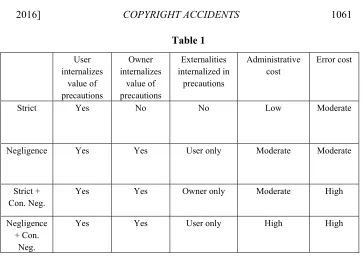
If both rules are expected to yield identical preventive outcomes, why is strict liability preferable? Because the different rules have other effects that make strict liability superior. The two most prominent ones are administrative cost and error cost. Administrative cost is the cost of resolving disputes incurred by both the parties and any institution involved, such as a court.77
Error cost is the cost produced by suboptimal incentives created by a legal standard whose content and application inaccurately track the underlying policy.78 It is commonly assumed that because negligence requires a complex
determination based on much more contextual information, strict liability involves significantly lower administrative and error costs.79 As we argue
below, these assumptions are overstated.80 Nevertheless, it is plausible that
negligence is a more costly legal standard overall. Therefore, if, as the unilateral model shows, strict liability leads to the same incentive effects as negligence, strict liability should be preferred.
73 See SHAVELL,supra note 5, at 181-82. 74 Id. at 180.
75 Id. at 179-80.
76 In the context of copyright, this is a gross over-simplification because compensatory
damages are not the only remedy for copyright infringement. Statutory damages and disgorgement of profits are generally available to plaintiffs. See 17 U.S.C. § 504(b)-(c) (2012). Because these remedies are expected to be selected when their value exceeds compensatory damages, the result is distortion of preventive incentives. As a rule, under strict liability, injurers who face supra-compensatory damages, as in copyright, will sub-optimally over-invest in prevention. Seeinfra text accompanying notes 138-40.
77 COOTER &ULEN, supra note 52, at 359-61. 78 Id. at 353-58.
79 See id. at 356, 360; SHAVELL, supra note 5, at 264.
Under a charitable reading, in the few instances where courts and commentators tried to justify copyright’s existing strict liability rule in policy terms, they had in mind reasoning similar to the one just explained. Such courts and commentators argued that infringers are in a better position to prevent the accidental infringement and that a strict liability rule would incentivize them to do so.81 The argument that copyright infringers are always
better situated to avoid copyright infringement is a version of the unilateral model. In effect, it says that typically it would be only the infringer who can take effective measures to avoid the accidental infringement and therefore a strict liability rule would produce the same incentives as a negligence one with lower administrative and error cost.82
However, copyright accidents typically do not fit the mold of the unilateral model. In many cases copyright owners can take their own preventive measures to avoid or at least reduce the risk of accidental infringement. Copyright owners could for example utilize the voluntary measures of copyright registration, notice and recordation of transfers, in order to make up-to-date information better accessible to others.83 Similarly, owners can often
attach other meta-information about the work’s status or their preferences to copies of the copyrighted work.84 In cases such as mass digitization projects,
users of potentially copyrighted works often give owners an easy, well-publicized, and cheap opportunity for opting out from a particular use of their works. Owners can take advantage of this opportunity and remove the informational fog shrouding their work and preferences.85 Owners also often
have available preventive means in cases like the computer code or song lyrics copied by derivation from a third party who has illegally incorporated the protected work into his own work or misrepresented his rights in regard to the
81 See Shapiro, Bernstein & Co. v. H.L. Green Co., 316 F.2d 304, 308 (2d Cir. 1963);
Gener-Villar v. Adcom Grp., Inc., 509 F. Supp. 2d 117, 125-26 (D.P.R. 2007); see also
ALAN LATMAN &WILLIAM S.TAGER, STUDY NO.25:LIABILITY OF INNOCENT INFRINGERS OF
COPYRIGHT, in STAFF OF S. COMM. ON THE JUDICIARY, 86TH CONG., COPYRIGHT LAW
REVISIONS: STUDIES NO. 22-25, at 155-57 (Comm. Print 1960); 2 PAUL GOLDSTEIN,
GOLDSTEIN ON COPYRIGHT § 11.4 (3d ed. 1989); NIMMER &NIMMER, supra note 11, § 13.08[B][1]; Sinclair, supra note 11, at 952.
82 Of course, one may disagree with the proposition that the infringer is typically better
situated to prevent the accidental infringement. See Ciolino & Donelon, supra note 12, at 378-85.
83 See 17 U.S.C. §§ 205, 401, 408 (2012).
84 For example, enabling owners to indicate their preferences to users was a major
impetus behind the Creative Commons licensing framework. Creative Commons offers six different licenses, each of which conveys to the user what uses the owner will permit. By attaching the relevant “Commons Deed” (a logo that indicates which license covers the work), all users receive a clear signal of the owner’s preferences. See About the Licenses, CREATIVE COMMONS, http://creativecommons.org/licenses/ [https://perma.cc/H8TE-HZ8B].
protected work. In such cases owners can often move expeditiously and effectively against the third party, thereby removing the hazard created by him for accidental infringement by others. In appropriate cases owners can effectively “spread the word” about such hazards created by illegal or misrepresenting uses of their works. The variations are many and the list could be extended, but the principle should be clear: copyright owners often have at their disposal effective preventive measures for reducing the risk of accidental infringement of their works.
This is not always true. In some instances, there may truly be no preventative measures available to the owner. For example, in a standard case in which a musician unconsciously copied a popular copyrighted song in writing his own tune, it is hard to imagine what effective preventive measures the copyright owner could have taken.86 But it hardly seems controversial to
assume that the typical case in copyright accidents is one in which the copyright owner has some preventive means at her disposal. Furthermore, in some instances the user may be better placed than the owner to prevent the accident. But note, the critical question distinguishing a unilateral from a bilateral model is not: Who is better situated to prevent the accident? It is, rather: Can both injurer and victim take meaningful (non-duplicative) preventive measures?87 Perhaps it is the case that in most copyright accidents
as between the user and the owner the former is better situated to prevent the accident. But it is certainly the case that in many copyright accidents copyright owners could take some meaningful, non-duplicative measures to reduce the risk of infringement.
Under such circumstances the inquiry is no longer which legal rule would optimally incentivize potential injurers to take precautions. Nor is it about how to optimally incentivize the party who is better situated to prevent the accident. The question becomes how to incentivize both potential injurers and victims to optimally invest in prevention. In many cases the optimal overall preventive strategy would be one that combines precautions taken by both of these parties. The search is for a legal rule that would incentivize both injurers and victims to undertake available cost-effective precautions. Locating such a rule requires an analysis under a bilateral model.
B. A Bilateral Model
When effective preventive measures are available to both potential injurers and victims, a negligence standard is generally superior to strict liability in
86 See Bright Tunes Music Corp. v. Harrisongs Music, Ltd., 420 F. Supp. 177 (S.D.N.Y.
1976).
87 See SHAVELL, supra note 5, at 18 (“[B]oth injurers and victims generally ought to do
creating optimal prevention incentives.88 The reason is that under strict liability
the victim has little to gain from taking preventive measures. Strict liability will cause, for example, a user encountering a work of uncertain legal status to invest optimally in trying to obtain the relevant information. But it will not cause the copyright owner to invest in readily available, cost-effective measures that may further reduce the chance of infringement and facilitate the search by the user. The owner has no interest in undertaking such investment because strict liability shifts the entire risk to users. The owner will not internalize any preventive benefits, no matter how cost-effective.
This is, of course, a highly stylized analysis. In reality, even under the current strict liability standard many copyright owners do use notice and registration. They do so for a variety of reasons. First, the Copyright Act89
creates incentives for using notice and registration by attaching significant advantages to such use. The most significant advantages include the denial of an innocent infringement defense in mitigation of statutory damages when notice is attached,90 a prima facie presumption of validity and ownership when
the work is registered,91 and the availability of statutory damages and
attorneys’ fees only for registered works.92 Second, copyright owners may
anticipate that settlement and litigation are unlikely to make them whole for the damage of infringement, including the resources they would have to invest in detection and dispute resolution. The highly discretionary power of courts to award costs and attorneys’ fees,93 together with compensatory damages and
supra-compensatory remedies such as disgorgement of profits94 and statutory
damages,95 may lead sophisticated copyright owners to predict that ex post
enforcement will fail to consistently compensate them for the combined sum of damage suffered and enforcement cost. To the extent that this is the case— which is a proposition that is highly debatable—owners do bear some of the cost of accidents even under a strict liability rule and therefore have some incentive to invest in their prevention.
Whatever the reasons for the partial use of precautions by copyright owners even under the current strict liability regime, it is far from clear that they are sufficient for ensuring optimal prevention measures.96 There is simply no
88 COOTER &ULEN, supra note 52, at 341-44; SHAVELL, supra note 5, at 18. 89 17 U.S.C. §§ 101-810 (2012).
90 Id. § 401(d). 91 Id. § 410(c). 92 Id. § 412. 93 Id. § 505. 94 Id. § 504(b). 95 Id. § 504(c).
96 Peter S. Menell & Michael J. Meurer, Notice Failure and Notice Externalities, 5 J.
LEGAL ANALYSIS 1, 22 (2013) (“[T]he Copyright Office registry is notably