City, University of London Institutional Repository
Citation
:
Sajjad, A., Rajarajan, M. and Dimitrakos, T. (2015). A low-overhead secure
communication framework for an inter-cloud environment. In: Al-Saidi, A., Fleischer, R.,
Maamar, Z. and Rana, O. (Eds.), Intelligent Cloud Computing. ICC 2014. Lecture Notes in
Computer Science. (pp. 121-136). Cham: Springer. ISBN 978-3-319-19847-7
This is the accepted version of the paper.
This version of the publication may differ from the final published
version.
Permanent repository link:
http://openaccess.city.ac.uk/4483/
Link to published version
:
Copyright and reuse:
City Research Online aims to make research
outputs of City, University of London available to a wider audience.
Copyright and Moral Rights remain with the author(s) and/or copyright
holders. URLs from City Research Online may be freely distributed and
linked to.
City Research Online: http://openaccess.city.ac.uk/ [email protected]
A Low-Overhead Secure Communication
Framework for an Inter-Cloud Environment
Ali Sajjad1, Muttukrishnan Rajarajan1, and Theo Dimitrakos2
1
City University London, London, UK
2 British Telecom Ltd, Adastral Park, Ipswich, UK
Abstract. Most of the current cloud computing platforms offer Infras-tructure as a Service (IaaS) model, which aims to provision basic virtual-ized computing resources as on-demand and dynamic services. Neverthe-less, a single cloud provider may not have limitless resources to offer to its users, hence the notion of an Inter-Cloud environment where a cloud can use the infrastructure resources of other clouds. However, there is no common framework in existence that allows the service owners to seam-lessly provision even some basic services across multiple cloud service providers, albeit not due to any inherent incompatibility or proprietary nature of the foundation technologies on which these cloud platforms are built. In this paper we present a novel solution which aims to cover a gap in a subsection of this problem domain. Our solution offers a se-curity architecture that enables service owners to provision a dynamic and service-oriented secure virtual private network on top of multiple cloud IaaS providers. It does this by leveraging the scalability, robust-ness and flexibility of peer-to-peer overlay techniques to eliminate the manual configuration, key management and peer churn problems en-countered in setting up the secure communication channels dynamically, between different components of a typical service that is deployed on multiple clouds. We present the implementation details of our solution as well as experimental results detailing the overheads of our solution carried out on two commercial clouds.
1
Introduction
infrastructure resources of other clouds. However, in order to progress from a basic cloud service infrastructure to a more adaptable cloud service ecosystem, there is a great need for tools and services that support and provide higher-level concerns and non-functional aspects in a comprehensive manner, e.g., automatic provisioning of value-added services like application and communication security. The OPTIMIS project [2] has been a recently completed effort in this regard, which strived to provide a holistic approach to cloud service provisioning by of-fering a single abstraction for multiple coexisting cloud architectures. OPTIMIS addressed various high-level concerns in this domain like trust, risk, eco-efficiency and cost, however a major concern of high importance is the provisioning of a secure communication framework to the services utilizing the resources of dif-ferent cloud IaaS providers. The usage pattern of these services is usually quite flexible. on one hand they might be directly accessed and managed by end-users, and on the other hand their access and management might be brokered and or-chestrated by Cloud Service Providers (CSP) or third-party Cloud Brokers [3] for their customers.
holis-tic provisioning of services to consumers from multiple cloud service providers. We present the design and architecture of an inter-cloud secure communica-tion framework that offers the features of dynamic and scalable virtual network formation, efficient and scalable key management and minimal manual configu-ration. This framework enables secure and private communication between the components of a service utilising resources of multiple cloud platforms. Our peer-to-peer architecture provides a single virtual network to that service as an overlay of resources from multiple cloud providers and offers the capability to efficiently and transparently run services on top of this network while catering for the dynamic growth and shrinkage of the components of the service.
The rest of the paper is organized as follows: In Section 2 we present the background and related works that address the issues related to this domain. In Section 3 we elaborate on the detailed Inter-Cloud Virtual Private Network (ICVPN) architecture. In Section4 we present our experimental setup and the analysis of the performance results and overheads of our solution. We conclude in Section5 with the future directions of our work.
2
Related Work
Virtual Private Networks (VPN) have been a mainstay for providing secure re-mote access over wide-area networks to resources in private organizational net-works for a long time. Well-known tools and softwares like OpenVPN [4] are used to create secure point-to-point or site-to-site connections for authenticated remote access. However, the main problem in client/server based approaches is that they require centralized servers to manage the life cycle of all the secure connections for the participating clients, hence suffering from a single point-of-failure. Another issue is the quite complex and error prone configuration prob-lems especially if you want to construct and manage a large-scale network not having a relatively simple topology, as it would require customized configuration on every client and even more elaborate management and routing configuration on the server-side. Another major drawback is the complexity of key distribu-tion among all the participating clients in a VPN, as the software itself does not provide any key distribution service and all keys have to be manually transferred to individual hosts. In case of the Public Key Infrastructure (PKI) model, an additional requirement of a trusted Certificate Authority (CA) exists that has to issue individual certificates to all the servers and clients constituting a VPN, which incurs an additional communication overhead when forming a virtual pri-vate network.
machines communication goes through this tunnel and the goal of the Proxy is to emulate the remote virtual machine as a local host on the users home net-work, in effect presenting it as a member of the same LAN. The motivation of this approach is to tackle the users lack of administrative control at remote grid sites to manipulate network resources like routing and resource reservations etc. but it suffers from the previously discussing problem of complex and manual configuration though going for the simplicity of a private LAN. Also the scala-bility will be a big issue for the Proxy as the number of remote virtual machines grows as each will require a secure tunnel connection and corresponding virtual network interface mapped to the Proxys network interface by the VNET server software.
VIOLIN is a small-scale virtual network with virtual routers, switches and end hosts implemented in software and hosted by User-Mode Linux (UML) en-abled machines as virtual appliances. It allows for the dynamic establishment of a private layer 3 virtual network among virtual machines, however, it doesnt offer dynamic or automatic network deployment or route management to setup the virtual network. Virtual links are established between the virtual appliances using encrypted UDP tunnels that have to be manually setup and are not self-configuring, making it cumbersome to establish inter-host connections in flexible and dynamic fashion.
P2P VPN solutions like Hamachi [7] and N2N [8] have come up as peer-to-peer alternatives to centralized and client/server model based VPNs. Hamachi is a shareware application that is capable of establishing direct links between computers that are behind NAT firewalls. A backend cluster of servers are used to enable NAT traversal and establish direct peer-to-peer connections among its clients. Each client establishes and maintains a control connection to the server cluster. It is mainly used for internet gaming and remote administration but suffers from scalability issues as each peer has to maintain the connection with the server as well as any other peers it wants to communicate with, ending up with the overhead of a mesh-topology. It therefore offers limited number of peers (16 per virtual network) and limited number of concurrent clients (50 per virtual network). The keys used for connection encryption and authentication are also controlled by the vendors servers and individual users do not initially control who has access to their network.
N2N is a layer 2 VPN solution which doesn’t require a centralized back-end cluster of servers like Hamachi but it uses a peer-to-peer overlay network similar to Skype, where a number of dedicated super-nodes are used as relay agents for edge nodes that cannot communicate directly with each other due to firewall or NAT restrictions. The edge nodes connect to a super-node at start-up and pre-shared TwoFish [9] keys are used for link encryption. As it operates on layer 2, the users of the overlay have to configure their IP addresses etc. It also assumes node membership as relatively static with edge nodes rarely leaving or joining the network over their life cycle.
public cloud offering and offering the customers some limited degree of control over this network, which is called a Virtual Private Cloud (VPC). Prime exam-ples in this domain are Amazon Virtual Private Cloud [10], Google Secure Data Connector [11] and CohsiveFT VPN-Cubed [12]. These are aimed at enterprise customers to allow them to access their resource deployed on the vendor’s cloud over an IPSec [13] based virtual private network. Although these products al-low the possibility of leveraging the cloud providers’ APIs to flexibly grow and shrink their networks, the management and configuration is as complex as a traditional network as components of the VPC such as internet gateways, VPN servers, NAT instances and subnets have to be managed by the customers them-selves. Furthermore, the customers are required to setup an IPSec device on their premises that connects to an IPSec gateway in the VPC running as a virtual appliance which integrates the enterprises network with the VPC subnet in the cloud. Most importantly, with the exception of [12], these solutions are locked to single cloud vendor and [12] provides use of a selective set of cloud providers by placing its virtual appliances as VPN gateways in these cloud infrastructures and allowing the customers to join these gateways in a mesh topology manually.
3
Design and Architecture
In this section we present the design and architecture of our inter-cloud secure communication framework, the Inter-Cloud VPN (ICVPN). The architecture is inspired by two main techniques, namely Peer-to-Peer (P2P) Overlays [14] and VPNs [15]. Network virtualization techniques like VPNs and P2P Overlays have been shown to provide their users legacy communication functionalities of their native network environments, despite the topology, configuration and management architecture of the actual underlying physical network. This fits perfectly with our goal of providing a secure virtual private network as a service to the consumers operating on top of multiple cloud providers. All complications and complexities of managing a physical network can be handled by the overlay network, enabling the services deployed on multiple clouds to benefit from a customized communication network typically only available in physical local-area environments.
3.1 Peer-to-Peer Overlay
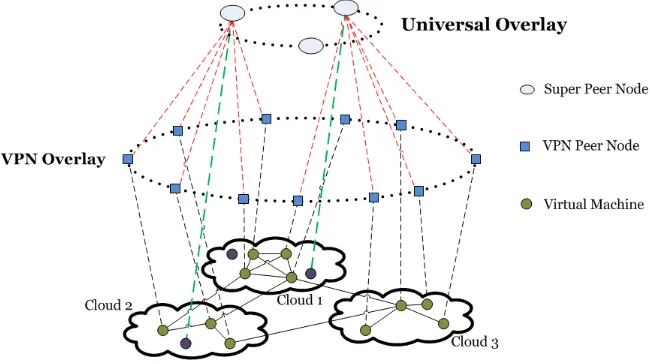
This approach acts as an aggregation service for the peered overlay resources (which in this case are virtual machines) span across multiple cloud domains to help form a virtual private network. The peers of the universal overlay act as super peers for the nodes of the underlying VPN overlays and let new nodes enrol, authenticate, bootstrap and join a particular VPN overlay based on the cloud service requiring a VPN service.
Fig. 1.Two-tiered overlay architecture for the Inter-Cloud VPN solution
and the same contextualization service is used to install the peer-to-peer client in the VM.
Once the peer has joined its overlay, it needs to discover its neighbours and gather additional configuration data to establish secure tunnels with them so that the deployed service can communicate securely with its different compo-nents deployed on different cloud platforms. In order to achieve this, we use the following scheme based on the Functional Encryption predicates.
3.2 Secure Service based Resource Discovery
After joining a peer-to-peer overlay, each peer needs to discover its neighbours for the resources they provide to achieve the secure communication goals of the application using the overlay. Most commonly these resources are configuration and credentials data and the secure communication goals of a typical application pertain to encryption of traffic associated with specific ports and protocols. In most structured P2P systems, the peers must maintain lists of neighbours to achieve this goal efficiently. To populate these lists, peers in a structured over-lay usually use distributed trackers or IP Multicast [17]. Although IP multicast offers the feature of scalable group communication needed for efficient resource delivery, it is not suitable for use in our system architecture, this is mainly due to its very limited deployment by ISPs and network carriers as well as the com-plexity of its architectural design [18]. A P2P tracker is a specialised service that introduces other peers of an overlay to the requesting peer. In order to perform this function, a tracker keeps track of peers as soon as they make a request. A tracker may be deployed as a dedicated server or distributed among the peers of an overlay it self. At first glance the distributed trackers based ap-proach looks very suitable for use in our system architecture as it maps nicely with the functionality of the peers of the universal overlay i.e. well known boot-strapping points. However, this approach is vulnerable to malicious attacks like Denial-of-Service (DoS) and Sybil attacks [19], in which the attacker can subvert the functioning of a peer-to-peer overlay by creating and using a large number of false identities. For ICVPN we focus on the Sybil attack where a malicious attacked can impersonate a number of the Universal Overlay peers to subvert the process of resource discovery.
above mentioned scalability problems by utilizing a functional encryption based scheme [20].
[image:9.612.173.445.299.358.2]In a generic functional encryption scheme, a decryption key describes a func-tion of the encrypted data to the user. This funcfunc-tion F(·,·) is modelled as a Turing Machine [21] and an authority possessing a master secret key (msk) can generate a key skk that can be used to compute the function F(k,·) on some encrypted data. Identity-Based Encryption [22], [23], [24], Searchable Encryp-tion [25] and Attribute-Based EncrypEncryp-tion [26] are some examples of a FuncEncryp-tional Encryption scheme. To describe it more formally but briefly, A functional en-cryption scheme (FE) for a functionality F dened over (K, X) is a sequence of four algorithms (setup, keygen, encryption, decryption) satisfying the following correctness condition for allk∈Kandx∈X is given in Table 1.
Table 1.Four-tuple Functional Encryption
Sequence Explanation
setup(1)→(pp, msk) Generate a public and master secret key pair
keygen(mk, k)→sk Generate secrekt key fork
enc(pp, x)→c Encrypt messagex
dec(sk, c)→y Usesk to decryptc
For ICVPN, we employ a special case of Functional Encryption which falls under the category of systems known as the predicate encryption schemes with public index. For our scheme we make use of the system defined in [26] as Attribute-Based Encryption (ABE), where the decision that which users can decrypt a ciphertext is based on the attributes and policies associated with the plaintext message and the user. In this scheme an authority creates secret keys for the users of the system based on attributes or policies for each user and any-one can encrypt a plaintext message by incorporating the appropriate attributes or policies in the scheme. We describe the simplified step-wise description of our version of this scheme as
follows:-i. A super peer sets up its own Master Secretms and Public Parameterspp
ii. The super peer generates a private key for itself using the attributes Ser-viceID and SuperPeerID as the public key i.e. P ubSP = ServiceID∧
SuperP eerID, for each service the super peer is managing
iii. After bootstrapping, the VPN peer sends a provisioning request to the super peer encrypted by the super peers public key (P ubSP)
iv. The super peer issues a private key to the VPN peer encrypted by its own private key, against the public key with attributes P ubV P N = V M ID∧
P eerID∧ServiceID
v. The super peer inserts the VPN peers public key in the universal overlay DHT to keep a record of issued private keys, against thekey(ServiceID) =
vi. The VPN peer query the universal overlay DHT for lists of other peers and gets the result of key(ServiceID) encrypted usingP ubV P Nx =P eerID∧ ServiceID
In Section5 we show the evaluation results of the performance overhead of using our secure resource discovery scheme as compared to that using a PKI-based approach described earlier in this section.
3.3 Secure Virtual Private Connections
The key feature of our ICVPN is establishing a secure communication network between the peers of the overlay formed over a collection of cloud providers in-frastructure. Therefore, after successfully joining the overlay network to become part of a service, a VPN peer starts the process of creating secure tunnels to the other peers of the service it wants to communicate with, according to the functional operations of that particular service. To achieve this, we make use of IPSec [13] to authenticate and encrypt each IP packet of a communication session between the peers, thus creating end-to-end tunnels which provide pro-tection against eavesdropping, message tempering and message forgeries. For establishing mutual authentication between peers at the beginning of the ses-sion and negotiation of cryptographic keys to be used during the sesses-sion, we employ the Internet Key Exchange protocol [27], which can make use of stan-dard cryptographic primitives like public key cryptography [28] and AES [29]. In our approach, we make use of an authenticated Diffie-Hellman based scheme to derive a secure session key which is used in the AES-CBC mode to ensure the confidentiality of the traffic exchanges between the peers using the tunnel [30]. The session keys generated for the IPSec communication are valid for a short period of time and when the keys expire the protocol is run again to come up with new session keys to maintain the IPSec tunnels.
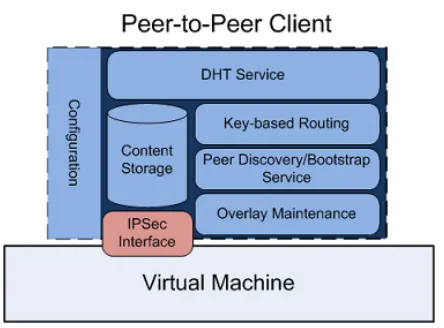
Fig. 2.Architecture of a P2P client in the VPN overlay
IPSec tunnels between the peers for the use of the higher-level services using the client to provide the secure communication framework.
The P2P client software sets up and configures the IPSec security associations according the service network security policy, which is advertised by the service owner through the DHT of the Universal Overlay. The peers of the underlying VPN overlay periodically check for any update in the security policy and apply and enforce any changes on the kernel of the VM through the P2P client’s IPSec interface.
4
Implementation
We implement a working prototype of ICVPN using the Java programming lan-guage on virtual machines running the Linux operating system. Our implemen-tation is built using open source libraries and APIs. Specifically, we use the BouncyCastle library [31] for most of the cryptographic operations, the cpabe library [32] for the Functional Encrytion based secure resource discovery, and the TomP2P library [33] for its implementation of the Kademlia [34] peer-to-peer protocol and the overlay DHT. In addition, we use BT Compute Cloud [35] and Flexiant Cloud [36] as our cloud service providers.
5
Evaluation
and Flexiant Ltd., our partners in the EU OPTIMIS project. The purpose of these experiments is to evaluate the architecture being proposed, in terms of service latency and service throughput, in a practical scenario with a service de-ployed over a real wide-area network, with the BT cloud geographically located in Ipswich, England and Flexiant cloud located in Livingston, Scotland.
5.1 Service Latency
[image:12.612.181.437.375.510.2]We define service latency as the inter-cloud round-trip time taken by a HTTP request, issued by a service component on one cloud, to get a response from the target service component on a different cloud. We compare the latency between the components of the service deployed on different cloud providers, as the la-tency between the components in the same cloud is almost negligible as they are usually hosted on the same hyper-visor. We measured the latency by using the round-trip delay of an HTTP HEAD request/response pair, as the components of the web service communicate with each other using HTTP protocol and ICMP, the de facto latency measurement protocol, is blocked in the networks of our cloud providers. We measured the latency readings by running 10 experiments very hour for a period of 24 hours, firstly without using the ICVPN solution and then with it.
Fig. 3.Service latency of 240 round-trip time experiments from BT to Flexiant clouds
Fig. 4.Service latency of 240 round-trip time experiments from Flexiant to BT clouds
5.2 Service Throughput
We define service throughput as the inter-cloud network throughput between service components deployed on different clouds. We measure the throughput between components of the service deployed on different cloud providers by using Iperf [37], a commonly used network testing tool. We measured the throughput in both directions by transferring 30 MB data, a size chosen empirically to saturate the WAN links between the components and get the throughput results representing realistic conditions. We obtained the throughput measurements by running10 experiments every hour for a period of10 hours, firstly without using the ICVPN solution and then applying the security policy to tunnel the traffic through IPSec.
[image:13.612.162.449.465.631.2]From the throughput results shown in Fig. 5, the first thing that stands out is the difference in the throughput values depending on the direction of transfer-ring the data. Although we don’t have the detailed knowledge of the underlying physical wide-area network connectivity between the two cloud service providers, such readings are not unheard of in this domain and are usually due to differ-ences in upstream and downstream traffic conditions, different routes chosen by the IP packets or network configuration issues. Irrespective of that, by looking at the comparative results it is clear that we just incur a small overhead in the throughput, of about 10%. By analysing the traffic dumps generated from the throughout test, we can attribute this overhead to the IKE and IPSec hand-shakes in addition to the extra time taken by the VM kernel in encrypting and encapsulating 30 MB of data for each throughput test.
5.3 Secure Resource Discovery Overheads
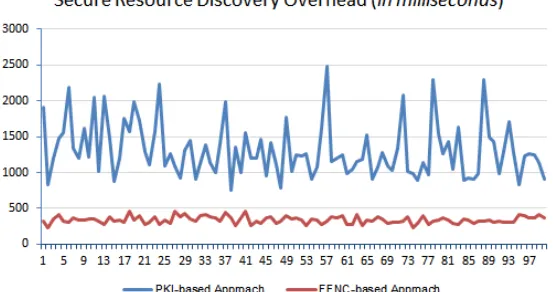
[image:14.612.168.446.432.578.2]One of the main overheads in peer-to-peer overlays related to the cost of the resource discovery after the peers have bootstrapped. Securing this process fur-ther adds to this overhead but in an effort to characterise the effect of our secure resource discovery mechanism, we compare it with an alternate design of a PKI-based system where the super peers have the functionality of a Certifi-cate Authority (CA), each peer is issued a signed certifiCertifi-cate upon authentiCertifi-cated completion of the bootstrapping process and queries the Universal Overlay DHT for resource discovery and gets the resulting data back which is encrypted by the owning peer using its private key.
Fig. 6.Secure resource discovery for 100 runtime analysis between PKI and Functional Encryption approaches
the nature of actual runtime measurements they can add unhelpful noise to the data. We define the runtime cost for both designs as the time duration between the start and end of the secure resource discovery process.
From the results shown in Fig. 6, the mean runtime of the PKI-based design is
1313.52 milli-seconds whereas that for our Functional Encryption based scheme is 338.81 milli-seconds. This shows that our scheme incurs about 74.2% less overhead than a PKI based scheme.
6
Conclusion
In this paper, we present a secure communication framework for services de-ployed in an inter-cloud environment. We employ the robustness and scalability afforded by structure peer-to-peer overlays to join virtual machines running on different cloud IaaS providers with each other using IPSec tunnels, hence pro-viding confidentiality, authentication and integrity for all the data exchanged between different components of a cloud service. Our solution needs minimal manual configuration as peers are automated to discover the information needed to perform their operations from the Universal Overlay. We also provide a dis-tributed and scalable key management solution for the consumption of the vir-tual machines to set-up the secure communication channels. Our solution sup-ports the dynamic addition and removal of nodes from the VPN overlay as we use the peer-to-peer DHT not just as a command and control channel for managing the VPN peers but also for the churn management of peers in the VPN overlay. We have evaluated a prototype implementation based on experiments conducted in realistic conditions, over multiple cloud infrastructure environments and found minimal latency, throughput and security overheads of creating and maintaining the ICVPN connections among the participating VMs of a service.
References
1. Buyya, R., Ranjan, R., Calheiros, R.N.: Intercloud: Utility-oriented federation of cloud computing environments for scaling of application services. In: Proceedings of the 10th International Conference on Algorithms and Architectures for Parallel Processing (ICA3PP 2010. (2010)
2. Ferrer, A.J., Hernandez, F., Tordsson, J., Elmroth, E., Zsigri, C., Sirvent, R., Guitart, J., Badia, R.M., Djemame, K., Ziegler, W.: OPTIMIS: a holistic approach to cloud service provisioning. In: First International Conference on Utility and Cloud Computing. (December 2010)
3. Gartner: Cloud consumers need brokerages to unlock the potential of cloud ser-vices. http://www.gartner.com/it/page.jsp?id=1064712 (July 2009)
4. Yonan, J.: OpenVPN - an open source SSL VPN solution. http://openvpn.net 5. Jiang, X., Xu, D.: VIOLIN: virtual internetworking on overlay INfrastructure. In:
In Proc. Of The 2nd Intl. Symposium On Parallel And Distributed Processing And Applications. (2003)
7. LogMeIn: Hamachi - a zero-configuration virtual private network. https://secure.logmein.com/products/hamachi2
8. Deri, L., Andrews, R.: N2N: a layer two Peer-to-Peer VPN. In: Resilient Networks and Services. Volume 5127 of Lecture Notes in Computer Science. Springer Berlin Heidelberg (2008) 53–64
9. Schneier, B., Kelsey, J., Whiting, D., Wagner, D., Hall, C., Ferguson, N.: The Twofish encryption algorithm: a 128-bit block cipher. John Wiley & Sons, Inc., New York, NY, USA (1999)
10. Amazon: Virtual private cloud. http://aws.amazon.com/vpc
11. Google: Secure data connector. http://code.google.com/securedataconnecto 12. CohesiveFT: VPN-Cubed. http://www.cohesiveft.com/vpncubed
13. Doraswamy, N.: IPSec : the new security standard for the Internet, intranets, and virtual private networks. 2nd ed. edn. Prentice Hall PTR (2003)
14. Andersen, D., Balakrishnan, H., Kaashoek, F., Morris, R.: Resilient overlay net-works. SIGCOMM Comput. Commun. Rev. (January 2002)
15. Tanenbaum, A.S., Wetherall, D.J.: Virtual private networks. In: Computer Net-works. 5th edn. Prentice Hall (October 2010) 821
16. Armstrong, D., Djemame, K., Nair, S.K., Tordsson, J., Ziegler, W.: Towards a contextualization solution for cloud platform services. In: CloudCom. (2011) 328– 331
17. Deering, S.E., Cheriton, D.R.: Multicast routing in datagram internetworks and extended lans. ACM Trans. Comput. Syst. (May 1990)
18. Diot, C., Levine, B., Lyles, B., Kassem, H., Balensiefen, D.: Deployment issues for the ip multicast service and architecture. Network, IEEE (2000)
19. Douceur, J.: The sybil attack. In: Peer-to-Peer Systems. Springer Berlin / Heidel-berg (2002)
20. Dan Boneh, A.S., Waters, B.: Functional encryption: a new vision for public-key cryptography. Commun. ACM55(11) (2012) 56–64
21. Turing, A.M.: On computable numbers, with an application to the entschei-dungsproblem. Proceedings of the London mathematical society42(1936) 230–265 22. Shamir, A.: Identity-based cryptosystems and signature schemes. In: Proceedings of CRYPTO 84 on Advances in cryptology, New York, NY, USA, Springer-Verlag New York, Inc. (1985) 47–53
23. Boneh, D., Franklin, M.K.: Identity-based encryption from the weil pairing. In: CRYPTO. (2001) 213–229
24. Cocks, C.: An identity based encryption scheme based on quadratic residues. In: IMA Int. Conf. (2001) 360–363
25. Boneh, D., Crescenzo, G.D., Ostrovsky, R., Persiano, G.: Public key encryption with keyword search. In: EUROCRYPT. (2004) 506–522
26. Hohenberger, S., Waters, B.: Attribute-based encryption with fast decryption. In: Public Key Cryptography. (2013) 162–179
27. Kaufman, C.: Internet key exchange protocol version 2 (ikev2). In: RFC 5996. (2010)
28. Diffie, W., Hellman, M.: New directions in cryptography. IEEE Transactions on Information Theory (November 1976)
29. 197, F.I.P.S.P.: Announcing the advanced encryption standard (aes) (2001) 30. Housley, R.: Using advanced encryption standard (aes) ccm mode with ipsec
en-capsulating security payload (esp) (2005)
32. Bethencourt, J., Sahai, A., Waters, B.: Advanced crypto software collection: The cpabe toolkit. http://acsc.cs.utexas.edu/cpabe (2011)
33. Bocek, T.: TomP2P: A P2P-based high performance key-value pair storage library. http://tomp2p.net (2012)
34. Maymounkov, P., Mazi`eres, D.: Kademlia: A peer-to-peer information system based on the xor metric. In: Revised Papers from the First International Workshop on Peer-to-Peer Systems, Springer-Verlag (2002)
35. BritishTelecom: BT Compute Cloud. https://cloud.btcompute.bt.com (2013) 36. Flexiant: Flexiant, your cloud simplified. http://www.flexiant.com (2013) 37. Ajay Tirumala, L.C., Dunigan, T.: Measuring end-to-end bandwidth with iperf