California Pnatitute of TechncLogy Pasadawa, GalEfsrda
The zushor takes pleasure i n thanking 2r. -1. L+fepmann for suggee'ci~~g ?:Ma psa'alem and for Izio Ez2any helpful suggestioras carad a~ncouragements during its solution. The help seceived froma &"ne ytaf'i ci khc Gugganheirtr iler~nautical Laboratory lil alstr gratefully ackno%qd~./- I o o ~ c E ~ . spacial thilrrko s r e lrae to 3 3 . C . 6. ti Etiti3am for bla help
a r ~ d i%c$ud con"eibugia.~as to kha thes~etical p a ~ " E f ";hi8 $ k k e ~ i @ ~ L S L ~ , t o
<% A
r
:r
.
.I:.
P. : 2 ~ u l t f o ~ dasigrd~xg a i i G building $ha m e r c u r y tow tank sntl toy rxm,rjy ke%p$uk discus s b n s.
7:he aeatl3sz a h o tI~anHr;e ?.? 8ea .Zorh"~$hy ,XJbd&er anti 2+s!.r~ GB S L " ~ I ~ O X ~ C Xreritler for the prepasation of the figures and the t y i 3 c s e ~ i p t .
M D
~ n e autlaor is sinrcorely g ~ a t e ; f u l ta the lu;ougL;es i a i r c ~ a f t Company and the Ford >?ou~da%ban $02 $he$ r fix1i1aa~fal asskstaance i n the $ 0 ~ ~ 9 of f ~ l l o v ~ s l d p o snci to tkna Office of Naval = R e a e a ~ c h f o r financing the
:w%,a,~~em~aee l a v e been made sf the perturbstion magnetic field in front of a semi-infinite Rankine body .;r,ov%ag parallel t o a uniform impreused magneac field ip.t a eonduegkrtg glrabd. The purpose
of Thace c x p e r i m a n t ~ tvas to inv@sGgate the eo-called upstrwac? vgcnke
a f f e c t which ha@ beon predicted by theory.
It
i a believed that the@@ are the f i r a t e r s p e s i m e n r ~ ~ in which tho izpotreaxn wake \%?a@ observed. AltPacpugh the wlrka vrae bour.d t o exist a s preiiictcd when the ?:lbbvdia nuxrrber 18 gseager tkxaa one, i t s docay behaxzior was rtsma~kably ciifferant from tk~ar Mich WEE pseciicted. The ~ ~ P u e i a n s for inandte ramik~x~za p ~ e c $ i ~ e e C $hat fz*~ the wake $ha ~ @ P $ B x ~ ~ ~ $ ~ Q D B ~lxouahd decayAc~cnsw%adgment~ Abetpact
Tabla c8f Conteata List
sf
FiguresX
.
$ n t s o d u c t i ~ na.
Experi~3aatsaf
.
*RestgBt~ of Expe~&rn&at@Kt.
Theoretical Gonajidecaaana I!' * EfPact of Boundary Condition8 VI*
Cax1elu~i~nfs68Refaren- .:ippenllix 1
Appendix 2
9;ppendSx 3 F i g u r e s
PAGE
i
F i g u s e 16 Tffect c a i Enitial Pueition sn the AAnl Distribution of the? lszagnetie Ff eld P e i-tugbation
Figure 17 Gompa~istaua o f GaZculated Infigrite ?vCedium an& Lnslfinitely Coneiueeing \, all Soluticg~s w i t h the 5'xperi?ment~ Perfcrmaii w i t h m 0 ,
Gl.
2 in. Dialmeter Cu~ser;t L ~ o pFigura 18 Docay Rates Prtedictei; by Eigerrselueiona
1. lnt~aeiuctf en
P'" 4
&air; paper presenfe the results
of
ezcpo~izaenta on %he flowof
a. eoraducting Sluid, m@rcury, over a semi-iilfiniter body in the pzesearctr: of a pasallel applied ~sagxxetic field. The genarai g ~ o b l o m of thenow
of a earrcirrcting fluid overa
body i r ~ the3 presesice of an applied magnetic fiela bas been s~urHied &haoreticallyby
many a u a o r s . Gheiater(1)
gtuciiecl thc hiphcrefor
low Reynolcle; n w b e r s and low comdueELvity, G r e s n s p a n an& C a ~ r i a r ( 2 ) ~ t x d i a d tha n o w over a flat plate* Stswartaon ( 3 ) otudied flows i n %qhBch the e ~ n d u e a v i t y f 8 hfia$&e, V m i3larkcaex344)
andGourdino ( 5 ) have fourad filncmrnenkal solufioas, and Ltary ( 5 ) awd Tarnadtz,
(7) stucllad two-dirneasiorml inanfte Rap.tlolds n i ~ m b a r n o w @ . The most inters5 t l n g result from tber~e thecsatical inveotigatiwrms waB $h& predictioa o f t h e srd3tencc of an 'upstreark2 w a k e h n d d e rcePtzkin conditions. The mt-ci%a~&ax~~ for the production
of
this rnow wake i 0 the propagatior.cf
I
itljlfvon waatas which c a r r y both %s~~rticI&y and caprent, "iB hen the
propagation speed is ~ P ~ E L ~ B S tiwil tba body speed. axon wakee are farmed
speed 2s l e a 8 tE%an $he speed
af
the body, than t~mkcsare
forzmed i n thewhere "rl i ~ 1 the speed r ~ f the body,
Bo
i~ the lanifa*rm ranalyneti~ field strengeh, 9is
the body diarnster, p is the mags denasfty sf the tmepcury,is Ohe
kinamatic coefficient of viscogity, o i s the t?lsclt+fcal sondue- givlty and i s$he
permeability w i t h all units in the P;I,ECSgl system.The magnetic Oseen nurnber appeazs a a the parm~etszr in the Baeen gyp@ ewatiolnr~ for the slsctrie eurrezlt density,
-
JI and Pine vorficily,(sae Appendix 1). This p a p m e t e r could
moge
accusatelybe
called aR s p c ~ l d s numbes since i t plays Che @&me role
ars
the ordinary Reynolcle n s a b e r in elassilcalR d d
dynamite. It f a a conlafnatio~aof
Rm, defined2
above,
and a Rm v~bich i s the ratio of the magnebic forces to the i ~ n e ~ t i a l forcss. The magnatic force p e r unft volums6s
(J &a x 13) *- n o ( Y-
ar B)-
jn 3-
wkaze
V-
i s eha Pluf d wlocity; thia gives the disrrensflanzal faston. (TU
3 2:230
for
the magnetic force. Dividiug by the dimensional factor for the2. 2
igaoslial forces, p
U
3,
sne obtains a 2 *fn order to fnvestigeta this upatrean2 wa*e expe~imantally,
the m;zgns(;ic field pesturbatfcns wep@ meaetured ia the region S ~ r w ~ r d
of
a
@@mi-infinite bodyin
the pavallel %magneto-fluid dynamic blow8That experiments w e r e performed
in
a facility wNch fe called the vneFcury ow ". tank. T M s facility c o v ~ e i s t aof
a stainless steel tube5411
IDand
55"
long w+Uch i s filled witla mercury. Surrounding tRe Labe #ie a watar cooled solenoid which produces a uniform magnetic field of uptc
speed@
up
to two meters p e r socond. TAB stfag crsrr~ts m p through aseal in the bettoa~
sf
the !:tank. 3 c l o w the Uak the sling i s c~nnected to a drive m o t o r . The drive syatem is deeignc-d so %hat the model i s accelerated vory rzrpkdly, 5 to 10 g's acceleration, tta the desired speedthen runa at t h i s spaad uaa3, the e q a s i m e n t i s coxapletad whegs a brake i s applied 2 0 bring the model to rest. A cftm~plcte description
of t h e facility has been given
by
kiepmann et al (8).The modal chss~an
Lolr
those axpasriman$ofe
a senqik-idfaai& Ra&ne: body, i. e.. the body defined by a aourca in a uniform stream. T h e ~ e aga acsvapal 2seassns far chasssfng tlGs particular modal, First, the model is just an eweensionof
$ha sting so &hat thc g a n g i a p a r t cf the model. whish i s a natural and. clean configuration. Sacand, i f a closed body w e r euses,
$he3 body would have to bo moanted on a v e r y% M a
sting which would extendfrom
the endcf
the dsive sting. This cocfiguratfcn would intsaduce two factor$ which v~outd confuso the problem: these are fha effect of the? drive eting on the Boav aatl thepeseiblo effect cf separated Qaw on ohe body. Third, f o r the sermi-infinite XnnMng: body an analytical solution i o known f c r ~ the B c w in the absence of mag%leEic efgecta.
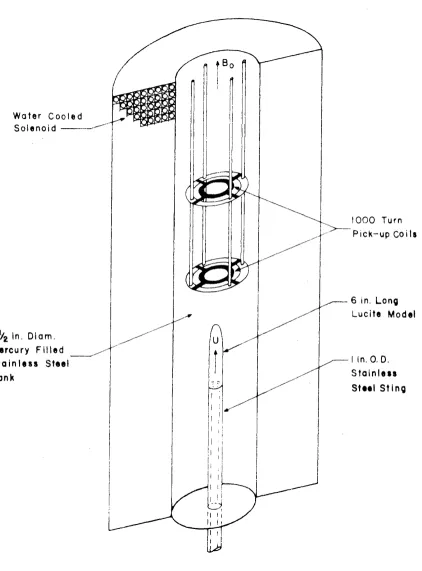
ln arder to measusa the magnetic neld perturbations, 1000 turn
piek-up coifs a r e used. The pick-up 6011s haare
a
larger diameter t b n the modal and are mounted stationary inthe
taw tank w i t h $heir C ~ I I ~ G S ~ Son
the a x i a04
anyrr,metry (see Fig. 1). The modelcarries
w i t h it a dis trikutionof
magnetic field so tkrat as the modal approaches and passe@ through the pick-up coil, the coil senoes 3 clnange i n the@
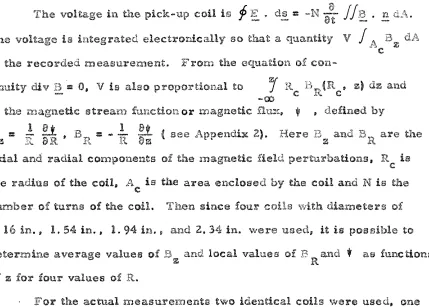
T h e voltage in the pick-up coil is
j6
fa'-
.
ds-
=
-N
---
/J$3.
t$:$. 8%--
--The valtsgc is integrated e l e c t ~ o x J c s l l y s o that
a
wanbity V,/
2.3 zd A
f2eixrdity
a.ti
3-
=
0. 'I is p r o p e r & i ~ ~ z . a l $0 3 i",i (R a) dz andG 6
*w
axial and padial c@mi~oner?Ee of :nagnetie fiaEG peredtlrbatfono, R i a
C
the padtun
of
eliecoil,
23 i s th@ abea encloasd by rhe coil and ail' is thec
1. 16 in.
,
k . 54 in..
1.94 it?.,
and 2.34 in. vvere uneci, i t is p o ~ o i b l e ta rietermiae! avosage v a l u t ? ~ 23 snJ local values: ofP
and ) acr faactionisE
R
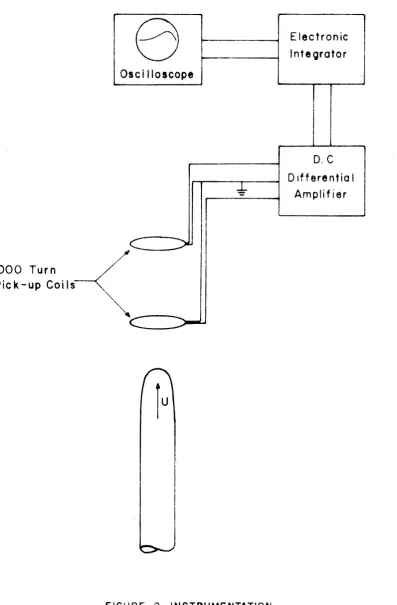
moangec! 6 inches above the w@%ar. Tke kovder coil m e a s u r e @ the signal and &he noise; tile u p p e r c ~ i I measures the s i g n d delay&& a b a w n
C&9fezantiaL amplifier, integrated, displayed olsl an oscilloscope, and
P L ' C D I C ~ ~ ~ by Polareid camepa (eee Fig. 2). The s i g ~ a l recr~rded from tho two ceile %S than
/
:?-
J
.% (=.+ 6 ) & r j , 2 whereA 58 A 23
C G
/
i> ( a ) d.:% >>/
R
fa,+
6)
&A drpa tinc aegirsn ~f interest;Z
A
B-e C
hence tEl2ese data can be ~ ~ d a a c e d ta
d
i3 (2) dZ+. i"iypic&B recording RiG"
of thc Gsta i s shown iin f i g & ~ ~ e 3 where the t i m e increases from right trs loft. The upper trace: is Prom
a
p ~ s i t f o n transducer wl.aBeh 2oeat;eu the boicy % p i t i t respect to the coil and togethcr wfG& the timc scale of the trace gives the velocityof
the body. T h e l o w e r trace i h p the voltage [image:10.525.48.477.62.369.2]lt'86;PW.
Qeid papturba""
The oliyeria?n@rits w s r o pcrfosmed for all four oeCs c a i coil@ a2:d f ~ r the basic ciimenaionlese p a r a z x 3 a t ~ ~ 8 in. the fallowing ranges:
The ordinary aeynolda nuznbcr, We, i p l much greater than onel 8 0 eke .iriscoua a f f ~ e t s ffihacld be ardnaportant ~ ~ ~ e p e ia the bwGzna.;lary l a y e r . The magnetic Reynolds auz22bez, Rwj, i s much l e a 8 Qxan so the magnetic field pergurbationo ~kaould also bo much less Clxam one. Fkc A L Z V ~ E ~ numbor, a. is varied f r o m l e e e than one: to greafex tlmn one
a ~ l d eklc magnetic Osoen ntrzmaber $8 both positive srm:.i negagiive s o data
w e e bbtafned b ~ t h vprhe~ a %vabz"is ~ h o u l d esd@t pape$reaw~ am2 when i t
Tho r e ~ u l t s
of
t h e erperirnente are %%at: presented in the form, 3~x1-lj
b d-%= fa
[ z / : J ) ,
w l ~ e r e b i s the axial coa29ponent of the2% Z
A
dhenairsnbeaer magnetic Bald perturla8ion and a i ' b i e the axial
&star:cc from %Re
raoee
cP
the bodyin
G i m e n ~ L o d e s s f o ~ m ( s e e E'igs.4
gh.8arough 11). The first majorr ~ e s u l t from this data i s that P m i s the bseic p a r a m e t e r i n deZorzr:ining the psrtrarbatioa uear tho body. Actually this rssclt itr e x p e c t e d , since the lincarised equation w i t h
<< $02 b .- i s curl
-.*
b P-
( v ;g wldch suggests 'tkaakI
bI=
Cl(&2)..-y
-
53rrre a.o v
=
ViEi,, ,-ee
i s the unit vectos in the a-direction, and -ili e%
i s $he impressed magnetic field.
In
Section I, it vdao p o i ~ t e d out tbat in the wake the perturbations ought to decay algebraically and outside the wakea~eyr
oraght to decay exponentially. F o r this coniigaration i t can be shown that the psrtur- bations in $he wake ought to decay inversely a s the distance from the body. How@ver, the exparfrnental data ohow a nloe t @%artling result&I?@ region atneat1 0 6 the body. It is found C h a t Che perturbstions
fbo~x; the expected exponent outsirla the wake. I n each uf tho four Sgures 4,
6,
8 and 10, t w a curves are shasvn far the case k > O when a w&<a ~ P ; & W ; S M % ~ not a 2 ~ a t f o r w a r dof
"$%c bady anti two cu-svsr; f o r k < 0 when awake ~laould a d ~ t frsa'tvard of 8;&a body. In each
~f
tho P s u s figurea 5 ,1,
9
and J5 1, faur curves as@ shown fop k < 0. Note f b & i x ~ atl%es@ f i g ~ ~ ~ g ~ wl%e+e a s e m i - l o g scale is uger3, an exponential heg~avior i s indicated bya straight line. The reascan fog this apparent anor2aly i s that Eha w a l l s of the tank and the solenoid oursow~ding the tank lmve a large affect 011
the
.
The theories ate- not Bncsr~cet; tha forx~ard walw eA1t8 3 ~ di a shown by the expeaimenta,
b e
the w a l l effect@ dominate the belaa%dos of the decayof
the p e r t u ~ b a ~ o n a for ths Fang@ oh values of the magnetic: Qtaoen number, k, wEch w e r e obtsfned in the e w @ ~ i r a s n t a . Thad i s c u s s i o ~ l of the w a l l effects wi11 be given i n Scctiozz
V.
not check the infinite fluid g%eeriee, eke p e r t u ~ b a t i o n s u p ~ t ~ e a r n still increase when tkn wake should exist. Since fhe wl%ol@ $ 1 0 ~ hae changed
so much becaulae
of'
the walls,i r
may not ba ~ t h i ~ t l y ~ F D P B P to ~ 5 1 1 thei n c ~ e a e e d upatrears ciisgurbance a wak4~e. i3owever, this regian
a8 8 w a k ~ in & i s p a p a r .
Figupes 4 ihrcugh 11 ~ I c a r l y shew that Ram is oae baoic paranjetor of the blow, but i t 13 nat clear fromza these eight figusaa wheth~rer o
or
k
i o the pparameter w u c k d e t e r n i n e % the decay rate of $he pariurbstica&.
This questiogz i s completely rcsolved i n Pigare 1 2 wherc data with diffesent and Rm. but t l l ~ sarne
k,
are p ~ e s e n t e d f o r each of the four s e t s of coils. The values of the dirnensiodese parameter3 area &
9 . 5 , ;Pm 0.012 and Q 6.4. Xm 0.0265 w i t h k ; -0.53. ' 6 h e 9 ~ 0is a. 50 / D c!%an.ge ta. a and rz 100
" l o
ch;enge i n Rm J L Y ~ yet .for each set of e ~ i k s there i 3 only one curve; $hue k is tho basis. parameter f~ap thes t r e n g a ~ of the wjalee. For k l a a g ~ and. negative, a strong wake cxIsts
not only i n the magnetic field but also in tho velocity field. ibfloroovar, 2
it wacs poaaibla in the e3~pa~isi.aenta Oas 813ak1&: a 5t,~'i? > 1. T h i ~ Q B the
p a s t ~ ~ g b a $ i o n a due &s the waka; the velacity p e f i u ~ b a t i a n s aka
cBf
o r d e r 2F: times the magnetic perturSationa whicl.1 are of o r d e r
,
R
(sacdefect
an
inepease i n the saciial velocity away from the body shoroldoccur,
and neag the body. especially when a strong w a k e i s prrssent, t h s r s ahoald be a decrease in the radial vslacity,A
relationsup between the magnetic field ant the velocity field i s given by the induction equation which can be simplified tcdescripticn
cf
tha velocity wake given above, it: be p o s ~ i b l e to predict tho trende in tire? magnetfe tireid perturbstioxms aad see i f tiley check wlw the exi~esirnento. This approslch irrdieates that be and b shouldR
be largelr for ks 0 U ~ a n fos
k >
0 away Prom the body and conv~jrcioly they uhouLd be smaller near tkc body. The effect of tha Geepease in bB
s h o d d appear dtrrtiaer gosward au the strength of blnc?, wake fnc~eartes.
6
IL.a
figures 4 through 11, Rm'IA
bl.
dW is s h a % ~ n a e s functionof
z/YJtaking $he slol2es
of
these curvov arzd the effects psodkcted f o r b, can*.* 1*
k
>
O w i t h that $02 k <0.
Figuze 13 show@ b i ~ m j t fn(R/D. e/La), wMnich is!%%
f o r p a i r 8 of coils. TMirs figure again s b % v a the sauch slower Gecay of the perWz'oations in the axial direction f o r k < 0; but m o r e important, ~ af~ ~V B P ~ ef i t a e d i a e r e a ~ e t ~ a t w e e n the radial d i a ~ r i b u t f e m ~ . Tb%g
~fmf%ajr%ty f a . the radial c~fst~Bbu$iesaas
fe
another effacesf
$ha wallis, i, B,P$,
Thaoretical C a n s $ d a z a ~ o , n ~Although
a
great deal of theorofical w a r k hasbeen
tX~ne far t h i e problem, no nolutio~ has beera preeented f o r thc se?enf-ianBaite R a ~ n e body. T h e r u f o ~ e it i s u ~ e f u l fa* compagison with the arqeriments to W D S ~ C O U ~ an spproAmate aoludlon in the ink"mf8z f l u i d theory fer somerange
covased by ther ~xpa~rirnents. Flawevertlnir
ir; anly rliscuaaedbriefly because the iniinite
nuid
thecryturns
c~ut 5 0 bs iiuadequauate. ft i e assamad h a t Rm<<I d
991,
The f i r s ttwo asaunaptionti arc saeiuficd by all Lha data and the t h i ~ d aeslamptton i s vale$ for some of tha expcritments. Then ZO~OT ~ ~ B G C aosumptiona. to
first
ordar,
the velocity field i o the poten~ial. Seld, aixi &her magneac $&..Id l a the uniform applied f i e i d , -3 (4.
From
*&a information 56@
-
23i c posaible tb calculate tho first perturbation
cri
t b zasjagnekic field.curl
-
b
=
-
Rm ( v-
x eg)$--"
The papti cular soluticn of $Ma equation which satisfies the boundary cons,ii$itpnas at infinity and which ir~ the dominant contribution for large
P i d f = h ~ 5$8&~814t:
Thc tern Stekaslet i s c o r a m ~ n l y used t o <!@note the pazticulaz fcsm of
ghes ~ t s a a m function which i e abtained in &be sws;ku&ien f a r a d s y m ~ m e t r k bollieo
P P ~
ordfnary StoEces' n o w .TMs
solution is not somp]LeEe since it doee, not satisfy the b o u n d a ~ y conditions at the body. Thc ccsmpletdt solution would sequise in addition, potential eehudons inside and outoide the body to satisfy the boundasy condition that the rnagnetic field becontinuous acroae the b ~ u n d a r y af the body. i3owever, this pjirtisulas solution contains the rnsajor ccpxltribution at: large dfatances frorn the bsuy.
1
Away Prom the body t h i s solstion gives 13
-
.
Thas, tlreT% E'
axpecteci liecay i o obtained but the wake effect has been lost. Upon cfoae~r axamfmtisn sf the equatfens f $ is found that the @qua$gon f o r the electric c ~ l a r e n t daasity,
2,
i n this appsoxinration i ady'fiamics, sitis clzangcs tho Stokestet solu.lmtloxz tpr Lh@ f o r m
of
caac %B C ~ C P B ~ ~ whgh k
=
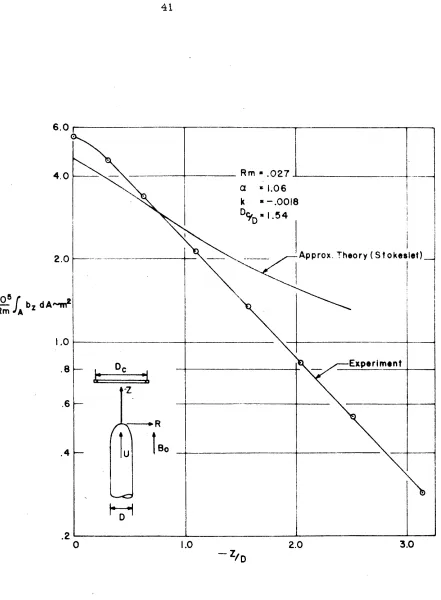
- O . O O I @ 8 0$?at
ths effsck sf the exponantialfactar
negUgible in tine range -4 i z / 3 < 0. T * d s comparison i s shown in f i g u ~ e 14. Ther Stakeolat checks ldcelp for osder of magntL2de but-
1 the ra$e 0.fGeczpr
i o rapidly d i v ~ s g e n t ; for the G::;okaslat b-
( a / Q )B
cais2nat explain %be exponenkial decays wkdeh wsra obes~ved. The disagreement is particularly seridng $or the caaee; vvhen !c< 0, sirzco
here
<&a theory pruciicts rslgebraic decay aheac' of the borly.A t
rhia point it is w e l l LQ consider the ty~estiorr as Co whetheyor
not s otclzdy flow w a s attained Eo the axpesi:+naats. Sirlee 6hs body s f a r t o moving at
a
Bnite cdlsrancef r o m
the p i c k - n p coils, it i s possible that the L . w s s a a ~ r e w e r e n3a3e bafoza the steady BQW beearxqilg aatab118hed. Pa orderto
check this effect, exqesimente wege perfoamed i n c&ieb ghe starein;: dirihnce was v a ~ i s d f r ~ m 8 t o 20 b ~ d y & a n 3 @ t e ~ ~ . The rosultn o f these c x p e r i m e ~ t s are oho~dra in f i g u ~ e ~ c 15 an4 16. 111 gigare 15 the pcrtcrbatfon ata
given a a t a n e e Prom tbe body rem:%ins s o n ~ b n t for initial poaitiono greater than15
3 r d decreases for OGtid positimv loss &an 15.In
figure 16 the perturbation is plotto6 z0 a fuxlcticr, of ehs d%s.tar;ce $.rm-n %ha Lady fear three &%itfa% positions, Tl3e two C U P V ~ G farthe aorxriaB data
were
taken at a x i d k i a l posltioga csf 20, i t & B concludedtbaa @BB Wok.% was ~ 0 ~ a b B 5 8 h ~ d ~ and %Ids 4s no% ax2 a f f ~ c t in ths diffargnca between the i d i n i t e fluid theory and the experiments.
Sixlce the experiments w o r e correct in tkmt bhe flow was steady snd tku tl%eory, though orify apppodmate, should at leaet give the
correct decay in the far B e l l , there is only
ones
p o ~ s i b i l i t y lefg tcaconaidex. The &eo+y and the exparfmenra are different condiFiona. The dlffcrencp, of Elae ccandtione is g l u t the t l b a a ~ y is l c l ~ an
i d i d t o
medium wMlc the e & ~ e r t m e n t s wose p e ~ i ' c l ~ m e d i n a twbe of nuid %~hieh i e surrouslded by a large copper salenoid.
Tbs change i n febfslx Beld behavior
of
the per&urb;ationa m a s t bo due t o the Quid dynamic boundary conditionuat
the w a l l cf the tube, the electro-magnetic bcundar y conditione due ta thcsolenoid
or
bath. The adid dynaxnfc bcusilsry eondigion i s obvious,%.
c ..
there can be tlof l ~ w n o r f n a ~ It0 $$B &~~&!k1. The @ % a ~ k q e ~ ~ m a g n e a c b@uz%da~y
~ o n e i t i ~ z 3
duat o the solenoid 1s not ser elearly deginad.
lIowever
i n gcnesal, at m a s s ofn3ebl tenris to resiot a chnngc
in
Bux in the~3etnE.
U
the eonducti-Yity of Lbs ~ a a t a l bscom~ca infinite, Qhsw surface cu~rsenta are s e t up which alirfiiwate the a a % d frorfi tha g::3e$al and impr°>@e the b$ii%~ndary condition thata%
the surface there caa be izorx~ml co~poazent of the magnetic Geld,T g ungsvaH the e f f ~ c g of the ~ s i a n a i d it i~ f i ~ o & a s e w ~ e d ths& the
solid nlase then
%he
diFFd~fon length for these expa~ime12ts woukd bto give?sa byThus it appears %l%~lat the fiald may be trapped
by
the solenoid. This model wae suggestad by D r . C .B.
Pchitlnam. Now secourse to a simple experiment can prove thitt ~ f f e c r . In u r t d e ~ 60rsmova
t b magneto-k2uid dynamic eP;fects the experiment chosen was tlmt of il Current loop running through tha @alenoid in the absence af the mercury and in vhe absexace ofa
x
u n l f o ~ m magnotic @old. 'She nel6i generated by %he euwen1i laop was n~sasured with $he pf~ltwup ~ Q i k a .l(P %he eolenoid had,
no
e f f e c t on tho diastributioar o f llne magnetic fiel& produced by the current loop then the ~ o l u t i o s l kvodd t ) ~ ehat for ar? i n f i d t e mediurn as given for e2gi.ampla by Smytbe 69).(kt
~ ( k ) the complete elliptic integraln of the first and aecaad k4ndo awd a i e rile radiusof
the cimsrent loop. 'ZhEs eoEuticn givesE
-(he oolenoid acts as an infinitely conducting w a l l then thesolution sbcu%d be ehat f o r 3 curre-nt loop in an inanllely coraduclbng
whepe (x) 1% i3essel fanctfan, the j ' ~ i are the aaros of
k
n% c a e e l fw2ction
and
b is the r a d i u s of the tab@ [see Appcaidix 3).For
lsrgc axial dfsl;llleeo ~ ] > > b tlds soltattan gives@ u z r e n t ~ , Jge a t e given by
The reslults of timse sveairnentni arc p r e s e j ~ t ~ d i a figure 17 along wit22 $he calculsted o~senlts for st:% infinite meGium and
for
the cxrss@r~% B @ Q ~ i n an i n f i d t a l y conduc$lng Lube.Th@
a~zpesin~
a d b i tast azq.cpane2%tiaP decay which is dhe same as ios Zhe in$iniE~ly conducting eube s~lutiona with b
=
3.O
in..
Eke inner radius t h ~ ~01er?ofd. Although the a3;perirnents give values s e m e w b % larger than ihe cstlculated values thera carr be no doubt &at %kc solenoid acts ;app%bxirnaEeIy as anin.Sazie@ly coaducting tube. .$Lli;%aouyl.a i t i s not a-b~dous nanuaiform
crazFan8s.
I
=
f(z), should Plow in the aolenold; J'or the Iarge cbracterietiea
eii23os in Cinegc experfmcots. T t
o
(T) _< 0.06 s e e .,
Ure experimentsw i t h the current Loop are srrzficient proof that t3my a i l s t .
Ir
i s intereating t o aoticet ghat the eqonential decay obtained in tho experiments with the c u r r e n t loop, jli b
1 0 2 8 ris
of the sameeisperiments, X
=
Q;(P). Ntlow using th~s boalkda~y E D I ~ ~ ; ~ ~ ~ O R S that at the wall there, can be no norznal cornponeat of the velocityor
the magnetic Beld, the magneto-fiuici dynamic problem can be atgacked. Thsequation@ f o r this case aEe the ii~ductkozre, equatlsn and the amapaantu~a equation.
If
tkeee equatious inre lineariaed an2 put i n t e r m @ o f thofuianetion, q, and the magneric stream function
.
they beccarrse (see Appendix 1)2 8'
vghe~e 1+3 t ,L.
-
- in cylindrical coordinatee.I t
Then th.ae equariouo can be uncoupled by c?efinfng two new f u n c t i ~ n ~
2 - 4
-
a 2and tihe @quatioaa b e c ~ m e
*.-- 2 @
"!-2 E O sad ( D 2
-
Zir -- 8 )x
S- 03% The bouraclasy c u n d i t i ~ n e
on
and rj aref
-
9 a n d q ~ 0 on R = b so the boundary conditions on 4 and .gg are alaoTho eigensolugiona f o r Elacsse etqaaations can
be
%ound for b h e eyliinclrical g e o m e t ~ y rcad from thasa modes t h e possible decay rates can be found withoat actually s~Xving the bouxndary value problemfor
the parr-isular bady used,The ~Pgensclr~tions f o r @ are
sad $ha eigensolution~
varies wriekn k . Hn (p~dap to ch.eck &is effect with+ elas esk~urfmerato
I\ is platted agafnot k, t&i;,lag S
-
3.0 in. an3 cazx2pasc.d w i t h the1
experimeflai ciecay rates isoypl the data
for one
s e t of coiPe. This c o m p a ~ i s o n fs shown in ligure 19. This approlrtmation not only givee the saxlsnc: trend as tha espezi~mentg but also differs by a maximumQ
of
snfy 30 / o aver the iraagc of the experime~ats,flow
from
ai? algebraic decaycf
the p s r t u ~ b a t i o n sEo
exponcantlal decay. This casc is analogoun ta the classical fluid dynau~sic problam where for the B a n @ b o d y 6 0 \valL Sameter ratkc the wall. effectr, at l o w KsyraoLds number arc.: much larger thaxl for high Reynolds number floux. Ea this magneto-Quid dynamic case the a p p r o p r i a t ~ dimensioiaess n u m b e r i s2 2 2
the anagnetic Oseen n w ~ b e r .
ltn
the limitk
>3 jl / b.
wkich can2 2
be attained either by z12aMng
k
large o r by latefng b-
oo
and
algebraic d e c a y wirhkrz Eha wakes and an exponential decay with a rate af d
k
outside %;la@ wakae.For
the aq2epin2ente t h i o Iigaia ?be not attained& 5knal tmtezaaating point frons
&ha;?
expe;f%%%@1.B@s i r ; &&at a direc$ maasurd~i
the perturbation magnetic stseaa2 function, f.
i aobtained ( ~ e e Section PI). T h i ~ z~@a8ezrems* z a a k @ ~ f % possible to p l o t
tire perturk~ation which i a generated.
It
shoals be possible from this data to see, that -+ 0 at R=
b. I r 4 figureZQ
4
i s proteed f o ~ k >O
and L,
<
O so Chat the effect: 09 the wake is again obse~vcci hue. also one notices that the 2Scld linoo i n *&e figure a r e s2arting t o reverse andbody Ln a, uwiiarm magnetic finld which i s pizrallol t o tha d i ~ e e t i o n
of
xslotion and Che magnatic field pcsrturbaUoass f~rtvs-xd sf &e body b + v e haen r n e a ~ u r e d . A s a r e a u i t of $ha@@ measuresment~ i t
ha8
b ~ e a sho~qn &at &ha r~agnetic Reynolds nxgmber determiner; Qxr: ardep of magrritetde or" the dieturbal3ce. A wake rrpsterem3 of the body has beea observed and its eZTeces are determined by the magnetic Oeeen n u r n b e ~ . Finallyi t tatas baerx shown that the disagreement bstwelen thc infinite aui6 theories and the experiments
is
due go the wall effecte, and by 3s h p l e tlnaereticsl approach resuite l;~ave beaa huxlC w h i c h give an
Creen~ipan. 3 .
P.
and Garricr,C.
F.
,
J. Fluid 3dlecf~. 1959,6,
"T-96.Tamatla,
iC.
.
ATqOSRNo.
1087,
1961.Liepmann, 53. W.
,
M o u l t , 2. 2 . and AhlsCrom, 23.e.
. l v t i a ~ e l l m ~ e a d e A6i.dachad1ea LcjbZ, Alca~crrrie- V e ~ l a y ,
%95@s, End edition,
The liineasieed e q ~ l a t - i o n ~ of magnato-nuid dyaarnics for tRs problem d i a c u s a e d i n tkds p a p e r ape
followfng aci-puations
f o r
a-
sad-
3:p r o d d e d
-
u, and 3 =+ O f o r m This 'Jr~unclzry condigion i scpplica!2t@ Eos $he u p o t r e a i ~ l directfoa.~
a s
long z s 3 ~ Lo 2anire
an& nsttoo large, but in the d.ovvnsthsam direction there 19 serI~lns doubt a s t o
cursc3.t and vorticity are obtained,
~ ~ ~ Q T ~ Y : 3af the 0e q u a ~ o n s ~ f e ~U S C ~ in ~w ~ ~ c I % ~tr@aa"i:3 ~
f~lncgions, .i] 203 tho velocity fieid and f f o r the :nagaetlc field, are Introducad, where q anti $ ;are defined by
Tha~z stEbetitu6ing equag.2.ion l a into eqpaaons 5 enG 8 , the momen2un~ and fnduc%i~n equatf
ons
age 013tafzaed in L c ~ m s of q and '* $ 5The voleage from ehne pick-up coils in these experiments gave
a
~ o a s u r e r n e n t of 3%. R an& f.
T h e relationokri~s forR
V
=
f 1( 3 %), f,(i-; ) and f ( +1
are d e ~ i v e d belaw.3 2 3
wMch gives
Then oknce the circuit contains an electronic fr.ite,vrator
wlacre
a
and Z are t h ~ ffeod- b c k resistance acJ capacitance of the integrator.A y_.elaao~@ldp ~ ~ ~ B ; J ' ~ B z z 13 and 74
*-'R caa b t 2 found frar~3
33
n2agnetic field continuity eclsation,
dfv
B
=
0*
wkdch v~hea su3seieuteti
into
e $ ~ a a t i o n 4 givee the relagionship for iiZtessihsc of eqwtion "? &magnetic t$t~ear:l f.dnetion can be
defiz:~d such that
'Wsen v
-
a currezlt loop i e illside an i~Ainit~.Pgr conducting tube.than the elolutior-1 for &he znagnelic a t r c a c 3 eksfictboz~ caa
56
derived in tlrc form of an inllfrJ$e scriegof
arthoyunak funcehons. For t23inisprtablerra &hc cocduc&i~zg fimpt)~eii a b ~ u n b r y
~ o l i a * . i ~ n
at the E12as thaziLt tI3ere bonw
magnetic field in thc radial lllvectioraat
the Pkxba wail. The two cquatiacs 6~ 'be aollvad ape &he i s d u e t h a equaacpn and tho c o ~ t i n ~ l t y aquaeion $or the magnetic field:.Then using the eontirauity equation, it is porseible "L define a ~ n a g n e t i e stream function slrch that
Substituting equatione 3 and "Iinto equaGon
B
givesNovv by separation of variables an& uoing the b o u n ~ a r y condition
and
$(a,
g r e8.
The solution i s naw specialleed toa
leingle current-
loop
and
t h ~ Cats and D,'aare
Qctermined. F ~ F a current l o ~ pBy ~ubstitutiag equation & iato e q u e i o n
5
and intsgsat9ing on ea t
Thua the jump cond?ieiox%
in
the 19 directionon
-
sndare
8s
Fsorn Ehe condition
on
Ulsn t o find
Ca
multiply ~ q a t i o x a 12 byJ
a '
Rib)
and integrate onIP
1 Jm
Then
Ear
a curreilt loop in an infinitely coniiilctisg fitbe tIae snaynetic @t%ea*m function i sThe pre38118~e o f the earrent %QDP ~ i % u ~ e a ourface currents
on
F o r
s < 1 . 3 i s given by'25
a n d r > b 3 s 0. $3
W a t e r C o o l e d
S o l s n o i d ---"-'
5
b2
i n . D i a m .Mercury F l l l s d
,
,
S t a i n l e s s Steel Tank
1000 T u r n
- P i c k - u p c o i l s
6 in. L o n g Lucite Model
[image:34.551.54.476.78.649.2]I In. 0. D. S t a i n i e s a Steel S t i n g
1000 Turn
P i c k - u p C o i l
[image:35.521.61.459.76.682.2]\
FBGUWE 13 E F F E C T O F IMlTIAL P O S I T i S N ON THE
FtQadRE I "SOMPARISON
OF
CALCULATED LNFlNOTE MEMUMAND %MFONBTE&Y CONDUCTIN@ W&LL SOCU"l$EOWS