City, University of London Institutional Repository
Citation:
Ziori, E., Pothos, E. M. and Dienes, Z. (2014). Role of prior knowledge in implicit and explicit learning of artificial grammars. Consciousness and Cognition, 28(1), pp. 1-16. doi: 10.1016/j.concog.2014.06.003This is the accepted version of the paper.
This version of the publication may differ from the final published
version.
Permanent repository link:
http://openaccess.city.ac.uk/4710/Link to published version:
http://dx.doi.org/10.1016/j.concog.2014.06.003Copyright and reuse: City Research Online aims to make research
outputs of City, University of London available to a wider audience.
Copyright and Moral Rights remain with the author(s) and/or copyright
holders. URLs from City Research Online may be freely distributed and
linked to.
Role of Prior Knowledge in Implicit and Explicit Learning of Artificial Grammars
Eleni Zioria, Emmanuel M. Pothosb and Zoltán Dienesc
a
Department of Psychology, University of Ioannina, Greece, bDepartment of Psychology, City University London, UK, cSchool of Psychology, University of Sussex,
Brighton, UK
Author Note
Emmanuel M. Pothos was supported by Leverhulme Trust grant RPG-2013-004
and by Air Force Office of Scientific Research (AFOSR), Air Force Material Command, USAF, grant FA 8655-13-1-3044. The U.S Government is authorized to reproduce and distribute reprints for Governmental purpose notwithstanding any
copyright notation thereon.
Correspondence should be addressed to Eleni Ziori (Department of Psychology,
Abstract
Artificial grammar learning (AGL) performance reflects both implicit and explicit
processes and has typically been modeled without incorporating any influence from general world knowledge. Our research provides a systematic investigation of the
implicit vs. explicit nature of general knowledge and its interaction with knowledge types investigated by past AGL research (i.e., rule- and similarity-based knowledge). In an AGL experiment, a general knowledge manipulation involved expectations being
either congruent or incongruent with training stimulus structure. Inconsistent
observations paradoxically led to an advantage in structural knowledge and in the use of
general world knowledge in both explicit (conscious) and implicit (unconscious) cases (as assessed by subjective measures). The above findings were obtained under
conditions of reduced processing time and impaired executive resources. Κey findings
from our work are that implicit AGL can clearly be affected by general knowledge, and implicit learning can be enhanced by the violation of expectations.
1. Introduction
The present work uses the AGL paradigm to explore the effect of prior
knowledge on (implicit and explicit) learning. Most AGL studies use meaningless stimuli, devoid of any correspondence with prior knowledge. Moreover, the majority of
AGL models reference only the structural aspects of stimuli (e.g., Boucher & Dienes, 2003; Cleeremans, 1993a, 1993b; Dienes, Altmann & Gao, 1999; Servan-Schreiber & Anderson, 1990; but see Dienes & Fahey, 1995; Sun, 2000). Extending the AGL
paradigm to a knowledge-rich version is crucial in determining whether AGL theory can extend to more realistic learning conditions and whether AGL tasks can be employed to shed light on how general knowledge can influence cognitive processes.
In a typical AGL experiment (e.g., Dulany, Carlson & Dewey, 1984; Reber, 1967; Reber & Allen, 1978), participants first study a list of letter strings generated by a
finite state grammar and are asked to simply observe them or memorize them. After training, they are informed that the strings followed a complex set of rules, but no
specific information is provided regarding the nature of the rules. Then, they are asked to classify new letter strings, half of which are consistent with the rules and are thus called grammatical (G) and half of which are not consistent with the rules and are called
non-grammatical (NG). No corrective feedback is provided in the test phase. Replacing the letter strings in the standard AGL paradigm with meaningful
stimuli (e.g., sequences of cities), without any more elaborate prior knowledge manipulation, does not seem to alter performance (Pothos, Chater & Ziori, 2006). Pothos (2005, Experiment 2) used sequences of cities and also manipulated the
consistency of stimulus structure with instructions given to participants, to induce different expectations about the stimuli. In his relevant experiment, the stimuli were
stimulus structure was consistent with participants’ expectations from the instructions
(that the salesman should make as many short trips as possible), whereas in the other it
was not. When stimulus structure was inconsistent with expectations, performance was impaired. At the very least, the study of Pothos (2005) shows that expectations about
stimulus structure can affect AGL performance. However, Pothos (2005) used only a simple incidental learning condition and measured AGL performance only in terms of grammaticality accuracy. Further, Pothos did not employ any measures of the
implicitness of the acquired knowledge. The present work extends Pothos’s (2005)
study, to explore the generality of his findings. In particular, we disentangle three
knowledge types, namely general knowledge relations that are consistent or inconsistent with people’s expectations and two purely structural aspects (i.e., grammaticality and
similarity). We also use subjective measures of implicitness, to examine the implicit or
explicit nature of each knowledge type, under different learning conditions.
1.1 Key Features of AGL
A key aspect of AGL tasks concerns stimulus construction. Consider, for example, Figure 1, which presents the grammar employed in the present experiment. *********************
insert Figure 1 about here
*********************
In going from left to right, a set of G strings are created, as opposed to NG strings. The distinction between G and NG sequences is referred to as ‘grammaticality’.
Crucially, the relation between the training and test stimuli is not limited to the grammar
rules per se: For example, some test items will have bigrams (pairs of symbols) or trigrams (triplets of symbols), which are familiar from training (Perruchet & Pacteau,
There has been a flourishing research tradition and divergent hypotheses on what is learned in AGL, including rules, whole item similarity and similarity based on
chunk overlap (e.g., Dulany et al., 1984; Knowlton & Squire, 1996; Perruchet & Pacteau 1990; Reber, 1967, 1989; Vokey & Brooks, 1992; see Pothos, 2007 for a
review). For example, apart from grammaticality, a common measure that has been used in AGL is Knowlton and Squire’s (1996) chunk strength index. Chunk strength is
estimated by averaging the frequency, with which all chunks (i.e., bigrams or trigrams)
of each test item occurred during training (cf. Meulemans & van der Linder, 1997). When grammaticality and chunk strength are carefully balanced, as is the case in the
present work, the former can be thought to constitute more rule-like knowledge (in the sense that it does not depend on frequency, at least of chunks) and the latter more similarity-like knowledge. Henceforth, when we say grammaticality we will imply
rule-like knowledge over and above the frequency-dependent distributional characteristics of chunks, and when we refer to similarity we will imply Knowlton and Squire’s (1996)
chunk-strength index.
AGL has also been widely used in the implicit learning literature. The issue of the implicitness of knowledge has been hotly debated (e.g., Dulany, 2003; Shanks & St.
John, 1994; Perruchet & Pacteau, 1990). In this work, we adopt a general definition, according to which implicit learning refers to learning without the need for intention
(i.e., it can be passive), and results in knowledge that has some content not directly available to conscious introspection (for a review of conscious vs. unconscious processes see Norman, 2010).
During testing in AGL tasks, participants may rely on any type of structural knowledge (e.g., bigrams, rules, whole items) they acquired during training. In this
Scott’s (2005) method, which asks participants to specify the basis of their
classifications, by choosing among different knowledge attributions (e.g., intuition,
memory; Guo et al., 2011; Hamrick & Rebuschat, 2012; Neil & Higham, 2012; Norman & Price, 2012). These attributions allowed us to assess whether, when each of our three
knowledge types (i.e., general knowledge relations, grammaticality, chunk strength) influenced participants’ judgments, there was explicit (conscious) knowledge of what
that structure was or that it was a particular structure motivating the judgment.
AGL research has led to conflicting arguments regarding the
implicitness/explicitness of similarity and grammaticality, with some researchers (Chang & Knowlton, 2004; Higham, 1997) associating similarity-based learning with
an intentional, conscious and effortful process and the learning of grammaticality with a more automatic and passive process, and others (Pothos & Wood, 2009) suggesting the
opposite. With respect to the implicitness of general knowledge relations, different views have also been proposed. On one view, theory-based knowledge is considered
explicit (e.g., McRae, 2004; Pothos, 2005; Sloman, 1996). On this view, we would expect general knowledge relations in the present study to be associated with explicit knowledge. On other views, the influence of prior knowledge may be considered as the
influence of prior exemplars (Heit, 1994), and, thus, might include some implicit memories. Most importantly, the implicitness results would bear on the important
debate of whether prior knowledge is an unselective and passive process with no room for possible interpretative biases (Hayes & Broadbent, 1988) or it is a selective process (van den Bos & Poletiek, 2009) that can interact with expectations (e.g., Sun, Merrill, &
Peterson, 2001; Sun, 2000; Ziori & Dienes, 2008).
In sum, the present work aims to explore AGL performance, by disentangling
general knowledge) and examining their implicit or explicit nature. We so hope to provide a clearer picture of the effect of prior knowledge on AGL performance.
1.2 The Effect of Prior Knowledge on Learning
The effect of prior knowledge on learning has been ignored in AGL research. By
contrast, in categorization research, the possibly profound influence of general knowledge on performance has been widely appreciated (Harris, Murphy & Rehder, 2008; Murphy & Allopenna, 1994; Kaplan & Murphy, 2000; Murphy & Kaplan, 2000;
Medin, Wattenmaker, & Hampson, 1987; Murphy & Wisniewski, 1989; Pazzani, 1991; Wattenmaker, Dewey, Murphy, & Medin, 1986; Wisniewski, 1995).
A clear conclusion from the bulk of categorization research is that congruency of prior knowledge with stimulus structure, typically, facilitates learning. What is less clear is what happens when prior knowledge is incongruent with the stimuli. According
to conflict monitoring theory (e.g., Botvinick, Braver, Barch, Carter, & Cohen, 2001; Verguts & Notebaert, 2009), when a stimulus or a situation involves conflict, the
cognitive system allocates more attentional resources to adapt to the relevant situation, which, in turn, reduces the influence of irrelevant information. According to the predictive coding approach, stimuli are coded precisely in terms of the extent to which
they violate expectations (Clark, 2013). Similarly, in categorization research, Heit (1998) found that, under slow-paced learning, observations incongruent with prior
knowledge affected categorization more than congruent observations did. Conversely, Pothos (2005) found that incongruence of prior knowledge with stimulus structure impaired AGL grammaticality performance.
We aim to test the generality of Pothos’s (2005) conclusion, by examining how
prior knowledge affects grammaticality together with other knowledge types, and under
knowledge with structure interfere with performance of all or some knowledge types and under all or specific learning conditions?
1.3 Logic of the Current Investigation
As in Pothos (2005), the current AGL task employed sequences of city names as
stimuli, but we also extend this work in several ways. Training stimuli were constructed to embody an association between high-frequency bigrams and shorter inter-city
distances and were the same for all participants. A knowledge type that characterized
stimuli, the so-called ‘distance’ factor, was computed from an approximate consideration of whether the city transitions in each test stimulus corresponded to
shorter or longer distances. Performance on this factor reflected participants’ prior (geographical) knowledge. A key experimental condition concerned instructions that elicited different expectations about the stimuli. Participants were told that the stimuli
were routes of an airline company and it was stated that it was advantageous for the company to either make more trips to nearby cities (the consistent condition) or to far
cities (the inconsistent condition). In the consistent condition, distance accuracy reflected the degree to which participants endorsed more short-distance items, in line with both their expectations (derived from the cover story) and the training stimulus
structure (which reflected shorter inter-city distances). Conversely, in the inconsistent condition, distance accuracy reflected the degree to which participants endorsed more
long-distance items over short-distance ones, in line with the expectations induced from the cover story, but at odds with the training stimulus structure. By comparing
performance in these two conditions, we can examine how the congruency or
incongruency of prior knowledge can affect learning (cf. Pothos, 2005, who provided the same instructions to all participants, but manipulated stimulus structure, to be
Our test stimuli were balanced along three knowledge factors, the distance factor, grammaticality, and similarity (as chunk strength). This design illustrates how our AGL task extends Pothos’s (2005) work and goes beyond similar work in
categorization, as, in the present work, performance during testing can be influenced by
three theoretically-relevant performance factors, which are pairwise (nearly) orthogonal to each other. By contrast, Pothos (2005) assessed performance only in terms of
grammaticality (and only in a baseline learning condition).
Another innovation of our work concerns the inclusion of two learning conditions, beyond the baseline one. The first condition was time pressure, whereby
exposure to the training stimuli was greatly reduced. This condition allows us to distinguish between performance factors that require time to develop and ones that do not. For example, perceptual categorization research has shown that the application of
background knowledge can be fast (Lin & Murphy, 1997; Luhmann, Ahn, & Palmeri, 2006; Palmeri & Blalock, 2000). Other researchers (Sloman, 1996; Smith & Sloman,
1994) equate knowledge-based categorization with rule-based processing, which they consider as time and effort demanding and contrast it with similarity-based
categorization, which they consider automatic. Cleeremans and Jiménez (2002)
suggested that representations become explicit depending on their quality and that one factor affecting quality is stability in time. Thus, on this view, under time pressure, we
expect performance to involve mostly implicit knowledge (cf. Mealor & Dienes, 2012; but see Mealor & Dienes, 2013).
The second learning condition was a concurrent task (a working memory load)
in training. A straightforward assumption is that such tasks engage executive control (Baddeley, 2007; Baddeley & Andrade, 1998; Shelton, Elliott, & Cowan, 2008).
infer that the supporting process does not require executive resources and is so more automatic (Kemler Nelson, 1984; Smith & Shapiro, 1989). Moreover, various
investigators have shown that a concurrent task is more likely to interfere with explicit learning, than with implicit learning (e.g., Dienes, Altmann, Kwan, & Goode, 1995;
Dienes & Scott, 2005; Roberts & MacLeod, 1995; Waldron & Ashby, 2001; Ziori & Dienes, 2008; contrast Shanks & Channon, 2002).
In sum, our work derives from Pothos’s (2005) study, but provides several key
extensions allowing the study of different knowledge factors, the
implicitness/explicitness of the acquired knowledge, and the dependence of learning on
time pressure and a concurrent task. We thus hope to provide a more comprehensive examination of the complex issue of how prior knowledge affects learning.
2. Method
2.1 Participants/Design
The experiment involved two between-participants conditions, consistency
(consistent vs. inconsistent) and training (baseline, time pressure and dual/concurrent task). One hundred and eighty participants, mostly undergraduate students at the
University of Ioannina, Greece, were randomly assigned to one of the six training cells.
The training stimuli were sequences of city names that corresponded to the routes of an airline company. Participants in both the consistent and the inconsistent conditions were
presented with the same stimuli. However, instructions (and related general knowledge) were congruent with training stimulus structure in the consistent condition, and
incongruent in the inconsistent condition.
2.2 Materials
Stimulus generation was based on a deterministic version of Reber and Allen’s
used Bailey and Pothos’ (2008) algorithm for generating AGL stimuli. There were 20
training items, and 40 test items, which were new (i.e., they had not been seen during
training). Half of the test items were G and the other half NG. Chunk strength, which was based on Knowlton & Squire’s (1996) index, was well counterbalanced in our
stimulus set: The mean chunk strength of G and NG items were 4.25 (SD = 1.46) and 4.20 (SD = 1.13) respectively, resulting in a non-significant difference, p = .90, ηp2
<.0011. Test items were ordered according to their chunk strength; there were 20
high-chunk strength items and 20 low-high-chunk strength items. The average high-chunk strength of the low-chunk strength items was 3.12 (SD = 0.51) and of the high-chunk strength items
5.33 (SD = 0.74), a significant difference, t(38) = 10.94, p < .001, ηp2 = .76. Chunk
strength values conformed roughly to a bimodal distribution, hence making the classification of test items into high/low chunk strength ones meaningful (Figure 2).
*********************
insert Figure 2 about here
*********************
Apart from the two purely structural factors of grammaticality and chunk
strength, we also created a general knowledge factor, the ‘distance factor’. We sought to
identify a mapping between the symbols of the grammar and city names, such that more frequent training bigrams would correspond to cities closer together. It is in this way that the training items can be said to ‘make sense’ or not relative to the general
(geographical) knowledge of participants and the added instructions that more frequent
1
P values are reported here and elsewhere when characterizing the properties of the items, according to convention, but as the items used constituted the population,
trips between nearby cities (in the consistent condition) or between far away cities (in the inconsistent condition) were advantageous.
To create the distance factor, we first created a similarity matrix for all the symbols of the grammar (for brevity, we represent these as in the original Reber &
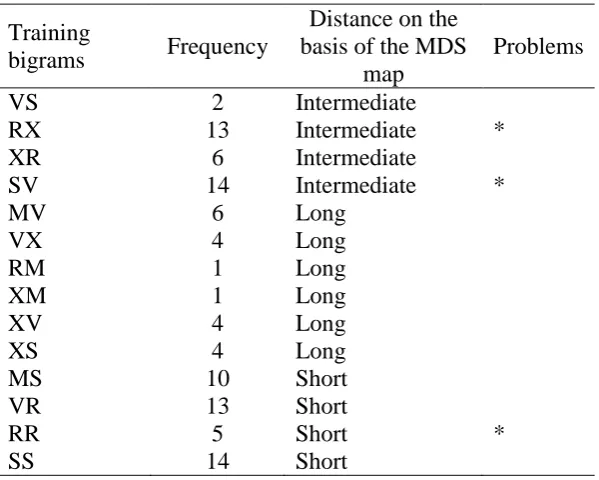
Allen, 1978, study, as M, S, R, V, and X). To do so, we computed the frequency of bigrams in training items (Table 1) and the matrix entries corresponded to this information. For example, the frequency of bigram MS in training would be 10,
therefore, this was the value in the corresponding entry in the similarity matrix. Bigram frequencies ranged between one and fourteen. We filled in the matrix elements as much
as possible using distributional information from training, but five of the possible bigrams did not appear in training.
*********************
insert Table 1 about here
*********************
The value of each cell was subtracted from 14 (i.e., the maximum bigram frequency), so as to create a distance matrix from the similarity matrix, such that high bigram frequencies would be associated with short distances. Further, we assigned the
value 0 to all the bigrams made of the same symbol (MM, SS etc.), since such bigrams should correspond to least distance. The missing cells were completed in either of two
ways: First, if there was a distance for cell AB, but not BA, we set the value for BA to be the same as the value for AB (in cases where there was a value for AB different to BA, we replaced both values with their average). Second, where there was neither an
AB value nor a BA one, we set both values to 7 (the median distance). In this way, we managed to create a distance matrix out of bigram frequencies, such that, in general,
In order to provide a two-dimensional representation of the pattern of distances, we carried out a multidimensional scaling (MDS) analysis (Shepard, 1980). The MDS
of the above distance matrix revealed a satisfactory (stress =.003, RSQ = .999) two-dimensional representation of the letters in the grammar (Figure 3). Of course, the two
dimensions cannot be interpreted in terms of any aspect of the grammar. *********************
insert Figure 3 about here
*********************
Using this MDS representation of the letters (Figure 3), we assigned a distance ‘value’ to each bigram, to examine the relation of the distance factor to grammaticality
and chunk strength. Table 1 shows these results and allows an appreciation of how successful the conversion of bigram frequencies to MDS distances has been: Overall,
most of the frequent bigrams are indeed associated with shorter distances, but with some exceptions.
Given the Table 1 association between distances and bigrams, we computed the distance factor for each test item. We assigned distance values of 0, 1, or 2 to each bigram, depending on whether the bigram corresponded to a short, intermediate, or long
distance. Then, we computed the overall distance associated with a test item, by simply adding the distances corresponding to the bigrams of the test items. For example, consider test item MSVS. Its ‘distance’ can be found by adding the distance values for
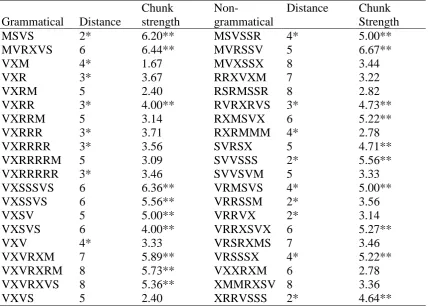
MS, SV, and VS, which is 0 + 1 + 1 = 2. The distance factor for the G and NG test items is shown in Table A1. Given the approximations involved in computing these
distance values, we simply ordered the test items on the basis of distance and called 23 of them ‘high distance’ and 17 ‘low distance’ (it was not possible to exactly equate the
variable takes into account our expectation that, at best, our participants’ knowledge of
geography would be approximate.
A key issue is whether the distance factor correlates with grammaticality or chunk strength. In both cases the answer is negative (for these correlations we used the
continuous distance and chunk strength factors, not the dichotomized ones). The
correlation with grammaticality was r(40) = -.013, and with chunk strength was r(40) = .058. Thus, the distance factor is largely independent of grammaticality and chunk
strength. This conclusion is reinforced by comparing the distance factor for G and NG test items (4.85 vs. 4.90 respectively) and high and low chunk strength items (4.90 vs.
4.85 respectively). In sum, if participants were responding, predominantly, on the basis of distance, we would expect very low grammaticality and chunk strength performance.
The final issue concerned how to map letters to city names. First, we needed an
arrangement of cities, which would conform as closely as possible to the arrangement of letters in Figure 3. Second, the cities had to be such that their geographical locations
would be broadly familiar to participants. Thus, we mapped the letters to the following European cities, that were expected to be familiar to our Greek participants: M was mapped to Nicosia, S to Athens, V to Berlin, R to London, and X to Lisbon. This
mapping between letters and city names captures the two-dimensional MDS representation of the letters in the grammar satisfactorily (Figure 4).
*********************
insert Figure 4 about here
*********************
There was not a significant difference in the actual geographical distance between G (7047kms, SD = 2673) and NG (8203kms, SD = 2754) or between high
ηp2 = .05 and p = .374, ηp2 = .02 respectively). By contrast, there was a significant
difference in geographical distance between short (5198kms, SD = 1574) and
long-distance (9418kms, SD = 1901) strings, p < .001, ηp2 = .59, in the expected direction.
The average geographical distance for training items was 6683kms (SD = 2776), closer
to the short-distance (p = .059, ηp2 = .10) than to the long-distance test strings (p < .001,
ηp2= .26), as intended. In sum, the grammaticality and similarity structures in the test
phase did not conform to or violate distance expectations in themselves; rather, it is the
relation of the cover task to training items that was congruent or incongruent with expectations.
2.3 Procedure and Tasks
All participants were informed that the study consisted of two parts. In the first part, they had to observe sequences of cities that corresponded to the routes of an airline
company. Learning was incidental, in that participants did not know that (or what) they were supposed to learn, nor that they were going to be tested.
2.3.1 Exposure phase
The two consistency conditions differed in terms of the cover stories given to participants, which favored more short-distance trips in the consistent condition and
more long-distance ones in the inconsistent one (Appendix B).
The training strings of city names were individually presented on a computer
screen. In the baseline learning condition, each string remained on the screen until participants pressed the space bar to move on to the next string (presentation time was limited to a maximum of 30s). Participants were asked to press the space bar as quickly
as possible. Training items were presented three times, with a different random order each time, such that no item was presented n+1 times before all items had been
In the dual task condition, we employed a random number generation (RNG) task that is known to engage executive function (Baddeley, Emslie, Kolodny, &
Duncan, 1998; Towse, 1998; Towse & Chesire, 2007). Throughout training, participants had to generate a random number between 1 and 10, guided by the beats of an electronic
metronome, at the rate of 40 beats per minute. Participants were corrected if they did not keep pace with the metronome or did not produce apparently random sequences.
Under time pressure training, strings appeared for a short time that was set on
the basis of string length, with strings containing seven, six, five, four and three city names appearing on the screen for 1200ms, 1000ms, 800ms, 650ms and 500ms,
respectively.
2.3.2 Test phase
After training, participants were asked to determine which of the new sequences
were compatible with the old ones and which were not (Appendix B provides verbatim instructions). The test strings of city names were presented individually and remained on the screen until participants pressed either of two keys labeled “yes” or “no”. Each
string was presented once with no corrective feedback.
Following each response, participants had to specify the source of their
knowledge by pressing one of the following keys labeled: guess, intuition, implicit prior knowledge, explicit prior knowledge, rules, or memory. Participants were given the following instructions: Press the ‘guess’ key when it seems to you that your response is
based on no information whatsoever, that is, when you feel as if your response was decided by the flipping of a coin. Press the ‘intuition’ key when you are, to some extent,
confident about your response and its correctness, but you have no idea why your judgment is correct. Press the ‘implicit prior knowledge’ key when it seems to you that
rather on pre-existing knowledge about cities, which, however, you could not specify and report if required. Press the ‘explicit prior knowledge’ key when it seems to you
that your judgment was not based on any knowledge you acquired during the first part, but rather on pre-existing knowledge about cities, which you could specify and report if required. Press the ‘rules’ key when it seems to you that your judgment was based on a
rule or some rules you learned in the first part, and which you could report if asked. Press the ‘memory’ category key when it seems to you that your judgment was based on
memory for specific routes or parts of routes from the first part.
The first three categories correspond to structural knowledge, the content of
which participants claim to be unaware of, and the last three to structural knowledge, the content of which participants claim to be aware of. Thus, the first three categories were considered as indices of implicit structural knowledge, whereas the last three as
indices of, at least partially, explicit structural knowledge (for use of such attributions see e.g., Grey, Williams, & Rebuschat, in press; Dienes, 2012; Dienes, Baddeley, &
Jansari, 2012; Dienes & Scott, 2005; Li, Jiang, Guo, Yang, & Dienes, 2013; Rebuschat, Hamrick, Sachs, Riestenberg, & Ziegler, 2013; Williams & Rebuschat, 2012).
2.3.3 Post experimental session
After the test phase, all participants answered a question regarding their
geographical knowledge of our cities. It was noted that this question was independent of
the experimental session. All 25 pairs of cities used to create the stimuli were presented, individually, on the computer screen. Participants had to provide an estimate of how long the distance between the two cities seemed to them, by pressing one of the three
keys: short, medium, long.
Performance in terms of the three knowledge types (grammaticality, similarity, distance) is used to assess whether learning took place. Performance on subjective
measures is used to establish whether training resulted in implicit (unconscious) or explicit (conscious) knowledge of the three possible knowledge kinds.
3.1 Classification Performance
Given we have employed a knowledge type (distance), different from the kind of knowledge types investigated in past AGL research, we analyzed each knowledge type
separately, using two-way ANOVAs, with consistency (consistent vs. inconsistent) and training (baseline, time pressure, dual task), as between-participants variables2. This
allows an examination of the impact of the key manipulation, regarding the consistency of knowledge, on each of the three knowledge types, and across the three training conditions.
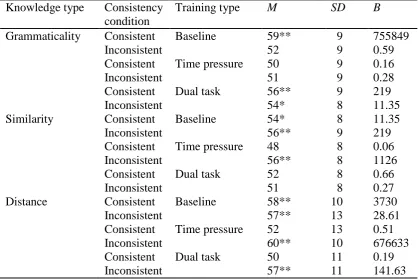
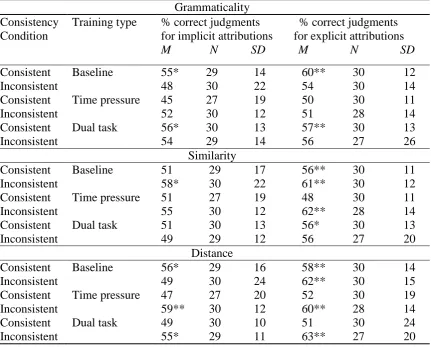
In terms of grammaticality, a consistency by training interaction, F(2, 174) = 4.02, p = .020, ηp2 = .04, revealed that participants in the consistent condition
significantly outperformed those in the inconsistent condition in the baseline learning condition only, F(1, 58) = 9.33, p = .003, ηp2 = .14, with evidence of grammaticality
knowledge being found in the consistent condition, r2 = .49, but not the inconsistent one
r2 = .03 (Table 2). This was effectively the conclusion of Pothos (2005). In the time pressure and dual task conditions, there were no significant differences in
grammaticality performance between the consistent and inconsistent conditions, F(1, 58) = .64, p = .426, ηp2 = .01, 95% CI [-6.22, 2.66] and F(1, 58) = .65, p = .422, ηp2 =
.01, 95% CI [-2.6, 6.1], respectively. Evidence of grammaticality knowledge in the two
2
The 3-way interaction was not significant. No conclusions will be drawn about differences between the knowledge types, where not tested and analogously for related
consistency conditions collapsed together was found in the dual task condition (55%, p
< .001, r2 = .23) and not under time pressure (51%, p = .662, r2 = .003), a difference
which was significant, F(1, 116) = 6.94, p =. 010, ηp2 = .06.
********************
insert Table 2 about here
********************
In terms of (chunk strength) similarity, a consistency by training interaction,
F(2, 174) = 4.99, p = .008, ηp2 = .05,revealed a clear advantage of the inconsistent over
the consistent condition under time pressure, F(1, 58) = 15.19, p < .001, ηp2 = .21, with
only the former condition demonstrating evidence of similarity knowledge in this training type (Table 2). There was not a significant consistency effect for either
baseline, F(1, 58) = 1.60, p = .211, ηp2 = .03, 95% CI [-7.1, 1.6], or dual task conditions,
F(1, 58) = .40, p = .532, ηp2 = .01, 95% CI [-2.8, 5.3]. Evidence of similarity knowledge
in the two consistency conditions collapsed together was found in the baseline condition
(55%, p < .001, r2 = .26), but not in the dual task one (51%, p = .176, r2 = .03), a difference which was significant, F(1, 116) = 5.90, p = .017, ηp2 = .05.
Finally, we compare participants’ performance on the distance factor. Recall, in
all cases, higher performance on the distance factor was a measure of selections consistent with participants’ expectations, but in the consistent condition these
expectations were further consistent with the structure of the stimuli, whereas this was not the case in the inconsistent condition. There was only a significant effect of
consistency, F(1,174) = 7.38, p = .007, ηp2 = .04, with overall distance accuracy being
significantly higher in the inconsistent than in the consistent condition, irrespective of training type. Evidence of distance knowledge collapsed across training types was
condition (58%, p < .001, r2 = .35). Note that, although pre-existing biases might explain the difference between the consistent and inconsistent conditions for any one
training condition, differences between training conditions cannot be so explained. To sum up, in many cases, performance in the inconsistent condition was higher
than in the consistent condition. This was the case for the distance factor, independent of training condition, and for similarity under time pressure. However, for baseline learning, grammaticality performance was higher in the consistent condition.
3.2 Subjective Measures of Awareness
The analysis of the conscious status of participants’ structural knowledge was
used to examine what sorts of information (distance relations, grammaticality or similarity) led to explicit and implicit knowledge.
3.2.1 Frequency of knowledge attributions
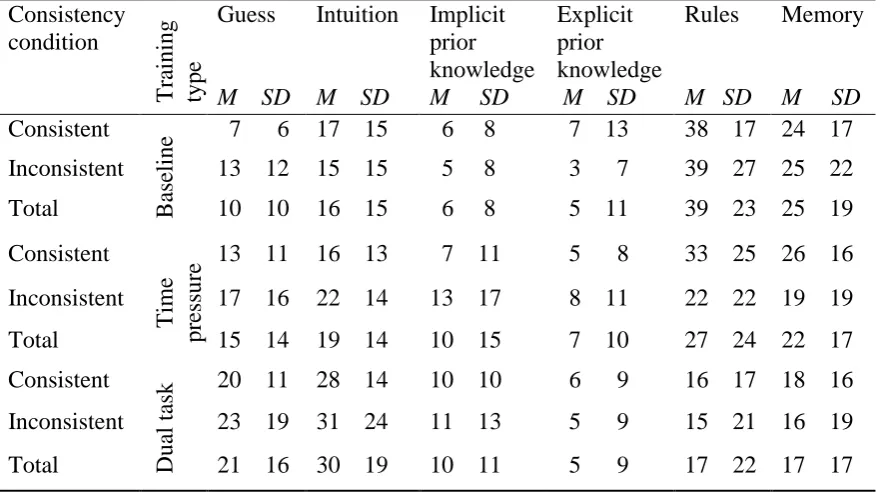
The frequencies of the different knowledge attributions are shown in Table 3. The guess, intuition and implicit prior knowledge categories were combined to create
implicit attribution scores, and the three explicit attributions were combined to create explicit attribution scores. The two-way ANOVA on percentage of implicit attributions in the two consistency conditions and the three training conditions revealed a significant
effect of training, F(2,174) = 24.87, p < .001, ηp2 = .22. An LSD post hoc test revealed
that each training type differed from the other two, ps < .05, with baseline learning
resulting in the lowest frequency of implicit attributions (31%), dual task leading to the highest frequency (61%), and time pressure lying in between (44%).
********************
insert Table 3 about here
An effect of consistency, F(1, 174) = 5.37, p = .022, ηp2 = .03, showed that, in
the consistent condition, participants gave fewer implicit attributions (41%) than in the
inconsistent condition (49%).
In sum, baseline learning led to the lowest and dual task to the highest number
of attributions indicating implicit knowledge. In addition, the inconsistent condition led to more implicit attributions than the consistent one.
3.2.2 The implicitness and explicitness of knowledge
The accuracy of the implicit attributions (i.e., accuracy for items included in the implicit attribution scores) was assessed with three 2-way ANOVAs on participants’
accuracy while providing implicit attributions for each knowledge type, with consistency (consistent vs. inconsistent) and training (baseline, time pressure, dual task), as between-participants variables. The accuracy of the explicit attributions (i.e.,
accuracy for items included in the explicit attribution scores) was assessed with corresponding ANOVAs for explicit attributions (Table 4)3.
*********************
insert Table 4 about here
*********************
3.2.2.1 Implicit knowledge
With respect to grammaticality, there were no significant effects (ps > .05, ηp2s <
.03) and the consistency by training interaction reached only marginal significance, F(2, 169) = 3.00, p = .053, ηp2 = .03. The overall accuracy of implicit grammaticality
knowledge (52%) was close to chance, p = .167, r2 = .01, 95% CI [49.3, 54.2].
3
Only the 3-way interaction for the accuracy of implicit knowledge was
No significant effects or interactions were found in terms of similarity, either, ps > .10, ηp2s < .03. However, the overall accuracy of implicit similarity knowledge (53%)
exceeded chance, t(174) = 1.99, p = .048, r2 = .02.
In terms of the distance factor, there was a consistency by training interaction,
F(2, 169) = 5.31, p = .006, ηp2 = .06. The consistent and inconsistent conditions did not
differ in terms of the accuracy of implicit distance knowledge under the baseline
condition, F(1, 57) = 1.95, p = .168, ηp2 = .03, 95% CI [-3.2, 18.1]. The overall accuracy
of implicit distance knowledge in the two conditions collapsed together was close to chance, p = .384, r2 = .01, 95% CI [47.0, 57.7]. By contrast, under time pressure, the
inconsistent condition demonstrated significantly greater accuracy of implicit distance knowledge than the consistent condition, F(1, 55) = 7.63, p = .008, ηp2 = .12. In fact,
evidence of implicit distance knowledge under time pressure was found only in the
inconsistent, r2 = .39, and not in the consistent condition, p = .489, r2 = .02, 95% CI
[39.4, 55.2]. Similarly, in the dual task condition, the inconsistent condition
outperformed the consistent one in terms of the accuracy of implicit distance
knowledge, F(1, 57) = 4.05, p = .049, ηp2 = .07, which again exceeded chance only in
the former, r2 = .14, and not in the latter condition, p = .543, r2 = .01, 95% CI [45.1,
52.7].
In sum, there was evidence only of implicit knowledge of similarity and not of
grammaticality, independent of consistency and training conditions. With respect to the distance factor, baseline learning did not elicit any implicit knowledge, independent of consistency condition. By contrast, time pressure and dual task led to the development
of implicit distance knowledge, but only in the inconsistent and not in the consistent condition.
In terms of the accuracy of explicit grammaticality knowledge, there were no significant effects or interactions, ps > .05, ηp2s < .04. The overall accuracy of explicit
grammaticality knowledge collapsed over conditions (54%) exceeded chance, p < .001,
r2 = .08.
With respect to similarity, there was a significant consistency by training interaction, F(2, 169) = 3.77, p = .025, ηp2 = .04. There was no difference between the
consistent and inconsistent conditions in terms of accuracy of explicit similarity
knowledge, F(1, 58) = 2.53, p = .117, ηp2 = .04, 95% CI [-10.8, 1.2], under baseline
training, with the corresponding accuracy collapsed over the two consistency conditions
(58%) exceeding chance, p < .001, r2 = .34. Under time pressure, the inconsistent condition outperformed the consistent condition, F(1, 56) = 16.68, p < .001, ηp2 = .23,
with accuracy of explicit similarity knowledge significantly exceeding chance only in
the former, r2 = .41, and not in the latter condition, p = .335, r2 = .03, 95% CI [43.9, 52.1] (see Table 4). Under dual task learning, there was no significant difference in
explicit similarity knowledge between the consistent and inconsistent conditions, F(1, 55) < .001, p = .987, ηp2 < .001, 95% CI [-8.5, 8.7]. Explicit similarity knowledge
collapsed over the two consistency conditions under dual task training (56%) exceeded
chance, p = .007, r2 = .12.
In terms of distance, the inconsistent condition outperformed the consistent one,
F(1, 169) = 8.52, p = .004, ηp2 = .05, independent of training, with accuracy of explicit
distance knowledge significantly exceeding chance only in the former (62%), p < .001,
r2 = .34, and not in the latter condition (54%), p = .088, r2 = .03, 95% CI [49.5, 57.7].
In sum, there was evidence of explicit grammaticality knowledge in all
conditions collapsed together. There was above chance explicit similarity knowledge in
inconsistent condition was the only condition that led to significant explicit similarity knowledge under time pressure. An analogous advantage of the inconsistent over the
consistent condition was found in terms of explicit distance knowledge, independent of training type.
3.3 Post Experimental Question
The post experimental question assessed participants’ knowledge of geography,
by asking them to rate if trips between two cities corresponded to short, medium or long
distances. Scores of 0, 1 and 2 corresponded to short, medium and long distances, respectively. The 2 X 3 X 3 (Consistency [consistent vs. inconsistent] X Training
[baseline vs. time pressure vs. dual task] X Distance [short vs. medium vs. long]) ANOVA showed that only distance, F(2, 348) = 905.72, p < .001, ηp2 = .84, and its
interaction with training, F(4, 348) = 3.90, p = .004, ηp2 = .05, were significant. The
three training conditions differed only in terms of short-distance (F(2,174) = 4.78, p = .010, ηp2 = .05) and long-distance items (F(2,174) = 3.37, p = .037, ηp2 = .04), and not in
terms of the medium ones (F(2,174) = .54, p = .582, ηp2 = .01). An LSD post hoc test
revealed a difference between baseline and the other two conditions in terms of the short- and long-distance items (ps < .05), with participants in the baseline condition
giving lower scores for the short-distance items and higher scores for the long-distance ones than did participants in the other two training conditions. This finding does not add
any useful information to our main question of interest concerning participants’ ability to distinguish between the different distances, which would indicate good geography knowledge. The important finding is that the effect of distance was significant in all
training conditions (baseline: F(2, 116) = 436.54, p < .001, ηp2 = .88, time pressure: F(2,
116) = 240.88, p < .001, ηp2 = .81, dual task: F(2, 116) = 261.78, p < .001, ηp2 = .82),
direction in all training types (all ps < .001). In particular, short-distance bigrams received the lowest score (baseline: M = .26, SD =.18, time pressure: M = .38, SD = .25,
dual task: M = .35, SD = .21), long-distance bigrams received the highest score (baseline: M = 1.54, SD =.24, time pressure: M = 1.44, SD = .26, dual task: M = 1.42,
SD = .32) and medium bigrams fell between these (baseline: M = 1.02, SD = .39, time pressure: M = 1.10, SD = .39, dual task: M = 1.05, SD = .36). Thus, participants had knowledge of geography in all training conditions.
4. General Discussion
Our aim was to investigate how (in)congruence of prior knowledge with
stimulus structure affects a) the learning of the novel distance knowledge type involving prior knowledge relations, and b) the learning of purely structural knowledge that has been used in past AGL research (i.e., grammaticality and similarity, as chunk strength).
Pothos (2005) first employed a prior knowledge manipulation and reported that, under baseline learning conditions, when stimuli reflected only a single type of knowledge
(grammaticality), consistency between prior knowledge and stimulus structure enhanced learning. We tested the generality of Pothos’s (2005) findings by using different training conditions (baseline, time pressure, dual task), examining performance in a refined way,
with stimuli made to reflect three knowledge types (grammaticality, similarity, distance), and including manipulations to test for the implicit/explicit nature of the
knowledge acquired.
4.1 The Impact of the Consistent vs. Inconsistent Knowledge Manipulation in AGL
In the baseline condition, which corresponded to that of Pothos (2005), we
replicated his earlier finding, regarding grammaticality. The relevant grammaticality scores in the consistent and inconsistent conditions in Pothos (2005) were 60.2% and
approach adopted in the present study revealed ways in which Pothos’s (2005)
conclusion could not be generalized (in relation to other knowledge types and other
learning circumstances).
Inconsistency between general knowledge and structure led to an advantage in
terms of distance knowledge (independent of training type) and also in the use of similarity (under time pressure). Higher performance of the consistent condition over the inconsistent one was observed for grammaticality in the baseline learning condition
(as Pothos, 2005, found too).
Conflict monitoring theory (e.g., Botvinick et al., 2001; Verguts & Notebaert,
2009) leads us to expect that the conflict between prior expectations and structural stimulus aspects in the inconsistent condition increased participants’ attention to distance information, leading to greater use of distance knowledge and to greater
learning of chunks that could be defined as distances.
Why should grammaticality knowledge be impaired in the inconsistent rather
than consistent condition? In our materials, grammaticality was fully counterbalanced with chunk strength. Thus, plausibly, part of what constitutes grammaticality knowledge is knowledge of repetition patterns (Brooks & Vokey, 1991; Scott & Dienes, 2008); that
is, which positions are repetitions of elements in which other positions (e.g., the last position being a repeat of whichever element is in the first, etc.). We determined the “global repetition structure” of each string (e.g., the letter strings MTTVMT and
BAACBA both have global repetition structure 122312). Following the procedure of Scott and Dienes (2008), we determined the “global repetition proportion” of each test
string, defined as the maximum proportion of a test string’s global repetition structure that appeared in full (uninterrupted) in any of the training strings. This proportion was
(.66, SD = .14), p < .001, ηp2 = .36; but was almost identical for high (.74, SD = .15) vs.
low (.78, SD = .20) chunk strength strings, p = .543, ηp2 = .01, and also for short (.80,
SD = .19) vs. long (.72, SD = .17) distance strings, p = .160, ηp2 = .05. Awareness of
incongruency may focus attention on details and local structure, allowing small chunks
to be learnt better, but global structure, like long-distance repetitions (e.g., 12341) to be learnt more poorly, as reflected in grammaticality knowledge (for the role of global vs local structure in implicit learning see Dienes et al., 2012; Fu, Dienes, Shang & Fu,
2013; Kiyokawa, Dienes, Tanaka, Yamada & Crowe, 2012). We acknowledge that this is a post hoc explanation for our results, though it is testable perhaps involving
methodologies especially designed for investigating the global local distinction (e.g., Kiyokawa et al., 2012).
The increased distance factor performance in the inconsistent condition does not
quite comply with Heit’s (1998) report, that observations incongruent with prior knowledge lead to an advantage in categorization over congruent observations, only
under slow-paced learning (when more resources are available). By contrast, we found that incongruent observations led to an advantage, even under time pressure and dual task conditions. Further, this finding broadly resonates with reports that prior
knowledge facilitates categorization even when only a few knowledge-related features are involved or even when categories contain information that is contradictory to prior
knowledge (Kaplan & Murphy, 2000; Murphy & Kaplan, 2000).
4.2 The Implicitness of Prior Knowledge and Purely Structural Relations
The present research assessed the (un)consciousness of prior knowledge, as
applied to AGL, by examining the (un)consciousness of knowledge for distance relations. We found evidence of both explicit (conscious) and implicit (unconscious)
component. The explicit component may involve recollecting inter-city distances. The implicit component may involve intuitions about the total distance of different items or
implicit memories of previously encountered related trips.
The present findings diverge from the proposal that implicit learning is a passive
process leaving no room for theory-based processes (Hayes & Broadbent, 1988).
Rather, our results are more consistent with the idea that implicit AGL reflects selective processes (van den Bos & Poletiek, 2009) and can be related to participants’ goals
(Eitam, Schul & Hassin, 2009), domain-specific constraints (e.g., Chen et al., 2011; Leung & Williams, 2011; Rohrmeier & Cross, 2013), and motivational relevance
(Eitam & Higgins, 2010). Relatedly, Tanaka, Kiyokawa, Yamada, Dienes and Shigemasu (2008) and Kiyokawa et al. (2012) have argued that implicit learning is sensitive to selective perceptual attention and to cultural expectations, respectively. In
an analogous vein, we have shown that what one attends to when learning implicitly is clearly influenced by prior knowledge.
Finally, we consider the (un)consciousness of the two purely structural factors. Similarity involved both implicit and explicit knowledge, under certain training and consistency conditions. Thus, similarity knowledge may involve both implicit and
explicit knowledge. In terms of grammaticality, we found evidence only of explicit knowledge. Dienes and Longuet-Higgins (2004), Jiang et al. (2012), Kuhn and Dienes
(2005), Li et al. (2013), Neil and Higham (2012), and Rebuschat and Williams (2009) obtained implicit knowledge of grammaticality independently of chunk similarity. Thus, it seems that, in general, both grammaticality and similarity knowledge can be learnt
Overall, our findings suggest that prior knowledge relevant to a learning task can involve both an explicit and an implicit component and may co-exist with both explicit
and implicit knowledge of purely structural aspects of the stimuli.
4.3 Learning Under Time Pressure and Dual Task Conditions
One interesting conclusion from the use of time pressure in this experiment is that the effect of prior knowledge on learning grammaticality requires a long enough exposure to the training strings (i.e., more than roughly a second per string). Similarity
and distance knowledge could develop within about a second per string (as the above chance similarity and distance knowledge in the time pressure inconsistent condition
suggests). This finding is broadly consistent with categorization research showing that general knowledge can be applied early on during categorization (e.g., Lin & Murphy, 1997; Luhmann et al., 2006; Palmeri & Blalock, 2000).
We employed the concurrent task to explore whether the different knowledge factors relied on executive resources. Distance factor performance (in the inconsistent
dual task condition) indicates that this knowledge type can be acquired with diminished executive control. No evidence of similarity knowledge was found in the dual task condition. Above chance grammaticality performance in this condition showed that it is
possible to develop grammaticality knowledge with disrupted executive resources (cf. Chang & Knowlton, 2004; Higham, 1997).
We expected the time pressure and dual task to be associated mostly with implicit knowledge. These predictions were confirmed only in part. Above chance implicit distance knowledge was demonstrated only in the inconsistent condition and
only in time pressure and dual task conditions. Consistently with Cleeremans and Jiménez’s (2002) theory, under speeded stimulus presentation in the inconsistent
corresponding to distance knowledge, hence at least part of such knowledge was implicit. Also, the finding of implicit distance knowledge in the dual task, inconsistent
condition is broadly compatible with research showing that divided attention leaves implicit knowledge intact (e.g., Dienes et al., 1995; Waldron & Ashby, 2001; Ziori &
Dienes, 2008). Evidence of implicit knowledge was also found in terms of similarity (and not grammaticality), independent of training type.
The explicit knowledge results, in general, followed the pattern of classification
results (except for grammaticality). Thus, again the inconsistent condition outperformed the consistent one in terms of explicit similarity knowledge (under time pressure) and
explicit distance knowledge (independent of training type). So, the determining factor seemed to be the inconsistency of prior knowledge with structure, with the inconsistent condition demonstrating more explicit knowledge than the consistent one, presumably
because of the greater effort the former condition required.
4.4 Conclusions
The main novel aspect of this work is that it is the only AGL study that
incorporates a knowledge factor, constructed to reflect people’s general knowledge and
expectations and dissociated from purely structural aspects of the stimuli. More
specifically, we investigated how (in)congruence of prior knowledge with structure affects the development of knowledge concerning both the relevant general knowledge
(the distance factor) and purely structural information (grammaticality and similarity), and we also examined the implicitness and/or explicitness of each of the three
knowledge types. Congruence of prior knowledge with structure led to an advantage
only in terms of grammaticality accuracy and only under baseline training, thereby replicating Pothos’s (2005) finding. However, a surprising finding is that we identified
and stimulus structure led to a clear advantage. Finally, we have identified conditions where expectations-based knowledge may involve both explicit and implicit knowledge
and may co-exist with both explicit and implicit knowledge of purely structural aspects. The complex pattern of results we identified indicates that, plausibly, the same kind of
knowledge can be extracted via multiple routes. Clarifying the relevant issues (e.g., the interplay between alternative learning routes; Ashby, Alfonso-Reese, Turken &
Waldron, 1998) in AGL is an under-researched, though important direction for future
Appendix A Table A1.
The Distance and Chunk Strength Factors For the Test Stimuli, Separately for the G
and NG Ones.
Grammatical Distance
Chunk strength
Non-grammatical
Distance Chunk Strength
MSVS 2* 6.20** MSVSSR 4* 5.00**
MVRXVS 6 6.44** MVRSSV 5 6.67**
VXM 4* 1.67 MVXSSX 8 3.44
VXR 3* 3.67 RRXVXM 7 3.22
VXRM 5 2.40 RSRMSSR 8 2.82
VXRR 3* 4.00** RVRXRVS 3* 4.73**
VXRRM 5 3.14 RXMSVX 6 5.22**
VXRRR 3* 3.71 RXRMMM 4* 2.78
VXRRRR 3* 3.56 SVRSX 5 4.71**
VXRRRRM 5 3.09 SVVSSS 2* 5.56**
VXRRRRR 3* 3.46 SVVSVM 5 3.33
VXSSSVS 6 6.36** VRMSVS 4* 5.00**
VXSSVS 6 5.56** VRRSSM 2* 3.56
VXSV 5 5.00** VRRVX 2* 3.14
VXSVS 6 4.00** VRRXSVX 6 5.27**
VXV 4* 3.33 VRSRXMS 7 3.46
VXVRXM 7 5.89** VRSSSX 4* 5.22**
VXVRXRM 8 5.73** VXXRXM 6 2.78
VXVRXVS 8 5.36** XMMRXSV 8 3.36
VXVS 5 2.40 XRRVSSS 2* 4.64**
Appendix B Instructions
Training phase:
Instructions in the consistent condition: “You will see a set of stimuli composed of city names. The city names correspond to the routes in Europe of an airplane company on successive days (repeated city names indicate that the plane flew to a place very near
the main city). The routes were planned so as to maximize the efficiency of the trips: The secret to success for the specific company is as many trips between nearby cities as
possible. Short trips are more efficient, as they require less fuel, operation and maintenance expenses. Long trips are not that efficient for this company.” The instructions in the inconsistent condition were exactly the same, with the following difference: “Long trips are more efficient, as the company charges a much higher price
for long trips without a significant increase in the operation and maintenance expenses
of its aircrafts. Short trips are not that efficient for this company.”
Test phase:
“The airline company has found a series of rules to plan its routes. The routes that these
rules allow are generally more efficient, and the company has been using them for a
References
Ashby, F. G., Alfonso-Reese, L. A., Turken, A. U., & Waldron, E. M. (1998). A
Neuropsychological Theory of Multiple Systems in Category Learning.
Psychological Review, 105(3), 442-481. doi:10.1037/0033-295X.105.3.442
Baddeley, A. D. (2007). Working memory, thought and action. Oxford: Oxford University Press.
Baddeley, A. D., & Andrade, J. (1998). Working memory and consciousness: An
empirical approach. In M. Conway, S. E. Gathercole, & C. Cornoldi (Eds.),
Theories of Memory II (pp. 1-24). Sussex: Psychology Press.
Baddeley, A. D., Emslie, H., Kolodny, J., & Duncan, J. (1998). Random generation and the executive control of working memory. Quarterly Journal of Experimental Psychology, 51(4), 819–852. doi:10.1080/713755788
Bailey, T. M., & Pothos, E. M. (2008). AGL StimSelect: software for automated selection of stimuli for artificial grammar learning. Behavior Research Methods,
40(1), 164–176. doi:10.3758/BRM.40.1.164
Botvinick, M., Braver, T., Barch, D., Carter, C., & Cohen, J. (2001). Conflict monitoring and cognitive control. Psychological Review, 108(3), 624-652.
doi:10.1037//0033-295X.I08.3.624
Boucher, L., & Dienes, Z. (2003). Two ways of learning associations. Cognitive
Science, 27(6), 807-842. doi:10.1016/j.cogsci.2003.03.001
Brooks, L., & Vokey, J.R. (1991). Abstract analogies and abstracted grammars:
Comments on Reber (1989) and Mathews et al. (1989). Journal of Experimental
Chang, G. Y., & Knowlton, B. J. (2004). Visual feature learning in artificial grammar classification. Journal of Experimental Psychology: Learning, Memory, and
Cognition, 30(3), 714–722. doi:10.1037/0278-7393.30.3.714
Chen, W., Guo, X., Tang, J., Zhu, L., Yang, Z., & Dienes, Z. (2011). Unconscious
Structural Knowledge of Form-meaning Connections. Consciousness and Cognition, 20(4), 1751-1760. doi:10.1016/j.concog.2011.03.003
Clark, A. (2013). Whatever next? Predictive brains, situated agents, and the future of
cognitive science. Behavioural and Brain Sciences, 36(3), 181-204. doi:10.1017/S0140525X12000477
Cleeremans, A. (1993a). Mechanisms of implicit learning: Connectionist models of sequence processing. Cambridge, MA: MIT Press.
Cleeremans, A. (1993b). Attention and awareness in sequence learning. In Proceedings
of the 15th Annual Conference of the Cognitive Science Society. Hillsdale, NJ: Erlbaum.
Cleeremans, A., & Jiménez, L. (2002). Implicit learning and consciousness: A graded, dynamic perspective. In R.M. French, & A. Cleeremans (Eds.), Implicit learning and consciousness: An empirical, computational and philosophical consensus in
the making (pp. 1-40). Hove, UK: Psychology Press.
Dienes, Z. (2008). Understanding Psychology as a Science: An Introduction to
scientific and Statistical Inference. Palgrave Macmillan.
Dienes, Z. (2011). Bayesian versus Orthodox statistics: Which side are you on?
Perspectives on Psychological Sciences, 6(3), 274-290.
Dienes, Z. (2012). Conscious versus unconscious learning of structure. In P. Rebuschat & J. Williams (Eds.), Statistical Learning and Language Acquisition (pp.
337-364). Mouton de Gruyter Publishers.
Dienes, Z., Altmann, G.T.M., & Gao, S. J. (1999). Mapping across domains without
feedback: A neural network model of transfer of implicit knowledge. Cognitive Science, 23(1), 53-82. doi:10.1207/s15516709cog2301_3
Dienes, Z., Altmann, G.T.M., Kwan, L., & Goode, A. (1995). Unconscious knowledge
of artificial grammars is applied strategically. Journal of Experimental
Psychology: Learning, Memory and Cognition, 21(5), 1322-1338.
doi:10.1037/0278-7393.21.5.1322
Dienes, Z., Baddeley, R. J., & Jansari, A. (2012). Rapidly Measuring The Speed Of Unconscious Learning: Amnesics Learn Quickly And Happy People Slowly.
PLoS ONE 7(3): e33400. doi:10.1371/journal.pone.0033400
Dienes, Z., & Fahey, R. (1995). The role of specific instances in controlling a dynamic
system. Journal of Experimental Psychology: Learning, Memory and Cognition, 21(4), 848-862. doi:10.1037/0278-7393.21.4.848
Dienes, Z. & Longuet-Higgins, H. C. (2004). Can musical transformations be implicitly
learned? Cognitive Science, 28(4), 531-558. doi:10.1016/j.cogsci.2004.03.003 Dienes, Z., & Scott, R. (2005). Measuring unconscious knowledge: Distinguishing
structural knowledge and judgment knowledge. Psychological Research, 69
(5-6), 338-351. doi:10.1007/s00426-004-0208-3
Dulany, D. E. (2003). Strategies for putting consciousness in its place. Journal of
Dulany, D. E., Carlson, R., & Dewey, G. (1984). A case of syntactical learning and judgement: How conscious and how abstract? Journal of Experimental
Psychology: General, 113(4), 541-555. doi:10.1037/0096-3445.113.4.541 Eitam, B., & Higgins, E. T. (2010). Motivation in mental accessibility: Relevance of a
representation (ROAR) as a new framework. Social and Personality Psychology Compass, 4(10), 951-967. doi:10.1111/j.1751-9004.2010.00309.x
Eitam, B., Schul, Y., & Hassin, R.R. (2009). Goal relevance and artificial grammar
learning. Quarterly Journal of Experimental Psychology, 62(2), 228-238. doi:10.1080/17470210802479113
Fu, Q., Dienes, Z., Shang, J., & Fu, X. (2013). Who learns more? Cultural differences in
implicit sequence learning. PLoS ONE 8(8): e71625.
doi:10.1371/journal.pone.0071625
Grey, S., Williams, J.N., & Rebuschat, P. (in press). Incidental exposure and L3
learning of morphosyntax. Studies in Second Language Acquisition.
Guo, X., Zheng, L., Zhu, L., Yang, Z., Chen, C., Zhang, L., …Dienes, Z. (2011).
Acquisition of conscious and unconscious knowledge of semantic prosody.
Consciousness and Cognition, 20(2), 417-425.
doi:10.1016/j.concog.2010.06.015
Hamrick, P., & Rebuschat, P. (2012). How implicit is statistical learning? In P.
Rebuschat & J. Williams (Eds.), Statistical Learning and Language Acquisition
(pp.365–382). Mouton de Gruyter Publishers.
Harris, H. D., Murphy, G. L., & Rehder, B. (2008). Prior knowledge and exemplar
frequency. Memory & Cognition, 36(7), 1335-1350. doi:10.3758/MC.36.7.1335 Hayes, N. A., & Broadbent, D. E. (1988). Two modes of learning for interactive tasks.
Heit, E. (1994). Models of the effects of prior knowledge on category learning. Journal of Experimental Psychology: Learning, Memory and Cognition, 20(6),
1264-1282. doi:10.1037/0278-7393.20.6.1264
Heit, E. (1998). Influences of prior knowledge on selective weighting of category
members. Journal of Experimental Psychology: Learning, Memory and Cognition, 24(3), 712-731. doi:10.1037/0278-7393.24.3.712
Higham, P. A. (1997). Dissociations of Grammaticality and Specific Similarity Effects
in Artificial Grammar Learning. Journal of Experimental Psychology: Learning, Memory and Cognition, 23(4), 1029-1045. doi:10.1037/0278-7393.23.4.1029
Jiang, S., Zhu, L., Guo, X., Ma, W., Yang, Z., & Dienes, Z. (2012). Unconscious
structural knowledge of tonal symmetry: Tang poetry redefines limits of implicit learning. Consciousness and Cognition, 21(1), 476-486.
doi:10.1016/j.concog.2011.12.009
Kaplan, A. S., & Murphy, G. L. (2000). Category learning with minimal prior
knowledge. Journal of Experimental Psychology: Learning, Memory and Cognition, 26(4), 829-846. doi:10.1037/0278-7393.26.4.829
Kemler Nelson, D. G. (1984). The effect of intention on what concepts are acquired.
Journal of Verbal Learning and Verbal Behavior, 23(6), 734-759. doi:10.1016/S0022-5371(84)90442-0
Kiyokawa, S., Dienes, Z., Tanaka, D., Yamada, A., & Crowe, L. (2012). Cross cultural
differences in unconscious knowledge. Cognition, 124(1), 16-24.
doi:10.1016/j.cognition.2012.03.009
Experimental Psychology: Learning, Memory, and Cognition, 22(1), 169-181. doi:10.1037/0278-7393.22.1.169
Kuhn, G., & Dienes, Z. (2005). Implicit learning of non-local musical rules. Journal of Experimental Psychology: Learning, Memory, & Cognition, 31(6), 1417–1432.
doi:10.1037/0278-7393.31.6.1417
Leung, J., & Williams, J.N. (2011). Constraints on implicit learning of grammatical form-meaning connections. Language Learning, 62(2), 634–662.
doi:10.1111/j.1467-9922.2011.00637.x
Li, F., Jiang, S., Guo, X., Yang, Z., & Dienes, Z. (2013). The nature of the memory
buffer in implicit learning: Learning Chinese tonal symmetries. Consciousness and Cognition, 22(3), 920–930. doi:10.1016/j.concog.2013.06.004
Lin, E. L., & Murphy, G.L. (1997). Effects of background knowledge on object
categorization and part detection. Journal of Experimental Psychology: Human Perception and Performance, 23(4),1153-1169.
doi:10.1037/0096-1523.23.4.1153
Luhmann, C. C., Ahn, W., & Palmeri, T.J. (2006). Theory-based categorization under speeded conditions. Memory & Cognition, 34(5), 1102-1111.
doi:10.3758/BF03193256
McRae, K. (2004). Semantic memory: Some insights from feature-based connectionist
attractor networks. In B. H. Ross (Ed.). The Psychology of Learning and Motivation,45 (pp. 41-86). San Diego: Academic Press.
Mealor, A. D. & Dienes, Z. (2012). No-loss gambling shows the speed of the