Discovering the Proportion of Motor Sequence Learning in Laparoscopic Simulator Task Performance
Saskia Henrichs, s1663054 University of Twente
Department of Cognitive Psychology and Ergonomics
Date: 25th June 2018
Abstract
Introduction. Creating learning curves based on virtual reality simulators seems to be a promising new method to tackle the challenges minimally invasive surgery has raised. Nevertheless, is it currently unclear how future training and assessment with virtual reality simulators can be designed. A question of interest is if the latent abilities necessary in the real procedure occur in simulator training as well. One aspect could be that simulator training elicits more repetitive behaviour. Therefore, MSL might play a role in simulator training. MSL is a form of open-loop learning in which sequences of actions are implicitly learned and automatized over time. The impact of MSL on simulator tasks might be assessed based on a two-part learning curve following the LARARY model. The current research will focus on finding out the general proportion MSL in laparoscopic simulator task performance and if there is a variance in the proportion MSL between individuals. Additionally, it will be assessed if the chosen tasks may serve as psychometric tools.
Method. It has been chosen for a time series as design. In total, there were 15 people practicing with the laparoscopic virtual reality simulator. Participants were required to carry out 40 trials of two different simulator tasks. The first 20 trials were in a variable
configuration, the second 20 trials were configured in a fixed sequence. Afterwards, a non-linear multilevel regression model with a gamma-distributed random component has been fitted the data. The proportion of MSL has been calculated on a population and a participant level. Additionally, the correlation between the chosen tasks has been estimated.
Results. A relatively high proportion of MSL has been found in both tasks with MSL being even higher in the easier task. Also, there was mentionable inter-individual variance in the proportion MSL from participant to participant. The correlation between both tasks has been mediocre. Uncertainty was very high for all results.
Discussion. The current study showed that MSL indeed makes up a part of the chosen tasks in laparoscopic simulator training. Also, there was individual variance in the proportion MSL. When the amount of MSL varies from person to person, simulator training would mean an unfair assessment and an inadequate training method. Therefore, needs MSL to be kept at a minimum when designing simulator based training and assessment. The study showed that the nature of the tasks play a role in the proportion of MSL. Easier tasks seem to trigger MSL faster than more complex ones. Also, it needs to be taken into consideration that the
on the current study, as there were some major limitations. The study mainly served as a proof of concept and future research should focus increasing the sample size significantly. Also, the amount of trials has not been sufficient. It should be taken into consideration to redistribute the amount of trials and to do less trials in the variable and more in the fixed part, as the asymptote level in contrast to the variable part has not been reached in the fixed part for most participants.
Introduction
Since its emergence, minimally invasive surgery (MIS) has been adopted at a fast rate (Tsui, Klein & Garabrant, 2013). MIS tries to keep the trauma of an operation as small as possible. Essentially, MIS is about replacing long incisions necessary for conventional surgery with incisions that are only few centimetres long or even to completely avoid them (Kantonsspital Aarau, 2011). Most of the general surgeons consider MIS as the gold standard for many gastrointestinal (GI) diseases, because it includes reduced postoperative pain, recovery time and cost-effectiveness (Tsui, Klein & Garabrant, 2013, Lacy, García-Valdecasas, Delgado, Castells, Taurá, Piqué & Visa, 2002, Darzi & Munz, 2004).
Laparoscopy is one of these minimally invasive techniques executed in the abdominal area of the patient. Small incisions are made in the abdominal wall and specially designed endoscopes are inserted (Gao & MacKenzie, 1996). Nevertheless, did the introduction of MIS like laparoscopy mean a huge paradigm shift for many surgeons for their regular operating procedures. Laparoscopy is a complex procedure that requires the surgeon to carry out precise movements in a restricted area while observing ones actions on a monitor which requires adjusted visual-spatial motor orientation (Dakin & Gagner, 2003). Not being able to touch or see the areas in which they operate requires a three-dimensional orientation in a
two-dimensional depiction of the procedure which has resulted in the need for a completely new man-machine environment (Mack, 2001, Van Dongen, Tournoij, Van der Zee, Schijven & Broeders, 2007).
involves executing segments of a movement automatically. Therefore, MSL encompasses carrying out a motor sequence without engaging in shifts of attention or intentional executive control (Rhodes, Bullock, Verwey, Averbeck & Page, 2004). MSL is, amongst other things, characteristically unintentional and inflexible (D’Angelo, Milliken, Jiménez & Lupiáñez, 2013). If MSL would make a great impact in a training and assessment method, it would not be transferrable to the real procedure, as in real life, every body on which is operated is
different. Therefore, an automated, inflexibly learned motor sequence would not be applicable on individually different patients.
In the current study, we will deal with the specific question concerning laparoscopic simulator training and assessment, namely to what extend repetition of trials matters in terms of MSL, with the purpose of finding out how to create valid tasks for laparoscopic simulator training.
Background
Training minimally invasive surgery. Because the skills required for laparoscopy are different from the skills necessary for traditional surgery, adequate training and assessment are crucial factors in the education of surgeons. For a long period of time, training has been performed on a master-apprentice basis within the operating room (Hyltander, Liljegren, Rhodin & Lönroth, 2002). In this mentor-trainee model, the trainee first of all observes the mentor operating and afterwards performs the procedure himself under guidance of his
mentor (Shalhav, Dabagia, Wagner, Koch & Lingeman, 2002). Although skill development in the operating room seems no longer to be appropriate due to cost factors, limited work hours and ethical issues, has laparoscopic surgery training remained highly unstructured and
restrained to this same mentor-apprentice model (Seymour et al., 2002). Despite the extensive adoption of laparoscopic operations, very little has developed in the way of teaching
laparoscopic procedures (Korndorffer, Stefanidis & Scott, 2006). Therefore, innovative and efficient new training and assessment methods are necessary to balance the complexity of new surgical demands.
improved the surgical performance during laparoscopy. The study by Seymour et al. (2002) therefore seems to validate the transfer of skill acquisition between VR and the original surgical procedure.
Another study which seemed to confirm the resemblance between training with a laparoscopic VR simulator (LapSim) and the real procedure has been the study by van Dongen, Tournoij, van der Zee, Schijven and Broeders (2007). The aim of this research has been to examine if training surgical procedures with a VR simulator would deliver construct validity and therefore, suggest skill acquisition of the trainee. For this purpose, van Dongen, Tournoij, van der Zee, Schijven and Broeders (2007) recruited 48 participants with different surgical experience and measured their performance in the simulator training. They found out that the higher the level of experience, the higher the score in the simulator training.
Therefore, they concluded that the LapSim simulator can be integrated in a training programme as construct validity has been confirmed (van Dongen, Tournoij, van der Zee, Schijven & Broeders, 2007).
The above described studies suggest that, VR simulators, like the LapSim simulator for laparoscopy might be used as an innovative and indispensable part in the preparation and assessment of surgeons (Van Dongen et al., 2007). However, when assessing construct validity and validating the transfer between VR training and the operation room, earlier studies did not take into consideration latent abilities such as the nature of learning which occurred when training with a VR simulator. It is questionable if an increased performance can actually be attributed to skill acquisition or if it is attributable to motor sequence learning (MSL) due to a high repetitiveness of the same movements in simulator training. In order to assess the question on which role MSL plays in laparoscopic simulator performance, the term learning first needs to be elaborated in more detail.
Introducing Learning. One can be concerned about the validity of sim training under various aspects. One particular issue regards in what way it promotes open- or closed-loop learning. When initially engaging in a specific motor behaviour, closed-loop learning occurs in which error detection and corresponding correction of the behaviour happens (Adams, 1971). When engaging in a motor behaviour, the desired outcome is specified beforehand. The result is then referred back, reflected for any error detection and if demanded improved (Adams, 1971). With more practice, motor skills are performed more automatically
MSL is a form of open-loop learning in which sequences of actions are implicitly learned and stabilized over time, which makes MSL less susceptible to interferences or adjusting responses (Meissner, Keitel, Südmeyer & Pollok, 2016). MSL involves the repetitive execution of a series of motor sequences in a fixed order which leads to the development of memory representations of this sequence, the so called motor chunks. With practice, those chunks can be executed collectively, in an open-loop manner as if it was one single response (Verwey, 2001). When learning a motor sequence, its execution does neither require shifts in attention nor is intentional executive control necessary. In other words, when MSL occurs, segments are executed automatically (Rhodes, Bullock, Verwey, Averbeck & Page, 2004). In terms of explaining the mechanisms necessary for MSL, associative chaining and parallel response activation have been suggested as responsible mechanisms. On the one hand, associative chaining involves that one element of a sequence is active at one point in time, which will in turn cause the activation of the next element. Parallel response activation on the other hand states, that the different elements of a sequence are represented
simultaneously (Rhodes et al., 2004).
MSL might be favourable in a multitude of situations as a learned motor sequence can be executed at a fast rate. However, when it comes to training for surgery, a great proportion of MSL would be problematic, as the training would not be transferable to the real procedure. In real life, the circumstances of every laparoscopy vary from operation to operation as every patient is individual. Performance predictions from simulators are not valid if they are
contaminated with MSL, because executing a learned motor sequences is not only
unintentional, but inflexible as well (D’Angelo, Milliken, Jiménez & Lupiáñez, 2013). This is likely to happen, when tasks are highly repetitive in nature. Research by Toni, Krams, Turner and Passingham (1998) has even shown decreased brain activity in the premotor and motor areas when a task has become overlearned. Additionally, MSL prevents stimulus guidance and deliberative choice which are both crucial necessities in laparoscopic surgery (Rhodes et al., 2004).
Consequently, if VR simulator performance should be considered a valid training and assessment method, it needs to be designed in a way that keeps MSL at a minimum. The question of interest is now: how can we find out what the general impact of MSL is in laparoscopic simulator tasks?
Performance data from training with a VR simulator for example could be used to make valid statements about an individual’s learning curve concerning laparoscopic simulator training. By estimating individual learning curves, assessment of the inter-individual variability of trainees can be made. Also, individual predictions about probable future skill acquisition of a surgeon is possible (Pusic et al., 2017). Additionally, previous selection for individuals which are suitable for being a surgeon would be possible based on learning curves of simulator performance. Momentarily, the integration of simulators into the training of surgeons is delaying mostly due to financial factors (Palter, Orzech, Reznick & Grantcharov, 2013). Because simulators have not yet established as a training method, learning curves are
currently not used as an evaluation method either. Therefore, more research on the validation of simulator training is necessary.
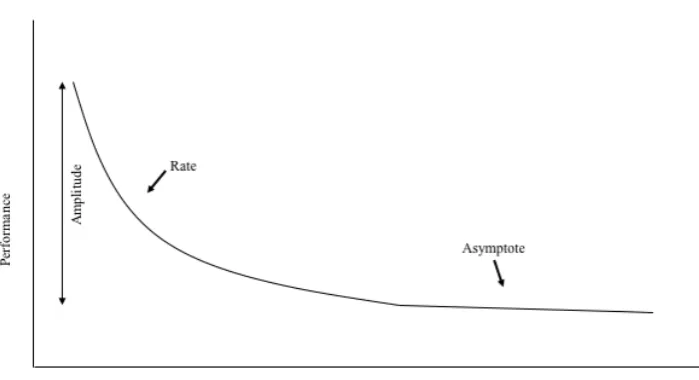
Commonly, learning curves consist of three parameters (Figure 1). The initials of the three parameters are why the model is labelled as the ARY-model. The first parameter is called the amplitude (A) and describes the amount of learning. The second parameter describes the speed of learning of a person and is called the rate (R). The last parameter is called the asymptote (Y) which indicates the maximum learning capacity of a person. (David, 2018).
In order to be able to measure the impact of MSL in laparoscopic simulator training, a new, experimental paradigm has been developed by Schmettow and Groenier. It is a two-part learning curve, which includes two additional parameters. In figure two it is shown that the x-axis in the new paradigm can be subdivided in a part in which learning is attributed to the skill (S) of the individual and a part that is attributed to MSL (M). The learning curve of S can be established by using many variable configurations of a simulator task. M on the other hand can be assessed by letting the trainee do a large number of fixed configurations of a simulator task. With the help of this model, the magnitude of actual skill acquirement as well as the extent to which MSL is present in simulator training can be estimated.
The formula1 to calculate performance with the help of this paradigm, is described as the following (David, 2018):
[image:9.595.126.476.179.369.2]performance = 𝜔 + 𝛿𝑆𝑒−𝜌𝑆𝑡𝑆 + 𝛿𝑀𝑒−𝜌𝑀𝑡𝑀
Figure 1. An exemplary learning curve. The x-axis represents an index of the learning effort (e.g. trials) and can be plotted against the y-axis, which gives an index of the
performance of the individual (e.g. time on task). The y-intercept indicates the individual’s prior knowledge. The slope of the learning curve is a proportional representation of the rate and the efficiency of learning. Additionally, given endless repetitions of a training, the maximal learning potential is plotted as the asymptote (Pusic et al., 2017).
Figure 2. Paradigm describing an experimental learning curve paradigm developed by Schmettow and Groenier. It includes the skill (S, left part) and MSL (M, right part) of the individual on the x-axis. On the y-axis, the amplitude of S and M as well as the asymptote level are given. Retrieved from David, Schmettow and Groenier (2018).
Conclusion and research questions. In summary, the use of laparoscopic simulator training seems to be a promising new method for training and assessing surgeons.
Nevertheless, it is still unclear how to construct simulator training in a way that it resembles the real procedure sufficiently. A factor that might prevent simulator training from having a high level of resemblance with the real procedure is MSL. MSL is not practicable in real surgery and therefore should not be enhanced by the training procedure. Consequently, the aim of the current research is to find out the extent to which MSL is present in simulator based laparoscopy training. With the help of the above described paradigm, the following general question can be answered: What is the proportion MSL in laparoscopic simulator task performance on a population level? However, it is not only important to come to know if MSL is part of simulator training for everybody, but also if there is inter-individual variance in the proportion MSL. Therefore, the second question that needs to be answered in order to assess if simulator training is a fair assessment method is: What is the individual variance in the proportion MSL in laparoscopic simulator task performance?
Method Design
All participants started with 20 variable trials, followed by 20 fixed trials of each task. Therefore, we chose for a time series as basic design. Tasks have been handled as a subject design. The two different parts of the tasks (variable and fixed) were both within-subject and within-task. Based on the study by David, Schmettow & Groenier (2018), each task consisted of 40 trials with 20 variable and 20 fixed trials in order to prohibit fatigue but on the same time to ensure that the asymptote level can be reached and stabilized. Within the variable phase, trials differed in that a gallstone (in the instrument navigation task) or a blood vessel (grasping task) reappeared in a completely different position than in the trial before. After having done all the variable configurations of the task once, participants engaged in the fixed part of the session. Here, participants were required to do another 20 trials of each task, but with the exception, that there was no variation in the position of the gallstone or blood vessel. They appeared in the same two positions for all the trials. One for being reached with the right instrument and in another position for the left instrument.
Procedure
Location. The procedure and instructions were the same for every participant. Because of the fixed position of the LapSim, the advanced simulation room 1 in the
Experimental Centre of Technical Medicine of the University of Twente served as a location for the data gathering. The baseline questionnaire and the informed consent have been filled out in the same location, as the room was comparatively quiet and there were no major distractions. Therefore, participants had the possibility to ask questions without feeling disturbed.
Instructions. After having welcomed and thanked participants, an oral explanation about the aim, the content and duration of the study has been given. Then, two printed
versions of the informed consent (see Appendix A) were handed out. Participants were asked if they had fully understood everything and if they would like to keep a copy of the informed consent. Both forms were then signed by the participant as well as the researcher.
Data gathering. With the LapSim, it has been possible to practice with different kinds of tasks and procedures. To achieve the goal of the current study, it has been chosen for two basic tasks. The task ‘Instrument Navigation’ has been chosen because it is one of the easiest tasks of the LapSim. Correspondingly, if applying, MSL might be triggered earlier than with a more complex task. To ensure, that there is a task included in which there is more skill
learning required and which is complex enough to actually show a learning curve, the
‘Grasping’ task has been chosen as a more challenging task. For the aim of the current study, one course for each task has been configured, each one consisting of 20 variable and 20 fixed trials.
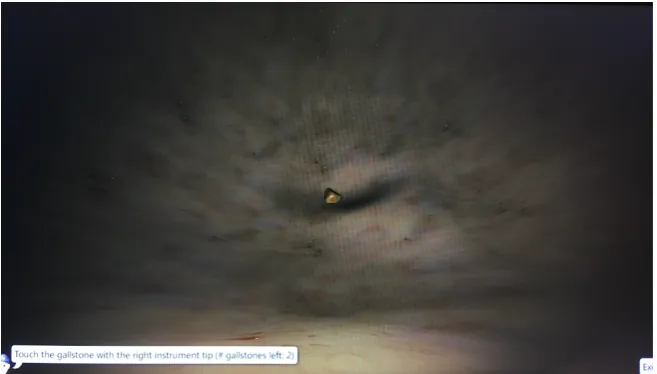
Course one: instrument navigation. The first course focussed on the instrument navigation (IN) task. The IN task involved carefully approaching a virtual gallstone (see figure 3) with the ends of the endoscopes. The gallstone has been surrounded by abdominal tissue which must not be touched with the instruments to avoid tissue damage. The
[image:12.595.72.401.444.631.2]endoscopes, in this task, did not have forceps as it was sufficient to touch the gallstone with the instrument. In the bottom, left corner it has been indicated if the gallstone had to be approached with the left or the right instrument. The approximate time for the first course was 35 minutes.
Figure 3. Example of the IN task with the gallstone in the centre, abdominal tissue around it and instructions about which instrument to use in the bottom, left corner.
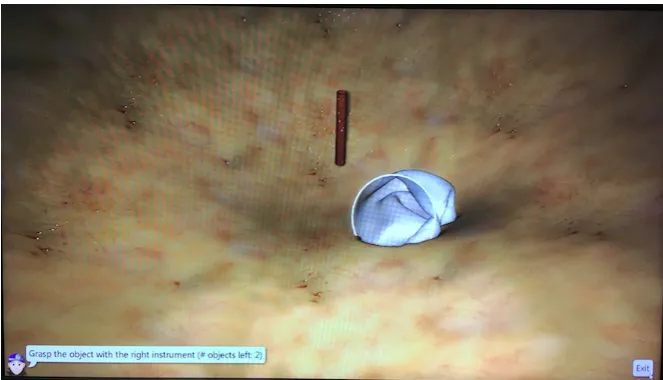
to be hold on and pulled out of the tissue. Next, it had to be put into a surgical bag. When the blood vessel was moved there close enough, the bag lighted up in yellow and the blood vessel had to be released by opening the forceps carefully.
The procedure of the second course was the same as for the first one. First,
[image:13.595.72.404.236.426.2]participants were required to do 20 trials in which the position of the blood vessel varied from trial to trial, followed by 20 trials in which the blood vessel stayed in a fixed position and alternated only in position for the right or the left instrument. Executing the second course took participants about 45 minutes.
Figure 4. Example of the grasping task. A blood vessel is sticking out of the abdominal tissue which needs to be placed in the white bag. Instructions are given in the bottom, left corner.
Debriefing. After finishing the second session, participants were asked what their overall impression of the training was. Furthermore, it was suggested if they want to receive their results via email. Participants received their version of the informed consent. It has been emphasized, that the informed consent included the contact data of the researcher in the case of questions or remarks.
Measurements
Data Analysis
A non-linear multilevel regression model with a gamma-distributed random component served to carry out the regression analysis. This multilevel model considered participants as a grouping variable themselves and thus estimated individual parameters. Additionally, participants were seen as part of a population. These two assumptions make up the so called random factors of the model (Schmettow, 2018). A population is hereby seen as a set of individuals that bundle around a representative value but nevertheless do vary
(Schmettow, 2018). The deviation of individuals from the population mean (random effects) were of interest for the current study. Despite the fact that the population average (fixed effects) of tasks been assessed as well, has the used model been purely a random effects model.
The ARARY parameters, are bounded at zero. This is similar to the so called link functions in Generalized Linear Models (Schmettow, 2018). The logarithm served as a link function to restrain the values to realistic, natural boundaries.
As time on task (ToT) measures are typically skewed, it has been chosen for a gamma random component (Schmettow, 2018).
Initially, a non-parametric, exploratory data-analysis has been carried out to get a first impression of the learning curves. The statistical analysis (Appendix C) was aimed at finding out the proportion of MSL in the two chosen tasks. As described above, regression was run with the help the LARARY model that linearized parameters of the model. Fixed and random effects were calculated on the log-scale, ranging between -∞ and +∞. As an inverse function, the exponent of the values had to been taken.
The actual proportion of MSL was not inherent in the model, it had to be calculated posterior by the following formula:
Pi = δM : (δS + δM)
This has been done on both, population and participant level. In the end, correlations between the tasks have been analysed in order to estimate the internal consistency of the tasks.
Material
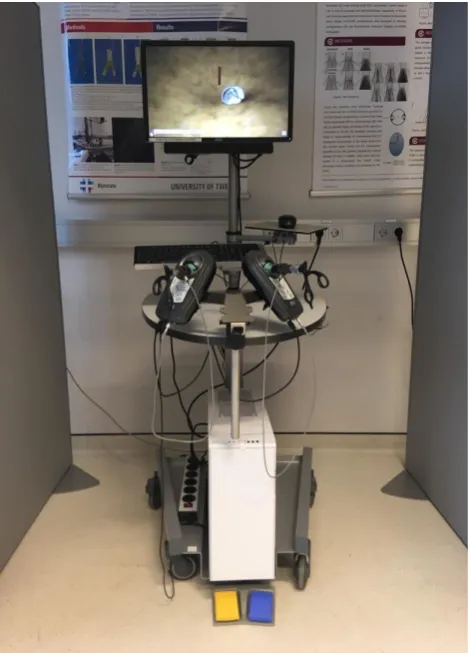
LapSim. The LapSim (figure 4) is a virtual reality simulator which serves as a training and assessment tool for various laparoscopic procedures. With the LapSim it is possible to practice with more basic skills like grasping, cutting, clip applying and more and it is possible to execute procedure modules in which operations like a cholecystectomy or appendectomy are simulated (surgicalscience.com, 2018).
Figure 5. Showing the LapSim VR-Simulator including two ball-shaped elements with inserted endoscopes. On the display, the grasping task is shown.
Participants
In total, there were 15 people participating in the current study. The age of the
been ethically approved by the Ethics Committee of the Faculty of Behavioural Science of the University of Twente.
Results
In the current section, results of the above described analysis will be discussed. A first analysis has been made on the fixed effects in order to find if MSL is in general part of laparoscopic simulator training. A second analysis focussed on the random effects to determine the inter-individual variance in the proportion MSL. A correlation analysis has been carried out on the correlation of the chosen tasks to establish the psychometric value of the chosen tasks.
Population-level
Estimates on a population level were calculated with 95% credibility limit. Overall, the proportion of MSL learning in the instrument navigation (IN) task (0.25, 95% CI [0.06; 0.53]) was almost twice as large as the proportion MSL in the grasping task (0.14, 95% CI [0.06; 0.28]. Based on the data, MSL made up 25% of the learning in the IN task and 14% of the grasping task. However there was a high level of uncertainty in both tasks. We can be 95% certain that the true value of the proportion MSL in the instrument navigation lies somewhere between 6% and 53% and between 6% and 28% in the grasping tasks. Participant-level
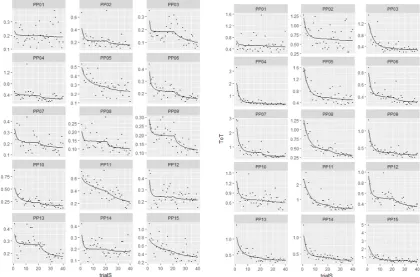
Figure 6. Individual learning curves for each participants of the IN task (left) and the grasping task (right). The x-axis represents the number of trials and the y-axis displays the time spent on the task (ToT).
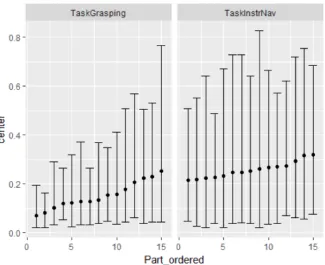
Figure 7. Random effects for the proportion MSL per participants, divided by the two tasks grasping (left) and instrument navigation (right).
Correlations between tasks
[image:18.595.74.373.601.754.2]Table 3 describes the correlation between the two tasks for each of the five model parameters. For the current study, the correlation of the asymptote parameter is of greatest interest. The asymptote showed the highest correlation between tasks (0.40, 95% CI [-0.84;0.96]) of all five parameters. Again, values are highly uncertain.
Table 3
Correlation between tasks for the five model-parameters nonlin Correlation1 Correlation2 center lower upper
δM Grasping Instrument Navigation
0.06 -0.92 0.93
δS Grasping Instrument Navigation
0.17 -0.90 0.95
ω Grasping Instrument Navigation
ρM Grasping Instrument Navigation
0.16 -0.90 0.92
ΡS Grasping Instrument Navigation
0.30 -0.76 0.90
Estimates with 95% credibility limits
Discussion
The main purpose of the current study has been to find out the proportion MSL on a population and on an individual level in order to be able to assess whether it is relevant for designing simulator tasks. MSL making up a significant proportion would mean, that training with a laparoscopic simulator would not be transferrable to the real procedure, as in real life, no fixed sequence can be applied to individual patients. As Seymour et al. (2002) state it, increasing the skill acquisition that resembles the real procedure is the most important goal of any training. Furthermore, Wong and Matsumoto (2008) proposed that a good assessment method would closely link to the learner’s actual skill. Therefore, it is important to have a look at the general amount of MSL in laparoscopic simulator training, but also to understand individual differences in the proportion MSL in order to be able to configure simulator training which resembles the real procedure best.
Interpretation of Results
In order to interpret the above described results, it is necessary to define if the
proportion of MSL is high or low and to have a look at the variance as well. In case of a low variance in the individual results, interpretation would differ when MSL is high or low. Low variance and low MSL would be unproblematic as MSL would not be significantly present. If the variance would be low and MSL would be high, this would mean, that simulator training under investigation would indeed trigger MSL but at least would be a fair assessment, as the proportion remains about the same for everyone. The problematic part would be, if the data showed high variance across individuals. Having high individual differences within the data would mean that the chosen tasks in the simulator training would be an unfair assessment method, no matter if MSL is high or low.
programme itself. So easier tasks seem to trigger MSL more than difficult tasks. This will probably not be problematic, as real trainings will more likely have complex tasks, rather than the chosen ones from the ‘basic skill module’ of the LapSim.
Another explanation might be that the IN task was more fluent in general. It involved one movement, while the grasping task required to approach an object, to move the forceps with the fingers and to open the forceps very carefully. Therefore, different types of
coordinating movement where involved which might have inhibited automatization and therefore restrained MSL.
On a participant level, variance in the IN task was higher than in the grasping task and in general, there were relatively high individual differences. Accordingly, not only the nature of the task seems to trigger MSL differently, but individual characteristics seem to have an influence as well. Some individuals seem to be more prone to learning a motor sequence than others.
The third research question focussed on the psychometric value of the two tasks. A correlation of 40% is in theory not sufficient. Nevertheless, in practice can be seen, that 40% is a rather high correlation when comparing the current study to similar ones (cf. David, Schmettow & Groenier, 2018; Arendt, Schmettow & Groenier, 2017; Katschub, Schmettow & Groenier, 2016). So the tasks seem to have a comparably high internal consistency and therefore, psychometric value.
In general, all values where prone to a high uncertainty. Therefore, no definite judgements should be made based on these findings. In order to validate the results of the current study, more observations in terms of increased number of trials and a larger sample size are necessary.
Relation to Existing Research
A study with the topic of the role of MSL in mastering complex motor procedures (David, Schmettow & Groenier, 2018) is mainly confirmative of the above mentioned interpretations. In their study, David, Schmettow and Groenier (2018) as well found out that there are general differences between the tasks being tested. In the case of their study, it was not about simulator task performance, but it had been chosen for two dexterity tasks.
Nevertheless, the nature and difficulty of the task played a significant role in both studies. In replication of the mirror drawing task with longer sequences and a larger sample, the MSL proportion was estimated as 12% [9%, 16%], which is less than the proportion of the
similarity to the study. Both researches showed that the population mean was not transferrable to every individual. David, Schmettow and Groenier found out as well that there are
prominent individual differences in the acquisition of MSL. As mentioned above, with a high individual variance, simulator tasks would be an unfair assessment method, no matter if the proportion MSL was high or low. In the end, another difference to the study of David, Schmettow and Groener (2018) has been the psychometric value of the two chosen tasks, which has been higher in the current study. This might have to do with the nature of the tasks: in the current research, participants had to do two tasks which were intended to follow each other by the simulator programme itself. Both tasks involved a similar movement
(approaching an object) but with increasing challenge and difficulty in the second task. In the study by David, Schmettow and Groenier, however, two dexterity tasks have been chosen which address fine motor skills, but which still demand rather differing movements. All in all, both studies seem to be comparable in their results and strengthen two important findings: first, the proportion MSL seems to differ across tasks and second, the proportion MSL is dependent on individual differences.
has not been reached for many participants in the fixed part. As a consequence for simulator training, this would mean that tasks should not involve doing an extensive amount of trials in the same configuration, as this would trigger MSL.
Limitations and future research
The current research mainly served as a proof of concept, with the intention of getting a first impression on the topic of the proportion MSL in simulator task performance. This also means, that there are still a lots of shortcomings and therefore implications for future research on the topic of MSL.
Level of Uncertainty. A major limitation of the current study has been the enormous levels of uncertainty in the data. Uncertainty was so high, that it is basically impossible to make any valid judgements based on the data. The true value of the proportion MSL often was between two values that ranged between being a relatively low (e.g. 6% in instrument navigation) and being a very high (e.g. 53% in instrument navigation) proportion of MSL. This shortcoming of the study is closely linked to another limitation. Another limitation which has at the same time been the reason for the insufficient levels of uncertainty have been the small sample size and the small amount of trials. As the study mainly served as a proof of concept, there were neither enough participants, nor enough trials to restrain the uncertainty to a minimum. With reference to future research, the current research would have to be
elaborated. In general, more observations would be necessary to decrease the overall level of uncertainty and to be able to make more stable judgements in general. For future research, a larger sample size would be proposed.
Distribution of trials. A factor which has already been discussed above and which was striking referred to the speed with which the asymptote level has been reached in most participants. In many individuals, the learning curves showed, that the asymptote level had been reached relatively early in the variable part. In the fixed part, however, many
participants did not reach the asymptote level at all. This might be due to the fact that MSL requires more extensive practice to occur.
An implication for this would be to redistribute the trials. For future research it might have a greater added value to not only configure more trials in general but less of them in the variable part and more in the fixed part to ensure that the asymptote level is reached in both configurations.
proposed the amount of time needed to complete a task and additionally the damage rate as indicative of the participant’s skill. Kundhal and Grantcharov (2009), found a correlation of these two parameters and the procedure in the operating room. Additionally, they found a correlation between movement economy and the surgical procedure (Kundhal & Grantcharov, 2009).
Therefore, future research, should make use of the existing functions of the LapSim. The LapSim does not only record the time on task but also the path length of both instruments and the caused tissue damage. In addition to ToT, damage rate and movement economy should be included in the statistical analysis to base performance on more than one parameter.
Further use of the paradigm. Another aspect which might be interesting for future research concerns the use of the experimental paradigm of the current study. The two-step learning curve can also be used to test other assumptions in terms of simulator training. It would for example be interesting to use the paradigm in order to find out the impact of haptic feedback in simulator training. The first part of the study would then involve doing a task without receiving haptic feedback. In the second part, haptic feedback would be turned on. It could be assumed that in this study design, there would also be a visible step in the learning curves.
Conclusions
Considering the above mentioned limitations of the current research and mainly the enormous uncertainty which should not be despised, it would be rash to make any firm assumptions based on the data. Nevertheless, did the current research serve as a proof of concept and showed, that the assumed two-part learning curve indeed seems to occur when doing laparoscopic simulator training in a variable-fixed order. Future research might now build up on the study to make more secure predictions.
From a psychometric point of view, were the two chosen tasks relatively suitable as
References
Adams, J. A. (1971). A closed-loop theory of motor learning. Journal of motor behavior, 3(2), 111-150.
Cao, C., MacKenzie, C., & Payandeh, S. (1996, November). Task and motion analyses in
endoscopic surgery. In Proceedings ASME Dynamic Systems and Control
Division(pp. 583-590).
Dakin, G. F., & Gagner, M. (2003). Comparison of laparoscopic skills performance between standard instruments and two surgical robotic systems. Surgical Endoscopy And Other Interventional Techniques, 17(4), 574-579.
D’Angelo, M. C., Milliken, B., Jiménez, L., & Lupiáñez, J. (2013). Implementing flexibility in automaticity: Evidence from context-specific implicit sequence
learning. Consciousness and cognition, 22(1), 64-81.
Darzi, A., & Munz, Y. (2004). The impact of minimally invasive surgical techniques. Annu. Rev. Med., 55, 223-237.
David, L., Schmettow & Groenier (2018). Towards a novel approach to applied research: The role of motor sequence learning in the process of mastering complex motor procedures. Unpublished master’s thesis, University of Twente, Enschede, Netherlands.
Ehrlenspiel, F., Wei, K., & Sternad, D. (2010). Open-loop, closed-loop and compensatory
control: performance improvement under pressure in a rhythmic task. Experimental
brain research, 201(4), 729-741.
Hyltander, A., Liljegren, E., Rhodin, P. H., & Lönroth, H. (2002). The transfer of basic skills learned in a laparoscopic simulator to the operating room. Surgical Endoscopy and Other Interventional Techniques, 16(9), 1324-1328.
Kantonsspital Aarau (2011). Minimal invasive Chirurgie. Retrieved from:
https://www.ksa.ch/sites/default/files/cms/viszeralchirurgie/docs/info-minimal-invasive-viszeralchirurgie-ksa.pdf
Korndorffer, J. R., Stefanidis, D., & Scott, D. J. (2006). Laparoscopic skills laboratories: current assessment and a call for resident training standards. The American journal of surgery, 191(1), 17-22.
Kovac, E., Azhar, R. A., Quirouet, A., Delisle, J., & Anidjar, M. (2012). Construct validity of the LapSim virtual reality laparoscopic simulator within a urology residency
Kundhal, P. S., & Grantcharov, T. P. (2009). Psychomotor performance measured in a virtual environment correlates with technical skills in the operating room. Surgical
endoscopy, 23(3), 645.
Lacy, A. M., García-Valdecasas, J. C., Delgado, S., Castells, A., Taurá, P., Piqué, J. M., & Visa, J. (2002). Laparoscopy-assisted colectomy versus open colectomy for treatment of non-metastatic colon cancer: a randomised trial. The Lancet, 359(9325), 2224-2229.
Mack, M. J. (2001). Minimally invasive and robotic surgery. Jama, 285(5), 568-572. Palter, V. N., Orzech, N., Reznick, R. K., & Grantcharov, T. P. (2013). Validation of a
structured training and assessment curriculum for technical skill acquisition in
minimally invasive surgery: a randomized controlled trial. Annals of surgery, 257(2), 224-230.
Pusic, M. V., Boutis, K., Pecaric, M. R., Savenkov, O., Beckstead, J. W., & Jaber, M. Y. (2017). A primer on the statistical modelling of learning curves in health professions education. Advances in Health Sciences Education, 22(3), 741-759.
Rhodes, B. J., Bullock, D., Verwey, W. B., Averbeck, B. B., & Page, M. P. (2004). Learning and production of movement sequences: Behavioral, neurophysiological, and
modeling perspectives. Human movement science, 23(5), 699-746.
Schmettow, M. (2018). New statistics for the design researcher: A Bayesian course in tidy R Seymour, N. E., Gallagher, A. G., Roman, S. A., O’brien, M. K., Bansal, V. K., Andersen, D.
K., & Satava, R. M. (2002). Virtual reality training improves operating room performance: results of a randomized, double-blinded study. Annals of surgery, 236(4), 458.
Shalhav, A. L., Dabagia, M. D., Wagner, T. T., Koch, M. O., & Lingeman, J. E. (2002). Training postgraduate urologists in laparoscopic surgery: the current challenge. The Journal of urology, 167(5), 2135-2137.
Surgicalscience (2018, 23rd March). Retrieved from: https://surgicalscience.com/systems/lapsim/
Toni, I., Krams, M., Turner, R., & Passingham, R. E. (1998). The time course of changes during motor sequence learning: a whole-brain fMRI study. Neuroimage, 8(1), 50-61. Tsui, C., Klein, R., & Garabrant, M. (2013). Minimally invasive surgery: national trends in
Van Dongen, K. W., Tournoij, E., Van der Zee, D. C., Schijven, M. P., & Broeders, I. A. M. J. (2007). Construct validity of the LapSim: can the LapSim virtual reality simulator distinguish between novices and experts?. Surgical endoscopy, 21(8), 1413-1417. Verwey, W. B. (2001). Concatenating familiar movement sequences: The versatile cognitive
processor. Acta psychologica, 106(1-2), 69-95.
Appendix A
Informed Consent
Project Title: Discovering the Proportion of Motor Sequence Learning in Laparoscopic Simulator Task Performance.
Investigator: Saskia Henrichs - Undergraduate student psychology Supervisor: Dr. M. Schmettow - Cognitive Psychology & Ergonomics
Dr. M. Groenier – Technical Medicine, Psychology & Educational Science
Participant Number:……… Participant Name: ………
Welcome!
First of all, thank you for your interest in participating in this study. In the following, a more detailed description about the nature and purpose of the study is given and what makes up your contribution to it. Do not hesitate to ask questions at the researcher during all parts of the process!
What it is all about? Nature and Purpose of the Research
what the exact proportion of motor sequence learning in laparoscopic simulator task performance is.
What exactly will happen if you take part in this research?
First of all, you will be asked to fill in a so called ‘baseline questionnaire’. This mostly includes your demographic data and questions about physical impairments. In the following, you will be given verbal instructions about the LapSim Simulator for laparoscopy. You will be able to try out the simulator once to get a first impression of it. Then, you will start doing the first task (grasping) in a variety of different configurations. Afterwards, you will execute the same task for about XX. When you have finished the grasping task, you will repeat the procedure with a new task, namely cutting. The exact workwise of the two tasks will be explained to you later by the researcher.
Important Information
When participating in this study you will be asked to serve as a trainee in laparoscopic simulator training. This will take about XX hours. With your participation, you make a great contribution not only in finalising a bachelor thesis, but in the validation of an innovative and efficient way of training and assessing surgeons for MIS. Improving the education of surgeons of course, makes up a great advantage for everyone in the society, as everybody might be in the situation of needing a competent surgeon at some point. Taking part in the study should not put you in any situations of risk or discomfort. Nevertheless, if you do not feel comfortable, you can stop your participation at any time without justification or consequences. It is hereby stressed, that your participation is completely voluntary.
What is Going to Happen to your Data?
Results will be used in terms of a bachelor thesis and to a corresponding degree public. This does not mean, that anyone can see your data. All the data that might lead to your identification will be anonymised (e.g. your name will be replaced by a number). Data will be treated strictly confidential by the researcher.
Contact Information
Saskia Henrichs
Agreement
I hereby agree to take part in this study. I have read all the information above and I been sufficiently provided with all the information I needed to know so far. I declare to have fully understood the content and purpose of the study and what is demanded with my participation. I have been sufficiently informed about the voluntary nature of my participation and the confidentiality of my data. I received a signed copy of the informed consent.
……….. ………
Date, Signature Participant Date, Signature Researcher
Appendix B
Appendix C
R Syntax
Data analysis BT Saskia Henrichs
Martin Schmettow
06 juni, 2018
knitr::opts_knit$set(warning = F, message = F)
purp.data = F
purp.mcmc = F
library(tidyverse)
## -‐-‐ Attaching packages -‐-‐-‐-‐-‐-‐-‐-‐-‐-‐-‐-‐-‐-‐-‐-‐-‐-‐-‐-‐-‐-‐-‐-‐-‐-‐-‐-‐-‐-‐-‐-‐-‐-‐-‐-‐-‐-‐-‐-‐-‐-‐-‐ tidyv erse 1.2.1 -‐-‐
## v ggplot2 2.2.1 v purrr 0.2.4
## v tibble 1.4.2 v dplyr 0.7.4
## v tidyr 0.8.0 v stringr 1.3.0
## v readr 1.1.1 v forcats 0.3.0
## -‐-‐ Conflicts -‐-‐-‐-‐-‐-‐-‐-‐-‐-‐-‐-‐-‐-‐-‐-‐-‐-‐-‐-‐-‐-‐-‐-‐-‐-‐-‐-‐-‐-‐-‐-‐-‐-‐-‐-‐-‐-‐-‐-‐-‐-‐-‐-‐-‐-‐ tidyverse_c onflicts() -‐-‐
## x dplyr::filter() masks stats::filter()
## x dplyr::lag() masks stats::lag()
library(readxl) library(brms)
## Warning: package 'brms' was built under R version 3.4.4
## Loading required package: Rcpp
## Warning: package 'Rcpp' was built under R version 3.4.4
## Loading 'brms' package (version 2.2.0). Useful instructions
## can be found by typing help('brms'). A more detailed introduction
## to the package is available through vignette('brms_overview').
## Run theme_set(theme_default()) to use the default bayesplot theme.
options(mc.cores = 6) library(mascutils) library(bayr)
##
## Attaching package: 'bayr'
## The following objects are masked from 'package:brms':
##
## The following object is masked from 'package:stats':
##
## predict
library(asymptote)
##
## Attaching package: 'asymptote'
## The following objects are masked from 'package:mascutils':
##
## inv_logit, logit
load("SH18.Rda")
if(!purp.mcmc){
load("M_SH_1.Rda")
# load("M_SH_2.Rda")
# load("M_SH_3.Rda")
# load("M_SH_4.Rda")
}
Data preparation
SH18 <-‐
bind_rows(
read_excel("raw_data/SH/Raw_Data.xls",
sheet = "Instrument Navigation", skip = 6),
read_excel("raw_data/SH/Raw_Data.xls",
sheet = "Grasping", skip = 6)
) %>%
mutate(ToT = (`Left Instrument Time (s)`+ `Right Instrument Time (s)`)/6 0,
path = `Left Instrument Path Length (m)` + `Right Instrument Path Length (m)`) %>%
rename(Part = Login, TaskName = `Task Name`) %>%
mutate(TaskName = str_replace(TaskName, "Instrument Navigation", "InstrN av"),
TaskName = str_remove(TaskName, "\\["),
TaskName = str_remove(TaskName, "\\]")) %>%
separate(col = TaskName,
into = c("Task", "Condition"), sep = " ") %>%
group_by(Part, Task) %>%
mutate(trialS = row_number(),
trialM = if_else(Condition == "variable", 1, trialS -‐ 20)) %>%
ungroup() %>%
select(Part, Task, Condition, trialS, trialM, score = Score, path, ToT) %>%
as_tbl_obs()
SH18
Descriptives
load("SH18.Rda")
Number of observations
SH18 %>%
group_by(Part, Task, Condition) %>%
summarize(N_trials = n()) %>%
knitr::kable()
PP08 InstrNav fixed 20 PP08 InstrNav variable 20 PP09 Grasping fixed 20 PP09 Grasping variable 20 PP09 InstrNav fixed 20 PP09 InstrNav variable 20 PP10 Grasping fixed 20 PP10 Grasping variable 20 PP10 InstrNav fixed 20 PP10 InstrNav variable 20 PP11 Grasping fixed 20 PP11 Grasping variable 20 PP11 InstrNav fixed 20 PP11 InstrNav variable 20 PP12 Grasping fixed 20 PP12 Grasping variable 20 PP12 InstrNav fixed 20 PP12 InstrNav variable 20 PP13 Grasping fixed 20 PP13 Grasping variable 20 PP13 InstrNav fixed 20 PP13 InstrNav variable 20 PP14 Grasping fixed 20 PP14 Grasping variable 20 PP14 InstrNav fixed 20 PP14 InstrNav variable 20 PP15 Grasping fixed 20 PP15 Grasping variable 20 PP15 InstrNav fixed 20 PP15 InstrNav variable 20
Exploratory Data Analysis
SH18 %>%
filter(Task == "Grasping") %>%
ggplot(aes(x = trialS, y = ToT)) +
facet_wrap(~Part, ncol = 3, scales = "free_y") +
geom_vline(xintercept = 20, linetype = 2, col = "red") +
geom_point(size = .2) +
geom_smooth(se = F)
SH18 %>%
filter(Task == "InstrNav") %>%
ggplot(aes(x = trialS, y = ToT)) +
facet_wrap(~Part, ncol = 3, scales = "free_y") +
geom_vline(xintercept = 20, linetype = 2, col = "red") +
geom_point(size = .2) +
geom_smooth(se = F)
Regression
Estimation
Setting up the LARARY model:
# Effects
# absolute means
F_ef_1 <-‐ list(
formula(asym ~ 0 + Task + (0 + Task|corr1|Part)),
formula(rateS ~ 0 + Task + (0 + Task|corr2|Part)),
formula(amplS ~ 0 + Task + (0 + Task|corr3|Part)),
formula(rateM ~ 0 + Task + (0 + Task|corr4|Part)),
formula(amplM ~ 0 + Task + (0 + Task|corr5|Part)))
# treatment contrasts
F_ef_2 <-‐ list(
formula(asym ~ 1 + Task + (1 + Task|corr1|Part)),
formula(rateS ~ 1 + Task + (1 + Task|corr2|Part)),
formula(amplS ~ 1 + Task + (1 + Task|corr3|Part)),
formula(rateM ~ 1 + Task + (1 + Task|corr4|Part)),
formula(amplM ~ 1 + Task + (1 + Task|corr5|Part)))
lazyeval::f_lhs(LARARY) <-‐ quote(ToT)
LARARY
## ToT ~ exp(amplS -‐ exp(rateS) * trialS) + exp(amplM -‐ exp(rateM) *
## trialM) + exp(asym)
## <environment: namespace:asymptote>
F_pr_larary_1 <-‐ c(set_prior("normal(0, 10)", nlpar = "asym"),
set_prior("normal(0, 10)", nlpar = "amplS"),
set_prior("normal(0, 10)", nlpar = "rateS"),
set_prior("normal(0, 10)", nlpar = "amplM"),
set_prior("normal(0, 10)", nlpar = "rateM"))
# ARARY
lazyeval::f_lhs(ARARY) <-‐ quote(ToT)
ARARY
## ToT ~ asym + amplS * exp(-‐rateS * trialS) + amplM * exp(-‐rateM *
## trialM)
## <environment: namespace:asymptote>
F_pr_arary_1 <-‐ c(set_prior("normal(0.2, 10)", nlpar = "asym", lb = 0),
set_prior("normal(0.2, 10)", nlpar = "amplS", lb = 0),
set_prior("normal(0.5, 10)", nlpar = "rateS", lb = 0),
set_prior("normal(0.1, 10)", nlpar = "amplM", lb = 0),
set_prior("normal(0.5, 10)", nlpar = "rateM", lb = 0))
M_SH_1 <-‐
brm(bf(LARARY,
flist = F_ef_1, nl = TRUE),
prior = F_pr_larary_1,
family = Gamma(link = "identity"),
data = SH18,
iter = 1000, warmup = 500,
init = "0")
M_SH_1 <-‐
brm(fit = M_SH_1,
data = SH18,
iter = 22000, warmup = 20000, chains = 6,
control = list(adapt_delta = 0.99,
max_treedepth = 12),
init = "0")
save(M_SH_1, file = "M_SH_1.Rda")
M_SH_1
## Warning: There were 4 divergent transitions after warmup. Increasing ad apt_delta above 0.99 may help.
## Family: gamma
## Links: mu = identity; shape = identity
## Formula: ToT ~ exp(amplS -‐ exp(rateS) * trialS) + exp(amplM -‐ exp(rateM ) * trialM) + exp(asym)
## asym ~ 0 + Task + (0 + Task | corr1 | Part)
## rateS ~ 0 + Task + (0 + Task | corr2 | Part)
## amplS ~ 0 + Task + (0 + Task | corr3 | Part)
## rateM ~ 0 + Task + (0 + Task | corr4 | Part)
## amplM ~ 0 + Task + (0 + Task | corr5 | Part)
## Data: SH18 (Number of observations: 1200)
## Samples: 6 chains, each with iter = 22000; warmup = 20000; thin = 1;
## total post-‐warmup samples = 12000
## ICs: LOO = NA; WAIC = NA; R2 = NA
##
## Group-‐Level Effects:
## ~Part (Number of levels: 15)
## Estimate Est.Error l-‐95% CI
## sd(asym_TaskGrasping) 0.18 0.13 0.01
## sd(asym_TaskInstrNav) 1.07 2.05 0.11
## sd(rateS_TaskGrasping) 0.65 0.30 0.11
## sd(rateS_TaskInstrNav) 1.58 0.79 0.09
## sd(amplS_TaskGrasping) 0.73 0.28 0.27
## sd(amplS_TaskInstrNav) 0.51 0.37 0.03
## sd(rateM_TaskGrasping) 3.04 2.80 0.18
## sd(rateM_TaskInstrNav) 1.78 1.40 0.40
## sd(amplM_TaskGrasping) 0.53 0.45 0.08
## sd(amplM_TaskInstrNav) 0.44 1.51 0.01
## cor(asym_TaskGrasping,asym_TaskInstrNav) 0.30 0.49 -‐0.84
## cor(rateS_TaskGrasping,rateS_TaskInstrNav) 0.24 0.43 -‐0.76
## cor(amplS_TaskGrasping,amplS_TaskInstrNav) 0.12 0.53 -‐0.90
## cor(rateM_TaskGrasping,rateM_TaskInstrNav) 0.10 0.53 -‐0.90
## cor(amplM_TaskGrasping,amplM_TaskInstrNav) 0.03 0.53 -‐0.92
## u-‐95% CI Eff.Sample Rhat
## sd(asym_TaskGrasping) 0.46 431 1.01
## sd(asym_TaskInstrNav) 7.63 239 1.02
## sd(rateS_TaskGrasping) 1.29 1774 1.00
## sd(rateS_TaskInstrNav) 3.23 243 1.03
## sd(amplS_TaskGrasping) 1.39 1454 1.00
## sd(amplS_TaskInstrNav) 1.43 1707 1.00
## sd(rateM_TaskGrasping) 10.32 559 1.01
## sd(rateM_TaskInstrNav) 4.98 256 1.02
## sd(amplM_TaskGrasping) 1.35 1047 1.00
## sd(amplM_TaskInstrNav) 1.23 368 1.02
## cor(asym_TaskGrasping,asym_TaskInstrNav) 0.96 908 1.01
## cor(rateS_TaskGrasping,rateS_TaskInstrNav) 0.90 778 1.01
## cor(amplS_TaskGrasping,amplS_TaskInstrNav) 0.95 1054 1.01
## cor(rateM_TaskGrasping,rateM_TaskInstrNav) 0.92 205 1.02
## cor(amplM_TaskGrasping,amplM_TaskInstrNav) 0.93 2603 1.00
##
## Population-‐Level Effects:
## Estimate Est.Error l-‐95% CI u-‐95% CI Eff.Sample Rhat
## asym_TaskGrasping -‐1.09 0.12 -‐1.30 -‐0.86 1118 1.00
## asym_TaskInstrNav -‐4.16 5.03 -‐19.77 -‐1.57 132 1.05
## rateS_TaskInstrNav -‐0.62 0.90 -‐2.43 1.05 167 1.03
## amplS_TaskGrasping 0.19 0.30 -‐0.44 0.74 1705 1.00
## amplS_TaskInstrNav -‐0.96 0.75 -‐1.88 0.59 307 1.02
## rateM_TaskGrasping -‐1.99 1.50 -‐4.53 1.19 1817 1.00
## rateM_TaskInstrNav -‐2.22 2.21 -‐5.80 0.33 86 1.08
## amplM_TaskGrasping -‐1.61 0.38 -‐2.40 -‐1.10 745 1.01
## amplM_TaskInstrNav -‐2.06 0.48 -‐2.81 -‐1.44 520 1.02
##
## Family Specific Parameters:
## Estimate Est.Error l-‐95% CI u-‐95% CI Eff.Sample Rhat
## shape 11.54 0.49 10.59 12.52 12000 1.00
##
## Samples were drawn using sampling(NUTS). For each parameter, Eff.Sample
## is a crude measure of effective sample size, and Rhat is the potential
## scale reduction factor on split chains (at convergence, Rhat = 1).
P_SH <-‐ posterior(M_SH_1)
P_fixef <-‐ P_SH %>% filter(type == "fixef")
P_ranef <-‐ P_SH %>% filter(type == "ranef")
fixef(P_SH)
Estimates with 95% credibility limits
nonlin fixef center lower upper asym TaskGrasping -‐1.1012111 -‐1.3038474 -‐0.8575067 asym TaskInstrNav -‐1.9352263 -‐19.7669042 -‐1.5719620 rateS TaskGrasping -‐1.0320117 -‐1.6051316 -‐0.3565804 rateS TaskInstrNav -‐0.5805124 -‐2.4335006 1.0502639 amplS TaskGrasping 0.2062430 -‐0.4432238 0.7391546 amplS TaskInstrNav -‐1.0378439 -‐1.8820776 0.5944062 rateM TaskGrasping -‐2.0367764 -‐4.5336853 1.1935872 rateM TaskInstrNav -‐1.9377433 -‐5.8016892 0.3345496 amplM TaskGrasping -‐1.5510129 -‐2.4017132 -‐1.1013971 amplM TaskInstrNav -‐2.1147340 -‐2.8059237 -‐1.4425346
Estimated curves
PP_SH <-‐ post_pred(M_SH_1)
T_pred <-‐
SH18 %>%
filter(!is.na(ToT)) %>%
bind_cols(predict(PP_SH)) %>%
mutate(resid = ToT -‐ center)
T_pred %>%
filter(Task == "Grasping") %>%
ggplot(aes(x = trialS, y = ToT)) +
geom_point(size = .2) +
geom_line(aes(y = center))
T_pred %>%
filter(Task == "InstrNav") %>%
ggplot(aes(x = trialS, y = ToT)) +
facet_wrap(~Part, ncol = 3, scales = "free_y") +
geom_point(size = .2) +
Estimated parameters
Individual differences as standard deviations by task and ARY parameters:
ranef(P_SH) %>%
rename(Task = fixef) %>%
group_by(nonlin, Task) %>%
mutate(Part_ordered = rank(center)) %>%
ungroup() %>%
ggplot(aes(x = Part_ordered, y = center, ymin = lower, ymax = upper)) +
facet_grid(nonlin~Task, scale = "free_y") +
geom_point() +
geom_errorbar()
The ratio of amplitudes directly answers the question of what relative impact motor sequence learning has. The proportion of MSL on overall learning is not directly represented in the model, but can be created on the posterior.
T_prop_fixef <-‐
P_fixef %>%
select(chain, iter, fixef, nonlin, value) %>%
filter(nonlin %in% c("amplS", "amplM")) %>%
mutate(value = exp(value)) %>%
spread(nonlin, value) %>%
mutate(propM = amplM/(amplS + amplM)) %>%
group_by(fixef) %>%
summarize(center = median(propM),
lower = quantile(propM, .025),
upper = quantile(propM, .975))
knitr::kable(T_prop_fixef, digits = 2)
fixef center lower upper TaskGrasping 0.14 0.06 0.28 TaskInstrNav 0.25 0.06 0.53 P_scores <-‐
left_join(P_ranef, P_fixef,
by = c("model", "chain", "iter", "fixef", "nonlin"),
P_scores$value = exp(P_scores$value + P_scores$value_fixef)
T_scores <-‐
P_scores %>%
group_by(fixef, nonlin, re_entity) %>%
summarize(center = median(value),
lower = quantile(value, .025),
upper = quantile(value, .975)) %>%
select(Task = fixef, nonlin, Part = re_entity, center, lower,upper) %>%
ungroup()
T_prop_ranef <-‐
P_scores %>%
select(chain, iter, fixef, nonlin, re_entity, value) %>%
filter(nonlin %in% c("amplS", "amplM")) %>%
spread(nonlin, value) %>%
mutate(propM = amplM/(amplS + amplM)) %>%
group_by(fixef, re_entity) %>%
summarize(center = median(propM),
lower = quantile(propM, .025),
upper = quantile(propM, .975)) %>%
ungroup() %>%
rename(Task = fixef, Part = re_entity)
T_prop_ranef %>%
group_by(Task) %>%
mutate(Part_ordered = rank(center)) %>%
ungroup() %>%
ggplot(aes(x = Part_ordered, y = center, ymin = lower, ymax = upper)) +
facet_grid(~Task, scale = "free_y") +
geom_point() +