City, University of London Institutional Repository
Citation
:
Bloomfield, R. E. & Parisaca-Vargas, A. (2015). Using Ontologies to Support
Model-based Exploration of the Dependencies between Causes and Consequences of
Hazards. Paper presented at the 7th International Conference on Knowledge Engineering
and Ontology Development, 12-11-2015 - 14-11-2015, Lisbon, Portugal.
This is the accepted version of the paper.
This version of the publication may differ from the final published
version.
Permanent repository link:
http://openaccess.city.ac.uk/12801/
Link to published version
:
Copyright and reuse:
City Research Online aims to make research
outputs of City, University of London available to a wider audience.
Copyright and Moral Rights remain with the author(s) and/or copyright
holders. URLs from City Research Online may be freely distributed and
linked to.
City Research Online:
http://openaccess.city.ac.uk/
[email protected]
Using Ontologies to Support Model-based Exploration of the
Dependencies between Causes and Consequences of Hazards
Abigail Parisaca Vargas
1, Robin Bloomfield
2Centre for Software Reliability, City University, London, UK
1[email protected],2[email protected]
Keywords: Preliminary Hazard Analysis, Hazard Analysis, Hazard Identification, Ontologies, Railway
Abstract: Hazard identification and hazard analysis are difficult and essential parts of safety engineering. These ac-tivities are very demanding and mostly manual. There is an increasing need for improved analysis tools and techniques. In this paper we report research that focuses on supporting the early stages of hazard identification. A state-based hazard analysis process is presented to explore dependencies between causes and consequences of hazards. The process can be used to automate the analysis of preliminary hazard worksheets with the aims of making them more precise, disambiguating causal relationships, and supporting the proper definition of system boundaries. An application example is presented for a railway system.
1
INTRODUCTION
Hazard identification and hazard analysis are dif-ficult and essential parts of safety engineering. These activities are very demanding and mostly manual. There is an increasing need for improved analysis tools and techniques. In this paper we report research that focuses on supporting the early stages of haz-ard identification. Hazhaz-ard analysis is the identifica-tion of hazards and their initiating causes (Interna-tional Organization for Standardization, 2000). It can be thought of as the process of investigating an acci-dent before it actually occurs. Its aim is to exhaus-tively identify all possible causes of accidents, so that they can be eliminated or controlled before they oc-cur (Leveson, 2011). Hazard analysis is extremely important, and lack of completeness in the analysis can have serious consequences.
A hazard is a potential source of harm. The term includes danger to persons arising within a short time scale, for example, fire and explosion, and also those that have a long-term effect on a person’s health, such as release of a toxic substance (ISO, 1999). Harm is a physical injury or damage to the health of people or damage to property or the environment (ISO, 1999).
Hazard identification (HazID) is one of the most important parts of the hazard analysis, as it forms the basis of the activities carried out to design a safe sys-tem. By looking at the system from a safety per-spective, safety analysts check important aspects of the system and try to identify hazards that could have
been accidentally overlooked. Common methods for identifying hazards at the early stages of system de-sign are checklists, HAZOPs (Hazard and Operabil-ity Studies) and PHA (Preliminary Hazard Analy-sis) (Kletz, 2001).
Various studies asserted that the most significant flaws in hazard analysis techniques applied at the early stages of system design are often related to the omission of hazards and hazard causes (Hardy, 2010). One reason for this could be that most haz-ard analysis techniques rely on the manual analysis of information recorded in text format using differ-ent spreadsheet represdiffer-entations, called hazard iddiffer-enti- identi-fication worksheets. The most basic description of a worksheet would be a table of three columns, where the first column describes a hazard, the second col-umn describes the cause or causes of that hazard, and the third column describes the consequences of the hazard occurring. Different examples of this basic de-scription will be discussed further in this paper.
Data and facts are usually abundant in hazard analysis worksheets. Because of this, for complex systems, there is always a good chance that even ex-pert analysts could accidentally miss something, and therefore draw conclusions on the basis of incom-plete information. A mechanised process for system-atic exploration of the dependencies between hazards, causes and consequences of hazards would therefore be a convenient way of supporting experts during the analysis.
explor-ing the use of ontologies as a means to mechanise the analysis of causal dependencies in hazard analysis techniques. The aims of these initiatives are generally to capture consensual knowledge, reuse it and share it across different application domains and different teams (Corcho et al., 2003). For example, in (Mayer et al., 2008), an ontology is described for representing risk and risk assessment processes, as well as con-cepts such as hazards and threats. Others have ex-plored the use of ontologies to support standard haz-ard analysis techniques, such as Job Hazhaz-ard Analy-sis (e.g., see (Wang and Boukamp, 2009)), HAZOP (e.g., see (Stralhane et al., 2010; Daramola et al., 2011)), and FMEA (e.g., see (LEE, 2001)), or other hazard analysis techniques targeted to industrial sec-tors like construction, food supply (Letia and Groza, 2010; Yang et al., 2012), geology (Liu et al., 2010), and many others.
Despite all the examples above, little attention has been devoted to using ontologies for the analysis of preliminary hazard worksheets generated at the early stages of system design. Being able to analyse these preliminary worksheets is highly desirable, as issues can be resolved earlier in the development process, when it is easier and cheaper to fix problems. The present work aims to address this gap.
Contribution. In this paper we present an approach to facilitate the analysis of preliminary hazard work-sheets generated at the early stages of system de-sign. The approach facilitates the resolution of weak-nesses in the hazard identification process. In our ap-proach, an ontology is used to review preliminary haz-ard worksheets using a mechanised process based on a set of inference rules. Our approach allows one to check well-formedness of hazards, their causes, and consequences, as well as to discover new relation-ships between hazards, causes and consequences, if these were accidentally omitted in the hazard work-sheets. The final result obtained using our approach is therefore an improved version of preliminary hazard worksheets, with disambiguated hazards and polished causal relationships.
Organisation. The paper is organised as follows. In Section 2, we contrast and compare our work with related work. In Section 3, we introduce our ontology. Then, in Section 4, we explain our proposed method, its steps, and the reasoning we used. In Section 5, we illustrate the method on a case study. Finally, in Section 6, we briefly conclude, summarise the results, and discuss future work.
2
RELATED WORK
A number of different hazard analysis techniques have been created over the last fifty years, and they are currently widely used by safety-critical industries. There are different examples of their use in com-plex systems (Leach, 2010; Zhang et al., 2010; Cen-ter for Devices and Radiological Health, US FDA, 2010). There are also examples of adaptations of stan-dard hazard analysis techniques for identifying secu-rity hazards (Winther et al., 2001).
Despite the wide use of the standard hazard anal-ysis techniques mentioned above, there is also strong criticism of them. New techniques are, in fact, being proposed that are specifically designed for the anal-ysis of hazards in today’s complex socio-technical systems. For example, Nancy Leveson describes a new approach to hazard analysis, STPA (System-Theoretic Process Analysis) (Leveson, 2011), based on the STAMP causality model. Another example is the Ontological Hazard Analysis (OHA) (Ladkin, 2005; Ladkin, 2010) proposed by Peter Ladkin for the analysis and maintenance of safety hazard lists using a refinement approach.
Differently from the efforts cited above, we do not aim to introduce a novel hazard analysis tech-nique. Rather, we propose a mechanised method that can improve the analysis of results obtained at the early stages of system design. In the method pre-sented in this paper, we start from preliminary haz-ard worksheets, and use an ontology to check consis-tency and well-formedness of information contained in these preliminary documents.
Finally, in his book called HAZOP and HAZAN (Kletz, 2001), Trevor Kletz discusses the feasibility of the automation of HAZOPs, for example, applying techniques from Artificial Intel-ligence, and whether these techniques could replace the safety analyst. Kletz concludes it is impossible. He gives two important objections to the automation of HAZOPs:
1. Artificial intelligence techniques can manipulate logical rules, but logic is just one aspect of hu-man intelligence. For example, most of the scien-tists who have recounted how they came to make an important discovery or to achieve a significant breakthrough have stressed that when they found the answer to the crucial problem they intuitively recognised it to be right, and only subsequently went back and worked out why it was right (Kletz, 2001).
Logic is not able to represent all the knowledge and expertise of the safety analyst. We do not aim to represent this; instead, we want to represent the knowledge already captured by hazard identification techniques, usually in worksheets. We want to be able to find logical relationships, which could have not been seen, and point out the relevant information that might have been hidden because of the quantity of information represented.
3
DEVELOPING THE
ONTOLOGY PROTOTYPE
Ontologies, or explicit representations of do-main concepts, provide the basic structure or framework around which knowledge bases can be built (Devedzi´c, 2002; Swartout and Tate, 1999). On-tologies are specific, high-level models of knowledge underlying all things, concepts, and phenomena. As with other models, ontologies do not represent the en-tire world of interest. Rather, ontology designers se-lect aspects of reality relevant to their tasks (Devedzi´c, 2002; Valente et al., 1999).
During the design of the ontology prototype, we used a UML-like modelling language. It has been argued that UML can be used to model ontolo-gies (Cranefield and Purvis, 1999), yet there are re-cent, more specialised modelling languages, like On-toUML (Benevides et al., 2010).
We decided to use the ontology engineering en-vironment Prot´eg´e because it provides an integrated environment for the ontology development and it has different features supporting different tasks during the ontology life cycle. The knowledge representa-tion language of choice was OWL-DL because it is the most used by the ontology development commu-nity (Simperl et al., 2009), and because OWL-DL and SWRL offer a number of sophisticated reasoning ca-pabilities.
3.1
Ontology Domains
When developing an ontology, we aim to formally and explicitly describe concepts in a domain, as well as their properties. Describing the concepts involves defining classes for these concepts and arranging them in a hierarchy.
The first domain we work on is the HazID work-sheets HI, which consist of different hazards with multiple causes and where different consequences might exist.
Table 1 shows a basic example of the main part of a HazID worksheet. The example is taken
Consequence
Cause Hazard
Situation
isCauseOfHazard isHazardForCause
[image:4.595.313.517.92.163.2]isConseqOfHazard isHazardWithConsequence 1..* 1..* 1..* 1..*
Figure 1: Examples of concepts that are part of our ontology
Process Object
Component Part
System Subsytem
Common Driver
isMemberOf isMemberOf isMemberOf isMemberOf processInvolves 1..* 1..*
1 1 1 1
[image:4.595.315.518.191.258.2]1 1 1 1
Figure 2: Part of Ontology
from (Evans and Associates, 2006). The hazard de-scription for hazards A−5 isToxic gases in tunnel. The cause of this hazard isToxic gases enter in
tun-nel from alignment or station. The alignment in the
context of a railway is the ground plan of the railway, as well as the path that the train follows. The con-sequences for hazard A−5 areinjury, deathor
ser-vice disruption. Another cause of hazardToxic gases
in tunnelisMaintenance personnel release toxic gas
while performing work.
Figure 1 shows the concepts of Hazard, Cause, and Consequence represented in our ontology and the relationships among them. Boxes in the figure repre-sent the concepts, arrows with triangular heads rep-resent inheritance, and arrows with two heads repre-sent the relationships. The concepts can be used to define a set of hazards,H, consisting ofh1. . .hn
indi-vidual hazards; a set of causes, consisting ofc1. . .cn
individual causes; a set of consequences, consisting of q1. . .qnindividual consequences. Figure 1 shows
the relationships among these concepts. The rela-tionships cause-hazard and hazard-consequence are many-to-many. That is, a cause might occur on differ-ent hazards, and a consequence might occur on sev-eral hazards. In the hierarchy of types, Situation is a higher node and the super type for Hazard, Cause and Consequence.
Table 1: Basic example of HazID worksheet
Hazard Cause Consequence
A−5 Toxic gases enter in tunnel from alignment or station Injury, death, Toxic gases in tunnel Maintenance personnel release toxic gas while performing work service disruption
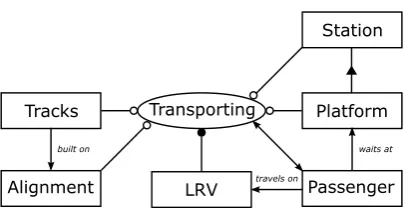
behaviour. An object can be a system, subsystem, component or a part of the system. The object can be in a particular state. Processes transform objects by generating, consuming, or changing their state (Craw-ley and Dori, 2011). A process can be decomposed into sub-processes. Figure 7 shows an example of OPM’s building blocks, whereTransportingis a pro-cess. This process involves the objectsTracks,
Align-ment,LRV,PlatformandStation.
”System”, is an important concept we need to represent in our ontology. The physical domain of the system is composed of subsystems. Subsystems, in turn, are composed of components, and compo-nents are composed of parts. From the CLIOS for-malism (Sussman et al., 2009), we take the notion
of Common drivers, which are shared components
among subsystems of a system.
Figure 2 shows the concepts of Object, Process, System, Subsystem, Component, Common Driver and Part Modelled. The initial design of a systemS, consists of different natural divisions such as subsys-temB, componentM, partP. We identify a set of sub-systems,B, consisting ofb1. . .bnindividual
subsys-tems; a set of components,M, consisting ofm1. . .mn
individual components; and finally, a set of parts,P, consisting of individual parts p1. . .pn. A part might
occur within a component, so then the relationship is one-to-one. Similarly, the relationship between com-ponent and subsystem and between subsystem and system is one-to-one. In addition, a system has a re-cursive relationship, where a system can be part of an-other system, and the relationship will again be one-to-one.
The behavioural description of the system is de-scribed as the set of objects,O, consisting ofo1. . .on
individual objects; the set of processes,C, consisting ofc1. . .cnindividual processes. An object may
par-ticipate in different processes and a process may oc-cur in different objects, so the relationship is many-to-many.
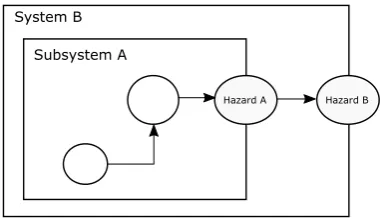
Figure 3 shows that subsystemAis a member of systemB. They have different system boundaries and, as a result, concentrate on different hazards. System
Bprovides the environment for subsystemA. A haz-ard, normally, is described with respect to its system boundary, so it is a relative term.
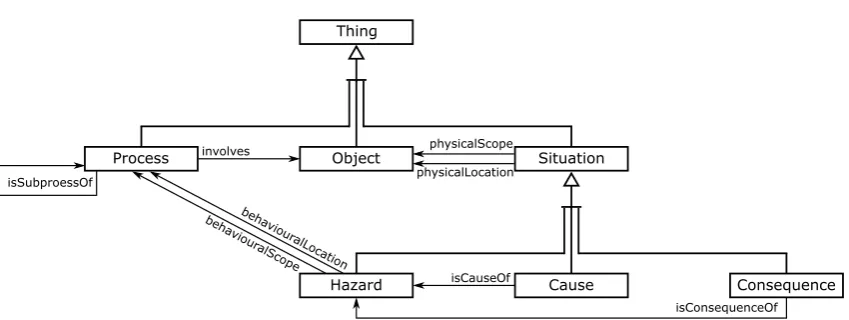
Figure 5 shows fundamental concepts of the ba-sic ontology. ”Thing” is a generalisation of objects, processes and situations; it represents the class of all
Subsystem A System B
[image:5.595.315.510.161.270.2]Hazard A Hazard B
Figure 3: Hazard in Systems. Based on (Railtrack, 2001)
things, or the abstract objects that can be described by the criteria for being something. This concept is taken from class-defined ontologies. In addition, Fig-ure 6 shows four new relationships that we need to discuss. The hazard information within the ontology needs to include information such as the scope and lo-cation of the hazards. When we talk about the scope of a hazard, we refer to what affects the hazard di-rectly; we therefore refer to two kind of scopes:
be-havioralScopeandphysicalScope. If a hazard affects
a determined system, that system will be the scope of the hazard. When we refer to the physicalScopewe refer to the boundary of the hazard. For example, if subsystemAis a member of systemB, then systemB
is the scope of subsystemA. When we talk about loca-tion, we refer to where the hazard is located in terms of objects and also in terms of processes; the relation-ships that we will use will be calledphysicalLocation
andbehaviouralLocation.
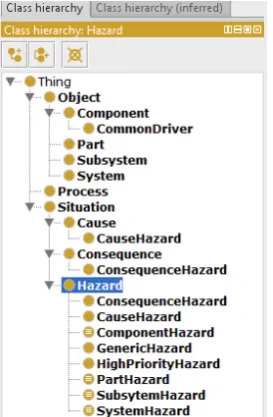
Figure 4: Class hierarchy of complete ontology
3.2
Extended Ontology
In this subsection we explain in detail the extended ontology. The extended ontology is formed using more specific types, i.e., lower nodes in the hierar-chy. This provides a more granular organisation of the hazards, causes and consequences, and relation-ships between them. Figure 4 shows a more detailed hierarchy of the classes in our ontology.
Hazards have a scope. In order to generate a hi-erarchy to hazards according to their scope, we cre-ate equivalent classes calledPartHazard,
Componen-tHazard,SubsystemHazardandSystemHazard. When
editing the ontology, the analyst can decide which of
the SystemHazards belong to the
HighPriorityHaz-ards. These are the hazards that are deemed the most important for analysis by the safety analyst. The class
GenericHazardsis useful to handle worksheets with
generic hazards identified using, e.g., a Preliminary Hazard Analysis.
The class ConsequenceHazard is a subclass of classHazard. The classesConsequenceand
Cause-Hazardare subclasses ofHazardsandCause.
4
THE METHOD
We developed an ontology to capture domain in-formation related to hazards, systems, and hazards within a system. The ontology is designed to help the analysts in the task of hazard identification using the knowledge already gathered, and the relationships
HazID
worksheets Initial design of the system
Ontology description and inference rules
Input A Input B
knowledge base
End
Populate ontology with Input A and Input B
Finding relationships among hazards, causes and consequences
Reviewed HazID
Amended system design
Does it need more processing?
Figure 5: Control flow diagram of our method
that already exist. An ontology provides the means to structure information by classes, property descrip-tions and reladescrip-tionships between classes and individ-uals. Analysts can use the ontology for reasoning about missing relationships between hazards, causes and consequences. Figure 5 shows the steps of our method:
1. We start from an initial Preliminary Hazard Anal-ysis, an initial design of the system, an ontol-ogy description of the domains, and a set of rules for reasoning about our domains. The ontology description models the data from the inputs il-lustrated above, including property descriptions and relationships between classes and individu-als. We used the open-source editor and frame-work Prot´eg´e 5.0 (Stanford Center for Biomedi-cal Informatics Research, 2015). The output is our knowledge base.
[image:6.595.113.250.94.303.2]Consequence Hazard Cause
Situation Object
Thing
isConsequenceOf isCauseOf
physicalLocation physicalScope
beha viour
alLocation beha
viour alScope
involves
Process
[image:7.595.88.513.85.245.2]isSubproessOf
Figure 6: Core classes of the ontology
and overlooked relationships. This is ilustrated in Sections 5.1 and 5.2. The intention is to use the structured and automated reasoning provided by tools for the analysis of ontologies, such as Prot´eg´e’s built-in reasoner, Pellet.
3. The initial results are used to review the HazID worksheet, and perhaps modify the System De-sign model. Yet more could be done after the first amendment, and our knowledge base could still be reviewed and amended further.
4.1
Reasoning Using the Ontology
In this subsection we will explain some concepts that are needed to understand the reasoning approach im-plemented with the ontology. The approach will also be illustrated with concrete examples.
4.1.1 Direct and Indirect Causality
In (Leveson, 2011) Leveson argues that current haz-ard analysis techniques are event chain models of the form: ”if eventAhad not occurred, then the following eventBwould not have occurred”. This type of model supports limited notions of direct causality, and it is sometimes impossible to incorporate indirect relation-ships. For example, consider the following statement: “Smoking causes lung cancer”. It is argued (Leveson, 2011) that in current models such a statement would not be allowed; however, it is widely accepted that there is a relationship between the two, even though the relationship is complex and indirect.
4.1.2 Synonymy, Entailment and Non-Direct Causality
Hazard identification is a demanding task and relies on detailed descriptions. It is difficult to remember
each and every hazard and cause in a hazard analysis and, as a consequence, the worksheets may refer to hazards, causes and consequences in different written forms. Sometimes this reflects real differences that should be captured, while in other situations the dif-ferences are only artificial, and should therefore be amended. For example, when analysing a road sys-tem, we could have the following hazards: H−1
Ve-hicle drives on the wrong lane;H−2Vehicle passes
through the wrong lane; H−3Vehicle on the wrong
lane. H−1 andH−3 could have the same mean-ing, or H−3 could mean that the vehicle actually stopped on the wrong lane. H−1 and H−2 could also have the same meaning if each just means that a vehicle temporarily drives on the wrong lane. An ontology could help the analyst to find and identify these hazards, as well as to disambiguate them, when needed, by means of logical rules applied to the struc-tured knowledge.
When two situations (hazards, causes, conse-quences) have the same meaning, we will call them synonyms. Using only inference rules, we cannot de-termine whether a hazard is a synonym of another hazard, cause or consequence. To resolve the prob-lem, we rely on different relationships established be-tween situations that are part of the HazID entry. For example, two synonym hazards might have the same physical location, physical scope, behavioural loca-tion, or behavioural scope. Therefore, using rules to find hazards where multiple similar relationships oc-cur can help to spot synonyms. In addition, a syn-onym is not the only kind of relationship that can be spotted. For example, let us consider hazard H−4
Train on fire. The cause of this hazard isCa−1Train
stopped adjacent to a wayside fire. A train circulates
rea-Transporting
Station
Passenger Platform
Alignment Tracks
LRV
waits at
[image:8.595.79.283.89.194.2]travels on built on
Figure 7: Top level representation of our initial system de-sign in OPM
soning, there might be a relationship between a haz-ard calledH−5Fire on station platformandCa−1
Train stopped adjacent to a wayside fire. Therefore,
there might be a nonlinear (indirect) causal relation-ship betweenH−5Fire on station platformandH−4
Train on fire.
In logic, entailment (Fellbaum, 1990), or strict implication, is properly defined for propositions; a propositionP entails a proposition Qif and only if there is no conceivable state of affairs that could make
Ptrue andQfalse. Entailment is a semantic relation-ship because it involves reference to the states of af-fairs thatPandQrepresent. We generalise the term in order to talk about hazards. For us, in the context of the hazard descriptions for a certain system, entail-ment refers to the special relationship between two hazards, where a hazard,H1, of a more general haz-ard,H2, also entailsH2. In addition, if H1 entails
H2, then it can not be the case that H2 entailsH1. In order to explain this, we introduce a brief exam-ple. We mentioned before that the alignment in the context of a railway is the ground plan of the railway, as well as the path that the train follows. The cross-ing is the crossroad between the train path and the motor road. HazardsH−6Motor vehicle on
align-ment and H−7 Road vehicle drives around
cross-ing gaterefer to a motor vehicle inside the train path.
Because the crossing is part of the path of the train,
H−7 entails H−6, because while a motor vehicle drives around the crossing gate, the motor vehicle is on the alignment. In addition,H−6 does not entail
H−7 becauseMotor vehicle on alignmentdoes not necessarily mean that the vehicle is driving around the alignment. Using inference rules and a reasoner could therefore help the safety analyst to disambiguate the meaning of those hazards and also to find hazards in-terlinked by the causation relationships. The follow-ing section will exemplify some of these rules and their application using a case study based on a rail-way system.
5
CASE STUDY
We now introduce a case study that we use to illus-trate the method: the West Corridor Light Rail Tran-sit (LRT) System. Figure 7 shows a representation of the system in Object Process Modelling (OPM). The hazard analysis that we use is the Preliminary Hazard Analysis (PHA) for the West Corridor LRT Project Design Phase (Evans and Associates, 2006). The de-scription of the system was inferred from the PHA document and from terminology in rail transport and railways (www.allenrailroad.com, 2014; Transport Canada, 2014; www.railway-technical.com, 2014; www.trafficsigns.us, 2014; www.railsigns.uk, 2014).
We succinctly describe the system:
• Alignment provides a path and physical infras-tructure, such as tunnels and crossrails.
• Track is the structure consisting of the rails, fas-teners, sleepers, and ballast, plus the underlying subgrade. The track provides the physical struc-ture by which the Light Rail Vehicle (LRV) circu-lates.
• A station is a railway facility where trains reg-ularly stop to load or unload passengers and/or freight.
• A control system provides help in controlling the train to prevent accidents and to improve circu-lation. The service provided can be concisely described as: train separation or collision avoid-ance, line speed enforcement, enforcing tempo-rary speed restrictions, enabling rail worker way-side safety.
• An Overhead Catenary System (OCS) comprises different components, such as wires suspended between poles, bridges supporting overhead con-tact wires which are normally energised with elec-tricity, etc. The OCS powers the LRV.
• The LRV is the vehicle that circulates along the railway and transports passengers.
LRV stopped adjacent to a wayside fire
Circulating
Fire on station platform
Platform
LRV fire
Fire on Alignment
Fire in tunnel Railway system
Tunnel
LRV
Alignment
physicalLocationOf
physicalLocationOf
physicalLocationOf
physicalLocationOf physicalLocationOf
process Involv
es
processInvolves
process
In
volv
es
process
In volv
es
Station
isMemberOf isMemberOf
isMemberOf
isMemberOf
[image:9.595.88.511.141.410.2]isMemberOf isCauseOf
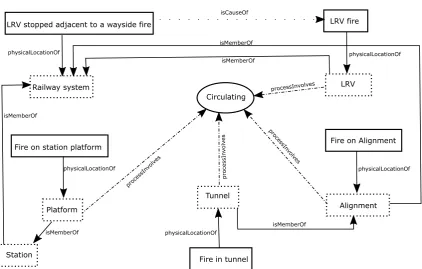
Figure 8: Relationships among individuals, exemplifying the relationships that are used in example 5.1
LRV stopped adjacent to a wayside fire LRV fire
isCauseOf
Fire on station platform mightRelateTo
isIndirectCauseOf
[image:9.595.101.500.536.649.2]5.1
Example with Non-Direct Causality
Let us start from a small subset of the PHA per-formed. Below, we define the rule that helps us to find non-direct or indirect causality between hazards and causes. The property representing this relation-ship isisIndirectCauseOf.
physicalLocationOf(?q,?o),
behaviouralLocationOf(?p,?a),
Object(?o),
Situation(?p),
processInvolves(?a,?o),
physicalLocationOf(?p,?o1),
isMemberOf(?o,?o1),
Situation(?q),
Process(?a)
→mightRelate(?p,?q)
(1)
This rule is explained as follows. Every situa-tion happens within some object (based on the bound-ary of hazards). The property representing this is
physicalLocationOf(a,b). We need to represent this
property since any situation, that could affect the be-haviour of the system, depends on where this situation occurs. In our ontology, the behaviour of the system is described via processes; a process may involve vari-ous objects (processInvolves(e,f)property). We need also to record which process(es) could be directly af-fected by a situation, and we do this using the property
behaviouralLocationOf(c,d).
Figure 8 helps us to understand better how it is going to happen. We can see three kinds of things (Objects, Situations and Processes) and different re-lationships among them, and that all are related by the processCirculating. This process describes the actions of the LRV passing directly through different objects. Therefore, theCirculatingprocess involves objects such astunnel, alignment, platformat a sta-tion and railwaycrossings. The situationLRV stopped
adjacent to a wayside firerefers to anywhere within
theRailway system. This situation affects the process
Circulating. Also, there exists a relationship among
the situationsFire on station platform,Fire in tunnel
andFire on alignmentbecause the physical locations
of all these situations are involved with the process
Circulating. Last, the physical locations of all those
different situations are related by a transitive, hierar-chical relationshipMemberOf.
Rule 1, in our example, returns as an answer that CauseLRV stopped adjacent to a wayside firemight relate to (mightRelate) hazards Fire on station
plat-form,Fire on tunnel,Fire on AlignmentandLRV fire.
It is not a reflexive relationship. LRV stopped
adja-cent to a wayside fireis definitely related toLRV fire
because the former is a direct cause of the latter. What we could conclude is that any of those hazards could be indirect causes ofLRV fire. Figure 9 illustrates this, and we can add this relationship (isIndirectCauseOf) to our knowledge base.
5.2
Another example on Non-Direct
Causality
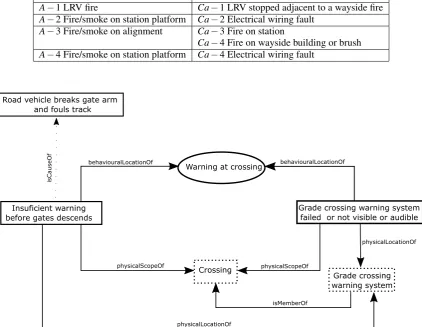
Let us examine another example. We will first give some definitions related to railways. A grade cross-ing is an intersection where a road passes across a line of railway at a grade. A grade is a part of a railway or road that slopes upwards or downwards. A grade crossing warning system consist of all of the elements or warning devices such as signals, signs, lights and horns that automatically alert the public that a train is approaching. Figure 10 illustrates that Grade
cross-ing warncross-ing system is part ofCrossing in a railway.
This object has a clear functionality, which is process
Warning at crossing. SituationsTC−6 andCa−8
both happened within objectGrade crossing warning
system and refer to the behaviour of process
Warn-ing at crossWarn-ing. In addition, the physical scope of
both situations is the wider object Crossing (Grade
crossing warning systemis part ofCrossing). Rule 2,
below, helps us to discover this possible relationship. The propertyphysicalScoperefers to the boundary of the hazard. As explained earlier, if a hazard affects a determined system, that system will be the scope of the hazard. The propertyisSubProcessOf exemplifies that a process can be decomposed into subprocesses. The rest of the properties have been explained while describing Rule 1.
physicalLocationOf(?h,?l2),
behaviouralLocationOf(?s,?p1),
behaviouralLocationOf(?h,?p2),
physicalScopeOf(?h,?c),
physicalLocationOf(?s,?l1),
physicalScopeOf(?s,?c),
isSubProcessOf(?p1,?p3),
Situation(?s),
isSubProcessOf(?p2,?p3),
Situation(?h)
→possibleEntailment(?s,?h)
(2)
Using Rule 2, we can discover a relationships between cause Insufficient warning before gate
Table 2: Table representing a small subset of the PHA for the case study (Evans and Associates, 2006)
Hazard Cause
A−1 LRV fire Ca−1 LRV stopped adjacent to a wayside fire
A−2 Fire/smoke on station platform Ca−2 Electrical wiring fault
A−3 Fire/smoke on alignment Ca−3 Fire on station
Ca−4 Fire on wayside building or brush
A−4 Fire/smoke on station platform Ca−4 Electrical wiring fault
Road vehicle breaks gate arm and fouls track
Warning at crossing
Insuficient warning before gates descends
Grade crossing warning system failed or not visible or audible
Crossing
Grade crossing warning system
physicalLocationOf
physicalLocationOf
isMemberOf
isCa
useOf behaviouralLocationOf behaviouralLocationOf
[image:11.595.86.509.126.453.2]physicalScopeOf physicalScopeOf
Figure 10: Relationships among individuals, exemplifying the relations that are used in example 5.2
Insuficient warning before gates descends
isCauseOf
possibleEntailment
isIndirectCauseOf
Road vehicle breaks gate arms and fouls track
Grade crossing warning system failed, not visible or audible
Figure 11: Possible causality relationship
Table 3: Table that represents another small subset of the PHA for the case study (Evans and Associates, 2006)
Hazard Cause
TC−8 Road vehicle breaks gate arm and fouls track Ca−8 Insufficient warning before gate descends
[image:11.595.99.496.500.609.2] [image:11.595.88.515.660.711.2]failed, or not visible or audible. They might not be synonyms but there is a possibleentailment relation between them. The final decision about this relation-ship is left to the analyst. What we can conclude is that there is a causality relationship between hazard
Grade crossing warning system failed, or not visible
or audibleand hazardRoad vehicle breaks gate arm
and fouls trackas shown in Figure 11. In the next
sec-tion we draw the conclusions and discuss future work.
6
DISCUSSION AND
CONCLUSION
In this paper we defined a state-based hazard pro-cess for model-based exploration of the dependencies between causes and consequences of hazards. In addi-tion, we showed how ontologies can be used to reason about these dependencies. This method can be used to automate the analysis of preliminary hazard work-sheets with the aims of making them more precise, disambiguating causal relationships, and supporting the proper definition of system boundaries. Our anal-ysis process is supported by an ontology that can help analysts to find nonlinear causal relationships, and to disambiguate identified hazards and causes. A demonstration of the approach was given using an in-dustrial example, the PHA of the West Corridor LRT System (Evans and Associates, 2006).
A thorough validation of our ontology is in progress. We are currently working on two exam-ples related to medical infusion pumps and an e-voting system. This will allow us to instantiate the ontology for real world situations, and check that the ontology is truly capturing the domain concep-tualisation. This is a well grounded evaluation pro-cess (de Almeida Falbo, 2014).
Specialised tools are needed to better support our analysis process. We believe that for a safety analyst using Protege 5.0 might add more work to their tasks. Our idea is that there should be a front-end tool that interacts with the analyst and with the ontology. This way, the input of data will be more user-friendly to the safety analyst and the results could also be presented in a more understandable way to the user.
REFERENCES
Benevides, A. B., Guizzardi, G., Braga, B. F. B., and Almeida, J. P. A. (2010). Validating modal aspects of ontouml conceptual models using automatically gen-erated visual world structures. J. UCS, 16(20):2904– 2933.
Center for Devices and Radiological Health, US FDA (2010). Total product life cycle: infusion pump – pre-market notification [510(k)] submissions.
Corcho, O., Fern´andez-L´opez, M., and G´omez-P´erez, A. (2003). Methodologies, tools and languages for build-ing ontologies: Where is their meetbuild-ing point? Data Knowl. Eng., 46(1):41–64.
Cranefield, S. and Purvis, M. (1999). Uml as an ontology modelling language. InIn Proceedings of the Work-shop on Intelligent Information Integration, 16th In-ternational Joint Conference on Artificial Intelligence (IJCAI-99, pages 46–53.
Crawley, E. and Dori, D. (2011). Object-Process Method-ology: A Holistic Systems Paradigm. Springer Berlin Heidelberg.
Daramola, O., Stralhane, T., Sindre, G., and Omoronyia, I. (2011). Enabling hazard identification from require-ments and reuse-oriented hazop analysis. In Manag-ing Requirements Knowledge (MARK), 2011 Fourth International Workshop on.
de Almeida Falbo, R. (2014). Sabio: Systematic approach for building ontologies. In Proceedings of the 1st Joint Workshop ONTO.COM / ODISE on Ontologies in Conceptual Modeling and Information Systems En-gineering co-located with 8th International Confer-ence on Formal Ontology in Information Systems, ONTO.COM/ODISE@FOIS 2014, Rio de Janeiro, Brazil, September 21, 2014.
Devedzi´c, V. (2002). Understanding ontological engineer-ing.Commun. ACM, 45(4):136–144.
Evans, D. and Associates, I. (2006). West corridor LRT project final engineering design phase pre-liminary hazard analysis draft revision 0. http: //www.rtd-fastracks.com/media/uploads/wc/ WC_Risk_Assessment_Draft_06-06.pdf.
Fellbaum, C. (1990). English verbs as a semantic net. In-ternational Journal of Lexicography, 3(4):278–301.
Hardy, T. (2010). Using accident reports to improve the haz-ard identification process. 28th International System Safety Conference.
International Organization for Standardization (2000). ISO 14971: medical devices - application of risk manage-ment to medical devices. ISO.
ISO (1999). ISO/IEC GUIDE 51:1999(E): Safety Aspects - Guidelines for Their Inclusion in Standards. Aus-tralian Standards.
Ladkin, P. B. (2005). Ontological analysis.Safety Systems, 14(3).
Ladkin, P. B. (2010). Ontological hazard analysis of a com-munication bus system. Technical report, Causalis Limited.
Leach, K. (2010). A Demonstration of the Applicability of HAZOP to Voting Systems. New Castle University. LEE, B. H. (2001). Using fmea models and ontologies to
build diagnostic models.AI EDAM, 15:281–293. Letia, I. and Groza, A. (2010). Developing hazard ontology
for supporting haccp systems in food supply chains. In
Intelligent Systems and Informatics (SISY), 2010 8th International Symposium on, pages 57–62.
Leveson, N. G. (2011).Engineering a safer world: Systems thinking applied to safety. MIT Press.
Liu, G., Wang, Y., and Wu, C. (2010). Research and ap-plication of geological hazard domain ontology. In
Geoinformatics, 2010 18th International Conference on, pages 1–6.
Mayer, R., Plank, C., Bohner, A., Kollarits, S., Corsini, A., Ronchetti, F., Siegel, H., Noessing, L., Mair, V., Sulzenbacher, U., Tosoni, D., Cimarosto, S., Zanco, A., Todorov, S., Krastev, L., Wergles, N., Gasperl, W., Mayerl, M., Toli, T., Haradalia, H., Koutsias, N., Kreuzer, S., Liehr, C., Rachoy, C., Papez, J., and Jin-dra, P. (2008). Monitor: Hazard monitoring for risk assessment and risk communication.Georisk: Assess-ment and ManageAssess-ment of Risk for Engineered Systems and Geohazards, 2(4):195–222.
Railtrack (2001).Engineering Safety Management, volume 1 and 2. Railtrack.
Simperl, E., Mochol, M., B¨urger, T., and Popov, I. O. (2009). Achieving maturity: The state of practice in ontology engineering in 2009. In Proceedings of the Confederated International Conferences, CoopIS, DOA, IS, and ODBASE 2009 on On the Move to Meaningful Internet Systems: Part II, OTM ’09, pages 983–991, Berlin, Heidelberg. Springer-Verlag. Stanford Center for Biomedical Informatics Research, S. U.
S. o. M. (2015). Protege 5.0 beta version. http:// protege.stanford.edu/.
Stralhane, T., Omoronyia, I., and Reicenbach, F. (2010). Ontology-guided requirements and safety analysis. In
6th International Conference on Safety of Industrial Automated Systems.
Sussman, J., Dodder, R. S., McConnel, J. B., Mostashari, A., and Sgouridis, S. (2009). The clios process a user’s guide. https://esd.mit.edu/Faculty_ Pages/sussman/CLIOS-PROCESS.pdf.
Swartout, W. and Tate, A. (1999). Guest editors’ introduc-tion: Ontologies.IEEE Intelligent Systems, 14(1):18– 19.
Transport Canada (2014). Rail transportation. http:// www.tc.gc.ca/eng/rail-menu.htm.
Valente, A., Russ, T., MacGregor, R., and Swartout, W. (1999). Building and (re)using an ontology of air cam-paign planning. IEEE Intelligent Systems, 14(1):27– 36.
Wang, H.-H. and Boukamp, F. (2009).Ontology-Based Job Hazard Analysis Support, chapter 66, pages 676–685. American Society of Civil Engineers.
Winther, R., Johnsen, O.-A., and Gran, B. (2001). Secu-rity assessments of safety critical systems using ha-zops. InComputer Safety, Reliability and Security, volume 2187 ofLecture Notes in Computer Science, pages 14–24. Springer-Verlag.
www.allenrailroad.com (2014). Railroad glossary and definitions. http://www.allenrailroad.com/ consulting/Railroad_Glossary.htm.
www.railsigns.uk (2014). Rail signs and signals of great britain. http://www.railsigns.uk.
www.railway-technical.com (2014). Railway technical web pages.http://www.railway-technical.com.
www.trafficsigns.us (2014). Manual of traffic signs.http: //www.trafficsign.us/railsign.html.
Yang, X., Gao, R., Han, Z., and Sui, X. (2012). Ontology-based hazard information extraction from chinese food complaint documents. In Tan, Y., Shi, Y., and Ji, Z., editors,Advances in Swarm Intelligence, volume 7332 of Lecture Notes in Computer Science, pages 155–163. Springer Berlin Heidelberg.