Research and Information Service
Briefing Note
Paper 51/16 22nd August 2016 NIAR 297-16
Caroline Perry
Special educational needs: a
brief overview
1
Introduction
This briefing note aims to provide a short overview of some of the key issues in relation to special educational needs (SEN) in Northern Ireland. It is prepared to support the Committee’s consideration of potential areas for inquiry, and is not intended to be comprehensive.
2
The number of children with SEN is growing
There has been a steady increase in the proportion of pupils with SEN in Northern Ireland. In 2005/06 a total of 16% of pupils had SEN, rising to 22% in 2015/16.1 This
amounts to 74,760 pupils, which includes over 16,500 who have a statement of SEN (indicating that they require significant additional support).
1 Department of Education (2016) Annual enrolments at schools and in funded pre-school education in Northern Ireland,
There has also been a year-on-year increase in the prevalence of autism, rising from 1.2% of children of compulsory school age identified with autism in 2008/09 to 2.3% in 2015/16.2
3
SEN legislation and policy is changing
The Assembly passed the Special Educational Needs and Disability Act
(Northern Ireland) 2016 (the SEND Act) during the previous mandate. Its provisions include:3
Requiring a personal learning plan for each child with SEN;
Requiring the Education Authority and health and social services bodies to
co-operate in regard to identifying, assessing and providing for children with
SEN;4
A new right to appeal where the EA does not make changes to a statement
following annual review; and for parents of children with SEN under the age of two to appeal against statement contents or the failure to make a statement;
An independent mediation service for those appealing to the Tribunal;
Giving children with SEN over compulsory school age rights previously
exercisable by parents; and
Allowing the Department to make regulations for a pilot scheme enabling children within the compulsory school age to make an appeal to the Tribunal. The SEND Act provides for a significant amount of subordinate legislation, and the Department has published draft SEN regulations.5 In addition, the Department is due to
provide a revised Code of Practice. This will be particularly important as it is likely to reduce the stages of the SEN assessment process from five to three and place greater emphasis on in-school support.
4
New duties for health and education bodies to cooperate are likely to
present challenges
Evidence suggests that there has been inadequate joint working between education and health bodies in terms of SEN assessment and provision. The Children’s Services
2 Department of Health (2016) The Prevalence of Autism (including Asperger Syndrome) in School Age Children in Northern
Ireland 2016 Belfast: Department of Health
3 Legislation.gov.uk Special Educational Needs and Disability Act (Northern Ireland) 2016 [online] Available at:
http://www.legislation.gov.uk/nia/2016/8/section/12/prospective
4 The Children’s Services Co-operation Act 2015 also contains duties in this regard
5 Department of Education (2016) Special education needs (SEN) draft regulations [online] Available at:
Co-operation Act 20156 and the SEND Act require greater co-operation between such
organisations, including duties to prepare joint plans provisions for sharing resources. However, these long-standing challenges are likely to be difficult to resolve.
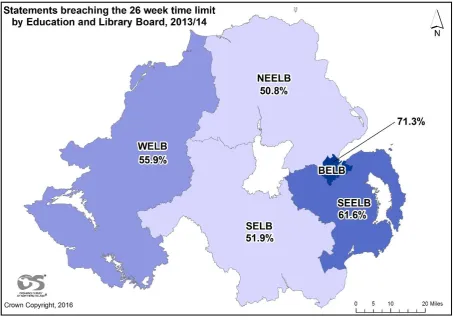
One area where challenges in joint working is evident relates to the frequent breaches of the statutory time period in which the EA must issue a final statement (26 weeks). In 2013/14, 59% of statements breached this time period.7
[image:3.595.81.535.308.630.2]However, a range of “valid exceptions” is permitted, including late receipt of advice from a Health and Social Care Trust. This accounted for almost three-quarters of delays (74%). It is important to note that under the new framework, this statutory time period will reduce to 20 weeks.
Figure 1: Proportion of statements of SEN breaching the statutory time limit by Education and Library Board, 2013/14
6 Legislation.gov.uk Children’s Services Co-operation Act (Northern Ireland) 2015 [online] Available at:
http://www.legislation.gov.uk/nia/2015/10/contents
5 New and proposed legislation emphasises the participation of
children with SEN, although questions around assessment and
support remain
The SEND Act transfers to children who are over compulsory school age a number of rights previously held by parents, including the right to request an assessment and to appeal to the Special Educational Needs and Disability Tribunal (SENDIST).
Article 1 also requires the EA to have regard to the importance of the child participating in decisions, and:
“the importance of providing children with SEN the information and support necessary to enable participation in those decisions”.
Enabling young people to exercise their new rights
Evidence indicates that children’s access to justice often depends on the goodwill of adults and the support they may or may not provide. In many cases parents,
particularly those with lower levels of literacy, are uncertain how to support children to exercise their rights; and children often need financial support for legal fees.8
However, the draft SEN regulations do not require the Education Authority to arrange or fund support or advocacy for young people. In addition, under current legal aid arrangements young people appealing to SENDIST may avail of limited legal assistance involving preparation for an appeal, but not representation.9
The draft SEN regulations also detail the process for determining whether a child has the capacity to exercise their rights within the framework. While the recent Mental Capacity Act10 requires that all practicable help and support are provided prior to
determining incapacity under its provisions, the draft SEN Regulations do not provide for any such support or advocacy.
These regulations may appear to be in contrast with Article 1 of the SEND Act, which requires the EA to have regard to the importance of a child being informed and supported to enable their participation in decision making.
6
A regional plan for special schools will help shape provision
In August 2015 a ministerial working group published a review of special school provision, whose recommendations the former Minister for Education “agreed with”.
8 Grandjean A. (2010) No Rights Without Accountability: promoting access to justice for children International Development Law Organization, Legal Empowerment Working Paper 10
9 Citizens Advice Help with legal costs [online] Available at:
http://www.adviceguide.org.uk/nireland/law_ni/law_legal_system_ni/law_taking_legal_action_e/help_with_legal_costs_nirelan d.htm#h_legal_advice_and_assistance_the_green_form_scheme
10 Legislation.gov.uk Mental Capacity Act(Northern Ireland) 2015 [online] Available at:
The Department has commissioned a regional plan for special schools. Recommendations from the review included that:11
Special schools should be developed with a common structure and remit to support learners with significant and/ or complex needs;
Pre-school provision should be available at all special schools; and
Pupils should attend their closest special school.
7
Conclusion
The continuing growth in the prevalence of special educational needs, together with new legislation and policy placing greater emphasis on in-school support, may present additional challenges for schools and the wider education system in the coming months and years.
In addition, draft subordinate legislation and a revised Code of Practice are likely to have significant implications for young people with SEN and their families. Areas for consideration could include:
The extent and effectiveness of joint working between education and health bodies in relation to children with SEN, and Executive actions and plans to improve co-operation;
The draft SEN regulations, including provisions around mediation, mental capacity, access to advocacy and support and access to justice;
The extent to which the regulations stating that the EA has no duty to fund advocacy or support for children in exercising their new rights reflects Article 1 of the SEND Act (requiring the EA to have regard to the importance of
supporting a child to enable participation);
The forthcoming Code of Practice, including revisions to the assessment process and the implications of an increased emphasis on in-school support;
The current breaches in the 26 week time limit for issuing a statement and the plans to reduce this period to 20 weeks;
The significant number of statements delayed due to late receipt of advice from a HSC Trust; and
The forthcoming regional plan for special schools and its implications.
11 Department of Education Area planning - an overview [online] Available at: