http://www.jscdss.com Vol.3 No.4 August 2016: 30-38 Article history:
Accepted 20 July 2016 Published online 22 July 2016
Journal of Soft Computing and Decision
Support Systems
Evaluating the Barriers of Hospital Information System Implementation
Using Analytic Network Processes (ANP) Method
Ali Ahani a,*, Mehrbakhsh Nilashi a,b, Hossein Ahmadi a
a Faculty of Computing, Universiti Technologi Malaysia, Johor, Malaysia
b Department of Computer Engineering, Lahijan Branch, Islamic Azad University, Lahijan, Iran
* Corresponding author email address: [email protected]
Abstract
Hospital Information System (HIS) refers to a computer system designed to manage all the hospital‘s medical and administrative information in order to enable health professionals to perform their jobs more effectively and efficiently in order to provide high-quality patients care services. Nevertheless, in successful implementation of HIS, various barriers exist. Hence, in this study the dimensions and barriers of HIS implementation have been analysed and prioritized to aid hospital policy makers address these broad challenges effectively in terms of cost and time. To this end, the Analytic Network Processes (ANP) applied to investigate which factors are more important to be considered in HIS implementation. Two influential groups of respondents in HIS implementation were chosen to fulfil the survey who works as hospital managers and information technology department administrators. The findings of this study showed that technical problems related to system design, lack of organizational training, lack of powerful information networks, user dissatisfaction about content of system, privacy concern, and no incentive to use system, are the major barriers of HIS implementation. It is wished that by ranking of these barriers, policy makers during the planning for HIS utilization make a right decision in what to do.
Keywords: HIS, Private hospital, Implementation, ANP
1. Introduction
It is known that one of the most widely used Information Technology (IT) applications is Hospital Information System (HIS) within hospitals (Hsiao, Chang et al., 2011). According to Ahmadi et al. (2015a), HIS refers to ―a computer system designed to manage all the hospital‘s medical and administrative information in order to enable health professionals to perform their jobs more effectively and efficiently.‖ Improving patient safety, increase quality of medical care and decrease healthcare costs to the community are the objective of HIS technology (Ahmadi, Nilashi et al., 2016; Lee and Wan, 2003; Ahmadi, Rad et al., 2014a). Despite all the facts, several issues and challenges in HIS implementation have been in existence (Tachinardi, Gutierrez et al., 1993; Chang, 1996; Boonstra and Broekhuis, 2010; Ismail, Abdullah et al., 2013; Ahmadi, Nilashi et al., 2015b; Ahmadi, Nilashi et al., 2015c).
Throughout the world, in the healthcare industry, the widespread utilization of technology become common (Ahmadi, Darvish et al., 2014b; Ahmadi, Nilashi et al., 2014c; Chang, 1992), with plans to utilize both present and future HIS applications. According to Hsu et al. (2006) ―the use of HIS that embraces the ability to plan, organize, and document patient care is leading to changes in care delivery processes and is contributing to improvements in the
quality of the processes and in the outcomes of health care.‖ By adopting and implementing HIS, health-care providers can fulfil the demands of high quality patient care and support healthcare task, which lead health processes to be improved (Ahmadi, Nilashi et al., 2014d; Ahmadi, Osmani et al., 2013a; Ahmadi, Rad et al., 2013b; Hossain and Quaddus, 2011).
Although, there is numerous benefits of utilizing HIS, but, the healthcare sector has been reported to be slow in adopting HIS and sustaining its use (Ahmadi, Nilashi et al., 2015d). In this regard, the adoption and acceptance of these systems are delayed by variety of factors. Some factors like over ambition, complacency, over-rating computer technology, over reliance on Information and Communication Technology (ICT) professionals and ICT consultants, undue confidence in the power of the contract to penalize an underperforming ICT company, and trust in costly custom built software as key factors to cause failure of HIS implementation. Moreover, more fundamental issues have been observed with regard to the developing countries. These included the lack of adequate electricity supply, lack of computer infrastructure, lack of funding, unsustainable funding, and the low level of educational of the technical staff who, rather than the clinicians, and tend to be the primary users of the system in developing countries (Cardozo, McLaughlin et al., 1993; Choudrie and Dwivedi, 2005). Besides, the main users of HIS including
physicians and nurses negatively influence the HIS utilization (Nilashi, Ahmadi et al., 2016; Fichman, 1992; Bhattacherjee and Hikmet, 2007; Boonstra and Broekhuis, 2010; Ismail, Abdullah et al., 2013; Ahmadi, Rad et al., 2014).
2. Dimension and corresponding barriers
The study at hand looks to find the most imperative factors that negatively affect the implementation of HIS. We follow the systematic review conducted by Gravel et al. (2006) on barriers and facilitators to implementing Electronic Health Record (EHR). Five dimensions have been covered including human factors, systematic characteristics, human environment, organizational environment, and hardware factors. Each dimension has its own categorical barriers which may influence the implementation and utilization of HIS.
The barriers under the human factors are lack of users‘ knowledge about objectives and importance of system, lack of users‘ knowledge about working with system, lack of freedom when working with system, time consuming, and no incentive to use system.
Furthermore, barriers related to the system characteristics are the technical problems related to system design, system task incompatibility, difficulty in using system, lack of trust to system, lack of interoperability with existing systems, no evidence regarding the usefulness of system, user dissatisfaction about content of system, non-compliance with quality standards, error in data entry, lack of participation of end-users in the design, and lack of system productivity.
The barriers under the human environment are reduce patient's interaction with health care provider, negative attitudes of patients toward systems, negative attitude of colleagues towards system, and reduce communication with colleagues.
With respect to the organizational environment dimension, setting of care (e.g. hospital, clinic), setting status and condition, practice size, staff‘ salary, high workload, no motivation to competition with other organizations, organizational culture, lack of organizational training, and lack of an integrated health care delivery system.
Finally, hardware related factors are composed of lack of appropriate hardware and lack of powerful information networks. The aforementioned barriers that were found in previous research have been shown in Table 1.
3. Research methodology
In this section, the research method used in the current study will be pointed out. The study at hand has focus on the most possible challenges and barriers of HIS implementation within the hospital setting. Hence, the effort is made to prioritize and rank the barriers of HIS implementation. We followed the prior work of Ahmadian et al. (2014), to re-examine the identified potential barriers in the context of Malaysia. The authors investigated 39
implementation barriers, however according to the expert consensus of this study, 8 factors were eliminated and 31 factors indicating more relevant implementation barriers was placed in our questionnaire. Furthermore, Ahmadian et al. (2014) found that lack of powerful information networks, error in data entry, technical problems related to system design, lack of organizational training, lack of users‘ knowledge about system and working with it, and negative attitudes of providers and patients toward systems are the most important barriers of HIS implementation. Therefore, it is aimed to understand whether the aforementioned factors could be general in other developing countries. The study populations are hospital managers and IT department administrators at private hospitals in the Malaysia context.
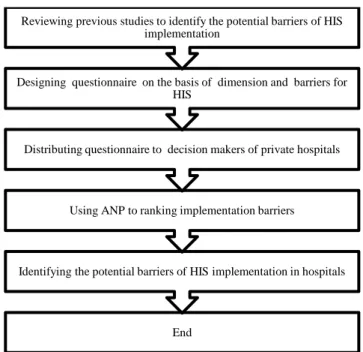
With the aim of above, a survey based method using Multi Criteria Decision Making (MCDM) was applied to rank the potential barriers of HIS system. In particular, the ANP was operated to obtain the ranking of these factors. Fig. 1, contains a description of each step in this study. 4. ANP
Recently, MCDM methods have been an active research for solving real-world decision problems (Nilashi, Ahmadi et al., 2015; Nilashi, Bagherifard et al., 2012; Nilashi and Ibrahim, 2014). Analytic Network Process (ANP) is a special case of Analytical Hierarchy Process (AHP) was developed by Saaty (2005). AHP maintains a unidirectional hierarchical relationship among decision level. The ANP does not assume independence between elements of the model. Therefore, whilst the AHP structures the problem as a hierarchy, the ANP structures it as a network where the goal, criteria (and where applicable sub-criteria) and alternatives are nodes on the network. In this manner, the ANP allows for feedback connections and loops within and between nodes to illustrate interdependence. The ANP builds upon the pairwise comparisons of the AHP where criteria are pairwise compared with respect to each alternative, and includes a further set of comparisons where alternatives are compared with respect to each criterion.
According to Saaty (2005), the steps in the quantitative component of the ANP are:
Step 1: Design a questionnaire for collecting responses from experts. The questionnaire used in this study involved pairwise comparisons of elements on a nine-point scale with nine points awarded if one element was extremely more important than the other and one point awarded if the two elements were equally important.
Step 2: This step involves arranging the results of the pairwise comparisons in the pairwise comparison matrix ( ). This matrix is then normalised by dividing each entry by its corresponding column sum to get the normalised
matrix. The rows of the normalised matrix are then averaged to get the priority vector for each element under consideration.
Table 1
Dimension and corresponding barriers
Dimensions Variables Reference (s)
Human factors (C1)
Lack of users‘ knowledge about objectives and
importance of system (V1) (van Teijlingen and Hundley, 2002) Lack of users‘ knowledge about working with system
(V2) (van Teijlingen and Hundley, 2002) Lack of freedom when working with system (V3) (Tolga, Demircan et al., 2005)
Time consuming (V4) (Tolga, Demircan et al., 2005; Ahmadi, Darvishi et al., 2014)
No incentive to use system (V5) (Degoulet and Fieschi, 1997; Radhakrishnan, David et al., 2008)
System characteristics (C2)
Technical problems related to system design (V6)
(Jayasuriya, 1999; Gravel, Légaré et al., 2006; Simon, 2007; Lucas, 2008; Ahmadi, Rad et al., 2013a; Ahmadi, Darvishi et al., 2014b; Ahmadi, Nilashi et al., 2014a; Jahanbakhsh, Sharifi et al., 2014; Ahmadi, Nilashi et al., 2015)
System task incompatibility (V7) (Tolga, Demircan et al., 2005)
Difficulty in using system (V8) (Rogers Everett, 1995; Ahmadi, Nilashi et al., 2015)
Lack of trust to system (V9) (Ang and Cummings, 1997) Lack of interoperability with existing systems (V10) (Wager, Lee et al., 2005)
User dissatisfaction about content of system (V11) (Kounalakis, Lionis et al., 2003; Ahmadian, Khajouei et al., 2014) Non-compliance with quality standards (V12) (Ahmadian, Khajouei et al., 2014) Error in data entry (V13) (Loomis, Ries et al., 2002) Lack of participation of end-users in the design (V14) (Ang and Cummings, 1997)
Privacy concern (V15) (Khoumbati, Themistocleous et al., 2006; Ahmadi, Nilashi et al., 2015) Lack of system productivity (V16) (Tolga, Demircan et al., 2005)
Human environment (C3)
Reduce patient's interaction with health care provider
(V17) (van Teijlingen and Hundley, 2002) Negative attitudes of patients toward systems (V18) (van Teijlingen and Hundley, 2002) Negative attitude of colleagues towards system (V19) (van Teijlingen and Hundley, 2002) Reduce communication with colleagues (V20) (Jahanbakhsh, Sharifi et al., 2014)
Organizational environment (C4)
Setting of care (e.g. hospital, clinic) (V21) (Tolga, Demircan et al., 2005) setting status and condition (V22) (Tolga, Demircan et al., 2005)
Practice size (V23)
(Chang, Hwang et al., 2007; Lin, Lin et al., 2012; Ahmadi, Nilashi et al., 2014)
Staff‘ salary (V24) (Tolga, Demircan et al., 2005) High workload (V25) (Tolga, Demircan et al., 2005) No motivation to competition with other organizations
(V26) (Tolga, Demircan et al., 2005)
Organizational culture (V27)
(Nunnally, 1978; Hair, Anderson et al., 1998; Sekaran, 2006; Chee and Barraclough, 2007)
Lack of organizational training (V28) (Nunnally, 1978; Chou, 2011; Ahmadi, Nilashi et al., 2014) Lack of an integrated health care delivery system (V29) (Trinkaus and Gaisser, 2010)
Hardware factors (C5) Lack of appropriate hardware (V30)
(Malik and Khan, 2009; Ahmadi, Rad et al., 2014)
Fig. 1. Research methodology
Step 3: This step is for the consistency test to certify that the original preference ratings made by the expert were consistent. The consistency ratio is a measure of the consistency of the individual judgements.
Step 4: In this step, forming the ―unweighted Supermatrix‖ is included in the ANP model which contains local priorities derived from the pairwise comparisons throughout the model‘s network and using this to construct the ―weighted Supermatrix‖.
Step 5: This step is only required when there are more than two clusters in a node of the network and involves performing cluster comparisons to get the cluster matrix. This cluster matrix is then multiplied by the unweighted Supermatrix to give the weighted Supermatrix. The final priority weights are derived by multiplying the super-matrix by itself until the columns stabilize with
An online survey was conducted for collecting data through using the questionnaire which was delivered to 24 hospital decision makers‘ email, who were highly familiar with the operation and activity of HIS inside their hospitals. The questionnaire contains the demographic section for each respondent, 5 dimensions and 31 implementation barriers.
The content validity of the questionnaire was confirmed by four experts with backgrounds in medicine, and health informatics. Table 2 provides the respondents‘ demographic profile. Almost 58% of the respondents were male, and 42% were female who work as the hospital managers and IT administrators.
5. Results of ANP
In this study, the ANP method was applied to obtain the final weights of four dimensions and their variables. Based
on the ANP model, an ANP based survey with pairwise questions was conducted and distributed to the 24 experts who had experience with the Total HIS of hospitals in Malaysia. From the 24 surveys conducted in this study, all of them were valid (effective response rate as 100%).
In addition, for the ANP model, the 24 respondents which participated in the survey were asked to provide their answers based on a scale of 1-9 to the pairwise questions, such as ‗For the ‗‗THIS adoption in the Malaysian hospitals‖, how much more important is ‗‗Human environment‖ to ‗‗Organizational environment‖?‘ It should be noted that in Saaty‘s 9-point of scale the 9 point indicates extreme importance and 1 as the equal importance of one component (dimension and variable) over another. After computing the results of their assessments, the Consistency Ratio (CR) values are all acceptable and the eigenvectors displayed are appropriate to enter into the Supermatrix.
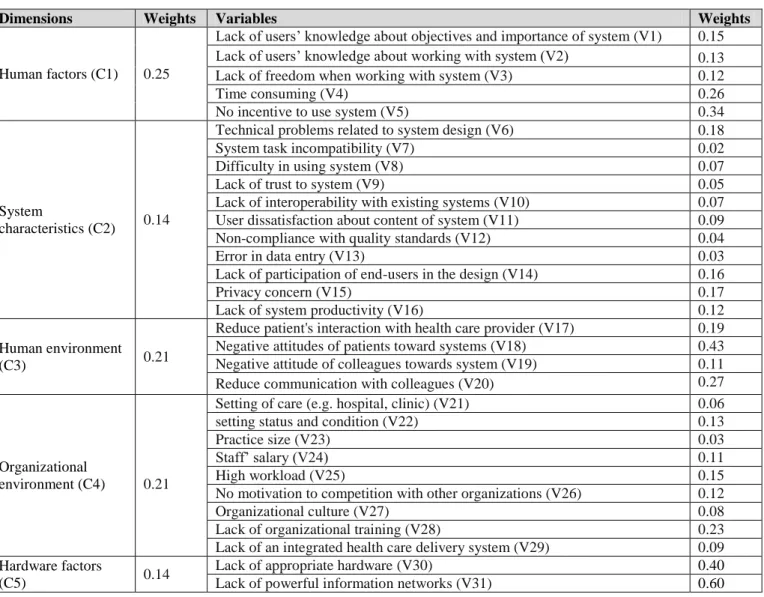
According to the steps described in ANP method, after calculating the unweighted Supermatrix and weighted Supermatrix, the limit Supermatrix was formed. This matrix presents the weight of each variable in the dimensions, and these are the final weight of variable in each dimension. The final weights of factors are presented in Table 3.
6. Discussion
The results of this study presented the priority of main factors and challenges affecting successful implementation of HIS in hospitals from professionals‘ points of view. With respects to the study of Ahmadian et al. (2014) in emphasizing several important barriers of HIS in hospitals with respect to developing countries, many similarities in this study were identified. Furthermore, some other findings from previous literature were supported and confirmed. Prioritizing the challenges helps health care authorities to decide on their first area of focus and the importance degree of criteria within that area.
System characteristics were realized as the main challenge in this study concerning the technical problems related to system design that took the highest score. Issues related to the technical aspects of HIS are in related to infrastructure as there is a lack of IT hardware. Some department inside the hospitals suffered from the old computers. Due to financial barriers, there was not chance to do things up to optimum level, so options are assessed in accordance to the budget. With respect to the system design, HIS design and performance is one the largest issues discussed by all levels of staff. This is more related to the level of user friendliness and the inability of the system to meet unexpected situations. Technical limitations related to software or hardware, and system problems are the most cited barriers in many studies (Jayasuriya, 1999; Simon, 2007; Malik and Khan, 2009; Rahimi, Vimarlund et al., 2009; Jahanbakhsh, Sharifi et al., 2014). Hence, allocating adequate funding and appropriate investments could solve these problems.
End
Identifying the potential barriers of HIS implementation in hospitals Using ANP to ranking implementation barriers
Distributing questionnaire to decision makers of private hospitals Designing questionnaire on the basis of dimension and barriers for
HIS
Most of the respondents in the class of system characteristics addressed user dissatisfaction about content of system. The issue can be raised from the poor design of the system. Several former studies (Kounalakis, Lionis et al., 2003; Ahmadian, Khajouei et al., 2014; Nabovati, Vakili-Arki et al., 2014) showed that user-friendly interface will foster the adoption of HIS where medical workers do not need to spend extra effort to familiarize with the system.
Another important factor addressed by respondents in system characteristics dimension, is privacy concern. According to Jahanbakhsh et al. (2014), the challenges of e-Health utilization in Iran relates to some fundamental issues primarily improper privacy and security mechanisms. The authors further stated that as a part of the HIS strategy, hospital authorities have to prepare a national IT security framework, preferably according to family standard, to protect all data available on healthcare servers. Such mechanisms can lead to the protection of healthcare data, and an increase in patient privacy in these hospitals.
After system characteristics factors, lack of organizational training was the second most important challenge in the class of organizational environment. Underlying staff attitudes are primarily affected by insufficient training or formal health informatics courses made available in medical schools which in turn may lead to resistance to technological changes. The new system
required all healthcare personnel to undertake training to be familiar with the new application. This could also assist the government in better planning and implementation of the HIS projects. Another main challenge in the current study was hardware-related factors with respect to the lack of powerful information networks took the highest score. In the same vein, study conducted by Ahmadian et al. (2014) have discovered the lack of powerful information networks to be the highest factors that make it difficult for hospitals to implement the HIS technology. This can be explained by the fact that in developing countries access to internet and public networks and home-made internet protocols are limited. Lack of required technological infrastructure to establish national health information system, is a prevalent problem in developing countries. limited resources and capability that can affect promotion of Health IT in private and public hospitals (Anwar, Shamim et al., 2011).
No incentive to use system also was indicated in the class of human factors to be the obstacle for the HIS implementation. It is highlighted that strong leadership, high-quality technology, financial incentives and regulations are among critical barriers that hospitals should overcome when adopting and implementing healthcare technology. Hence, the informants of the Hospitals should take some strategies to overcome this barrier by providing financial incentives to the staff in more encouraging them in using this kind of technology.
Table 2
Sample characteristic
Aspects Respondent Characteristic Frequency Percentage
Gender Male
Female
14 10
~58% ~42%
Age 26-31
31-39 39-45 45-58
6 5 8 5
25% ~21% ~33% ~21% Title of responding executives Hospital managers
Information Technology (IT) administrators 8 16
~33% ~67% Seniority in current position Above 10 years
7∼9 years 4∼6 years 1∼3 years Less than 1 years
3 5 8 6 2
12.5% 20.83% 33.33% 25% 8.33% Seniority in the healthcare
industry
Above 26 years 21∼25 years 16∼20 years 11∼15 years 6∼10 years Less than 5 years
0 1 5 8 4 6
Table 3 Final weights
Dimensions Weights Variables Weights
Human factors (C1) 0.25
Lack of users‘ knowledge about objectives and importance of system (V1) 0.15
Lack of users‘ knowledge about working with system (V2) 0.13
Lack of freedom when working with system (V3) 0.12
Time consuming (V4) 0.26
No incentive to use system (V5) 0.34
System
characteristics (C2) 0.14
Technical problems related to system design (V6) 0.18
System task incompatibility (V7) 0.02
Difficulty in using system (V8) 0.07
Lack of trust to system (V9) 0.05
Lack of interoperability with existing systems (V10) 0.07
User dissatisfaction about content of system (V11) 0.09
Non-compliance with quality standards (V12) 0.04
Error in data entry (V13) 0.03
Lack of participation of end-users in the design (V14) 0.16
Privacy concern (V15) 0.17
Lack of system productivity (V16) 0.12
Human environment
(C3) 0.21
Reduce patient's interaction with health care provider (V17) 0.19
Negative attitudes of patients toward systems (V18) 0.43
Negative attitude of colleagues towards system (V19) 0.11
Reduce communication with colleagues (V20) 0.27
Organizational
environment (C4) 0.21
Setting of care (e.g. hospital, clinic) (V21) 0.06
setting status and condition (V22) 0.13
Practice size (V23) 0.03
Staff‘ salary (V24) 0.11
High workload (V25) 0.15
No motivation to competition with other organizations (V26) 0.12
Organizational culture (V27) 0.08
Lack of organizational training (V28) 0.23
Lack of an integrated health care delivery system (V29) 0.09
Hardware factors
(C5) 0.14
Lack of appropriate hardware (V30) 0.40
Lack of powerful information networks (V31) 0.60
The findings of this study emphasized the prioritized barriers in the implementation of HIS. This study aims at shedding the light for the policy makers and hospital practitioners to make effective efforts in the relevant area of HIS challenges. This will help to foster the trend of HIS implementation and utilization in private hospitals which lead to the efficiency and safety of hospitals in providing high-quality services to the patients. Moreover, the study at hand can assist in generalizability of recognizing the barriers in healthcare industry in developing country context, as there is scarcity of studies.
Nevertheless, limitation should be addressed in this study regarding the small sample of respondents. The large sample of respondents can provide more insight to the issues and challenges of HIS within hospital. Also, multiple case studies are highly encouraged as an effective technique to scrutinize the HIS implementation, explore the overlooked hidden barriers in hospitals and compare their HIS practices to uncover the important point in this regard. Hence, future studies are pursued to overtake the studies as was suggested.
7. Conclusion
Recently, efforts have been made in Malaysia to clarify the EHR definition, integration of several different hospitals with different hospital information systems plan, which is a long-term reform to gather and record health related information of all citizens.
The main aim of this article was to clarify challenges associated with e-Health systems‘ utilization in hospitals on the basis of the example of private sector.
amongst health professionals. Hence, proper implementation plans including distribution of financial resources seems necessary to increase the HIS systems‘ acceptance in hospitals. Besides, The HIS design and performance is one the largest issues discussed by all levels of staff at the Alpha Hospital. Most of the comments were concerned with the level of user friendliness and the inability of the system to meet unexpected situations.
Relied on this study results, it is suggested that short and long term policies to deal with these barriers need to be established. More financial resources are to be allocated toward the development of information systems that fit the local needs. Moreover, there are no specific strategies for HIS long-term utilization, but recently some steps have been taken to prepare such strategy plans.
Determining the barriers regarding the implementation of health care information systems and arranging them in order of importance helps authorities to decide about what to pay more attention to. It can also give them the idea of where invest their limited funding. HIS implementation requires proper planning and considerable investment in funding, effort and time. These must be done to minimize the potential of HIS implementation failure. This is more important in developing countries where funding is difficult to get and often limited.
References
Ahmadi, H., M. Nilashi, et al. (2016). "Multi-level Model for the Adoption of Hospital Information System: A Case on Malaysia." Journal of Soft Computing and Decision Support Systems, 3(1): 61-74. Ahmadi, H., M. Darvishi, et al. (2014a). "Evaluating the
Critical Factors for Electronic Medical Record Adoption Using Fuzzy Approaches." International Journal of Innovation and Scientific Research, 9(2): 268-284.
Ahmadi, H., M. Nilashi, et al. (2015a). "Organizational decision to adopt hospital information system: An empirical investigation in the case of Malaysian public hospitals." International journal of medical informatics, 84(3): 166-188.
Ahmadi, H., M. Nilashi, et al. (2015b). "Exploring Potential Factors in Total Hospital Information System Adoption." Journal of Soft Computing and Decision Support Systems, 2(1): 52-59.
Ahmadi, H., M. Nilashi, et al. (2014b). "Fuzzy Multi-Criteria Approaches for Evaluating the Critical Factors of Electronic Medical Record Adoption." Review of Contemporary Business Research, 3(2): 01-24.
Ahmadi, H., M. Osmani, et al. (2013a). "Ranking The Meso Level Critical Factors Of Electronic Medical Records Adoption Using Fuzzy Topsis Method." International Journal of Health, Physical Education & Computer Science in Sports, 12(1): 43-47.
Ahmadi, H., M. S. Rad, et al. (2014c). "Ranking the Macro-Level Critical Success Factors of
Electronic Medical Record Adoption Using Fuzzy AHP Method." International Journal of Innovation and Scientific Research 8(1): 35-42.
Ahmadi, H., M. S. Rad, et al. (2014d). "Evaluating the Factors Affecting the Implementation of Hospital Information System (HIS) Using AHP Method." Life Science Journal, 11(3).
Ahmadi, H., M. S. Rad, et al. (2013b). "Ranking The Micro Level Critical Factors Of Electronic Medical Records Adoption Using Topsis Method." Health Informatics, 4(2).
Ahmadi, H., M. Nilashi, et al. (2015c). "Prioritizing critical factors to successful adoption of total hospital information system." Journal of Soft Computing and Decision Support Systems, 2(4): 6-16.
Ahmadi, H., O. Ibrahim, et al. (2015d). "Investigating a new framework for hospital information system adoption: a case on Malaysia." Journal of Soft Computing and Decision Support Systems, 2(2): 26-33.
Ahmadian, L., R. Khajouei, et al. (2014). "Prioritizing Barriers to Successful Implementation of Hospital Information Systems." Journal of medical systems, 38(12): 1-6.
Ang, S. and L. L. Cummings (1997). "Strategic response to institutional influences on information systems outsourcing." Organization science, 8(3): 235-256. Anwar, F., A. Shamim, et al. (2011). "Barriers in adoption of health information technology in developing societies." Int J Adv Comput Sci Appl, 2: 8. Bhattacherjee, A. and N. Hikmet (2007). Physicians'
Resistance toward Healthcare Information Technologies: A Dual-Factor Model. System Sciences, 2007. HICSS 2007. 40th Annual Hawaii International Conference on, IEEE.
Boonstra, A. and M. Broekhuis (2010). "Barriers to the acceptance of electronic medical records by physicians from systematic review to taxonomy and interventions." BMC health services research, 10(1): 231.
Cardozo, R., K. McLaughlin, et al. (1993). "Product— Market choices and growth of new businesses." Journal of Product Innovation Management, 10(4): 331-340.
Chang, D.-Y. (1996). "Applications of the extent analysis method on fuzzy AHP." European Journal of Operational Research, 95(3): 649-655.
Chang, D. (1992). Extent analysis and synthetic decision, optimization techniques and applications, Vol. 1, World Scientific, Singapore.
Chang, I., H.-G. Hwang, et al. (2007). "Factors affecting the adoption of electronic signature: Executives' perspective of hospital information department." Decision Support Systems, 44(1): 350-359. Chee, H. L. and S. Barraclough (2007). Health care in
Chou, D. (2011). "Health Information Systems: Architectures and Strategies." JAMA, 306(12): 1383-1384.
Choudrie, J. and Y. K. Dwivedi (2005). "Investigating the research approaches for examining technology adoption issues." Journal of Research Practice, 1(1): Article D1.
Degoulet, P. and M. Fieschi (1997). Introduction to clinical informatics, Springer Science & Business Media. Fichman, R. G. (1992). Information technology diffusion: a
review of empirical research, ICIS.
Gravel, K., F. Légaré, et al. (2006). "Barriers and facilitators to implementing shared decision-making in clinical practice: a systematic review of health professionals' perceptions." Implement Sci, 1(1): 16.
Hair, J. F., R. E. Anderson, et al. (1998). Black (1998), Multivariate data analysis, Upper Saddle River, NJ: Prentice Hall.
Hossain, M. and M. Quaddus (2011). "Factors influencing the mandatory adoption of RFID: An empirical investigation from Australian livestock industry." Hsiao, J.-L., H.-C. Chang, et al. (2011). "A study of factors
affecting acceptance of hospital information systems: a nursing perspective." Journal of Nursing Research, 19(2): 150-160.
Ismail, N. I., N. H. Abdullah, et al. (2013). "Implementation Differences of Hospital Information System (HIS) in Malaysian Public Hospitals." Technology, 20(21): 22.
Jahanbakhsh, M., M. Sharifi, et al. (2014). "The Status of Hospital Information Systems in Iranian Hospitals." Acta Informatica Medica, 22(4): 268. Jayasuriya, R. (1999). "Managing information systems for
health services in a developing country: a case study using a contextualist framework." International Journal of Information Management, 19(5): 335-349.
Khoumbati, K., M. Themistocleous, et al. (2006). "Evaluating the adoption of enterprise application integration in health-care organizations." Journal of management information systems, 22(4): 69-108.
Kounalakis, D. K., C. Lionis, et al. (2003). "Developing an appropriate EPR system for the Greek primary care setting." Journal of medical systems, 27(3): 239-246.
Lee, K. and T. T. Wan (2003). "Information system integration and technical efficiency in urban hospitals." International journal of healthcare technology and management, 5(6): 452-462. Lin, C.-H., I.-C. Lin, et al. (2012). "Critical Factors
Influencing Hospitals‘ Adoption of HL7 Version 2 Standards: An Empirical Investigation." Journal of medical systems, 36(3): 1183-1192.
Loomis, G. A., J. S. Ries, et al. (2002). "If electronic medical records are so great, why aren't family physicians using them?" Journal of Family Practice, 51(7): 636-641.
Lucas, H. (2008). "Information and communications technology for future health systems in developing countries." Social science & medicine, 66(10): 2122-2132.
Malik, M. A. and H. R. Khan (2009). Understanding the implementation of an electronic hospital information system in a developing country: a case study from Pakistan. Proceedings of the Third Australasian Workshop on Health Informatics and Knowledge Management, Volume 97, Australian Computer Society, Inc.
Nabovati, E., H. Vakili-Arki, et al. (2014). "Usability Evaluation of Laboratory and Radiology Information Systems Integrated into a Hospital Information System." Journal of medical systems, 38(4): 1-7.
Nilashi, M., H. Ahmadi, et al. (2016). "Determining the importance of Hospital Information System adoption factors using Fuzzy Analytic Network Process (ANP)." Technological Forecasting and Social Change. 10.1016/j.techfore.2016.07.008. Nilashi, M., H. Ahmadi, et al. (2015). "Evaluating the
Factors Affecting Adoption of Hospital Information System Using Analytic Hierarchy Process." Journal of Soft Computing and Decision Support Systems, 3(1): 8-35.
Nunnally, J. (1978). C.(1978). Psychometric theory, New York: McGraw-Hill.
Radhakrishnan, A., D. David, et al. (2008). "Challenges with adoption of electronic medical record systems." Encyclopedia of healthcare information systems.
Rahimi, B., V. Vimarlund, et al. (2009). "Health information system implementation: a qualitative meta-analysis." Journal of medical systems 33(5): 359-368.
Rogers Everett, M. (1995). "Diffusion of innovations." New York.
Sekaran, U. (2006). Research methods for business: A skill building approach, John Wiley & Sons.
Simon, S. J. (2007). "User acceptance of voice recognition technology: an empirical extension of the technology acceptance model." Journal of Organizational and End User Computing (JOEUC) 19(1): 24-50.
Tachinardi, U., M. Gutierrez, et al. (1993). Integrating Hospital Information Systems. The challenges and advantages of (re-) starting now. Proceedings of the Annual Symposium on Computer Application in Medical Care, American Medical Informatics Association.
Tolga, E., M. L. Demircan, et al. (2005). "Operating system selection using fuzzy replacement analysis and analytic hierarchy process." International Journal of Production Economics, 97(1): 89-117.
dialogues." Patient education and counseling 80(3): 410-416.
van Teijlingen, E. and V. Hundley (2002). "The importance of pilot studies." Nursing Standard 16(40): 33-36. Wager, K. A., F. W. Lee, et al. (2005). ManagingHealth
Care Information Systems: A Practical Approach for Health Care Executives, John Wiley & Sons. Nilashi M, Bagherifard K, Ibrahim O, Janahmadi N,
Ebrahimi L: Ranking Parameters on Quality of Online Shopping Websites Using Multi-Criteria Method. Research Journal of Applied Sciences 2012, 4(21): 4380-4396.
Nilashi M, Ibrahim O: A model for detecting customer level intentions to purchase in B2C websites using TOPSIS and fuzzy logic rule-based system. Arabian Journal for Science and Engineering 2014, 39(3): 1907-1922.
Saaty, T. L: Theory and applications of the analytic network process: decision making with benefits, opportunities, costs, and risks. RWS publications 2005.
Herath G, Prato T, (Eds.): Using multi-criteria decision analysis in natural resource management. Ashgate Publishing 2006, Ltd.