Niche engineering reveals complementary resource use
JACOBT. GABLE,1DAVIDW. CROWDER,1,4TOBIND. NORTHFIELD,2SHAWNA. STEFFAN,3ANDWILLIAME. SNYDER1
1Department of Entomology, Washington State University, Pullman, Washington 99164 USA
2
Department of Zoology, University of Wisconsin, Madison, Wisconsin 53706 USA
3USDA-ARS, Department of Entomology, University of Wisconsin, Madison, Wisconsin 53706 USA
Abstract. Greater resource use by diverse communities might result from species
occupying complementary niches. Demonstrating niche complementarity among species is challenging, however, due to the difficulty in relating differences between species in particular traits to their use of complementary resources. Here, we overcame this obstacle by exploiting plastic foraging behavior in a community of predatory insects common onBrassica oleracea
plants in Washington, USA. These predators complemented one another by partitioning foraging space, with some species foraging primarily along leaf edges and others at leaf centers. We hypothesized that emergent biodiversity effects would occur when predators partitioned foraging space on leaves, but not when spatial complementarity was dampened. Indeed, on intact leaves, edge- and center-foraging predators combined to kill more prey than any single predator species could by itself. These emergent diversity effects, however, disappeared on plants damaged by the caterpillarPlutella xylostella. Caterpillar chew-holes brought edge habitats to the center of leaves, so that all predator species could attack aphids anywhere on plants. With spatial niche differences diminished, there were no benefits of predator diversity; the most voracious single predator species killed the most aphids. Thus, caterpillar herbivory determined whether multi-predator-species effects reflected complemen-tarity or species’ individual impacts. Our study provides direct evidence for a causative relationship between niche differentiation and increased resource consumption by diverse communities, as revealed by ecological engineers that homogenize the foraging environment.
Key words: biodiversity effects;Brassica oleracea;cabbage aphid predators; complementary niches;
complementarity; field and greenhouse experiments; habitat complexity; identity effect; niche overlap; niche
partitioning;Plutella xyostella;Washington state, USA.
INTRODUCTION
Across a broad range of ecosystems, increasing the number of consumer species increases the volume of resources consumed (Hooper et al. 2005, Cardinale et al. 2006). This is predicted to occur when different species use dissimilar subsets of the total resource pool, so that species combine to access more resources that any single species could on its own (MacArthur 1958, Hutchinson 1959). That is, species occupy complementary niches. A causal link between resource-use differences and result-ing diversity effects has been surprisresult-ingly hard to demonstrate, however, because of the inherent difficulty in manipulating species’ resource-use niches independent of other species traits (Finke and Snyder 2008). For example, species differ from one another in body size, metabolic rate, and a host of other traits that are manipulated along with feeding habits whenever species richness is varied (Huston 1997, Loreau and Hector 2001). Thus, ecologists have struggled to differentiate between species-identity effects, and true complemen-tarity, as the underlying causes of greater resource use
by diverse compared with simple communities (Naeem and Wright 2003, Cardinale et al. 2006).
One approach to examine complementarity is to determine whether ecological functions in diverse commu-nities exceed the expected performance of the strongest-acting individual species (Petchey 2003). However, this approach provides no insight into the mechanisms that lead to emergent diversity effects (Petchey 2003). A more direct test is to experimentally manipulate niche comple-mentarity independent of species identity. For example, when consumers have flexible resource needs and acquired food preferences, species can be ‘‘trained’’ to use the same or different resources (Finke and Snyder 2008). Another possibility exists when species differ in where they forage in the environment, such that each species can only access resources available in the habitat it frequents. Here, habitat complexity could be experimentally manipulated to heighten or lessen spatial niche differences, while measur-ing how this impacts diversity effects, as a means to uncover any relationship between niche partitioning and commu-nity-wide resource use (Griffin et al. 2009). An advantage of this approach is that it might unveil diversity effects as they naturally vary across ecosystems and landscapes, with species complementing one another in some situations but filling redundant roles in others.
Manuscript received 2 February 2012; revised 30 April 2012; accepted 7 May 2012. Corresponding Editor: J. T. Cronin.
4Corresponding author. E-mail: [email protected]
1994
R
demonstrated. The aphids and their predators often co-occur with Plutella xylostella caterpillars, which chew ragged holes in leaves (Steffan and Snyder 2010). The aphid predators almost never eat caterpillars (Steffan and Snyder 2010). Nonetheless, caterpillar feeding could disrupt space-use differences among aphid predators, if predator species otherwise restricted to leaf edges can use holes chewed by caterpillars as ‘‘toe holds’’ providing access to aphids in leaf centers (Fig. 1B). This led us to hypothesize that caterpillar feeding could dampen spatial niche separation among predators by providing edge-like habitats throughout leaves (Fig. 1B). In turn, reduced niche differences might diminish the benefits of predator diversity for aphid suppression seen on plants with intact leaves.
METHODS
Caterpillar impacts on predator–aphid relationships in the open field
In an open-field setting in Washington (USA) we first tested whether positive effects of predator diversity on aphid consumption would diminish with increasing caterpillar densities, based on our hypothesis that caterpillar feeding would reduce spatial complementar-ity among predators. To accomplish this, we used sprays
of Bacillus thuringiensis (Bt) insecticides to reduce
caterpillar densities in five 25-m2 plots of B. oleracea
plants; five remaining 25-m2 plots were sprayed with water (as a harmless control) so natural caterpillar populations developed (detailed in the Appendix: Fig. A1). Bt is toxic to Lepidoptera but leaves other species unharmed (Talekar and Shelton 1993; Appendix: Fig. A2). On 7 and 23 July 2009 we visually searched 10 plants in each plot for aphids, caterpillars, and predators (detailed in the Appendix).
Impacts of caterpillar damage on predator-niche overlap
In a second open-field study in Washington (USA) we conducted observations of predator foraging behavior to test the hypothesis that caterpillar feeding would dampen spatial complementarity between predators. We established four 4-m2
B. oleracea plots; two were
sprayed with Bt insecticide to exclude caterpillars, and
Caterpillar damage and predator diversity effects
Our field experiments allowed us to examine how caterpillars impacted predator–aphid relationships in natural communities, and to observe how caterpillar feeding mediated space use by predators. These studies, however, could not convincingly draw a causal link between any differences in spatial niches that caterpillar feeding engenders, and the importance of species-rich predator communities for aphid suppression. To fill this gap we performed an experiment in greenhouse meso-cosms, where we conducted a fully factorial manipulation of two factors: predator species richness (0, 1, 2, or 4 species) and caterpillar feeding damage (present or absent). Caterpillar damage was established by allowing 10 third-instarP. xylostellacaterpillar larvae to feed for 72 h; caterpillars were then removed before predators or aphids were added. Predators were manipulated within a substitutive design, such that four individuals were present in each cage (except for controls), and all possible combinations of our four predator species were included at each level of predator richness (detailed in the Appendix). To begin the experiment, 20 aphids were released into all mesocosms and allowed 72 h to establish, after which we performed initial aphid counts and released predators. Predators were allowed to feed for 72 h, after which we conducted final aphid counts. The number of aphids that had been parasitized during the 72-h period was determined by allowing parasitoid larvae to develop in their aphid hosts for 10 days after predator removal, at which point the number of parasitized aphids were counted (this number was subsequently subtracted from the final aphid count). The experiment included two temporal blocks, initiated on 15 and 22 October 2010, and included 144 experimental units total (detailed in the Appendix). We again observed predator foraging behavior on both caterpillar-damaged and undamaged plants, as de-scribed for the open-field experiment (detailed in the Appendix).
Statistical analyses
We analyzed aphid counts from the open-field experiment using a generalized linear model with a
R
negative binomial distribution (PROC GENMOD; SAS Institute 2012b), including the factors caterpillar density (high vs. low), predator species richness, and their interaction. In this analysis, data were pooled across sample dates to account for temporal variation and non-independence of aphid and predator counts over time; we assumed an underlying negative binomial error distribution to account for over-dispersion and hetero-scedasticity in the data. For the greenhouse study, we examined change in aphid abundance [ln(final/initial abundance)] using ANOVA including the factors: number of predator species, caterpillar feeding (present or absent), temporal block, and all two-and three-way interactions. To further examine these data, we used ANOVA followed by least significant difference tests to assess whether change in aphid abundance in the fully diverse treatment (with four species) differed from the monocultures; this allowed us to detect if transgressive overyielding occurred (Snyder et al. 2006).
For field and greenhouse behavioral observations, we used logistic regression to examine whether the propor-tion of predators foraging in the center vs. perimeter of leaves, and the proportion foraging along any leaf edge, were affected by the factors: caterpillar presence or absence, predator species (H. convergens orD. rapae), and their interaction. For these tests, each cage or field plot served as a replicate, with individual observations serving as the counts. For leaves collected from both the field and greenhouse, we compared leaf area (log transformed) and the proportion of edge area (logit-transformed) from caterpillar-damaged vs. undamaged leaves, using two-way ANOVAs that included block effects. The general linear model was analyzed using SAS, all remaining analyses were performed using JMP (SAS Institute 2010a,b).
RESULTS
Caterpillar impacts on predator–aphid correlations in the open field
We found a significant interaction between caterpillar density and predator species richness in open-field plots (v2¼1.34, P¼0.044; Fig. 2A; Appendix: Table A1). Aphid densities increased as predator richness increased when caterpillar densities were naturally high, but there was a flatter relationship between aphid densities (declining slightly) and predator richness when caterpil-lar densities were experimentally reduced (Fig. 2A; Appendix: Figs. A1, A2).
Impacts of caterpillar damage on predator niche overlap
Two predator species, the ladybeetle H. convergens
and the parasitoid wasp D. rapae, were observed frequently enough to allow their behavior to be statistically analyzed. On plants in plots where caterpil-lars were excluded, so that leaves were intact, lady beetles foraged more frequently along leaf perimeters than in leaf centers (n¼941 observations;v2¼56.9,P,
0.0001), while wasps foraged most frequently in leaf centers (n¼941 observations; v2¼85.5,P , 0.0001); thus, foraging by these two species was largely separate in space (Fig. 2C; Appendix: Table A2). The pattern was very different on plants that had been fed upon by caterpillars. With edges available in leaf centers, lady beetles readily foraged there, significantly diminishing space-use differences between lady beetles and wasps (species3caterpillar interaction: n¼941 observations;
v2 ¼ 4.58, P ¼ 0.032) (Fig. 2C). Caterpillar feeding significantly increased the total edge area on leaves (Appendix: Fig. A3A). However, caterpillars did not significantly alter total leaf area, possibly because
FIG. 1. At our study site, cabbage aphids are attacked by the lady beetleHippodamia convergens, the predatory bugNabis
alternatus, and the endoparasitoid waspsAphidius matricariaeandDiaeretiella rapae. The lady beetle forages primarily at leaf
edges, whereas the smaller wasps and predatory bug commonly hunt at leaf centers (Straub and Snyder 2008). (A) On undamaged leaves the predator species will clearly partition foraging space, such that they occupy relatively distinct space-use niches. (B) However, by providing edge-like habitats in leaf centers, caterpillar feeding damage might diminish space-use differences among predators.
R
richness (Fig. 2B). Thus, feeding damage by caterpillars eliminated the predator-diversity effect. On undamaged plants, each single predator species killed significantly fewer aphids than the diverse mix of four predator species (Fig. 3A, Appendix: Table A4). However, on caterpillar-damaged plants single species variously killed more, the
FIG. 2. In both (A) open fieldBrassica oleraceaplantings and (B) greenhouse mesocosm cages, aphid densities decreased with increasing predator richness when caterpillar feeding damage was reduced or absent (black solid circles and line), but not when caterpillar feeding damage was present (gray triangles and gray line). In panel (B) data are means6 SE. Similarly, (C) spatial complementarity among Diaeretiella
rapaewasps and Hippodamia convergens beetles was
signifi-cantly reduced on caterpillar-damaged leaves (‘‘damaged’’), as the frequency of foraging in leaf centers for the two species was more similar when caterpillars were present than when they were absent (‘‘no damage’’) (species3caterpillar interaction,n
¼941 observations;v2
¼4.58,P¼0.032; Appendix: Table A3).
FIG. 3. Change in aphid abundance (mean6 SE) when aphids were exposed to single predator species (Am,Aphidius
matricariae; Dr,Diaeretiella rapae; Hc,Hippodamia convergens;
Na, Nabis alternatus) or a diverse, four-species, predator
community on plants (A) without and (B) with caterpillar damage. The dotted lines indicate the mean 6 SE for the diverse community; asterisks indicate a significant difference between single-species and diverse community (P , 0.05) (Appendix: Table A4).
R
same, or fewer aphids than did diverse predator commu-nities (Fig. 3B, Appendix: Table A4).
Caterpillar feeding damage did not directly influence aphid abundances in the absence of predators (Appen-dix: Fig. A4). While caterpillar feeding significantly increased edge area on leaves, as in the open-field this occurred with no significant change in total leaf area (Appendix: Fig. A5). Averaging across all predator richness treatments, predators similarly reduced aphid abundance on plants with or without caterpillar feeding damage (Appendix: Fig. A6, Table A5). The effects of caterpillar feeding on predator foraging behavior, and leaf architecture, were similar in the greenhouse to what was observed in the field (Appendix: Figs. A7 and A8, Table A6).
DISCUSSION
Across open-field and cage studies, caterpillars con-trolled whether predators exerted complementary or substitutable impacts on aphids. Where caterpillar feeding damage was reduced or absent, aphid densities declined with increasing predator species richness (Fig. 2). This suggested strong predator complementarity, where differ-ent predator species made unique contributions such that several predator species were needed to maximize aphid suppression. In stark contrast, in the presence of caterpillar feeding damage, increasing the number of predator species provided no benefit for aphid suppression (Fig. 2). This suggested that different predator species did not attack aphids in unique ways on plants chewed by caterpillars, so that a single, highly voracious predator species could maximize aphid suppression. Thus, caterpillar feeding
eliminated the emergent diversity effects that were seen on undamaged plants.
We had hypothesized that caterpillars might dampen niche differences among predator species by chewing edge habitat into leaf centers, thereby homogenizing predators’ space use (Fig. 1). Our observations of behavior suggested that this was indeed the case. In both the field and greenhouse, lady beetle foraging on undamaged plants occurred almost exclusively along leaf perimeters (Fig. 2C; Appendix: Fig. A7). On the other hand, wasps foraged most frequently in leaf centers, such that on intact leaves wasps and lady beetles foraged in different (and complementary) loca-tions (Fig. 2C). When caterpillar feeding provided lady beetles with toeholds at leaf centers, however, they readily exploited this foraging opportunity and spatial overlap between beetles and wasps increased (Fig. 2C). Thus, the weakening of diversity effects we observed on caterpillar-damaged plants that suggested reduced com-plementarity, occurred concurrently with an observed decline of complementary space use. This strongly suggests a causal link between diminishing spatial niche divergence and a resulting weakening of consumer diversity effects. Caterpillars increased total edge area of leaves without changing total leaf area (Appendix: Figs. A3, A5, and A8), and did not significantly alter the overall ability of predators to suppress aphid abundance (Appendix: Fig. A6). Thus, caterpillars altered predator diversity effects without altering the overall effectiveness of predators.
Careful consideration of the results of our green-house-cage experiment provides further evidence that
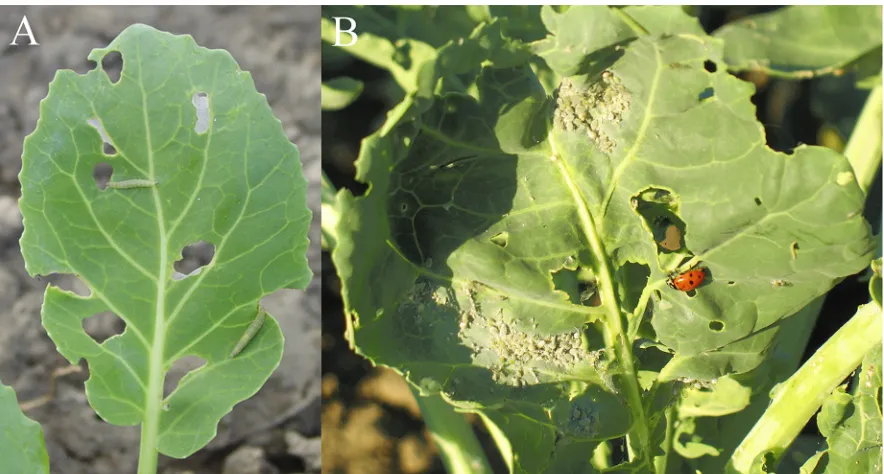
PLATE1. (A)Plutella xylostellacaterpillars chew ragged holes inBrassica oleracealeaves, which (B) lady beetles use as toeholds
to access aphids in leaf centers that the predators would otherwise be unable to reach. Photo credits: S. A. Steffan.
R
[image:5.567.61.503.61.298.2]identity effects predominated. In this case, the perfor-mance of multi-predator-species mixes could be predict-ed baspredict-ed on the number of aphids each prpredict-edator killpredict-ed when that species occurred alone, and aphid suppression was maximized when the single most-effective predator species (the parasitoid waspD. rapae) was by itself. The increased effectiveness of D. rapae when caterpillars were present may be due to their use of feeding holes; we observed that adult wasps used holes to move between leaf undersides and leaf tops (J. T. Gable and S. A. Steffan, personal observations). This perhaps allowed adult parasitoids to forage and access aphids across the entire leaf surface more effectively than when feeding holes were absent. Altogether, these results provide further evidence that caterpillars triggered a shift from predators complementing one another to exerting substitutable effects on the prey resource.
Our results differ from predictions of Schmitz (2007), who developed a general framework for predicting the impacts of multiple predator species on shared prey. Under that scheme, when multiple predator species are spatially separate but prey cross both predators’ ‘‘domains,’’ predators are predicted to exert substitut-able effects, and increasing predator diversity will not increase prey consumption. This spatial arrangement of predators and prey occurred on intact leaves in our system, but we observed super-additive, rather than substitutable, diversity effects (Fig. 2). Under the Schmitz framework, when predators and prey all fully overlap in space, predators are predicted to interfere with one another, such that herbivore suppression decreases as predator diversity increases. In our system, this scenario occurred on caterpillar-damaged leaves, but we observed predator substitutability rather than predator–predator interference (Fig. 2). We suggest, however, that two small tweaks can bring our results entirely in line with the predictions of Schmitz (2007). First, Schmitz (2007) imagined mobile herbivores, such as grasshoppers, that readily redistribute themselves among the habitat domains of different predator species. In contrast, the aphids in our system are relatively immobile and can only be fully suppressed when predators can reach aphids everywhere that the
herbi-There is growing realization that species may com-plement one another in one ecological context, but not in others (Loreau et al. 2003, Cardinale et al. 2007, Zavaleta et al. 2010, Isbell et al. 2011). In our system the factor that mediated complementarity was the presence of a species that altered the foraging environment, leaf-chewing caterpillars. ‘‘Ecological engineers’’ such as our caterpillars are known to impact biodiversity by increasing habitat complexity, expanding the resource base, and/or altering the behavior of other species, such that a broader range of species can be supported (Wright et al. 2002, Lill and Marquis 2003). The example presented here shows that ecological engineers can also impact whether species complement one another. Our open-field observations suggested that this flexibility in whether predators complement one another or not (Fig. 2), might lead to a mosaic of emergent diversity effects arising and disappearing across land-scapes depending on whether caterpillars happen to be present or absent. Indeed, these results link findings from a series of previous experiments in this system where caterpillars were not included (e.g., Snyder et al. 2006, Straub and Snyder 2008, Northfield et al. 2010; but see Steffan and Snyder 2010) to the broader range of ecological conditions expected in the field.
Although studies have demonstrated positive effects of biodiversity on a wide variety of ecological functions (Hooper et al. 2005, Cardinale et al. 2006), few have convincingly demonstrated a causal link between niche differences among species and emergent biodiversity effects (Finke and Snyder 2008). The central difficulty lies in the fact that highly diverse communities are both more likely to bring together species that complement one another, and to include single highly impactful species. This problem is roughly analagous to earlier difficulties in relating differences among species in particular traits, to their ability to coexist through niche partitioning (Strong et al. 1979, Simberloff and Boecklen 1981). We overcame these obstacles by manipulating differences among consumer species along one niche axis, degree of overlap in foraging-space use, while simultaneously and independently manipulating species richness. This approach provided support for the
R
idea that it is differences among species in the resources they use that intensifies overall resource exploitation at higher levels of consumer biodiversity (Silvertown et al. 1999, Finke and Snyder 2008). Furthermore, our results strengthen the assertion that manipulating plastic foraging behavior to alter niche breadth among animal consumers is a particularly powerful approach to vary resource-use patterns independent from other aspects of species identity and diversity (Finke and Snyder 2008, Griffin et al. 2009). When this is accomplished through the deployment of ecological engineers, as we have done, such studies might also reveal how diversity effects naturally vary with ecological context.
ACKNOWLEDGMENTS
We thank Tadashi Takizawa and Elizabeth Aultman for aiding with the open-field surveys. This project was supported by USDA-NIFA grants number 2004-01215 and number 2007-02244.
LITERATURECITED
Cardinale, B. J., D. S. Srivastava, J. E. Duffy, J. P. Wright, A. L. Downing, M. Sankaran, and C. Jouseau. 2006. Effects of biodiversity on the functioning of trophic groups and ecosystems. Nature 443:989–992.
Cardinale, B. J., J. P. Wright, M. W. Cadotte, I. T. Caroll, A. Hector, D. S. Srivastava, M. Loreau, and J. J. Weis. 2007. Impacts of plant diversity on biomass production increase through time because of species complementarity. Proceed-ings of the National Academy of Sciences USA 104:18123– 18128.
Finke, D. L., and W. E. Snyder. 2008. Niche partitioning increases resource exploitation by diverse communities. Science 321:1488–1490.
Griffin, J. N., S. R. Jenkins, L. Gamfeldt, D. Jones, S. J. Hawkins, and R. C. Thompson. 2009. Spatial heterogeneity increases the importance of species richness for an ecosystem process. Oikos 118:1335–1342.
Hooper, D. U., et al. 2005. Effects of biodiversity on ecosystem functioning: a consensus of current knowledge. Ecological Monographs 75:3–35.
Huston, M. A. 1997. Hidden treatments in ecological experi-ments: re-evaluating the ecosystem function of biodiversity. Oecologia 110:449– 460.
Hutchinson, G. E. 1959. Homage to Santa Rosalia, or Why are there so many kinds of animals? American Naturalist 93:145– 159.
Isbell, F., et al. 2011. High plant diversity is needed to maintain ecosystem services. Nature 477:199–202.
Lill, J. T., and R. J. Marquis. 2003. Ecosystem engineering by caterpillars increases insect herbivore diversity on white oak. Ecology 84:682–690.
Loreau, M., and A. Hector. 2001. Partitioning selection and complementarity in biodiversity experiments. Nature 412:72– 76.
Loreau, M., N. Mouquet, and A. Gonzalez. 2003. Biodiversity as spatial insurance in heterogeneous landscapes. Proceedings of the National Academy of Sciences USA 100:12765–12770. MacArthur, R. H. 1958. Population ecology of some warblers
of northeastern coniferous forests. Ecology 39:599–619. Naeem, S., and J. P. Wright. 2003. Disentangling biodiversity
effects on ecosystem functioning: deriving solutions to a seemingly insurmountable problem. Ecology Letters 6:567– 579.
Northfield, T. D., G. B. Snyder, A. R. Ives, and W. E. Snyder. 2010. Niche saturation reveals resource partitioning among consumers. Ecology Letters 13:338–348.
Petchey, O. L. 2003. Integrating methods that investigate how complementarity influences ecosystem functioning. Oikos 101:323–330.
SAS Institute. 2010a. JMP 9.0. SAS Institute, Cary, North Carolina, USA.
SAS Institute. 2010b. SAS 9.0. SAS Institute, Cary, North Carolina, USA.
Schmitz, O. J. 2007. Predator diversity and trophic interactions. Ecology 88:2415–2426.
Silvertown, J., M. E. Dodd, D. J. D. Gowing, and J. O. Mountford. 1999. Hydrologically defined niches reveal a basis for species richness in plant communities. Nature 400:61–63.
Simberloff, D., and W. Boecklen. 1981. Santa Rosalia reconsidered: size ratios and competition. Evolution 35:1206–1228.
Snyder, W. E., G. B. Snyder, D. L. Finke, and C. S. Straub. 2006. Predator biodiversity strengthens herbivore suppres-sion. Ecology Letters 9:789–796.
Steffan, S. A., and W. E. Snyder. 2010. Cascading diversity effects transmitted exclusively by behavioral interactions. Ecology 91:2242–2252.
Straub, C. S., and W. E. Snyder. 2008. Increasing enemy biodiversity strengthens herbivore suppression on two plant species. Ecology 89:1605–1615.
Strong, D. R., L. A. Szyska, and D. S. Simberloff. 1979. Tests of community-wide character displacement against null hypotheses. Evolution 33:897–913.
Takizawa, T., and W. E. Snyder. 2011. Cannibalism and intraguild predation of eggs within a diverse predator assemblage. Environmental Entomology 40:8–14.
Talekar, N. S., and A. M. Shelton. 1993. Management of the diamondback moth. Annual Review of Entomology 38:275– 301.
Wright, J. P., C. G. Jones, and A. S. Flecker. 2002. An ecosystem engineer, the beaver, increases species richness at the landscape scale. Oecologia 132:96–101.
Zavaleta, E. S., J. R. Pasari, K. B. Hulvey, and G. D. Tilman. 2010. Sustaining multiple ecosystem functions in grassland communities requires higher biodiversity. Proceedings of the National Academy of Sciences USA 107:1443–1446.
SUPPLEMENTALMATERIAL
Appendix
Methods related to the field and greenhouse experiments, eight figures showing data from the field and greenhouse experiments, and six tables showing results of the statistical analyses (Ecological ArchivesE093-189-A1).