THE URBAN SECTOR NETWORK’S EXPERIENCE
OF THE PEOPLES HOUSING PROCESS (PHP)
CONTENTS
CHAPTER ONE: THE PEOPLES HOUSING PROCESS (PHP) 1.1. Introduction
1.2. Policy Overview 1.3. Current PHP Practice
CHAPTER TWO: THE USN’s UNDERSTANDING OF THE PHP 2.1. The USN’s experience of PHP
2.2. USN definition of PHP 2.3. USN key PHP principles 2.4. Benefits of PHP
2.5. A livelihoods approach to PHP 2.6. Challenges identified by the USN
CHAPTER THREE: USN PHP CASE STUDIES 3.1. Southern Pinetown: Kwazulu Natal 3.2. Khayelitsha: Western Cape
3.3. Vosloorus: Gauteng
3.4. Amalinda Housing Cooperative: Eastern Cape
CHAPTER FOUR : CONCLUSION
CHAPTER ONE : THE PEOPLE’S HOUSING PROCESS
1.1. INTRODUCTION
The Peoples Housing Process (PHP) is a generic term describing the ongoing processes of self-provision of shelter and services by the poorest members of society in the
developing world (Bauman, 2003). PHP is however often seen as synonymous with “self build” or “sweat equity”. However, the Urban Sector Network, and others, argues that it is far more than this. Although beneficiaries may participate in the actual construction, it is the participation of communities in the process of deciding, organizing and managing
settlement development that is more important (Bauman, 2003). For the Urban Sector Network it is about “Building people, building houses” and is about building citizenship, building effective partnerships, people being involved directly in the development of their communities, and ultimately about creating more sustainable human settlements. PHP therefore, is about far more than just housing.
1.2. POLICY OVERVIEW
The Housing White Paper, published in December 1994, set out the government’s broad housing policy and strategy. “Supporting The Peoples Housing Process” was included as one of the seven strategic thrusts listed in the White Paper. This was in acknowledgement that 70% of South Africa’s population was unable to afford finance, and that a further 10 – 15% of the population would only be able to afford finance through non-traditional lenders. It was felt that if people were given the chance to build or organise the building of their homes themselves, they would achieve a greater level of value for money (Housing Code). In it’s original form key principles behind the PHP policy were about partnerships, a people-driven process, skills transfer, and community empowerment.
However it was not until March 1998 that the Department of Housing, together with the Peoples Housing Partnership Trust (PHPT) and the Housing Support Task Team, released a “National Policy for Supporting the Peoples Housing Process” for comment. The Housing MinMec then adopted this policy in May 1998. Implementation guidelines for the PHP were incorporated into the implementation Manual from June 1998 (Napier, 2003 : 324).
Chapter Eight of the Housing Code deals with the rules of Peoples Housing Process, outlining how households can follow the PHP route in accessing consolidation, project-linked, institutional or rural subsidies, as well as technical and other forms of assistance in the house building process. The policy, as listed in the Housing Code, is aimed at
supporting households who wish to enhance their subsidies by building or organizing the building of their homes themselves. The process assists households to access:
• Housing subsidies;
• Technical, financial, logistical and administrative support regarding the building of their homes, on a basis that is sustainable and affordable.
There is no PHP subsidy, it is rather a process to be followed using the subsidy types as listed above. Eligibility criteria for the PHP are therefore essentially the same as for the housing subsidy, however an additional amount in the form of an Establishment Grant (currently R570 per beneficiary, although this can vary across Provinces) is paid. The Establishment grant pays for all the costs of the Support Organisation, Account Administrator and Certifier. The Support Organisation’s main responsibility is to give technical and administrative assistance to beneficiaries and for preparing beneficiaries for PHP by going through a series of workshops with the community. It is clear from this that although the policy as articulated in the White Paper upholds all the social aspects of PHP, the Housing Code reflects only the procedures to be followed. The policy is about
regulation rather than creating an enabling environment or lending support to the process. This ambiguity has led to all kinds of interpretations of the PHP policy, many of which ignore the key principles for which the PHP was supposed to stand.
1.3. CURRENT PHP PRACTICE
As noted by Rust (2003) and Bauman (2003a), in recent years there has been a shift in emphasis, with the PHP now being understood as a way to get beneficiaries to value their subsidised houses. This has come about with the April 2002 requirement of the housing subsidy scheme (HSS), that beneficiaries either make a cash contribution of R2 479 or offer “sweat equity” via the PHP route, which government introduced in response to the resale of subsidy houses. The previous Minister of Housing, Ms Sankie Mathembe Mahanyele, highlights this in a speech:
“Our noble intentions of providing basic shelter to the poor have also promoted total dependency on the state…. Savings and sweat equity contributions by prospective
homeowners, which have not been encouraged enough, are now the central thrust of our subsidization programme”. (MoH, 2002).
Since the majority of beneficiaries are not able to afford the R2479 requirement, the PHP becomes the route for “avoiding” payment. This has reinforced the notion that PHP is about “sweat equity” only.
In addition, with the withdrawal of private developers from delivering housing through project linked subsidies because they have been unable to make a profit, they are now getting involved in PHP where they can claim the additional establishment grants, and use beneficiaries labour.
Added to this, in order to stamp out corruption, the government introduced a new
Procurement Policy (2002), which devolves allocative decisions about housing to the local authority level. Local Authorities now have to do by packaging projects and then going out to public tender for the delivery of these projects. The public tender route effectively
excludes beneficiary organizations such as CBOs and NGOs as it isn’t a level playing field, and the motive driving development is delivery. The Procurement Policy also excludes all beneficiary choice related to housing matters. This policy has had a huge impact on PHP, as it is dependent on the local authority supporting PHP, and identifying a project for PHP in the tender procedure. Because of the perceived risks involved in PHP, and the strict Performance Finance Management Regulations, Local Authorities would also rather go the safe route with housing delivery where they can exercise control and outcomes are
predictable, rather than encouraging innovation and capacity building through the PHP. So although the intention of the Procurement Policy is good, it has had the effect of making PHP delivery nearly impossible in the original PHP form. Added to this applying NHBRC regulations to PHP will also over regulate PHP, stifling innovation and peoples choice.
The Procurement policy has also led to the emergence of secondary support organizations and Implementation Agents whose motivation for participation in PHP is profit. This is being termed “managed PHP”. “Managed PHP” is where the process is either
developer-driven and beneficiaries are only asked to contribute in terms of labour, or local government driven and once again beneficiaries only contribute labour.
In a recent review of the PHP by the People’s Housing Partnership Trust (December 2003), it was highlighted that despite the policy support for PHP, very little has been achieved in terms of houses delivered through PHP (only 3% of subsidies delivered), compared to other forms of delivery. Many bottlenecks were identified in the policy including; lack of policy guidance and targets for implementing the PHP projects, too broad/flexible policy guidelines allowing deviation from the ideal ‘traditional’ form of PHP, the question of managed PHP, the institutional home for PHP, lack of clarity of roles and responsibilities between government partners and external organisations, the fact that various provinces roll out PHP in their own way, and the lack of overall coordination and monitoring by the National Department of Housing.
Because of the ambiguous nature of the PHP policy, and given the housing environment that has developed, there are numerous types of PHP delivery being practiced in South Africa. The USN has therefore produced this document to raise awareness around the PHP and also to support and promote the USN model of PHP.
CHAPTER TWO: THE USN’s UNDERSTANDING OF THE PHP 2.1. THE USN’s EXPERIENCE OF PHP
PHP activity in South Africa did however predate the adoption of the PHP policy. Before this the USN had been involved in self-help models that were initially seen as conventional consolidation projects but which had evolved into people driven processes (USN, 1998). Through the USN experiences of Southern Pinetown (Built Environment Support Group) and Masithembane (Development Action Group) the USN provided substantial comments into the policy process.
“ we think the roles and responsibilities of the different tiers of government and the Peoples Housing Trust needs to be more clearly spelt out. Our view is that provincial governments should as far as possible, avoid consuming the role of legal entity and not be involved in delivery. It should rather concentrate on facilitating the creation of an enabling environment within which PHP projects can take place and on building the capacity of local authorities to undertake projects themselves, in those cases where the local authorities have the capacity to do so (USN, 1998: 3).
At the time, BESG noted that:
“PHP is an organic concept designed to place housing consumers, in a collective situation, in the driving seat of development. Potentially it has benefits in terms of greater levels of satisfaction with both services and sustainable incremental housing. However it operates in a highly regulated environment, where the investment costs in organizational development, skills training and supervision, frequently outweigh the benefits in terms of enhanced product and building of social capital (BESG, 1998).
The USN has continued to be involved in PHP, with many of the original suggestions made to the policy remaining, especially in light of the current developments in PHP practice. It is also clear from the USN’s PHP projects that given the different Provincial contexts, each project has been influenced/affected by the way in which the government partner
interpreted the PHP policy and their willingness to participate in the projects. Because of all the policy and structural shortcomings affecting implementation of the PHP, USN
affiliates came together in a workshop in 2003 to jointly define the USN’s view of what PHP should be about. All these are guided by the philosophy that housing is not an end but a means through which the community/households are empowered to support their
livelihoods through a housing delivery process.
2.2. USN’S DEFINITION OF THE PHP
‘ PHP is an ongoing developmental process where people willingly come together to decide how best to use the natural, financial and social resources available to them for the delivery of better integrated human settlements.’
2.3. USN’S KEY PRINCIPLES FOR IMPLEMETING A PHP PROJECT
Based on the USN experience of PHP, the following key principles should be what defines a PHP project :
Beneficiaries are the key decision makers; Beneficiaries appoint the support organisation;
There is maximisation of choice for beneficiaries in all the processes; It is a process of building partnerships;
It is a process of building sustainable organisations;
It is about building the capacity of beneficiaries to meet the goal of habitable environments;
External organisations come in with maximum support and less intervention; There is maximum mobilisation of local human and material resources. PHP builds and supports CBOs;
PHP is conscious of the socio-economic conditions at the household level; PHP builds linkages and connections – this includes general attention to open spaces and other community facilities;
Promote the use of an effective Housing Support Centre;
Provide training and organisational development for Housing Support Centre; Community independence.
decision-making by the communities themselves. It should be a way to integrate settlements, acknowledge diversity, and develop livelihood strategies all with a focus on households and neighborhoods.
2.4. BENEFITS OF PHP
From the USN’s experience, communities where the PHP has been followed, have had the following benefits:
• Houses are generally larger;
• Houses are better designed and suited to households needs; • There is more choice, creativity and community involvement; • PHP builds the notion of citizenship;
• PHP contributes to a feeling of pride / ownership within communities; • Less resale of PHP built houses;
• People have added to their subsidy amount through savings and low-income loans; • Community empowerment;
• Community investment;
• More sustainable income generating activities are started through the PHP; • Higher levels of beneficiary satisfaction are achieved through the PHP; • Higher levels of project sustainability are achieved through the PHP; • PHP supports the creation of partnerships;
• PHP allows for the opportunity of building the community / CBO enabling them to take forward development issues beyond the construction of their homes;
• Participation is maximised. 2.5. THE NATURE OF PHP For the USN, PHP should be about:
• Maximising participation; • Choice and not consultation;
• More than just a labour contribution by beneficiaries; • Beneficiaries acting as collective developers;
• Incremental housing;
• Focussing on a qualitative outcome;
• Beneficiaries choosing PHP take the risk of choice 2.6. PHP AND LIVELIHOODS
The USN has adopted a livelihoods approach in support of the development of new
projects. This is so as to develop a better understanding of poverty within communities with which the USN works, and by doing so, better plan our interventions with communities.
According to de Sagte (2003) the important link between housing and livelihoods assessments lies in the understanding of how people are living and understanding the differentiation. This includes understanding the relations within and between households and examining what role housing and the location of housing plays in people’s livelihoods. It is also important to understand how access to housing increases livelihood security and reduced vulnerability.
In undertaking a livelihoods approach to development, processes such as PHP benefit in that they are likely to achieve:
• A more holistic and coherent approach to development; • A more targeted and sustainable approach;
• Growth in the asset base at household level;
• Focus on people and their priorities and not expert driven technical solutions; • A better understanding of the socio-economic dimensions of poverty;
• Connections and linkages which supports local integrated development planning; • An assessment of HIV / AIDS / TB and other household vulnerabilities;
• A greater awareness of the effects of chronic poverty; • An understanding of the power relations at play;
• An understanding of the advocacy /lobbying opportunities that need to be taken up. 2.7. CHALLENGES IDENTIFIED BY THE USN
The USN in working with the PHP has identified issues that have hindered the implementation of PHP at the local level.
Ambiguous policy:
PHP is not clearly defined in the policy, or is defined very broadly and as such is open to all kinds of interpretations. The implication of the ambiguity is that PHP lands up as being about ‘sweat equity’ or the R2479 contribution. This goes against the original principles.
Institutional Structure:
Affiliates emphasise that for PHP to occur, there has to be a specific line department dealing with PHP. Under the current arrangement whereby PHP is grouped together with other delivery routes under the Housing Subsidy Scheme Directorate, the feeling is that PHP becomes an ’activity that falls between the cracks’ and does not receive the attention that it deserves. In addition there is a need to review the role of the PHPT and to
Risk factor
Government seems to be minimizing its share of risk in relation to PHP. This means that NGOs or CBOs often have to take up the risk.
Establishment grant:
The amount allocated is not sufficient. Support organizations like the USN often land up carrying the additional costs and responsibility in performing the housing support functions that the PHP policy identifies as necessary to make the process work. The Establishment grant can also be quite difficult to access, as some Provinces reserve the right to approve the grant. The establishment grant has not been increased in line with the subsidy amount increases.
Consultation:
In the USN’s experience, NGOs are rarely engaged with outside the formal consultation processes by the Department of Housing.
Bridging Finance:
USN affiliates have come across the inadequacy of both the facilitation and establishment grants in relation to the envisaged empowerment process. This takes a long time and requires committed resources from the supporting organisation.
Roles and responsibilities:
The roles and responsibilities of partners in the PHP projects must be clarified and be contained in the policy, particularly the role of the Local Authority as the level of
government that is closest to the people. A recommendation is made that PHP projects should not be subject to the governments’ procurement policy at the local level.
NHBRC:
The NHBRC standards are to be imposed on the PHP. However the NHBRC does not have the necessary capacity to oversee/monitor the implementation of such standards This regulation is seen as another level of bureaucracy added to the PHP. It will also stifle innovation and choice.
Managed PHP:
The managed PHP is another way of introducing developer driven delivery in housing; it greatly undermines the original PHP principles and should not be marketed as PHP.
Subsidy type:
Most PHP projects to date have used the project-linked subsidy, which means that the same subsidy needs to be used to for housing, land and services. This means that a household based subsidy funds an area-based intervention. This then creates a tension between the local municipalities interests in minimizing the long term costs of infrastructure and therefore spending more on infrastructure upfront and the beneficiaries desire to have more spent on the house. The USN would call for either that subsidies be ring-fenced for PHP development or that a completely new PHP subsidy be developed.
Bridging finance
As noted in the USN’s original criticism of the policy in 1998, because of the subsidy not providing for up-front financing, beneficiaries through the PHP, have to borrow money to build, even though the PHP was designed for people who cannot borrow. As a
consequence, it is often then organisations like the USN who bear the “development risk”.
Procurement Policy
The PHP policy is designed around the assumption that beneficiaries can act as developer, either directly or via Support Organisations (like the USN). However the Procurement Policy doesn’t allow for this, with only the local authority being allowed to act as developer. Different Provinces have also interpreted the Procurement Policy differently.
Lack of PHP capacity at Local Government Level
For PHP projects to happen, they need to be understood and promoted by local
government. However because PHP is perceived to be a more risky from of delivery than other delivery routes, and because PHP projects traditionally take longer to deliver end products because of the level of community participation, PHP does not serve the interests of local government.
CHAPTER THREE: THE USN AFFILIATE’S EXPERIENCES OF THE PHP 3.1. INTRODUCTION TO CASE STUDIES
The USN case studies included give a detailed account of the USN affiliate’s experiences of the PHP. The Built Environment Support Group (BESG) applied PHP to an existing Consolidation project in Southern Pinetown, Kwa – Zulu Natal. The project is unique in that it started as a consolidation project and was later adapted to PHP. It demonstrates an innovative approach to housing delivery using small contractors and community housing advisors and it is driven by community organisations. The Development Action Group (DAG) in Cape Town worked with PHP projects where a private material supplier company Marnol was very active in supporting PHP. In Gauteng, Planact assisted the Vosloorus community to build houses with the PHP process. This case study demonstrates that where there is an active involvement of a municipality, projects are likely to be sustainable. The Amalinda case study demonstrates how the concept of cooperatives can be used to support PHP.
3.2. SOUTHERN PINE TOWN : KWAZULU/NATAL 3.2.1. PHP POLICY IN KWAZULU/ NATAL
PHP has been limited in KZN Province due to poor support from the Provincial Department of Housing, whose policy states that in most cases communities do not have the technical capacity to drive developments. This has been compounded by the introduction of the Public Procurement Policy, where prospective Implementation Agents (IAs) effectively have to tender and projects are awarded principally on competence and cost. The
procurement process mitigates against contact with the beneficiary community prior to the awarding of the contract, consequently unless the municipality has predetermined with the community that PHP is the preferred route, prospective IAs can hardly be expected to submit a PHP proposal without buy-in from the community itself.
In KZN PHP historically seems to have been more successful in rural and peri-urban areas where building controls are more relaxed and service levels lower, and there is a resident community. Private Sector developers are also using the PHP to avoid beneficiaries having to make the saving contribution of R2479. KZN also believes that PHP should be limited to the final “top-structure” stage, and that other stages (land, provision of services etc.) should be controlled by professionals employed by the state (Bauman, 2003 p.25)
The provision of stage payments is a convenient, low-risk method of funding self-build, but adds to overhead costs for supervision and certification. Undoubtedly the greatest risk to Implementation Agents is planning the most economic use of the Establishment Grant, but having no effective control over the rate of house construction.
3.2.2. CASE STUDY CONTEXT : SOUTHERN PINETOWN
In the 1970s Pinetown was one of the fastest growing industrial towns in South Africa, with industrialisation happening along the major transportation routes. Pinetown and the surrounding areas experienced an increase in urbanisation. Forced removals were taking place to allow for development to take place whilst a growing number of residents needed to be resettled and housed. Southern Pinetown, about 11 kilometres from Pinetown Central
communities began struggling against attempts by the landowners to forcibly remove them, and BESG became involved with supporting the communities of Luganda and Zilweleni in their struggle for land and housing.
After 1990, South Africa began undergoing political changes, and there was a shift from land struggles towards the implementation of projects. In 1992-1994, community based upgrading projects were implemented in Luganda and Zilweleni in which formal tenure and basic
services were provided. 1702 sites were serviced in Luganda and 445 sites were serviced in Zilweleni.
People began to organise and started their own housing development initiatives with assistance from either private developers and/or the local authority as early as 1994/96. Many Community Based Developers were registered at this time. Through their concerted effort 11 000 serviced sites were delivered giving people secure tenure. The Independent Development Trust (IDT) provided funding to the projects through the Capital Subsidy Scheme. This funding provided site and servicing but not a top structure. The IDT allocated funds to employ people who would mobilise funds for top-structure delivery. These funds were used to explore different housing delivery options. BESG then partnered with the Southern Pinetown Joint Civic Association (SP JCA) to develop a community based housing delivery method.
Twelve civic associations in the Southern Pinetown area had joined together to form the Southern Pinetown Joint Civic Association (SPJCA), and in 1994, the SPJCA, with the assistance of BESG began formulating proposals for a housing consolidation programme. Luganda and Zilweleni were chosen as the first areas in which to implement a pilot project. An application for 2147 consolidation subsidies of R5000-R7500 for Luganda and Zilweleni was successfully submitted to the Provincial Housing Board (PHB) in November 1994. The
consolidation subsidy scheme was introduced in 1994 to be used to provide top structures for beneficiaries of site and service projects.
The context within Southern Pinetown was then that people had secure tenure and basic services, opportunities for formal employment within the industrial sector, and a fairly
organised / empowered civic association set up to drive development. Most of the housing in the two areas was "informal", i.e. built of materials such as wattle and daub or corrugated iron. There was therefore already a significant amount of household investment in housing before the start of the project. About 43% of houses in Luganda and 49% of houses in Zilweleni were
"formal", i.e. constructed entirely of concrete block, and there were a number of small builders and building materials suppliers active in the area.
3.2.3. BESG’s PHP INTERVENTION STRATEGY
The following principles underlie the consolidation/PHP process in Zilweleni and Luganda. These principles recognise the capacity that exists within the poor and vulnerable groups. For BESG then, these are the core elements that should underlie a PHP.
Community Control
Households take control of their housing delivery, directly or through representative community structures
Choice
Maximum beneficiary choice is allowed in; house design, contractor/builder and
construction method, material suppliers, project management and other support functions including recruitment of labourers for the project.
Housing and Economic Development
The system created a foundation for housing and economic development in medium and long term. Construction technology and skills were developed during the implementation. These skills remain in the project area for future use.
Minimize Exploitation
The system minimised internal and external exploitation. This allows for the greater part of the subsidy goes to construction of the house (top structure)
Housing Support Centre
A Housing Support Centre is critical for smooth running of a PHP project. All project activities are coordinated at the Housing Support Centre with the Community Housing Advisors.
Housing Advisors
The Housing Advisors were mostly Housing Training Program (HTP) participants from BESG. Housing Advisors advises beneficiaries about different project levels. They also provide technical certification for final subsidy draw down.
The above characteristics create an opportunity for individual households to exercise their freedom of choice. The delivery method enables beneficiaries to own both the process of
3.2.4. PROJECT PLAN / METHODOLOGY
The housing consolidation project in Luganda and Zilweni in Southern Pinetown was launched in 1996. The project was intended to deliver over 2000 houses, with the potential for replication in other parts of Southern Pinetown where up to 12 000 houses could eventually be delivered. By that time, only about 400 sites in Luganda and 250 sites in Zilweleni had been occupied. Most subsidies were used for building new houses (77% in Luganda and 67% in Zilweleni), while beneficiaries who already had concrete blockhouses generally used the subsidies to add on extra rooms. Over 90% of beneficiaries received subsidies of R7500, which was typically used to build a two-room house of about 28m2 with
walls of unplastered and unpainted concrete block and a corrugated iron roof. Other subsidies on the project are estimated at about R370 per house, giving a total cost of R7870 per 28m2 house, or an average cost of R280 per m2.
The Housing Delivery System is centred around the buying voucher. All transactions are conducted through the voucher. All service providers enter their amount in the voucher until the running balance is zero. BESG conducts random checks on building material prices to see whether prices are still inline with the quoted price list in the contract agreement. The strength of the system is that it sustains the low prices for sometime. The low material prices assist beneficiaries to build better houses. Another advantage is the competition among suppliers, which reduces the material price instead of increasing with escalation. The cheapest suppliers receive more business.
After the first few months of the project, formal contractors played little part in the project as over 90% of beneficiaries preferred to use small local contractors, because they were considerably cheaper and their standard of construction was often better than that of the formal contractors. Less than 5% of beneficiaries built their houses themselves. Up to 60 builders and their building teams worked on the project, providing employment for over 200 community members, and by August 1998 over R1.2 million of subsidy money had been paid out to local builders on the project. Building teams consisted of a builder and two or three employees.
Details of a typical building team
Composition: One builder (block laying, roofing) and two assistants (digging trenches, carrying materials, mixing concrete and mortar).
Output: Two 25-30m2 unplastered concrete block two room houses per month.
Income: Builder is paid R1500 for building the house; each assistant earns R30 per day (R600 per month); builder’s income is R1800 per month.
Four housing advisors, based at housing advice offices in Luganda and Zilweleni, were employed to provide advice to beneficiaries on how to spend their subsidies. Beneficiaries had complete freedom of choice as to building materials, which builder to hire and house design. Beneficiaries used order forms showing the amount of their subsidy to order materials from the four building materials suppliers accredited to the project and to hire accredited small builders. The local authority-housing advisor certified completion of the structures, enabling payment to be made to the suppliers and builders.
The consolidation project greatly speeded up the consolidation processes that had already started happening in the area prior to the project start, as a result of the provision of tenure and basic services in the upgrading projects in 1993-1994. Over 2200 concrete block rooms were built in Luganda and Zilweleni during the project compared with only 260 concrete block rooms built in the 1993-1996 period prior to the consolidation project. On the other hand, the availability of subsidies reduced personal household investment: only 130 households added amounts of R1000 or more to their subsidies from their savings during the project in 1996-1998, while 340 households had invested R1000 or more in their housing prior to the project.
The availability of consolidation subsidies also had the effect of speeding up the co
modification process that had started after the upgrading projects. Whereas hired builders had built only 58% of concrete blockhouses built prior to the consolidation project, during the project this figure was 96%. In effect, non-monetary housing production was almost entirely eliminated by the availability of subsidy money. On the other hand, competition between suppliers and builders, close monitoring of prices by the project managers, and the fixing of builders prices ensured that the cost of a house built in the project during 1998 was 30% less than the real cost of the same house would have been to an individual household in 1995. This would seem to indicate that one of the main advantages of implementing a consolidation project is the potential to arrange for prices on a collective basis, which makes the housing delivery process far cheaper than if it is for a household trying to improve their housing on an individual basis.
Due to competition between the building materials suppliers, the nominal price of a standard bundle of building materials actually decreased by 19% over the first two years of the project (a decrease of 34% in real terms). The building materials were constantly checked to ensure that they were of adequate quality.
3.2.5. ROLES PLAYED BY OTHER STAKEHOLDERS / PARTNERSHIPS
The Southern Pine Town PHP project established a contractual relationship between SJV (a community based organisation), the Local Authority (the Inner West City Council) and an NGO (BESG). Each partner had their own roles and responsibilities necessary for
satisfying the contract requirements.
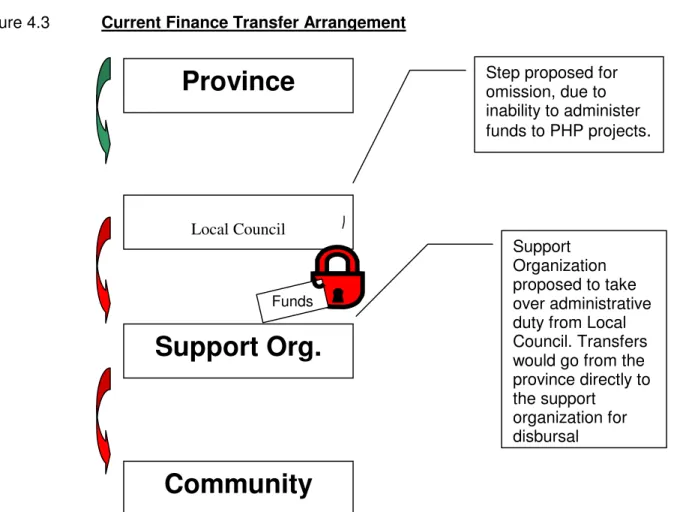
The Luganda and Zilweleni Development Trusts formed the Sibambisene Joint Venture (SJV) to be in overall control of the project. BESG was appointed as the project manager and the local authority, the Inner West Council, was appointed as the financial administrator of the subsidy money (see Figure 1 below).
Support Organisation
BESG was the Support Organization appointed by the community based organisation. This role involves conceptualising, packaging, registering of legal entities, setting up delivery systems and implementation of the project. BESG as a Support organization is also involved in capacity building and training. The beneficiary training takes place during the pre-application phase and on approval of their subsidies. In the pre-application phase beneficiaries are addressed in mass meetings or big groups. The next stage is subsidy approval and approved beneficiaries are invited to a workshop where the housing delivery processes are dealt with in detail. Therefore the bulk invest in any housing project is in the pre-implementation stage which is partially funded through the facilitation grant. The Support Organisation develops different contracts with all stakeholders for the smooth implementation of the project. Individual beneficiaries enter into a contract on the basis of their choice.
The developer
The developer (Project Co-ordinator) is usually an ordinary member of the community who has little or no experience in development issues. The capacity building training assists leaders to understand potential outcomes of their decision. The Community Based Development Organisation needs to better understand the roles and responsibilities of each stakeholder and therefore training is needed to cover the knowledge gaps. The community leaders pass information and respond to the beneficiaries through mass
meetings or group discussions. Being a developer creates new challenges of becoming an employer. BESG’s training modules address these challenges; for instance the module on Community Based Organisation as an employer. Training is scheduled before and during project implementation (construction of houses).
The Community Housing Advisors
The Community Housing Advisors (CHA) provides advice to beneficiaries before and during the construction of houses. In most projects, CHAs are former participants of BESG Housing Training Programme (HTP). Some targeted training is organised for potential candidates who are later appointed to undertake work in the project. This training assists them to do their work more effectively.
The current PHP projects that BESG are involved with replicate the same systems with a few changes and innovations. An Accounts Administrator is presently a private company instead of a Local Authority. The Local Authority only signs the Social Compact as one of the stakeholders.
3.2.6. BENEFITS OF THE PHP IDENTIFIED BY THE BESG For BESG, the PHP provides the following benefits for communities:
• PHP creates an environment for poor and vulnerable groups to initiate and participate in their housing programme.
• PHP creates employment opportunities.
• PHP creates an environment conducive for skills transfer and identifying local solutions in existing programmes.
• PHP promotes individual choice.
• PHP promotes Public Private Partnership for all sectors to be part of the solution. 3.2.7. DIFFICULTIES EXPERIENCED BY THE BESG IN THE PHP
For BESG, the following problems have been experienced in the implementation of the PHP.
• The Establishment Grant is too little to cover all aspects of the project
(implementation agent, packaging, company registration, management cost etc). • The Establishment Grant has not been increased with the subsidy increases. • The NHBRC registration undermines the PHP and creates contradiction. • Absentee site owners undermine and delay the project.
• Unregistered property sales delay the project.
• The relationship between stakeholders and the Department of Housing are not properly structured.
3.2.8. LESSONS LEARNT
BESG has learnt the following key lessons in their involvement in PHP projects:
• The importance of recognising the social capital of the poor.
• The importance of creating a balance between socially and technically driven projects.
• The importance of achieving a balance between process and product. • Value attached to the freedom of choice.
3.2.9. CONCLUSION
The Southern Pine Town project started long before the adoption of the PHP support policy and therefore piloted the small contractor housing delivery model.The use of community based housing advisors and local contractors has proven to be an extremely efficient and affordable way of providing housing at scale, and one that has the potential to play a large role in solving South Africa’s housing problem. The co-operation between CBOs, an NGO and the local authority on the project also demonstrated the advantages of organisations working together in partnership.
In addition the project has been extremely successful and has had an immense impact upon Luganda and Zilweleni. About 95% of beneficiaries are satisfied with the project as a whole, 98% of beneficiaries felt that the project had improved the area, and 87% of beneficiaries were satisfied with their new houses. Luganda and Zilweleni were transformed from less than 50% of rooms being formal (i.e. concrete block) before the start of the consolidation project to about 80% of rooms being formal at present. The project has also resulted in a large increase in the number of occupied sites in the two areas, from 400 to 800 in Luganda and from 250 to 300 in Zilweleni. Importantly, the project has also been a springboard for the community organisations in the area to start obtaining funding of their own and to build up their capacity to initiate further development initiatives in Southern Pinetown.
Future housing policy, for example, the "People’s Housing Process" policy, needs to allow for and encourage future projects of this type. The BESG PHP model has demonstrated the potential for replication whether small or large scale. The case study shows different ways in which PHP can be adapted to existing situations, and brings into play a large number of stakeholders.
3.3. KHAYELITSHA : CAPE TOWN
3.3.1. POLICY OVERVIEW IN THE WESTERN CAPE
The Cape Town City Council, with support from Provincial Authorities has adopted a “managed PHP” model. This means that only the City of Cape Town may be a PHP developer and Support Organisation. But because the City of Cape Town does not have the capacity to be a Support Organisation, this role can then be allocated to a “Secondary Support Organisation” through a competitive tender process. In addition all choices except the application of “sweat equity” are eliminated from the PHP and reserved for Support / Secondary Support Organisation.
At provincial level the Western Cape Department of Housing has aligned itself to the PHP principles as outlined by the National Department of Housing. Within the Cape Town region, PHP occurs when individuals, families or groups take the initiative to organise the planning, design and the building of their own houses. Support for the PHP include access to suitably located serviceable/serviced land as well as housing subsidies and appropriate forms of credit. Technical support to PHP extends to include opportunities for skills acquisition, appropriate technical and financial assistance and simple innovative and people sensitive procedures and guidelines.
3.3.2. CASE STUDY CONTEXT: KHAYELITSHA
DAG’s PHP Programme consists of three housing consolidation projects in Khayelitsha, Cape Town. The projects are Masithembane, Homeless and Squatters Housing Project (HOSHOP) and Sinako Ukuzenzele. The projects were initiated in 1997 and implemented during 1999 – 2002.
Masithembane was the first project that started in site B. A group of residents came together to form the Masithembane People’s Housing Association with the intention to help themselves and others to acquire adequate housing. HOSHOP and Sinako Ukuzenzele were formed later by other residents of Khayelitsha.
The settlements where these projects are located consist of a crowded maze of narrow streets and shacks to the N2 freeway on Site B. Site B was established in the late 1980’s and consists of 9000 serviced sites with over 50 000 people living in shack structures.
3.3.3. THE DAG’s PHP INTERVENTION STRATEGY
The Development Action Group (DAG) has worked with the South African Homeless People’s Federation (SAHPF) and together developed a unique approach to PHP that have set a high standard for implementation of self-built projects in South Africa.
The key principles for DAG and SAHPF PHP model have been:
Capacity building, skills transfer, community control, community empowerment, household choice, active housing support centers, mobilisation of savings, loans, choice of material, choice of house design, self-build, job creation, use of semi-skilled and skilled community builders, houses between 32 sq meter – 62sq meter, low levels of corruption and high quality products.
The DAG has been involved in PHP projects in the Western Cape since 1997, all of which have been consolidation subsidy projects. The key principles in working in these projects have been:
Partnerships
In the initial stages of all projects a number of partnerships are developed in order to achieve different objectives.
The partnerships are:
The community housing association (CBO) – DAG undertakes to build the capacity of the CBO, educate beneficiaries on PHP and other housing related matters, and build a common understanding of the role of a support organisation (DAG) and ensures that a participatory methodology is used in every phase of the project. DAG –Local Authority (LA) & CBO – The LA addresses the problem of title deeds, to LA is further engaged to play the role of accounts administrator in order to save money, for house design issues and other LA requirements.
accountant is required. In some cases one or more professionals such as engineer, land surveyor, town planner or architect is required. In cases where a professional needs to be engaged DAG assists the CBO to go through a rigorous process of interviews.
Prior to decision taken for Housing Development Board (HDB) to approve funds through local authorities as reflected in the IDP Priority list. The ability to work closely with the HDB was fundamental from conception through implementation to completion.
People Centered/People Driven
DAG operates on a community request basis. In the three PHP projects within which DAG is involved, housing associations approached DAG for assistance in securing subsidy funding. These associations vary in their level of organisational development and
understanding of the subsidy scheme and the housing process in general. In each case an assessment is made of the organisation, the leadership and the beneficiaries. There is time allocated to strengthen the executive committee with special attention paid to the various roles and responsibilities. An investment is made in work shopping the subsidy scheme and the PHP system. Members decide on the PHP option and also on whether or not to work with DAG as a support organisation.
Skills transfer
Capacity building of the committee, training of Housing Support Center staff, preparing the subsidy application and running workshops on technical issues such as the housing delivery cycle and house design all made a crucial contribution towards the success of the project.
The following were seen as the most important services provided by DAG:
Training of Housing Support Center staff (identified by 5 committee members) Providing advice and assistance to the committee (identified by 4 committee members)
Running workshops on technical issues such as the housing delivery cycle, government subsidies and house design (identified by 2 committee members)
At HOSHOP, the project committee requested that DAG provided intensive support for a further six month before they acted with greater independence. A block yard was started in HOSHOP with funds from the Provincial Department of Social Services to develop skills, create jobs and save money by supplying blocks at reduced prices to beneficiaries in the project.
Community Empowerment
The greatest benefit of the project has been the empowerment of the community. Initially many people were skeptical of the organisation’s ability to deliver housing. Their success has encouraged a further 500 families to join HOSHOP and to participate in the second phase of the project. HOSHOP’s experience set a standard for other communities. There has been perceived reduction in crime due to the greater sense of community cohesion created by the projects.
The project build women leadership, as a result two women from the project was employed by a private material supplier as facilitators of people’s housing projects in other
communities. As one of the most successful People’s Housing Process projects in the country, and the first one to finish building its houses within the allocated time period of 12 months, Masithembane has also had an impact beyond Cape Town. (A video of the projects was commissioned by the People’ s Housing Partnership Trust (PHPT) to promote the PHP approach.
As part of DAG’s involvement in the national Sustainable Energy, Environment and
Development (SEED) programme, awareness raising on energy and environmental issues was also undertaken. A demonstration house was built to demonstrate key principles of energy efficiency and environmental sustainability in house design.
Funding and Savings
The main source of project funding was the National Housing Subsidy Scheme, administered by the Provincial Housing Department. The projects made use of the consolidation subsidy of R9200, which totaled R5 915 600. Facilitation grants were also awarded, totaling R95 712 as well as R 353 290 for establishment of the housing support centres. DAG’s facilitation role was largely donor funded; actual costs for supporting the
three projects totaled approximately R910 000, of which R832 102 was funded directly by donors.
The PHPT provided some funding and support for training and information dissemination.
DAG has always encouraged PHP projects to try to build bigger houses. To do this, project members were asked to save as much as possible. Savings often occurred in groups and DAG made use of this peer savings groups to start a micro-lending scheme for housing called the Kuyasa Fund. Kuyasa was started by DAG as a micro lending scheme for housing. This fund has gone from strength to strength and has to date put out R3million worth of loans and a loan book of 2.3 million. In all cases where beneficiaries made use of savings and loans were bigger than 30 square meters.
The promotion of household’s savings to supplement the subsidy amount was also an important part of the project. Households were encouraged to save in a variety of forms, which included saving cash, saving on the cost of building materials by reusing materials from their shacks, and saving on labour costs by carrying out some construction tasks themselves. A survey of HOSHOP beneficiaries found a median household savings
contribution of R1450. By extrapolation the total household savings contribution across the three projects is estimated at R900 000.
Job Creation
Over 70 people were employed as builders during the life of the project, and there has also been ongoing employment as households extend their new homes. A further dozen people were employed in the housing support centres and the HOSHOP block yard. Volunteers working in the housing support center also learned new skills relating to management and administration.
3.3.4. PROJECT PLAN / METHODOLOGY
The main objective of the projects was to build adequate housing and improve living conditions, with secondary objectives to develop the capacity of the community
organisations to manage development processes and to stimulate local job creation. The three communities decided to follow the PHP route, a community based form of housing
delivery in which beneficiaries initiate, plan, design and implement their own projects. The DAG suggested that housing development could be used to develop community capacity; hence the three projects were managed by the community-based organisations involved. This included managing a housing support center, employing staff of the support center and making all the decisions in the projects. Local people from the community were selected to work in the housing projects, in the housing support centers, in the community block yards and received training. In order to supplement the housing subsidy funds, savings groups were formed and savings were promoted. Access to savings-linked credit was also facilitated.
DAG follows the project cycle and ensures that people participate throughout the process. The following steps are involved.
Step 1
Community establish a housing project;
Community elect a committee to drive the process;
The committee seeks the services of a Support Organization to facilitate the housing development.
Step 2
The Support Organisation works in partnership with project committee to:
Develop a project application for submission to the Housing Development Board. Build the organisation by building the capacity of the committee for effective leadership
Step 3
Once the project application is approved, the project committee in partnership with the Support organisation prepare for construction by:
Setting up a housing support center (HSC)
Assist the committee to employ staff to do the technical and administrative work to ensure smooth housing delivery.
Step 4
Once the project preparations have been done, the support organisation together with the project committee:
Organise workshops for beneficiaries on house designs
Organise training for the housing support center staff on their roles and responsibilities
Step 5 Construction
The table below describes DAG’s support to HOSHOP through the implementation of the steps.
Stage Typical time period Description
1. Request/ initial
investigation 3 weeks+ Community approaches DAG with request for assistance in obtaining housing. DAG introduces itself and its way of working to the community and collects information relating to the community and their housing need.
2. Feasibility 6 weeks+
3. Partnership negotiation 6-10 weeks Agreement on roles and responsibilities is reached and a contract between DAG and the community is signed; DAG also
commences training on leadership and negotiation skills, and facilitates networking with other communities.
4. Packaging 3-6 months An application for housing subsidies from the PHDB is put together by DAG and the community; DAG provides training on housing issues to ensure that the community will be able to participate in the process. The setting up of savings schemes is also encouraged.
5. Institutional
preparation 3-5 months A legally instituted development organisation is set up to be the
developer of the project and DAG provides training in financial management. 6. Detail design 4-8 months After approval of the
housing subsidies, detailed planning and design takes place, training in
construction and
construction management skills is provided, the project goes out to tender and/or a housing support centre is set up; DAG also facilitates access to housing loans from the Kuyasa Fund.
7. Implementation 12-24 months The construction
programme is monitored and DAG provides home ownership education. 8. Post-construction 12 months DAG facilitates the
maintenance of the housing and ongoing support for the community organisation.
3.3.5. ROLES PLAYED BY OTHER STAKEHOLDERS / PARTNERSHIPS Local Authority/municipality
City of Tygerberg (now Tygerberg Administration, City of Cape Town)
Type of support: responsible for issuing Title Deeds, locating plots boundaries and building inspection.
Province
Subsidy applications for the HOSHOP, Masithembane, Masithandaze, and Masimanyane projects were submitted to the Provincial Housing Development Board in 1998 and were approved in March 1999. The HOSHOP subsidy application was for 200 subsidies (although the membership of HOSHOP subsequently continued to grow).
CBO/Housing Association
Homeless and Squatters Housing Project (HOSHOP) Type of organisation: Community – based organisation Type of support: Managed the implementation of the project
NGO
DAG trained the committee members, set up the housing support centres, trained
community members to staff the centres, set up the systems and procedures for ordering materials and monitoring construction, and supervised the first six months of the
implementation phase in the HOSHOP project. DAG through the Housing Leadership Course, Community Housing Development Management, trained HOSHOP community members for ordering materials and monitoring construction, and supervised the first six months of the implementation phase in the HOSHOP project. HOSHOP community members were trained by DAG via the Housing Leadership Course, community Housing Development Management Course, and Managing Housing Support Centres Course
Support Organisation (could be the NGO)
DAG performed the support organisation’s role in the projects.
Housing Support Centre
DAG trained the committee members, set up the housing support centres, trained
community members to staff the centres, set up the systems and procedures for ordering materials and monitoring construction, and supervised the first six months of the
implementation phase in the HOSHOP project. HOSHOP community members were trained by DAG through the Housing Leadership Course, Community Housing
Development Management Course, and Managing Housing Support Centres Course.
Materials Supplier
Since DAG stopped being the project manager, HOSHOP has been managing their own project, with the assistance of Marnol, for the following tasks:
preparing and costing house plans
assistance in setting up procedures for materials ordering and payment, assistance in monitoring of construction
assistance with monthly reports to the PHDB
Marnol were very committed to the process, did a reasonable support role, and were presumably ably to cover the cost of their support from their prices of materials. A third of the committee members were very happy with Marnol, another third were relatively happy, although they thought the delivery of materials was too slow (and prices were going up). The other third were unhappy with Marnol due to slow delivery of materials. 58% of the HOSHOP beneficiaries interviewed were happy with the supply of materials by Marnol, while the other 42% were unhappy due to slow delivery or delivery of the wrong materials.
Other
The PHPT provided support to build capacity around implementing the PHP approach and provided some funding and support for training and information dissemination.
3.3.5. PHP BENEFITS
The benefits of the PHP approach in the projects have been enormous. There has been the provision of formal houses that are more durable, weather resistant and fire resistant than the shacks they replaced. Because of the encouragement of individual choice and household savings, and the provision of housing loans by the Kuyasa Fund, these houses meet the specific needs of each household, most of better quality and larger size (36m2 – 66m2) than houses in most conventional low cost housing projects.
Energy efficiency was emphasized with regard to house design and skills development and job creation and features of the project – over 80 residents were employed either in the housing support centres, as builders or in the block yard. The greatest achievement has been the empowerment of the community organisations, which have now initiated a further phase of housing delivery and are also tackling broader development issues. DAG has subsequently been involved in the capacity building of other communities and local authorities to implement similar projects in other parts of the country.
3.3.6. DIFFICULTIES EXPERIENCED IN IMPLEMENTING THE PHP
Skeptics raise many criticism of PHP; some are well founded while others are not. Many of the criticisms are simply rhetoric offered by those who are ignorant of what PHP actually involves and what its results are. Some legitimate criticisms are:
The process is long and drawn out and is not suited to rapid housing delivery, Complex social dynamics exist in communities and inviting higher levels of participation often complicates the delivery process
Ill-founded criticisms include:
The quality of the houses are poorer than what would be achieved in contractor driven projects
Poor people are incapable of planning and managing their own housing development projects
PHP projects result in greater levels of corruption
3.3.7. LESSONS LEARNT / RECOMMENDATIONS
The successes and shortcomings illustrated under the three projects make it clear that through PHP a greater level of community empowerment, job creation, access to social as well as economic opportunities and skills transfer is more possible that through any other housing delivery process. At the same time the shortcomings point the way forward to possible solutions that will greatly improve the degree of effectiveness of which the PHP is capable. The main lessons learnt are that:
Poor communities are able to initiate and manage housing delivery projects by themselves (with advice and support from an NGO).
The poor are able to save and are able to repay loads.
People driven housing processes can result in a better quality of housing than housing built by large, formal contractors.
It is important to have the space for people driven processes. One of the main reasons for the success of the projects was that the Provincial Housing Department and the Local Authority allowed the space for a people-driven project and did not attempt to impose rigid bureaucratic restrictions. Subsequently, this space seems
to be closing as there is increasing attempts to regulate the People’s Housing Process.
3.3.7. CONCLUSION
The greatest benefit of the project has been the empowerment of the community. Initially many people were skeptical of the organisation’s ability to deliver housing. Their success has encouraged a further 500 families to join HOSHOP and to participate in the second phase of the project. There is an overall sense of pride and achievement that the committee was able to deliver what they promised.
3.4. VOSLOORUS: GAUTENG
3.4.1. POLICY OVERVIEW: GAUTENG
The Gauteng Department of Housing has prioritised PHP housing projects as a delivery strategy to increase housing stock in Gauteng. A PHP directorate has been established with the goal to establish 60 Housing Support Centres (HSCs) and construct 60 000 houses in three years time. The following are its stated objectives towards that end:
• Develop a provincial PHP strategy
• Ensure fair distribution of financial, human and other resources • Promote collaboration with other relevant stakeholders
• Align PHP with Zivuseni initiatives
• Put in place monitoring and evaluation systems The following are strategies for communities:
• Develop effective and efficient HSC • Develop capacity and skills
• Choice of product and how to contribute • Restore human dignity
The province has also begun to prescribe PHP policy further, and seems to be advocating for a PHP model in which construction ‘brigades’ are responsible for the actual building, using labour sourced from the subsidy beneficiaries and the local community. We believe this policy has borrowed extensively from the experience in Vosloorus, though we question whether it should be an exclusive model for PHP; rather it should be one in a range of options that beneficiaries could choose from.
Another important thing about the provincial context to note is that the province had previously decided to implement PHP by almost uniformly designating the local authority as the support organisation. They have found, however, that this strategy has severely hampered the implementation of PHP projects and is now trying to source other support organisations and create a new institution that would capacitate local authorities to play this role.
Finally, the province has insisted on certain building standards for PHP projects that include a specification for the size of the house at minimum to be 36 square metres, and that the home includes dividing walls to make at least two bedrooms.
3.4.2. CASE STUDY CONTEXT: VOSLOORUS (EKURHULENI METRO/EAST RAND) Vosloorus extension 28, is an informal settlement with 1350 services sites, approximately 25km from the CBD of Boksburg on the East Rand. A survey conducted five years ago by the local council indicated that 60% of the community members are unemployed and they survive by informal means such as spaza shops, selling fruit and vegetables, selling scrap metals, and growing backyard vegetable gardens. 40% of community members are formally employed as domestic and factory workers. 70% are women-headed households. The community is relatively poor with no educational facilities such as schools, library, shopping complex etc.
In 1987 the Vosloorus SANCO after being approached by backyard dwellers, single-sex hostel dwellers, ext.25 squatter camp dwellers and homeless people about housing needs, decided to start the process of identifying land that could accommodate those people. A site allocation committee was elected with the mandate to engage the Council and IDT about suitable land in and around Vosloorus. A community office was established for potential beneficiaries to register, with the R110 registration fee being administered by a law firm.
Land was identified where presently Ext. 28, Phase One is located. Infrastructure was installed in 1990 through the IDT Capital Subsidy scheme. Over time high mast lights and electricity were installed, proper tarred roads and clinics were built through community struggles, and taxis started operating in the area, making travelling easier.
The community has over time developed a strong social network, community spirit and a sense of belonging to the area. Throughout its history, the community has organised itself through Block and Area Committees, CDFs’ and more recently the Ward Committee.
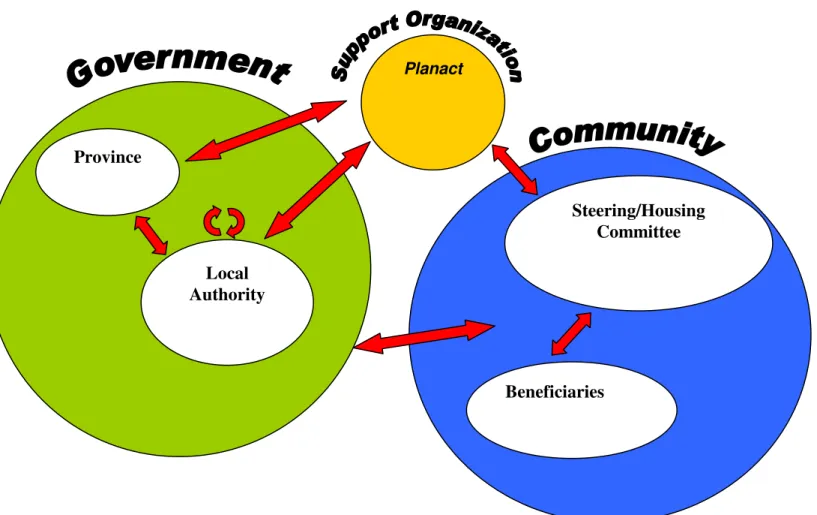
particular reference to accessing land and housing with secure tenure, developing employment opportunities, and satisfying the social, educational, cultural and recreational needs of the community. A fundamental principle of the Steering Committee is that its project activities should at all times be based upon shared decision-making, which incorporates the democratic representation of the beneficiary community itself.
3.4.3. PLANACT’S PHP INTERVENTION STRATEGY
Planact operates under the understanding that the core elements of the People’s Housing Process must be continuously preserved and implemented to their full extent, based on the needs and aspirations of each community. Planact is committed to supporting the habitable environment agenda and the right to adequate housing. The PHP process provides an opportunity to pursue this agenda by demonstrating how the government sponsored PHP programme can meet the principles and objectives it seeks to achieve, and by advocating for a more integrated delivery process. We seek to adhere to the following principles and objectives on any PHP process undertaken:
A people-led process. The community must be the true owners of the PHP process. By taking possession of the process they take command of their futures, and in doing so the PHP process is given a sustainable and productive life, well beyond the construction of the housing. Planact helps the community to establish a representative community structure that has been democratically elected by the community. This structure drives the PHP process and ensures beneficiary involvement in decision-making. Planact works to ensure the committee develops skills in organising, administration and management. The committee must be committed to women’s empowerment in the process. It should be driven by passion to improve the lives of the community and must be accountable to the community.
Capacity building of subsidy beneficiaries. In addition, those qualifying for subsidies must be empowered with full information about the PHP and decision-making opportunities throughout the process, as well as given skills-development opportunities. By building the capacity at the household level we empower the most vulnerable stakeholders in the community, imbuing a new sense of control and opportunity over ones livelihood in addition to providing a resource to the beneficiary for economic mobility.
Job creation and skills development. It is critical that the PHP contribute to improvement in the skills and opportunities of the community members, and that any economic benefits of the project are maximized at local level. This can be through local material suppliers, contractors and labourers, and direct involvement by those receiving subsidies through PHP to participate in building their housing.
Partnerships: Engaging the local municipality, the provincial Department of Housing and other partners, in a way that ensures their commitment to a people-led process is vital to the sustainability and further development of the community. It is hoped that by instilling this sense of importance for the project within Council and other partners, that a willingness to invest resources can be elicited beyond the involvement of the support organisation/service provider. This new-found relationship between community and Council is then one of mutual respect and empowered partnership, supplanting the previous dependant and provider paradigm, which often hinders progressive community participation, a vital component of any PHP. This renegotiation of roles allows the public and private sector partners to view the community as a well-capacitated, cohesive unit, and conversely the potential partners are seen as allies in the community’s quest for economic and social growth.
Working towards integrated development of a community: This means stepping beyond the confines of simple shelter provision and working together to create a well developed community. The individual homes that we help create cannot survive as islands, they must be seen in the context of the community, which means service provision, economic opportunity, and social welfare. By taking this approach we not only create sustainable communities but we also provide for their future growth.
3.4.4. PROJECT PLAN/METHODOLOGY
Below is a list of steps developed in the Vosloorus PHP Project. While this list is generally in sequential order, there are steps that of necessity run concurrent to each other. Also, the order is not necessarily fixed and would depend upon local circumstances.