Faculty of Health, Engineering and Sciences
School of Mechanical and Electrical Engineering
PHD DISSERTATION
Adaptive Relaying Protocol Multiple-Input
Multiple-Output Orthogonal Frequency Division
Multiplexing Systems
Ibrahim Khalil Sileh
Student Number: 0050096562
Principal Supervisor
A/Prof. Wei Xiang
Co-Supervisor
Dr. Andrew Maxwell
Abstract
In wireless broadband communications, orthogonal frequency division
multiplex-ing (OFDM) has been adopted as a promismultiplex-ing technique to mitigate multi-path
fading and provide high spectral efficiency. In addition, cooperative
communi-cation can explore spatial diversity where several users or nodes share their
re-sources and cooperate through distributed transmission. The concatenation of
the OFDM technique with relaying systems can enhance the overall performance
in terms of spectral efficiency and improve robustness against the detrimental
effects of fading.
Hybrid relay selection is proposed to overcome the drawbacks of conventional
forwarding schemes. However, exciting hybrid relay protocols may suffer some
limitations when used for transmission over frequency-selective channels. The
combination of cooperative protocols with OFDM systems has been extensively
utilized in current wireless networks, and have become a promising solution for
fu-ture high data rate broadband communication systems including 3D video
trans-mission. This thesis covers two areas of high data rate networks. In the first part,
several techniques using cooperative OFDM systems are presented including relay
selection, space time block codes, resource allocation and adaptive bit and power
allocation to introduce diversity.
Four (4) selective OFDM relaying schemes are studied over wireless networks;
selective OFDM; selective OFDMA; selective block OFDM and selective unequal
block OFDM. The closed-form expression of these schemes is derived. By
ex-ploiting the broadcast nature, it is demonstrated that spatial diversity can be
improved. The upper bound of outage probability for the protocols is derived.
performance by removing the sub-carriers that experience deep fading. The
per-subcarrier basis selection is considered with respect to the predefined threshold
signal-to-noise ratio. The closed-form expressions of the proposed protocol in
terms of bit error probability and outage probability are derived and compared
with conventional hybrid relay selection. Adaptive bit and power allocation is
also discussed to improve the system performance.
Distributed space frequency coding applied to hybrid relay selection to
ob-tain full spatial and full data rate transmission is explored. Two strategies, single
cluster and multiple clusters, are considered for the Alamouti code at the
desti-nation by using a hybrid relay protocol. The power allocation with and without
sub-carrier pairing is also investigated to mitigate the effect of multipath error
propagation in frequency-selective channels.
The second part of this thesis investigates the application of cooperative
OFDM systems to high data rate transmission. Recently, there has been growing
attention paid to 3D video transmission over broadband wireless channels. Two
strategies for relay selection hybrid relay selection and first best second best are
proposed to implement unequal error protection in the physical layer over
error-prone channels. The closed-form expressions of bit error probability and outage
probability for both strategies are examined. The peak signal-to-noise ratio is
Certification of Dissertation
I certify that the ideas, designs and experimental work, results, analyses and
conclusions set out in this dissertation are entirely my own effort, except where
otherwise indicated and acknowledged.
I further certify that the work is original and has not been previously submitted
for assessment in any other course or institution, except where specifically stated.
——————————— / /
Ibrahim Khalil Sileh, Candidate
——————————— / /
A/Prof. Wei Xiang, Principal supervisor
——————————— / /
Acknowledgments
First and foremost, without the enlightenment of ALLAH, this thesis would not
have been done successfully.
I would like to express my deep gratitude to my supervisor A/Prof. Wei
Xi-ang. I would also like to thank my associate supervisor Dr. Andrew Maxwell
for his insightful comments and for contributing his broad perspectives to this
thesis. My thanks go to Prof. Youngi Li for his invaluable suggestions and
rec-ommendations throughout the project.
My special appreciation goes to my colleague Catherine Hills for her assistance
with the proofreading. Thanks also go to A/Prof. John Leis for his brilliant
advice.
I would like to gratefully thank the Staff of the Faculty of Health, Engineering
and Sciences, School of Mechanical and Electrical Engineering at the University
of Southern Queensland, Toowoomba, Australia, who have been supported me
immensely during this research.
Finally, I am especially grateful to my family for all the love, concern,
un-derstanding, their everlasting moral support and encouragement when I felt
frus-trated during the research process. Without them none of this would have been
possible and so it is to them I dedicate this work.
Ibrahim Khalil Sileh
University of Southern Queensland
List of publications
The following publications were produced during the period of candidature:
[1] I. K. Sileh, W. Xiang and K. M. Alajel, “Outage probability of unequal
block-based OFDM amplify-and-forward relay protocol over wideband channels,”in
Proc. IEEE 12th International Symposium on Communications and Information
Technologies (ISCIT 2012), Gold Coast, Australia, Oct. 2012, pp.1-5.
The work in the paper is presented in Chapter 3.
[2] I. K. Sileh , W. Xiang, and A. Maxwell “Joint Subcarrier Pairing and
Resource Allocation for Adaptive Hybrid Relay Protocol in OFDM Systems,”in
Proc. IEEE 24th International Symposium on Personal, Indoor and Mobile Radio
Communications (PIMRC13), London, UK, Sep. 2013, pp.2011-2015.
The work in the paper is presented in Chapter 4.
[3] I. K. Sileh , W. Xiang, and A. Maxwell “Error Probability of
OFDM-based Hybrid Relay Protocols Over Wideband Fading Channels,”in Proc. IEEE
International Conference on Ultra-Wideband (ICUWB), Sydney, Australia, Sep.
2013, pp.255-260.
The work in the paper is presented in Chapter 4.
[4] I. K. Sileh and W. Xiang, “Distributed space-frequency coding for
OFDM-based hybrid relay selection,”in Proc. IEEE 12th International Symposium on
Communications and Information Technologies (ISCIT 2012), Gold Coast,
Aus-tralia, Oct. 2012, pp.1-5.
The work in the paper is presented in Chapter 5.
[5] I. K. Sileh , W. Xiang and A. Maxwell “Power allocation of distributed
7th International Conference on Signal Processing and Communication Systems
, Gold Coast, Australia, Dec. 2013.
The work in the paper is presented in Chapter 5.
[6] I. K. Sileh, K. M. Alajel, and W. Xiang, “Cooperative relay selection
based UEP scheme for 3D video transmission over Rayleigh fading Channel,”in
Proc. IEEE International Conference on Digital Image Computing Techniques
and Applications (DICTA), Noosa, Australia, Dec. 2011, pp.689-693.
The work in the paper is presented in Chapter 6.
[7] K. M. Alajel, W. Xiang, and I. K. Sileh, “Best relays selection method
for error-resilient 3-D video transmission”in Proc. IEEE 12th International
Sym-posium on Communications and Information Technologies (ISCIT 2012), Gold
Coast, Australia, Oct. 2012, pp.1-5.
Contents
Abstract i
Acknowledgments v
List of Publications vii
List of Figures xii
List of Tables xvi
Acronyms & Abbreviations xvii
Chapter 1 Introduction 1
1.1 Research Motivations . . . 2
1.1.1 Cooperative Systems . . . 3
1.1.2 Orthogonal Frequency Division Multiplexing . . . 4
1.1.3 High Data Rate Applications . . . 6
1.2 Research Problem . . . 7
1.3 Summary of Original Contributions . . . 8
1.4 Structure of the thesis . . . 9
Chapter 2 Background 11 2.1 Introduction . . . 11
2.2 Cooperative Relaying . . . 11
2.2.1 Amplify-and-Forward (AF) . . . 13
2.2.2 Decode-and-Forward (DF) . . . 14
2.2.3 Hybrid Relay Protocol (HRP) . . . 16
2.3 Adaptive Techniques for OFDM Relaying Systems . . . 20
2.3.1 Resource Allocation (RA) . . . 21
2.3.2 Adaptive Bit and Power Allocation . . . 23
2.4 Distributed Space-Frequency Coding (DSFC) for OFDM Technique 29
2.5 3D Video Transmission in Wireless Networks . . . 32
2.6 Conclusion . . . 33
Chapter 3 Selective OFDM Relaying 35 3.1 Introduction . . . 35
3.2 Motivation and Related Work . . . 36
3.3 System Model . . . 37
3.4 Outage Probability Analysis . . . 39
3.4.1 Outage Probability of End-to-end Single Sub-carrier . . . . 40
3.4.2 Selective OFDM . . . 41
3.4.3 Selective OFDMA . . . 44
3.4.4 Selective Block-OFDM Relaying . . . 46
3.4.5 Selective Unequal Block-OFDM Relaying . . . 48
3.5 Results and discussions . . . 51
3.6 Conclusion . . . 56
Chapter 4 Selective Per-subcarrier OFDM-based HRP 57 4.1 Introduction . . . 57
4.2 Related Work . . . 59
4.3 System Model . . . 61
4.3.1 MC-HRP Strategy . . . 64
4.3.2 Proposed MC-AHRP Strategy . . . 65
4.4 Cumulative Density Function Derivation . . . 66
4.4.1 MC-HRP Scheme . . . 67
4.4.2 MC-AHRP Scheme . . . 68
4.5 Bit and Power Allocation at the Source . . . 71
4.6 Bit and Power Allocation at the Relay . . . 72
4.6.1 Without Subcarrier Permutation . . . 72
4.6.2 With Subcarrier Permutation . . . 73
4.7 Performance Analysis . . . 75
4.7.1 Bit Error Probability Performance . . . 75
4.7.2 Outage Probability . . . 81
4.7.3 System Capacity . . . 82
4.8 Simulation Results . . . 83
4.9 Conclusion . . . 93
Chapter 5 Space-Frequency Coding with OFDM-HRP Systems 95 5.1 Introduction . . . 95
CONTENTS xi
5.3 System Model . . . 100
5.4 Power Allocation and Sub-carrier Pairing for DSFC-OFDM . . . . 108
5.4.1 Power allocation . . . 108
5.4.2 Sub-carrier Pairing . . . 113
5.4.3 Joint Power Allocation and Sub-carrier Pairing . . . 114
5.5 Simulation Results . . . 116
5.6 Conclusion . . . 120
Chapter 6 3D Video Transmission Over Cooperative OFDM Re-laying Systems 121 6.1 Introduction . . . 121
6.2 Motivation and Related Work . . . 123
6.3 3D video coding and DIBR Representation . . . 126
6.3.1 H.264/AVC Coding . . . 126
6.3.2 Depth Image Based Rendering (DIBR) Representation . . 127
6.4 System Model . . . 128
6.4.1 UEP Based on HRP . . . 131
6.4.2 UEP Based on First and Second Best AF relays (FBSB) . 133 6.5 PDF of proposed protocols . . . 134
6.5.1 UEP Based on HRP . . . 134
6.5.2 UEP Based on First and Second Best AF relays (FBSB) . 137 6.6 End-To-End Performance Analysis . . . 138
6.6.1 Bit Error Probability Performance . . . 138
6.6.2 Outage Probability Performance . . . 139
6.7 Simulation and Numerical Results . . . 140
6.8 Conclusion . . . 152
Chapter 7 Conclusions and Future Work 153 7.1 Introduction . . . 153
7.2 Conclusions . . . 154
7.3 Future Work . . . 157
7.4 Final Remarks . . . 159
2.1 Cooperative communication with three terminals. . . 12
2.2 Spectral characteristic of OFDM transmission. . . 13
2.3 Block diagram of the AF-OFDM relaying with adaptive power loading. . . 14
2.4 Adaptive decode-and-forward relay protocol. . . 15
2.5 Block diagram of hybrid forwarding relay scheme a) Ideal mode b) Outage mode. . . 17
2.6 Block diagram of hybrid forwarding relay for OFDM system. . . . 20
2.7 Block diagram of hybrid forwarding relay with different selection style a) Selection criterion I b) Selection criterion II. . . 20
2.8 Block diagram of the OFDM transceiver with adaptive resource allocation. . . 24
2.9 Bit and power allocation. . . 25
2.10 Channel coefficients for the first and second hops. . . 26
3.1 System model of selective OFDM relaying. . . 37
3.2 Frame structure of selective OFDM relaying wherei∈ {1,· · · , M} and the selected relay forwards the entire sub-carriers of the OFDM symbol. . . 42
LIST OF FIGURES xiii
3.6 Outage probability versus SNR with M=10 and N=16 without
direct transmission. . . 53
3.7 Outage probability versus SNR with M=10 and N=16 with direct
transmission. The dash line represents the upper bound while the
sold line denotes the simulation results. . . 53
3.8 Outage probability versus M with SNR=10 dB and N=16 without
direct transmission. . . 55
3.9 Outage probability versus N with M=10 and SNR=10 dB. . . 55
4.1 Transceiver block diagram of the relay node a) HRP b)
MC-AHRP. . . 63
4.2 Transceiver block diagram of the relay node with sub-carrier pairing. 74
4.3 Numerical results of the error probability versus different values
of SNR threshold of the MC-AHRP and the MC-HRP schemes
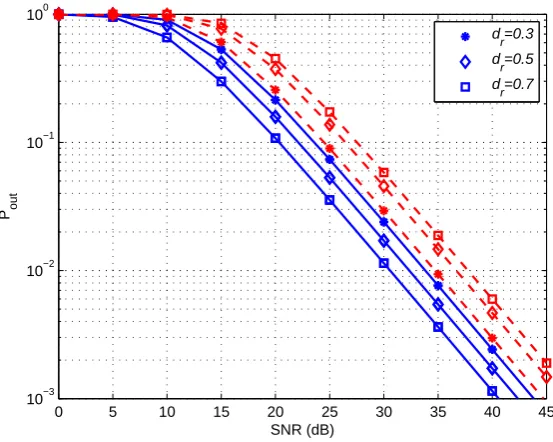
(proposed by Li) for different values of dr = dsrdsd and SNR=15 dB. 84
4.4 Numerical results of the error probability versus different values of
SNR threshold of MC-AHRP for different values ofdr and average
SNR. . . 84
4.5 The bit error probability of the MC-AHRP and the MC-HRP
schemes versus different values of SNR fordr = 0.5 andγth = 1, the
theoretical results (solid line) and the simulation results (dashed
line). . . 86
4.6 The bit error probability of the MC-AHRP scheme versus different
values of SNR for different values ofdr andγth = 1, the theoretical
results (solid line) and the simulation results (dashed line). . . 87
4.7 The bit error probability of the MC-AHRP (solid line) and the
MC-HRP (dashed line) schemes versus different values of SNR for
different values ofγth and dr = 0.5 . . . 88
4.8 Numerical results of the error probability of MC-AHRP versus
4.9 Outage probability of the MC-AHRP (solid line) and the MC-HRP
(dashed line) schemes versus SNR for both schemes for different
values of dr with γth = 2dB. . . 89
4.10 Outage probability of the MC-AHRP (solid line) and the MC-HRP
(dashed line) schemes versus SNR for both schemes for different
values of SNR threshold with dr = 0.5. . . 90
4.11 Capacity performance versus different values of SNR with and
without RA and SP for dr=0.3. . . 91
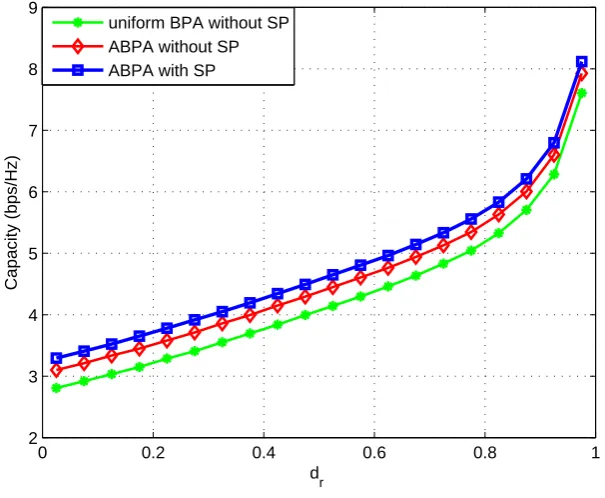
4.12 Capacity performance versus relative distance dr = dsr/dsd for
different values of γth and SNR=15 dB. . . 91
4.13 Capacity performance of MC-AHRP protocol versus relative
dis-tance dr =dsr/dsd with and without RA and SP for SNR=15 dB. 92
5.1 Cooperative system architecture . . . 100
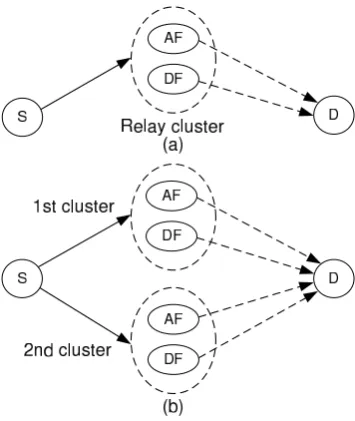
5.2 System model for the distributed Alamouti code with: a) 2 relay
nodes and b) 4 relay nodes. . . 103
5.3 DSFC-OFDM transceiver architecture. . . 107
5.4 BEP performance of the DSFC-OFDM based on HRP for single
cluster. . . 117
5.5 BEP performance of the DSFC-OFDM based on HRP for two
clus-ters. . . 118
5.6 BEP performance of the DSFC-OFDM based on HRP versus SNR
with and without adaptive techniques when M=6 and N=64. . . . 118
5.7 System capacity of the proposed versus SNR for two clusters with
4 relay nodes. . . 119
5.8 System capacity of the proposed versus SNR with and without
adaptive techniques. . . 119
6.1 Block diagram of color-plus-depth video representation. . . 127
6.2 Color-plus-depth representation in DIBR for Newspaper test
se-quence a) color image b) depth map. . . 128
LIST OF FIGURES xv
6.4 System Model. . . 130
6.5 Hybrid relay selection system model. . . 132
6.6 First and second best relay selection system model. . . 133
6.7 Bit error probability performance of the UEP-based HRP and EEP
versus SNR . . . 141
6.8 Outage probability performance of the UEP-based HRP and EEP
versus SNR. . . 142
6.9 Average PSNR of video sequence. . . 143
6.10 Average PSNR of the Interview sequence versus SNR for EEP and
UEP based HRP. . . 145
6.11 Average PSNR of the Interview sequence versus SNR for EEP and
UEP based HRP. . . 146
6.12 Average PSNR of the Interview sequence versus SNR for EEP and
UEP based HRP. . . 147
6.13 Original frames of Interview sequence. . . 148
6.14 Reconstructed frames of EEP at SN R = 12 dB for Interview se-quence. . . 149
6.15 Reconstructed frames of UEP based HRP at SN R = 12 dB for Interview sequence. . . 150
3.1 Scenarios for Sub-carriers Distribution . . . 52
4.1 SNR threshold values of modulation scheme . . . 72
4.2 Optimum Threshold of the Given Range of Channel Simulation
Parameters . . . 85
5.1 Transmission sequence for each relay node for single cluster . . . . 102
5.2 Transmission sequence for each relay node for two clusters . . . . 104
Acronyms & Abbreviations
ABPA Adaptive bit and power allocation
ADF Adaptive decode-and-forward
AF Amplify-and-forward
AVC Advance video coding
AWGN Additive white Gaussian noise
BEP Bit error probability
BER Bit error rate
BL Bit loading
BPSK Binary phase shift key
CD Cooperative diversity
CDF Cumulative density function
CRC Cyclic redundancy check
CSI Channel state information
DIBR Depth image based rendering
DF Decode-and-forward
DSFC Distributed space frequency coding
EEP Equal error protection
FBSB First best second best
FEC Forward error correction
HRP Hybrid relay protocol
iid Independent and identical distribution
ISI Inter-symbol interference
MC-AHRP Multi-carrier adaptive hybrid relay protocol
MC-HRP Multi-carrier hybrid relay protocol
xix
MIMO Multi-input-multi-output
OFDM Orthogonal Frequency Division Multiplexing
OSP Ordered subcarrier pairing
PA Power allocation
PDF Probability density function
PSNR Peak signal-to-noise ratio
QAM Quadrature amplitude modulation
RA Resource allocation
RS Relay selection
SNR Signal-to-noise ratio
SP Sub-carrier pairing
STBC Space time block codes
STC Space time codes
TDM Time division multiplexing
UEP Unequal error protection
Chapter 1
Introduction
The growing demand for high data rate wireless communication systems over
broadband channels necessitates a system re-design to increase compatibility with
the wireless environment. System performance can be significantly limited by
channel defects such as channel fading and inter-symbol interference (ISI). An
important technique to mitigate the detrimental effects of fading in a wireless
system is the use of diversity techniques including temporal, spatial, or frequency
diversity or their hybrids. Diversity provides the destination with multiple copies
of the source signal. Several techniques have been previously investigated in the
literature to achieve diversity including multiple-input multiple-output systems
(MIMO) [1], OFDM modulation, space time-frequency block codes [2, 3], relay
selection [4] and adaptive bit and power allocation [5].
The evolution of wireless broadband networks, such as WiMax, Wi-Fi, LTE
and 3GPP, has created an important need for research into video
transmis-sion. Video transmission over wireless networks is one of the most popular
meth-ods for future generations of wireless systems. Recently, three-dimensional (3D)
video transmission has attracted much interest [6–8] and it is anticipated to grow
significantly in wireless multimedia applications. However, transmitting 3D video
over wireless networks is a challenging task due to the inherent high error
proba-bility and bandwidth constraints. Cooperative communications offer the potential
to overcome these challenges by transforming the link between transmitter and
Conventional relaying amplify-and-forward (AF) and decode-and-forward (DF)
schemes have suffered from noise amplification and error propagation [4,9,10]. The
hybrid relay protocol (HRP) overcomes these drawbacks [11–13]. Many different
forms of HRP approaches have been proposed although there is still potential for
future improvement.
In order to achieve the benefits of the aforementioned techniques, there is
con-siderable active research in cooperative networks over broadband wireless
com-munication channels. The first part of this thesis contributes to this research
through an investigation of the potential improvements in system performance
by adopting diversity techniques. The second part investigates the advantages of
cooperative communications and induced diversity to serve high data rate systems
such as 3D video transmission.
1.1
Research Motivations
The main purpose of communication systems is to broadcast information from
the source to the destination over a reliable channel with maximum
through-put. Recently, cooperative communications have been developed to achieve this
through the creation of multiple communication paths between the source and
the destination. These links are mutually independent. As a result, the
destina-tion receives multiple versions of the source informadestina-tion, thus providing spatial
diversity. In the past, multiple-input multiple-output (MIMO) systems have been
proposed as an efficient technique to achieve transmission and reception diversity
by using several antennas at the transmitter and/or receiver [1, 2]. It can obtain
a potential high spectral efficiency to overcome the drawbacks caused by channel
fading. The use of multiple antennae in small wireless terminals may, however,
be impractical due to size, cost, or hardware restrictions. It has proven that the
cooperative (relaying) communications can realize the benefits of conventional
MIMO systems and provide cooperative diversity gains without any reliance on
1.1 Research Motivations 3
1.1.1
Cooperative Systems
The underlying concept of a cooperative system is that the client devices share
re-sources and cooperate through distributed transmission to form virtual antenna
arrays (VAA) that can reap the benefits of conventional MIMO systems
with-out the additional hardware requirements. Moreover, it can enlarge the service
footprint area covered by the system and enhance throughput by utilizing
inter-mediate nodes and short links. This also enhances system reliability by exploiting
spatial diversity.
In general, cooperative protocols are classified into two broad schemes named
amplify-and-forward (AF) and decode-and-forward (DF). In the AF protocol, the
relay amplifies and forwards the signals received from the source. However, it not
only amplifies the signal received from the source, but also any noise received by
the relay node. Alternatively, in the DF protocol, the relay attempts to decode
the received signal, which may introduce error propagation, then re-encodes and
forwards it to the destination. Various types of cooperative protocols have been
proposed to overcome the shortcomings of the AF and DF schemes. The authors
in [14–17] proposed an adaptive DF (ADF) scheme. An alternative protocol is
proposed in [11], [18] known as hybrid relay protocol (HRP), and is designed
to overcome the disadvantages of conventional relaying protocols. However, the
signal may be corrupted when transmitted over sub-carriers that experience deep
fading. In order to avoid this problem a new paradigm of HRP with multi-carrier
technique is presented known as multi-carrier adaptive hybrid relay protocol
(MC-AHRP).
Multiple cooperative communication systems can drastically increasing the
cooperative diversity gains [4]. However, this can make degradation in the
spec-tral efficiency due to the relays must transmit on orthogonal channels to avoid the
interference. Relay selection is one of the most popular techniques has adopted to
overcome this problem [14, 19–21]. In relay selection protocol, the relay that has
best channel condition forwards the source signal toward the destination.
There-fore, the communication protocol requires only two orthogonal channels. As a
diversity.
1.1.2
Orthogonal Frequency Division Multiplexing
Orthogonal frequency division multiplexing (OFDM) is considered a physical
layer technology in broadband wireless networks. It has been adopted as an
effec-tive technique to capture multi-path energy, mitigate ISI caused by multi-path
propagation, and offer high spectral efficiency in broadband communications. In
addition, OFDM is a transmission technique that transforms frequency-selective
fading channels into several independent flat fading sub-channels. Therefore it
is suitable for high data rate communication systems over frequency selective
fading channels and has been widely accepted for commercial broadband
wire-less network standards such as IEEE 802.11 (WiFi) [22] and 802.16 (WiMax)
[23]. It has also been proposed for the long-term-evolution (LTE) of universal
mobile telecommunications systems (UMTS). Cooperative communication
com-bined with OFDM is a promising technique to enhance the performance and
enlarge the coverage area of high data rate communication systems.
Design and analysis of selective OFDM in cooperative communications have
recently attracted considerable attention. OFDM-based relay systems have been
adopted by the current wireless standard IEEE 802.16j. In general, there are
two main strategies for selective OFDM relaying. The first strategy is to select an
entire OFDM symbol by single relay, which is referred to as selective OFDM. The
second way is to select a single relay for each subcarrier or group of sub-carriers
and this is referred to as selective orthogonal frequency division multiple access
(OFDMA) (per-subcarrier basis). Channel power gain suffers different
attenua-tion according to the circumstance of the channel environments. An active area
of research is using resource allocation [24] and adaptive bit and power allocation
(ABPA) [25] for the OFDM-based relaying systems in an effort to overcome these
drawbacks in channel environments.
Optimizing resource allocation or adaptive bit and power allocation (ABPA)
are effective approaches to mitigating the detrimental effects of wireless channels
there-1.1 Research Motivations 5
fore significant performance improvements can be achieved when implemented in
a cooperative OFDM relay system. This can play a vital role in enhancing system
performance by making full use of the channel parameters. A number of papers
have discussed resource allocation in single hop OFDM systems to maximize the
capacity or to minimize error performance [5, 26–34]. For OFDM relay protocols,
the task of resource allocation is to allocate the amount of power per symbol not
only for the source and the relay terminals but also for each sub-carrier on both
hops. In addition, the ABPA consists of bit loading (BL) and power allocation
(PA). The general idea of the BL algorithm is that the number of bits per
sym-bol for each sub-carrier at source and relay will vary according to the channel
state information (CSI) of the first and second hops. Therefore, it can reduce the
transmission power from the source and relay as well as increasing data rates. In
the PA algorithm, the amount of power assigned to each sub-carrier depends on
the quality of the channel. As a result, sub-carriers that experience deep fading
are assigned minimal or no power and vice versa for good sub-channel conditions.
Subcarrier permutation (pairing) (SP) can further improve the spectrum
ef-ficiency of OFDM-based relay systems by allowing the relay to reassign the
sub-carriers in both hops. In the SP scheme, the nth subcarrier in the first hop joins with themth subcarrier in the second hop based on the channel power quality of both links. The simplest method of employing SP is by arranging the sub-carriers
in the first and second hops in descending or ascending order [35, 36]. However
this technique might not provide an optimal solution especially when the relay is
close to or far from the source. To cope with this, the sub-carriers in the relay are
partitioned into two groups according to the forwarding scheme. Then an efficient
SP can be implemented to achieve better capacity performance.
Space time coding (STC) schemes can provide spatial diversity by
deliver-ing the destination with a replica of the original signal via independent faddeliver-ing
links. It has been proven that STC schemes can achieve full spatial diversity
for MIMO [1], and for cooperative communications [14]. This is known as a
dis-tributed STC (DSTC) system due to the fact that the received signals arrive
the full transmission rate. This technique is efficient when used with flat fading
channels. However, broadband communication systems suffer from severe
multi-path fading and delay spread, which destroys their orthogonality when applied
with STC. OFDM technique has ability to overcome this problem by dividing
the wideband channel into numerous narrowband subchannels. Space frequency
coding (SFC) combined with OFDM modulation has been investigated in order
to explore multi-path and frequency diversities in MIMO systems [37] as well as
cooperative diversity [38]. Moreover, it can reduce the harmful effects of fading
in the frequency domains for OFDM systems.
1.1.3
High Data Rate Applications
Three dimensional video transmission has become one of the interesting
ar-eas of research in wireless communication systems. The video coding standard
H.264/AVC (Advanced Video Coding) achieves high compression efficiency [39]. It
has been widely accepted as a suitable video coding standard for wireless video
transmission. H.264/AVC employs variable length coding, so the transmitted bit
stream, which experiences unequal bit error sensitivity, may suffer severe
degra-dation due to error-prone channels. To cope with this problem, unequal error
protection (UEP) was proposed where the video bitstreams are partitioned into
several layers of different levels of importance [40]. In UEP, the most important
bits are protected with higher priority than less important bits. Several techniques
of UEP have been studied for transmitting multimedia data over single-carrier
MIMO systems [41–43] and over multi-carrier (OFDM) systems [8]. The extent
to which performance of 3D video transmission can be further improved with
depth image based rendering (DIBR) was investigated in [44]. To increase the
ro-bustness of transmitting 3D video scenes over wireless environments, cooperative
communication, which exhibits high diversity gain can be used. A combination of
OFDM relaying systems with DIBR technique can provide significant
1.2 Research Problem 7
1.2
Research Problem
The previous discussion shows that diversity can take many forms according to
the physical layer scheme used. The objective of this research is to design and
analyse new techniques for diversity concatenated with OFDM relaying systems
to overcome the drawbacks of conventional protocols. The approach is to
mod-ify the protocol by utilizing techniques such as relay selection, adaptive resource
allocation, sub-carrier permutation and space time frequency coding in order to
increase the robustness of channel variations. The research tasks in this thesis
are:
Subproblem 1:
To investigate the outage probability performance of selective OFDM relaying
with, and then without direct transmission over frequency-selective Rayleigh
fad-ing channels. Unequal block-OFDM relayfad-ing is proposed to provide a unified
scheme.
Subproblem 2:
To investigate a new type of hybrid relay protocol concatenated with multi-carrier
(OFDM) technique called a multi-carrier adaptive hybrid relay protocol, which
avoids the sub-carriers that experience deep fading over frequency-selective
chan-nels. For comparison purposes a conventional hybrid relay selection will be
ex-tended from a single carrier system to multi-carrier system. An efficient algorithm
of adaptive bit and power allocation with, and then without subcarrier pairing is
proposed.
Subproblem 3:
To investigate the use of a DSFC based hybrid relay protocol with relay
se-lection to overcome the drawbacks of multi-path fading in frequency-selective
channels. Full-rate and full diversity order can be achieved by exploiting the
ad-vantages of DSFC and relay selection. Power allocation optimization, with and
without subcarrier permutation, is investigated to further improve system
Subproblem 4:
To investigate unequal error protection (UEP) in the physical layer based on
re-lay selection to deliver 3D video scenes to the end user with useful improvements
in error resilience and reliability. Two strategies for UEP are proposed based on
hybrid relay selection and first best second best relay selection. The proposed
schemes take into account the protection level of the 3D video sequences.
1.3
Summary of Original Contributions
The main contribution of this thesis can be summarized as follows:
• Selective OFDM(A) Relaying Scheme: The selective OFDM(A) schemes, where the AF approach is used at the relay node is investigated in Chapter 3. It
was shown that selective OFDM is less complex than selective OFDMA, whereas
selective OFDMA has better outage probability performance. To achieve a flexible
tradeoff between complexity and diversity gain, selective unequal block OFDM
is proposed and developed. The closed-form expression of outage probability is
analyzed when the direct link is assumed to be absent. The proposed protocol
was published in [45].
• Selective Per-sub-carriers OFDM-based HRP: The conventional hy-brid protocol is extended from a single carrier to a multi-carrier system. As a
result of the selectivity of channels, some sub-carriers experience deep fading,
which degrades system performance. To solve this problem an adaptive hybrid
relay protocol based OFDM is proposed where an adaptive DF scheme is used
to distinguish the corrupted sub-carriers as described in Chapter 4. The
selec-tion per-subcarrier for a single relay is considered. The closed-form expression of
bit error probability and outage probability for both protocols are derived over
frequency-selective Rayleigh fading channels. Adaptive bit and power allocation
techniques with low computational complexity is adopted to achieve better
perfor-mance. The proposed MC-AHRP and power allocation algorithm was published
1.4 Structure of the thesis 9
• Space-Frequency Coding in Conjunction with HRP Scheme: The distributed space frequency code (DSFC) is implemented in the selected relay to
obtain spatial diversity and full transmission rate in Chapter 5. The hybrid relay
selection is utilized to overcome the inherent drawbacks of conventional relaying
strategies. The selected relays are organized into clusters to reduce complexity
without any loss in performance. Power allocation was applied optimally with
and without sub-carrier pairing to further improve system performance. The
sim-ulation results demonstrated that the proposed scheme has better performance
in terms of bit error probability and capacity than conventional schemes and
the hybrid relay protocol using orthogonal channels. The proposed DSFC and
power allocation algorithm over frequency selective channel was published in [48]
and [49].
• 3D Video Transmission Over Cooperative OFDM Relaying Systems: The proposed UEP of 3D video transmission based on relay selection is
inves-tigated in Chapter 6. Two schemes are proposed: hybrid relay protocol (HRP)
and first-best second-best (FBSB) relay selection. Closed-form expression of both
schemes is investigated in terms of bit error probability and outage probability
based on moment generation function. The peak signal-to-noise ratio (PSNR)
results show that the HRP outperforms the FBSB at low SNR due to its higher
gain. Whereas, FBSB obtains better PSNR at high SNR than HRP due to it
providing higher diversity. The proposed UEP based cooperative communication
system was published in [50] and [51].
1.4
Structure of the thesis
This thesis is composed of two fundamental parts. The first part of this
disserta-tion studies system performance of the OFDM relaying protocols and consists of
Chapter 3, 4, and 5. The second part considers 3D video transmission protocols
based on cooperative OFDM system and is addressed in Chapter 6.
Chapter 2: presents background on a cooperative communication, OFDM
could be used to improve the performance of OFDM-relaying system are also
addressed including resource allocation, relay selection, distributed space time
coding, sub-carrier pairing as well as unequal error protection for 3D video
trans-mission.
Chapter 3: selective OFDM performance in terms of outage probability is
ad-dressed and a new approach that can provide a unified scheme is proposed.
Chapter 4: demonstrates a new scheme of hybrid relay protocol is proposed and
analyzed in order to decrease system complexity and overcome drawbacks in the
conventional scheme. Adaptive bit and power allocation to maximize the system
capacity under individual power constraint is proposed. Sub-carrier pairing is also
investigated to further improve system performance.
Chapter 5: investigates distributed space frequency codes over selective OFDM
relaying based on hybrid relay selection. Resource allocation and sub-carrier
pair-ing techniques are addressed to provide a substantial improvement in system
per-formance.
Chapter 6: presents cooperative communication based on OFDM techniques in
multimedia applications. Taking advantage of cooperative diversity, a new
tech-nique is proposed using potentially unequal error protection to enhance 3D video
transmission over error-prone channels. A closed-form expression of the bit error
probability and outage probability are investigated for two particular relay
selec-tion schemes; hybrid relay selecselec-tion and first best second best schemes.
Chapter 7: concludes the dissertation with a discussion of future directions in
Chapter 2
Background
2.1
Introduction
This chapter is dedicated to presents a brief review of prior work for two related
ar-eas of communication. The first is the cooperative OFDM relaying systems
involv-ing resource allocation, subcarrier permutation, and distributed space-frequency
coding. It begins in Section 2.2 by introducing cooperative relaying networks
em-ployed in single-carrier and multi-carriers transmissions. There are two notable
relaying strategies and another secondary strategy created by modifying or
com-bining these strategies. A brief background on these strategies is provided. Section
2.3 discusses prior work for selective OFDM-based relaying protocols including
resource allocation, adaptive bit and power allocation and subcarrier pairing.
Dis-tribution space-frequency coding in broadband communication with and without
resource allocation is discussed in Section 2.4. The later area is the 3D video
transmission over OFDM relaying protocols is reviewed in Section 2.5. Section
2.6 concludes the chapter.
2.2
Cooperative Relaying
The main aim of communication systems are to broadcast information from the
Cur-R
S D
Broadcasting Phase
hsd
hsr hrd
Source Destination
Relay
Relaying Phase
Figure 2.1: Cooperative communication with three terminals.
rently, cooperative relaying is emerging as an effective protocol for next
gener-ation of wireless networks. The classical relay channel model was examined by
Van der Meulen [52, 53] and involves three nodes known as source, relay and
des-tination as illustrated in Figure 2.1. Later, Cover and El Gamal [54] evaluated
the channel capacity for discrete memoryless and Gaussian relay channels.
Relay-ing or cooperative communications techniques can achieve a cooperative spatial
diversity by allowing users to cooperate in their transmissions [4, 55, 56]. This
enlarges the coverage area and further improves the system performance and
re-liability. In [4] and [14], Laneman et al. proposed several cooperative diversity
schemes and analyzed outage behavior performance. The concepts of fixed
re-laying such as amplify-and-forward, decode-and-forward, selective rere-laying, and
incremental relaying schemes have been investigated. User cooperation diversity
was introduced by Sendonaris et al. in [55] and [57]. In this series of papers,
the authors implemented a two-user code division multiple access (CDMA)
co-operative system, where both users are active and use orthogonal codes to avoid
multiple access interference. Another technique to achieve diversity that
incor-porates error-control-coding into cooperation was introduced by Hunter et al.
in [58]. In [59], Boyer et al. introduced the concept of multihop diversity, in
which each relay combines the signals received from all of the previous
transmis-sions. This kind of spatial diversity is especially applicable in multihop ad hoc
networks. In cooperative communication systems, relaying protocols are
desig-nated in accordance with their functions. Consequently in the next sub-sections
2.2 Cooperative Relaying 13
0 1 2 3 4 5 6 7
0.8 1 1.2 1.4 1.6 1.8 2
Consecutive OFDM Subcarriers in Time domain
Subcarrier index
[image:35.595.171.458.91.335.2]Amplitude
Figure 2.2: Spectral characteristic of OFDM transmission.
Most of research work in cooperative relaying has employed OFDM techniques
to overcome inherent problems in frequency-selective channels by exploiting the
advantage of converting frequency-selective channel into several frequency-flat
sub-channels. In OFDM system, the total bandwidth of the wideband signal is
divided into N narrowband sub-channels with bandwidth WN. The bandwidth of each sub-channel should be less than the channel coherence bandwidth to ensure
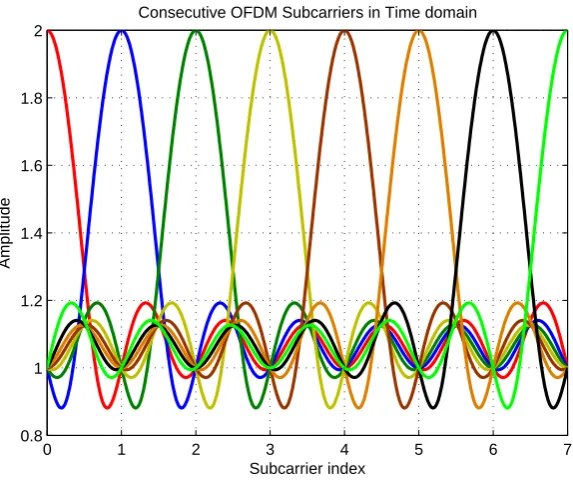
its experience flat fading. Figure 2.2 illustrated the the spectrum of OFDM symbol
in frequency domain where the spectra of sub-carriers are overlapped for
band-width efficiency due to orthogonality. Practically inverse discrete Fourier
trans-form (IDFT) and discrete Fourier transtrans-form (DFT) can be used at the transmitter
and receiver respectively to implement these orthogonal signal efficiently [60].
2.2.1
Amplify-and-Forward (AF)
Amplify-and-forward (non-regenerative) relaying is extremely attractive in
coop-erative communications due to its easy implementation at the relay terminal and
S/P and CP Removed
1
N
Rx
Channel Estimation
FFT IFFT
x
P/S and CP Insertion
Tx
N 1
x
Power Loading .
. . . . .
. . . . . .
. . . . . .
Figure 2.3: Block diagram of the AF-OFDM relaying with adaptive power loading.
be reduced at the relay. The block diagram of the AF relay node is illustrated in
Figure 2.3. In the AF scheme, the relay node broadcasts a scale version of source
signals under a power constraint to the destination node [4]. In general, there are
two different ways to amplify the output of the relay signal according to the relay
ability to estimate the first hop channel [4, 61].
The performance of AF-OFDM relaying schemes have attracted some
atten-tion in the literature regarding dual hops. Megumi et al. investigated the outage
probability for several allocation schemes [62]. In [63–65], a multiple AF-OFDM
relaying protocol was considered. The relays transmit in orthogonal channels
in [65], while in [63,64], relay selection was considered. Two types of relay selection
involving a “per-subcarrier basis” and an “all-subcarrier basis” were investigated
to obtain diversity gain [63].
2.2.2
Decode-and-Forward (DF)
In a decode-and-forward scheme, the relay node fully decodes the received signal
and then re-encodes and retransmits it to the destination. However if the channel
quality is weak or in deep fade, the relay fails to decode the received signal
suc-cessfully. Therefore it experiences error propagation which leads to deterioration
of the received signal at the destination. Decode-and-forward may be classified
2.2 Cooperative Relaying 15
Yes
No
DF
Silent Decode
correctly CRC Data
Figure 2.4: Adaptive decode-and-forward relay protocol.
difference between them is that fixed DF always decodes the received signal, while
adaptive DF only decodes for sufficient received signal quality.
2.2.2.1 Fixed Decode-and-Forward (DF)
In fixed DF relay schemes, the relay always decodes what it receives from the
source in the first time slot regardless whether it can decode the received signal
correctly or not [4]. It then forwards the decoded signals to the destination in
the second time slot. If however the relay fails to decode the received signal
successfully, it induces errors at the destination because the relay retransmits
the erroneous version of the original signals. This has been extensively studied in
single carrier systems over frequency-flat fading channels [4, 58, 66–68].
DF forwarding schemes have been widely investigated in cooperative
com-munications over frequency-selective channels by exploiting the advantages of
OFDM modulation [69–74]. In these papers, the authors were considered the
re-lay selection and studied the diversity order that can be achieved by the network
in frequency selective fading channels.
2.2.2.2 Adaptive Decode-and-Forward (ADF)
The main advantage of the ADF scheme is to eliminate the error propagation
induced by the forwarding relay [4, 15, 16, 75]. The underlaying concept of ADF is
that the relay forwards the received signal to the destination only when it fully
modes to verify if the relay has successfully decoded the received signal: “ideal
mode” and “outage mode”. In the ideal mode, the symbol is appended with cyclic
redundancy check (CRC) code [76], while in outage mode the SNR threshold
value is considered [15]. Without loss of generality, if the relay detects the check
sum correctly in ideal mode or if the received SNR is greater than threshold
value, the relay decodes the received signal. Otherwise it refrains from doing
so. Ritesh et al. [77] proposed a relay selection scheme utilizing the Shannon’s
capacity formula to evaluate the threshold value (γth = 2r−1), where r is the
rate (capacity). The basic idea of this protocol is that the relays estimate the
instantaneous SNR of the first hop and compares it with the SNR threshold. The
relays which have an instantaneous SNR larger than the threshold are included in
the decoding set and all participate in the second phase (beamforming technique)
or the destination selects the best relay (incremental relay selection). The authors
in [16], investigated the outage probability of parallel DF relay system in Rayleigh
fading channels with dissimilar fading parameters. They represented the
end-to-end SNR of the indirect links (S −Ri −D) by a random variable denoted
ξi. Subsequently, the authors in [75,78] proposed an adaptive decode-and-forward
in which the relay forwards the source signal only if decoded correctly. Therefore
the probability density function (PDF) is given as
fξi(x) =fξi|decoded incorrectly(x)Pe[decoded incorrectly]
+fξi|decoded correctly(x)Pe[decoded correctly]
(2.1)
To date, all mentioned work on ADF have assumed the channel is flat-fading. At
the timing of writing there appears to have been no discovered work considering
the OFDM technique incorporated with ADF over frequency-selective channel.
2.2.3
Hybrid Relay Protocol (HRP)
As mentioned in the previous subsections, the AF and DF protocols experience
noise amplification and error propagation, respectively. In order to overcome the
inherent problems in both protocols, a hybrid relay protocol has been recently
2.2 Cooperative Relaying 17
Decode correctly
No Yes
CRC Data
gsr,n ≥gth
No
(a)
Data
DF
Yes
AF DF
AF
(b)
Figure 2.5: Block diagram of hybrid forwarding relay scheme a) Ideal mode b)
Outage mode.
fading channels. The authors in [18] and [79] proposed a relay selection scheme
based on hybrid relay protocol by adopting CRC codes to ensure whether the
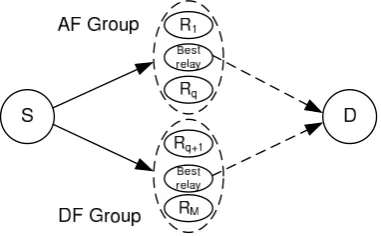
codeword is decoded correctly or not, as shown in Figure 2.5. The
fundamen-tal idea of the protocol is to classify all the relays into two groups, either the
“AF”, or “DF” group according to the instantaneous received signal to noise
ra-tio (SNR). The relays that are able to decode the received signal from the source
successfully are included in the DF group, otherwise they are included in the
AF group. In [18] the authors studied the frame error rate (FER) performance
of hybrid relay selection (HRS) with adopted relay selection, while in [79] an
all-participate scheme is considered. A dynamic optimal combination was
pro-posed in [80] by discarding the relays which undergo the deep fading. Liu et. al.
modified the relay selection by using SNR threshold value to improve the
sys-tem performance [81–84]. The closed-form symbol error rate (SER) expression of
HRS scheme was derived in [85], and the optimum power allocation under fixed
total transmit power is consider. The authors of [86], introduced the hybrid
for-warding protocol and derived a closed-form expression of analytical solution of
the outage probability over Rayleigh fading channels. The system model is based
on a single relay where it can choose a forwarding strategy between AF and
DF. If the received SNR at the relay exceeds the predetermined threshold, then
the AF protocol is used. Otherwise, the relay performs the DF protocol. Outage
probability under optimal power allocation was investigated in [87] based upon
is restricted. The authors assumed that the perfect CSI is available at both the
source and the destination. The power assigned at the source and relay can be
written as
Ps=εPtotal
Pr= (1−ε)Ptotal
(2.2)
where ε,(1−ε) indicate the proportions of Ptotal allocated to the source and the
selected relay. The authors of [88] proposed a static hybrid AF and DF relaying
protocol. In this protocol, the AF relaying group is composed by the relays that
are close to the source and the DF group contains of the remaining relays. The
BER performance for both all-participating and opportunistic hybrid AF-DF
relaying was considered. In [89], the authors proposed a hybrid
decode-amplify-forward (HDAF) protocol in which the relay performs DF if the decoding process
succeeds. If the relay cannot decode the received signal successfully, it performs
the AF scheme instead of remaining silent. The main shortcoming of this protocol
is that the relay has always to decode the received signal in order to decide
which scheme to use. Therefore, the authors of [90] proposed SNR-HDAF that
selected the protocol to be used at the relay based on the SNR of its received
signal. The basic idea of this protocol is that if the received SNR is greater
than the threshold SNR the relay performs DF scheme, while it performs the
AF scheme in the other case. The authors derived the closed-form expression
for the outage probability and error probability over independent non-identical
flat Rayleigh fading channels. When the channel parameters between the source
and relay are substantially good, the received signal at the relay not corrupted
and in this case it is better to use the AF scheme. According to this concept
the authors in [91] propose a new adaptive relaying protocol called
threshold-based adaptive decode-amplify-forward relaying protocol (T-ADAF). In addition,
outage probability and average channel capacity for incremental hybrid
decode-amplify-forward were investigated in [12].
In this protocol, the relay compares the received SNR to the average SNR of
the source relay link. If the SNR of the received signal is greater than the average
2.2 Cooperative Relaying 19
other hand, if the SNR of the received signal does not exceed the average SNR of
the source-relay link, then the relay performs ADF. The closed-form expression
of symbol error probability (SER) of single relay and multiple-relay scenarios was
derived and compared with other protocols (e.g AF, ADF, and SNR-HDAF). The
authors in [92] investigated the optimization of channel capacity by choosing an
optimal relay depending on adaptive relay table (ART). In order to prolong the
network lifetime, Heo proposed in [93], [94], an adaptive relay selection based
on individual and total power constraint for hybrid relay system. In this
proto-col, the relays are divided into two groups and two relays are selected according to
instantaneous channel conditions. In [93], the optimization problem to maximize
the received SNR at the destination with total transmission power constraint of
one communication and individual residual power of each relay was considered.
All of above researches on hybrid forwarding scheme have aimed at
single-carrier systems. However, Hybrid relay protocol combined with OFDM has
re-ceived less attention so far. The earlier work was done by Can et.al [11] where
each sub-carrier in the relay chooses the forwarding scheme according to the
qual-ity of the channel gains. Subsequently system capacqual-ity under power allocation for
OFDM based hybrid forward relay with two selection criterion was investigated
in [95]. The schematic diagram of these protocols are shown in Figures 2.6 and
2.7. In Figure 2.6, Pe,DF, Pe,AF and Pe,DT denote the probability of error for the
DF, AF and DT protocols. While in Figure 2.7,αsr,n,µrd,nandβsd,nrepresent the
channel power gains of the source-relay, relay-destination and direct transmission
links respectively. γsr,n and γth are the instantaneous SNR for the first hop and
the threshold value respectively. In these protocols the relay should possess all
the subcarrier parameters (direct and indirect) in the network in order to give
a forwarding scheme for each sub-carrier. This leads to an increase the overhead
signals which can be increased the complexity and reduced the channel
capac-ity. The authors in [80] proposed a dynamic optimal combination strategy for the
hybrid relay protocol and evaluated the system BER. The relays are reordered
in descending order of the SNR between the source and relays. The first relay
Pe,DF≥ Pe,AF
Yes
No
DF
DT AF
Pe,AF≥ Pe,DT
No Data
Figure 2.6: Block diagram of hybrid forwarding relay for OFDM system.
AF
DF
asr,n>βsd,n
gsr,n>gth
AF DF
µrd,n≤ βsd,n
asr,n>βsd,n
DT
No Yes
Yes
Yes
No No No
Yes
(a) (b)
Data Data
Figure 2.7: Block diagram of hybrid forwarding relay with different selection style
a) Selection criterion I b) Selection criterion II.
value. The rest of relays follow the AF protocol and discard the relays which
satisfied the dynamic optimal combination strategy. This protocol has a high loss
in spectral efficiency due to all relays participating in the communication phase.
2.3
Adaptive Techniques for OFDM Relaying
Systems
The channel fading in broadband wireless communication systems is generally
frequency-selective. The OFDM relaying systems can provide an additional
de-gree of freedom due to the OFDM channel being composed of N sub-channels with the relay using a half-duplex transmission. The same subcarrier in the first
and second slots experience different fading. Even if the subcarrier experiences
2.3 Adaptive Techniques for OFDM Relaying Systems 21
hop, and vice versa. Under these circumstances resource allocation and subcarrier
pairing may increase efficiency. It has been proven that these techniques provide
substantial improvements to the OFDM relaying systems over frequency-selective
channels. The most important result of this strategy is that the sub-carrier
per-mutation achieves much better performance than adaptive resource allocation.
2.3.1
Resource Allocation (RA)
Power allocation for single-carrier relaying systems and multi-carrier systems have
been intensively investigated to further increase system performance. Prior work
has studied power allocation issues in single-carrier systems to yielded higher
system transmission rates [96–98]. The authors in [96] considered optimal power
allocation algorithms for both AF and DF schemes in order to minimize the
outage probability under overall power constraints. Optimal power allocation to
maximize the system capacity was investigated in [97] for DF protocol, while for
AF relaying scheme in [98] and taking into account direct transmission. These
pioneering works considered either maximizing system capacity, or minimizing
outage probability under power constraint in single-carrier systems. However,
for OFDM systems each subcarrier experiences independent channel fades and
can carry different numbers of bits/symbols, therefore they should be allocated
transmission power levels independently. These optimizations either maximize
the channel capacity which refers to rate adaptive or minimizing the transmission
power refers to margin adaptive. It has been proven that these techniques can
en-hance the performance of the communication networks [25,99–105]. The objective
of the margin adaptive protocol is to minimize overall transmission power under
fixed data rate and fixed target BER constraints [25, 99, 100]. Mathematically,
can be formulated as
PT = Min N X
n=1
Pn
Subject to
N X
n=1
Cn =C
where PT and Pn are the total transmit power and the power assigns to nthe
sub-carrier respectively. C and Cn denote the overall channel capacity and the
individual throughput in each sub-carrier respectively. In rate adaptive, the
ob-jective is to maximize sum capacity under an aggregate transmit power
con-straint [101, 102, 106, 107].
C = Max
N X
n=1
Cn
Subject to
N X
n=1
Pn = PT
(2.4)
The work in [99], and [101] considered a multiuser OFDM in single hop
trans-missions. The authors of [25, 100, 102, 106, 107] investigated OFDM cooperative
systems. Their results shown that the system performance can be substantially
enhanced when the overall power is distributed to the source and relay optimally.
For multi-hop systems, the optimum power allocation was calculated in [108–
113] in order to maximize system capacity for DF-OFDM systems while in [24,
35, 114–116], the AF-OFDM systems were considered. Power allocation based on
RA for DF-OFDM relaying system was discussed under individual and global
power constraint in [110]. The quality of the channel parameters of the direct
and indirect links were taken into account and a modified water-filling algorithm
was proposed. However, sub-optimal power allocation may converse to an optimal
solution with some improvements to the system complexity [117]. The closed-form
expression of symbol error rate (SER) expression was derived in [118] for HRS and
the optimum power allocation (OPA) is presented. In order to reduce the overhead
signals in a multi-relay AF-OFDM system, suboptimal power allocation with
and without sub-channel selection were proposed in [119], which are known as
cooperative channel equalization (CCE) and CCE-S, respectively. The substance
of CCE algorithm is to distribute the source power uniformly for the sub-carriers
and the total relay power is set to be equal to all sub-carriers as
Ps,n =
Ps
N
Pn=
PT
N
2.3 Adaptive Techniques for OFDM Relaying Systems 23
where Ps,n and Ps are the transmit power of the nth sub-carrier and the overall
power at the source. Pn and PT are the transmit power at thenth sub-carrier in
all relays and the total power budget for relays, while N is the number of sub-carriers in the OFDM symbol. Eventually the power assigned to each individual
sub-carrier is distributed optimally between the relays.
2.3.2
Adaptive Bit and Power Allocation
Adaptive bit and power allocation (power allocation (PA) with bit loading (BL))
has been regarded as an efficient way to enhance the system capacity in a
coop-erative wireless network. The main task of the BL algorithm is to assign an
ap-propriate number of bits in each subcarrier taking into account the channel
qual-ities. Adaptive BL utilizes prior knowledge of channel state information (CSI) to
improve the system performance by allocating more bits to sub-carriers that have
higher SNR. Without any loss of generality, each subcarrier has a variable number
of bits which can be achieved by using different modulation schemes. Therefore,
sub-carriers with high channel gains are assigned more bits and employ higher
order modulation schemes, whereas sub-carriers experience deeps fade or lower
channel quality may carry less or zero bits. However, in equal bit loading (EBL),
the modulation scheme is constant over all the sub-carriers in the OFDM symbol.
In single-link OFDM communication systems, ABPA techniques have been
intensively investigated by utilizing a feedback channel. The block diagram of the
OFDM transceiver is illustrated in Figure 2.8. The most important approaches
were water-filling [5, 27–29] and greedy [26, 31] algorithms which have proven
to be the optimal solution for resource allocation. The main objective of these
algorithms is to either maximize system capacity or to minimize system errors
(error and outage probability).
The basic structure of the greedy (successive bit allocation) algorithm is to
initialize the number of bits allocated to all sub-carriers with a zero. Then the
additional transmit power of each sub-carrier is computed and one bit is added
to the subcarrier with the least additional transmit power. The process continues
S/P 1 N Channel Estimation IFFT x P/S and CP Insertion x Power Loading . . . . . . . . . . . . . . . . . . Bit stream Adaptive Modulati on Frequency Selective Channel P/S S/P and CP Removal FFT x x . . . . . . Adaptive Demodul ation . . . . . . . . . . . . 1 N
X1(b1)
XN(bN)
ES,1 ES,N Output data Bit Loading Transmitter Receiver
Figure 2.8: Block diagram of the OFDM transceiver with adaptive resource
allo-cation.
As the result, optimization of resource allocation can enhance the system
per-formance substantially. Another method of bit loading algorithm is based on mode
switching level. This approach selects a suitable modulation scheme for each
sub-carrier based on the predetermined SNR threshold for fixed target (BER). This
can reduce the computational complexity of BL implementation at the source and
decrease the overhead signals. The simply selects the number of bits assigned to
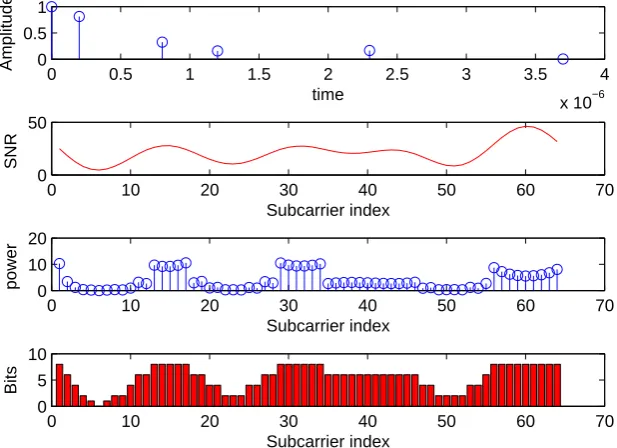
each subcarrier (e.g, 0, 1, 2, 4, 6 and 8). These being no transmission, BPSK and
M-QAM, where M = 2bi as shown in Figure 2.9. However, for relaying
transmis-sion the main question is how to allocate the limited power among the source and
relay and further among all sub-carriers efficiently. Several papers have
demon-strated that combined adaptive modulation with OFDM system can provide a
substantial improvement in the system performance [106, 107]. Integrated design
of resource allocation and OFDM relaying gained extensive interest recently. Since
square QAM with gray mapping is an efficient modulation technique and easy to
2.3 Adaptive Techniques for OFDM Relaying Systems 25
0 0.5 1 1.5 2 2.5 3 3.5 4
x 10−6 0
0.5 1
time
Amplitude
0 10 20 30 40 50 60 70
0 50
Subcarrier index
SNR
0 10 20 30 40 50 60 70
0 10 20
Subcarrier index
power
0 10 20 30 40 50 60 70
0 5 10
Subcarrier index
[image:47.595.161.470.104.328.2]Bits
Figure 2.9: Bit and power allocation.
2.3.3
Subcarrier Permutation (SP)
In OFDM relaying systems, each time slot is composed of several parallel
chan-nels. Since these channels experience frequency-selective fading, the end-to-end
subcarrier capacity is limited by the worst one. Figure 2.10 illustrates the
chan-nel power gain of the first and second time slot. Thus, the subcarrier capacity
decreases when the source information is retransmitted on the same subcarrier
in the second hop. The issue is resolved by using an additional degree of freedom
provided by OFDM relaying systems that is subcarrier permutation as proposed
in [117]. The underlying concept of subcarrier permutation is that the information
bearing symbol on the ith sub-carrier in the first hop may be retransmitted on the same or different sub-carrier in the second hop depending on the CSI. In this
0 10 20 30 40 50 60 70 0
0.2 0.4 0.6 0.8 1 1.2 1.4 1.6 1.8 2
Subcarrier index
Amplitude
Source−relay channel Relay−destination channel
Figure 2.10: Channel coefficients for the first and second hops.
relay system based on OFDM modulation. The Hungarian algorithm was used for
subcarrier permutation and the water-filling algorithm was used over selected
sub-carrier pair for optimal power allocation. The authors in [36, 60, 108] proposed a
sorted subcarrier pairing algorithm by matching the subcarrier with highest
chan-nel gain at the first slot with the highest one in the second slot which is known as
best to best algorithm (BTB) [121] or ordered subcarrier pairing (OSP). The
re-sults proved that the system capacity is maximized. However, it does not provide
an optimal solution when the direct transmission is available. Therefore, [122]
modified the sorted pairing algorithm by selecting the pairing either
ascending-sorted or descending-ascending-sorted depending on the channel conditions of the S-D and
S-R links.
The system capacity of the OFDM based AF multi-relay system with joint
relay selection and subcarrier coupling was investigated in [123–125]. The brute
force search was investigated in [123] while an opportunistic relay protocol with
limited overhead signals was adopted in [125]. Authors in [126] investigated
the symbol error probability of an AF-OFDM relaying network with SP and
variable-gain of the relay over Rayleigh fading channels. They proved that the
sub-2.3 Adaptive Techniques for OFDM Relaying Systems 27
carriers. In [127, 128], the authors derived the closed-form expressions of average
end-to-end SNR and throughput for multi-user downlink OFDMA systems
us-ing sub-carrier pairus-ing. In [127] the AF protocol was considered while in [128]
performed the DF protocol. The opposite subcarrier pairing scheme is presented
in [129] by matching the sub-carrier possesses highest SNR in the first hop with
the sub-carrier possesses lowest SNR in the second hop. Following this the
closed-form expressions of BER for BTB and best-to-worse (BTW) subcarrier mapping
were derived in [121] for the uncoded dual-hop OFDM AF relaying system.
Subcarrier pairing performance appears to has only been investigated either
for AF or DF schemes in the literature.
2.3.4
Joint Subcarrier Permutation (SP) and Resource
Allocation
Since resource allocation and subcarrier permutation have been proven to
im-prove the system performance when employed independently, it is no surprise
that a joint power allocation and sub-carrier pairing scheme proposed in [117]
can further improve the system performance. The objective of this paper was to
maximize the transmission rate under an aggregate power constraint of the source
and relay terminals. The authors of [117] studied sub-optimal power allocation
algorithm of an AF-OFDM scheme by evaluating an equivalent channel gain to
perform SP and then using water-filling approach for power allocation.