International Journal of Innovative Technology and Exploring Engineering (IJITEE) ISSN: 2278-3075, Volume-8 Issue-9, July, 2019
Abstract: The present conventions for making pair wise mysteries between hubs in a remote system, so these insider facts are secured from a secret agent, yet with constrained system nearness. The main present a fundamental mystery understanding convention for single-bounce systems, where mysteries are developed utilizing traffic traded between the hubs, and we demonstrate that under standard hypothetical suppositions, our convention is data hypothetically secure. Secondly, proposing a secrecy understanding convention for subjective, multi-jump arranges that expand on the fundamental convention yet in addition contains configuration highlights for utilizing extra sources that multi-bounce offers, for mystery. At long last, assess our conventions, and give exploratory proof that it is practical to make a huge number of mystery bits every second, in reasonable remote setups.
Keywords- Secret key generation, packet erasures, multi-hop key agreement, wireless networks.
I. INTRODUCTION
Issue in which a gathering of n remote hubs that structure a specially appointed remote system, need to make n 2 pair wise insider facts, with the end goal that an inactive spy Eve, who is situated in an obscure position in the system, finds out almost no about them. Recent Cryptographic mystery understanding calculations which is supposed to be planned around computational rigidity doubts. Safety break can't be accomplished in valuable time. Eve does not have enough computational power. The intrigued rather in solid data hypothetical or unlimited safety, in which security won’t rely upon computational constraints of Eve, but instead on the way that Eve does not have enough data to break security. Regardless of whether it is conceivable to offer solid security, as the quantity of hubs and number of pair wise keys increments, and over subjective remote topologies. As of late, there has been critical enthusiasm on structure data hypothetical security out of remote channel properties, yet the work has been restricted to quite certain topologies and situation. Most of the work considers pair wise key age over a solitary channel with a solitary source and recipient, the few works that have taken a gander at various collectors still just think about a solitary source and beneficiaries inside a similar communicate space. Works that take a gander at bigger systems normally don't give solid, however feeble data security ensures, and generally center around single message
Revised Manuscript Received on June 05, 2019
Manikandan N.K, CSE department, Vel Tech Rangarajan Dr.Sagunthala R&D Institute of Science and Technology , Chennai, India.
Shanmuganathan V, CSE department, Vel Tech Rangarajan Dr.Sagunthala R&D Institute of Science and Technology , Chennai, India.
Manivannan D, CSE department, Vel Tech Rangarajan Dr.Sagunthala R&D Institute of Science and Technology , Chennai, India
appropriation, rather than making n 2 diverse mystery keys. Besides, in the greater part, the secrecy accomplished is just a couple of several bits for each second. Interestingly, we would be able to use system accordingly, for subjective n and remote system topologies. Our fundamental commitments are as per the following: an essential mystery understanding convention, which empowers n hubs associated with a similar communicate area to make pair wise privileged insights that Eve knows next to no about. Our convention use the communicate idea of the remote to make pair wise mysteries between all pair of hubs all the while, has polynomial time multifaceted nature and is promptly implementing in basic remote gadgets. Break down our convention in two different ways: under standard data hypothesis suppositions (autonomous eradication channels among hubs as well as deletion process, to demonstrate (1) Fundamental convention is data hypothetically secured, i.e., it releases no data to Eve about the mysteries. (2) Accomplishes a secrecy that is ideal for hubs and scales well with the quantity of hubs n. We think about mystery understanding over subjective, multi-bounce systems. This is essential, right off the bat, from a commonsense perspective: notwithstanding when systems have few hubs, as availability is hindered from separation, impedance and different obstacles (e.g., metal blocks), it is trying to reliably keep up a solitary jump associated organize. Furthermore, multi-bounce systems are likewise intriguing from a specialized perspective since they give two new chances to mystery that we could use: impedance and multi-way spread. Impedance between simultaneous transmissions, (for example, brought about by the shrouded issue); particular parcel engendering through different ways can guarantee that Eve, situated in an obscure not yet fixed position in our system, does not approach every one of them, and again misses bundles that real hubs get. At long last, mystery understanding over self-assertive multi-bounce systems can empower applications. A mystery understanding convention for multi-jump organizes, expands in our essential convention, yet additionally involves new plan includes that understand the advantages multi-bounce offers for mystery. This incorporates a tweaked parcel dispersal convention that adjusts two clashing objectives:
spreading the bundles as proficiently and as broadly as conceivable among the real hubs, while guaranteeing that a huge division of bundles
won't be caught by Eve, where it could be situated in wherever inside the system.
Authentication of Communicating Node Key
Generation Based on User with Mutual
Removal Concepts
Our convention is totally decentralized; it cannot be separated among hubs and is promptly implementable in basic remote gadgets. Finally tentative assessing the execution of our conventions and we give proof that it is attainable by and by to make pair wise privileged insights at rates of thousands of bits for each second in practical setups. In the trial setup, we accept no learning of channel parameters and no information of Eve's area or gathered data. In single-bounce case, need to be utilized a little remote test bed and in other case multi-jump case we recreate distinctive system designs, comprising of up to more than hundred hubs and situated up to few bounces separated. We demonstrate that we can accomplish mystery age rates in the extent of Kbps, autonomously from the enemy's computational abilities. In outline, our commitments are: 1) planning functional mystery understanding conventions for at the same time producing n 2 insider facts in: a) solitary jump systems, by utilizing channel properties, b) self-assertive multi-bounce systems, by utilizing system properties. 2) Assessing, execution of our conventions by testing in sensible remote conditions. Stating that the mystery understanding convention for a single-jump systems and a subset of a one bounce trial results. Specifically, in we exhibited the base feasible mystery rates in our test bed, though here we need to show progressively summed up estimations that lead to new perceptions on mystery key age in a genuine remote system. Stretching out the work to multi-bounce systems is definitely not a direct advance, as new difficulties, yet additionally new chances, emerge: we have to structure a custom dispersal convention, and we have to use extra wellsprings of mystery, notwithstanding channel clamor. The multi-jump convention and the related test results are displayed here out of the blue. The paper is composed as pursues. In the wake of depicting our setup, we portray our fundamental mystery understanding convention, which empowers n hubs associated in a solitary bounce system to make n 2 pair wise privileged insights under standard hypothetical suppositions. Sequentially, we propose a discharge key, it expands over the essential and empowers n hubs associated in a subjective multi-bounce system to make privileged insights. Next, we express the properties of our conventions and we adjust them to genuine systems, where hypothetical system conditions don't hold. At long last, we give assessment results on the execution our conventions and we close with a dialog, subsequent to abridging related work.
II. PROBLEMSTATEMENT
A mystery understanding convention for single-bounce systems, where privileged insights are developed utilizing traffic trade between the hubs. The insider facts are appeared hypothetical supposition, than the convention is data hypothetically secure.
III. PRELIMINARIES
A secrecy understanding convention for self-assertive, multi-jump organizes that expand on the essential convention yet additionally contains configuration highlights for utilizing extra sources, that multi-bounce offers, for mystery. Goal & Source can speak with Each other with Relay as the
Intermediate Medium. Goal and Source Share their Primary and Secondary Keys to the relay where it can be utilized for Communication.
IV. RELEATEDWORK
The wiretap channel is where one means to give data theoretic protection of conveyed information dependent on suspicious activity from sender to enemy. Being created in the form of Information and Coding (I &C) people group in the course of the most recent 30 years to a great extent separated from the parallel advancement of present day cryptography. This paper intends to conquer any hindrance with a cryptographic treatment including propels on two fronts, specifically definitions and plans. On the primary front (definitions), we clarify that the mis-r definition in current use is frail and propose two options: mis (in light of common data) and ss (in view of the traditional idea of semantic security). We demonstrate them equal, accordingly associating two on very basic level diverse methods for characterizing protection, and giving another, solid and all around established focus for developments. On the second front (plans), we furnish the principal unequivocal plan with all the accompanying attributes: it is demonstrated to accomplish both security and decidability, it has ideal rate; and both the encryption and unscrambling calculations are ended up being polynomial time [1]. It considers a system including a transmitter, which utilizes irregular direct system code to instruct a message, a real beneficiary it can recoup the message in the event that it assembles an adequate number of straightly autonomous coded bundles, and a busybody. Shut structure articulations for the likelihood of the busybody catching enough coded parcels to recuperate the message are inferred. Transmission with and without criticism is examined. Moreover, an advancement display that limits the capture likelihood under deferral and dependability limitations is introduced. Results approve the proposed examination and measure the mystery gain offered by an input connection from the genuine recipient [2].We investigate the extra security gotten by commotion at the physical layer in a wire tap channel setting to be displayed. Security & safety improvements at the physical layer have been proposed as of late utilizing a mystery metric dependent on the degrees of opportunity that an assailant has concerning the sent figure content. Earlier work concentrated on cases in which the wiretap channel could be displayed as measurably free parcel eradication channels for the genuine recipient and a busybody.
In this paper, we go past the cutting edge by tending to corresponded deletion occasions over the two correspondence channels. The subsequent security improvement is introduced as a component of the relationship coefficient and the eradication probabilities for the two channels. It is demonstrated that security enhancements are feasible by methods for
reasonable physical-layer configuration
International Journal of Innovative Technology and Exploring Engineering (IJITEE) ISSN: 2278-3075, Volume-8 Issue-9, July, 2019
spy has a superior channel than the genuine collector. The main case in which this statement may not hold is when eradications are exceptionally related crosswise over channels. Nonetheless, we can demonstrate that relationship can't invalidate the normal security improvement if the channel nature of the genuine recipient is carefully superior to that of the spy [3].
In this paper we consider pair blunder control coding and cryptography in the setting of the wiretap channel due to Wyner. In a run of the mill interchanges framework a cryptographic application is kept running at a layer over the physical layer and accept the channel is without blunder. Be that as it may, in any genuine application the channels for well disposed clients and uninvolved busybodies are not mistake free and Wyner's wiretap display tends to this situation. Utilizing this model, we demonstrate the security of a typical cryptographic primitive, i.e. a key stream generator dependent on direct criticism move registers (LFSR), can be fortified by abusing properties of the physical layer. An inactive meddler can be made to encounter more noteworthy trouble in splitting a LFSR-based cryptographic framework insomuch that the computational intricacy of finding the mystery key increments by requests of greatness, or is through and through infeasible. This outcome is appeared two quick connection assaults initially displayed by Meier and Staffelbach, with regards to channel mistakes because of the wiretap channel show [4]. In this paper, a unique class of remote systems, called remote deletion systems is considered. In these systems, every hub is associated with a lot of hubs by perhaps connected deletion channels. The system show fuses the communicate idea of the remote condition by requiring every hub to send a similar flag on every cordial channel. Be that as it may, we accept there is no obstruction in gathering. Such models are in this manner fitting for remote systems where all data transmission is packetized and where some instrument for impedance evasion is as of now inherent. This paper takes a gander at multicast issues over these systems. The limit under the presumption that deletion areas on every one of the connections of the system are given to the goals is gotten. Things being what they are, the limit area has a pleasant max-°ow min-cut elucidation. The meaning of cut-limit in these systems fuses the communicate property of the remote medium. It is additionally appeared straight coding at hubs in the system accomplishment to accomplish the limit locale. Toward the end, the execution of various coding plans in the system when no side-data is accessible to the goals is examined [5].
V. ALGORITHM:
5
.
1 KEY GENERATION
A key is utilized to encode and decode whatever information is being scrambled /unscrambled. A gadget or program used to create keys is known as a key generator.
Current cryptographic frameworks incorporate
symmetric-key calculations, (for example, DES and AES) and open key calculations, (for example, RSA). Symmetric-key
calculations utilize a solitary shared key; keeping information mystery requires staying quiet. Open key calculations utilize an open key and a private key. The open key is made accessible to anybody (regularly by methods for a computerized endorsement). A sender encodes information with the open key; just the holder of the private key can decode this information. Since open key calculations will in general be much slower than symmetric-key calculations, current frameworks, for example, TLS and SSH utilize a blend of the two: one gathering gets the other's open key, and encodes a little bit of information (either a symmetric key or a few information used to produce it). The rest of the discussion utilizes an (ordinarily quicker) symmetric-key calculation for encryption.
Fig.5.1 key generation
5.2 RANDOM NUMBER GENERATOR
A pseudo arbitrary number generator (PRNG), otherwise called a deterministic irregular piece generator (DRBG), is a calculation for producing an arrangement of numbers whose properties surmised the properties of groupings of irregular numbers.
The PRNG-created grouping isn't really arbitrary, in light of the fact that it is totally dictated by an underlying worth, called the PRNG's seed (which may incorporate genuinely irregular qualities). Despite the fact that groupings that are nearer to genuinely arbitrary can be produced utilizing equipment irregular number generators, pseudo irregular number generators are vital by and by for their speed in number age and their reproducibility. PRNGs are focal in applications, for example, reproductions (for example for the Monte Carlo technique), electronic diversions (for example for procedural age), and cryptography. In cryptographic applications require the yield not to be
expound calculations, which don't acquire the linearity of less complex PRNGs, are required.
Fig.5.2 Random Number Generator
5.3 ERASURE CONCEPT
At the point when encryption is set up, information
eradication
goes
about as a supplement to
crypto-destroying, or the act of 'erasing' information by
(just) erasing or overwriting the encryption keys. By
and by, committed equipment/firmware encryption
arrangements can play out a 256-piece full AES encryption quicker than the drive hardware can compose the information. Drives with this capacity are known as self-scrambling drives (SEDs); they are available on most current undertaking level workstations and are progressively utilized in the venture to secure the information. Changing the encryption key renders difficult to reach all information put away on a SED, which is a simple and quick technique for accomplishing a 100% information eradication. Burglary of a SED results in a physical resource misfortune, yet the put away information is difficult to reach without the unscrambling key that isn't put away on a SED, accepting there are no powerful assaults against AES or its usage in the drive equipment.
VI. ARCHITECTUREDIAGRAM:
Fig.6. Relay Generator Node Architecture
6.1.
NETWORK DEPLOYMENT
We need to develop a system which comprises of 'n' number of Nodes. Hubs can demand information from different hubs in the system. Whereas the Nodes have the portability property, they can move over the system. To demonstrate this idea we'll make the Node outline which contains the time. In view of the time change we can expect that the hubs are moving over the system. For every hub we need to make a Node Frame which contains the Node data. Destination Node field to exchange the information and the peruse catch to transfer the information from Node's registry.
6.2.
CONCATENATION OF KEYS:
International Journal of Innovative Technology and Exploring Engineering (IJITEE) ISSN: 2278-3075, Volume-8 Issue-9, July, 2019
6.3.
KEY GENERATION & XOR PROCESS:
The key age in the two-way hand-off channel by embracing a plan. Rather than endeavoring to copy an immediate channel. The two terminals included don't have to get associated gauges. Rather, the hand-off first sets up a couple astute key with Source utilizing the physical channel connecting it and Source. Thus, the transfer and Destination can set up a couple shrewd key utilizing the channel connecting them. At that point the hand-off communicates the XOR of these two sets astute keys to both Source and Destination. Source and Destination would then be able to interpret both keys and pick the one with a littler size as the last key.
6.4.
VIRTUAL ENERGY COMPUTATION:
Virtual vitality calculation that is Even does not get any data about the channel increases utilized for the key age, subsequently our aim is to get a lot higher key rate; which is exceptionally simple to assess the key rate of the proposed plan; and Our plan can be effectively reached out to different receiving wire case, and the key rate scales straightly with the quantity of radio wires.
6.5.
SECURED DATA ACCESS:
Goal will get the vitality dimension of Source. So if
Destination send the information to Source, data
can be Encrypted and included with the vitality
estimation of Source and again Encrypted utilizing
XOR key acquired. Transfer gets the information
and transmits to Source. Source needs to give its
relating XOR key to open the Encrypted Data. At
that point the vitality of the Source can be checked.
At exactly that point the information is opened.
VII. EXPERIMENTALRESULTS
[image:5.595.304.512.59.389.2]In a remote system, first to make a hub than the hub
have allotted the essential and auxiliary key. At that
point the document has update and downloads the
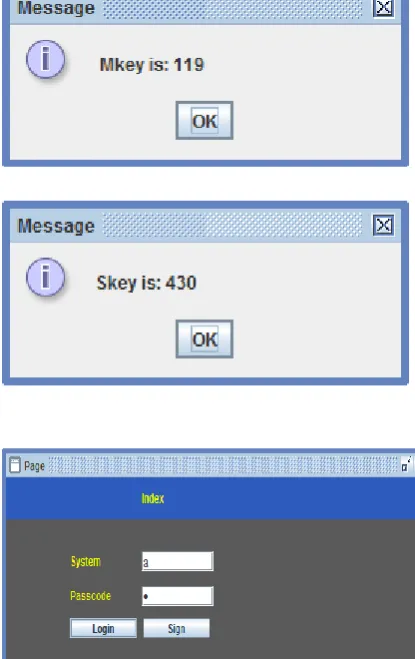
record or information in with respect to fig.6.1.
VIII. CONCLUSIONANDFUTUREWORK
We have displayed two conventions for empowering a gathering of n remote hubs to make pair insightful insider facts, within the sight of a detached enemy, with constrained system nearness, without accepting anything about her computational and memory abilities. Our fundamental mystery understanding convention works in single-bounce systems, it is data hypothetically secure and use communicate to make mysteries all the while between every terminal pair. Our convention for subjective, multi-jump systems, expands on the fundamental convention and incorporates new structures, e.g., a custom parcel dispersal convention, to use the advantages of multi-bounce for mystery age. A fundamental suspicion we do is that Eve is a detached foe. For the situation that Eve is a functioning enemy (endeavors to mimic a terminal), the terminals need to share some bootstrap data to confirm each other when they initially impart. The requirement for this bootstrap data is on a very basic level and its unavoidable and there is no chance to get for Source to realize she is conversing with Destination until they have built up their initial mystery. Verification is symmetrical to our mystery understanding and can occur in various ways, e.g., by requiring the terminals to at first offer bootstrap data and use it to build confirmation codes for the x-bundles (and the input parcels) they transmit the first occasion when they run our conventions. After the terminals have set up their first pair savvy insider facts utilizing our conventions, they can utilize these to build new confirmation codes, which don't rely upon the bootstrap data.
REFERENCES:
1. A. D. Wyner, “The wire-tap channel,” Bell Syst. Tech. J., vol. 54, no.
8,pp. 1355–1387, Oct. 1975.
2. U. M. Maurer, “Secret key agreement by public discussion from
common information,” IEEE Trans. Inf. Theory, vol. 39, no. 3, pp. 733–742,May 1993.
3. B. Kanukurthi and L. Reyzin, “Key agreement from close secrets over
unsecured channels,” in Advances in CryptologyEUROCRYPT.Berlin, Germany: Springer, 2009, pp. 206–223.
4. I. Csiszar and P. Narayan, “Secrecy capacities for multiterminal
channel models,” IEEE Trans. Inf. Theory, vol. 54, no. 6, pp.
2437–2452,Jun. 2008.
5. E. Ekrem and S. Ulukus, “Secrecy capacity of a class of broadcast
channels with an eavesdropper,” EURASIP J. Wireless Commun.
Netw, vol. 2009, Mar. 2009, Art. ID 824235. DOI: 10.1155/2009/824235
6. K. Bhattad and K. R. Narayanan, “Weakly secure network
coding,”NetCod, vol. 104, pp. 1–6, Apr. 2005.
7. Y. Wei, Z. Yu, and Y. Guan, “Efficient weakly-secure network coding
scheme
8. M. Adeli and H. Liu, “On the inherent security of linear network coding,” IEEE Commun. Lett., vol. 17, no. 8, pp. 1668–1671, Aug. 2013.
9. C. Ye, S. Mathur, A. Reznik, Y. Shah, W. Trappe, and N. B.
Mandayam, “Information-theoretically secret key generation for fading wireless channels,” IEEE Trans. Inf. Forensics Security,vol. 5, no. 2, pp. 240–254, Jun. 2010.
10.H. Liu, Y. Wang, J. Yang, and Y. Chen, “Fast and practical secret key
extraction by exploiting channel response,” in Proc. IEEE INFOCOM, Apr. 2013, pp. 3048–3056.
11.S. N. Premnath, J. Croft, N. Patwari, and S. K. Kasera, “Efficient highrate secret key extraction in wireless sensor networks using
collaboration,”ACM Trans.
International Journal of Innovative Technology and Exploring Engineering (IJITEE) ISSN: 2278-3075, Volume-8 Issue-9, July, 2019
12.I. Safaka, L. Czap, K. Argyraki, and C. Fragouli, “Towards
unconditional Tor-like anonymity,” in Proc. Int. Symp. Netw. Coding (NetCod), 2015, pp. 66–70.
13.I. Safaka, C. Fragouli, K. Argyraki, and S. Diggavi, “Exchanging pairwise secrets efficiently,” in Proc. IEEE INFOCOM, Apr. 2013,pp. 2265–2273.
14.I. Safaka, C. Fragouli, K. Argyraki, and S. Diggavi, “Creating shared
secrets out of thin air,” in Proc. 11th ACM Workshop Hot Topics Netw.,2012, pp. 73–78.
15.F. J. MacWilliams and N. J. A. Sloane, The Theory of
Error-CorrectingCodes, 2nd ed. Amsterdam, The Netherlands: North Holland, 1978.
AUTHORSPROFILE
Manikandan N.K Assistant Professor, Department of Computer Science and Engineering,; Vel Tech Rangarajan Dr. Sagunthala R&D Institute of Science and Technology: His research area includes Machine learning & Networking.
Shanmuganathan V Assistant Professor, Department of Computer Science and Engineering,; Vel Tech Rangarajan Dr. Sagunthala R&D Institute of Science and Technology: His research area includes Mobile Ad-hoc Sensor Networks and Wireless N/Ws.