International Journal of Innovative Technology and Exploring Engineering (IJITEE) ISSN: 2278-3075, Volume-8 Issue-10, August 2019
Abstract: Iris is most promising bio-metric trait for identification or authentication. Iris consists of patterns that are unique and highly random in nature .The discriminative property of iris pattern has attracted many researchers attention. The unimodal system, which uses only one bio-metric trait, suffers from limitation such as inter-class variation, intra-class variation and non-universality. The multi-modal bio-metric system has ability to overcome these drawbacks by fusing multiple biometric traits. In this paper, a multi-modal iris recognition system is proposed. The features are extracted using convolutional neural network and softmax classifier is used for multi-class classification. Finally, rank level fusion method is used to fuse right and left iris in order to improve the confidence level of identification. This method is tested on two data sets namely IITD and CASIA-Iris-V3.
Index Terms: Convolutional Neural Network, Softmax classifier, Iris Recognition, Bio-metric
I. INTRODUCTION
Iris recognition system provided a trustworthy and secure environment for its users. A major problem is its deployment in large scale application. One of large scale application, which brought diverse population, is inclusion of iris trait in AADHAR card in India. Iris recognition system is evolving as most powerful bio-metric identification system [1]. Compared to other biometric trait, iris trait has number of advantages such as iris is in annular region of pupil and sclera which is completely protected from external environment, no physical contact is required for identification or authentication this makes system hygienic, stability over life time of user and high degree of randomness in pattern that differentiates the identities of twins and even right and left eye of same person. Apart from these advantages, iris acquisition makes the problem of capturing irrelevant parts such as specular reflection, eyelashes and eyelids. This influences the localization accuracy of iris in turn recognition rate of overall system. The unimodal system uses only one of biometric trai for identification. This may suffer from noise present in image , intra-class variation , inter-class variation and non-universality [2]. The multimodal system has ability to overcome this limitation by combining evidences from both iris and solves the problem of non-universality. Convolutional neural network has automated the feature extraction process without any domain knowledge and also given outstanding results over Texture code [3] , Discrete Wavelet transform (DWT) [4], Scattering Transform [5] , Shift Invariant Feature
Revised Manuscript Received on August 02, 2019.
Gajanan Choudhari, NITTTR Chandigarh, India.
Rajesh Mehra, NITTTR Chandigarh, India
Shallu, NITTTR Chandigarh, India
Transform (SIFT)[6] and Discrete Cosine Transform (DCT) [7]. Now a much attention is focusses in designing CNN model for automatic feature extraction and suitable classifier for classification purpose [8]. First contribution made by Daugman in implementation of complete iris recognition system. The 2D Gabor filter is used for feature extraction and Hamming distance is used for classification [9]. Rai et al.[10] used Daubechies wavelet transform to extract textural features. This method reduced the number of features to be stored for each template. Saiyed et al.[3] used texture code matrix to compute the co-occurrence matrix which further used in computation of features. Part of iris is used to avoid the occlusion by eyelashes and eyelids. Constrained Circular Hough Transform (CCHT) is used for pre-processing which reduced complexity. Minaee et al.[5] proposed scattering transform and textural features of iris images and minimum distance classifier is used for classification. Dhage et al.[11] provided use of combination of Discrete Wavelet transform (DWT) and discrete cosine transform (DCT) for feature extraction. The Euclidean distance classifier is used for classification. Rathgeb et al.[6] used general image descriptor as SIFT( shift invariant feature transform ) for feature extraction. This work mainly focuses on recognition accuracy of iris recognition. Alaslani et al.[8] used pre-trained Alex-net models of convolutional neural networks architecture for feature extraction. Circular Hough transform is used in pre-processing of images. Support Vector machine is used for the classification purpose. Alaa S. Al-Waisy et al.[12] proposed a deep learning approach for Iris Recognition System. This method has given outstanding results. The system made multimodal by fusion ranking method. Iris features are extracted using scratch convolutional neural network architecture. Here many network configurations are tested for high recognition rate. This method has addressed the problems of non-universality, inter-class variation and intra- class variation. But as single CNN architecture has given slightly different recognition rates on both right and left of same database. In this work, CNN architecture is designed from scratch for feature extraction. The network learning is done by using back propagation algorithm with Adam optimization technique. The Adam optimization doesn't provide monotone convergence but reaches more global minimum in less computations. Combination of CNN and softmax classifier is used for automatic feature extraction and multi class classification respectively. The other training strategies such as dropout and data augmentation included to avoid the over fitting
problem.
Multi-modal Iris Recognition System based on
Convolution Neural Network
The main contribution of this paper is: 1) An improved Multimodal Iris Recognition System is proposed. The rank level fusion method is used to fuse the right and left iris. 2) The effect of Adam optimization is observed which resulted in improved Identification Rate and good generalization ability.
3) An attempt is made to use single CNN architecture for both right and left iris.
This is tested on two publically available datasets collected under different conditions: CASIA-Iris-V3 and IITD.
II. DATA SET
[image:2.595.47.296.353.468.2]The Two Iris databases used for implementation are IITD and CASIA-Iris-V3. In the IITD database consists of 224 subjects include 176 males and 48 females. Each subject's 5 iris images of left and right are taken. The camera used for capturing the images is JIRIS, JPC1000 and digital CMOS camera. It consists of total 2240 images. In case of CASIA-Iris-V3 database, it consists of 249 subjects out of which only 120 subjects used for testing. Each subject's 7 iris images of left and right are taken. Here 7 images of each iris is available for 120 subjects. The camera used for capturing iris images is self-developed close up camera. The more details of iris database are given in Table 1.
TABLE I. IRIS DATA SET
Database IITD CASIA-Iris-V3
No. of persons 224 120
No. of Images 2240 1680
Samples 5 left and 5 right 5 left and 5 right
Size 320X280 320X240
Format BMP JPEG
Camera JIRIS,JPC1000 and
digital CMOS camera
Self-developed close up camera
III. PROPOSED IRIS RECOGNITION SYSTEM Initially efficient pre-processing is employed on iris images to detect iris from other unwanted part such as pupil, scalar, specular reflection, eyelids and eyelashes. After detection of iris region, the iris is transformed from Cartesian co-ordinate system to polar co-ordinates by Daugman's Rubber sheet model. A fixed dimension images are generated out of this process. This dimensional reduction reduces computational burden on CNN. The discriminative features are extracted using scratch CNN configurations design. CNN acts as automatic feature extractor without domain knowledge. Softmax classifier is placed at the top of CNN to generate probabilistic matching score. The matching scores of right and left iris are obtained using fully connected layer at the end. Finally fusion ranking method such as Borda Count method is used in order to make system multi-modal. The overall proposed Iris Recognition System is as depicted in figure 1.
Fig. 1. Multi-Modal Iris Recognisation System
A. Iris Localization and Normalization
Iris localization is done using efficient and fast localization method as proposed in paper [13]. In this method, initially specular reflection detected and reflection mask is created out of it. These specular reflection spots are pained using reflection mask. An image enhancement employed using 2D Gaussian filter and histogram equalization to reduce computational cost of Circular Hough Transform (CHT). Finally, fast and accurate eyelid detection algorithm is used to detect the upper and lower eyelids. This algorithm uses the anisotropic transform with Radon transform to fit the eyelids as straight lines as shown in Figure 2. After localization method, in order to get the images of required size iris normalization is done. This removes the dimensional inconsistencies occurred due to pupil contraction, imaging distance and elastic distortion. Using Daugman's rubber sheet model the iris image transformed from Cartesian co-ordinate system to polar co-ordinate system as shown in Figure 3. The mapping of pixels is done from normalized images (p,q) to non-centric (r, θ) where r interval [0,1] and θ ranges from [0, 2π].The mapping is mathematically represented as
I(x(r,θ),y(r,θ))→I(r,θ)
x(r,θ)=(1-r) xP(θ) rxl(θ) (1) y (r,θ) = (1- r) yP(θ) ryl(θ)
[image:2.595.312.555.394.555.2]Where , I(p,q) is pixel intensity value at co-ordinates (p,q) and remaining parameters are co-ordinates r along θ direction[12].
Fig. 2. Iris Localisation [2]
Fig. 3. Daugman Rubber sheet model for co-ordinate mapping
B. CNN Architecture Design
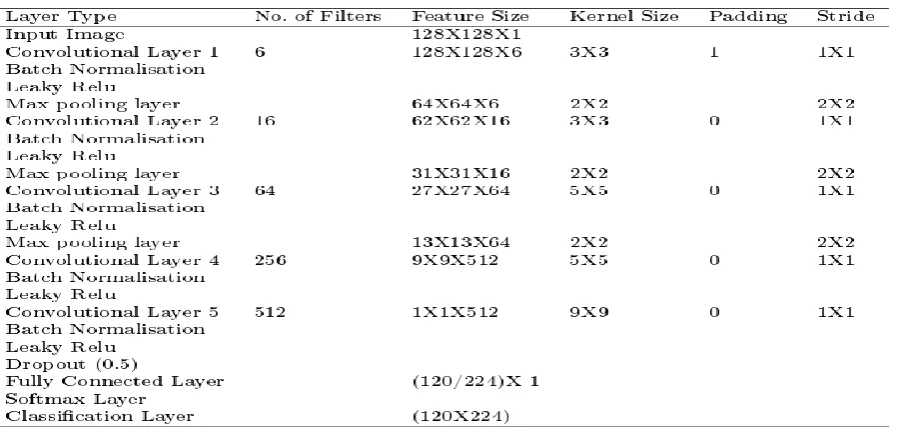
The CNN architecture is dependent on input image size. From literature, it seems that there is no theory available for design of CNN architecture for given application. In this paper two CNN architecture designs are proposed for input image size 64X64 and 128X128. In both architectures, first Convolution layer is with filter size of 3X3 is used. The number of filters is kept small at initial layer and increased in successive layers. The number of filters kept increasing in order to get high level features of iris images. Then batch normalization layer is used to normalize the output of convolutional layer.
International Journal of Innovative Technology and Exploring Engineering (IJITEE) ISSN: 2278-3075, Volume-8 Issue-10, August 2019
TABLE II. CNN ARCHITECTURE FOR IMAGE SIZE 64X64
TABLE III. CNN ARCHITECTURE FOR IMAGE SIZE 128X128
batch normalization layer is used after each convolutional layer to reduce the feature co-variance shift. This resulted in speeding up in network learning. Batch normalization also provides regularization to network to some extent. The activation function used is Leaky Relu. This avoids the problem of dead neuron in Relu activation which do not take part in back propagation. The Max-pooling layer reduces the spatial size of features generated in convolutional layer. The number of filters in max-pooling layer is kept same as that of convolutional layer. The size of filter used in max-pooling is fixed to 2X2.The stride for max-pooling layer is chosen 2. The max-pooling layer provides translational and rotation invariance. Only one fully connected layer used at the top of network. To control the spatial size padding is used. The network configurations are as shown in Table II and Table III. Note Number of classes for IITD is 224 and CASIA-Iris-V3 is 120.
A. Training Methodology
In this work, in order to reduce over fitting problem and improve generalization ability of network, the training
techniques and strategies are chosen. These are given as follows:
1) Data Augmentation
The Deep Neural Network requires large data sets to avoid over fitting problem. This also improves the classification at end. This method is used to artificially enlarge the data set. The methods include random crop, intensity variation and flipping . Initially rectangular image is converted in square image. Then five images are cropped out of square image corresponding to 4 corners and one central. After words the square images horizontally flipped and again 5 images are cropped. The total 10 images generated for each input image. . Here two patch sizes are extracted from original image size of 64X64 and 128X128. The augmented data used as provided by author Alaa S. Al-Waisy [2].
2) Dropout Method
[image:3.595.78.527.305.520.2]nodes do not take part in learning. This result in a thinned network is generated that shares the weights. This method provides the regularization to network. In this work, dropout method is applied to fully connected network because it includes more weights which are vulnerable to over fitting. The dropout method helps in learning strong features [14].
3) Adam Optimization
It is variation of combination RMSProp and SGD with momentum. In this optimization method, keeps a track historical first moment and second moment of gradients is kept. The second moment is exponential moving average of gradients. This solves the problem of zero initialization of bias. The learning rates are initialized to 0.001. The suggested default settings for the tested machine learning problems are α = 0.001, β1 = 0.9, β2 = 0.999 and ε = 10-8. The final parameter update is given by
(2) Where α is learning rate, ε is small number to prevent any divide by zero in the implementation, θt is final parameter update , is bias corrected second row moment estimate and
is bias corrected first moment estimate. This is alternative optimization techniques to SGD with momentum. This optimization method combines the benefits of RMSprop and AdaGrand optimization methods. The more details on this optimization is given in [15].
D. Softmax Classifier
This classifier is useful in multi class classification. This classifier generates a vector of probability distribution of input set with each class. This is probabilistic model of classifier. The strong prediction values will be closer to 1 and weak prediction values are near to 0. The cost function used by softmax layer is cross entropy function [16] . Let K are classes and n training sample labels. The estimate probability
is given by
(3)
Where h ranges from 1 to K are parameters and learned back propagation algorithm. For input , softmax will produce a k dimensional vector whose sum is 1, where each vector element is estimated probability based on input feature. E. Hyper-Parameter Selection
Input data is divided in 80:10:10 as training, validation and testing respectively. More information on effect of data splitting is given in [17] . The architecture or configuration is designed and trained with training set, after each epoch the validation data is used to calculate cost value and validation error rate. The training procedure is done by using back propagation algorithm with adaptive moment estimation optimizer. Early stopping procedure is used to stop leaning as soon as high accuracy is reached at minimum validation error. At last validation data is used to calculate the accuracy of
configuration or architecture which further calculate identification rate. Identification rate is used as objective function used to maximize during the learning process. The learning rate is set to 0.001. The batch size used is 128. For Adam optimization techniques parameter are set to β1 = 0.9, β2 = 0.999 and ε = 10-8.
F. Rank Level Fusion
Here rank level fusion method is used at classifier to generate a ranked list of possible match score. These ranked lists are taken in to account for final decision. Suppose employed classifiers are M and registered individuals are P . The rank Rx,y is rank assigned by Xth classifier to registered Yth person. The fusion methods are used to find the consensus rank Rf. In this paper, Borda count method is used for fusion, which computes the sum ranks assigned by each classifier which are statistically independent. This fusion method is mathematically given as follows:
(4) No any training is required in this method. This method is affected by performance of individual classifier [18].
IV. RESULTS AND DISCUSSION
In this approach, the Adam optimization technique is used to improve recognition rate and generalization ability of network. The Adam optimization techniques are used because of its ability to converge faster than AdaGrand optimization technique which focuses on the infrequent feature parameter updating. The number of parameter in CNN design is increased so as to improve the generalization ability of network. The first of all the fast and efficient localization technique is used for localization of iris. This contributed in improving the overall accuracy of system. The results obtained are as follows:
A. Localization Accuracy
Initially pre-processing is done on iris databases to localize iris part. Fast and accurate iris localization model is used as per paper [13] . The localization accuracy of proposed model is calculated mathematically as given by formula
(5) The localization accuracy found on iris databases is 99.82% and 99.87%. on CASIA-Iris-V3 and IITD data set respectively. This results shows that they have outperformed other state of art techniques.
B. CNN Architecture and Training Parameter Evaluation While designing the CNN architecture, the spoofnet[19] architecture is taken in to account. Initially kernel size of 3X3 is used in both architectures. In second architecture initial 2 convolution layers use 3X3 kernel size. This is to preserve the spatial size of features at
International Journal of Innovative Technology and Exploring Engineering (IJITEE) ISSN: 2278-3075, Volume-8 Issue-10, August 2019
[image:5.595.306.554.49.101.2]convolutional layer. The number of filter kept less at initial layers and then increased in subsequent layers. This is done to control model capacity. The padding of 1 is applied in first layer. In first architecture, padding is used at two places. The initial learning rate is set to 0.001. While training the number of epoch are set to 50. The training is stopped as soon as highest validation accuracy achieved on minimum validation error. After finishing the training of CNN, the validation data is used to calculate the accuracy of designed configuration. The output Validation error is fluctuating because of Adam optimization technique. Though the validation error rate is fluctuating but still it settles down to more global minimum than AdaGrand optimization technique. Adam optimization techniques have shown more generalization ability than AdaGrand optimization which helped further in using single architecture for both iris. The early stopping condition is used stop the training when desired accuracy is reached.. The overall training time is less than 50 minutes in each case. However it is observed that, the recognition rate is slightly dropped in case of IITD left iris database of image size 64X64 by 0.01%. The comparison of recognition rate with AdaGrand optimization technique is as shown Table II. The results obtained are compared with other existing system as shown in Table III. It is also noted that a single architecture provides comparably equal recognition rate which shows that better generalization ability.
TABLE IV. COMPARISION WITH ADAGRAD OPTIMIZATION TECHNIQUE
Size Database Method Recognition
Rate (%)
Left Right
64X64
CASIA-V3
IirsConvNet[2] 99.88 99.94 Proposed 100 100
IITD
IirsConvNet[2] 99.92 99.82 Proposed 99.91 99.91
128X128 CASIA-V3
IirsConvNet[2] 100 99.88 Proposed 100 100
IITD
[image:5.595.44.296.395.783.2]IirsConvNet[2] 99.64 99.91 Proposed 99.82 99.91
TABLE V. COMPARISIONOFRECOGNITIONRATE(%)OTHER EXISTINGMETHODS
Data set Method CRR(%)
IITD
Haar Wavelet [20] 98.45
Log Gabor Filter[21] 97.19
DCT[7] 95.17
Texture+Scattering[5] 99.20 Deep Convolutional Features[8] 99.4
Proposed System 100
CASIA-V3
Texture Code[22] 100
1D log polar Gabour Filter [23] 97.21
Haar wavelet[20] 98.45
Texture + Scattring[5] 99.20
Proposed System 100
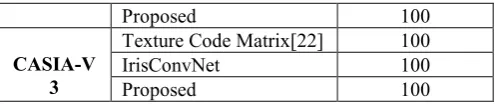
TABLE VI. COMPARISIONOFRANK1IDETIFICATIONRATE(%) USINGBORDACOUNTMETHOD
Data Set Method Identification
Rate (%)
IITD Texture Code Matrix[22] IrisConvNet[2] 99.52 100
Proposed 100
CASIA-V 3
Texture Code Matrix[22] 100
IrisConvNet 100
Proposed 100
C. Fusion Evaluation
Fusion evaluation Borda count method is employed to fuse the rank generated by classifier for each iris, and the ranks are assigned after the sample query is given and matching score are generated. Then these scores are arranged in descending order. This method has ability to exploit the capability of each classifier individually. The rank assigned to matching score of classifier is statistically independent of each other. This method is better than logistic regression classifier which needs training for finding weights of classifier. The Rank 1 identification rate is obtained after fusion techniques as shown in IV. The Rank 1 Identification rate obtained with Borda count method is 100% on both databases.The MATLAB code is written in 2018b. Simulation is done on Laptop Intel(R) core(TM) i5-7200U CPU with 4GB RAM.
V. CONCLUSION
The efficient pre-processing technique has increased the localization accuracy. The effect of this is contributed in overall system accuracy. The designed configuration of CNN used for both right and left eye is same and gives recognition rates comparably equal. The network training is done with Adam optimizer with other hyper-training parameter resulted in improved the recognition rate on individual data set. Compared with AdaGrand optimization, Adam optimizer has faster convergence rate in less computation and have shown improved accuracy on same databases, some are equal and only one slight reduced recognition rates on left eye of IITD of 64X64 sizes. A designed CNN architecture gives comparative same recognition rate on both right and left iris of same database. The final decision of identification is made with rank level fusion using Borda count method.The identification rate of overall system is found to be 100% for both databases.
ACKNOWLEDGMENT
I am greatly thankful to honorable Director, NITTTR Chandigarh, Prof. & Head of Electronics Department Dr. S.P Narote, Government Residence Women Polytechnic, Tasgaon, Maharashtra, India for their worthy guidance and help in writing this paper. I am also thankful to kind help of author Ala.S.Waisy and team form School of Electrical
Engineering and Computer Science,
University of Bradford, Bradford, UK.
REFERENCES
1. R. Gupta and P. Sehgal, Priti ,“Non ‑ deterministic approach to allay replay attack on iris biometric,” Pattern Analysis and Applications,Springer, pp. 1-13, 2018.
2. A. S. Al-waisy, R. Qahwaji, S. Ipson, and S. Al-fahdawi, Shumoos and Nagem, Tarek AM “A Multi-biometric Iris Recognition System based on a Deep Learning Approach,” Pattern Analysis and Applications,Springer,
3. Saiyed Umer, Bibhas Chandra Dhara, Bhabatosh Chanda “Texture Code Matrix-based Multi-Instance Iris Recognition,” Pattern Analysis and Application,Springer, Vol.19, No.1, pp. 283-295, 2016. 4. Mahmoud Elgamal, Nasser Al-Biqami, “An Efficient Feature
Extraction Method for Iris Recognition Based on Wavelet Transformation,” International Journal of Computer and Information Technology ,Vol. 02, No. 03, pp. 521–527, 2013.
5. Shervin Minaee, AmirAli Abdolrashidi, and Yao Wang, “Iris Recognition Using Scattering Transform And Textural Features ",IEEE Signal Processing and Signal Processing Education Workshop, pp. 37–42, 2015.
6. Rathgeb, C and Wagner, J and Busch, C, “SIFT-based Iris Recognition Revisited : Prerequisites , Advantages and Improvements,” Pattern Analysis and Applications , Springer,pp.1-18, 2018.
7. Abhiram M.H, Chetan Sadhu, K. Manikantan, S. Ramachandran “Novel DCT Based Feature Extraction for Enhanced Iris Recognition,” IEEE, International Conference on Communication, Information & Computing Technology,2012, pp. 1–6.
8. M. G Alaslani and L. A. Elrefaei, “Convolutional Neural Network Based Feature Extraction for IRIS Recognition,” International Journal of Computer Science Informatics Technology, Vol. 10, No. 2, pp. 65–78, 2018..
9. J. G. Daugman, “High Confidence Visual Recognition of Persons by a Test of Statistical Independence,” vol. 15, no. 11, 1993.
10.K. Roy, P. Bhattacharya, and C. Y. Suen, “Iris Recognition using Shape-Guided Approach and Game theory,” Pattern Analysis and Applications ,Springer,Vol.14, No.4, pp. 329–348, 2011.
11.S. S. Dhage, S. S. Hegde, K. Manikantan, and S. Ramachandran, "DWT-based Feature Extraction and Radon Transform based Contrast Enhancement for Improved Iris ecognition,"International conference on Advanced Computing technology and applications, Elsevier/Procedia Computer Science, Vol. 45, pp. 256-265, 2015. 12.A. S. Al-waisy, R. Qahwaji, S. Ipson, and S. Al-fahdawi, “A
Multimodal Biometric System for Personal Identification Based on Deep Learning Approaches,” pp. 163–168, 2017.
13.Alaa S. Al-Waisy, Rami Qahwaji, Stanley Ipson, Shumoos Al-Fahdawi,“ A fast and accurate iris localization technique for healthcare security system” IEEE International Conference on Computer and Information Technology; Ubiquitous Computing and Communications,pp.1028-1034,2015.
14.Nitish Srivastava, Geoffrey Hinton, Alex Krizhevsky, Ilya Sutskever, Ruslan Salakhutdinov,”Dropout: a simple way to prevent neural networks from overfitting”, The Journal of Machine Learning Research,Vol. 15,No. 01, pp.1929-1958, 2014.
15.A. Czajka, S. Member, K. W. Bowyer, M. Krumdick, and R. G. Vidalmata, “Recognition of image-orientation-based iris spoofing,” vol. 6013, no. c, pp. 1–13, 2017.
16.Rui Zeng, Jiasong Wu, Zhuhong Shao, Lotfi Senhadji and Huazhong Shu ,”Quaternion softmax classifier”, IET Electronics Letters, Vol. 50, No. 25, pp-1929-1931, 2014.
17.Rajesh Mehra , Shallu ,” Breast cancer histology images classification: Training from scratch or transfer learning?”, ICT Express, Elsevier, Vol.4, No.4, pp-247-254 , 2018.
18.Md. Maruf Monwar, Marina Gavrilova , “Markov chain model for multimodal biometric rank fusion”, Signal, Image and Video Processing, Springer,Vol.7 ,No.1, pp.137-149,2013.
19.David Menotti , Allan Pinto , William Robson Schwartz , Helio Pedrini , Alexandre Xavier Falcao , Anderson Rocha ,”Deep representations for iris, face, and fingerprint spoofing detection”, IEEE Transactions on Information Forensics and Security,Vol.10, No.4, pp. 864-879, 2015.
20.Tze Weng Ng, Thien Lang Tay, Siak Wang Khor, “ Iris Recognition Using Rapid Haar Wavelet Decomposition,” IEEE, International Conference on Signal Processing Systems (ICSPS) ,2010, pp. 820–823.
21.A. Kumar and A. Passi, “Comparison and combination of iris matchers for reliable personal authentication,” Pattern Recognit., vol. 43, no. 3, pp. 1016–1026, 2010.
22.Saiyed Umer, Bibhas Chandra Dhara, Bhabatosh Chanda “Texture Code Matrix-based Multi-Instance Iris Recognition,” Pattern Analysis and Application,Springer, Vol.19, No.1, pp. 283-295, 2016. 23.M. Vatsa, S. Member, R. Singh, S. Member, and A. Noore, “Improving
Iris Recognition Performance Using Segmentation , Quality Enhancement , Match Score Fusion , and Indexing,” IEEE Transactions on Systems, Man, and Cybernetics, Part B (Cybernetics), Vol. 38, No. 4, pp. 1021–1035, 2008.
AUTHORS PROFILE
Dr. Rajesh Mehra is presently Head of Curriculum Development Center at National Institute of Technical Teacher Training & Research, Chandigarh, India. He has received his Doctor of Philosophy and Master’s Degree in Electronics & Communication Engineering from Punjab University, Chandigarh, India. Dr. Mehra has completed his Bachelor of Technology from NIT, Jalandhar, India. Dr. Mehra has 23 years of Academic Experience along with 10 years of Research Experience. He has nearly 500 publications in Refereed Peer Reviewed International Journals and International Conferences. Dr. Mehra has guided more than 105 PG scholars for their ME thesis work and also guiding 03 independent PhD scholars in his research areas. His research areas include VLSI Design, Digital Signal & Image Processing, Renewable Energy and Energy Harvesting. He has authored one book on PLC & SCADA. Dr. Mehra is senior member IEEE and Life member ISTE.
![Fig. 2. Iris Localisation [2]](https://thumb-us.123doks.com/thumbv2/123dok_us/8183146.255536/2.595.312.555.394.555/fig-iris-localisation.webp)