Cooperative Coordination and
Formation Control for Multi-agent
Systems
Zhiyong Sun
A thesis submitted for the degree of
Doctor of Philosophy
The Australian National University
Except where otherwise indicated, this thesis is my own original work. The nature and extent of collaboration have been outlined in this thesis.
—Fyodor Dostoyevsky: Crime and Punishment(Chapter II of Part VI).
"To begin well is common; To end well is rare indeed."
—The Ancient Chinese Classic of Poetry1 (Shi-jing, published c. 600 BC).
Declaration
My doctoral studies have been conducted under the guidance and supervision of Prof. Brian D. O. Anderson, Assoc. Prof. Changbin (Brad) Yu and Dr. Adrian N. Bishop. This thesis contains no material which has been accepted for the award of any other degree or diploma in any university.
Most of the results in this thesis have been published at refereed international journals or international conferences. Some of these results have been achieved in collaboration with other researchers, or carried out in other institutions. I have in-cluded as part of the dissertation a statement clearly outlining the extent of collab-oration, with whom and under what auspices. Coauthored publications as a result of parts of my thesis research are listed as below: (Note: (i) Submitted papers that are under review are not listed here; (ii) * indicates that the thesis incorporates material of this paper. )
Refereed Journal Papers
1. *Z. Sun, S. Mou, B. D. O. Anderson, and A. S. Morse. Rigid motions of 3-D
undirected formations with distance mismatch. IEEE Transactions on Auto-matic Control, conditionally accepted, 2016.
2. * Z. Sun, M.-C. Park, B. D. O. Anderson, and H.-S. Ahn. Distributed
sta-bilization control of rigid formations with prescribed orientation. Automat-ica, vol. 78, No. 4, pp.250-257, 2017. Full version available at arXiv http:
//arxiv.org/abs/1606.03199.
3. M. H. Trinh, V. H. Pham, M.-C. Park, Z. Sun, B. D. O. Anderson, and H.-S. Ahn. Comments on ‘Global stabilization of rigid formations in the plane’. Automatica, in press, 2016. DOI: 10.1016/j.automatica.2016.11.006
4. *Z. Sun, B. D. O. Anderson, M. Deghat, and H.-S. Ahn. Rigid formation control
of double-integrator systems. International Journal of Control. In press. DOI: 10.1080/00207179.2016.1207100, 2016
5. * Z. Sun, S. Mou, B. D. O. Anderson, and M. Cao. Exponential stability for
formation control systems with generalized controllers: a unified approach. Systems and Control Letters, vol. 93, pp.50-57, 2016.
6. Z. Sun, S. Mou, M. Deghat, and B. D. O. Anderson. Finite time distributed
distance-constrained shape stabilization and flocking control for d-dimensional undirected rigid formations. International Journal of Robust and Nonlinear Control, vol. 26, No. 13, pp.2824-2844, 2016.
Refereed Conference Papers
8. *Z. Sun, H. Garcia de Marina, B. D. O. Anderson, and M. Cao. Quantization
ef-fects in rigid formation control. Proc. of the 6th Australian Control Conference (AUCC’16), pp. 168-173, Newcastle, Australia, 2016.
9. X. Zhang, Z. Sun, and C. Yu. Finite-time synchronization of networked Ku-ramoto oscillators. Proc. of the 6th Australian Control Conference (AUCC’16), pp. 81-86, Newcastle, Australia, 2016.
10. *Z. Sunand B. D. O. Anderson. Formation feasibility on coordination control of networked heterogeneous systems with drift terms. Proc. of the 55th IEEE Conference on Decision and Control (CDC’16), pp. 3462-3467, Las Vegas, USA, 2016.
11. C. Lageman and Z. Sun. Consensus on spheres: convergence analysis and perturbation theory. Proc. of the 55th IEEE Conference on Decision and Control (CDC’16), pp. 19-24, Las Vegas, USA, 2016.
12. Z. Sun, N. Huang, B. D. O. Anderson and Z. Duan. A new distributed
Zeno-free event-triggered algorithm for multi-agent consensus. Proc. of the 55th IEEE Conference on Decision and Control (CDC’16), pp. 3444-3449, Las Vegas, USA, 2016.
13. M.-C. Park,Z. Sun, B. D. O. Anderson, and H.-S. Ahn. Distance-based control of K4 formation with almost global convergence. Proc. of the 55th IEEE Con-ference on Decision and Control (CDC’16), pp. 904-909, Las Vegas, USA, 2016. Also available at arXiv:http://arxiv.org/abs/1606.01638.
14. M. H. Trinh, M.-C. Park, Z. Sun, B. D. O. Anderson, V. H. Pham, and H.-S. Ahn. Further Results in Rigidity Index. Proc. of the 55th IEEE Conference on Decision and Control (CDC’16), pp. 922-927, Las Vegas, USA, 2016.
15. * Z. Sun, U. Helmke and B. D. O. Anderson. Rigid formation shape control in general dimensions: an invariance principle and open problems. Proc. of the 54th IEEE Conference on Decision and Control (CDC’15), pp. 6095- 6100, Osaka, Japan, 2015 (Best Student Paper Award Finalist)
17. Z. Sun, G. S. Seyboth and B. D. O. Anderson. Collective control of multiple unicycle agents with non-identical constant speeds: Tracking control and per-formance limitation. Proc. of the 2015 IEEE Multi-Conference on Systems and Control (MSC’15), pp. 1361-1366, Sydney, Australia, 2015
18. * Z. Sun and B. D. O. Anderson. Rigid formation control with prescribed orientation. Proc. of the 2015 IEEE Multi-Conference on Systems and Control (MSC’15), pp. 639-645, Sydney, Australia, 2015
19. Z. Sun, C. Yu and B. D. O. Anderson. Distributed optimization on proximity
network rigidity via robotic movements. Proc. of the 34th Chinese Control Conference (CCC’15), pp. 6954-6960, Hangzhou, China, 2015. Also available at arXiv: http://arxiv.org/abs/1309.4850.
20. Q. Liu, Z. Sun, J. Qin and C. Yu. Distance-based formation shape stabilisa-tion via event-triggered control. Proc. of the 34th Chinese Control Conference (CCC’15), pp. 6948-6953, Hangzhou, China, 2015
21. Z. Sun, Q. Liu, C. Yu and B. D. O. Anderson. Generalized controllers for rigid
formation stabilization with application to event-based controller design. Proc. of the European Control Conference (ECC’15), pp. 217-222, Linz, Austria, 2015 22. B. Jiang, Z. Sun and B. D. O. Anderson. Higher order Voronoi based mobile coverage control. Proc. of the American Control Conference (ACC’15), pp. 1457-1462, Chicago, USA. Also available at arXiv preprinthttp://arxiv.org/abs/
1410.1941.
23. Z. Sun, S. Mou, U. Helmke, and B. D. O. Anderson. Convergence Analysis for
Rigid Formation Control with Unrealizable Shapes: The 3 Agent Case. Proc. of the 4th Australian Control Conference(AUCC’14), Canberra, Australia, pp. 1-6, 2014 (Best Student Paper Award Finalist)
24. M.-C. Park, Z. Sun, K.-K. Oh, B. D. O. Anderson, and H.-S. Ahn. Finite-Time Convergence Control for Acyclic Persistent Formations. Proc. of the 2014 IEEE Multi-conference on Systems and Control (MSC’14), Nice/Antibes, France, pp. 1608-1613, 2014
25. M.-C. Park, Z. Sun, B. D. O. Anderson, and H.-S. Ahn. Stability Analysis on Four Agent Tetrahedral Formations. Proc. of the 53rd IEEE Conference on Decision and Control(CDC’14), Los Angeles, USA, pp. 631-636, 2014
26. U. Helmke, S. Mou, Z. Sun, and B. D. O. Anderson. Geometrical Methods for Mismatched Formation Control. Proc. of the 53rd IEEE Conference on Decision and Control(CDC’14), Los Angeles, USA, pp. 1341-1346, 2014
2014.
Acknowledgments
I have so many people to thank for their great help during my PhD journey! My sin-cerest gratitude first goes to my principal supervisor, Prof. Brian D. O. Anderson, for your caring supervision, patient guidance, and countless discussions for my whole PhD research and study. Brian has been a role model for me to follow, not only in re-search but also in life and many other ways. His encouragement and extraordinarily conscientious mentoring (which enables me to deeply appreciate the meaning of the word Doktorvater), as well as his warm and good humoured personality have made my PhD journey a really enjoyable one under his wing. I have always been feeling extremely lucky to be one of your students, and been greatly honoured to be the last PhD student receiving your primary supervision. I also want to thank Brian’s wife, Mrs. Dianne Anderson, for the great hospitality and the very nice Australian-style dishes that I have enjoyed very much at Brian’s home in Canberra and at Brian’s beach house in Malua Bay.
I wish to express my heartfelt thanks to my co-advisors, Assoc. Prof. Changbin (Brad) Yu and Dr. Adrian N. Bishop, for your great help and support along my research journey. My way of becoming a well-trained researcher is due to your careful guidance as well. I shall in particular thank Brad for lots of help during my pre-PhD study. I was "recruited" by Brad in 2012, after I obtained a Master Degree in China and before I decided to come to Australia to pursue a PhD degree. Brad’s support and advice on my application to the ANU PhD program and in particular to the Endeavour Award have contributed a lot to the success, which then paved a smooth way for me to start a PhD adventure at ANU.
In my PhD journey, I have been fortunate to have the privilege of receiving guid-ance and supervision of world-class researchers from other institutes. Prof. A. Stephen Morse from Yale University deserves my truest admiration. His critical thinking, the rigour in mathematical proofs, and the very keen sense in research problems have influenced me a lot, and will be a life-long treasure for my future career. I would also pay my deep respect to the late Prof. Uwe Helmke from Uni-versity of Würzburg. I have enjoyed a lot from discussions and collaborations with him. His enthusiasm in research, always surprising insights in tackling a research problem and his vast knowledge in mathematics have benefited me a lot and also enabled me to further appreciate the true beauty of math.
I will also take this opportunity to thank all my collaborators. Prof. Hyo-Sung Ahn from Gwangju Institute of Science and Technology (GIST), South Korea, and Prof. Ming Cao from University of Groningen, The Netherlands, thank you for all your patient guidance and discussions. My other collaborators have also greatly helped me go though my PhD time, and have shaped me from a fresh PhD student
Würzburg, Germany), Dr. Héctor Garcia de Marina (École nationale de l’aviation civile, France), Mr. Myoung-Chul Park (GIST, South Korea), Dr. Mohammad Deghat (University of New South Wales, now at Data61 of CSIRO), Mr. Minh Hoang Trinh (GIST, South Korea), Dr. Shiyu Zhao (University of Sheffield, UK), Dr. Georg S. Seyboth (University of Stuttgart, Germany), Prof. Jiahu Qin (University of Science and Technology of China), Dr. Na Huang (Peking University, now at Hangzhou Dianzi University, China), and Mr. Bomin Jiang (MIT). The discussions with you on different research topics are always very stimulating and have been a constant source of inspirations. Furthermore, in many of our group meetings I have the privilege to discuss technical issues and research problems directly related to applications with DSTG (Defence Science and Technology Group) researchers. Their insightful feedbacks and comments are also greatly appreciated.
In various occasions including research meetings and conference attendances, I have the chance to meet other leading researchers in the field. Dr. Guodong Shi, Prof. Zhiyun Lin, Prof. Wei Ren, Prof. Wei Xing Zheng, Prof. Daniel Zelazo, Dr. Xudong Chen, Dr. Junfeng Wu, Dr. Ji Liu, Dr. Iman Shames and many others, thanks for being an example of a leading academic for me!
One of the most important parts in my PhD life should be the DICE group at the Research School of Engineering at ANU. I am grateful that I have been accom-panied by so many nice and brilliant members and visitors in our group: Junming, Qingchen, Xiaolei(Eric), Yun(Gavin), Mengbin(Ben), YonHon, Zhixun, Xianwei, and many others. Without you, my PhD life at Canberra would surely be of much less fun! Interactions with academics and students from other research groups at the same RSISE Building (now Brian Anderson Building), including Dr. Hongdong Li, Dr. Jochen Trumpf, Dr. Nan Yang, Dr. Yuchao Dai, Mr. Geoffrey Stacey et al., are al-ways very enjoyable and inspiring! In addition, the excellent administration support from the department administrators at CECS also deserves my special thanks.
I consider myself a fortunate PhD student to obtain certain opportunities of vis-iting some leading research groups in the world in the past three years. For each visit I received lots of help from the fellow students and group members at the host group and I appreciate a lot for their support. They are: Lili, Fengjiao (Zoe), Daniel from Yale University; Sung-Mo, Myoung-Chul and other DCASL lab mates from GIST; Qingkai, Yuzhen, Xiaodong, Jie and other members from ENTEG group at the University of Groningen; Michael and other members from Prof. Uwe Helmke’s group at University of Würzburg; and those fellow students from Prof. Toshiharu Sugie’s group at University of Kyoto. Research visits to these institutes not only have enhanced my research productivity, but also have consisted of some very beautiful travel memory to me.
much to my life at Canberra.
My life at Canberra has also been enriched by becoming a member of Woden Daybreak Rotary Club. This is a truly family-like club, and I consider joining the club as one of the best decisions I have ever made after I moved to Canberra. Thank you, Rosemary, Patty, Robyn(×2), Rob, Greg, Mark, Darren, John, Gavin, Lyn, Barry, Karen, Alison, Graham, Sue and many other rotarians! The community service and various voluntary activities have been an indispensable part of my Canberra life (apart from my ANU PhD life), which have also provided me numerous unique opportunities to enjoy the Canberra local culture!
My old friends in China should also have a place in my acknowledgement. Haix-iang, Shanshan, Peizhi, Shouzhi and so many old friends in Nanjing, Xi’an, Shanghai and Jinan have been an important part for my memory of my life in China. Special thanks to Xinrui for your understanding and being a company along the way.
My PhD research has been supported by a special scholarship which has a long name: The Prime Minister’s Australia Asia Incoming Endeavour Postgraduate Award from Australian Government. The financial support from this scholarship is greatly appreciated. The Endeavour supporting team (Scope Global) has helped to address various issues relating to my settling down at Canberra, international travels and my overall overseas life. In particular, I am thankful to my case manager, Ms. Beth Mutton (Scope Global), for her constant support and professional service in the past three years.
Abstract
The primary aim of this thesis is to study cooperative coordination control and for-mation control for multi-agent systems, with a focus on distributed stabilization con-trol of rigid formation shapes. We consider several problems in the field, ranging from the equilibrium and stability of formation control systems, some practical con-siderations in formation control, and cooperative coordination control when agents have general dynamical models.
In the first part of the thesis, we study in detail the equilibrium property of rigid formation control systems. A rank-preserving property is established for this coor-dination control system, and with this property we further prove the instability of a special equilibrium set (termed degenerate equilibria) at which agents’ positions only span an affine space with dimension less than that of the full space. The exponential stabilityof rigid formation control systems for a large family of formation controllers is also proved, with the property applying for both minimally rigid formations and non-minimally rigid formations. This approach provides a general and unified way for stability analysis of formation control systems.
In the second part, we investigate several practical issues on formation control, including robustness issues, rigid shape stabilization with a prescribed orientation, and formation control with quantized measurements. From the exponential stability proved in the first part, we discuss the convergence and robustness property for 3-D rigid formation control systems with distance mismatches, and identify ahelical rigid motion induced by mismatched distances. In addition, we propose a feasible forma-tion controller to achieve a desired rigid shapeand a prescribed formation orientation in ambient 2-D and 3-D spaces, with minimal knowledgeof the global coordinate frame orientation. Furthermore, quantization effects on rigid formation shape stabilization are discussed in detail in the case that the cooperative formation control only uses quantized distance measurements.
In the third part, we extend some main results considered in previous chapters on formation control systems modelled by single integrators to systems modelled by more general dynamics, including double integrator models and nonlinear control sys-tems. First, two types of double-integrator cooperative control systems (i.e. formation stabilization systems and flocking control systems with a target rigid shape) are thor-oughly investigated. By using a family of parameterized Hamiltonian-like systems, we further establish certain invariance principles concerning the equilibrium set and local stability, which build the link between the stability analysis for formation sys-tems modelled by single integrators and those modelled by double integrators. In addition, we consider a fundamental problem termed formation feasibility in multi-agent cooperative control. The problem concerns general forms of both formation constraints and individual agent’s kinematics constraints. In this cooperative control
Contents
Declaration vii
Acknowledgments xi
Abstract xv
1 Introduction 1
1.1 Research background: cooperative control and networked systems . . . 1
1.2 Introduction and literature review . . . 2
1.2.1 Different approaches on formation shape control . . . 2
1.2.2 Coordinate frame requirement in formation control . . . 3
1.2.3 Equilibrium and stability analysis on rigid formation control systems . . . 4
1.2.4 Some practical issues in rigid formation control . . . 4
1.2.5 Agent dynamical model: beyond single-integrator models . . . . 5
1.3 Thesis outline and statements of collaborations . . . 6
2 Theoretical preliminaries 9 2.1 Notations . . . 9
2.2 Preliminary on graph theory . . . 10
2.3 Preliminary on rigidity theory . . . 10
2.3.1 Definitions and properties . . . 10
2.3.2 Rigidity matrix and related results . . . 11
2.4 Gradient systems . . . 14
2.4.1 Definitions and properties . . . 14
2.4.2 Real analyticity and local minimum . . . 15
2.5 Gradient descent control law for rigid formation stabilization . . . 15
I Formation Control Systems: Equilibrium and Stability Analysis 17 3 Invariance principles and equilibrium analysis for formation shape control systems 19 3.1 Introduction . . . 19
3.1.1 Background and related work . . . 19
3.1.2 Chapter organization . . . 20
3.2 Problem setup and motion equations . . . 21
3.3 Rank-preserving property for formation systems . . . 21
3.3.1 Proof of the rank-preserving property . . . 21
3.3.2 Consequences of the rank-preserving property . . . 23
3.4 Stability analysis for degenerate equilibria . . . 24
3.4.1 The equilibrium set . . . 26
3.4.2 Eigenvalue property ofEand the Hessian . . . 27
3.4.3 Degenerate equilibria are unstable . . . 28
3.5 Concluding remarks . . . 32
3.6 Appendix: background on rank-preserving matrix flow . . . 32
4 Exponential stability for formation control systems with generalized con-trollers 35 4.1 Introduction . . . 35
4.1.1 Background and related work . . . 35
4.1.2 Chapter organization . . . 37
4.2 Exponential stability for minimally rigid formations . . . 37
4.2.1 Review of special controllers in the literature . . . 38
4.2.2 Convergence analysis . . . 39
4.2.3 Properties of the formation control system with generalized controllers . . . 44
4.3 Exponential stability for non-minimally rigid formations . . . 46
4.4 Simulation examples . . . 49
4.5 Concluding remarks . . . 52
II Formation Control Systems: Some Practical Considerations 53 5 Robustness issues for 3-D undirected formations with distance mismatches 55 5.1 Introduction . . . 55
5.1.1 Background and related work . . . 55
5.1.2 Chapter organization . . . 57
5.2 Motion equations with distance mismatches . . . 57
5.3 Analysis of convergence and formation movements . . . 61
5.3.1 Self-contained distance error equation and exponential conver-gence . . . 61
5.3.2 Convergence to a rigid formation . . . 62
5.3.3 Rigid motions induced by distance mismatches . . . 62
5.3.4 Convergence of the equilibrium motion . . . 65
5.4 Further analysis of the rigid helical motions . . . 68
5.4.1 Determining helical motion parameters . . . 68
5.4.2 Steering formations by manipulating mismatches . . . 70
Contents xix
6 Distributed stabilization control of rigid formations with prescribed
orien-tations 73
6.1 Introduction . . . 73
6.1.1 Background and related work . . . 73
6.1.2 Chapter organization . . . 75
6.2 Preliminaries and problem setup . . . 75
6.2.1 Rigidity matrix and its null space . . . 75
6.2.2 Gradient-based formation controller and problem formulation . 76 6.3 Main result . . . 76
6.3.1 Target formation and control framework . . . 76
6.3.2 Controller design . . . 79
6.3.3 Properties of the formation control system . . . 80
6.3.4 Convergence analysis . . . 80
6.4 Illustrative examples . . . 85
6.5 Concluding remarks . . . 88
6.6 Appendix: proofs of several lemmas . . . 88
7 Quantization effects in rigid formation control 91 7.1 Introduction . . . 91
7.1.1 Background, motivation and related work . . . 91
7.1.2 Chapter organization . . . 92
7.2 Preliminaries . . . 93
7.2.1 Additional notations in this chapter . . . 93
7.2.2 Quantizer functions . . . 93
7.2.2.1 Definition of the quantizers . . . 93
7.2.2.2 Properties of the quantizers . . . 94
7.2.3 Nonsmooth analysis . . . 95
7.3 Formation control with quantized measurements . . . 95
7.3.1 Quantized formation controllers . . . 95
7.3.2 Properties of quantized formation control systems . . . 97
7.3.3 Convergence analysis . . . 99
7.4 A special quantizer: formation control with binary distance information 101 7.4.1 Rigid formation control with coarse measurements . . . 101
7.4.2 Convergence analysis . . . 102
7.5 Asymmetric uniform quantizer . . . 104
7.5.1 Motivating example: two-agent formation case . . . 104
7.5.2 General formation case . . . 105
7.6 Illustrative examples and simulations . . . 105
7.7 Concluding remarks . . . 106
7.8 Appendix: background and useful tools on nonsmooth analysis . . . 108
8 Rigid formation control of double-integrator systems 113
8.1 Introduction . . . 113
8.1.1 Background and related work . . . 113
8.1.2 Chapter organization . . . 115
8.2 Motion equations . . . 115
8.2.1 Introduction of double-integrator formation control systems . . 115
8.2.2 Independence of global coordinate frame . . . 117
8.3 System dynamics . . . 118
8.3.1 Equilibrium sets for single- and double-integrator formation systems . . . 118
8.3.2 General results on convergence analysis . . . 121
8.3.3 Jacobian matrix analysis . . . 122
8.4 Perspectives from a parameterized double-integrator formation system 124 8.4.1 Invariance principles . . . 125
8.4.2 Relating double-integrator formation systems to single-integrator formation systems . . . 126
8.4.3 Exponential convergence of double-integrator formation systems 130 8.5 Extensions to double-integrator flocking systems . . . 131
8.6 Illustrative examples on convergence . . . 132
8.7 Concluding remarks . . . 134
9 Formation feasibility and motion generation of networked heterogeneous systems 137 9.1 Introduction . . . 137
9.1.1 Background, motivation and related work . . . 137
9.1.2 Chapter organization . . . 139
9.2 Preliminaries, problem formulation and motivating examples . . . 139
9.2.1 Preliminaries on differential geometry and system equation . . . 139
9.2.2 Motivating examples . . . 140
9.2.3 Problem formulation: formation feasibility with kinematics and formation constraints . . . 141
9.3 Conditions for feasible motion . . . 142
9.3.1 Constraints on inter-agent formations . . . 142
9.3.2 Constraints on individual agents’ kinematics . . . 142
9.3.3 Main results on formation feasibility . . . 143
9.4 Application to coordination control of multiple constant-speed agents . 144 9.4.1 Affine distribution and codistribution generated by constant-speed dynamics . . . 144
9.4.2 Example: rigid formation maintenance and coordination by constant-speed agents . . . 145
9.5 Motion generation and coordination control with heterogeneous agents 147 9.5.1 Generalization and motion derivation . . . 147
Contents xxi
9.6 Concluding remarks . . . 151
10 Conclusions and future work 153 10.1 Thesis summary and contributions . . . 153
10.1.1 Formation control systems: equilibrium and stability analysis . . 153
10.1.2 Formation control systems: some practical considerations . . . . 154
10.1.3 Distributed coordination control: general system models . . . 154
10.2 Future work . . . 155
10.2.1 Equilibrium analysis . . . 155
10.2.2 Robustness issues . . . 156
10.2.3 Formation feasibility and motion generation . . . 157
List of Figures
1.1 An overview of relations between the main chapters. . . 8 2.1 Examples of rigid and non-rigid formations. (a) non-rigid formation (a
deformed formation with dashed lines is shown); (b) minimally rigid formation; (c) rigid but non-minimally rigid formation. . . 13 2.2 Examples of a non-infinitesimally-rigid framework and an
infinitesi-mally rigid framework. (a) A rigid but not infinitesiinfinitesi-mally rigid frame-work. The collinear positions of the three nodes lead to rank(R) =1< 3. The red arrow indicates a non-trivial infinitesimal motion. (b) An infinitesimally rigid framework. . . 13 3.1 An example of a pair of flip/flex formations. (a) A target formation
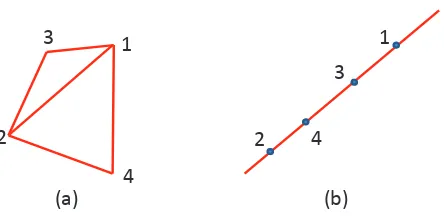
defined by five inter-agent distances. (b) A flip version of the target formation with the same set of five desired distances. In rigid forma-tion control, they are both considered as correct equilibria for a target formation specified by given desired distances. . . 25 3.2 An example of a correct equilibrium and a degenerate equilibrium for
a four-agent formation shape with five given distances. (a) The correct formation shape, in which all the five distances are achieved. (b) An example of collinear degenerate equilibrium in R2, in which all the four agents converge to a line formation. . . 26 3.3 The sets of collinear or coplanar positions are invariant for 2-D/3-D
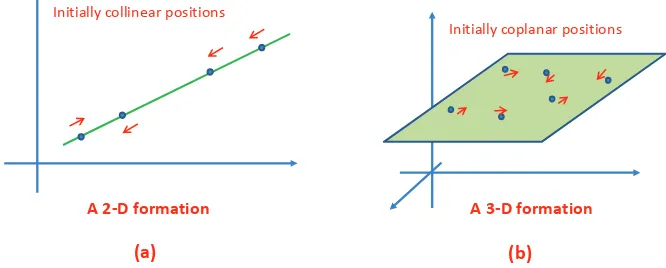
rigid formation systems. . . 31 3.4 If all agents start at non-collinear (non-coplanar) positions, then their
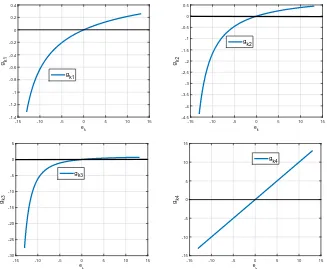
positions will be non-collinear (non-coplanar) at any finite or infinite time. . . 31 4.1 Several examples of controller functions gk studied in the literature
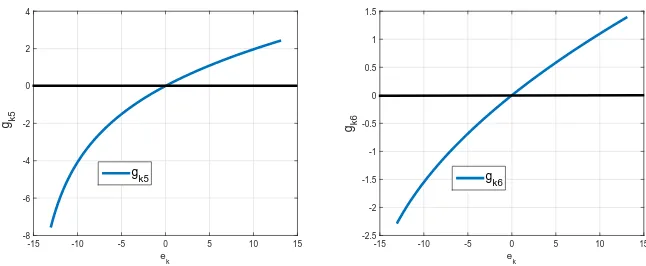
(which correspond to the controller functions (4.5), (4.7), (4.9) and (4.10) discussed above). In all plots, we let dk = 4 and thus ek ∈
(−16,∞). . . 40 4.2 Two novel controller functionsgkwith guaranteed exponential
conver-gence of the distance error system. In both plots, we let dk = 4 and thus ek ∈ (−16,∞). The left figure shows the proposed function in (4.29), and the right figure shows the proposed function in (4.31). . . 46
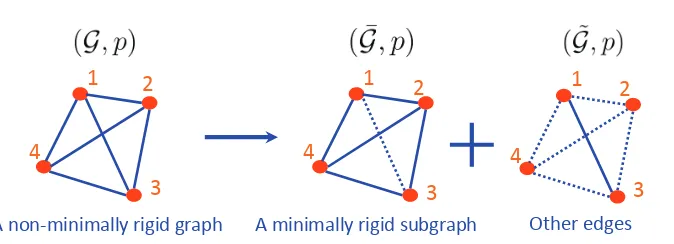
4.3 An example of graph decomposition of a non-minimally rigid frame-work. The dashed lines in the decomposed subgraphs indicate the removed edges. . . 47 4.4 Simulation on stabilization control of an 4-agent rectangular
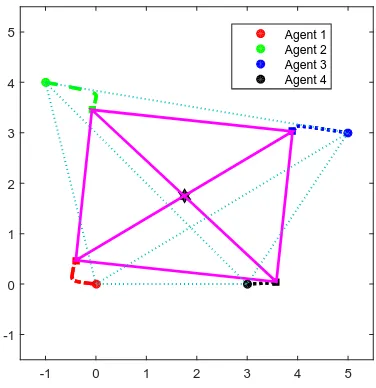
forma-tion shape. The initial and final posiforma-tions are denoted by circles and squares, respectively. The initial formation is denoted by dotted blue lines, and the final formation is denoted by red solid lines. The black star denotes the formation centroid, which is stationary. . . 50 4.5 Exponential convergence of the distance errors for 2-D rectangular
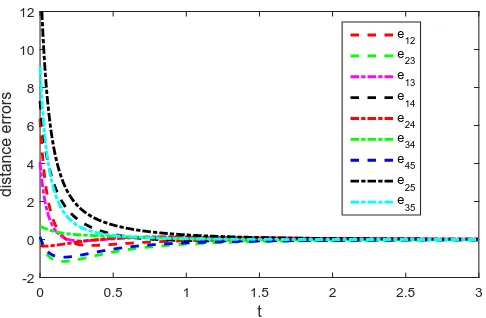
for-mation control. . . 50 4.6 Simulation on stabilization control of a double tetrahedron formation
in 3-D space. The initial and final positions are denoted by circles and squares, respectively. The initial formation is denoted by dashed lines, and the final formation is denoted by red solid lines. The black star denotes the formation centroid, which is stationary. . . 51 4.7 Exponential convergence of the distance errors for 3-D tetrahedron
for-mation control. . . 51 5.1 An undirected rigid tetrahedron formation. . . 58 5.2 Convergence of distance errors. . . 67 5.3 Rigid motions (helical motions) induced by distance mismatches in a
tetrahedron formation. . . 67 6.1 Example of controlling a 2-D rectangular formation and a 3-D
tetra-hedral formation with prescribed orientation. (a) Agent 1 and one of its neighbors, agent 2, are chosen as orientation agents. The relative position vector p2−p1 associated with edge (1,2) is used to describe the desired orientation, which is denoted by red color (in this example (1, 2)∈ Eo). (b) Agent 1 and two of its neighbors, agents 2 and 4, are chosen as orientation agents. The relative position vectors p2−p1and p4−p1 associated with edges (1,2) and (1,4) are used to describe the desired orientation, which are denoted by red color (in this example (1, 2),(1, 4)∈ Eo). . . 78 6.2 Stabilization of a rigid rectangular formation without orientation
con-trol. The initial and final positions are denoted by circles and squares, respectively. The initial formation is denoted by dotted blue lines, and the final formation is denoted by red solid lines. The black star denotes the formation centroid. . . 86 6.3 Stabilization of a rigid rectangular formation with prescribed
LIST OF FIGURES xxv
6.4 Convergence of the distance/orentation errors with the proposed con-troller (6.2). The orientation errorφ12is defined asφ12 =arctan((p2,y− p1,y)/(p2,x−p1,x))−π/2. . . . 87 6.5 Stabilization of a 3-D rigid formation with prescribed orientation. The
initial and final positions are denoted by circles and squares, respec-tively. The initial formation is denoted by dotted blue lines, and the final formation is denoted by red solid lines. The black star denotes the formation centroid. . . 87 7.1 Logarithmic quantizer function with the gainδu=0.5, defined in (7.3). 94 7.2 (a) Symmetric uniform quantizer function, defined in (7.2). (b)
Asym-metric uniform quantizer function, defined in (7.23). . . 104 7.3 Stabilization control of a rigid formation: symmetric uniform
quanti-zation case. Left: the trajectories of five agents and the final formation shape. Right: Time evolutions of the distance errors. . . 106 7.4 Stabilization control of a rigid formation: logarithmic quantization
case. Left: the trajectories of five agents and the final formation shape. Right: Time evolutions of the distance errors. . . 107 7.5 Stabilization control of a rigid formation: binary measurement case.
Left: the trajectories of five agents and the final formation shape. Right: Time evolutions of the distance errors. . . 107 7.6 Stabilization control of a rigid formation: asymmetric uniform
quanti-zation case. Left: the trajectories of five agents and the final formation shape. Right: Time evolutions of the distance errors. . . 107 8.1 Simulation on shape stabilization control of a double tetrahedron
for-mation in the 3-D space with double-integrator systems. . . 133 8.2 Simulation on formation flocking control of a double tetrahedron
for-mation in the 3-D space with double-integrator systems. . . 134 8.3 Simulation on formation shape control of a double tetrahedron
for-mation in the 3-D space with single-integrator systems. The initial conditions are chosen to be in a plane in the 3-D space, and the forma-tion converges to an incorrect formaforma-tion shape that lives in that plane (i.e. an incorrect planar equilibrium formation). . . 135 8.4 Simulation on formation shape control of a double tetrahedron
forma-tion in the 3-D space with double-integrator systems. The formaforma-tion converges to a correct formation shape, even if one chooses degenerate coplanar initial positions. . . 135 9.1 Two feasible formations with a group of constant-speed agents. . . 146 9.2 Feasible motions for heterogeneous agent group. Type (i): w1=0 and
Chapter1
Introduction
1
.
1
Research background: cooperative control and networked
systems
The research problems to be discussed in this thesis fall into the broad scope of co-operative control and networked systems, which have gained considerable attention in the last decade in the control community. According to the recently published Encyclopedia of Systems and Control [Baillieul and Samad, 2015], networked systems can be loosely defined as "a system of systems", or "a collection of agents that interact with each other" 1. The wordagent can refer to autonomous robots, unmanned aerial vehicles (UAVs), or mobile sensors, depending on the different control context (see also [Ren and Cao, 2010]).
The central themes in the study of cooperative control for networked multi-agent systems include the understanding of the role of cooperation, the mechanism of infor-mation sharing between distributed agents, the stability and achievement of a global task arising from local interactions, the robustness against measurement/commu-nication perturbations, and the fundamental limitations or tradeoffs between local tasks and global tasks, among others. In contrast to centralized control systems, dis-tributed networked systems and cooperative control enjoy several nice advantages, including flexible scalability to the system size and change of agent number, strong adaptivity to the change of environment, and low operational cost without increasing the complexities of the whole system. Some excellent surveys for recent progress on distributed multi-agent coordination and networked systems can be found in [Cao et al., 2013; Zhang et al., 2013; Knorn et al., 2016].
We mainly consider coordination and formation control for multi-agent systems in this thesis. Formation control and shape stabilization is typically a distributed and cooperative control task, in that each agent uses only local information/measure-ments to achieve a cooperative formation task. Roughly speaking, formation con-trol aims to design distributed concon-trollers such that a group of spatially distributed agents could reach some pre-defined formations involving geometric relationships between them. Such geometric relationships can be described by relative positions, bearings, distances, or a mix of different geometric variables, depending on the
con-1See [Baillieul and Samad, 2015, Page 849]: the entrynetworked systemscontributed by J. Cortés.
text and control requirement. In this thesis, we will focus in particular on rigid formation shape control 2, in which the formation shape is defined by a certain set of inter-agent distances.
1
.
2
Introduction and literature review
In this section, some relevant and recent papers for each research theme will be briefly reviewed. We remark that in the beginning of each main chapter, a more detailed literature review will be provided for each research topic.
1.2.1 Different approaches on formation shape control
Formation control for a group of autonomous mobile agents has attracted much research interest due to its broad applications in many areas including both civil and military fields. According to several surveys, most approaches on formation control in the literature can be classified as leader-follower strategy, virtual structure approach and behavior-based method (see e.g. the review in [Fahimi, 2008]). A key problem in formation control that receives particular interest is how to stabilize and maintain a geometrical formation shape in a distributed manner, and this will be one of the central focuses of this thesis. In the recent survey paper [Oh et al., 2015], different types of formation shape control strategies are reviewed and compared in terms of the sensing capability and the interaction topology, among which two most commonly-used approaches are
• Thedisplacement-basedapproach, in which the desired formation is specified by a certain set of inter-agentrelative positionsand linear controllers turn out to be possible;
• The distance-based approach, in which the desired formation is specified by a certain set of inter-agentdistancesand nonlinear control laws are required. There are several distinct properties for the above two approaches. For the first ap-proach, all the agents must have their coordinate bases with the same orientation (while the origins may be different); this means that the desired relative position vec-tors can be well defined and controlled between agents (see e.g. [Ren and Beard, 2008; Xiao et al., 2009]). In turn, this means that all the agents should be equipped with a compass or equivalent to guarantee their coordinate orientation alignments, which may not be practical in real world applications since having consistency among the compass readings would be a challenging task due to instrument bias and/or local variations caused by, e.g., the earth’s magnetic field. We will review the require-ment of coordinate frame alignrequire-ment in formation control in the following section, together with some other recently proposed formation control algorithms that were not reviewed in [Oh et al., 2015].
§1.2 Introduction and literature review 3
1.2.2 Coordinate frame requirement in formation control
The coordinate frame requirement was largely ignored in early works on formation control (as reviewed in [Oh et al., 2015]). It is only in recent years that the impor-tance of coordinate frame alignment has been recognized in formation controller design and implementation. It has also been shown in [Meng et al., 2016] that the assumption that all the agents have coordinate systems with the same orientation may not be realistic in practice, since small perturbations in their local coordinate systems will cause unexpected behaviors for the displacement-based formation sys-tem. Thus in practice, a coordinate-free formation control system is almost always preferable. In [Aranda et al., 2015], a coordinate-free formation control strategy was proposed by including a rotation matrix in the formation controller. The advan-tage of the coordinate-free property of the proposed formation controller in [Aranda et al., 2015] is offset by the requirement that the relative position measurements from all other agents should be available to each individual agent, which implies that the coordinate-free formation control in [Aranda et al., 2015] is effectively not a distributed one. A graph Laplacian-based approach has been proposed in [Lin et al., 2016b] which enables coordinate-free formation stabilization of target shapes (defined as an affine formation). Recent efforts also show that the bearing-based approach is another promising strategy to achieve a desired formation [Zhao and Zelazo, 2016] which is translation- and scaling-invariant. We note that such an ap-proach however still does not resolve the strict requirement for global knowledge of coordinate frame orientation among all agents.
In the case that a common coordinate orientation is required for all the agents and initially they have different local coordinate frames, one needs to design a combined control establishing coordinate frame direction alignment and formation shape sta-bilization to ensure the convergence to a target shape. This idea has been developed and discussed in detail in e.g. [Cortés, 2009; Oh and Ahn, 2014b; Zhao and Zelazo, 2016; Montijano et al., 2016; Tron et al., 2016] in different control scenarios.
The requirement on the coordinate frame alignment can be avoided in the distance-based formation setup. This is because in the distance-distance-based setup a global coor-dinate system defining a common orientation for all individual agents’ coorcoor-dinate frames is not required, and each agent can use its local coordinate basis to achieve a rigid formation shape. 3 Partly because of this, the distance-based control approach attracts particular interest in the field of formation control.
3A very nice result on how to determine the coordinate-free property (termed SE(N) invariance
1.2.3 Equilibrium and stability analysis on rigid formation control sys-tems
For distance-based formation control, graph rigidity theory [Asimow and Roth, 1979] plays a central role. The first paper that considered rigidity-based formation control is probably [Olfati-Saber and Murray, 2002], in which a graph theoretical framework was proposed to employ rigidity theory [Asimow and Roth, 1979] to define a target formation shape and to construct a formation potential. A comprehensive study of the equilibrium and stability for gradient-based rigid formation control system was performed in [Krick et al., 2009], in which the authors proved the local asymptot-ical stability of the equilibrium manifold by assuming that the target formation is infinitesimally rigid4.
Several recent papers including [Dimarogonas and Johansson, 2009; Oh and Ahn, 2014a; Cai and De Queiroz, 2015] have studied distance-based formation control for different formation shapes described by undirected graphs, mostly focusing on local convergence. Formation shape stabilization with communications and interactions modeled by directed graphs has been reported in [Dörfler and Francis, 2010; Cao et al., 2011; Summers et al., 2011] and [Yu et al., 2009].
Since the rigid formation control system involves nonlinear control terms, a com-plete analysis of the equilibrium sets and their stability property is very challenging. For this reason, some recent efforts have been devoted to understanding formation systems with a simple shape like triangular shape [Cao et al., 2011], tetrahedral shape [Park et al., 2014] and rectangular shape [Dasgupta et al., 2011]. In order to better understand (and estimate) the bounds of numbers of different types of equilibrium sets, Morse theory was applied in the study of rigid formation control systems [An-derson, 2011; Helmke and An[An-derson, 2013; Anderson and Helmke, 2014]. In later chapters, we will give a more comprehensive review on this topic.
1.2.4 Some practical issues in rigid formation control
In order to achieve a rigid target formation shape, each agent needs to acquire the real-time relative information (in terms of relative positions) from its neighboring agents, and should agree on what the global task is. In [Belabbas et al., 2012], a key robustness issue in rigid formation control systems was first identified, by con-sidering that some neighboring agents may have different views on what the target distances between them should be, or they may have biases in their distance measure-ments. A more comprehensive investigation on this robustness issue for undirected 2-D rigid formations was reported in [Mou et al., 2016], which shows that the forma-tion shape may converge to an approximated one close to the target formaforma-tion shape, while additional circular motion would occur almost always due to mismatched dis-tances. A further study on 3-D rigid formations via a tetrahedral formation as an example was shown in [Sun et al., 2013], which indicates that generically a helical motion will occur for 3-D rigid formations with distance mismatches. In this
§1.2 Introduction and literature review 5
sis, we will further discuss this problem, and give a more complete report on the robustness issue for general 3-D rigid formations.
As mentioned earlier, in a rigid formation control problem, the aim is to stabi-lize and maintain a rigid target formation shape, while the orientation is not well defined and not controlled. To stabilize a target formation shape with a prescribed orientation, one may turn to the displacement-based formation control approach (as shown in [Oh et al., 2015]), or adopt other control approaches which may require all the agents to have knowledge of the global coordinate frame. We will devote one chapter in this thesis to addressing the control problem of stabilizing both for-mation shapes and orientations, and will show how minimal knowledge of a global coordinate orientation is required by a small subset of agents to achieve this control task.
Apart from the mismatches in distance measurements or perceived distances, an-other practical issue is on the effect of information inaccuracy in the measurement or actuation caused by the intrinsic property of sensors or actuators. Quantization is a typical case to cause such information inaccuracy. In recent years, the study of networked control systems with quantized measurements has been an active topic in the control community [Cao et al., 2013; You et al., 2015]. Formation control with quantized measurements has been discussed in e.g. [De Persis et al., 2010; Liu et al., 2014; Jafarian and De Persis, 2015], while a complete analysis of the quantization effects on rigid formation control system is still lacking. This motivates us to fur-ther investigate the dynamics and convergence property for rigid formation control systems with quantized measurements.
1.2.5 Agent dynamical model: beyond single-integrator models
As reviewed in [Cao et al., 2013; Oh et al., 2015; Knorn et al., 2016], most papers on formation control assume that the agents in a formation control system are modelled by single integrators. This assumption allows one to focus on the dynamics and convergence property at the formation control task level, however it may hinder the issue of design and convergence analysis when agents have their own (linear or nonlinear) system dynamics. Apart from single-integrator models, more realistic models that have also been adopted extensively in the literature include double-integrator models [Cao et al., 2013] particulary in linear consensus research, and unicycle models on rendezvous control of distributed robotics [Francis and Maggiore, 2016]. Other models on formation control have also been reported in the literature; see e.g. [Abdessameud and Tayebi, 2013] on VTOL (vertical take-off and landing) models for attitude synchronization and formation control of a group of UAVs, and [Dong, 2015] for higher-order linear models on formation and containment control.
This motivates us to consider the double-integrator rigid formation control system in full detail, which will be reported in a later chapter in this thesis.
A fundamental problem in cooperative control is to understand the effect of each agent’s local dynamic constraint on the global task achievement. A concept termed motion feasibility was developed in [Tabuada et al., 2005], in which an elegant crite-rion was proposed to guarantee the existence of feasible trajectories for all the agents under both formation constraints and kinematics constraints. The agent’s model used in [Tabuada et al., 2005] is a drift-free control system, which however cannot encompass some commonly-used agent models in this framework. For example, a particular constraint in the cooperative formation control design is that on occasions UAVs used in the control task (e.g. Aerosonde UAVs or other types of fixed-wing aircraft) usually fly most efficiently at fixed, nominal speeds [Anderson et al., 2008a]. The control problem of coordinating constant-speed agents is a research problem posed to us by the Australian Defence Science and Technology Group (DSTG) on the practical use of such UAVs. To this purpose, agent’s dynamics described by affine nonlinear control systems with possible drifts [Isidori, 1995] are more reasonable and will provide more insight to understand the interplay between individual agent’s kinematic constraints and formation task constraints. Based on this, we will devote a chapter in this thesis to developing a formation feasibility theory and motion gen-eration technique in this scenario, which aims to address a fundamental problem in the field of coordination control of multi-agent systems.
1
.
3
Thesis outline and statements of collaborations
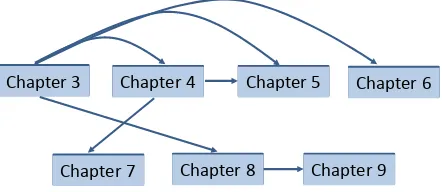
This thesis consists of ten chapters, including the current chapter, the next chapter on theoretical preliminaries, followed by seven main chapters showing main technical results, and the last chapter providing conclusions. The following is a brief outline of the thesis structure as well as the content in each chapter. According to the dif-ferent emphases of research topics and proposed research problems, the seven main chapters (Chapters 3-9) are divided into three parts as shown in the list.
Also, after the introduction of each main chapter (Chapters 3-9), a brief sum-mary of the nature of the collaboration is reported when appropriate. The author is primarily responsible for the contribution of research outcomes in each main chapter. 1. Chapter 1 presents a general introduction to the research background, state-of-art results in the research field, as well as research problems to be discussed in this thesis.
2. Chapter 2 provides certain theoretical preliminaries on graph theory, rigidity theory, gradient systems that will be frequently applied in the discussions of technical results in later chapters.
Part I: Formation control systems: equilibrium and stability analysis
§1.3 Thesis outline and statements of collaborations 7
3. Chapter 3 focuses on equilibrium analysis of the standard rigid formation con-trol system, and establishes a rank-invariant property which provides more insights on the stability and dynamics property of such systems.
This is joint work with U. Helmke (University of Würzburg, Germany), and B. D. O. Anderson. Part of the research in this chapter was preformed during a research visit at University of Würzburg, Germany.
4. Chapter 4 aims to establish the exponential stability of the distance error system (definitions will become clear in the context) arising in rigid formation control. The results in this section will be theoretical basis for the robustness analysis for rigid formation control systems in the presence of mismatched distances, as discussed in Chapter 5.
This is joint work with B. D. O. Anderson, S. Mou (Purdue University, USA) and M. Cao (University of Groningen, The Netherlands).
Part II: Formation control systems: some practical considerations
This part consists of Chapter 5, Chapter 6 and Chapter 7.
5. In Chapter 5, we discuss the robustness issues in 3-D rigid formation control systems 5 with mismatched distances, investigate the rigid motion property induced by distance mismatches, and explore how such mismatches can be used to steer a rigid formation.
This is joint work with A. S. Morse (Yale University), B. D. O. Anderson, S. Mou (Purdue University, USA). Part of the research in this chapter was done during a research visit at Yale University.
6. Chapter 6 discusses the stabilization control problem of rigid formations with desired shapes and prescribed orientations. The main contributions are a de-scription of the formation controller, the proof of the minimum number of agents with knowledge of global coordinate orientation, and the stability anal-ysis.
This work is a collaboration of B. D. O. Anderson, M.-C. Park and H.-S. Ahn from Gwangju Institute of Science and Technology (GIST), South Korea. Part of the research in this chapter was preformed during a research visit to GIST.
7. Chapter 7 explores the quantization effect on rigid formation control, motivated by the fact that many distributed control systems are equipped with digital sen-sors and actuators which only produce quantized measurements or feedbacks. This work is a collaboration with H. Garcia de Marina (École nationale de l’aviation civile, France), B. D. O. Anderson, and M. Cao (University of Groningen, The Nether-lands). Part of the research in this chapter was finished during a research visit at University of Groningen.
5The robustness issues for 2-D rigid formation control systems are discussed in a joint paper [Mou
Chapter 3 Chapter 4 Chapter 5 Chapter 6
Chapter 9 Chapter 8
[image:34.595.166.387.117.213.2]Chapter 7
Figure 1.1: An overview of relations between the main chapters.
Part III: Distributed coordination control: general system models
This part consists of Chapter 8 and Chapter 9.
8. Chapter 8 extends several results on equilibrium analysis of single-integrator formation systems discussed in previous chapters (in particular in Chapter 3) to rigid formation systems modelled by double integrators. To be specific, we consider two types of double-integrator formation systems in this chapter, namely, formation stabilization systems and flocking control systems. Some in-variance principles and links between single-integrator formation systems and double-integrator formation systems will be established, such that the results in previous chapters on single-integrator systems can be applied to the study of double-integrator systems.
The results in this chapter are from joint work with B. D. O. Anderson, M. Deghat (University of New South Wales) and H.-S. Ahn (GIST, South Korea).
9. Chapter 9 considers a very general yet fundamental problem in multi-agent coordination control, namely the formation feasibility of distributed control in the presence of both formation constraints from the global task level, and kinematic constraints from each agent. The agents’ dynamics are modelled by affine control systems with possible drift terms, which include single-integrator models and double-integrator models as special cases. Some control problems in previous chapters can also fit in this general framework. We derive an alge-braic condition to guarantee the existence of feasible formations for such group of agents, and propose a systematic way to generate feasible trajectories for a group of heterogeneous agents.
The results are from close collaboration and extensive discussions with B. D. O. An-derson. We also appreciate insightful discussions with S. Drake (Australian Defence Science and Technology Group) on this problem, and his feedbacks on how this control framework can be used in the coordination control of multiple constant-speed UAVs. 10. Chapter 10 presents a short summary of the main results and contributions of
Chapter2
Theoretical preliminaries
This chapter introduces several essential concepts and theoretical foundations on graph theory, rigidity theory and gradient systems that will be frequently applied in later chapters. We also review gradient descent formation control for stabilization of rigid formation shapes [Krick et al., 2009] in the last section of this chapter, which will be revisited in several chapters in this thesis.
2
.
1
Notations
The notations used in this thesis are fairly standard. A real valued function f is called a Cr function if it has continuous firstr derivatives. We useRn to denote the n-dimensional Euclidean space, andRm×n to denote the set of m×n real matrices. The transpose of a matrix or vector M is denoted by M>. The rank, determinant, image (i.e., column space) and null space of a matrix M are denoted by rank(M), det(M), Im(M) and null(M), respectively. For a vector v, the symbol kvk denotes its Euclidean norm. We use span{v1,v2,· · · ,vk}to represent the subspace spanned by a set of k vectors v1,v2,· · · ,vk. We denote the n×n identity matrix and zero matrix as In×nand0n×n, respectively. Let1n and0n be then-dimensional vectors of all ones and all zeros. When the subscripts for In×n,0n×n,1n or0nare omitted, their dimensions should be clear in the context.
The inertia of a matrix M ∈ Rn×n is given by the triple {
ν+,ν−,ν0}, where ν+
(respectively, ν−) denotes the number of unstable (respectively, stable) eigenvalues
of M in the open right (respectively, left) complex half plane, and ν0 denotes the number of eigenvalues with zero real part (see e.g. [Carlson and Schneider, 1963]). The symbol ⊗ denotes Kronecker product. SE(d) and SO(d) denote the special Euclidean group and the special orthogonal group, respectively.
Note in later chapters we may use additional notations that will be solely used in that particular chapter. This will be made clear in the corresponding chapter.
2
.
2
Preliminary on graph theory
Consider an undirected graph with m edges and n vertices (or nodes), denoted by
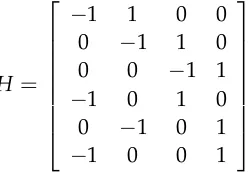
G = (V,E)with vertex set V = {1, 2,· · · ,n}and edge setE ⊂ V × V. The neighbor set Ni of node i is defined as Ni := {j ∈ V : (i,j) ∈ E }. The matrix relating the nodes to the edges is called the incidence matrix H = {hij} ∈ Rm×n, whose entries are defined as (with arbitrary edge orientations)
hij =
1, thei-th edge sinks at node j;
−1, thei-th edge leaves node j;
0, otherwise.
Another important matrix representation of a graph G is the Laplacian matrix L(G) [Mesbahi and Egerstedt, 2010]. For an undirected graph, the associated Laplacian matrix can be written as L(G) = H>H. For a connected undirected graph, one has rank(L) = n−1 and null(L) = null(H) = span{1n}. For more introductions on algebraic graph theory and their applications in distributed and networked control, we refer the readers to [Bapat, 2010] and [Mesbahi and Egerstedt, 2010].
2
.
3
Preliminary on rigidity theory
2.3.1 Definitions and properties
Let pi ∈ Rd denote a point that is assigned to i ∈ V in the d-dimensional Euclidean spaceRd. 1 The stacked vector p = [p>1, p2>,· · · , p>n]>∈ Rdn represents the realiza-tion ofGinRd. The pair(G,p)is said to be aframework(or aformation, in our context of formation control) ofG in Rd. By introducing the matrix ¯H := H⊗Id ∈ Rdm×dn, one can construct the relative position vector as an image of ¯H from the position vector p:
z= H p¯ (2.1)
where z = [z1>, z2>,· · · , z>m]> ∈ Rdm, with z
k ∈ Rd being the relative position vector for the vertex pair defined by thek-th edge.
Consistent with the assumed ordering of the edges in E, the distance function rG(p):Rdn →Rm associated with the framework(G,p)is given as:
rG(p) = 1
2
· · · ,kpi−pjk2,· · · >
, (i,j)∈ E (2.2) in which thek-th component inrG(p), 12kpi−pjk2, corresponds to half of the squared length of the relative position vectorzk which connects the vertices iand j. We first show the definitions ofcongruenceandequivalenceof two frameworks(G,p)and(G,q) (see e.g. [Asimow and Roth, 1978], [Eren et al., 2003]).
1In this thesis we will mostly considerd∈ {2, 3}. Some results obtained in the following chapters
§2.3 Preliminary on rigidity theory 11
Definition 1. (G,p)and(G,q)are equivalent if they have the same edge lengths, i.e.,kpi−
pjk=kqi−qjk,∀(i,j)∈ E.
Definition 2. (G,p)and(G,q)are congruent if kpi−pjk=kqi−qjk,∀i,j∈ V.
We refer the readers to [Connelly and Guest, 2015] for more discussions and examples on framework equivalence and framework congruence. The rigidity of frameworks is then defined as follows.
Definition 3. ([Asimow and Roth, 1979]) A framework(G,p)is rigid inRdif there exists a
neighborhoodUof p such that r−G1(rG(p))∩U= r−K1(rK(p))∩UwhereKis the complete
graph with the same vertices asG.
The above definition may seem to be too technical, but there is an intuitive inter-pretation by using concepts fromjointsandbarsin a structure. The notion of rigidity then corresponds to the undeformability of a structure of joints and bars [Hendrick-son, 1992]. In other words, when the only allowed smooth motions are those that preserve the distance between every pair of joints, the framework is said to be rigid. Otherwise it is flexible. Figure 2.1 shows several examples of two-dimensional rigid and non-rigid formations. The definition of minimal rigidity that is also shown in Figure 2.1 will be given in the next section.
2.3.2 Rigidity matrix and related results
In the following, the set of all frameworks (G,p) which satisfies the distance con-straints is referred to as the target formation. One useful tool to characterize the rigidity property of a framework is the rigidity matrix R∈ Rm×dn, which is defined as
R(p) = ∂rG(p)
∂p (2.3)
It is not difficult to see that each row of the rigidity matrixRtakes the following form [01×d,· · · ,(pi−pj)>,· · · ,01×d,· · · ,(pj−pi)>,· · · ,01×d] (2.4) Each edge gives rise to a row of R, and, if an edge links vertices i and j, then the nonzero entries of the corresponding row of Rare in the columns from di−(d−1) todiand fromdj−(d−1)todj.
We indicate a simple expression for the rigidity matrix which involves both the network topology and position configuration. Recall (2.1), which shows that the relative position vector lies in the image of ¯H. The distance function is a map from the node positions to the squared edge lengths. Thus we can redefine the distance function, gG(z) : Im(H)¯ → Rm as gG(z) = 12
kz1k2,kz2k2,· · · ,kzmk2 >
and (2.3), one can obtain the following simple form for the rigidity matrix
R(p) = ∂rG(p) ∂p =
∂gG(z)
∂z ∂z
∂p (2.5)
=
z>1 · · · 0 ..
. . .. ... 0 · · · z>m
H¯
= Z>H¯ (2.6)
where Z = diag{z1, z2,· · · ,zm} ∈ Rdm×m. It is obvious that the entries of R(p)are also functions ofz, and we will also write it asR(z).
Now we introduce an important concept in graph rigidity theory called infinites-imal rigidity. In order to understand infinitesimal rigidity, we first introduce the notion of infinitesimal motion. Consider the position of each vertex as a differen-tiable function oft (which can be the time) and supposekpi(t)−pj(t)k2 = constant for every (i,j) ∈ E. By differentiating the edge length constraints one can obtain (vi−vj)>(pi−pj) = 0, where vi is the instantaneous velocity of vertex i. An as-signment of velocities that satisfies such an equation for a particular framework is called an infinitesimal motion of that framework [Hendrickson, 1992]. The definition of infinitesimal rigidity for a framework is given as follows (see e.g., [Hendrickson, 1992; Hendrickx, 2008]).
Definition 4. A framework is infinitesimally rigid if all its infinitesimal motions are special
Euclidean motions.
The rigidity matrix is useful to determine the infinitesimal rigidity of a frame-work, as shown in the following theorem.
Theorem 1. ([Hendrickson, 1992]) Consider a framework(G,p)in the d-dimensional space
with n≥d vertices and m edges. It is infinitesimally rigid if and only if
rank(R(p)) =dn−d(d+1)/2 (2.7) Specifically, under the condition that n ≥ d as shown in Theorem 1, the frame-work(G,p)is infinitesimally rigid inR2(resp.R3) if and only ifrank(R(p)) =2n−3 (resp. rank(R(p)) = 3n−6). Obviously, in order to have an infinitesimally rigid framework, the graph should have at least 2n−3 (resp. 3n−6) edges in R2 (resp.
R3). If the framework is infinitesimally rigid inR2 (resp. R3) and has exactly 2n−3 (resp. 3n−6) edges, then it is called a minimally and infinitesimally rigid framework. In the examples shown in Figure 2.1, two of which are rigid and one of which is non-rigid. In a non-rigid formation, part of the formation can flex or move, while the rest of the formation remains stationary, and all distance constraints remain satis-fied. Examples of a non-infinitesimally-rigid framework and an infinitesimally rigid framework are shown in Figure 2.2.
§2.3 Preliminary on rigidity theory 13
(a)
3
2
4
(b)
3
2
4
1
1
(c)
3
2
4
1
Figure 2.1: Examples of rigid and non-rigid formations. (a) non-rigid formation (a deformed formation with dashed lines is shown); (b) minimally rigid formation; (c)
rigid but non-minimally rigid formation.
2
(b)
3
2
3
1
1
(a)
Figure 2.2: Examples of a non-infinitesimally-rigid framework and an infinitesimally rigid framework. (a) A rigid but not infinitesimally rigid framework. The collinear positions of the three nodes lead to rank(R) = 1 < 3. The red arrow indicates a
Lemma 1. If the framework(G,p)is minimally and infinitesimally rigid in the d-dimensional space, then the matrix R(z(p))R(z(p))>is positive definite.
The following result will be useful for later analysis, which shows that there exists a smooth function which maps the distance set of the minimally rigid framework to the distance set of its corresponding framework modeled by acompletegraph.
Lemma 2. Let rG(q) be the distance function for a given infinitesimally minimally rigid
framework(G,q)with agents’position vector q. Further letrˆGˆ(q)denote the distance function for an associated framework(Gˆ,q), in which the vertex set remains the same as(G,q)but the underlying graph is a complete one (i.e. there exist n(n−1)/2edges which link all vertices). Then there exists a continuously differentiable function f : rG(q) → Rn(n−1)/2 for which
ˆ
rGˆ(q) = f(rG(q))holds locally.
The proof of Lemma 2 is omitted here and can be found in [Mou et al., 2016]. In later chapters, we will frequently revisit Lemma 2 and apply it in the stability analysis for formation control systems with different properties.
We also refer to the paper [Anderson et al., 2008b] and the thesis [Hendrickx, 2008] for a detailed survey on using graph rigidity theory in modelling autonomous formations, and the extensions of graph rigidity theory for undirected graphs to graph persistence theoryfordirectedgraphs.
2
.
4
Gradient systems
2.4.1 Definitions and properties
In this section we briefly review the definition and properties of gradient systems. Let V : Rn → R≥0 be a scalar valued function that is Cr with r ≥ 2. Consider the following continuous-time system
˙
x=−∇V(x) (2.8)
The above system is usually called agradient system, and the corresponding function V(x)is referred to as apotential function.
Gradient system enjoys several convergence properties due to the special struc-ture of the gradient vector field in the right-hand side. Firstly, it should be clear that equilibrium points of (2.8) are critical points ofV(x). Moreover, at any point except for an equilibrium point, the vector field (2.8) is perpendicular to the level sets of V(x). In fact, it is obvious to observe that ˙V(x) = ∇V(x)>x˙ = −k∇V(x)k2 ≤ 0, which indicates that the potentialV(x) is always nonincreasing along the trajectory of (2.8). The following results are also obvious.
Lemma 3. Consider the gradient system(2.8)with the associated potential V(x).
§2.5 Gradient descent control law for rigid formation stabilization 15
• Supposex is an¯ isolated minimumof a real analytic V(x), i.e., there is a neighbor-hood of x that contains no other minima of V(x). Then¯ x is an asymptotically stable¯ equilibrium point of (2.8).
The proof of the above lemma can be found in e.g. [Wiggins, 2003, Chapter 15]. Note that in the second statement we have emphasized the condition isolated mini-mumin the convergence property. As we will see in later chapters, for most formation control systems, their equilibrium points are not isolated but are continuum equilib-ria that form equilibrium orbits, which complicates the stability analysis. These will be made clear in the context.
We also refer the readers to the book [Wiggins, 2003, Chapter 15] and the thesis [Lageman, 2007] for more introductions and properties on gradient vector fields and gradient systems.
2.4.2 Real analyticity and local minimum
Note that a local minimum ofVis not necessarily a stable equilibrium point of (2.8), unless some more properties on the potentialV are imposed (while the smoothness of the potential V is not enough). In [Absil and Kurdyka, 2006], several examples (and counterexamples) are carefully constructed to show the relationship between local minima of V and stable equilibrium points of (2.8). In particular, it is shown in [Absil and Kurdyka, 2006] that with the analyticity 2 of the potential V, local minimality becomes a necessary and sufficient condition for stability.
Theorem 2. ([Absil and Kurdyka, 2006]) Let V be real analytic in a neighborhood of an
equilibrium x¯ ∈Rn. Then, x is a stable equilibrium point of¯ (2.8) if and only if it is a local minimum of V.
2
.
5
Gradient descent control law for rigid formation
stabi-lization
The control goal in formation shape stabilization is to drive all the agents to reach a configuration such that a certain set of inter-agent distances can be achieved. We denote the target distance between agent i and its neighboring agent j as dkij, for which the agent pair i and j should work cooperatively to achieve. The typical structure of the formation potential function is defined by
V(p1,· · · ,pn) = 1
4{i,j
∑
}∈E(kpi−pjk 2−d2kij)2 (2.9)
It is obvious that the value of the above potential function for a formation is invari-ant if the given formation undergoes translation, rotation or reflection. By assuming 2A real function is analytic if it possesses derivatives of all orders and agrees with its Taylor series