Ames Laboratory Publications
Ames Laboratory
5-1-2000
An extended model of the Barkhausen effect based
on the ABBM model
D. M. Clatterbuck
Iowa State University
V. J. Garcia
Iowa State University
M. J. Johnson
Iowa State University
David C. Jiles
Iowa State University, [email protected]
Follow this and additional works at:
http://lib.dr.iastate.edu/ameslab_pubs
Part of the
Electromagnetics and Photonics Commons
, and the
Engineering Physics Commons
The complete bibliographic information for this item can be found at
http://lib.dr.iastate.edu/
ameslab_pubs/158
. For information on how to cite this item, please visit
http://lib.dr.iastate.edu/
howtocite.html
.
An extended model of the Barkhausen effect based on the ABBM model
Abstract
The Barkhausen model of Alessandro et al. [ J. Appl. Phys.
68
, 2901 (1990)] has been extended to
nonstationary domain walldynamics. The assumptions of the original model limit, its use to situations where
the differential permeability, and time derivative of applied field are constant. The later model of Jiles et al.
assumes that the Barkhausen activity in a given time interval is proportional to the rate of change of
irreversible magnetization which can be calculated from hysteresis models. The extended model presented
here incorporates ideas from both of these. It assumes that the pinning field and domain wall velocity behave
according to the Alessandro model, but allows the rate of change of the magnetic flux to vary around a moving
average which is determined by the shape of the hysteresis curve and the applied magnetic field wave form. As
a result, the new model allows for changes in permeability with applied field and can also reproduce the
frequency response of experimental Barkhausen signals.
Keywords
CNDE, Barkhausen effects, Domain walls, Magnetic hysteresis, Magnetic fields, Magnetic flux
Disciplines
Electromagnetics and Photonics | Engineering Physics
Comments
The following article appeared in
Journal of Applied Physics
87 (2000): 4771 and may be found at
http://dx.doi.org/10.1063/1.373154
.
Rights
Copyright 2000 American Institute of Physics. This article may be downloaded for personal use only. Any
other use requires prior permission of the author and the American Institute of Physics.
An extended model of the Barkhausen effect based on the ABBM model
D. M. Clatterbuck, V. J. Garcia, M. J. Johnson, and D. C. Jiles
Citation: Journal of Applied Physics 87, 4771 (2000); doi: 10.1063/1.373154
View online: http://dx.doi.org/10.1063/1.373154
View Table of Contents: http://scitation.aip.org/content/aip/journal/jap/87/9?ver=pdfcov
Published by the AIP Publishing
Articles you may be interested in
Modeling the effects of nanosized precipitates on magnetic hysteresis and Barkhausen effect signal
J. Appl. Phys. 111, 07D109 (2012); 10.1063/1.3672403
Analysis of Barkhausen effect signals in surface-modified magnetic materials using a hysteretic-stochastic model
J. Appl. Phys. 99, 08B705 (2006); 10.1063/1.2163272
Examination of the relationship between the parameters of Barkhausen effect model and microstructure of magnetic materials
J. Appl. Phys. 91, 7651 (2002); 10.1063/1.1453312
Study of magnetization processes and the generation of magnetoacoustic and Barkhausen emissions in ferritic/pearlitic steel
J. Appl. Phys. 85, 5193 (1999); 10.1063/1.369121
Effect of plastic strain on magnetic and mechanical properties of ultralow carbon sheet steel
J. Appl. Phys. 81, 4263 (1997); 10.1063/1.364796
An extended model of the Barkhausen effect based on the ABBM model
D. M. Clatterbuck,a)V. J. Garcia, M. J. Johnson, and D. C. Jilesb)
Ames Laboratory and Center for Nondestructive Evaluation, Iowa State University, Ames, Iowa 50011
The Barkhausen model of Alessandro et al.关J. Appl. Phys. 68, 2901共1990兲兴has been extended to nonstationary domain wall dynamics. The assumptions of the original model limit, its use to situations where the differential permeability, and time derivative of applied field are constant. The later model of Jiles et al. assumes that the Barkhausen activity in a given time interval is proportional to the rate of change of irreversible magnetization which can be calculated from hysteresis models. The extended model presented here incorporates ideas from both of these. It assumes that the pinning field and domain wall velocity behave according to the Alessandro model, but allows the rate of change of the magnetic flux to vary around a moving average which is determined by the shape of the hysteresis curve and the applied magnetic field wave form. As a result, the new model allows for changes in permeability with applied field and can also reproduce the frequency response of experimental Barkhausen signals. © 2000 American Institute of Physics.
关S0021-8979共00兲77908-4兴
I. INTRODUCTION
Irreversible changes in magnetization occur when a do-main wall moves suddenly from one local minimum in the free energy to another, causing discontinuous changes in the magnetization known as Barkhausen events. These discon-tinuous changes can be detected by selecting the components of the voltage induced in a coil encircling a sample over a given frequency range, usually in the range of tens to hun-dreds of kilohertz, while the sample is being magnetized. These components of voltage are linearly proportional to the discontinuous rate of change of flux in accordance with Fara-days’ law. As a result of the dependence of domain wall motion on the local conditions in the material through which the wall is moving, the Barkhausen effect has found use for probing both the microstructure and stress state of materials.
II. REVIEW OF EXISTING MODELS
A description of the domain wall dynamics giving rise to the Barkhausen effect has been proposed by Alessandro, Beatrice, Bertotti, and Montorsi1共ABBM兲. In this model the rate of change of magnetic flux˙ can be expressed as
G˙⫽H⫺Hs, 共1兲
where is the electrical conductivity, G is a dimensionless coefficient 共which reduces to G⫽0.1356 if a wide slab is considered兲, and H is the local magnetic field. As the domain wall moves through a material it will experience an effective local pinning field Hcwhich is the result of interactions with
discontinuities in the structure of the material. Hcis assumed
to be a random function of the domain wall position. The interaction range of the domain wall with a given
disconti-nuity in the material can be described by a correlation distance1, which represents the equivalent change in flux over the range of interaction
dHc
d ⫹
H0⫺
具
Hc典
⫽
dW
d, 共2兲
where the white noise function W() is characterized by
具
dW典
⫽0,具
兩dW兩2典
⫽2Ad, with A being a coefficient which describes the variance of the fluctuations. Owing to the sta-tionary assumptions of the model, both the power spectrum and amplitude probability distribution have analytical solu-tions in many regimes. Agreement of the ABBM model with experiments shows that the dynamics of a system with many interacting domain walls can be described by simply consid-ering the statistical behavior of a single domain wall. How-ever, the ABBM model is derived only for a limited case and is restricted to Barkhausen signals at constant applied field rates and in a small region of the hysteresis loop near the coercive point where the permeability is constant. It should also be noted that the model equations are restricted to soft magnetic materials where rⰇ1.Models which describe the Barkhausen effect over the entire hysteresis loop have been proposed by Sablik and Au-gustymak 2and Jiles, Sipahi, and Williams3共JSW兲and sub-sequently developed further.4,5 This latter model assumes that the rate of irreversible change in magnetization is pro-portional to the level of Barkhausen activity in a given time interval. While not explicitly stated, this implies that the Barkhausen signal is the result of a linear combination of many individual events occurring at different locations within in the material. In order to account for the random nature of the Barkhausen effect, it was suggested that the number of Barkhausen events in a given time period N(tn) is related to the to the number of events in the previous time period N(tn⫺1) by some random increment. This increment
is small enough to ensure that the number of events remain correlated with those in the previous time period. Since the number of possible locations for a Barkhausen event to occur
a兲Present address: Lawrence Berkeley National Lab and Dept. of Materials
Science and Mineral Engineering, University of California, Berkeley, CA 94720.
b兲Electronic mail: [email protected]
JOURNAL OF APPLIED PHYSICS VOLUME 87, NUMBER 9 1 MAY 2000
4771
0021-8979/2000/87(9)/4771/3/$17.00 © 2000 American Institute of Physics
in the material is large, but the probability that an event occurs at a specific point in the material is low, Poisson statistics describe the variation of the number of events from one time period to the next. This leads to a model equation of the form
M˙JS共tn兲⫽共Mdisc兲irr
⬘
H˙关N⬘
共tn⫺1兲⫹␦冑
N⬘
共tn⫺1兲兴, 共3兲where MJSrepresents the Barkhausen activity in terms of the
‘‘jump sum’’ as discussed by Swartzendruber et al.,6
具
Mdisc典
is the average jump size, irr
⬘
is the irreversible differential susceptibility, H is the rate of change of magnetic field with time, and ␦ is a random number with a mean value of zero and a standard deviation of unity. The advantage of this model is that it is able to describe the Barkhausen effect at all points on the hysteresis curve and under the action of a vari-able rate of change of applied field and thus does not require the assumption of a stationary process.Consider the ABBM model in the particular case where
→⬁. This corresponds to an unlimited range of correlation between the domain wall and a given pinning site in the material, or alternatively to a sufficiently slow domain wall velocity. Equation共2兲then reduces to dHc⫽dW, which can
also be expressed as dHc⫽␦
冑
2Ad, where ␦ is again anormal distribution with a mean of zero and a variance of unity. Following the earlier work,1 this leads to
Gd ˙
dt ⫽H ˙
a⫺H˙⬁⫺␦
冑
2Ad, 共4兲where Ha is the applied field and Hm is a correction to the
magnetic field due to magnetostatic or demagnetizing ef-fects. Over short time periods, this equation will be
domi-nated by the third term on the right, and thus if we consider the change induring a short time increment⌬t, we obtain
a simplified ABBM model of the form
˙共tn兲⫽˙共t n⫺1兲⫹␦
冑
2A⌬tG
冑
˙共tn⫺1兲. 共5兲The JSW model described by Eq.共3兲can be rewritten as
M˙JS共tn兲⫽M˙JS共tn⫺1兲⫹␦
冑
共Mdisc兲in⬘
H˙冑
M˙JS共tn⫺1兲, 共6兲which shows that the ABBM model can be reduced to a mathematical structure similar to the JSW model under these conditions.
III. PROPOSED MODEL
In order to arrive at a model that can describe the dy-namics of the Barkhausen events which occur as a sample is magnetized around an entire hysteresis loop, the ABBM equation can be written as
d˙ dt ⫹
˙⫺
具
˙典
⫽⫺
1
G dHc
dt . 共7兲
[image:5.612.341.535.52.152.2]We can see that the original ABBM model describes the variation of ˙ from a constant average value
具
˙典
. This is shown graphically in Fig. 1 for the case of continual domain wall motion. In the proposed model˙ does not have a single average value for all times, but instead it has an ensemble average value which is a function of time,具
˙典
(t). This is equivalent to suggesting that if one applies a cyclic time varying magnetic field, the material will sweep out a hyster-esis curve, and that the fine details of this curve will be different during each cycle due to the statistical nature of the Barkhausen effect. Over many cycles the hysteresis curve atFIG. 1. The ABBM model gives fluctuations around a constant average, while the proposed model describes fluctuations around a moving average.
[image:5.612.61.285.52.154.2]FIG. 2. Comparison of experimental Barkhausen signal and results of model in the time domain.
FIG. 3. The effect ofon the envelope with A chosen to compensate for the
effect of variance. Asis increased the result is an increased broadening
and lag in the envelope.
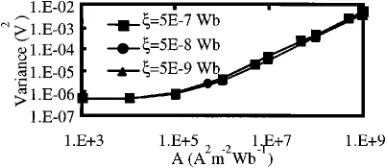
FIG. 4. Effect of A on variance at various values of. For large values of A
the variance increases linearly. There was no effect on the variance due to,
except at small values where there is slight increase in variance with.
4772 J. Appl. Phys., Vol. 87, No. 9, 1 May 2000 Clatterbucket al.
[image:5.612.65.286.628.727.2] [image:5.612.341.535.639.723.2]any given time in the cycle will generally lie close to the average value for that time as in the bottom half of Fig. 1. We can then rewrite the model in terms of deviations from this ensemble average. Since Barkhausen jumps actually cor-respond to irreversible changes in magnetization †irr rather than changes in magnetic induction, we rewrite the model in terms of SIirr rather than , where S is the cross sectional area, where ⫽GSirr. The pinning field Hc is given by
dI˙irr
dt ⫹
I˙irr⫺
具
I˙irr典
⫽⫺
1
GS dHc
dt , 共8兲
where⫽aGSin
⬘
. The pinning field Hc is given bydHc
dIirr⫹
S共Hc⫺
具
Hc典
兲 ⫽
dW
dIirr
, 共9兲
and
具
dW典
⫽0,具
兩dW兩2典
⫽2ASdIirr. 共10兲Due to the nonlinear, multivalued properties of the differen-tial susceptibility, both
具
iirr典
andwill now be functions ofthe position on the hysteresis curve and can be related to time t through the applied field wave form Ha(t) by
具
I˙arr典
⫽0irr⬘
关Ha共t兲兴H˙a共t兲. 共11兲 [image:6.612.85.266.51.167.2]The extended Barkhausen model based on these equa-tions is able to generate signals which closely resemble the experimental data around a hysteresis loop, as shown in Fig. 2.
The first step in modeling the experimental Barkhausen signals from nickel was to select a value of. The effect of
on the Barkhausen voltage ‘‘envelope’’ is shown in Fig. 3. Simulations show that ⫽1⫻105⍀⫺1m⫺1 yields a
Barkhausen envelope which matches well with the experi-mental data.
The effect of the parameters A andon the variance of the Barkhausen signal is shown in Fig. 4. Simulations were also performed with systematically varying values ofand A selected so that the variance was the same as the variance of the experimental data. The power spectral density共PSD兲for
this series of simulations for various values ofare shown in Fig. 5. Agreement with the experimental PSD was found for
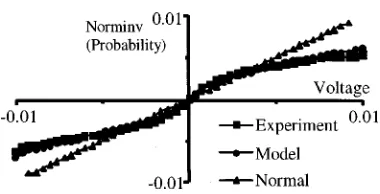
⫽1⫻10⫺8W b. The time domain of this simulation was compared to the experimental results of Fig. 2, and the am-plitude probability distribution for both are shown in Fig. 6. By linearizing the probability with respect to a normal dis-tribution, we find that both the experimental data and the simulation show systematic deviations from a normal distri-bution with the same variance.
IV. CONCLUSIONS
The ABBM model was only derived for cases of con-stant permeability and concon-stant rate of change of applied field at locations near the coercive point. However, the model is able to describe the amplitude distribution and power spectrum of the Barkhausen signal under these re-stricted conditions. The model has been combined with the JSW model, which is applicable at all points on the hyster-esis curve. A more general model therefore results which can describe the fluctuations in Barkhausen emissions around a moving average. Comparisons with experimental data ob-tained on a nickel sample show that the model is able to accurately reproduce the time domain, amplitude probability distribution, and power spectrum of the Barkhausen signal.
ACKNOWLEDGMENTS
This work was supported by the Center for Nondestruc-tive Evaluation, a NSF Industry/University CooperaNondestruc-tive Re-search Center at Iowa State University and by the US De-partment of Energy, Office of Basic Energy Sciences, under Contract No. W-7405-Eng-82.
1
B. Alessandro, C. Beatrice, G. Bertotti, and A. Montorsi, J. Appl. Phys. 68, 2901共1990兲.
2M. I. Sablik and B. Augustyniak, J. Appl. Phys. 79, 963共1996兲. 3D. C. Jiles, L. B. Sipahi, and G. Williams, J. Appl. Phys. 73, 5830共1993兲. 4
A. Mitra and D. C. Jiles, J. Magn. Magn. Mater. 168, 169共1997兲. 5
A. Mitra and D. C. Jiles, IEEE Trans. Magn. 31, 4020共1995兲.
6L. J. Swartzendruber, L. H. Bennett, H. Ettedgui, and I. Aviram, J. Appl.
[image:6.612.343.533.55.152.2]Phys. 67, 5459共1990兲.
FIG. 5. Effect ofon the PSD at constant variance. Asis decreased, the
PSD is flattened.
FIG. 6. Amplitude probability distribution for experimental Barkhausen sig-nal and model. Both the proposed model and experiment results show simi-lar systematic deviations from a normal distribution.
4773
J. Appl. Phys., Vol. 87, No. 9, 1 May 2000 Clatterbucket al.