International Journal of Innovative Technology and Exploring Engineering (IJITEE) ISSN: 2278-3075, Volume-8 Issue-7, May, 2019
Abstract: In the literature local based methods are popular in extracting facial features. The local binary pattern (LBP) and its variants are one of the popular approaches to extract local features more significantly and precisely and they have been using in many image processing applications. The texons based methods also extract local structural information on a micro grid of 2 x 2 and they are very popular in CBIR. This paper has overcome the disadvantages of the existing texton methods by proposing gradient integrated texton matrix (GITM).This paper initially derives a gradient on facial image and then derives textons on the gradient image. The proposed gradient integrated texton matrix (GITM) defined textons by combining the textons derived in TCM and MTH and GITM has overcome the ambiguity issues of MTH in identification of textons and representation issues of minute textons and complex fusing operations of TCM. The proposed GITM represents the blob, triangle and line shapes of 2 x 2 grids and is specially intended for facial image analysis and can achieve higher face recognition rate than other local based methods. The GLCM features derived on GITM integrates the structural, edge, texture and statistical features of facial images more accurately and precisely. The proposed GITM is specially intended for facial image analysis and can express the spatial correlation of textons and can be considered as a generalized visual attribute descriptor. The proposed GITM descriptor is experimented on popular databases and the results are compared with state of art local representative based methods, the experimental results demonstrate the efficacy of the proposed method over the existing ones.
Index Terms: local features; GLCM; blob; triangle; lines; structure.
I. INTRODUCTION
One of the stimulating and motivating problems in the field of computer vision and image analysis is the face recognition (FR). The researchers in the field of computer vision have shown tremendous interest and attention over the last few years in FR methods. This is mainly due to various real time and practical applications of FR in day today life. Initially the FR methods are mainly used to provide a biometric
authentication [1-2]. The FR methods have several advantages over the other bio-metric systems. The other biometric systems like finger prints etc. requires physical touch/ contact between the authentication devices and bio-metric object like finger etc…. The FR does not require this and facial images can be captured easily through powerful cameras even when humans are located at a far
Revised Manuscript Received on May 07, 2019.
B Vamsee Mohan, Rayalaseema University (Research Scholar – Reg. No. PP.COMP.SCI & ENG. 0076C), Associate Professer, PBR Visvodaya Technology and Science ,Kavali, Andhra Pradesh, India Associate Professor, at PBR Visvodaya Technology and Science ,Kavali, and after obtaining B.E (Electronics and Communication Engineering) passed from St Peters Engineering College.
V. Vijaya Kumar , Professor, & Dean , Aurag Group of Institutions, Hyderabad, Telangana, India
distance from the authentication point. And by the time they reach authentication point the FR can be carried out. This is very beneficial and also major requirement for many applications. Further the user will be known an authentication process is being carried out on him through other biometric systems, whereas by using FR the user may not know an authentication has been processing on him. For example by using surveillance cameras the facial images can be captured at a distance, for example before passing through the entrance and recognition process can be carried out automatically. In the literature various face recognition methods are developed. Though lot of research has been carried out in the field of FR, however recognition of a human face in various situations has become one of the challenging problems. The crucial task of any image recognition classification, identification or retrieval is mainly dependent on extraction of discriminative characteristic features from the object or image surface. The face recognition problem can be formulated as follows: Given an input or query face image and a feature database of face images of known individuals, how can we verify or determine the identity of the person in the input image. The efficacy of a FR method greatly depends on the quality of the facial image and FR accuracies drops significantly due to the poor quality of facial images: either due to a variety of facial expressions, subject’s alignment problem to the camera, gaze deviations or facial hair. The facial images can be classified in to two groups: unconstrained and constrained. The unconstrained facial images are captured without any particular background. The FR methods for unconstrained facial images yielded good results to some extent. Today FR methods are derived against different facial expressions, occlusions, and pose variations when compared to the holistic approaches like LBP[3], LTP[4] and LPQ[5]. These algorithms are derived based on Gabor filters, Speeded Up Robust Features (SURF), Scale Invariant Feature Transform (SIFT), and histograms of LBP.
The term texton was introduced long back by julesz [6]. The texton theory has become popular and it has made a significant contribution in texture analysis [7, 8 ], texture classification [9, 10] , age classification [11] and other applications of images [12, 13]. The textons represents the patterns or structure of a micro grid. The texton theory is more dependent on the critical distance between texture elements and textons [14]. A texton is identified if the adjacent texture elements exhibit the exactly similar attributes. In fact some researchers defined texture in terms of textons and spatial arrangement between them.
B Vamsee Mohan, V. Vijaya Kumar
The most popular methods of textons are texton co-occurrence matrices (TCM) [13], multi-texton histogram (MTH) [14] and complete texton matrix (CTM) [15]. The TCM and MTH are derived for CBIR and CTM is for texture classification. This paper proposes an efficient mechanism for generation of texton features and extraction of low level features from textons. The present paper integrates the color, texture and shape features using textons and derives an integrated texton matrix (ITM) that overcomes the disadvantages of TCM and MTH for precise face recognition.
This paper is organized as follows: the section one describes the introduction. The section two elaborates the proposed method. The section three presents results and discussions with major contribution of the paper. The conclusions are presented in section four.
II. PROPOSEDMETHOD
This paper initially derives gradients on facial image and derives GITM. There are many advantages of gradient images and they are listed below:
i. The gradient images hold more number of significant attributes and thus represent facial features more effectively than gray level images.
ii.The gradient played a significant role in many image processing applications, because the visual system of human beings is more sensitive to gradient changes. iii. The gradient images also hold directional
information based on the derivation of gradients, which is not possible in the raw gray level images. This paper initially derives four directional gradients that is two directional gradients in each x and y directions i.e. GXl (towards left) and GXr (towards right); GYt (towards top) and GYb (towards bottom). This paper derived the local primitives in the form of textons on a gradient image.
This paper computes the gradient of each pixel in X (both left and right sides) and Y direction (both top and bottom directions) and computes the average gradient of these two directions and replaces the current pixel value with this gradient value as given in the following equations. The Fig.1 displays a 3x3 window with pixel location.
Fig.1: A 3x3 neighborhood with pixel locations.
(1)
(2)
(3)
(4)
(5)
p(x,y) and G(x,y) represents the gray level intensity of the current pixel and gradient pixel at location x and y respectively. This paper replaces the p(x,y) with G(x,y) and thus the entire image is transformed in to a gradient image with four directions. The proposed GITM (gradient based integrated texton matrix) initially derives gradients on the
facial image with a step length of one. That is each p(x,y) is replaced with G(x,y). Thus the facial image is transformed into a four directional gradient image.
Texton is defined on a grid if two or more pixels contain the same intensity levels. The textons are derived on a 2x2 grid in the literature. The textons defines horizontal lines, vertical lines and diagonal lines when two pixels only have identical gray level values. If three pixels of a 2 x 2 grid have exactly similar grey level values, the textons defines triangles. The textons defines a blob when all four pixels in the 2x2 grid exhibit the same intensity levels. The textons defines a complete hole whenever all four pixels exhibit different levels of intensities.
The advantages of textons are listed below
1. They represent micro features more efficiently on a 2 x 2 grid instead of 3 x 3 windows as in the case of LBP.
2. They represent complex patterns with the help of micro patterns of a 2x2 grid.
3. They can distinguish attributes of color, shape, texture more efficiently and precisely.
4. Textons can be easily integrated with statistical features.
Two popular texton based approaches are texton co-occurrence matrix (TCM) and multi-texton histogram (MTH). The TCM and MTH are derived for content based image retrieval (CBIR) and they attained good retrieval results. The TCM and MTH differ in many respects and they are listed below. The two popular methods the TCM and MTH defined two different types of textons. The TCM has defined textons of type triangles and blob and whereas the MTH has defined the textons of type few lines only. The TCM has defined the following five types of textons as shown in Fig.2.
Fig.2: The textons defined by TCM.
The MTH has defined the following four types of textons as shown in Fig.3.
Fig.3: The textons defined by MTH.
International Journal of Innovative Technology and Exploring Engineering (IJITEE) ISSN: 2278-3075, Volume-8 Issue-7, May, 2019
The TCM approach assigns a zero value to those pixel(s) that are not part of the texton type Ti. To derive final texton image of the original texture image the TCM fuses the five texton type’s images.
Fig.6: The texton image of TCM for Fig.4 (Fusing the texton images of Fig 5).
Fig.7(c) shows the texton type identification in MTH and Fig.7 (d) shows the final texton image of MTH for the image patch of Fig.7 (a).
The advantage of MTH over TCM is it overcomes the fusing operation and scanning the original image n times to identify n-types of textons. The disadvantage of MTH is it may create ambiguity in identifying the texton types as shown in the following Fig.8. The MTH can recognize the texton of micro image patch as T8 or T7 and it creates the ambiguity. The TCM approach overcomes the ambiguity problem, since it defines textons with three identical pixels.
Further TCM approach derived a co-occurrence matrix on texton image and derived gray level co-occurrence matrix (GLCM) feature for efficient CBIR. The MTH approach only derived histograms. This paper after analysis the advantages and disadvantages of TCM and MTH approach derived integrated texton matrix (ITM).
International Journal of Innovative Technology and Exploring Engineering (IJITEE) ISSN: 2278-3075, Volume-8 Issue-7, May, 2019
Fig.10: Identification of texton types of GITM.
The Fig.9 defines the texton types of GITM. The figure 10 shows an 8 x 8 gradient image patch and the frame work of deriving gradient integrated texton image from the gradient texture image is shown in Figure 10(c) and 10(d).The present paper derives co-occurrence matrix on Gradient integrated texton image and this derives GTIM.
The GLCM is one of the oldest and still popular and benchmark proposed by Haralick [28] and it is widely used and integrated with many other models due to its high classification rate. The
GLCM is a second order statistical model. The spatial relationships between grey level tones are well established by GLCM and this is an important and very useful relationship for characterizing texture information more efficiently. The GLCM computation is given below: Let the image grey level ranges from 0 to g-1. Then, GLCM is computed from the coded image by scanning the intensity of each pixel and its neighbours, defined by displacement d and angle ø. The displacement, d could take a value of 1, 2, 3…n whereas an angle, ø is limited 0°, 45°, 90° and 135°. This paper derived four GLCM features on GITCM i) Contrast ii) Correlation iii)
Entropy iv) homogeneity for face recognition purpose on the proposed GITM descriptors.
III. RESULTSANDDISCUSSIONS
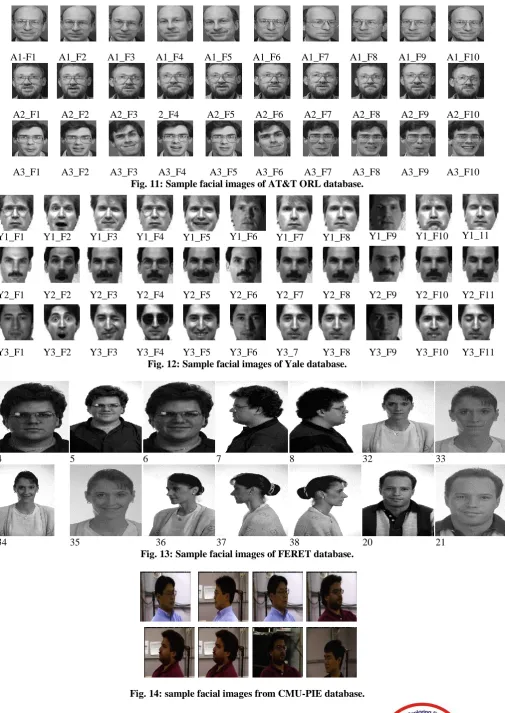
To test the efficacy of the proposed method, this research selected the five popular facial databases namely: ORL[17] ,Yale B[18], FERET[19], CMU Multi-PIE [20], CAS-PEAL [21].The sample images of these databases are shown in Fig.11, 12, 13, 14 and 15 respectively. The brief descriptions about these databases are given below. This research used SVM classifier for FR purpose.
The ORL data set [17] contains images from 40 subjects and each subject contains ten face images. This results a total of 400 (40 x 10) face images in ORL data base. For most of the subjects, the images are captured at different times with varying facial details i.e., with glasses and without glasses; with varying lighting conditions; with varying facial expressions like open/closed eyes, smiling/not smiling, etc. The first 2–6 face images of each subject were used as training samples and the remaining face images were used as test samples. Fig. 11 shows Sample Facial Images of ORL database.
The extended Yale B facial database consists of facial images of 38 different people [18]. Further there are more than 64 facial images per each individual and this lead to a minimum total of 2432 facial images (38*64) under this dataset. This research randomly selected 20 facial images of each person p for training propose and this leads to a total 38*20 =760 images. The remaining facial images are used for testing purpose and sample images of this data set are shown in Fig. 12.
There are two sub categories of facial images under FERET database [19], namely frontal and non-frontal FERET image sets (Fig. 13). This research considered only frontal dataset facial images for experimental sake. The frontal FERET dataset consists of various facial image sets known as Fa, Fb, Fc, duplicate I (DUP I) and duplicate II (DUP II). This research used Fa set facial images of frontal FERET data set for training purpose and the remaining sets are used for testing purpose.
A1-F1 A1_F2 A1_F3 A1_F4 A1_F5 A1_F6 A1_F7 A1_F8 A1_F9 A1_F10
A2_F1 A2_F2 A2_F3 2_F4 A2_F5 A2_F6 A2_F7 A2_F8 A2_F9 A2_F10
A3_F1 A3_F2 A3_F3 A3_F4 A3_F5 A3_F6 A3_F7 A3_F8 A3_F9 A3_F10
Fig. 11: Sample facial images of AT&T ORL database.
Y1_F1 Y1_F2 Y1_F3 Y1_F4 Y1_F5 Y1_F6 Y1_F7 Y1_F8 Y1_F9 Y1_F10 Y1_11
Y2_F1 Y2_F2 Y2_F3 Y2_F4 Y2_F5 Y2_F6 Y2_F7 Y2_F8 Y2_F9 Y2_F10 Y2_F11
Y3_F1 Y3_F2 Y3_F3 Y3_F4 Y3_F5 Y3_F6 Y3_7 Y3_F8 Y3_F9 Y3_F10 Y3_F11
Fig. 12: Sample facial images of Yale database.
4 5 6 7 8 32 33
34 35 36 37 38 20 21
[image:6.595.50.556.45.758.2]Fig. 13: Sample facial images of FERET database.
International Journal of Innovative Technology and Exploring Engineering (IJITEE) ISSN: 2278-3075, Volume-8 Issue-7, May, 2019
To consider facial images with different races and continents the CAS-PEAL facial dataset is used in the recent literature. The CAS-PEAL facial data set consists of chines face dataset with different orientations like pose, expressions, accessories and lighting (PEAL) conditions. This datasets consists of 1040 individual facial images which 595 are male and rest is female. Totally this database consists of 99,594 facial images with different PEAL of each individual. The publically
available CAS-PEAL face dataset is referred as CAS-PEAL R1 facial dataset and it consists of 30,900 facial images of 1040 persons. This data set consists of one training set and six probe sets. The six probe/test facial datasets are denoted as PE, PA, Pl, PT, PB and PS corresponds to variations in expression, accessories, lighting, time, back ground and distance respectively. The sample images of this data are shown in Fig. 15.
CAP1 GLASS1 BLUE RED YELLOW CLOSEEYES SUPRISE
SMILE OPENMOUT
H
[image:7.595.42.563.152.365.2]LIGHT1 LIGHT2 LIGHT3 FM_000046 FY_000007
Fig. 15: Sample facial images of CAS-PEAL database.
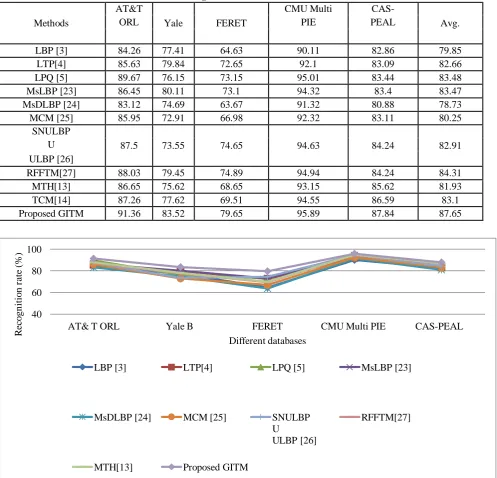
The proposed GITM descriptor is experimented with different d values of GLCM. The best results are obtained for d=2 on the proposed GITM. This research used GITM with d=2 in the remainder of this research. The performance of the proposed descriptor is compared with ten state-of-the-art Face Recognition descriptors: LBP [3], LTP [4], LPQ [5], MsLBP [23], MsDLBP [24], MCM [25], SNULBP UULBP [26], RFFTM [27], MTH [13], TCM [14]. The face recognition rates of the proposed and existing methods on the five different databases are given in Table 1 and plotted in Fig.16.
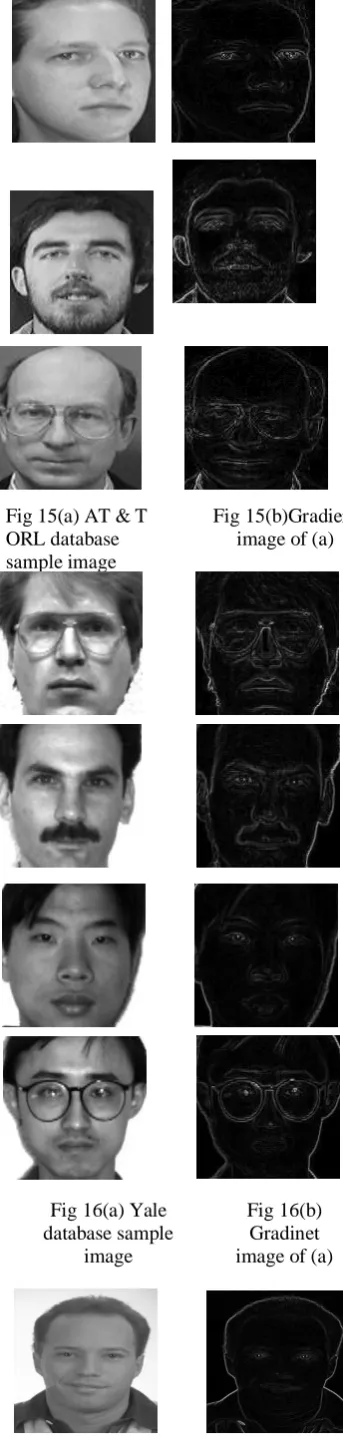
The Fig. 15(a) to 19(a) shows the original images of the databases and the Fig.15 (b) to 19(b) displays the gradient images respectively. The table 1 gives the Face recognition rate of the proposed method and other state of art methods on the above facial databases and the following are noted down. The Figure 16 shows the FR rate of the different methods on the above databases. From the experimental results on the five popular databases of human faces by the proposed GITM and the other state of art local based descriptors, this paper derives the following investigations: Out of the five databases the high face recognition is noted on the CMU Multi PIE and ORL databases by the proposed descriptor; this reveals an important note that the proposed descriptor GITM is capable of extracting facial features more efficiently even if the facial images are taken at different times with varying facial details (with glasses and without glasses) and with fluctuating and unpredictable lighting conditions and facial expressions like ORL data base and the CMU multi PIE face data set images are captured under varying conditions. This reveals the robustness of the proposed GITM method in extracting structural, textural and statistical facial features more efficiently and precisely. The proposed GITM
Fig 15(a) AT & T ORL database sample image
Fig 15(b)Gradient image of (a)
Fig 16(b) Gradinet image of (a)
Fig 16(a) Yale database sample
image
Fig 16(b) Gradinet image of (a)
Fig 17(a) FERET database sample image
Fig 17(b) Gradinet image of (a)
Fig .18(a) Yale database sample
image
[image:8.595.72.509.27.785.2] [image:8.595.329.501.46.691.2] [image:8.595.66.238.51.780.2]International Journal of Innovative Technology and Exploring Engineering (IJITEE) ISSN: 2278-3075, Volume-8 Issue-7, May, 2019
Table 1: Face Recognition rate on considered databases.
Methods
AT&T
Yale FERET
CMU Multi CAS-
Avg.
ORL PIE PEAL
LBP [3] 84.26 77.41 64.63 90.11 82.86 79.85
LTP[4] 85.63 79.84 72.65 92.1 83.09 82.66
LPQ [5] 89.67 76.15 73.15 95.01 83.44 83.48
MsLBP [23] 86.45 80.11 73.1 94.32 83.4 83.47
MsDLBP [24] 83.12 74.69 63.67 91.32 80.88 78.73
MCM [25] 85.95 72.91 66.98 92.32 83.11 80.25
SNULBP
87.5 73.55 74.65 94.63 84.24 82.91
U ULBP [26]
RFFTM[27] 88.03 79.45 74.89 94.94 84.24 84.31
MTH[13] 86.65 75.62 68.65 93.15 85.62 81.93
TCM[14] 87.26 77.62 69.51 94.55 86.59 83.1
Proposed GITM 91.36 83.52 79.65 95.89 87.84 87.65
Fig. 20: Comparison of proposed method with existing methods.
Contribution of the research
1. Derivation of a gradient image that computes gradients in four directions. 2. Derivation of textons on gradient images.
3. Deriving integrated textons that overcomes the ambiguity and complexity of fusing operation.
4. Extraction of local features by integrating the statistical, texture and structural attributes of facial database.
IV. CONCLUSIONS
This paper derived a new scheme GITM by defining textons that describes the blob, triangle, line and hole structures, whereas the popular texton descriptor TCM has only defined triangles and blobs by ignoring the line structures and the other popular texton descriptor MTH only defined line structures. The GITM has also gained advantage of gradient approach and the gradients are computed using four directions instead of two directions. The GITM divided the gradient facial image into micro gradient blocks of size 2 x 2 to overcome the complex fusing operation as in the case of TCM. Further the proposed GITM derived textons of four, three and two identical pixels to overcome the ambiguity
issues in recognizing textons in a 2 x 2 grid as in the case of MTH. The ITM has defined 9 texons instead of five in the case of TCM and four in the case of MTH and that’s why the proposed GITM is more robust and efficient than TCM and MTH. Further the ITM method expressed the spatial correlation of textons and has the discrimination power of texture, color, and shape features more precisely than other methods. Shape and textons have close relationship via fundamental micro-structures of facial images. The experimental results on various databases clearly show the efficacy of the proposed GITM over the other existing methods.
40 60 80 100
AT& T ORL Yale B FERET CMU Multi PIE CAS-PEAL
R
ec
o
gn
it
io
n
r
a
te
(%)
Different databases
LBP [3] LTP[4] LPQ [5] MsLBP [23]
MsDLBP [24] MCM [25] SNULBP
U
ULBP [26]
RFFTM[27]
[image:9.595.49.547.62.540.2]REFERENCES
1 K.-H. Lee and H.-R. Byun, “A new face authentication system for
memory-constrained devices,” IEEE Trans. Consumer Electron., vol. 49,no. 4, pp. 1214-1222, Nov. 2003.
2 F. Zuo and P. H. N. de With, “Real-time embedded face
recognition for smart home,” IEEE Trans. Consumer Electron., vol. 51, no. 1, pp. 183-190, Feb. 2005.
3 Y. Wang, C. Chua, and Y. Ho, "Facial feature detection and face
recognition from 2D and 3D images", Pattern Recognition Letters, vol.23, pp.1191-1202, 2002.
4 D. Maturana, D. Mery and Á. Soto, “Face Recognition with Local
Binary Patterns, Spatial Pyramid Histograms and Naive Bayes Nearest Neighbor Classification”, Proc. in SCCC International Conference of the Chilean Computer Science Society, pp. 125- 132, Chile, 2009.
5 Ojala, T., Pietikäinen, M., Harwood, D.: A comparative study of
texture measures with classification based on featured distributions, Pattern recognition 29(1), 51–59 (1996)
6 Julesz B (1981): Textons, the elements of texture perception, and
their interactions. Nature 290:91-97.
7 T. Chang, C.C. Jay Kuo, Texture analysis and classification with
tree-structured wavelet transform, IEEE Trans. Image Process. 2 (4) (1993) 429–441.
8 H. Zhou, R. Wang, C. Wang, “A novel extended local binary
pattern operator for texture analysis”, Information Sciences 22, 314–4325, 2008.
9 A. Laine, J. Fan, Texture classification by wavelet packet
signatures, IEEE Trans. Pattern Anal. Mach. Intell. 11 (15) (1993) 1186–1191.
10 M. Varma, and A. Zisserman, 2005, “A statistical approach to
texture classification from single images,” International Journal of Computer Vision, vol. 62, no. 1-2, pp. 61-81.
11 Pullela R Kumar, V. Vijaya Kumar, Rampay.Venkatarao, “Age
classification based on integrated approach”. International Journal Of Image, Graphics And Signal Processing (IJIGSP), Vol. 6, Iss.7, 2014, pp. 50-57, ISSN: 2074-9082.
12 S. Alvarez,M.Vanrell, Texton theory revisited: abag-of-words
approach to combine texton,PatternRecognit.45(2012)4312–4325.
13 Guang-Hai Liu∗, Jing-Yu Yang, Image retrieval based on the
texton co-occurrence matrix, Pattern Recognition 41 (2008) 3521 – 3527.
14 Guang-Hai Liu a, LeiZhang b, Ying-KunHou d, Zuo-YongLi c,
Jing-YuYang, Image retrieval based on multi-texton histogram, Pattern Recognition, 43(2010),2380–2389
15 Y.SowjanyaKumari, V. Vijaya Kumar, Ch. Satyanarayana,
Texture Classification Using Complete Texton Matrix, I.J. Image, Graphics and Signal Processing, 2017, 10, 60-68.
16 R. M. Haralick, K. Shanmugam, I. Dinstein, Textural features for
image classification, IEEE Trans. Syst., Man, and Cyber. 3 (1973) 610–621.
17 G. E. Hinton and R. R. Salakhutdinov, “Reducing the
dimensionality of data with neural networks,” Science, vol. 313,
no. 5786, pp. 504–507, 2006.
18 Jain, A.K., Li, S.Z.: Handbook of face recognition, Springer
(2005)
19 A.Georghiades, P.Belhumeur, D.Kriegman, From few to many:
illumination cone models for face recognition under variable lighting and pose, IEEE Trans. Pattern Anal. Mach. Intell.(2001)643–660.
20 P.J.Phillips, H.Wechsler, J.Huang, P.Rauss, The FERET database
and evaluation procedure for face recognition algorithms, Image Vision Comput.(1998) 295–306.
21 T.Sim, S.Baker, M.Bsat, The CMU Pose, Illumination, and
Expression (PIE) database, in: Proceedings of IEEE International Conference on Automatic Face and Gesture Recognition, 2002, pp.46–51.
22 T. Ahonen, E. Rahtu, V. Ojansivu, and J. Heikkila, “Recognition
of blurred faces using local phase quantization,” in Proc. Int. Conf. Pattern Recog., 2008, pp. 1–4.
23 T. Ojala, M. Pietik¨ainen, and T. Maenpaa, “Multi-resolution
gray-scale and rotation invariant texture classification with local binary patterns,” IEEE Trans. Pattern Anal. Mach. Intell., vol. 24,
no. 7, pp. 971–987, Jul. 2002.
https://doi.org/10.1109/TPAMI.2002.1017623
24 W. Wang, W. Chen and D. Xu, "Pyramid-Based Multi-scale LBP
Features for Face Recognition," 2011 International Conference on Multimedia and Signal Processing, Guilin, Guangxi, 2011, pp. 151-155.
25 N. Jhanwar, S. Chaudhuri, G. Seetharaman, B. Zavidovique
‘Content based image retrieval using motif cooccurrence matrix’,
Image and Vision Computing 22 (2004) 1211–1220.
26 K.Srinivasa Reddy, V.Venkata Krishna, B.Eswara Reddy, “Face
Recognition using the combination of Significant non uniform local binary patterns”, ICGST-Graphics, Vision and Image Processing (GVIP), ISSN: 1687-398X, 15(1), June-2015, pp: 1-8.
27 B Vamsee Mohan , V.Vijaya Kumar, “Face Recognition using
Robust Fuzzy Based Fundamental Texture Matrix (RFFTM) “, Jour of Adv Research in Dynamical & Control Systems, Vol. 10, 15-Special Issue, 2018
Author’s Profile
Mr. B Vamsee Mohan is working as Associate Professor, at PBRVisvodaya Technology and Science ,Kavali, and after obtaining B.E (Electronics and Communication Engineering) passed from St Peters Engineering College affiliated to Madras University 1999 and M.Tech. from JNTU , Kakinada in 2007 . At present he is pursing Ph.D. from Rayalaseema University under the guidance of Dr.V.Vijaya Kumar, Dean- of CSE & IT and Director for Advanced Computational Research (CACR) Labs of AGI, Hyderabad. He has published 6 research papers.