International Journal of Innovative Technology and Exploring Engineering (IJITEE) ISSN: 2278-3075, Volume-8 Issue-7, May, 2019
Abstract: The ordinary Portland cement (OPC) production increasing worldwide and it is necessary to reduced CO2 generation. It needs to increase the blended cement by addition of supplementary cementitious material such as industrial and agricultural byproduct. The effect of Fly Ash (FA) and Rice Husk Ash (RHA) as partial substitute of OPC on the properties of cement paste and packing density were describes in this research paper. The cement was replaced by 5% to 30% FA and RHA for double blended cement paste. And for triple blended cement paste replaced by 15% to 40% of FA and RHA combination were used. The particle packing density, void ratio, water film thickness and all general properties of cement test were conducted. The result shows that an increase in strength and particle packing density of triple blend cement paste with a lower void ratio. Hence, by using such industrial and agricultural byproducts in the triple blend were useful for reduces the consumption of OPC and making the sustainable concrete.
Index Terms: Cement, Packing density, Fly Ash, Rice Husk Ash.
I. INTRODUCTION
In the construction field concrete is highly utilized material all over the world. The demand for concrete is increasing day by day from developing countries. Concrete demand in
special categories such as high-performance,
self-compacting, high strength, and roller compacted concrete for many industries as highways, bridges, tunnels, and dam. These types of concrete were required special mix design and the high cost of achieving such quality. Hence, many researchers were doing the work on high-performance concrete by using different aspect such as changing microstructure of concrete, particle packing density, ternary blend concrete with different industrial and agricultural by-products. The industrial and agricultural byproduct can be utilized such as Fly Ash (FA) and Rice Husk Ash (RHA) as partial replacement of cement in concrete[1],[2]. The fly ash mainly generated from burning of coal in power plant at huge quantity. In India most are coal-based power plant. The
Revised Manuscript Received on May 10, 2019.
Vishvanath N. Kanthe, PhD Scholar, Department of Civil Engineering, National Institute of Technology Raipur, Raipur,Chhattisgarh, India.
Dr.Shirish V. Deo, Associate Professor, Department of Civil Engineering, National Institute of Technology Raipur, Raipur,Chhattisgarh, India.
Dr.Meena Murmu,Assistant Professor, Department of Civil Engineering, National Institute of Technology Raipur, Raipur,Chhattisgarh, India.
record of the central electrical board, New Delhi reported that in the year 2017 the generation of FA was around 169.25 million tonnes from 151 power plants and its generation increases each year[3]. Such huge quantities of FA create an environmental issue like land and water contamination also huge land is wasted as landfill. Hence, utilization of such industrial byproduct as partial replacement of OPC was taken into consideration on priority. India is second largest producer of paddy rice in the World. The rice husk ash was produced from combustion of rice husk at control temperature in an industrialized furnace. In India the generation of RHA was around 5.08 million tonnes[4]. The RHA is highly reactive pozzolanic admixture containing silica which helps for forming CSH gel and improving the packing in concrete. Unfortunately, RHA was mostly utilized for dumping which creates an environmental problem. Though, the RHA is enhancing the properties of concrete[5]. The utilization of FA and RHA in construction industries is the major interest of research[6]. The main objective of this research work is to study the effect of FA and RHA as partial substitute of OPC on the properties of cement and packing density.
A. Particle Packing Density Approach
The packing density is the ratio of the volume of solid to total volume. From the literature, it was shown that most of the researcher worked on packing density of course and fine aggregate for mix designed. The ultra-high performance concrete can be made by packing density model developed by F. de Larrard et al. (1994)[7]. The particle packing of cementitious material like silica fume and superfine cement were studied and developed equations for packing density, void ratio, and water film thickness as reported by A. K. H. Kwan et al. (2008)[8]. Very few researches were found on particle packing density of cementitious material. The dense packing of the particle can be achieved by selecting the grouping of sizes so that it reduced voids between the particles at the time mixing of material. This means voids between the bigger particle filled by macro particle and voids between macro particle will be filled by microparticle. The micro size particles are smaller than the capillary pores. They were well isolated and block the capillary pores.
Effect of Fly Ash and Rice Husk Ash as Partial
Replacement of Cement on Packing Density and
Properties of Cement
Cement
This fundamental of particle packing utilized in this research work by using two types of the binder as FA and RHA finer along with OPC. The average size of OPC, FA, and RHA particle was found 32 m, 24 m, and 22 m respectively.
II. EXPERIMENTAL WORK AND RESULT DISCUSSION
A. Material
[image:2.595.324.556.64.185.2]The material used in this research work contains OPC, water, FA, and RHA which is locally available. The FA was arranged from the coal-based thermal power station situated at Bhilai, Chhattisgarh, India, and from the local merchant processed RHA was arranged. The high water reducer admixture was used with the required dose of 0.5% (SP) superplasticizer on the basis various trial tests. Table 1 shows the chemical elemental content and physical properties of the FA, RHA, and OPC.The Fig. 1 (a), (b), and (c) illustrate the microstructure of RHA, FA, and OPC particle. The rough surface of RHA particle were shown in Fig. 1 (a), the same structure was found by other experts[9]. The Fig. 1 (b) shows the rounded particle of FA which assists to enhance to fresh properties. The Fig. 1 (c) shows the uneven surface of the OPC particle.
Table 1. Chemical and physical properties of material. Chemicals
Elemental Contents (%)
(Si) (Ca) (Al) (Fe) (Mg) (K) (Na)
FA 62.1
7
1.12 23.2 4
5.0 1
0.48 2.4 6
0.21
RHA 92.7
1
1.84 0.70 1.1 2
0.47 2.2 5
0.08
OPC 16.3
0
67.5 2
4.75 3.6 5
1.57 2.5 2
0.45
FA RHA OPC
Specific Gravity 2.22 2.3 3.14 Specific surface
area (m2/kg)
456. 8
599. 9
372. 7
(a) (b) (c)
Fig. 1 SEM image of (a) RHA, (b) FA, and (c) OPC particle[1].
B. Particle Size Distribution
The particle size distribution of FA, RHA, and OPC were shown in Fig. 2. The average particle at D10 and D50 were found that 5 m and 32 m for OPC, 2 m, and 20 m for RHA, 3 m, and 22 m for FA particle. It can be viewed as the RHA molecule particle is smallest than FA and OPC. As per concept of particle packing the cementitious material found well graded. That means the voids between cement particle will filled by FA and voids between FA and OPC will filled by RHA hence particle packing density were achieved.
Fig. 2. Particle size distribution.
C. X-Ray Diffraction Test
XRD test were performed to check the morphology of the material used in this research[10],[11]. In this test the 2θ an angle used and number of count measured at an angle of 100 to 800 places the rays of beam stroked on sample. The test results were shown in Fig. 3. It was clearly shows the amorphous silica content presence in the RHA at an angle between the range of 050 to 300. And for FA particle the amorphous and partially crystalline phase has shown. The amorphous silica content were used for forming the hydration product as Calcium Silicate Hydrate (C-S-H) gel which helps for enhance the packing density, strength and durability of cement mortar or concrete.
0 5000 10000 15000 20000 25000
0 10 20 30 40 50 60
C
o
u
n
ts
2θ degree
FA RHA
Fig. 3. XRD Analysis of FA and RHA.
III. MIXPROPORTIONS
[image:2.595.42.292.364.599.2] [image:2.595.315.537.382.505.2]International Journal of Innovative Technology and Exploring Engineering (IJITEE) ISSN: 2278-3075, Volume-8 Issue-7, May, 2019
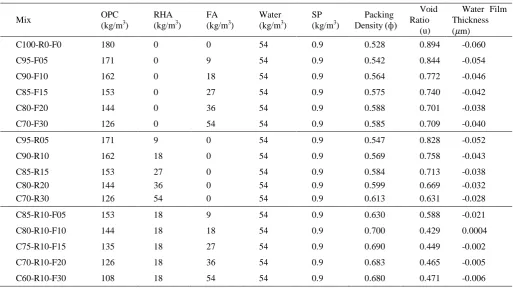
Table 2. Mix proportions, packing density, void ratio and water film thickness of cement Paste.
Mix OPC
(kg/m3)
RHA (kg/m3)
FA (kg/m3)
Water (kg/m3)
SP (kg/m3)
Packing Density (ф)
Void Ratio
(u)
Water Film Thickness ( m)
C100-R0-F0 180 0 0 54 0.9 0.528 0.894 -0.060
C95-F05 171 0 9 54 0.9 0.542 0.844 -0.054
C90-F10 162 0 18 54 0.9 0.564 0.772 -0.046
C85-F15 153 0 27 54 0.9 0.575 0.740 -0.042
C80-F20 144 0 36 54 0.9 0.588 0.701 -0.038
C70-F30 126 0 54 54 0.9 0.585 0.709 -0.040
C95-R05 171 9 0 54 0.9 0.547 0.828 -0.052
C90-R10 162 18 0 54 0.9 0.569 0.758 -0.043
C85-R15 153 27 0 54 0.9 0.584 0.713 -0.038
C80-R20 144 36 0 54 0.9 0.599 0.669 -0.032
C70-R30 126 54 0 54 0.9 0.613 0.631 -0.028
C85-R10-F05 153 18 9 54 0.9 0.630 0.588 -0.021
C80-R10-F10 144 18 18 54 0.9 0.700 0.429 0.0004
C75-R10-F15 135 18 27 54 0.9 0.690 0.449 -0.002
C70-R10-F20 126 18 36 54 0.9 0.683 0.465 -0.005
C60-R10-F30 108 18 54 54 0.9 0.680 0.471 -0.006
VI.PROPERTIESOFCEMENTPASTE A. Normal Consistency
The normal consistency was increased with increasing the percentage of RHA than the control mix as shown in Fig. 4. It was due to the pore and rough surface of RHA. The rough surface of RHA stored water at mixing period due to this the demand for water increase and normal consistency of cement paste was increased. The reserved water in pore then release afterword and it assist to hydration reaction as an inside curing mediator [13]. Whereas, the increasing the percentage of FA normal consistency slightly decrease than the control mix. This was due to the rounded form of FA particle. In the case of ternary blend the normal consistency increases it was because of the pore structure of RHA and maximum specific surface area hence increases water demand.
Fig. 4. Normal consistency result of cement paste.
B. Initial and Final Setting Time
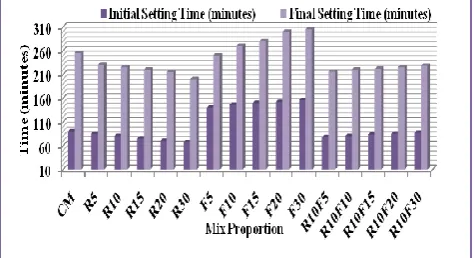
The result of initial and final setting time of double blend
[image:3.595.47.272.585.719.2]Cement
[image:4.595.48.286.63.192.2]
Fig. 5. Initial and Final setting time of cement paste.
C. Soundness
The soundness is an important property of cement. It will give the idea about the volume changes due to the hydration process. This test examines by Le-Chatelier apparatus. In RHA cement paste, FA cement paste and ternary blend the soundness were observed less than 10mm. Hence, it indicates that expansion was less and there will be less chance of cracking. This was because of dense particle packing.
D. Packing Density ( )
The packing density of cementitious material paste by wet method was calculated by the following Eq. (1) developed by (Wang and Kwan 2008)[8]. The results were shown in Table 2.
(1)
Where, (M/V) indicates the bulk density of water- solid mix of cementitious material, (ρw) indicates the density of water and (�, �, and �) respective densities of cementitious material, (uw) indicates the ratio of water volume to solid volume of mix, and (R�, R�, and R�) indicates the volumetric ratio to total solid mix. The maximum particle packing density was found when the total cementitious particle closely packed. The voids between the cement particle filled by FA and voids between FA filled by RHA. The packing density was found in case of the binary blend as increasing the percentage of FA or RHA up to 30% replacement the density increases by 16.09% and voids ratio was decreased by 29.41%. This was due to the filling effect, it was defined as the volumetric fraction of finer elements were lesser than optimal, the coarser elements were overriding and the finer elements enhance the packing density by fill up the voids between the packing of coarser elements[14]. Whereas, if the coarser element volumetric ratio was less than the optimum the fine particle were dominant and coarser elements enhance the packing density by occupy the volume and known as occupying effect. The maximum packing density was found 24.57% for ternary blend paste as (C80-R10-F10) mix than binary blend paste and only cement paste. This was because of the different particle sizes. In comparison with the ternary blend packing density was much higher than the binary blend of paste.
D. Void Ratio ( )
The void ratio defines as the voids volume to solid volume ratio. From the packing density of each mix, the corresponding voids ratio determine from the following Eq.(2)[15],
(2) Where, (�) indicate the voids ratio and (ф) indicate the packing density. The calculated voids ratios were shown in Table 2. The results were shows that in the binary blend the void ratio decreases by 29.41% and 20.69% with the amount of RHA and FA content increases. Similarly in the case of ternary blend the packing density increases by 24.57 % and at the same time void ratio decreases by 52.01 %. It may conclude that the ternary blend reduces the loosening, wall and wedging effect which were responsible for particle packing density. Hence, due to the large reduction of voids correspondingly reduction in water required to fill the voids. The reduction of voids was also useful to the resistance of permeability.
E. Water Film Thickness (T)
The layer of water on the cementitious particle is the water film thickness. The water film thickness of the cement paste can be calculated by following Eq. (3)[15],
(3)
Where, (Acm) indicated as a specific surface area of cementitious material can be calculated by Eq.(4),
(4)
Where, (A.alfa, A.beta, A.gyama) indicates the specific surface area of respective cementitious material. The water film thickness of cement paste calculated results was shown in Table 2. It was seen that most of the result is negative it indicates that water available in cement paste was insufficient required to fill the voids. It was because of the low water-cement ratio. It was also observed that at low water-cement ratio high the packing density was achieved.
V.HARDANPROPERTIESOFCEMENTPASTE A. Compressive Strength
International Journal of Innovative Technology and Exploring Engineering (IJITEE) ISSN: 2278-3075, Volume-8 Issue-7, May, 2019
In the case of triple blend cement paste of cement paste the maximum strength were observed 33.64% than only cement paste. Ternary blend cement paste increases the strength than only cement paste [17],[18]. This was due to the dense particle packing of cementitious material and due to dense C-S-H, C-A-H gel formed in cement paste by FA and RHA.
Fig. 6. Compressive strength result of various mix proportion.
B. Water Absorption
The durability concern the water absorption test was conducted in this research work. The water absorption of concrete specimen were determined by the method illustrate in ASTM-C642-13[19]. This test was performed for to check the permeability of concrete. The 100mm x 100mm x 100mm size cube specimen were selected to perform the water absorption test for all concrete at 28 days. As per the procedure the oven dried specimens were used at the constant temperature of 1100C for 24 hours. Afterword the specimens were put in the water tub, to avoid water absorption. The water absorption percentage of concrete sample were determine at 24 hours intervals by given equation (5)[2],
Water absorption after immersion, (%) = (5)
Where, (A) denote the initial weight of the specimen, (B) denote the weight of the specimen after water absorption. The Fig. 7 describe the water absorption capacity of the cement all proportion of paste mix. The Fig. 7 shows that the increasing the percentage of FA, RHA and combination of both the water absorption decreases drastically around 34%, 42% and 80% respectively as compared to only cement paste. This was because of the high particle packing density. The FA and RHA produced the secondary C-S-H gel it reduced the voids between cement particles. And hence the durability of cement mortar or concrete was increased.
0.00 2.00 4.00 6.00 8.00 C 1 0 0 -R0 -F0 C 8 5 -F 0 5 C 8 0 -F 1 0 C 8 0 -F 1 5 C 7 0 -F 2 0 C 6 0 -F 3 0 C 8 5 -R 0 5 C 8 0 -R 1 0 C 8 0 -R 1 5 C 7 0 -R 2 0 C 6 0 -R 3 0 C 8 5 -R 1 0 -F 0 5 C 8 0 -R 1 0 -F 1 0 C 8 0 -R 1 0 -F 1 5 C 7 0 -R 1 0 -F 2 0 C 6 0 -R 1 0 -F 3 0 Wa te r A b so rp ti o n ( %) Mix Proportions
Fig. 7 Water absorption test result of various mix proportion.
VI. CORRELATION BETWEEN TEST RESULTS
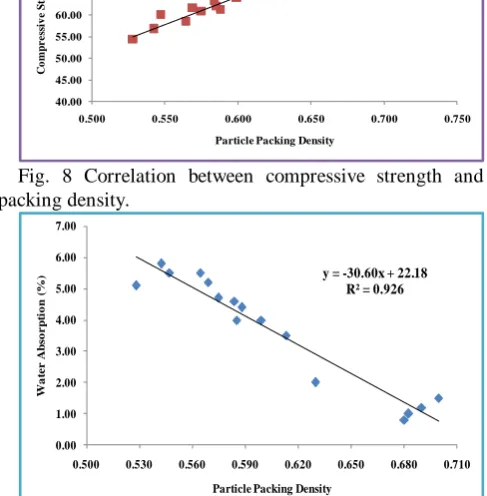
[image:5.595.306.547.52.185.2]The linear rogation equation were plotted for showing the relation between particle packing density and compressive strength, particle packing density and water absorption. The Fig. 8 shows that the relation between packing density and compressive strength were very closer about 0.94 R square value getting. It can be conclude that the particle packing density increases the compressive strength also increased. It was due to the dense concrete matrix formed. The correlation between particle packing density and water absorption, the Fig. 9 shows that as the packing density increase the water absorption decreased with the accuracy of 0.93 R square value. It was happened due to the dense particle packing and reduction in pores. From the correlation regression analysis, it may conclude that the compressive strength and water absorption capacity are depends on particle packing density.
y = 129.1x - 13.24 R² = 0.942
40.00 45.00 50.00 55.00 60.00 65.00 70.00 75.00 80.00 85.00
0.500 0.550 0.600 0.650 0.700 0.750
C o m p r e ss iv e S tr e n g th ( M P a )
Particle Packing Density
Fig. 8 Correlation between compressive strength and packing density.
y = -30.60x + 22.18 R² = 0.926
0.00 1.00 2.00 3.00 4.00 5.00 6.00 7.00
0.500 0.530 0.560 0.590 0.620 0.650 0.680 0.710
Wa te r A b so r p ti o n ( %)
[image:5.595.54.282.133.269.2]Particle Packing Density
[image:5.595.314.550.414.540.2] [image:5.595.306.550.464.712.2]Cement
VII. CONCLUSIONS
The following conclusions were concluded from experimental work,
1) The normal consistency of cement paste was increase with increased in RHA content, it was because of the fine particle, pore and rough structure of RHA. 2) The initial and final setting time of cement paste were
reduced with raise in FA or RHA content. It was because of the high reactivity of RHA and particle packing.
3) The soundness of cement paste was observed less than 10mm. Hence, the FA and RHA cement blend were consider as durable and less chance of cracking.
4) The FA and RHA triple blend cement paste increased the particle packing density. This was because of particles filled the voids between each other. Subsequently the maximum reduction in voids ratio.
5) The voids ratio was decreased with increase in particle packing density. Hence, it will help in reducing permeability and increasing durability. 6) The lower water-cement ratio had achieved high
strength, though the water film thickness was very small. Hence, it could be concluded that water-cement ratio is deciding factor over water film thickness.
7) The maximum strength was achieved with triple-blend cement paste. It was because of dense particle packing, reduction in voids and high reactivity of RHA.
8) The closed correlation shows between compressive strength and water absorption with packing density. Hence, the given regression model is satisfactory. 9) This type of triple blend is strongly recommended for
making the high strength and sustainable concrete.
ACKNOWLEDGEMENT
The writer would like to acknowledge to Technical Education Quality Improvement Program (TEQIP-III), NIT Raipur, for financial support in the form of purchasing the required material. The author acknowledge to Department of Metallurgy, NIT Raipur for help in testing work through Scanning Electron Microscope (SEM).
CONFLICT OF INTEREST
There is no conflict of interest for this research.
REFERENCES
1. V. Kanthe, S. Deo, and M. Murmu, “Combine Use of Fly Ash and Rice Husk Ash in Concrete to Improve its Properties,” Int. J. Eng., vol. 31, no. 7, pp. 1012–1019, 2018.
2. V. N. Kanthe, S. V Deo, and M. Murmu, “Effect of fly ash and rice husk ash on strength and durability of binary and ternary blend cement mortar,”
Asian J. Civ. Eng., vol. 19, no. 8, pp. 963–970, 2018.
3. Central Electricity Authority New Delhi, “Report on Fly Ash Generation at Coal / Lignite Based Thermal Power Stations and its Utilization in the Country for the year 2016-17,” Cent. Electr. Auth. New Delhi, no. December, 2017.
4. International Rice Research Institute (IRRI), “World Rice Statistics, International Rice Research Institute (IRRI) 2017,” 2017. [Online]. Available: http://ricestat.irri.org:8080/wrs World.
5. A. Modarres and Z. Hosseini, “Mechanical properties of roller compacted concrete containing rice husk ash with original and recycled asphalt pavement material,” J. Mater., vol. 64, pp. 227–236, 2014.
6. V. N. Kanthe, S. V Deo, and M. Murmu, “Use of Mineral Admixture in Concrete for Sustainable Development,” Int. J. Innov. Res. Sci. Eng., vol. 3, no. 3, pp. 279–284, 2017.
7. F. de Larrard and T. Sedran, “Optimization of Ultra-High-Performance Concrete by the Use of a Packing Model,” Cem. Concr. Res., vol. 24, no. 6, pp. 997–1009, 1994.
8. A. K. H. Kwan and H. H. C.Wong, “Packing density of cementitious materials : part 2 — packing and flow of OPC + PFA + CSF,” Mater. Struct., vol. 41, pp. 773–784, 2008.
9. L. A. Bui, C. Chen, and Hwang, “Effect of silica forms in rice husk ash on the properties of concrete,” Int. J. Miner. Metall. Mater., vol. 19, no. 3, pp. 252–258, 2012.
10. Vladimir P. Rakhimov, Ravil Z.Rakhimova, Nailia R.Gaifullin, Albert R.Morozov, “Properties of Portland cement pastes enriched with addition of calcined marl,” J. Build. Eng., vol. 11, no. December 2016, pp. 30–36, 2017.
11. E. Qoku, T. A. Bier, and T. Westphal, “Phase assemblage in ettringite-forming cement pastes : A X-ray di ff raction and thermal analysis characterization,” J. Build. Eng., vol. 12, no. January, pp. 37–50, 2017.
12. Bureau of Indian Standard, “Indian Standard Method of Physical Test for Hydraulic Cement,” IS 4031( Part 10), pp. 1–9, 1988.
13. N. Van Tuan, K. Ye, Guang Van Breugel, and O. Copuroglu, “Hydration and microstructure of ultra high performance concrete incorporating rice husk ash,” Cem. Concr. Res., vol. 41, no. 11, pp. 1104–1111, 2011. 14. V. Wong and K. W. Chan, “Applying Theories of Particle Packing and
Rheology to Concrete for Sustainable Development,” organi zat ion, t e chnology Manag. const ruc t ion an int e rnat ional J., vol. 5, no. 2, pp. 844–851, 2013.
15. A. K. H. Kwan, W. W. S. Fung, and H. H. C. Wong, “Water film thickness , flowability and rheology of cement – sand mortar,” Adv. Cem. Res., vol. 7605, no. 1, pp. 3–14, 2010.
16. S. Mayooran, S. Ragavan, and N. Sathiparan, “Comparative study on open air burnt low- and high-carbon rice husk ash as partial cement replacement in cement block production,” J. Build. Eng., vol. 13, no. August, pp. 137–145, 2017.
17. M. M. Younes and M. M. Khattab, “Utilization of rice husk ash and waste glass in the production of ternary blended cement mortar composites,” J. Build. Eng., vol. 20, no. October 2017, pp. 42–50, 2018.
18. A. G. N. D. Darsanasiri, F. Matalkah, S. Ramli, K. Al-jalode, A. Balachandra, and P. Soroushian, “Ternary alkali aluminosilicate cement based on rice husk ash , slag and coal fly ash,” J. Build. Eng., vol. 19, no. April, pp. 36–41, 2018.
19. ASTM C 642-06, “Standard Test Method for Density , Absorption , and Voids in Hardened Concrete,” Am. Soc. Test. Mater., pp. 11–13, 2008.
Authors Profile
Vishvanath N. Kanthe, ME (Structure), PhD. Pursuing from department of civil engineering, NIT Raipur, Chhattisgarh, India.Life time member of IEI, ISTE, ACCE, ICI, and ISSE. Research interest are ferrocement, concrete technology and structural design.
Dr. Shirish V. Deo, Associate professor, department of civil engineering, NIT Raipur. Life time member of IEI, ICI. Research interests are concrete technology, Structural Design, Use of marginal materials in concrete for their higher utilization.
Dr. Meena Murmu, Assistant professor, department of civil engineering, NIT Raipur. Life time member of IEI, ICI. Research interest concrete technology, mineral admixture and strength and hydration product of cold
![Fig. 1 SEM image of (a) RHA, (b) FA, and (c) OPC particle[1].](https://thumb-us.123doks.com/thumbv2/123dok_us/8205628.262028/2.595.42.292.364.599/fig-sem-image-rha-b-fa-opc-particle.webp)