Abstract: Gender classification from biometrics data is a significant step in forensics to categorize and minimize the suspects search from the criminal records. In this paper, we present multimodal biometrics data analysis for Gender Classification using machine learning algorithms which take input as a Face, Fingerprints and Iris images. Extensive experiments were conducted using feature level and synthesis of classifiers on the SDMULA-HMT and KVK-Multimodal datasets. Experimental results presented using multimodal biometrics data fusion schemes achieves high gender classification accuracies compared to the contemporary techniques stated in the literature.
Keywords: Biometrics, Decision Tree, Fusion, Gender Identification, K NN, Multimodal biometrics, SVM.
I. INTRODUCTION
G
ender identification refers to identify gender of an individual based upon there physiometrics or behaviometrics [51]. A numerous types of uni-modal biometric systems for identification and recognition have been developed; which includes fingerprints [1-2], Iris [3-5], palmprints [6-8][26], face [11-14][24], speech[15-16] and gait[22] etc. Later to improve the security aspect, multimodal biometric systems have been adopted, which ensures the characteristics of multimodal biometrics as reliable and able to provide higher security and accuracy. As uni-biometric system, utilizes a single biometric clue, which may come across the problems like missing information (e.g. occluded face), poor data quality (e.g. dry fingerprint), overlapped between identities (e.g. Identical twins face images) [33] and so-on. In such situation, the usage of the multi-biometrics clues becomes inevitable.Multimodal-based gender identification system has [17] attracted attention in recent times because of ethical and reliability concern. Multiple biometrics-based gender identification represents an emerging trend and practically has many real-world and business applications like access control, re-identification in surveillance, internet browsing,
Revised Manuscript Received on July 22, 2019. * Correspondence Author
Shivanand S Gornale*, Professor, Department of Computer Science, Rani Channamma University, Belagavi, India
Email: [email protected]
Abhijit Patil, Research Scholar, Department of Computer Science, Rani Channamma University, Belagavi, India
Email: [email protected]
Kruti R, Research Scholar, Department of Computer Science, Jain University, Bangalore, India
Email: [email protected]
computer based games, mobile phones and artificial intelligence which can be customized to the user’s gender. Fusion scheme is generally a good practice for all the applications for improving the efficiency, robustness and applicability of the system. From the literature, it is witnessed that Fusion can be accomplished by four different [27] ways namely they are: sensor-based, feature-based, score based and a decision based fusion. Presently, several application areas have embraced the fusion of features and synthesis of classifiers, such as image recognition, radar emitter recognition, medical diagnostics and face recognition [28]etc. In this work, a multimodal biometrics-based gender identification system is presented by assimilating features of three different modalities viz Face, Iris, and Fingerprints. The Multi-block Projection Profile, Binarized Statistical Image Features, Gabor Wavelet, Multi-block-local binary pattern feature and Segmentation based Fractal Texture Analysis features are computed individual. Further, experiments implicate the fusion of features along with synthesis of classifiers. The rest of the paper is organized as follows: section II, exhibits the related work. The proposed methodology is described in Section III. In section IV fusion strategies are discussed. Section V includes experimental analysis and finally, conclusions are drawn in section VI.
II. RELATEDWORK
Studies on gender identification using multi-modal biometrics are reported in this section Xiong Li et al. [18] have performed multimodal based gender identification by combining local binary patterns and Bag of words features. The decision level fusion on the face and fingerprint traits of the internal database of 397 volunteers from Han nationality and obtained an accuracy of 94% using Bayesian Hierarchical model. Mohamed A et al.[19] have performed multimodal based gender identification by combining binary features, Eigenvalue, Syntactic Complexity, Response length, shallow and deep syntax and mean heart rate max-min difference features are fused on five different traits i.e. visual linguistic, physiological, thermal and acoustic traits. Results are computed on a database of 51 males and 53 females and obtained an overall accuracy of 80.6% using decision tree classifier. Abdenour H et al [20] have worked on unimodal datasets of face and video which are further combined to form a multimodal database. Likewise, by using local binary patterns an overall accuracy of 96.3% is obtained using support vector machine. Caifeng Shan et al [21] performed multimodal gender identification by combining the face and gait modalities from CASIA Gait-b dataset from which frontal face image is extracted from
119 subjects which are further combined with gait videos. AdaBoost based face detector
Multimodal Biometrics Data Based Gender
Classification using Machine Vision
and Background subtraction feature extraction techniques are implemented respectively and using the support vector machine classifier an overall accuracy of 97.2% is achieved. Preceding research has shown that there is a possibility of authenticating an individual from their respective biometrics traits however from the available literature it is witnessed that limited work has been carried out for identifying a person’s gender using multi-modal biometrics.
III. PROPOSEDMETHODOLOGY
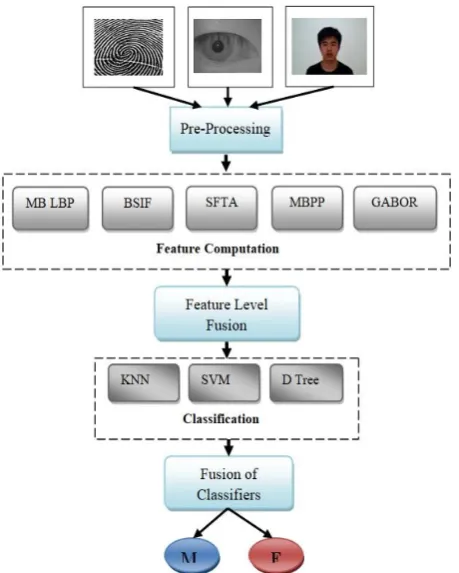
[image:2.595.57.287.302.589.2]Gender Identification using multimodal biometrics mainly emphases on pre-processing; which is rather dependent on application and on biometrics traits. Then in Feature computation step, deals with extraction of textural information using fusion of multiblock local binary patterns and BSIF filters, Gabor wavelet, Multi-block-local binary pattern and SFTA. Lastly, the computed features are evaluated with different binary classifiers and further, syntheses of classifiers are carried out. The flow of proposed method is represented below:
Figure 1: Schematic representation Proposed Methodology
A. Preprocessing
Preprocessing mainly plays a vital role in biometrics and its applications are biometric trait dependent. The fingerprint images are normalized, and then the background is eliminated. The Iris trait images are normalized by CLAHE algorithm. The faces, images are resized and normalized to 250x250. Lastly, contrast limited adaptive histogram equalization is applied.
B. Feature Extraction
In this step, features of an image are expatiated which results in recognition and classification of accuracy with a simple classification module. Most of the traditional methods employed in the literature are dependent on the nature of the
image under study. The well-known traditional methods of the features extraction are not generic in nature, their performance of describing the image and extracting meaningful information from them has lot of deviations. This emphasizes the study of behavior and use potentiality of the traditional methods such as the Multi-block Projection Profile, Binarized Statistical Image Features, Gabor Wavelet, Multi-block-local binary pattern and SFTA.
Though, some of individual features have exhibited exceptional performance in other prior domain applications. However by empirical testing we have witnessed that fusion scheme is significant and improves the performance of gender classification accuracy rather than individual performance. Multi-Block Local Binary Patterns: (MB-LBP)
These features provide micro and local information of an image. It is quite similar to the LBP’s operation, except that summed blocks are used instead of individual pixel values of each neighboring sub regions, 9 equal sized non overlapping rectangles blocks are implemented for computing the features. From each such rectangle, the sum of pixel intensity is computed. The operator compares the central block intensity by its neighborhood.
2n 9
1
n s(p0 p )
LBP
MB
c(1) Where pc is the average intensity and pk= {k=1…9} for
neighboring the blocks, resulting into binary patterns from each non overlapping blocks, furthers these pattern values are integrated and formed 90 features for each image.
Binarized Statically Image Features
Binary Statistical image feature technique encodes textural information from sub-regions of image which relies upon the statistics of natural images. The basic vector obtained by projecting patches on subspaces from images locally by Independent Component Analysis [22]. Pixel coordinate is thresholded and then respective binary codes are calculated. The image intensity patterns are represented by value in neighborhood of considered pixel [25] for I (m, n) and filter WiKxK, Likewise, BSIF is calculated as
l
i
L i k
k
i mn bm n
BSIF
1( ( , ) (2 ))
) , (
(2) Binary Statistical Image Feature is worked out as a histogram of pixels binary codes for each sub-region of images to characterize texture properties from it. The, filter size 11 *11 filters and 8bit length is fixed empirically which is quite capable in capturing suitable information from an image. This filter as a result produces a feature vector of 256 elements from each image.
Segmentation based Fractal Texture Analysis(SFTA) In this work, applicability of the fractal dimension [32] on multi-biometrics trait image is explored. Generally fractal dimension (FD) is determined by the following equation
1ε
log
log(N( εog lim
FD ε0 (3)
Where N (∊) is objects, (1/∊) is the scale factor and FD is obtained by a least square regression method. SFTA feature extraction is split into two parts. Firstly, by threshold a set of binary images is yielded [30] then later, by Th threshold values it image intra class
1,if.ThL (m,n) ThUOtherwise 0,
n) (m,
B
(4)Where B (m, n) is a binary input image, ThL and ThU are lower
and upper limit [31] threshold values. Secondly, SFTA feature vector is created by calculating binary image size (pixel count) and mean grey level and the limits by computing fractal domain (FD) given by equation-3 and 4. The Mean grey level value and size (pixel count) are complementary information calculated and extracted without increasing the computational time and computes 45 features from each image.
Multi-Block Projection Profile (MB-PP)
Projection Profile [33] explicitly stores each cell of the projection vector is associated with a number of pixels of the background. A Projection Profile has number of black pixel values gathered via parallel projecting an image which may be denoted by:
vv
w
F
w 1)
,
(
(U)
PP
(5) Where, w and y are rows and columns of image. The image is successively splited into r x r non-overlapping sub-blocks that are individually equivalent in self-representing blocks like: Sblock1, Sblock2….Sblockn(r x r). Likewise, the obtained non overlapping r x r sub-blocks for each image is the size of an image S. Further, on each sub-block horizontal projection profile feature extraction is performed by using the equation-5.Features are calculated by alternative runs of either black or white pixels, all are added column-wise by white pixels skipping all alternative black pixels. Finally, resulting features from each sub-block are integrated and stored which contains 9 features from each image.
Gabor Wavelet
Gabor Wavelet is rotational and scale invariant in nature and mimics simple pictorial cortex of mammalian brains exceptionally. lsinθ kcosθ v lcosθ ksinθ w v) f(w, cos2 l σ (v) k σ (w) 2 1 exp θ) f, l G(k, 2 2 2 2 : (6)
Gabor wavelets have both multi-resolutional and multi-orientation properties and are even effective in finding the spatial frequencies of an image. Therefore, multimodal images are characterized through Gabor filters; they are used in extracting energy features from the images for gender identification tasks.
Here F specifies the central frequency of interest points from the underlying image, w= 0, 1…; l-1; where S is the total scales and v=0, 1…; k-1; where k is the total number of orientation. Likewise, by changing w and v values different orientations and frequencies features are estimated from an image. Thus a total of (30 Mean-squared energy and 30 Mean-amplitudes) features are extracted from each multi-biometric trait male and female image.
C. Feature Selection
The multimodal biometrics features-data are intuitively large in size, as the feature vectors obtained from a face, iris and fingerprint modalities are augmented. From this, it is observed that the values are redundant in nature. Thus the
feature selection method can make the representation into compact set of features which mainly contains the potential and strongest features values.
Feature selection is a method which defines and selects significant [29] features with high discriminative information by reducing the dimensionality curse. In this experiment adaptive threshold based feature selection is implemented to choose the appropriate features.
The computed texture features have been passed as input to adaptive threshold based feature selection method which optimally finds the threshold values and further, the datum values below the threshold are omitted. In this experiment, it is observed that the adaptive threshold based feature selection method generates new feature vector with only 66% of the total features and other irrelevant features have been eliminated.
D. Classification
K-Nearest Neighbor classifier will label the class based on measuring the distance between testing and training of data. KNN will classify by suitable K value and interns which finds the nearest neighbor and provides a class label to un-labeled. In this work, City-block distance is considered with K=3 which is empirically fixed throughout the experiment. Basically, K-NN is non-parametric classifier which tries to find minimum,’d’ distance using the following equation:
n 0
J J J
CityBlock(S,T) S T
D
(7)Support Vector Machine: performs binary classification based upon hyperplane separation. A discriminant function: F (X) = WT .Y – b determines the distance between the data item in hyperplane and vectors. This representation is used to characterize linear separation based upon splitting each data item [27] into 2 classes. In our experiment Yi yields the results of male (+1) or female (-1).
1. b
.Y W
f(x) T i (8)
k 2(k)
c
1
gdm
(9)
Where, c (k) is the observed classes with class k that reach the node.
IV. FUSION
From the literature, it is observed that there are different types of fusion levels they are; match score level, sensor level, feature level and decision level fusions [33]. Among four levels of fusions our aim is to implement feature level fusion along with fusion of classifiers to address the issues of multimodal-based gender classification.
Feature Level Fusion
In any traditional application a single feature extraction technique is unable to capture all the significant information from an image thus to get most prominent and resilient features from an image, feature-level-fusion is implemented. The feature level fusion technique is accomplished by augmenting the feature vectors obtained after the feature selection process of a face, iris and fingerprint modalities of a single subject. The final feature vector is obtained after the threshold based feature selection which is stored and used to train and test the system to classify male and female subjects based on multimodal-biometrics traits.
Synthesis Of Classifier
In any traditional recognition problem the usage of a single classifier is quite obvious, but when the members of classifier are diverse and un-correlated, the multiple classifiers potentially offer better results than single classifier. The synthesis mechanism can be implemented generally by two types: building a single sophisticated classifier by fusing multiple relative weak classifiers another way is fusing the classifier outputs of different classifiers.
In this experimentation, the majority voting strategy is considered by presumptuous that each of the classifier provides a label as output. The output of the classifiers provides d1,d2…dn belongs to c1,c2,…cn and which denotes the label of ith class and the voting strategy is denoted as:
n
1 j
n
1 j j i i
j {1...m} t 1,
0,if B(c) B(c) α.m Q(d)
E(d)
(10) In view of it Q (d) is level of adjunction of selected class and denotes score for the selected class [34]. The voting strategy E using thresholding is denoted by
c ,if..MAX.( e ) α.K rejectedK
i i 1
E
(11)Where K defines classifiers [28] that is to be fused and with =1, the final class is assigned to the class label of the most represented among the classifiers outputs.
V. EXPERIMENTALANALYSIS
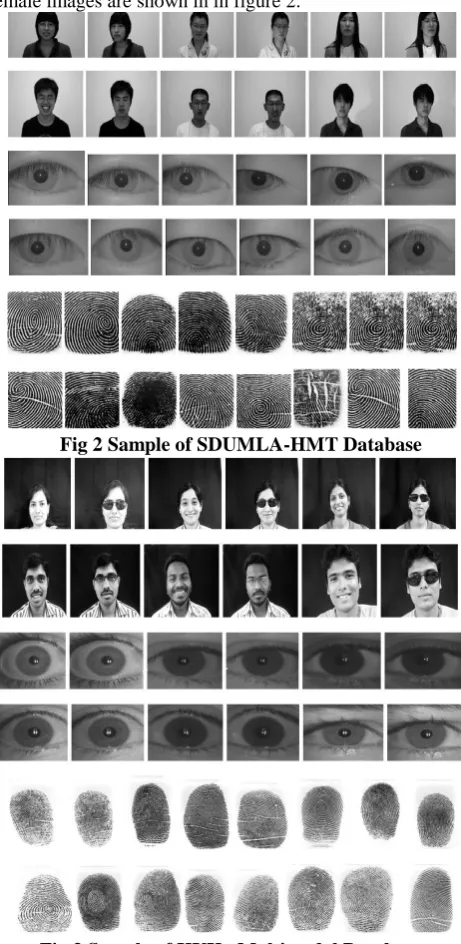
Dataset: In this work we have used two standard datasets for experimentation out of which, first one is publicly available SDUMLA-HMT standard dataset which is collected by machine learning and application lab of Shandong University[9]. The dataset includes real multimodal data from
[image:4.595.311.542.162.635.2]106 individuals of which 59 are male volunteers and 47 are female volunteers. The database contains face images which were collected from different poses, expressions and accessories. An Iris, dataset images are captured giving proper direction to volunteers, images from the both eyes are collected. Likewise, fingerprint dataset images are acquired with FT-2BU sensors, from each such subject images of both-hand thumb, index and middle finger were collected by giving prerequisite directions. A sample dataset of male and female images are shown in in figure 2.
Fig 2 Sample of SDUMLA-HMT Database
Fig 3 Sample of KVK –Multimodal Database
Second dataset is KVK Multimodal dataset which is collected and maintained by KVK multimodal Biometrics Researcher Lab Aurangabad, Maharashtra [10]. This dataset includes real multimodal database from 48 individuals of which 39 are male subjects and 9 are female subjects. The dataset contains face images which were collected from different poses, expressions and accessories. An Iris, dataset images are captured giving proper direction to volunteers, images from the both eyes are collected.
from each such subject images of both-hand thumb, index and middle finger were collected by giving prerequisite directions. Sample dataset images are presented in figure 3. The algorithmic steps are as follows:
Input: Multimodal images.
Output: Gender Identification using Multimodal biometrics. Step 1: Input the images from database.
Step 2: Image preprocessing is carried out.
Step 3: Feature level fusion is computed by adaptive threshold based feature selection.
Step 4: Feature vectors are generated by concatenation rule. Step 5: Training and Testing is performed.
Step 6: Fusion of classifiers is implemented. Step 7: Gender classification.
The experimentations were carried out by 10 cross validation over different binary classifiers i.e. K-NN,SVM and Decision Tree classifier on publically available SDUMLA-HMT and KVK- Multimodal database where each volunteers
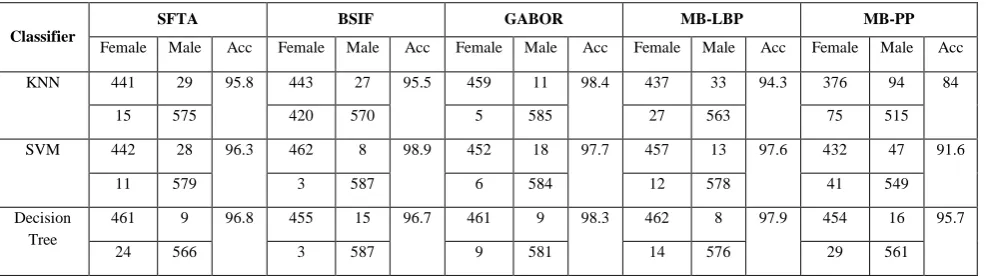
contributes 10 images from each modality respectively. Further the Chi square test for testing the goodness of fit [23] is performed to check whether there exists any correlation between the respective modalities and it is observed that the modalities are unambiguously co- related. The results are predicted in the form of confusion matrix which is represented in Table-1 to Table-4.
From the Table 1, it is observed that from individual SFTA, the highest accuracy of 96.8 % is obtained by Decision Tree classifier and lowest accuracy of 95.8% is yielded by K-NN classifier. From the BSIF, the highest accuracy of 98.9 % is obtained by Support vector machine classifier and lowest accuracy of 95.5% is yielded by K-NN classifier. At the same time by Gabor wavelet, the highest accuracy of 98.4 % is gained by K-NN classifier and lowest accuracy of 97.7% is yielded by SVM classifier. It is also noted that by MB-LBP, the highest accuracy of 97.9 % is obtained by Decision Tree classifier and lowest accuracy of 94.3% is yielded by K-NN classifier. Besides for the MB-PP, it is perceived that the highest accuracy of 95.7 % is obtained by Decision tree classifier and lowest accuracy of 84% is yielded by K-NN classifier respectively.
Further the experimentation involves the fusion on SDUMLA-MLA Multimodal dataset. From Table-2, it is observed that by feature-level fusion, a conservative result of 99.5% is achieved with SVM classifier and the lowest accuracy of 99.3% is noted with K-NN classifier. From the above results it is apparent that by different features and classifiers of varying results are noticed. Thus, for achieving novel classification accuracy, the synthesis of classifier is employed and a novel accuracy of 100% is witnessed. Further, the experiment has been extended on KVK–multimodal database for testing the robustness of the algorithm. From the individual features evaluation, of Table-3
it is observed that for SFTA feature, the highest accuracy of 99.8% is obtained by SVM and lowest accuracy of 99.5% is yielded by K-NN classifier. Besides, for the BSIF, the highest accuracy of 99.9% is obtained by K-NN classifier and lowest accuracy of 99.2% is yielded by Decision Tree classifier. Moreover, for the Gabor wavelet, the highest accuracy of 99% is obtained by Decision Tree classifier as well as lowest accuracy of 98.2% is yielded by SVM classifier. Then by MB-LBP, it is noticed that the highest accuracy of 99.5% is
obtained by Decision Tree classifier and lowest accuracy of 98.2% is yielded by SVM classifier. Further for the MB-PP, it is observed that the highest accuracy of 96.5% is obtained by Decision Tree classifier and lowest accuracy of 94.1% is yielded by SVM classifier.
Similarly, the experiments are extended for KVK-Multimodal dataset. From the Table 4, it is found that feature-level fusion give better accuracy as features of Heterogonous multi-modal biometrics traits features are contemplated. The SVM classifier and K-NN classifier yields the highest accuracy of 99.7% is achieved and lowest accuracy of 99% is yielded by Decision tree classifier. Further, with Fusion of classifiers, it is observed that fusion tends to yield a better accuracy of 100% respectively.
VI. CONCLUSION
In this paper, empirically tests are conceded for reporting gender discriminative ability of multimodal biometrics by exploring individually using textural features: as-well-as with the fusion correspondingly. Initially, the experiments are implemented by individual features i.e. multiblock local binary patterns ,binarized statistical image feature, gabor wavelet, multi-block-local binary pattern and SFTA features and then, later fusion of respective features are tested with the implementation of adaptive threshold based features selection. The overall results are observed optimal by fusion rather than using them alone. As MB-LBP and MB-PP are capable in gathering minor and local information, in contrast to it BSIF, SFTA along with Gabor wavelets encodes textural information over a wider range of scale from the multimodal biometrics trait images.
We explored performance evaluation of gender classification algorithm over 2 different state-of-the-art multimodal databases. With the adaptive feature selection, not only the dimension is reduced, but also the time complexity is observed to be minimized. Thus overall result exhibits to be significantly increased with the fusion scheme of Feature-level and synthesis of classifiers which provides higher accuracy rather than using individually.
ACKNOWLEDGMENT
Table 1: Confusion matrix of Individual Features on SDUMLA-HMT Database
Table 2: Confusion Matrix of Fusion Scheme on SDUMLA-HMT Database
Table 3: Confusion matrix of Individual Features on KVK-Multimodal Database
Table 4: Confusion Matrix of Fusion Scheme on KVK-Multimodal Database
Classifier
SFTA BSIF GABOR MB-LBP MB-PP
Female Male Acc Female Male Acc Female Male Acc Female Male Acc Female Male Acc
KNN 441 29 95.8 443 27 95.5 459 11 98.4 437 33 94.3 376 94 84
15 575 420 570 5 585 27 563 75 515
SVM 442 28 96.3 462 8 98.9 452 18 97.7 457 13 97.6 432 47 91.6
11 579 3 587 6 584 12 578 41 549
Decision Tree
461 9 96.8 455 15 96.7 461 9 98.3 462 8 97.9 454 16 95.7
24 566 3 587 9 581 14 576 29 561
Classifier Female Male Accuracy
KNN 465 5 99.3
2 588
SVM 469 1 99.5
4 586
Decision Tree 468 2
99.4
4 586
Fusion of Classifier 470 0
100
0 590
Classifier
SFTA BSIF GABOR MB-LBP MB-PP
Female Male Acc Female Male Acc Female Male Acc Female Male Acc Female Male Acc
KNN 69 1 99.5 69 1 99.9 67 3 98.7 68 2 99.2 58 12 95.6
1 339 0 340 2 338 1 339 6 334
SVM 70 0 99.8 68 2 99.8 63 7 98.2 63 7 98.2 47 23 94.1
2 338 0 340 0 340 0 340 1 339
Decision Tree
67 3 99 68 2 99.2 68 2 99 69 1 99.5 59 11 96.5
0 340 1 339 2 338 1 339 3 337
Classifier Female Male Accuracy
KNN 69 1 99.7
0 340
SVM
69 1
99.7
0 340
Decision Tree 69 1 99
3 337
Fusion of Classifier 70 0 100
[image:6.595.46.551.580.719.2]REFERENCES
1. S S Gornale, Abhijit Patil and Veersheety C. “Fingerprint Based Gender Identification Using DWT and Gabor Filters”, International Journal of Computer Applications Vol.152 Issue 4, 2016 page.34-37. 2. Kruti R, Abhijit Patil and S S Gornale, “Fusion of Features and
Synthesis Classifiers for Gender Classification using Fingerprints”, International Journal of Computer Sciences and Engineering (IJCSE) ISSN: 2347-2693, Vol-7 1ssue-5, May 2019.
3. Zhang H., Sun Z., Tan T., Wang J. (2011) “Ethnic Classification Based on Iris Images”, In: Sun Z., Lai J., Chen X., Tan T. (eds) Biometric Recognition. CCBR 2011. Lecture Notes in Computer Science, Vol 7098. Springer, Berlin, Heidelberg.
4. S. Aryanmehr, Fanny Dufoss, Farsad Zamani Boroujeni . “CVBL IRIS Gender Classification Database Image Processing and Biometric Research, Computer Vision and Biometric Laboratory (CVBL)”, 2018 IEEE 3rd International Conference on Image, Vision and Computing (ICIVC). 2018.
5. Shruti Nagpal , Mayank Vatsa ; Richa Singh ; Afzel Noore ; Angshul Majumdar Maneet Singh , “Gender and ethnicity classification of Iris images using deep class-encoder”, 2017 IEEE International Joint Conference on Biometrics (IJCB), DOI: 10.1109/BTAS.2017.8272755, ISSN: 2474-9699, Denver, CO, USA.2017.
6. W Ming and Y Yuan, “Gender Classification Based on Geometrical Features of Palmprint Images”, The Scientific World Journal vol.2014.Article Id: 734564, pp.: 7 2014.
7. S.S Gornale ,Abhijit Patil and Kruti R ,” Fusion Of Gabor Wavelet And Local Binary Patterns (LBP) Features Sets For Gender Identification Using Palmprints”, International journal of Imaging Science and Engineering,Vol.10,Issue No.2,April2018.
8. Zhihuai Xie, Zhenhua G and Chengshan Q,” Palmprint gender classification by Convolution neural network”, IET Computer Vision, Vol 12, Issue 4 pp.:476-483 ,2018,
9. Yilong Yin, Lili Liu, and Xiwei Sun,” SDUMLA-HMT: A Multimodal Biometric Database”, The 6th Chinese Conference on Biometric Recognition (CCBR 2011), LNCS 7098, pp.: 260-268, Beijing, China, 2011.
10. VK Multimodal Database, Dept. of C.S and I.T,Aurangabad Maharashtra,India.
11. Len Bui ; Dat Tran ; Xu Huang ; Girija Chetty, “Classification of gender and face based on gradient faces”, 3rd European Workshop on Visual Information Processing, 10.1109/EuVIP.2011.6045544 Paris, France -July 2011.
12. Arnulf B. A. Graf and Felix A. Wichmann, “Gender Classification of Human Faces”, Biologically Motivated Computer Vision, eds. H.H. B¨ulthoff, S.-W. Lee, T.A. Poggio and C. Wallraven, LNCS 2525, pp.: 491-501, 2002, Springer Verlag, Heidelberg.
13. S.Ravi, S.Wilson, “Face Detection with Facial Features and Gender Classification Based On Support Vector Machine”, 2010 Special Issue - International Journal of Imaging Science and Engineering, 14. Abul Hasnat ; Santanu Haider ; Debotosh Bhattacharjee ; Mita
Nasipuri , “A proposed system for gender classification using lower part of face image:, 2015 International Conference on Information Processing (ICIP), DOI: 10.1109/INFOP.2015.7489451, ISBN: 978-1-4673-7758-4, Pune, India.
15. Hadi Harb , Liming Chen ,” Voice-Based Gender Identification in Multimedia Applications“, Journal of Intelligent Information Systems, vol.24: pp.: 179, 2005.
16. Rafik Djemili ; Hocine Bourouba ; Mohamed Cherif Amara Korba,” A speech signal based gender identification system using four classifiers”, 2012 International Conference on Multimedia Computing and Systems ,ISBN no.978-1-4673-1520-3, 2012.
17. Daniel Reid, Sina Samangooei, Cunjian Chen, Mark Nixon, and Arun Ross. 2013. So. biometrics for surveillance: an overview. Machine learning: theory and applications. Elsevier pp.: 327–352,2013, 18. X. Li, X. Zhao, H. Liu, Y. Fu and Y. Liu, "Multimodality gender
estimation using Bayesian hierarchical model," 2010 IEEE International Conference on Acoustics, Speech and Signal Processing, Dallas, TX, 2010, pp.: 5590-5593. doi: 10.1109/ICASSP.2010.5495242.2010.
19. Mohamed Abouelenien, Veronica Perez-Rosas , Rada Mihalcea , and Mihai Burzo, “Multimodal Gender Detection” , in Proceedings of ICMI ’17, Glasgow, UK, November , pp.: 302-311.ISBN no. 978-1-4503-5543-8.2017. 2017.
20. A. Hadid and M. Pietikainen, "Combining motion and appearance for gender classification from video sequences", 2008 19th International
Conference on Pattern Recognition, Tampa, Florida, 2008, pp.: 1-4.doi: 10.1109/ICPR.2008.4760995.
21. Caifeng Shan and Shaogang Gong and McOwan, Peter W,” Learning Gender from Human Gaits and Faces”,2007 IEEE Conference on Advanced Video and Signal Based Surveillance Washington, DC, USA.pp.:505-510,isbn 978-1-4244-1695-0.
22. Juho Kannala, E Rahtu, “Bsif: Binarized statistical image features”, IEEE International Conference on Pattern Recognition, (ICPR), pp.: 1363–1366, Nov.2012.
23. Linda N Groat, David Wang”, Architectural Research Methods, 2nd Edition, ISBN: 978-0-470-90855-6, April-2013, Wiley Publishing House.
24. F. Becerra-Riera, H. Méndez-Vázquez, A. Morales-Gonzalez and M. Tistarelli, "Age and gender classification using local appearance descriptors from facial components," 2017 IEEE International Joint Conference on Biometrics (IJCB), Denver, CO, 2017, pp. 799-804.DOI: 10.1109/BTAS.2017.8272773
25. W. Kuo, L. Wang and P. Chen, "Preliminary results of computer aided system with the 2nd-generation narrow-band imaging for endoscopic screening of colorectal neoplasms," 2017 International Conference on Applied System Innovation (ICASI), Sapporo, 2017, pp.854-857.doi: 10.1109/ICASI.2017.7988568
26. Ragvendra R and Christoph Busch,” texture based features for robust palmprint recognition: a comparative study”,EURASIP Journal of information Security,Vol pp 5 2015, DOI 10.1186/s13635-015-0022-z 27. Abhijit Patil, Kruthi R and Shivanand Gornale, " Analysis of Multi-modal Biometrics System for Gender Classification Using Face, Iris and Fingerprint Images", International Journal of Image, Graphics and Signal Processing(IJIGSP), Vol.11, No.5, pp. 34-43, 2019.DOI: 10.5815/ijigsp.2019.
28. Aizhong Mi, Lei Wang, and Junyan Qi, “A Multiple Classifier Fusion Algorithm Using Weighted Decision Templates,” Scientific Programming,vol.1.,pp:10,2016.ArticleID3943859 https://doi.org/10. 1155/2016/3943859.
29. Y. Chang, Y. Wang, K. Ricanek and C. Chen, "Feature selection for improved automatic gender classification," 2011 IEEE Workshop on Computational Intelligence in Biometrics and Identity Management (CIBIM), Paris, 2011, pp. 29-35. doi: 10.1109/CIBIM.2011.5949221.
30. Pawan Kumar Singh, Ram Sarkar, Mita Nasipuri. "Indic script identification from handwritten document images", International Journal of Intelligent Systems Technologies and Applications, 2019. 31. Jamil, Nursuriati, Nuril Aslina Che Hussin, Sharifalillah Nordin, and
Khalil Awang. "Automatic Plant Identification: Is Shape the Key Feature?", Procedia Computer Science, 2015.
32. Sujitra A, Phasit. C and D. Xu, "POC: Paphiopedilum Orchid Classifier," 2015 IEEE 14th International Conference on Cognitive Informatics & Cognitive Computing (ICCI*CC), Beijing, 2015, pp. 206-212. doi: 10.1109/ICCI-CC.2015.7259387.
33. Maneet Singh, Richa Singh, Arun Ross, A comprehensive overview of biometric fusion, Information Fusion, Volume 52, 2019, pp. 187-205, ISSN 1566-2535, https://doi.org/10.1016/j.inffus.2018.12.003. 34. M. Suganthi, M. Madheswaran. "An enhanced decision support system
for breast tumor identification in screening mammograms using combined classifier", Proceedings of the International Conference and Workshop on Emerging Trends in Technology - ICWET '10, 2010, DOI: 10.1145/1741906.1742088.
AUTHORSPROFILE
Dr. Shivanand S. Gornale has completed M. Sc. in Computer Science. M.Phil. in Computer Science., Ph.D. in Computer Science from Savitribai Phule Pune University, Maharashtra, India in 2009 under the guidance of Professor. K V Kale and has been recognized as a research guide for Ph.D. in Computer Science and Engineering from Rani Channamma University, Belagavi and Jain University Bangalore. He has published more than 90+ research papers in various National and International Journals and conferences. He is a Fellow of IETE New Delhi, Life Member of CSI, Life Member of Indian Unit of Pattern Recognition and Artificial Intelligence (IPRA),
Information Technology (IACS&IT) Singapore, Member of International Association for Engineers’, Hong Kong, Member of Computer Science Teachers Association, USA, Life Member of Indian Science Congress Association, Kolkata-India. Presently he is working as Professor and Chairman, Department of Computer Science and also Director of IQAC Rani Channamma University, Belagavi – Karnataka, India. His research areas of interest are Digital Image Processing, Pattern Recognition, Computer Vision and Machine Learning, Video Retrieval and Biometric analysis.
Abhijit Patil is pursuing Ph.D. in computer science at Rani Channamma University, Belagavi Karnataka, India. He has completed M.Sc. in Computer Science from Gulbarga University Gulbarga, in 2011. His research area of interest is Digital Image Processing, Computer Vision, Uni –Modal and Multi-Modal Biometric analysis.