THE FLORIDA STATE UNIVERSITY
COLLEGE OF ARTS AND SCIENCES
PLATFORMS FOR HPJAVA: RUNTIME SUPPORT FOR SCALABLE PROGRAMMING IN JAVA
By
SANG BOEM LIM
A Dissertation submitted to the Department of Computer Science
in partial fulfillment of the requirements for the degree of
Doctor of Philosophy
The members of the Committee approve the dissertation of Sang Boem Lim defended on June 11, 2003.
Gordon Erlebacher
Professor Directing Dissertation
Geoffrey C. Fox
Professor Co-Directing Dissertation
Larry Dennis
Outside Committee Member
Daniel G. Schwartz Committee Member
Robert A. van Engelen Committee Member
ACKNOWLEDGEMENTS
This work was supported in part by the National Science Foundation Division of Advanced Computational Infrastructure and Research, contract number 9872125 (any opinions, findings, and conclusions or recommendations expressed in this material are those of the author and do not necessarily reflect the views of the National Science Foundation).
TABLE OF CONTENTS
List of Tables . . . . vi
List of Figures . . . . vii
Abstract. . . . ix
1. INTRODUCTION . . . . 1
1.1 Features of HPJava . . . 2
1.2 Organization of the Dissertation . . . 5
2. ENVIRONMENTS FOR PARALLEL AND DISTRIBUTED COMPUTING . . . . 8
2.1 Parallel and Distributed Computing Environments for Java . . . 8
2.1.1 Parallel Virtual Machine (PVM) in Java . . . 8
2.1.2 MPI and MPJ . . . 9
2.1.3 Java RMI . . . 10
2.1.4 JavaParty . . . 11
2.1.5 Jini . . . 12
2.2 Peer to Peer Computing . . . 13
2.2.1 Javelin . . . 13
2.2.2 SETI@home . . . 14
2.2.3 Parabon . . . 15
2.2.4 JXTA . . . 16
2.3 Java Enterprise Computing . . . 17
2.3.1 Java Message Service . . . 17
2.3.2 Enterprise JavaBeans (EJB) . . . 18
2.4 Comparison of Languages . . . 20
2.4.1 Java . . . 20
2.4.2 C++ . . . 21
2.4.3 C# . . . 22
2.4.3.1 MPI with C# . . . 25
3. REVIEW OF THE HPJAVA ENVIRONMENT . . . . 27
3.1 Introduction . . . 27
3.2 HPJava—an HPspmd language . . . 29
3.3 High-level Communication Library . . . 34
3.4 Message-passing for HPJava . . . 37
3.4.1 The mpiJava wrapper . . . 38
4. A HIGH-LEVEL COMMUNICATION LIBRARY FOR HPJAVA . . . . . 45
4.1 Background . . . 45
4.2 Implementation of Collectives . . . 46
4.3 Collective Communications . . . 52
4.3.1 Regular Collective Communications . . . 52
4.3.2 Reductions . . . 54
4.3.3 Irregular Collective Communications . . . 56
4.4 Schedules . . . 59
5. A LOW-LEVEL COMMUNICATION LIBRARY FOR JAVA HPC. . . . 60
5.1 Goals and Requirements . . . 60
5.2 General APIs . . . 62
5.2.1 Message Buffer API . . . 63
5.2.2 Communication API . . . 66
5.3 Message Format . . . 70
5.3.1 Layout details . . . 72
5.4 Communication Protocol . . . 74
5.4.1 Encoding . . . 76
5.5 Implementations . . . 76
5.5.1 mpiJava-based Implementation . . . 76
5.5.2 Multithreaded Implementation . . . 77
5.5.3 LAPI Implementation . . . 79
5.5.3.1 Implementation issues . . . 81
5.5.4 Jini Implementation . . . 85
6. APPLICATIONS AND PERFORMANCE. . . . 88
6.1 Environments . . . 88
6.2 Partial Differential Equations . . . 89
6.2.1 An Application . . . 90
6.2.2 Evaluation . . . 93
6.3 HPJava with GUI . . . 99
6.3.1 Evaluation . . . 101
6.4 LAPI . . . 102
6.5 Communication Evaluation . . . 104
7. CONCLUSION AND FUTURE WORK . . . .107
7.1 Conclusion . . . 107
7.2 Future Work . . . 108
7.2.1 HPJava . . . 108
7.2.2 Communication Libraries . . . 108
APPENDIX A The Java Adlib API . . . .110
REFERENCES. . . .172
LIST OF TABLES
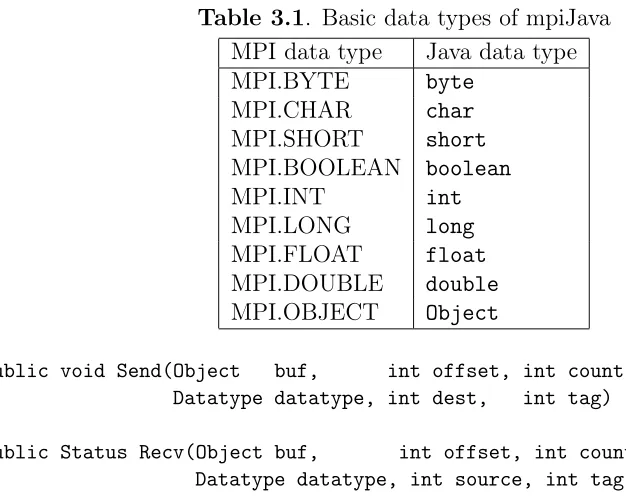
3.1 Basic data types of mpiJava . . . 40 4.1 Low-level Adlib schedules . . . 48 6.1 Red-black relaxation performance. All speeds in MFLOPS. . . 96 6.2 Three dimensional Diffusion equation performance. All speeds in MFLOPS. . . 97 6.3 Multigrid solver with size of 5122. All speeds in MFLOPS. . . 98 6.4 Speedup of HPJava benchmarks as compared with 1 processor HPJava. . . 99 6.5 CFD speedup of HPJava benchmarks as compared with 1 processor HPJava. . . 101 6.6 CFD performance. All speeds in MFLOPS. . . 103 6.7 Comparison of the mpjdev communication library using MPI vs. LAPI. All
speeds in MFLOPS. . . 103 6.8 Timing for a wait and wake-up function calls on JAVA thread and POSIX
Thread in microseconds. . . 104 6.9 Latency of Laplace equation Communication Library per One Iteration and
C/MPI sendrecv() function in microseconds. . . 104 6.10 Latency of CFD Communication Library per One Iteration and C/MPI
LIST OF FIGURES
1.1 Sequential Matrix multiplication in HPJava. . . 2
1.2 A parallel Matrix multiplication in HPJava. . . 3
1.3 A general Matrix multiplication in HPJava. . . 5
2.1 RMI Architecture. . . 11
2.2 The JMS API Architecture . . . 19
3.1 A parallel matrix addition. . . 30
3.2 The HPJava Range hierarchy . . . 32
3.3 A general Matrix multiplication in HPJava. . . 34
3.4 Solution of Laplace equation by Jacobi relaxation. . . 36
3.5 Example of a distributed array with ghost regions. . . 37
3.6 Illustration of the effect of executing the writeHalo function. . . 38
3.7 Principal classes of mpiJava . . . 39
3.8 HPJava data parallel version of the N-body force computation. . . 42
3.9 Version of the N-body force computation using reduction to Java array. . . 44
4.1 API of the class BlockMessSchedule . . . 48
4.2 Partial API of the class Range . . . 50
4.3 sendLoop method forRemap . . . 51
4.4 Illustration of sendLoop operation forremap . . . 52
4.5 Jacobi relaxation, re-using communication schedules. . . 58
5.1 An HPJava communication stack. . . 61
5.2 The public interface of Buffer class. . . 63
5.3 The public interface of WriteBuffer class. . . 64
5.4 The public interface of ReadBuffer class. . . 65
5.5 The public interface of ObjectWriteBuffer class. . . 66
5.6 The public interface of ObjectReadBuffer class. . . 67
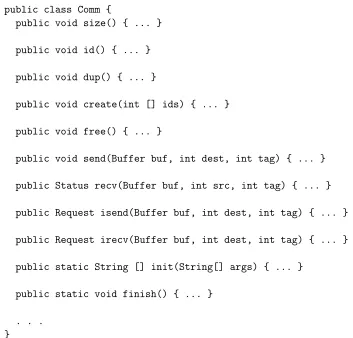
5.7 The public interface of mpjdev Comm class. . . 68
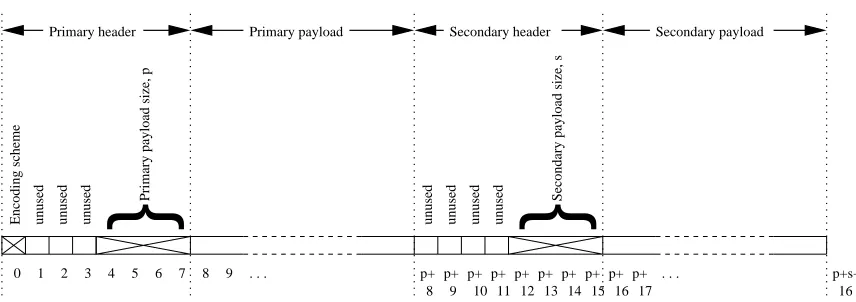
5.9 Overall layout of logical message. . . 71
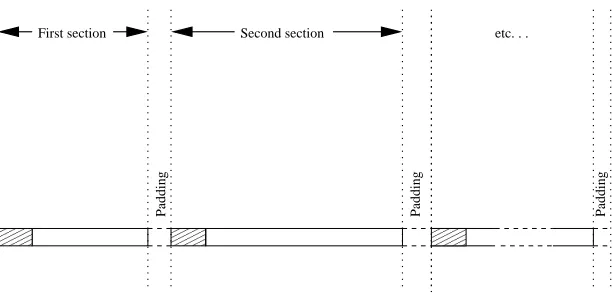
5.10 Layout of primary payload . . . 72
5.11 Layout of one section in the primary payload . . . 73
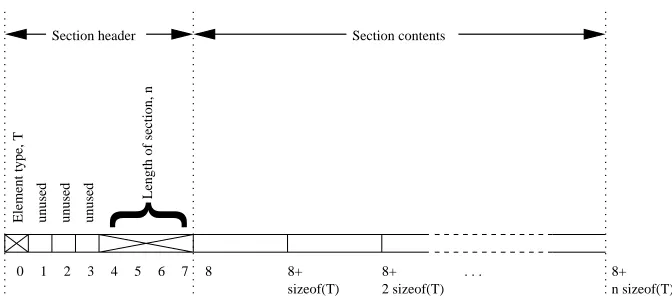
5.12 Layout of send messages. a) When secondary payload is empty. b) When secondary payload is not empty and the sum of secondary payload size and the size of the primary payload are less than the capacity of the buffer object. c) When secondary payload is not empty and the sum of secondary payload size and the size of the primary payload are greater than the capacity of the buffer object. . . 74
5.13 Multithreaded implementation. . . 78
5.14 LAPI Active Message Call. . . 80
5.15 LAPI implementation with Active Message Call andGET operation. . . 83
5.16 LAPI implementation with Active Message Call. . . 84
5.17 Layers of a proposed mpjdev reference implementation . . . 86
5.18 Independent clients may findmpjdevService daemons through the Jini lookup service. Each daemon may spawn several slaves. . . 87
6.1 An example of multigrid iteration. . . 90
6.2 Red black relaxation on array uf. . . 91
6.3 Restrict operation. . . 92
6.4 Illustration of restrict operation . . . 93
6.5 Interpolate operation. . . 94
6.6 Illustration of interpolate operation . . . 95
6.7 Red-black relaxation of two dimensional Laplace equation with size of 5122. . . . 95
6.8 Three dimensional Diffusion equation with size of 1283. . . 96
6.9 Three dimensional Diffusion equation with size of 323. . . 97
6.10 Multigrid solver with size of 5122. . . 98
6.11 A 2 dimensional inviscid flow simulation. . . 100
6.12 CFD with size of 2562. . . 102
6.13 Comparison of the mpjdev communication library using MPI vs. LAPI. . . 103
ABSTRACT
The dissertation research is concerned with enabling parallel, high-performance computa-tion—in particular development of scientific software in the network-aware programming language, Java. Traditionally, this kind of computing was done in Fortran. Arguably, Fortran is becoming a marginalized language, with limited economic incentive for vendors to produce modern development environments, optimizing compilers for new hardware, or other kinds of associated software expected of by today’s programmers. Hence, Java looks like a very promising alternative for the future.
The dissertation will discuss in detail a particular environment calledHPJava. HPJava is the environment for parallel programming—especially data-parallel scientific programming– in Java. Our HPJava is based around a small set of language extensions designed to support parallel computation with distributed arrays, plus a set of communication libraries. In particular the dissertation work will concentrate on issues related to the development of efficient run time support software for parallel languages extending an underlying object-oriented language.
Two characteristic run-time communication libraries of HPJava are developed as an application level library and device level library. A high-level communication API, Adlib, is developed as an application level communication library suitable for our HPJava. This communication library supportscollective operationson distributed arrays. We include Java
Object as one of the Adlib communication data types. So we fully support communication of intrinsic Java types, including primitive types, and Java object types. The Adlib library is developed on top of low-level communication library called mpjdev, designed to interface efficiently to the Java execution environment (virtual machine).
systems. This can be implementing portably on network platforms and efficiently on parallel hardware.
The dissertation describes the novel issues in the interface and implementation of these libraries on different platforms, and gives comprehensive benchmark results on a parallel platform. All software developed in this project is available for free download from
CHAPTER 1
INTRODUCTION
The Java programming language is becoming the language of choice for implementing Internet-based applications. Undoubtedly Java provides many benefits—including access to secure, platform-independent applications from anywhere on the Internet. Java today goes well beyond its original role of enhancing the functionality of HTML documents. Few Java developers today are concerned with applets. Instead it is used to develop large-scale enterprise applications, to enhance the functionality of World Wide Web servers, to provide applications for consumer device such as cell phones, pagers and personal digital assistants. Amongst computational scientists Java may well become a very attractive language to create new programming environments that combine powerful object-oriented technology with potentially high performance computing. The popularity of Java has led to it being seriously considered as a good language to develop scientific and engineering applications, and in particular for parallel computing [2, 3, 4]. Sun’s claims on behalf of Java, that is simple, efficient and platform-natural—a natural language for network programming—make it attractive to scientific programmers who wish to harness the collective computational power of parallel platforms as well as networks of workstations or PCs, with interconnections ranging from LANs to the Internet. This role for Java is being encouraged by bodies like Java Grande [33].
float [[*, *]] c = new float [[M, N]]; float [[*, *]] a = new float [[M, L]]; float [[*, *]] b = new float [[L, N]]; ... initialize ’a’, ’b’
for(int i = 0; i < M; i++) for(int j = 0; j < N; j++) {
c [i, j] = 0;
for(int k = 0; k < L; k++)
c [i, j] += a [i, k] + b [k, j]; }
Figure 1.1. Sequential Matrix multiplication in HPJava.
Our HPJava is an environment for parallel programming, especially suitable for data parallel scientific programming. HPJava is an implementation of a programming model we call the HPspmd nodel. It is a strict extension of its base language, Java, adding some predefined classes and some extra syntax for dealing with distributed arrays. We overview of HPJava in following section.
1.1
Features of HPJava
In this section, we present a high level overview of our HPJava. Some predefined classes and some extra syntax for dealing with distributed arrays are added into the basic language, Java. We will briefly review the features of the HPJava language by showing simple HPJava examples. In this section, we will only give an overview of features. Detailed description of those features will be presented in the Chapter 3.
Procs2 p = new Procs2(P, P); on(p) {
Range x = new BlockRange(N, p.dim(0)); Range y = new BlockRange(N, p.dim(1)); float [[-,-]] c = new float [[x, y]]; float [[-,*]] a = new float [[x, N]]; float [[*,-]] b = new float [[N, y]]; // ... initialize ‘a’, ‘b’
overall(i = x for : ) overall(j = y for : ){
float sum = 0;
for(int k = 0; k < N ; k++) sum += a[i, k] * b[k, j]; c[i, j] = sum;
} }
Figure 1.2. A parallel Matrix multiplication in HPJava.
many similarities. Both arrays have some index space and stores a collection of elements of fixed type. Syntax of accessing a multiarray is very similar with accessing ordinary Java array which uses single brackets, but an HPJava sequential multiarray uses double bracket and asterisks for its type signature. The most significant difference between ordinary Java array and the multiarray of HPJava is that the distributed array is true multi-dimensional array like the arrays of Fortran, while ordinary Java only provides arrays of arrays. These features of Fortran arrays have adapted and evolved to support scientific and parallel algorithms.
puts a hyphen in the type signature to indicate a particular dimension is distributed over processes. Input arrays a and b and result array c are distributed arrays. The array c is distributed in both its dimensions while array a and b each have one distributed dimension and one sequential dimension.
Figure 1.2 is a simple program but it includes much of the HPJava special syntax. In this program, we can see some unusual key words and operations which we do not see in an ordinary Java program like control constructs on and overall. There are also some added standard classes, like Procs2, and BlockRange.
The class Procs2 represents 2-dimensional grids of processes selected from the set of available processes. The on construct makes pthe active process groupwithin its body, and only the processes that belong top execute the code inside of theon construct. Distribution format of each dimension of a distributed array is represented by a Range class. The
BlockRange class used in this example describes block-distributed indexes. We also have a control construct which represents distributed parallel loops, similar the forall construct in High Performance Fortran (HPF), called overall. Theoverall construct introduced a
distributed index for subscripting a distributed array.
The program in Figure 1.2 depends on a specialalignment relationbetween its distributed arrays.
We can create a general purpose matrix multiplication routine that works for arrays with any distributed format (Figure 1.3) from Figure 1.2 using collective communication. This program take arrays which may be distributed in both their dimensions, and copies into the temporary array with a special distribution format for better performance. A collective communication schedule remap() is used to copy the elements of one distributed array to another.
public void matmul(float [[-,-]] c, float [[-,-]] a, float [[-,-]] b) { Group2 p = c.grp();
Range x = c.rng(0); Range y = c.rng(1); int N = a.rng(1).size();
float [[-,*]] ta = new float [[x, N]] on p; float [[*,-]] tb = new float [[N, y]] on p; Adlib.remap(ta, a);
Adlib.remap(tb, b); on(p)
overall(i = x for : ) overall(j = y for : ) {
float sum = 0;
for(int k = 0; k < N ; k++) sum += ta [i, k] * tb [k, j]; c[i, j] = sum;
} }
Figure 1.3. A general Matrix multiplication in HPJava.
In addition to the features described above, many more features and communication functions available to the HPJava are described in the Chapter 3 and Chapter 4.
The HPJava software including Adlib and mpjdev is available for free download from
www.hpjava.org.
1.2
Organization of the Dissertation
not only to use Java for scientific computing. It is also to demonstrate a specific programming model for parallel computing that we call the HPspmd model. The HPspmd model itself is independent of the choice of Java as base language, but the two go together well. One goal of this dissertation is as a foundation for research and development on the HPJava environment. In particular the dissertation concentrates on issues related to the development of efficientrun
time support softwarefor a class of parallel languages extending an underlying object-oriented
language. So the dissertation emphasizes aspects most relevant to this topic—aspects like high performance interprocessor communication.
A review of interesting related research and systems is given first. We will be especially interested in technologies developed in recent years by participants of bodies like the Java Grande Forum and the Global Grid Forum. We start with reviews of general parallel and distributed computing environments for Java including JavaParty, Javelin, and Jini. We discuss communication approaches relevant to parallel computing including Java RMI and Message passing libraries for Java. As an example of distributed computing, we review Peer-to-Peer (P2P) computing and Java enterprise computing. We review SETI@home as a characteristic example of P2P. As examples of P2P in Java, we briefly review Parabon, and discuss JXTA in more detail. We also briefly review contemporary, Java-specific enterprise distributed computing technology, like the Java Message Service and Enterprise JavaBeans. Java as language support for parallel and scientific computing is compared with C++ and C#.
The dissertation continues with the HPJava design and its features. Motivation of HPJava and its syntax features are described in this chapter. An existing runtime library, mpiJava, is also discussed. The mpiJava library, an object-oriented Java interface to MPI, has been developed as part of HPJava. Its usage in HPJava will be described.
Detailed description of a low-level communication library, mpjdev, is follows. We start with requirements of mpjdev. Its Message buffer API and communication API are described. We describe how a message will be formatted, sent, and received among the processes. Four different implementations of mpjdev are also described.
The following chapter presents applications and analyzes performance of HPJava pro-grams. A full application of HPJava is discussed first to illustrate how HPJava can be used as a tool for complex problems. Some partial differential equations are developed and analyzed for the performance using HPJava. We describe computational fluid dynamics simulation into a grapical user interface using HPJava. We also have performance test and evaluation of a platform-specific, LAPI-based implementation of the libraries.
CHAPTER 2
ENVIRONMENTS FOR PARALLEL AND
DISTRIBUTED COMPUTING
In this chapter we give a general overview of some interesting research and systems related to ours. We will be especially interested in technologies developed in recent years by participants of bodies like the Java Grande Forum and the Global Grid Forum. We start with discussion of parallel and distributed computing environments for Java. We briefly review contemporary Java-specific distributed computing technology and how they related to our high performance infrastructures. Finally Java as language to support parallel and scientific computing is compared with C++ and C#.
2.1
Parallel and Distributed Computing Environments for Java
As well as reviewing select computing environments for Java, this section includes discussion of communication frameworks including Java RMI and Message Passing libraries for Java. PVM and MPJ are discussed as examples of message passing libraries. MPJ is an effort by members of the Java Grande Forum [33] to define a consensus MPI-like interface for Java.
2.1.1 Parallel Virtual Machine (PVM) in Java
reduced latency, and better reliability within workstation clusters using Java, several projects are under way.
PVM [30], developed at Oak Ridge National Laboratory, provides a mechanism that enables a collection of heterogeneous networked computing systems to be used cooperatively for concurrent or parallel computation. This system can solve large computational problems effectively using the aggregate power and memory of many computers. The PVM system consists of two parts: a daemon, pvmd, and a library of PVM. Any user with a valid login can install a daemon on a computer, adding it to a virtual machine. The PVM library contains a repertoire of primitives that are needed for cooperation between tasks of an application: user-callable routines that include message passing, spawning processes, coordinating tasks, and modifying the virtual machine. C, C++, and Fortran languages are currently supported by the PVM system.
JavaPVM [34] (or jPVM), which is an interface written using the Java native methods
capability, and JPVM [26], which is a pure Java implementation of PVM are two groups working on making PVM support for programs written in Java. Since JavaPVM is using native methods, cross-platform portability is limited. JPVM is better matched to Java programming styles, much simpler to maintain across heterogeneous machines compared to JavaPVM. The performance of JavaPVM is better compared to JPVM. Communication benchmarks of native PVM, JavaPVM, and JPVM are reported in [57].
2.1.2 MPI and MPJ
In 1998, the Message-Passing Working Group of Java Grande Forum was formed in response to the independent development by several groups of Java APIs for MPI-like systems. Discussion of a common API for MPI-like Java libraries was an immediate goal. An initial draft for a common API specification was distributed at Supercomputing ’98 [14]. Minutes of meetings that held in San Francisco, Syracuse and Supercomputing ’99 are available at http://mailer.csit.fsu.edu/mailman/listinfo/java-mpi/. To avoid confusion with standards published by the original MPI Forum (which is not presently convening) the nascent API is now called MPJ. Its reference implementation can be implemented two ways. A pure Java reference implementation of that API has been proposed, and Java wrapper to a native MPI reference implementation, which will be discussed in section 3.4.1. We will discuss a proposed pure Java reference implementation in section 5.5.4.
2.1.3 Java RMI
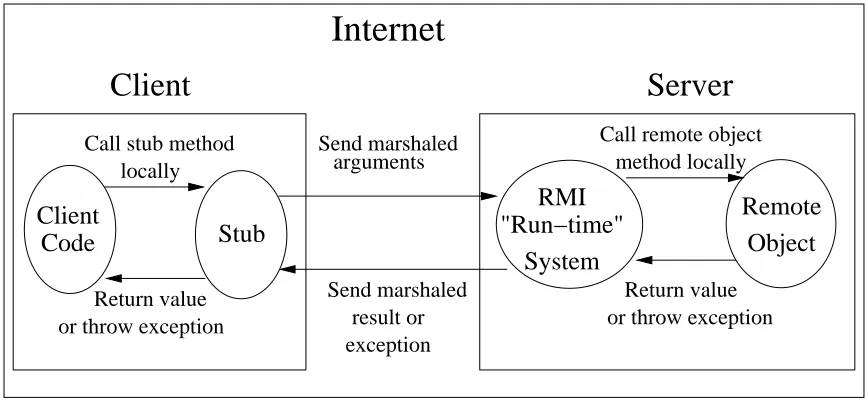
Java Remote Method Invocation (RMI), which is a simple and powerful network object transport mechanism, provides a way for a Java program on one machine to communicate with objects residing in different address spaces. Some Java parallel computing environments use RMI for communication, such as JavaParty, discussed in next section. It is also the foundation of Jini technology—discussed on section 2.1.5. RMI is an implementation of the distributed object programming model, comparable with CORBA, but simpler, and specialized to the Java language. An overview of the RMI architecture is shown in Figure 2.1. Important parts of the RMI architecture are the stub class, the object serialization, and the server-side Run-time System.
The stub class implements the remote interface and is responsible for marshaling and unmarshaling the data and managing the network connection to a server. An instance of the stub class is needed on each client. Local method invocations on the stub class will be made whenever a client invokes a method on a remote object.
Client
Call stub method locally
Stub
Client
Code
Return value or throw exception
Send marshaled arguments Send marshaled result or exception
System
RMI
"Run−time"
Server
Return value or throw exceptionmethod locally Call remote object
[image:21.612.89.523.69.269.2]Remote
Object
Internet
Figure 2.1. RMI Architecture.
network or to a file-system. In order to provide the functionality, an object must implement the Serializable interface.
The server-side run-time system is responsible for listening for invocation requests on a suitable IP port, and dispatching them to the proper, remote object on the server.
Since RMI is designed for Web based client-server applications over slow network, it is not clear it is suitable for high performance distributed computing environments with low latency and high bandwidth. A better serialization would be needed, since Java’s current object serialization often takes at least 25% and up to 50% of the time [50] needed for a remote invocation.
2.1.4 JavaParty
The JavaParty [51] platform, which is a system from the University of Karlsruhe,
JavaParty provides a mechanism that can discover remote objects and remote threads on different nodes without any programmer’s extra work.
JavaParty is implemented by a pre-processing phase added to EspressoGrinder [46] and Pizza [47] Java compilers. After JavaParty code is transformed into regular Java code plus RMI hooks, Sun’s RMI generator (stub and skeleton generator) take the resulting RMI portions.
JavaParty is an important contribution to research on Java-based parallel computing. Compared to approach in this survey paper, we expect to suffer from some unavoidable overhead from the RMI mechanism, relative to direct message-passing. Also, arguably, there is comparatively little evidence that the remote procedure call approach is most convenient for SPMD programming.
2.1.5 Jini
As we mentioned in previous chapter,Jinitechnology may eventually become a core part of the underlying communication environment for our HPJava project (see section 5.5.4). In this section we will give a more general overview of Jini technology.
Jini technology [7, 24], built by Sun Microsystems, is a programming model that makes it easier for programmers to get their devices talking to each other. It is a lightweight layer of Java code that rests on top of the Java 2 platform. Jini provides a mechanism to enable smooth adding, removal, and finding of devices and services on the network without device vendors having to agree on network level protocols to allow their devices to interact. A service can be anything that sits on the network and is ready to perform a useful function. Hardware devices, software, and communications channels can all offer up their services to a dynamic network in a standard fashion without a central controlling authority.
Jini’s architecture takes advantage of one of the fundamental features of object-oriented programming—the separation of interface and implementation. Jini depends on Java’s RMI to provide the underlying distributed communications framework. The runtime infrastruc-ture uses one network-level protocol, called discovery, and two object-level protocols, called
join and lookup. Discovery enables clients and services to locate lookup services. Join
programming model includes three important API collections: Distributed events,distributed
leasing, and distributed transactions. Thedistributed event programming model offers a set
of interfaces to allow services to notify each other of changes in their state. The distributed leasing model provides a set of interfaces that encourage distributed objects to obtain leases for use of particular distributed resources. The service is responsible for renewing that lease before expires. If the lease is not renewed, access to the distributed resource expires, and resources are freed. The purpose of this feature is that it cleans up resources no longer in use by potentially failed distributed objects. For example, the lookup service automatically unregisters a failed service object. Finally, a distributed transactions programming model is to provide services for coordinating distributed operations, and guarantee that either all must occur atomically or that none occur at all.
2.2
Peer to Peer Computing
The term peer-to-peer (P2P) became fashionable in the computing field around the middle of the year 2000. A P2P network differs from conventional client/server or multitiered server’s networks. A P2P architecture provides direct communication between peers without the reliance on centralized servers or resources. The claim for P2P architecture is that enables true distributed computing, creating networks of computing resources. Computers that have traditionally been used as clients can act as both clients and servers. P2P allows systems to have temporary associations with one other for a while, and then separate. P2P is an umbrella term for a rather diverse set of projects and systems including Napster, Freenet, and SETI@home. Here we discuss a select few that are more relevant to our interests.
2.2.1 Javelin
Javelin predates fashion for the P2P, but resembles other projects described in this
without compromising portability and flexibility. The Javelin design is exploit widely used components—Web browsers and the Java language—to achieve those goals.
Three kinds of participating entities exist inside the Javelin system. The three entities
are clients, which are processes seeking computing resources, hosts, which are processes
offering computing resources, and brokers, which are processes that coordinate the supply and demand for computing resources. The broker gets tasks from clients and assigns to hosts that registered with the broker. Hosts send result back to the clients after finish running tasks. Users can make their computers available to host part of a distributed computation by pointing their browser to a known URL of a broker.
Javelin is good for loosely-coupled parallel applications (“task parallelism”) but in itself it does not address the more tightly-coupled SPMD programming considered by HPJava.
2.2.2 SETI@home
SETI@home[52], a project that searches for extraterrestrial intelligence using networked
personal computers, was launched early 1998. The Internet clients analyze data that is collected by the Arecibo radio telescope looking for possible indication of extraterrestrial intelligence. The collected data is divided into work unitsof 0.25 Mbyte. A work unit is big enough to keep a computer busy for a while and small enough to transmit in a few minutes even for a 28.8Kbps modem.
The essential part of this project is the client program, which is a screen saver for Windows or Macintosh users. Hence the client program will run only when computer is not being used. A Sign-up client gets a work unit from SETI@home data distribution server. After finishing processing its data, the client sends results back to the server and gets a new work unit. The SETI@home data server connects only when transferring data. To protect the job from computer failure, the client program writes a “check point” file to disk. Hence the program can pick up where it left off. The SETI@home data distribution server keeps track of the work units with a large database. When the work units are returned, they are put back into the database and the server looks for a new work unit and sends it out. Each work unit is sent out multiple times in order to make sure that the data is processed correctly.
3.1 trillion floating-point operations are required by a work unit to compute an FFT. SETI@home clients (between them) process about 700,000 work units in a typical day. This works out to over 20 TFLOPS. SETI@home also costs less then 1% compared to ASCI White.
In the first week after the launch, over 200,000 people downloaded and ran the client. This number has grown to 2,400,000 as of October 2000. People in 226 countries around the world run SETI@home. You can find more information about this project and client sign up are available from http://setiathome.ssl.berkeley.edu.
The SETI@home approach is not suitable for all problems. It must be possible to factor the problem into a large number of pieces that can be handled in parallel, with few or no interdependencies between the pieces.
2.2.3 Parabon
Parabon Computation, Inc. [48] announced a commercial distributed application called
Frontier at the Supercomputing 2000 conference. The Frontier is available as a service over
the Web or as service software. It claims to deliver scalable computing capacity via the Internet to a variety of industries.
The Client Application, the Pioneer Compute Engine, and the Frontier Server are three
components of the Frontier platform. The client application runs on a single computer by an individual or organization wishing to utilize the Frontier platform by communicating with the Frontier server. The Pioneer Compute Engine is a desktop application that utilizes the spare computational power of an Internet-connected machine to process small units of computational work called tasks during idle time. The Frontier Server is the central hub of the Frontier platform, which communicates with both the client application and multiple Pioneer compute engines. It coordinates the scheduling and distribution of tasks.
The inherent security features of JVM technology was the main reason to choose Java over other programming languages as programming language of Frontier. The JVM provides a “sandbox” inside which an engine can securely process tasks on a provider’s computer. Valid Java bytecode has to be sent to engines and used to run tasks within the JVM.
In this project sustaining a large network of “volunteer” machines is a problem. Not many consumers are willing to donate computing cycles for purely commercial projects. Parabon system is good for task parallel applications but arguably is not peer to peer computing in sense tasks cannot communicate. Parabon system is less appropriate for the more tightly-coupled SPMD programming we are interested in.
2.2.4 JXTA
Project JXTA [36], an industry-wide research project led by Sun Microsystems, was
launched on April 25th, 2001. The goal of Project JXTA is to develop protocols for cross-platform communication that provide direct access from one node to another without any centralized server control, and to create a simple, open, lightweight layer of standards that ensures interoperability and scalability when existing software stacks are integrated. Even though current JXTA is developed on top of Java technology, JXTA supposed to be independent from programming platforms, systems platforms, and networking platforms. The claim is that it can be embraced by all developers, independent of their preferred pro-gramming languages, existing development environments, or targeted deployment platforms. Currently existing software technologies such as Java, Jini, and Extensible Markup Language (XML) are used by JXTA technology. The goal is a P2P system that is familiar to developers and easy to use. The benefit of using Java technology is the ability to compute on different machines without worrying about operating system limitations. Jini network technology enables spontaneous networking of a wide variety of hardware, and services. XML technology allows data to move across a network in a widely used format.
to access information directly from a PDA to a laptop without going through a centralized server.
JXTA has a limited number of concepts at it core. Here we overview some important concepts. Apeeris any network device that implements one or more of the JXTA protocols. A collection of peers which have common interests can organize into a peer group. We can identify each peer group by a unique peer group id. Two peers can send and receive message usingpipes—currently unidirectional virtual communication channels. All network resources, such as peers, peer groups, pipes and services are represented by an advertisement, which is JXTA’s language neutral metadata structure for describing such resources.
Along with Jini technology, JXTA technology may become a very useful tool for our pure Java version of HPJava runtime environment.
2.3
Java Enterprise Computing
Our project is not particularly targeting enterprise computing. However we will review some related Java technologies in this area, namely the Java Message Service, which makes possible to exchange messages between Java programs, and Enterprise Java Beans, which implements server-side applications.
2.3.1 Java Message Service
Java Message Service (JMS) [35], designed by Sun Microsystems and several partner
companies provides standard APIs that allows applications to create, send, receive, and read messages. It has been a part of the Java 2 Enterprise Edition since release 1.2. Java programs can exchange messages with other Java programs by sharing a messaging system in JMS. A messaging system, sometimes called Message-Oriented Middleware (MOM), accepts messages from “producer” clients and delivers them to “consumer” clients. Messaging systems are peer-to-peer distributed systems in the sense that every registered client can communicate with every other registered client. The term messaging is used to describe asynchronous communication between enterprise applications.
sends a message to a specified queue. A QueueReceiver class (consumer) receives messages from the queue. The publish/subscribe messaging model is organized around topics. A
TopicPublishers class (producer) sends messages to a topic. A TopicSubscribers class (consumer) retrieves messages from a topic. JMS also supports both synchronous and asynchronous message passing.
A JMS application is composed of the following parts: a JMS provider, JMS clients,
messages, administered objects, and native clients. A JMS provider is a messaging product
that implements the JMS interfaces and provides administrative and control features. JMS clients are programs or components written in the Java programming language that produce and consume messages. Messages are the objects that communicate information between JMS clients. An administrator creates administered objects, which are JMS objects, for use of client. There are two kinds of administered objects: destinations and connection factories. A client uses a destination object to specify the target and the source of messages. Connection configurations that have been defined by the administrator are contained in a connection factory. Native clients are programs that use a messaging product’s native client API instead of the JMS API. Figure 2.2 illustrates the way these parts interact. After we bind destinations and connection factories into a Java Naming Directory Interface (JNDI) namespace, a JMS client looks up the administered objects in the namespace. Then the JMS provider provides the same objects for a logical connection to the JMS client.
Unlike the Remote Procedure Call (RPC) synchronous model, where we block and wait until each system finishes processing a task, a fundamental concept of MOM is that communication between applications is asynchronous. Code that is written to communicate assumes there is a one-way message that requires no immediate response from another application. There is also a high degree of anonymity between producer and consumer. Information about the owner of produced message is not important for the message consumer. This anonymity helps provide dynamic, reliable, and flexible systems.
2.3.2 Enterprise JavaBeans (EJB)
Enterprise JavaBeans (EJB) [25] implements server-side, arbitrarily scalable,
Administrative Tool
JNDI Namespace
Connection Factories Destinations
JMS Provider JMS Client
LookUp
Logical Connection Bind
Figure 2.2. The JMS API Architecture
Java RMI with server-side components to simplify the task of application development. EJBs can be built on top of existing transaction processing systems including traditional transaction processing monitors, Web servers, database servers, and application servers. Sun claims that EJB is not just platform independent—it is also implementation independent. An EJB component can run in any application server that implements the EJB specification [22].
User applications and beans are isolated from the details of the component services. The ability to reuse the same enterprise bean in different specific applications is one advantage of this separation. The bean implementation or the client application need not have the parameters that control a bean’s transactional nature, persistence, resource pooling, or security management. These parameters can be specified in separate deployment descriptors. So, when a bean is deployed in a distributed application, the properties of the deployment environment can be accounted for and reflected in the setting of the bean’s options.
EJB is a rather specialized architecture—aimed at transaction processing and database access. It is not really an environment for general distributed computing in our sense.
2.4
Comparison of Languages
In this section we compare Java as a language to support parallel and scientific computing with other object-oriented programming languages like C++ and C#, which is a new .NET platform language from Microsoft. In this comparison we discuss issues like performance and added functionality, such as multidimensional arrays, operator overloading, and lightweight objects. We also compare the Microsoft intermediate language with the Java Virtual Machine (JVM).
2.4.1 Java
Java started out as a Sun Microsystems funded internal corporate research project that tried to develop intelligent consumer electronic devices in 1990. A C and C++ based language called Oak—the former name of Java—was developed as a result of this project. After the World Wide Web exploded in popularity in 1993, the potential of using Java to create Web pages emerged. Although Java applets have lost some popularity, the Java language has continued to gain new applications.
The Java Grande Forum [33] has been set up to co-ordinate the community’s efforts to standardize many aspects of Java and so ensure that its future development makes it more appropriate for scientific programmers. A “Grande” application can be described as one with a large scale nature, potentially requiring any combination of computers, network, I/O, and memory-intensive applications. Examples include, financial modeling, aircraft simulation, climate and weather, satellite image processing and earthquake predication. Two major working group of the Java Grande Forum are the Numerics Working Group and the Applications and Concurrency Working Group.
overloading. Lightweight classes and operator overloading provide key components to proposed improvements for complex arithmetic and multidimensional arrays.
Associated developments have helped establish the case that Java can meet the vital performance constraints for numerically intensive computing. A series of papers from IBM [40, 41, 56], for example, demonstrated how to apply aggressive optimizations in Java compilers to obtain performance competitive with Fortran. In a recent paper [42] they described a case study involving a data mining application that used the Java Array package supported by the Java Grande Numerics Working Group. Using the experimental IBM HPCJ Java compiler they reported obtaining over 90% of the performance of Fortran.
2.4.2 C++
C++, an extension of C, was developed by Bjarne Stroustrup in the early 1980s at Bell Laboratories. The most important feature of C++, and difference from C, is that C++ provides capabilities for object-oriented programming. C++ was recently standardized by the ANSI and ISO committees.
Java is a descendant of C++. Although a lot of syntax has been borrowed from C++, Java made no attempt to be compatible with C++. Java is designed to run over the Internet, and that required it take advantage of new language technology—for example, advances in automatic garbage collection, and just-in-time compilation.
There are some similarities of Java and C++, like C-style statements, expressions, and declarations—and classes, access privileges, virtual functions and overloading. Java, however, omits various features of C and C++ that are considered “difficult”—notably, pointers. Poor compiler analysis has often been blamed on these features. Java has fewer rules to remember. This is sometimes because it doesn’t support the operations (operator overloading, for example), and sometimes because it does the work for you (automatic garbage collection, for example).
2.4.3 C#
C# [20], which is an important part of the new Microsoft .NET platform, is a modern, object-oriented and type-safe programming language based on C and C++. Header files, Interface Definition Language, and complicated interfaces are not needed in C#. C# is supposed to offer an alternative to C++ programmers who find that language too complicated, and to Java programmers who miss certain features of C and C++, like pointers, operator overloading, and templates.
C# has all the data types provided by the Java, with additional unsigned counterparts and a new 12-byte-decimal floating-point number. Java uses primitive types that are distinguished from object-based types. Java primitive types must be put into an instance of a wrapper class to participate in the object-based world. C# provides what it calls a “unified type system”. This means all types—including value types—derive from the type
object. Primitive types are stack–allocated as in Java, but are also considered to derived from the ultimate base class,object. This means that the primitive types can have member functions called on them. The example:
using System; class Test {
static void Main() {
Console.WriteLine(3.ToString()); }
}
calls the object-defined ToString method on an integer literal.
Whenever a primitive type is used in a situation where a parameter of type object
class Test {
static void Main() {
int i = 123;
object o = i; // boxing
Console.WriteLine(‘‘Value is: {0}’’, o); int j = (int) o; // unboxing
} }
Declaring the object variable is done for illustration only; in real code, i would be passed directly, and the boxing would happen at the call site.
Unlike Java we can pass method arguments by reference in C# using ref and out
modifiers. A reference parameter is declared with arefmodifier. The same storage location is used between a reference parameter and the variable given as the argument. An example usage of these parameters may look like:
void Swap(ref int x, ref int y) { int temp = x;
x = y; y = temp; }
A outmodifier is used to declare a output parameter. Like reference parameters, output parameters do not create a new storage location. An output parameter need not be assigned
before it is passed as a argument of a method.
C# also provides C-like pointers through unsafe code. In order to use unsafe code we should specify the unsafe modifier on the code block. Unsafe code can be used in place of Java Native Methods in many cases.
As mentioned in section 2.4.1, the Java Grande Numerics Working Group identified various critical areas to improve the Java language. C# addresses some of issues by supporting structs, operator overloading, andmultidimensional arrays.
They are value types rather than reference types, and inheritance is not supported for structs. Struct values are stored either “on the stack” or “in-line”.
C# provides operator overloading that allows user-defined operators to be implemented on classes or structs so that they can be used with operator syntax. Unlike C++, it is not possible to overload member access, member invocation (function calling), or the +, &&,, ?:, or new operators. The new operation can’t be overloaded because the .NET Runtime is responsible for managing memory.
Like our HPJava system, C# supports both “rectangular” and “jagged” multi-dimensional arrays1. Rectangular arrays always have a rectangular shape. Given the length of each dimension of the array, its rectangular shape is clear. A jagged array is merely an array of arrays and it doesn’t have to be square.
Microsoft’s .NET framework is based on its Common Language Runtime (CLR), which is a specification for language-independent intermediate language (IL) code, and a runtime that provides memory management and security. Whereas Java programs can run on any platform supporting JVM, and are compiled to byte code, which is an intermediate language only for Java, C# demands the standardization of Microsoft intermediate language (MSIL) [1]. Unlike Java, which is platform independent, MSIL has a feature calledlanguage independence: code and objects written in one language can be compiled to MSIL format and interoperate with other languages. However, for classes to be usable from .NET languages in general, the classes must adhere to the Common Language Specification (CLS), which describes what features can be used internally in a class. This significantly restricts C++ programs, for example, if they are to run under .NET.
The MSIL instruction set is very similar in many ways to the JVM instruction set. The MSIL assumes a stack-based abstract machine very similar to the JVM, with a heap, a frame stack, the same concept of stack frame, and bytecode verification.
There are some rather simple differences—for example JVM words are big endian (most significant byte first) whereas MSIL uses a little endian (least significant byte first) binary representation. Also MSIL instructions do not include information that specifies the type of the arguments. Rather, that is inferred by what is been pushed on the stack. We can find
more fundamental differences between JVM instruction sets and MSIL in the verification of compiled code, and pointers.
JVM verification ensures that the binary representation of a class or interface is struc-turally correct. The following lists of checks are performed during JVM verification.
• Every instruction has a valid operation code.
• Every branch instruction branches to the start of some other instruction, rather than into the middle of an instruction.
• Every method is provided with a structurally correct signature.
• Every instruction obeys the type discipline of the Java language.
Unlike JVM, several important uses of MSIL instructions are not verifiable, such as the pointer arithmetic versions of addthat are required for the faithful and efficient compilation ofC programs. For nonverifiable code, memory safety is the responsibility of the application programmer.
The only kind of pointer manipulated by the JVM instruction set is the object reference. MSIL manipulates three different kinds of pointers: object reference like JVM, managed
pointersfor reference argument variables, and unmanaged pointers for unsafe code pointers.
Managed pointers must be reported to the garbage collector. The garbage collector can modify the managed pointer itself, as well as the contents of the location which is pointed to. The unmanaged pointers get great flexibility in their operation since they are not reported to the garbage collector. But memory safety is endangered by performing arithmetic on unmanaged pointers; hence they are not verifiable.
2.4.3.1 MPI with C#
The C# binding is relatively straightforward. Each object of C# bindings contains the underlying C representation of the MPI object. Similarly, the high-level objects in the MPI.NET are usually containers of underlying MPI objects. Both the C# binding and MPI.NET libraries are built on top of a native implementation of MPI. The P/Invoke feature of CLI is used to bind lowest level of both libraries to the C MPI functions. A P/Invoke is a mechanism to create direct interface to existing libraries written in C and C++ in the .NET programming environments.
Since the MPI.NET binding uses language features of C#, it has unique features. The MPI.NET uses a feature of C# properties. This feature allows to access a field of object more conveniently by providing special syntax like method. This feature simplifies interface of information like rank of the current process or number of nodes. Unlike the C# bindings, automatic pinning and unpinning of user defined data is also provided in the MPI.NET binding. A more minor difference is the C# bindings try to follow naming convention of MPI C++ bindings and the MPI.NET library tries to follow C# naming convention.
CHAPTER 3
REVIEW OF THE HPJAVA ENVIRONMENT
In this chapter we will discuss ongoing work within our research group on the HPJava system. HPJava is an environment for SPMD (Single Program, Multiple Data) parallel programming—especially, for SPMD programming with distributed arrays. The HPJava language design and its features are discussed first. The results reported in this dissertation concentrate in particular on issues related to the development of efficient run time support software for parallel languages extending an underlying object-oriented language. So the review emphasizes aspects most relevant to this topic—aspects like high performance interprocessor communication.
3.1
Introduction
The SPMD (Single Program Multiple Data) programming style is the most commonly
used style of writting data-parallel programs for MIMD (Multiple Instruction Multiple
Data) systems. This style provides a Loosely Synchronous Model. In SPMD programming
style, each processor has its own local copy of control variables and datas. Processors execute the same SPMD program asynchronously across MIMD nodes. Explicit or implicit synchronization takes place only when processors need to exchange data. Conditional branches within the source code may provide the effect of running different programs. There have been many data-parallel languages. These programming languages provided some consensus about outline of a standard language for SPMD programming. The High Performance Fortran (HPF) standard was established by the High Performance Fortran
Forum in 1993.
program and operates on parts of the overall data. The HPF programs are simpler to write than explicit message-passing programs, but performance of HPF rarely achieves the efficiency of the message-passing. Although the HPF language might never be widely adopted, many of the ideas—for example its standardization of a distributed data model for SPMD computing—remain important.
Over many years the SPMD programming style has been very popular among the high-level parallel programming environment and library developers. SPMD framework libraries try to overcome weakness of HPF. While HPF has strength on rather regular data structures and regular data access patterns problems, it is not particularly suitable for irregular data access. Some libraries are dealing directly with irregularly distributed data, DAGH [49], Kelp [27], and other libraries support unstructured access to distributed arrays, CHAOS/PARTI [21] and Global Arrays [44]. While the library-based SPMD approach to data-parallel programming may address weakness of HPF, it loses good features like the uniformity and elegance that promised by HPF. There are no compile-time or compiler-generated run-time safety checks for the distributed arrays because libraries manage the arrays. The ourHPspmd
model is an attempt to address such shortcomings.
The HPspmd model is SPMD programming supported by additional syntax for HPF-like distributed arrays. This model provides a hybrid of the data parallel model of HPF and the low-level SPMD programming style—as often implemented using communication libraries like MPI. In the HPspmd model, a subscripting syntax can be used to directly access local elements of distributed arrays. References to these elements can only be made on processors that hold copies of the elements concerned. To ensure this, a well-defined set of rules are automatically checked by the translator. Even though the HPspmd model does provide special syntax for HPF-like distributed arrays, all access to non-local array elements should go through library function calls in the source program. These library calls must be placed in the original HPJava program by the programmer. This requirement may be unusual to people expecting high-level parallel languages like HPF, but it should not seem particularly unnatural to programmers used to writing parallel programs using MPI or other SPMD libraries. The exact nature of the communication library used is not part of the HPJava language design. Collective operations on whole distributed arrays , or some kind of get
by an appropriate communication library. This dissertation concentrates especially on one particular communication library called Adlib.
In the current system, syntax extensions are handled by a preprocessor that outputs an ordinary SPMD program in the base language. The HPspmd syntax provides a fairly thin veneer on low-level SPMD programming, and the transformations applied by the translator are correspondingly direct—only limited analysis should be needed to obtain good parallel performance. But the language does provide a uniform model of a distributed array, which can be targeted by reusable libraries for parallel communication and arithmetic. The model adopted very closely follows the distributed array model defined in the High Performance Fortran standard.
3.2
HPJava—an HPspmd language
HPJava [15] is a particular implementation of the HPspmd idea. It is a strict extension of its base language, Java, adding some predefined classes and some extra syntax for dealing with distributed arrays. HPJava is thus an environment for parallel programming, especially suitable for data parallel scientific programming. To some extent the choice of base language is accidental, and we could have added equivalent extensions to another language, such as Fortran itself. But Java does seem to be a better language in various respects, and it seems likely that in the future more software will be available for modern object-oriented languages like Java than for Fortran.
An HPJava program can freely invoke any existing Java classes without restrictions because it incorporates all of Java as a subset. A concept of multidimensional distributed arrays—closely modeled on the arrays of HPF1—has been added to Java. Regular sections of distributed arrays are fully supported. Distributed arrays can have any rank greater than or equal to zero and the elements of distributed arrays can be of any standard Java type, including primitive types, Java class types and ordinary Java array types.
A standard Java class file is produced after translating and compiling a HPJava program. This Java class file will be executed by a distributed collection of Java Virtual Machines. All externally visible attributes of an HPJava class—e.g. existence of distributed-array-valued
Procs2 p = new Procs2(P, P) ; on(p) {
Range x = new BlockRange(M, p.dim(0)) ; Range y = new BlockRange(N, p.dim(1)) ;
float [[-,-]] a = new float [[x, y]], b = new float [[x, y]], c = new float [[x, y]] ;
... initialize values in ‘a’, ‘b’ overall(i = x for :)
overall(j = y for :)
c [i, j] = a [i, j] + b [i, j] ; }
Figure 3.1. A parallel matrix addition.
fields or method arguments—can be automatically reconstructed from Java signatures stored in the class file. This makes it possible to build libraries operating on distributed arrays, while maintaining the usual portability and compatibility features of Java. The libraries themselves can be implemented in HPJava, or in standard Java, or through Java Native Interface (JNI) wrappers to code implemented in other languages. The HPJava language specification carefully documents the mapping between distributed arrays and the standard-Java components they translate to.
The distributed array is the most important feature HPJava adds to Java. A distributed array is a collective array shared by a number of processes. Like an ordinary array, a distributed array has some index space and stores a collection of elements of fixed type. The type signature of anr-dimensional distributed array involves double brackets surrounding r comma-separated slots. A hyphen in one of these slots indicates the dimension is distributed. Asterisks are also allowed in these slots, specifying that some dimensions of the array are not to be distributed, i.e. they are “sequential” dimensions (ifall dimensions have asterisks, the array is actually an ordinary, non-distributed, Fortran-like, multidimensional array—a valuable addition to Java in its own right, as many people have noted [42, 43]).
In HPJava the subscripts in distributed array element references must normally be distributed indexes (the only exceptions to this rule are subscripts in sequential dimensions, and subscripts in arrays with ghost regions, discussed later). The indexes must be in the distributed range associated with the array dimension. This strict requirement ensures that referenced array elements are held by the process that references them.
The variables a, b, and c are all distributed array variables. The creation expressions on the right hand side of the initializers specify that the arrays here all have ranges x and
y—they are all M by N arrays, block-distributed over p. We see that mapping of distributed arrays in HPJava is described in terms of the two special classes Group and Range.
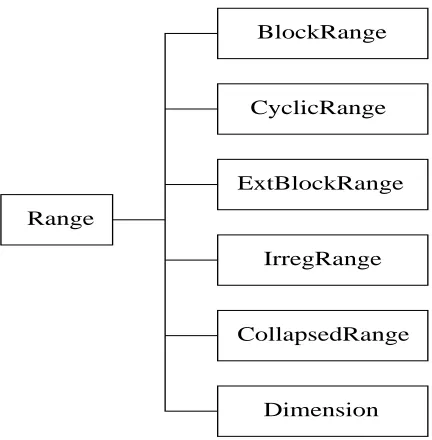
TheRangeis another special class with privileged status. It represents an integer interval
0,..., N - 1, distributed somehow over a process dimension (a dimension or axis of a grid like p). BlockRange is a particular subclass of Range. The arguments in the constructor of
BlockRange represent the total size of the range and the target process dimension. Thus, x has M elements distributed over first dimension of p and y has N elements distributed over second dimension of p.
BlockRange
CyclicRange
Range
IrregRange ExtBlockRange
CollapsedRange
[image:42.612.199.415.67.287.2]Dimension
Figure 3.2. The HPJava Range hierarchy
dimensions of this grid, and if a particular dimension of the grid is targeted by none of the ranges, the array is said to bereplicatedin that dimension2. Some of the range classes allow
ghost extensions to support stencil-based computations.
A second new control construct, overall, implements a distributed parallel loop. It shares some characteristics of the forall construct of HPF. The symbols i and j scoped by these constructs are calleddistributed indexes. The indexes iterate over all locations (selected here by the degenerate interval “:”) of ranges x and y.
HPJava also supports Fortran-like array sections. An array section expression has a similar syntax to a distributed array element reference, but uses double brackets. It yields a reference to a new array containing a subset of the elements of the parent array. Those elements can be accessed either through the parent array or through the array section— HPJava sections behave something like array pointers in Fortran, which can reference an arbitrary regular section of a target array. As in Fortran, subscripts in section expressions can be index triplets. HPJava also has built-in ideas of subranges and restricted groups. These describe the range and distribution group of sections, and can be also used in array
constructors on the same footing as the ranges and grids introduced earlier. They allow HPJava arrays to reproduce any mapping allowed by the ALIGN directive of HPF.
The examples here have covered the basic syntax of HPJava. The language itself is relatively simple. Complexities associated with varied or irregular patterns of communication are supposed to be dealt with in communication libraries like the ones discussed in the remainder of this dissertation.
The examples given so far look very much like HPF data-parallel examples, written in a different syntax. We will give one last example to emphasize the point that the HPspmd model is not the same as the HPF model. If we execute the following HPJava program
Procs2 p = new Procs2(2, 3) ; on(p) {
Dimension d = p.dim(0), e = p.dim(1) ;
System.out.println("My coordinates are (" + d.crd() +
, " + e.crd() + ")") ; }
we could see output like:
My coordinates are (0, 2) My coordinates are (1, 2) My coordinates are (0, 0) My coordinates are (1, 0) My coordinates are (1, 1) My coordinates are (0, 1)
public void matmul(float [[-,-]] c, float [[-,-]] a, float [[-,-]] b) { Group2 p = c.grp();
Range x = c.rng(0); Range y = c.rng(1); int N = a.rng(1).size();
float [[-,*]] ta = new float [[x, N]] on p; float [[*,-]] tb = new float [[N, y]] on p; Adlib.remap(ta, a);
Adlib.remap(tb, b); on(p)
overall(i = x for : ) overall(j = y for : ) {
float sum = 0;
for(int k = 0; k < N ; k++) sum += ta [i, k] * tb [k, j]; c[i, j] = sum;
} }
Figure 3.3. A general Matrix multiplication in HPJava.
3.3
High-level Communication Library
In this section we discuss extra syntax and usage of high-level communication library in HPJava programs. Two characteristic collective communication methods remap() and
writeHalo() are described as examples.
This example relies on a high-level Adlib communication schedule that deals explicitly with distributed arrays; the remap() method. The remap() operation can be applied to various ranks and type of array. Any section of an array with any allowed distribution format can be used. Supported element types include Java primitive and Object type. A general API for the remap function is
void remap (T [[]] dst, T [[]] src) ; void remap (T [[-]] dst, T [[-]] src) ; void remap (T [[-,-]] dst, T [[-,-]] src) ; ...
where T is a Java primitive or Object type. The arguments here are zero-dimensional, one-dimensional, two-one-dimensional, and so on. We will often summarize these in the shorthand interface:
void remap (T # dst, T # src) ;
where the signature T # means any distributed array with elements of type T (This syntax is not supported by the current HPJava compiler, but it supports method signatures of this generic kind in externally implemented libraries—ie. libraries implemented in standard Java. This more concise signature does not incorporate the constraint thatdst and src have the same rank—that has to be tested at run-time.)
As another example, Figure 3.4 is a HPJava program for the Laplace program that uses
ghost regions. It illustrates the use the library class ExtBlockRange to create arrays with
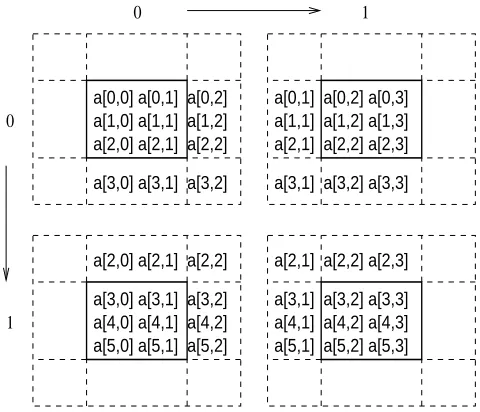
ghost extensions. In this case, the extensions are of width 1 on either side of the locally held “physical” segment. Figure 3.5 illustrates this situation.
From the point of view of this dissertation the most important feature of this example is the appearance of the function Adlib.writeHalo(). This is a collective communication
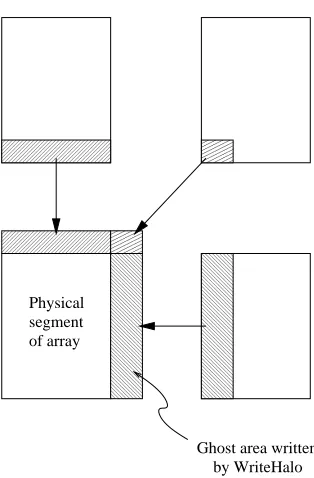
operation. This particular one is used to fill theghost cellsoroverlap regionssurrounding the
Procs2 p = new Procs2(P, P) ; on(p) {
Range x = new ExtBlockRange(M, p.dim(0), 1) ; Range y = new ExtBlockRange(N, p.dim(1), 1) ; float [[-,-]] a = new float [[x, y]] ;
... initialize edge values in ’a’
float [[-,-]] b = new float [[x, y]], r = new float [[x, y]] ; do {
Adlib.writeHalo(a) ;
overall(i = x for 1 : N - 2) overall(j = y for 1 : N - 2) {
float newA = 0.25 * (a[i - 1, j] + a[i + 1, j] + a[i, j - 1] + a[i, j + 1]); r[i,j] = Math.abs(newA - a[i,j]);
b[i,j] = newA ; }
HPutil.copy(a,b) ; // Jacobi relaxation. } while(Adlib.maxval(r) > EPS);
}
Figure 3.4. Solution of Laplace equation by Jacobi relaxation.
More general forms of writeHalo may specify that only a subset of the available ghost area is to be updated, or may select cyclic wraparound for updating ghost cells at the extreme ends of the array.
If an array has ghost regions the rule that the subscripts must be simple distributed indices is relaxed; shifted indices, including a positive or negative integer offset, allow access to elements at locations neighboring the one defined by the overall index.
a[0,0] a[0,1] a[0,2] a[1,0] a[1,1] a[1,2] a[2,0] a[2,1] a[2,2]
a[2,0] a[2,1] a[2,2]
a[3,0] a[3,1] a[3,2] a[4,0] a[4,1] a[4,2] a[3,0] a[3,1] a[3,2]
a[0,1] a[0,2] a[0,3] a[1,1] a[1,2] a[1,3]
a[3,1] a[3,2] a[3,3] a[2,1] a[2,2] a[2,3]
a[5,0] a[5,1] a[5,2]
a[2,1] a[2,2] a[2,3]
a[3,1] a[3,2] a[3,3] a[4,1] a[4,2] a[4,3] a[5,1] a[5,2] a[5,3]
0 1
0
[image:47.612.186.426.68.274.2]1
Figure 3.5. Example of a distributed array with ghost regions.
operations based on the corresponding Fortran 90 array intrinsics. Reduction operations take one or more distributed arrays as input. They combine the elements to produce one or more scalar values, or arrays of lower rank.
Currently our collective communication library is built on top of device level commu-nication library called mpjdev. The mpjdev API is designed with the goal that it can be implemented portably on network platforms and efficiently on parallel hardware. This library is developed with HPJava in mind, but it is a standalone library and could be used by other systems. The main purpose of this library is to perform actual point-to-point communications between processes.
We will discuss implementation issues of high- and low-level communication libraries in Chapter 4 and Chapter 5.
3.4
Message-passing for HPJava
Physical segment of array 00000000 00000000 11111111 11111111 00000000 00000000 11111111 11111111 000 000 000 000 111 111 111 111 000 000 000 000 000 000 000 000 000 000 000 111 111 111 111 111 111 111 111 111 111 111 0000 0000 0000 0000 1111 1111 1111 1111 0000 0000 0000 0000 0000 0000 0000 0000 0000 0000 0000 1111 1111 1111 1111 1111 1111 1111 1111 1111 1111 1111 0 0 0 0 0 0 1 1 1 1 1 1 000000 000000 000000 000000 000000 000000 111111 111111 111111 111111 111111 111111 by WriteHalo Ghost area written
Figure 3.6. Illustration of the effect of executing the writeHalo function.
3.4.1 The mpiJava wrapper
The Message-Passing Interface (MPI) [39] was developed by a group of researchers from industry, government, and academia. It provides a rich set of communication libraries, application topologies and user defined data types. MPI is the first message-passing standard for programming parallel processors.
Our mpiJava software implements a Java binding for MPI proposed late in 1997. The API is modeled as closely as practical on the C++ binding defined in the MPI 2.0 standard, specifically supporting the MPI 1.1 subset of that standard. The mpiJava is developed by our research group and currently version 1.2 is available.