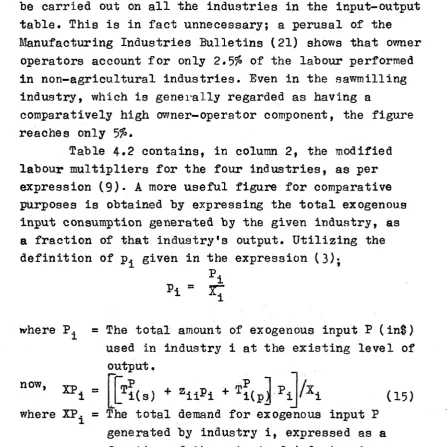
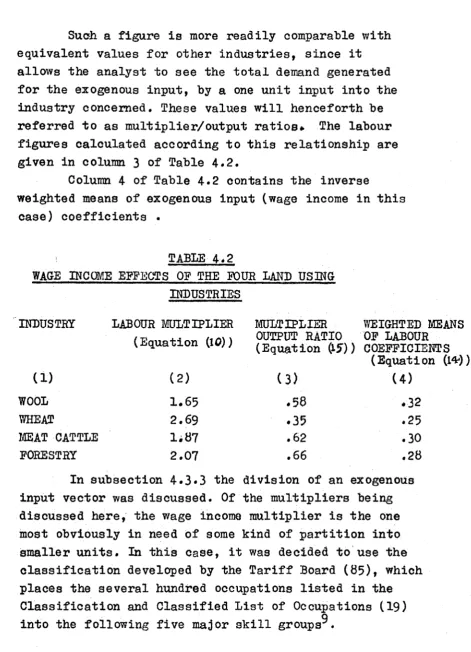
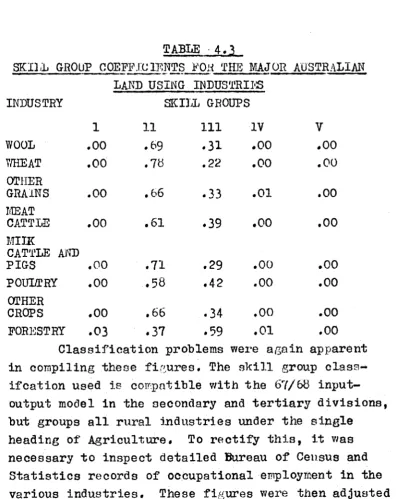
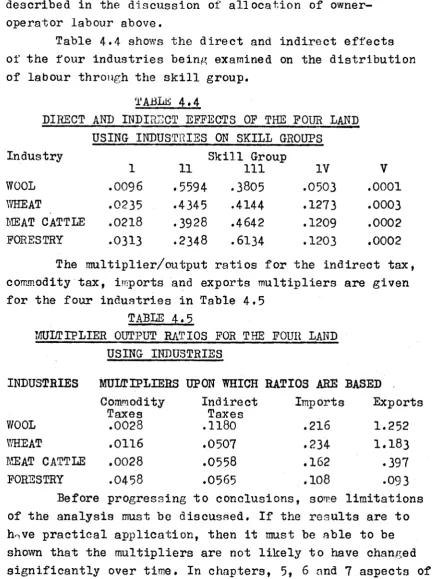
INPUT OUTPUT ANALYSIS FDR REGIONAL AND LAND USE EVALUATION WITH PARTICULAR REFERENCE
TO FORESTRY
by
James John D o u g la s , B . S c . ( F o r . )
A t h e s i s s u b m itte d f o r th e d e g re e o f M a s te r o f S c ie n c e a t th e A u s t r a li a n N a t io n a l U n i v e r s i t y .
i
-PREFACE
The work reported in this thesis was conducted by the author at the Department of Forestry, Australian National University. None of the original work in this thesis has been submitted previously for a degree at this, or any other University. Information derived from other researchers has been specifically acknowledged either as
personal communications, or in a list of references appended.
J.J. Douglas
ii
ACKNOWLEDGEMENTS
I wish to express my gratitude to my supervisor, Mr E.D. Parkes, for his valuable assistance and guidance through all stages of this work.
My thanks are also due to Mr T. Johnson of the Department of Forestry, for his assistance in the computational work associated with this thesis, and his major part in formulating the mathematical
proof presented in Chapter 5.
I am indebted to the head of the Forestry Department,
Professor J.D. Ovington, and to other staff members and post-graduate students at the Australian National University, for their help in provision of facilities and information. I would also like to thank the various officers of Federal and State Government Departments who assisted with the supply of data.
I am grateful to my employer, the Forestry Commission of New South Wales, for allowing me leave of absence to carry out this work, and to the Institute of Foresters of Australia, whose award to me of the Alan R. Henderson Bequest in 1971-72 provided some
much needed financial assistance.
iii
ABSTRACT
In the area of forestry economics, and indeed land use economics as a whole, there has been a tendency to analyze projects from the rather restricted viewpoint involving only their direct market costs and benefits. It is a fundamental argument of this thesis
that, where government and thereby society in general have an interest in an investment the indirect economic effect of that investment should be evaluated because they can be as important as the direct effects. Further, it is argued from the evidence presented that inferences
about the nature and magnitude of indirect effects can not be drawn from quantification of the direct effects.
Since the forestry industry was specifically examined in this thesis, it was necessary to place the industry in both its economic
and international perspective. This is done in the introductory chapters. A review of government investment criteria, particularly those relating to land use evaluation follows. This review outlines the basis for in cluding indirect economic effects into this type of analysis.
Having argued the necessity of including the indirect economic effects it was necessary to discuss the problems of how this may best be done. Although for regional analyses, many examples of the use of economic base models are available in the literature the alternative
technique of input output analysis has usually been restricted to multiple industry analyses of national or large scale regional projects.
i v
t o a n a ly z in g i n d e t a i l t h e t o t a l i n f l u e n c e o f one s e c t o r . Some r e g i o n a l f o r e s t r y e x a m p le s a r e p r e s e n te d t o d e m o n s tr a te how l i m i t e d r e g i o n a l
d a t a c a n be im p u te d i n t o a n a t i o n a l i n p u t o u t p u t m o d e l, t o y i e l d
s p e c i f i d in f o r m a t i o n a b o u t i n d i r e c t e c o n o m ic e f f e c t s o f an i n d u s t r y on e i t h e r a r e g i o n a l o r s u b - s e c t o r i a l b a s i s .
A t t h e n a t i o n a l l e v e l i t w i l l be s e e n fro m t h e r e s u l t s o b t a in e d t h a t t h e m u l t i p l i e r e f f e c t s o f th e v a r i o u s la n d u s in g i n d u s t r i e s e x a m in e d v a r y w i d e l y , b o th i n m a g n itu d e and e f f e c t . The r e g i o n a l f o r e s t r y
f i g u r e s d e v e lo p e d f o r t h i s t h e s i s p o i n t o u t t h e w i d e l y v a r y i n g n a t u r e o f i n d i r e c t e f f e c t s w i t h i n a n a t i o n a l l y d e f in e d s e c t o r , and a l s o p r o v id e d i n t e r e s t i n g i n f o r m a t i o n on t h e s t r u c t u r e o f t h e i n d u s t r y and how t h i s may be e x p e c te d t o c h a n g e o v e r t i m e .
C o n s id e r a b le a t t e n t i o n i s g iv e n i n t h i s w o rk t o t h e e x a m in a t io n o f t h e tw o m a jo r p ro b le m s a s s o c ia t e d w i t h i n p u t o u t p u t a n a ly s e s -
V
-TABLE OF CONTENTS
Page
INTRODUCTION 1
CHAPTER 1 GOVERNMENT INVESTMENT IN LAND USE
-AN OVERVIEW 11
1.1 INTRODUCTION 11
1.2 MEASURING THE WORTH OF A FOREST
INVESTMENT 12
1.3 CAPITAL 12
1.4 LAND 15
1.4.1 Inappropriate Maximands 15 1.4.2 Methodological Limitations 15 1.4.3 Valuation of Inputs and Outputs 17
1.5 EMPLOYMENT 18
1.6 EXTERNALITIES AND INTANGIBLES 20
1.7 SUMMARY 21
CHAPTER 2 INPUT OUTPUT ANALYSIS - A
DESCRIPTION OF THE MODEL AND ITS
APPLICATION TO LAND USE EVALUATION 23
2.1 INTRODUCTION 23
2.2 THE BASIC MODEL 24
2.3 FACTORS OF IMPORTANCE IN THE PRACTICAL
APPLICATION OF INPUT OUTPUT MODELS 32 2.4 SOME PREVIOUS APPLICATIONS OF INPUT
OUTPUT ANALYSIS TO THE FORESTRY SECTOR 33 CHAPTER 3 CORRECTION OF THE 1967/68 INPUT OUTPUT TABLE 36 CHAPTER 4 MULTIPLIERS - THEIR DERIVATION AND USE IN
LAND USE EVALUATION 41
4.1 THE CONCEPT 41
4.2 THE MODIFIED MULTIPLIER 43
4.3 INPUT OUTPUT DEFINITION OF THE MULTIPLIER 46 4.3.1 "Supply Side" Effects 46 4.3.2 "Processing Side" Effects 47 4.3.3 Useful Relationships Based on
the Modified Multiplier 50 4.4 MODIFIED MULTIPLIER ANALYSIS OF POUR LAND
vi
-CHAPTER 5 THEORETICAL ASPECTS OF AGGREGATING INPUT
OUTPUT MATRICES 63
5.1 REASONS FOR AGGREGATING MATRICES 63 5.2 THEORETICAL CRITERIA FOR AGGREGATION 64 5.3 PRESERVING MULTIPLIER EFFECTS 66 5.4 APPROXIMATION METHODS OF AGGREGATION 73 CHAPTER 6 AGGREGATION IN AUSTRALIAN INPUT OUTPUT TABLES 79
6.1 INTRODUCTION 79
6.2 COMBINATION OF SECTORS 79
6.2.1 Combining Sectors in the 1967/68
Model 79
6.2.2 Testing Sectors 80
6.3 METHODS OF AGGREGATION 81
6.3.1 The Output Weighting Method 81 6.3.2 The Equal Weighting Method 81
6.3.3 The flow/ALG Method 82
6.3.4 The Coefficient/ALG Method 82 6.4 TESTING FOR REPERCUSSION EFFECTS
PRESERVATION 83
6.5 TESTING FOR MULTIPLIER EFFECTS
PRESERVATION 89
6.6 THE 51 SECTOR MODEL 92
6.7 THE BUREAU OF CENSUS AND STATISTICS
30 SECTOR AGGREGATION 96
CHAPTER 7 COEFFICIENT DRIFT 97
7.1 INTRODUCTION 97
7.2 TESTING THE AUSTRALIAN MODEL 99
7.3 THE RAS TECHNIQUE 105
CHAPTER 8 IMPUTATION OF REGIONAL INPUT OUTPUT DATA INTO
THE NATIONAL MODEL 112
8.1 INTRODUCTION 112
8.2 IMPUTATION OF REGIONAL DATA 112 8.3 THE CENTRAL QUEENSLAND REGIONAL DATA 117 8.4 THE GREEN HILLS PLANTATION DATA 121 8.5 THE RESIDUAL, OR PARENT SECTOR 126
- vii
CHAPTER 9 SUMMARY AND CONCLUSIONS 130
9.1 ASSUMPTIONS 130
9.2 RESULTS AND CONCLUSIONS 131
9.3 POLICY INDICATIONS 134
9.4 FURTHER RESEARCH 135
9.5 PERSPECTIVE 136
BIBLIOGRAPHY 138
APPENDIX A Updating the Labour Vector APPENDIX B Skill Group Classification
APPENDIX C Aggregations of the 1967/68 RAS Update of the 1962/63 Input Output Table
APPENDIX D Driving Instructions for Program AG and associated Data Files.
APPENDIX E Diameter Distribution of Pinus Sawlogs, Batlow Sub-district
APPENDIX F Forestry Commission Records of Average Mill Door Log Values for the Month of May,1972.
ENCLOSURE: "A Note on the Use of a Modified Input Output Multiplier for Land Use Evaluation"
- viii
LIST OF TABLES
Table Page
1.1 Public and Private Costs and Benefits Associated with a Forestry Project
2.1 Cash Flows in a 3-Sector Economy 24
2.2 Input Output Coefficients 26
2.3 Symbolic Cash Flows in a 3 Sector Economy 28
2.4 Summary of Results 32
3.1 Hardwood and Softwood Logging Costs (Average) 39 4.1 Labour Input Output Figures for the Four Land
Using Industries 53
4.2 Wage Income Effects of the Four Land Using Industries56 4.3 Skill Group Coefficients for the Major Australian
Land Using Industries 57
4.4 Direct and Indirect Effects of the Four Land Using
Industries on Skill Groups 58
4.5 Multiplier Ouput Ratios for the Four Land Using
Industries 58
4.6 Intermediate Deliveries Plus Personal Consumption
Deliveries of the Four Land Use Industries 60 4.7 Net Foreign Exchange Effects of the Four Land Using
Industries 61
6.1 E Values for Aggregations of the 1967/68 Model 81 6.2 Proportion of Output From Test Sector That Goes to
Interindustry Demand in the 1967/68 Model 86 6.3 Ee Values for Aggregations of the 1967/68 Model 90 6.4 Percentage Deviations of Repercussion Effects
Produced in the 51 Sector Aggregation of the 1967/68
Model 94
6.5 Percentage Deviations of Multiplier Effects Produced in the 51 Sector Aggregation of the 1967/68 Model 94 6.6 e and Ee Indices for the 51 Sector Aggregation of
the 1967/68 Model 95
6.7 Percentage Deviations of Multiplier Effects Produced in the Bureau of Census and Statistics 30 Sector
Aggregation of the 1967/68 Model 96 7.1 Significant Coefficients in the Related Test Sectors
of the Two Models 103
7.2 Modified Multipliers for Wage Income, Indirect Taxes and Imports for Four Test Sectors in the Two Models 104 8.1 Summary of Inputs and Outputs in the Forestry
ix
8.2 Intermediate Inputs for Forestry in Central
Queensland 120
8.3 Summary of Inputs and Outputs in the Forestry
Industry of Green Hills 123
8.4 Intermediate Inputs for Forestry Industry at Green
Hills 125
8.5 Forestry Multipliers Calculated from Regional and
National Data 127
Tables in Appendices
Al Updated Labour Coefficients A2 Updated Labour Inputs
A3 Labour Coefficients - 1962/63 Model
Cl |l-A| ^ Based Aggregations of the 67/68 Model C2 "By Eye" Aggregations of the 67/68 Model
C3 "Round by Round Aggregation of the 67/68 Model C4 51 Sector Aggregation of the 67/68 Model
1
INTRODUCTION
FORESTRY IN AUSTRALIA
The f o r e s t r y i n d u s t r y i n A u s t r a l i a i s , by i n t e r n a t i o n a l s t a n d a r d s , a r e l a t i v e l y s m a ll o n e . I n te r m s o f la n d a v a i l a b i l i t y , l e s s th a n 10% o f th e t o t a l la n d s u r f a c e h a s a n y p o t e n t i a l f o r p r o d u c t i o n f o r e s t r y (F0RW00D ( 4 4 ) ) . I n c o m p a r is o n , a ro u n d 28% o f Canada i s
a l r e a d y u n d e r p r o d u c t iv e f o r e s t , and i n t h e U .S .A . t h e f i g u r e i s 2*2% (USDA ( 9 0 ) ) . The t o t a l o u t p u t o f t h e f o r e s t r y s e c t o r h a s r i s e n t o $150m a n n u a l l y , w h e re a s a s i n g l e a g r i c u l t u r a l i n d u s t r y - t h e w o o l i n d u s t r y - a d d s o v e r $800m t o G ro s s N a t i o n a l P r o d u c t a n n u a l l y (E v a n s e t a l . ( 3 3 ) ) . A u s t r a l i a p r o d u c e s a b o u t 1 c u b ic m e tr e o f wood p e r c a p i t a p e r annum , ( F o r e s t G ra p h s ( 4 2 ) ) , w h i l e e q u i v a l e n t f i g u r e s
q
f o r F in la n d , Canada and t h e U n it e d S t a t e s a r e 11.2m ( E r v a s t i £ t a l . ( 3 1 ) ) , 5 .1 m ^ (DFF ( o p c i t ) ) and 1.9m ^ (USDA ( o p c i t ) ) r e s p e c t i v e l y . T hese f i g u r e s , h o w e v e r, u n d e r s t a t e t h e im p o r ta n c e o f t h e i n d u s t r y t o th e A u s t r a l i a n e c o n o m y. F i r s t l y , t h e c o n t i n u a t i o n o f t h e l a r g e p l a n t a t i o n program m e w i l l in c r e a s e t h e s i z e o f t h e r e s o u r c e . W h ile some r e s e r v a t i o n s h a v e been e x p r e s s e d a s t o th e w isd o m o f c o n t in u e d f e d e r a l lo a n s u n d e r t h e S o ftw o o d A g re e m e n t A c t i n t h e
Coombes R e p o r t ( 2 3 ) , i t i s c e r t a i n t h a t a t l e a s t t h e c u r r e n t f i v e y e a r program m e w i l l p r o c e e d . S e c o n d ly , t h e i n d i r e c t e c o n o m ic s t i m u l a t i o n e f f e c t o f t h i s i n d u s t r y i s g r e a t e r th a n f o r m o s t o t h e r p r im a r y i n d u s t r i e s . I t w i l l be shown l a t e r i n t h i s t h e s i s t h a t , w h e re t h e n e t s o c i a l b e n e f i t i s a t i n t e r e s t when f o r e s t r y p r o j e c t s a r e b e in g c o n s id e r e d , t h e
2
direct economic effects. Further, it will be argued that the
quantification of a range of indirect effects is a more fruitful area of research for the land use analyst than is the investigation of more restricted, direct criteria.
One such direct criterion which has been commonly advanced as a rationale for extension of plantations in Australia is the
foreign exchange argument. Indeed, the original impetus given to the Softwood plantation schemes in the mid sixties was the conclusion in the Vernon Report (91) that it would become necessary to produce more wood locally to maintain the national standard of living. One of the principal reasons given in the report for this claim was the necessity to reduce the balance of payments deficit. Due to the unprecedented capital inflow into Australia over the last few years, the predicted balance of payments deficit has not eventuated but whether this is a permanent situation is difficult to predict. The
3
c o m m o d ity th a n a t p r e s e n t and th e f o r e i g n e x c h a n g e c r i t e r i o n w i l l assume g r e a t e r im p o r t a n c e .
The E c o n o m ic S tu d y G roup ( 2 6 ) s e t up t o i n v e s t i g a t e t h e e c o n o m ic s o f t h e A u s t r a l i a n t im b e r i n d u s t r y c o n c lu d e d t h a t t h e b a s ic lo g
in t a k e n e c e s s a r y t o a llo w a s a w m ill t o a c h ie v e e c o n o m ic s o f s c a le and o - J o p e r a t io n i s b e tw e e n 1 4 ,0 0 0 and 1 9 ,0 0 0 c u b ic m e tr e s p e r annum . A t th e t im e o f t h e s t u d y , o n l y 4% o f m i l l s had i n t a k e s e q u a l t o a g r e a t e r th a n t h i s l e v e l . T re n d s i n d i c a t e d i n F o r e s t G ra p h s (o p c i t ) show t h a t t h e s i t u a t i o n i s im p r o v in g s l o w l y , and p r o v id e d t h a t t h i s im p r o v e m ent i s f a s t e r th a n th e r a t e o f c o s t in c r e a s e s , t h e in c r e a s e d e f f i c i e n c y s h o u ld r e s u l t i n re d u c e d r e a l t im b e r p r i c e s i n t h e f u t u r e .
The d e c l i n e i n p e r c a p i t a c o n s u m p tio n o f sawnwood i n A u s t r a l i a ca n b r o a d ly be a t t r i b u t e d t o t h e d e v e lo p m e n t o f e c o n o m ic s u b s t i t u t e s , c h a n g e i n d w e l l i n g t y p e s and e c o n o m ie s o f d e s ig n ( s u c h a s t h e age o f p r e f a b r i c a t e d r o o f t r u s s e s , a nd t h e i n t r o d u c t i o n o f t h e L i g h t T im b e r F ra m in g Code by t h e S ta n d a r d s A s s o c i a t i o n o f A u s t r a l i a
i n 1 9 7 1 ). I f c u r r e n t m a r k e t p r i c e t r e n d s f o r s t a n d a r d t im b e r and i t s m a in n o n -w o o d s u b s t i t u t e s ( s t e e l , a lu m in iu m and c o n c r e t e ) a r e e x t r a
p o l a t e d , t h e f u t u r e f o r s t r u c t u r a l t im b e r a p p e a rs u n f a v o u r a b le . I t i s f a i r l y c l e a r , h o w e v e r, t h a t t h e c u r r e n t s w in g i n e c o n o m ic t h o u g h t to w a r d s w e l f a r e c o n s i d e r a t i o n s and s o c i a l c o s t i n g w i l l p r o f o u n d ly a f f e c t th e r e l a t i o n s h i p b e tw e e n th e s e p r o d u c t s .
As lo n g ago a s 1920, A . C . P ig o u t h e o r i z e d t h a t p r i v a t e
4
p a p e rs o f t h e C lu b o f Rome sponsored s tu d y on th e " P re d ic a m e n t o f 'I
M an kin d " (Meadows e t elL. ( 7 2 ) ) i n d i c a t e t h a t th e c u r r e n t m a rk e t p r ic e s f o r c e r t a i n raw m a t e r i a l s and power in p u t may s e r i o u s l y u n d e r e s t im a t e t h e i r r e a l s o c i a l c o s ts because o f p r e d ic t e d s h o r ta g e s and e n v ir o n m e n ta l p ro b le m s . More s p e c i f i c a l l y , Dane ( 2 4 ) has p re s e n te d f i g u r e s on t h e s o c i a l c o s ts o f p ro d u c in g s t r u c t u r a l m a t e r i a l s in th e U n ite d S t a t e s . U sing as a b a s is th e c o s t p e r l i n e a l f o o t o f w a l l , i n c l u s i v e o f th e c o s ts o f a v o id in g e n v ir o n m e n ta l d e s p o l i a t i o n in th e p r o d u c tio n p ro c e s s , i t can be c o n c lu d e d from D a n e 's r e s u l t s t h a t i f s o c i a l c o s ts w ere ch arg ed in f u l l t o th e consum er, th e n t im b e r w ould become c h e a p e r th a n s t e e l , c o n c r e te o r a lu m in iu m .
P l a s t i c s a r e a ls o in c o m p e t it io n w it h sawn t im b e r in some a r e a s . In d e e d , in a co m p re h e n s iv e a n a l y s i s o f th e p r o s p e c ts and tr e n d s in w o o d /p la s t ic s c o m p e t it io n , Runeberg (1 9 7 3 ( 8 3 ) ) c la im s " t h e b u i l d i n g in d u s t r y i s w it h o u t d o u b t one o f th e most im p o r ta n t f i e l d s in w h ic h t im b e r and p l a s t i c w i l l f i g h t f o r a p la c e in th e s u n " . I n an e a r l i e r p a p e r Runeberg (1 9 6 9 ( 8 2 ) ) c o n c lu d e d t h a t th e usage o f w o o d /p la s t ic c o m p o s ite s f o r s t r u c t u r a l and f u r n is h in g uses was g ro w in g f a s t e r th a n th e usage o f e i t h e r p r o d u c t i n d i v i d u a l l y in F i n l a n d .
The s i t u a t i o n f o r p u lp and p a p e r p ro d u c ts i s more d i f f i c u l t to p r e d i c t . M ost f o r e c a s t s o f p e r c a p i t a co n su m p tio n o f wood p u lp
Not t h a t t h e r e i s u n a n y m ity in academ ic c i r c l e s as to th e v a l i d i t y o f th e Meadows' team p r e d i c t i o n s (S e e , f o r e x a m p le , C o le and Curnow
5
products predict rising consumption against macroeconomic parameters such as personal disposable income, GNP and so on. Two related factors may militate against these trends continuing in the future. Firstly, there is concern for the potential environmental damage of high levels of consumption, and secondly the availability of sub stitutes - particularly plastics - must be considered. Runeberg's
1973 study shows that plastics are already making inroads into the wood pulp market, and will continue to do so. In terms of environ mental damage (at least in manufacture, if not disposal) plastics are well placed to compete with conventional paper products. Runeberg
is satisfied that the raw material for plastics will continue to be 2
available for the foreseeable future.
Although plastics may well continue their current high rate of growth, this is not to say that existing per capita rates of wood
based paper consumption will actually fall, but it appears certain that the current exponential growth rates in consumption will not continue
in the future.
It is probably safe to suggest that, whilst exponential rates of consumption growth may still apply in underdeveloped regions for some time, this will be counterbalanced by diminishing growth rates in developed countries - so that the 'world curve' may be fairly
close to linear.
Plastics at present are made from the otherwise useless naptha fraction of oil. Miller (Nation Review, July 13/19, 20/26 1973) is of the
6
I n v iew o f t h e a b o v e , t h e p r o b le m f o r t h e g o v e r n m e n t a l f o r e s t r y p l a n n e r i n A u s t r a l i a b e c o m e s o n e o f d e c i d i n g how much o f t h e f u t u r e r e q u i r e m e n t s h o u l d be p r o d u c e d l o c a l l y . A u s t r a l i a i s i n t h e p o s i t i o n o f b e i n g a r e s i d u a l m a r k e t f o r wood p r o d u c t s , w i t h v i r t u a l l y no c a p a c i t y t o a f f e c t t h e w o r ld p r i c e o f wood e i t h e r by s u p p l y d e v e l o p m e n t s
o r demand m a n i p u l a t i o n . W h ile t h i s h a s t h e e f f e c t o f m akin g t h e n a t i o n v u l n e r a b l e t o u n d e s i r a b l e p r i c e t r e n d s i t a t l e a s t s i m p l i f i e s t h e c h o i c e o f r e m e d i e s , i n t h a t m a r k e t m a n i p u l a t i o n t e c h n i q u e s h a v e
v i r t u a l l y no p o t e n t i a l . T h u s , from A u s t r a l i a ' s p o i n t o f v i e w , t h e d e c i s i o n a s t o how much o f t h e p r e d i c t e d r e q u i r e m e n t s h o u l d be grown l o c a l l y c a n be d i s c u s s e d i n t h e l i g h t o f o v e r s e a s p r i c e t r e n d s ,
( c o m p a re d t o l o c a l t r e n d s ) a n d t h e i n d i r e c t e c o n o m ic c o s t s and b e n e f i t s o f a l o c a l l y b a s e d f o r e s t r y an d f o r e s t p r o d u c t s i n d u s t r y .
R e a l p r i c e m ovem ents o v e r s e a s w i l l o f c o u r s e be a r e s u l t o f c h a n g e s i n w o r l d m a r k e t demand and s u p p l y . The aim o f t h i s t h e s i s i s n o t t o e x h a u s t i v e l y e x a m in e t h e l i t e r a t u r e on t h i s t o p i c a n d a more d e t a i l e d a n a l y s i s o f t h e a v a i l a b l e i n f o r m a t i o n w i l l be a v a i l a b l e i n C h a p t e r 6 o f t h e S o ftw o o d P l a n t a t i o n R e v ie w , d ue f o r r e l e a s e by t h e F o r e s t r y C om m ission o f New S o u t h W ales i n e a r l y 1974. H ow ev er, an o u t l i n e o f t h e i m p o r t a n t p o i n t s i s g i v e n b e lo w . G f a l l t h e r e f e r e n c e s c i t e d i n t h a t w o rk , o n l y two ( F l o r e n c e ( 4 0 ) , C a r t e r ( 1 3 ) ) c l a i m t h a t s u p p l y o f wood h a s some c h a n c e o f k e e p i n g p a c e w i t h dem and, and e v e n t h e s e a r e b a s e d on r e g i o n a l , r a t h e r t h a n w o r l d w id e f i g u r e s . S i n c e a l a r g e p r o p o r t i o n o f f u t u r e wood s u p p l i e s w i l l n e c e s s a r i l y come from
7
from the underdeveloped regions would be necessary to supply predicted needs. However, he makes the points that:
1. Growing stock is likely to be more severely reduced in these regions due to agricultural expansion.
2. Social interest rates in developing regions are high, and thus utilization of the forest resource in these areas will
probably be delayed until prices rise sufficiently to justify investment.
This point is difficult to accept per se. Foreign exploitation by United States and Japanese interests in the Philippines, Indonesia and New Guinea, for example, indicate that high profits are apparently
forthcoming from such investments at current prices. However, it is reasonable to suggest that investment in the development of new resources, via plantations and/or silvicultural treatment in these areas will not be attractive until the product price rises considerably.
A third point is that the detrimental results of careless development experienced by the developed nations is likely to cause a number of underdeveloped nations to treat development with more caution. Hence, it is
reasonable to assume that conservationist pressure may have a much greater impact at a relatively early stage in the development of these countries.
When the regional analyses generally referred to above are combined with more broadly based prognostications such as that given
by Leslie, it is difficult to escape the impression that increasing demand, increasingly difficult access to supply and perhaps, in the very long term, absolute limits to supply, will cause the real price
8
can maintain reasonable control over costs, there would therefore seem to be some vindication of the foreign exchange argument.
However, as stated earlier, whether or not this is so does not affect the necessity to analyze forest land use from the total, rather than the direct, viewpoint.
The basic aim of this thesis is to examine the uses and limitations of input output analysis as an analytical tool to measure the direct and indirect effects of land use decisions.
Initially it will be necessary to investigate the need for such a technique in evaluating the economies of forest and other land use in Australia.
In Chapter 1, the argument is extended to a discussion of
the importance of land use industries in government planning. In
addition,a review of government investment criteria is undertaken, and the development of workable criteria by which a government may achieve the optimal allocation of funds is suggested for the land use
industries.
In Chapter 2, the role of indirect economic effects on the optimal allocation of government funds is further discussed, and the
application of input output analysis to this end is outlined. A simple
model is introduced to illustrate the technique while a more precise definition of the model is presented algebraically.
9
In Chapter 4, a modified input-output multiplier, which was developed to give a more accurate picture of the total effects
of increased investments in the land use industries on the rest of the economy is introduced. A range of multipliers for several land use industries is presented, and the results are examined in the light of the preceding arguments for specification of the indirect effects.
Input output analysis has two major limitations which have been widely discussed in the literature; aggregation distortion and coefficient drift. In Chapter 5,a method for aggregation of large input output systems is presented and the important theoretical aspects of aggregation are discussed. A general proof of weighting require ments for aggregation is given, and this is discussed in relation to
its implications for previous theory and published aggregation
procedures. Some discussion of approximation methods for aggregation is given in Chapter 6, together with test results of using a range of aggregation procedures on the Australian input output tables. The applicability of these findings in developing a workable aggregated model is demonstrated at the end of the chapter, together with a 51 sector aggregated model of the Australian economy.
Chapter 7 discusses the problem of coefficient drift over time, and empirical findings related to Australian conditions are presented. The RAS updating technique is examined, and some theoretical comments are made.
10
11
CHAPTER 1
GOVERNMENT INVESTMENT IN LAND USE - AN OVERVIEW /
'I 1.1 INTRODUCTION
Investment in forestry projects, both in Australia, and in the world, is largely under the direct control of governments.
Leslie (59) estimates that 70% - 75% of the world’s forest resources are directly administered by government agencies, while in Australia the figure is around 60%. In view of this, it is not surprising that forest economists have long been concerned with the development of adequate criteria by which governments can make decisions related to forestry investment.
If national planners wish to optimise net social benefit, then they will have a different viewpoint and a different set of objectives tc those of the private investor.
Usually planners need to know both the direct and the total economic effects of their decisions, regardless of the sector of the economy in which those effects are manifested. Moreover, national planners should take a different attitude to the effects of his decisions on employment and income distribution to that taken by the private investor.
12
1 .2 MEASURING THE WORTH OF A FOREST INVESTMENT
The m a in d i f f e r e n c e s b e tw e e n t h e g o v e rn m e n t and t h e p r i v a t e i n v e s t o r s a p p ro a c h t o in v e s t m e n t d e c i s i o n can be d e m o n s tr a te d by l i s t i n g
t h e r e l e v a n t c o s t s and b e n e f i t s p e r t a i n i n g t o m o st f o r e s t r y p r o j e c t s , and n o t i n g how t h e y a r e a c c o u n te d f o r fro m b o th t h e p r i v a t e and g o v e rn -r m e n t v i e w p o i n t . (S e e T a b le 1 . 1 ) .
T h e s e d i v i s i o n s a r e n e c e s s a r i l y som ew hat a r b i t r a r y - p a r t i c u l a r l y i n t h e c a s e o f s o c i a l m e a s u re s , w h ic h i n t e r r e l a t e and o v e r l a p . N e v e r t h e l e s s , t h e y p r o v id e a c o n v e n ie n t fra m e w o rk f o r d i s c u s s i o n .
1 .3 CAPITAL
The r e t u r n t o c a p i t a l o f a f o r e s t r y in v e s t m e n t ( o r a n y i n v e s t m e n t , f o r t h a t m a t t e r ) c a n be c a l c u l a t e d by u se o f th e i n t e r n a l r a t e o f r e t u r n ( IR R ) (S ee B o u ld in g ( 4 ) ) o r b e n e f i t c o s t r a t i o (B C R ). B e n e f i t c o s t r a t i o s c a n be e x p r e s s e d w i t h o p e r a t in g c o s t s in c lu d e d i n t h e d e n o m in a t o r , i n w h ic h c a s e t h e r a t i o e x p r e s s e s t h e r e t u r n p e r t o t a l d o l l a r in v e s t e d . A l t e r n a t i v e l y , t h e r a t i o may be e x p re s s e d w i t h t h e o p e r a t i n g c o s t s s u b t r a c t e d fro m th e n u m e r a t o r , and w i l l i n t h a t c a s e e x p r e s s t h e r e t u r n p e r d o l l a r o f c a p i t a l in v e s t e d . N e t b e n e f i t / c o s t r a t i o s c a n a l s o be c a l c u l a t e d . B e ca u se o f th e s e m e t h o d o lo g ic a l v a r i a t i o n s , c a r e m u s t be e x e r c is e d when c o m p a rin g B C R 's c a l c u l a t e d b y d i f f e r e n t a g e n c ie s .
T A B L E 1 . 1 P U B L I C A N D P R I V A T E C O S T S A N D B E N E F I T S A S S O C I A T E D W I T H A F O R E S T R Y P R O J E C T 13
□ 0
0 P rH
-C I—I (0 -P 3 Ü
O ü ’H
•h cn
T3 P O
C D)H
P -P
15 U
TJ □ □ 0)
0 rH
CL 0 I— I P •iH -H
cn c
(0 u rH o
□ p rH P
•H QJ Ü P
a cn QJ 15
0 3 g cn P T3
•H "H
P QJ > in cn c
0 m
•H P 3 •H E
0 C
C Ü 0
U 0 0 0
•H O □ E
P "D Ü □ C P
a p 0 0
E Ü
a a x p M
p □ a
□ rH p
0 0 0 o 0 x p
p a e p c
0 *H >
0 0 -H 0 Ü
■H DJ □ P 0 •H 0
•H 0 a p u c
p 0 p G 0 0 O 0
CD E P CJ 0 0 JD
a 3 o
•H "H 0 P 0 P
0 O
CC Ü P u
a 0 a -X
c 0
3 0 •H 0
X 0 0 X E 0 a p
CD I— I 0 P
>N 0
Cn <p □ 0 rH
rH 0
p a
0 I—I Ü 0
0 a 3 P 0
> 0
O 0 0
0 rH a
Ü C rH 0 E
•H O rH ' “
P -H 0
a p
0 cn p □ 0 p p c -H P 0
0 U -H 3 0 -X 0 T3 C 0 rH
P a 3 c ü
0 X rH < C p — “ - 0 -H
0 P
cn o a 0
0 c
rH T5
P rH
0 P
0 rH
a 0
•H C 0 0 0 cn
Ü 0
I o 0 ü
M CD O H _l I— C H
< 2 0
UJ GC ^
14
A c r u c i a l f a c t o r when c o n s id e r in g in v e s tm e n t in f o r e s t r y is th e a p p r o p r i a t e r a t e o f d is c o u n t . T h is i s a c c e n tu a te d because o f th e lo n g p r o d u c tio n p e r io d in v o lv e d in f o r e s t r y p r o j e c t s , and th e
i r r e g u l a r t im in g o f th e s tre a m s o f c o s ts and r e t u r n s . D is c u s s io n in th e l i t e r a t u r e on th e a p p r o p r ia t e r a t e o f d is c o u n t f o r g o vern m en t in v e s tm e n t has f l u c t u a t e d between th o s e who a d v o c a te v e r y low r a t e s b u t h ig h c u t o f f r a t e s ( E c k s t e in ( 3 0 ) ) to th o s e who a d v o c a te r a t e s h ig h e r th a n th e p r e v a i l i n g p r i v a t e i n t e r e s t r a t e (Baumöl ( 2 ) ) .
P r o t a g o n is t s o f low r a t e s p o i n t t o th e g r e a t e r a b i l i t y o f s o c i e t y as a w hole to fo r g o p r e s e n t b e n e f i t s f o r f u t u r e g a in s , and be le s s m ind f u l o f r i s k , th a n th e i n d i v i d u a l i n v e s t o r . H ow ever, b o th T u rv e y ( 8 8 ) and H eesterm a n ( 5 2 ) have c o n c lu d e d t h a t most r e a l p r e f e r e n c e f u n c t io n s a r e a s s y m e t r ic , because o f r i s k a v e r s io n - i n d i c a t i n g t h a t th e r i s k f a c t o r , even in g o vern m en t r a t e s , may be to o h ig h .
A rg u in g f o r h ig h e r d is c o u n t r a t e s , Baumöl c la im s t h a t g o v e rn ment in v e s tm e n t in c u r s an o p p o r t u n it y c o s t , in s o f a r as i t rem oves
in v e s tm e n t c a p i t a l from th e p r i v a t e s e c t o r . Such an in v e s tm e n t must t h e r e f o r e e a r n a t th e m a r g in a l b e f o r e - t a x p r i v a t e r a t e o f r e t u r n .
A p p lic a t io n o f t h i s p r i n c i p l e in t o t o seems t o assume p e r f e c t l i q u i d i t y between th e p u b lic and p r i v a t e s e c t o r s , b u t n e v e r t h e le s s , i t s use in shadow p r i c i n g o f c a p i t a l t r a n s f e r r e d from th e p r i v a t e t o th e p u b lic s e c t o r , i s a t t r a c t i v e .
15
F te g a rd le s s o f w h ic h r a t e o f d i s c o u n t i s c h o s e n , a t t e n t i o n m u st a lw a y s be g iv e n t o w h e th e r c o n s t a n t o r c u r r e n t p r i c e s a r e u s e d , and t h a t t h e r a t e i s a d ju s t e d a c c o r d i n g l y , v i a th e r e l a t i o n s h i p ;
(1 + f ) = (1 + r ) ( 1 + i ) o r r = | y -y -' y j w h e re
f = f i n a n c i a l r a t e o f d i s c o u n t r = r e a l r a t e o f d is c o u n t i = r a t e o f i n f l a t i o n .
1 .4 LAND
I n f o r e s t r y and a g r i c u l t u r a l e c o n o m ic s , p r e s e n t n e t w o r th (PNW) o f a p r o j e c t ha s co m m o n ly been u sed t o m e a s u re i t s e f f i c i e n c y o f la n d u se (S ee G ilm o u r and R e i l l y ( 4 5 ) , Hoy and S in d e n ( 5 3 ) , T r e l o a r and M o r r is o n ( 8 ? ) ) . T h e se s t u d i e s u se d i s c o u n t i n g t o re d u c e a l l f u t u r e c o s t s and b e n e f i t s t o p r e s e n t v a l u e s . T h e re a r e some m a jo r p ro b le m s a s s o c ia t e d w i t h t h e u se o f t h i s t e c h n iq u e :
1 . 4 . 1 I n a p p r o p r i a t e M axim and
As n o te d i n S e c t io n 1 .3 a b o v e , c a p i t a l i s o f t e n t h e p r im a r y c o n s t r a i n t i n g o v e rn m e n t in v e s t m e n t . PNW i s n o t a good i n d i c a t o r o f c a p i t a l e f f i c i e n c y . A la n d u s e p r o j e c t t h a t m a x im iz e s PNW may
r e q u i r e a much h e a v ie r c a p i t a l in v e s t m e n t p e r u n i t a r e a th a n a lo w e r PNW a l t e r n a t i v e . E a r l ( 2 9 ) h a s s u g g e s te d t h a t t h i s may be o v e rc o m e by t h e i m p o s i t i o n o f c a p i t a l c o n s t r a i n t s , and th e n u s in g PNW f o r m u l a t i o n s w i t h i n th e s e c a p i t a l l i m i t s .
1 . 4 . 2 M e t h o d o lo g ic a l L i m i t a t i o n s
16
□ f t h i s f o r m u la , p a r t i c u l a r l y w h e re a f o r e s t r y a l t e r n a t i v e Is b e in g co m p a re d t o a n o n - f o r e s t r y p r o j e c t . Two a s s u m p tio n s i m p l i c i t i n th e
f o r m u la a r e p o s s i b l e s o u r c e s o f e r r o r ;
( i ) The 'a v e r a g e a c r e ' a s s u m p tio n r e q u i r e s t h a t a l l a c r e s i n t h e p r o j e c t m u s t be p la n t e d i n y e a r 1, and h a r v e s t e d i n t h e f i n a l y e a r o f t h e r o t a t i o n . F o r l a r g e p r o j e c t s , i t i s u n l i k e l y t h a t t h i s w i l l be s o . P a rk e s ( 7 9 ) h a s s u g g e s te d t h a t m ore r e a l i s m may be o b t a in e d b y use o f t h e f o l l o w i n g m o d i f i c a t i o n :
PNWr \ ( s y )
™V)
( 1 + i f - 1 ni ( i + i p - 1 w h e r e ,
PNW( s y ) = S u s ta in e d y i e l d PNW
P
N
V)
= F a u stm a n n F o rm u la PNW n = R o t a t i o n le n g t hi = D is c o u n t r a t e
T h is f o r m u la c a l c u l a t e s th e PNW o f an in v e s t m e n t in t e n d e d t o p ro d u c e a s u s t a in e d y i e l d p l a n t a t i o n by e s t a b l i s h i n g l / n o f th e t o t a l p r o j e c t a r e a e a c h y e a r - i . e . th e e s t a b lis h m e n t o f a 'n o r m a l ' f o r e s t .
M o st p l a n t a t i o n s , h o w e v e r, a r e n o t e s t a b l i s h e d i n s u c h a r e g u l a r f a s h i o n , b u t r a t h e r h a ve an a c c e le r a t e d p l a n t i n g program m e e a r l y i n
t h e f i r s t r o t a t i o n . (S ee F e n to n ( 3 4 ) ) . P r o b a b ly t h e m o s t s a t i s f a c t o r y s o l u t i o n t o t h i s p ro b le m i s t o u se a p ro g ra m m in g a p p r o a c h , s u c h as t h e
1
o ne c u r r e n t l y i n u s e by t h e F o r e s t r y C o m m is s io n o f New S o u th W a le s .
1
17
T hese m o d e ls have a f a c i l i t y t o a l l o w f o r v a r i a t i o n o f e s t a b lis h m e n t and h a r v e s t i n g tim e s t h r o u g h t h e l i f e o f a p l a n t a t i o n .
( i i ) The s p e c i f i c a t i o n o f a n n u a l a d m i n i s t r a t i v e c o s t s a s a c o n s t a n t i n t h e f o r m u la i s n o t a p p r o p r i a t e f o r m o st r e a l o p e r a t i o n s . When s u c h c o s t s a r e r e l a t i v e l y s m a l l , t h i s i s an a c c e p t a b le a p p r o x im a t io n . O t h e r w is e , a b u d g e tin g a p p r o a c h , s u c h a s t h a t u se d by F e n to n (o p c i t ) ,
i s m ore a p p r o p r i a t e .
1 . 4 . 3 V a lu a t io n o f I n p u t s and O u t p u t s
M ost p u b lis h e d f o r e s t r y / a g r i c u l t u r e la n d u se c o m p a r is o n s h a ve based t h e i r re v e n u e c a l c u l a t i o n s on m a r k e t p r i c e s . M c C a rth y e t a l . (o p c i t ) h a ve w a rn e d a g a i n s t t h i s p r a c t i c e when t h e n e t s o c i a l
b e n e f i t i s t o be m a x im iz e d . C e r t a i n l y , i n t h e c a s e o f a g r i c u l t u r e i n A u s t r a l i a , t h e r e e x i s t s a c o m p lic a t e d n e t w o r k o f p r i c e s u p p o r t s c h e m e s, s u b s i d i e s , b o u n t ie s , t a x a t i o n c o n c e s s io n s a nd so o n . Two p r o j e c t s p r o d u c in g d i f f e r e n t c o m m o d itie s c a n n o t be co m p a re d fro m t h e n a t i o n a l v ie w p o in t u n t i l a l l s u c h A r t i f i c i a l * i n f l u e n c e s on t h e m a rk e t p r i c e s a r e re m o v e d .
Even i f shadow p r i c e s a r e used t h e r e e x i s t s th e v e r y r e a l p o s s i b i l i t y o f d i f f e r e n t i a l p r i c e c h a n g e s o v e r t i m e . P a rk e s ( 7 9 ) and F e n to n ( 3 5 ) h a ve d e m o n s tr a te d th e m a rke d r e s p o n s e o f f o r e s t r y
in v e s t m e n t t o c h a n g e s i n p r o d u c t p r i c e s . W here f o r e s t r y in v e s t m e n t s a r e b e in g co m p a re d t o o t h e r la n d u s e s , t h e u s e o f o f t h e c o n s t a n t
2
p r i c e a s s u m p tio n i s o n ly v a l i d w hen;
V i r t u a l l y a l l p u b lis h e d f o r e s t r y / a g r i c u l t u r e c o m p a r is o n s i n
A u s t r a l i a u s e t h i s a s s u m p tio n (S e e , f o r e x a m p le , r e f e r e n c e s ( 4 5 ) , ( 5 3 ) , ( 8 7 ) ) .
18
( i ) The p r i c e s o f a l l i n p u t s and o u t p u t s o f th e i n d u s t r i e s b e in g co m p a re d a r e e i t h e r s t a t i c o r c h a n g in g a t th e same r a t e ;
( i i ) The d is c o u n t r a t e b e in g u se d i s a d ju s t e d b y an a m o u n t e q u a l l i n g t h e r a t e o f p r i c e ch a n g e ( a s o u t l i n e d i n S e c t io n 1 .3 a b o v e ) . C l e a r l y ,
i n t im e s o f r a p i d i n f l a t i o n , a d i s c o u n t r a t e d e f in e d when p r o d u c t p r i c e s w e re n o t c h a n g in g so q u i c k l y w o u ld be i n a p p r o p r i a t e .
C o n d it io n ( i i ) a b o v e i s u s u a l l y a b le t o be m et i f t h e r a t e o f d i s c o u n t i s based on t h e s o c i a l o p p o r t u n i t y c o s t o f c a p i t a l . H o w e v e r,
i t i s r e l a t i v e l y s im p le t o d e m o n s tr a te t h a t c o n d i t i o n ( i ) i s r a r e l y m et i n p r a c t i c e . D o u g la s and W a tt ( 2 8 ) h a ve used f a i r l y s im p le e x t r a p o l a t i o n t e c h n iq u e s t o show t h a t i n c o r p o r a t i o n o f h i s t o r i c a l r e a l p r i c e t r e n d s i n t o a f o r e s t r y / a g r i c u l t u r e c o m p a ris o n m a r k e d ly a l t e r s th e c o n s t a n t p r i c e PNW v a lu e s , and i n some c a s e s r e v e r s e d th e r a n k in g o f t h e p r o j e c t s in v o l v e d .
1 .5 EMPLOYMENT
I t i s common i n c o s t / b e n e f i t a n a ly s e s t o assum e a f u l l - e m p lo y m e n t e co n o m y. W h ile t h i s o b v ia t e s t h e n e c e s s i t y t o p e r fo r m a n y a n a l y s i s o f t h e shadow p r i c e o f l a b o u r , i t c l e a r l y c a u s e s o v e r e s t i m a t i o n o f t h e s o c i a l c o s t s o f la b o u r when t h e r e i s u n e m p lo y m e n t. T u r v e y (o p c i t ) a r g u e s a g a i n s t a l l o w i n g f o r t h i s o v e r e s t im a t e f o r t h e f o l l o w i n g re a s o n s :
19
(ii) The effect of a project on unemployment is to some extent a function of how the project is funded. Turvey claims that this may not be known to the researcher, although in Australia this is unlikely to be the case.
(iii) It is easier to allow for overpricing of direct labour input than to allow for the overpricing of fuel, equipment and other inputs required for the project caused by the overpricing of labour in the supplying industries. Turvey claims that allowing for project labour overpricing without adjusting input prices as well may estimate the relative social costs of labour and all other inputs more poorly than if corrections were n o t oni.-ic
Weingartner (92) calculated shadow prices for resources over time using a linear programming model. The model calculates the opportunity cost or marginal product of the resources for each time period involved - and allowed for variation in the rate of discount over time as well.
Haveman and Krutilla (51) have devised a method for obtaining the total labour effects under varying conditions of employment. Their model utilized a series of regional input output models linked to a national model. This system was combined with an industry/occupations
3
matrix. The process allowed the final bill of goods for a project to be related to the factor sources which supply the primary inputs. By then comparing occupational labour demands with rates of un employment by occupation, an estimate of the total effect of the project on the idle pool of labour can be made.
In Chapter 4, it will be seen that such a matrix can be developed for Australia using existing data.
20
T u r v e y (o p c i t ) c r i t i c i z e s t h i s a p p ro a c h on a num ber o f p o i n t s . Some o f th e s e r e l a t e t o t h e v a r i o u s fu n d a m e n ta l a s s u m p tio n s i m p l i c i t
i n i n p u t o u t p u t a n a l y s i s i n g e n e r a l and th e s e w i l l be d is c u s s e d
l a t e r i n t h i s t h e s i s . M ore s p e c i f i c a l l y , T u r v e y c la im s t h a t Haveman and K r u t i l l a ' s a s s u m p tio n t h a t s u p p ly in g f ir m s w i l l a u t o m a t i c a l l y
in c r e a s e o u t p u t i n r e s p o n s e t o an in c r e a s e i n dem and, may n o t be v a l i d . T u r v e y r a i s e s t h e p o s s i b i l i t y t h a t t h e f i r m s may s u p p ly g o o d s t o a new p r o j e c t a t t h e e x p e n s e o f r e g u l a r b u y e r s . H o w e v e r, i t seems
r e a s o n a b le t o assum e t h a t , a s th e u n e m p lo y m e n t i s h ig h (a n d p r e s u m a b ly a l l f a c t o r s o f p r o d u c t io n a r e u n d e r - e m p lo y e d ) f i r m s w i l l te n d t o in c r e a s e o u t p u t i n re s p o n s e t o new d e m a n d .
R e s u lt s o b t a in e d i n t h i s t h e s i s i n d i c a t e t h a t i n t e r - i n d u s t r y m e th o d s ca n r e a d i l y be u se d t o i n v e s t i g a t e a ra n g e o f e f f e c t s a
p r o j e c t h a s on t h e econom y, i . e . b a la n c e o f p a y m e n ts , in c o m e d i s t r i b u t i o n , 4
t a x a t i o n f l o w s , s u b s i d i e s and t a r i f f e f f e c t s . A t t h i s s t a g e , i t w o u ld seem m ore b e n e f i c i a l t o c o n c e n t r a t e on i n c l u d i n g th e s e e f f e c t s i n t o c o s t b e n e f i t a n a ly s e s , r a t h e r th a n t o d e v e lo p m ore r i g o r o u s a n a l y t i c a l d e t a i l s o f t h e e x i s t i n g t e c h n iq u e s .
1 .6 EXTERNALITIES AND INTANGIBLES
S in c e t h e c o n c e p t o f m u l t i p l e u se f o r e s t r y was e m p h a s iz e d a t t h e N in t h W o rld F o r e s t r y C o n g re s s , much g e n e r a l d i s c u s s i o n h a s a r i s e n
An i n p u t o u t p u t m o d e l i s a lr e a d y b e in g u se d t o i n v e s t i g a t e t h e e f f e c t s o f t h e t a r i f f s t r u c t u r e i n A u s t r a l i a (S e e E va n s e t a l . ( 3 3 ) ) .
21
i n t h e l i t e r a t u r e . H o w e v e r, l i t t l e m e t h o d o lo g ic a l w o rk h a s a p p e a re d , m a in ly b e c a u s e o f t h e d i f f i c u l t y o f e v a l u a t i n g c e r t a i n o f t h e
n o n -w o o d b e n e f i t s o f f o r e s t s . R ic h a r d s o n ( 8 0 ) h a s s t r o n g l y c r i t i c i z e d t h e u s e o f t h e m u l t i p l e use a rg u m e n t as a j u s t i f i c a t i o n f o r u n p r o f i t a b l e f o r e s t r y o p e r a t i o n s , and he c la im s m ore t h o u g h t s h o u ld be g iv e n t o
th e c o n c e p t o f m a n a g in g a r e a s e i t h e r t o m a x im iz e wood p r o d u c t i o n , o r a s p u r e l y r e c r e a t i o n a l f o r e s t s .
5
B o th s u p p o r t e r s and c r i t i c s o f v a r i o u s f o r e s t r y p r a c t i c e s i n A u s t r a l i a u se t h e v a l u a t i o n o f e x t e r n a b i l i t i e s and i n t a n g i b l e s t o s u p p o r t t h e i r c l a i m s . C e r t a i n l y , i n th e c a s e o f e x t e r n a l i t i e s ,
t h e c o s t s and b e n e f i t s o f c e r t a i n t y p e s o f f o r e s t r y ca n be q u a n t i f i e d , a n d , i n a n y l a r g e s c a le f o r e s t in v e s tm e n t a n a l y s i s , t h i s s h o u ld be d o n e . I n t a n g i b l e s w i l l p r o b a b ly c o n t in u e t o be v a lu e d s u b j e c t i v e l y o r
e x p re s s e d a s o p p o r t u n i t y c o s t s - e i t h e r way v a lu e ju d g m e n ts on t h e i r d e s i r a b i l i t y m u s t be m ade. H o w e v e r, w o rk a lo n g t h e l i n e s o f F e rg u s o n and G r ie g ( 3 ? ) show s t h a t some p r o g r e s s i n t h e s p e c i f i c a t i o n o f a demand f u n c t i o n f o r c e r t a i n i n t a n g i b l e b e n e f i t s ca n be made.
1 .7 SUMMARY
T h is c h a p t e r ha s been a b r i e f summary o f t h e f a c t o r s o f c o n c e r n t o t h e la n d u se e c o n o m ic a n a l y s t . I t h a s been p o in t e d o u t t h a t , w h e re th e n a t i o n a l o r s o c i a l i n t e r e s t i s o f p r im a r y c o n c e r n , t h e t o t a l , r a t h e r th a n o n ly th e d i r e c t e c o n o m ic e f f e c t s o f la n d use p r o j e c t s s h o u ld be
22
specified. Haveman and Krutillafs work is an example of how
inter-industry analysis may be applied to this aim - in that example the employment effects were quantified. Inter-industry methods have similar potential for analyzing the total effects of subsidies,
bounties, tariffs, taxation payments, balance of payments factors and so on. In a more general sense, inter-industry analysis of land use industries can yield much useful information about the structure of those industries, and about their relationship to the rest of the economy.
CHAPTEK 2
INPUT OUTPUT ANALYSIS - A DESCRIPTION OF THE MODEL AND ITS APPLICATION TO LAND USE EVALUATION
2.1 INTRODUCTION
In the previous chapter, the important factors which influence investment in land use projects were discussed. The factor most neglected in Australia is the indirect economic effects. These are defined as being economic effects caused by a given industry but manifested in other parts of the economy.
If it can be shown that these effects are significant and that for any given factor input they are not nec essarily correlated to direct effects, then they cannot be ignored when selecting that set of projects which optimize net social benefits. It will be shown in chapter 4 of this thesis that the indirect effects of certain land using industries in Australia on factors such as labour, taxation generation, imports and so on can be quite different to their direct effects.
The use of input-output multipliers is often regarded as an alternative to the use of economic base multipliers, in specifying total rather than direct effects.Wore discussion of this point is given in chapter 4. Normally, input-output multipliers are applied to large-scale economic planning, involving many or all of the sectors being examined. The
following chapters will show that it is also an effective tool for assessing the effects of changes in one industry, or a small group of industries, on the economy as a whole.
24
2.2. THE IHSJC MODEL.
"Input-output analysis is a prnctical extension of the classical theory of interdependence which views
the whole economy of a region, a country or even the entire world, as a single system and sets out to
interpret all of its functions in terns of the specific measurable properties of its structure."
The fundamental concept of the input-output model i3 to represent in matrix form the inter industry
transactions taking place within the economy. These are usually, although not necessarily, expressed in money terms.
The interindustry flows of goods and services are tabulated in a square matrix such that all the inputs, into a given sector are recorded in the column headed by that sector, and all the outputs from that sector are recorded in the row headed by that sector. It can be seen that this system provides a means of assessing the input any sector receives, or the output it
supplies, to any other sector.
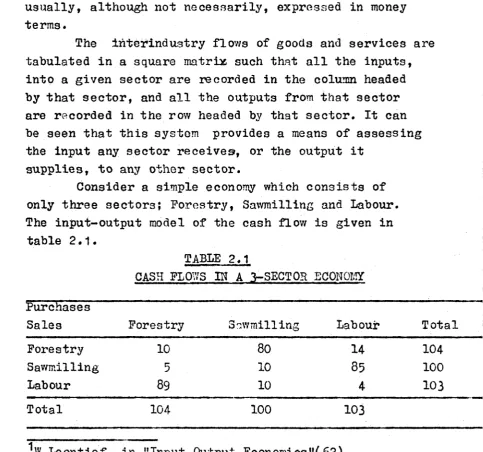
Consider a simple economy which consists of only three sectors; Forestry, Sawmilling and Labour. The input-output model of the cash flow is given in table 2.1.
TABLE 2.1
CASH FLOV/S IN A 3-SECT03 ECONOMY
P u r c h a s e s
S a l e s Forestry S c w m i l l i n g L a b o u r T o t a l
Forestry 10 80 14 104
S a w m i l l i n g 5 10 85 100
L a b o u r 89 10 4 103
T o t a l 104 100 103
[image:34.544.51.535.259.711.2]25
The model shows that, for Forestry to maintain its production, it requires inputs of $5.00 from the Sawmilling industry, £8 9.00 from the Labour sector, and $10.00 from itself. These values are based on a given time interval - usually a year.
Looking at the output row of the forest sector, it will be seen that of the $104 worth of goods produced, $80 worth goes to the Sawmilling industry, $10 worth
is uded by the Forestry industry itself, and the balance goes directly to the Labour sector. The same inter pretation can be placed on the values of the rows and
columns of the Sawmilling industry,and the Labour sector. For the model to be in balance, the row and
column total for any sector should be equal. In this simple model, all transactions are treated endog enously, while final demand is simply the purchases made by the Labour sector. In large open models, the various components that constitute final demand in the real world are determined exogenously.
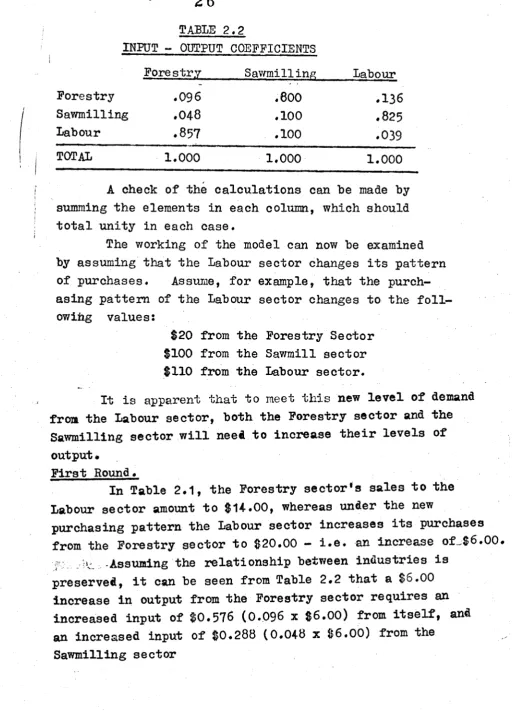
The input-output table as presented has only limited descriptive use. Eefore detailed analysis can be undertaken, the values in the table have to be con verted from cash flows to input coefficients. Input
coefficients are calculated by dividing the value of the purchases from each sector by the total value of all the inputs into the sector being considered.
2 6
TABLE 2.2
INPUT - OUTPUT COEFFICIENTS
Forestry Sawmilling Labour
Forestry .096 .800 .136
Sawmilling .048 .100 .825
Labour .857 .100 .039
TOTAL 1.000 1.000 1.000
A check of the calculations can be made by summing the elements in each column, which should total unity in each case.
The working of the model can now be examined by assuming that the Labour sector changes its pattern of purchases. Assume, for example, that the purch asing pattern of the Labour sector changes to the foll ow ihg values:
$20 from the Forestry Sector $100 from the Sawmill sector $110 from the Labour sector.
It is apparent that to meet this new level of demand from the Labour sector, both the Forestry sector and the Sawmilling sector will need to increase their levels of output •
First Round.
In Table 2.1, the Forestry sector's sales to the Labour sector amount to $U.00, whereas under the new
purchasing pattern the Labour sector increases its purchases from the Forestry sector to $20.00 — i.e. an increase of_$6.00.
•r. Assuming the relationship between industries is preserved, it can be seen from Table 2.2 that a $o.00
increase in output from the Forestry sector requires an increased input of $0,576 (0.096 x $6.00) from itself, and an increased input of $0,288 (0.048 x $6.00) from the
27
The S aw m illing s e c t o r h as in c r e a s e d i t s s a l e s t o th e Labour s e c t o r by $15*00. F o llo w in g th e same r e a s o n in g as above, t h i s w i l l r e q u i r e t h a t th e S aw m illin g s e c t o r in c r e a s e i t s p u rc h a s e s from i t s e l f by $ 1 .5 0 (0 .1 x $15*00) and i t s p u rc h a s e s from th e F o r e s tr y s e c t o r by $1 2 .0 0
( 0 .8 x $ 1 5 .0 0 ) .
T h e r e f o re , in t h i s f i r s t ro u n d , F o r e s tr y has
in c re a s e d i t s t o t a l o u tp u t by $ 1 2 ,5 7 6 , and S aw m illin g by a t o t a l of $ 1 ,7 8 8 .
Second Round.
I n p u ts r e q u ir e d t o p roduce th e s e in c r e a s e d o u tp u ts r e q u ir e in c re a s e d o u tp u ts from th e two s u p p ly in g s e c t o r s . To m eet i t s in c re a s e d o u tp u t o f $ 1 2 ,5 7 6 , F o r e s tr y w i l l need t o p u rc h a s e from i t s e l f a f u r t h e r $ 1 ,2 0 7 (0 .0 9 6 x $ 1 2 ,5 7 6 ) w o rth of i n p u t s . The S aw m illin g s e c t o r w i l l need t o p u rc h a s e $ 1 .4 3 ( 0 .8 x $ 1 ,7 8 8 ) w o rth o f a d d i t i o n a l in p u t from th e
F o r e s tr y s e c t o r . Thus, th e in c re a s e d o u tp u t r e q u ir e d in th e second round from th e F o r e s tr y s e c t o r w i l l be $ 2 .6 4 . S i m i l a r l y , th e in c r e a s e d o u tp u t from th e S aw m illin g s e c t o r w i l l be $ 0 ,7 8 2 .
T h e r e f o r e , a f t e r th e second ro u n d , th e t o t a l in c r e a s e in o u tp u t r e q u ir e d from th e F o r e s tr y s e c t o r i s $ 6 .0 0 +
$12,576 + $ 2 .6 4 = $21,213* From th e S aw m illin g s e c t o r , th e e q u iv a le n t f i g u r e w i l l be $ 1 5 .0 0 + $ 1 ,7 8 8 + $ 0 ,7 8 8 = $ 1 7 .5 7 .
O b v io u sly , i f t h i s i t e r a t i v e round by round p ro c e d u re were c o n tin u e d , s u c c e s s iv e ly d im in is h in g in c re m e n ts would
r e s u l t . E q u a lly o b v io u s ly , t h i s i t e r a t i v e ap p ro a c h i s
r a t h e r i m p r a c t i c a l f o r s o lv in g f o r changed l e v e l s o f demand i n in p u t - o u t p u t sy stem s - p a r t i c u l a r l y a s th e number of
s e c t o r s in v o lv e d i n c r e a s e s . An a l t e r n a t i v e method o f s o l u t i o n i s a v a i l a b l e th ro u g h th e u se of m a trix a l g e b r a , where by
th e sy stem i s r e p r e s e n te d by a sy stem o f sim u lta n e o u s
-28
o u t p u t a n a l y s i s ( s e e f f o r e x a m p l e , L e o n t i e f e t a i ( 6 3 ) ) *
In g e n e r a l, th e s ta n d a r d i n p u t - o u tp u t e x p r e s s io n shows t h a t f o r an m x m in p u t- o u tp u t sy stem , w here;
A » (m x m) m a tr ix o f in p u t c o e f f i c i e n t s # I = (m x m) i d e n t i t y m a tr i x .
X = v e c to r of t o t a l s e c t o r o u tp u ts of d im ension m. Y = v e c to r o f f i n a l demands o f d im ension mf
th e n ;
[i - a] “ 1 y = X
T h is a p p ro a c h can now be used to s o lv e th e n u m e ric a l exam ple g iv e n p r e v io u s ly by e x p r e s s in g i t a s a 2 x 2 i n t e r i n d u s t r y system , w ith an exogenous L abour s e c t o r . In t h i s c a s e , th e sy stem i s r e p r e s e n te d by th e fo llo w in g m a tr i c e s ;
. 0 9 6
^
o
o
00
•
.04-8 . 100_
20
100_
The 2 elem e n t v e c to r o f t o t a l o u tp u ts (X) becomes th e unkn own, s o t h a t ;
and s i n c e ,
fx i'T 1 o .0 9 6 .8 0 0 - 1 20
A
i
0 1 00 • •m
X
o o L
__
1 0 0 _1 0 . 0 9 6 . 8 0 0 - 1 1 . 1 6 0 0 " 1 .0 3 1 1
0 1 . 0 4 8 . 1 0 0
s
0 . 0 5 9 0 1 . 1 6 3 6
"x r 1 . 1 6 0 0 1.0311* 20
X2 zz
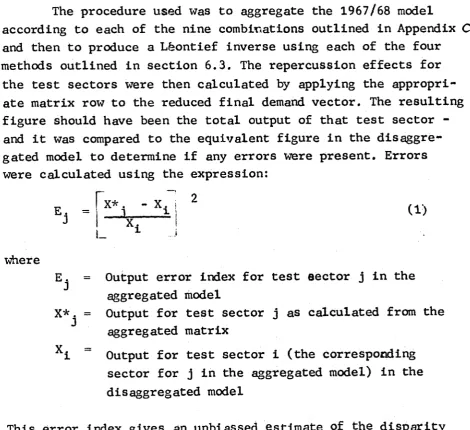
0 . 0 5 9 0 1 . 1 6 3 6 100