REFERENCE TO MALAYSIA
by
Muhammad Basri bin Hamzah
A thesis submitted for the degree of Master of Science
in forestry at the Australian National University.
Except where acknowledged the research work reported in this thesis is entirely that of the author.
ACKNOWLEDGEMENTS
The study was conducted under the Staff Training Scheme of the Universiti Pertanian Malaysia. I would like to record here my appreciation of the continued sponsorship by the Universiti.
It is my pleasure to especially thank my Supervisor, Mr M.U. Slee of the Forestry Department, A.N.U. His help, guidance and
personal encouragement which enabled me to complete the study are deeply appreciated.
I would like to thank Professor D.M. Griffin, of the Forestry Department, A.N.U., for the use of departmental facilities and various members of the department for the help generously given. I would also like to thank Mr R. Dunstone of the C.S.I.R.O. CERES
phytotron for the use of facilities and staff members of the phytotron, whose help is extremely appreciated.
Aopreciations are due to the Forest Research Institute, Canberra for the supply of seed materials and to Mr J.W. Turnbull of the F.R.I. for helpful discussions on seed sources of Eucalyptus decaisneana and Pinus kesiya.
I would like to thank Mrs E.H. Robinson for her excellent work in typing the thesis and my collegues Miss J.T. Stupendick
and Mr Kamis Awang who went through a sleepless night in reading through the text meticulously.
Above all, my appreciations are due to Aliah Basri who assisted me throughout the study and to my parents and family
ABSTRACT
The highland forests of Peninsular Malaysia, lying between ,300m-900m, comprise c .40°/o of the total productive forest of the country. These forests, recently included into the Forest Estate, posed new
silvicultural problems centring on the development of a new silvicultural system. Basic to this are the problems associated with regeneration. Knowledge of the highland ecosystem and of the effects of environ mental factors on growth, distribution and differentiation of highland vegetation is indeed relevant. It thus forms the subject of the present study which comprises a review of the literature and experi mental works conducted on several tropical highland tree species.
The review of literature suggests the following:
(1) The tropical highland environment is extremely diverse with a recognised series of altitudinal vegetation zones characterised by physiognomy, flora, local climate and soil. The environmental factors controlling plant growth and distribution are unknown. The primary role of climate and secondarily of soil has been suggested.
(
2
) Climate is important in the control of growth of lowland species. This is supported by the relationship of growth patterns of lowland species to seasonal rythm.(
3
) Intraspecies differences exist in highland vegetation especially in species with wide altitudinal range.Introductory experimental work was conducted with the major
tree species to variations in day and night temperatures, light intensity, frost and moisture treatments. The species used were
Pinus caribaea var. hondurensis B and G, Pinus oocarpa var. ochoterenai Schiede from Central America, Pinus kesiya Royal ex Gordon from
the Philippines and Eucalyptus decaisneana from Portuguese Timor. Except for P. caribaea, a lowland species included for comparison, seed sources of all species were collected from widely spaced altitudes covering most of the species range but generally within limited latitude and longitude. The factors studied were either precisely controlled
(temperature and frost) or partially controlled (light intensity and moisture). Growth analysis technique was mainly used in the inter
pretation of results. Results of the moisture experiment were not reported in the thesis.
It was clear from the experimental work that intraspecies differentiation occurs in tropical highland species with wide alti tudinal range. Differential growth responses to variation in day and night temperatures, light intensity and frost treatment were signi
ficant. A speciation process that is adaptive and must necessarily incorporate physical environmental factors (different from the
processes proposed for lowland tropical species) was suggested. The temperature experiment with P. kesiya also suggests that altitudinal variation in growth may be greater than geographical variation between disjunct seed sources of equivalent altitude.
in view of its speed and accuracy in assessing variations in growth rate and productivity, especially in controlled experiments.
TABLE 1 .1 Land Use P a t t e r n i n S e le c t e d S t a t e s o f 8 P e n in s u la r M a la y s ia
TABLE 3 .1 C h a r a c te r s C o n s id e re d U s e f u l i n C l a s s i f y i n g A l t i t u d i n a l V e g e t a t io n Zones i n t h e T r o p ic s
TABLE 3 . 2 A v e ra g e W e e k ly Maximum and M inim um T e m p e ra tu re s 32 i n t h e S ta n d a t V a r io u s A l t i t u d e s on M t
M a k i l l i n g
TABLE 3 . 3 C l i m a t i c D i f f e r e n c e s B e tw e e n 'F o g - F r e e * 34 and 'F o g -B o u n d ' D ays i n th e LMRF i n E c u a d o r
a t 1710m E l e v a t i o n
TABLE 3 . 4 A l t i t u d i n a l C hanges i n Some S o i l P r o p e r t i e s 38 TABLE 8 .1 D a ta o f O r i g i n o f Seed S o u rc e s Used i n 73
E x p e r im e n ts
TABLE 8 . 2 D e t a i l s o f E x p e r im e n ts C o n d u c te d 77 TABLE 8 . 3 D e s ig n s and A n a ly s e s o f E x p e r im e n ts 83 TABLE 8 . 4 E s t a b lis h m e n t S c h e d u le f o r E . d e c a is n e a n a , 89
P . o o c a rp a and P . c a r ib a e a S e e d lin g s
TABLE 9 .1 H a r v e s t in g S c h e d u le : T e m p e ra tu re E x p e r im e n t 98 w i t h E u c a ly p t u s S e r ie s
TABLE 9 . 2 C o m p a ris o n o f S e le c t e d P a ra m e te rs o f 100 E . d e c a is n e a n a S e e d lin g s Grown U n d e r Common
T e m p e ra tu re s i n H ig h ( E x p e r im e n t i ) and Low ( E x p e r im e n t I I ) T e m p e ra tu re Range E x p e r im e n ts
TABLE 9 . 3 G ro w th R esponse i n S e e d lin g s o f E . d e c a is n e a n a 102 From T h re e A l t i t u d e s Grown U n d e r Two Ranges
o f Day x N ig h t T e m p e ra tu re s
TABLE 9 . 4 Summary o f A n a ly s is o f V a r ia n c e (T y p e I I ) o f 107 V a r io u s G ro w th P a ra m e te rs o f E . d e c a is n e a n a
S e e d lin g s fr o m T h re e A l t i t u d e s Grown U n d e r Two Ranges o f Day x N ig h t T e m p e ra tu re s
TABLE 1 0 .1 H a r v e s t in g S c h e d u le : T e m p e ra tu re E x p e r im e n t w i t h O o c a rp a S e r ie s
TABLE
TABLE
TABLE
TABLE
TABLE
TABLE
TABLE
TABLE
TABLE
TABLE
TABLE
TABLE
TABLE
TABLE
TABLE
Page No.
10.2
Growth Response in Seedlings of Pinus caribaea
131
and Pinus oocarpa Grown Under Two Ranges
of Day x Night Temperatures
10.3
Summary of Analysis of Variance (Type II)
139
of Various Growth Parameters of Pinus caribaea
and Pinus oocarpa Seedlings Grown Under Two
Ranges of Day x Night Temperatures
11.1
Harvesting Schedule:
Temperature Experiment
157
with Kesiya Series
11.2
Growth Response of Seedlings of Pinus kesiya
162
from Five Altitudes to Variation in Day and
Night Temperatures
11.3
Summary of Analysis of Variance (Type II) of
165
Various Growth Parameters of Pinus kesiya
Seedlings from Five Altitudes Grown Under
Ten Day x Night Temperatures
12.1
Frost Treatments: Eucalyptus Series
180
12.2
Analysis of Variance of R Values in
182
Untreated Control Plants : Eucalyptus Series
12.3
Analysis of Variance of Treated Plants for
182
Adjusted and Unadjusted R Values
12.A
Means of Adjusted R Values (°/o) of Treated Plants
182
Eucalyptus Series
13.1
Harvest Schedule:
Light Experiment with
188
Eucalyptus Series
13.2
Growth Response in Seedlings of E. decaisneana
190
from Three Altitudes Grown Under Four Relative
Light Intensities
13.3
Summary of Analysis of Variance (Type II)
194
of Various Growth Parameters of Eucalyptus
decaisneana Seedlings from Ihree Altitudes
Grown Under Four Light Intensities
IVa
Selected Meteorological Data at Maubisse
226
and Hato Buillico in Portuguese Timor
IVb
Selected Climatic Data at Baguio City,
229
The Philippines
LIST OF FIGURES
Page N o .
FIGURE
2%
1
Altitudinal Floristic Zones in Peninsular
14
Malaysia
FIGURE
2m2
Altitudinal Forest Formation Series in
15
Peninsular Malaysia
FIGURE 3.1
Diagram for the Classification of World
26
Life Zones
FIGURE 4.1
Histology of the Shoot Apex and Derivation
46
of Tissues and Organs
FIGURE 9.1
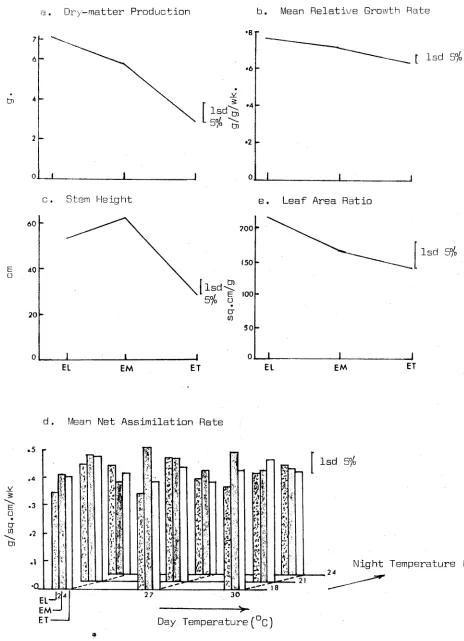
Multiple Range Test of Means of Growth
110
Parameters of Eucalyptus decaisneana Seedlings
Grown Under Two Ranges of Day x Night Temperatures
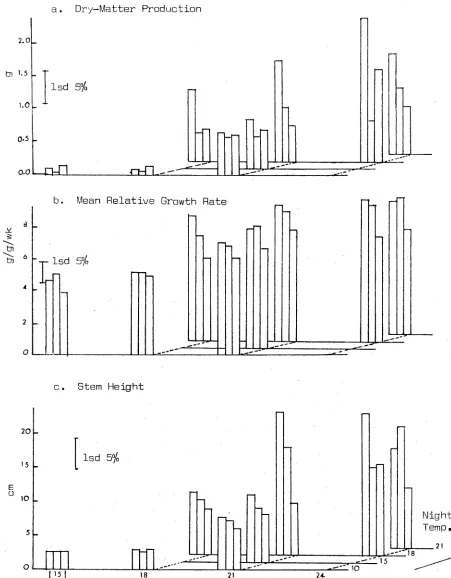
FIGURE 9.2
Growth Response of Seedlings of Eucalyptus
113
decaisneana to Varying Day and Night Tempera
tures:
I. High Temperature Range
FIGURE 9.3
Growth Response of Seedlings of Eucalyptus
114
decaisneana to Varying Temperatures:
II Low
Temperature Range
FIGURE 10.1
Multiple Range Test of Means of Growth
142
Parameters of Pinus caribaea and Pinus oocarpa
Seedlings Grown Under Two Ranges of Day x Night
Temperatures
FIGURE 10.2
Growth Response of Seedlings of Pinus caribaea
144
var hondurensis and P. oocarpa var ochoterenai
to Varying Day and Night Temperatures. I. High
Temperature Range
FIGURE 10.3
Growth Response of Seedlings of Pinus oocarpa
145
var ochoterenai to Varying Temperatures.
II. Low Temperature Range
FIGURE 11.1
Multiple Range Test of Means of Growth
168
Parameters of Pinus kesiya Seedlings from
Five Altitudes Grown Under Ten Day x Night
Temperature Combinations
Page No»
FIGURE 13.1
FIGURE 13.2
FIGURE IVa
Multiple Range Test of Means of Growth
Parameters of E. decaisneana Seedlings from
Three Altitudes Grown Under Four Relative
Light Intensities
Growth Response of Seedlings of Eucalyptus
decaisneana to Different Levels of Light
Intensity
Natural Distribution of P. kesiya
in Northern Luzon, the Philippines
197
198
228
[image:10.525.54.508.156.808.2]LIST OF APPENDICES
Page N o .
APPENDIX I
Classification of Forest Vegetation in
219
Peninsular Malaysia
APPENDIX II
Forest Types Associated with the Highland
221
Dipterocarp Subzones
APPENDIX III Vegetation Structure and Physiognomy in
224
Lowlands and Montane Zones
APPENDIX IV/
Notes on Seed Sources Used in Experimental
226
Work
TABLE OF CONTENTS
Page N o .
ORIGINALITY OF THESIS
i
ACKNOWLEDGEMENTS
ii
ABSTRACT
iii
LIST OF TABLES
vi
LIST OF FIGURES
viii
LIST OF APPENDICES
x
TABLE OF CONTENTS
xi
INTRODUCTION
1
PART I
LITERATURE REVIEW - An Outline of the
4
Basis and Framework of Study
CHAPTER 1
THE ROLE OF FORESTRY IN THE MALAYSIAN ECONOMY
5
AND ITS FUTURE PROSPECTS IN THE LIGHT OF
CHANGING LAND USE
1.1
THE PRESENT AND FUTURE ROLE OF FORESTRY IN
5
THE MALAYSIAN ECONOMY
1.2
THE CHANGING PATTERN OF LAND USE IN PENINSULAR
7
MALAYSIA AND ITS POTENTIAL IMPACT ON THE
PRACTICE OF FORESTRY
1.3
THE PROSPECT OF FORESTRY ON THE HIGHLANDS OF
9
PENINSULAR MALAYSIA
CHAPTER 2
FORESTS AND FORESTRY IN THE HIGHLANDS OF
11
PENINSULAR MALAYSIA
2.1
INTRODUCTION
11
2.2
VEGETATION TYPES IN THE HIGHLANDS OF
11
PENINSULAR MALAYSIA
2.2.1
Zonation of Tropical Highlands
11
Page No.
2.3
SILVICULTURE IN THE MALAYSIAN HIGHLANDS
19
2.3.1
Silvicultural Problems
19
2.3.2
Possible Silvicultural Improvements in
21
the Highland
Dipterocarp Subzones
CHAPTER 3
3.1
3.2
3.3
3.3.1
3.3.2
3.3.3
3.4
3.4.1
ENVIRONMENT OF THE TROPICAL HIGHLAND FOREST
INTRODUCTION
TROPICAL HIGHLAND FOREST AND WORLD VEGETATION
CHANGES IN BOTANICAL COMPONENT WITH ELEVATION
Stand Structure
Physiognomy
Floristics
CHANGES IN PHYSICAL COMPONENT WITH ELEVATION
Climate
a) Temperature
b)
Rainfall
c) Fog Influence
d) Atmospheric Moisture Status
(e) Light and Radiation
3.4.2
Soil
3.5
3.6
a) Altitudinal Segregation
b)
Chemical and Physical Properties
SUPERIMPOSED FACTORS IN TROPICAL HIGHLANDS
DISCUSSION
24
24
24
25
27
28
30
31
31
31
33
34
35
35
36
36
37
39
40
PART II
CHAPTER 4
LITERATURE REVIEW - An Outline of Patterns and 42
Control of Growth of Tropical Lowland Species
GROWTH PATTERNS AND GROWTH PHENOLOGY IN
43
TROPICAL VEGETATION
Page N o .
4.2
CLASSIFICATION OF GROWTH PATTERNS IN TROPICAL
43
VEGETATION
4.3
MERISTEMATIC ACTIVITY OF THE SHOOT APEX
45
4.4
PHENOLOGY OF THE VEGETATIVE SHOOT
47
4.5
LEAF CHANGE AND ITS PHENOLOGICAL PATTERNS
48
4.6
CAMBIAL ACTIVITY AND ITS PHENOLOGICAL PATTERNS
49
4.7
VARIATIONS IN GROWTH PATTERNS
49
4.8
REPRODUCTIVE GROWTH AND ITS PHENOLOGICAL
50
PATTERNS
4.9
DISCUSSION
51
CHAPTER 5
THE CONTROL OF GROWTH IN TROPICAL VEGETATION
52
5.1
INTRODUCTION
52
5.2
CONTROL OF VEGETATIVE GROWTH
52
5.2.1
Promotion of Growth During Wet Seasons
52
5.2.2
Promotion of Rest
53
5.2.3
Mechanisms of Climatic Control
54
5.2.4
Intrinsic Control of Shoot Growth
54
5.2.5
Correlation of Extension and Radial Growth
55
5.3
CONTROL OF REPRODUCTIVE GROWTH
55
5 . 4
MODIFICATION OF CLIMATIC CONTROL THROUGH
55
VEGETATIVE AND REPRODUCTIVE INTERACTION
5.5
DISCUSSION
57
PART III
LITERATURE REVIEW - Genecology of Tree Species
58
CHAPTER 6
GENECOLOGY OF TREE SPECIES
59
Page No.
6.2
EXISTENCE OF INTRASPECIES GENETIC
DIFFERENTIATION IN TEMPERATE TREE SPECIES
59
6.3
ALTITUDINAL ECOTYPES IN TROPICAL TREE SPECIES
60
6.4
ADAPTATION OF ECOTYPES TO LOCAL ENVIRONMENTAL
FACTORS
61
6.5
EVOLUTION IN TROPICAL TREE SPECIES
63
6.5.1
Reproductive System of Tropical Tree Species
63
6.5.2
Evolutionary Processes Proposed
64
6.6
DISCUSSION
65
PART IV
AN OUTLINE OF THE GENERAL APPROACH TO THE
EXPERIMENTAL WORK
67
CHAPTER 7
SCOPE OF EXPERIMENTAL WORK
68
7.1
INTRODUCTION
68
r7 n
DEFINITION OF PROBLEMS
58
7.3
ESTABLISHMENT OF SEEDLINGS
69
7.4
SCOPE OF EXPERIMENT
70
7.4.1
Choice of Experimental Materials
70
7.4.2
Choice of Environmental Factors
71
CHAPTER 8
MATERIALS, FACILITIES, EXPERIMENTS AND
72
GENERAL METHODOLOGY
72
8.1
INTRODUCTION
72
8.2
MATERIALS
72
8.3
FACILITIES
74
8.4
EXPERIMENTS CONDUCTED
76
Page N o .
8 . 6 EXPERIMENTAL DESIGNS 82
8 . 7 CALCULATIONS AND ANALYSIS 84
8 . 7 . 1 C a l c u l a t i o n s 84
8 . 7 . 2 A n a ly s is 87
8 . 8 GENERAL EXPERIMENTAL PROCEDURES 88 8 . 8 . 1 Seed S to r a g e and F u m ig a t io n 88 8 . 8 . 2 E s t a b lis h m e n t o f S e e d lin g s 88 8 . 8 . 3 G ra d in g o f S e e d lin g s f o r E x p e r im e n ts 91 8 . 8 . 4 Some R o u tin e P ro c e d u re s 92
8 . 8 . 5 H a r v e s ts 92
PART V EXPERIMENTAL WORK 94
CHAPTER 9 THE EFFECTS OF DAY AND NIGHT TEMPERATURES ON 95 THE GROWTH OF EUCALYPTUS DECAISNEANA SEEDLINGS
9 .1 INTRODUCTION 95
9 . 2 MATERIALS AND METHODS 96
9 . 3 RESULTS 99
9 . 3 . 1 D if f e r e n c e s B etw een E x p e r im e n ts i n G ro w th 99 R esponse o f S e e d lin g s Grown U n d e r Common
T e m p e ra tu re s
9 . 3 . 2 P ro v e n a n c e D i f f e r e n c e s 101 9 . 3 . 3 T e m p e ra tu re D i f f e r e n c e s 119
9 . 4 DISCUSSION 123
Page No.
CHAPTER 10
THE EFFECTS OF DAY AND NIGHT TEMPERATURE
128
ON GROWTH OF SEEDLINGS OF PINUS CARIBAEA VAR
HONDURENSIS B AND G AND P. OOCARPA VAR
OCHOTERENAI SCHIEDE
10.1
INTRODUCTION
128
10.2
MATERIALS AND METHODS
129
10.3
RESULTS
134
10.3.1
Provenance Differences
134
10.3.2
Temperature Differences
150
10.4
DISCUSSION
154
CHAPTER 11
THE EFFECTS OF DAY AND NIGHT TEMPERATURE
157
ON GROWTH OF SEEDLINGS OF PINUS KESIYA ROYLE
EX GORDON
11.1
INTRODUCTION
157
1 1 .2
MATERIALS AND METHODS
158
11.3
RESULTS
151
11 .4
DISCUSSION
173
CHAPTER 12
EFFECTS OF FROST ON SEEDLINGS OF EUCALYPTUS
177
DECAISNEANA
12.1
INTRODUCTION
177
12.2
MATERIALS AND METHODS
177
12.3
METHOD OF ANALYSIS AND RESULTS
181
12.4
DISCUSSION
184
CHAPTER 13
THE EFFECTS OF LIGHT INTENSITY ON THE GROWTH
185
OF EUCALYPTUS DECAISNEANA SEEDLINGS
Page No.
13.2
MATERIALS AND METHODS
186
13.3
RESULTS
189
13.a
DISCUSSION
204
13-4.1
Shade Tolerance of E. decaisneana
204
13.4.2
Practical Application of Results of
Experiment
PART VI
DISCUSSION
208
CHAPTER
14
DISCUSSION
209
14.1
FACTORS AFFECTING GROWTH OF TROPICAL HIGHLAND
SPECIES
209
14.2
INTRASPECIFIC DIFFERENCES IN HIGHLAND SPECIES
21 1
fa)
Continuous Distribution Pattern
(b) Discontinuous Distribution Pattern
fc) Genecological Adaptation
(d)
Possible Speciation Process in Tropical
Highland Environment
14.3
APPLICATION OF GROWTH ANALYSIS STUDY
215
14.3.1
Species and Provenance Selection
215
14.3.2
Determination of Species Potential Range
216
for Optimum Growth
APPENDICES
219
INTRODUCTION
I n 1 9 6 3 , a Land C a p a b i l i t y C l a s s i f i c a t i o n was c o n d u c te d i n P e n in s u la r M a la y s ia w i t h t h e a im o f o p t i m i s i n g t h e use o f la n d
w i t h i n th e fra m e w o rk o f t h e N a t i o n 's d e v e lo p m e n t s t r a t e g y . I n t h e s u b s e q u e n t r e c l a s s i f i c a t i o n o f la n d use much o f th e lo w la n d f o r e s t e s t a t e was e x c is e d f o r h ig h e r p r i o r i t y u s e s l e a v i n g a t o t a l o f a p p r o x im a t e ly 10 m i l l i o n a c r e s r e s e r v e d f o r f o r e s t r y . O f t h i s , c .40% w e re v i r t u a l l y u n t r i e d a r e a s l y i n g a b o v e t h e 300m c o n t o u r , h i t h e r t o ta k e n a s t h e u p p e r l i m i t o f th e f o r e s t e s t a t e . I t i s c l e a r t h a t f u t u r e e x p a n s io n o f f o r e s t r y i n P e n in s u la r M a la y s ia w i l l h ave t o be i n t h e h ig h la n d r e g i o n s . In d e e d , l a r g e a r e a s a r e a l r e a d y d e s ig n a t e d f o r p l a n t a t i o n and e x p l o i t a t i o n .
The in c r e a s in g a t t e n t i o n p a id t o f o r e s t r y i n t h e h ig h la n d a r e a s o f P e n in s u la r M a la y s ia c e n t r e s p r i m ä r i l y on t h e p ro b le m s o f d e v e lo p in g a new s i l v i c u l t u r a l s y s te m f o r t h e h ig h la n d f o r e s t s .
T o w a rd s t h i s end a k n o w le d g e o f t h e e c o s y s te m , i n p a r t i c u l a r o f e n v ir o n m e n ta l f a c t o r s im p o r t a n t in th e g r o w t h , d i s t r i b u t i o n and v a r i a t i o n o f t im b e r s p e c ie s i s e s s e n t i a l . A c c o r d in g ly i t was d e c id e d t o c o n d u c t a b ro a d s t u d y i n t o t h i s s u b j e c t .
The s t u d y o u t l i n e d i n t h e t h e s i s c o m p r is e s a r e v ie w o f l i t e r a t u r e ( P a r t s I - I I I ) , a p r e - e x p e r im e n t a l s e c t i o n ( P a r t IV /), an e x p e r im e n t a l s e c t i o n ( P a r t V ) and a g e n e r a l d is c u s s io n ( P a r t V I ) .
land use was examined (Chapter 1). As a framework to the study,
an outline of forests and forestry practice in the highlands of
Peninsular Malaysia including a review and discussion
on silvicultural problems is incorporated in Chapter 2. The
ecosystem of the tropical highlands is systematically outlined in
Chapter 3 with emphasis on its complexity. Factors considered im
portant in differentiating highland vegetation are identified.
In Part II, the environmental processes controlling the growth of lowland tropical species are reviewed since surprisingly
little is known of the subject with respect to tropical highland
species. Growth pattern and growth phenology of tropical vegetation
is examined (Chapter 4). It is clear that the majority of tropical
species display a periodic pattern strongly related with seasonal
rythm. The climatic control of plant growth is accordingly
reviewed and important controlling factors identified (Chapter 5). In view of the highly diverse tropical highland environment
the question of genetic differentiation of tree species is important
and relevant to forestry. This is accordingly reviewed in Part III
with liberal examples from the temperate areas since little work has
been done on this subject in the tropics.
In Part IV, the relevant findings of the review are collated
and, together with information available of the experimental
materials, used as guidelines in defining the scope for experimental
work (Chapter 7). Materials, general facilities, experiments
conducted and general methodology were then outlined in Chapter 8. Part V comprises the experiment section of the study.
studies on the effect of several environmental factors which vary
with altitude on species with wide altitudinal ranges in the tropics".
The factors studied include temperature (Chapters 9-11), frost
(Chapter 12), light intensity (Chapter 13) and moisture stress.
The latter experiment was not reported in the thesis.
Part VI (Chapter 14) is a general discussion of experimental
findings. The importance of growth analysis technique to forestry
LITERATURE REVIEW
CHAPTER 1
THE ROLE OF FORESTRY IN TEE MALAYSIAN ECONOMY AND IT S FUTURE PROSPECTS IN THE LIGHT OF
CHANGING LAND USE.
T h is c h a p t e r d is c u s s e s t h e r o l e o f f o r e s t r y i n t h e n a t i o n a l econom y o f M a la y s ia , i n p a r t i c u l a r th e econom y o f P e n in s u la r M a la y s ia , and f u t u r e p r o s p e c t s i n t h e l i g h t o f r e c e n t e x t e n s iv e c h a n g e s i n
t h e p a t t e r n o f la n d use and o f c h a n g in g demands i n wood and wood p r o d u c t s .
1.1 THE PRESENT AND FUTURE ROLE OF FORESTRY IN THE MALAYSIAN ECONOMY As f o r e s t r y i s a p r im a r y i n d u s t r y , i t s im p o r ta n c e t o a
n a t i o n a l econom y i s g e n e r a l l y g r e a t e s t d u r in g t h e c o u n t r y ' s e a r l y d e v e lo p m e n ta l p h a s e . I n P e n in s u la r M a la y s ia , t h e f o r e s t r y s e c t o r c o n t r i b u t e d 4 .3 7 % t o t h e G ro s s N a t i o n a l P r o d u c t i n 1971 ( v a lu e d a t M $41 1 ,0 0 0 ,0 0 0 ) and d i r e c t l y p r o v i d i n g e m p lo y m e n t t o a b o u t 2 9 ,0 0 0 p e o p le ( I s m a i l , 1 9 7 2 ) .
The f o r e s t r y s e c t o r a ls o f i g u r e d p r o m in e n t ly i n th e i n t e r n a t i o n a l t r a d e o f t h e c o u n t r y . As e x p o r t it e m s , t im b e r and t im b e r p r o d u c t s ra n k e d t h i r d a f t e r r u b b e r and palm o i l , e a r n in g M $ 2 4 9 ,5 0 0 ,0 0 0 i n 1 9 7 0 . T h is r e p r e s e n t e d an in c r e a s e o f tw o and h a l f tim e s o v e r t h e p a s t f i v e y e a r s (Anon., 1 9 7 4 a ).
approximately M$10G,000,000 in imports.
Consumption by the year
1990, is projected at 410,000 metric tons, a three fold increase from
1970 (Ismail, 1972).
It is clear that the industry will have to expand in order
to meet rapidly increasing demand.
Based on present trends it is
estimated that approximately 200,000 acres annually will have to be
reforested and rehabilitated, providing employment for about 100,000
people (Ismail, 1972).
Forestry in Malaysia is not regarded solely in terms of wood
production.
Indeed, the range in goods and serivces is continually
expanding in the light of changing social needs from the traditional
production of wood and water to such intangibles as recreation and urban
beautification.
Forestry is thus a permanent and versatile industry
able to suffice the varying needs of the community in the various
phases of economic development of the country.
The future ambitious role intended for forestry in the Malaysian
economy has been outlined by Ismail (1972).
"In the field of agro— based industries, wood will provide a
healthy diversification of products.
The availability of
renewable raw material enhances the opportunity of expanding
industrial growth to include secondary and tertiary wood processing
industries.
The potential for short-fibred pulp manufacture
from industrial wood residues, supplemented by the more effective
utilisation of the available growing stock, is good and so is
the scope of plantation of long-fibred pulpwood.
Short-fibred
boards is in heavy demand and this demand is steadily increasing.
The world demand in newsprint is also growing and Malaysia has
the potential to supply these products.
Still more encouraging
is the fact that while the supply of high quality tropical hardwood
is diminishing, their demand is increasing.
Higher financial
return and more foreign exchange earnings can thus be anticipated.
Forest industries will become more viable and employment,
social and economic opportunities will increase".
1.2
THE CHANGING PATTERN OF LAND USE IN PENINSULAR MALAYSIA AND
ITS POTENTIAL IMPACT ON THE PRACTICE OF FORESTRY
Traditionally, Malaysian society has largely been agrarian
with a life style that had relatively little impact on the forested
ecosystem.
The scale and pattern of land use has however changed
dramatically in modern times.
The most profound change has been
the massive clearing and reclassification of forest land for agriculture,
often resulting in the excision of large tracts of prime managed
Lowland Dipterocarp Forests (Section 2.2.2).
In 1963 a technical
sub-committee on Land Capability Classification was set up to devise
an optimum national land use plan within the framework of the nation's
overall development strategy (Leong, 1968).
Under the classification scheme, mining was given top
priority of land use, followed by agriculture, thence forestry.
These
major land uses are however subject to other priority uses which
include reservations for aboriginal settlement, water conservancy,
game, grazing and national parks.
Forestry was largely assigned to
It is clear therefore the planned development of the
Forest Estate will have to be made in the hill areas.
Thus, forests
lying between 3G0m to 100Gm, hitherto protected, will be brought
under production.
Above 1000m, forest operation is generally thought
to be uneconomic, hazardous or detrimental to the environment.
Table 1.1 shows the pattern of land use following classifica
tion for the states of Pahang, Johore, Melaka and Negri Sembilan
in Peninsular Malaysia.
It is clear that the major proportion of
land area in all states are mainly reserved for mining and agriculture
leaving an estimated total of 10 million acres of productive Forest
Estate.
Of this area, over 40% or approximately 4 million acres,
lie above the 300m contour, the approximate upper limit of the Lowland
Dipterocarp Forest.
The figure however may vary between states.
Thus there will be a move of a considerable proportion of the Forest
Estate into a virtually untried area.
TABLE 1.1
Land Use Pattern in Selected States of Peninsular
Malaysia.
(Lee, 1968 )
Pahang
Johore
Melaka
N. Sembilan
“IT
Total State
Area (*000 ac]
8,869
100
4,692
100
415
100
1 ,642
100
Area below
300m countour
7,057
81
4,534
97
407
98
1,343
82
Area for mining
or agric.
4,412
50
3,089
66
342
82
1 ,033
63
Total prod.for.
2,622
30
543
12
8
2
433
26
Prod• forests
above 300m
1 ,126
13
214
5
1
-
243
15
Prod• forests
below 300m
1,496
17
329
7
7
2
190
11
Prod. for.below
300m as % of total
prod, forests.
57
60
82
61
1.3
ThE PROSPECT OF FORESTRY IN THE HIGHLANDS OF PENINSULAR MALAYSIA
The impact of the changing pattern in land use will be felt
most acutely in the indigeneous hill forests.
The failure of the
Malaysian Uniform System of Silviculture to satisfactorily regenerate
these forests necessitates the development of an alternative sil
vicultural system specifically adapted to the hill areas.
The
Malaysian Uniform System, which aims at enriching managed stands, was
mainly designed for the primary Lowland Dipterocarp Forests where
regeneration is usually adequate (Burgess, 1970).
Despite the
lowland forests’ relatively more accessible terrain, with a less
complex ecosystem than the hill forests, the Malaysian Uniform System
took nearly fifty years to evolve.
Given the complexities of the
highland environment (Chapter 3), the naturally poor regeneration of the
hill forest (Section 2.3) and the utmost urgency of the whole venture,
the problems that will be encountered in developing a viable hill
silvicultural system has been rated "as the biggest challenge to
forestry research since the evolution of the Malaysian Uniform System",
(Anon., 1970).
The future prospects for plantation of exotics have already
been stated.
Pilot projects with P. caribaea v ar.
hondurensis
have largely proved successful (Freezaillah,
1966) and large scale
plantation is currently planned for Peninsular Malaysia and Sabah
(Anon., 1974b).
Although in Peninsular Malaysia, plantation projects
are largely confined to the Lowland Dipterocarp Forest zone the
The successful development of a hill silviculture system
and the choice and establishment of exotics in plantation programmes
will depend on an adequate understanding of the ecology of the highlands.
One main line of enquiry should centre on determining the optimum
growth condition of seedlings of highland species and allied with the
detection of genetic variation.
Such autecological studies would
assist in understanding successful regeneration conditions, in
determining the potential limits for productive growth, and the possible
extension of a species outside of its natural distribution and in the
selection of provenances for optimum matching with plantation sites.
CHAPTER 2
FORESTS AND FORESTRY IN THE HIGHLANDS OF PENINSULAR MALAYSIA
2 .1 INTRODUCTION
The c h a p t e r o u t l i n e s t h e f o r e s t s and f o r e s t r y i n t h e h ig h la n d s o f P e n i n s u l a r M a la y s ia a s a p e r s p e c t iv e t o t h e p o l i c y c h a n g e s o u t l i n e d i n C h a p te r 1 .
2 . 2 VEGETATION TYPES IN THE HIGHLANDS OF PENINSULAR MALAYSIA 2 . 2 . 1 Z o n a t io n o f T r o p i c a l H ig h la n d s
Z o n a t io n p a t t e r n s i n t r o p i c a l h ig h la n d v e g e t a t i o n h a ve been r e p o r t e d by v a r i o u s w o r k e r s fro m v a r i o u s s t u d i e s c o v e r in g p h y to
s o c i o l o g y (B ro w n , 1 9 1 9 ) , f l o r i s t i c s (v a n S t e e n is , 1 9 3 4 ) and e c o lo g y (B ro w n , 1 9 1 9 ; A ske w , 1 9 6 4 ; G ru b b and W h itm o re , 1 9 6 6 ) . R ic h a r d s ( 1 9 6 4 ) i n a r e v ie w o f some o f t h e f i n d i n g s d is c e r n e d an a l t i t u d i n a l p a t t e r n common f o r t h e w e t t r o p i c s , w i t h z o n e s d e m a rc a te d by f o u r a l t i t u d e s w h ic h he c o n s id e r e d c r i t i c a l . T h e se a r e 1 ,0 0 0 m , 2 ,4 0 0 m , 4 ,0 0 0 m and 4 ,5 0 0 m .
The v e g e t a t i o n i s t h u s d e m a rc a te d i n t o f i v e p r i n c i p a l z o n e s . R ic h a r d 1 s ( 1 9 6 4 ) t e r m in o lo g y i s a d o p te d h e re e x c e p t f o r t h e lo w e r tw o z o n e s i n w h ic h c a s e G ru b b and W h itm o r e ’ s ( 1 9 6 6 ) p r o p o s a l i s u s e d . The f o r m a t i o n - t y p e s a r e :
1 . The L o w la n d R a in F o r e s t 0 - 1 ,000m ( T r o p i c a l R a in f o r e s t and Subm ontane
2 .
The Montane R a i n F o r e s t
1 , 0 0 0 - 2, 400m
a . The Lower Montane R a i n F o r e s t
b . The Upp er Montane R a i n F o r e s t
( S u b d i v i s i o n s by Grubb and W h it mo r e)
3 .
The T r o p i c a l S u b a l p i n e F o r e s t
2 , 4 0 0 - 4, 000m
4 .
The T r o p i c a l A l p i n e S c r u b and
4 , 0 0 0 - 4 , 500m
Chomophyte f o r m a t i o n s
5 .
N i v a l Chomophyte V e g e t a t i o n
4, 500m+
A c t u a l z o n a l c o n t o u r s a r e h o w ev e r v a r i a b l e s i n c e t h e r a t e
o f c h a n g e o f c l i m a t i c f a c t o r s v a r y from p l a c e t o p l a c e ( v a n S t e e n i s ,
1934; T r o l l , 1958; R i c h a r d s , 1 9 6 4 ) .
The m o s t common v a r i a t i o n i s due
t o t h e Mass M o u n t a i n E l e v a t i o n E f f e c t w h e r e b y z o n a l c o n t o u r s a r e d e p r e s s e d
w i t h p r o x i m i t y t o t h e s e a and w i t h i s o l a t i o n o f r i d g e s and p e a k s ,
( v a n S t e e n i s , 1961; R i c h a r d s , 1 9 6 4 ) .
Z o n e s on h i g h e r m o u n t a i n s
t e n d t o b r o a d e n a s i s t h e c a s e w i t h t h e Mon ta ne R a i n F o r e s t z o n e on t h e
main r a n g e o f t h e An de s, i n E c u a d o r , w h i c h r a n g e s from c.12G0-15G0m
t o c . 3 2 0 0 - 3 6 0 0 m , ( Gr ubb and W h it mo r e, 1 9 6 6 ) .
Some c h a r a c t e r i s t i c s o f t h e z o n e s a r e o f i n t e r e s t .
The
1,000m a l t i t u d e , t h e l o w e r b o u n d a r y o f t h e Montane R a i n F o r e s t z o n e ,
i s marked by a s h a r p i n c r e a s e i n f o g f r e q u e n c y w i t h e l e v a t i o n (Brown,
1 9 1 9 ) .
I t i s a l s o t h e l o w e s t a l t i t u d e f o r p e r m a n e n t e x i s t e n c e o f
t e m p e r a t e e l e m e n t s o f t h e h i g h l a n d f l o r a ( v a n S t e e n i s , 1961) whi ch
o c c u r i n a b u n d a n c e i n t h e Uppe r Montane R a i n F o r e s t ( R i c h a r d s , 1 9 6 4 ) .
The 4 , 00 0 m a l t i t u d e , t h e u p p e r b o u n d a r y o f t h e T r o p i c a l
S u b a l p i n e F o r e s t z o n e , i s t h e c l i m a t i c t r e e l i m i t and t h e 4,500m
2 . 2 . 2 V e g e t a t io n Z ones o f t h e M a la y s ia n H ig h la n d s
I n P e n in s u la r M a la y s ia th e f o r e s t v e g e t a t i o n was o r i g i n a l l y c l a s s i f i e d by S y m in g to n ( 1 9 4 3 ) . S y m in g to n 's c l a s s i f i c a t i o n was b a s i c a l l y e c o l o g i c a l and t h i s was m o d if ie d by W y a tt- S m ith ( 1 9 6 3 ) , c h a n g in g th e e m p h a s is t o ' f o r e s t im p o r t a n c e '. B o th c l a s s i f i c a t i o n s a r e d e t a i l e d i n A p p e n d ix I .
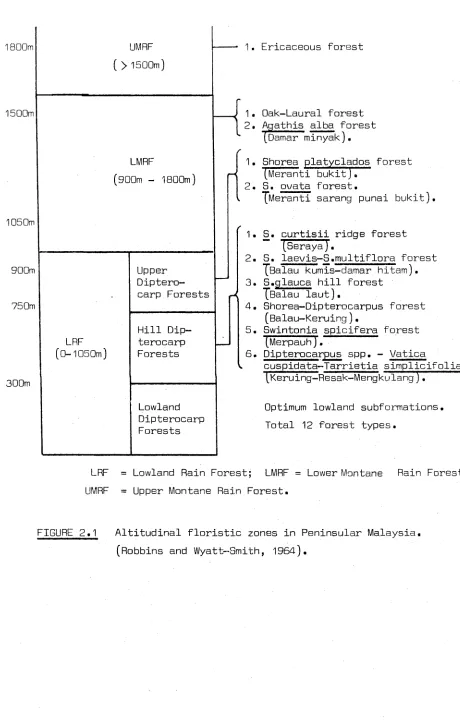
The a l t i t u d i n a l d i s t r i b u t i o n o f M a la y s ia n f o r e s t v e g e t a t io n u s in g W y a t t - S m it h 's c l a s s i f i c a t i o n w i t h i n R ic h a r d s * a l t i t u d i n a l z o n e s i s g iv e n i n F ig u r e 2 . 1 . I n t h i s s e c t i o n t h e m a in v e g e t a t i o n z o n e s o f t h e M a la y s ia n H ig h la n d s a r e o u t l i n e d .
I n W y a t t - S m it h 's c l a s s i f i c a t i o n t h e D i p t e r o c a r p f o r e s t i n lo w la n d s i s a l t i t u d i n a l l y d i v i d e d i n t o t h r e e s u b z o n e s : ( 1 ) L o w la n d D i p t e r o c a r p F o r e s t ; ( 2 ) H i l l D ip t e r o c a r p F o r e s t ; ( 3 ) U p p e r D ip t e r o c a r p F o r e s t . The u p p e r tw o s u b z o n e s , a lo n g w i t h t h e M o n ta n e Oak f o r e s t s ( L o w e r M o n ta n e R a in F o r e s t Z o n e ) and t h e M o n ta n e E r ic a c e o u s f o r e s t o f t h e U p p e r M o n ta n e R a in F o r e s t Zone c o n s t i t u t e t h e 'H ig h A l t i t u d e F o r e s t s ' o f M a la y s ia . The u p p e r tw o D ip t e r o c a r p s u b z o n e s o f t h e Low la n d R a in F o r e s t w i l l c o l l e c t i v e l y be te rm e d t h e 'H ig h la n d D ip t e r o c a r p S u b z o n e s '.
The c h a n g e i n s ta n d s t r u c t u r e and s p e c ie s c o m p o s it io n b e tw e e n t h e f o u r f o r e s t z o n e s and s u b z o n e s o f th e H ig h A l t i t u d e F o r e s t s i s t y p i c a l o f t h e g e n e r a l a l t i t u d i n a l c h a n g e i n t r o p i c a l v e g e t a t i o n . The l a t t e r i s d is c u s s e d i n g r e a t e r d e t a i l i n C h a p te r 3 . F ig u r e 2 . 2
1800m UMRF ( > 1500m)
1500m
LMRF
r
(900m - 1800m) H
1050m
900m U p p e r
D i p t e r o
-c a r p F o r e s t s
|4
750mH i l l D ip -LRF t e r o c a r p ( 0 - 1 050m) F o r e s t s
<
300m
L o w la n d D ip t e r o c a r p F o r e s t s
1
.
1
.
2
.
1
.
2
.
1
.
2
.
3 . 4 . 5 . 6
.
E r ic a c e o u s f o r e s t
O a k - L a u r a l f o r e s t A g a t h is a lb a f o r e s t
( D a m a r m in y a k ) .
S h o re a p l a t y c l a d o s f o r e s t ( M e r a n t i b u k i t ) .
S . o v a t a f o r e s t .
" [ M e r a n t i s a ra n g p u n a i b u k i t ) .
S . c u r t i s i i r i d g e f o r e s t [ S e r a y a J .
S . l a e v i s - S . m u l t i f l o r a f o r e s t "[B a la u k u m is -d a m a r h i t a m ) .
S . g la u c a h i l l f o r e s t ( B a la u l a u t ) .
S h o r e a - D ip t e r o c a r p u s f o r e s t ( B a la u - K e r u in g ) .
B w in t o n ia s p i c i f e r a f o r e s t ( M e r p a u h ) .
D ip t e r o c a r p u s s p p . - V a t ic a
c u s p i d a t a - T a r r i e t i a s i m p l i c i f o l i a [ K e r u in g - R e s a k - M e n g k u la n g ) .
O ptim um lo w la n d s u b f o r m a t io n s . T o t a l 12 f o r e s t t y p e s .
LRF = L o w la n d R a in F o r e s t ; LMRF = L o w e r M o n ta n e R a in F o r e s t ; UMRF = U p p e r M o n ta n e R a in F o r e s t .
[image:32.525.43.503.61.787.2]FIGURE 2 . 2 A l t i t u d i n a l F o r e s t F o r m a tio n S e r ie s in P e n in s u la r M a la y s ia . ( W y a t t - S m it h , 1 9 6 3 )
( a ) Red m e r a n t i - k e r u i n g f o r e s t . 150m a . s . l . J e n k a F o r e s t R e s e rv e , P a h a n g . (L o w la n d R a in F o r e s t - LR F) .
( b ) U p p e r d i p t e r o c a r p f o r e s t . 8G0m a . s . l . Kedah P e a k, K e d a h . (L o w la n d R a in F o r e s t - L R F ).
( c ) L o w e r m o n ta n e o a k - l a u r e l f o r e s t . 1500m a . s . l . Gunong B erem bun, Cameron H ig h la n d s , P a h a n g . (L o w e r M ontane R a in F o r e s t - LMRF) .
( d ) M o n ta n e e r ic a c e o u s f o r e s t . Cam eron H ig h la n d s , P a h a n g .
2000m a . s . l . Gunong B e re m b u n . (U p p e r M o ntane R a in F o r e s t - UMPF) .
Each s e c t i o n r e p r e s e n t s an a c t u a l s t r i p o f f o r e s t 1 0 0 f t x 2 5 f t . The f i r s t tw o s e c t io n s ( a and b ) b e lo n g t o t h e lo w la n d f o r m a t io n
( L R F ). D o m in a te d by D ip t e r o c a r p a c e a e (o p e n c r o w n s ) t h e f o r m a t io n in c o r p o r a t e s many f o r e s t ty p e s d i f f e r i n g in s t a t u r e and f l o r i s t i c c o m p o s it io n b u t e x h i b i t s t h e 3 - s t o r i e d t r e e s t r a t a t h r o u g h o u t i t s
( a ) H i l l D ip t e r o c a r p F o r e s t (L o w la n d R a in F o r e s t Z o n e ]
The f o r e s t g e n e r a l l y o c c u r s b e tw e e n 300m and 760m a l t i t u d e b u t i n s h e l t e r e d v a l l e y s t h e u p p e r l i m i t may be h i g h e r .
The t r a n s i t i o n fro m th e L o w la n d D ip t e r o c a r p s u b z o n e t o t h e H i l l D ip t e r o c a r p i n c lu d e s a c h a n g e i n t h e c o m p o s it io n o f t h e d o m in a n t s p e c ie s , a lt h o u g h some s p e c ie s e x i s t i n b o th z o n e s .
T h e re i s a ls o a m arked a g g r e g a t io n o f i n d i v i d u a l s o f t h e same s p e c ie s w i t h i n t h e H i l l D i p t e r o c a r p Zone c o n t r a s t i n g w i t h th e g r e a t e r h e t e r o g e n e it y o f t h e L o w la n d s u b z o n e . Thus th e m o st common
s p e c ie s on t h e r i d g e s i s S h o re a c u r t i s i i .
S ta n d s t r u c t u r e d i f f e r s s l i g h t l y fro m t h a t o f t h e L o w la n d D ip t e r o c a r p f o r e s t , v a r y i n g p a r t i c u l a r l y h o w e v e r, w i t h to p o g r a p h y . The s ta n d i s g e n e r a l l y t h r e e la y e r e d . I n d i v i d u a l s on r i d g e to p s
a r e c o m p a ra b le i n s i z e t o th o s e o f t h e L o w la n d S ubzone b u t a r e d e c id e d ly g r e a t e r i n te r m s o f s ta n d d e n s i t y . L o c a l l y , i n d i v i d u a l s on r i d g e
t o p s a r e g e n e r a l l y l a r g e r i n s i z e and a ls o g r e a t e r i n s ta n d d e n s i t y co m p a re d t o th o s e g r o w in g on s lo p e s and v a l l e y b o tto m s .
( b ) U p p e r D i p t e r o c a r p F o r e s t (L o w la n d R a in F o r e s t Z o n e ] The f o r e s t i s g e n e r a l l y lo c a t e d b e tw e e n 760m and 1200m a l t i t u d e s . The s u b z o n e b o r d e r s th e u p p e r l i m i t o f t h e L o w la n d R a in F o r e s t and shows d i s t i n c t c h a n g e i n f l o r a and s t r u c t u r e fro m t h e lo w e r s u b z o n e s .
Dipterocarpus retusus,
Shorea ciliata,
Shorea ovata and Shorea submontana.
Common non-Dipterocarp species include Agathis alba,
Calophyllum spp.
and Melanorrhoea spp.
Stand structure and physiognomy differ from the preceding
Hill Dipterocarp forest.
The top storey of the three-storied stand
is lower with a more even canopy level.
The lower two stories tend
to be less distinct.
Individuals are smaller and incidence of
buttressing less common.
Density of pole-sized individuals is however,
fairly similar.
Litter accumulation is more noticeable.
In general the Highland Dipterocarp Subzones are characterised
by the presence of distinct vegetation units.
These are basically
associations of dominants and co-dominants, often occupying specific
topographic situations.
In view of their forest importance their
brief descriptions are given in Appendix II.
(c) Montane Oaks or Oak-Laurel Forests (Lower Montane Rain Forest)
This forest occurs between 100Gm and 1500m average altitudes.
Flora and structure differ markedly from those of the Higher
Dipterocarp Subzones.
Species of the Dipterocarpaceae occur rarely; the flora is
dominated by the Oak-Laurel family, i.e. the Fagaceae (Quercus,
Lithocarpus,
Castanopsis} and Lauraceae.
Other common species include
Acer niveum,
Adinandra spp., Agathis alba,
Calophyllum spp., Canarium
spp.,Dacrydium spp., Engelhardia spp., Eugenia spp., Gareinia spp.,
Gordonia spp., Podocarpus spp., Santiria laevigata and Toona spp.
well within the belt of high fog frequency in the Upper Montane Rain
Forest.
The vegetation is highly distinctive of the Upper Montane
Rain Forest type.
The Dipterocarpaceae is completely absent and the Oak-Laurel
families drastically reduced in size.
The dominant family is the
Ericaceae with such species as Pieris ovalifolia,
Rhododendron spp.,
and Vaccinium spp.
Other common species are Arthrophyllum montanum,
Anneslea crassipes,
Buseus spp., Elaeocarpus mastersii,
Eugenia spp.,
Gare inia spp., Ilex spp., Myrsine posteriana,
Pentaphylax arborea,
Phoebe declinata,
Rhodamnia cinerea,
Symplocos spp.,
Ternstroemia
japonica,
Teractomia tetrandra and Tristania merguensis.
Stand structure is typical of the Upper Montane Rain Forest.
Trees in the stand are one-storied, averaging 10m in height, commonly
gnarled and heavily covered with epiphytes.
The accumulation of
mounds of litter, peat and acid humus is distinctive of the forest.
2.3
SILVICULTURE IN THE MALAYSIAN HIGHLANDS
2.3.1
Silvicultural Problems
The major silvicultural problems of the highland forests,
in particular the more exploited Hill Dipterocarp Forests, stem from
The most important problem is inadequate regeneration of desirable species. According to Mok (1968) the method of solving the regeneration problem will essentially constitute the basis of a new silvicultural system for the subzones. There are several causes of poor regeneration both natural and artificial. Natural causes include
infrequent and irregular flowering and weed competition, whilst the major artificial cause is damage caused by harvesting.
Flowering and fruiting of most hill species are usually
irregular and infrequent (Burgess, 1969; Wyatt-Smith, 1963). The good fruiting years of Shorea and Dipterocarpus species occur at intervals of five to ten years. In addition insect damage to flowers and fruit can be considerable.
Natural regeneration is hampered by weeds. The most common and important weed is Bertam (Eugeissona triste), a stemless palm commonly and characteristically associated with Seraya ridge forests
(Wyatt-Smith, 1963). It frequently forms dense thickets 5m to 7m in height, inhibiting regeneration of Seraya seedlings. The luxuriant fronds deprive the regeneration of moisture, cast heavy shade and
cause mechanical obstruction to regeneration (Burgess, 1970).
Regeneration damage due to harvesting is common. Economic considerations dictate the preferential logging of ridges where the more desirable species and their regeneration are usually dense. Damage to regeneration in this situation is inevitable.
G i l l and Wan H a s s a n , 1 9 6 8 ) . C o c k b u rn and Wong ( 1 9 6 9 ) h a s d e m o n s tr a te d t h e s u s c e p t i b i l i t y o f S e ra y a s e e d lin g s t o d e s s i c a t i o n i n t h e i r e a r l y g e r m in a t io n p e r i o d . I n a d d i t i o n , u n r e s t r i c t e d t h r o u g h f a l l d u r i n g t h e w e t s e a s o n o f t e n r e s u l t s i n r a p i d r u n o f f s c a u s in g m e c h a n ic a l damage t o s e e d lin g s ( B u r g e s s , 1 9 7 0 ) .
E n v ir o n m e n t a l d is t u r b a n c e s i n a d d i t i o n , s t i m u l a t e weed
g r o w th o r p ro m o te in v a s io n o f s e c o n d a ry f o r e s t s p e c ie s . P ro b le m s due t o B e rta m have a lr e a d y been d is c u s s e d . I n a d d i t i o n , d is t u r b e d v a l l e y b o tto m s and s lo p e s a r e o f t e n in v a d e d by bamboos ( W y a t t - S m it h , 1 9 6 3 ) . T h e se s p e c ie s a r e c h a r a c t e r i s t i c a l l y f a s t g r o w in g and e a s i l y o u tc o m p e te t h e s lo w e r g r o w in g s e e d lin g s o f e c o n o m ic s p e c ie s .
2 . 3 . 2 P o s s ib le S i l v i c u l t u r a l Im p ro v e m e n ts i n t h e H ig h la n d D ip t e r o c a r p S u b zo n e s
T h e re a r e tw o m a jo r a r e a s w h e re s i l v i c u l t u r e can m a x im a lly c o n t r i b u t e t o t h e p r o d u c t i v i t y o f th e H ig h la n d D ip t e r o c a r p S u b z o n e s .
( l ) A s s i s t i n g r e g e n e r a t i o n : ( 2 ) E x te n d in g t h e d i s t r i b u t i o n o f e c o n o m ic s p e c ie s .
R e g e n e r a tio n c a n be a s s i s t e d th r o u g h e n r ic h m e n t p l a n t i n g and t h e c o n t r o l o f w e e d s . The f o r m e r n e c e s s i t a t e s a s t e a d y and r e l i a b l e s u p p ly o f s e e d lin g s - a d i f f i c u l t r e q u ir e m e n t i n a s i t u a t i o n o f
i n f r e q u e n t and e r r a t i c s e e d in g . L a l l G i l l ( 1 9 6 9 ) has shown t h a t b u f f e r s t o c k s o f ' w i l d i n g s ' ( b a r e r o o t e d s e e d lin g s c o l l e c t e d fro m th e f o r e s t
Weed c o n t r o l r a t h e r th a n e r a d i c a t i o n , e s p e c i a l l y o f B e rta m , i s g e n e r a l l y f a v o u r e d . C o m p le te e r a d i c a t i o n may c r e a t e e x p o s u re p ro b le m s ( B u r g e s s , 1 9 6 9 ) o r m e r e ly le a d t o a r e p la c e m e n t by o t h e r weed s p e c ie s (C h o n g , 1 9 7 0 ) . F u r th e r m o r e , B u rg e s s (1 9 7 C ) ha s p o in t e d o u t t h a t th e s e e d lin g l a y e r i s a ls o h e ld i n c h e c k by r o o t and l i g h t c o m p e t i t i o n o f u p p e r s t o r e y t r e e s and i s n o t n e c e s s a r i l y r e le a s e d by B e rta m c o n t r o l a l o n e . As a c o n t r o l m e a s u re , m o d e ra te s l a s h i n g o f f r o n d s i s recom m ended t o a l l o w i n e noug h l i g h t w i t h o u t j e o p a r d i s i n g t h e m o is t u r e r e g im e .
The n a t u r a l d i s t r i b u t i o n l i m i t s o f a s p e c ie s may be d e te r m in e d b y f a c t o r s w h ic h ca n be m o d if ie d s i l v i c u l t u r a l l y . F o r e x a m p le ,
G ru b b ( 1 9 7 1 ) s u g g e s te d one o f t h e f a c t o r s c o n t r o l l i n g t h e lo w e r l i m i t o f d i s t r i b u t i o n i s c o m p e t i t i o n . A c c o r d i n g l y , i f t h i s h y p o t h e s is h o ld s t r u e f o r a d e s i r a b l e s p e c ie s i t s lo w e r l i m i t m ig h t be e x te n d e d t h r o u g h t h e re m o v a l o f c o m p e t i t i o n . L a l l G i l l ( 1 9 5 9 ) ha s d e m o n s tr a te d t h a t s e e d s o f S h o re a p la t y c la d o s t r a n s p l a n t e d w e l l b e yond i t s lo w e r l i m i t showed a h ig h g e r m in a t io n p e r c e n ta g e and f a s t s e e d lin g g r o w th r a t e . S uch e x p e r im e n t s , d e s ig n e d t o d e te r m in e p o t e n t i a l and p r o d u c t i v e d i s t r i
b u t io n l i m i t s , c o n t r o l l e d o r o t h e r w is e , a r e p r e r e q u i s i t e t o l a r g e s c a le p l a n t i n g s . Once th e s e l i m i t i n g p a r a m e te r s a r e d e te r m in e d f a v o u r a b le c o n d i t i o n s ca n be c r e a t e d th r o u g h s i t e a m e l i o r a t i o n .
uneconomic species, checking of weeds and manipulation of canopy cover.
Canopy manipulation can certainly be useful in releasing seedlings
CHAPTER 3
ENVIRONMENT OF THE TROPICAL HIGHLAND FOREST
3 .1 INTRODUCTION
The c h a p t e r e x a m in e s th e t r o p i c a l h ig h la n d e n v ir o n m e n t i n a w id e r p e r s p e c t iv e a s a b a c k g ro u n d t o t h e e n s u in g d is c u s s io n on p l a n t g r o w th and d i s t r i b u t i o n i n C h a p te r 4 . I n p a r t i c u l a r , th e c h a p t e r o u t l i n e s i n d e t a i l th e c h a n g e s w i t h a l t i t u d e i n b o t a n i c a l and p h y s i c a l c o m p o n e n ts o f t h e e n v ir o n m e n t w i t h e m p h a s is on th e i n d i v i d u a l i s a t i o n o f a l t i t u d i n a l z o n e s .
The p la c e o f t r o p i c a l v e g e t a t i o n i n g e n e r a l and t r o p i c a l h ig h la n d v e g e t a t i o n i n p a r t i c u l a r w i t h i n t h e c o n t e x t o f w o r ld v e g e t a t i o n , i s f i r s t d is c u s s e d u s in g H o l d r i d g e ' s c l a s s i f i c a t i o n
s y s t e m .
3 . 2 TROPICAL HIGHLAND FOREST AND WORLD VEGETATION
W o rld v e g e t a t i o n ha s been c l a s s i f i e d b y H o ld r id g e u s in g a b i o - e c o l o g i c a l s y s te m , ( H o ld r id g e e t a l . , 1 9 7 1 ) . H o l d r i d g e 's c l a s s i f i c a t i o n a p p e a rs t o h a ve an a d v a n ta g e o v e r p r e v io u s s y s te m s
( f o r e x a m p le S c h im p e r , 1 8 9 8 ) i n g i v i n g a m ore d e t a i l e d c a t e g o r i s a t i o n o f t r o p i c a l v e g e t a t i o n .
zone on the basis of vegetation and land use constitute the secondary
and tertiary levels of classification.
The world environment is
thus divided into over one hundred life zones arranged according to
latitude of origin, altitudinal belt and humidity province [see
Figure 3.1).
The tropical environment has thirty eight life zones and is
characterised by high mean annual bio-temperature, total annual
precipitation and potential evapo-transpiration.
At the opposite
climatic extreme are the Polar environment and its high altitudinal
equivalent, the Nival altitudinal belt.
An increase in altitude is
thus characterised by lower biotemperature, precipitation and potential
evaporation.
3.3
CHANGES IN BOTANICAL COMPONANT WITH ELEVATION
Stand structure, physiognomy and floristics undergo definite
changes with altitude and it is possible to identify the various
altitudinal zones by the combination of vegetation features considered
characteristic to each zone.
[image:43.525.49.520.335.795.2]Mean Annua! Biotemperature in Degrees Centigrade
apojßnudD saajöag u/ arn/ojaduiajoig /onuuy uoayy
J5K Q ^ 5
r x 5 * $ 2
f S ?
r 1
^ cr
£ UJ
r
-%K
' 5
; o ✓ 03
r 3
S' o /
■» a
" (E
^ <
? 5
^ £
r>"
2 r
r I
2 - £ ^
°-I ? “ £
I s
I %
I 8 /
- 5 " 5
„ a.
' 2 : 8 /
TABLE 3 .1 C h a r a c t e r s C o n s id e r e d U s e f u l i n C l a s s i f y i n g A l t i t u d i n a l V e g e t a t io n Zones i n th e T r o p ic s
(G ru b b e t a l . , 1 9 6 3 ) .
LRF LMRF UMRF
L e a f s i z e p re d o m in a n c e M e s o p h y ll M e s o p h y ll M i c r o p h y l l C lim b e r s :
P h o to p h y te s L a r g e woody s p p . common
uncommon uncom m on/ a b s e n t
E p ip h y t e s
S k io p h y t e s c o m m o n /o c c a s io n a l common uncommon
V a s c u la r common a b u n d a n t common
N o n - v a s c u la r common a b u n d a n t v e r y a b u n d a n t O t h e r s :
H e ig h t 2 4 - 3 6 m (-4 5 m ) 15-27m 4 . 5 - 1 8m
T re e s t r a t a N o . 3 2 1
B u t t r e s s e s u s u a l l y f r e q u e n t and l a r g e
uncommon o r s m a ll
n i l
U n d e r lin e d c h a r a c t e r s a r e c o n s id e r e d m o s t i m p o r t a n t .
LRF = L o w la n d R a in F o r e s t LMRF = L o w e r M o n ta n e R a in F o r e s t UMRF= U p p e r M o n ta n e R a in F o r e s t
3 . 3 . 1 S ta n d S t r u c t u r e
[image:45.525.47.494.88.805.2]