A Choice Set Modeling Approach to EU Issue
Voting
Catherine de Vries [email protected] University of Amsterdam
Marco R. Steenbergen [email protected]
University of Bern
Dominik Hangartner [email protected]
University of Bern & Washington University in St. Louis
Paper prepared for the panel \Transnational Politics and the Vote" at the EUSA Conference
Abstract
Introduction
A growing body of literature is concerned with the role of the European Union in national elections. As an issue, European integration has been referred to as a \sleeping giant" (Van der Eijk and Franklin, 2004). While potentially of great importance, European integration has so far had relatively minor elec-toral consequences. But contemporary research suggests the giant may be awakening. Declining support for European integration, its growing salience as an issue, and the rise of explicitly Euroskeptic parties all contribute to the growing potential for EU issue voting.
Britain is one place where this transformation can be observed. In the period between the 1992 and 1997 elections for the House of Commons, two things happened. First, the British public became more Euroskeptic (Evans, 1998, 1999, 2001). Second, the conservative party grew more Euroskeptic, increasing its distance from the Labour party on European integration, and increasing this issue's salience (Evans, 1998). The potential for EU issue voting thus rose considerably, even though Evans (2001) concludes that this potential remained unrealized by 1996.
As researchers begin to consider EU issue voting, several questions remain about the precise role of this issue. Is the EU a primary decision criterion, i.e., one that voters use to eliminate parties from their consideration? Or is it a secondary decision criterion, something that is applied to make a nal choice but is not used to screen parties? The answers to these questions are of considerable importance because they result in a dierent appreciation of the potency of EU issue voting. To the extent that parties are eliminated based on their EU stance, the issue is more potent than when it serves as one of several criteria that allow voters to make a nal choice among parties that are all reasonable choices for them.
This paper is a rst eort to answer the question of how the EU enters voters decision calculus. Using the British elections of 1992 and 1997 as our \laboratory," we ask if and how EU issue voting inuenced voting behavior. Our analytic vehicle is a choice set logistic regression model that allows us to explore whether the EU was a primary or secondary consideration in shaping vote choice in Britain.
EU Issue Voting: The Story So Far
and conict regarding the EU in the post-Maastricht era have resulted in what some scholars term a \constraining dissensus," whereby European citizens and political parties alike actively monitor the course of integration and where nec-essary voice their fears and objections (Hooghe and Marks, 2009). Indeed, there is ample evidence of the growing politicization of the EU in domestic politics. The large body of research on citizen support for European integra-tion in both Western and Eastern Europe points to percepintegra-tions of economic benet and social identity as factors inuencing public opinion (e.g., Gabel, 1998; McLaren, 2002; Carey, 2002; Tucker et al., 2002; Elgun and Tillman, 2007). Moreover, political parties are no longer turning a blind eye to Eu-ropean publics on such matters, but are instead taking increasingly open and distinguishable positions on European integration that are at least minimally responsive to citizens attitudes (Carrubba, 2001; Steenbergen et al., 2007). Often this has come at a high price for political parties, as intra-party dissent over European integration has become manifest in party systems throughout Europe (Edwards, 2008). Taken together, this suggests the development of a range of structured public opinion and dierentiated party positions on Euro-pean integration, leading Van der Eijk and Franklin (2004) to describe the EU issue as a \sleeping giant" in electoral politics.
The inuence of EU issues on domestic electoral politics can occur through a number of ways. It can take place indirectly, either through the inuence of European Parliamentary elections on national voting behavior (e.g. Van der Eijk and Franklin, 1996; Van der Eijk et al., 1996; Marsh 1998) or through the impact of European integration on economic voting in national elections (e.g. Scheve, 1999; Bohrer and Tan 2000; Tillman, 2008). But it also can occur directly through a mechanism referred to as EU issue voting. EU issue voting is the process whereby individual preferences over European integration inuence vote choices in national elections (Tillman, 2004; De Vries, 2007).
In keeping with Evans' work, recent studies also provide evidence of EU issue voting. This research shows that the degree to which voters' positions on European matters inuence their vote choice varies cross-nationally depending on the level of EU issue salience among the electorate, the choices oered by political parties regarding European issues as well as specic EU events such as an EU Treaty referendum or (Turkish) accession. In his examination of Austria, Finland, and Sweden, for example, Tillman (2004) nds evidence of EU issue voting at the time of accession, a period in which EU membership can be assumed to have been salient and at least somewhat divisive. Simi-larly, De Vries (2007) nds evidence of EU issue voting in Denmark and the United Kingdom, two countries characterized by high levels of partisan conict over Europe, yet fails to nd such evidence in Germany or the Netherlands, where partisan conict over the EU is far more limited. Looking at the 2005 German elections, Schoen (2008) argues that attitudes towards Turkey's po-tential accession to the EU played an important role, with voters being more likely to support parties that held closer positions to their own on the Turkish question. Taken together, these ndings suggest that European issues can inuence domestic elections in situations where there are signicant elite and public disagreements over European integration. Finally, in a recent study De Vries (2009) highlights the importance of EU referenda for the development of EU issue voting. By means of a quasi-experiment which compares two Dutch elections (one before and one after the EU referendum on the Constitutional Treaty in 2005), she demonstrates that the EU referendum induced EU issue voting in Dutch elections by raising the degree of party conict as well as voter salience regarding Europe. However, these EU eects in the 2006 par-liamentary elections are relatively modest. European integration is still merely of secondary concern to Dutch voters, though the EU referendum did bring the issue closer to home.
the ballot by ltering out those that are viable (the consideration stage) and second utilize additional information to choose among the alternatives within the consideration set (the choice stage) leads to a dierent and more balanced appreciation of the potency of EU issue voting. To the extent that parties are eliminated based on their EU stance, the issue is more potent than when it serves as one of several criteria that allow voters to make a nal choice among parties that are all reasonable choices for them.
Considerations and Choices: The Development of EU
Issue Voting
Complex societies produce diverse conicts over public policy. Indeed, the number of potential policy issues that voters can consider when casting their ballot is almost innite. This raises the question under which conditions can we expect relatively (new) policy issues, like European integration, to inuence voting behavior? This issue has been addressed by several prominent scholars within political science (Campbell, et al., 1960; Schattschneider, 1960; Riker, 1982; Sundquist, 1983; Carmines and Stimson, 1986, 1989; Franklin, et al., 1992; Stimson, 2004). A large array of factors, such as critical events or new party entry, are viewed as important pieces of the puzzle concerning why some issues inuence voters' voting decisions while others do not.
In this study, we change our focus to the decision process that voters use when making up their minds. Sometimes new issues arise which are explosive in nature. In terms of choice behavior, these become primary decision criteria, competing with old criteria. For example, until the 1850s traditional agrarian-commercial cleavages dominated American politics, favoring Democrats in the South and West and Republicans in the North. However, gradually the issue of slavery had inserted itself into the political debate, creating cracks in particular within the Democratic camp. By 1860, the issue had become so divisive as to produce an outright realignment and, of course, the Civil War. It had become clear that, especially in the South, slavery had become the primary criterion by which politics was judged. At other times, issue evolution is more glacial. Perhaps an issue becomes a secondary decision criterion rst, i.e, the issue serves as a criterion by which voters choose among viable options. Eventually, the issue may move toward being the primary criterion, at which time it decides if alternatives are even worth considering. This seems to be the case for abortion in the U.S. context for example (Adams, 1997).
i.e. a situation in which new issues become the primary decision criteria, competing with or even replacing the old criteria (Carmines and Stimson, 1986, 1989). The term issue evolution refers to the emergence and development of issues that invoke public interest, which under the condition of long-lasting divisiveness will eventually alter the link between voters and parties and lead to mass (re-) alignment (Carmines and Stimson, 1989: 11).
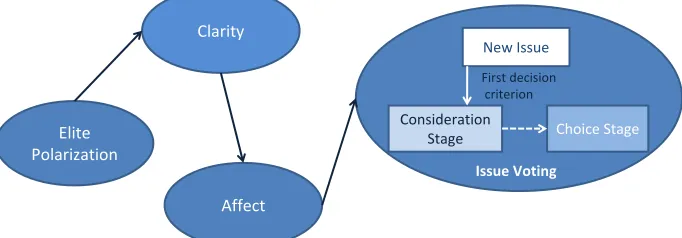
The model proposed by Carmines and Stimson (1986) is intrinsically top-down, i.e. it is derived from the assumption that party elites set in the process of political change, which will eventually result in mass (re-)alignment. More-over, it develops a sequence in which elite stances on an issue may result in mass realignment. The rst step is the (re-) phrasing of a contentious issue in partisan terms. Vote-seeking, that is the maximization of votes, constitutes the overriding objective of political parties (Downs, 1957). Hence, political parties may have an incentive to introduce or promote an issue within elec-toral competition, if they feel that this could result in an increase of votes or eventually upset an existing majority. In this respect, the authors also stress the importance of critical moments (Carmines and Stimson, 1986: 902). Ex-ternal developments (i.e. outside of the control of political parties) may draw attention to particular issues. Importantly, in a second step voters must be aware of the dierences in the position of the parties on the new issue. This is what Carmines and Stimson (1986: 902-903) refer to as clarity. Following the elite reorientations on contentious issues, the mass public must take on the cues of party elites and form clear preferences on this issue. The clarity of party preferences is not sucient, however: the new issue must evoke an emotional response among citizens. Hence, the third step highlights the fact that voters must also care about this issue. This is labeled as aect in the model by Carmines and Stimson (1986: 902-903). When these conditions are met, increased polarization of issue attitudes will occur and the issue will eventually change mass identication as the new issue becomes the primary decision criteria, competing or even replacing old criteria (Carmines and Stim-son, 1986: 902-903). The nal outcome of this process is a realignment of the party system and electorate.
Traditional models of voting behavior often assume (implicitly or explicitly) that voters consider all of the available alternatives. In keeping with research in economics and consumer research (e.g. Manski 1977; Wright and Barbour 1977) and psychology (Tversky 1979), we view voters choices in elections as a two-stage process consisting of a consideration and a choice stage. In the consideration stage voters screen parties based on general information heuristics (such as class or partisanship) and eliminate alternatives. In this rst stage, then, voters narrow down the number of options presented to them on the ballot by ltering out those that are viable. In a second and nal stage, voters utilize additional information to choose among the alternatives enclosed in the consideration set, should there still be more than one alternative left. This second stage is labeled the choice stage.
The distinction between the consideration and choice stages matters for issue evolution in the following way. Since most issues of all potential political concerns are not likely to be realigning in nature, we may expect the majority of new issues to impact elections and vote choice more gradually. We coin this process gradual issue evolution. In the case of gradual issue evolution, an issue starts a secondary decision criterion. That is, the issue inuences the choice stage but not the consideration stage. Put dierently, the issue is not (yet) of such great importance that it is used to eliminate alternatives. Over time, such an issue may become a primary decision criterion, i.e., a screening mechanism to remove alternatives from consideration. If issue evolution is more abrupt or radical, of course, the issue will start as a primary decision criterion. As the issue loses importance, it might become of secondary importance or lose inuence completely. Figure 1 depicts the connection between issue evolution and choice.
When studying the electoral change, we argue that the rst question any author needs to address is the following: Is the issue a primary decision cri-terion, i.e., one that voters use to eliminate parties from their consideration or is it a secondary decision criterion, something that is applied to make a nal choice but is not used to screen parties? One can think of radical issue evolution by means of a Litmus test. When voters use an issue as a means to screen parties, parties have to pass on this issue in order to become considered by voters, much like candidate judges for the Supreme Court who screened on their views regarding abortion or (strict) constitutionalism before they become ocial nominees.
Elite
Polarization
Clarity
Affect
Consideration
Stage Choice Stage
New Issue
First decision
criterion
[image:9.612.133.474.297.416.2]Issue Voting
issue voting for national politics. When voters use the EU issue as a means to screen parties, the eect of the EU issue on national politics may considerable, while when it serves as one of several criteria that allow voters to make a nal choice among parties that are all reasonable choices for them the impact of the EU issue is likely less strong. When parties' EU stances rst have to pass a Litmus test, we may actually be witnessing a process of radical issue evolution which could over time bring about changes in the underlying structures of party and electoral competition and mass electoral behavior.
Choice Set Logistic Regression
How does one distinguish between primary and secondary decision making in a choice model? To do so, one needs to formulate a fundamentally dierent type of model than is commonly used in political science. Conventional choice models, including conditional logit and multinomial probit, implicitly assume that decision makers consider all of the available alternatives. In these models, there is no possibility of distinguishing between primary and secondary decision criteria. These models, then, will not work to answer the questions we ask.
Choice set logistic regression (CSLR) is a model that allows us to distin-guish between consideration and choice stages and thus allows us to estimate the impact of the EU in each stage. The model estimates both the probability of including an alternative in the choice set and, given a particular choice set, the conditional probability of selecting the alternative. No data about choice sets need to be elicited. It is sucient to have data about the nal choices that decision makers make.
To formalize the model, let M be the universe of alternatives, in our case political parties; assume there are m such alternatives. Let C M be a particular choice set, where we exclude the empty choice set. We can construct 2m 1 such choice sets, which can be collected into the power set G. Let
q(C) be the probability that voter q chooses choice set C; we call this the choice set probability. This probability reects the decision process in the consideration stage. Further, let q(ijC) be the probability of choosing alternative i from choice set C; we call this the conditional choice probability. This probability reects the decision process of the choice stage. Then, the unconditional probability of choosing alternative i, i.e., q(i), follows straightforwardly from the laws of probability:
q(i) = X
C2G
(Manski 1977). It is now a matter of formulating decision models for each of the decision stages to work out the unconditional choice probabilities on the left-hand side of (1).
Consideration Stage
The consideration stage can be thought of in terms of screening of the al-ternatives. Let zqi be a vector of screening rules. Further, let zqi0 be the weighted sum of these screening rules. Then an alternative i is included into the choice set if
z0
qi + qi > i (2)
Here qi is a stochastic component, consisting of unobserved factors that may inuence the appeal of a particular alternative. The parameter i is an acceptability threshold: the overall appeal of the alternative has to exceed this threshold before it is included into the choice set.
One way in which the EU can inuence vote choice is through the screening mechanism. Including the distance between a voter and the parties on the EU in zqi, one obtains a model in which alternatives are at least partially screened on their EU stance. Note that in our setup, the EU stance could be compensated for by other elements of zqi. Nevertheless, too discrepant an EU stance could lead to disqualication of a party by the voter.
We now turn (2) into an inclusion probability by making the assumption that the qi are independently, standard logistic distributed. It then follows that the inclusion probability for an alternative is given by
!qi = 1 + exp(1
i zqi0 ) (3)
Equation (3) species a regular logit model for each alternative in M.
The choice set probabilities are now easily constructed. Given the inde-pendence assumption on qi, it follows that
q(C) = Q
i2C!qiQj =2C(1 !qj)
1 Pr(Empty) (4)
Choice Stage
In the choice stage, an alternative is selected from the choice set. Here, we assume that voters are utility maximizers and choose the alternative with the highest utility. Thus, alternative i is selected from the choice set if Uqi > Uqj 8j 6= i 2 C. Assuming that utility has a xed and random component and that the xed component is a linear function of a vector of attributes, xqi, this can be expressed as:
xqi + qi > xqj + qj (5)
8j 6= i 2 C. Here q: is a random component and is a parameter vector. Assuming that the random components follow independent Gumbel distribu-tions, we can express the conditional choice probabilities as conditional logit models (McFadden 1974):
q(ijC) = exp(x 0 qi) P
j2Cexp(xqj0 ) (6)
Note that q(ijC) = 0 if i =2 C and q(ijC) = 1 if C = fig.
Estimation
Estimation of the CSLR is complicated by the fact that the likelihood func-tion is not guaranteed to be strictly log-concave. This problem arises when the parameters in the consideration stage become so large, as to push the inclusion probabilities to essentially one, such that further increasing the pa-rameters doesn't aect the inclusion probability { and hence the likelihood { anymore. Standard optimizers run the risk of landing in a at region, leading to convergence problems. Note that this is an optimization problem only. The likelihood function has a unique maximum and is locally log-concave around this maximum.
The 1992 and 1997 British Elections
BackgroundStudying the 1992 and 1997 elections for the House of Commons provides one with a unique opportunity to assess EU issue voting. In 1992, the EU was a minor issue. While British voters were not wildly enthusiastic about the EU, neither were they strong Euroskeptics. And the distance between Labour on the Conservatives on the EU was relatively small (Evans 2001). In all, these conditions were less than favorable for observing EU issue voting in the elections. By 1997, this had all changed. The Conservatives had begun to give considerable weight to the issue. At the same time, the British public had become quite Euroskeptic and was also giving greater weight to the issue. Finally, the Conservatives had moved their position, increasing the distance to Labour and taking a stance much closer to the typical Brit (Evans 2001). In sum, by 1997 the conditions for EU issue voting had become much more favorable.
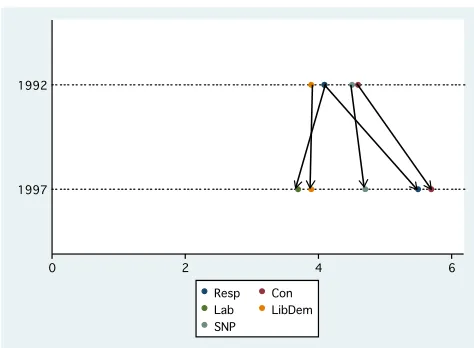
These shifts can be clearly observed in Figures 2 and 3, which depict mean voter and perceived party positions on the EU in 1992 and 1997 for England and Scotland, respectively. These horizontal scale in these pictures runs from pro-European attitudes on the left to anti-European attitudes on the right. It is clear that voters shifted in anti-EU direction from 1992 to 1997. They also perceived that the Conservatives had moved in this direction. If anything, they deemed Labour to be more pro-EU in 1997 than it had been in 1992. Thus, perceived party polarization was a reality by 1997, providing fertile ground for EU issue voting.
At the same time that voter and party positions shifted, so did the perceived importance of the EU. In 1992, 42.6 percent of voters indicated that the EU was (extremely) important for their vote. By 1997, this number had increased to 56 percent. Clearly, issue salience had increased, further adding to the favorable conditions for EU issue voting.
0 0 0 2 2 2 4 4 4 6 6 6 1997 1997 1997 1992 1992 1992 Resp Resp Resp Con Con Con Lab Lab Lab LibDem LibDem LibDem
Figure 2: Shifting EU Positions in England 1992-97
0 0 0 2 2 2 4 4 4 6 6 6 1997 1997 1997 1992 1992 1992 Resp Resp Resp Con Con Con Lab Lab Lab LibDem LibDem LibDem SNP SNP SNP
[image:14.612.196.433.447.621.2]Data, Model Specication, and Measures
Data The data for this paper come from the British Election Studies 1992-97 panel survey (Heath, Jowell, and Curtice 1998). We separately analyze the data for English and Scottish respondents. For England, we consider vote choice among three alternatives: the Conservatives, Labour, and the Liberal Democrats. For Scotland, we consider a fourth alternative as well: the Scottish National Party (SNP).
Model Specication Our modeling strategy is to estimate three dierent models of EU issue voting. The rst model, includes subjective class indica-tors in the rst stage and the EU, traditional left-right issues, and economic retrospections in the second stage. This model is in keeping with a long lit-erature suggesting the primary role of social class in voting behavior (Butler and Stokes 1969; Evans 1999). This literature suggests that class is a primary decision criterion in British elections, albeit one that may have lost some of its inuence over time (Franklin 1985). By contrast, the EU is assumed to be a secondary criterion in the rst model. In this model, then, the perceived EU stance of parties is not used to eliminate alternatives. Rather, this stance is used only to choose among a set of acceptable alternatives and only then when the screening stage has left more than one party in the consideration set.
In the second model, we move the EU from the choice to the consideration stage of the CSLR. Here, it competes with class as a screening mechanism. Traditional left-right issues and economic retrospections remain in the sec-ond stage. This model allows us to determine to what extent parties were eliminated from further consideration based on their EU stance.
The third model keeps the EU in the choice stage but moves traditional left-right issues to the consideration stage of the CSLR. The purpose of this model is to compare the inuence of the EU (Model 2) to traditional left-right issues (Model 3) as a screening mechanism.
Measures We use two social class indicators: working and middle class. They take on the value one if a voter identies with the working class or middle class, respectively. The baseline category consists of voters without a subjective class identity.
For Scottish independence, we use on a question concerning the power of the Scottish Assembly. Several response options allude to the desire for independence of Scotland (either insider or outside of the EU). Voters receive a score of one if they expressed such a desire and zero otherwise.
Economic retrospections refer to perceptions of the development of the economy in the previous year. They run from perceptions that the British economy got worse to perceptions that it got better. In general, negative economic perceptions should hurt the incumbent party (the Conservatives in both 1992 and 1997).
Traditional economic left-right issues are captured through four questions about policy priorities. The rst concerns whether government should try to get people back to work versus keeping prices down. The second concerns the question of whether spending and taxes should increase versus decrease. The third concerns privatization versus nationalization of businesses. The nal issue concerns whether incomes should be made more equal. For each of these issues, we dened the absolute distance between the voter's own position and his/her perception of the party positions. Since all of these issues are clearly economic left-right issues|as is clear from a factor analysis of the self-placements, which yields a clear single factor with that interpretation|we averaged the four distances to obtain a single measure.
Finally, the EU issue is dened in terms of uniting fully with the European Union versus retaining Britain's independence. Here, we dened again the absolute distance between a voter's own placement and that of the political parties (see Figures 2 and 3).
Results
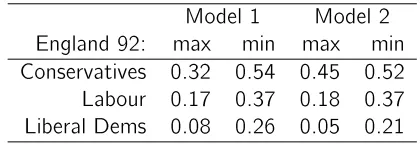
Table 1: Average Partial Eects of EU (England 1992)
Model 1 Model 2
England 92: max min max min
Conservatives 0.32 0.54 0.45 0.52 Labour 0.17 0.37 0.18 0.37 Liberal Dems 0.08 0.26 0.05 0.21
EU Issue Voting in England 1992-97
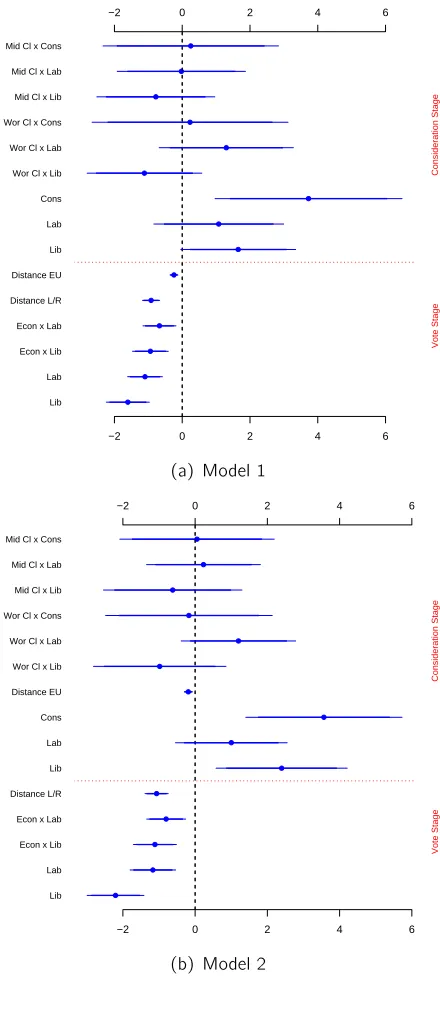
Figure 4 shows the 1992 coecients for the rst and second model speci-cations, where EU issue voting is conceived of as a secondary versus primary decision criterion. The plot shows the posterior mode, as well as the 95 per-cent credible intervals. There is evidence of EU issue voting in 1992, both in the form of a screening mechanism and a secondary choice criterion. The EU coecient for the rst model is -.243, while it is -.188 for the second model.
When translated into average marginal eects, we obtain the results in Table 1. These average partial eects move the EU distance for one party from minimum to maximum while holding everything else at the actual observed values. The entries in Table 1 reect the average over the observations. Importantly, the eects of EU issue voting are most pronounced when the EU is a secondary consideration. For instance, moving the Conservatives from the maximum to the minimum distance on the EU increase the probability of voting for them by .22 points when the EU is a secondary consideration and by .07 when he EU is a primary consideration. The results for Labour are similar. Only for the Liberal Democrats does it appear that the EU issue vote mattered about equally as a primary and secondary consideration.
It should be noted that the impact of EU issue voting was relatively minor compared to traditional left-right issues in 1992. In model 1, where the EU and economic left-right compete in the choice stage, the left-right coecient (-.918) is almost four times greater than the EU coecient (-.243).1 And when left right is considered a screening mechanism, as we do in the third model, then its coecient (-.831) is also considerably larger than that of the EU as screening mechanism. Clearly, EU issue voting was a signicant factor in 1992, but of relative lesser importance than economic left-right issues.
1Note that the coecients of these two issue dimensions can be directly compared as
Figure 4: Posterior Estimates England 1992
−2 0 2 4 6
−2 0 2 4 6
Lib Lab Econ x Lib Econ x Lab Distance L/R Distance EU Lib Lab Cons Wor Cl x Lib Wor Cl x Lab Wor Cl x Cons Mid Cl x Lib Mid Cl x Lab Mid Cl x Cons
Vote Stage
Consideration Stage
(a) Model 1
−2 0 2 4 6
−2 0 2 4 6
Lib Lab Econ x Lib Econ x Lab Distance L/R Lib Lab Cons Distance EU Wor Cl x Lib Wor Cl x Lab Wor Cl x Cons Mid Cl x Lib Mid Cl x Lab Mid Cl x Cons
Vote Stage
Consideration Stage
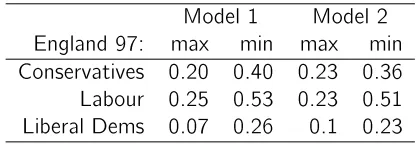
Table 2: Average Partial Eects of EU (England 1997)
Model 1 Model 2
England 97: max min max min
Conservatives 0.20 0.40 0.23 0.36 Labour 0.25 0.53 0.23 0.51 Liberal Dems 0.07 0.26 0.1 0.23
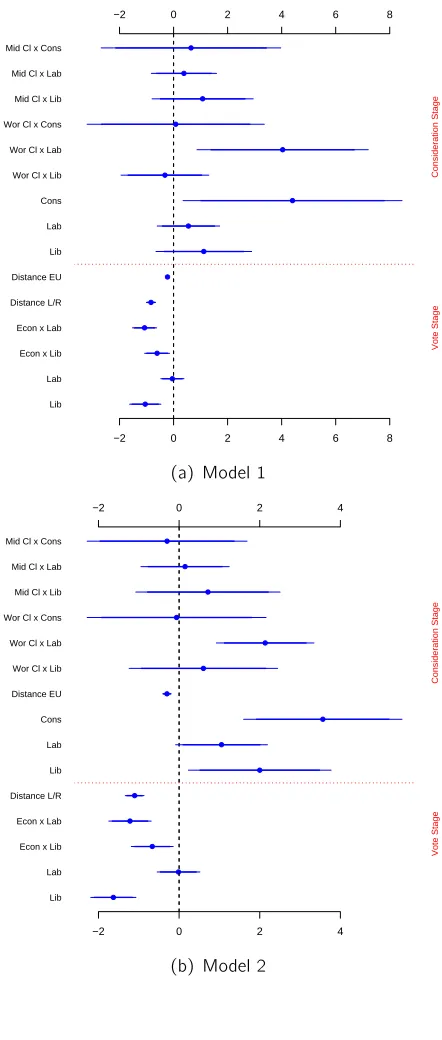
How did this all change in 1997? Figure 5 shows the posteriors for models 1 and 2 in 1997. In the model where the EU enters the choice stage (model 1), we see that the 1997 coecient is slightly smaller than the 1992 coe-cient: -.224 versus -.243. This change is so small as to be of no substantive importance; for all intents and purposes, we can argue that the impact of EU issue voting in the choice stage has remained constant from 1992 to 1997. By contrast, there is clear evidence of the increased importance of the EU as a screening rule. By 1997, the EU coecient in the second model was -.300 (in contrast to -.188 in 1992). This suggests that English voters started to use the EU to weed out parties.
There is clear evidence of this in the average partial eects. As Table 2 shows, changes in EU distance still left a signicant mark on the probability of voting for a particular party when the EU served as a secondary consideration. But compared to Table 1, there is now clear evidence of the EU also having strong eects when conceived of as a primary decision criterion. In all, then, there is good evidence for the increased importance of EU issue voting in England by 1997.
Again, the impact of EU issue voting should be contrasted with that of the economic left-right dimension. When this is done for the rst model, we see that the EU remained a minor issue compared to economic left-right: the left right coecient (-.835) continues to be about four times larger than the EU coecient in 1997 compared to 1992. As a screening mechanism, however, the EU had caught up some with left-right in 1997: the ratio of the EU versus left-right coecients was -.3 to -.919 in 1997 versus -.188 to -.831 in 1992.
EU Issue Voting in Scotland 1992-97
Figure 5: Posterior Estimates England 1997
−2 0 2 4 6 8
−2 0 2 4 6 8
Lib Lab Econ x Lib Econ x Lab Distance L/R Distance EU Lib Lab Cons Wor Cl x Lib Wor Cl x Lab Wor Cl x Cons Mid Cl x Lib Mid Cl x Lab Mid Cl x Cons
Vote Stage
Consideration Stage
(a) Model 1
−2 0 2 4
−2 0 2 4
Lib Lab Econ x Lib Econ x Lab Distance L/R Lib Lab Cons Distance EU Wor Cl x Lib Wor Cl x Lab Wor Cl x Cons Mid Cl x Lib Mid Cl x Lab Mid Cl x Cons
Vote Stage
Consideration Stage
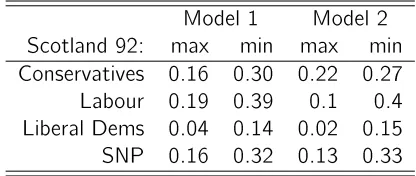
Table 3: Average Partial Eects of EU (Scotland 1992)
Model 1 Model 2 Scotland 92: max min max min Conservatives 0.16 0.30 0.22 0.27
Labour 0.19 0.39 0.1 0.4
Liberal Dems 0.04 0.14 0.02 0.15 SNP 0.16 0.32 0.13 0.33
we consider the role of Scottish independence in vote choice.
For 1992, the results for models 1 and 2 are shown in Figure 6. When playing the role of a secondary decision criterion (model 1), the EU coecient is -.192. As a screening mechanism, the EU played a bigger role in Scotland in 1992: the coecient is -.33.
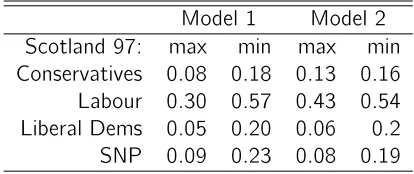
Table 3 considers the marginal partial eects due to EU issue voting for both models. In general, the eects of the EU are more pronounced for the model in which the EU serves as a screening mechanism (model 2) than for the model in which it serves as a secondary consideration (model 1). These eects were computed identically to England.
These results should be judged in light of the other predictors. Comparing the EU to leftright economic issues, its eect in model 1 is relatively minor: -.192 versus -.791. As a screening mechanism, too, the EU seems to have been less important in 1992, its coecient of -.33 in model 2 being quite a bit smaller than the left-right coecient of -.868 in model 3. Both of these screening mechanisms seem less relevant than the question of whether Scotland should be independent. Scotsmen favoring such independence were considerably more likely to include the SNP and less likely to include the Tories.
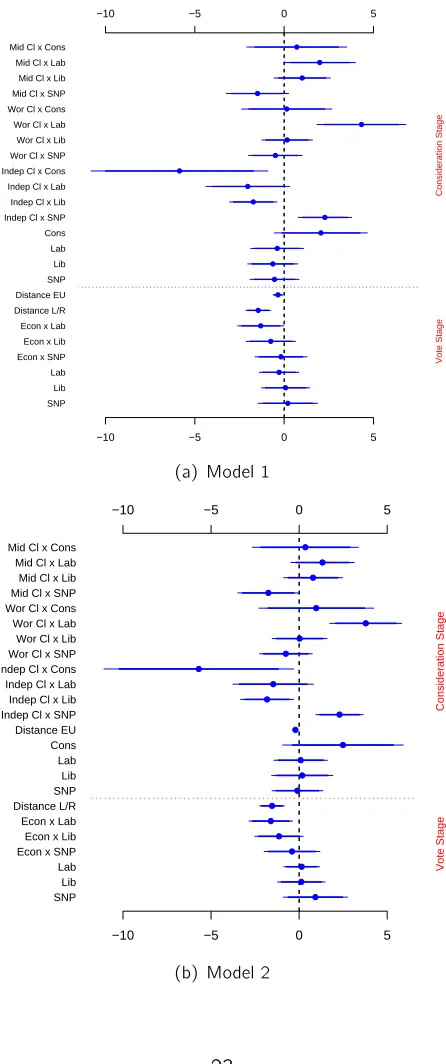
By 1997, something interesting had happened, which contrasts with the pattern observed in England. As a secondary decision criterion, the EU gained in importance (with a coecient of -.346 in 1997 versus -.192 in 1992). As a screening rule, however, the issue lost importance, with the coecient dropping from -.33 to -.212. Figure 7 shows the parameter estimates for 1997.
Figure 6: Posterior Estimates Scotland 1992
−5 0 5
−5 0 5
SNP Lib Lab Econ x SNP Econ x Lib Econ x Lab Distance L/R Distance EU SNP Lib Lab Cons Indep Cl x SNP Indep Cl x Lib Indep Cl x Lab Indep Cl x Cons Wor Cl x SNP Wor Cl x Lib Wor Cl x Lab Wor Cl x Cons Mid Cl x SNP Mid Cl x Lib Mid Cl x Lab Mid Cl x Cons
Vote Stage
Consideration Stage
(a) Model 1
−10 −5 0 5
−10 −5 0 5
SNP Lib Lab Econ x SNP Econ x Lib Econ x Lab Distance L/R SNP Lib Lab Cons Distance EU Indep Cl x SNP Indep Cl x Lib Indep Cl x Lab Indep Cl x Cons Wor Cl x SNP Wor Cl x Lib Wor Cl x Lab Wor Cl x Cons Mid Cl x SNP Mid Cl x Lib Mid Cl x Lab Mid Cl x Cons
Vote Stage
Consideration Stage
Figure 7: Posterior Estimates Scotland 1997
−10 −5 0 5
−10 −5 0 5
SNP Lib Lab Econ x SNP Econ x Lib Econ x Lab Distance L/R Distance EU SNP Lib Lab Cons Indep Cl x SNP Indep Cl x Lib Indep Cl x Lab Indep Cl x Cons Wor Cl x SNP Wor Cl x Lib Wor Cl x Lab Wor Cl x Cons Mid Cl x SNP Mid Cl x Lib Mid Cl x Lab Mid Cl x Cons
Vote Stage
Consideration Stage
(a) Model 1
−10 −5 0 5
−10 −5 0 5
SNP Lib Lab Econ x SNP Econ x Lib Econ x Lab Distance L/R SNP Lib Lab Cons Distance EU Indep Cl x SNP Indep Cl x Lib Indep Cl x Lab Indep Cl x Cons Wor Cl x SNP Wor Cl x Lib Wor Cl x Lab Wor Cl x Cons Mid Cl x SNP Mid Cl x Lib Mid Cl x Lab Mid Cl x Cons
Vote Stage
Consideration Stage
Table 4: Average Partial Eects of EU (Scotland 1997)
Model 1 Model 2 Scotland 97: max min max min Conservatives 0.08 0.18 0.13 0.16 Labour 0.30 0.57 0.43 0.54 Liberal Dems 0.05 0.20 0.06 0.2 SNP 0.09 0.23 0.08 0.19
Again, the eect of EU issue voting should not be exaggerated. It seems to have been mild when compared to left-right ideology. The eect of this was almost ve times larger in model 1 (-1.454). In Model 2, it was almost four times greater (model 3 coecient of left-right economic ideology was -.750). As with the 1992 analysis, the impact of Scottish independence was particularly strong.
Discussion
We see clear evidence of the importance of the EU in the British case. While the EU was not without electoral consequences in 1992, in certain ways its impact had strengthened by 1997. In England, this strengthening occurred in the consideration stage, with English voters using party's EU stance to decide if that party was an acceptable alternative. In Scotland, the strengthening occurred in the choice stage. And the decreasing weight of the EU as a screening mechanism from 1992 to 1997, makes it more dicult to conclude that the EU had clearly evolved into a more important issue for Scottish voters by 1997.
The diverging patterns of issue evolution qua decision criteria in England and Scotland are unexpected. An obvious explanation is missing. As Figures 2 and 3 reveal, voter EU positions and their perceptions of the parties shifted analogously in England and Scotland. There is also no evidence of signicantly dierent saliences of the EU in England and Scotland in 1997 (or, for that matter, 1992). While Scottish independence is a factor that played a role in Scotland and not England, it is not clear that this issue became much more decisive from 1992 to 1997 so as to change the impact of the EU.
elec-tions played a role here. These elecelec-tions returned Labour to power and may have had a unique dynamic that can account for the anomalous patterns in Scotland. In this regard, an analysis of the 2001 elections, when the Conser-vatives campaigned even more intensely on the EU issue, may be worthwhile.
Conclusions
Has the EU ceased to be a sleeping giant? That is, has it begun to inuence electoral behavior?An armative answer to these questions would suggest that the issue has evolved in the sense of becoming a dening element of the political landscape.
A long literature on issue evolution has debated how issues cease to be sleeping giants. That literature has been silent, however, on the question of how new issues enter voters' decision processes. In this paper, we have de-veloped a model that ties issue evolution directly to choice. We have argued that issues may come to aect electoral behavior in two dierent ways. Some-times, issues are so explosive that they become criteria by which voters screen alternatives. They decide, based on the issue, whether a party alternative is acceptable or not. At other times, an issue's impact is less dramatic. Vot-ers decide, based on other criteria, if alternatives are acceptable or not. In this way, they assemble a choice set of viable alternatives. The new issue then helps them to choose among those alternatives but no alternative is eliminated because of its stance on the new issue.
We also developed a statistical model that allows one to assess the deci-sion path by which a new issue inuences vote choice. The choice set logis-tic regression model distinguishes between a consideration and choice stage in decision making. The consideration stage is a screening stage, whereby unattractive alternatives are eliminated, The choice stage entails the selection of one alternative from within a subset of viable options.
References (incomplete)
Adams, Greg (1997) Abortion: Evidence of an Issue Evolution, American Jour-nal of Political Science 31(3): 718-32.
Bohrer, Robert E. and Alexander C. Tan (2000) Left Turn in Europe? Re-actions to Austerity and the EMU, Political Research Quarterly 53(3): 575-595.
Campbell, Angus, Philip E. Converse, Warren E. Miller and Donald E. Stokes (1960) The American Voter. New York: Wiley.
Carey, Sean (2002) Undivided Loyalties: Is National Identity an Obstacle to European Integration?, European Union Politics 3 (4): 387-413.
Carmines, Edward G. and James A. Stimson (1986) On the Structure and Sequence of Issue Evolution, American Political Science Review 80(3): 901-20.
Carmines, Edward G. and James A. Stimson (1989) Issue Evolution: Race and the Transformation of American Politics. Princeton: Princeton University Press.
Carrubba, Cliord (2001) The Electorate Connection in European Union Pol-itics, Journal of Politics 63: 141-58.
De Vries, Catherine E. (2009) The Impact of EU Referenda on National Elec-toral Politics: Evidence from the Dutch Case, West European Politics 32(1):142-71.
De Vries, Catherine E. (2007) Sleeping Giant: Fact or Fairytale? How Eu-ropean Integration Aects National Elections, EuEu-ropean Union Politics 8: 363-385.
Downs, Anthony (1957) An Economic Theory of Democracy. Harper and Row, New York.
Edwards, Erica E. (2008) United We Stand? Examining Dissent within Polit-ical Parties on Issues of European Integration. Unpublished manuscript. Elgun, Ozlem and Erik R. Tillman (2007) Exposure to European Union Policies
and Support for Membership in the Candidate Countries, Political Research Quarterly 60 (3): 391-400
Evans, Georey (1998) Euroscepticism and Conservative Electoral Support: How an Asset Became a Liability, British Journal of Political Science 28(4): 573-90.
Evans, Georey (1999) Europe: A New Electoral Cleavage?, in Georey Evans and Pippa Norris (eds.) Critical Elections: British Parties and Voters in Long-Term Perspective, pp. 207-22. London: Sage Publications.
2001 Election, in Lynn Bennie, Colin Rallings, Jonathan Tonge and Paul Webb (eds.) British Elections and Parties Review, pp. 95-110. London: Frank Cass Publishers.
Franklin, Mark, Tom Mackie and Henry Valen (eds.) (1992) Electoral Change: Responses to evolving Social and Attitudinal Structures in Western Europe. Cambridge: Cambridge University Press.
Gabel, Matthew J. (2000) European Integration, Voters, and National Politics, West European Politics 23(4): 52-72.
Hooghe, L.iesbet and Gary Marks (2009) A Postfunctional Theory of European Integration: From Permissive Consensus to Constraining Dissensus, British Journal of Political Science 39(1): 1-23.
Riker, William H. (1982) Liberalism against Populism: A Confrontation be-tween the Theory of Democracy and the Theory of Social Choice. San Francisco:
W.H. Freeman and Co. Schattschneider, Elmer E. (1960) The Semi-Sovereign People: A Realists View of Democracy in America. New York:
Holt, Rinehart and Winston. Scheve, Kenneth (1999) European Economic Integration and Electoral Politics in France and Great Britain, paper pre-sented at the Annual Meeting of the American Political Science Associa-tion, Atlanta, September 2-5.
Schoen, Harald (2008) Turkeys Bid for EU Membership, Contrasting Views of Public Opinion, and Vote Choice. Evidence from the 2005 German Federal Election, Electoral Studies 27: 344-355.
Steenbergen, Marco R., Erica E. Edwards and Catherine E de Vries. (2007) Who's Cueing Whom? Mass-Elite Linkages and the Future of European Integration, European Union Politics 8(1): 13-35.
Stimson, James A. (2004) Tides of Consent: How Opinion Movements Shape American Politics. Cambridge: Cambridge University Press.
Sundquist, James L. (1983) Dynamics of the Party System: Alignment and Realignment in the United States. Washington D.C.: The Brookings In-stitute.
Tillman, Erik R. (2004) The European Union at the Ballot Box? European Integration and Voting Behavior in the New Member States, Comparative Political Studies 37(5): 590-610.
Tillman, Erik R. (2008) Economic Judgments, Party Choice, and Voter Ab-stention in Cross-National Perspective, Comparative Political Studies 41(9): 1290-1309.
Post-Communist Countries, American Journal of Political Science 46 (3): 557-571.
Van der Eijk, Cees and Mark N. Franklin (2004) Potential for Contestation on European Matters at National Elections in Europe, in Gary Marks and Marco R. Steenbergen (eds.) European Integration and Political Conict. pp. 33-50. Cambridge: Cambridge University Press.
Van der Eijk, Cees and Mark N. Franklin (eds.) (1996) Choosing Europe? The European Electorate and National Politics in the Face of the Union. Ann Arbor: University of Michigan Press.