
Programmes at the turning point. Challenges, activities and developments for partner regions : September 2003-March 2004
58
0
0
Full text
(2) European Policies Research Centre University of Strathclyde Graham Hills Building 40 George Street Glasgow G1 1QE United Kingdom Tel: +44-141-548 3339/4906 Fax: +44-141-548 3955 E-mail: [email protected] [email protected] http://www.eprc.strath.ac.uk/eprc/default.htm http://www.eprc.strath.ac.uk/iqnet/iq-net/index.html. June 2004.
(3) Programmes at the turning point: September 2003 - March 2004. Preface The research for this paper was undertaken in preparation for the third meeting of Phase III of IQ-Net, the exchange of experience network for Objective 1 and 2 programming authorities. The meeting took place in Oulu, Finland from 25-27 April 2004. This paper is a product of desk research and fieldwork visits among national and regional authorities in Member States (notably in partner authorities of the IQ-Net consortium) in Spring 2004. The field research team comprised: Dr Sara Davies (Austria, Germany) François Josserand (Flanders, France) Laura Polverari (Italy) Sandra Taylor (UK). Dr Henrik Halkier (Denmark) Carlos Méndez (Spain) Nina Celina Quiogue (Sweden) Professor Douglas Yuill (Finland). Many thanks to everyone who participated in the research. The European Policies Research Centre gratefully acknowledges the financial support provided by IQ-Net partners and by the European Commission (through European Regional Development Fund co-financing for regional subscriptions) in funding the production of this report and the organisation of the Oulu meeting. The Centre also expresses its thanks to the Western Finland programme authorities for their special financial assistance in making the meeting possible. For further information about IQ-Net, and access to the full series of Thematic Papers, visit the IQ-Net website: http://www.eprc.strath.ac.uk/iqnet/iq-net/index.html.. IQ-Net Thematic Paper 14(1). i. European Policies Research Centre.
(4) Programmes at the turning point: September 2003 - March 2004. IQ-Net Thematic Paper 14(1). ii. European Policies Research Centre.
(5) Programmes at the turning point: September 2003 - March 2004. Programmes at the turning point Challenges, activities and developments for partner regions: September 2003 - March 2004. TABLE OF CONTENTS 1.. Introduction.................................................................................................. 1. 2.. Financial Commitments and Payments...................................................... 3 2.1 2.2 2.3. 3.. Programme commitments, expenditure and the n+2 rule.........................................3 Drawing lessons from the application of the n+2 rule ...............................................4 Issues relating to financial absorption in 2004-08.....................................................6. Mid-term Evaluations................................................................................... 7 3.1 3.2. 4.. Main points raised by the MTE reports .....................................................................7 Overall assessment of the MTE exercise................................................................18. Allocation of the Performance Reserve ................................................... 25 4.1 4.2 4.3 4.4. 5.. The design of the reserve in different Member States ............................................25 The technical assessment process .........................................................................25 The Member States’ proposals for allocating the reserve.......................................27 Views on the usefulness of the reserve ..................................................................29. Mid-term Review of Programmes ............................................................. 30 5.1 5.2 5.3 5.4. 6.. The basis for the mid-term review...........................................................................30 Changes in the programme complements ..............................................................30 Changes in the OP or SPD documents...................................................................30 Obtaining Commission approval for changing financial allocations........................32. Conclusions and Themes for Discussion ................................................ 33 6.1 6.2 6.3 6.4. Progress on commitments and payments...............................................................33 Mid-term evaluation.................................................................................................34 Performance reserve...............................................................................................34 Mid-term review.......................................................................................................34. Annex I : Legislative and Policy Outlook............................................................. 36 7.1 7.2. The Third Cohesion Report .....................................................................................36 The results of the ex post evaluations for the 1994-99 programmes......................41. Annex II : Forthcoming Initiatives ........................................................................ 46 INTERACT Information Day on Second Call for Proposals .................................................46. IQ-Net Thematic Paper 14(1). iii. European Policies Research Centre.
(6) Programmes at the turning point: September 2003 - March 2004. EU Enlargement: a major opportunity for European territories ............................................46 Cohesion Forum ...................................................................................................................46 Committee of the Regions/DG Regio Open Days and Regional Policy Management Workshops............................................................................................................................48. Bibliography .......................................................................................................... 49 General Sources ..................................................................................................................49 Country Specific Sources .....................................................................................................49. IQ-Net Thematic Paper 14(1). iv. European Policies Research Centre.
(7) Programmes at the turning point: September 2003 - March 2004. Programmes at the turning point Challenges, activities and developments for partner regions: September 2003 - March 2004. 1.. INTRODUCTION The second half of 2003 and early 2004 have been characterised by considerable activity in Structural Funds programmes. All partners have been engaged with a range of issues relating to the mid-term of the programmes, with the completion of the mid-term evaluations, the development of proposals for allocating the performance reserve, and the mid-term review. For many partner programmes, the end of 2003 also saw the first application of the n+2 rule, so that attention has been focused on financial implementation and avoiding automatic decommitment. This period has also seen a number of other important events, notably the publication of the Commission’s Third Cohesion Report in February 2003, as well as the finalisation of the Commission’s ex post evaluations of the 1994-99 programming period. This paper provides an overview of all these issues, with the second section focusing on financial absorption in terms of commitments and payments. It also looks at the application of the n+2 rule, and the steps taken by partners to avoid decommitment. The experience of partner programmes in relation to the n+2 rules varies widely, although even those programmes with strong aggregate levels of absorption have sometimes experienced specific problems due to the complexities of EU systems for managing claims. A related issue in some programmes has been a growing awareness of the need to ensure that steps are taken now in order to ensure that all funds are fully absorbed by the end of the programming period. The third section of the paper focuses on the mid-term evaluations, notably on the main issues raised by the evaluators, and perceptions of the usefulness of the mid-term evaluation exercise. The mid-term evaluations provided an opportunity to assess strategic and qualitative aspects, and to take steps to ensure that certain key goals were being addressed adequately, as well as to ensure that conditions were in place to safeguard financial absorption. The fourth section examines the performance reserve, notably the submission of proposals by programme partners to the Commission for allocating the reserve, and views of the usefulness of this instrument. The fifth section briefly outlines the broader mid-term review which is taking place in many programmes, and the wider proposals for revising the financial tables for the second half of the programming period. The first annex to the paper provides an overview of other core developments in relation to Cohesion policy, in particular of the Third Cohesion Report, as. IQ-Net Thematic Paper 14(1). 1. European Policies Research Centre.
(8) Programmes at the turning point: September 2003 - March 2004. well as a summary of the results of the Commission’s ex post evaluations of the 1994-99 programmes. The second annex provides a summary of various forthcoming initiatives which may be of interest to partners.. IQ-Net Thematic Paper 14(1). 2. European Policies Research Centre.
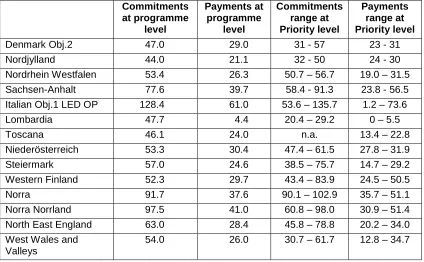
(9) Programmes at the turning point: September 2003 - March 2004. 2.. FINANCIAL COMMITMENTS AND PAYMENTS. 2.1. Programme commitments, expenditure and the n+2 rule Since the last IQ-Net meeting in Leoben (September 2003), the programmes which were adopted in 2001 have faced their first n+2 deadline, on 31 December 2003. This provided a formal test of the programmes’ ability to commit and disburse Structural Funds allocations. At the time of the Leoben conference, a contrasting picture of programmes’ experiences was emerging, with levels of commitments and payments varying widely across Member States and regions. For a majority of programmes, there was confidence from an early stage that, while some action might be needed to ensure absorption, there was been no real risk of automatic decommitment. Elsewhere, however, financial monitoring showed that levels of commitment and/or spending were too low to meet targets, and that a significant mobilisation of effort would be required to avoid the possibility of automatic decommitment. The situation as regards automatic decommitment remains extremely varied across programmes, with some experiencing little or no serious difficulty in meeting the n+2 rule at programme and Fund level, even if there are sometimes specific problems with financial absorption below the level at which the n+2 rule is applied i.e. at the level of individual Measures or subMeasures (e.g. Niederösterreich, Sachsen-Anhalt, Western Finland, Sweden, País Vasco). For example, overall levels of commitments and payments are high in Norra Norrland, but the absorption of FIFG funds has been low due to the very low levels of demand because of the lack of fishing fleets; a decision was therefore taken towards the end of 2003 to shift finance from the FIFG to the ERDF. In other cases, however, programme managers have experienced serious difficulties (e.g. NRW, Steiermark, UK), and have had to rely on a range of ad hoc steps aimed at avoiding decommitment. In one programme, targets were met only on 23 December 2003, while funds were actually decommitted in three partner programmes, although the amount of money in all cases was very small compared to total funding. Automatic decommitment seems mainly to have concerned the ESF rather than the ERDF, although it is not clear whether this is a more widely observed phenomenon.. IQ-Net Thematic Paper 14(1). 3. European Policies Research Centre.
(10) Programmes at the turning point: September 2003 - March 2004. Table 2.1: Commitments and payments, as a percentage of total public expenditure allocations, relative to the entire programming period Commitments at programme level. Payments at programme level. Commitments range at Priority level. Payments range at Priority level. Denmark Obj.2. 47.0. 29.0. 31 - 57. 23 - 31. Nordjylland. 44.0. 21.1. 32 - 50. 24 - 30. Nordrhein Westfalen. 53.4. 26.3. 50.7 – 56.7. 19.0 – 31.5. Sachsen-Anhalt. 77.6. 39.7. 58.4 - 91.3. 23.8 - 56.5. 128.4. 61.0. 53.6 – 135.7. 1.2 – 73.6. Lombardia. 47.7. 4.4. 20.4 – 29.2. 0 – 5.5. Toscana. 46.1. 24.0. n.a.. 13.4 – 22.8. Niederösterreich. 53.3. 30.4. 47.4 – 61.5. 27.8 – 31.9. Steiermark. 57.0. 24.6. 38.5 – 75.7. 14.7 – 29.2. Western Finland. 52.3. 29.7. 43.4 – 83.9. 24.5 – 50.5. Italian Obj.1 LED OP. Norra. 91.7. 37.6. 90.1 – 102.9. 35.7 – 51.1. Norra Norrland. 97.5. 41.0. 60.8 – 98.0. 30.9 – 51.4. North East England. 63.0. 28.4. 45.8 – 78.8. 20.2 – 34.0. West Wales and Valleys. 54.0. 26.0. 30.7 – 61.7. 12.8 – 34.7. Note: Caution is needed in comparing data across programmes and particularly across Member States. Data are not strictly comparable because the dates range from September 2003 until February 2004. Data at Priority level exclude Priorities for Technical Assistance. Source: EPRC calculations based on programming information.. 2.2. Drawing lessons from the application of the n+2 rule The reasons for difficulties with financial absorption in some programmes have already been extensively examined in previous IQ-Net papers1. Some of the main issues are: o. Thematic: Financial absorption may be put at risk if programmes are narrowly focused (e.g. Steiermark, UK), particularly on interventions which are outside the programme managers’ control. For example, the persistently negative economic situation in some Member States has affected both business investment (and thus the uptake of aid schemes) and public finances (Austria, Nordrhein Westfalen).. o. Geographical: Absorption is often more difficult when eligible areas are small and fragmented (Steiermark, UK), and may be less of a problem when programmes are focused on large Objective 1 areas with serious economic difficulties (Sachsen-Anhalt, LED OP).. 1. Downes R, Davies S, Bachtler J and Michie R, (2003) Review of Structural Fund Programming: MarchSeptember 2003, IQ-Net Thematic Paper 13(1), European Policies Research Centre, Glasgow (see http://www.eprc.strath.ac.uk/iqnet/partners_pages/downloads.html) Polverari L, Bachtler J and Michie R (2003) Taking Stock of Structural Fund Implementation: Current Challenges and Future Opportunities, IQ-Net Thematic Paper 12(1), European Policies Research Centre, Glasgow (see http://www.eprc.strath.ac.uk/iqnet/IQ-Net/reports.html) Raines P and Taylor S (2002), Mid-Term Evaluation of the 2000-06 Structural Fund programmes, IQNet Thematic Paper 11(2), European Policies Research Centre, Glasgow , June 2002 (see http://www.eprc.strath.ac.uk/iqnet/IQ-Net/downloads/IQNet_Conference_documentation/Lulea_Jun02/Lulea_Mid-Term_Evaluation_Jun02.pdf ).. IQ-Net Thematic Paper 14(1). 4. European Policies Research Centre.
(11) Programmes at the turning point: September 2003 - March 2004. o. Administrative complexity: Absorption may be more difficult in ‘differentiated’ administrative systems where projects have long run-in phases due to e.g. staff recruitment, organisational set-up etc (UK). Absorption is also difficult for more soft and innovative interventions in ‘subsumed’ systems, due to insufficient existing implementation mechanisms (Austria, Italy).. o. Planning: Almost all programme partners have noted that the rigours of n+2 requires significant advance planning and ongoing monitoring by programme managers and other partners, to ensure that commitments and especially payments are on schedule.. o. Major projects: While major projects can facilitate financial absorption, there are often long run-in phases, not least due to the need to gain explicit Commission approval e.g. for large State aid-related projects, or for the creation of venture capital funds (Nordrhein Westfalen, Steiermark, UK).. Programme managers have taken various steps in order to ensure that programmes meet the n+2 rule, or plan to take further steps in 2004. Some of the most important initiatives are the following: o. Communication (letters, bilateral meetings etc) with actors responsible for different Measures and/or with project-holders on the importance of making timely claims (Nordrhein Westfalen, Steiermark, UK). Some UK programmes have also set up ad hoc working groups to focus on financial absorption.. o. Ensuring effective financial management and monitoring, including risk analysis, at project level (Denmark, LED OP, Nordrhein Westfalen, East Wales, West of Scotland).. o. Simplifying financial management and control procedures, and taking steps to reduce the time-scale needed to submit claims to the Commission (France).. o. The retrospective inclusion of projects which were originally financed outside the Structural Funds programmes, but which in principle fit within the programmes’ eligibility criteria (France, Nordrhein Westfalen, UK). Programme managers have taken care to get agreement in writing from the Commission, confirming that retrospection was permissible.. o. Loosening project selection criteria e.g. minimum targets for employment creation (LED OP).. o. Ensuring that projects are fully ready to start before they are approved (Kempen).. o. Steps to increase domestic co-financing e.g. by bringing forward public spending from 2004 to 2003 for Measures where absorption is strong, or drawing in additional domestic co-financing from other public funding mechanisms (Nordrhein Westfalen).. o. Increasing staff resources in implementation (Steiermark).. o. Finalising projects likely to result in fast spending, notably venture capital and loan funds, since these can involve a first and final claim (East Wales, West of Scotland, Steiermark).. o. Raising the grant level for larger projects which had already been approved, but with lower grants than could potentially have been awarded (East of Scotland, East Wales).. IQ-Net Thematic Paper 14(1). 5. European Policies Research Centre.
(12) Programmes at the turning point: September 2003 - March 2004. o. Improving forward-planning for project generation e.g. via ongoing dialogue with key partners (East Wales).. Opinions of the n+2 rule differ widely. Some programme managers regard the rule as a useful tool for enhancing programme effectiveness and efficiency, not least because it provides a means of ensuring that all partners are sufficiently focused on financial absorption. Others, however, perceive the rule to have had a negative impact on project quality and strategic direction, as well as to have undermined staff morale. 2.3. Issues relating to financial absorption in 2004-08 Some of the steps taken over the past year are expected to have positive effects on the programmes’ capacity to meet expenditure targets in 2004, either because of the general acceleration in payments, or because steps have been taken to address obstacles to poor financial absorption. These include, for example, the establishment of better systems for ensuring timely payment claims, more detailed monitoring of project-level progress, and the re-allocation of funds towards Measures and sub-Measures showing stronger progress on financial indicators. In some programmes (Western Finland, Sweden, Wales, Kempen and Limburg), attention is already turning to programme closure, both in terms of the need to ensure that the remainder of the programme’s funds are targeted on ‘good’ projects, and also in terms of the range of administrative requirements facing programme managers, notably in terms of financial management, control and auditing.. IQ-Net Thematic Paper 14(1). 6. European Policies Research Centre.
(13) Programmes at the turning point: September 2003 - March 2004. 3.. MID-TERM EVALUATIONS The Dortmund IQ-Net update paper2 provided an overview of approaches to the mid-term evaluations (MTE). It noted that, although the evaluation methodologies in all programmes were in compliance with DG Regio’s Working Paper 8, some programme managers had opted for an ‘ongoing evaluation’ approach e.g. in Austria, Italy and Ireland. Some innovative elements could also be found in other programmes e.g. the benchmarking exercise included as an integral part of the mid-term evaluations of Nordrhein Westfalen, West of Scotland and East of Scotland. The IQ-Net up-date paper written for the Leoben conference3 in autumn 2003 continued to monitor the progress of the mid-term evaluations. It noted that the quality of evaluation was seen to be improving, in part as a response to the regulatory requirement to undertake an MTE in the 2000-06 period, but also due to a broader evolution of an evaluation culture and to a more widespread interest in participative and learning-focused approaches to evaluation. The Leoben paper also examined what the programmes were doing to exploit positively the outcomes of the mid term evaluations, ensuring that, as Working Paper 8 states, the “mid-term evaluation is not an end in itself but a means to improve the quality and relevance of programming”4. The deadline for the submission of the MTEs to the Commission was 31st December 2003 and all reports have now been submitted. This is therefore an opportune moment to comment on the recommendations raised by the MTE reports, on their perceived usefulness, on the weaknesses and strengths of the approaches adopted and on the commonalities and differences in the problems met across the IQ-Net partner regions. As the processes and methods used in undertaking the MTEs were dealt with extensively in previous research and specifically in the thematic paper for the Luleå conference in June 20025, the discussion here focuses instead on the main points raised by the MTE reports. These relate to the validity of the strategies implemented; progress on effectiveness, efficiency and impacts; management and implementation procedures; the integration of the horizontal themes, and other specific themes addressed by the evaluators. This section also provides a synthesis of the assessment of IQ-Net partners and the Commission of the overall usefulness of the exercise.. 3.1. Main points raised by the MTE reports The content of the MTEs across partner programmes is fairly standard. The programmes have generally drawn on the guidelines of the Commission’s Working Paper 8, and have included a re-appraisal of the validity of the. 2. Polverari L, Bachtler J and Michie R (2003) Taking Stock of Structural Fund Implementation: Current Challenges and Future Opportunities, IQ-Net Thematic Paper 12(1), European Policies Research Centre, Glasgow (see http://www.eprc.strath.ac.uk/iqnet/IQ-Net/reports.html) 3 Downes R, Davies S, Bachtler J and Michie R, (2003) Review of Structural Fund Programming: MarchSeptember 2003, IQ-Net Thematic Paper 13(1), European Policies Research Centre, Glasgow (see http://www.eprc.strath.ac.uk/iqnet/partners_pages/downloads.html) 4 CEC (2000) The Mid Term Evaluation of Structural Fund Interventions, Working Paper No. 8, Commission of the European Communities, Brussels 5 Raines P and Taylor S (2002), Mid-Term Evaluation of the 2000-06 Structural Fund programmes, IQNet Thematic Paper 11(2), European Policies Research Centre, Glasgow , June 2002 (see http://www.eprc.strath.ac.uk/iqnet/IQ-Net/downloads/IQNet_Conference_documentation/Lulea_Jun02/Lulea_Mid-Term_Evaluation_Jun02.pdf ).. IQ-Net Thematic Paper 14(1). 7. European Policies Research Centre.
(14) Programmes at the turning point: September 2003 - March 2004. strategy, an assessment of financial and physical progress; an overview of the anticipated impacts (and sometimes also of efficiency); an analysis of management and implementation mechanisms; and an assessment of the operationalisation of the horizontal themes (equal opportunities, environmental sustainability, the information society). In some cases, for example in Italy’s OP LED, in Kempen and in Limburg, in the West of Scotland programme and in Austria, these general themes were supplemented by thematic or geographical foci (e.g. the themes of competitiveness, SMEs, or on selected sub-areas of the programmes). In other cases, there has been an additional focus on areas of specific national interest. In France for instance, DATAR included several domestic policy priorities in the standard terms of reference which were provided to regional programmes. 3.1.1. Strategic appropriateness In none of the evaluations of the partner programmes was there a fundamental critique of the appropriateness of the strategies adopted. Most evaluations undertook a thorough assessment of the strategy and core objectives, and concluded that these were still broadly relevant. In other cases, the evaluators were asked not to undertake a thorough review of the strategy but to focus on more operational issues. In the Austrian programmes, for example, the evaluators were asked not to re-assess the basic strategy, but simply to examine ways of enhancing the realisation and implementation of the existing strategy and core goals. In France, none of the mid-term evaluations questioned the relevance of the analysis of the socio-economic context or the basic strategy, because they felt that the context had not changed sufficiently to justify a radical modification of the programme. This approach was criticised by the reading committee set up by the French authorities to assess the MTEs (see Section 3.3 below). Although the evaluators were generally positive in their assessment of the overall strategic appropriateness of the programmes, many raised issues which are of relevance to the programme’s strategic orientation, notably in three areas:. a.. (i). the need to narrow and/or re-focus the strategy (the Austrian SPDs, the Italian OP LED, West of Scotland, the Swedish programmes, and some French Objective 2 programmes);. (ii). the opportunity to revise overall targets (Denmark);. (iii). the need to respond to problems emerging from the strategy (Finland).. Improved strategic focus A number of MTE reports noted that, whilst the strategies continued to be coherent with their analysis of the socio-economic context and with the core objectives, there might be a need to re-adjust the emphasis placed on different aspects of the strategies. In Austria, in particular, both the evaluations for Steiermark and Niederösterreich underlined the need to strengthen further RTD and innovation support to businesses, as well as the need to develop more cross-border projects with the new Member States in the form of inter-firm networks and R&D cooperation projects. Interestingly, the evaluation of the Niederösterreich programme includes some strategic recommendations for the 2007+ period, notably to enhance development strategies for small and medium sized towns in the fields of urban renewal and in leisure/culture/retail; a stronger focus on tourism, not least targeted on. IQ-Net Thematic Paper 14(1). 8. European Policies Research Centre.
(15) Programmes at the turning point: September 2003 - March 2004. visitors from nearby cities, and, more generally, a move away from focusing on narrowly defined eligible areas towards a greater focus on ensuring the participation of structural weak regions in horizontal networks. Whilst the recommendations above are specific to the Austrian context, the suggestion for a more stringent focus on innovation and RTDI appears to be a theme common to a number of IQ-Net partners, and is relevant also to Italian (OP LED), French (Aquitaine) and British programmes (West of Scotland). For the OP LED, the evaluators found it difficult to suggest any strategic reorientation of the programme, since most of the resources have already been committed. However, some general points were raised which also apply to the post 2006 period, such as the need to focus more on technological innovation, to promote new industrial specialisations with high value added and to attract external investments, adopting a ‘global’ and not just ‘local’ logic. The MTE for the Aquitaine programme proposed two possible scenarios for a strategic reorientation of the programme. The first, ‘continuity’ scenario suggests a rebalancing of the programme within each priority, identifying those measures which represent the strongest potential and shifting budget resources to them, to the expense of less efficient measures. A second, ‘audacious but pragmatic’ scenario sees a rebalancing of resources from one priority to the other. This would move the strategic and financial focus of the programme away from direct aids to companies, to favour the funding of telecommunication infrastructure, thus better taking into account the EU’s horizontal priority of the information society. The evaluation of Sachsen-Anhalt also presents reflections on the focus of the programme. The evaluators note that the strategy in general remains relevant, but that there is a need for a stronger focus on certain goals, notably to concentrate funds on interventions which directly support business-oriented economic development; to strengthen further the development of infrastructure; to maintain the dual focus of labour market policy on reducing social exclusion and ensuring a high quality supply of labour; and to enhance the thematic and spatial concentration of funding in rural development. The MTEs of the Swedish programmes note that that the programmes in their present form are both relevant and capable of achieving the desired impacts, but also emphasise that funding should be targeted towards projects with dynamic or longer-term effects in the remainder of the programming period. They argue that these projects should be characterised by: i) openness to the external context to ensure the wide involvement of different actors, (ii) clear mechanisms for follow up and control, (iii) network-building, (iv) potential for catalytic effects, (v) networks aimed at developing cooperation and democracy, (vi) making use of local resources in new ways. However, this view does not seem to be shared by programme managers, who have some doubts over whether these recommendations can be put into practice. b.. Revision of targets In Denmark, the evaluators re-stated the overall validity of the strategy, as it is based on an analysis of structural weaknesses which have not changed since the late 1990s when the strategy was formulated. However, the subsequent economic slow-down and more stringent financial environment, which has affected both private and public actors, mean that the broad indicators are now too optimistic and that the programme may not be able to reach the quantitative targets set ex ante.. IQ-Net Thematic Paper 14(1). 9. European Policies Research Centre.
(16) Programmes at the turning point: September 2003 - March 2004. c.. Gaps in the background analyses for the programmes In the MTE of the Western Finland Objective 2 programme, the core of the strategy was commended as being both reasonable and well-founded, a major improvement on the 1995-99 period, not least in the degree to which it took regional views into account and allowed regional details and features to be respected. On the other hand, a number of issues were raised by the MTE in respect of the strategy. First, Finlandit argued that the strategy might have over-emphasised particular sectors which have been experiencing difficulties, and that there was a risk that this could lead to dependence on programme support. Second, labour supply issues have increased in importance since the strategy was developed so that there may be a need to address issues relating to the ageing population and migration. Third, there may be room to focus more strongly on the private service sector, which is under-represented in the programme area and is seen by the mid-term evaluation team as having considerable potential for (female) employment growth. Finally, there seems to have been insufficient weight in practice on measures to promote female employment, in order to compensate for the programme’s focus on traditional (male-dominated) activities.. 3.1.2. Progress and effectiveness Most MTEs confirm the good implementation levels achieved, both financially and in terms of physical outcomes. Even when progress is uneven across measures in terms of physical outcomes, as in the West of Scotland, the evaluations underlined that the programme has led to additional funding for certain interventions. Most evaluations present a measure-by-measure detailed analysis of financial and physical targets (e.g. Lombardia). Provisional estimates of gross jobs created are also quite frequent (e.g. Austrian programmes, OP LED). The MTE reports also present some recommendations of improvements needed, notably in relation to the points summarised below. A common theme across a number of programmes relates to the difficulty of implementing less traditional interventions. In Denmark and Lombardia, this is seen to be due to a mismatch between what the programme offers and the needs of potential recipients. In both programmes, the measures focused on technological innovation were not attractive to the predominantly rural, remote and mountainous areas (for Lombardia) covered by the programmes. This is leading to a shift of funding towards more traditional forms of support (Denmark) and to a simplification and broadening of actions. In the case of the OP LED, on the other hand, problems related to the selection procedures used for less traditional interventions, rather than to a lack of demand. The OP LED evaluation report suggests some modifications, especially as regards the selection criteria and methods used for measure 1.2 (PIA Innovation), for example a more articulated innovation-related criterion, and separate ranking lists for manufacturing and service sector enterprises. Issues relating to the ‘innovative’ character of projects were also raised for both the Flemish and Toscana SPDs. In Kempen and Limburg (Flanders), the evaluators emphasised the need to exploit the opportunity to select new kinds of projects, rather than those which are de facto a continuation of the past programme. In Toscana, on the other hand, the evaluators raised some concerns on the quality of the interventions implemented through the socalled parco progetti, already discussed in previous IQ-Net reports. The parco progetti were used to allow fast spending in the first year of implementation, by funding infrastructure projects that had already fulfilled all administrative procedures required for expenditure to start. The evaluation report suggested. IQ-Net Thematic Paper 14(1). 10. European Policies Research Centre.
(17) Programmes at the turning point: September 2003 - March 2004. that these projects were not necessarily in line with the programme’s objectives. In other words, the report criticised the emphasis given to the need to spend fast rather than well. This view is not shared by the programme’s Managing Authority, however, which maintains that the interventions of the parco are carried out within the broader Regional Development Plan (to which the SPD’s strategy is linked), and underline that funding the parco progetti projects has encouraged the beneficiaries (the municipalities) to become more efficient in designing and implementing projects. The use of this instrument, moreover, has also allowed the programme to reach its spending targets, without having to fund projects that had already been financed from national funds. The Western Finland MTE also addresses the issue of effectiveness and programme progress. The programme is considered to have made good financial progress overall. In addition, an analysis of the content of aided projects showed that the projects which had been supported were firmly in line with the objectives of the programme. This view was confirmed by a survey of the members of the Regional Management Committees. They felt that the SPD had been particularly successful in respect of the following objectives: developing research and technological expertise; promoting entrepreneurship; enhancing competitiveness and the attractiveness of regions; improving connections between the education sector and firms and networking business activities. However, other objectives were felt by the MTE to have been less well realised, in particular: improving the business environment for new enterprises; achieving gender equality in the labour market; developing fruitful relationships between urban and rural areas; and enhancing cooperation between regions. In Austria, the evaluations of both Steiermark and Niederösterreich undertook a thorough assessment of the programmes’ effects in relation to the ex ante targets. In Niederösterreich, the evaluators developed a number of tools, drawing on both quantitative and qualitative information to provide a succinct overview of effects. First, they developed a scoring system to reflect the expectations of participants as to whether the ex ante targets for outputs/results would be met for the whole programme, and showed that it is anticipated that the targets will probably be met for 70% of the indicators. Second, they assessed the extent of current evidence of effectiveness. Third, they developed a synthesis of ten core goals, and assessed the contribution of each Measure to these goals. In the case of the French programmes, there was no assessment of the degree to which initial mid-term objectives had been met by the programmes. The French authorities consider this to be a weakness of the evaluations. The evaluators of País Vasco’s SPD did not make any major criticisms, but commented on the very satisfactory employment creation results; good progress with environmental and equal opportunities principles (which is a common concern for most programmes, as will be seen in section 0); as well as a good level of complementarity with Objective 3 actions and alignment with the European Employment Strategy. 3.1.3. Efficiency and impacts Most MTEs did not carry out an assessment of the programmes’ efficiency, in terms of an examination of cost-per-job and/or the opportunity-cost of the interventions (i.e. whether stronger effects could have been achieved with an alternative use of the funds). Cost-per-job estimates were included, however, in the evaluation of Italy’s OP LED, the Danish SPD, the Western Finland. IQ-Net Thematic Paper 14(1). 11. European Policies Research Centre.
(18) Programmes at the turning point: September 2003 - March 2004. SPD, in some French evaluations and in the MTE of the País Vasco programme. The assessment of cost per job was relatively straightforward for the OP LED, which concentrates about 80% of spending on one measure providing State aid for investment in industrial and service sector firms. The evaluators drew on the forecasts of the numbers of jobs to be created and safeguarded which the applicants have to quantify in their application forms (the performance in terms of job creation of each investment project being one of the elements for selection). Generally, however, Italian MTEs - following the guidelines by the Commission and by the national Ministry for Economics and Finance - were predominantly oriented towards process rather than impacts. The Danish report also includes some cost-per-job calculations, but stresses the constraints of this exercise, due to the limited number of projects which had been completed when the evaluation was undertaken and the importance of infrastructure and knowledge-oriented projects within the programme, for which cost-per-job assessments were seen not to be very meaningful. The evaluation of the País Vasco programme underlines the efficiency of the programme both in terms of unit costs and qualitative insights. Few MTEs undertook a detailed assessment of the impacts that the programmes are likely to deliver, for example because it was too early in the programmes’ cycle, or due to the methodological difficulties of assessing impacts in programmes involving comparatively small amounts of public spending. Some programmes did, however, attempt to estimate impacts. In the Western Finland MTE, for example, the evaluation team measured the impact of direct programme actions in terms of gross jobs and then made adjustments to take account of deadweight, double counting etc. in order to produce an estimate of the net jobs created by the programme – namely around one third of the gross impact (between 7000 and 9000 jobs by the end of 2002). The evaluators also emphasised the need to bear in mind that, in a number of development projects, the main objective of the project was not always short-term job creation but, for example, longer run business competitiveness. The evaluation of the OP LED includes an assessment of the programme’s initial impact, by means of a survey of 340 supported firms (from a total of 1,615 which had received aid in 2000-03). The results of the survey show that public funds are delivering positive effects on the productive, technological and commercial performance of recipient firms. In more detail, the analysis shows that the aid plays a significant role in the investment decisions of firms, and in the location chosen for such investments, and that the grants played a strong role in the decision of medium-large and labour-intensive firms owned outside the South of Italy to locate there. A further interesting example of attempts to calculate impacts can be found in the MTE of the Flemish SPD, via a case study analysis of the effects of investment in industrial estates and tourism in the Kempen area. The analysis related spending to outcomes achieved (number of jobs created, size of investments made, etc.). This analysis produced estimates for indicators such as the net cost per job created, the net cost per hectare for new industrial sites and business office locations, and so on. These were used, with some caution, to provide a general estimate of a possible final impact of the programme, not only for the Kempen area but also, via extrapolation, for the whole of Flanders.. IQ-Net Thematic Paper 14(1). 12. European Policies Research Centre.
(19) Programmes at the turning point: September 2003 - March 2004. 3.1.4. Implementation and management A number of weaknesses in programme management are identified and improvements suggested. As might be expected, most reports raise specific issues on measures which have met problems with financial absorption or other implementation-related issues. Apart from very detailed, measurespecific comments, the most commonly raised issues relate to the following themes:. a.. o. Staffing and internal organisation of programme secretariats, particularly the need to increase the number of staff working on programme coordination/implementation.. o. The need to improve information exchange between the actors involved in programme implementation.. o. Publicity, animation and proactive project development. External communication activities were mostly deemed adequate and appropriate in the MTEs, with evaluators suggesting only minor adjustments. Some evaluations, however, emphasise the need to increase efforts.. o. The need to improve coordination between ERDF and ESF and between Objective 2 and Objective 3 programmes.. o. Domestic co-financing problems were identified.. o. Project selection, including both general and specific improvements to the selection mechanisms of measures with lower than expected take-up of funds.. o. Almost all MTEs note some gaps and inefficiencies in monitoring systems and data. Issues raised include: the indicators in use, the system for gathering monitoring information and the usability of information gathered. Specific points were raised also as regards the monitoring of the horizontal themes; this issue is discussed in more detail in paragraph 3.1.5 below.. Staffing and internal organisation of programme secretariats. In a number of programmes, the evaluations raised the need to increase the number of staff working on programme coordination/implementation (Steiermark, Lombardia, País Vasco). In addition, the MTE for Steiermark also underlined the need to improve local-level implementation structures. In Western Finland, the MTE found considerable satisfaction at the project level with the way the programme is operating and the ability of the programme to spend the available funds was also positively evaluated. There were however criticisms at the regional level, even though there was recognition that regional level cooperation is working well and has been strengthened by the programme. The most significant organisational criticisms were a consequence of the subsumed nature of the Finnish system. Particular mention was made of the following issues: (i) the large size and heterogeneity of the programme area; (ii) fragmented and complicated structure of EU interventions in the area; (iii) varying administrative cultures and practices within different funding bodies; (iv) tension between regional and national (sectoral ministry) influence and power; (v) large number of parties involved in the funding and administration of the programme. It is recognised that most of these issues cannot be dealt with in the short term (that is, within the current programme period). However, looking to any future programming period, the evaluation team felt that the issue of concentrating programme administration within a smaller number of administering bodies should be actively debated within the programme area.. IQ-Net Thematic Paper 14(1). 13. European Policies Research Centre.
(20) Programmes at the turning point: September 2003 - March 2004. b.. Information exchange between the actors involved in programme implementation. Some evaluators noted the need to improve information exchange (Steiermark, Lombardia, Kempen, Sachsen-Anhalt). In Kempen, the mid-term evaluation noted that the role of the Monitoring Committee was not as strong as it was in the previous programming period. The reason is that there used to be a separate Monitoring Committee for the Kempen region, whereas at present the structure has been reorganised around one Monitoring Committee, which is effectively shared with the other Flemish Objective 2 programme - the different Provinces being dealt with one after the other during meetings (although there is officially a separate committee for each programme). The meetings take place successively in each Province following a rota, but this is perceived to have a negative effect on the involvement of partners, in that the new ‘overall’ Flemish Monitoring Committee is not as strongly connected to the Province as in the past. In West of Scotland, on the other hand, the MTE commented on the working of committees and on the need to review committee membership. These points are being taken on board by the management of the programme.. c.. Publicity, animation and proactive project development. External communication activities were mostly deemed adequate and appropriate in the MTEs, with evaluators suggesting only minor adjustments. Some evaluations, however, emphasise the need to increase efforts. In Lombardia, for example, the evaluators note the absence of a communication plan, whereas in País Vasco, the MTE notes the lack of a website for the programme. Some remarks are more specific. For example, in the Italian OP LED and Toscana SPD, the evaluators recommend an increase in communication and animation activities in support of the gender equality objectives, in particular to respond to the low up-take of funding opportunities for women entrepreneurs. The MTEs of the French Objective 2 programmes argue that, since the ‘territorial component’ of the SPDs reserves a percentage of funding for complex projects, there is a need to improve the involvement of local government (communautés d’agglomérations and pays i.e. inter-municipal associations, local actors, etc.) in ‘animation’ and in the project development stage. However, very few evaluation reports succeed in demonstrating how this proposal could be taken into practice. Similarly, in Niederösterreich, evaluators stressed the need to further extend the use of local organisations – notably the Regional Managements - to undertake proactive project development in those areas where demand for funding is relatively low, for example due to a lack of information and other barriers.. d.. Coordination between ERDF and ESF and between Objective 2 and Objective 3. The MTE of the Objective 1 programme for Steiermark stated the need to improve links between ERDF and ESF, for example, in terms of their combined use to support specific projects. In West of Scotland, on the other hand, evaluators pointed out that the Objective 2 and Objective 3 programmes are not adequately coordinated, not just as regards potential synergies but also because there are areas of overlap between programmes. This presents a series of challenges to the Objective 2 SPD because Objective 3 is implemented for Scotland as a whole, which makes this programme a more attractive option for many projects. This is one factor which is limiting the absorption of Objective 2 funds for business. IQ-Net Thematic Paper 14(1). 14. European Policies Research Centre.
(21) Programmes at the turning point: September 2003 - March 2004. development. Further absorption problems are caused by the exclusion of ESF funding from the SPD’s transitional areas. e.. Domestic co-financing problems Some MTEs note the co-financing difficulties met by programmes. Some measures under the Toscana SPD’s Environmental priority, for example, were delayed due to lack of co-financing from local authorities. These problems were solved, however, before the completion of the MTE, by modifying implementing procedures. For the same problem, the SachsenAnhalt MTE suggested increasing the range of domestic co-financing options outside the Land budget. Co-financing problems were also met in Flanders (Limburg).. f.. Project selection and follow up The MTEs contain various comments on project selection criteria and mechanisms, both on general issues Sachsen-Anhaltand specific improvements to the selection mechanisms of measures with lower than expected take-up of funds. For example, the MTE of Sachsen-Anhalt suggests concentrating funding on large-scale Measures, which is argues allow for more efficient financial absorption, and ending the funding of small interventions within the OP. This view is not shared, however, by the managing authority, which prefers to focus on the effectiveness and potential impact of interventions, rather than on their scale. Many problems concerned less traditional interventions of the programmes (eg. new interventions which have been introduced in the current programmes). The MTE of the Limburg SPD suggested that members of the Management Committee be given more opportunity to follow up the progress of projects after approval, although the Secretariat only partially agrees that this represents a weakness in programme management. In Denmark, on the other hand, although the division of labour between regional and national authorities is generally considered to function well, the survey of programme administrators conducted for the MTE showed some concern among regional administrators over ‘losing touch’ with projects when, after approval, NAEH becomes the sole contact point in the implementation phase.. g.. Monitoring Almost all MTEs note some gaps and inefficiencies in monitoring systems and data. Issues raised include: the indicators in use (Western Finland, Lombardia, the Swedish programmes, West of Scotland), the system for gathering monitoring information (País Vasco) and the usability of information gathered (France, Sachsen-Anhalt). Specific points were raised also as regards the monitoring of the horizontal themes; this issue is dealt with in section 0. In Western Finland, problems have arisen because monitoring is undertaken by the national ministries which are the funding bodies for the programme. This has led to differences of definition within the administration of the programme and to some ill-defined project selection criteria. The evaluation recommends focusing on fewer but more useful indicators and also suggests that the monitoring system needs to be unified, namely by narrowing down the system to core indicators (mainly, new jobs and new firms). It was also recommended that a study could be funded to address the problem of double counting within the system. In Lombardia, the system of physical indicators has been criticised by the evaluators (eg. a number of result indicators specified in the programming. IQ-Net Thematic Paper 14(1). 15. European Policies Research Centre.
(22) Programmes at the turning point: September 2003 - March 2004. complement should have been considered impact indicators). This is leading to a revision of the whole system of indicators. Equal opportunities indicators were also considered weak with respect to all measures and the MA is taking steps to address this issue. The MTE of the West of Scotland programme raised concerns about the interpretation of monitoring indicators across project implementers and suggested the need for training on indicators, as well as working on data held in the ‘GM2’ database. In Sweden, the MTE suggested the need to improve the indicators in use. Problems were also met with the national STINS monitoring system, since different project managers have interpreted the indicators in different ways. There are several documented errors related to the system, for example, double counting and overestimated values. As a result of the criticism of the MTE, a Working Group will be set up by the end of the year within the Ministry of Industry to consider how to improve and coordinate current indicators, providing standardised and unequivocal definitions to be applied by all programmes. The group will comprise representatives from the regions, NUTEK and the Ministry of Industry. In addition, NUTEK is currently reviewing the monitoring system with a view to have a new system, NYPS, in place in 2005. Problems relating to the data gathering system were met in Spain, where the national Fondos 2000 system proved to be inefficient in being too slow to access. In Sachsen Anhalt, one of the main problems raised by the evaluators related to the usability of physical monitoring data. The Managing Authority sees the problems mainly in terms of the large number of agencies involved in managing the programme, with monitoring undertaken by around 60 different Land departments and agencies. This means that a number of different electronic and paper-based systems are used for monitoring indicators. Monitoring of physical outcomes also depends on a large number of indicators, which means that data is not manageable and that there is little potential for comparisons to be undertaken across the various actions and measures of the programmes. Progress has already been made in simplifying the system of indicators (which were ‘reduced’ from around 2,500 to c. 300), and the managing authority is now taking further steps to ensure a consistent approach across interventions. In France it has proved difficult to make use of the physical data stored on PRESAGE because data are only partial and, even when data are available, their reliability is sometimes considered doubtful. Once again, it seems that indicators, particularly those relating to horizontal priorities, have been understood differently by different departments. It has been recommended that efforts be made at national level to facilitate the processing of data, but also at the regional level, to organise ongoing technical assistance on these matters. 3.1.5. Horizontal themes and other specific thematic foci Virtually all MTEs commented on the progress made in the integration of the horizontal themes of equal opportunities and the environment, as well as on the need to improve progress on these aspects. In Austria, both MTEs noted the difficulties in linking all project types with the two goals; they argued that there might be room to consider further the extent to which it was possible to identify clearer causal linkages, and to revise the indicators and systems for monitoring these aspects. In Steiermark, for example, evaluators noted that most of the funding agencies stated that their interventions were ‘neutral’ in relation to the environment, while in. IQ-Net Thematic Paper 14(1). 16. European Policies Research Centre.
(23) Programmes at the turning point: September 2003 - March 2004. Niederösterreich the evaluators estimated that around two thirds of projects were seen to have no direct impact on environmental improvement. However, under both programmes, the evaluators argued that a significant share of projects and costs was directed towards interventions with positive effects on the environment. Similarly, with the theme of equal opportunities, the evaluators found that policy makers often had difficulties in making direct causal linkages, and both evaluations aimed to put forward suggestions for improving this aspect. . Similar comments were made in respect to the Danish programme, where it was noted that the two themes were not yet adequately internalised. In Denmark, evaluators found that more than two-thirds of all applicants claimed that equal opportunities were not a relevant criteria for judging their projects, although in practice most of the jobs created are filled by men. In Finland, there are four horizontal themes: sustainable development; gender equality, the information society; and rural development and cooperation between rural and urban areas. The evaluation was particularly critical of the last of these objectives. It concluded that the content of the rural development theme was unclear at the programme level and had had no impact. For the environmental and equality themes, as is the case with other programmes, projects are classified within the monitoring system as having positive, negative or neutral effects. While targets were achieved on this basis, the evaluation team found the approach unsatisfactory. In particular, they felt that the programme had performed inadequately with respect to gender equality. The evaluators stressed that notwithstanding the rhetoric in the strategy with respect to gender equality, in practice insufficient weight was given to specific measures to promote female employment. The programme tended to focus on traditional (male-dominated) activities and did not include sufficient emphasis on interventions which could counter this traditional approach. The post-report discussions have focused, amongst other things, on how the results with respect to gender equality might be strengthened during the remainder of the programme. In France, the main criticisms made by the MTEs regarding the horizontal themes related to monitoring. The indicators used to monitor progress have been understood differently by different departments. In addition, optional fields are seldom provided and at the same time compulsory fields are often filled in inaccurately, for example, very often projects have been considered ‘neutral‘, but this may simply mean that no appraisal has been undertaken on the implications of the project for the horizontal themes. In Italy, the most serious problems in relation to the horizontal themes were seen in Lombardia, where the monitoring of equal opportunities was highlighted as a weakness of the programme. The MTE report suggests a list of indicators on this topic which the Managing Authority is trying to include in project selection and monitoring. However, the Managing Authority still finds it difficult to monitor equal opportunities, especially in infrastructure interventions which represent a significant proportion of the programme. The Toscana evaluation found that overall the horizontal themes were well received, but that there was some scope for improvement. For example, local environmental objectives have not always been integrated into selection procedures; however, environmental performance and safety in the workplace are widely included among selection criteria. Gender equality has not been included among selection criteria very satisfactorily. The evaluation also suggests the need to undertake specific publicity work to alert women as to the opportunities presented by the programme. Finally, the evaluation of the. IQ-Net Thematic Paper 14(1). 17. European Policies Research Centre.
(24) Programmes at the turning point: September 2003 - March 2004. OP LED covers the following themes: environment, SMEs, competitiveness, employment, equal opportunities, information society. The report underlines that attention is paid to the theme of gender equality, but the relatively weak outcomes suggest the need to improve targeted publicity work, and also for example to reserve 30% of funding for women entrepreneurs and to examine the possibility of funding nurseries under law 488/92. The environmental theme is strongly emphasised in the OP and the report stresses the effective outcomes produced via cooperation with the environmental authority6. The OP finances specific interventions with an environmental component and monitors environmental indicators. Suggested improvements relate mainly to the territorial specification of environmental criteria. The horizontal themes take up most of the mid-term evaluation in the Swedish programmes because these themes are seen to be insufficiently integrated and quantified in the programmes. Recommendations range from the need to increase dialogue between experts in the County Administration Boards, to the need to ensure that the two themes of environmental sustainability and gender equality are integrated into projects at an early stage of development and selection. The evaluators suggest also that training be put in place, targeting managers and project implementers. As a response to the recommendations of the MTE, a Working Group has been set up which comprises representatives of NUTEK, the Ministry of Industry, the Objective 1, 2 and 3 Programmes, Interreg IIIA, the National Board of Fisheries, Leader, the Swedish Environmental Protection Agency, and the Swedish National Rural Development Agency. The target group is the whole organisation of the secretariat. The Working Group will organise activities (mainly seminars) at both central and regional levels with the aim of providing project managers’ with the necessary knowledge, tools and methods to enable them to enhance the integration of the horizontal themes. The Working Group is further divided into three sub-groups, one of which will focus on managing the indicators and improving quantification of the horizontal goals in the programming documents. The second sub-group is conducting comparative analyses of the work of other Member States and regions on horizontal themes. The last group is organising a series of seminars on the horizontal themes that will take place in the regions with the concluding seminar organised centrally. 3.2. Overall assessment of the MTE exercise. 3.2.1. The views of the partner programmes The MTE has generally been seen as useful. In a number of cases, partners stressed the real value of this exercise as a management and decisionmaking tool; as a stimulus to strategic discussion among stakeholders and for partnership-building; and as an instrument for enhancing accountability and transparency. Table 3.1, below provides a synthesis of the assessment by partners on the MTE on a country by country basis.. 6. This point is illustrated in detail in Polverari L (2003) Added Value from the Structural Funds in Italy, IQ-Net Occasional Paper, European Policies Research Centre, Glasgow, May 2003. http://www.eprc.strath.ac.uk/iqnet/IQNet/downloads/country_reports(partners)/Value_added/Value_added_Italy.pdf. IQ-Net Thematic Paper 14(1). 18. European Policies Research Centre.
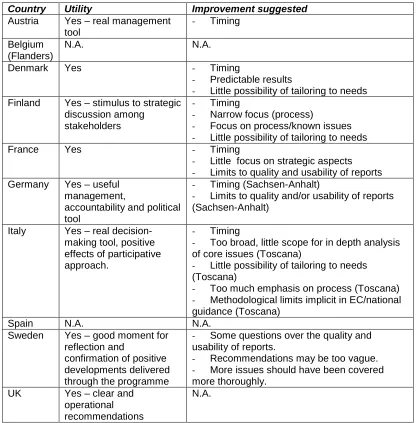
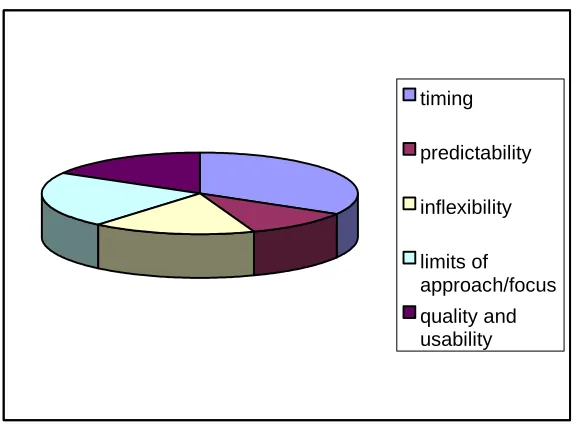
(25) Programmes at the turning point: September 2003 - March 2004. Table 3.1: Partners’ overall assessment of the mid-term evaluations Country Austria Belgium (Flanders) Denmark. Utility Yes – real management tool N.A.. Improvement suggested - Timing. Yes. - Timing - Predictable results - Little possibility of tailoring to needs - Timing - Narrow focus (process) - Focus on process/known issues - Little possibility of tailoring to needs - Timing - Little focus on strategic aspects - Limits to quality and usability of reports - Timing (Sachsen-Anhalt) - Limits to quality and/or usability of reports (Sachsen-Anhalt). Finland. Yes – stimulus to strategic discussion among stakeholders. France. Yes. Germany. Yes – useful management, accountability and political tool Yes – real decisionmaking tool, positive effects of participative approach.. Italy. Spain Sweden. UK. N.A. Yes – good moment for reflection and confirmation of positive developments delivered through the programme Yes – clear and operational recommendations. N.A.. - Timing - Too broad, little scope for in depth analysis of core issues (Toscana) - Little possibility of tailoring to needs (Toscana) - Too much emphasis on process (Toscana) - Methodological limits implicit in EC/national guidance (Toscana) N.A. - Some questions over the quality and usability of reports. - Recommendations may be too vague. - More issues should have been covered more thoroughly. N.A.. However, a number of comments have been raised on aspects which de facto have hindered the overall usefulness of the MTEs. These can be categorised as follows (see Figure 3.1 below): o. An issue frequently raised is the timing of the exercise, which in many cases was deemed inappropriate due to the delayed start of the programmes;. o. Second, IQ-Net partners often emphasised the limits in the approach and focus of the MTEs, as defined in Commission and national guidance documents. The evaluations are sometimes seen to be too focussed on processes, with too little emphasis on strategic aspects and impacts;. o. Third, some partners noted the lack of scope for tailoring the evaluation to programme-specific needs and questioned the usability and, at times quality, of the evaluation reports delivered (often too long, sometimes with vague and non-operational recommendations); and,. o. Finally, some partners underlined that evaluations delivered ‘alreadyknown’ messages and therefore provided little added value.. IQ-Net Thematic Paper 14(1). 19. European Policies Research Centre.
(26) Programmes at the turning point: September 2003 - March 2004. Figure 3.1: Partners’ assessment of the main limitations of the MTEs. timing predictability inflexibility limits of approach/focus quality and usability. Looking in more detail at the comments of each partner region, both Austrian programmes stressed the usefulness of the MTEs. Most actors involved in the management and implementation of programmes perceive the mid term evaluation as useful, although some still view them as a burden imposed by EU rules. One key reason for the generally positive views of the MTE is that the Austrian authorities have made considerable efforts to ensure that the MTEs do not simply lead to the production of documents to be delivered to the Commission, but that they feed directly into the programming process and are useful to programme managers. As reported in previous up-date papers, a coordination group (KAP-EVA) was set up at national level, with representatives of the managing authorities, evaluation teams and other key actors. Moreover, the call for tender was agreed for all programmes, and each team of evaluators was provided with the same monitoring data (at project level) and other information. This led to considerable transparency and comparability between the work of the evaluation teams, as well as the different approaches and different results across Länder. However, each Land was responsible for its own evaluation and set up its own steering group to coordinate the work and to provide direct feedback to the evaluators. This contributed to the emphasis on ensuring that the mid term evaluations would generate recommendations which were meaningful and practical, and could realistically be implemented by the policy-makers. The evaluators were asked not to revise the strategy, but to consider whether there were ways of making the strategy more effective and efficient i.e. how its goals could better be achieved. Finally, most Länder decided to undertake an ongoing evaluation: the evaluators will continue to provide analysis and advice to the programme managers and steering groups during 2004-2005. This aspect is seen as vital to the capacity of the evaluators to have a direct input into improving the programmes and potentially as more useful than the reports produced at the end of 2003. In a similar vein, KAP-EVA will continue its work, with further meetings scheduled until 2005. In Denmark, the mid-term evaluation is seen as useful by programme managers and to have made a valuable contribution to the programming process, especially with regard to development strategies and organisation, although its main results were not totally unexpected. Unlike the mid-term evaluations in the previous programming period, this has clearly been more. IQ-Net Thematic Paper 14(1). 20. European Policies Research Centre.
(27) Programmes at the turning point: September 2003 - March 2004. than just ‘going through the motions’ driven by Commission regulations. Although improvements in strategies and administration might have been made without the MTE, the institution of a formalised process appears to have created a public platform within the programme where criticism could be voiced and constructive action taken. However, due to timing and resources, the Danish mid-term evaluation has been able to shed less light on the factors influencing the success or otherwise of individual projects, and it is therefore to be hoped that additional thematic evaluations will be undertaken before preparations for a (possible) new programming period begin, in order for results to be able to feed into the planning of future activities. Moreover, given the early stage at which evaluation is required according to EU regulation and the relatively small size of the programme, the main focus has been minor adjustment of the strategic focus and fine-tuning of the administrative set-up, and this was also reflected in the evaluation’s methodological approach. Initially, hopes were not high in Western Finland (and nationally) that the midterm evaluation would generate any radically new results. It was felt to focus too much on process issues and not enough on added value and regional competitiveness. For this reason, a specific focus on regional competitiveness was inserted into all the Finnish evaluations, even though there was relatively little room for it amongst the Commission’s questions. In the event, the evaluation has been very positively evaluated both at the national level and in the region. In part, this is because it is perceived to be a good professional evaluation. However, even more important, it proved to be extremely useful at stimulating debate and discussion within the programme area. In particular, it has stimulated a process where regional actors are actively considering what could and should be done in future. The focus has been raised above technical administrative issues to consider what should be done – and why – at the programme level. Given the nature of the Finnish system, the evaluation was never likely to result in dramatic change; the fact that it has stimulated strategic discussion about the programme is viewed very positively. In France, a reading committee was set up to comment on the MTEs, which highlighted a number of weaknesses. A first issue noted was the lack of indepth analysis and recommendations in some reports, which was seen to be due in part to a failure on the part of the evaluators to adopt an analytical approach, but also due to weaknesses in the terms of reference drawn up by some managing authorities. Second, the presentation and clarity of the reports varied. Third, the evaluations did not always provide an adequate critical assessment of the initial objectives that were quantified ex ante, and the proposals for improving the monitoring indicators were not always useful. Fourth, few reports provided a long-term view based on financial data, or linked this with a qualitative assessment of the difficulties faced by the programmes. Finally, the evaluations rarely included a qualitative analysis which would have compensated for the lack of quantitative data available. It was argued that the methodologies adopted by evaluators should be strengthened for future evaluations. Overall, it was felt that the MTEs could have been more critical, and could have gone further in recommending modifications to the programmes’ strategies. This may in part be because the mid-term evaluation occurred too early in the programme cycle, and that the evaluators did not take a sufficiently questioning approach. In Germany, the evaluations have been considered to be a useful tool for management, accountability and political decision-making. In SachsenAnhalt, the MTE is seen to have allowed informed decisions to be taken to direct funds to those interventions which are perceived as most efficient and. IQ-Net Thematic Paper 14(1). 21. European Policies Research Centre.
Figure

+2
Related documents