generalized and modified Maxwell boundary conditions
S. Kokou Dadzie∗ and J. Gilbert M´eolans†
Polytech’Marseille,
D´epartement de M´ecanique Energ´etique - UMR CNRS 6595
5, rue Enrico Fermi 13453 Marseille cedex 13 France
(Dated: 28 October 2004; accepted for publication 03 February 2004)
This paper presents a model of a scattering kernel of boundary conditions for the Boltzmann equation. The proposed scattering kernel is based on an anisotropic ac-commodation argument. Three parameters equal to the momentum acac-commodation coefficients are shown as characterizing the influence of each direction. First the new scattering kernel is derived from a phenomenological criticism of the first form of the scattering kernel proposed by Maxwell; then the same result is established from an analytic approach based on the spectral nature of the linear integral oper-ator associated to the scattering kernel problem. As a result, the model provides a correct form of scattering kernel to handle the influence of each direction in particle collisions with the wall. Finally independent accommodation of each internal mode is added to extend the model to the case of polyatomic gases.
PACS numbers: 47.45.-n,51.10.+y
Keywords: kinetic theory; gas-wall interaction; scattering kernel; accommodation
coeffi-cients; Boltzmann equation
∗Electronic address: [email protected]
†Electronic address: [email protected]; URL: http://www.polytech.univ-mrs.
I. INTRODUCTION
The problem of writing good boundary conditions for the Boltzmann equation in rarefied gas flows, is to find an operator called scattering kernel in kinetic theory. The first known scattering kernel was proposed by Maxwell and is based on phenomenological argument [1]. However, in various situations this kernel fails to reproduce correctly the phenomena occurring at the wall [2, 3]. Indeed the Maxwell boundary condition corresponds to an isotropic conception of the reflection at the wall; so, in this approach, the three velocity components are considered as equivalent in the accommodation process.
Another class of scattering kernel is the CL (Cercignani-Lampis) model byCercignani et al. [3, 4]. The authors extend the research to a more general field of operators and obtain a more flexible model. However as is well-known this class of scattering kernels are not totally efficient to describe physically gas behavior close to the wall [4]. Moreover, some results in particle simulation of rarefied gas flows seem to show that none of the existing models of scattering kernel can reproduce all the features of the real gas dynamics [5].
Generally the existing models of scattering kernel do not describe the interplay between the different degrees of freedom (i.e. the three velocity components of the particle and its internal energy modes) in interaction with the wall [5]. This would explain the partial inefficiency of these models to reproduce the behavior of high speed non-equilibrium flows near the wall. The main purpose of this paper is to propose a new model of scattering kernel by considering more possible reflection types of particles at the wall. In this way we attempt to eliminate any isotropic character of momentum accommodation in the velocity reflection process, and we introduce three coefficients to take into account the influence of the velocity directions.
scattering kernel. In section V the coefficients introduced in the modelling are shown to equal the well known momentum accommodation coefficients. Finally in sectionVIthe new kernel is involved in a more complete model characterizing molecules with internal modes.
II. CONDITIONS REQUIRED FOR THE SCATTERING KERNELS
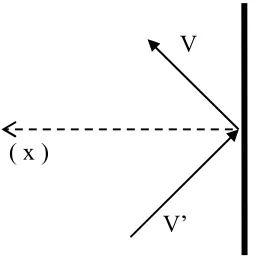
Let us consider a particle hitting the wall, as shown in fig.1. V′ is the velocity of the
impinging gas particle referred to the wall, V′ = (V′
x, Vy′, Vz′)∈ {Ω′ = R−×R×R} and V the velocity of the reflected one referred to the wall, V = (Vx, Vy, Vz)∈ {Ω = R+×R×R}.
These velocities reduce to peculiar velocities when the slip velocity at the wall is neglected. VR is defined as VR = (−Vx, Vy, Vz).
The kernel, B(V′, V), is the density of probability that a molecule impinging the wall at any point X of the wall with velocity V′ is reflected at the same point with velocityV. This kernel, which turns the impinging particles at the wall into reflected ones, must satisfy some basic physical conditions. The least obvious of them is the reciprocity relation. This relation is a necessary condition for a good scattering kernel in the kinetic theory of gases [6, 7].
According to the scattering kernel probability density property, kernel B(V′, V) must satisfy:
B(V′, V)≥0 , (1)
and also the normalization condition Z
Ω
B(V′, V)dV = 1 . (2)
Finally the balance of particles hitting the wall at position X and reflected with velocity V at a given time may be written [8]:
Vxf(V) =
Z
Ω′|
Vx′ |f(V′)B(V′, V)dV′ (3)
In the thermodynamic equilibrium state between the gas and the wall at the same tem-perature, the time reversibility assumption of the thermodynamic equilibrium state may be formulated as follows [3, 7, 9]: the number of gas particles which hit the wall during timet, with velocityV′ and reflect with velocityV at positionXof the wall, is equal to the number of particles with incident velocity−V reflected with velocity−V′ at the same timet, at the same position X of the wall. This may be written:
|Vx′ |f0(V′)B(V′, V) =|Vx |f0(−V)B(−V,−V′) (4)
where f0(V) = (Cwn√π)3e −kVk
2
C2w is the Maxwellian distribution function of the gas in equilib-rium state at the temperature of the wall. Cw2 = 2kTw
m , whereTw is the wall temperature, k
is the Boltzmann constant, m the molecular mass of gaseous particles and n their numeri-cal density. The time reversibility assumption means that all detailed balancing of energy exchange between the gas and the wall in the thermodynamic equilibrium state at any time t is equal to zero. This state of thermodynamic equilibrium between the gas and the wall at the same temperature is a reference state. Owing to this fact, any scattering kernel in kinetic theory must be validated by the property (4), called Reciprocity Relation.
Note that the normalization condition (2) is equivalent to: Z
Ω′
B(−V,−VR′)dV′ = 1 .
From this remark, the reciprocity relation also leads to: Z
Ω′|
Vx′ |f0(V′)B(VR′, V)dV′ = |Vx |f0(−V). (4′)
III. PHENOMENOLOGICAL APPROACH TO SCATTERING KERNELS
A. Maxwell scattering kernel
The first form of scattering kernel proposed by Maxwell is given by:
BM(V′, V) = (1−α)δ(V −VR′) +α
2 C4
wπ
Vxe
−kVk 2
Cw2 . (5)
BM(V′, V) is a linear combination of two elementary kernels: the dirac function for
the specular reflection part and the exponential function for the diffuse reflection part at temperature Tw of the wall; α, called accommodation coefficient, represents the weight of
the diffusion in the gas collision process at the wall.
Before writing this scattering kernel Maxwell made several phenomenological comments on the nature of the surface in contact with the gas, which can be found in the appendix of reference [1]. Firstly he assumed the surface to be a ”perfectly elastic smooth surface”, then each molecule striking the surface had its normal component reversed while the other components were not altered by the impact; the scattering kernel in this case was simply given byδ(V −V′
R). Secondly he assumed the surface to be a perfectly absorbing surface so
that each particle hitting the wall was absorbed before being re-emitted; and the velocity of each re-emitted particle was oriented from the surface towards the gas. But the probability of any particular magnitude and direction of its velocity would be the same as in a gas at rest in the thermal equilibrium state at the temperature of the wall; in this case, this led to the diffusive scattering kernel given by C24
wπVxe −kVk
2 Cw2 .
Finally Maxwell decided to consider the real reflecting surfaces as an intermediate surface between these two extreme perfect surfaces and then proposed the linear combination (5).
isotropic one; but we cannot be sure that a scattering kernel characterizing any real surface is an isotropic one. Moreover, in the kernel (5), the weight of the diffusion in any direction is represented by the same coefficientα: this description cannot be considered as correct, as pointed out by various authors [2, 10].
B. Our scattering kernel proposal
In order to write a general scattering kernel for any kind of real surface, we return to the investigation of various possible types of accommodation which can occur during a particle collision with the wall. Then we have to consider a more general type of accommodation than the isotropic one, in which of course the normal component of the incoming particle velocity must be reversed during the collision. We can thus assume elementary processes where diffusive and specular reflection are mixed: each of the velocity components can be altered or not by the wall independently of others. This argument leads us to consider the eight elementary operators listed below:
B0(V′, V) =δ(Vx+Vx′)δ(Vy −Vy′)δ(Vz−Vz′), (6a)
Byz(V′, V) =
1 πC2
w
δ(Vx+Vx′)e
−V 2 y C2we−
Vz2 Cw2 ,
Bxz(V′, V) =
2 C3
w
√
πVxδ(Vy −V ′
y)e
−V 2 x Cw2 e−
Vz2 C2w ,
Bxy(V′, V) =
2 C3
w
√πVxδ(Vz−Vz′)e
−V 2 x Cw2 e−
Vy2 C2w ,
Bxyz(V′, V) =
2 πC4
w
Vxe
−V 2 x C2we−
Vy2 Cw2 e−
Vz2
Cw2 , (6b)
Bz(V′, V) =
1 Cw√π
δ(Vx+Vx′)δ(Vy −Vy′)e
−V 2 z C2
By(V′, V) =
1 Cw√π
δ(Vx+Vx′)δ(Vz−Vz′)e
−V 2 y C2w ,
Bx(V′, V) =
2 C2
w
Vxδ(Vy−Vy′)δ(Vz−Vz′)e
−V 2 x C2w .
It is easy to show that each of these elementary kernels satisfies positivity and normalization conditions. These kernels also satisfy the reciprocity relation (more details are given in appendix A). The coefficients appearing in front of each operator are normalizing coefficients obtained by calculating R
ΩBκ(V′, V)dV.
Each of these elementary kernels represents a particular possible situation of accommo-dation. Then the complete scattering kernel will be a linear combination of the elementary kernels in which the combination coefficients will represent the weight of each kind of ac-commodation at the wall. This complete scattering kernel may be written:
B(V′, V) = X
κ
µκBκ(V′, V) , (7)
with
X
κ
µκ = 1 . (8)
If we introduce three coefficients, αj (j = 1,2,3) satisfying αj ∈ [0,1], to quantify the
influence of each direction in a particle accommodation process by the wall, and taking into account condition (8), the coefficients µκ may be written:
µxz =αxαz(1−αy) , µxy =αxαy(1−αz), µyz =αyαz(1−αx),
µx =αx(1−αy)(1−αz) , µxyz =αxαyαz , µ0 = (1−αx)(1−αy)(1−αz),
µy =αy(1−αx)(1−αz) , µz =αz(1−αx)(1−αy) .
(9)
It is clear that neglecting the elementary kernels with incomplete diffusion or incomplete specular reflection in the full scattering kernel (7), the result reduces to the sum of the kernels (6a) and (6b) which represents the Maxwell scattering kernel. Moreover, it is easy to show that the Maxwell boundary conditions give satisfactory results for values ofα close to 1: indeed, if the gas is in a state very close to thermodynamic equilibrium at the temperature of the wall, the most important reflection is the reflection with complete accommodation in all directions.
In the following section, an analytical method to build the complete scattering kernel (7) is presented.
IV. ANALYTICAL FORMULATION OF THE NEW SCATTERING KERNEL
Let us consider the problem of finding operator B(V’,V), satisfying the conditions listed in section II, and let us write the transformation
K(V, V′) = [|Vx′ |f0(V′)]
1 2[|V
x |f0(V)]
−1 2 B(V′
R, V) . (10)
Since f0(V) is a known function the problem of finding B(V′, V) is equivalent to finding
K(V, V′). Instead of studying the problem in K(V, V′), we can study the linear integral associated operator A defined by the relation:
A(ψ) = Z
Ω′
K(V, V′)ψ(V′)dV′ . (11)
This integral operator is defined in the Hilbert space of square summable functions of V noted L2(Ω) (i.e. ψ(V)∈L2(Ω)), where the scalar product is defined as follows:
< ψ, ϕ >= Z
Ω
ψ(V)ϕ(V)dV .
Therefore the problem is reduced to an eigenvalue problem, and then to discussing the spectral nature of operator A.
Assuming that the operator Ahas a purely discrete spectrum, its kernel K(V, V′) can be written:
K(V, V′) = ∞ X
n=0
λnψn(V)ψn(V′) , (12) whereψn(V)∈L2(Ω) is an eigenfunction of the operatorA and λ
n its corresponding
eigen-value. According to positivity and normalization conditions required inB(V′, V), the oper-ator A must be non-negative and its eigenvalues satisfy λn
∈[0,1] for any n ∈ N. From now the eigenfunction ψn(V) is assumed to be in the form:
ψr(Vx)ψl(Vy)ψm(Vz) =
3
Y
j=1
ψkj(Vj) .
Since the eigenfunction ψn(V) is a square summable function, we have ψ
kj(Vj) ∈ L
2(Ω
j),
where Ωj denotes the scalar space associated to Vj. Moreover, the family of the function
set ψkj(Vj), kj ∈ N must be a function basis of the Hilbert space L
2(Ω
j) (note that this
assumption will lead immediately to the coming property (16)). The eigenvalues of operator A become λrlm, and we can assume λrlm = λrλlλm, in respect to the respective scalar
products in the different Hilbert spaces L2(Ω
j) and L2(Ω). Finally the expression (12) can
be replaced by:
K(V, V′) = X
r,l,m
λrλlλmψr(Vx)ψl(Vy)ψm(Vz)ψr(Vx′)ψl(Vy′)ψm(Vz′) . (13)
The sum in the right member of (13) can be written as the product of three infinite sums:
K(V, V′) =
3 Y j=1 ∞ X k=0
λkjψkj(Vj)ψkj(V ′
j) . (14)
Let us put
ψ0x(Vx) = √
2 Cw |
Vx|
1 2 e
−Vx2 2Cw2 ,
ψ0y(Vy) = (Cw √
π)−21e −Vy2 2C2w ,
ψ0z(Vz) = (Cw √
π)−21e −Vz2 2Cw2 .
Each of ψ0j(Vj) functions satisfies:
kψ0j(Vj)k
2
j =
Z
Ωj
[ψ0j(Vj)]
2d
From the relation (4′), it may be deduced that the functionψ0(V) = ψ
0x(Vx)ψ0y(Vy)ψ0z(Vz) is an eigenfunction of operatorA, associated to eigenvalueλ0xλ0yλ0z = 1(see demonstration in appendix B). This first eigenfunction takes an important part in the solution of the problem because it corresponds to the maximal eigenvalue ofA, and so leads to an equilibrium state. Indeed, in the equilibrium state between the gas and the wall, the most physically convenient scattering kernel is the complete accommodation kernel, which is assigned here to ψ0(V).
Therefore any good model of a scattering kernel must converge to this equilibrium scattering kernel. This point matches the basic assumption founding the reciprocity relation which is that any scattering kernel must be valid when a thermodynamic equilibrium exists between the gas and the wall.
In agreement with the concept of three distinguishable degrees of freedom in the reflection process, we introduce three coefficientsαj, related to the set of eigenvalues by: λ0j = 1, and λkj = (1−αj) for k 6= 0 with αj ∈[0,1]; relation (14) becomes
K(V, V′) =
3
Y
j=1
³³³
ψ0j(Vj)ψ0j(V ′
j) + (1−αj)
∞ X
k=1
ψkj(Vj)ψkj(V ′ j) ´ ´ ´ (15)
which may be rewritten,
K(V, V′) =
3
Y
j=1
³³ ³
αjψ0j(Vj)ψ0j(V ′
j) + (1−αj)
∞ X
k=0
ψkj(Vj)ψkj(V ′
j)
´´ ´ .
Finally, by using the following property: ∞
X
k=0
ψkj(Vj)ψkj(V ′
j) = δ(Vj −Vj′) , (16)
we obtain the result:
K(V, V′) =
3
Y
j=1
³³³
αjψ0j(Vj)ψ0j(V ′
j) + (1−αj)δ(Vj−Vj′)
´´ ´
. (17)
By developing the product (17) we obtain K(V, V′) as a sum of elementary operators as follows:
K(V, V′) =X
κ
whereµκis given again by the relations (9) of sectionIII, and where the elementary operators
Kκ(V, V′) are written below:
K0(V, V′) = δ(Vx−Vx′)δ(Vy−Vy′)δ(Vz−Vz′) ,
Kyz(V, V′) =
1 πC2
w
δ(Vx−Vx′)e
− V 2 y 2C2we−
Vz2 2Cw2 e−
Vy′2 2Cw2 e−
Vz′2 2C2w ,
Kxz(V, V′) =
2 C3
w
√π|VxVx′ |
1 2δ(V
y −Vy′)e
−V 2 x 2Cw2 e−
Vz2 2C2we−
Vx′2 2C2we−
Vz′2 2Cw2 ,
Kxy(V, V′) =
2 C3
w
√ π|VxV
′
x |
1 2δ(V
z−Vz′)e
−V 2 x 2Cw2 e−
Vy2 2C2we−
Vx′2 2C2we−
Vy′2 2Cw2 ,
Kxyz(V, V′) =
2 πC4
w|
VxVx′ |
1 2e−
Vx2 2Cw2 e−
Vy2 2Cw2e−
Vz2 2C2we−
Vx′2 2Cw2 e−
Vy′2 2Cw2 e−
Vz′2 2Cw2 ,
Kz(V, V′) =
1 Cw√π
δ(Vx−Vx′)δ(Vy−Vy′)e
−V 2 z Cw2 e−
Vz′2 C2w ,
Ky(V, V′) =
1 Cw√π
δ(Vx−Vx′)δ(Vz−Vz′)e
− V 2 y 2Cw2 e−
Vy′2 2Cw2 ,
Kx(V, V′) =
2 C2
w|
VxVx′ |
1 2δ
(Vy −Vy′)δ(Vz−Vz′)e
−V 2 x 2C2
we− Vx′2 2C2
w .
It is easy to verify that the elementary operators Kκ(V, V′) given above correspond to
the elementary kernels Bκ(V′, V) given in section III, through transformation (10); so the
complete operatorK(V, V′) obtained from relation (18) corresponds exactly to the scattering kernel given by relation (7).
Referring now directly to equations (15) and (13), it is clear that our choice corresponds to a spectral expansion of K(V, V′) involving eight different eigenvalues, namely: 1, (1− αx), (1−αy), (1−αz), (1−αx)(1−αy), (1−αx)(1−αz), (1−αy)(1−αz), (1−αx)(1−
space associated to each eigenvalue, except for the maximum eigenvalue; therefore, as shown above, it is not necessary to specify the eigenfunctions.
As is well known, the classical CL model and its extensions by Lord [13, 14] to polyatomic molecules are derived from another procedure based on a more general relation [12]:
K(V, V′) = ∞ X
n,m=0
λnmϕn(V)ϕm(V′) , (20)
where the ϕk function is specified. As it can be seen, kernels built on this general form
could not automatically insure the properties listed above for good scattering kernels (i.e positivity, normalization, and reciprocity properties)[12]. Moreover, in these CL scattering kernel models the normal and the tangential components of the velocity of the molecule colliding with the wall are considered as independent, and then the scattering kernel is written separately in normal and tangential parts. This aspect of the CL models was recently criticized as not allowing interplay between the various components of the impinging particle velocity [5].
V. RELATIONS WITH ACCOMMODATION COEFFICIENTS
In this section the physical meaning of the parameters involved in the kernel is clarified. So doing, we prove that theαj coefficients respectively equal the accommodation coefficients
βj of the momentum components.
Firstµκ may be easily shown to represent the weight of particles reflected according to the
process κ in the flux of reflected particles. This property appears obvious when integrating the two members of equation (3) over the reflected velocity range, usingB(V′, V) expressions given in relations (7) and (9). Moreover the scattering is built using three independent coefficientsαj: then it can be seen that taking into account condition (8), theµκ coefficients
are necessarily given by relations (9).
On the other hand, the momentum accommodation coefficients βj are defined as [9]:
βj =
Φ−j −Φ+j
Φ−
j −Φej
where Φ−j is the incoming flux at the wall of the momentum j component, Φ+j is the the
corresponding reflected flux, and Φe
j is the reflected flux in the hypothetical situation of
perfect accommodation to the wall. These various momentum fluxes may be written for each component:
Φ−j = Z
Ω′
m|Vx′|Vj′f−(V′)dV′ (22)
Φ+j = Z
Ω
m|Vx|Vjf+(V)dV
wheref−(V) andf+(V) are respectively the incident and the reflected distribution function.
Remembering thatf+(V) is given by (3) and using expression (7) ofB(V′, V), Φ+j is written:
Φ+
j =
Z
Ω′
m|Vx′|f−(V′)X
κ
µκ
µZ
Ω
VjBκ(V′, V)dV
¶
dV′ . (23)
And Φe
j for total perfect accommodation (i.e. αx=αx =αx = 1) is written:
Φe
j =
Z
Ω′
m|Vx′|f−(V′) µZ
Ω
VjBxyz(V′, V)dV
¶
dV′ (24)
A. calculation of βy and βz
First the case Vj =Vy is dealt with.
According to the expression of Bxyz(V′, V), VyBxyz(V′, V) is an odd function of the Vy
component, therefore,
Z
Ω
VyBxyz(V′, V)dV = 0
and then Φe= 0, so we can write
βy = 1−
Φ+
y
Φ−
y
,
On the other hand looking at relation (23), the contribution of each partial kernelBκ(V′, V)
in Φ+y expression can be estimated separately by:
Z
Ω
Each of these partial integrals can be calculated easily and give for anyκ either 0 orV′
y. As
result we obtain
X
κ
µκ
Z
Ω
VyBκ(V′, V)dV =Vy′(µ0+µx+µz+µxz) ,
and
Φ+j = (µ0+µx+µz+µxz)Φ−j
It results directly that
βy = 1−(µ0+µx+µz+µxz)
which, according to the normalization condition (8), is also equal to
βy =µy+µxy +µyz+µxyz (25)
Similarly we obtain for βz
βz =µz+µxz+µyz+µxyz (26)
By using the µκ expressions given by relations (9), equations (25) and (26) lead to:
βy =αy (27)
and
βz =αz (28)
B. calculation of βx
Now Vj =Vx is considered.
Using the same definition of the various fluxes with respect to the sign of the incident flux, we can write:
Φ−x =
Z
Ω′
mVx′2f−(V′)dV′ (29) The calculation of the partial integrals involved in relation (23)
Z
Ω
gives in this case, either −Vx′ or Cw√π
2 for any κ. As a result we obtain:
X
κ
µκ
Z
Ω
VxBκ(V′, V)dV =−Vx′(µ0+µy+µz+µyz)
+Cw √
π
2 (µx+µxy +µxz +µxyz). Using the flux expressions (29) and (23), this result leads to:
Φ−
x −Φ
+
x =
¡¡ ¡
1−(µ0+µy+µz+µyz)
¢¢¢ Φ−
x −
Cw√π
2 ¡¡ ¡
µx+µxy +µxz+µxyz
¢¢ ¢
Z
Ω′
m|Vx′|f−(V′)dV′ .
We also have:
Z
Ω
VxBxyz(V′, V)dV =
Cw√π
2 and so:
Φ−
x −Φ
e
x= Φ−x −
Cw√π
2 Z
Ω′
m|Vx′|f−(V′)d′V .
Consequently, remembering condition (8), it results
βx =µx+µxy +µxz+µxyz. (30)
Replacing µκ by relations (9) once more, the result shows:
βx =αx
VI. EXTENSION OF THE NEW MODEL TO POLYATOMIC GASES
In polyatomic gases the internal state of a molecule is characterized by the rotational and vibrational energies, Eir andEiv, and depends on quantum numbersir and iv. In addition,
because of the degeneracy of rotational levels, a weight factor (gir = 2ir+ 1) is involved in
the distribution function expression. The distribution functions of impinging and emerging particles are linked by the following relation (generalizing relation (3)) [9, 19]:
Vxfi+(V, Eir, gir, Eiv) =
X
ir′,iv′ Z
Ω′|
Vx′|f−(V′, Eir′, gir′, Eiv′)PG(V′, Eir′, gir′, Eiv′, V, Eir, gir, Eiv)dV′ , (31)
where PG(V′, Eir′, gir′, Eiv′, V, Eir, gir, Eiv) is the generalized scattering kernel for molecules considered with internal modes. Of course normalization and non-negative conditions are easily generalized to:
X
ir,iv
Z
Ω
PG(V′, Eir′, gir′, Eiv′, V, Eir, gir, Eiv)dV = 1 (32)
and
PG(V′, Eir′, gir′, Eiv′, V, Eir, gir, Eiv)≥0 . (33)
Furthermore, for the reciprocity condition, we admit the form given by Kuscer [9] which, excluding external magnetic fields, assumes the form:
|Vx′|e− kV′k2
Cw2 e−εir′e−εiv′(2ir′+ 1)P
G(V′, Eir′, Eiv′, V, Eir, Eiv) = Vxe
−kVk 2
Cw2 e−εire−εiv(2ir+ 1)PG(−V, Eir, Eiv,−V′, Eir′, Eiv′) ; (34)
with
εir =
Eir
kTw
, εiv=
Eiv
kTw
. (35)
the appendix C). In kernel P the translation mode was taken as a whole (without inter-play between the three translational degrees of freedom); so, when applied to unstructured molecules, P reduced to a classical Maxwell kernel. Nevertheless, a partial accommodation concept was employed in theP derivation allowing different accommodations of the various modes (translation, rotation, vibration). In fact this concept was analogous to those used in the new model to disconnect the three translation degrees in the accommodation process. From reference [19], P may be immediately rewritten:
P = µ
(1−αθ)δ(V −VR′) +αθ
2 C4
wπ
Vxe
−V2 Cw2
¶
³³³
(1−αr)(1−αv) ˜P0+αv(1−αr) ˜Pv+αr(1−αv) ˜Pr+αvαrP˜rv
´ ´ ´
(36)
whereαθ,αv andαrare real parameters independent of the microscopic state of the molecules
and are considered in [0,1], and : ˜
P0 =δ(Eir′ −Eir)δ(Eiv′ −Eiv), P˜rv = e−εir
Qr
(2ir+ 1)
e−εiv Qv
,
˜
Pv =δ(Eir′−Eir) e −εiv Qv
, P˜r =
e−εir Qr
(2ir+ 1)δ(Eiv′ −Eiv) .
The quantities Qv and Qr involved in ˜Pχ (χ = v, r, rv) are the partition functions defined
at the wall temperature:
Qr=
X
iv
(2ir+ 1)e−εir , Q
v =
X
iv
e−εiv
Now, in operatorP (36), let us replace the first parenthesis corresponding to the classical Maxwell scattering kernel by the new kernel proposed in relation (7) and (9). So a general scattering kernel is obtain in the form:
PG =
³³ ³X
κ
µ∗κBκ(V′, V)
´ ´ ´³³³
(1−αr)(1−αv) ˜P0+
αv(1−αr) ˜Pv+αr(1−αv) ˜Pr+αvαrP˜rv
´ ´ ´
(37)
where theµ∗
κ are expressed by relations (9) using the directional parametersα∗x, α∗y, andα∗z.
Considering the properties of its parts, PG visibly satisfies the normalization and
non-negativity conditions. FurthermorePGis a sum of partial operators assuming the factorized
form ˜PχBκ (where χ refers to the internal accommodation process). It is clear that the
Bκ satisfying condition (4) implies that ˜PχBκ satisfies the generalized reciprocity condition
(34). Consequently PG also satisfies (34) as a linear combination of ˜PjBκ terms. So a good
anisotropic scattering kernel PG has been obtained phenomenologically.
Furthermore in relation (37) the part in the first parenthesis of the second member con-cerns the translation mode. Introducing into it αθ defined as αθ = 1−µ0∗ =Pκ6=0µ∗κ, this
part assumes the form:
PG= (1−αθ)δ(V −VR′) +αθ
X
κ6=0
λ∗κBκ(V′, V) (38)
where
λ∗κ = µ∗κ
αθ
, X
κ6=0
λ∗κ = 1 . (39)
In this last form the complete specular reflection appears separately from all the processes in which partial or complete accommodation occurs.
Integrating on velocity and summing over quantum numbers the left and right sides of equation (31), it is easily shown that µ∗
κ represents (as µκ for the unstructured molecules)
the part of the particle flux reflected according to the directional process κ. The analytical systematic derivation ofPGand further physical interpretation of α∗x,α∗y,α∗z, αv,αr, andαθ
will be presented in a subsequent study.
accommodated in the same way according to the normal and tangential directions: and on the microscopic level this means that the kinetic energy transfers of an impinging molecule change according to its velocity direction with respect to the wall.
In the same manner the three energy modes may interplay when exchanging energy at the wall; and so in operators ˜P0, ˜Pr, ˜Pv, and ˜Prv the effects of elastic or inelastic collisions
for each internal mode appear independently.
VII. DISCUSSION
first criticism formulated byCercignani [3] concerns the Maxwellian-type kernel: for a given monochromatic beam this model predicts a sharp maximum in the number of molecules at the angle corresponding to specular reflection, which is contradicted by experiments [25]; it is clear that this maximum is smoothed in the new model (see relation (38)). The second criticism recently formulated by D. Bruno et al [5], is not completely justified because it is based, for a part, on studies of reactive or dissociated flows; and as is well-known, the scattering kernel modelling cannot give correct results in such a case because of the assumption of the wall impermeability involved in it. But on the other hand, the comments of the authors requiring the introduction of interplay between the velocity directions and the various energy modes is, in our opinion, completely justified. In the present model, precisely such an interplay is present, and the separating procedure of velocity components, which appears in the CL models [3](also when extended to internal modes [13, 14, 26]) is not employed here.
A final argument in defence of the new model is its simplicity: as seen above the physical interpretation of the various parts of the kernel is straightforward. Moreover the model is easy-to-use: first the calculations are simplified because the kernel only depends on the reflected microscopic parameters space; then, from the account of different kinds of accom-modation of the moment components a preponderant weight can be given to the particular accommodation process; so the model may be easily simplified according to the geometrical symmetry or the physical conditions of the problem.
VIII. CONCLUDING REMARKS
We have derived an anisotropic model of a scattering kernel. For the unstructured molecules, three directional parameters involved in the model have been shown to be equal to the accommodation coefficients of the fluxes of the momentum components at the wall.
method and further calculations to relate parametersα∗
x,α∗y,α∗z,αv,αr,αθ to the
accommo-dation coefficients βj of momentum fluxes and to accommodation coefficients of the energy
fluxes will be presented in a subsequent study. These relationships are not expected to be very simple, especially because the constant parameters introduced in the model refer to direct exchanges between each molecular mode and the wall, while the energy accommoda-tion coefficients involve direct exchange with the wall for each mode and also inter-mode exchanges. Finally, even if not yet confirmed in applications, many arguments have been developed, showing the consistency, physical pertinence and usefulness of the new scattering kernel.
APPENDIX A:
Bκ(V′, V) satisfies the reciprocity relation:
The property for operator Bzy is demonstrated. For the rest of the operators the
demon-strations are similar.
|Vx′ |f0(V′)Bzy(V′, V) =|Vx′ |
n (Cw√π)3
e− kV′k2
Cw2 1 πC2
w
δ(Vx+Vx′)e
−V 2 y Cw2 e−
Vz2 Cw2 ,
and
|Vx |f0(−V)Bzy(−V,−V′) =|Vx |
n (Cw√π)3
e− kVk2
C2w 1 πC2
w
δ(Vx+Vx′)e
−V ′ y 2 Cw2 e−
Vz′2 Cw2 .
In these two expressions, there appear the same terms in y and z; the full equality of both the expressions comes from the property of the dirac function.
APPENDIX B:
ψ0 as an eigenfunction of operator A:
A(ψ0) = Z
Ω′
[|Vx′ |f0(V′)]
1 2[|V
x |f0(V)]
−1 2 B(V′
R, V)ψ
0(V′)d
Replacing ψ0 and f0(V) by their expression in this integral: ψ0 = √ 2 C2 w √
π | Vx |
1 2 e−
kVk2 2Cw2 and f0(V) = (Cwn√π)3e
−kVk 2
C2w , it is found
A(ψ0) = √ 2 C2 w √ π Z
Ω′ | Vx |
−1 2 |V′
x |e
kVk2 2C2
w e− kV′k2
C2
w B(V′
R, V)dV′ . The reciprocity relation (4′) leads to:
Z
Ω′ | Vx′ |e
−kV′k 2 Cw2 B(V′
R, V)dV′ =|Vx |e− kVk2
Cw2 .
And consequently
A(ψ0) = √
2 C2
w
√π |Vx|
1 2 e−
kVk2
2Cw2 =ψ0.
APPENDIX C:
Kernel Operator of reference [19]
The full scattering kernel of reference [19] is given by:
P = (1−αθ)(1−αr)(1−αv)P1+ (1−αθ)(1−αr)αvP2+ (1−αθ)αr(1−αv)P3
+(1−αθ)αrαvP4+αθ(1−αr)(1−αv)P5+αθαr(1−αv)P6+αθ(1−αr)αvP7+αθαrαvP8
where αθ, αr, αv are real parameters independent of the microscopic state of the molecules.
The specular operator with elastic and inelastic parts for each internal mode are given by:
P1 =δ(V′−VR)δ(E
′
ir−Er)δ(E
′
iv−Ev) ,
P2 =δ(V′−VR) δ(E
′
ir−Er)
e−εiv,w Qv,w
,
P3 =δ(V′ −VR)
e−εir,w Qr,w
(2ir+ 1)δ(Eiv′ −Ev) ,
P4 =δ(V′−VR)
e−εir,w Qr,w
(2ir+ 1)e −εiv,w Qv,w
The diffusive operators with elastic and inelastic parts, for each internal mode, are given by:
P5 =
2 πC4
w
Vxe−v
2 wδ(E
ir−E
′
ir)δ(Eiv−E
′
iv) ,
P6 =
2 πC4
w
Vxe−v
2 we
−εir,w Qr,w
(2ir+ 1)δ(Eiv−E
′
iv) ,
P7 =
2 πC4
w
Vxe−v
2 wδ(E
ir−E
′
ir)
e−εiv,w Qv,w
,
P8 =
2 πC4
w
Vxe−v
2 we
−εir,w Qr,w
(2ir+ 1)e−
εiv,w
Qv,w
;
with
1 C4
w
= µ
m 2kTw
¶2 .
In reference [19], Er and Ev defined as mean energy per molecule have been used by error.
[1] J. C. Maxwell, Philosophical Transactions of the royal society of London170, 231 (1878). [2] S. F. Shen, Entropie 18, 138 (1967).
[3] C. Cercignani and M. Lampis, transport theory and statistical physics1, 101 (1971). [4] C. Cercignani and M. Lampis, AIAA journal35(1997).
[5] D.Bruno, M. Cacciatore, S. Longo, and M. Rutigliano, chemical physics letters 320, 245 (2000).
[6] R. Monaco, Introduction `a la th´eorie et aux applications de l’interaction gaz-paroi en th´eorie
cin´etique des gaz, Dipartimento di Matematica Politecnico Torino, Torino-Corso, libreria ed-itrice universitaria levrotto & bella ed. (1986).
[7] C. Cercignani,Theory and Application of the Boltzmann Equation (Scottish Academic Press, Edinburgh, 1975).
[8] S. Chapman and T. Cowling, The Mathematical Theory of Non-Uniform Gases (Cambridge Mathematical Library, 1970), third edition ed.
[9] I. Kuscer, in International Symposium on Rarefied Gas Dynamics, Gottingen (1974), vol. E1, pp. 1–21.
[10] F. Sharipov, European Journal of Mechanics, B/Fliuds21(2001). [11] C. Cercignani, Journal of Statistical Physics 1, 297 (1969).
[12] C. Cercignani, Mathematical Methods in Kinetic Theory (plenum press new york, 1990), chap. 4, p. 98, 2nd ed.
[13] R. G. Lord, Physic of FluidsA3, 706 (1991). [14] R. G. Lord, Physic of Fluids7, 1159 (1995). [15] R. K. Hason, Physics of Fluids16 (1973).
[16] I. Larina and V. Rykov, in 15th Rarefied Gas Dynamics International Symposium, Teubner
(1986), p. 635.
[18] F. Goodman, Physical Review A68(2003).
[19] J. G. M´eolans and L. Aufr`ere, C. R. Acad. Sci. Paris, M´ecanique des fluides/fluids mechanics t.329 (2001).
[20] C. Cercignani and M. Lampis, Mechanics Research Communication26, 451 (1999).
[21] S. Nocilla, in 3thRarefied Gas Dynamics International Symposium, Aachen, edited by J.
Lau-rman (1963).
[22] E. B. Arkilic, K. S.Breuer, and M. A. Schmidt, Journal of Fluids Mechanics 437, 29 (2001). [23] J. G. M´eolans and I. A. Graur, in 23rd International Symposium on Rarefied Gas Dynamics,
Whistler, British Columbia, Canada (2002).
[24] J. G. M´eolans, accepted in press, Mechanics Research Communications, Elsevier MRC 813, editorial reference: 02-40 (2003).
[25] J. J. Hinchen and W. M. Foley, in Proceding Rarefied Gas Dynamics, edited by J. H.Leauw (Press Inc. new york, 1966).
[26] R. G. Lord, in 17th Rarefied Gas Dynamics International Symposium, Aachen, edited by
( x )
V
[image:27.595.243.372.72.200.2]V’