PUBLICATION OF THE HEALTH AND CONSUMER PROTECTION DG
PUBLICATION DE LA DG SANTÉ ET PROTECTION DES CONSOMMATEURS VERÖFFENTLICHUNG DER GD “ GESUNDHEIT UND VERBRAUCHERSCHUTZ”
N0 3 - 2000
Préface du Directeur-Général Robert John Coleman Foreword by Director-General Robert John Coleman Vorwort von Generaldirektor Robert John Coleman EU-Presidency
Présidence de l’UE EU-Präsidentschaft
Sweden’s priorities - consumers making safe use of the internal market
In the Spotlight Sur la sellette Nachgefragt
BSE between facts and fears - full control will take time BSE new geographical risk assessement - first results Tobacco advertising - what’s behind it
Rauchen ist nicht “cool” - Rauchen Tötet - EU-Informationskampagne für junge Menschen 15/03/2001 - Journée européenne du consommateur
News and developments Du nouveau
Wissenswertes
Meeting future neighbours - EU-Commissioner D. Byrne visits accession countries
Joining the club - accession countries talk business
Social justice and world market - global consumer concerns discussed in Durban
Series Série Serie
Consumers in Latvia - confidently looking ahead
Sécurité alimentaire, paiements électroniques, produits et services - les Français sur le qui-vive
Euroguichet Lille - mettre l’Europe à la portée des consommateurs
EURO
2002 - l’euro dans mes poches. Que dois-je faire ?
Points of view Opinions Meinungen
Is the EU good for your health? - different responses to different risks
Access to health - a fundamental right all over the world? Tester des produits - plus que de simples statistiques ! Consommer à bon prix - pour qui la facture ?
Surfing safely - EU/US precautions to protect consumers
The EU institutions at work
Les institutions européennes au travail Neues von den EU-Organen
Blood - EU-Commission pushes for new common standards Marketing - Praktiken - engere Zusammenarbeit zwischen EU und USA EU-Scientific committees completed - continued excellence with new committee chairs
Comité scientifique directeur - cap sur de nouvelles tâches Grange, Co.Meath (Ireland) - future home of the EU’s Food and Veterinary Office
Zoonoses - protecting humans from animal diseases Organisation Chart “Health and Consumer Protection” DG
Calendar of events Agenda
Veranstaltungskalender
PUBLICATION OF THE HEALTH AND CONSUMER PROTECTION DG PUBLICATION DE LA DG SANTÉ ET PROTECTION DES CONSOMMATEURS VERÖFFENTLICHUNG DER GD “ GESUNDHEIT UND VERBRAUCHERSCHUTZ” N0 3 - 2000
ISSN N0 1560-263X
PUBLICATION OF ARTICLES ON THE INTERNET In view of further improving transparency and the potential of information for an even wider public, the main articles will be available in English, French, German, Spanish and Italian on the Internet site of DG ‘Health and Consumer Protection’. Reproduction
of articles is authorised, except for commercial purposes, provided that the source is mentioned.
*
PUBLICATION DES ARTICLES SUR L’INTERNET Pour une plus grande transparence et pour qu’un public plus large
encore ait accès à nos informations, les principaux articles seront disponibles en allemand, anglais, espagnol, français et italien sur le
site Internet de la DG Santé et Protection des Consommateurs. Reproduction autorisée, sauf à des fins commerciales, moyennant
mention de la source.
*
VERÒFFENTLICHUNG VON ARTIKELN IM INTERNET Im Hinblick auf ein verstärkte Transparenz und breitere Information
für noch zahlreichere Leser werden die wichtigsten Artikel in Englisch, Französisch, Deutsch, Spanisch und Italienisch auch auf
der Internet-Site der Generaldirektion ‘Gesundheit und Verbraucherschutz’ veröffentlicht. Die Wiedergabe von Artikeln ist -außer zu gewerblichen Zwecken - unter Angabe der Quelle gestattet.
The views expressed in ‘Consumer Voice’do not necessarily reflect the opinions of the European Commission.
*
Les points de vue exprimés dans ‘Consumer Voice’ne sont pas nécessairement ceux de la Commission Européenne.
*
Die in„Consumer Voice“geäußerten Ansichten geben nicht notwendigerweise die Meinung der Europäischen Kommission wieder.
Editor-in-chief – Rédactrice responsable – Verantwortliche Redakteurin
Brigitte Reichle
Editorial board – Comité éditorial – Die Redaktion
Soeren Abildgaard, Howard Batho, Brona Carton, Anita Fokkema, Jacques Gennatas, Cathal O’Conaill, Jorge Savio, Hilde Van Loon
Secretariat – Secrétariat – Sekretariat
P R É F A C E
La Commission européenne a établi en 2000 un nouveau programme de santé publique, et le Conseil
ainsi que le Parlement européen adopteront leurs positions ces prochains mois. Il est donc temps de
nous interroger sur la pertinence et l’importance de ce programme de santé publique pour les
consommateurs.
Un trait essentiel de cette nouvelle stratégie est le droit des citoyens de l’Union européenne à
l’information en matière de santé et de soins de santé. On observe dans la société une évolution, qui
se reflète dans le nouveau programme de santé publique, vers une plus grande assurance des citoyens
concernant les soins de santé. Ce que dit le médecin n’est plus parole d’évangile: les gens sont devenus
plus critiques vis-à-vis des prestations de santé. Une importance croissante est accordée au choix entre
un médecin ou un autre, un hôpital public ou privé, ou encore tel ou tel type de médicament. La
Cour de justice des Communautés européennes a déclaré que les patients peuvent se rendre dans
d’autres pays de l’Union européenne pour bénéficier de prestations médicales et en obtenir le
remboursement conformément aux dispositions de leurs systèmes de sécurité sociale nationaux.
Les patients essaient également d’opérer des choix mieux éclairés. Rien que l’abondance
d’informations en matière de santé sur Internet témoigne déjà de ces efforts pour s’informer et
améliorer ses connaissances dans ce domaine, qu’il s’agisse de prévention ou de guérison. En même
temps, la possibilité d’accéder sur la toile à une multitude d’informations, de produits et de services
médicaux souvent «non certifiés» constitue un problème en soi qui requiert l’attention des pouvoirs
publics.
Suivre les principaux problèmes de santé tels que l’obésité, les maladies cardiaques et le tabagisme, et
promouvoir des modes de vie sains pour les tenir en échec sont des mesures qui s’inscrivent dans le
cadre d’un autre domaine d’action important pour l’Union européenne. La nouvelle assurance des
patients et l’intérêt accru porté par les leaders d’opinion aux questions de santé n’ont toutefois pas
encore entraîné d’évolution générale des mode de vie et des habitudes de consommation. Un facteur
déterminant essentiel de la santé des citoyens est la nutrition. La Commission présentera cette année
un plan d’action à ce sujet.
De nouveaux pouvoirs législatifs donnent aussi une impulsion à ce programme de santé publique. La
Commission a présenté en décembre dernier une proposition de directive sur la sécurité du sang. Une
véritable politique de lutte contre le tabac est en train de prendre forme: l’adoption finale de la
proposition de directive sur l’étiquetage du tabac aura lieu prochainement, et une proposition révisée
concernant la publicité en faveur du tabac et remplaçant le texte annulé par la Cour de justice est
prévue pour bientôt.
D’autre part, les programmes en faveur des consommateurs dépassent de plus en plus les frontières des
intérêts économiques proprement dits. La politique des consommateurs intègre dans une mesure
croissante l’incidence des produits et des services sur la santé. La lutte contre le tabac figure en tête
des priorités des organisations de consommateurs, de même que la maladie de Creutzfeldt-Jakob. En
outre, un nouvel accent est mis sur les droits des
consommateurs dans le cadre des services d’intérêt général
comme suite aux tendances à la privatisation et à la
libéralisation observées au cours de la dernière décennie.
Ces évolutions des attitudes et des programmes entraînent
un rapprochement de la politique des consommateurs et de
la politique de santé publique. La Commission a regroupé
les questions de consommation, de sécurité alimentaire et de
santé publique au sein d’une seule direction générale. Quant
aux parties prenantes telles que les organisations de
consommateurs et de santé, elles ont tout lieu, elles aussi, de
rechercher de nouvelles possibilités de coopération et de
soutien mutuel.
SANTÉ
— choix et responsabilité des consommateurs
Robert John Coleman
Directeur général
F O R E W O R D - V O R W O R T
GESUNDHEIT — Wahl und Verantwortung in Händen der Verbraucher
Im Jahr 2000 hat die Europäische Kommission eine neue Strategie für den Bereich der öffentlichen Gesundheit vorgeschlagen. Der Rat und das Europäische Parlament werden dazu in den kommenden Monaten Stellung nehmen. Ich halte den Zeitpunkt deshalb jetzt für gekommen, dass wir uns einige Fragen darüber stellen, inwiefern diese Strategie für verbraucherpolitisch interessierte Leser überhaupt relevant bzw. von Bedeutung ist.
Wesentliches Merkmal der neuen Strategie ist das Recht der EU-Bürger auf Information über Gesundheitsfragen und gesundheitliche Versorgung. In der Gesellschaft vollzieht sich, wie dies auch in der neuen gesundheitspolitischen Strategie zum Ausdruck kommt, bei den Bürgern ein Wandel in Richtung auf eine selbstbewusstere Einstellung, wo es um Gesundheit geht. Es wird nicht mehr alles hingenommen, „was der Arzt vorschreibt". Vielmehr werden die Menschen immer kritischer gegenüber Gesundheitsleistungen. Immer wichtiger wird für sie die Frage der freien Arztwahl und der freien Entscheidung zwischen Privatkliniken und öffentlichen Krankenhäusern und der Art der Medikation. Die Rechtsprechung des Europäischen Gerichtshofs deutet darauf hin, dass Patienten in der EU heute zunehmend von der Möglichkeit profitieren, sich im Ausland ärztlich behandeln zu lassen. Die anfallenden Kosten werden ihnen dann nach den geltenden Sätzen von ihrer Krankenversicherung erstattet. Ferner machen sich die Patienten zunehmend sachkundig, bevor sie ihre Wahl treffen. Allein die Fülle von Gesundheitsinformationen im Internet ist schon symptomatisch für den neuen Wissensdrang schlechthin und insbesondere die Suche nach mehr gesundheitsbezogenen Informationen sowohl im präventiven als auch im kurativen Bereich. Gleichzeitig stellen aber die Vielfalt des frei zugänglichen, jedoch auch häufig nicht wissenschaftlich gesicherten medizinischen Wissens und das breite Angebot an Produkten und Dienstleistungen im Internet ein Problem dar, das die Aufmerksamkeit der Behörden erfordert.
Schritt halten mit den wesentlichen Gesundheitsproblemen in der EU wie etwa Übergewicht, Herz-Kreislauf-Erkrankungen und dem Problem des Rauchens, aber auch Förderung gesunder Lebensweisen, um Erkrankungen entgegenzuwirken, lautet ein weiterer wichtiger Handlungsbereich für die EU. Das neue Selbstbewusstsein der Patienten wie auch das Gesundheitsbewusstsein der Meinungsmacher hat allerdings noch nicht zu Änderungen der Lebensgewohnheiten und des Konsumverhaltens geführt. Zu den Faktoren, die für die Gesundheit der Bürger mit entscheidend sind, gehört die Ernährung. Dazu wird die Kommission in diesem Jahr einen Aktionsplan vorlegen.
Eine neue Dynamik gewinnt die gesundheitspolitische Strategie der EU durch neue Legislativbefugnisse. So hat die Kommission im vergangenen Dezember einen Vorschlag für eine Richtlinie über die Sicherheit von Blut- und Blutprodukten vorgelegt. Allmählich nimmt eine Politik zur Bekämpfung des Tabakmissbrauchs deutliche Konturen an: Der Vorschlag für eine Richtlinie zur Angleichung der Rechts- und Verwaltungsvorschriften über die Herstellung, die Aufmachung und den Verkauf von Tabakerzeugnissen steht kurz vor der Verabschiedung und ein geänderter Vorschlag für eine Richtlinie über die Tabakwerbung, die an die Stelle des vom Europäischen Gerichtshof für nichtig erklärten pauschalen Tabakwerbeverbots tritt, steht demnächst an.
Auf der anderen Seite betreffen Verbraucheranliegen immer mehr Fragen, die über rein wirtschaftliche Interessen hinausgehen. Die gesundheitlichen Auswirkungen von Produkten und Dienstleistungen fließen zunehmend in die Verbraucherpolitik ein. Hohe Priorität wird vonseiten der Verbraucherorganisationen der Bekämpfung des Tabakmissbrauchs eingeräumt. Gleiches gilt für die Creutzfeldt-Jakob-Krankheit. Darüber hinaus wird den Verbraucherrechten bei Dienstleistungen von allgemeinem Interesse infolge der Privatisierungs- und Liberalisierungsbestrebungen des letzten Jahrzehnts besondere Bedeutung beigemessen. Mit diesem Wandel der Einstellungen und Aktionsschwerpunkte rücken öffentliche Gesundheit und Verbraucherpolitik immer stärker aufeinander zu. Bei der Europäischen Kommission sind verbraucherpolitische Anliegen, Fragen der Lebensmittelsicherheit und die öffentliche Gesundheit nunmehr in einer einzigen Generaldirektion zusammengefasst. Die Betroffenen, wie etwa die Verbraucher- und Gesundheitsorganisationen, haben ihrerseits also allen Grund, nach neuen Möglichkeiten zur Kooperation und gegenseitigen Unterstützung Ausschau zu halten.
HEALTH — information means choice and responsibility
The European Commission set out a new agenda in the public health area in 2000, and the Council and European Parliament will adopt their positions in the coming months. I feel this is the right moment to ask ourselves some questions about the relevance and importance of this public health agenda for a consumer policy audience.
The right of EU citizens to information on health and healthcare is a prime feature of the new strategy. What is happening in society and reflected in the new public health agenda is a shift towards more assertive attitudes of citizens with respect to healthcare. Rather than taking ‘what the doctor says’ for granted, people are becoming more critical of the health services they use. Increasing emphasis is being placed on choice, between one doctor or another, a private or public hospital, or one type of medication or another. Case-law of the Court of Justice of the European Communities is pointing to an option for patients to ‘shop around’ for medical services in other EU countries and get reimbursed for them according to the rules of their national social security systems.
Patients are also trying to make more informed choices. The wealth of information on health issues on the Internet is but one symptom of this new search to know, and know more about, health, both in prevention and cure. At the same time, the availability of a multitude of often ‘uncertified’ medical information, products and services on the Internet, is a problem in itself demanding the attention of public authorities.
Keeping track of what the main health problems in the EU really are, like obesity, heart disease and smoking, and promoting healthy lifestyles to counteract them, is another key area for EU action. The new assertiveness of patients and the health consciousness of opinion leaders has not yet led to general changes in lifestyle and consumption patterns. A critical determinant of citizens’ health is nutrition. The Commission will this year bring forward an action plan on this subject.
New legislative powers are also providing impetus to the public health agenda. The Commission tabled a proposal for a directive on the safety of blood last December. A real tobacco control policy is taking shape. The proposal for a tobacco labelling directive is nearing its final adoption, and a revised proposal on tobacco advertising, replacing the text annulled by the Court of Justice, is due soon.
On the other hand, we see the consumer agenda stretching ever more beyond the limits of economic interests only. Consumer policy increasingly integrates the health impacts of products and services. Tobacco control is high on the agenda of consumer organisations, and so is Creutzfeldt-Jacob disease. There is also a new emphasis on consumer rights in services of general interest following the privatisation and liberalisation trends of the last decade.
E U - P R E S I D E N C Y
Les intérêts des consommateurs dans le marché intérieur occupent une place centrale dans les préoccupations de la présidence suédoise de l’UE. Elle tient à ce que le marché intérieur procure des avantages concrets sous la forme d’un plus grand choix de produits et de services sûrs à des prix compétitifs. Elle entend promouvoir les intérêts juridiques et économiques des consommateurs et améliorer leur protection contre les risques sanitaires et les produits dangereux. Elle souhaite contribuer à l’amélioration des règles de commercialisation et à leur application plus stricte dans le marché intérieur. Pour profiter des chances et avantages offerts par celui-ci, il importe que les consommateurs sentent que leurs intérêts sont bien protégés non seulement en théorie, mais aussi en pratique.
Den Verbraucherinteressen im Europäischen Binnenmarkt misst die schwedische EU-Ratspräsidentschaft zentrale Bedeutung bei. Die Vorzüge, die der Binnenmarkt bietet, müssen dahin gehend konkret greifbar sein, dass der Verbraucher auf ein größeres Angebot an sicheren Produkten und Dienstleistungen zu wettbewerbsfähigen Preisen zurückgreifen kann. Zu stärken sind die Interessen der Verbraucher in wirtschaftlicher und rechtlicher Hinsicht, und im Bereich der gefährlichen Produkte sind Verbesserungen erforderlich. Außerdem möchte die schwedische Präsidentschaft auf eine Verbesserung der Vermarktungsregelungen und auf einen strengeren Maßnahmenvollzug im Binnenmarkt hin arbeiten. Damit der Verbraucher uneingeschränkt jene Vorzüge und Chancen nutzen kann, die ihm der Binnenmarkt eröffnet, muss er die Gewissheit haben, dass seine Interessen optimal geschützt werden – nicht nur theoretisch, sondern auch in der Praxis.
Consumer organisations play an extremely important role in making sure that the consumer voice is heard. Consumer protection has developed rapidly within the European Union. There are numerous, modern consumer laws in place. Despite this, it seems that consumers are not yet making full use of the possibilities in the internal market.
We would like to contribute to improved consumer confidence in Europe. Our ambition is to create good opportunities to discuss this and to find effective ways to improve the consumer’s position where necessary. Children and young people are an increasingly important target group for businesses. How to ensure safe products for children therefore deserves our attention. How to enhance consumer awareness is clearly a crucial issue too. Young people should be trained to be critical regarding commercial pressures. They should have the tools to handle, in an independent way, commercial communication in whatever form it takes.
We are certain that the ongoing evolution of the market is bound to call for a dynamic approach to consumer protection at EU level. We need to be open to new ways of cooperating in the EU to safeguarding consumer interests and to helping build consumer confidence. One urgent step in this direction would be to improve the enforcement process.
During our Presidency we will seek to contribute to allowing the voice of the consumer to be better heard. To this end we will arrange a seminar for European consumer organisations on 26 and 27 April, linked with an informal meeting of consumer and internal market ministers on 27 and 28 April in the city of Lund. The overriding theme will be the consumer interests in the internal market. Another matter that will be important for the Swedish Presidency is to go forward with
the product safety directive and with the proposed directive on distance marketing of financial
services. Food safety is also, of course, a major concern for the Swedish Presidency.
The Treaty of Amsterdam calls for a stronger recognition of consumer policy at EU-level. Through the new Treaty provisions it is clear that consumer-related issues are a concern of the Union as an objective of its own and not only as a way to improve the functioning of the internal market. Furthermore, consumer protection requirements should now be considered in all policy areas. This implies a real challenge. We hope that we will be able to contribute to strengthening the citizens of Europe in their consumer role. This is important for the markets to function well. It is also important for the quality of life of people. Consumer policy needs the clear and strong voice of consumers.
Britta Lejon, Minister for Consumer and Youth Affairs, Democratic Issues and Public Administration, Sweden E-mail: [email protected]
SWEDEN’S PRIORITIES
— consumers making safe use of
the internal market
Stockholm
© I
nter
net
© I
nter
net
I N T H E S P O T L I G H T
L’évolution rapide des connaissances scientifiques en matière d’ESB et l’application du principe de précaution à cette situation extrêmement complexe ont conduit la Commission et les États membres à adopter un éventail de mesures visant à arrêter la propagation de la maladie chez les animaux et à réduire le plus possible l’exposition des êtres humains. Il est possible que le grand défi posé par l’ESB soit à présent révolu, mais il ne fait guère de doute que les conséquences de cette épidémie se feront sentir encore longtemps, et nous n’avons aucune raison de relâcher notre vigilance.
Angesichts der raschen Entwicklung der wissenschaftlichen Erkenntnisse über BSE und in Anwendung des Vorsorgeprinzips auf diese hochkomplexe Sachlage haben die Europäische Kommission und die Mitgliedstaaten eine Reihe von Maßnahmen ergriffen, um die weitere Verbreitung der Tierseuche aufzuhalten und die menschliche Exposition zu minimieren. Möglicherweise ist zwar der Höhepunkt der BSE-Krise nun überschritten; es besteht jedoch kaum ein Zweifel daran, dass uns die Folgen dieser Seuche noch lange Zeit beschäftigen werden. Somit gibt es keinen Grund, unsere Wachsamkeit zu verringern.
Bovine spongiform encephalopathy (BSE) is a neuro-degenerative, fatal brain disease associated with exposure of cattle to feed manufactured from organs of infected animals (such as meat-and-bone meal) which contain a transmissible ‘agent’ able to induce sponge-like lesions in the brain. Other possible transmission routes, such as maternal or environmental ones, if any, are of much less importance; moreover, appropriately handled ova, semen and embryos are not seen to be effective transmission vectors of the BSE infection.
According to a main theory, the BSE infectious agent consists largely of a protein referred to as ‘prion’; however, another theory argues that it is rather a virus-like agent that also contains nucleic acids. The BSE agent is highly stable, as it resists freezing, drying, alcohol, radiations, enzymatic proteolysis and relatively high temperatures including those used for pasteurisation, boiling and sterilization. A large (but not complete) inactivation of the infectivity can be achieved by a ‘pressure cooking’ treatment (rendering) of small particles of animal tissues at 133 °C for 20 minutes at a saturated pressure of 3 bar.
Neurological symptoms of the disease appear in infected cattle at an age of about five years from the infection, on average, and death occurs within weeks to months from the onset of symptoms. During the long incubation period, a large increase of the infectious load takes place in the affected cattle. At the end of the incubation, this load is mainly concentrated in the central nervous system, i.e. the brain and spinal cord, and also the eyes (being directly linked to the brain) and the dorsal root ganglia (being directly linked to the spinal cord). Considerable infectivity has also been found, but at much lower levels, in intestines and is assumed to be likely in tonsils, spleen, thymus and trigeminal ganglia. All these tissues are, therefore, called the ‘specified risk materials’ (SRMs), indicating that their ingestion could pose a particular risk of contracting the infection. It has been shown that as little as less than 1 gram of infected bovine brain is enough to infect cattle via the oral route. On the other hand, if the incubation period is not completed, the infective load is much lower and the distribution pattern in the cattle body quite different; this explains why
lowering the age of slaughter reduces the infective load that can potentially enter the human food chain and the animal feed chain.
Between November 1986 (initial reports on BSE) and December 2000, approximately 180 000 cases of BSE have been confirmed in cattle in the United Kingdom (UK), but it is likely that the total number of infected cattle was much higher. Since 1989, when the first BSE cases were reported outside the UK, approximately 1 300 native BSE cases have been reported, mainly in France, Ireland, Portugal and Switzerland, and to a much lesser extent in Belgium, Denmark, Germany, Italy, Liechtenstein, Luxembourg, the Netherlands and Spain. A few cases have also been reported in Canada, the Falkland Islands and Oman, but solely in animals imported from the UK.
The causes for the initial emergence of the BSE epidemic in the UK (currently declining since 1992) are still largely unknown, whereas the likelihood of the presence of one or more cattle being infected with BSE (BSE risk) in other countries has been evaluated and, to some extent, predicted by the European Commission Scientific Steering Committee by means of an innovative methodology based on trades of potentially-infected live bovines and meat-and-bone-meal (challenge) and on the ability of each country to prevent the introduction and to reduce the spread of the BSE agent within its borders (stability)(1). Monitoring programmes using new
laboratory tests for the diagnosis of BSE in dead cattle are likely to significantly improve current understanding of the occurrence of BSE in countries, although none of the available tests is reliably detecting BSE in cattle incubating the disease but showing no symptoms, possibly except for the last months of the incubation period.
Animal species other than bovine can also experience transmissible spongiform encephalopathies (TSEs). Scrapie is a common TSE in sheep and goats and BSE can be experimentally provoked in these species. A neurological disease in household cats as well as in ruminant and feline species in zoos has also been linked to BSE.
(1)see article p.5
BSE BETWEEN FACTS AND FEARS
— full control will take time
BSE NEW GEOGRAPHICAL RISK ASSESSMENT
— first results
Der Wissenschaftliche Lenkungsausschuss (WLA) der Europäischen Kommission hat eine qualitative Methode für die Bewertung des geografischen Risikos entwickelt. Unter dem geografischen BSE-Risiko versteht man die Wahrscheinlichkeit, dass BSE im heimischen Rinderbestand eines Landes oder einer Region auftritt. Bereits 14 Mitgliedstaaten der Europäischen Union und 9 Drittländer sind dieser Risikobewertung unterzogen worden. Für 27 weitere Drittländer findet derzeit eine Risikobewertung statt. Zusammenfassend ist Folgendes festzuhalten: Bereits im Juli 2000 kam man zu dem Schluss, dass das Auftreten von BSE in keinem Mitgliedstaat ausgeschlossen werden kann, auch wenn es in Österreich, Finnland und Schweden unwahrscheinlich ist. In drei Ländern, in denen zum Zeitpunkt der Risikobewertung noch keine BSE-Fälle gemeldet worden waren, hielt der WLA ein Vorhandensein des BSE-Erregers im heimischen Rinderbestand für wahrscheinlich; diese Länder waren Deutschland, Spanien und Italien. In alle drei Länder waren bedeutende Mengen lebender Rinder oder Tiermehl aus dem Vereinigten Königreich oder anderen BSE-betroffenen Ländern importiert worden. Gleichzeitig konnte eine Rückführung des BSE-Erregers in die Futtermittelkette nicht ausgeschlossen werden, da Rindermaterial zu Tiermehl verarbeitet wurde, das verfüttert worden ist oder zumindest versehentlich in die Futtermittelkette hätte gelangen können. Mittlerweile hat sich diese Risikobewertung in Deutschland, Spanien und Italien bestätigt, wo nun auch die ersten BSE-Fälle entdeckt worden sind.
Le comité scientifique directeur (CSD) de la Commission européenne a élaboré une méthode qualitative d’évaluation du risque géographique d’ESB. Ce terme désigne la probabilité de la présence de l’ESB parmi les troupeaux de bovins indigènes d’un pays donné ou d’une région donnée. Cette méthode a déjà été appliquée à quatorze États membres de l’Union européenne et à neuf pays tiers. Elle est actuellement appliquée à vingt-sept autres pays tiers. En résumé, il a été conclu, déjà en juillet 2000, que la présence de l’ESB ne peut être exclue dans aucun État membre, même si elle est peu probable en Autriche, en Finlande et en Suède. Le CSD estimait la présence de l’ESB possible au sein de troupeaux de bovins indigènes dans trois pays qui n’avaient jamais déclaré de cas d’ESB chez eux jusqu’alors, à savoir l’Allemagne, l’Espagne et l’Italie. Ces pays avaient tous les trois importé un grand nombre de bovins vivants ou de grandes quantités de farines de viande et d’os (FVO) du Royaume-Uni ou d’autres pays touchés par l’ESB. En même temps, une réintroduction de l’agent de cette maladie dans la chaîne alimentaire animale ne pouvait être exclu car des tissus de bovins étaient transformés en farines animales utilisées pour l’alimentation de bovins indigènes ou pouvant du moins avoir abouti accidentellement dans leur alimentation. Entre-temps, cette évaluation a été confirmée pour l’Allemagne, l’Espagne et l’Italie où les premiers cas d’ESB ont été identifiés.
Vittorio Silano, Ministry of Health, Italy E-mail: V. [email protected]
Several human TSEs have been recognized, Creutzfeldt–Jakob disease (CJD) being the prototype. A form of human TSE, known as variant Creutzfeldt–Jakob disease (vCJD), was first reported in March 1996 in the UK; it affects younger patients, has a longer duration of illness and is strongly associated with exposure to BSE. So far, 87 cases of vCJD have been reported in the UK, 3 in France and 1 in Ireland. Insufficient information is available to make any precise prediction about the future number of vCJD cases although mathematical projections exist, some of which are rather alarming, due to the assumed wide human exposure which may have occurred in the past and to the expected high infective potential of some bovine products at the time of exposure.
The rapid evolution of scientific knowledge on BSE and the application of the precautionary principle to this highly complex situation have led the European Commission and the Member States to adopt a series of measures to stop the diffusion of the disease among the animals and minimise the exposure of human beings. The more recent and important decisions to this end are those concerning: (i) the destruction of SRMs from bovines, sheep and goats (in force since 1 October 2000); (ii) the
temporary ban of the use of MBM for all farm animals (since 1 January 2001); (iii) the prohibition of the use of bones of the head and vertebral columns of bovine, ovine and caprine animals for the production of mechanically recovered meat (since 1 October 2000); (iv) the prohibition of the use of certain slaughtering techniques which entail a risk of contamination of animal blood by the release of BSE-infected tissues (since 1 October 2000); (v) the optimal rendering conditions of ruminant tissues and organs (since 1 July 2000); (vi) a series of trade restrictions applicable to live animals and derived MBM from the UK and Portugal; (vii) some local restrictions of specific food items (e.g. meat-on-the-bone in the UK and France); and (vii) an intensified active monitoring programme of BSE based on the new laboratory methods (since 1 January 2001).
Although it is possible that the big threat from BSE is now over, there is little doubt that the consequences of this epidemic will remain for a long time and there is every reason for continuing to be on our guard.
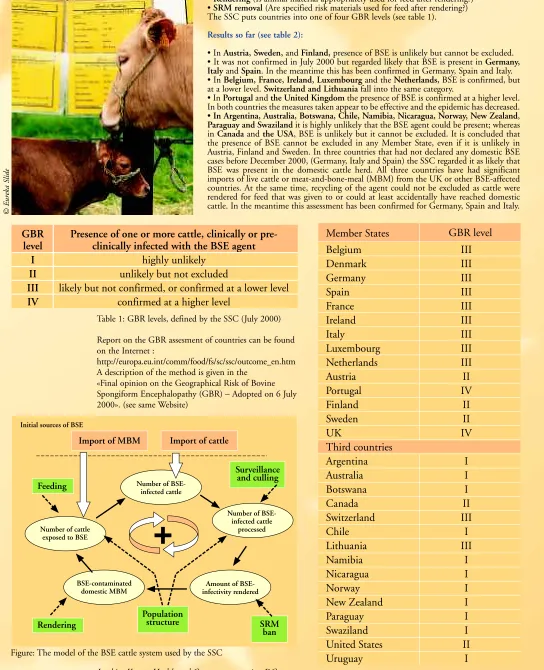
The Scientific Steering Committee (SSC) of the European Commission developed a qualitative method for the assessment of the geographical BSE risk (GBR) — the probability that BSE is present in the domestic cattle herd of a country or region. It was already applied to 14 Member States of the European Union and to 15 Third Countries. The assessment of 25 other Third Countries is ongoing. The SSC bases its assessments on a model of the BSE cattle system that consists of a feed-back loop controlled by a number of factors (see figure).
If these controls function, a system will be able to cope with incoming BSE, otherwise, the BSE agent would be recycled and amplified.
For assessing the geographical BSE risk, two basic questions have to be answered:
1. Could the BSE agent have been imported? 2. If yes, what would probably have happened with it?
When answering the first question, the SSC assumes that BSE does not sporadically exist in cattle herds. It appeared somehow in the UK and got distributed from there, mainly by exports of live animals and feedstuffs. Accordingly, the risk of having imported the BSE agent depends on imports from the UK and other BSE-affected countries.
Report on the GBR assesment of countries can be found on the Internet :
http://europa.eu.int/comm/food/fs/sc/ssc/outcome_en.htm A description of the method is given in the
«Final opinion on the Geographical Risk of Bovine Spongiform Encephalopathy (GBR) – Adopted on 6 July 2000». (see same Website)
[image:8.595.46.590.100.770.2]Table 1: GBR levels, defined by the SSC (July 2000)
Table 2: Overview of the result of the GBR assessment for 29 countries
Figure: The model of the BSE cattle system used by the SSC
• Feeding(Could potentially infective feed reach cattle?)
• Rendering(Is animal material appropriately used for feed after rendering?) • SRM removal(Are specified risk materials used for feed after rendering?) The SSC puts countries into one of four GBR levels (see table 1).
Results so far (see table 2):
• In Austria, Sweden,and Finland,presence of BSE is unlikely but cannot be excluded. • It was not confirmed in July 2000 but regarded likely that BSE is present in Germany, Italyand Spain. In the meantime this has been confirmed in Germany, Spain and Italy. • In Belgium, France, Ireland, Luxembourgand the Netherlands,BSE is confirmed, but at a lower level. Switzerland and Lithuaniafall into the same category.
• In Portugaland the United Kingdomthe presence of BSE is confirmed at a higher level. In both countries the measures taken appear to be effective and the epidemic has decreased. • In Argentina, Australia, Botswana, Chile, Namibia, Nicaragua, Norway, New Zealand,
Paraguay and Swazilandit is highly unlikely that the BSE agent could be present; whereas in Canadaand the USA, BSE is unlikely but it cannot be excluded. It is concluded that the presence of BSE cannot be excluded in any Member State, even if it is unlikely in Austria, Finland and Sweden. In three countries that had not declared any domestic BSE cases before December 2000, (Germany, Italy and Spain) the SSC regarded it as likely that BSE was present in the domestic cattle herd. All three countries have had significant imports of live cattle or meat-and-bone-meal (MBM) from the UK or other BSE-affected countries. At the same time, recycling of the agent could not be excluded as cattle were rendered for feed that was given to or could at least accidentally have reached domestic cattle. In the meantime this assessment has been confirmed for Germany, Spain and Italy.
Presence of one or more cattle, clinically or
pre-clinically infected with the BSE agent
highly unlikely
unlikely but not excluded
likely but not confirmed, or confirmed at a lower level
confirmed at a higher level
GBR
level
I
II
III
IV
Belgium
Denmark
Germany
Spain
France
Ireland
Italy
Luxembourg
Netherlands
Austria
Portugal
Finland
Sweden
UK
Third countries
Argentina
Australia
Botswana
Canada
Switzerland
Chile
Lithuania
Namibia
Nicaragua
Norway
New Zealand
Paraguay
Swaziland
United States
Uruguay
III
III
III
III
III
III
III
III
III
II
IV
II
II
IV
I
I
I
II
III
I
III
I
I
I
I
I
I
II
I
GBR level
Member States
Initial sources of BSE
Number of BSE-infected cattle
Number of cattle exposed to BSE
BSE-contaminated
domestic MBM infectivity renderedAmount of Number of
BSE-infected cattle processed
Import of MBM Import of cattle
Surveillance and culling
SRM ban Population
structure Rendering
Feeding
© E
ur
eka S
lide
TOBACCO ADVERTISING
— what’s behind it ?
Consumer Voice hat das kürzlich vom Europäischen Gerichtshof über die Richtlinie zur Werbung und zum Sponsoring zugunsten von Tabakerzeugnissen gefällte Urteil zum Anlass genommen, eine Übersicht der Situation in Europa vorzustellen. Kommissar David Byrne ist fest entschlossen, so schnell wie möglich unter Berücksichtigung des Urteils neue Maßnahmen zum Verhindern der schädlichen Folgen des Tabakrauchens zu ergreifen.
La récente annulation, prononcée par la Cour de justice des Communautés européennes, de la directive sur le parrainage et la publicité en faveur du tabac, réintroduit le sujet dans l’agenda politique. Le commissaire Byrne est en effet déterminé à proposer, dès que possible et en tenant compte du jugement prononcé, de nouvelles mesures destinées à combattre les effets pernicieux de la promotion du tabagisme, surtout concernant les jeunes. Une occasion pour «Consumer Voice» de présenter la situation législative actuelle en matière de tabagisme dans l’UE.
The 1998 EU directive on tobacco advertising was introduced to avoid and eliminate differences between the Member States legislation on this issue, which had given rise to internal market difficulties, and to differences of treatment of products, services, and events between the Member States, leading to varying treatment of firms and distortion of competition. While some advertising does occur locally, tobacco advertising is often international, using materials and strategies conceived and implemented on the European or world scale. Also, sponsorship of events by tobacco firms, especially televised events, is essentially international in nature. Goods carrying tobacco trademarks and logos are marketed worldwide, and cannot be considered as designed only for a particular national market. Thus, regulations adopted on the national level are often ineffective when controls are impossible within the internal market.
The current legislative situation in the EU on tobacco products is as follows.
Cinema advertising is banned in Belgium, Denmark, Finland, France, Ireland, Italy, Luxembourg, the Netherlands, Portugal and Sweden. It is allowed in Austria, Germany, Spain and the United Kingdom but only when accompanied by a warning.
Poster advertising is banned in Denmark, Finland, France, Portugal and Sweden. It is allowed with a warning
in Austria, Belgium, Germany, Greece, Luxembourg, the Netherlands, and the United Kingdom.
Press advertisingis banned in Finland, France, Portugal and Sweden. It is allowed with warnings in Austria, Belgium, Denmark, Germany, Greece, Ireland, Luxembourg, the Netherlands, Spain and the United Kingdom.
Radio advertisingis banned in all Member States except Spain and the United Kingdom, where warnings are required.
TV advertising is banned in all Member States by Directive 89/552/EEC.
Point of sale advertisingis banned in Finland, and Italy. It is allowed with warnings in Belgium, France, Greece, Ireland, Luxembourg, Spain and the United Kingdom.
Samples are banned in Belgium, Finland, France, Germany, Ireland, Italy, Luxembourg and the Netherlands.
Sponsorshipis banned in Belgium, Finland, France, Italy and Sweden.
John-F. Ryan, Health and Consumer Protection DG E-mail: John F. [email protected]
© A
ndr
ew H
ay
© Eureka Slide
Diese Informationskampagne für junge Menschen ist mit rund 3,5 Mio. EUR dotiert und soll hauptsächlich in Kinos und einschlägigen Zeitungen durchgefürt werden. Eine Vorankündigung, um potenzielle Teilnehmer von der bevorstehenden Ausschreibung zu informieren, wurde am 5. Oktober 2000 veröffentlicht. Das offizielle Ausschrei-bungsverfahren ist für Anfang 2001 geplant.
Der gemeinschaftliche Tabakfonds wurde 1992 eingerichtet, und zwar durch den Einbehalt von 1 % der für die Tabakproduktion in der EU bestimmten Subventionen. Er ist für die Förderung von Projekten zur Gesundheitsinformation und Erforschung weniger schädlicher Tabakpflanzen gedacht. Die Durchführungsbestimmungen wurden in einer Verordnung der Kommission von 1993 festgelegt. Auf dieser Grundlage lancierte die Kommission zwei Aufforderungen zur Einreichung von Vorschlägen. Durch eine Verordnung des Rates von 1998 wurde der Fonds
La Commission projette de lancer un appel d’offres dans le cadre du Fonds communautaire de recherche et d’information dans le domaine du tabac. L’objectif est l’organisation d’une vaste campagne d’information destinée aux jeunes. La campagne sera principalement diffusée dans les cinémas et les quotidiens appropriés.
The Commission plans to launch a new call for tenders in the framework of the Community Tobacco Fund with the objective to organise a broad information campaign on smoking prevention aimed at young people. The campaign will mainly use cinemas and relevant newspapers as a means of communication.
RAUCHEN IST NICHT „COOL" — RAUCHEN TÖTET:
EU - Informationskampagne für junge Menschen
verdoppelt und beträgt nunmehr 2 % der gesamten Subventionen für die Tabakproduktion. Jetzt befasst er sich mit
– Maßnahmen zur Bekämpfung des Tabakmissbrauchs; – Forschungsarbeiten zur Schaffung und Weiterentwicklung neuer Sorten und Anbaumethoden, die für die menschliche Gesundheit weniger schädlich sind, besser an die Marktbedingungen angepasst und umweltfreundlicher sind;
– der Schaffung oder Weiterentwicklung alternativer Verwendungsmöglichkeiten für Rohtabak;
– Studien zur Untersuchung der Möglichkeiten für Erzeuger, sich auf andere Kulturen oder Tätigkeiten umzustellen.
Am 25. Juli 2000 billigte die Kommission eine geänderte Durchführungsbestimmung, die diese neuen politischen Bereiche berücksichtigt.
John-F. Ryan, GD Gesundheit und Verbraucherschutz E-mail: John-F. [email protected]
15 / 3 / 2001
Journée Européenne du Consommateur
— Europäischer Verbrauchertag
— European Consumer Day
Le 15 mars 2001, la Commission européenne organisera à Bruxelles la troisième Journée européenne du consommateur sur le thème de la Qualité Alimentaire avec 3 ateliers sur la qualité des aliments, la sécurité alimentaire et la nutrition.
Le même jour, avec le soutien de la Commission, les associations de consommateurs organiseront dans chaque Etat membre des manifestations sur le même thème. A Stockholm, la Commission ouvrira ce jour-là un douzième Euroguichet pour les consommateurs suédois.
Am 15. März 2001 wird die Europäische Kommission in Brüssel den dritten Europäischen Verbrauchertag organisieren; er ist dem Thema Lebensmittelqualität gewidmet, und in seinem Rahmen werden 3 Workshops über Qualität der Lebensmittel, Lebensmittelsicherheit und Ernährung stattfinden.
Am gleichen Tag werden die Verbraucherverbände mit Unterstützung der Kommission in allen Mitgliedstaaten Veranstaltungen zum gleichen Thema organisieren. In Stockholm wird die Kommission für die schwedischen Verbraucher an diesem Tag die zwölfte europäische Verbraucherberatungsstelle (Euroguichet) eröffnen.
On 15 March 2001, the European Commission will organise the third European Consumer Day in Brussels on the theme of food quality, with three workshops on food quality, food safety and nutrition.
On the same day, with the Commission's support, consumer associations will organise events on the same issue in each Member State and in Stockholm, the Commission will open the 12th Euroguichet (European Consumer Information Centre) for Swedish consumers.
N E W S A N D D E V E L O P M E N T S
MEETING FUTURE NEIGHBOURS
— EU-Commissioner David Byrne visits
accession countries
Die erste Gruppe von Beitrittsländern beschleunigt ihre Vorbereitungen für den Beitritt zur Europäischen Union, und damit steigt auch der Druck, ihre Rechtsvorschriften mit denen der EU in Einklang zu bringen. Dies gilt auch für alle neuen Entwicklungen des EU-Lebensmittelrechts. Um die Beitrittsländer bei dieser Aufgabe zu unterstützen, schlagen der für Gesund-heit und Verbraucherschutz zuständige Kommissar David Byrne und der für Erweiterung zuständige Kommissar Günter Verheugen einen Entwurf für eine Strategie im Bereich der Lebensmittelsicherheit vor, der an die jeweiligen Länder angepasst werden kann.
Les pays appartenant à la première vague de candidats à l'adhésion, qui intensifient leurs préparatifs dans ce sens, sont instamment tenus d'aligner leur législation sur celle de l'UE. Toutes les nouvelles dispositions adoptées dans le domaine de la législation alimentaire sont également concernées. Pour aider les pays candidats dans cette tâche, David Byrne, membre de la Commission responsable de la santé et de la protection des consommateurs, et Günter Verheugen, membre de la Commission responsable de l'élargissement, proposent une ébauche de stratégie en matière de sécurité alimentaire adaptable à chaque pays et comprenant une approche par étapes du travail à accomplir.
As the first wave of accession countries step up their preparations to become part of the European Union, the pressure is on for them to bring their laws into line with those of the EU. That includes all the new developments in EU food law. To help the countries take these on board, Health and Consumer Protection Commissioner David Byrne and Enlargement Commissioner Günter Verheugen propose an outline for a Food Safety Strategy, that can be adapted to each country.
When Commissioner Byrne visited Poland, Hungary and Czechoslovakia last autumn, food safety was the main topic on the agenda. However, the series of in-depth discussions with policy-makers also covered the question of how these three countries are dealing with transposing (bringing into conformity) the acquis (the full body of EU law) into national legislation. On consumer protection alone, all of the countries who wish to join the
EU must take on board 14 EU directives, a Council decision and three Commission decisions on scientific and consumer committees.
Commissioner Byrne outlined the evolution of EU legislation that aims to ensure food safety from farm to fork. ‘Central to this principle,’ he explained, ‘is the White Paper on Food Safety that will affect the general principles of EU food law.’ Telling them that he believed the establishment of the European Food Authority, would give effect to the White Paper’s general principles and requirements, the Commissioner spoke of his confidence that these proposals will ensure that consumers can have confidence in the safety of European food.
This new food legislation will have to be in place — and implemented — well in advance of accession in addition to all other EU legislation. Most of the countries have made considerable progress in the areas of consumer protection and are keenly interested in fully participating to the EU’s public health programmes. However, the countries agree that to process food legislation effectively and quickly, it would be helpful if the Health and Consumer Protection DG could work closely with their agriculture and health ministries, within a food safety strategy, along the lines proposed by Commissioners Byrne and Verheugen.
Active and ongoing interaction between the accession countries and the Commission has been a constant factor, and can be relied upon by accession countries as they prepare to join the EU. Much of the early work was carried out through the Commission’s Phare programme. This programme is now discontinued but there is no change to the continuing cooperation between the Commission and the accession countries.
Commissioner Byrne intends to visit each country before accession and plans are well under way for visits to Slovenia, Estonia and Cyprus in the coming months. In addition to frequent visits by officials from the Health and Consumer Protection DG to accession countries, officials from accession countries also visit Brussels for information exchange. EU vets from the Food and Veterinary Office (FVO) will also visit each accession country to look at food safety systems and make recommendations on how safety, throughout the whole food chain, can be implemented.
Helen Kinghan, Health and Consumer Protection DG E-mail: [email protected]
Des représentants de dix pays d’Europe centrale et orientale, ainsi que de Chypre, de la Turquie et de Malte ont participé à un séminaire organisé à Bruxelles. Ils ont été informés des derniers résultats en matière d’harmonisation de l'«acquis communautaire» et des directions dans lesquelles se développe la protection des consommateurs dans l’Union européenne. Au cours de la demi-journée de discussion, des personnalités éminentes des pays candidats ont exposé leurs priorités et leurs besoins dans ce domaine. Leurs toutes premières priorités sont l’éducation des consommateurs, la formation et la stabilité et la continuité du financement. Ces personnalités ont demandé à la Commission d’organiser une rencontre de haut niveau avec des représentants des gouvernements, en vue de convaincre ceux-ci de l’importance de la protection des consommateurs dans tous les secteurs (y compris les ONG), ainsi que des réunions régulières, des ateliers et des séminaires sur les principaux dossiers d’actualité en matière de protection des consommateurs.
For the third time, representatives of State and non-governmental consumer organisations gathered in the Charlemagne Building, Brussels. Leading figures from central and east European countries together with their colleagues from Cyprus, Turkey and Malta came together for a seminar on consumer policy for candidate countries. Other participants were the German AgV and Belgian CDC, their helpers in the consumer institutions and consumer policy programmes (CICPP II) concerning preparations for EU accession.
Delegates were given information by a representative of the Directorate-General for Enlargement DG about how the EU had received their current results relating to harmonisation of the “acquis communautaire“ (Body of EU law) in the consumer protection field.
Commissioner Byrne also addressed them, emphasising the directions in which the Health and Consumer Protection DG’s work was developing. He referred to the most important fields, such as food safety, financial services and e-commerce, and drew attention to the need for more effective enforcement of legal regulation, to turn theory into practice.
Following the Commissioner’s speech and a general discussion chaired by the newly-appointed director of the Health and Consumer Protection DG, Mrs Pantelouri, participants described the present state of consumer protection in their countries, together with their priorities and needs in building their consumer movements. Almost all of them emphasised the necessity to raise the general profile of consumer protection. They referred to the joint task of politicians, both in the Member States and the candidate countries, to raise awareness of mutually beneficial development in a common Europe.
Most delegates gave top priority to consumer education, education for children and adults including public servants and teachers, and training for all actors on the consumer stage, experts, advisors, managers, judges and voluntary workers.
The way to strong consumer protection passes through the development of the institutional system, distribution of tasks among participants, capacity building, and
finding the resources to make each of them capable of independent action. Without stability and continuity of NGO financing, no consumer education, representation or protection is possible. But we still seem to be a long way from a situation in which governments of candidate countries can ensure the emergence of strong and effective civic organisations as collaborators in safeguarding consumer interests.
The Commission has a decisive role in achieving this. The participants requested its help in organising a high-level meeting for the government representatives of their countries, emphasising the importance of consumer protection in a free economy and the need for support — including financial assistance — for non-governmental organisations.
They all agreed on the usefulness of the annual meetings and in addition made an offer to Health and Consumer Protection DG to organise regular meetings, workshops and seminars during the year on topics such as capacity building, running consumer organisations or functional aspects such as bank services, e-commerce, fair advertising, etc. These meetings would contribute to transnational cooperation among consumer organisations in Member States, organisations in still non-member countries and international consumer-related organisations.
The representatives asked the commissioner and DG officials to examine the possible continuation of the Phare access programme while significant development is still necessary mainly in the implementation and enforcement of the acquis communautaire.
Vertreter zehn mittel- und osteuropäischer Länder sowie Maltas, der Türkei und Zyperns kamen in Brüssel zu einem Seminar zusammen. Sie wurden über die neuesten Ergebnisse bei der Anpassung an den gemeinschaftlichen Besitzstand informiert sowie über die Richtung, in die sich der Verbraucherschutz in der EU entwickelt. In der halbtägigen Diskussionsrunde erläuterten führende Verbraucherschutzpersönlichkeiten der Beitrittsländer ihre Prioritäten und Erfordernisse. An erster Stelle standen Verbraucherbildung und Schulung sowie Stabilität und Kontinuität der Finanzierung. Die Kommission wurde gebeten, ein Treffen hochrangiger Regierungsvertreter zu organisieren, um diese von der Bedeutung des Verbraucherschutzes auf allen Gebieten (einschließlich des NRO-Sektors) zu überzeugen, und regelmäßige Sitzungen, Workshops und Seminare über die aktuellsten Verbraucherfragen zu veranstalten.
JOINING THE CLUB
— accession countries talk business
Istvan Garai, National Association for Consumer Protection, Hungary
E-mail: [email protected]
© EU-Commission
Le seizième congrès mondial de Consumers International, qui s’est récemment réuni en Afrique du Sud, a principalement étudié la possibilité de mettre en œuvre des mesures importantes pour protéger les droits des consommateurs face à la mondialisation et aux nouvelles technologies. Les militants des droits des consommateurs, au nombre de plus de 600 et originaires de 120 pays différents, qui se sont réunis en Afrique du Sud, ont exigé, entre autres, une interdiction du brevetage des formes de vie et l’imposition d’un moratoire à la culture et à la commercialisation de nouveaux aliments génétiquement modifiés. Le congrès, qui a examiné les perspectives qui s’offrent aux consommateurs en matière de justice sociale et dans le contexte de la mondialisation, s’est tenu pour la première fois en Afrique et a imprimé une grande dynamique à l’amélioration de la protection des consommateurs dans les pays les plus pauvres. De nouvelles initiatives visant à établir des liens entre les organisations de consommateurs européennes et leurs homologues d’Amérique latine et d’autres régions du monde ont été annoncées. Consumers International, qui vient de célébrer son quarantième anniversaire, est une confédération rassemblant quelque 265 groupes qui œuvrent en faveur de la protection des consommateurs dans le monde entier.
Wirksame Maßnahmen zum Schutz der Verbraucherinteressen angesichts globaler Märkte und neuer Technologien standen auf dem 16. Weltkongress von Consumers International ganz oben auf der Tagesordnung. Zu den Forderungen der über 600 Verbraucherschützer aus 120 Ländern, die sich unlängst in Südafrika zu dem Kongress einfanden, gehörten ein Verbot von Patenten auf alle Formen des Lebens und ein Aussetzen von Anbau und Vertrieb neuer gentechnisch veränderter Lebensmittel. Der Kongress, der sich mit sozialer Gerechtigkeit und dem Weltmarkt aus Verbrauchersicht befasste, fand erstmals in Afrika statt und wird den Bemühungen um einen besseren Verbraucherschutz in ärmeren Ländern neue Dynamik verleihen. Angekündigt wurden Initiativen, bei denen europäische Verbraucherorganisationen mit Partnerorganisationen aus Lateinamerika und anderen Teilen der Welt zusammenarbeiten sollen. Consumers International ist ein Zusammenschluss von rund 265 Verbraucherschutzgruppen in der ganzen Welt und besteht seit 40 Jahren.
SOCIAL JUSTICE AND WORLD MARKET
— global consumer concerns discussed in Durban
Stronger measures to protect consumer rights in the face of global markets and new technologies topped the agenda of Consumers International’s 16th World Congress which met recently in South Africa.
The international meeting brought together consumer activists, officials, donors and academics from over 100 nations to debate issues of consumer policy and protection. The triennial event, entitled ‘Consumers, social justice and the world market,’ was held on November 13–17 in Durban, hosted by South Africa’s Department of Trade and Industry and supported by the
Health and Consumer Protection DG of the European Commission.
This was the first Consumers International World Congress to be held in Africa, and more than one third of the 600 delegates came from the region.
The congress ended with a strong statement in line with its theme on ‘Consumers, social justice and the world market’. The statement analyses the situation faced by consumers everywhere and especially in Africa. It calls on governments and international agencies to, among other actions:
S E R I E S
En Lettonie, la première organisation de consommateurs a été créée en 1990. L’adoption en 1992 de la première loi sur la protection des consommateurs a marqué le début d’un développement lent mais constant des politiques liées aux consommateurs.
À l’heure actuelle, les problèmes et les pré-occupations majeurs sont les suivants:
• le gouvernement n’apporte pas de soutien financier;
• aucun organisme consultatif n’a été créé dans le cadre des politiques relatives aux consommateurs; • les services publics offrent des prestations onéreuses et de mauvaise qualité;
• aucun essai comparatif de produits n’est effectué.
Réalisations actuelles
— Dix organisations régionales de consommateurs provenant des dix régions de la Lettonie ont fondé l’Association lettone de protection des consommateurs.
— Des bureaux d’information des consommateurs ont été créés.
— U n n o u v e a u s y s t è m e d ’ i n f o r m a t i o n d e s consommateurs a été mis en place. Il est accessible par l’intermédiaire de toutes les organisations de consommateurs, ainsi que sur Internet.
In Lettland wurde die erste Verbraucher-schutzorganisation 1990 gegründet. Mit der Verabschiedung des ersten Verbraucher-schutzgesetzes 1992 begann die langsame, aber konstante Entwicklung einer Verbraucherpolitik.
Die größten Probleme und Anliegen sind heute:
• das Fehlen finanzieller Unterstützung von Regierungsseite,
• das Fehlen eines beratenden Gremiums für Verbraucherpolitik,
• geringe Qualität und hohe Tarife bei den öffentlichen Dienstleistungen,
• das Fehlen von vergleichenden Warentests.
Die bis heute erzielten Erfolge:
— Zehn regionale Verbraucherorganisationen aus ganz Lettland gründeten den lettischen Verbraucherschutzverband.
— Es wurden Beratungsstellen für Verbraucher eingerichtet.
— Ein neues Informationssystem für Verbraucher ist über sämtliche Verbraucherorganisationen und im Internet zugänglich.
CONSUMERS IN LATVIA
— confidently looking ahead
• prohibit the use of patents on life forms;• impose a moratorium on the cultivation and marketing of new GM foods until proven to be safe, environmentally sustainable and acceptable to consumers; • cancel the debt of least developed countries;
• end the export of hazardous products and processes where domestically banned;
• develop and implement an evidence-based framework convention on tobacco control;
• ensure that trade and economic policies are formed with the input of consumers.
Among the movement’s demands is that ‘pharmaceutical companies and governments in Africa and elsewhere must immediately start negotiations on licensing drugs for the treatment of HIV/AIDS at affordable prices’. National governments ‘have the right to invoke safeguards — including compulsory licensing, parallel importing and public non-commercial use provisions — to guarantee access to essential drugs necessary for protecting the basic human rights of life and health’.
The congress consisted of five days of plenaries, workshops, fringe meetings and training courses — all aimed at developing strategies to ensure that people’s needs as consumers are met and respected in light of the challenges and opportunities presented in the 21st century.
In addition to the long-standing consumer concerns of satisfaction of basic needs, adequate protective legislation and consumer education and information, a number of specific current issues were discussed in depth. These included the impact on consumer welfare of trade liberalisation, public utilities and privatisation, genetic modification of foodstuffs, privacy problems and alternative dispute resolution in e-commerce, intellectual property agreements, and sustainable consumption.
During the congress, consumer organisations were invited to participate in the upcoming Euro-Latin American Consumer Dialogue for Development and Democracy, to be held on 24–26 January 2001 in Cartagena de Indias, Colombia. Representatives from over 30 Latin American consumer groups and government officials will meet with European organisations and EU officials to draw up a three-year plan to improve legislation, food standards and public utilities.
Chris Gethin, Consumers International, London E-mail: [email protected]
S E R I E S
At the start of a new millennium and the beginning of a new year, we would like to leave in the past everything that has hindered our work. In the new year, we will help our consumers more effectively with a new strategy corresponding to the current situation and with a deeper understanding of consumer needs. Together, we will do our best to ensure a better quality of life.
This year the first consumer organisation — the Club for Protection of Consumer Interests — celebrated its 10-year anniversary since starting its consumer protection activities. The Consumer Protection Act can be regarded as our first major achievement. The Saeima (the Parliament of the Republic of Latvia) adopted it on 28 October 1992. Its club’s working group devised the basis for the draft legislation, and its total contribution to the act is about 80 %.
Since the adoption of the first Consumer Protection Act in 1992, Latvia has been committed to consumer protection policy. This position was strongly reaffirmed by the adoption of the revised Consumer Rights Protection Act in March 1999, which grants rights to non-governmental consumer organisations but does not provide for financial support for implementing those rights.
Problems
In accordance with the national EU integration programme, the Ministry of the Economy worked out a concept, ‘Increasing the role of non-governmental consumer organisations’, but the Ministry of Finance has not yet adopted it. This means we cannot hope for the delegation of State functions to consumer organisations in the immediate future. By partial financing of the non-governmental sector, the State could give substantial impetus to the development of consumer policy in Latvia.
Unfortunately, there is as yet no consumer policy body in Latvia, such as a consumer consultative council, which would allow consumer organisations to represent consumer interests and influence policy on a regular basis and on different consumer policy issues.
As regards consumer complaints, the majority of consumers are not satisfied with the public utilities — heating, cold and hot water. This problem is very difficult to solve because it is connected with the following circumstances:
• adoption of political decisions in this specific area; • tariff calculation is not transparent and does not correspond to consumers’ ability to pay;
• the quality of services is poor owing to low energy efficiency and insufficient measuring of consumption.
The weak point in the consumer information system is the lack of comparative product testing. State institutions test
products only if there are well-founded suspicions about a product’s conformity to safety requirements. Non-governmental organisations lack the means to do this.
Successes
The most successful work is in the area of consumer information and education, which is carried out by consumer protection clubs. The creation of a non-governmental consumer advice system was initiated by AgV under the Phare programme, with the opening of the first advice office in Riga in 1998 under the Club for Protection of Consumer Interests.
In March 1999, 10 years after the first consumer club was founded in Riga, consumer clubs and societies from all over Latvia united to form the Latvian Consumer Protection Association (PIAA). The founder members are the regional consumer clubs from Riga, Jurmala, Rezekne, Latgale Region and Jelgava and two tenants’ associations from Ogre and Liepaja. The association is an independent non-governmental organisation which works nationally to extend and protect consumer rights in Latvia as well as to coordinate the work of local and regional groups. Today, PIAA consists of 10 regional clubs with a total of about 700 individual members.
One step in the direction of professional support for consumer advice activities is the new consumer information system, which has been set up by a State institution — the Consumer Rights Protection Centre — in cooperation with the PIAA and with technical support from AgV under the Phare programme. The information files are distributed through all PIAA regional advice offices.
In August 2000, the Club for Protection of Consumer Interests together with the Consumer Rights Protection Centre created the first resource site for consumers, ‘The consumer guide’, on the Internet (www.consumer-guide.lv). By visiting the site, consumers can, at any time and place, obtain full and detailed information about their legal rights, goods and services, read the latest consumer news, express their opinions in polls and submit complaints. The consumer guide is one of the most visited sites run by non-governmental organisations.
Zinta Kovalevska, Consumer Protection Association, Latvia E-mail: [email protected]
In 2001 Riga celebrates its 800th anniversary.