Int. J. Electrochem. Sci., 10 (2015) 10389 - 10401
International Journal of
ELECTROCHEMICAL
SCIENCE
www.electrochemsci.org
Poly (ionic liquid) Based on Modified Ionic Polyacrylamide for
Inhibition Steel Corrosion in Acid Solution
Ayman M. Atta1,2,*, Gamal A. El-Mahdy1, 3 Hamad A. Allohedan 1 , and Mahmood M. S. Abdullah1
1
Surfactants Research Chair, Department of Chemistry, College of Science, King Saud University, P.O. Box 2455, Riyadh 11451, Kingdom of Saudi Arabia.
2
Petroleum Application Department, Egyptian Petroleum Research Institute, Cairo 11727, Egypt.
3
Department of Chemistry, Faculty of science, Helwan University, 11795 Helwan, Egypt
*
E-mail: [email protected]
Received: 10 September 2015 / Accepted: 6 October 2015 / Published: 4 November 2015
The green method to protect steel from corrosion becomes target for corrosion science. In this work, synthesis of new poly(ionic liquid) as green inhibitor with lower concentration is used to protect carbon steel from aci corrosion. In this respect, poly(ionic liquid) based on 2-acrylamido-2-methylpropane sulfonic acid, AMPS, was synthesized without solvent in the presence of diethyl ethanolamine (DEEA) as reagent and solvent. The chemical structure of PAMPS-DEA was confirmed by NMR analyses. The wettability of the prepared PAMPS-DEA was confirmed from contact angle measurements. The inhibition activity of poly(AMPS) and PAMPS-DEA for steel in acidic chloride solution was tested using electrochemical techniques. The synthesized Ionic liquids PAMPS-DEA shows an excellent corrosion inhibition performance for steel in 1 M HCl medium at concentration of 5 ppm. The adsorption of IL on steel surface blocked the active centers, which lowered the corrosion rate of steel.
Keywords: Poly (ionic liquid); Steel; Acid corrosion, inhibition, EIS, polarization.
1. INTRODUCTION
They have large tendency to be chemically bonded or physically adsorbed at the surface metal substrates to protect them from corrosive environments [7]. ILs can be applied using several techniques such as electrodeposition, corrosion inhibitors, conversion plating solution and coatings to mitigate materials corrosion [8-10]. It is well known that carbon steel as metal substrate has been widely used in several industrial applications due to its good mechanical properties and cheap prices than other metal substrates [11]. Its chemical composition suffers from absence of Noble metals that increases its ability to damage form surround corrosive environments [12]. On the other hand, there are some of ILs cause damages for metal substrates depending on their kinds [13]. For this reason, it is very important to explore new strategies to overcome this problem. Amphiphilic polymers have several advantages than their monomers to act as corrosion inhibitors [14] due to lower sensitivity to salts, high shear and thermal stability, high resistivity to strong acid and their efficiencies at lower concentrations [9, 15-18]. For these reasons polymeric ionic liquids or poly (ionic liquid)s (PILs) become more favorable than their monomers in the field of anticorrosion.
PILs are a macromolecular architecture of functional materials based on IL monomers connected through a polymeric backbone [18, 19]. The modification of PIL characteristics (density, viscosity, and surface tension) are of great importance for their application [20]. Synthesis and purification PIL attracted further developments due to their valuable applications as green materials in the materials sciences such as metal protection, catalysis, nanomaterials, etc. [18]. PIL with functionalized imidazolium and pyridinium cations gathered from the literature [21-23] can be copolymerized to control segmental motion and chain packing for modifying their industrial applications. The imidazolium and pyridinium cations can be converted to polymerizable monomers by functionalization with vinyl, acrylic or styryl moieties [24-26]. One of the main obstacles to produce imidazolium and pyridinium cations is their high production cost. However, the choosing of new cheaper cations rather than imidazolium or pyridinium can be reduced the production cost [27]. Moreover, more energy efficient techniques are used to reduce the cost [28]. In this respect, the present work extends previous works that succeeded to prepare PILs based on acrylamides followed by quaternization with aliphatic tertiary amine at room temperature [29-30]. The present work aims to promote an ionic liquid character of 2-acrylamido-2-methylpropane sulfonic acid (AMPS) to increase its wettability and adorability at steel surfaces. The quaternization of AMPS with diethyl ethanolamine (DEEA) reported here promotes a wetting actuation of poly(AMPS). The corrosion inhibition activity of the prepared PIL for steel in acidic chloride solution was investigated using electrochemical techniques and contact angle measurements at different concentrations of poly(AMPS) and its IL with DEEA ( PAMPS-DEA).
2. EXPERIMENTAL
2.1 Materials
was recrystallized from methanol solution to use as radical initiator. The radical polymerization of AMPS was carried out in water as solvent as reported in previous work [31].
Steel was used as working electrode and has a chemical composition described in details in a previous work [ 32 ]. Platinum sheet and SCE were used as counter and reference electrode.
2.2. Synthesis procedure
Equal molar ratios of AMPS and DEEA were mixed into a nitrogen purged 50 ml flask at room temperature to dissolve AMPS for 8 hr to produce transparent light amber oil. AIBN (0.6 wt. % related to AMPS monomer) was added to the reaction mixture and the reaction temperature increased up to 70 oC for 18 hr. The reaction mixture cooled to room temperature to produce transparent dark amber mixture. The product was dissolved in ethanol with concentration of 20 Wt % and precipitated into 5 folds of acetone and filtrated under vacuum. The wax white product was dried under vacuum to obtain transparent amber oil with % yield polymer 98.2% and melting temperature 42 oC. The produced polymer was designated as PAMPS-DEA.
2.3. Characterization
The chemical structure of the PAMPS-DEA was confirmed by 1H- and 13CNMR analyses that recorded on a 400MHz Bruker Avance DRX-400 spectrometer.
Contact angles between steel surfaces and different concentrations of PAMPS-DEA and Poly(AMPS) in aqueous and 1M HCl were measured using drop shape analyzer model DSA-100 at 25
o
C. The ageing time of contact angle measurements was measured from zero time up to 30 minutes until the contact angles reach the equilibrium. The advancing contact angle was measured using sessile drop technique. The needle of the instrument is located close to the steel surface and the volume of the droplet is gradually increased while recording at the same time the contact angle.
Scanning electron microscope (SEM; Model JEOL-JSM-5400) was used to scan the steel microstructure.
2.4. Electrochemical measurements
All electrochemical experiments were performed using a potentiostat (Solartron 1470E system) with Solartron 1455A as FRA. The potentiodynamic polarization curves were recorded with a scan rate of 1 mV/s. The EIS measurements were carried out in a frequency range from 10 kHz to 10 mHz..
3. RESULTS AND DISCUSSION
system to promote the wetting characteristics to form anticorrosion protective layer at the solid surfaces. The proposed chemical structure of the AMPS monomeric and polymeric ionic liquid is represented in Scheme 1.
Scheme 1. Preparation of PIL based on PAMPS-DEA.
The DEEA is selected in the present work as solvent to solubilize AMPS monomer at room temperature and to prepare polymerizable ionic liquid monomer AMPS-DEA. It is converted to poly(ionic liquid) by radical polymerization the acrylic group of AMPS-DEA monomer. The presence of ethanol group in the chemical structure of DEEA assists its quaternization without coordinating of protonated amine center with the sulfonated anion. This was elucidated from depression the melting point of AMPS from 192 to 42 oC due to formation of PAMPS-DEA.
3.1. Characterization of PAMPS-DEA
The chemical structure of PAMPS-DEA is elucidated from 1HNMR and 13CNMR as represented in Figures 1 and 2, respectively. In this respect, the polymerization of AMPS – DEA is confirmed from disappearance of acrylic (CH2=CHCON-) proton peaks at chemical shifts (δ) 6.03 (dd,
1H, J = 17.1 Hz), 5.94 (dd, 1H, J = 17.1 Hz) and 5.49 ppm (dd, 1H, J = 3.06 Hz), it was not represented here for brevity, and appearance of new broad peaks (Figure 1) of polymerized protons – CH2-CH- at δ 1.2 and 3.2 ppm, respectively. The appearance of broad peaks at δ 9.11 (br s, 1H) and
7.16 (br s, 1H) that attributed to cationic +NH and SO3H, respectively confirms the quaternization of
[image:5.596.80.498.143.535.2]
Figure 1. 1HNMR spectrum of PAMPS-DEA.
Figure 2. 13CNMR spectrum of PAMPS-DEA.
13
C NMR spectrum of PAMPS-DEA (Figure 2) shows peaks at δ 173.58 (CON), 60.06 (C-N+), 58.13 (C-SO3-), 40.3 (C-SO3-) 26.84 ( CH) and 10 ppm (CH3) that confirm the formation of IL. The
Figure 3. Effect of ageing time on contact angle measurements of the 100 ppm and 5 ppm of poly(AMPS) and PAMPS-DEA on the steel surface at 25 oC.
[image:6.596.150.444.72.269.2]Their contact angles average values were listed in Table 1. The data confirm that the contact angle of 1M HCl greatly reduced more water as blank solutions that indicate the wettability of 1M HCl increased on the steel surfaces. However, these data indicate increment of HCl attack to steel surface. Careful inspection of data indicates that the contact angle values of polymer solutions lowered than blank. Moreover, the greater reduction of contact angles data for poly(AMPS) solution is more than PAMPS-DEA either in water or 1M HCl solutions. This means that the formation of IL in cationic and ionic form increased the contact angle than a parotic poly(AMPS). This can be referred to increased hydrophobicity by incorporating of DEEA in the chemical structure of PAMPS-DEA. These data indicate that the PAMPS-DEA has strong ability to form hydrophobic layer on the steel surface and reduce diffusion of HCl on the steel surface, consequently, the corrosion rate can be inhibited. Moreover, it is expected that the IL based on PAMPS-DEAA will behave a large anionic polyelectrolyte at interfaces in 1M HCl while amide groups of poly(AMPS) can be easily protonated with 1M HCl more than PAMPS-DEAA [36]. This means that poly(AMPS) can attack easily than PAMPS-DEAA to increase the diffusion of HCl to steel surface to reduce the ability of poly(AMPS) to inhibit the corrosion rate of steel at lower concentrations.
Table 1. Contact angle data for different concentrations of poly(AMPS) and PAMPS-DEA on the steel surface at 25 oC.
Compounds Medium
Contact angle (degree) at different concentrations (ppm)
100 250 500
Poly(AMPS) water 54 53 52
1M HCl 12 13 14
PAMPS-DEA water 73 74 75
[image:6.596.20.573.664.772.2]
3.2. Potentiodynamic polarization measurements
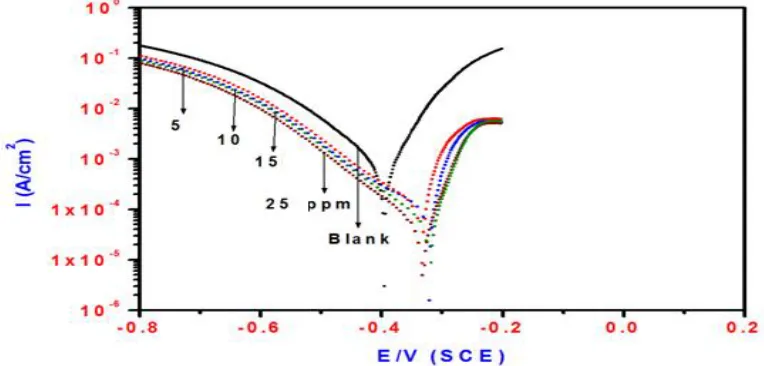
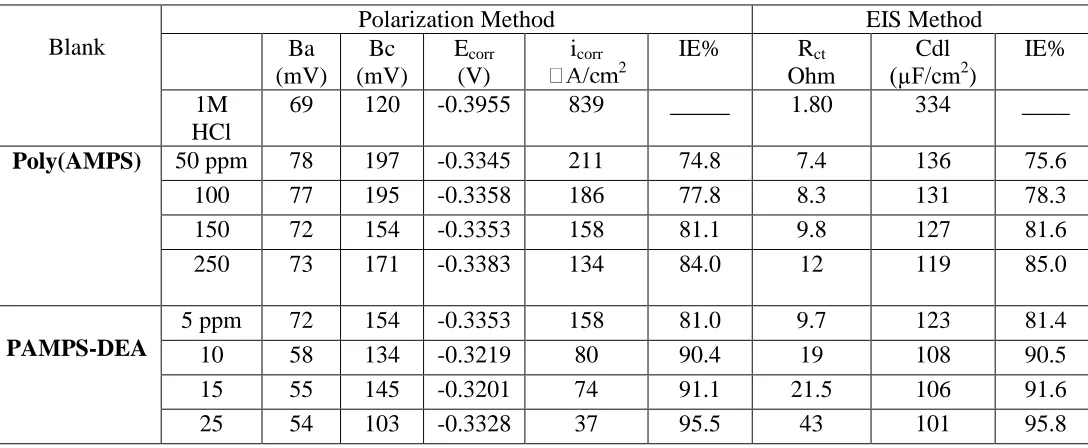
The potentiodynamic polarization curves of steel electrode in 1 M HCl solution containing different concentrations of poly(AMPS) and PAMPS-DEA are shown in Figures.4 and 5, respectively. It is clear that the additions of poly(AMPS) and PAMPS-DEA lowers the current density of both branches of polarization curves. The results can be explained on the basis of ILS adsorption on active centers of steel, which decreases the anodic and cathodic reactions. All electrochemical parameters were estimated and quoted in Table 1. It is evident that the shift in Ecorr in both directions is lower
than 85 mV indicating that both ILS acted as a mixed type of inhibitors [37, 38]. Moreover, the parallel variation of cathodic and anodic Tafel curves in case of PAMPS-DEA indicates that the mechanism of inhibition in the presence of the investigated inhibitors is activation controlled. In case of poly(AMPS) the steel dissolution mechanism is not affected by the changing the concentrations in the presence of poly(AMPS) [39].
Figure 4. Polarization plots of steel electrode obtained in 1M HCl solution and containing various concentrations of poly(AMPS).
[image:7.596.112.451.319.480.2] [image:7.596.105.487.540.723.2]
Table 2. Inhibition efficiency values of steel electrode in 1M HCl containing various concentrations of poly(AMPS) and PAMPS-DEA calculated by polarization and EIS methods
Blank
Polarization Method EIS Method
Ba (mV) Bc (mV) Ecorr (V) icorr 2
IE% Rct
Ohm Cdl (µF/cm2 ) IE% 1M HCl
69 120 -0.3955 839 _____ 1.80 334 ____
Poly(AMPS) 50 ppm 78 197 -0.3345 211 74.8 7.4 136 75.6
100 77 195 -0.3358 186 77.8 8.3 131 78.3
150 72 154 -0.3353 158 81.1 9.8 127 81.6
250 73 171 -0.3383 134 84.0 12 119 85.0
PAMPS-DEA
5 ppm 72 154 -0.3353 158 81.0 9.7 123 81.4
10 58 134 -0.3219 80 90.4 19 108 90.5
15 55 145 -0.3201 74 91.1 21.5 106 91.6
25 54 103 -0.3328 37 95.5 43 101 95.8
The additions of ILS to 1M HCl solution is accompanied by a remarkable drop in the values of Icorr and the extent of reduction is highly dependent upon ILS concentrations. The inhibition
efficiency (%IE) was computed using the following equation [40]: IE(%) = 1- (iinhibited /i uninhibited) x 100 (1)
where inhibited and iuninhibited are the inhibited and uninhibited corrosion current densities,
respectively.
The data presented in Table 2 indicates that all the studied ILS has higher inhibition efficiency than experienced in blank solution and increased with increasing ILS concentrations. Icorr decreases in
the presence of the studied ILS compared to the blank solution, indicating that these ILS acting via adsorption on the steel surface and suppresses the corrosion process. The Increase in IE% with increasing ILS concentration can be accounted to more inhibitor molecules adsorption on the steel surface covering wider surface and suggesting that the ILS has a protective inhibition performance [41]. It can be concluded that when the IE% values of the inhibitor approaches near 100 the inhibitor has a good protective barrier for diffusion the aggressive ions and suppresses the corrosion process of the steel in the acidic chloride solution.
3.3. EIS measurements
Figure 6. Nyqusit plots of steel electrode obtained in 1M HCl solution and containing various concentrations of poly(AMPS).
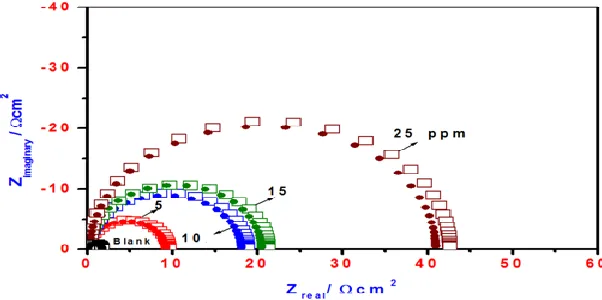
Figure 7. Nyqusit plots of steel electrode obtained in 1M HCl solution and containing various concentrations of PAMPS-DEA.
The Nyquist plots are characterized by one capacitive semicircle showing that the corrosion process was charge transfer controlled and the diameter of the semicircle increases as the inhibitors concentration increased [42]. The higher protection performance of both inhibitors was observed at high concentration of inhibitors can be accounted to an increase in the area covered with poly(AMPS) and PAMPS-DEA molecules on steel surface [43].The equivalent circuit employed for fitting the data consists of Rs, Rct and Cdl. The estimated parameters gathered from the analysis of Nyquist diagram are given in Table 2. %IE is calculated from Rct using the following relation:
x 100 (2)
[image:9.596.127.442.85.234.2] [image:9.596.145.446.308.458.2]
high concentration resulted in an increase in the charge-transfer resistance (Rct) values [44]. The thickness of the of the adsorbed protective layer increases with ILS concentration, which renders the corrosion inhibition performance of both inhibitors is more effective and ILS has a good protection performance for steel in aggressive chloride solution [45].
3.4. Adsorption isotherm
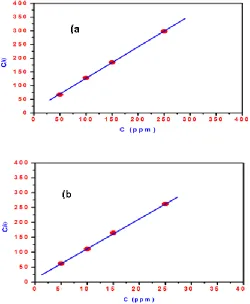
The electrochemical measurement data were tested by fitting to several adsorption isotherms in order to gain insights of ILS adsorption on steel surfaces in acidic chloride solutions. Figures 8a and b displayed a strong correlation of Langmuir adsorption isotherm between the C(inh) / θ and C(inh) for
poly(AMPS) and PAMPS-DEA, respectively. A straight line with an average correlation coefficient of 0.999 for both ILS is obtained . The slopes of the straight lines were computed and found to be 1.1 and for poly(AMPS) and PAMPS-DEA, respectively. This data suggests that the adsorption of both inhibitors on steel surface obeys Langmuir adsorption isotherm [46]. The standard free energy of adsorption (Goads ) for ILS is determined from the values of the adsorption constant, Kads [47, 48].
The estimated Goads values for poly(AMPS) and PAMPS-DEA are -34.99 and -55.33 kJ / mol, respectively. This suggests that the adsorption of these ILS on steel surfaces is a complex interaction and occurred via physical and chemical adsorption. The spontaneity of adsorption of ILS onto the steel surface in the acidic chloride solution is expected due to the high negative values of Goads.
[image:10.596.172.422.418.722.2]
SEM can be used to investigate the morphology of the protective layer of PAMPS-DEA on the steel surface as illustrated in Figure 9. The SEM micrograph of blank material of carbon steel before immersion in 1M HCl, Figure 9a, shows a uniform finishing that indicates the good sample preparation. Figure 9b shows a damages as dense film of corrosion products on the steel surfaces after exposure to 1 M HCl (24 hr). Figure 9c shows the cleaner metallic surface after the electrochemical test in the presence of 25 ppm of PAMPS-DEA. Moreover deposits are observed on steel surface which suggests that PAMPS-DEA does mitigate steel corrosion rate with complete all over the steel surface. This results confirm the chemical adsorption of PAMPS-DEA on the steel surface.
Figure 9. SEM micrograph of steel a) polished b) immersed in 1 M HCl (24 hr) and c) after electrochemical measurement treated with 15 ppm of PAMPS-DEA.
ACKNOWLEDGEMENT
The project was financially supported by King Saud University, Vice Deanship of Research Chairs.
4. CONCLUSIONS
[image:11.596.189.410.224.582.2]
PAMPS-DEA has a strong corrosion protection performance for steel in acidic chloride solution.
The additions of PAMPS-DEA to 1M HCl solution is accompanied by a remarkable drop in
the values of Icorr and enlargement of charge transfer resistance at very low concentration.
Polarization data indicated that PAMPS-DEA behaved as a mixed type inhibitor and acted via adsorption on steel surface by hindering and retarding the active centers from the corrosion reaction and obey Langmuir adsorption isotherm.
ACKNOWLEDGEMENT
The project was financially supported by King Saud University, Vice Deanship of Research Chairs.
References
1. L.C. Murulana, A.K. Singh, S.K. Shukla, M.M. Kabanda and E.E. Ebenso, Ind. Eng. Chem. Res, 51 (2012) 13282.
2. I. Lozano, E. Mazario, C.O. Olivares-Xometl, N.V. Likhanova and P. Herrasti, Mater. Chem. Phys., 147 (2014) 191.
3. N. V. Likhanova, M. A. Dominguez-Aguilar, O. Olivares-Xometl, N. Nava-Entzana, E. Arce and H. Dorantes, Corros. Sci., 52 (2010) 2088.
4. T. Tuken, F. Demir, N. Kıcır, G. Sıgırcık, M. Erbil, Corros. Sci., 59 (2012) 110.
5. Y-C. Wang, T-C. Lee, J-Y Lin, J-K. Chang and C-M. Tseng, Corros. Sci., 78 (2014) 81.
6. J. Łuczak, J. Hupka, J. Thoming and C. Jungnickel, Colloids Surf. A Physicochemical. Eng. Aspects, 329 (2008) 125.
7. Q.B. Zhang and Y.X. Hua, Electrochim. Acta., 54 (2009) 1881.
8. M. H. Chuang, J. K. Chang, P. J. Tsai, W. T. Tsai, M. J. Deng and I. W. Sun, Surf. Coat. Technol., 205 (2010) 200.
9. A. M. Atta, H. A. Al-Lohedan and A. O. Ezzat, Int. J. Electrochem. Sci., 10 (2015) 5812.
10. P. Howlett, J. Efthimiadis, P. Hale, G. V. Riessen, D. MacFarlane and M. Forsyth, Int. J. Electrochem. Sci., 157 (2010) 392.
11. L. Smith, Br. Corros. J., 34 (1999) 247.
12. A. G. Petersen, D. Klenerman and W.M. Hedges, Corrosion, 60 (2004) 187.
13. P.-C. Lin, I.-W. Sun, J.-K. Chang, C.-J. Su and J.-C. Lin, Corros. Sci., 53 (2011) 4318. 14. M. Finšgar and J. Jackson, Corros. Sci., 86 (2014) 17.
15. E. Kowsari, M. Payami, R. Amini, B. Ramezanzadeh and M. Javanbakht, Appl. Surf. Sci., 289 (2014) 478.
16. A. M. Atta, Polym. Int., 48 (1999) 571.
17. P. Arellanes-Lozada, O. Olivares-Xomet, D. Guzmán-Lucero, N. V. Likhanova, M. A. Domínguez-Aguilar, I. V. Lijanova and E. Arce-Estrada, Materials, 7 (2014) 5711.
18. D. Mecerreyes, In Applications of Ionic Liquids in Polymer Science and Technology, Springer Heidelberg New York, 2015.
19. J. Yuan, D. Mecerreyes and M. Antonietti, Prog. Polym. Sci., 38 (2013) 1009.
20. M. C. Bubalo, S. Vidovic, I. R. Redovnikovic and S. Jokic, J. Chem. Technol. Biotechnol., 90 (2015) 1631.
21. J. E. Bara, S. Lessmann, C. J. Gabriel, E. S. Hatakeyama, R. D. Noble and D. L. Gin, Ind. Eng. Chem. Res., 46 (2007) 5397.
23. T. K. Carlisle, E. F. Wiesenauer, G. D. Nicodemus, D. L. Gin and R. D. Noble, Ind. Eng. Chem. Res., 52 (2013) 1023.
24. M. Yoshizawa, W. Ogihara and H. Ohno, Polym. Adv. Technol., 13 (2002) 589. 25. S. Washiro, M. Yoshizawa, H. Nakajima and H. Ohno, Polymer, 45 (2004) 1577.
26. H.Tang, J. Tang, S. Ding, M. Radosz and Y. Shen, J. Polym. Sci.: Part A, 43 (2005)1432. 27. R. Renner, Environ. Sci. Technol., 35 (2001) 410.
28. M. C. Bubalo, K. Radošević, I. R. Redovniković, J. Halambek and V. G. Srček, Ecotoxicol. Environ. Saf., 99 (2014) 1.
29. H. L. Ricks-Laskoski and A. W. Snow, J. Am. Chem. Soc., 128 (2006) 12402.
30. A. M. Atta, G. A. El-Mahdy, H. A. Allohedan and M. M. S. Abdullah, Int. J. Electrochem. Sci., 10(2015) 6106.
31. A. M. Atta, M. Akel, R. A. Elghazawy and M. Alaa, Polym. Sci. Ser. A, 55 (2013) 327.
32. G. A. El-Mahdy, , A. M. Atta, H. A. Al-Lohedan, A. M. Tawfik and A. A. Abdel-Khalek, Int. J. Electrochem. Sci., 10 (2015) 151.
33. A. M. Atta and K. F. Arndt, Polym. Int., 50 (2001) 1360. 34. A. M. Atta and K. F. Arndt, Polym. Int., 54 (2005) 448.
35. A. M. Atta, A. A. Gaser and Z. F. Kamel, J. Dispersion Sci. Technol., 31 (2010) 1456.
36. N. Greesh, P. C. Hartmann, V. Cloete and R. D. Sanderson, J. Coll. Interf. Sci., 319 (2008) 2. 37. W. H. Li, Q. He, S. T. Zhang, C. L. Pei and B. R. Hou, J. Appl. Electrochem., 38 (2008) 289. 38. S. A. Abd El-Maksoud, J. Electroanal. Chem., 565 (2004) 321.
39. J. Aljourani, K. Raeissi and M. A. Golozar, Corros. Sci., 51 (2009) 1836.
40. A. Popova, E. Sokolova, S. Raicheva and M. Christov, Corros. Sci., 45 (2003) 33. 41. S. S. Afak, B. Duran, A. Yurt and G. Türkoglu, Corros. Sci., 54 (2012) 251.
42. A. Singh, V. K. Singh and M. A. Quraishi, Arab. J. Sci. Eng., 38(2013) 85.
43. S. A. Umoren, M. M. Solomon, U. M. Eduok, I. B. Obot and A. U. Israel, J. Environ. Chem. Eng., 2 (2014) 1048.
44. A. Fekry and R. R. Mohamed, Electrochim. Acta, 55 (2010) 1933.
45. S. H. Yoo, Y. W. Kim, K. Chung, N. K. Kim and J. S. Kim, Ind. Eng. Chem. Res., 52 (2013) 10880.
46. M. Lebrini, F. Bentiss, H.Vezin and M. Lagrenee, Corros. Sci., 48 (2006) 1279.
47. C. M. Goulart, A. Esteves-Souza, C. A. Martinez-Huitle, C. J. F. Rodrigues, M. A. M. Maciel and A. Echevarria, Corros. Sci., 67 (2013) 281.
48. H. Kele, M. Kele, I. Dehri and O. Serinda, Mater. Chem. Phys., 112 (2008) 173.