Playing for Success:
An Evaluation of the Third Year
Caroline Sharp, Jenny Blackmore, Lesley Kendall
Ian Schagen, Keith Mason, Katherine O'Connor
National Foundation for Educational Research
Research Report RR337
Research Report No 337
Playing for Success:
An Evaluation of the Third Year
Caroline Sharp, Jenny Blackmore, Lesley Kendall Ian Schagen, Keith Mason, Katharine O’Connor
National Foundation for Educational Research
The views expressed in this report are the authors' and do not necessarily reflect those of the Department for Education and Skills.
© Queen’s Printer 2002. Published with the permission of DfES on behalf of the Controller of Her Majesty's Stationery Office. Applications for reproduction should be made in writing to The Crown Copyright Unit, Her Majesty's Stationery Office, St Clements House, 2-16 Colegate, Norwich NR3 1BQ.
CONTENTS
Page No.
Executive summary i
1. Introduction to the report 1
1.1 About Playing for Success 1
1.2 Aims of the National Evaluation 2
1.3 Research design and sample 2
1.4 About the sample 3
1.5 About the report 4
2.2 About the Study Support Centres 7
2.1 Centres’ operation and location 7
2.2 Mentors and staffing ratios 12
2.3 What did the Centres aim to do? 14
2.4 Using the environment and medium of football 16
2.5 Celebration events 17
2.6 Feedback to schools 18
2.7 Main achievements during the year 19
2.8 Future developments for the Centres 23 2.9 Summary: About the Study Support Centres 24
3. Who attends Playing for Success? 27
3.1 Pupil selection 27
3.2 The pupils attending Playing for Success 30 3.3 Pupils attendance at Playing for Success 33
3.4 Pupils’ interest in football 35
3.5 Summary: Who attends Playing for Success? 36
4. Expectations and experiences of Playing for Success 39
4.1 What pupils thought of the Centre 39
4.2 Parents’ views of Playing for Success 43 4.3 Teachers’ views of Playing for Success 51 4.4 Improvement to the Study Support Centres suggest by pupils, 58
parents and schools
4.5 How did the football club environment contribute to pupils’ 62
experiences?
4.6 Summary: Expectations and experiences of Playing for Success 65
5. Achievement in Numeracy and Reading Comprehension and 67 Changes in Attitudes
5.1 Using multilevel modelling to examine differences in attainment 67
5.2 Numeracy 69
5.3 Reading comprehension 76
5.4 Measuring pupil attitudes 80
6. Achievement in Computer Skills 89
6.1 The checklist of computer skills 89
6.2 Overall computer skills 90
6.3 Computer basics 92
6.4 Word processing skills 95
6.5 Using the internet 97
6.6 Using email 100
6.7 Summary: Achievement in computer skills 104
7. Discussion and conclusions 109
7.1 How consistent are the results? 109
7.2 Is Playing for Success equally beneficial for different groups? 112 7.3 Were there any Centre-level differences? 112
7.4 What is the influence of the football context? 113
7.5 How does study support work? 114
7.6 Conclusion 116
References 119
Appendix 1: Multilevel modelling 121
Appendix 2: The pupil attitude questionnaire 129
A2.1 The reading section 129
A2.2 The writing section 132
A2.3 The mathematics section 133
A2.4 The study skills section 134
A2.5 Self-esteem 136
i
Playing for Success
An Evaluation of the Third Year
Executive summary
Playing for Success is a national initiative, established by the DfES in partnership with the FA Premier League, the Nationwide League and their clubs, and LEAs. It aims to contribute to raising educational standards, especially in urban areas, by
establishing Study Support Centres in professional football clubs1. Centres are
managed by experienced teachers. They use the medium and environment of football to support work in literacy, numeracy and ICT. With a focus on addressing the needs of underachieving young people, mainly in Years 6 to 9, the initiative places a strong emphasis on improving pupils’ attitudes and motivation to learn.
Key Findings
Playing for Success has proved popular with pupils, parents
and schools
• In total, the 35 Study Support Centres took over 12,600 pupils from 710 schools
during 2000–1. The ‘typical’ Centre took pupils for a total of 20 hours over a period of ten weeks.
• Pupils had high hopes of Playing for Success, and the experience lived up to their
expectations. For example, over 90 per cent considered the Centre to be ‘fun’, ‘interesting’ and ‘a good idea for me’. Few were able to identify anything about the Centre that could be improved.
• Despite sessions being held after school, most pupils attended over 80 per cent of
the course.
• Parents had very positive views about their children’s participation in Playing for
Success.
1 Please note that all Playing for Success Centres participating in the 2000–1 national evaluation were
ii
• Teachers rated the Centres’ organisation very highly. Centres had no difficulty
filling their places, and 99 per cent of schools would welcome another opportunity to take part.
The initiative has contributed to improved achievement
• Pupils made substantial and significant progress in numeracy. On average,
primary pupils improved their numeracy scores by about 18 months and secondary pupils by about 14 months.
• Gains in numeracy brought the performance of these underachieving young
people much closer to the level expected for their age, especially at KS2.
• Performance in reading comprehension improved during the pupils’ time at the
Centres, although the progress of secondary pupils did not quite reach statistical significance when compared with the control group. Primary pupils’ reading comprehension scores improved significantly, by the equivalent of about 15 months.
• Teachers and parents noticed particular improvements in pupils’ self-confidence
and ICT skills.
• Attitude questionnaires revealed that KS3 pupils made significant progress in their
independent study skills and their self-image.
• Pupils’ ICT skills improved significantly during their time at the Centres. Their
ability to operate a computer, carry out word processing tasks, use email and navigate the internet improved markedly.
• Pupils who attended longer courses made greater progress in computer skills.
Playing for Success has reached its target group of
underachieving pupils
• The initial numeracy and reading comprehension scores of participating pupils
were well below average for their age.
• Just over half (53 per cent) of the pupils attending the Centres were boys. At least ten per cent were from non-White ethnic backgrounds.
• The initiative benefited all pupils, regardless of gender, deprivation, ethnicity,
iii
What contributed to the Centres’ success?
The results from this and the previous years’ evaluation studies reveal a considerable
degree of consistency and demonstrate the positive impact of Playing for Success on
underachieving young people. Gains in numeracy are particularly impressive, given the relatively short periods of time for which pupils attend (most pupils attended for about 20 hours).
The football setting proved attractive to pupils and was a strong element in motivating pupils to become involved in Playing for Success.
Once at the Centres, pupils responded positively to many aspects of the initiative, especially using computers and the internet. They enjoyed the work, felt they had made progress and were grateful for the help they received. They also benefited from the opportunity to meet people and make new friends.
Attending an educational setting other than school gave underachieving youngsters the opportunity to make a ‘fresh start’. Student mentors were available in many Centres to provide advice and support, and the high ratio of staff/mentors to pupils (typically 1:4) enabled pupils to get immediate help and to make progress in their learning.
The Centres provided some of the key elements in supporting self-regulated learning. Pupils volunteered to attend and were offered individual support. They were given tasks at their level and were able to see for themselves the progress they had made. Centre staff and mentors encouraged pupils to become more self-reliant and to try things out for themselves. There were opportunities for pupils to make choices and to develop independent study skills. All these elements contributed to pupils’ confidence, progress and sense of achievement.
About the evaluation
This evaluation was carried out for the DfES by a team of researchers based at the National Foundation for Educational Research. This is the third year in which NFER
iv
35 Centres operating in 2000–2001, but not all were in a position to participate fully in the evaluation (e.g. due to major building work). All 35 Centres returned information about their Centre’s operation and the team gathered pupil outcome data from 27 Centres during the spring term, 2001.
Two thousand and ninety-five pupils, 598 parents and 107 teachers took part in the evaluation. The views of pupils, parents and schools were gathered by means of questionnaires. Pupils’ attitudes were obtained at the beginning and end of their time at the Centre. ICT skills were measured by a self-report questionnaire. Nationally standardised tests of numeracy and reading comprehension, specially designed for the evaluation, were used to assess pupils’ progress. For each measure, the progress of pupils attending Playing for Success was compared with that of a control group of 349 similar pupils who did not attend. The research used statistical techniques to assess
whether the pupils attending Playing for Success had significantly out-performed the
1
1 Introduction to the report
1.1 About
Playing for Success
The Government established the Playing for Success initiative in 1997, in partnership with the FA Premier and Football Leagues and their clubs, and LEAs. The broad aim of the initiative was to contribute to raising educational standards, especially in urban areas, through the establishment of Study Support Centres in football clubs1. As well as enhancing educational standards, it was anticipated that the Centres would have a major impact on pupils’ motivation to learn. The scheme allowed some flexibility for individual Centres to interpret these aims and relate them to local needs.
The initiative was targeted at underachieving pupils in Key Stages 2 and 3. The sessions were to be held after school and at weekends. The running and capital costs of the Centres were to be shared between national and local Government (via the Standards Fund), the clubs and business sponsorship. The initiative envisaged that the Centres would offer excellent facilities for Information and Communications Technology (ICT), with additional funding for this purpose raised from local business sponsors. Using the medium and environment of football, the Centres were expected to focus on skills in literacy and numeracy, as well as to provide opportunities for pupils to develop ICT and study skills and to complete their homework.
Guidelines produced by the Department for Education and Skills (DfES) anticipated that the Centres would be open for six, four-hour sessions per week and would be staffed by a full-time Centre Manager, an ICT technician, four student mentors per session and have administrative support. The DfES convened a national steering group, with representatives from local authorities and football clubs and a national practitioners’ group of Centre Managers, LEA representatives and others. The DfES also organised
2
meetings and workshops for Centre Managers, and employed a network of ‘critical friends’ to provide support and guidance in setting up and running the Centres.
1.2 Aims of the National Evaluation
This evaluation was carried out for the DfES by a team of researchers based at the National Foundation for Educational Research. This is the third year in which NFER has been responsible for the national evaluation of Playing for Success. The main aim of the
evaluation was to provide an assessment of the effectiveness of Playing for Success and to identify and describe those features leading to success in terms of participation, gains in motivation, positive attitudes towards learning and enhanced learning outcomes.
The evaluation took place between September 2000 and October 2001, although most of the activity in Centres took place during the spring term, 2001. (The rest of the time was taken up with updating existing evaluation instruments and devising new ones, liaising with Centre Managers and analysing the results.)
1.3 Research design and sample
Playing for Success is expanding as more Centres become established. This evaluation set out to include all Playing for Success Centres which were established by the autumn of 2000. In total, 27 of the 35 Centres took part in the evaluation. Two of the eight Centres which did not take part were in their pilot stage, and a further one did not have any groups of pupils participating at the beginning of the evaluation period. Four were in the middle of restructuring, and one was unable to take part due to the personal circumstances of the Centre Manager. The majority of the participating Centres were located in the midlands and North of England, reflecting the distribution of the Centres as a whole (see Appendix 3).
3
assessed by a self-report checklist. The evaluation also included a pupil attitude questionnaire.
Parents were asked to complete a questionnaire at the beginning and end of their child’s attendance at the Centre. The research team also sent out a school feedback questionnaire, and information on each Centre was collected by means of a questionnaire sent to all Managers of Centres established by spring 2001.
Centres were asked to supply background information on each pupil participating in the evaluation, namely:
•
age and gender•
ethnic group and fluency in English•
whether the pupil had special educational needs•
whether the pupil was entitled to free school meals•
length of attendance at the Centre.1.4 About the sample
4
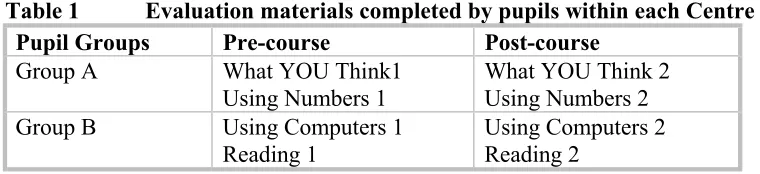
Table 1 Evaluation materials completed by pupils within each Centre
Pupil Groups Pre-course Post-course
Group A What YOU Think1 Using Numbers 1
What YOU Think 2 Using Numbers 2 Group B Using Computers 1
Reading 1
Using Computers 2 Reading 2
Pupils were asked to complete either an attitude questionnaire (‘What YOU Think’) and a numeracy test (‘Using Numbers’) or an ICT skills checklist (‘Using Computers’) and a reading comprehension test (‘Reading’). The instruments were administered twice, once at the beginning and again at the end of the course (parallel versions of the tests were used, so that the pupils did not perform better on the second occasion simply because they had become more familiar with the tests). Each Centre was provided with all four pupil instruments and pupils were included in the analysis for each questionnaire/test instrument if they had completed both the pre- and the post-course versions.
The evaluation also established a control group of 349 pupils, drawn from schools that were sending pupils to four of the Centres in the spring term. The purpose of the control group was to enable comparisons to be made between the progress of pupils attending the Centres and that of similar pupils who had not taken part in Playing for Success. Pupils in the control group were selected to be as similar as possible to pupils attending Playing for Success, and the evaluation instruments were administered to both groups at about the same time (i.e. to coincide with the beginning and end of the course).
1.5 About this report
5
7
2 About the Study Support Centres
This chapter draws on information from the Centre Manager questionnaire, which was sent to the 35 Playing for Success Centres operating in 2001. The survey took place in April and we received completed questionnaires from all 35 Centres.
2.1 Centres’ operation and location
The 35 Playing for Success Centres had been operating for different lengths of time, with the first established in March 1997 and the most recent in May 2001. The majority of Centres (22) had begun taking pupils in or before 1999. Two Centres were still in their pilot stage at the time of the survey.
We asked Centre Managers whether their Centre had begun operating on a pilot basis at first. The majority (26) had done so, but the remaining nine Centres had begun operating without a pilot phase. Those Centres running pilots did so for about eight weeks, on average, although the length of the pilot phase varied considerably, from one to 24 weeks.
Most of the 35 Centres (31) were based in the football club’s stadium. The other four were located elsewhere: one at the club’s training ground, one in a residential house near the ground and two in local schools. Three Centres were in the process of moving from one site to another (for example, during building work at the ground). Two were operating on a split-site basis, including one Centre that was running sessions concurrently at the club and in two local secondary schools.
8
dedicated space (i.e. a space which was not in regular use for other, non-educational purposes).
The responses to this question revealed that 25 of the Centres had their own dedicated space and ten did not. These ten Centres were sharing space with a variety of other users, including the club’s pressroom, a youth club and a room in a school also used for assemblies. One Centre Manager explained that her Centre was used for a number of other purposes: ‘The Centre is located in the north stand, which also houses a business and leisure complex. The football club do not own the stadium. The Centre’s designated room has a shared tenancy with the football club, the rugby club, the council’s leisure services and a limited company... Other activities in the Centre are: meetings, training sessions, stewards’ training and press on match days.’
Once the Centres are established, they have the potential to be used by other groups wishing to access the computer facilities and learning resources. All 35 Centre Mangers were able to identify at least one additional educational use of their Centre, the most common being daytime sessions for local schools (20 Centres). In nine cases, the Centres were used by the football club to educate their youth team (Academy) players, for adult education and/or for community projects. Nine Centres were used to provide for specific groups of ‘at risk’ young people, such as looked-after children, pupils at risk of exclusion from school and young offenders.
Other educational uses, each mentioned by a small minority of Centre Managers, ranged over pupil, teacher and family education courses. These included: literacy and numeracy summer schools; INSET courses for teachers; mentor training; use by the careers’ service; links with local FE colleges to provide facilities for their students; courses for parents of pupils attending the Centre; family literacy/numeracy courses; and use by the football club for training players and stewards.
9
not having their own, dedicated space). Others were newly-established, and were understandably concentrating on Playing for Success in the first few months.
On the other hand, some of the longer-established Centres were being used to the full. The Manager of one such Centre described a rich variety of courses and programmes:
‘[The Centre provides] IT course for PfS parents; PASS project (literacy and IT) with non-PfS pupils during school time; Learning Through Football; CLAIT [computer training courses]; Super Learning Days; Summer School; anti-racism work; maths and literacy “festivals”; revision projects for children in local authority care; New Deal/Gateway courses; Princes Trust; and INSET for local schools. These projects fill the Centre on six mornings and five afternoons per week plus holiday times. This is in addition to the five weekday evenings and Saturday mornings that the Centre is used for Playing for Success’
A second said: ‘Just last term, 1,353 pupils used the Centre as part of a “Crucial Crew” campaign. We hosted 570 pupils on a mini “Cybertour” visit and received a party from Germany and Holland for an afternoon session.’
A third explained that his Centre was in use seven days a week, with 500 pupils each week using the Centre’s facilities during the day.
2.1.1 Operating capacity
10
The questionnaire also asked how many schools and pupils would have attended the Centre during the 2000–1 school year. (Because the questionnaire was sent out in April, Centre Managers were asked to provide projections for the summer term.)
Table 2.1 Number of pupils taking part during 2000–1
Pupils Autumn Spring Summer Total Key Stage 2 2087 2538 2502 7127
Key Stage 3 1606 1830 2124 5560
Total 3693 4368 4626 12687
Based on responses from 35 Centre Managers who completed the questionnaire.
Not all Centres were operating during all three terms. Figures for Summer 2001 are estimates.
The table shows that over 12,600 pupils took part in Playing for Success during the 2000–1 school year and that just over half (56 per cent) of the pupils who attended were of primary-school age. It would be misleading to give an average figure for the number of pupils per Centre, because the circumstances differed so greatly between one Centre and the next. Some Centres were working with small numbers of pupils, for a variety of reasons. A few had only just begun operating or were only able to accommodate small numbers, and some had decided to work intensively with a small group of pupils over a longer period of time. On the other hand, some Centres were aiming to extend the opportunity to as many pupils as possible. The Centre taking the largest number of pupils had provided places for 1,500 during the 2000–1 school year (this Centre’s courses lasted nine hours for primary and 12 hours for secondary pupils).
The number of schools taking part also varied considerably between Centres. Table 2.2 gives the total number of schools served by the 35 Centres in each of the three school terms.
Table 2.2 Number of schools taking part during 2000–1
11
Primary/middle deemed primary
163 181 183
Secondary/middle deemed secondary
92 98 111
Special 6 6 6
Total 261 285 300
Based on responses from 35 Centre Managers who completed the questionnaire.
Not all Centres were operating during all three terms. Figures for Summer 2001 are estimates.
The table shows that between 261 and 300 schools participated in Playing for Success
during each term. All Centres accommodated pupils from both primary and secondary schools. Six Centres took pupils from special schools during any one term (seven Centres took pupils from special schools at some time during 2000–1).
Some Centres worked with the same schools throughout the year, whereas others took pupils from a different group of schools each term. We therefore included a separate question asking Centre Managers to tell us how many schools in total sent pupils to
Playing for Success courses during the current school year. The number of schools working with each Centre ranged from six to 50. In total, the 35 Centres worked with 710 schools during 2000–1.
2.1.2 Year-groups attending Playing for Success
The original intention of Playing for Success was to focus on pupils in Years 6–9, but we were aware that some Centres were taking other year-groups (especially Year 5) in response to local demand. The questionnaire asked which year-groups each Centre took for Playing for Success. The answers to this question are shown in Table 2.3.
Table 2.3 Year-groups attending Playing for Success
12
Year 5 28
Year 6 35
Year 7 29
Year 8 30
Year 9 19
Other year-group 8
Based on responses from 35 Centre Managers who completed the questionnaire. Centre Managers could make more than one response.
The table shows that the most popular year-groups served were Year 6 (all Centres), Year 8 (30 Centres) and Year 7 (29 Centres). In addition, most Centres included pupils in Year 5. Just over half of the Centres took Year 9 pupils.
Centres taking other year-groups were asked to provide further details. From this, it became apparent that six Centres were taking older, KS4 pupils. Two Centres were taking pupils younger than those in Year 5: one Centre was taking pupils in Year 4; another was taking pupils in Year 2.
2.2 Mentors and staffing ratios
Playing for Success Centres are staffed by a Centre Manager, who is a qualified teacher, plus a team of mentors/tutors. Some Centres employ others, such as teachers, mentor coordinators, IT technicians and administrative staff.
We could have asked numerous questions about staffing, but in order to keep the questionnaire to a reasonable length we decided to focus on two main areas of interest: the use of mentors and the ratio of pupils to each adult/mentor.
13
(including those on teacher training courses), sixth form students and secondary school students (sometimes referred to as ‘peer mentors’). A few Centres had recruited business mentors and others had recruited mentors from the football club, including coaches, Academy players and in one case, professional football players. Other sources of mentors mentioned by one or two Centres included: volunteer teachers; learning support staff; youth workers; play workers; parents; retired professionals; and members of the Salvation Army.
Although most Centres had just one or two sources of mentors, one Centre Manager said she used a range of mentors, namely: ‘HE students, Duke of Edinburgh Award students, Queens Guides, Year 11 students (Trident Community Challenge) and Millennium Volunteers.’
Taking into account the presence of mentors and Centre staff, the ratio of pupils to adults/mentors was 4:1, on average, for pupils attending Playing for Success. Although the majority of Centres offered ratios at this level or better, pupil-adult/mentor ratios varied considerably between Centres, from 2:1 to 10:1.
2.2.1 Computer equipment
One of the features of Playing for Success is that the Study Support Centres should be equipped with good computer facilities. The questionnaire asked Centre Managers how many computers were available for use by pupils and whether the computers had internet access. We also asked whether the pupils used Integrated Learning Systems (such as
Plato, Successmaker or Global).
14
In most cases, internet access was available on all the Centre’s computers. Only one Centre had no internet access. Over half (19) of the Centres used Integrated Learning Systems.
2.3 What did the Centres aim to do?
The questionnaire included a section asking Centres about their aims. The national aims of Playing for Success are to provide support for numeracy, literacy, ICT, homework and to improve pupils’ attitudes and motivation. However, Centres do have discretion over the emphasis placed on each of these aims, and some may wish to address additional aims in response to local needs.
A majority of Centre Managers (21) said that they did place emphasis on one particular aspect of Playing for Success. The most common emphasis, mentioned by just under a third of Centre Managers, was on ICT skills. Some said this was the main characteristic of their Centre and others said that it was the principal means of delivering all the other aims. However, some Centre Managers emphasised other areas. For example, five Centre Managers placed the main emphasis on basic skills in literacy and numeracy, and four said they emphasised pupil attitudes and motivation.
When asked whether they had any additional aims, just under a third of Centre Managers said they emphasised building pupils’ self-confidence and self-esteem. Additional aims mentioned by a minority of Centre Managers were: the development of key skills; communication and social skills; and independent learning
2.3.1 Focus within numeracy
15
Managers added comments about their approach to teaching numeracy, for example, about a third said that they used ICT packages to teach numeracy and a few said they used a games-based approach, similar to that used in the National Numeracy Strategy. A few also pointed out that the content of their numeracy programme was tailored to meet the needs identified by individual pupils during a target-setting process.
2.2.2 Focus within literacy
In answer to a similar question about literacy skills, the most common areas identified were writing (17 Centres) and reading (15 Centres). Literacy skills emphasised by a smaller number of Centres included speaking and listening, spelling and research skills. Eight Centre Managers mentioned the use of software packages to teach literacy skills.
2.3.3 Focus within ICT
Two main areas were highlighted in the answers to the question about the Centres’ focus in the area of ICT. These were using the internet (16 Centres) and word processing skills (15 Centres). Other areas mentioned by fewer Centre Managers included email,
Powerpoint presentations, desk-top publishing and spreadsheets. In addition, a few Centre Managers mentioned that pupils gained familiarity with a range of computer programmes and learned how to use CD Roms.
2.3.4 Other areas of the learning programme
16
2.4 Using the environment and medium of
football
We were interested to know how Centre Managers were using the football context within
Playing for Success. All Centre Managers answered this question and each named several ways in which they used the environment and medium of football within their programme. The most common strategies were: to arrange a tour of the football ground (30 Centres); to use football-themed tasks (28); and to enable pupils to meet football players (24). Other strategies reported by fewer Centres included: using the ground for practical tasks; using football-themed software; fantasy football competitions; compiling footballer profiles; and meeting club staff. Four Centre Managers mentioned the use of club merchandise or match tickets as incentives or rewards. Two Centres offered opportunities for pupils to develop football skills.
Some Centre Managers provided further details on how they used football or the club environment as a learning medium. For example, one Centre Manager said: ‘We use the ground and staff as a learning tool when possible, e.g. to interview club staff, such as the Press Officer, on their role in the club. We do ground tours, measure the pitch, use a questionnaire on pitch adverts and do map-work around the ground.’
Another said: ‘Our Centre is very much a football environment – we have an excellent view of the pitch in addition to having club wallpaper. All tasks and activities have a football theme, e.g. Football Challenge, acrostic name poem of a player including similes and alliteration. We have a tour of the ground where we carry out oral literacy and numeracy tasks, in addition to creating follow-up activities. All students get to meet at least one first team player.’
17
example, one Centre Manager explained: ‘We have a Reading Champions scheme which uses one of the first team players to read alongside the children within the Centre.’ Use of the football environment for practical tasks, included: mathematics trails; counting the seats and measuring the pitch; using sales in the shop, restaurant and kiosks for work on numeracy and data handling; use of the football ground for work with a digital camera; and visits to the club’s museum, boardroom or pressroom as the basis for ICT and literacy work.
Centre-based tasks included writing match reports, researching and writing player biographies; compiling a football magazine or match programme; writing letters to players and completing football-related worksheets. Several Centre Managers also mentioned using football-themed tasks as a means of teaching pupils how to search the internet.
2.5 Celebration events
All but one (newly-established) Centre had held a celebration event to congratulate pupils on having completed their course. These were usually held at the end of the course or shortly thereafter, and included the presentation of certificates and prizes. In most cases, celebration events were held at the football club, but a few Centres held their celebratory events in other venues, including schools. One of the three Centre Managers to hold celebration events in schools explained: ‘We have an individual celebration event for every cohort [three schools]. This takes place at the end of the term in the school. It’s seen as an important way of spreading the message that “it’s good to succeed” to other children in the school. Raises the profile of the children and the school. Lots of prizes including a computer donated to each new school in the PfS scheme by our IT sponsor.’
18
attended by others, such as Academy players, sponsors, LEA representatives, Playing for Success mentors and transport staff, the club mascot, VIPs (MPs, the mayor) and members of the local press.
One Centre Manager explained that their celebration event, held in the Premier Suite at the ground, was attended by a wide range of people, including parents, link teachers and headteachers from the participating schools and volunteer mentors. Presentations were made by two first team players. The Centre invited the local press and the club’s media department covered the event for the match day programme.
2.6 Feedback to schools
In the previous evaluation report, feedback about pupil progress had been highlighted as one of the few aspects of the initiative that teachers felt could be improved. For this reason, we listed different kinds of feedback and asked Centre Managers to indicate which they provided for schools. The answers to this question are shown in Table 2.4.
Table 2.4 Type of feedback provided to schools
N
Oral feedback to teachers during the course 33 Oral feedback to teachers at the end of the course 29 Written feedback during the course 17 Written feedback at the end of the course 28
Other forms of feedback 19
Based on responses from 35 Centre Managers who completed the questionnaire. Centre Managers could make more than one response.
19
the course was clearly the most popular method, followed by oral and/or written feedback at the end. Other forms of feedback, mentioned by a minority of Centre Managers included: individual pupil reports and Records of Achievement; a mid-course newsletter; examples of pupils’ work sent to schools at the end of the course; and display boards of work from each school, which were updated on a weekly basis. Three Centres provided schools with a CD Rom containing all their students’ ICT work.
One Centre Manager described her approach as follows: ‘There is a daily link with teachers and parents as the Centre Manager acts as an escort and link person. All children’s work and software is given to the school for display and use. There is a post-course meeting after every cohort and suggestions for further developments are noted.’ Although all Centres offered some kind of feedback, this was clearly an area of development for some. One Centre Manager explained: ‘I regularly talk to contact teachers about attendance and other issues. Written feedback to schools may well be a recommendation from the Centre’s Focus Group.’ Another said: ‘It depends on the school. [We provide] direct [feedback] where possible but this needs improving. It’s part of the current changes.’
2.7 Main achievements during the year
20
2.7.1 Developing the Centre’s programme and facilities
Many of the Centre Managers highlighted achievements related to the Centre’s learning programme and facilities. Thirteen mentioned that they were participating in the Quality in Study Support (QISS) accreditation scheme, which requires study support Centres to document that they meet a set of quality criteria.
Some Centre Managers provided more detail of improvements to their learning programme. These included the development of learning activities; designing a project for pupils using digital cameras and scanners; and the creation of a ‘paperless’ learning environment. One Centre had developed a ‘follow-up’ programme for pupils to use after they had attended Playing for Success. In addition, a few Centre Managers mentioned achievements in developing their records of progress and evaluation systems.
Several Centre Managers had expanded their provision, either as part of Playing for Success and/or for other users. For newly-established Centres, this was a natural expansion to enable fuller use of the Centre. For example, one Centre Manager reported the: ‘Successful roll out after initial pilot from 12 schools to approx. 30 per week.’ Others were able to expand because their Centre had been redeveloped or relocated. One Centre Manager explained that his Centre, which had occupied various rooms in the football ground since its establishment in 1997, had benefited greatly from the redevelopment of the club’s main stand. The Centre now comprised a: ‘State of the art, ICT-focused Learning Centre’, representing an investment of £1.6 million. Another Centre Manager reported that the Playing for Success Centre had moved to a new location and its original premises had been developed into an additional Study Support Centre for local schools.
21
2.7.2 Pupils’ responses to the learning programme
Centre Managers mentioned pupils’ reactions to the learning programme as one of their main achievements of the year. This was evident in the pupils’ enjoyment of the activities, the quality of their work and improvements in self-confidence. As one Manager of a new Centre said: ‘It’s early days, but 100 per cent of pupils say they are more confident learners as a result of attending the Centre.’ Another highlighted: ‘The achievements with the pupils we work with – to see their increased confidence and the progress they have made while with us.’
Several Centre Managers pointed to high attendance levels as an indicator of success. Pupils attend Playing for Success voluntarily, giving up their free time to do so, and have to travel to reach the Centres. Therefore if the Centre were not providing a rewarding experience, this would soon be reflected in the level of pupil attendance and the demand for further places. One Centre Manager wrote: ‘The average attendance over two years has been 95 per cent (98 per cent and 96 per cent for the last two cohorts).’ Another said: ‘Average attendance over two years has been 95 per cent.’ A third pointed out that their Centre had: ‘100 per cent of pupils wanting to return.’
2.7.3 Staff recruitment and development
22
2.7.4 Raising the Centre’s profile
Developing the Centre’s identity and raising its profile were major achievements noted by some. For newly-established Centres, a well-publicised launch provided a real boost. For example, one Centre Manager highlighted recorded one of the main achievements as: ‘Holding a high profile launch with the Secretaries of State for Education and Employment and for Culture, Media and Sport.’ Another spoke of the Centre’s ‘Successful official opening with first team players, DfES, the MEP, LEA and club representatives’.
Some of the more established Centres reported that their work had gained local recognition as a focus for innovation and development. One Centre Manager reported that his Centre had achieved: ‘Recognition throughout the city that the Centre is helping pupils develop and improve literacy and numeracy and ICT skills in a fun and innovative way.’ Another reported that during 2000–1, his Centre had: ‘Extended and reinforced our lasting impact within the LEA by developing new, innovative and cutting-edge projects which have never been established before.’
2.7.5 Relationships with stakeholders
Centre Managers mentioned achievements in the area of relationships with the key stakeholders, namely: schools, parents, the football club, the LEA, sponsors and other partners. Positive feedback from schools and an increased demand to take part were important indicators to Centres that they were getting it right. For example, one Centre Manager said: ‘All the primary schools who have attended wish to repeat and there is a waiting list.’ Another reported that the “most improved primary school in the LEA” had sent pupils to the Centre. This had provided the pupils with a: ‘Big boost and changed their attitude. It led to a vast improvement in SATs results, well over their original expectations.’
23
and increased player involvement. A few mentioned their relationships with the LEA. For example, one Centre Manager noted that: ‘In addition to positive letters from headteachers we have received a very positive letter from the Director of Education at the City Council.’
2.8 Future developments for the Centres
The questionnaire asked Centre Managers to outline their plans for the future development of their Centre, both as part of Playing for Success and for other initiatives. The Centre Managers reported a wide range of development plans as part of Playing for Success, most commonly focusing on the development of the Centre, its facilities, programme and staffing. For example, 11 Centre Managers outlined building improvements or plans to move to new premises and nine mentioned expansion or upgrading of the Centre’s computer equipment. Nine respondents outlined plans to develop their teaching and learning programme and seven Centres reported plans to recruit extra staff (especially teaching staff).
Several of the Centre Managers’ plans focused on consolidation of the Centre’s position (with the club and local schools) as well as creating links with new partners such as schools that had not yet used the Centre, universities and other Centre Managers.
Some of the more established Centre Managers were in a good position to think strategically and plan for the future viability of the Centre in the longer-term. For example, one Centre was planning a network of remote links with schools and other Centres ‘in order to sustain the impetus and share resources’. Similarly, another was planning to: ‘Explore the area of outreach using the Study Centre website to post projects.’ One Centre Manager had established the Centre as a limited company with charitable status, to ensure its financial security and independence from the club.
24
section related to pupil/student involvement with the Centre’s development. Two Centres mentioned work in this area in particular, one of which had set up a students’ panel and the other had established a ‘Focus Group’ to consider the work of the Centre. This latter group included pupil representatives alongside parents, teachers, the FE college, and a representative from the sponsoring company.
Other developments tended to focus on an expansion in the use of the Centre. For example, 15 Centres were planning to extend daytime use for local schools, six planned to offer summer schools and five hoped for greater use by the community. Nine Centre Mangers said they were working on fundraising and were attempting to attract more sponsorship in future.
2.9 Summary: About the Study Support Centres
The information in this chapter is based on questionnaire returns from the 35 Playing for Success Centres operating in April 2000.
Operation and location
• The majority (31) Centres were based at the football club’s stadium and 25 had their own, dedicated space.
• All 35 Centres were being used for other educational purposes, especially daytime sessions for local schools.
• Although Centres varied considerably in their operating capacity, the ‘typical’ Centre took pupils for Playing for Success on four days a week, for a total of 20 hours. Most Centres ran two sessions each evening and could accommodate about 20 pupils per session.
25
Mentors, staffing ratios and computers
• All but one of the Centres used mentors for Playing for Success. The most common sources of mentors were students from higher education courses, sixth-formers and secondary school students. A few recruited mentors from the football club.
• The average ratio of pupils to mentors and staff was 4:1.
• On average, Centres had 18 computers available for pupils to use. Most had internet access available on all computers and 19 Centres used Integrated Learning Systems.
Centres’ aims
• Most Centre Managers said they had a particular emphasis within the aims of Playing for Success. About a third emphasised ICT skills, whereas others aimed to develop pupils’ basic skills or to improve their attitudes and motivation.
• Computation and mental arithmetic were the main areas addressed within numeracy. In literacy, Centres tended to emphasise writing and reading skills. The focus within ICT was on using the internet and developing word processing skills.
• Teamwork, communication skills and independent learning were each emphasised by a number of Centres.
Using the environment and medium of football
• Centre Managers used the football context in a variety of ways. Most courses included a tour of the ground, the use of football-themed learning tasks and opportunities for pupils to meet players and club employees.
• Players were most commonly involved during celebration events, which were held at the end of the course.
Feedback to schools
• All Centre Managers provided some kind of feedback to schools about their pupils’ progress. Most gave oral feedback to teachers during and/or at the end of the course. Written feedback was usually provided at the end of the course.
26
Achievements and future developments
• The Centre Managers’ main achievements related to five main areas: developing the Centre’s programme and facilities; receiving positive responses from pupils; recruiting and developing staff; raising the Centre’s profile; and developing positive relationships with stakeholders.
27
3 Who
attends
Playing for Success?
This section describes the pupils who attended Playing for Success Study Support Centres in terms of how they were selected, and their characteristics such as year group and gender. We also consider the pupils’ rates of attendance at the Centres and the extent of pupils’ interest in football.
Most of the information summarised here was provided by Centre Managers with the help of the schools sending pupils to the Centres. Some of the information came from link teachers at the schools taking part in Playing for Success, and some came from the pupils themselves.
The sample comprised 27 out of the total of 35 Centres. Eight Centres were unable to take part in the evaluation due to a range of reasons. For example, several were still in their pilot phase. One Centre was in the middle of redecoration, another was reorganising the programme, and the Centre Manager of a third was unable to take part due to personal circumstances.
3.1 Pupil selection
28
Questionnaires were sent to the PfS link teacher at each school. The majority of the questionnaires received from primary schools were completed by head and deputy head teachers, compared with only 11 per cent of responses from secondary schools. Responses from secondary schools were completed by people holding a range of different posts, including heads of year, Special Educational Needs Co-ordinators and other teachers.
Pupils were nominated by their schools to attend Playing for Success. However, we
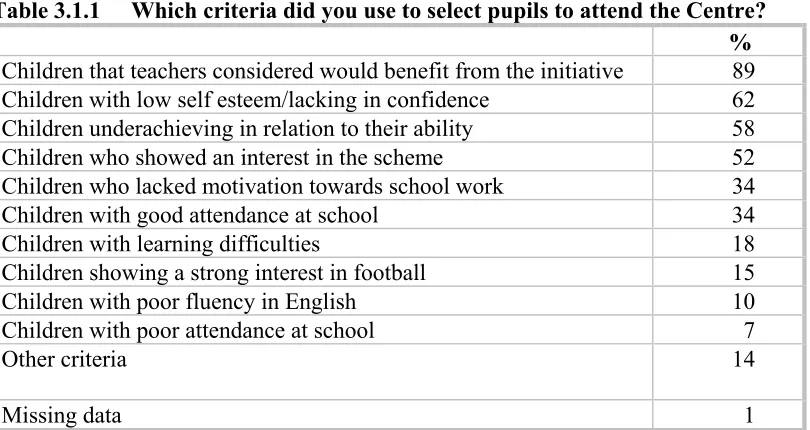
should explain that attendance was voluntary − pupils had a choice of whether or not they wanted to take up the offer of a place. Centres provided their own individual guidelines to schools about pupil selection, but in most cases, schools had a considerable degree of discretion. Link teachers were asked a series of closed questions about the criteria used in selecting pupils to attend Playing for Success. A number of possible criteria were listed, and teachers were invited to add any others that they had used. The most frequent responses are given in Table 3.1.1
Table 3.1.1 Which criteria did you use to select pupils to attend the Centre? %
Children that teachers considered would benefit from the initiative 89 Children with low self esteem/lacking in confidence 62 Children underachieving in relation to their ability 58 Children who showed an interest in the scheme 52 Children who lacked motivation towards school work 34 Children with good attendance at school 34
Children with learning difficulties 18
Children showing a strong interest in football 15 Children with poor fluency in English 10 Children with poor attendance at school 7
Other criteria 14
Missing data 1
Based on responses from 107 schools. Percentages do not add to 100 because teachers could make more than one response.
[image:36.595.92.497.436.651.2]29
pupils who they considered would benefit. Almost 90 per cent of all teachers used this broad category in their selection process. Selecting pupils with low self-esteem was the second most frequently used criterion employed by teachers.
Almost sixty per cent of the teachers selected pupils to attend Playing for Success who they considered to be underachieving in relation to their ability. Although many teachers wrote of the advantages of the scheme for low-achievers, not all selected pupils in this category. One teacher explained: ‘We targeted gifted and talented youngsters to offer after-school benefit.’
More than half of the teachers considered the level of interest the children themselves showed in the scheme. In their questionnaire responses, some teachers referred to the reputation already developed by the Centres and the positive reactions of previous attendees. As one teacher said: ‘The children who have attended over the last three years are so positive and enthusiastic about the Centre.’
The results show that 15 per cent of teachers considered pupils’ strong interest in football when selecting pupils for Playing for Success. However, this was not usually the sole criterion, but was used in conjunction with at least three or four others.
30
3.2 The pupils attending
Playing for Success
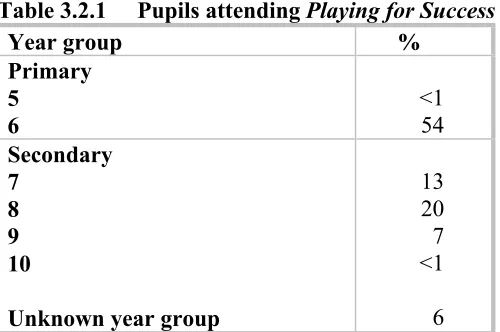
The Centre Managers, with the help of schools, provided a range of information about pupils attending the Centres during the evaluation period. The Centres provided information on a total of 2,095 pupils: 56 per cent of these were in Key Stage 2 and 44 per cent in Key Stage 3. Table 3.2.1 shows the year groups of the pupils on whom data were collected during the spring term 2001.
Table 3.2.1 Pupils attending Playing for Success
Year group %
Primary 5
6
<1 54
Secondary 7
8 9 10
Unknown year group
13 20 7 <1
6
Based on responses from 2,095 pupils. Percentages may not sum to 100 because of rounding.
The table shows that more than half of the pupils who took part in the evaluation were in Year 6. Some Centres took groups of Year 5 pupils (who were not eligible to take part in the evaluation). The actual numbers of Year 5 pupils who took part in Playing for Success during the spring term are therefore unknown. At secondary level, a range of year groups participated, most commonly Year 8. Small numbers of Year 10 pupils also took part.
Table 3.2.2 shows some of the other characteristics of pupils attending Playing for Success.
[image:38.595.89.339.261.427.2]31
Key Stage
2 3 Total
Variable Category % % %
Gender Male Female unknown 52 46 2 55 44 2 53 45 2 Special Educational Needs No SEN
Pupils with SEN (concern identified)
Pupils with SEN (statement) unknown 25 7 <1 67 24 8 2 66 25 7 1 67 Free School Meals Entitled to FSM
Not entitled to FSM unknown 16 29 55 10 31 60 13 30 57 Ethnicity White Non-White unknown 54 12 33 63 8 29 58 10 32 English Language English first language
English not first language unknown 42 4 54 41 3 56 42 4 55
Based on responses from 1,176 KS2 and 919 KS3 pupils. Percentages may not sum to 100 because of rounding.
This table shows that slightly more boys than girls were attending the 27 Centres, and that this difference was slightly greater at Key Stage 3 than 2.
We were interested to find out about other characteristics of the pupils, such as whether they had special needs, were entitled to free school meals, their ethnic background and fluency in English. These details were gathered by the Centres from the schools. Some Centre Managers had difficulty in obtaining the more detailed background information from their partner schools, and consequently there is a large amount of missing data.
It is disappointing that there is a high proportion of pupils for whom Centres were unable to establish whether or not they had special educational needs. However, it is clear that over seven per cent of the pupils attending the Centres had special educational needs.
32
details about entitlement to free school meals were unavailable for more than half of the pupils. This makes it difficult to interpret the information in Table 3.2.2.
Overall, twelve per cent of pupils were identified as being from non-White backgrounds. Due to the low proportion of pupils from different ethnic backgrounds, we were forced to adopt a fairly crude category of ‘non-White’ in our analysis of the impact of ethnic differences. The non-White pupils came from a variety of ethnic backgrounds, with the largest proportion being Pakistani. There were smaller numbers from Bangladeshi and Black Caribbean backgrounds.
33
3.3 Pupils’ attendance at
Playing for Success
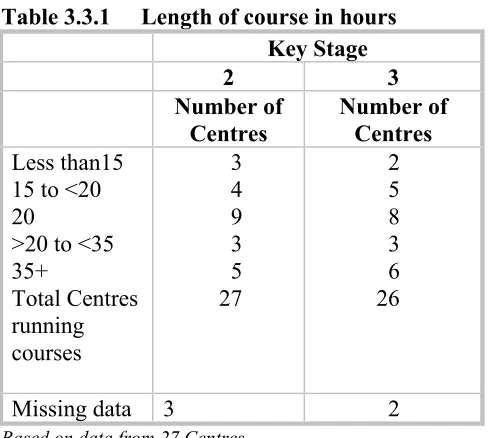
Table 3.3.1 shows the length of course offered by the 27 participating Centres.
Table 3.3.1 Length of course in hours
Key Stage
2 3
Number of
Centres
Number of Centres
Less than15 15 to <20 20
>20 to <35 35+
Total Centres running courses
3 4 9 3 5 27
2 5 8 3 6 26
Missing data 3 2
Based on data from 27 Centres.
The table shows that 20 hours was the most commonly used course length for both primary and secondary pupils, and that almost half of the courses were between fifteen and twenty hours long. Although Centres tended to offer the same length of course to all pupils, there were some differences within Centres between groups attending on different days of the week, and the length of course was also sometimes affected by match fixtures, staff illness and other events.
[image:41.595.87.332.166.385.2]34
Table 3.3.2 Pupils’ attendance at the Centres
Key Stage Key Stage
2 3 Total
Variable Category % % %
Length of course (hours)
Less than 15 15–<20 20 21–<35 35+ 19 23 31 4 23 25 13 29 17 17 22 18 30 10 20 Percentage of
course attended per pupil
Up to 50 per cent 55 to 75 per cent 80 to 95 per cent 100 per cent per cent of course attendance data missing
5 6 29 35 26 10 9 28 26 26 7 7 28 31 26
Based on responses from 2,095 pupils. Percentages may not sum to 100 because of rounding.
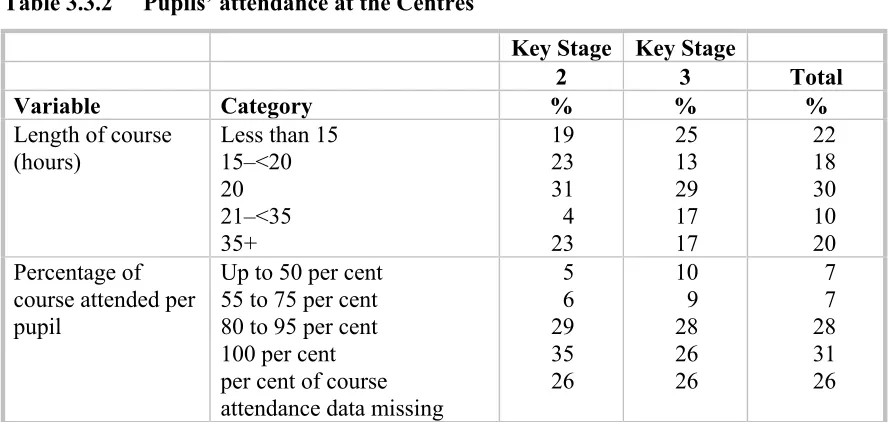
The table shows that most pupils attended courses of 20 hours or less. The results showing pupils’ attendance at the Centres are difficult to interpret due to the fact that over a quarter of the relevant data is missing. However, the table shows that almost a third of all pupils who participated in Playing for Success attended 100 per cent of the course. The majority (59 per cent) attended for at least 80 per cent of the course. At first sight, these attendance figures appear to compare somewhat unfavourably with last year, when 78 per cent of pupils were shown to have attended at least 80 per cent of the course. However, the difference can be explained by the large amount of missing data this year (26 per cent), compared with only five per cent last year.
[image:42.595.86.531.112.323.2]35
3.4 Pupils’ interest in football
[image:43.595.88.525.325.526.2]We wanted to know whether pupils attending Playing for Success were interested in football. We included a question on this in the pupil attitude questionnaire ‘What YOU Think’. The questionnaire was completed by approximately a third of pupils attending the Centres. The question asked pupils whether or not they were interested in football (yes, no, not sure), and if yes, which team they supported. We were then able to work out whether pupils supported their Centre’s team. Table 3.4.1 shows the level of interest in football among pupils attending Playing for Success. It is based on the answers from 737 pupils who completed both pre- and post-course questionnaires.
Table 3.4.1: Pupils’ interest in football before attending Playing for Success
Support Centre team Support another team Not interested in football/ not sure No response % % % %
Key Stage KS2 KS3 35 35 40 35 23 25 2 5 Gender Boys Girls 39 31 45 29 12 39 4 2 Ethnicity White Non-White Ethnicity data missing 40 32 22 30 47 54 26 19 20 3 3 4
Total All pupils 35 38 24 3
Based on responses from 737 pupils attending Playing for Success. Percentages may not sum to 100 because of rounding. Results are based on pupils with pre-and post-course questionnaires.
Table 3.4.1 shows a very high level of interest in football among pupils who attended Playing for Success. More than 70 per cent of pupils expressed an interest in football at the beginning of the course.
36
boys and girls is in contrast to the results from the previous year’s evaluation, when levels of interest in football between girls and boys were found to be almost the same.
This year we asked pupils about their interest in football in the post-course, as well as in the pre-course, questionnaire. Comparing pupils’ answers on these two occasions, we found that the only difference was that there was a very slight increase in pupils’ support for the Centre team after attending Playing for Success. Overall levels of interest in football remained almost the same.
3.5 Summary: Who attends
Playing for Success?
This chapter has looked at the ways in which pupils were selected to attend Playing for Success, and has described the pupils attending in terms of a number of background characteristics. It has also considered attendance rates and reported pupils’ level of interest in football.
Selection for Playing for Success
• One hundred and seven teachers from different schools completed the school questionnaire.
• Schools typically used three or four criteria when selecting pupils to attend PfS.
• Teachers most commonly selected pupils they considered would benefit from the initiative. A high proportion of teachers also selected pupils with low self-esteem, and children underachieving in relation to their ability.
• More than half of the schools considered the level of interest the children themselves showed in the scheme during the selection process.
• As found in the previous year’s evaluation, more than half of all teachers used assessment results as part of the selection process.
Characteristics of pupils attending the Centres
37
pupils were in Year 6. Among secondary school pupils, the majority of pupils were in Year 8.
• As last year, slightly more boys than girls attended the Centres.
• Unfortunately large quantities of pupil background were missing. This particularly affected information on special educational needs, whether pupils were eligible for free school meals, their ethnicity and whether English was an additional language. Meaningful analysis of these data is therefore very difficult. However, we do know that at least seven per cent of the pupils attending PfS had special educational needs.
Rates and length of attendance
• Most of courses offered were 20 hours in length.
• The majority of pupils (59 per cent) attended for at least 80 per cent of the course.
• There was a significant difference in attendance between KS2 and KS3 pupils. Ten per cent of KS3 pupils attended for less than 50 per cent of the course, compared with only five per cent of KS2 pupils.
• Pupils in KS2 were also significantly more likely to attend 100 per cent of the course compared with pupils in KS3.
Support for football
• The majority (73 per cent) of pupils attending the Centres said that they were interested in football at the pre-course stage. Just over a third supported the club where the Centre was located.
39
4 Expectations and experiences of
Playing for Success
This section reports information on the expectations and experiences of Playing for
Success from the point of view of parents, schools and the pupils themselves.
4.1 What pupils thought of the Centre
The pupil attitude questionnaire (‘What YOU think’) was completed by approximately a third of the pupils at the beginning and end of their courses. The information below is based on the 737 pupils who attended the Centres and completed both pre- and post-course questionnaires.
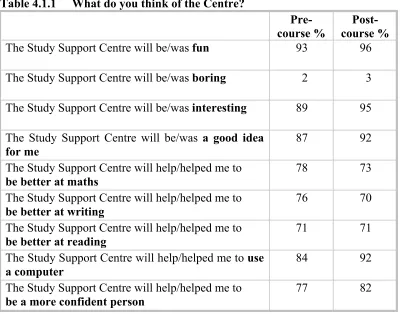
Table 4.1.1 shows pupils’ responses to a series of ‘closed’ questions about the Study Support Centre. The questionnaire invited pupils to give one of three responses to each item (yes, not sure, no). As most of the pupils had strong opinions on these items, we have chosen to report the percentage of pupils answering ‘yes’ to each item.
Table 4.1.1 What do you think of the Centre?
Pre-course % course %
Post-The Study Support Centre will be/was fun 93 96
The Study Support Centre will be/was boring 2 3
The Study Support Centre will be/was interesting 89 95
The Study Support Centre will be/was a good idea
for me
87 92
The Study Support Centre will help/helped me to
bebetter at maths
78 73
The Study Support Centre will help/helped me to
bebetter at writing
76 70
The Study Support Centre will help/helped me to
bebetter at reading
71 71
The Study Support Centre will help/helped me to use
a computer
84 92
The Study Support Centre will help/helped me to
be a more confident person
77 82
[image:47.595.90.490.445.759.2]40
The table shows that at the outset of the course, pupils had very high expectations of
Playing for Success, and that the Centres lived up to their expectations in providing an enjoyable and interesting experience. Levels of pupils’ satisfaction shown in the courses they attended were even higher than those achieved in the Centres last year. At the end of the course, for example, 96 per cent considered the Centre to be ‘fun’; 95 per cent considered it to be ‘interesting’ and 92 per cent thought it was ‘a good idea for me’. More than 80 per cent of the pupils felt that the Centre had helped them to become more self-confident.
Pupils also had very high expectations in terms of helping their learning. At the beginning of the course, at least 70 per cent of pupils expected their numeracy,
reading, writing and computer skills to be developed by attending Playing for
Success. After the course, the pupils’ judgements were not always quite as positive as their expectations at the beginning. There were two examples of this regarding improvements in mathematics and writing. Nevertheless, overall levels of satisfaction were extremely high. Seventy per cent or more of the pupils felt that their numeracy, writing and reading skills had been improved, and over 90 per cent thought that their computer skills had been improved by attending Playing for Success.
Patterns of expectations and experiences were very similar across Key Stage, gender and ethnic groupings. The only exception to this was that Key Stage 2 pupils were
significantly more likely to think that Playing for Success had helped them improve
their numeracy skills than were pupils at Key Stage 3 (p<0.05).
41
Table 4.1.2 How else would you like/did the Study Support Centre help you?
Pre-course %
Post-course %
Develop computer/internet skills 27 46
Improve literacy 25 19
Improve numeracy 18 16
Develop interpersonal skills 6 12
Boost self-confidence 7 11
No response 19 12
Based on responses from 737 pupils who completed both pre- and post-course questionnaires. Percentages may sum to more than 100 because pupils could make more than one response.
The table shows that the expectation held most frequently by pupils at the beginning of the course was that the Centre would help them to develop their computer/internet skills. While at the beginning of the course, just over a quarter of the pupils wanted the Centre to help them develop their IT skills, at the end of the course almost half of the pupils wrote a specific comment about the fact that the Centre had helped them in this respect.
At the beginning of the course, 25 per cent of all pupils said that they hoped that the Centre would help them improve their literacy skills and 18 per cent said that they would like help with their numeracy. At the end of the course, similar numbers of pupils felt that they had been helped in these areas. Many of the pupils’ comments suggested that the Centre had supported their learning in multiple ways. For example one pupil wrote that the Centre had helped her to ‘write my essays, learn how to use a computer and finally learn how to do fractions’.
Some pupils emphasised the way in which the Centre had given them the opportunity to develop personal and social skills, for example to ‘get along with other people from different schools,’ ‘make friends with other people quickly’ and ‘work in teams with other people’. Eleven per cent of the pupils referred to their increased levels of
confidence after attending the course. Typical comments included: ‘[The Centre
[image:49.595.92.493.71.297.2]42
‘give things a try, because at some time in your life you’re bound to make a mistake, so why not give it a go?’
4.1.1
What pupils liked most about the Study Support Centre
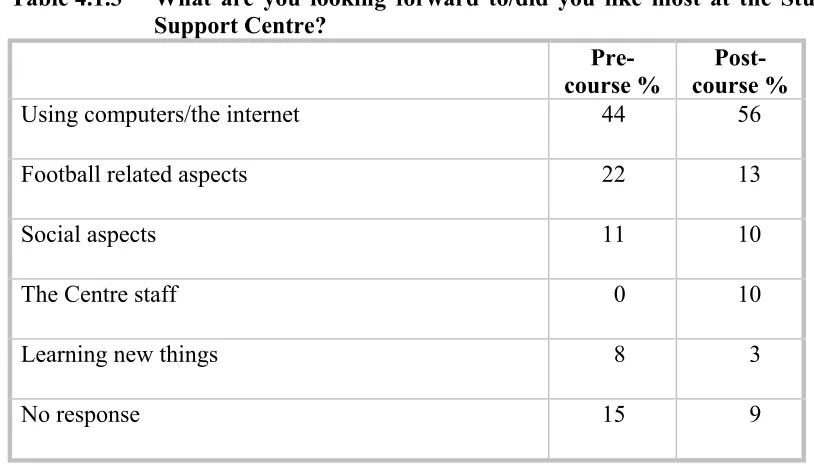
The final question in the pre-course questionnaire asked pupils what they were looking forward to most at the Study Support Centre. The parallel question in the post-course questionnaire asked pupils what they had liked most at the Centre. Pupils’ answers to these open-ended questions are shown in Table 4.1.3.
Table 4.1.3 What are you looking forward to/did you like most at the Study Support Centre?
Pre-course %
Post-course %
Using computers/the internet 44 56
Football related aspects 22 13
Social aspects 11 10
The Centre staff 0 10
Learning new things 8 3
No response 15 9
Based on responses from 737 pupils who completed both pre- and post-course questionnaires. Percentages may sum to more than 100 because pupils could make more than one response.
The questionnaire responses from pupils attending Playing for Success once again
highlight pupils’ interest in using computers and the internet, both before and after the course. More than half of the pupils who attended Playing for Success listed these as aspects of the Study Support Centre that they had enjoyed most.
At the beginning of the course, 22 per cent of the pupils singled out football-related aspect