CPU Child Poverty Pilots
Interim synthesis report
by Martin Evans and Karen Gardiner
CPU Child P
ov
erty P
ilo
ch r
eport no. 730
ts: In
terim syn
thesis r
eport
d by the
ment for
011
wp.gov.uk
h report n
Publishe
Depart
March 2
www.d
Researc
livery evidence, and explorees. lutions;
of pilot servic
y Unit.
ch, please contact: Management Team, Sheffield, S1 2GQ. p
o
, s s
ert
ear dge eet .as v
r x d
n o i
s
fol s the lo
Work and Pensions
o. 730
makers at national and local level.The report focuses on implementation and de wing cross-cutting themes:
• pilot participants;
• developing tailored, innovative and localise • early indications, experiences and percept
The report was commissioned by the Child Po
CPU Child Poverty Pilots
Interim synthesis report
Martin Evans and Karen Gardiner
or write to the Information Policy Team, The National Archives, Kew, London TW9 4DU, or email: [email protected].
This document/publication is also available on our website at: http://research.dwp.gov.uk/asd/asd5/rrs-index.asp
Any enquiries regarding this document/publication should be sent to us at:
Department for Work and Pensions, Commercial Support and Knowledge Management Team, Upper Ground Floor, Steel City House, West Street, Sheffield S1 2GQ
First published 2011.
ISBN 978 1 84712 954 3
Contents
The Authors ... viii
Glossary of terms ... ix
Summary ...1
Chapter 1 Introduction ...7
1.1 Background to the Child Poverty Pilots Programme ...7
1.2 Aims ...7
1.3 Policy context ...9
1.4 Content ... 10
1.5 Structure ... 11
2 Overviews of the Child Poverty Pilots ... 12
2.1 Introduction ... 12
2.2 Childcare Affordability Pilot: HMRC operated ... 13
2.3 Childcare Affordability Pilot: London Development Agency ... 14
2.4 Child Development Grant ... 15
2.5 Child Poverty Family Intervention ... 16
2.6 Coordinated Support for Separating Parents ... 17
2.7 HMRC Outreach in Children’s Centres ... 18
2.8 Local Authority Innovation ... 19
2.9 School Gates Employment Support ... 20
2.10 Supported Housing for Teenage Parents ... 21
2.11 Work-Focused Services in Children’s Centres ... 22
3 Pilot participants ... 23
3.1 Introduction ... 23
3.2 Pilot focus ... 23
3.2.1
Pilots by employment focus and age of child ... 24
3.2.2
Who is participating in the pilots? ... 24
3.3 Pilot populations and participants ... 28
3.4 Summary ... 30
4 Developing tailored, innovative and localised solutions ... 32
4.1 Pilot delivery models ... 32
4.1.1
Vertical Integration Models ... 32
4.1.2
Local Horizontal Integration Models ... 33
4.2 Emerging evidence on set-up and implementation of new pilot services ... 34
4.2.1
Set-up of pilot services ... 34
4.2.2
Challenges to partnership working ... 36
4.3 Gains and costs of integrated working ... 37
4.4 Engaging clients effectively ... 37
4.5 Lessons learnt from different delivery models... 38
4.5.1
Outreach ... 38
4.5.2
Co-location ... 40
4.6 Summary ... 41
5 Early indications of outcomes, experiences and perceptions of pilot services ... 42
5.1 Child Development Grants ... 42
5.2 Child Poverty Family Intervention ... 43
5.3 Co-ordinated Services for Separating Parents ... 43
5.4 Local Authority Innovation Pilots ... 43
5.5 Supported Housing for Teenage Parents ... 44
5.6 Work-focused Services in Children’s Centres ... 45
5.7 Summary ... 46
6 Synthesising evaluation evidence ... 47
6.1 Synthesising evaluation evidence across the Child Poverty Pilot Programme ... 47
6.2 Interim consideration of evaluation issues for pilots based
in Children’s Centres ... 49
problems to apply findings from the pilot sites to the more general
population of poor children? ... 55
6.2.3
How can pilot findings be interpreted and programmes replicated
to future more restrictive ‘pro-poor’ targeting of Children’s
Centres services? ... 57
6.3 Summary ... 58
7 Content of the final synthesis report... 59
7.1 Child Poverty Building Blocks ... 59
7.1.1
Employment and skills ... 59
7.1.2
Financial support ... 60
7.1.3
Families and life chances ... 60
7.1.4
Place and delivery ... 60
7.2 Costs and cost-effectiveness ... 61
Appendix A Summary of pilot evaluation methodology ... 62
Appendix B Overview of the interim evaluation findings ... 72
Appendix C Geographical overview of pilots locations ... 90
List of tables
Table 1.1
Child Poverty Building Blocks and Pilots ...8
Table 1.2
Revisions to pilots ...9
Table 3.1
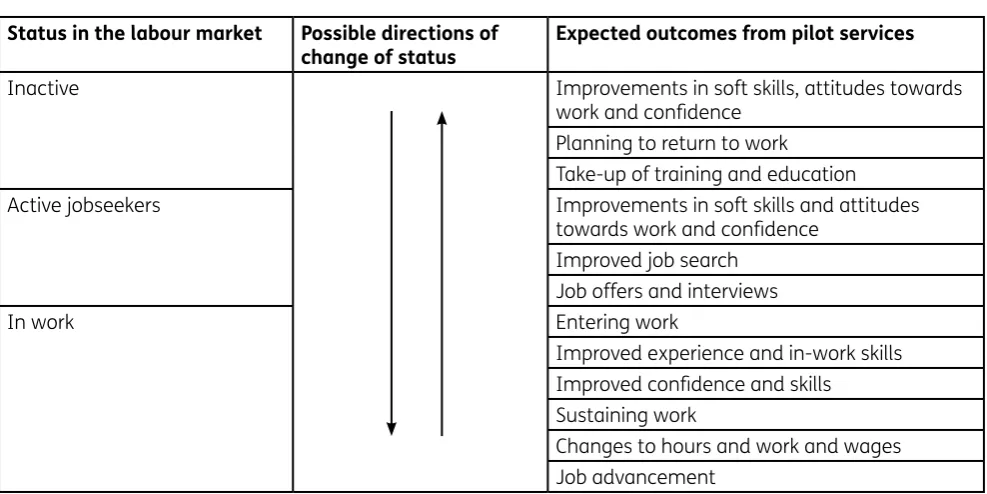
Expected employment outcomes 27
Table 6.1
Characteristics of those who are not aware of Children’s Centres (CC) ... 51
Table 6.2
Characteristics of those who are aware of Children’s Centres (CC)
but do not use their services ... 52
Table 6. 3
Characteristics of those who use Children’s Centres ... 54
Table C.1
Geographical overview of pilots locations ... 91
List of figures
Figure 1
The Child Poverty Pilots Programme ...6
Figure 3.1
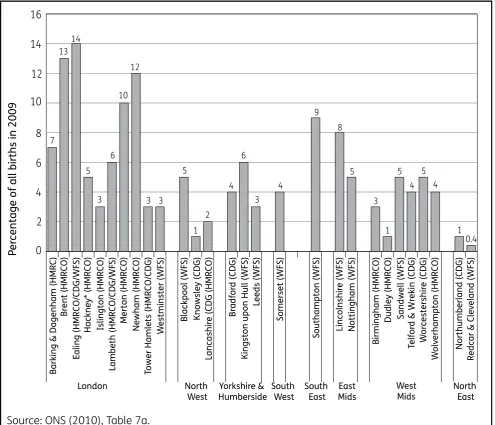
Proportion of Births in 2009 to Mothers born outside UK in Authorities
in which Children’s Centre-based Child Poverty Pilots are in place ... 30
Figure 5.1
Expected Difference that Teenage Parent Supported Housing will make
in the lives of participants and their children ... 45
Figure 6.1
Births to mothers born in new EU countries in 2009 in local authorities
The Authors
Martin Evans is a Senior Research Fellow in the Oxford Institute of Social Policy (OISP) based in the
Department of Social Policy and Social Work, University of Oxford. All correspondence to [email protected]
Glossary of terms
The various Child Poverty Pilot evaluations vary in approach, from randomised ‘impact evaluations’ to more descriptive ‘before and after’ studies. There is a resulting difference in terminology used in reports that is both inconsistent and potentially confusing. In line with the approaches laid out for economic evaluation of policy (HM Treasury Greenbook), we adopt the following set of definitions of terms:
Generalisability The ability to draw conclusions from the outcome evidence
(primarily impacts) so that the findings would apply in other circumstances other than the pilot. For instance, in other locations and points in time, or with different economic circumstances and population characteristics, or where change of wider policy environment may mean that the impact is likely to be different.
Impact An ‘outcome’ that has been established as caused by the
intervention (usually identified against a counterfactual where no intervention is in place or through the use of statistical controls for other confounding factors). Impacts can also be called, ‘additionality’. Examples of impacts: the difference between the treatment group and control in programme outcomes, ‘difference in differences’– a statistically estimated treatment effect. An example of an outcome that is not an ‘impact’: increased level of job entry at pilot location that results from changes in local economic demand rather than intervention itself.
Inputs The resources allocated to the pilot (staff time, budget
allocation, buildings and premises, promotion).
Outcome A measured effect associated with a pilot intervention (which
may or may not be causally related to intervention), e.g. increased use of childcare.
Outputs What the pilot produces that is not an effect: number of
treatments, caseload, staff ratios.
Process evaluation The evaluation of changes in delivery and working practices
rather than the evaluation of effects of policy change on participants’ behaviour.
Replicability A finding that implementation of the intervention would be
feasible, a requirement for wider roll-out of programme. For instance, the underlying assumptions on ‘mandation’ and public service provision, substitution for local funding for third sector organisations.
Treatment The policy change (or rule change) provided in the pilot that is
Summary
Introduction
A suite of nine Child Poverty Pilots have been operating across England since 2008, with over a third of local authorities (LAs) involved with at least one of the initiatives1. The pilots represent a large and
varied set of policy interventions, with each pilot testing a range of different approaches to reducing child poverty. There is also diversity in terms of the client group the pilots engage with, for example, some have a whole community focus, whilst others target families and/or specific vulnerable groups or individuals. The diverse nature of the pilots reflects the complex, cross-cutting and multi-faceted nature of child poverty as well as the different ways in which services are shaped in local areas to meet the needs of their populations.
The aim of this report is to bring together information from each of the pilots, to maximise
comparisons across the evaluation evidence base, and to draw out key findings relevant for policy makers and practitioners at national and local level. Additional analysis has been conducted to strengthen the evidence base.
This interim report mainly focuses on implementation and pilot delivery evidence, and explores the following cross-cutting pilot themes:
• pilot participants;
• developing tailored, innovative and localised solutions;
• early indications of outcomes, experiences and perceptions of pilot services.
It is hoped that the evidence base from the Child Poverty Pilots in conjunction with other relevant poverty related reviews and reports, e.g. Review on Poverty and Life Chances led by Frank Field MP, the Early Intervention Review led by Graham Allen MP and the work conducted by the Centre for Excellence and Outcomes (C4EO) and Local Government Improvement and Development (LGID) can help shape Child Poverty strategies at both national and local level. The Child Poverty Act, which received Royal Assent on 25 March 2010, creates the framework to address child poverty at national and local level. The Act requires local areas and named partners to work together to undertake a Child Poverty Needs Assessment and to produce a Child Poverty Strategy.
Pilot context
The nine pilots are testing a range of key challenges across adult skills, employment, childcare, family intervention, the take up of services and local delivery. They reflect a good geographical mix, covering inner city, rural, urban and suburban areas. They are also testing a range of delivery mechanisms that includes the use of the Voluntary and Community Sector. Although established under the previous administration, the pilots provide valuable evidence and learning for the priorities of the Coalition Government. Links have been made in this report to demonstrate where this is the case. Of the nine pilots funded, Coalition Ministers decided that six should continue without changes to pilot delivery or evaluation design.
particularly in the current fiscal climate; HM Revenue & Customs’ (HMRC) Childcare Affordability pilot, two strands of which were terminated early but evidence from all the strands will inform future welfare reform and Universal Credit proposals. Evaluation evidence will still be available for these pilots, albeit in reduced format. The HMRC outreach pilot was completed, but the evaluation was terminated early after a review by HMRC deemed that the project was not good value for money in May 2010.
Overview of the Child Poverty Pilot programme
• The Childcare Affordability Pilot 2009 tests whether changes in childcare subsidies make childcare more affordable and improve employment rates.
• The Child Development Grant provides cash payments as incentives to encourage attendance and active participation at Children’s Centre services. Emphasis is on developmental and parenting services to families with children aged 0-3 years.
• The Child Poverty Family Intervention Project provides intensive family interventions to families with significant barriers to work including mental health problems, drug and alcohol issues, domestic violence and family functioning issues, to ensure their issues are addressed and that they are ‘work ready’. These family interventions operate alongside pre-existing Anti – Social Behaviour and Youth Offending Family Intervention Projects
• The Co-ordinated Local Support for Separating Parents assesses local development of integrated services to support separating and separated parents, with the aim of improving access to help, minimising parental conflict and negative impact on children’s outcomes. • HMRC Outreach Initiative explores the benefits of placing tax credit advisers in Children’s
Centres to improve tax credit delivery and customer experience and help with reducing fraud and error.
• The Local Authority Innovation Pilots look at a wide range of innovative activity designed by local areas to tackle child poverty. They often consist of multiple intervention components. • The School Gates Employment Support Initiative provides employment support to parents of primary school children through school-based information and support services to help prepare them for going back to work.
• The Teenage Parent Supported Housing tests locally designed approaches to enhancing the housing support available to teenage parents to improve outcomes for them and their children.
• The Work-focused Services in Children’s Centres Pilot explores the benefits of integrating full-time Jobcentre Plus advisers in Children’s Centres to help prepare parents for going back to work.
Interim findings of the Child Poverty Pilots
• The pilots work with low-income families at different stages throughout their lives and with a wide range of (underlying) issues. One key difference in the balance of objectives across the suite of pilots is how far they emphasise developmental services to improve life chances – to children and their parents – or services to reduce monetary poverty and material deprivation.
• Such a difference in approach is crucial to understanding routes out of poverty that can be immediate (say, through a step-change in moving into work and increasing family income) or could be preparatory and developmental (improving child development and parenting behaviour, improving maternal education and training in preparation for later work).
• Pilots that concentrate on the former are likely to show results in terms of monetary poverty within the lifetime of the pilot itself, while others that are building capacity in children and their families are more likely not to result in children ‘crossing the poverty line’ during the lifetime of the pilot but to impact on later life chances.
• One important theme in the emerging evidence base is whether the pilots are reaching out to new and previously under-served groups of parents and families. The early indications are very encouraging.
Developing tailored, innovative and localised solutions
• The Child Poverty Pilots can be seen as developing new services alongside new delivery methods. Most of the pilots are trying out new delivery methods to find better ways of working with families at risk of child poverty. These new ways of operation often involve partnerships between agencies that have previously never worked together. Some pilots are both developing new services and new delivery approaches. Overall, the pilots reflect an appreciation that improved co-ordination of services provide a more client-focused, integrated and holistic approach to service provision. • Implementation problems around the set-up of the pilots have caused delays in many cases.
These often involved practical constraints in terms of building size, setting up monitoring and information systems, delayed announcements of successful bids, but also conflicting wider LA developments around recruitment, restructuring and redeployment.
• Most pilots show that they have recruited their anticipated target groups, and often above anticipated numbers, for example, the Teenage Parent Supported Housing and Coordinated Support for Separating Parents Pilots. However, some experienced delays and slower than expected recruitment, for example, in some of the Local Authority Innovation pilots.
• New locally-led partnerships in the Teenage Parent Supporting Housing and the Coordinated Support for Separating Parents Pilots show varied experiences that are both illustrative of obstacles and of the positive leaps forward when such obstacles are overcome: for instance in data sharing, from overcoming differences in checking and accreditation (e.g. for working with children) and in investing up-front time to reconcile differences in working practices. Some partnerships – particularly the Separating Parents pilot – provide a very wide ranging mix of services.
• Differences in organisational cultures are a common obstacle but there are early signs of real gains from integrating employment and benefits services in Children’s Centres.
Early Indications of Outcomes, Experiences and Perceptions of pilot services
• The emerging evidence base demonstrates that the pilot services are well received by participants. Improved co-ordination of services and the more flexible and personalised approach of pilot services offered has helped engage low-income parents previously not engaged. For example, eight out of ten teenage parents participating in the Teenage Parent Supported Housing Pilot expect the pilot to make a big, or some, difference to the lives of themselves and their children. • Overall, low-income parents have responded positively to the opportunities provided by the
pilots for locally delivered integrated services. Interviews with Local Authority Innovation Pilot stakeholders demonstrate that families can face a range of barriers in accessing provision and that, to address these barriers, family-based interventions are required.
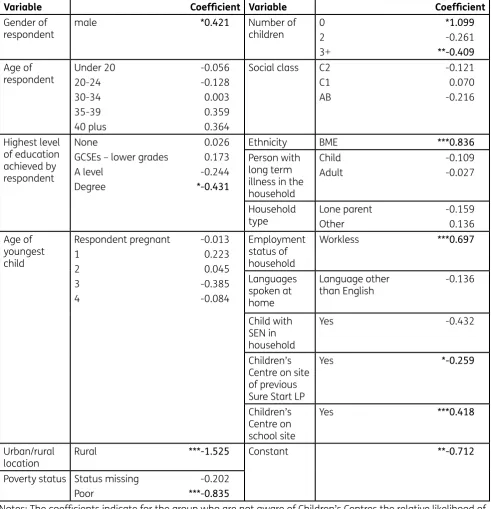
• Services offered through Children’s Centres are well-received by Centre users. However, 2008 Sure Start Children’s Centre Survey data shows that not everyone eligible is aware of its existence. Modelling shows that eligible parents who are unaware of the local Children’s Centre are more likely to be: male, from an ethnic minority background, expecting their first child or live in a household where no-one works. These parents are also less likely to be educated to degree level, live in a rural area, be poor, or have three or more children.
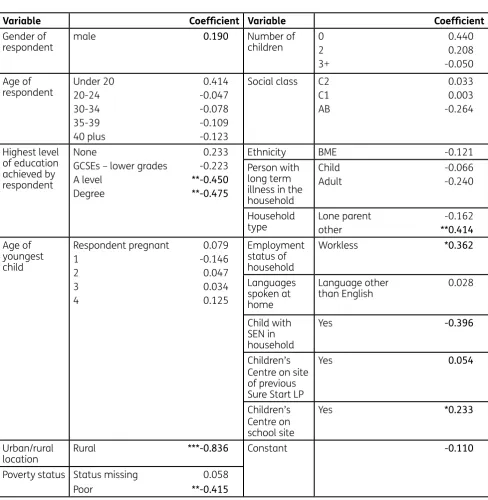
• Some parents are aware of the local Children’s Centre but do not use their services. It is not clear whether this is because they do not like or require the services offered. However, modelling does show that this group of parents is less likely to live in a working household, less likely to be highly educated, less likely to live in a rural area and less likely to be poor compared with users of Children’s Centres services.
• Across the interim evidence base, soft outcomes are reported as being most prevalent for
participants: greater confidence; increased awareness of opportunities and options; access to job preparation skills and support. Although encouraging evidence, the route out of poverty depends heavily on finding and keeping a job. Crucially, crossing the poverty line depends on job quality, i.e. on pay and hours, as well as just getting a job. The final evaluation reports of the individual pilots will provide more information.
The aim of the synthesis is to share cross-cutting evaluation evidence, disseminate promising practice and encourage local areas to take up and/or shape locally suitable initiatives to tackle child poverty. The final synthesis report due in late summer 2011 will continue to build on the interim evidence discussed here, but in addition will focus on pilot outcomes, cost effectiveness and new analysis on poverty gaps and distance travelled toward employability, i.e. capturing people’s progress (towards the labour market), even if it hasn’t resulted in employment in the short term. The final report will be structured around the Child Poverty Building Blocks.2
2 1 Localism and place – Freeing up local organisations and communities to target resources more
effectively at tackling child poverty, and promote stable, safe and thriving communities for children to grow up in;
2 Employment and skills – Removing barriers to work and supporting families to achieve
financial independence;
3 Life chances and families – Intervening early to support every child in fulfilling their potential
and through our education, health and family policies, facilitating true social mobility;
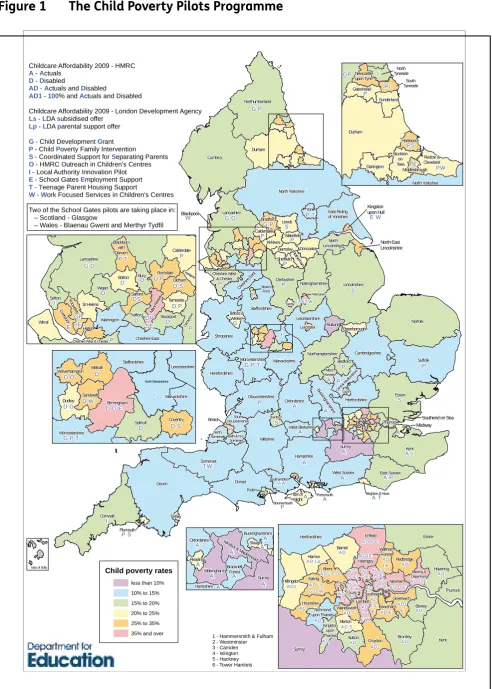
Figure 1
The Child Poverty Pilots Programme
P Devon Cumbria Kent Essex Suffolk Cornwall Wiltshire Dorset Somerset Hampshire Durham Surrey Oxfordshire Cambridgeshire Gloucestershire Herefordshire West Sussex Warwickshire East Sussex Hertfordshire Norfolk North Yorkshire Lincolnshire Northumberland Shropshire Lancashire Derbyshire Staffordshire Leicestershire Northamptonshire Nottinghamshire Worcestershire East Riding of Yorkshire Bucking ham shire Leeds Chesh ire East York Doncaster Kirklees Rutland North Lincolnshire West Berkshire Bradford Sheffield Barnsley
Central B edford shire Wakefield Calderdale Isle of Wight Cheshire West & Chester Bedford Swindon Rotherh am Peterborough North Somerset South Gloucestershire Medway Milton Keynes Thurrock Bristol Telford & Wrekin Derby
Bath & N.E. Somerset Poole Torbay Plymouth North East Lincolnshire Leicester Luton Nottingham Stoke-on -Trent
Brighton & Hove
Kingston upon Hull Southampton Blackpool Portsmouth Bournemouth
Southend on Sea
S I P S A I P G P P A A I A TW A G O A P G P T
A P P A S P P A P A G S G P A P T P P A T P P S A E W W AW PETW 2 3 4 5
6 Kent Surrey Essex Bromley Hertfordshire Barnet Havering Hillingdon Enfield Croydon Bexley Ealing Brent Harrow Sutton Thurrock Hounslow Redbridge Merton Greenwich Newham Lewisham Haringey Lambeth Wandsworth Southwark Waltham Forest Richmond upon Thames Kingston upon Thames Barking & Dagenham
1Kens. & Ch elsea City AD AD AD AD1 AD1 AD AD
AD P E
AD AD AD AD AD Lp AD S AD1 E AD E AD T AD I E AD Ls O
AD O E AD O E
AD Ls G O W
AD1E AD Ls E AD I E AD1 S E AD G O E W AD G P O E AD AD Ls I E W
AD OIE AD Ls POE AD Surrey Wokingham Oxfordshire Buckinghamshire Windso r & Maidenhe
ad Bracknell Forest Reading Slough Hampshire A A A A A A A A A Warwickshire Solihull Staffordshire Birmingham Walsall Dudley Worcestershire Coventry Sandwell Leicestershire Wolverhampton I D D
D O E
G P T D G D S D W D O North Warwickshire Lancashire Wigan Wirral Calderdale Bolton Bury Cheshire East Oldham Warrington Trafford Salford Stockport Tameside Sefton Rochdale St Helens Liverpo ol Manc heste r Kno wsley Blackburn with Darwen Kirklees Halton
Cheshire West & Chester
Derby shire G O P I D P D D D P T P D E D P D S D P DS DP SE GP IE Durham Gateshead Sunderland North Yorkshire Darlington Stockt on-Tees Redcar & Cleveland Hartlepool North Tyneside Newcastle
upon Tyne South
Tyneside Middlesbrough PW GP I P PS PI PE
Isles of Scilly
Child poverty rates less than 10% 10% to 15% 15% to 20% 20% to 25% 25% to 35%
35% and over 1 - Hammersmith & Fulham 2 - Westminster 3 - Camden 4 - Islington 5 - Hackney 6 - Tower Hamlets
Childcare Affordability 2009 - HMRC
A - Actuals
D - Disabled
AD - Actuals and Disabled
AD1 - 100% and Actuals and Disabled
Childcare Affordability 2009 - London Development Agency
Ls - LDA subsidised offer
Lp - LDA parental support offer
G - Child Development Grant
P - Child Poverty Family Intervention
S - Coordinated Support for Separating Parents
O - HMRC Outreach in Children's Centres
I - Local Authority Innovation Pilot
E - School Gates Employment Support
T - Teenage Parent Housing Support
W - Work Focused Services in Children's Centres Two of the School Gates pilots are taking place in: – Scotland - Glasgow
Chapter 1 Introduction
The Child Poverty Unit (CPU) was established in 2007 to integrate work across the Department for Work and Pensions (DWP), the Department for Education (formerly Children, Schools and Families (DCSF)) and HM Treasury (HMT), to focus on taking forward the Government’s strategy to eradicate child poverty, which had been announced in 1999 and consolidated in the Child Poverty Review in 2004.
Since 2008, the CPU has led on a programme of nine pilots delivered in more than one in three local authorities (LAs) to test a range of innovative approaches in tackling child poverty. To maximise learning from the suite of pilots CPU also commissioned the production of a synthesis report to draw together the evaluation evidence from these pilots and identify key messages for national and local policy makers and practitioners. This is the interim synthesis report. The second and final report will be published in late summer of 2011.
1.1
Background to the Child Poverty Pilots Programme
The original idea of pilots was ‘to draw on new ideas and approaches to ensure sustainable progress is made, improving children’s life chances for the longer term, pilots will look at new approaches to increasing parental employment and raising incomes, to tackling deprivation in communities and to improving poor children’s life chances.’ (HMT, 2008, p.63).
The contemporary CPU strategy paper, Ending Child Poverty: everybody’s business, set out an approach that encouraged the development of more localised initiatives and responsibilities for ending child poverty to accompany the national programmes based on tax credits, employment programmes, skills and other mainstream programme activity. Child Poverty Pilots were seen as part of this widening and deepening of action on child poverty: ‘The Government needs to begin now, working with stakeholders, to develop a strategy for the next decade to reach the 2020 goal. In preparation for the strategy, the Government will undertake further research and establish new pilots and approaches that will inform and shape future policy.’ (CPU, 2008, p.61).
Accompanying the pilots was the development of strategic legislation and approaches to tackling child poverty that were heralded in 2009 by Ending Child Poverty: Making It Happen. The Child Poverty Act, which received Royal assent on 25 March 2010 enshrines the pledge to eradicate child poverty by 2020 in legislation and commits future Governments to this pledge.
The pilots are being delivered and managed by a range of pilot and project leads from central government, local government and third sector organisations. Each pilot has commissioned an independent evaluation.
1.2
Aims
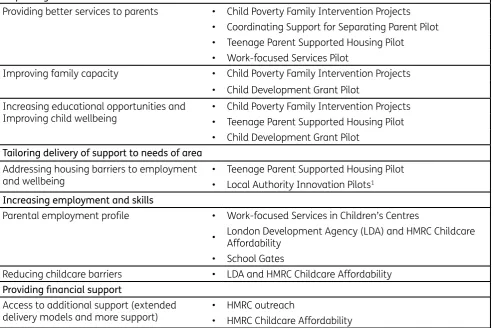
The suite of Child Poverty Pilots can be placed against the Building Block structure often used for policy development by the CPU. A group of pilots, for instance, focuses on improving life chances, i.e. ensuring poverty in childhood does not translate into poor outcomes; some focus on improving employment and skills, i.e. getting more parents into work that pays; some focus on providing financial support; and some focus on tailoring support to the needs of a particular area. The table demonstrates under which Building Block each of the pilots fits. Note that the pilots are not necessarily mutually exclusive to one Building Block.
Table 1.1 Child Poverty Building Blocks and Pilots
Improving life chances
Providing better services to parents • Child Poverty Family Intervention Projects
• Coordinating Support for Separating Parent Pilot • Teenage Parent Supported Housing Pilot
• Work-focused Services Pilot
Improving family capacity • Child Poverty Family Intervention Projects
• Child Development Grant Pilot Increasing educational opportunities and
Improving child wellbeing • Child Poverty Family Intervention Projects• Teenage Parent Supported Housing Pilot
• Child Development Grant Pilot
Tailoring delivery of support to needs of area
Addressing housing barriers to employment
and wellbeing • Teenage Parent Supported Housing Pilot• Local Authority Innovation Pilots1
Increasing employment and skills
Parental employment profile • Work-focused Services in Children’s Centres
• London Development Agency (LDA) and HMRC Childcare Affordability
• School Gates
Reducing childcare barriers • LDA and HMRC Childcare Affordability
Providing financial support
Access to additional support (extended
delivery models and more support) • HMRC outreach• HMRC Childcare Affordability
1 This is a suite of ten locally driven Child Poverty Pilots that explore a range of innovative ways of tackling
area-based poverty. Each pilot consists of various strands and fits under more than one of the Building Blocks. For more information see Appendix B.
Where relevant, this synthesis report also includes references to the Local Authority Innovation pilots. This is a suite of ten locally driven Child Poverty Pilots that explore a range of innovative ways of tackling area-based poverty. However, as a separate synthesis evaluation report has been commissioned by the Department for Education to capture the learning from those pilots this report does not give a detailed account of what each of the LA pilots are about. For more information, please refer to their evaluation reports, which can be found in Appendix B.
This interim synthesis report has the following objectives:
• to provide an overview of the Child Poverty Pilots Programme and signpost where more detailed information on the individual evaluations can be found;
[image:17.595.53.548.242.570.2]evidence base;
• to discuss the emerging evidence and how they are relevant to the priorities of the Coalition government;
• to outline the content of the final synthesis report due in summer 2011;
• to aim at a wide audience, including national and local policy makers and practitioner reflecting the mix of centrally and locally initiated Child Poverty Pilots.
1.3
Policy context
Although set up under the previous administration, the pilots and the evaluation evidence base of the suite of Child Poverty Pilots continue to be relevant to the current administration’s approach to child poverty. The Coalition Government has expressed commitment to finding the right long-term solutions through prioritising opportunity, fairness and social mobility across society. With a particular emphasis on improving parental support, and improving the skills that parents need to create a better life for themselves and for their children, i.e. tackling the causes of poverty and enabling people to participate in work.
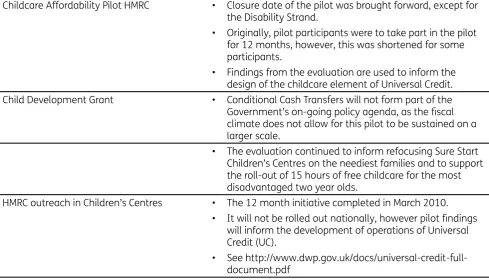
After taking office in May 2010, Coalition Ministers agreed that most pilots should continue unchanged on their original timetable until March 2011. The exceptions were: HMRC Outreach in Children’s Centres, the Child Development Grant and some strands of the Childcare Affordability pilots, where closure of the pilots occurred and evaluation was brought forward. Table 1.2 provides more details on the revised timetable and operation of these pilots.
Table 1.2 Revisions to pilots
Childcare Affordability Pilot HMRC • Closure date of the pilot was brought forward, except for
the Disability Strand.
• Originally, pilot participants were to take part in the pilot for 12 months, however, this was shortened for some participants.
• Findings from the evaluation are used to inform the design of the childcare element of Universal Credit.
Child Development Grant • Conditional Cash Transfers will not form part of the
Government’s on-going policy agenda, as the fiscal climate does not allow for this pilot to be sustained on a larger scale.
• The evaluation continued to inform refocusing Sure Start Children’s Centres on the neediest families and to support the roll-out of 15 hours of free childcare for the most disadvantaged two year olds.
HMRC outreach in Children’s Centres • The 12 month initiative completed in March 2010.
• It will not be rolled out nationally, however pilot findings will inform the development of operations of Universal Credit (UC).
[image:18.595.53.543.484.764.2]The Coalition Government remains committed to the targets set out in the Child Poverty Act, ‘We will maintain the goal of ending child poverty in the UK by 2020’ (HM Government, 2010, p.19), but devolve power at the same time, freeing up LAs, partners and voluntary communities to target resources more effectively. However, changes in government priorities together with cuts in public spending will significantly influence the environment into which the findings of the pilots and their evaluations are discussed. Thereby many of the underlying assumptions held in 2008, at the beginning of the Child Poverty Pilots, have changed.
The final report will discuss interpretation of the pilot findings in the light of a fuller appreciation of policy reform under the Coalition Government.
1.4
Content
Six of the pilots have produced early and/or interim evidence available for interim synthesis, see Appendix B. These early and interim evaluation reports provide information on the implementation and start up of the pilots and provide information about the ‘baseline’ position from quantitative and qualitative surveys. There is little that can be considered as early evidence on outcomes or results, but there is emerging evidence of the new policy treatments provided to participants and of the new ‘processes’ involved.
We have prioritised the evidence to identify issues of potential importance to the national and local Child Poverty Strategies. These form three cross-cutting themes:
Pilot participants
• Who do the pilots help?
– Who does each pilot aim to support?
– What evidence is there on actual participation?
– What expectations do we have in terms of reduced poverty risk from the pilot interventions for these groups?
• How do the characteristics of pilot participants influence interpretation of the evaluation findings?
Developing tailored, innovative and localised solutions
• What is the early evidence from pilots on developing tailored, innovative and localised solutions? • What innovative delivery models are being adopted and how do pilot approaches differ from
pre-pilot practices?
• What emerging evidence is there from providers on implementing new services?
Early Indications of Outcomes, Experiences and Perceptions of pilot services
This report has six further chapters:
Chapter 2 introduces each of the Child Poverty pilots and summarises what the pilot is about. Each
overview sets out the aims and rationale of the pilots and provides an overview of how the pilot is expected to work in practice, i.e. what the inputs and expected outputs and outcomes are.
Chapter 3 to 5 discuss the emerging findings from early and interim evaluation around the three key
themes discussed above. In the light of the variations in evaluation approaches and evidence across the pilot programme a lot of the information presented will be descriptive, i.e. capturing what the pilots aim to do to, how to engage clients and how to adapt practices with vulnerable families and as such can inform practice even if the underlying pilot evaluation of which they are a part is not set up to satisfy economic evaluation conditions.
Chapter 6 sets out the analytical challenges of synthesising the evaluation evidence across the
Child Poverty Pilots programme. This chapter will explore the extent to which findings from the evaluations can be generalised, i.e. whether they have a wider relevance beyond the specific pilot evidence, and replicated, i.e. whether if repeated by others using the same procedures the results would the same.
2 Overviews of the Child
Poverty Pilots
2.1
Introduction
This chapter provides an overview of each of the Child Poverty Pilots. The summaries provide the background and aim of each of the pilots and describe what the expected policy learning and outcomes of the pilots are.
Childc
ar
e A
ffor
dability P
ilot: HMR
C oper
at
ed
AIMS TA RG ET G RO UP S PO LI CY L EA RN IN G 1. W he th er in cr ea si ng su bs id ie s fo r c hi ld ca re costs for low in com e fa m ilie s im pr ov es ta ke -u p of c hi ld ca re a nd in cr ea se s th e nu m be r o f p ar en ts en te rin g su st ai na bl e em pl oy m en t. 100% P ilo t t es ts th is th ro ug h pa yi ng 1 00 % ra th er th an a n 80 % subsidy (and up to higher lim its ), i.e . p ay in g up to £2 15 a w ee k fo r o ne c hi ld co m pa re d to th e us ua l £1 75 a nd u p to £ 35 0 fo r two or more ch ildren from £3 00 ; Disabled Child Pilot te st s this through paying 80% of ch ild ca re c os ts o f a h ig he r am ou nt fo r d is ab le d children than the current sy st em ; 2. W he th er a d iff er en t system of reporting and payment has an impact on the ability of parents to m ee t f lu ct ua tio ns in childcare costs and reduces error, fr aud and overpayment of benefits. Actual Cost P ilo t t es ts th is th ro ug h pa yi ng p ar en ts their actual monthl y childcare costs rather than th e cu rr en t s ys te m (b as ed on annual averaged childcare costs). 10 0% P ilot (0 9/ 10 ) • O ut -o f-w or k lo ne pa re nt s an d co up le s • Si ng le e ar ne r c ou pl es • Not clai ming the ch ild ca re e le m en t • 20 08 /0 9 in co m e of u p to £1 6, 00 0 • Living in London Disa bl ed C hi ld P ilo t (0 9/ 10 ) Sa m e as a bo ve b ut : • with a disabled child • includes a cont rol group in Birmingham and M an ch es te r Actual Co st Pi lo t (09/10) Sa m e as 1 00 % P ilo t b ut al so in -w or k lo ne p ar en ts and dual earner couples not clai ming the childcare el em en t Actual Co st Pi lo t (10/11) • In -w or k lo ne p ar en ts and dual earner couples, already in-wor k and claiming the ch ildcare el em en t. • 20 09 -1 0 in co m e of u p to £2 1, 00 0 fo r l on e pa re nt s, an d £2 3, 00 0 fo r c ou pl es . • Li vi ng in L on do n & th e So ut h Ea st Increased understanding of the followin g will inform future policyoptions: •
Childc
ar
e A
ffor
dability P
ilot: L
ondon De
velopmen
t Agency
The two London Development Agency (LDA) pilots of the Ch ildcare Af fo rd ab ili ty P ro gr am m e 20 09 (C AP 09 ) p ro gr am m e se ek th ro ug h th e process of delivery to help remove some of the strategic barriers to achieving sustaine d employment ou tc om es fo r t he e co no m ic al ly in ac tiv e fa m ilie s. T he p ilo ts a im to a dd re ss th e fo llo wing barriers: constrained LA funding mechanisms; supply-side inflexibilities in offering a suit able choice and range of childcare provision, and a lack of accessibility, clarity and flexib ility in the available support options availa ble to low inco me parents. The pilots aim to a dd to existing jo bs brokerage and childcare inform ation services and not act as a substitu te for resources alrea dy out la id by Government, the boroughs, or their core delivery pa rt ne rs . AIMS TA RG ET G RO UP S PO LI CY L EA RN IN G The LDA pilots are aimed at testing two different ap pr oa ch es fo r s up po rt in g low income parents into su st ai na bl e em pl oy m en t. Th e tw o m od el s ar e: Pa re nt al s up po rt o ff er Te st s w he th er a n ew m od el o f s up po rt to w he re 50 0 fa m ili es a cr os s 5 London borou ghs will be provided with up to 12 months of hand-holding support in the form of advice and guidance on Working Tax credits to en co ur ag e pa re nt s to m ov e in to w or k. Subs id is ed o ff er Te st s ef fe ct iv en es s of a supply side out come-based funding model for childcare providers to give employment se rvices to ou t o f w or k fa m ili es . • Par ents; over 16 yea rs of age and un de r 6 5 • Econo mical ly inactive for th e pa st 1 2 m on th s • An nu al h ou se ho ld in co m e of le ss th an £ 20 ,0 00 ; a nd • Reside withi n the 10 L on do n bo ro ug hs ta ki ng pa rt in th e pi lo t • Low-income parents to find employment • Pa re nt s to s us ta in employment • Improving access to affordable childcare Jo in t o ut co m es • Improved childcare take-up amongst low-income groups • Sustained employment (and associated soft outcomes) Pare nt al s up po rt o ff er • In cr ea se d jo b se ar ch activity • Improved tax credit ta ke -u p Su bs id is ed o ff er • In cr ea se in s up pl y of flexible childcare pr ov is io n RE LE VA NC E FO R FU TU RE P O LI CY M AK IN G Pilo ts d es ig ne d to te st th e ef fe ct iv en es s of tw o di st in ct deliver y mod els in movi ng lo w-inco me, unemp loy ed or econo mical ly-inactive par ents into sust aine d emplo yme nt, w hich wil l in form future approaches to addr essing access to af for da ble chil dca re as a ba rrie r to enteri ng emp loyment. IN PU TS £2 50 k ad va nce pa ym en t a nd outcome-r elated pa ym en ts a t t hr ee tr ig ge r s ta ge s: J ob En tr y (£ 31 2. 50 p er ou tp ut ); 6-m on th Sustaine d Em pl oy m en t ( £6 25 per outcom e) an d 12-m on th S us ta in ed Em pl oy m en t ( £1 ,2 50 pe r o ut co m e) . Bonu s pa ym en t u po n achiev eme nt of all co nt ra ct ed o ut pu ts . Betwe en 3 and 7 dedicate d staff pe r bo ro ug h, 1 L DA s ta ff ac ro ss th e pi lo t. Progr amm e re late d co st s in cl ud e: s et -u p; re cr ui tm en t; st ak eh ol de r en ga ge m en t, et c. ACTIVIT IES • Referral to the pilot when ‘work ready’ and job offer made • Suitable childc are pl ac e br ok er ed • Supply-side su bsidy of u p to £ 21 5 p/ w • Tracking ove r 12 m on th s SAV Activities • LD A en ga ge s cr oss-departmental support
to place a st ro ng er e m ph as is on childcare affordability wi thin the child poverty agenda • Ch ild ca re p ro vi de rs supported to offe r more affordable and flexible provision in response to the demand gener ated by the investment •
Collaborative wor
Child De
velopmen
t Gr
an
t
This pilot aims to encourage economical ly de prived and disengage d pare nts to use their lo ca l S ur e St ar t C hi ld re n’ s Ce nt re s (S SC Cs) by giving (cash) in centives to pa rticipate. Particular emphasis is placed on services that promote children’s development and family func tioning. T he c as h in ce nt iv e is p ro vi de d to th os e co m pl et e a programme of activity at Ch ildren’s Centr es based on an agreed parent al action plan. On completion of the action plan, a pay m ent of £50 for a 4-week action plan and £200 fo r a 12-week a ct io n pl an is m ad e (t he m ax im um o ne fa m ily c an re ce iv e is thus £250 for a combined 16 week action pl an). Note that one of the pilo t areas did no t use cash incentives as part of its app roach. Investigates how to best identify, target and engage th e m os t d ep riv ed fa m ilie s in the UK with Sure Start Ch ild re n’ s Ce nt re (S SC C) se rv ic es a nd a ss es se s th e correlating impact of of fe rin g th es e fa m ilie s Co nd iti on al C as h Tr an sf er s in relation to their su st ai ne d en gag em en t with services. Fa m ili es w ho a re : • Ec on om ic al ly de pr iv ed • Have at least on e ch ild u nd er th e ag e of three. • Who have notpreviously register
ed with Sure Start Children’s Centres and/or en ga ge d w ith service s. Fo r L As In cr ea se d un de rs ta nd in g of e ffe ct iv e pr ac tic e in terms of target ing, outreach and needs-led planning re dis advantaged families accessing SSCCs. For DfE In cr ea se d un de rs ta nd in g of th e im pa ct th e gr an t ha s ha d on in flu en ci ng parental behav iour. For parents Ra is ed a w ar en es s & sustained uptake of a range of servic es and support benefi cial to the fa m ily . Fo r c hi ld re n Fa m ili es m or e in vo lv ed in ac tiv iti es w hi ch p os iti ve ly im pa ct o n th e ho m e en vi ro nm en t a nd in cr ea se access to positive social and developmental activities for the child. Project Man ag em ent LA s ar e re sp on si bl e fo r id en tif yi ng th e SS CC s and families who are eligible to take part and distributing funding according to lo cal need. Da ta A na ly si s LA s ha ve u se d a ra ng e of approaches and resources to identify SSCCs and families in th ei r a re a in cl ud in g: IDACI, housing and employment benefit data, SSCC registration details and health data. O ut re ac h Workers to identify and directly engage and su pp or t f am ili es . A variety of ou treach models are in operation in the pilot are as. Out re ac h w or ke rs a re re sp on si bl e fo r u si ng local data to id entify and en ga ge e lig ib le fa m ilie s, ei th er b y lo ca lit y or th em e.
In most
Coor
dinat
ed Support f
or Separ
ating P
ar
en
ts
This pilot provides local partn ershi ps with th e opportunity to de velop co-o rdinated servic es for low inco me parents who are thr eatened with separa tion. The Governme nt’s paper Families in Britain, pu bl is he d in D ec em be r 2 00 8, s et s ou t s ub stantial evidence that strong family relation sh ip s ar e fu nd am en ta l t o th e w el l-b ei ng o f children, adults, and wider society. Adults in st able relationships benefit not onl y emotional ly but also sociall y and financial ly. Positive adu lt coup le relati onships are also important fo r children’s well-being and growing up in a fa m ily w ith s ta bl e re la tio ns hi ps h as a po si tiv e im pa ct o n ch ild o ut co m es . AIMS TA RG ET G RO UP S POLICY LEAR NING This aims to test how best to co-ordinate local se rv ic es fo r s ep ar at in g and separated parents and th ei r c hi ld re n in o rd er to : • im pr ov e an d sp ee d up access to financial, pr ac tic al , l eg al a nd em ot io na l h el p; • re du ce p ar en ta l co nf lic t ; a nd • m in im is e th e ne ga tiv e im pa ct o f s ep ar at io n on c hi ld re n’ s ou tc om es . •Low-income families.
• So ci al ly e xc lu de d fa m ilie s, i. e. h ar d-to re ac h fa m ili es . • Pa re nt s th at h av e se pa ra te d. • Pa re nt s th at a re se pa ra tin g. All parents me eting the ab ov e cr ite ria w er e of fe re d se rv ic es . T ho se that did not meet the criteria were referred to other means of support. Improve understanding of: • Couple re latio nsh ips un de r s tr es s • Th e ne ed s of c ou pl es in d iff ic ul t relationships • Ho w b es t t o he lp pa re nt s su pp or t t he ir child through and post separation How to ensure that se pa ra tin g pa re nt s: • Experi ence less debt • Ha ve q ui ck er a cc es s to benefits • Have easier access to integrated support • Ha ve le ss p ro bl em s w ith a cc om m od at io n ar ra ng em en ts Fo r s ep ar at in g pa re nt s: • Reduced short -term st re ss a nd le ss lo ng te rm emotional dist ress • Le ss o pp or tu ni ty fo r problems to es calate that negatively affect parent or child • More stable child m ai nt en an ce a nd contact arrangements, and stronger family relationships
For t
he ir ch ild re n: A re du ct io n in n eg at iv e impact on their educational ou tc om es , t he ir he al th a nd th eir g en er al w el l-b ei ng ; Redu ci ng th e nu m be r o f children who get into serious pr ob le m s su ch a s involvement in crime, and in cr ea si ng in th e nu m be r o f children making successful tr an si tio n to a du lth oo d an d going on to have positive re la tio ns hi ps . RELEVANCE TO FUTIRE POLICY MAKING The pilot fits in with Coalition commit m ents on relationship support – to im prove access and early take up of support – and putting relati onship support funding on a secure footing. Evid en ce fr om th e pi lo t w ill a ls o in fo rm th e Fa m ily J us tic e Re vi ew . M O RE IN FO RM AT IO N Around a quar ter (some 3 mil lion) of the UK’s 12 m ill io n ch ild re n ex pe rie nc e se pa ra tio n of th eir p ar en ts d ur in g ch ild ho od a nd e st im at es s ug ge st th at 2 00 ,0 00 - 25 0, 00 0 co up le s separate each year, affecting ar ou nd 3 50 ,0 00 c hi ld re n. I t i s kn ow n th at c hi ld re n w ho a re ex po se d to p ro tr ac te d co nf lic t b et w ee n th ei r p ar en ts fo llo w in g se pa ra tio n ar e pa rt ic ul ar ly a t risk of negative outcomes in the medium to lo ng er te rm . T he re is a ls o a re po rt ed n ee d fo r improvements in service provi sion around sepa ration, with over 90% of pa rents respondi ng that ‘more should be done to support adults going through separat ion’ in the ‘Kids in the Middle’ campai gn. IN PU TS • Pilot set up; • Recruitment, • Pa rt ne rs hi p coordination • Project manager and project lead for each of the pilots • Additional experts, e. g. counse llor. • Running costs, rent, telephones, IT eq ui pm en t • Salaries ACTIVIT IES O ffe rin g su pp or t a ro un d: Lega l i ss ue s, fi na nc e an d debt, benefits and tax cr ed its Child ca re & S ha re d parenting/chil d contact Employment, housing Heal th , e .g . f am ily counse lling, Specific ‘crisis’ services around the ‘event’ of
separation Fam
HMR
C Outr
each in Childr
en’s C
en
tr
es
The pilot was designed to investigate and improve operational delivery, howev er indirectly co uld be seen to contribute to the “Financial Support” building block of the Child Poverty Act as a financial situation of a family can im pr ov e th ro ug h im pr ov em en ts m ad e in th e delivery model. This initiative originated as one of HM RC ‘S er vi ce Im pr ov em en t M od ul es ’ t ha t w er e administered to improve tax credits delivery , i n pa rt ic ul ar , t o im pr ov e cu st om er e xp er ie nc e an d he lp w ith re du ci ng e rr or a nd fr au d. T he p ilo t w as d es ig ne d to provide additional su pport to those with children who might be at risk of child poverty through improving customers’ knowledge and awareness of th e ta x cr ed its s ys te m th er eb y re du ci ng le ve ls o f c us to m er e rr or a nd th e lik el ih oo d of re ce iv in g ov er pa ym en ts , a nd th ro ug h increasing take-up. Additiona lly , the pilot could be seen to assist promotion of the childcare element of Work ing Tax Credit when participants are considering employ ment and thus improve indicato rs fo r t he n um be r o f l ow in co m e fa m ili es ta ki ng u p fo rm al ch ild ca re (n at io na l i nd ic at or N 11 8) . T he 1 2-m on th p ilo t b eg an in A pr il 20 09 a nd w as b as ed in 1 01 C hi ld re n’ s Ce nt re s in a re as o f London, West Midlands and Lancashire. AIMS TA RG ET G RO UP S PO LI CY L EA RN IN G • To improve cus tomers’ knowledge and aw ar en es s of th e ta x cr ed its s ys te m th us reducing customer error in their claims • To re du ce th e likelihood of overpayment; and • To increase “take-up of tax credits” - both among eligible cu st om er s w ho a re no t y et c la im in g an d to in cr ea se a w ar en es s of p ot en tia l a dd iti on al tax credit entitlements to th os e th at w er e already claima nts Pa re nt s at te nd in g Ch ild re n’ s Ce nt re s. • Im pr ov ed e xp er ie nc e and understanding of th e sy st em fo r f am ilie s in receipt of ta x credits. • Co nt rib ut io n to lowered rates of error and fraud amo ng ta rg et a ud ie nc e. RE LE VA NC E FO R FU TU RE P O LI CY M AK IN G The initiative was not rol led ou t after its 12-month pilot as a result of alte rations to HMR C pl an s w he n th e pr oj ec t w as re vi ew ed in te rm s of va lue-for-money in May 2010. Details on how the pilot worked may be of interest to the development of Universa l Credit (UC) in considerations of potential Ou treach progra mmes for UC. For more information on Universal Credit – W el fa re th at W or ks W hi te P ap er s ee http:/ /www.dw p.gov.uk/ docs/un iversal -cre di t-ful l-docum en t.pdf M O RE IN FO RM AT IO N The role of tax credits in child poverty reduction (both in ter m s of direct in come su pp le m en ta tio n an d in te rm s of th ei r e ffe ct iv en es s as a n em pl oy m en t i nc en tiv e) is c le ar from research (see for instance, Brewer, et a l., 2 00 3 an d Har ke r 2 00 6 – Ch ap te r 7 ). An earlier HMRC outreach initi ative in Birmin gham operated across a ran ge of outreach sites in supermarket s, two children’s centres and a neighbourho od office and with posters an d leaflets distributed to GP surgeries, health ce nt re s an d sc ho ol s, w as fo un d to h av e ve ry positive results in terms of tak e-up. ‘There were a total of 54 new claims, which exceeded expectations and over 1,300 existing or pot ent ia l c us to m er s re qu es te d in fo rm at io n. T o da te , th e pi lot h as re su lte d in a w ar ds o f £ 12 ,5 80 in C hi ld T ax C re di ts , £ 2, 41 0 in W or ki ng T ax C re di ts an d £1 1, 37 9 in jo in t T ax C re di ts – a to ta l o f £ 26 ,3 69 .’ (H M RC , 2 00 9, p .5 ). Targ et in g th e pi lo t t o ar ea s kn ow n to h av e hi gh levels of ethnic minority populations increases the potential to deal with barriers to take up that result fr om lan guage problems and lower levels of informa tio n and awarene ss . I m pr ov in g ‘ta ke -u p’ le ve ls a ls o m ea ns assisting those already clai mi ng tax credits to re ce iv e th ei r f ul l e nt itl em en t. M os t r ec en t es tim at es g iv e an a ve ra ge 9 2% ‘e xp en di tu re ta ke-up’ - the amount of mo netary tax credit entitlement taken up by th os e th at c la im (H M RC 2 01 0) . 1 IN PU TS HMRC Tax Credit advisors provide advice in Children’s Centres on a limi ted but regular basis, which bu ilds up re lations and allow s for post interventi onsupport. Two
Loc
al Authority Inno
vation
Th is p ilo t c on si st s of ten locally designed and implemented programme s. T he p ilo ts w er e se le ct ed fo r t he ir innovative approach and ability to re duce local child poverty le ve ls . T he y ai m to accurately cap ture and reflect important loc al context – su ch as particula r neighbourho od patterns of deprivation, population chara cteristics and local organisati onal capacity. The promotion of local level acti on on child po verty is a ke y el em en t o f t he C hi ld P ov er ty S tr at eg y and lo cal a ut ho rit ie s hav e du tie s to p ro m ot e lo w er le ve ls o f c hi ld p ov er ty u nd er th e 20 10 C hi ld P ov er ty A ct . AIMS TA RG ET G RO UP S PO LI CY L EA RN IN G Th e te n pi lo ts w er e es ta bl is he d to tr ia l l oc al ly designed and innovative approaches to address child poverty.All p
ilo ts a im to re du ce child poverty in the lo ng er term primarily through increases in employment and employabi lity (distance travelled towards em pl oy m en t r at he r t ha n employment itself).
A number
of pilots seek sh or te r-te rm improvements through increases in income (such as take-up of be nefits) and through measures to provide direct financial and other support to al leviate material disad vantage. Each pilot focu ses, in particular, on su pporting lo w -in co m e fa m ili es , although there are di ffe re nc es b et w ee n th e pilots on how th is is exactly defined. Som e fo cu s on p ar en ts w ho h av e m ul tip le problems and are considered to be further away from employment, w hi ls t o th er s fo cu s on pa re nt s w ho a re c lo se r to th e lab ou r m ar ke t. Som e pi lo ts in cl ud e w or ki ng d ire ct ly w ith em pl oy er s, c om m un iti es and children. Get a better un derstanding of innovative ways local ar ea s ar e in te re st ed in tr ia lli ng to ta ck le c hi ld
poverty. Iden
tif y w hi ch p ilo ts h av e be en m or e an d le ss successful and could be pr om ot ed m or e w id el y. Promote what has been learnt to supp ort areas de ve lo pi ng th eir lo ca l st ra te gi es . • Increased par ental em pl oy m en t, employability and w el lb ein g. • In cr eas ed fa m ily a nd children’s wellbeing. • Improved economic regen eration focused on fa m ili es a nd tackling deprivation at a community wide le ve l. • Increased capacity of co m m un iti es to ta ck le poverty. • Employers adopting fa m ily fr ie nd ly p ol ic ie s. • Narrowed outcome ga p be tw ee n ch ild re n in lo w in co m e fa m ili es an d th ei r p ee rs . RELEVANCE TO FUTURE POLICY MAKING The Local Au th ority Innovation pilots fit wit h the Coalition’s drive towards a more locali sed approach, i.e. moving away fr om centrally im plemented initiatives. Some focus in pa rt ic ul ar o n in ce nt iv is in g co m m un iti es to c om e to ge th er a nd ta ke a n ac tiv e ro le in ad dr es si ng lo ca l i ss ue s th rou gh locally designed servic e pr ovision. M O RE IN FO RM AT IO N Th re e in te rim e va lu at io n re po rt s ha ve b ee n pu bl is he d si nc e th e st ar t o f t he p ilo ts in 2 00 8. They can be found on the Child Poverty website. Separate Logic models fo r each of the pilots ha ve b ee n pr ovi de d in th e th ird interim eval uation report. IN PU TS Differs for each of the pilots. More inf ormation can be found in the Lo ca l A ut ho rit y Innovation Pilo ts ev al ua tio n re po rt s, s ee ‘more informat ion section’ below. ACTIVIT IES
Includes: •
Information,
Advice
and
Guidance
•
Employment support
• Childcare support • Ho us in g su pp or t • Support for fa milies w ith m ul tip le problems • Tr ai ni ng a nd W or kf or ce development • Pr ov id in g
discretionary fund
School Gat
es Emplo
ymen
t Support
This initiative is part of the go vernme nt’s ef forts to acceler ate progress in tackli ng and re ducing child poverty in the UK and to support families thro ugh the economic downturn. It aims to incr ease the amount of employment an d enterprise support that pa rents receiv e in and around thei r children’s schools. Half of all poor ch ildr en a re in c ou pl e fa m ilie s w he re o ne p ar en t a lre ad y w or ks . Howev er, a child’s risk of pov erty decrease s su bs ta nt ia lly w he n th ey h av e a pa re nt in work. Expectations are that the pilot wil l reach out to the non-working pare nt s, who may not engage with traditional employment services. AIMS TA RG ET G RO UP S PO LI CY L EA RN IN G To increase the amount of employment and enterpri se support that pa re nt s re ce iv e in a nd ar ou nd th ei r c hi ld re n’ s school. N on -w or ki ng p ar en ts with a child/ch ildren in sc ho ol s w he re th e initiative is taking place. Fo r L As In cr ea se d un de rs ta nd in g of p ar tn er sh ip w or ki ng be tw ee n sc ho ol s, employment se rvices and enterpri se support. How s ch oo ls c an b e us ed to target workless parents and improve lo cal em pl oy m en t o ut co m es . How to deliver successfully a co-ordinated and tailored package of information in and around their child’s school. For parents Gr ea te r a w ar en es s of th e support avail abl e to them in the local area. Increased desi re to move into work, and with a clear understanding of how to pu rs ue th is g oa l. Incr ea se d en gag em en t o f pa re nt s w ith e xi st in g employment and en te rp ris e. Fo r c hi ld re n Im pr ov em en ts in as pi ra tio ns d ue to ri si ng parental aspira tions. Impr ov em en ts in educational at tainment as ho us eh ol d in co m e in cr ea se s. RELEVANCE TO FUTURE POLICY MAKING The School Gat es initiative is a good exampl e of how natio nal government can work wit hin local co mmunities to im prove outcome s. W hi le th is is a n em pl oy m en t p ro gr am m e th e sam e ap pr oa ch could be taken with other government priorit ie s. S ch oo l G at es e xe m pl ifi es h ow s ch oo ls c an b e a ce nt ra l r es ou rc e in a re as , e sp ecially deprived area s, and there is scope to uti lise schools better to support educational ou tco mes. It is al so a good example of lo ca l p ar tn er sh ip w or ki ng w ith a n um be r o f s uc ce ss fu l p ar tn er sh ip s be in g es ta bl is he d. T hi s w ill b ec om e m or e im po rt an t a s th e localisation pr ocess gather s pace and examples o f s uc ce ss fu l p ar tn er sh ip s w ill b e ne ed ed . Th e ev al ua tio n w ill th er efo re b e ab le to provide valuable evidence and le ss on s on p ar tn er sh ip w or ki ng . M O RE IN FO RM AT IO N Th e in iti at iv e ru ns fr om O ct ob er 2 00 9 to th e en d of M ar ch 2 01 1 in 25 areas of across England, Wales an d Scotland. It is hoped that, during this time, the initiative can generate sustainable changes in the app ro ac h of m ai ns tr ea m e m pl oy m en t a nd b us in es s su pp or t s er vi ce s to a ss is tin g lon g-te rm u ne m pl oy ed p ar en ts b ac k into the workforce. The initiative will take a different form in Scotland and Wales, and th e devolved administrations in those countries will commu nicate separat ely to local partne rs in their jurisdictions. DWP have undertak en si m ila r o ut re ac h pr og ra m m es b ef or e th at h av e ei th er c on ce nt ra te d on at risk grou ps such as ethnic minorities (POEM) or areas (City Strategy). Howev er, these ha ve not concentrated on schools as a poi nt of access to difficult t o reac h groups. It is this that constitutes the novel aspect of the initiative . IN PU TS¾ ¾ ¾ ¾ ¾ ¾ ¾
Funding
for
th
e
initiative Scho
ol p re m is es made available. Staff from or ga ni sa tio ns s uc h as J ob ce nt re P lu s,
Regional Development Agen
ci es . Expert advice fr om
staff. Co-ordination
of the initiative by Co nt in Yo u. O ffi ce E qu ip m en t,
IT. Access
to previous re se ar ch fo r learning lesson s. ACTIVIT IES Promotional activities, e. g. c of fe e m or ni ng s, Internet site. Incr ea si ng a w ar en es s of lo ca l s er vi ce s, e .g . training opportunities, w or ks ho ps Outreach and recruitment by advisors and practitioners. Adviser tailored to the
individual. Peer
Support
ed Housing f
or T
eenage P
ar
en
ts
Tee nag e par ents and th ei r chil dre n ex pe rienc e co nsiderabl e dis ad vantage inclu ding disprop ortionate ly p oo r c hi ld h ea lth o ut co m es , poor m ater nal emotio nal he alth and wel lbeing, an d poor eco no mic we llbei ng. Curre ntly ther e is littl e ro bu st e vi de nc e on h ow h ou si ng -r el at ed s up po rt im pa ct s on o ut co mes fo r tee nage pa rents and w e kn ow that a la rge pr opo rtion of te en age pare nts re tain po or ex pe rienc es of ed ucation a nd ofte n la ck fo rmal q ua lif ic at io ns . Th e pi lo t, th er efore , provides LA s with an opp ortunity to de ve lo p an d te st ‘e nh an ce d’ s up po rt p ac ka ge s fo r te enag e par ent s in resid enti al un its and th eir ow n ho mes. This in cl udes suppo rt to dev elop a range o f li fe sk ills. AIMS TA RG ET G RO UP S PO LI CY L EA RN IN G To develop ‘enhanced’ ho us in g su pp or t p ac ka ge s fo r t ee na ge p ar en ts in 7 pilot LAs. Left to LAs to de fine what ‘enhanced’ looks like but suggest ed outcomes to include improv ed tenancy su st ai nm en t o r r ea di ne ss for a tenancy, higher levels of e ng ag em en t o f t ee na ge parents in edu cation, employment and training, better health outcomes for mothers and children and reduction in subsequent pr eg na nc ie s. Te en ag e pa re nt s an d expectant par ents, primarily living outside th e pa re nt al h om e. Exact nature of target gr ou p va rie s ac ro ss ar ea s. M ai nl y m ot he rs (a nd e xp ec ta nt m ot he rs ) 16-19 and their partners up to 2 5. One a re a pr ov ide s se rv ic es fo r a ll te en ag e parents. Six out of seven ar ea s ta rg et ed s up po rt at te en ag e pa re nt s m os t in n ee d of a ss is ta nc e focusing on most vu ln er ab le , e .g . t ho se with more than one child, care leav ers and/or those who have not be en in e m pl oy m en t, education or tr aining (N EE T) fo r p ro lo ng ed pe rio ds . In cr ea se d un de rs ta nd in g on h ow h ou si ng -r el at ed support impacts on ou tc om es fo r t ee na ge pa re nt s