earliness in the globe artichoke/cultivated
cardoon complex
Portis
et al.
R E S E A R C H A R T I C L E
Open Access
Genetic mapping and identification of QTL for
earliness in the globe artichoke/cultivated
cardoon complex
Ezio Portis
1, Davide Scaglione
1, Alberto Acquadro
1, Giovanni Mauromicale
2, Rosario Mauro
2, Steven J Knapp
3,4and Sergio Lanteri
1*Abstract
Background:The Asteraceae speciesCynara cardunculus(2n=2x= 34) includes the two fully cross-compatible domesticatedtaxaglobe artichoke (var.scolymusL.) and cultivated cardoon (var.altilisDC). As both are out-pollinators and suffer from marked inbreeding depression, linkage analysis has focussed on the use of a two way pseudo-test cross approach.
Results:A set of 172 microsatellite (SSR) loci derived from expressed sequence tag DNA sequence were integrated into the referenceC. cardunculusgenetic maps,based on segregation among the F1progeny of a cross between a globe artichoke and a cultivated cardoon. The resulting maps each detected 17 major linkage groups,
corresponding to the species’haploid chromosome number. A consensus map based on 66 co-dominant shared loci (64 SSRs and two SNPs) assembled 694 loci, with a mean inter-marker spacing of 2.5 cM. When the maps were used to elucidate the pattern of inheritance of head production earliness, a key commercial trait, seven regions were shown to harbour relevant quantitative trait loci (QTL). Together, these QTL accounted for up to 74% of the overall phenotypic variance.
Conclusion:The newly developed consensus as well as the parental genetic maps can accelerate the process of tagging and eventually isolating the genes underlying earliness in both the domesticatedC. cardunculusforms. The largest single effect mapped to the same linkage group in each parental maps, and explained about one half of the phenotypic variance, thus representing a good candidate for marker assisted selection.
Keywords:Cynara cardunculus, Linkage map, Microsatellite, QTL, Earliness
Background
The Asteraceae (ex Compositae) speciesCynara
cardun-culusL. comprises three taxa, namely the two domesti-cated form globe artichoke (var.scolymus) and cultivated cardoon (var.altilis), along with their common ancestor the wild cardoon (var. sylvestris). While the globe arti-choke was selected for its large immature inflorescences, the cardoon was selected for its fleshy leaves and stalks. The threetaxaremain fully cross-compatible with one an-other, and their F1hybrids are fertile. The species complex
has a highly heterozygous diploid genome (2n= 2x= 34),
maintained by its cross-pollinating habit [1]. The domesti-cated forms produce a variety of nutraceuticals and pharmaceutically active compounds like inulin, mono- and
di-caffeoylquinic acids [2–6] and sesquiterpene
lac-tones, which are responsible for its characteristic bit-terness [7–9]. Globe artichoke contributes significantly to the Mediterranean agricultural economy in the form of an annual production of ~750Mt worth over US$500 M annu-ally. It is also cultivated in the Americas, North Africa and China (http://faostat.fao.org).
Most of the Mediterranean globe artichoke germplasm is vegetatively propagated, and a number of varietal groups have been defined on the basis of the appearance of the inflorescence and harvesting time of the head (capitula) Flowering can be induced between autumn and spring in early flowering types by watering dormant * Correspondence:[email protected]
1Di.Va.P.R.A. Plant Genetics and Breeding, University of Torino, via L. da Vinci
44, I-10095, Grugliasco, Torino, Italy
Full list of author information is available at the end of the article
underground shoots, whereas late flowering types flower only during spring and early summer. A common breed-ing target for both vegetatively and seed-propagated var-ieties is the promotion of earliness since inflorescences produced in the early part of the year command a higher price than those produced in the summer. Unlike globe artichoke, the cultivated cardoon is exclusively seed-propagated, and is generally handled as an annual crop. Of late it has been promoted as a source of lignocellulosic
biomass [10–12] and the evidence suggests that it
should be possible to derive types able to flower early, to produce stems with a high lignin content and to generate biomass with a good level of energy efficiency [13,14]. Earliness is therefore an important trait in both domesticated forms.
The first generation of C. cardunculus marker-based
genetic maps [15–17] have resulted in a cultivated car-doon map composed of nearly 200 loci (17 major linkage groups, LGs) spanning just over 10 M, and a globe arti-choke one featuring 326 loci (20 major LGs) spanning about 15 M. The two maps have since been integrated on the basis of common loci with the inclusion of a number of genes involved in the synthesis of caffeoylqui-nic acids [18,19]. More recently crosses between globe artichoke and its ancestor wild cardoon have generated
highly segregating F1 populations exploitable as
orna-mentals [20] as well as for mapping studies [21].
The multi-allelism of many microsatellite (SSR) loci makes them particularly well suited as bridging markers to link independent maps. The design of SSR assays requires DNA sequence, which in globe artichoke exists at present largely in the form of expressed sequence tag
(EST) sequence (http://compgenomics.ucdavis.edu/).
Over 4,000 potential EST-SSR loci have been identified from this sequence resource, and the experimental test-ing of a sample of 300 loci showed that more than one half were informative between the parents of our two mapping populations [22]. In the present report, we de-scribe the integration into the globe artichoke and
cultivated cardoon maps of a large number of these EST-SSR loci, and show that they can be used as bridg-ing markers to merge the two maps. The resultbridg-ing dense maps was then used to identify a number of quantitative
trait loci (QTL) underlying early head production in C.
cardunculus.
Results and discussion
Genotyping
Six of the 178 informativeCynara Expressed
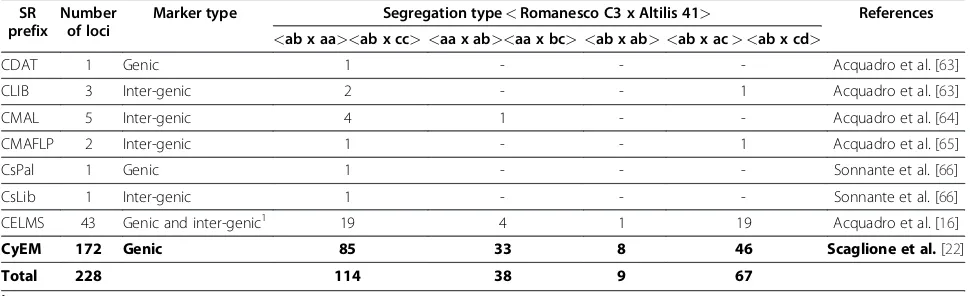
Microsatel-lite (CyEM) markers, identified by Scaglione et al. [22], were excluded from the analysis on the basis of excessive missing values. Of the remaining 172, 54 segregated in both parents (46 as 1:1:1:1, eight as 1:2:1) and 118 in just
one of the parents (85 in globe artichoke ‘Romanesco
C3’, 33 in cultivated cardoon ‘Altilis 41’). On the whole 228 microsatellite markers were available for map con-struction (Table 1). Eleven of these loci suffered from mild segregation distortion (χα2=0.05<χ2≤χα2=0.01) but just
one (CyEM_58) from severe distortion (χ2>χα2=0.01).
Since CyEM_58 was excluded from the mapping ana-lysis, this left a total of 227 SSR loci. Co-dominant mar-kers appear to be less affected by segregation distortion than dominant ones [23,24], and this certainly was
the case for C. cardunculus, where ~13% of AFLP
[image:3.595.56.541.579.727.2]and S-SAP loci [17], but only ~5% of SSRs and SNPs are distorted. Segregation distortion has been associated with statistical bias and/or with errors in genotyping, but they can also stem from a number of biological phenom-ena affecting meiosis, fertilization and embryogenesis [25] as well as the presence of null alleles. Null alleles at SSR loci are not uncommon, as they can arise where either one (or both) of the primers fail to anneal because of se-quence mismatch or the deletion of the whole locus, and cause an higher apparent number of homozygotes because they can no longer be distinguished from the heterozy-gotes [26]. In this situation, the options are either to disre-gard the affected loci, to score segregation in the same way as for a dominant marker [27], to attempt to redesign
Table 1 Polymorphism and segregation patterns for the SSR loci used for map construction
SR prefix
Number of loci
Marker type Segregation type<Romanesco C3 x Altilis 41> References <ab x aa><ab x cc> <aa x ab><aa x bc> <ab x ab> <ab x ac> <ab x cd>
CDAT 1 Genic 1 - - - Acquadro et al. [63]
CLIB 3 Inter-genic 2 - - 1 Acquadro et al. [63]
CMAL 5 Inter-genic 4 1 - - Acquadro et al. [64]
CMAFLP 2 Inter-genic 1 - - 1 Acquadro et al. [65]
CsPal 1 Genic 1 - - - Sonnante et al. [66]
CsLib 1 Inter-genic 1 - - - Sonnante et al. [66]
CELMS 43 Genic and inter-genic1 19 4 1 19 Acquadro et al. [16]
CyEM 172 Genic 85 33 8 46 Scaglione et al.[22]
Total 228 114 38 9 67
1
the primers [28,29], or to adjust allele frequencies on the basis of a global estimate of the frequency of null alleles. As recently described by Lanteri et al. [20] the null alleles segregating in a Mendelian fashion were identified, thus limiting the segregation distortion in our populations. As noted previously [15,17], although the inclusion of loci distorted at the 1% level and above increases the fre-quency of type I errors, it does help to maintain marker density throughout the map.
The updated‘Romanesco C3’map was built from 574
loci (359 AFLPs, 19 S-SAPs, 189 SSRs and seven SNPs),
and the ‘Altilis 41’ one from 373 loci (246 AFLPs,
8 S-SAPs, 114 SSRs and five SNPs); of these, 78 (76 SSRs and two SNPs) were in common between the two parental genotypes. The CyEM SSRs were less in-formative in the cultivated cardoon than in the globe artichoke. Of the 228 assayed SSR loci 189 (83%)
seg-regated in ‘Romanesco C3’, but only 114 (50%) in
‘Altilis 41’ (Table 1). The difference in level of hetero-zygosity between these parents has been remarked on
before [17] and is thought to be a consequence of the sustained vegetative propagation used in globe arti-choke, in contrast to the seed propagation applied to the cultivated cardoon, which led to a certain degree of purifying selection aimed at stabilizing production.
Globe artichoke map
The globe artichoke ‘Romanesco C3’ map (LOD 6.0)
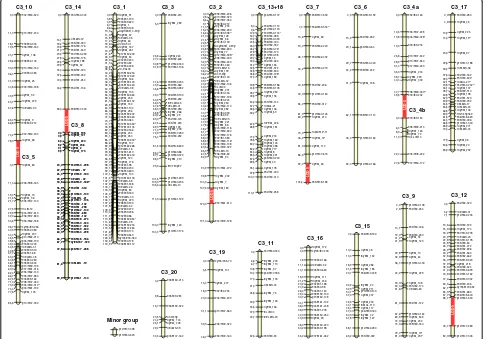
consisted of 473 loci falling into 20 LGs, each containing at least eight loci (Figure 1). The number of mapped SSRs has now risen from 46 to 185. The largest LG con-tained 73 loci, and the range in genetic length of the in-dividual LGs was 34.5-140.9 cM. CyEM loci (139 markers) were mapped to all the major LGs, and their inclusion allowed the integration of six AFLP loci which previously had remained unlinked [17]. Two LGs (C3_13 and C3_18) which were previously separated have now been merged, while LG C3_4 has been split into C3_4a and C3_4b as a consequence of more stringent LOD ap-plied (Figure 1). LG C3_17 has increased in genetic
rCyEM_195 0,0 rCyEM_121 0,9 rCyEM_220 6,3 CyEM_236 8,2 CyEM_2 9,1 rCyEM_173 9,9 e42/m50 -298 20,0 CELMS -37 22,9 p12/m59 -180 25,4 CELMS -02 28,6 e36/m59 -306** 30,8 e32/t81 -340 35,9 38,7 p13/m60 -100 40,4 rCELMS -21 42,3 p12/m47 -105 43,7 e33/t80 -132 44,4 e35/t81 -298 45,2 p12/m62 -100 46,6 e38/t82 -680 47,5 e35/t89 -142 48,7 e35/m48 -274 50,4 e34/m50 -340 54,5 e38/m47 -182 55,4 e36/m59 -500 58,3 e34/m50 -298 60,3 e35/m48 -186 66,7 cyre5/t87 -320 67,7 p45/m47 -288 72,8 rCELMS -19 81,6 p12/m61 -140 90,9 rCyEM_195 0,0 rCyEM_121 0,9 rCyEM_220 6,3 CyEM_236 8,2 CyEM_2 9,1 rCyEM_173 9,9 e42/m50 -298 20,0 CELMS -37 22,9 p12/m59 -180 25,4 CELMS -02 28,6 e36/m59 -306** 30,8 e32/t81 -340 35,9 38,7 p13/m60 -100 40,4 rCELMS -21 42,3 p12/m47 -105 43,7 e33/t80 -132 44,4 e35/t81 -298 45,2 p12/m62 -100 46,6 e38/t82 -680 47,5 e35/t89 -142 48,7 e35/m48 -274 50,4 e34/m50 -340 54,5 e38/m47 -182 55,4 e36/m59 -500 58,3 e34/m50 -298 60,3 e35/m48 -186 66,7 cyre5/t87 -320 67,7 p45/m47 -288 72,8 rCELMS -19 81,6 p12/m61 -140 90,9 e42/m50-520 0,0 p13/m47-240 11,0 e39/t80-330 18,1 e36/m59-164 19,5 CyEM_136 24,7 e38/t82-176 28,6 p13/m50-150 33,0 e39/t80-480 36,4 rCyEM_25 41,0 e39/m50-188 44,8 CyEM_32 49,9 rCyEM_279 53,7 rCELMS-33 57,6 rCyEM_9 65,4 e38/t82-212 66,8 e42/m50-204 74,2 rCyEM_66 78,0 rCyEM_63 0,0 e36/m48-164 11,4 rCyEM_13 19,4 CyEM_36 21,5 e35/m47-140 21,7 rCLIB-12 27,5 p45/m47-610 29,9 e36/m47-580 32,0 e35/m62-348 34,6 cyre5/t89-255 38,7 e38/t82-380 40,3 rCyEM_207 44,4 p13/m62-210 45,5 p45/m59-190 48,8 e33/t80-240 49,4 rCELMS-41 50,5 e33/t89-340 50,8 e35/t81-68 51,7 rCELMS-48 53,0 e35/t80-280 54,8 e38/t80-504 56,1 p13/m59-195 58,0 e37/m61-316 60,3 e35/m62-140 62,4 e35/m47-580 66,7 e35/t89-162 67,5 e38/m47-450 71,0 e35/m50-314** 73,3 p45/m61-192 74,4 CyEM_175 77,6 p13/m47-330 85,5 e34/m50-404 0,0 CELMS-12 15,1 e35/t89-300 18,2 e35/t89-176 19,8 e35/t81-540 21,0 e37/m50-290 23,9 e32/t80-178 27,8 rCyEM_188 29,5 CyEM_52 29,9 e38/t82-490 34,4 e33/t89-232 37,5 e32/t81-250 40,4 e32/t81-136 45,2 e38/m47-400 58,3 rCyEM_91 0,0 e35/t81-190 3,8 e33/t89-620 4,9 CyEM_1 6,7 e39/t80-148 8,6 Acyltransf_4-snp 13,3 rCyEM_57 14,3 CELMS-05 15,8 CyEM_60 17,2 rCDAT-01 18,6 rCyEM_157 19,3 rCyEM_261 19,9 p12/m50-230 21,6 rCyEM_54 25,5 e32/t82-224 28,9 e32/t80-82 31,3 e32/t82-226 33,8 rC-PAL03 38,6 p13/m50-216 40,2 p12/m47-320 41,3 rCyEM_166 43,3 p13/m59-120 46,7 p45/m50-420 48,5 rCELMS-08 50,3 rCyEM_130 52,3 e39/m50-364 55,3 CyEM_259 58,2 p13/m60-142 61,3 CyEM_150 63,8 e35/t81-104 64,9 CyEM_296 65,3 p45/m59-232 70,3 p45/m59-460 72,0 e35/t80-364 73,7 p12/m50-350* 74,7 e37/m49-104 76,8 e32/t82-166 82,7 CyEM_234 83,4 CyEM_254 84,1 e38/m50-340* 85,7 rCyEM_147 88,6 p12/m62-268 89,9 CELMS-16 91,9 e32/t81-610 93,8 e35/m62-440 94,9 CyEM_124 96,5 rCyEM_176 97,2 e32/t81-98 98,0 e38/t82-230 99,1 e38/t80-630 99,7 rCyEM_104 100,1 p13/m50-176 101,2 CELMS-58 102,7 e35/t81-348 102,9 CELMS-26 103,1 rCyEM_84 103,3 e33/t89-430 104,0 rCELMS-40 105,1 rCyEM_223 106,1 e38/t80-190 107,2 CELMS-52 107,8 e32/t82-272 109,5 e35/t89-296 110,4 e32/t82-86 111,9 e35/m50-354* 113,8 CELMS-09 114,6 e34/m50-216 116,6 e36/m47-260 119,5 e33/t89-174 121,6 e38/t80-550 124,3 cyre5/e33-350 128,5 e39/t80-178 130,5 e36/m59-112 140,9 e38/t82-214 0,0 rCyEM_289 5,3 CyEM_260 25,8 e38/t82-600 27,4 p12/m62-340 30,8 e37/m61-136 31,8 e38/m50-234 41,6 e39/t80-560 43,9 e35/m50-282 45,6 e36/m59-130 49,4 e38/t80-252 53,9 rCELMS-45 56,3 CELMS-01 57,6 e33/t89-280 58,0 rCyEM_266 58,8 rCyEM_29 60,2 e32/t80-474 63,0 e35/t81-220 67,5 CyEM_199 69,3 rCyEM_209 71,0 e38/m47-280 72,9 e33/t80-252 75,4 e36/m48-600 81,5 p13/m60-86 86,0 p13/m60-420 87,1 rCyEM_210 88,4 rHCTsnp97 93,9 p12/m61-290 101,5 p12/m60-235 103,3 CELMS-10 105,6 p13/m61-192 114,3 rCyEM_120 130,0 p13/m47-175 134,4 e38/m50-206 0,0 p13/m59-320 2,8 e38/m47-350 8,6 e38/t80-212 9,1 rCyEM_294 11,3 e35/m50-280 15,2 e33/t89-338** 16,6 CyEM_128 21,0 rCyEM_56 21,5 e32/t80-190 22,5 Acyltransf_2-snp 24,7 p45/m60-690 25,8 CyEM_77 27,7 p12/m60-395** 28,6 e38/m50-230 30,8 e35/m50-220 32,3 e32/t81-460 34,2 rCELMS-15 34,7 CyEM_190 36,0 C4H-snp 36,2 e32/t82-140 38,3 CELMS-42 39,7 p12/m62-106 40,2 CLIB-02 40,3 rCyEM_231 40,9 e38/t80-450 42,1 p12/m47-196 42,6 e33/t80-224 43,0 CyEM_250 43,1 p13/m60-110 43,6 CyEM_282 44,1 e38/t80-390 44,7 e32/t82-92 45,6 rCELMS-03 46,3 rCyEM_221 47,3 rCyEM_86 47,8 p45/m59-116 48,2 e42/m50-590 51,7 e42/m50-176 54,9 e32/t81-380 58,0 p12/m60-116* 58,5 e38/m50-108 59,2 e34/m49-322 63,5 CELMS-13 65,3 e36/m48-82 67,5 rCyEM_94 82,9 p13/m61-272 94,9 rCyEM_202 99,8 rCyEM_7 104,0 CyEM_183 107,5 e37/m61-510 120,0 e34/m49-128 131,0 p45/m59-172 0,0 e36/m47-112 8,4 p12/m62-120 9,6 e42/m50-144* 12,9 e38/t82-288 16,7 p45/m50-390 19,2 e38/t80-430 24,5 e32/t82-182 25,3 p45/m60-76* 26,2 e32/t80-170 27,9 p13/m50-98 29,2 CyEM_15 29,7 e32/t80-260 30,0 CyEM_155 31,2 e32/t81-372 32,5 e33/t89-530 34,8 e35/t80-128* 35,8 CyEM_189 37,4 e38/m59-186 43,8 e38/m59-178 44,8 rCyEM_280 48,7 CyEM_135 49,5 e33/t89-144 54,2 rCMAL-21 57,7 CyEM_106 58,6 rCyEM_53 59,2 rCYEM_226 67,9 rCyEM_181 68,8 CyEM_243 77,0 rCyEM_169 78,5 rCyEM_145 rCyEM_288 80,7 CyEM_73** 82,2 rCyEM_8 84,4 rCyEM_291 85,5 p45/m60-200 87,6 CyEM_43 89,5 CyEM_178 95,1 e32/t81-400 97,8 e32/t80-410 100,7 e32/t82-258 110,1 e38/m47-530 0,0 e36/m59-334** 7,4 CyEM_80 13,6 e35/m62-220 19,2 e35/m62-432 26,1 e39/m50-270 33,2 e32/t82-206 43,5 p12/m50-160 49,0 e35/t89-312 55,2 p12/m60-125 61,3 rCyEM_214 63,2 rCMAFLP-11 73,0 rCyEM_47* 76,2 CyEM_112 81,4 p12/m47-670 86,5 CyEM_55 92,2 e35/m48-158 104,2 e35/m49-192 0,0 e32/t80-282 13,9 p45/m60-64 20,1 e35/m50-420 29,7 e38/t80-242 34,2 rCyEM_158 41,9 e38/m47-114 62,1 p13/m59-164 76,2 p12/m62-166 92,4 e32/t82-160 0,0 e35/m47-228 10,5 p45/m60-428* 13,8 e33/t89-234 19,0 p13/m47-542 25,8 p13/m47-550 28,9 p12/m50-220 31,4 rCyEM_244 35,3 CyEM_293 38,7 rCyEM_300 40,4 e38/m59-450** 47,7 e33/t80-232 49,5 e33/t89-154 0,0 e38/m59-214 6,4 rCyEM_163 rCyEM_72 8,3 rCs-LIB-14 11,3 e35/m48-222 22,4 e37/m50-172 27,6 e33/t80-280 0,0 rCyEM_45 4,5 CyEM_225 10,9 rCyEM_19** 14,0 rCyEM_97 23,3 p13/m47-188 29,6 rCELMS-36 33,2 e32/t80-162 37,5 e33/t80-504* 39,3 rCMAL-24** 42,1 e42/m50-242** 43,8 rCyEM_107 46,1 e35/t89-310 48,7 rCyEM_138 50,8 e32/t81-570 52,3 e35/t89-292 53,9 CELMS-17 54,5 rCELMS-24 55,5 rCyEM_146 56,8 HQT-snp359 59,3 e36/m48-620 61,5 e38/t80-496 64,4 p13/m61-340 66,8 rCyEM_271 68,9 rCELMS-44 70,4 CyEM_35 77,9 rCyEM_20 80,6 rCyEM_232 83,9 e32/t82-420 0,0 rCELMS-31 5,2 p12/m62-245 7,1 e39/t80-190 13,5 rCyEM_174 15,9 e37/m49-278 18,2 rCELMS-23 20,9 e34/m49-178 22,8 e35/t89-64 24,8 e35/t81-272 26,7 e38/t82-696 28,9 e35/t81-560 30,2 e38/t82-662 32,8 e35/m49-320 35,0 CyEM_218 37,9 e35/t89-224 38,9 e39/m50-690 41,2 e42/m50-162 43,8 e35/m50-302 47,2 e39/t80-206 50,3 cyre5/m49-352 52,1 e35/t81-680 55,3 e36/m48-640 57,7 p12/m61-530 58,1 p12/m47-283 76,1 p12/m47-305 82,3
C3_10 C3_14 C3_1 C3_3 C3_2 C3_13+18 C3_7 C3_6 C3_4a C3_17
e38/m50-214 0,0 e35/t89-284 9,8 e36/m59-322 15,7 C3H-snp 23,5 CyEM_144 24,2 CyEM_248 25,1 CELMS-39 29,2 p45/m47-162 34,5 C3_20 cyre5/e35-70 0,0 rCyEM_141 5,5 CyEM_277 13,4 e32/t82-294 18,3 e35/m50-230 23,0 p13/m47-560 31,1 e35/m49-324 39,3 e35/m49-164 46,7
[image:4.595.56.540.346.685.2]C3_19 0,0 e37/m50-340 rCyEM_233 6,6 rCyEM_113 6,7 rCyEM_37 10,8 p45/m47-335 13,4 rCyEM_193 17,3 CELMS-04 21,0 rCyEM_75 25,8 rCyEM_126 30,9 CyEM_156 34,5 rCLIB-04 37,3 rCELMS-20 40,7 e39/t80-90 52,5 C3_11 rCyEM_172 0,0 cyre5/t87-230 2,3 e33/t89-166 7,8 rCELMS-32 11,1 e35/t80-660 14,1 rCyEM_111 18,3 rCyEM_246 21,2 e32/t81-188 23,2 e35/t80-98 24,9 e35/t81-154 26,4 e38/m59-130 29,4 p13/m60-148 30,7 p45/m61-102 34,1 p45/m61-248 36,4 e35/t81-278 38,9 e35/m50-254 42,0 CyEM_93 43,9 p45/m50-220 48,0 e35/t89-198 50,2 e37/m61-262 55,2 C3_16 e36/m48-150 0,0 CyEM_48 10,0 rCyEM_152 13,4 CyEM_286 18,9 rCyEM_185 21,5 e36/m47-248 23,7 rCyEM_24 32,2 CyEM_211 32,9 p13/m50-140 34,7 CyEM_237 37,0 CyEM_240 42,5 rCMAL-110 44,1 CyEM_117 45,4 p45/m59-164 47,0 rCyEM_42 50,3 rCyEM_127 51,8 p12/m62-280 58,1 e33/t80-322 63,2 C3_15 p13/m62-148 0,0 e32/t82-254 2,5 e39/t80-406 14,1 e38/t80-250 19,0 CyEM_34 21,2 rCyEM_123 21,9 CyEM_10 29,8 CyEM_64 32,3 p13/m50-430 36,1 rCyEM_229 42,2 CyEM_108 49,3 e33/t80-174 50,4 CELMS-60 51,6 e32/t81-122 61,0 p13/m62-164 67,6 rCyEM_54b 69,5 CyEM_200 72,3 e38/t80-340 74,0 rCyEM_70* 79,4 CyEM_231* 81,4 C3_9 p12/m47-498 p13/m50-520 C3_12 C3_5 C3_8 C3_4b LOD 5 LO D 5 LO D 5 LO D 5 LO D 5 LO D 5 Minor group
length by 36 cM (86%), while that of LG C3_3 and C3_8 has increased by ~30% and ~20%, respectively. The map spanned 1543.8 cM, with a mean inter-marker distance of 3.40 cM, corresponding to a 3.8% increase in length over the earlier map [17], but in a ~28% decrease in the mean inter-marker distance. The proportion of intervals shorter than 7 cM is now 88% (previously 77%), and
only six gaps of >15 cM remain. The SSRs appeared to
be rather quite uniformly dispersed, although some clus-tering is present in the distal regions of C3_8, C3_2 and C3_17, and around the putative centromeric region, of C3_3, C3_15 and C3_20. These chromosomal regions are typically enriched for SSRs [30–35]. The relatively low marker saturation present in the distal regions of C3_3 and C3_14 presumably reflects a localized reduced level of polymorphism between the mapping parents.
Some segregation distortion was present at five of the CyEM loci (CyEM_19, _47, _70, _73 and _231; three at
α= 0.05 and two at α= 0.01, Figure 1) which affected a cluster of loci on both C3_17 and C3_9. In both cases the distortion was due to an excess of the band detected in the female parent, thus it is likely to have a biological basis, rather than being due to either scoring error or chance [36]. Biological mechanisms causing segregation distortions have been extensively studied in Drosophila [37], and are
known to occur in many plant species [38–42]. On the
other hand, the other 18 distorted loci were scattered across the genome, a common feature in the genetic maps of both plant and animal species [43].
By lowering the LOD threshold from 6.0 to 5.0, three pairs of LGs were merged: C3_10 with C3_5, C3_14 with C3_8 and C3_4a with C3_4b, resulting in the formation of 17 LGs (corresponding to the haploid chromosome number, Figure 1). It also allowed the inclusion of two unlinked pairs of loci (one into C3_2 and the other into C3_12) and the singlet AFLP locus e35/m46-156 (into C3_7). This generated an increase in the genetic length of the map of ~60 cM; one doublet still remains unlinked (Figure 1).
Both the goodness-of-fit of marker placement (mean
χ2
contribution) and nearest neighbour fit (cM) were
evaluated. Compared to the earlier ‘Romanesco C3’map
[17], the average meanχ2contribution of markers across the LGs has been significantly reduced from 5.38 to 4.42 (ttest atα= 0.005), highlighting the improvement in ro-bustness. The variation in this parameter for each LG is illustrated in Figure 2, which confirms that LGs C3_1, C3_2, C3_5, C3_8, C3_10, C3_17 and C3_20 have all shown an improved goodness-of-fit. C3_12 remained largely composed of AFLP loci (only two CyEM loci were integrated) and thus its robustness was hardly improved. The mean nearest neighbour fit of the CyEM
loci (24.3 ± 3.7 cM) was markedly lower (t test at
α= 0.005) than that of the AFLP loci (51.0 ± 4.6 cM),
confirming the desirability of including co-dominant markers to obtain reliable marker placement.
Cultivated cardoon map
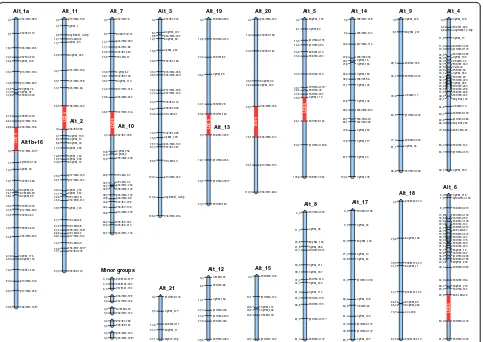
The genetic map of the cultivated cardoon ‘Altilis 41’ parent (LOD 6.0) was constructed from 373 segregating loci (82 CyEM loci), of which 273 were ordered into 21 major LGs, whose length ranged from 27.1 to 125.2 cM, with the largest LG consisting of 29 loci. The result of integrating the CyEM loci was an increase in the num-ber of major LGs from 17 to 21. This involved the rec-ognition of four new LGs (Alt_18 to _21), the splitting of Alt_1 into two (Alt_1a and Alt_1b) and the merging of Alt_16 and Alt_1b (Figure 3). The updated ‘Altilis 41’ map included 107 SSR loci distributed across all but one (Alt_13) of the major LGs, with a total genetic length of 1485.7 cM and a mean inter-marker distance of 5.44 cM. This represents a marked increase in both length (+42%) and number of loci (+50%), together with a minor decrease in the mean inter-marker distance
(−5%). The proportion of intervals smaller than 10 cM
(about 80%) was not significantly reduced. Some of the
LGs recorded large increases in their genetic length –
for example, that of Alt_17 by 64.7 cM, Alt_14 by 58.9 cM and Alt_18 by 57.8 cM. The only LG which recorded a reduction in length was Alt_5. There was some clustering of CyEM loci in the distal region of Alt_2 and around the putative centromeric region of Alt_1b and Alt_15. Three CyEM loci (CyEM_73, _3 and _231; Figure 3) showed a degree of segregation
distor-tion (two at α= 0.05 and one at α= 0.01), but none of
these were linked to other distorted loci, similar to the other nine markers showing segregation distortion. The addition of the new SSR markers decreased the mean in-ter-marker distance on Alt_11 by ~60%, and some gaps in the previous map have been filled; but ten gaps of >15 cM remained, perhaps reflecting regions of genetic fixation which have arisen during cultivated cardoon domestication.
Lowering the LOD threshold to 5.0 led to the merging of four pairs of LG: Alt_1a with Alt_1b, Alt_11 with Alt_2, Alt_7 with Alt_10, and Alt_19 with Alt_13. At this level of stringency the number of LGs corresponded to the haploid chromosome (Figure 3). The lowered stringency also allowed the incorporation of two groups of three linked loci into LGs Alt_20, and Alt_5, and of one doublet into LG Alt_6. As a result, the overall length of the map was increased by 133.5 cM; one triplet and four doublets still remain unlinked (Figure 3).
TheC. Cardunculusconsensus map
result, 19 of the‘Romanesco C3’LGs were alignable with 20 of the ‘Altilis 41’ones (Table 2). There was a one to one correspondence between 18 LG pairs, but C3_1
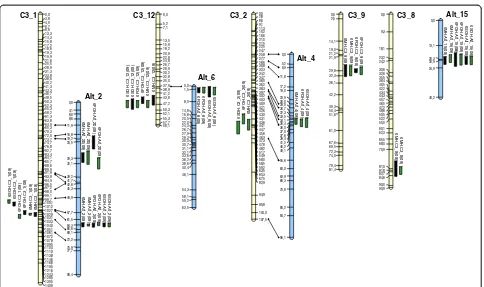
[image:6.595.59.540.89.261.2]shared markers with both Alt_11 and Alt_2 (Table 2). C3_4b remained non-aligned, but did harbour a number of SSR loci which were informative for the second step Figure 2Variation in the mean goodness-of-fit of markers for each‘Romanesco C3’LG. Variation detected by comparing the current ‘Romanesco C3’map with that published by Portis et al. [17]. LGs C3_13 and C3_18 have been merged.
e32/t82 -308 0,0 CyEM_236 10,8 CyEM_2 11,9 e35/m62 -248 14,9 CELMS -37 25,5 CELMS -02 32,0 p45/m47 -250 32,2 e38/m59 -102 32,9 p45/m60 -122 38,3 p45/m60 -68 40,8 e32/t80 -226 42,6 e35/t80 -148 46,4 p13/m50 -278 49,6 e35/t89 -322 56,0 e35/t89 -212 57,2 p45/m47 -134 62,7 e32/t82 -308 0,0 CyEM_236 10,8 CyEM_2 11,9 e35/m62 -248 14,9 CELMS -37 25,5 CELMS -02 32,0 p45/m47 -250 32,2 e38/m59 -102 32,9 p45/m60 -122 38,3 p45/m60 -68 40,8 e32/t80 -226 42,6 e35/t80 -148 46,4 p13/m50 -278 49,6 e35/t89 -322 56,0 e35/t89 -212 57,2 p45/m47 -134 62,7 e34/m49-380* 0,0 e32/t82-112 9,1 e35/m62-238 18,2 e32/t80-220 24,2 CyEM_136 26,5 p13/m47-335 33,4 p13/m50-690 40,5 aCyEM_76 44,9 CyEM_32 47,0 e33/t80-302 47,8 e38/t80-230 61,9 p12/m62-136 65,0 e39/m50-186 68,8 e37/m61-204** 0,0 cyre5/t90-145 7,7 CyEM_36 12,0 e32/t81-258 19,1 aCyEM_38 25,8 aCELMS-59 26,7 aCyEM_99 28,1 e33/t80-200 35,2 p12/m50-295 37,5 e32/t82-64 40,9 e38/t82-540 49,3 e38/m50-600 54,8 CyEM_175 67,6 aCyEM_118 69,0 e32/t81-248 76,0 p13/m60-108 83,3 p12/m62-256 89,4 e36/m47-158** 99,8 p13/m62-138 0,0 CyEM_1 4,1 Acyltransf_4-snp 9,9 CELMS-05 12,7 CyEM_60 14,7 aCyEM_264 22,8 e34/m50-196 32,7 e34/m50-198 39,1 p45/m61-66 43,7 e38/m50-162 55,3 e35/t80-358 0,0 aCyEM_133 4,1 aCyEM_14 6,0 aCyEM_30 8,6 CyEM_259 11,9 CyEM_150 16,8 CyEM_296 19,2 aCyEM_12 20,5 p12/m62-150 29,3 p12/m62-164 32,1 CyEM_234 39,2 CyEM_254 41,7 CELMS-16 42,6 e34/m49-212 45,3 CyEM_124 49,9 CELMS-26 57,7 CELMS-58 61,5 e38/m47-158* 64,3 CELMS-52 66,6 p12/m50-105 68,1 CELMS-09 72,2 e35/m47-590** 75,9 e33/t80-272 77,7 e35/t89-144 90,4 e32/t80-76 0,0 aCMAFLP-07 9,2 p45/m50-280 14,1 p45/m47-88 17,7 e35/t81-554 20,8 CELMS-12 23,9 CyEM_52 33,5 e32/t82-148 36,1 aCyEM_110 39,2 p12/m47-315 44,5 e35/m62-252 49,8 e37/m49-146 58,9 e32/t81-200 0,0 aCyEM_247 8,4 p45/m59-402 9,8 aCyEM_59 12,1 CyEM_260 19,6 e32/t81-168 26,3 p45/m60-258 33,4 e35/m48-650* 35,3 e37/m61-228 45,2 e37/m61-240 47,0 e39/t80-124 52,3 e38/t82-306 56,7 CELMS-01 60,5 e32/t81-328 72,2 CyEM_199 75,3 p45/m60-102 79,7 e32/t81-352 81,0 CELMS-10 89,9 p13/m59-450 100,7 Acyltransf_3-snp 113,5 e35/m49-206 125,2 e35/m62-280 0,0 e34/m50-470 12,6 e32/t81-82 24,3 CyEM_93 35,2 e38/t82-78 54,1 e32/t81-160 60,5 e36/m47-290 0,0 p12/m62-455 16,1 p12/m62-390** 29,2 e33/t89-180 44,0 p45/m60-420 0,0 e32/t82-158 10,2 e32/t82-164 20,2 aCyEM_90 39,4 CyEM_293 42,0 e36/m48-326 55,7 e36/m59-140 75,1 p13/m62-190 93,1 e35/m47-686 110,3 aCyEM_197 0,0 CyEM_80 6,1 p12/m60-118 13,5 p13/m50-90 16,3 aCELMS-14 20,6 e35/t80-200 23,5 e33/t89-510 34,9 e39/m50-410* 43,7 e39/t80-78 45,2 e39/t80-224 47,8 CyEM_112 49,9 e37/m49-164 65,1 p12/m50-160a 80,2 e38/m47-354 100,6 e38/m47-248 0,0 e35/m62-144 9,0 p12/m62-114 16,0 e38/t82-406 24,9 CyEM_15 26,7 CyEM_155 27,6 CyEM_189 35,0 e35/t81-86 38,2 CyEM_135 41,7 CyEM_106 51,8 e35/m48-500 58,0 e35/t80-540 63,7 e32/t82-228 65,1 CyEM_243 70,9 CyEM_73** 77,5 CyEM_43 87,7 CyEM_178 100,4 CyEM_225 0,0 aCyEM_227 8,1 e38/t82-182 28,1 e39/m50-240 36,1 CELMS-17 48,6 p13/m60-230 60,9 e35/m62-390 77,3 CyEM_35 81,1 e37/m49-336 96,6 CyEM_128 0,0 e32/t81-590 5,2 Acyltransf_2-snp 6,9 CyEM_77 11,8 e35/m47-332 17,2 p13/m59-170 19,0 e34/m50-282 23,9 CyEM_190 26,0 CELMS-42 28,0 e35/t81-340 30,7 CLIB-02 32,3 e38/t80-90 33,5 CyEM_250 34,1 e32/t82-90 35,4 e33/t89-490 36,0 CyEM_282 37,0 e32/t82-260 37,6 e35/t80-238 39,4 e38/t82-638 41,2 e33/t89-402 46,2 aCyEM_122 49,1 CELMS-13 55,6 e38/m59-190 60,0 p13/m50-365 63,9 aCyEM_284 66,3 aCELMS-25 70,8 e32/t82-124 80,2 p13/m62-410 84,7 CyEM_183 96,1 Alt1b+16 Alt_10 Alt_13 Alt_20 p13/m59-105 0,0 CyEM_277 9,3 aCELMS-11 17,6 aCyEM_3* 21,0 Myb12-snp 27,1 Alt_21 CELMS-04 0,0 e39/t80-86 5,2 CyEM_156 14,1 p12/m50-95 21,0 p13/m62-230 24,5 e35/t80-340 27,9 e39/m50-360 39,5 Alt_12 e35/m48-108 0,0 p13/m50-124 13,1 CyEM_144 20,3 CyEM_248 20,9 CELMS-39 24,9 p12/m47-162 40,2 Alt_15 e37/m50-232 0,0 CyEM_48 11,0 aCyEM_153 18,8 CyEM_286 21,8 e34/m49-272 24,1 CyEM_211 33,5 CyEM_237 38,1 e32/t82-510 43,0 CyEM_240 44,7 CyEM_117 51,0 e33/t80-178 54,7 e33/t89-190 58,8 p12/m50-310** 67,9 e38/m50-170 81,0 Alt_8 e34/m49-108 0,0 CyEM_34 9,2 aCyEM_148 19,3 CyEM_10 27,7 CyEM_64 30,8 p13/m47-430 44,0 CyEM_108 56,6 CELMS-60 60,5 CyEM_200 67,4 p13/m62-174 72,4 p13/m62-170 76,8 CyEM_231* 82,1
Alt_17 0,0 p45/m62-370
aCyEM_196 23,6 e38/m47-440 39,3 aCyEM_11 41,0 p45/m61-150 57,7 aCyEM_69 65,2 aCyEM_256 65,4 4CL-snp 70,7 e36/m48-410 87,9
Alt_18 0,0 CyEM_218 cyre5/m47-160 1,5 e36/m59-270 8,0 e34/m50-130 14,8 e34/m49-90 16,8 e36/m47-148 20,5 e35/t80-144 22,0 e38/m50-274 24,3 aCELMS-57 26,7 e35/m50-272 27,9 e33/t80-154 29,3 e32/t82-178 30,0 e39/t80-500 30,7 e35/t80-440 31,1 aCyEM_16 32,1 e33/t89-492 33,6 p12/m59-228 36,2 e35/m62-198 38,6 aCyEM_204 40,4 e38/m50-350 46,1 e35/t89-336 54,3 aCyEM_219 58,1 e32/t80-152 59,2 aCELMS-49 63,5 e39/m50-120 80,2 e39/m50-490 91,7 Alt_6 e34/m50-212** 0,0 e35/m62-394 3,0 e37/m61-194 6,0 e35/m50-198 0,0 e37/m49-196 3,0 aCELMS-18 0,0 e36/m47-272 3,0 e32/t81-268 0,0 e35/t89-164 3,0 p45/m61-154 0,0 p45/m61-328** 3,0 4 _ t l A 9 _ t l A 4 1 _ t l A 5 _ t l A 9 1 _ t l A 3 _ t l A 7 _ t l A 1 1 _ t l A a 1 _ t l A Alt_2 LO D 5 LO D 5 LO D 5 LO D 5 LO D 5 LO D 5 LO D 5 Minor groups
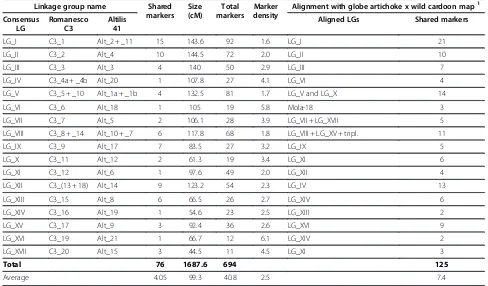
[image:6.595.58.541.343.685.2]of the analysis; this was not the case for Alt_13 (Table 2). The alignment was followed by the construction of a consensus map based on a LOD threshold of above 5.0 (Figure 4), which succeeded in capturing 694 loci, 227 (217 SSRs, ten SNPs) of which involved co-dominant markers. The map generated 17 LGs with a total genetic length of 1687.6 cM and a mean inter-marker spacing of 2.5 cM; consensus LG numbers (from LG I to LG XVII) have been assigned (Table 2, Figure 4). The length of each individual LG varied from 44.5 to 144.5 cM (mean 99.3 cM), with the largest containing 92 loci. Only three of the CyEM loci (the intercross locus CyEM_134 and
the two ‘Altilis 41’ testcross loci CyEM_167 and _79)
remained unlinked.
The consensus map, obtained from the domesticated
C. cardunculus forms, was compared with the Sonnante et al. [21] map constructed from a cross between the var. scolymuscultivar ‘Mola’and the var.sylvestris(wild cardoon) accession‘Tolfa’, by considering 125 (117 SSRs, eight SNPs) common markers. The common markers identified each of the 17 LGs on the consensus map, with between two and 21 present on each LG (Table 2). Ten of the LGs aligned readily; LGs V and VII aligned with two‘Mola’/‘Tolfa’LGs, and LG VIII with two major groups and a triplet of markers. LGs X/XVII, and XIII/ XVI each aligned with only a single‘Mola’/‘Tolfa’LG. In general, marker order and genetic separation were
comparable, with some exceptions. It has been estab-lished that wild cardoon is more divergent from the two cultivated forms (globe artichoke and cultivated car-doon) than are the two cultivated forms with respect to one another [44,45]. Somewhat surprisingly, therefore, over 100 SSR loci featured in the consensus map but ap-parently were either non-informative or remained as singlet loci in the‘Mola’/‘Tolfa’population.
EST-SSRs as functional markers
Putative functions can be deduced for markers derived from ESTs using homology searches with public protein databases. Annotation of mapped loci was performed via BlastX search as well as InterPro scan and GO categor-isation made it possible to tag some biological functions.
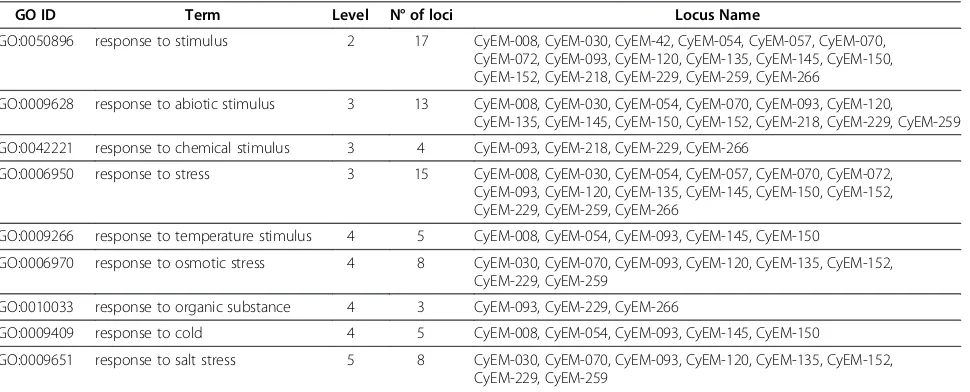
A set of 17 CyEM markers were annotated with GO terms involved in the ‘response to stimulus’ (Table 3), five of which were derived from transcripts related to
‘response to cold stress’ and eight to ‘response to salt stress’ terms. In particular, the marker CyEM-42, devel-oped from the contig CL4773Contig1 (1281 bp, 267
aminoacids) [22] and mapped on LG_12 of“Romanesco
C3” map, showed high amino acid similarity (81%) with
the Arabidopsis protein kinase PBS1 (NP_196820.1, uni-gene At.23518). To consider reliable orthology, a recip-rocal tblastx analysis against the whole EST collection,
[image:7.595.54.542.101.387.2]currently available for C. cardunculus, was performed
Table 2 Characteristics and alignment of the consensusC. cardunculuslinkage map
Linkage group name Shared markers
Size (cM)
Total markers
Marker density
Alignment with globe artichoke x wild cardoon map1
Consensus LG
Romanesco C3
Altilis 41
Aligned LGs Shared markers
LG_I C3_1 Alt_2 + _11 15 143.6 92 1.6 LG_I 21
LG_II C3_2 Alt_4 10 144.5 72 2.0 LG_II 10
LG_III C3_3 Alt_3 4 140 50 2.9 LG_III 7
LG_IV C3_4a + _4b Alt_20 1 107.8 27 4.1 LG_VI 4
LG_V C3_5 + _10 Alt_1a + _1b 4 132.5 81 1.7 LG_V and LG_X 14
LG_VI C3_6 Alt_18 1 105 19 5.8 Mola-18 3
LG_VII C3_7 Alt_5 2 106.1 28 3.9 LG_VII + LG_XVII 5
LG_VIII C3_8 + _14 Alt_10 + _7 6 117.8 68 1.8 LG_VIII + LG_XV + tripl. 11
LG_IX C3_9 Alt_17 7 83.5 27 3.2 LG_IX 5
LG_X C3_11 Alt_12 2 61.3 19 3.4 LG_XI 6
LG_XI C3_12 Alt_6 1 97.6 49 2.0 LG_XII 4
LG_XII C3_(13 + 18) Alt_14 9 123.2 54 2.3 LG_IV 13
LG_XIII C3_15 Alt_8 6 66.5 26 2.7 LG_XIV 6
LG_XIV C3_16 Alt_19 1 54.6 23 2.5 LG_XIII 2
LG_XV C3_17 Alt_9 3 92.4 36 2.6 LG_XVI 9
LG_XVI C3_19 Alt_21 1 66.7 12 6.1 LG_XIV 2
LG_XVII C3_20 Alt_15 3 44.5 11 4.5 LG_XI 3
Total 76 1687.6 694 125
Average 4.05 99.3 40.8 2.5 7.4
a-p13/m62-138 0,0 r-CyEM-91 2,0 r-e35/t81-190 5,5 CyEM-1 6,9 a-p45/m61-66 7,2 r-CyEM-54a 10,2 CELMS-05 13,4 CyEM-60 14,7 r-CDAT-01 16,3 Acyltransf-4-snp 16,8 r-CyEM-157 17,5 a-e38/m50-162 18,0 r-CyEM-261 18,6 r-CyEM-57 19,7 r-p12/m50-230 22,6 r-e33/t89-620 23,2 a-e34/m50-196 27,3 r-e39/t80-148 28,7 r-e32/t82-224 30,1 r-e32/t80-82 32,4 a-e34/m50-198 33,2 r-e32/t82-226 34,9 a-CyEM-264 37,4 r-p12/m47-320 40,3 r-p13/m50-216 41,1 r-Cs-PAL03 42,2 r-CyEM-166 44,4 r-p13/m59-120 47,8 r-p45/m50-420 49,5 a-CyEM-133 50,3 r-CELMS-08 51,4 a-CyEM-14 52,6 r-CyEM-130 53,5 a-CyEM-30 55,2 r-e39/m50-364 56,7 a-e35/t80-358 58,3 CyEM-259 61,1 r-p13/m60-142 61,8 CyEM-150 65,3 r-e35/t81-104 66,3 CyEM-296 67,7 a-CyEM-12 68,9 r-p45/m59-232 70,3 r-p12/m50-350* 74,6 r-p45/m59-460 75,4 r-e38/t80-630 76,2 a-p12/m62-150 77,3 r-cyre5/e33-350 81,0 a-e34/m49-212 82,0 r-e32/t82-166 86,0 CyEM-234 87,7 CyEM-254 88,3 r-e38/m50-340* 90,8 r-p12/m62-268 91,7 r-CyEM-147 93,3 a-e35/t89-144 93,9 CELMS-09 95,1 a-p12/m62-164 95,8 CELMS-16 97,1 r-e35/m62-440 98,4 r-CyEM-176 99,0 CyEM-124 99,6 r-e32/t81-610 101,0 r-CyEM-104 101,9 r-e38/t82-230 102,6 r-e32/t81-98 103,4 CELMS-26 103,6 r-p13/m50-176 104,8 r-CyEM-84 105,7 r-e33/t89-430 106,4 r-e35/t81-348 106,7 CELMS-58 107,5 a-e38/m47-158* 107,9 r-CELMS-40 108,3 r-CyEM-223 109,8 CELMS-52 110,3 r-e38/t80-190 111,3 r-e32/t82-272 112,8 a-p12/m50-105 113,0 r-e35/t89-296 114,0 r-e32/t82-86 115,5 r-e35/m50-354* 117,4 a-e35/m47-590** 118,3 r-e34/m50-216 119,8 a-e33/t80-272 120,1 r-e33/t89-174 123,0 r-e36/m47-260 124,6 r-e38/t80-550 126,9 r-e37/m49-104 130,1 r-e39/t80-178 133,6 a-e38/t82-550 138,4 r-e36/m59-112 143,6 C3-1 / Alt-2+11
a-e33/t89-310 0,0 r-e38/m50-108 10,9 a-CyEM-162 19,2 r-e38/m50-206 23,0 r-p13/m59-320 27,3 r-CyEM-294 32,2 r-e35/m50-280 35,2 Acyltransf-2-snp 36,1 r-e38/t80-212 38,2 r-e36/m48-82 38,6 a-e32/t81-590 39,2 CyEM-128 42,5 r-e33/t89-338** 42,6 r-e32/t80-190 45,0 r-CyEM-56 47,2 CyEM-77 48,3 a-e35/m47-332 51,5 r-e32/t81-380 52,3 a-p13/m59-170 52,9 r-p12/m60-395** 53,3 r-e32/t81-460 55,3 r-e42/m50-590 57,8 a-e34/m50-282 58,0 C4H-snp 59,4 CyEM-190 60,0 r-p12/m62-106 61,0 r-p45/m59-116 61,5 r-CyEM-86 61,8 r-CELMS-03 62,9 r-CyEM-221 63,3 r-p12/m47-196 64,1 a-e35/t81-340 64,3 r-e33/t80-224 64,5 r-p13/m60-110 65,1 r-CyEM-231b 65,4 CyEM-282 65,6 r-e38/t80-390 66,3 CLIB-02 66,4 r-CELMS-15 66,5 r-e38/t80-450 67,0 CyEM-250 67,2 r-e32/t82-92 67,9 a-e38/t80-90 68,1 a-e32/t82-90 69,0 a-e33/t89-490 69,6 r-e32/t82-140 69,8 a-e32/t82-260 71,3 CELMS-42 71,8 a-e35/t80-238 73,1 r-e35/m50-220 74,5 a-e38/t82-638 74,9 r-e42/m50-176 79,5 a-e33/t89-402 79,6 r-p45/m60-690 81,8 a-CyEM-122 82,3 r-e38/m50-230 83,8 CELMS-13 r-p12/m60-116* 86,0 r-e34/m49-322 88,6 r-e38/m47-350 92,6 a-e38/m59-190 93,3 a-p13/m50-365 96,9 a-CyEM-284 99,4 a-CELMS-25 103,7 r-CyEM-94 104,5 a-e32/t82-124 113,3 r-p13/m61-272 117,1 a-p13/m62-410 117,7 r-CyEM-202 121,8 r-CyEM-7 126,2 CyEM-183 129,3 r-e37/m61-510 144,5 C3-2 / Alt-4
a-p45/m60-258 0,0 r-e38/t82-214 4,4 r-CyEM-289 9,8 a-e32/t81-200 11,8 a-CyEM-247 20,2 a-p45/m59-402 21,5 a-CyEM-59 23,6 CyEM-260 30,5 r-e38/t82-600 32,3 r-p12/m62-340 35,6 r-e37/m61-136 36,4 a-e35/m48-650* 37,8 r-e38/m50-234 46,8 a-e37/m61-240 48,0 r-e39/t80-560 49,2 a-e37/m61-228 50,5 r-e35/m50-282 51,0 r-e36/m59-130 54,4 a-e39/t80-124 55,6 r-e35/t81-220 56,2 r-CyEM-266 59,8 a-e38/t82-306 60,3 r-e38/t80-252 61,5 r-e32/t80-474 62,8 r-e33/t89-280 64,9 CELMS-01 65,8 r-CELMS-45 66,8 r-CyEM-29 67,9 r-e38/m47-280 75,0 a-e32/t81-328 75,7 CyEM-199 76,3 r-CyEM-209 77,8 r-e33/t80-252 80,8 Acyltransf-3-snp 85,5 a-e32/t81-168 86,1 r-e36/m48-600 87,1 a-e32/t81-352 90,9 r-p13/m60-86 91,3 r-p13/m60-420 92,5 r-CyEM-210 93,9 HCT-snp 99,4 a-p13/m59-450 100,2 r-p12/m61-290 106,8 r-p12/m60-235 108,9 CELMS-10 111,4 a-e35/m49-206 118,3 r-p13/m61-192 119,9 a-p45/m60-102 125,0 r-CyEM-120 135,6 r-p13/m47-175 140,0 C3-3 / Alt-3
a-p45/m60-420 0,0 r-e32/t82-160 12,0 a-e32/t82-158 21,1 r-e35/m47-228 21,6 r-e32/t80-266 24,1 r-p45/m60-428* 25,5 r-p45/m60-432 26,4 r-e32/t82-164 30,1 r-e33/t89-234 30,7 r-p13/m47-550 37,4 r-p13/m47-542 40,1 r-p12/m50-220 42,8 r-e38/t80-540 44,1 r-CyEM-244 46,4 CyEM-293 50,1 r-CyEM-300 51,3 a-CyEM-90 52,7 r-e38/m59-450** 58,7 r-e33/t80-232 60,4 a-e36/m48-326 74,2 r-e33/t89-154 80,2 r-e38/m59-214 86,5 r-CyEM-163 88,4 r-CyEM-72 88,5 r-CLIB-14 91,5 r-e35/m48-222 102,6 r-e37/m50-172 107,8 C3-4 / Alt-20
a-e38/m50-600 0,0 r-p45/m61-192 3,9 r-p45/m47-610 5,2 r-e35/m50-314** 9,8 a-e32/t82-64 11,2 r-e35/m47-580 11,8 r-cyre5/t89-255 14,5 a-p12/m50-295 15,3 a-e33/t80-200 17,1 r-e35/m62-140 17,5 r-e38/m47-198 18,3 r-e37/m61-316 19,5 r-p13/m59-195 21,8 r-e35/t80-280 a-CyEM-38 24,1 a-CELMS-59 24,7 r-CELMS-48 26,4 a-CyEM-99 26,5 r-e35/t81-68 27,7 r-CELMS-41 28,5 r-e33/t89-340 28,7 r-e33/t80-240 29,8 a-e38/t82-540 30,5 r-p45/m59-190 30,6 r-e38/t80-504 32,7 a-e32/t81-258 33,5 r-p13/m62-210 34,1 r-CyEM-207 36,9 r-e38/t82-380 38,0 a-e32/t81-248 39,9 r-e36/m47-580 42,8 r-e35/t89-162 44,1 r-e38/t82-212 a-cyre5/t90-145 44,7 r-e35/m62-348 45,9 r-CyEM-9 47,0 a-e39/m50-186 47,5 a-CyEM-118 49,0 r-e38/m47-450 49,7 a-p12/m62-136 50,9 r-CLIB-12 51,5 a-e37/m61-204** 51,8 r-e42/m50-204 52,0 CyEM-175 53,4 a-e38/t80-230 54,6 r-CyEM-66 56,7 a-e42/m50-182 57,1 r-e34/m50-120 58,0 r-CyEM-13 58,2 r-e35/m47-140 61,7 CyEM-36 61,9 r-CELMS-33 62,4 a-p13/m60-108 62,5 r-p13/m47-330 64,8 r-CyEM-279 67,1 a-CyEM-76 68,4 a-p12/m62-256 68,5 r-e36/m48-164 68,7 a-e33/t80-302 70,3 CyEM-32 70,5 r-e39/m50-188 74,2 a-p13/m50-690 75,9 r-CyEM-63 78,4 r-CyEM-25 78,5 a-e36/m47-158** 79,4 r-e39/t80-480 82,2 a-p13/m47-335 83,2 r-p13/m50-150 85,8 r-e38/t82-176 89,7 a-e32/t80-220 91,3 r-e39/t80-330 95,0 a-e35/m62-238 95,3 CyEM-136 98,3 r-e36/m59-164 101,2 a-e32/t82-112 105,4 r-p13/m47-240 107,6 a-e34/m49-380* 112,8 r-e42/m50-520 117,6 a-e35/m62-138 124,2 a-e35/t89-244 130,3 a-e35/t89-252 132,5
C3-5+-10 / Alt-1a+-1b
a-p45/m62-370 0,0 a-CyEM-196 7,5 a-e38/m47-440 12,1 r-e35/m49-192 14,4 r-e32/t80-282 23,7 r-p45/m60-64 29,4 r-e32/t80-102 34,0 r-e35/m50-420 39,2 r-e38/t80-242 40,6 r-CyEM-158 41,3 a-CyEM-11 46,2 4CL-snp 50,6 a-CyEM-256 55,9 a-CyEM-69 60,1 a-p45/m61-150 62,5 a-e36/m48-410 68,5 r-p13/m59-164 75,6 r-p12/m62-166 90,1 r-e38/m47-114 105,1 C3-6 / Alt-18
r-e38/m47-530 0,0 a-e39/t80-78 3,5 r-e36/m59-334** 7,4 CyEM-80 13,3 a-e33/t89-510 18,2 r-e35/m62-220 19,2 a-e39/t80-224 25,3 r-e35/m62-432 26,2 r-e32/t81-468 27,7 r-e39/m50-270 33,3 a-p13/m50-90 37,3 r-e32/t82-206 43,7 a-CELMS-14 44,1 r-p12/m50-160 49,2 a-CyEM-197 49,8 a-p12/m60-118 53,8 r-e35/t89-312 55,5 a-e35/t80-200 57,4 r-p12/m60-125 61,5 r-CyEM-214 63,5 r-e32/t82-146 69,5 a-e39/m50-410* 70,6 r-CMAFLP-11 73,5 r-CyEM-47* 76,4 CyEM-112 81,6 r-p12/m47-670 86,6 r-CyEM-55 92,3 r-e35/m48-158 106,1 C3-7 / Alt-5
a-p45/m50-590 0,0 a-e32/t80-76 2,9 r-e34/m50-404 4,6 a-CMAFLP-07 11,9 a-p45/m50-280 17,0 r-e37/m50-290 17,9 CELMS-12 20,1 a-e32/t82-308 20,8 a-p45/m47-88 22,1 r-e35/t89-300 23,3 r-e35/t89-176 24,7 a-e35/t81-554 25,7 r-e35/t81-540 26,0 r-CyEM-195 27,9 r-CyEM-121 28,7 r-e32/t80-178 31,0 r-CyEM-188 32,6 CyEM-52 33,3 r-CyEM-220 34,2 CyEM-2 36,0 CyEM-236 36,7 a-e32/t82-148 r-e38/t82-490 37,3 r-CyEM-173 37,7 a-e35/m62-248 39,5 a-CyEM-110 40,3 r-e33/t89-232 40,5 r-e32/t81-250 43,4 a-p12/m47-315 45,7 r-e42/m50-298 47,5 r-e32/t81-136 48,3 CELMS-37 50,4 a-e35/m62-252 51,0 r-p12/m59-180 53,5 CELMS-02 56,4 a-p45/m47-250 56,9 a-e38/m59-102 58,0 a-e37/m49-146 60,1 r-e38/m47-400 60,9 r-e32/t81-340 62,0 a-p45/m60-122 63,0 a-p45/m60-68 65,4 r-p13/m60-100 65,8 r-p12/m62-100 67,1 a-e32/t80-226 67,2 r-e38/t82-680 68,9 r-CELMS-21 70,2 a-e35/t80-148 71,0 r-p12/m47-105 71,3 r-e35/t81-298 72,1 r-e33/t80-132 72,7 Acyltransf-1-snp 74,2 a-p13/m50-278 74,3 r-e35/t89-142 75,3 r-e35/m48-274 77,0 a-e35/t89-322 80,6 r-e34/m50-340 81,0 a-e35/t89-212 81,8 r-e38/m47-182 81,9 r-e36/m59-500 84,0 r-e34/m50-298 86,4 a-p45/m47-134 87,3 r-e36/m59-306** 90,9 r-e35/m48-186 94,3 r-cyre5/t87-320 95,8 r-p45/m47-288 99,9 r-CELMS-19 108,3 r-p12/m61-140 117,8 C3-8+-14 / Alt-7+-10
r-e32/t82-254 0,0 a-p13/m47-430 0,3 r-p13/m62-148 2,7 r-CyEM-229 8,4 CyEM-64 14,0 r-e38/t80-250 18,7 CyEM-10 20,1 r-e39/t80-406 21,1 r-p13/m50-430 26,8 CyEM-34 27,3 r-CyEM-123 27,5 a-CyEM-148 29,2 a-e34/m49-108 38,9 CELMS-60 39,6 r-e33/t80-174 40,6 CyEM-108 42,4 a-p13/m62-174 50,7 r-e32/t81-122 51,2 a-p13/m62-170 55,2 r-p13/m62-164 57,7 r-CyEM-54b 59,6 CyEM-200 62,5 r-e38/t80-340 64,1 a-e32/t82-256 68,5 r-CyEM-70* 69,4 CyEM-231* 71,4 a-cyre5/m47-90 83,5 C3-9 / Alt-17
r-e37/m50-340 0,0 r-CyEM-233 r-CyEM-113 6,6 r-e34/m49-250** 11,3 r-p45/m47-335 12,8 r-CyEM-37 13,4 r-CyEM-193 18,4 CELMS-04 22,8 a-e39/t80-86 26,8 r-CyEM-75 26,9 r-CyEM-126 31,8 CyEM-156 35,3 r-CLIB-04 38,3 r-CELMS-20 41,7 a-p12/m50-95 42,8 a-p13/m62-230 46,3 a-e35/t80-340 49,7 r-e39/t80-90 53,4 a-e39/m50-360 61,3 C3-11 / Alt-12
r-e36/m48-640 0,0 r-e32/t82-420 5,1 r-e39/t80-206 7,4 r-cyre5/m49-352 9,0 r-e39/m50-690 15,7 r-e39/t80-190 17,2 r-e35/m49-320 20,3 r-e35/t81-272 23,3 r-e38/t82-662 24,4 r-e37/m49-278 25,9 r-p12/m62-245 26,9 r-e35/t81-560 29,4 r-CELMS-31 30,2 r-e38/t82-696 31,4 r-e35/t89-224 34,1 r-e35/t89-64 35,2 CyEM-218 37,8 r-e34/m49-178 39,4 r-CELMS-23 40,8 r-CyEM-174 44,6 r-e35/m47-136 46,9 a-e34/m50-130 48,0 a-e34/m49-90 49,8 r-e35/t81-680 51,6 a-e36/m47-148 53,6 r-e35/m50-302 54,4 a-e35/t80-144 55,2 r-e42/m50-90 56,4 a-e38/m50-274 57,7 a-CELMS-57 60,0 r-e42/m50-162 61,1 a-e35/m50-272 61,2 a-e33/t80-154 62,8 a-e32/t82-178 63,4 a-e36/m59-270 63,7 a-e39/t80-500 64,5 a-e35/t80-440 65,1 a-CyEM-16 66,2 a-e33/t89-492 67,5 a-p12/m59-228 70,0 r-p12/m61-530 71,8 a-e35/m62-198 72,5 a-CyEM-204 74,0 a-e38/m50-350 79,9 a-e35/t89-336 88,2 a-cyre5/m47-160 88,8 a-CyEM-219 92,1 a-e32/t80-152 93,4 a-CELMS-49 97,6 C3-12 / Alt-6
r-p45/m59-172 0,0 r-p12/m62-120 6,4 r-e42/m50-144* 10,4 a-e35/m62-144 11,7 r-e38/t82-288 14,7 a-e37/m49-196 16,1 a-e35/t81-86 16,6 r-e38/m59-178 17,1 r-p45/m60-76* 21,4 r-e35/t80-128* 23,3 r-e32/t80-170 24,4 r-e32/t82-182 25,3 a-e38/t82-406 26,1 r-p13/m50-98 26,7 r-p45/m50-390 27,8 r-e32/t80-260 28,3 CyEM-15 29,1 CyEM-155 30,1 r-e32/t81-372 31,0 r-e38/t80-430 33,9 CyEM-189 34,9 r-e33/t89-530 37,0 a-p12/m62-114 38,8 r-e38/m59-186 44,1 a-e38/m47-248 44,4 CyEM-106 47,0 r-CyEM-280 48,6 CyEM-135 49,4 r-CMAL-21 50,0 r-e33/t89-144 53,4 r-e34/m49-154 53,5 r-e36/m47-112 55,6 a-e35/t80-540 59,0 r-CyEM-53 60,0 a-e32/t82-228 66,4 r-CYEM-226 69,3 r-CyEM-181 70,1 a-CyEM-205 71,6 CyEM-73** 77,3 r-CyEM-169 79,3 r-CyEM-288 r-CyEM-145 81,5 CyEM-243 82,6 r-CyEM-8 85,3 a-e32/t80-338 86,3 r-CyEM-291 86,5 r-p45/m60-200 88,4 CyEM-178 90,8 CyEM-43 91,5 a-e35/m48-500 93,2 r-e32/t81-400 98,8 r-e32/t80-410 101,6 r-e32/t82-258 110,5 a-e35/m50-650 123,2 C3-13+18 / Alt-14
a-e37/m50-232 0,0 r-e36/m48-150 1,8 CyEM-48 12,9 a-e34/m49-272 15,1 r-CyEM-152 15,6 a-CyEM-153 19,9 r-CyEM-185 21,0 CyEM-286 23,1 r-e36/m47-248 25,8 a-e38/m50-170 32,4 CyEM-211 34,4 r-CyEM-24 34,9 r-p13/m50-140 36,8 CyEM-237 38,8 r-CyEM-127 43,3 a-e33/t80-178 43,5 CyEM-117 45,3 r-CMAL-110 46,5 a-e32/t82-510 47,1 r-CyEM-42 48,0 r-p45/m59-164 50,8 a-e33/t89-190 53,5 CyEM-240 53,8 r-p12/m62-280 60,1 r-e33/t80-322 65,5 a-p12/m50-310** 66,5
C3-15 / Alt-8
r-cyre5/t87-230 0,0 r-CyEM-172 2,5 r-e33/t89-166 6,9 r-e35/t80-660 11,6 r-p45/m61-248 13,9 r-p45/m61-102 16,9 a-e35/m62-280 19,0 r-CyEM-111 19,3 r-CyEM-246 21,7 r-e32/t81-188 23,9 r-e35/t80-98 25,5 r-CELMS-32 27,6 r-e35/t81-154 28,3 r-p13/m60-148 31,1 r-e38/m59-130 34,2 r-e35/t81-278 36,9 r-e35/m50-254 40,8 r-e32/t80-310 41,0 CyEM-93 42,9 r-p45/m50-220 46,9 r-e35/t89-198 49,3 a-e32/t81-82 50,9 r-e37/m61-262 54,6 C3-16 / Alt-19
r-e33/t80-280 0,0 r-CyEM-45 4,5 CyEM-225 10,2 r-CyEM-19** 13,9 a-CyEM-227 17,2 a-e38/m50-500 21,1 r-CyEM-97 23,2 r-p13/m47-188 29,6 r-CELMS-36 33,2 a-e38/t82-182 34,2 a-e32/t82-134 35,4 r-e32/t80-162 37,5 r-e33/t80-504* 40,1 r-CMAL-24** 42,0 r-e35/t89-310 46,1 r-CyEM-138 48,3 a-p13/m60-230 48,4 r-e32/t81-570 49,8 r-e35/t89-292 51,8 r-CELMS-24 53,6 CELMS-17 53,7 r-CyEM-146 54,8 HQTsnp359 56,7 r-e42/m50-242** 58,8 r-e36/m48-620 60,2 r-CyEM-107 62,9 r-e38/t80-496 64,4 r-p13/m61-340 66,6 r-CyEM-271 a-e35/m62-390 68,8 r-CELMS-44 70,5 a-e39/m50-240 76,5 CyEM-35 77,6 r-CyEM-20 80,4 r-CyEM-232 83,8 a-e37/m49-336 92,4 C3-17 / Alt-9
Myb12-snp 0,0 a-CyEM-3* 7,1 a-CELMS-11 9,9 r-cyre5/e35-70 15,0 r-CyEM-141 21,5 a-p13/m59-105 28,4 CyEM-277 35,9 r-e32/t82-294 39,3 r-e35/m50-230 43,0 r-p13/m47-560 51,1 r-e35/m49-324 59,3 r-e35/m49-164 66,7 C3-19 / Alt-21
r-p45/m47-162 0,0 CELMS-39 5,4 CyEM-248 9,5 CyEM-144 10,3 C3H-snp 11,0 a-e35/m48-108 16,0 r-e36/m59-322 18,8 a-p13/m50-124 23,0 r-e35/t89-284 24,7 r-e38/m50-214 34,5 a-p12/m47-162 44,5 C3-20 / Alt-15
MH-08 MH-09 FOH-08 FOH-09 SOH-08 SOH-09 MH-08 MH-09 FOH-08 FOH-09 MH-09 FOH-09 SOH-09 MH-08 MH-09 MH-08 MH-09 FOH-08 FOH-09 SOH-08 SOH-09 MH-08 MH-09 FOH-08 FOH-09 MH-08 MH-09 FOH-08 FOH-09 SOH-08 SOH-09
I
II
III
IV
V
VI
VII
VIII
[image:8.595.60.537.64.723.2]IX
X
XI
XII
XIII
XIV
XV
XVI
XVII
and no better alignment than that of contig CL4773 was detected. PBS1 was found to work as R gene against the
bacterial pathogen Pseudomonas syringae, where its
cleavage, operated by the pathogens’ effector AvrPphB,
triggers the signalling cascade, generating the host
re-sponse (HR) [46].Pseudomonasspp. together with other
endophytic bacteria may affect globe artichoke plants both in field and during micropropagation [47] and the CyEM-42 may be likely considered a reliable marker for tagging a bacterial resistance trait in the species.
Our EST-SSR markers may be defined as functional markers with the potential to target polymorphisms in gene responsible for traits of interest and they can be also particularly useful for constructing comparative framework maps with other Asteraceae, giving the possi-bility to amplify ortholog genes and provide anchor loci.
The genetic basis of earliness
An evaluation of the variance for the three earliness-related traits established significant genotypic differences (P<0.05) between ‘Romanesco C3’ and ‘Altilis 41’ (Table 4). Thus, eMH in the former was 162 days in
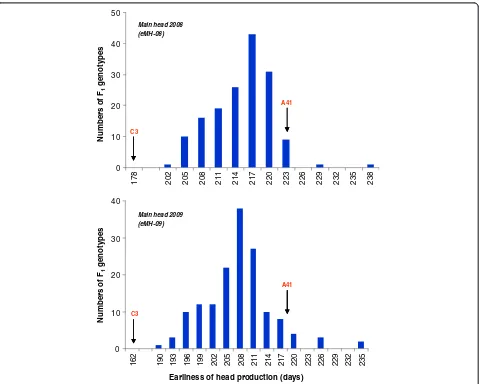
“2009”and 178 days in“2008”, while in the latter the re-spective times were 218 and 223 days. All three traits varied continuously among the F1 progeny (the distribu-tion for eMH is shown in Figure 5); no progeny was as early flowering as ‘Romanesco C3’, but a few were later flowering than‘Altilis 41’, due to transgressive segregation.
The mean eMH, eFOH and eSOH lay substantially above the mid-parent value, suggesting semi-dominance for late-ness. The low global level of heterozygosity characteristic of the cultivated cardoon makes it possible that one or more of the earliness QTL are in the homozygous state in
‘Altilis 41’, so that the presence of dominant alleles for late-ness may contribute to later flowering across the whole mapping population. The inter-trait correlations were similar in both seasons, with the strongest correlation linking eMH and eFOH (r>0.80, P<0.0001). The corre-lations between the two seasons were also strong, ranging from 0.64 (P<0.0001) for eMH to 0.49 (p<0.001) for eSOH (Table 5). Flowering and head harvesting time was a little earlier in “2009” than in “2008” (7–8 days on average), while performance was somewhat more
variable in “2009” (Table 4), probably reflecting the
difference between re-awakened and newly sown ma-terial. The broad sense heritability for eMH of 0.76 (Table 4) indicated the trait to be predominantly under genetic control, but the rather lower heritabilities shown by the traits eFOH and eSOH suggested that
the environment is quite influential in their
determination.
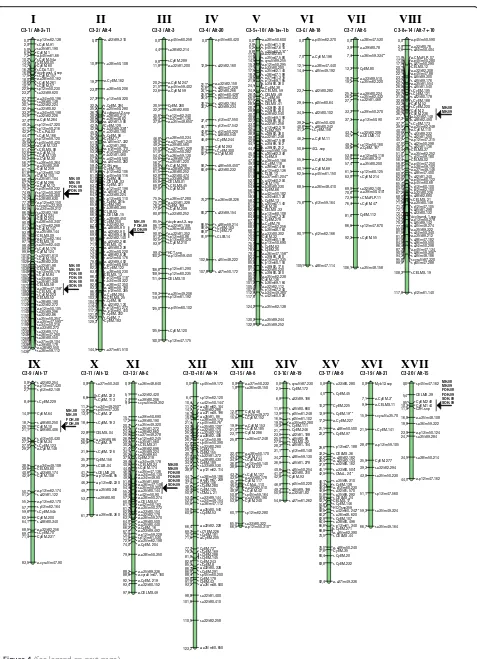
The KW test and SIM procedure identified, at first, six QTL regions stable across years in the developed con-sensus map (Figure 4). Those on LGs I, XI and XVII involved all three traits, those on LGs I and IX only eMH and eFOH, and the one on LG VII solely eMH. (See figure on previous page.)
[image:9.595.58.543.528.724.2]Figure 4Consensus genetic map ofC. cardunculus.Marker names appear to the right of each LG, with map distances in cM to the left; 'r-' and 'a-' indicate markers segregating only in, respectively,‘Romanesco C3’(C3) and‘Altilis 41’(Alt41). Arrows indicate the positions of earliness QTL, named as follows: trait abbreviation (MH: main inflorescence; FOH: first order inflorescence; SOH: second order inflorescence) and harvest season (08:“2008”, 09:“2009”).
Table 3 CyEM markers with Gene Ontology annotation for stimuli response-related terms
GO ID Term Level N° of loci Locus Name
GO:0050896 response to stimulus 2 17 CyEM-008, CyEM-030, CyEM-42, CyEM-054, CyEM-057, CyEM-070,
CyEM-072, CyEM-093, CyEM-120, CyEM-135, CyEM-145, CyEM-150, CyEM-152, CyEM-218, CyEM-229, CyEM-259, CyEM-266
GO:0009628 response to abiotic stimulus 3 13 CyEM-008, CyEM-030, CyEM-054, CyEM-070, CyEM-093, CyEM-120,
CyEM-135, CyEM-145, CyEM-150, CyEM-152, CyEM-218, CyEM-229, CyEM-259
GO:0042221 response to chemical stimulus 3 4 CyEM-093, CyEM-218, CyEM-229, CyEM-266
GO:0006950 response to stress 3 15 CyEM-008, CyEM-030, CyEM-054, CyEM-057, CyEM-070, CyEM-072,
CyEM-093, CyEM-120, CyEM-135, CyEM-145, CyEM-150, CyEM-152, CyEM-229, CyEM-259, CyEM-266
GO:0009266 response to temperature stimulus 4 5 CyEM-008, CyEM-054, CyEM-093, CyEM-145, CyEM-150
GO:0006970 response to osmotic stress 4 8 CyEM-030, CyEM-070, CyEM-093, CyEM-120, CyEM-135, CyEM-152,
CyEM-229, CyEM-259
GO:0010033 response to organic substance 4 3 CyEM-093, CyEM-229, CyEM-266
GO:0009409 response to cold 4 5 CyEM-008, CyEM-054, CyEM-093, CyEM-145, CyEM-150
GO:0009651 response to salt stress 5 8 CyEM-030, CyEM-070, CyEM-093, CyEM-120, CyEM-135, CyEM-152,
CyEM-229, CyEM-259
The seventh QTL cluster on LG II involved all three traits, but was only expressed in “2009” (Figure 4). On the whole, seven chromosomal regions scattered over six LGs of the consensus map were identified. When the
[image:10.595.56.539.111.218.2]‘Romanesco C3’ and ‘Altilis 41’ maps were used separ-ately for QTL validation, the percentage of phenotypic variance explained by some of the QTL differed from that predicted by the analysis based on the consensus Table 4 Earliness of the parental lines (‘C3’:‘Romanesco C3’,‘Alt 41’:‘Altilis 41’) and their F1 progeny in“2008”and “2009”
Precocity trait Year Parents1 F
1population2
C3 A41 Mean Range s.e. hB2
Main head (eMH) 2008 178 a 223 b 212.9 202-238 0.518 0.76
2009 162 a 218 b 206.1 190-235 0.694
First order heads (eFOH) 2008 185 a 229 b 221.3 209-248 0.456 0.61
2009 180 a 224 b 214.0 198-239 0.828
Second order heads (eSOH) 2008 198 a 239 b 232.6 214-267 0.695 0.54
2009 192 a 237 b 225.7 207-246 0.897
1
Means followed by different letters within the same row are significantly different atP<0.05.
2
s.e. : standard errors; hB2: broad sense heritability based on two years’data.
0 10 20 30 40 50
17
8
2
02 205 208 211 214 217 022 223 226 229 232 235 238 A41
C3
Nu
mb
er
s
o
f
F1
ge
no
ty
pe
s
Main head 2008
(eMH-08)
A41
C3
Main head 2009
(eMH-09)
Numb
er
s
o
f
F1
genot
y
pes
16
2
19
0
19
3
19
6
19
9
20
2
20
5
20
8
21
1
21
4
21
7
22
0
22
3
22
6
22
9
23
2
23
5
0 10 20 30 40
Earliness of head production (days)
[image:10.595.60.539.322.706.2]map (data not shown), perhaps reflecting the structure and size of the segregating progeny and the existence of different allelic interactions [48]. However, all seven QTL regions were detectable by applying the SIM method to the parental maps, and further analysed with the MQM procedure. QTL identified in each map and season are shown in Table 6 and graphically reported in
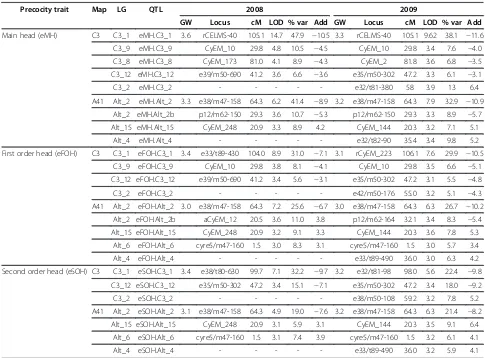
Figure 6. Only three of the seven QTL regions were de-tectable in both parental maps, presumably these regions were heterozygous in both parental lines. The other four were only detectable in one of the two maps, suggesting that one parent was homozygous in the critical region (Figure 6). Across all three traits, a total of 25 QTL was detected, of which 19 were stable across both growing seasons, with the other six expressed only in“2009”.
With respect to eMH, two of the QTL were heterozy-gous in both parents, three only in ‘Romanesco C3’and two just in ‘Altilis 41’. The largest effect stable eMH
QTL in ‘Romanesco C3’ mapped to LG C3_1 in the
neighbourhood of the SSR locus CELMS_40, named eMH.C3_1. This QTL was responsible for 38-48% of the phenotypic variation and was associated with an additive effect of 10–12 days. The other four QTL in‘Romanesco
C3’mapped to LGs C3_9, _8, _12 and _2, and accounted
individually for between 6-10% of the phenotypic
vari-ance; eMH.C3_2 was only detected in “2009”. The
[image:11.595.57.292.122.215.2]lar-gest stable QTL detected in ‘Altilis 41’ (eMH.Alt_2),
Table 6 Characteristics of the earliness QTL detected using the‘Romanesco C3’(C3) and the‘Altilis 41’(A41) maps
Precocity trait Map LG QTL 2008 2009
GW Locus cM LOD % var Add GW Locus cM LOD % var Add
Main head (eMH) C3 C3_1 eMH.C3_1 3.6 rCELMS-40 105.1 14.7 47.9 −10.5 3.3 rCELMS-40 105.1 9.62 38.1 −11.6
C3_9 eMH.C3_9 CyEM_10 29.8 4.8 10.5 −4.5 CyEM_10 29.8 3.4 7.6 −4.0
C3_8 eMH.C3_8 CyEM_173 81.0 4.1 8.9 −4.3 CyEM_2 81.8 3.6 6.8 −3.5
C3_12 eMH.C3_12 e39/m50-690 41.2 3.6 6.6 −3.6 e35/m50-302 47.2 3.3 6.1 −3.1
C3_2 eMH.C3_2 - - - e32/t81-380 58 3.9 13 6.4
A41 Alt_2 eMH.Alt_2 3.3 e38/m47-158 64.3 6.2 41.4 −8.9 3.2 e38/m47-158 64.3 7.9 32.9 −10.9
Alt_2 eMH.Alt_2b p12/m62-150 29.3 3.6 10.7 −5.3 p12/m62-150 29.3 3.3 8.9 −5.7
Alt_15 eMH.Alt_15 CyEM_248 20.9 3.3 8.9 4.2 CyEM_144 20.3 3.2 7.1 5.1
Alt_4 eMH.Alt_4 - - - e32/t82-90 35.4 3.4 9.8 5.2
First order head (eFOH) C3 C3_1 eFOH.C3_1 3.4 e33/t89-430 104.0 8.9 31.0 −7.1 3.1 rCyEM_223 106.1 7.6 29.9 −10.5
C3_9 eFOH.C3_9 CyEM_10 29.8 3.8 8.1 −4.1 CyEM_10 29.8 3.5 6.6 −5.1
C3_12 eFOH.C3_12 e39/m50-690 41.2 3.4 5.6 −3.1 e35/m50-302 47.2 3.1 5.5 −4.8
C3_2 eFOH.C3_2 - - - e42/m50-176 55.0 3.2 5.1 −4.3
A41 Alt_2 eFOH.Alt_2 3.0 e38/m47-158 64.3 7.2 25.6 −6.7 3.0 e38/m47-158 64.3 6.3 26.7 −10.2
Alt_2 eFOH.Alt_2b aCyEM_12 20.5 3.6 11.0 3.8 p12/m62-164 32.1 3.4 8.3 −5.4
Alt_15 eFOH.Alt_15 CyEM_248 20.9 3.2 9.1 3.3 CyEM_144 20.3 3.6 7.8 5.3
Alt_6 eFOH.Alt_6 cyre5/m47-160 1.5 3.0 8.3 3.1 cyre5/m47-160 1.5 3.0 5.7 3.4
Alt_4 eFOH.Alt_4 - - - e33/t89-490 36.0 3.0 6.3 4.2
Second order head (eSOH) C3 C3_1 eSOH.C3_1 3.4 e38/t80-630 99.7 7.1 32.2 −9.7 3.2 e32/t81-98 98.0 5.6 22.4 −9.8
C3_12 eSOH.C3_12 e35/m50-302 47.2 3.4 15.1 −7.1 e35/m50-302 47.2 3.4 18.0 −9.2
C3_2 eSOH.C3_2 - - - e38/m50-108 59.2 3.2 7.8 5.2
A41 Alt_2 eSOH.Alt_2 3.1 e38/m47-158 64.3 4.9 19.0 −7.6 3.2 e38/m47-158 64.3 6.3 21.4 −8.2
Alt_15 eSOH.Alt_15 CyEM_248 20.9 3.1 5.9 3.1 CyEM_144 20.3 3.5 9.1 6.4
Alt_6 eSOH.Alt_6 cyre5/m47-160 1.5 3.1 7.4 3.9 cyre5/m47-160 1.5 3.2 6.1 4.1
Alt_4 eSOH.Alt_4 - - - e33/t89-490 36.0 3.2 5.9 4.1
Each QTL name is formed by the abbreviated form of the trait followed by the relevant LG. The table indicates genome-wide LOD thresholds (GW) as determined
by a permutation test atP≤0.05, the closest linked markers (Locus) and their map location (cM), the estimated LODs at the QTL peak (LOD), the proportions of
the total variance explained (% var), and the additive effects (Add). Table 5 Correlations between the three earliness traits measured in the‘Romanesco C3’x‘Altilis 41’F1 population in“2008”and“2009”
Precocity trait Year eMH eFOH eSOH
eMH 2008 0.64*** 0.84*** 0.69***
2009 0.86*** 0.76***
eFOH 2008 0.54*** 0.66***
2009 0.72***
eSOH 2008 0.49**
2009
[image:11.595.55.540.349.707.2]homologous to the ones detected in the same region of the
[image:12.595.57.541.85.372.2]‘C3’ map, explained from 33-41% of the phenotypic vari-ance and was associated with an additive effect of 9–11 days. A second QTL, eMH.Alt_4, was detectable only in“2009”, but its location suggested it to be identical with eMH.C3_2 (Figure 6). Further two minor QTL present on LGs Alt_2 and _15 accounted for, respectively, 8% and-11% of the variance. Globally, the QTL identified in the ‘Romanesco C3’and ‘Altilis 41’ maps accounted for, respectively, 74% and 62% of the phenotypic variance for main head harvest-ing time in“2008”.
Six eFOH QTL were detected, three of which were represented in both parental maps, one on just the
‘Romanesco C3’map, and the other two on just the‘
Alti-lis 41’ map. Five of the six QTL mapped to a region
where a eMH QTL was also located, with overlapping LOD confidence intervals but with an overall lower phenotypic effect. The exception was eFOH.Alt_6 (Table 6, Figure 6). As for eMH, the largest effect QTL mapped to LGs C3_1 and Alt_2 in the neighbourhood of
CyEM_223. Based on the “2009” data, the set of eFOH
QTL accounted for 47% (‘Romanesco C3’) and 54%
(‘Altilis 41’) of the variation.
Only four eSOH QTL were uncovered, due to the reduced heritability of this trait (hB2= 0.54, Table 4). All
four co-localized with eFOH QTLs, with an overall
lower phenotypic effect (Table 6, Figure 6), with the lar-gest effect QTL mapping to the cluster on C3_1 and
Alt_2. Based on the “2009” data, the set of eSOH QTL
accounted for 48% (‘Romanesco C3’) and 43% (‘Altilis 41’) of the variation.
Conclusions
We have reported here an extension of theC.
carduncu-lus genetic map by introducing SSR loci sited within
genic sequence. The integration of 139 of these loci has significantly improved the resolution and accuracy of the maps. Given that the genome size of the species is ~1.08Gbp [49], the mean equivalence between the phys-ical and genetic length in this species is of the order of 1 cM to 670 kbp. Thus the mean physical separation of the mapped markers is around 2.2Mbp. On this basis, most gene sequences should lie within about 1Mbp of the nearest marker, although this value makes the non-valid assumption that recombination sites are randomly distributed along the length of the chromosomes.
Shortening the life cycle is seen as an important
breed-ing goal in terms of both globe artichoke’s economic
value, and the ease of exploiting cultivated cardoon as an energy crop [13,14]. The newly developed consensus as well as the parental genetic maps can accelerate the process of tagging and eventually isolating the genes underlying
0,0 2,5
14,1
19,0 21,2 21,9
29,8 32,3
36,1
42,2
49,3 50,4 51,6
61,0
67,6 69,5 72,3 74,0
79,4 81,4
eMH.C3_9(08) eMH.C3_9(09) eFOH.C3_9(08) eFOH.C3_9(09)
C3_9 0,0
9,3
18,1
23,2 24,2
30,6 32,6 35,5 36,4 40,5 42,2 43,4 44,3 45,7 46,5 47,2 48,6 50,5 52,2 55,0 60,1 62,3 65,5 68,0 70,9
81,0 81,8 82,7 84,6
90,0 90,9
eMH.C3_8(08)
eMH.C3_8(09)
C3_8
0,0
13,1
20,3 20,9
24,9
40,2
eMH.Alt_15(08) eMH.Alt_15(09) eFOH.Alt_15(08) eFOH.Alt_15(09) eSOH.Alt_15(08) eSOH.Alt_15(09)
Alt_15
0,0 3,8 4,9 6,7 8,6 13,3 14,3 15,8 17,2 18,6 19,3 19,9 21,6 25,5 28,9 31,3 33,8 38,6 40,2 41,3 43,3 46,7 48,5 50,3 52,3 55,3 58,2 61,3 63,8 64,9 65,3 70,3 72,0 73,7 74,7 76,8 82,7 83,4 84,1 85,7 88,6 89,9 91,9 93,8 94,9 96,5 97,2 98,0 99,1 99,7 100,1 101,2 102,7 102,9 103,1 103,3 104,0 105,1 106,1 107,2 107,8 109,5 110,4 111,9 113,8 114,6 116,6 119,5 121,6 124,3 128,5 130,5 140,9
eMH.C3_1(08)
eMH.C3_1(09)
eFOH.C3_1(08)
eFOH.C3_1(09)
eSOH.C3_1(08)
eSOH.C3_1(09)
C3_1
0,0
4,1 6,0 8,6
11,9
16,8 19,2 20,5
29,3 32,1
39,2 41,7 42,6 45,3
49,9
57,7
61,5 64,3 66,6 68,1
72,2
75,9 77,7
90,4 eMH.Alt_2b(08) eMH.Alt_2b(09)
eFOH.Alt_2b(08)
eFOH.Alt_2b(09)
eMH.Alt_2(08) eMH.Alt_2(09) eFOH.Alt_2(08) eFOH.Alt_2(09) eSOH.Alt_2(08) eSOH.Alt_2(09)
Alt_2
0,0
5,2 7,1
13,5 15,9 18,2 20,9 22,8 24,8 26,7 28,9 30,2 32,8 35,0 37,9 38,9 41,2 43,8 47,2 50,3 52,1 55,3 57,7 58,1
eMH.C3_12(08)
eMH.C3_12(09)
eFOH.C3_12(08)
eFOH.C3_12(09)
eSOH.C3_12(08)
eSOH.C3_12(09)
C3_12
0,0 1,5
8,0
14,8 16,8 20,5 22,0 24,3 26,7 27,9 29,3 30,0 30,7 31,1 32,1 33,6 36,2 38,6 40,4
46,1
54,3
58,1 59,2
63,5 eFOH.Alt_6(08) eFOH.Alt_6(09)
eSOH.Alt_6(08) eSOH.Alt_6(09)
Alt_6
0,0 2,8 8,6 9,1 11,3 15,2 16,6 21,0 21,5 22,5 24,7 25,8 27,7 28,6 30,8 32,3 34,2 34,7 36,0 36,2 38,3 39,7 40,2 40,3 40,9 42,1 42,6 43,0 43,1 43,6 44,1 44,7 45,6 46,3 47,3 47,8 48,2 51,7 54,9 58,0 58,5 59,2 63,5 65,3 67,5 82,9
94,9
99,8
104,0
107,5
eMH.C3_2(09)
eFOH.C3_2(09)
eSOH.C3_2(09)
C3_2
0,0
5,2 6,9
11,8
17,2 19,0
23,9 26,0 28,0 30,7 32,3 33,5 34,1 35,4 36,0 37,0 37,6 39,4 41,2 46,2 49,1
55,6
60,0
63,9 66,3
70,8
80,2
84,7
96,1 eMH.Alt_4(09) eFOH.Alt_4(09) eSOH.Alt_4(09)
Alt_4
earliness in both the domesticated C. cardunculus forms. We have shown that a cluster of large effect QTL resides on the homologous LGs C3_1 and Alt_2, and this clearly represents a reasonable candidate for mar-ker assisted breeding. The critical genetic interval contains two SSR loci (CELMS_40 and CyEM_223), either of which is well-placed to serve as an indirect selection criterion for earliness. Before such a geno-typic selection programme can be implemented, how-ever, a validation of the presence and importance of the QTL needs to be conducted using different gen-etic backgrounds and in other relevant environments [50,51]. To date, this study represents the first attempt to
identify QTL in C. cardunculus, which is the necessary
preliminary step for implementing marker-assisted se-lection for quantitative traits. Beyond tagging, map-ping also prepares the ground for positional cloning, which will enable the molecular basis of trait vari-ation to be identified.
Methods
Plant material and SSR analysis
The 178 informative CyEM markers identified by Sca-glione et al. [22] were used to genotype a set of 94 F1
hy-brid (randomly selected from 154 true hyhy-brids as described by Portis et al. [17] from the cross’Romanesco C3’(globe artichoke; female parent) x ‘Altilis 41’ (culti-vated cardoon; male parent). A 7 ng aliquot of genomic DNA from each mapping population individual was amplified in a 10 μl reaction containing 1x PCR buffer,
1 mM MgCl2, 0.5U Taq DNA polymerase (Qiagen Inc.,
Venlo, Netherlands), 40nM 5’-labelled (FAM, HEX or
TAMRA) forward primer, 40 nM unlabelled reverse pri-mer and 0.2 mM dNTP. A touchdown cycling regime was applied, consisting of an initial denaturation of 94°C/ 2.5 min, followed by nine cycles of 94°C/30s, 63°C/30s (decreasing by 0.7°C per cycle), 72°C/60s, and 30 further cycles of 94°C/30s, 57°C/30s, 72°C/60s. Where only weak amplification was achieved, the MgCl2concentration was
raised to 1.5 mM and the final annealing temperature was lowered to 55°C. The amplicons were separated on an ABI3730 capillary DNA sequencer (Applied Biosystem Inc., Foster City, CA, USA). Internal ROX-labelled GS500 size standards were included in each capillary. The output was analysed by GeneMapper v3.5 software (Applied Biosystems).
Linkage analysis and parental maps construction
The CyEM genotypes of the 94 mapping population individuals were combined with previous genotypic data based on 605 AFLP, 27 S-SAP and 56 other SSRs [17], along with ten SNP from genes underlying caffeoylquinic acid synthesis (reported by Comino et al. [18] and Menin et al. [19]). JoinMap v4.0 [52] was used to
generate two separate linkage maps (one for each par-ent) using the double pseudo-testcross mapping strategy [53]. The markers fell into three classes: maternal
test-cross markers segregating only in ‘Romanesco C3’
(expected segregation ratio 1:1); paternal testcross mar-kers segregating only in ‘Altilis 41’ (1:1); and intercross markers segregating within both parents (either 1:2:1 or 1:1:1:1). Differences between observed and expected seg-regation ratios were tested byχ2, and only markers
devi-ating if at all only slightly from expectation
(χα2=0.1<χ2≤χα2=0.01) were used for map construction and
the estimation of genetic distances, when their presence did not alter surrounding marker order in the LG. Heav-ily distorted loci (χ2>χα2=0.01), along with those
asso-ciated with 30 or more missing values, were excluded. LGs were established on the basis of an initial LOD threshold of 6.0. Locus order and distances between loci were established using the following parameter set: Rec = 0.40, LOD = 1.0, Jump = 5. Map distances were con-verted to cM using the Kosambi mapping function [54]. Where a locus order discrepancy arose between a pair of parental LGs, the marker order of the ‘1:1:1:1’ segregat-ing SSR and the marker order of SNP markers were taken as the‘fixed order’. Once the framework maps had been established, additional loci were subsequently added and some LGs merged by lowering the LOD threshold to 5.0. On the resulting maps, loci suffering from slight segregation distortion have been identified with either one (χα2=0.1<χ2≤χα2=0.05) or two (χα2=0.05< χ2≤χ
α=0.01 2
) asterisks. The ‘Romanesco C3’ LGs are
la-belled LG_C3, and the‘Altilis 41’ones LG_Alt, using the numbering system suggested by Portis et al. [17].
Consensus map construction
A genotypic data set based on all the available markers was then used to construct a consensus map. Here, the loci belonging to two segregation classes ‘1:2:1’ (the same pair of alleles segregating in each parent), and
‘1:1:1:1’(different alleles segregating in each parent) were used as ‘bridge markers’. The most likely locus order was established from a comparison of the ‘C3’,‘Alt’and consensus LGs, and where these differed substantially from one another, the most likely order was assumed to
be one associated with the lowest χ2 value (estimating
goodness-of-fit) and the lowest meanχ2contribution for all loci. LGs were established on the basis of an initial LOD threshold of 5.0 and numbered according to C3 maps LGs order.
Sequence annotation