Open Access
S T U D Y P R O T O C O L
© 2010 Wynia et al; licensee BioMed Central Ltd. This is an Open Access article distributed under the terms of the Creative Commons Attribution License (http://creativecommons.org/licenses/by/2.0), which permits unrestricted use, distribution, and reproduction in any medium, provided the original work is properly cited.
Study protocol
Design of a Randomised Controlled Trial (RCT) on
the effectiveness of a Dutch patient advocacy case
management intervention among severely
disabled Multiple Sclerosis patients
Klaske Wynia*
1,2,3, Coby Annema
2, Hans Nissen
4, Jacques De Keyser
1and Berrie Middel
5,6Abstract
Background: Case management has been suggested as an innovative strategy that facilitates the improvement of a patient's quality of life, reduction of hospital length of stay, optimization of self-care and improvement of satisfaction of patients and professionals involved. However, there is little evidence about the effectiveness of the patient advocacy case management model in clinical practice.
Therefore, the objective of our study was to examine the effects of the Dutch patient advocacy case management model for severely disabled Multiple Sclerosis (MS) patients and their caregivers compared to usual care.
Methods/design: In this randomized controlled trial the effectiveness of casemanagement on quality of life of patients and their caregivers, quality of care, service use and economic aspects were evaluated. The primary outcomes of this study were quality of life of MS-patients and caregiver burden of caregivers.
Furthermore, we examined quality of life of caregivers, quality of care, service use and costs.
Discussion: This is a unique trial in which we examined the effectiveness of case management from a broad
perspective. We meticulously prepared this study and applied important features and created important conditions for both intervention and research protocol to increase the likelihood of finding evidence for the effectiveness of patient advocacy case management. Concerning the intervention we anticipated to five important conditions: 1) the contrast between the case management intervention compared to the usual care seems to be large enough to detect intervention effects; 2) we included patients with complex care situations and/or were at risk for critical situations; 3) the case managers were familiar with disease specific health-problems and a broad spectrum of solutions; 4) case managers were competent and authorized to perform a medical neurological examination and worked closely with neurologists specialized in MS; and 5) the case managers had a regional network of professionals and health care organisations at their disposal, and were accepted as a coordinator of care. We also put a lot of effort on the selection of eligible patients, randomization and statistical methods, but also on power analysis, selection of reliable, validated and sensitive outcome measures, and (statistical) control of confounders.
Trial registration: Dutch Trial Register http://www.trialregister.nl. Trial ID: NTR762.
Background Case management
Case management has been suggested as an innovative strategy that facilitates the improvement of a patients'
quality of life, the reduction of hospital length of stay, the optimization of self-care and improvement in the satis-faction of the patient and the professionals involved.[1,2] In general, case management focuses on high-risk and high-cost populations that represent the largest part of the expenses for health care in developed countries.[3,4]
* Correspondence: [email protected]
1 Department of Neurology, University Medical Center Groningen, University of Groningen, Groningen, the Netherlands
In case management, an individual or a small team is responsible for navigating the patient through a complex process in the most efficient, effective and acceptable way.[5] Based on suggestions of the underlying dynamics, Long [6,7] categorized the many variants of case manage-ment into two types: the "interrogative case managemanage-ment model" and the "patient advocacy" model:
▪ The predominant focus of the interrogative case man-agement model is on the appropriateness of services dur-ing the initial clinical decision-makdur-ing process. The costs of care in particular are recognized as representing a legitimate argument in this process. This model, also referred to as the "medical case management model" [8] and the "keeper model" [9] employs a physician gate-keeper with expectations of cost containment by arrang-ing substitution of services.
▪ The predominant focus of the patient advocacy case management model is on a more comprehensive coordi-nation of services across the continuum of care, viewed from the patient perspective.[10] The case manager assesses the changing needs of the clients, eliminates fragmented care, and arranges for services to be pro-vided.[7] In this model, also referred to as the socioeco-nomic model, the treatment regimen is determined not only by the medical needs, but also by a combination of financial, psychological and social circumstances of the patient.
The case management approach in the patient advo-cacy model seems especially relevant for the growing number of chronically ill and elderly people with complex health problems, and is in line with the contemporary general emphasis on patient-centered health care and the delivery of effective health care for these patients.[11]
The Dutch case management model for the chronically ill
In the Netherlands we developed a case management model for people with a chronic disease in a multidisci-plinary and integrated care setting.[12] This model was developed using literature review, four focus group meet-ings (n = 6), and a Delphi method (n = 65) with two writ-ten rounds and a consensus meeting. The participants of the Delphi panel were patients and caregivers (27%), medical and non-medical professionals (51%) and health administrators (23%).
The final model consists of five basic assumptions and 21 characteristics and was evaluated by 92% (n = 58) of the Delphi panel as (very) desirable for the chronically ill. The characteristics of the Dutch case management model for the chronically ill are similar to the characteristics of the patient advocacy model. Most important characteris-tics of the Dutch model are: (i) the patient-centred vision, (ii) the focus on somatic as well as the psychosocial and environmental problems, and (iii) the independency of
the case manager from organizational and professional structures. In fact the patient - case manager relation can be seen as an employer - employee relationship in which the case manager acts under agreement of the patient.
Effectiveness of case management
There are several reasons to perform studies to evaluate the efficacy of the patient advocacy model. The first is that financial constraints require that we select effective interventions that at the least maintain quality of care. A second reason is the growing number of chronically ill and elderly people with complex health problems. These groups in particular seem to benefit from the patient advocacy model in which the case manager assesses the changing needs of the clients, eliminates fragmented care, and arranges for services to be provided[7]. Although it is expected that less costly appropriate sub-stitute services are likely to be used whenever possible[7], it is important to know which effects the patient advo-cacy model has on service use and health care costs.
There is little evidence about the effectiveness of patient advocacy case management model in clinical practice. However, Oeseburg et al[13] showed in a sys-tematic review of randomized controlled trials (RCTs) that the patient advocacy case management model did not increase service use and costs. Moreover, there were indications that patient advocacy case management for chronically ill or elderly people may lead to a decrease in service use and health care costs. Another conclusion was that little attention was paid to other potential benefits of patient advocacy case management such as physical health or quality of life aspects. These potential limita-tions tend to result in a narrowed view of the effective-ness of patient advocacy case management.
Multiple Sclerosis (MS)
Objective
The objective of our study was to examine the effects of the Dutch patient advocacy case management model for people with a chronic disease compared to usual care on (i) quality of life of patients and their caregivers, (ii) qual-ity of care, (iii) service use and economic aspects.
Expected outcomes of patient advocacy case manage-ment compared to the usual care were: (i) improved qual-ity of life for both, patients and caregivers (primary outcome patients), (ii) improved quality of care, (iii) less caregiver burden or strain (primary outcome caregivers), and (iv) equal or less service use and costs.
This paper will provide a detailed description of the study design and research protocol.
Methods/design Study design and setting
The study was a randomized controlled trial performed among severely disabled MS-patients known to the Groningen MS center, and their caregivers. Study partici-pants received either case management according to the Dutch patient advocacy case management model or the usual care during the intervention period of 15 months between September 2006 and January 2008.
Randomisation procedure
Eligible patients (and their caregivers) were randomly allocated - with a computerized programme - to either the intervention group or the control group using a ran-domized block design.[15] This approach allowed us to control our findings for characteristics of the partici-pants. Blocking variables in our study were severity of limitations in walking (yes/no wheelchair dependency), having a partner or caregiver (yes/no), educational level (low/middle/high level), having children living at home (yes/no), and performing paid work (yes/no).
Ethical approval
The study has been approved by the University Medical Center Groningen medical ethical committee (Reference M06.040514).
Study population MS-patients
The study was performed among MS-patients known to the Groningen MS center, which is part of the University hospital. Patients lived in a wide surrounding area around the hospital with a maximum distance of about 100 kilo-metres. As it is known that case management is most effective in high-risk populations, eligible patients should be characterized by complex care situations and/or be at risk for exacerbations of critical situations. We therefore included:
▪ MS-patients with increasing limitations in walking ability who were at risk for becoming completely depen-dent of a wheelchair and help from others. This phase is
especially complex because of the (potential) changes in psychosocial circumstances and necessary environmental changes. Furthermore, this phase is critical for partner-ships because of the changing roles between the partners and the growing caregiver burden.
▪ MS-patients that were completely wheelchair depen-dent but not essentially restricted to bed much of day. This phase is especially complex because of the growing risk of physical complications and care dependency. This phase is also critical for the caregiver because of increas-ing caregiver burden. In summary, admission to a nursincreas-ing home is a threatening solution for all health-related and caregiver problems.
To define our sample of severely disabled MS-patients we used the neurological classification system, the Expanded Disability Status Scale (EDSS). The EDSS is a commonly used disability measure for MS[16] with a twenty-points scoring scale starting at 0 (no disability) and increasing at half point increments to a maximum score of 10 (death due to MS).
Eligible patients with increasing limitations in walking were defined as patients with an EDSS score ranging from 4.5 to 7.0 (= able to walk without rest some 300 meters or less without assistance or with canes or other assist devices). Patients essentially restricted to wheelchair but not essentially restricted to bed much of day were defined with an EDSS score ranging from 7.0 to 8.5). Further-more, patients should be of adult age, live independently in the community and not in a nursing home or other institution for long term referral. Patients should not par-ticipate in another intervention study (Table 1).
In total 227 eligible patients with the diagnosis MS and a suitable EDSS score were selected from our hospital registration system and invited by mail to participate in
Table 1: Eligibility criteria for the Dutch patient advocacy case management study.
Inclusion criteria
- Adult people older than 18 years - Diagnosed with MS
- EDSS score with a range of 4.5 to 8.5 - Living at home
- Treated by neurologists of the Groningen MS centre, which is part of the University hospital
Exclusion criteria
- No clear diagnose for MS - EDSS score below 4.5 or above 8
- Living in a nursing home or other institution for long term referral
- Participation in another MS related study
the study according to the Informed Consent procedure in our study protocol. Patients were informed about the intervention, the intervention period, the fact that there was an equal chance to get allocated to the case manage-ment group or to the usual care group, and the efforts asked by the researchers to fill out a number of question-naires at the start and at the end of the intervention period of 15 months.
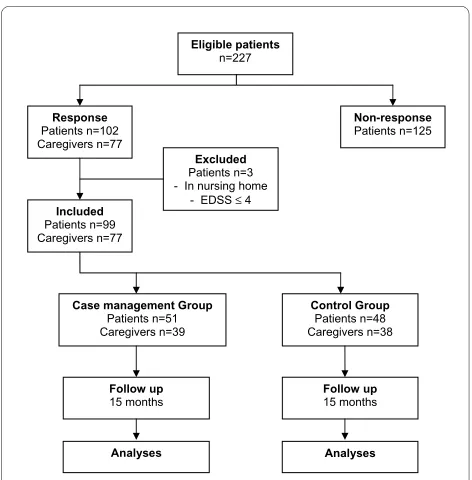
Finally, 102 MS-patients (45%) responded to our invita-tion to participate in our study. There were no differences between respondents and non-respondents concerning age (T-test p-value .332) and gender (Mann-Whitney Test p-value .374). Respondents answered the questions nec-essary to check the inclusion criteria and for the random-ized block procedure. From these questions - and from telephone calls by the researcher - it became clear that three patients were living in a nursing home or had no walking disabilities. In total, 99 patients (44% response) agreed to participate in the study and signed the Informed Consent paper including the consent for the case manager to perform the usual neurological evalua-tion under supervision of the neurologist, to read the medical dossier, and to contact the general practitioner when necessary. The computerized randomization pro-gramme assigned 51 patients to the case management group, while 48 patients were included in the usual care group (Figure 1).
Study population Caregivers
Caregivers of participating MS patients were invited to participate in the study according to the Informed Con-sent procedure in our study protocol. Caregivers were informed about the intervention, the intervention period and the special attention of the case manager for the care-giver burden, the fact that there was an equal change to get allocated to the case management group or to the usual care group, and the efforts asked by the researchers to fill out a number of questionnaires at the start and at the end of the intervention period. In total, 77 caregivers agreed to participate in the study and signed the Informed Consent paper: Thirty-nine caregivers were included - with the MS-patients they were related to - in the case management group and 38 caregivers were included in the usual care group (Figure 1).
Case managers
Case management was performed by two experienced professionals in care-coordination for people with MS. One case manager was a nurse practitioner of the MS center of our university hospital while the other case manager was a nurse specialist in chronic neurological diseases especially in MS of a large home healthcare organisation. Both case managers were familiar with dis-ease specific health-problems and a broad spectrum of solutions for these problems. Furthermore, both case managers were competent and authorized to perform a medical neurological examination and worked closely with the neurologists specialized in MS.
Both case managers had a regional network of profes-sionals and health care organisations at their disposal. Because of their years of experience in the regional MS-care in the community and hospital the acceptance of the case manager as the coordinator for care delivery was accepted. The case managers were not limited to organi-zational boundaries in allocating services. Patients' pref-erences were leading in the selection of the most appropriate service.
Intervention: Dutch Patient Advocacy Case management
Elements of the Dutch Patient Advocacy Case manage-ment model with regular home visits were:
▪ Use of valid and reliable self-report assessment tools: The Multiple Sclerosis Impact Profile (MSIP) [17,18] for the disease specific health-status of the patients, and the Caregiver Strain Index (CSI) [19] to assess the caregiver burden. In the paragraph about outcome measures these assessment tools are described.
[image:4.595.56.292.450.690.2]▪ Regular assessments (each five months, three times during the study) during a visit at the patients' home: Patients prepared themselves by filling-out the MSIP. Caregivers prepared themselves by filling-out questions concerning caregiver burden. Casemanagers prepared
Figure 1 Flowchart Dutch patient advocacy case management intervention among severely disabled MS-patients. Summary of the progress through the phases of the study until the allocation of the participants to each treatment arm.
Eligible patients
n=227
Response
Patients n=102 Caregivers n=77
Non-response
Patients n=125
Included
Patients n=99 Caregivers n=77
Excluded
Patients n=3 - In nursing home
- EDSS ≤ 4
Case management Group
Patients n=51 Caregivers n=39
Control Group
Patients n=48 Caregivers n=38
Follow up
15 months Follow up 15 months
themselves by reading the filled-out questionnaires. Dur-ing the assessment the filled-out questionnaires were guidelines for the discussion for the patient, caregiver and case manager.
▪ Medical examination and treatment: During each visit the case managers also performed a medical examination as a part of the total assessment. Concerning neurological medical aspects, like changes in medical treatment, the case managers were supervised by the neurologists of the MS centre structurally (during weekly meetings) and inci-dentally (when necessary). For regular medical treatment the case managers contacted the patients' general practi-tioner.
▪ Care plan: using the outcomes of the assessments, pri-orities set by the patient and caregiver and advise for pos-sible solutions given by the case manager, a multidisciplinary and patient-centred care plan was com-posed. Health problems, preferred solution directions, actions to be undertaken and agreements about who is doing what and when were registered in the care plan.
▪ Navigation and monitoring: after the care plan was established and put into action, there were regular con-tacts between the case manager and the patient and care-giver about the progress in the realization of the plan and the effects on patient and caregiver. These contacts were mostly telephone contacts and sometimes additional home visits.
▪ Evaluation: during each follow-up home visit the care plan was evaluated and results were described.
Usual Care: regular consultations in the hospital
Patients and caregivers in the control group received the usual care during regular consultations with their neurol-ogist in the Groningen MS center. Normally, patients vis-ited their neurologist about two times a year. This frequency may decrease or increase depending of the patients' personal preference and actual health-status. The time planned for a standard consultation was 20 minutes. Consultations focused on the neurological health problems of the patient. For non-neurological issues patients were referred to their general practitioner or other health professionals. For non-medical issues patients were referred to a nurse specialist.
Procedure of data collection
After inclusion in the study and assignment to either the intervention or the control group, patients were informed by mail about their inclusion and allocation. Patients included in the control group were advised to make an appointment with their neurologist as they were used to do. Patients included in the experimental group were ran-domly assigned to one of the two case managers.
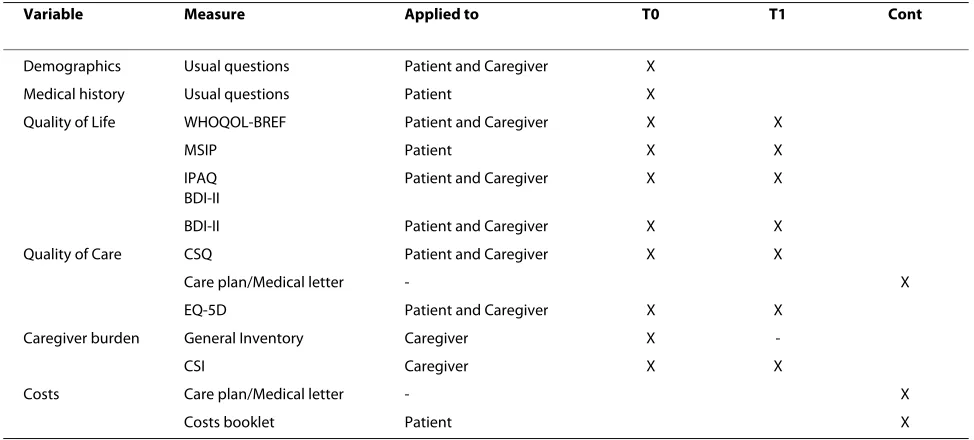
Data were collected with self-report outcome measures on quality of life (patients and caregivers), quality of care
(patients) and caregiver burden (caregivers) at two moments during the study: i) at baseline, after inclusion in the study and randomization to one of the research groups, ii) 15 months after the baseline assessment a few weeks after finishing the intervention. See also Table 2.
During the intervention data were collected continu-ously about: i) health problems, interventions and out-comes from the care plans (case management group) and the medical records (control group), and ii) about service use and costs from a structured costs booklet for the patients in both research groups and structured case management records. See also Table 2.
Outcome measures
General Quality of Life (primary outcome patients)
The World Health Organization Quality of Life, abbrevi-ated version (WHOQOL-BREF)[20] is a generic quality of life measure with a broad scope, including environ-mental aspects. It consists of 26 items in four constructs: 'physical health and autonomy', 'psychological health', 'social relationships' and 'environment', and two separate questions: 'overall quality of life' and 'overall satisfaction with health'. For each scale, item scores were coded, summed and transferred to a scale of 0 (worst health) to 20 (best health). In our former study among MS-patients the WHOQOL-BREF showed satisfactory levels of inter-nal consistency with Cronbach's alpha = .63/.81[17].
Participation and autonomy
The Impact on Participation and Autonomy Question-naire (IPAQ) [21,22] is a domain specific quality of life measure covering participation aspects. The IPAQ con-sists of twenty-five items focusing on person-perceived participation and autonomy. The instrument assesses two aspects of participation: perceived participation and the perceived problem. In this study the perceived participa-tion aspect was used. The sub-domains are autonomy indoors, family role, autonomy outdoors and social rela-tions. Item scores are graded on a five-point rating scale with discrete responses, ranging from 1 (very good) to 5 (very poor). Scores are summed for each domain. In a for-mer study among MS-patients the IPAQ showed satisfac-tory levels of internal consistency with Cronbach's alpha = .86/.94.[17]
Depression
The Beck Depression Inventory-II (BDI-II) measures the severity of self-reported depression in adolescents and adults.[23,24] The BDI-II consists of 21 items reflecting the diagnostic criteria for major depressive disorders that are described in the American Psychiatric Associations Diagnostic and Statistical Manual of Mental Disorders, 4th Edition (DSM-IV).[25] Respondents are asked to
negative feelings) to 3 (severe negative feelings). Scores are summed and total scores can range from 0 to 64. Sug-gested cut-off values are the following: 0-10 = no depres-sion; 11-17 = mild depresdepres-sion; 18-23 = moderate depression; 24-39 = severe depression.
MS-specific health-status
The Multiple Sclerosis Impact Profile (MSIP)[17] is a self-report measure for people with MS to assess disability and disability perception and is based on the Interna-tional Classification of Functioning, Disability and Health (ICF). The MSIP consists of two related parts: 1) the MSIP-Disability (MSIP-D) part, reporting the prevalence and severity of MS-related disabilities and 2) the MSIP-Disability Perception (MSIP-DP) part, reflecting the per-ception of reported disabilities. A disability perper-ception item is directly linked to each disability item. The MSIP consists of 36 items for each part, divided into three func-tioning scales: 'Muscle and movement functions', 'Excre-tion and reproductive func'Excre-tions' and 'Mental func'Excre-tions'; two activities scales: 'Basic movement activities' and 'Activities of Daily Living'; one participation scale: 'Partic-ipation in Life situations'; and one environmental factors scale: 'Environmental factors'; and four additional impair-ment items for Fatigue, Pain, Seeing functions and Speech functions. Scoring options for the MSIP-disability part range from 0 (no disability) to 3 or 4 (complete dis-ability). Summed scores for the disability domains indi-cate the extent of disability. A lower disability score means less serious disability. Scoring options for the
MSIP-disability perception part range from 0 (no, never) to 3 (yes, always). Summed scores for the disability per-ception domains indicate the extent to which patients perceive the reported disabilities as problematic. A lower disability perception score means that a reported disabil-ity is perceived as less problematic.
The internal consistency tests of MSIP scales showed good levels of internal consistency with Cronbach's Alpha's = .80/.90 for most scales, and satisfying and weak Cronbach's Alpha's for the mental functioning scales (.62/ .65) and the 'Environmental' scales (.49/.50).[17,18]
Overall Quality of Care
The 'Client Satisfaction Questionnaire (CSQ-8)'[26] con-sists of eight items belonging to one domain: satisfaction with the received care. Items can be scored on a scale ranging from 1 (very negative) to 4 (very positive). The total score therefore can range from 8 (most dissatisfied) to 32 (most satisfied). The Dutch version of the CSQ-8 showed similar high internal consistency (Cronbach's Alpha = 0.91) as the original English version (Cronbach's Alpha = 0.93).[27]
Care plans and medical letter
[image:6.595.55.542.113.333.2]Two researchers independently analyzed each care plan (case management group) and medical letter (control group) for the reported health problems of the patients, caregiver burden, applied interventions, and patient and caregiver outcomes. Differences between the researchers were resolved through discussion or with reference to a third researcher when necessary.
Table 2: Measures
Variable Measure Applied to T0 T1 Cont
Demographics Usual questions Patient and Caregiver X
Medical history Usual questions Patient X
Quality of Life WHOQOL-BREF Patient and Caregiver X X
MSIP Patient X X
IPAQ BDI-II
Patient and Caregiver X X
BDI-II Patient and Caregiver X X
Quality of Care CSQ Patient and Caregiver X X
Care plan/Medical letter - X
EQ-5D Patient and Caregiver X X
Caregiver burden General Inventory Caregiver X
-CSI Caregiver X X
Costs Care plan/Medical letter - X
Costs booklet Patient X
Findings were recorded and categorized in SPSS.
▪ Disease related health problems were categorized into the MSIP-categories;
▪ Caregiver burden problems were summarized as care-giver problems;
▪ Interventions were clustered into categories of 'giving information', 'consultation of medical and non medical specialists or organizations', 'refers medical and non medical specialists or organizations', 'acquiring assist devices or home adjustments', 'arranging supplementary care ad home' or 'arranging (short) stay or day treatment'
▪ Outcomes were recorded in terms of 'improved', 'worsened' or 'no change'
Opinion about case management
To examine the patients and caregivers opinion about the case management process and outcomes we developed thirty statements about case management. These state-ments were based on the assumptions and characteristics defined in the Delphi study in which we developed the Dutch casemanagement model [12]. Patients were asked to give their opinion about their personal experience (what case management did bring them), and the case management processes (e.g. the home visits, the care plans, the casemanagers actions). We linked four response options to each statement: I fully disagree, I dis-agree, I dis-agree, I fully agree.
Caregiver context and tasks
To gain insight into the caregivers tasks and time spent, relevant contextual factors (age, gender, relation to MS-patient, health status), personal experiences with care-giver tasks (e.g. (not) heavy, (not) problematic) we devel-oped an inventory. Relevant items for this inventory were selected from existing questionnaires applied in other studies about caregiver tasks and caregiver burden.
Caregiver Burden (primary outcome caregivers)
The Caregiver Strain Index (CSI)[28] measures caregiver burden related to care provision. The CSI can be used as a tool to identify caregivers with potential care giving bur-den and strain. The CSI consists of 13 items with at least one item for each of the following major domains: Employment, Financial, Physical, Social, and Time. Posi-tive responses to seven or more items on the index indi-cate a greater level of strain. Positive responses on four to six items of the index indicates an increased burden, while positive responses on seven to nine items indicates a risk for overburdening or strain, and a positive response on ten to twelve index items indicates a clear overload or strain.
Economic evaluation
For economic evaluation from the societal perspective data on service use and indirect costs were collected from several sources:
▪ Patients in both research groups filled out a struc-tured costs booklet each three months.
▪ Casemanagers recorded travelling costs and time spent on each patient, while for comparison with the costs for usual care the standard costs for a consultation with a neurologist were used.
▪ We analyzed care plans (case management group) and the medical records (control group) for data on service use.
▪ Patients and caregivers filled out the EQ-5D for calcu-lating the costs of an additional day of life. The EQ-5D is a health-related quality of life measure consisting of i) five dimensions (mobility, self-care, usual activities, pain/dis-comfort, anxiety/depression) each of which can take one of three responses reflecting three levels of severity (no problems/some or moderate problems/extreme prob-lems) within a particular EQ-5D dimension, and ii) a standard vertical 20 cm visual analogue scale (similar to a thermometer) for recording an individual's rating for their current health-related quality of life.
Sample size calculations
We used samples of MS-patients as well as samples of caregivers and expected that about 60% of the caregivers would give their informed consent to participate in the study. Sample size calculations were targeted on a clini-cally relevant change in quality of life for the smallest group, the caregivers. A clinically relevant change in the primary outcome measure of quality of life (WHOQOL-BREF) of 1.5 points on a scale ranging from 0 (worst qual-ity of life) to 20 (best qualqual-ity of life) and standard devia-tion of 2.0 can be found with a power of 0.815 in comparing two groups of 30 subjects is applied. The clin-ically relevant change of 1.5 points and standard devia-tion of 2.0 were found in a former study among 530 MS patients [17,29] Consequently the sample size for the MS-patients should consist of 50 subjects for each research group. Power analysis for this sample size showed a power of 0.960.
Potential confounders and effect modifiers
To prevent confounding in the control group during the consultations in the hospital were not performed by the casemanagers involved in the project during the inter-vention period. For special non-medical interinter-ventions casemanagers could be consulted by the neurologist, while contacts of the casemanagers with patients from the control group were limited to that specific interven-tion they were asked for by the neurologist.
Statistical analysis
measures: quality of life for the MS-patients and care-giver burden for the carecare-givers. Secondary analysis will focus on: 1) the comparison between research groups for the secondary variables concerning quality of life, quality of care, service use and costs, and 2) the explanation on the outcomes on the primary outcome variables. Finally, analysis will focus on the patient-caregiver couples: e.g. the impact of the patients' disability and disability percep-tion (MSIP scales) on the caregiver strain en caregiver quality of life.
For comparison of samples and estimation of differ-ences in outcomes between the case management and usual care groups before and after the intervention period we used t-tests for continuous variables, Chi-square tests and Fisher exact tests when appropriate, and differences of proportions tests[30] for comparisons with categorical variables. For multiple group comparisons we will use one-way ANOVA analysis to determine statistically sig-nificant differences between subgroups. Effect sizes will be calculated only for statistically significant group differ-ences (p < 0.05) with post hoc tests (with Bonferroni cor-rection for capitalization on chance in multiple testing). According to Cohen's thresholds [31] an ES of < 0.20 indi-cates a trivial effect, an ES of ≥ 0.20 to < 0.50 a small effect, an ES of ≥ 0.50 to < 0.80 a moderate effect and an ES ≥ 0.80 a large effect. An ES ≥ 0.20 reflects a clinical rel-evant difference between groups.[32]
The impact of case management on quality of life (patients and caregivers) and on caregiver burden (care-givers) will be assessed using hierarchical regression anal-ysis with each of the Quality of Life scale variables, participation scale variables and depression variable (patients and caregivers) and Caregiver Strain Index out-come variable (caregiver) as dependent variables. Rele-vant other patient, disease related and caregiver variables with a statistically significant correlation with the depen-dent variables will be include in the analysis as covariates. The primary economic evaluation will be a cost-effec-tiveness analysis from the societal perspective. In a sec-ondary cost-utility analysis, quality adjusted life years (QUALYs) will be calculated based on EQ-5D values.
Discussion
In this paper we have reported on the background and the study protocol of a unique randomized controlled trial to examine the effects of the Dutch patient advocacy case management model. We meticulously prepared this study and applied important features and created impor-tant conditions for both intervention and research proto-col to increase the likelihood of finding evidence for the effectiveness of patient advocacy case management.
Concerning the intervention we anticipated to four important conditions: Firstly, the contrast between the
case management intervention - in combination with home-visits - compared to the usual care seems to be large enough to detect intervention effects. Secondly, as it is known that case management is most effective in high-risk populations, we decided that eligible patients should be characterized by complex care situations and/or should be at risk for exacerbations or critical situations. Thirdly, the case managers in this study were familiar with disease specific health-problems and a broad spec-trum of solutions for these problems. Furthermore, both case managers were competent and authorized to per-form a medical neurological examination and worked closely with the neurologists specialized in MS. Finally, the case managers had a regional network of profession-als and health care organisations at their disposal, and were accepted in the community and in the hospital as a coordinator of care.
Apart from the intervention, the study design is of essential importance for finding evidence for the effec-tiveness of case management. We therefore developed a powerful design: We put a lot of effort on the selection of eligible patients, randomization and statistical methods, but also on power analysis, the selection of reliable, vali-dated and sensitive outcome measures, and (statistical) control of confounders, and finally the assessment by a medical ethics committee.
We decided against performing a feasibility study. Arguments were that the intervention (casemanagement) was already tested on a small scale in days-to-day prac-tice, and evaluated by patients, casemanagers and other relevant health professionals. Furthermore most applied measures, utilized in the trial, were tested in earlier MS-related studies. In other words, we acquired sufficient evidence for feasibility and based on these experiences we were confident about the adequacy of our study design and data collection plan.
Competing interests
The authors declare that they have no competing interests.
Authors' contributions
KW was principal investigator, conceived and drafted the study, and this manu-script. CA was investigator, was involved in the design of the study, was responsible for data collection and helped to draft the manuscript. HN and JDeK commissioned the study, provided the necessary conditions, and partici-pated in the design of the study and. BM was methodological and statistical investigator and participated in the design of the study. All authors contrib-uted to the manuscript and have read and approved the final version of the manuscript.
Acknowledgements
We want to thank the patients and caregivers who participated in this study for their efforts made by filling out our questionnaires and sharing their personal information about the consequences of their disease and caregiver tasks and burden. We gratefully thank the University Medical Centre Groningen Depart-ments of Home Healthcare and Neurology for making this study possible, and the MSAnders Foundation for financial support for data entry and analysis. We also wish to thank our nurse specialists Ms M. Bullinga and Mr. M. Heerings who performed case management during the study, Ms E. Eshuis MSc for being project leader, Ms. D.J. Heersema MD PhD for neurological supervision, Ms. S. Smit MSc for data entry, and Mr. W.S. Lok MSc for statistical support.
Author Details
1Department of Neurology, University Medical Center Groningen, University of Groningen, Groningen, the Netherlands, 2Wenckebach Institute, School of Nursing and Health, University Medical Center Groningen, University of Groningen, Groningen, the Netherlands, 3Graduate School for Health Research (SHARE), University Medical Center Groningen, University of Groningen, Groningen, the Netherlands, 4Department of Home health care, University Medical Center Groningen, Groningen, The Netherlands, 5Department of Health Sciences, University Medical Center Groningen, University of Groningen, Groningen, the Netherlands and 6Department of Oral Health and Clinical Epidemiology, University Medical Center Groningen, University of Groningen, Groningen, the Netherlands
References
1. Lee DTF, Mackenzie AE, Dudley-Brown S, Chin TM: Case management: a review of the definitions and practices. J Adv Nurs 1998, 27:933-939. 2. Long MJ: Case management model or case manager type? That is the
question. Health Care Manager 2002, 20:53-65.
3. Casarin SNA, Villa TCS, Gonzales RIC, Freitas MC, Caliri MHL, Sassaki CM:
Case management: evolution of the concept in the 80's and 90's. Rev Latino-am Enfermagem 2002, 10:472-477.
4. Meier DE, Thar W, Jordan A, Goldhirsch SL, Siu A, Morrison RS: Integrating case management and palliative care. J Palliat Med 2004, 7:119-134. 5. Zwarenstein M, Stephenson B, Johnston L: Case management: effects on
professional practice and health care outcomes. (Protocol). The Cochrane Database of Systematic Reviews 2005, 2000:CD002797. DOI:10.1002/1465 1858,CD002797.
6. Long MJ, Marshall BS: What price an additional day of life? A cost-effectiveness study of case management. Am J Manag Care 2000,
6:881-886.
7. Long MJ: Cost effectiveness of case management programs for the elderly. Geriatric Times 2001, II:.
8. Hurley RE, Fennell ML: Managed-care Systems as Governance Structures: A Transaction-Cost Interpretation. In Innovations in Health Care Delivery: Insights for Organization Theory Edited by: Mick SS. San Francisco: Jossey-Bass Publishers; 1990:241-268.
9. Capitman JA: Case-management for Long-Term Care and Acute Medical Care. Health Care Financ Rev 1988:53-55.
10. Long MJ, Marshall BS: What price an additional day of life? A cost-effectiveness study of case management. Am J Manag Care 2000,
6:881-886.
11. Pruitt SD, Epping-Jordan JE: Preparing the 21st century global healthcare workforce. Br Med J 2005, 330:637-639.
12. Wynia K, Nissen JMJF, Hoekzema EJ, De Keyser J: Case management for people with a chronic illness. Characteristics of a patient-centred multidisciplinary case management model for people living in the community [Casemanagement voor mensen met een chronische ziekte. Kenmerken van een vraaggericht casemanagement model in een multidisciplinaire en transmurale setting]. Verpleegkunde 2006,
21:242-253.
13. Oeseburg B, Wynia K, Middel B, Reijneveld SA: Effects of case management for frail older people or those with chronic illness: a systematic review. Nurs Res 2009, 58:201-210.
14. Compston A, Coles A: Multiple sclerosis. Lancet 2002, 359:1221-1231. 15. Polit DF, Beck CT: Nursing Research. Principles and Methods Philadelphia
York New, Baltimore: Lippincott; 2004.
16. Kurtzke JF: Rating Neurologic impairment in Multiple Sclerosis: an Expanded Disability Status Scale (EDSS). Neurology 1983, 33:1444-1452. 17. Wynia K, Middel B, Van Dijk JP, De Ruiter H, De Keyser J, Reijneveld SA: The
Multiple Sclerosis Impact Profile (MSIP). Development and testing psychometric properties of an ICF-based health measure. Disability and rehabilitation 2008, 30:261-274.
18. Wynia K, Middel B, Dijk JPv, Ruiter Hd, Lok WS, Keyser JHAd, Reijneveld SA:
Adding a subjective dimension to an ICF-based disability measure for people with Multiple Sclerosis. Disabil Rehabil 2009, 31:1008-1017. 19. Robinson BC: Validation of a Caregiver Strain Index. J Gerontol 1983,
38:344-348.
20. The WHOQOL Group: Development of the World Health Organization WHOQOL-BREF Quality of Life Assessment. Psychological Medicine 1998,
28:551-558.
21. Cardol M, de Haan RJ, Bos GA van den, De Jong BA, de Groot IJ: The development of a handicap assessment questionnaire: the Impact on Participation and Autonomy (IPA). Clin Rehabil 1999, 13:411-419. 22. Cardol M, de Haan RJ, De Jong BA, Bos GA van den, de Groot IJ:
Psychometric properties of the Impact on Participation and Autonomy Questionnaire. Arch Phys Med Rehabil 2001, 82:210-216.
23. Beck AT, Steer RA, Brown GK: Manual for Beck Depression Inventory-II San Antonio: TX: Psychological Corporation; 1996.
24. Steer RA, Cavalieri TA, Leonard DM, Beck AT: Use of the Beck Depression Inventory for Primary Care to screen for major depression disorders.
Gen Hosp Psychiatry 1999, 21:106-111.
25. American Psychiatric Association: Diagnostic and Statistical Manual of Mental Disorders, Fourth Edition (DSM-IV). Washington: DC: Author 1994. 26. Wilde EFd, Hendriks VM: The client satisfaction questionnaire:
Psychometric properties in a dutch addict population. European Addiction Research 2005, 11:157-162.
27. de Brey H: A cross-national validation of the client satisfaction questionnaire: the Dutch experience. Eval Program Plann 1983,
6:395-400.
28. Robinson BC: Validation of a Caregiver Strain Index. J Gerontol 1983,
38:344-348.
29. Wynia K, Middel B, De Ruiter H, Van Dijk JP, De Keyser JHA, Reijneveld SA:
Stability and relative validity of the Multiple Sclerosis Impact Profile (MSIP). Disability and rehabilitation 2008, 30:1027-1038.
30. Newcombe RG, Altman DG: Proportions and their differences. In
Statistics with confidence Edited by: Altman DG, Machin D, Bryant TN, Gardner MJ. Bristol: British Medical Journal; 2005:45-56.
31. Cohen J: Statistical power analysis for the behavioural sciences New York: Academic Press; 1988.
32. Middel B, Stewart R, Bouma J, van Sonderen E, Heuvel WJA van den: How to validate clinically important change in health-related functional status. Is the magnitude of the effect size consistently related to magnitude of change as indicated by a global question rating? J Eval Clin Pract 2001, 7:399-410.
33. Toseland RW, ODonnell JC, Engelhardt JB, Richie J, Jue D, Banks SM:
Outpatient geriatric evaluation and management: Is there an investment effect? Gerontologist 1997, 37:324-332.
34. Newcomer R, Miller R, Clay T, Fox P: Effects of the Medicare Alzheimer's disease demonstration on Medicare expenditures. Health Care Financ Rev 1999, 20:45-65.
35. Long MJ, Marshall BS: What price an additional day of life? A cost-effectiveness study of case management. Am J Manag Care 2000,
6:881-886.
Received: 12 November 2009 Accepted: 27 May 2010 Published: 27 May 2010
This article is available from: http://www.biomedcentral.com/1472-6963/10/142 © 2010 Wynia et al; licensee BioMed Central Ltd.
This is an Open Access article distributed under the terms of the Creative Commons Attribution License (http://creativecommons.org/licenses/by/2.0), which permits unrestricted use, distribution, and reproduction in any medium, provided the original work is properly cited.
36. Toseland RW, ODonnell JC, Engelhardt JB, Richie J, Jue D, Banks SM:
Outpatient geriatric evaluation and management: Is there an investment effect? Gerontologist 1997, 37:324-332.
Pre-publication history
The pre-publication history for this paper can be accessed here: http://www.biomedcentral.com/1472-6963/10/142/prepub
doi: 10.1186/1472-6963-10-142
Cite this article as: Wynia et al., Design of a Randomised Controlled Trial