5551
Towards Integration of Statistical Hypothesis Tests into Deep Neural
Networks
Ahmad Aghaebrahimian Zurich University of Applied Sciences
Switzerland
Mark Cieliebak
Zurich University of Applied Sciences Switzerland
Abstract
We report our ongoing work about a new deep architecture working in tandem with a statis-tical test procedure for jointly training texts and their label descriptions for multi-label and multi-class classification tasks. A statistical hypothesis testing method is used to extract the most informative words for each given class. These words are used as a class description for more label-aware text classification. In-tuition is to help the model to concentrate on more informative words rather than more fre-quent ones. The model leverages the use of la-bel descriptions in addition to the input text to enhance text classification performance. Our method is entirely data-driven, has no depen-dency on other sources of information than the training data, and is adaptable to different clas-sification problems by providing appropriate training data without major hyper-parameter tuning. We trained and tested our system on several publicly available datasets, where we managed to improve the state-of-the-art on one set with a high margin, and to obtain competi-tive results on all other ones.
1 Introduction
Text classification is a complex problem in Natural Language Processing (NLP) with lots of applica-tions from sentiment analysis (Liu,2015) to ques-tion answering (Aghaebrahimian and Jurˇc´ıˇcek,
2016b,a;Yu et al.,2014) or abusive language de-tection (von Gr¨unigen et al., 2018;Founta et al.,
2018), to name just a few. Text classification is de-fined as the task of assigning a certain pre-dede-fined class to a document.
The number of classes can be arbitrarily large in
multi-class classification, whereas there are only two classes for binary classification. In multi-labelclassification, the number of labels attached to each document is not known and usually larger
than one, while inmulti-classclassification, only one class is assigned to each document.
There exist numerous approaches for text classi-fication, ranging from simple hand-crafted lexical-level features with Naive Bayes or Support Vec-tor Machines (SVM) (Wang and Manning,2012) to self-learning approaches with Deep Neural Net-works (DNN) (Deriu and Cieliebak,2017).
For the latter, several architectures such as Con-volutional or Recurrent Neural Networks (CNN or RNN) (Shen et al.,2017;Wang et al.,2018b) have been proposed. These architectures learn differ-ent levels of textual represdiffer-entation in their layers, which are an essential source of information for the classification process. As an alternative, at-tention networks are also introduced (Bahdanau et al.,2015;Yang et al.,2016) to capture the fea-tures with the highest discriminative power regard-ing the class and irrespective of their distance. On the other hand, the field of Statistics has since long developed and optimized various methods to cap-ture ‘relevant’ properties of a given dataset. In this work, we extend DNNs with statistical hypothesis testing methods to enhance their performance in assessing feature relevancy on the input data.
More precisely, our approach works as follows: - For each class, we generate a class descrip-tion, which is a set of ‘most informative words’ that will help to distinguish the class from others.
- To achieve this, we apply two statistical hy-pothesis testing approaches called χ2 test ( Pen-nington et al.,1893) and Analysis of Variance test (ANOVA) (Fisher,1921).
Our experiments on four standard datasets show that this approach can already reach or even outperform state-of-the-art solutions for these datasets. While this is very promising, we want to stress already here that this is ongoing work, and that it needs extensive further experiments to fully understand when and why the proposed method works.
The main contributions of this work are the use of statistical hypothesis testing methods specif-ically for class descriptor extraction rather than feature extraction, and a new deep architecture working in tandem with a statistical test proce-dure with state-of-the-art performance in multi-label and multi-class classification.
We organize the remaining content into the fol-lowing sections. After a review on state of the art in Section2, we describe how we extract the class descriptors in Section3. Then we continue with a description of our deep architecture, followed by the system setup for our experiments in Sections4
and5, respectively. Finally we report our results in Section 6and conclude in Section7.
2 Related Work
Many solutions for text classification with DNNs use word embeddings as the primary and only rep-resentation of the input text. Word embeddings are low-dimensional word vectors that can be pre-computed using, for instance, Word2Vec (Mikolov et al., 2013), GloVe (Pennington et al., 2014), or fastText (Bojanowski et al.,2017). Many studies show the importance of embeddings in text classi-fication (Arora et al.,2017;Wieting et al.,2016), and DNNs have been proven very useful in cap-turing syntactic- and semantic-level textual infor-mation. Still, it has been shown that they can ben-efit from additional representations of the input, e.g., by using a method called Attention Mecha-nism (Bahdanau et al.,2015;Yang et al.,2016;Cui et al.,2017;Gehring et al.,2017).
The main idea in the attention mechanism for text classification is to put emphasis on more informative tokens for each class. The atten-tion mechanism has been successfully applied for different tasks in NLP, including but not lim-ited to sentiment analysis (Zhou et al., 2016), modeling sentence pair (Aghaebrahimian,2018a;
Yin et al., 2016), question answering ( Aghae-brahimian, 2018b;Seo et al.,2016), and summa-rization (Rush et al.,2015).
The idea of joint learning of text and class descriptions is already practiced by Wang et al.
(2018a). They showed that training an attention model on class descriptions in a joint embedding space is beneficial for text classification. How-ever, they extracted class descriptions only from the class names, which limits the functionality of this approach, since in many use cases the names are very short, sometimes even just one token.
In our work, the class descriptions are extracted using a statistical, data-driven approach. This makes our model independent from the label-set description which is not always available.
Our model is also similar to the one byFounta et al. (2018) with two differences. First, they assume that classes are provided with metadata, while our model extracts class descriptions di-rectly from the training data. Second, the to-ken channel and class description channel in our model both have the same time complexity thus they both converge simultaneously, and we do not need to worry about over-fitting one channel while the other is still training.
The use of statistical tests for extracting textual features in text classification is quite common and already proven beneficial.Bahassine et al.(2018), for instance, used three different statistical tests for feature extraction to improve Arabic text classifi-cation. However, we do not use statistical tests for feature extraction. Instead, we use them to ex-tract class descriptions which are used as a second channel alongside with their accompanying texts in a deep neural network.
This is the first time that statistical tests are used for extracting class descriptor tokens which can be used for jointly training deep neural models on texts with their class descriptions.
3 Generating Class Descriptions
We show how to extract class descriptions using a data-driven method applied to the training data. To retrieve the class descriptions, we use two statis-tical hypothesis testing approaches calledχ2 and
Analysis of Variance (ANOVA) tests.
their class determination. Then we check which words can reject the hypothesis, hence, have dis-criminative significance in distinguishing classes from each other.
Theχ2test is used to determine whether there is a significant difference between the expected fre-quencies and the observed frefre-quencies of tokens in each one of the classes. Using the training data, we separate the documents into mutually exclusive classes. Given each class and the null hypothe-sis, we compute theχ2 of the documents’ words, which provides us with the probability with which any token falls into the corresponding class.
The χ2 test allows us to evaluate how likely it is to observe a word in a class, assuming the null hypothesis is true.
Similarly, we use the ANOVA F-statistics to de-termine whether there is a dependence between certain tokens and a specific class, so to eliminate the words that are most likely independent of the class, hence, irrelevant for classification.
Both tests provide each word with a probabil-ity given each class. To get an n-dimensional class description vector, we extract thentop-rated words for each class and use them as class de-scriptors. One should be careful not to confuse word embedding dimensions with the dimension of class descriptions. By class description dimen-sion, we mean the length of the string containing the most informative words given each class.
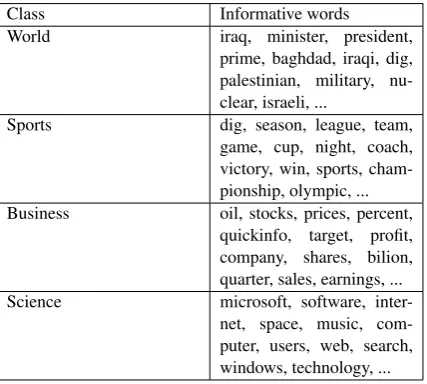
Some of the most informative words
given the classes available in the AG News datasets (Del Corso et al.,2005) are presented in Table1.
Class Informative words
World iraq, minister, president,
prime, baghdad, iraqi, dig, palestinian, military, nu-clear, israeli, ...
Sports dig, season, league, team,
game, cup, night, coach, victory, win, sports, cham-pionship, olympic, ...
Business oil, stocks, prices, percent,
quickinfo, target, profit, company, shares, bilion, quarter, sales, earnings, ...
Science microsoft, software,
inter-net, space, music, com-puter, users, web, search, windows, technology, ...
Table 1: Extractedχ2words for the AG News dataset
4 Model
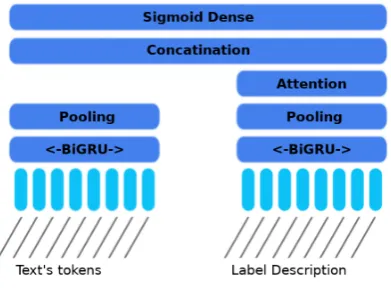
The overall architecture of our system is illustrated in Figure1. We use a lookup table for transform-ing token indices to embeddtransform-ing vectors. The em-beddings are fed into a bidirectional Gated Recur-rent Unit (BiGRU) (Cho et al.,2014). The result-ing tensors are then max- and average-pooled to extract the most relevant features. At the end of this channel, we have the vector of an encoded text.
A similar channel is used for encoding the class descriptions. Using the words extracted by theχ2 test as described in Section3, we generate a new string in which only the χ2 words are available. Given each class, this contains the highest infor-mative words for this class. Additionally, we put an attention layer on top of this channel to learn the importance of each word given a particular class.
The attention layer is implemented based on the work ofYang et al.(2016). The mathematical rep-resentation is as follow:
u=f(ω·h+b) ai=Sof tmax(ui·us)
vi=σiai·hi.
(1)
wherehare the tensors out of the BiGRU layer, and w, b, a, and v are the weight vectors, bias terms, attention vectors, and document vectors re-spectively.
Finally, we concatenate the resulting tensors from the attention layer with the max- and average-pooling layers and feed them into a dense layer for final classification.
For multi-class classification it is common to use the Softmax function
P(cj|xi) =
exp(ωj·xi)
PC
c=1exp(ωc·xi)
.
wherexi, c, andω are features, classes, and
asso-ciated weight vectors, respectively. This function is used as the dense output layer of the network to normalize the logits generated by previous lay-ers. In this way, we can model the probability of class cj as a multi-nominal distribution. The
[image:3.595.76.290.538.730.2]Figure 1: The system architecture
comment for being offensive is independent of its probability of being hateful, because an offensive tone can be used in a text that is not necessarily hateful (Founta et al.,2018). For this reason, in-stead of Softmax, we use the Sigmoid activation function
σ(z) = 1
1 + exp(−z)
which is a better choice for multi-label classifica-tion. In this way we can model the probability of a class as Bernoulli’s distribution
P(cj|xi) =
1
1 + exp(−ωj ·xi)
which makes the probability of each classcj
inde-pendent from the other class probabilities.
Therefore we use a Softmax dense layer for class and Sigmoid dense layer for multi-label classification to get the probabilities associ-ated with each target class.
5 System Setup
For the text representation in our system, we use pre-trained Glove embeddings (Pennington et al.,
2014) trained on 840 billion tokens with 300-dimensional vectors and set it to get updated through training. As the loss function for multi-class and multi-label settings, we use the Cate-gorical and the Binary cross-entropy, respectively. We define the bidirectional GRUs, each with 128 units. We also set both the drop-outs (Srivastava et al., 2014) and recurrent drop-outs to 0.5. In the following subsections, some details concern-ing the processconcern-ing of tested datasets are pre-sented.
5.1 Multi-label
Data. For the multi-label classification task, we train and test our model on a large publicly avail-able dataset provided for toxic comment classifi-cation in a Kaggle competition called ‘Toxic Com-ment Classification Challenge.’ The texts of the dataset were extracted from Wikipedia comments and have been labeled by human raters for six cat-egories of toxic behavior: toxic, severe-toxic, ob-scene, threat, insult, and identity-hate. The train-ing and test datasets contain 160k and 153k com-ments, respectively. The task is to train a model which assigns a probability to each of the six cat-egories of toxic behavior given a new comment.
Pre-processing. The pre-processing step for this dataset is performed by lower-casing, clean-ing the comments from non-alphanumeric charac-ters, using the first 130k most frequent tokens and removing comments longer than 80 tokens (95% percentile of the training dataset). Shorter com-ments are padded with zero to fixate the length of all comments to 80 tokens.
Performance Measure. The Area Under the Receiver Operating Characteristic Curve (AUC-ROC) is used to measure the performance of the systems. ROC is a probability curve, and AUC is a measure of separability. This measure tells how much a model is capable of distinguishing be-tween classes.
Since the output of the model is a vector of probabilities that the model computes for each class and we want to assign more than one class to each text, we define a threshold using the vali-dation data and accept all the classes with proba-bilities above the threshold as positive class.
5.2 Multi-class
Data. We also train and test our system on three other datasets for multi-class classifications, namely Hate Speech dataset (Davidson et al.,
2017), AG News (Del Corso et al.,2005), and DB-pedia, to measure its performance on multi-class classification. Some statistics of these datasets are reported in Table2.
Dataset Type Classes/Labels Training Testing Hate Speech Multi-class 3 22.5K 2.5K DBpedia Multi-class 14 560K 70K AG News Multi-class 4 120K 7.6K Kaggle-toxic comments Multi-label 6 160K 153K
[image:4.595.310.526.673.718.2]Pre-processing. The pre-processing step for these datasets is performed by lower-casing, re-moving non-alphanumeric characters, and remov-ing repetitive characters from tokens (e.g. yoooou-uuuu ->you).
Performance Measure. In contrast to the multi-label setting, in the multi-class setting, we do not need to define a threshold. Instead, we get the argmax of the vector of probabilities since we need to return only one class.
6 Experimental Results
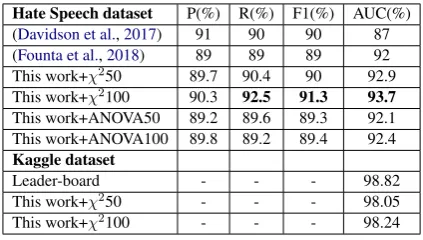
Table3shows that the system obtains superior re-sults in the Hate Speech dataset and yields com-petitive results on the Kaggle data in comparison to some sate-of-the-art baseline systems. Table4
shows the results of our system on the DBpedia and AG News datasets. Using the same model without any tuning, we managed to obtain com-petitive results again compared to previous state-of-the-art systems.
We also ran preliminary experiments on class description vectors with different dimensions (50 vs. 100), indicated by the suffix of each name in Table 3. By dimension, we mean the number of words given each label and not the dimension of word vectors which are all the same for both chan-nels (i.e., 300).
It turns out that in all but one case, the more words, the better the performance. However, we did not get statistically significant results with class descriptors with dimensions higher than 100. It seems that the range 50-100 is the optimal di-mension for this approach and these datasets. Big-ger vectors such as 150 did not yield any sta-tistically significant improvement in performance, and 200-, and 300-dimensional vectors deterio-rated the performance.
We observed that the decline in the performance comes mainly from two sources: the network over-fit, and the similar words in different classes. By increasing the number of informative words, the number of similar words in different classes increases which leads to sub-optimal classification decision boundaries.
7 Conclusion
Previous studies in text classification have shown that training classifiers with class descriptions or class metadata alongside the text is beneficial. However, many of these systems depend on the
Hate Speech dataset P(%) R(%) F1(%) AUC(%) (Davidson et al.,2017) 91 90 90 87 (Founta et al.,2018) 89 89 89 92
This work+χ250 89.7 90.4 90 92.9
This work+χ2100 90.3 92.5 91.3 93.7
This work+ANOVA50 89.2 89.6 89.3 92.1
This work+ANOVA100 89.8 89.2 89.4 92.4
Kaggle dataset
Leader-board - - - 98.82
This work+χ250 - - - 98.05
[image:5.595.308.520.61.181.2]This work+χ2100 - - - 98.24
Table 3: The results of our system on the Hate Speech and Kaggle datasets. With one exception, in all cases longer class description leads to better performance. The results of the Kaggle dataset are only reported in AUC to be comparable with other systems in the multi-label category.
DBpedia(%) AG News(%) Bi-BloSAN(Shen et al.,2018) 98.77 93.32 LEAM(Wang et al.,2018a) 99.02 92.45
This work 98.90 92.05
Table 4: Competitive results on DBpedia and AG News reported in accuracy (%) without any hyper-parameter tuning.
provided label set for generating their class de-scriptors. This dependence on an external source of information limits their applicability when such information is not available.
[image:5.595.308.522.285.327.2]References
Ahmad Aghaebrahimian. 2018a. Deep neural net-works at the service of multilingual parallel sentence extraction. InProceedings of the 27th International Conference on Computational Linguistics (CoLing), pages 1372–1383, Santa Fe, New Mexico, USA. As-sociation for Computational Linguistics.
Ahmad Aghaebrahimian. 2018b. Linguistically-based deep unstructured question answering. In Proceed-ings of the 22nd Conference on Computational Nat-ural Language Learning (CoNLL), pages 433–443, Brussels, Belgium. Association for Computational Linguistics.
Ahmad Aghaebrahimian and Filip Jurˇc´ıˇcek. 2016a. Constraint-based open-domain question answering using knowledge graph search. In Proceedings of the 19th International Conference of Text, Speech, and Dialogue (TSD), volume 9924, pages 28–36.
Ahmad Aghaebrahimian and Filip Jurˇc´ıˇcek. 2016b. Open-domain factoid question answering via knowl-edge graph search. In Proceedings of the Confer-ence of the North American Chapter of the Associ-ation for ComputAssoci-ational Linguistics (NAACL)- the Workshop on Human-Computer Question Answer-ing, pages 22–28, San Diego, California. Associa-tion for ComputaAssocia-tional Linguistics.
Sanjeev Arora, Yingyu Liang, and Tengyu Ma. 2017. A simple but tough-to-beat baseline for sentence em-beddings. InProceedings of the International Con-ference on Learning Representations (ICLR).
Said Bahassine, Abdellah Madani, Mohammed Al-Sarem, and Mohamed Kissi. 2018. Feature selection using an improved chi-square for arabic text classifi-cation. Journal of King Saud University - Computer and Information Sciences.
Dzmitry Bahdanau, Kyunghyun Cho, and Yoshua Ben-gio. 2015. Neural machine translation by jointly learning to align and translate. In Proceedings of the International Conference on Learning Represen-tations (ICLR).
Piotr Bojanowski, Edouard Grave, Armand Joulin, and Tomas Mikolov. 2017. Enriching word vectors with subword information. Transactions of the Associa-tion for ComputaAssocia-tional Linguistics, 5:135–146. Kyunghyun Cho, Bart van Merrienboer, Dzmitry
Bah-danau, and Yoshua Bengio. 2014. On the properties of neural machine translation: Encoder-decoder ap-proaches. InProceedings of the Eighth Workshop on Syntax, Semantics and Structure in Statistical Trans-lation.
Yiming Cui, Zhipeng Chen, Si Wei, Shijin Wang, Ting Liu, and Guoping Hu. 2017. Attention-over-attention neural networks for reading comprehen-sion. InProceedings of the 55th Annual Meeting of the Association for Computational Linguistics (Vol-ume 1: Long Papers), pages 593–602, Vancouver, Canada. Association for Computational Linguistics.
Thomas Davidson, Dana Warmsley, Michael W. Macy, and Ingmar Weber. 2017. Automated hate speech detection and the problem of offensive language. In
Proceedings of the International AAAI Conference on Web and Social Media (ICWSM).
Gianna M. Del Corso, Antonio Gull´ı, and Francesco Romani. 2005. Ranking a stream of news. In Pro-ceedings of the 14th International Conference on World Wide Web, WWW ’05, pages 97–106, New York, NY, USA. ACM.
Jan Milan Deriu and Mark Cieliebak. 2017. Swissalps at semeval-2017 task 3 : attention-based convolu-tional neural network for community question an-swering. In Proceedings of the 11th International Workshop on Semantic Evaluation (SemEval-2017), pages 334–338, Canberra, Australia. Association for Computational Linguistics.
Ronald A. Fisher. 1921. On the ‘probable error’ of a coefficient of correlation deduced from a small sam-ple. Metron, 1:3–32.
Antigoni-Maria Founta, Despoina Chatzakou, Nicolas Kourtellis, Jeremy Blackburn, Athena Vakali, and Ilias Leontiadis. 2018. A unified deep learning ar-chitecture for abuse detection. Computing Research Repository, CoRR, abs/1802.00385.
Jonas Gehring, Michael Auli, David Grangier, Denis Yarats, and Yann N Dauphin. 2017. Convolutional sequence to sequence learning. arXiv preprint, arXiv:1705.03122.
Dirk von Gr¨unigen, Ralf Grubenmann, Fernando Ben-ites, Pius Von D¨aniken, and Mark Cieliebak. 2018. spMMMP at GermEval 2018 shared task: Classifi-cation of offensive content in tweets using convolu-tional neural networks and gated recurrent units. In
Proceedings of the GermEval 2018 Workshop : 14th Conference on Natural Language Processing (KON-VENS).
Bing Liu. 2015. Sentiment Analysis. Cambridge Uni-versity Press, Cambridge, UK.
Tomas Mikolov, Kai Chen, Greg Corrado, and Jeffrey Dean. 2013. Efficient estimation of word represen-tations in vector space.arXiv:1301.3781.
Jeffrey Pennington, Richard Socher, and Christopher Manning. 1893. Contributions to the mathematical theory of evolution. InProceedings of the Royal So-ciety.
Jeffrey Pennington, Richard Socher, and Christopher Manning. 2014. Glove: Global vectors for word representation. InProceedings of the Conference on Empirical Methods in Natural Language Processing (EMNLP).
Conference on Empirical Methods in Natural Lan-guage Processing, pages 379–389, Lisbon, Portugal. Association for Computational Linguistics.
Minjoon Seo, Aniruddha Kembhavi, Ali Farhadi, and Hannaneh Hajishirzi. 2016. Bidirectional attention flow for machine comprehension.
arXiv:1611.01603.
Dinghan Shen, Yizhe Zhang, Ricardo Henao, Qinliang Su, and Lawrence Carin. 2017. Deconvolutional latent-variable model for text sequence matching.
CoRR, abs/1709.07109.
Tao Shen, Tianyi Zhou, Guodong Long, Jing Jiang, and Chengqi Zhang. 2018. Bi-directional block self-attention for fast and memory-efficient sequence modeling. InProceedings of the International Con-ference on Learning Representations (ICLR).
Nitish Srivastava, Geoffrey Hinton, Alex Krizhevsky, Ilya Sutskever, and Ruslan Salakhutdinov. 2014. Dropout: A simple way to prevent neural networks from over fitting. Journal of Machine Learning Re-search, 15(1):1929–1958.
Guoyin Wang, Chunyuan Li, Wenlin Wang, Yizhe Zhang, Dinghan Shen, Xinyuan Zhang, Ricardo Henao, and Lawrence Carin. 2018a. Joint embed-ding of words and labels for text classification. In
Proceedings of the Association for Computational Linguistics (ACL).
Sida Wang and Christopher D Manning. 2012. Base-lines and bigrams: Simple, good sentiment and topic classification. InProceedings of the Association for Computational Linguistics (ACL).
Wenlin Wang, Zhe Gan, Wenqi Wang, Dinghan Shen, Jiaji Huang, Wei Ping, Sanjeev Satheesh, and Lawrence Carin. 2018b. Topic compositional neural language model. InProceedings of the International Conference on Artificial Intelligence and Statistics (AISTATS).
John Wieting, Mohit Bansal, Kevin Gimpel, and Karen Livescu. 2016. Towards universal paraphrastic sen-tence embeddings. In Proceedings of the Inter-national Conference on Learning Representations (ICLR).
Zichao Yang, Diyi Yang, Chris Dyer, Xiaodong He, Alex Smola, and Eduard Hovy. 2016. Hierarchical attention networks for document classification. In
Proceedings of the Conference of the North Amer-ican Chapter of the Association for Computational Linguistics (NAACL).
Wenpeng Yin, Hinrich Schutze, Bing Xiang, and Bowen Zhou. 2016. Abcnn: Attention-based convo-lutional neural network for modeling sentence pairs.
Transactions of the Association for Computational Linguistics (TACL).
Lei Yu, Karl Moritz Hermann, Phil Blunsom, and Stephen Pulman. 2014. Deep learning for answer sentence selection. In Proceedings of the Con-ference on Neural Information Processing Systems (NIPS) - Deep learning workshop.