R E S E A R C H A R T I C L E
Open Access
Visibility of retractions: a cross-sectional
one-year study
Evelyne Decullier
1,2,3*, Laure Huot
1,2,3, Géraldine Samson
1,2,3and Hervé Maisonneuve
2Abstract
Background:Retraction in Medline medical literature experienced a tenfold increase between 1999 and 2009, however retraction remains a rare event since it represents 0.02% of publications. Retractions used to be handled following informal practices until they were formalized in 2009 by the Committee on Publication Ethics (COPE). The objective of our study was to describe the compliance to these guidelines.
Methods:All retractions published in 2008 were identified using the Medline publication type“retraction of publication”. The notices of retraction and the original articles were retrieved. For each retraction, we identified the reason for retraction, the country of affiliation of the first author, the time to retraction, the impact factor of the journal and the mention of retraction on the original article.
Results:Overall, 244 retractions were considered for analysis. Formal retraction notices could not be retrieved for 9. Of the 235 retractions available (96%), the reason was not detailed for 21 articles (9%). The most cited reasons were mistakes (28%), plagiarism (20%), fraud (14%) and overlap (11%). The original paper or its location was found for 233 retractions (95%). Of these, 22% were available with no mention of the retraction.
Conclusion:A standard retraction form could be helpful, with a check list of major reason, leaving the editor free to provide the reader with any further information. Original articles should remain available with a clear mention of the retraction.
Keywords:Retraction of publication, Scientific misconduct, Guidelines
Background
The process of scientific communication relies on trust: the researcher is supposed to conduct his research according to Good Practice, they should report the re-sults properly [1] and declare any conflict of interest [2]. It is difficult for reviewers to detect errors or suspected fraud [3]. Their task is to improve the paper. Various types of inappropriate behavior can be encountered dur-ing the writdur-ing of a paper and the review process, including misconduct, faked data, falsification, ethical misconduct, plagiarism, etc. [4]. Mistakes, i.e. misinfor-mation without intent, can also diminish the quality of scientific evidence [5]. In cases of scientific misconduct or mistakes, it is necessary that readers are informed,
which is why the editor later publishes a correction (correcting a mistake by substituting correct informa-tion), expression of concern (issued in case of suspected misconduct, not yet proven) or retraction (published in case of proven misconduct) [6,7].
Following the Joachim Boldt case with 88 retractions [8] and the Scott Reuben case with 21 falsified papers [9], the subject of retraction was studied in 4 dedicated publications in 2011 [5,10-12]. The number of retrac-tions in journals covered by the Science Citation Index Expanded has increased 20 times i.e. a tenfold increase since there has been a twofold increase in articles pro-duction between 1990 and 2008 [13]. A similar tenfold increase was found when focusing on Medline only
(1999–2009), although retraction remains a rare event
since it only represents 0.02% of publications [10]. The Committee on Publication Ethics (COPE) has established guidelines on dealing with retractions in 2009 [14]. COPE recommends that retractions should * Correspondence:[email protected]
1
Hospices Civils de Lyon, Pôle Information Médicale Evaluation Recherche, Unité de Recherche Clinique, Lyon F-69003, France
2
RECIF, EAM Santé Individu Société 4128, Université de Lyon, Lyon F-69003, France
Full list of author information is available at the end of the article
be issued in case of unreliable findings (misconduct or error), plagiarism or unethical research.
To better understand the reasons for retractions, 5 stud-ies investigated cohorts of retraction notices (sometimes leading to more than one publication) [10-12,15-18]. All these studies covered different time periods, different dura-tions of time, and provided the rate of retracdura-tions related to mistakes (research error and inability to reproduce the results). The rates of retractions related to mistakes tended to decrease according to the last year investigated: 55% for 1997 [17], 62% in 2002 [15], 42% in 2004 [16], 39% in 2008 [10] and 32% in 2010 [11].
COPE’s guidelines also state that notices of retraction should clearly identify the retracted article (title and authors) and be linked with the retracted article. The no-tices should be available freely and state the reason for re-traction (without being defamatory) and who is retracting. Steen found that 45% of retracted papers were either avail-able without any mention or deleted [11].
We analysed retractions published in Medline over a single year period to describe the conformity with re-traction guidelines as well as the reasons for rere-traction and their distribution across countries.
Methods
Data extraction (August, 22th 2011)
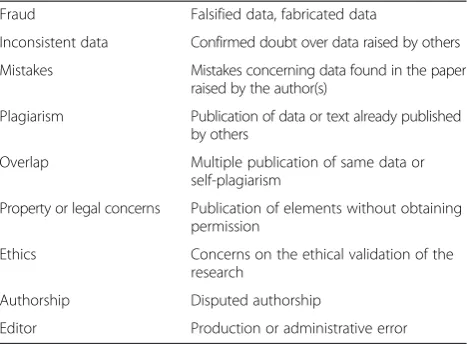
All retractions published in 2008 were identified using the Medline publication type “retraction of publication”. The year 2008 was chosen to ensure that all notices of retraction to be correctly indexed at the time of the data extraction. We retrieved the retraction notice and the complete original article for all retractions. All docu-ments were retrieved through the internet, and we did not search paper journals from the local medical library. For each retraction notice, we recorded the numbers of articles retracted, the time to retraction (number of years elapsed between publication of the original paper as noted on the pdf format, and the 2008 publication of the retraction), the country of affiliation of the first author (according to the address of the first author which is usually the same country as the last author, and often the country where the research was done), the impact factor of the journal in 2008 and the reasons for retrac-tion. For the reason for retraction, we used the termin-ology agreed upon between investigators (Table 1).
Data were extracted by GS, then LH and ED inde-pendently reviewed the reasons for retractions. Discrep-ancies were resolved by consensus between the two reviewers.
Analysis
We described the frequency of each reason, and cross-tabulated it with the country to obtain the ranking of countries for each reason.
Among the 9 reasons, we combined fraud, mistakes and inconsistent data since retracted articles led to the circulation of false information (labelled as “false
infor-mation”) and were compared to the 6 other reasons
combined.
To assess the conformity of visibility of retraction to good practices, we decided to choose the COPE guide-lines. Even if published in 2009, COPE guidelines were the formalization of common sense and informal prac-tices of some journals. We therefore determined whether the retraction was mentioned on the pdf of the original article or not. Visibility of retractions was defined by three possibilities: 1) deletion of the article from the journal’s website; 2) presence of the article with a mention of the retraction on the paper itself (either a comment at the beginning and/or at the end; or a clear indication for example printed diagonally across the paper) and/or men-tion on the journal’s website; and 3) presence of the article with no mention.
Time to retractions and impact factors were compared using the Mann–Whitney or Kruskal-Wallis test. Visibility
of retractions was compared using Chi2 test (or Fisher
exact test where Chi2test conditions were not fulfilled). All analyses were performed using SAS v9.2 (Cary, North Carolina).
Results
Overall, 241 notices of retraction were retrieved. Concerning access, 209 were available by open access or accessible through our institution’s subscription, 23 were found outside of our institution and 9 were im-possible to locate.
[image:2.595.305.539.111.283.2]These 241 notices of retraction represented 253 retrac-tions (10 retracting 2 articles and 1 retracting 3 articles). After deleting 3 duplicate notices, 250 retractions remained available. Lastly, one “retracted retraction” and 5 partial
Table 1 Reasons used to classify retractions: proposed definitions
Fraud Falsified data, fabricated data
Inconsistent data Confirmed doubt over data raised by others Mistakes Mistakes concerning data found in the paper
raised by the author(s)
Plagiarism Publication of data or text already published by others
Overlap Multiple publication of same data or
self-plagiarism
Property or legal concerns Publication of elements without obtaining permission
Ethics Concerns on the ethical validation of the research
Authorship Disputed authorship
retractions were discarded. Overall, 244 retractions were considered for analysis.
Reason for retraction (n = 235)
As previously stated, formal retraction notices could not be retrieved for 9 of the retractions. Of the 235 retrac-tions available, the reason was not given for 21 articles (9%). For example, the only information given by some journals is that the article is being retracted. Sometimes, it is also specified“retracted by the authors” or“retracted to be consistent with the publisher policy on article with-drawal” or “retracted by the authors with the agreement
of the journal editors and the publisher” without any
other details.
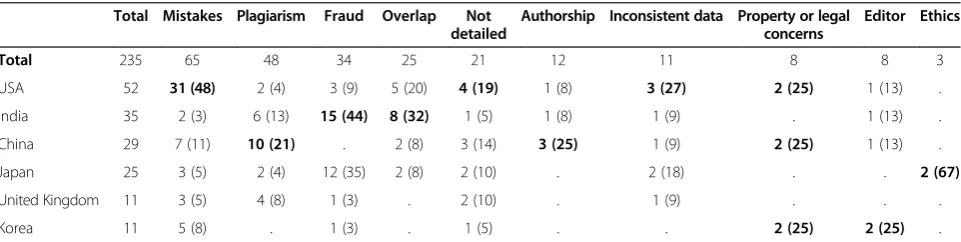
The most cited reasons were mistakes (n = 65, 28%), plagiarism (n = 48, 20%), fraud (n = 34, 14%) and overlap (n = 25, 11%) (Table 2).
The reasons are also presented according to countries in Table 2. In India and Japan, the most frequent reason was fraud, representing 43% for India (15/35) and 48% for Japan (12/25). In China, it was plagiarism with 34% (10/29); whereas in the USA the main reason was mis-takes at 60% (31/52) and plagiarism at 36% for United Kingdom (4/11).
Time to retraction and impact factors are compared between fraud, mistakes and plagiarism in Table 3.
Mention of retraction on the original article (n = 233)
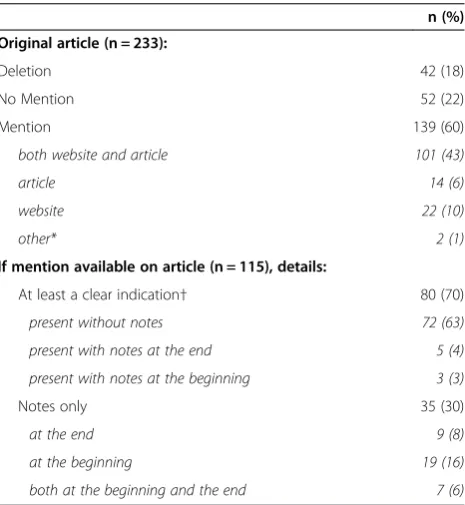
Of the 244 original articles, 11 could not be retrieved be-cause they had to be paid for online or were printed arti-cles or impossible to locate. We therefore found the original paper or its location for 233 retractions (95%). Of these 233 retracted original articles, 139 (60%) were available with a mention of the retraction either on the article or on the journal’s website, 52 (22%) were avail-able with no mention and 42 (18%) had been completely deleted (the publication concerned was no longer avail-able on the journal’s website) (Table 4). For articles with at least one mention, 101 (73%) had a mention both on
the article and the website, for 22 (16%) the mention only featured on the website, 14 (10%) only on the art-icle and the 2 last cases (1%) were 1) an empty pdf marked“retraction”with no mention on the website and 2) an article with a mention on the website for which the paper was no longer available in pdf format but which was available as html text. For the 115 papers which mentioned the retraction on the original article, 80 (70%) had a clear indication and 35 (30%) had notes at the be-ginning and/or at the end of the paper (Table 4).
Visibility of retraction on original articles was signifi-cantly higher for false information (p = 0.003). Among the 106 articles with false information, 75 (71%) had a mention compared to 64 / 127 articles (50%) retracted for other reasons; the rate of deleted articles was lower for false information compared to other reasons (11 (10%) vs 31 (24%)); finally, the rate of articles available with no men-tion was similar (20 (19%) vs 32 (25%)).
Discussion
The most frequent reasons for retraction in 2008 were mistakes (28%), followed by plagiarism (20%) and fraud (14%), and journals insufficiently followed the retraction good practices formalized by the 2009 COPE guidelines.
[image:3.595.58.539.586.707.2]All investigations into Medline retractions have high-lighted the fact that it is difficult to find formal retrac-tion notices containing the reason for retracretrac-tion (studies found that formal explanation was unavailable for 5% [10], 11% [15], 12% [16], 18% [11]). Here, the content of the retraction was not explicit for 21 retractions (9%). As recommended in previous studies, editors should al-ways provide the precise reason for retraction. Some-times obtaining the formal retraction notice is subject to a pay-per-view fee, and is therefore linked to the institu-tion’s membership. One study specified that the search was restricted to articles accessible within the institu-tion [10], another specified that 46 notices (5.8%) could not be retrieved [11], the other studies did not spe-cify these cases were excluded or counted them as“reason
Table 2 Reasons for retraction ranked according to countries with at least 10 retractions in 2008
Total Mistakes Plagiarism Fraud Overlap Not detailed
Authorship Inconsistent data Property or legal concerns
Editor Ethics
Total 235 65 48 34 25 21 12 11 8 8 3
USA 52 31 (48) 2 (4) 3 (9) 5 (20) 4 (19) 1 (8) 3 (27) 2 (25) 1 (13) .
India 35 2 (3) 6 (13) 15 (44) 8 (32) 1 (5) 1 (8) 1 (9) . 1 (13) .
China 29 7 (11) 10 (21) . 2 (8) 3 (14) 3 (25) 1 (9) 2 (25) 1 (13) .
Japan 25 3 (5) 2 (4) 12 (35) 2 (8) 2 (10) . 2 (18) . . 2 (67)
United Kingdom 11 3 (5) 4 (8) 1 (3) . 2 (10) . 1 (9) . . .
Korea 11 5 (8) . 1 (3) . 1 (5) . . 2 (25) 2 (25) .
Values are n (column percentage). Column percentage = number of given reason in a country/ total for this reason; allowing to see which countries contribute the most to each reason.
unclear”. Overall, in our study, 9 retractions were not avail-able even with payment. The fact that retraction notices are not freely available and when available, are not explicit, contravenes the COPE guidelines [14] and should be a pri-ority for journals as they are essential for the reader’s un-derstanding of whether the results still hold.
However, editors are not always willing to retract arti-cles [19]. It is therefore necessary that all journals imple-ment a retraction policy, indeed in a 2004 review it was
shown that only 18% had a dedicated policy [20]. The way to handle mistakes is sometimes controversial: some rec-ommend to publish corrections [7], whereas others state that they should be full retractions [14]. Practices are not homogeneous [21], and retractions for mistakes are regu-larly published.
It has already been demonstrated that the retracted lit-erature continues to be cited [18,22]. One of the expla-nations might be that retractions are not correctly reported on original article. We found that the mention of the retraction was incorrect for half of the retractions: the article was either completely deleted, or was still available with no mention. This is similar to the 45% found by Steen [11]. The retraction good practices for-malized by the COPE guidelines [14] are probably not well known or respected. Clear rules should be applied to ensure that this literature is identified as retracted. To be consistent with full transparency of publication, it is inappropriate to completely remove a retracted article from the website of a journal. As long as a clear mention of the retraction is available on both the journal website and the article, scientists must still have access. Some publishers are probably afraid of the circulation of false information, particularly of fraudulent data, and retracted articles continue to be removed from printed or online ver-sions of some journals.
[image:4.595.54.538.111.294.2]We also decided for the purposes of this study to com-bine fraud, inconsistent data and mistakes to estimate what proportion of retracted articles might have dam-aged the body of knowledge. Other reasons include, of course, misconduct however the information in these papers remains true. Steen has also shown that many pa-tients are put at risk since approximately 2 472.6 sub-jects per retracted paper were enrolled in subsequent studies using this retracted research [23]. Recently, the
Table 3 Comparison of the 3 main reasons for retraction by impact factor, time to retraction and visibility of retractions
Fraud Mistakes Plagiarism p-value
Impact factor (n = 137) 4.9 7.2 2.3 <0.0001
(3.2, 2.9-14.6) (4.1, 0.7-31.4) (1.9, 0.3-9.8)
Time to retraction (n = 244), years 2.2 2.5 3.2
0.722
(2, 0–8) (2, 0–10) (2, 0–10)
Publication year of retractionvsoriginal article (n = 244), n (%) 0.024
same year 2 (6) 11 (17) 8 (17)
1 to 5 years 31 (91) 47 (72) 29 (60)
>5 years 1 (3) 7 (11) 11 (23)
Visibility (n = 233), n (%) 0.057
mention 28 (82) 38 (62) 22 (51)
no mention 5 (15) 15 (25) 12 (28)
deletion 1 (3) 8 (13) 9 (21)
Values are mean (median, min-max) unless otherwise specified.
Table 4 Mention of retraction on the original article
n (%)
Original article (n = 233):
Deletion 42 (18)
No Mention 52 (22)
Mention 139 (60)
both website and article 101 (43)
article 14 (6)
website 22 (10)
other* 2 (1)
If mention available on article (n = 115), details:
At least a clear indication† 80 (70)
present without notes 72 (63)
present with notes at the end 5 (4)
present with notes at the beginning 3 (3)
Notes only 35 (30)
at the end 9 (8)
at the beginning 19 (16)
both at the beginning and the end 7 (6)
* One empty pdf marked“retraction”with no mention on the website and one article with a mention on the website for which the paper was no longer available in pdf format but which was available as html text.
[image:4.595.58.291.446.699.2]CrossMark system has been developed following the col-laboration between several publishers to standardize the way of providing readers how to locate the current version of an article [24]. If one journal applied the CrossMark icon on every pdf, it is to try to maintain the content of published articles and, by clicking on it, to warn readers if changes have occurred. In the future, this system may re-duce citations to retracted articles.
We cross-tabulated reasons for retraction with coun-tries. However, retraction rates by country should be interpreted relative to publication rate: the USA repre-sents 22% of retractions but also reprerepre-sents the highest number of publication. The aim of this study was to pro-vide a global description of retraction, and due to the low numbers in each category we did not provide any statistical comparison of countries. Good practices should be better disseminated to authors and editors in order to educate them and raise their awareness to better prevent misconduct; however fraud will not be deterred by this dis-semination. We found similar rates as Wager [10]: 28% for mistakes vs. 28%, 20% for plagiarism vs. 16% and 14% for fraud vs. 11%.
We noticed an association between impact factor and reasons for retraction with mistakes being published in higher impact factor journals. This could be explained by the fact that some authors might hurry to publish in a prestigious journal without taking enough time to check their data. When a paper deals with a hot topic, journals tend to publish special issues very rapidly. Moreover, mis-takes are also very frequent in the USA where researchers can be subject to greater pressure and are more inclined to submit to prestigious international journals. The publica-tions by Steen and Fang also found that higher impact fac-tor journals were more prone to retraction [12,25].
Conclusion
It would be useful to use a standard retraction form with for example a check list of major reason, which would then leave the editor free to provide the reader with any further information. Original articles should remain available with a clear mention of the retraction, and not only a mention on the journal website or in notes at the beginning or end of the article. This is probably on the COPE agenda, and our work can contribute to pro-posing definitions.
Competing interest
The authors declare that they have no competing interests.
Authors' contributions
ED declares that she designed the study, assessed the retractions, analysed the data, interpreted the data and wrote the manuscript. LH declares that she designed the study, assessed the retractions, interpreted the data, participated in drafting the manuscript and that she has read and approved the final version. GS declares that she retrieved the retraction notices, assessed the retractions, participated in drafting the manuscript and that she has read and approved the final version. HM declares that he participated in
analysis planning, interpreted the data, participated in drafting the manuscript and that he has read and approved the final version. All authors read and approved the final manuscript.
Authors’information
ED is a senior researcher (PhD), LH is a senior researcher (PharmD, PhD), GS is a junior researcher (PharmD), HM is a senior researcher (MD).
Acknowledgements
We would like to thank Florence Bouriot from the documentation center of Hospices Civils de Lyon for retrieving articles and notices of retraction, Joan Marsh (Wiley, London, UK), Paola De Castro (Istituto Superiore di Sanità, Roma, Italy), Barbara Gastel (Texas A&M Health Science Center, USA), Shou-chu Qian (Chinese Medical Association, China) who helped us to retrieve articles; and Kim Barrett for proofreading.
Author details 1
Hospices Civils de Lyon, Pôle Information Médicale Evaluation Recherche, Unité de Recherche Clinique, Lyon F-69003, France.2RECIF, EAM Santé Individu Société 4128, Université de Lyon, Lyon F-69003, France.3Université Lyon 1, Lyon F-69003, France.
Received: 6 November 2012 Accepted: 11 June 2013 Published: 19 June 2013
References
1. Uniform Requirements for Manuscripts Submitted to Biomedical Journals. [www.icmje.org].
2. Drazen JM, Van Der Weyden MB, Sahni P, Rosenberg J, Marusic A, Laine C, Kotzin S, Horton R, Hebert PC, Haug C,et al:Uniform format for disclosure of competing interests in ICMJE journals.Lancet2009,374:1395–1396. 3. Can peer review police fraud?Nat Neurosci2006,9:149.
4. Martinson BC, Anderson MS, De Vries R:Scientists behaving badly.Nature 2005,435:737–738.
5. Steen RG:Misinformation in the medical literature: What role do error and fraud play?J Med Ethics2011,37:498–503.
6. Sox HC, Rennie D:Research misconduct, retraction, and cleansing the medical literature: lessons from the Poehlman case.Ann Intern Med2006,
144:609–613.
7. Smith R:When to retract?BMJ2003,327:883–884.
8. Marcus A:Retractions Come in Boldt Case, Likely Most for Single Author. Probe finds 88 papers lacked ethics approval.Anesthesiology News2011,37.
9. Rittner HL, Kranke P, Schafer M, Roewer N, Brack A:[What can we learn from the Scott Reuben case? Scientific misconduct in anaesthesiology].
Anaesthesist2009,58:1199–1209.
10. Wager E, Williams P:Why and how do journals retract articles? An analysis of Medline retractions 1988–2008.J Med Ethics2011,37:567–570.
11. Steen RG:Retractions in the scientific literature: is the incidence of research fraud increasing?J Med Ethics2011,37:249–253.
12. Steen RG:Retractions in the scientific literature: do authors deliberately commit research fraud?J Med Ethics2011,37:113–117.
13. Corbyn Z:Retractions up tenfold.Higher Education: Times; 2009. 14. COPE:Retraction guidelines; 2009 [http://www.publicationethics.org/files/
retraction%20guidelines.pdf].
15. Nath SB, Marcus SC, Druss BG:Retractions in the research literature: misconduct or mistakes?Med J Aust2006,185:152–154.
16. Redman BK, Yarandi HN, Merz JF:Empirical developments in retraction.
J Med Ethics2008,34:807–809.
17. Budd JM, Sievert M, Schultz TR:Phenomena of retraction: reasons for retraction and citations to the publications.JAMA1998,
280:296–297.
18. Budd JM, Sievert M, Schultz TR, Scoville C:Effects of article retraction on citation and practice in medicine.Bull Med Libr Assoc1999,
87:437–443.
19. Newman M:The rules of retraction.BMJ,341:c6985.
20. Atlas MC:Retraction policies of high-impact biomedical journals.J Med Libr Assoc2004,92:242–250.
22. Pfeifer MP, Snodgrass GL:The continued use of retracted, invalid scientific literature.JAMA1990,263:1420–1423.
23. Steen RG:Retractions in the medical literature: how many patients are put at risk by flawed research?J Med Ethics2011,37:688–692. 24. CrossMark Support Site.[http://crossmarksupport.crossref.org/].
25. Fang FC, Casadevall A:Retracted Science and the Retraction Index.Infect Immun2011,79:3855–3859.
doi:10.1186/1756-0500-6-238
Cite this article as:Decullieret al.:Visibility of retractions: a cross-sectional one-year study.BMC Research Notes20136:238.
Submit your next manuscript to BioMed Central and take full advantage of:
• Convenient online submission
• Thorough peer review
• No space constraints or color figure charges
• Immediate publication on acceptance
• Inclusion in PubMed, CAS, Scopus and Google Scholar
• Research which is freely available for redistribution