R E S E A R C H A R T I C L E
Open Access
The prevalence and characteristics of
microalbuminuria in the general population:
a cross-sectional study
Satoru Tanaka
1, Hiroyuki Takase
2, Yasuaki Dohi
1*and Genjiro Kimura
1,3Abstract
Background:Microalbuminuria is a marker of cardiovascular events. This study investigated the prevalence of microalbuminuria in the general population and the factors that can affect urinary excretion of albumin.
Methods:Apparently healthy subjects who participated in a health checkup at our hospital were enrolled in this study (n = 7963, male 64.0%, 56.2 ± 11.8 years old) Urine samples were collected for the measurement of albumin concentrations, which were expressed as the ratio of urinary albumin to creatinine concentrations (UACR [mg/g Cr]). Individual salt intake was assessed by estimating the 24-hour urinary salt excretion of subjects.
Results:The mean blood pressure was 124 ± 15/76 ± 10 mmHg and 31.6%, 7.4%, and 44.1% of subjects had hypertension, diabetes mellitus, and dyslipidemia, respectively. Urinary albumin was detected in 7265 subjects (91.2%: UACR≥300 mg/g Cr, 0.5%; 300 > UACR≥30 mg/g Cr, 4.6%; 30 > UACR≥20 mg/g Cr, 2.4%; 20 > UACR≥10 mg/g Cr, 8.7%; 10 > UACR≥5 mg/g Cr, 21.8%; UACR < 5 mg/g Cr, 53.2%). In subjects with detectable albuminuria, UACR was independently correlated with age, systolic blood pressure, serum creatinine, fasting plasma glucose, and salt intake after adjustment for possible factors (P< 0.0001).
Conclusion:The prevalence of microalbuminuria was found to be 4.6% in the general population. The urinary excretion of albumin was closely associated with blood pressure and salt intake. These data indicated the importance of salt restriction for the prevention of cardiovascular disease and end-stage renal disease.
Keywords:Blood pressure, General population, Hypertension, Microalbuminuria, Salt
Background
Recent studies have established that microalbuminuria is an important cardiovascular risk factor [1,2]. Clinical data have demonstrated that left ventricular hyper-trophy, increased intima-media thickness of the carotid artery, and subclinical cardiovascular diseases are associ-ated with microalbuminuria among individuals at high risk for cardiovascular disease [3-5]. Furthermore, epi-demiological and experimental studies have established that high levels of urinary albumin excretion are associ-ated with an increased incidence of cardiovascular mor-tality as well as mormor-tality from all causes [6]. Most of these data came from observations involving high-risk
patients. The association between urinary albumin levels and increased cardiovascular mortality in high-risk pa-tients is evident even at urinary albumin levels below the clinically defined threshold for microalbuminuria.
Urinary albumin excretion is also a predictor of mor-tality from all causes in the general population [7]. The excess risk is more attributable to death from cardiovas-cular causes and this relationship is already apparent at ‘normal’ levels of albuminuria [3,8]. The establishment of an association between urinary excretion of albumin and cardiovascular morbidity and mortality in the gen-eral population may support the measurement of urinary albumin as a cardiovascular disease marker. This would enable the identification of individuals who may benefit from aggressive risk reduction for the primary preven-tion of cardiovascular disease. Thus, the present study investigated the range of urinary excretion levels for * Correspondence:[email protected]
1
Department of Cardio-Renal Medicine and Hypertension, Nagoya City University Graduate School of Medical Sciences, Nagoya, Japan Full list of author information is available at the end of the article
albumin and the prevalence of microalbuminuria. Through these data we sought to identify factors that may affect urinary excretion of albumin in the general population.
Methods
The study was performed in accordance with the princi-ples of the Declaration of Helsinki, and the Ethics Com-mittee of Enshu Hospital approved the study protocol. Written informed consent was obtained from all subjects prior to the start of the study.
Study settings and subjects
A total of 8155 persons who visited our hospital for a yearly physical checkup from April 2010 to March 2011 were screened for eligibility to be included in the present study. Subjects with incomplete data were excluded and the rest of the 7963 subjects were finally included in the present study. In addition to the routine examination of subjects in our health checkup program (physical exa-mination, chest X-ray, electrocardiogram [ECG], and la-boratory assessment of cardiovascular risk factors), urine was sampled for the measurement of urinary albumin in the morning after an overnight fast. Cross-sectional ana-lyses were performed in order to investigate the preva-lence of albuminuria and factors closely related to the urinary excretion of albumin.
Urinary albumin concentrations were measured by a turbidimetric immunoassay (analytical range≥ 1.1 mg/L) and are expressed as the ratio of concentrations of urinary albumin to urinary creatinine (UACR [mg/g Cr]). UACR was recorded as 0 mg/g Cr in those subjects with a urinary albumin concentration below the analytical limit. Micro-albuminuria was defined according to the recommenda-tion of the American Diabetes Associarecommenda-tion and the National Kidney Foundation (300 > UACR≥30 mg/g Cr) [9,10]. Individual salt intake was assessed by estimating the 24-hour urinary salt excretion of subjects and it was calculated using a previously reported formula [11].
Blood pressure was measured by a standard sphygmo-manometer, after subjects were seated in a chair for 5 min with their backs supported as well as their arms supported at heart level. Proper cuff size was determined based on arm circumference. Three consecutive blood pressure measurements were taken, with two minutes between each measurement, and the mean of the second and third measurements was recorded as the blood pressure. Hyper-tension was defined as systolic blood pressure (SBP)≥140 mmHg and/or diastolic blood pressure (DBP) ≥ 90 mmHg, or the use of antihypertensive medications. In this study, diabetes mellitus was defined as fasting plasma glu-cose≥126 mg/dL or the use of anti-diabetic medications and dyslipidemia was defined as low-density lipoprotein-cholesterol (LDL-lipoprotein-cholesterol) ≥140 mg/dL, high-density lipoprotein-cholesterol (HDL-cholesterol) < 40 mg/dL,
triglyceride≥150 mg/dL, or the use of antidyslipidemic medications [12]. ECGs were recorded after subjects had rested for 1 min in the supine position in an air-conditioned room.
Statistical analysis
All statistical analyses were performed using StatView 5.0 (SAS Institute, Inc., Cary, USA). Data in the text and the tables were expressed as mean ± standard deviation. Because the distribution of UACR was skewed rightward, these values were expressed as median ± absolute devi-ation and were log-transformed before statistical ana-lysis. Differences between two groups were compared by unpaired Student’sttests. A corrected chi-square test was used for comparisons between categorical data. Subjects were divided into six groups (Figure 1) according to their urinary level of albumin. The relationship between urinary excretion of albumin and blood pressure, fasting plasma glucose, or salt intake was investigated (ANOVA followed by Scheffe’s post-hoc analysis). Univariate and multivariate regression analyses were performed in order to investigate the relationship between urinary levels of albumin and other variables. APvalue of less than 0.05 was considered to be statistically significant.
Results
The characteristics of all study subjects are shown in Table 1, with 31.6% having hypertension, 7.4% having dia-betes mellitus, and 44.1% having dyslipidemia. Of the sub-jects with these conditions, 66.3%, 67.9%, and 26.0%, respectively, were under medical treatment for the dis-order. A total of 1642 subjects (20.6%) were overweight (body mass index (BMI) > 25 kg/m2. Urinary albumin was detected in most subjects (n = 7265, 91.2%). More than half of the subjects (53.2%), had minimal excretion levels of albumin (UACR < 5 mg/g Cr) and about 4.6% of sub-jects showed microalbuminuria (300 > UACR ≥ 30mg/g Cr) (Figure 1).
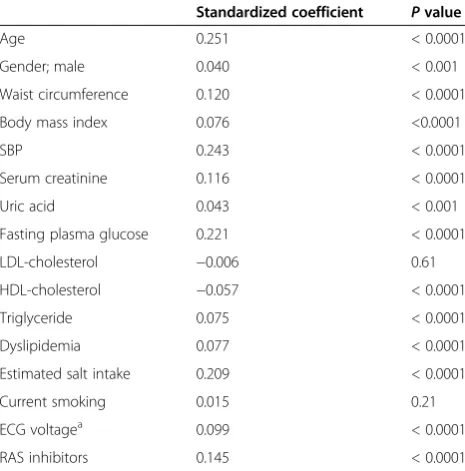
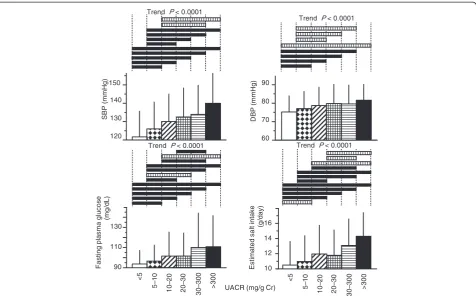
used log transformed (UACR + 0.5) as a dependent vari-able. Age (coefficient 0.113, P < 0.0001), male gender (−0.154,P < 0.0001), SBP (0.139,P < 0.0001), serum cre-atinine (0.125,P< 0.0001), salt intake (0.105,P< 0.0001), smoking (0.124, P < 0.0001), ECG voltage (0.056, P < 0.0001), and use of inhibitors of the renin-angiotensin sys-tem (0.038, P < 0.001) independently correlated with UACR after adjustment for waist circumference, uric acid, fasting plasma glucose, and dyslipidemia (R2= 0.111,F= 83.0, P < 0.0001). In line with these observations, SBP, DBP, fasting plasma glucose, and salt intake were observed
to increase with increasing urinary excretion of albumin in analyses that included all subjects (Figure 2). These results were further supported by a multivariate logistic regres-sion analysis where risks of microalbuminuria were calcu-lated (Table 4).
Discussion
This study demonstrates that the majority of the Japanese general population has detectable albuminuria but only 4.6% present with abnormal microalbuminuria. There is a close association between urinary excretion of albumin,
Urinary album in (mg/g Cr)
UACR < 5
5 UACR < 10
10 UACR < 20
20 UACR < 30
30 UACR < 300
UACR 300 ≤
≤ ≤ ≤
[image:3.595.59.539.89.276.2]≥
Figure 1Distribution of urinary levels of albumin.Urinary albumin was detected in 7265 subjects (UACR≥300 mg/g Cr, n = 41, 0.5%; 300 > UACR≥30 mg/g Cr, n = 362, 4.6%; 30 > UACR≥20 mg/g Cr, n =192, 2.4%; 20 > UACR≥10 mg/g Cr, n = 694, 8.7%; 10 > UACR≥5 mg/g Cr, n = 1737, 21.8%; UACR < 5 mg/g Cr, n = 4239, 53.2%). UACR indicates the ratio of the concentrations of urinary albumin to urinary creatinine.
Table 1 Characteristics of subjects
Total (n = 7963) Male (n = 5095) Female (n = 2868)
Age (years old) 56.2 ± 11.8 56.0 ± 11.9 55.6 ± 11.7
Waist circumference (cm) 83.3 ± 8.7 84.7 ± 8.3 81.0 ± 8.9
Body mass index (kg/m2) 22.7 ± 3.2 23.2 ± 3.0 21.9 ± 3.3
SBP (mmHg) 124.1 ± 15.1 125.6 ± 14.8 121.6 ± 15.5
DBP (mmHg) 76.3 ± 9.5 77.7 ± 9.4 73.8 ± 9.0
Serum creatinine (mg/dL) 0.76 ± 0.22 0.84 ± 0.24 0.62 ± 0.10
Uric acid (mg/dL) 5.5 ± 1.4 6.0 ± 1.3 4.5 ± 1.0
Fasting plasma glucose (mg/dL) 95.8 ± 17.9 98.1 ± 19.5 91.7 ± 13.6
LDL-cholesterol (mg/dL) 118.5 ± 26.9 118.5 ± 27.0 118.4 ± 26.7
HDL-cholesterol (mg/dL) 58.5 ± 13.8 55.6 ± 13.1 63.8 ± 13.5
Triglyceride (mg/dL) 107.8 ± 71.4 119.9 ± 80.7 86.2 ± 43.4
Urinary albumin (mg/g Cr) 3.89 ± 2.02 3.84 ± 2.13 3.94 ± 1.81
Estimated salt intake (g/day) 10.9 ± 3.4 12.3 ± 3.1 8.3 ± 2.1
Current smoking (n [%]) 1692 [21.2%] 1547 [30.4%] 145 [5.1%]
ECG voltagea(mV) 2.21 ± 0.93 2.33 ± 0.97 2.00 ± 0.82
Values are the mean ± standard deviation or the number of subjects, except for urine albumin (median ± absolute deviation). SBP indicates systolic blood pressure; DBP, diastolic blood pressure; LDL, low-density lipoprotein; HDL, high-density lipoprotein, Cr; creatinine.
a
[image:3.595.62.540.484.708.2]even in normal range, and cardiovascular morbidity and mortality. This association suggests that an approach of reducing urinary albumin could be used to prevent cardio-vascular disease, which is a leading cause of death. Life-style modification is one possible mechanism to improve
urinary excretion of albumin because both salt intake and SBP independently correlate with urinary albumin.
Several studies have reported on the prevalence of microalbuminuria in the general population including 7% of subjects in the PREVEND study, and 3.8% of subjects in the INTERMAP study. The prevalence of subjects with microalbuminuria in those studies are similar to the present study [13,14]. In contrast, the Takahata study reported that the prevalence of microalbuminuria was 13.7% in the general population [15]. We observed that the excretion of urinary albumin is closely associated with age, male gender, blood pressure, salt intake, and various other factors. Thus, the discrepancy in the prevalence of microalbuminuria between the present study and previous studies may be attributable to differences in the character-istics of the subjects studied. Indeed, the mean age was older and the blood pressure was higher in the Takahata study than in the present study. A linear correlation of urinary excretion of albumin with future cardiovascular and non-cardiovascular death was observed in the PREVEND study and the adjusted hazard of major cardio-vascular events was increased by 5.9% for every 0.4 mg/ mmol increase in UACR levels in the HOPE trial [1,7]. These studies demonstrate that even small increases in urinary excretion of albumin within the‘normal level’can increase the risk of future cardiovascular events. Further-more, a reduction in urinary albumin levels is associated with a reduction in cardiovascular events [16,17]. These observations suggest that urinary excretion of albumin may be a surrogate marker that will useful for the evalu-ation of individual risk in clinical settings. The findings of others in combination with the findings of this study indi-cate that many people may benefit from intensive inter-vention to reduce or normalize the urinary excretion of albumin.
The beneficial effects of inhibitors of the renin-angiotensin system on urinary albumin have already been established [13,18-20]. However, in most cases medical intervention is not realistic because of the wide prevalence of albuminuria, including ‘normal’ albumi-nuria, in the general population. A public health ap-proach aimed at lifestyle modification that includes restriction of salt intake and high calorie diet, may be effective, because of the observed close relationship between urinary excretion of albumin and salt intake, SBP, and fasting plasma glucose.
[image:4.595.57.290.112.348.2]Although the present study does not establish a causal relationship between the urinary excretion of albumin with other factors, several mechanisms underlying the observed relationship can be proposed. The kidney is an important target organ of hypertension and the relation-ship between increased blood pressure and albuminuria has been established. Excess salt intake produces an ex-cess volume load and, thereby, causes an increase in Table 2 Results of univariate analyses demonstrating the
relationship between urinary albumin and other variable Standardized coefficient Pvalue
Age 0.251 < 0.0001
Gender; male 0.040 < 0.001
Waist circumference 0.120 < 0.0001
Body mass index 0.076 <0.0001
SBP 0.243 < 0.0001
Serum creatinine 0.116 < 0.0001
Uric acid 0.043 < 0.001
Fasting plasma glucose 0.221 < 0.0001
LDL-cholesterol −0.006 0.61
HDL-cholesterol −0.057 < 0.0001
Triglyceride 0.075 < 0.0001
Dyslipidemia 0.077 < 0.0001
Estimated salt intake 0.209 < 0.0001
Current smoking 0.015 0.21
ECG voltagea 0.099 < 0.0001
RAS inhibitors 0.145 < 0.0001
Univariate analysis was conducted in subjects with detectable urinary albumin (n=7265). SBP indicates systolic blood pressure; LDL, low-density lipoprotein; HDL, high-density lipoprotein; RAS, renin-angiotensin system.
a
Electrocardiogram voltage (SV1+ RV5).
Table 3 Multivariate regression analysis demonstrates the relationship of urinary excretion of albumin to other variables
R2= 0.163,F= 117.4,P< 0.0001
Standardized coefficient Pvalue
Age 0.152 < 0.0001
Gender; male −0.215 < 0.0001
Waist circumference −0.017 0.16
SBP 0.130 < 0.0001
Serum creatinine 0.135 < 0.0001
Uric acid −0.004 0.76
Fasting plasma glucose 0.155 < 0.0001
Dyslipidemia 0.006 0.59
Estimated salt intake 0.185 < 0.0001
Current smoking 0.103 < 0.0001
ECG voltagea 0.055 < 0.0001
RAS inhibitors 0.054 < 0.0001
Analysis in subjects with detectable urinary albumin (n = 7265). SBP indicates systolic blood pressure; RAS, renin-angiotensin system.
a
[image:4.595.57.289.513.708.2]intra-glomerular pressure and glomerular hyperfiltration, which results in urinary excretion of albumin. An in-crease in blood pressure is also involved in the mecha-nism underlying salt-induced albuminuria. An elevated fasting plasma glucose level indicates the presence of
insulin resistance that promotes sodium re-absorption and may increase the volume load. Alternatively, endothelial dysfunction may be involved in the mechanism underlying the observed relationship between urinary excretion of al-bumin and other factors [21-23]. Many factors that have a close association with the urinary excretion of albumin in the present study also promote atherosclerosis. Since endothelial dysfunction is an early step of atherosclerosis, these factors may cause urinary albumin excretion via endothelial damage [24]. Indeed, in the Hoorn study, a linear association of microalbuminuria with endothelium function as assessed by flow-mediated vasodilation was observed in subjects either with or without diabetes [22]. Furthermore, inhibition of the endothelial nitric oxide pathway causes albuminuria [23]. The positive correlation between the use of inhibitors of the renin-angiotensin system and urinary albumin may have been attributable to high prevalence of microalbuminuria among hyper-tensive patients as compared to normohyper-tensive subjects. Alternatively, patients with albuminuria may have been preferably prescribed with renangiotensin system in-hibitors though the prevalence of microalbuminuria was not significantly different between hypertensive patients with and without renin-angiotensin system inhibitors (data not shown).
<5 5– 1 0 10 – 2 0 20 – 3 0 30 – 3 0 0 >3 00 SBP (m m H g ) 120 130 140 150 Es ti mate d sa lti n ta ke (g /d a y ) 10 12 14 16
UACR (mg/g Cr)
Trend P < 0.0001
90 110 130 F a s tin g p lasma g lucose (mg /d L ) DBP (m m Hg ) <5 5 – 10 10 –2 0 20 –3 0 30 – 3 0 0 >3 00 60 70 80 90 Trend P < 0.0001
[image:5.595.61.538.88.384.2]Trend P < 0.0001 Trend P < 0.0001
Figure 2The relationship of urinary albumin with blood pressure, plasma glucose, and salt intake (n=7963).The solid and hatched horizontal bars in the upper part of the figure denote that a significant difference was determined by Scheffe’s post-hoc test withP< 0.001 orP< 0.05, respectively. UACR indicates the ratio of the concentrations of urinary albumin to urinary creatinine.
Table 4 Results of logistic regression analysis demonstrating a risk of microalbuminuria
Odd’s ratio (95%CI) Pvalue
Age (years) 1.047 (1.035–1.059) < 0.0001
Gender; male 0.467 (0.324–0.671) < 0.0001
Waist circumference (cm) 1.010 (0.996–1.024) 0.16
SBP (mmHg) 1.027 (1.020–1.035) < 0.0001
Serum creatinine (mg/dL) 7.090 (3.863–13.015) < 0.0001
Uric acid (mg/dL) 1.081(0.983–1.188) 0.11
Fasting plasma glucose (mg/dL) 1.019 (1.015–1.023) < 0.0001
Dyslipidemia 1.132 (0.908–1.412) 0.27
Estimated salt intake (g/day) 1.142 (1.103–1.183) < 0.0001
Current smoking 2.040 (1.553–2.681) < 0.0001
ECG voltagea 1.151 (1.030–1.285) < 0.05 RAS inhibitors 1.485 (1.150–1.917) < 0.01
Logistic analysis in all subjects (n = 7963).
SBP indicates systolic blood pressure; RAS, renin-angiotensin system.
a
[image:5.595.57.290.527.708.2]The interpretation of the present study is limited by the following conditions. Firstly, the urinary excretion of albu-min was measured only once. Secondly, study subjects were participants in our health checkup program, which could introduce a selection bias. Thirdly, clinical significance of albuminuria as a cardiovascular risk was not assessed in the present study. Finally, a causal relationship cannot be established because this was a cross-sectional study. Longi-tudinal follow-up studies are necessary to draw a definite conclusion.
Conclusion
The majority of the general population has detectable uri-nary excretion of albumin and 4.6% show microalbuminuria. The urinary excretion of albumin was shown to be closely associated with salt intake as well as blood pressure. These data indicate the importance of dietary salt restriction for the prevention of cardiovascular disease as well as end-stage renal disease.
Abbreviations
UACR:The ratio of urinary albumin to creatinine concentrations; Cr: Creatinine; ECG: Electrocardiogram; SBP: Systolic blood pressure; DBP: Diastolic blood pressure; LDL-cholesterol: Low-density lipoprotein-cholesterol; HDL-cholesterol: High-density lipoprotein-cholesterol.
Competing interests
The authors declare that they have no competing interests.
Authors’contributions
ST analyzed data and mainly drafted the manuscript. HT participated in the design of the study, substantially contributed to the acquisition of data. YD substantially designed the study, substantially contributed to the interpretation of the data, and critically revised the manuscript. GK participated in the design of the study and contributed to the interpretation of the data. All the authors have read and approved the final manuscript.
Author details
1Department of Cardio-Renal Medicine and Hypertension, Nagoya City University Graduate School of Medical Sciences, Nagoya, Japan.2Department of Internal Medicine, Enshu Hospital, Hamamatsu, Japan.3Department of Internal Medicine, Asahi Rousai Hospital, Owariasahi, Japan.
Received: 7 February 2013 Accepted: 3 July 2013 Published: 7 July 2013
References
1. Gerstein HC, Mann JF, Yi Q, Zinman B, Dinneen SF, Hoogwerf B, Halle JP, Young J, Rashkow A, Joyce C, Nawaz S, Yusuf S:Albuminuria and risk of cardiovascular events, death, and heart failure in diabetic and nondiabetic individuals.JAMA2001,286:421–426.
2. Adler AI, Stevens RJ, Manley SE, Bilous RW, Cull CA, Holman RR: Development and progression of nephropathy in type 2 diabetes: the United Kingdom Prospective Diabetes Study (UKPDS 64).Kidney Int2003, 63:225–232.
3. Wachtell K, Ibsen H, Olsen MH, Borch-Johnsen K, Lindholm LH, Mogensen CE, Dahlof B, Devereux RB, Beevers G, de Faire U, Fyhrquist F, Julius S, Kjeldsen SE, Kristianson K, Lederballe-Pedersen O, Nieminen MS, Okin PM, Omvik P, Oparil S, Wedel H, Snapinn SM, Aurup P:Albuminuria and cardiovascular risk in hypertensive patients with left ventricular hypertrophy: the LIFE study.Ann Intern Med2003,139:901–906. 4. Yokoyama H, Aoki T, Imahori M, Kuramitsu M:Subclinical atherosclerosis is
increased in type 2 diabetic patients with microalbuminuria evaluated by intima-media thickness and pulse wave velocity.Kidney Int2004, 66:448–454.
5. Chico A, Tomas A, Novials A:Silent myocardial ischemia is associated with autonomic neuropathy and other cardiovascular risk factors in type 1 and type 2 diabetic subjects, especially in those with microalbuminuria. Endocrine2005,27:213–217.
6. Weir MR:Microalbuminuria and cardiovascular disease.Clin J Am Soc Nephrol2007,2:581–590.
7. Hillege HL, Fidler V, Diercks GF, van Gilst WH, de Zeeuw D, van Veldhuisen DJ, Gans RO, Janssen WM, Grobbee DE, de Jong PE:Urinary albumin excretion predicts cardiovascular and noncardiovascular mortality in general population.Circulation2002,106:1777–1782.
8. Matsushita K, van der Velde M, Astor BC, Woodward M, Levey AS, de Jong PE, Coresh J, Gansevoort RT:Association of estimated glomerular filtration rate and albuminuria with all-cause and cardiovascular mortality in general population cohorts: a collaborative meta-analysis.Lancet2010, 375:2073–2081.
9. American Diabetes Association:Clinical Practice Recommendations 2001. Diabetes care2001,24(Suppl 1):S69–72.
10. Mattix HJ, Hsu CY, Shaykevich S, Curhan G:Use of the albumin/creatinine ratio to detect microalbuminuria: implications of sex and race.J Am Soc Nephrol2002,13:1034–1039.
11. Kamata K, Tochikubo O:Estimation of 24-h urinary sodium excretion using lean body mass and overnight urine collected by a pipe-sampling method.J Hypertens2002,20:2191–2197.
12. Teramoto T, Sasaki J, Ueshima H, Egusa G, Kinoshita M, Shimamoto K, Daida H, Biro S, Hirobe K, Funahashi T, Yokote K, Yokode M:Diagnostic criteria for dyslipidemia. Executive summary of Japan Atherosclerosis Society (JAS) guideline for diagnosis and prevention of
atherosclerotic cardiovascular diseases for Japanese.J Atheroscler Thromb2007,14:155–158.
13. Monster TB, Janssen WM, de Jong PE, den Berg LT DJ-v:The impact of antihypertensive drug groups on urinary albumin excretion in a non-diabetic population.Br J Clini Pharmacol2002,53:31–36.
14. Daviglus ML, Greenland P, Stamler J, Elliott P, Appel LJ, Carnethon MR, Chan Q, Claeys G, Kesteloot H, Miura K, Nakagawa H, Pirzada A, Steffen L, Yan LL, Zhou B, Dyer AR:Relation of nutrient intake to microalbuminuria in nondiabetic middle-aged men and women: International Population Study on Macronutrients and Blood Pressure (INTERMAP).Am J Kidney Dis2005,45:256–266.
15. Konta T, Hao Z, Abiko H, Ishikawa M, Takahashi T, Ikeda A, Ichikawa K, Takasaki S, Kubota I:Prevalence and risk factor analysis of
microalbuminuria in Japanese general population: the Takahata study. Kidney Int2006,70:751–756.
16. Ibsen H, Olsen MH, Wachtell K, Borch-Johnsen K, Lindholm LH, Mogensen CE, Dahlof B, Devereux RB, de Faire U, Fyhrquist F, Julius S, Kjeldsen SE, Lederballe-Pedersen O, Nieminen MS, Omvik P, Oparil S, Wan Y:Reduction in albuminuria translates to reduction in cardiovascular events in hypertensive patients: losartan intervention for endpoint reduction in hypertension study.Hypertension2005,45:198–202.
17. Araki S, Haneda M, Koya D, Hidaka H, Sugimoto T, Isono M, Isshiki K, Chin-Kanasaki M, Uzu T, Kashiwagi A:Reduction in microalbuminuria as an integrated indicator for renal and cardiovascular risk reduction in patients with type 2 diabetes.Diabetes2007,56:1727–1730. 18. Gaede P, Tarnow L, Vedel P, Parving HH, Pedersen O:Remission to
normoalbuminuria during multifactorial treatment preserves kidney function in patients with type 2 diabetes and microalbuminuria. Nephrol Dial Transplant2004,19:2784–2788.
19. Remuzzi G, Macia M, Ruggenenti P:Prevention and treatment of diabetic renal disease in type 2 diabetes: the BENEDICT study.J Am Soc Nephrol 2006,17(4 Suppl 2):S90–97.
20. Eijkelkamp WB, Zhang Z, Remuzzi G, Parving HH, Cooper ME, Keane WF, Shahinfar S, Gleim GW, Weir MR, Brenner BM, de Zeeuw D:Albuminuria is a target for renoprotective therapy independent from blood pressure in patients with type 2 diabetic nephropathy: post hoc analysis from the Reduction of Endpoints in NIDDM with the Angiotensin II Antagonist Losartan (RENAAL) trial.J Am Soc Nephrol2007, 18:1540–1546.
21. Imai E, Nakajima H, Kaimori JY:Albumin turns on a vicious spiral of oxidative stress in renal proximal tubules.Kidney Int2004,66:2085–2087. 22. Stehouwer CD, Henry RM, Dekker JM, Nijpels G, Heine RJ, Bouter LM:
further evidence for a link between microalbuminuria and endothelial dysfunction-the Hoorn Study.Kidney Int2004,Suppl 92:42–44. 23. Ott C, Schneider MP, Delles C, Schlaich MP, Schmieder RE:Reduction in
basal nitric oxide activity causes albuminuria.Diabetes2011,60:572–576. 24. Deckert T, Feldt-Rasmussen B, Borch-Johnsen K, Jensen T,
Kofoed-Enevoldsen A:Albuminuria reflects widespread vascular damage. The Steno hypothesis.Diabetologia1989,32:219–226.
doi:10.1186/1756-0500-6-256
Cite this article as:Tanakaet al.:The prevalence and characteristics of microalbuminuria in the general population: a cross-sectional study. BMC Research Notes20136:256.
Submit your next manuscript to BioMed Central and take full advantage of:
• Convenient online submission
• Thorough peer review
• No space constraints or color figure charges
• Immediate publication on acceptance
• Inclusion in PubMed, CAS, Scopus and Google Scholar
• Research which is freely available for redistribution