DYNAMIC SET THEORY
MSc Thesis
(Afstudeerscriptie)
written by
Yvette Oortwijn
(born March 9th, 1996 in Amsterdam, the Netherlands)
under the supervision of Dr Luca Incurvati, and submitted to the Board of Examiners in partial fulfillment of the requirements for the degree of
MSc in Logic
at theUniversiteit van Amsterdam.
Date of the public defense: Members of the Thesis Committee:
July 3, 2019 Dr Luca Incurvati (Supervisor)
Dr Paul Dekker (Chair) Dr Maria Aloni
Abstract
Acknowledgements
First and foremost, I would like to thank my supervisor Luca Incurvati for guiding me to and through this project. From the first class I was taught by you, Philosophy of Mathematics in the Bachelor Philosophy, I was drawn to the idea that this thesis was built on. From there on, you not only helped me understand all the necessary concepts and theories to write this thesis, but you also gave me the confidence to develop my own views and stand by them. As I also wrote in Bachelor thesis’ acknowledgements, your kindness and intelligence is inspiring and I hope I get the chance to keep on learning from you.
I want to thank all the members of my thesis committee for reading my thesis and challenging and inspiring me with the difficult questions they asked. I want to thank Maria Aloni for the suggestions I got in the earliest stages of this thesis (I wish I had been able to use them more). I want to thank Paul Dekker for the confidence I gained from working with him in teaching a first year philosophy class. I want to thank Arianna Betti for teaching me to read and write. Working with you has been one of the most inspiring things I have done.
Generally, I want to thank all the people working at the ILLC whose doors were always open and for teaching all the amazingly inspiring things I got to learn, both in the courses offered, in projects I took and in many more informal conversations. And all my friends at the ILLC, who taught me so much about all the various subjects we encountered but also made this intense programme so enjoyable, I could not have done it without you.
My special thanks goes out to Rachael and Maria, for all the much needed distraction, listening to my frustration and allowing me to listen to yours. Our brains may be gone, but you will never go from my heart. To Lisa, for enduring me during a second thesis together. I hope to have you around for the next one and beyond. To Matteo, for proofreading my thesis, helping me with the semantics, teaching my the art of tikz pictures (that I still haven’t mastered) and continuously reminding me to be mindful of nonexistent objects.
My even more special thanks goes out to Joe. Your intelligence, wit and love inspire me every day. I could write a thesis about all I have you to thank for and how grateful I am to have you.
Contents
Abstract 1
Acknowledgments 2
Introduction 5
1 Potentialism 9
1.1 The Foundations of Mathematics . . . 9
1.2 Potentialism to the Rescue . . . 12
1.2.1 Potential and actual Infinity . . . 13
1.2.2 Modern Potentialism . . . 14
1.3 Potentialism Formally . . . 16
1.4 The Problems of Potentialism . . . 19
1.4.1 The minimal explanation . . . 19
1.4.2 Modal notions unexplained . . . 20
1.4.3 Modal notions track expansion of the universe . . . 21
1.4.4 The problems of Potentialism . . . 23
1.5 What’s next? . . . 24
2 Dynamic Set Theory 25 2.1 Intuitions . . . 25
2.2 Dynamic Set Theory . . . 28
2.2.1 Identifying the appropriate modal logic . . . 28
2.2.2 Plural logic . . . 29
2.2.3 Semantics . . . 30
2.2.4 The dynamics of DST . . . 33
2.2.5 Set existence and the nature of sets . . . 34
2.3 Recovering the Axioms of ZF . . . 35
2.3.1 Extensionality . . . 38
2.3.2 Foundation . . . 38
2.3.3 Empty Set . . . 39
2.3.4 Separation . . . 39
2.3.5 Pairing . . . 39
2.3.6 Union . . . 39
2.3.7 Powerset . . . 39
2.3.9 Infinity . . . 40
2.4 DST and DSTi . . . 41
3 Properties of Dynamic Set Theory 43 3.1 Deducibility . . . 43
3.2 Interpretability . . . 45
3.2.1 DST and ZF . . . 45
3.2.2 DSTi and ZFi . . . 47
3.2.3 DSTi and ZF . . . 47
4 Philosophy of Dynamic Set Theory 48 4.1 Principles of Potentialism . . . 48
4.1.1 Open-endedness and indefinite extensibility . . . 48
4.1.2 Avoiding arbitrariness and ad hocness . . . 49
4.2 The Concept of Set . . . 51
4.2.1 The linguistic turn . . . 51
4.2.2 Dynamic modalities . . . 52
4.2.3 Classical and Intuitionistic DST . . . 54
4.3 TheWhy-Question . . . 56
4.3.1 Answering thewhy-question . . . 56
4.3.2 An independent motivation . . . 59
4.3.3 Questioning thewhy-question . . . 60
Conclusion 63
Introduction
This thesis presents an approach to modelling the continuously developing universe of mathematical objects by capturing an old and intuitive idea of infinity with a method new to the foundations of mathematics. The conception of infinity that will be used here can already be found in ancient philosophy:
Infinity turns out to be the opposite of what people say it is. It is not “that which has nothing beyond itself” that is infinite, but “that which always has something beyond itself”. (Aristotle,Physics, 3.6)
The conception that Aristotle sketches of infinity fits our intuitive idea of it, as a process that never stops, something that goes on and on without termination. For instance, if I would ask you to count, you would (assuming you will not protest) start listing the numbers in the natural number sequence in its order. However, if I would ask you to count to infinity, you can only imagine yourself continuing to count without ever stopping. All the numbers you manage to list would be finite, so never at any point would you reach your destination. Our conception of infinity, it seems, is something that simply goes on and on, without bounds. In this thesis, we will exploit these intuitions of infinity, by taking a potentialist perspective on the foundations of mathematics and using a dynamic approach to implement this perspective in set theory.
This idea of infinity as a never-ending process was the standard view of infinity for a long time, already present in ancient philosophy. However, Georg Cantor changed the views of many mathematicians and philosophers on infinity with his work on the transfinite; distinguishing between actual and potential infinity. This work also started the development of set theory as a foundation of mathematics.
Set theory, in general, is the mathematical theory on collections of well-defined objects, namely sets and their elements. Currently, the standard form of set theory is ZF(C), formulated by Zermelo and Fraenkel. Their axiomatic system is so construed that all objects of mathematics can be represented as sets. Due to this feature, set theory can be seen as a foundation of mathematics. Seeing ZF(C) as a foundation for mathematics does raise some important questions; are the axioms just mathematically successful in representing the objects of mathematics or do the axioms of ZF(C) capture something more fundamental about the nature of mathematics and its objects? In order to answer this question, a conception of sets is needed.
conception of sets, namely, Actualism and Potentialism. Actualism regards the hierarchy of sets as actually existing, all at once. This can be seen as problematic since it raises the question why the hierarchy of sets itself is not a set. Generally, it is thought that, following Cantor, potential infinities cannot form sets, while actual infinities can. However, if the entire hierarchy is actual, why can the universe of sets still not be a set itself (all paradoxes aside)? Potentialism regards the hierarchy of sets as merely potentially existing. This position has its own problems, mostly regarding the interpretation ofpotential existence.
In this thesis we will focus on the potentialist perspective on the iterative conception of sets. The potentialist account of the universe of sets as currently implemented using a standard modal logic is not able to do what it purports to do. For instance, it cannot give an answer to the question why the universe of sets is not a set itself that goes beyond any answer also available to the actualist. It will be argued that there are two main problems for the current view of Potentialism: (i) its system is static, which makes it impossible to model the process of set development, and (ii) its interpretation of the modalities is ontological, which makes it hard to define what it means topotentially exist. Therefore, in this thesis, we propose a novel approach to implementation of Potentialism that will solve these problems by using a logic that truly captures itsdynamiccomponent and has a natural interpretation of the modalities that is linguistic and epistemic rather than ontological.
The conception of sets is an important issue for the philosophy of mathematics since, in order for set theory to function as a foundation of mathematics, we want it to not only provide to be a basis from which the pursuit of mathematics can grow but also capture the nature of its objects. This means that a successful foundation of mathematics should lead us to answers about the nature of the objects it describes. Within set theory, this requires a conception of sets and the hierarchy of sets that also motivates the axioms of set theory.
Moreover, Potentialism specifically has recently gained renewed attention from both philosophers and mathematicians. Not only have there been various formally valuable results from modal set theory, it has also been shown to form a solution for some of the philosophical issues that come up for other views. Solving some of the open problems for Potentialism would further strengthen it as a view on the universe of mathematical objects and infinity. The main objectives of this thesis are the following two: (i) formulating a form of set theory that istruly dynamic, and (ii) offering a solution to the question why the universe of sets is not a set itself.
The first objective will consist of combining set theory and dynamic semantics such that we can model the process of set formation, in a way which still allows us to recover the results of ZF. Thus, this thesis is not aiming to change or disprove any results of set theory as we know it. What this thesis aims to do is find a formulation of set theory that makes it more clear what the practices of the set-theorist consist of and how we can understand the hierarchy of sets. We aim to provide a formulation of set theory that matches our intuitions and philosophical considerations of the concept of sets and the set-theoretical hierarchy.
are in line with our philosophical and mathematical intuitions and make it possible to recover the axioms of ZF.
The second objective of this thesis will consist of finding an interpretation of the dynamic operators such that it can provide an explanation ofwhy the universe of sets is not a set itself, more in-depth than that its existence would lead to a contradiction. In order to this, we need to investigate the concept of set and the set-theoretic hierarchy to find out what the difference between a set and the hierarchy of sets is. However, finding a satisfactory and in-depth answer to thewhy-question will prove to be too complicated not to involve a more general discussion of thewhy-question itself. This will consist of an exposition of what answering thewhy-question requires and what criteria for a satisfactory answer are.
To reach the second objective we will use a linguistic interpretation of Potentialism building on the version of Potentialism formulated by Uzquiano (2015). This contrasts with other versions of Potentialism that use a more ontological interpretation of the modalities involved. Instead of modelling how the mathematical ontology expands as the stages of the hierarchy progress, the proposal is to model how our expressive resources expand by step-wise assigning more inclusive meanings to the word “set”. Based on this interpretation it will be argued that we can never assign an all-inclusive meaning to “set”. It will also be argued that a completely satisfactory and in-depth answer to thewhy-question is not possible. This does not mean that we should dismiss the pursuit entirely since some answers are still better than others. To make this point, a few constraints on conceptions of sets will be formulated.
Note that, in order to reach both objectives we will need to use a combination of formal and philosophical methods. These two cannot remain entirely separate; we will use philosophical considerations to motivate the construction of a formal system, and use the formal system to both answer philosophical questions and raise new ones.
In the first chapter, we will introduce the necessary background to understand the problem that this thesis aims to solve. This will start with a historical introduction of set theory and the foundational crisis within mathematics. Then, the currently most standard version of set theory and foundation of mathematics will be introduced along with the leading interpretation of it. This interpretation, the iterative conception of sets, will be used throughout this thesis. In this first chapter, we will introduce the two main views on this conceptions of set, Actualism and Potentialism. We will discuss the different reasons researches have used to favour either perspective and what the problems with each are. Since the focus of this thesis will be the potentialist perspective on the iterative conception, the central point of this chapter will be which problems Potentialism has solved and which problems still remain for it. We will finish this chapter with introducing the proposed solution which will be elaborated throughout the rest of the thesis; a dynamic approach to Potentialism.
reformulate existing set theory in such a way that the underlying concept of set becomes explicit. We will end this chapter with a brief comparison of the formal systems resulting from adopting classical and intuitionistic semantics.
In chapter three, we will prove some results that compare dynamic set theory, in both its classical and intuitionistic version, with ZF. This will show that a formula is deducible in classical dynamic set theory if and only if it is deducible in ZF. The same result will be proven between intuitionistic dynamic set theory and intuitionistic ZF. A weaker result, only the direction from dynamic set theory to ZF, will be shown to apply to intuitionistic dynamic set theory and classical ZF. Based on these results we will further prove that both classical and intuitionistic dynamic set theory are interpretable in classical ZF, and that intuitionistic dynamic set theory is interpretable in intuitionistic ZF.
In the final chapter, we will discuss the philosophy of dynamic set theory. The first step will be to see whether the dynamic version of Potentialism can still recover the philosophical results of Potentialism as currently implemented. To this end, we will outline how dynamic set theory solves the problems that Potentialism was originally designed to solve and captures the open-ended nature of sets. The second step consists of the study of the concept of set and the interpretation of the dynamic modalities in dynamic set theory. In order to do this we will first introduce a different perspective on Potentialism that interprets its endeavour as more linguistic, rather than ontological. We will combine this view of Potentialism with the version of it discussed in the first chapter to formulate an interpretation of what dynamic set theory is modelling. Based on these considerations we will also compare the classical and intuitionistic version of dynamic set theory from a philosophical point of view. This will show which version of it best fits with the concept of sets and the interpretation of the hierarchy of sets that Potentialism aims to capture. Finally, the last step is to return to one of the central problems for Potentialism, namely, its trouble to providing an in-depth answer to the questionwhy the universe of sets is not a set itself. We will discuss to what extend dynamic set theory is able to give a more satisfactory answer, that there is an independent reason to adopt dynamic operators in set theory and why answering thewhy-question in a satisfactory way might not be achievable in general. We will finish this last chapter with some considerations on what a conception of sets can and cannot be and what any conception should do.
1
Potentialism
In this chapter, we will introduce the necessary background to understand the main subject of this thesis, Potentialism, as well as the view itself. We will begin from a historical perspective, starting from the foundational crisis within mathematics. This will lead us to ZF(C), the most common form of axiomatic set theory and foundation for mathematics nowadays, and the iterative conception of sets, which is usually used to motivate ZF(C). Even though ZF(C) is the most commonly used foundation for mathematics, there are some arguments against using it as such, some of which will be briefly discussed. Against this background we can consider Potentialism, which argues for a specific view on the iterative conception of sets and endorses some of the criticism to ZF(C). We will look at this theory from both a philosophical and a formal perspective; considering its critique on ZF(C), its conception of sets and the formal system resulting from it. Potentialism itself is not without problems either. So, directly after the outline of this theory, we will discuss some of its issues. Finally, we will look at what the options for Potentialism to circumvent these problems are, which will serve as a bridge to the next chapter.
1.1
The Foundations of Mathematics
At the end of the nineteenth century, mathematicians were searching for a foundation for mathematics. This search for foundation turned into a foundational crisis when the attempts ran into a variety of difficulties. In this section, we will briefly describe the route to modern set theory to put the Potentialist view of the foundations of mathematics and set theory into perspective. This route to modern set theory starts with Cantor and Dedekind and will lead us to modern set theory as formulated by Zermelo and Fraenkel. This section will finish by discussing why ZF(C) is sometimes said to be ad hoc and is not always seen as a fully satisfactory foundation for mathematics.
on set theory (Giaquinto, 2002).
In the following years, a variety of researchers were studying whether set theory could form a foundation for mathematics. Among these, was Frege (1903, §147) who with his logicist project aimed to show that the truths of arithmetic are logical truths by trying to derive the fundamental axioms and theorems of arithmetic by purely logical methods.
The early formulation of set theory is, what is now called, naive set theory based on the naive conception of sets. In the naive conception of sets, sets were taken to be collections of things falling under a certain concept, combined with the idea that any predicate is able to determine a set. This idea was captured by the axiom schema of comprehension: ifϕ(x) is a formula in the language of first-order set theory, then there exists a setY ={x:ϕ(x)}. (Giaquinto, 2002; Tiles, 2004)
This axiom schema was a crucial figure in Frege’s Basic Law V, which he used in his attempts to derive the truths of arithmetic by logical means. However, both Frege’s logicist project and his Basic Law V, and naive set theory more generally were soon found problematic by the discovery of multiple set-theoretic paradoxes starting with the Burali-Forti paradox and, specifically problematic for Frege’s project, later Russell’s paradox (see e.g. Ferreir´os (2016); Giaquinto (2002)).
In a letter from 1902, Russell proves Frege’s Basic Law V to be inconsistent by using the axiom schema of comprehension (see Van Heijenoort (1967) for a translation). To see how Russell’s proof works, letϕ(x) stand forx∈xand takeR={x:¬ϕ(x)}. In other words, letR be the set such that its members are exactly those objects which are not a member of themselves. Now suppose thatR is a member of itself. This means that it is not a member of itself since it must satisfy the condition¬ϕ(x). Suppose instead thatRis not a member of itself. Then it follows that it is a member of itself since it must not satisfy the condition
¬ϕ(x). Since classically we have that eitherRis a member of itself or it is not a member of itself, we have a contradiction. This proves that Frege’s Basic Law V is inconsistent since this law states that the extensions of two predicates (F, G) are the same if and only if for all x,F(x)↔G(x) (see e.g. Gianquinto (2002, 53-54)).
The discovery of the set-theoretic paradoxes led to a variety of attempts to develop a new system for the foundations of mathematics. In 1908, Zermelo published his system of axioms for set theory with an exposition of how this new system was able to prohibit the earlier found paradoxes from arising. From this grew the nowadays most common form of axiomatic set theory, formulated by Zermelo and Fraenkel (ZF or ZFC depending on, respectively, the exclusion or inclusion of the axiom of choice).
To eliminate paradoxes such as the paradox of the ordinals and Russell’s paradox the axiom schema of comprehension is relinquished and instead the weaker axiom schema of separation is used (Ferreir´os, 2016): ifϕ(x) is a formula in the language of first-order set theory,L∈, then for any setX there exists a setY ={x∈X :ϕ(x)}. In other words, for
every setX and everyϕexpressible in L∈ there is a set consisting of all objects inX that
satisfyϕ. This removes the possibility of formulating sets such as Russell’s set since we cannot take the set of all sets that are not a member of themselves, merely the set of all sets that are not a member of themselves within a certain set. More generally, this also eliminates the possibility to have a set of all sets (Ferreir´os, 2016). Aside from the axiom schema of separation, ZF(C) includes further axioms to recover the desired mathematical properties of sets and further capture the concept of set (Bagaria, 2019).
at stageV0. Then, by applying the power set operation, we getV1=P(V0). Following this
further we get to the first limit ordinal, such thatVω=SVn. From this follows the hierarchy,
as shown in figure 1.1.
The iterative conception is not only seen as a way to interpret ZF(C) but even as an independent way to motivate it.
ZF alone (together with its extensions and subsystems) is not only a consistent (apparently) but also an independently motivated theory of sets: there is, so to speak, a “thought behind it” about the nature of sets which might have been put forth even if, impossibly, naive set theory had been consistent. (Boolos, 1971, 219)
[image:12.612.272.352.358.451.2]One of the benefits of this iterative conception of set is that it gives an intuitive way to counter to paradoxes such as Russell’s by its hierarchical structure. It provides an interpretation of the nature of sets that directly prohibits the existence of sets that are members of themselves since each set is formed out of objects from the stages below it. This means that for a set to be a member of itself, it would already have had to exist at the level before it was formed, which is impossible. This also means that there is no set of all sets since such a set would contain itself, and since in the hierarchy only sets of all sets occurring at earlier stages exist it would also not occur in the hierarchy.
Figure 1.1: The cumulative hierarchy of sets
Moreover, according to some, there is still a problem underlying these paradoxes. The claim is that prohibiting paradoxes from arising is not enough; we need to look at the roots of the problem, not just solve its symptoms. Michael Dummett, for instance, argued that the real problem lies in the indefinite extensibility or open-endedness of the concept of set (e.g. Dummett (1994a)).
Indefinite extensibility refers to concepts such that when we form a conception of the totality of the objects that fall under a specific concept we can, by reference to this totality, characterise a bigger totality of objects that fall under the concept. This process of extending can go on indefinitely. This is problematic according to Dummett because, since we are not able to fix a definite totality of objects falling under the concept “set”, we are not able to fix the truth-values of statements quantifying over this totality. Moreover, since there is nothing else that can determine those truth-values, we are left with statements with no determinate truth-value. This is not acceptable in classical logic and cannot be circumvented, therefore we should adopt a different logic (see e.g. Dummett (1963, 1991, 1994a,b)).
Although Dummett’s argument for intuitionistic logic based on indefinite extensibility is notoriously obscure (see e.g. Linnebo (2018, 36)), indefinite extensibility does seem to clearly relate to the paradoxes of early set theory. Russell argued that the paradoxes
result from the fact that [...] there are what we may call self-reproductive processes and classes. That is, there are some properties such that, given any class of terms all having such a property, we can always define a new term also having the property in question. Hence we can never collect all of the terms having the said property into a whole; because, whenever we hope we have them all, the collection which we have immediately proceeds to generate a new term also having the said property. (Russell, 1907)
Although this does not give us a much clearer perspective on what indefinite extensibility or self-reproductiveness is exactly, it does show that there is a relation between these phenomenena and the set-theoretic paradoxes. Note, however, that the problem does not lie in the conception of sets as in the iterative hierarchy, but rather in the way that ZF(C) is trying the capture this. This will become more explicit in the following section in which we will discuss a conception of sets that emphasises the open-ended and indefinitely extensible nature of sets.
1.2
Potentialism to the Rescue
Based on the paradoxes that arose from naive set theory, many researchers working on the foundations of mathematics have concluded that the universe of sets is not a set itself. The question that follows iswhy this is the case, thewhy-question for short (Soysal, 2017). Some state-of-the-art proposed solutions to thewhy-question and the other problems mentioned in the previous section are built on a conception of the hierarchy of sets aspotential (see e.g. Linnebo (2010); Uzquiano (2003)).
We will give a clearer description of Potentialism throughout this section, but, roughly, Potentialism argues that no matter how many stages of the hierarchy of sets have been formed, there is always the possibility of a next stage; the hierarchy is open-ended and indefinitely extensible. This way, the hierarchy is never “complete”. Since only “complete” totalities can form sets, the totality of sets cannot form a set. This potential nature of the hierarchy of sets fits the iterative conception of sets quite naturally since this incorporates the idea of there always being a next stage. However, while the iterative conception of sets is often used to motivate ZF(C), this potential nature is not represented in it.
The apparent potential character of the hierarchy of sets contrasts starkly with the axiomatic set theory that the iterative conception is ordinarily used to motivate, namely Zermelo–Fraenkel (ZF) set theory. This theory is formulated in a language with no modal vocabulary. Moreover, the theory quantifies freely over ‘all sets’, thus apparently assuming that ‘all sets’ are simultaneously available as a legitimate range of quantification. So this theory appears to treat the hierarchy of sets as if it was an actual or completed hierarchy. (Linnebo, 2013, 205)
So, while the iterative hierarchy does show a potential nature in the sense that it is always possible to further extend it, this potential character is not mirrored in the language of ZF(C).
Before going into more detail on Potentialism in set theory and how it contrast with its opposing view, Actualism, we will first give a more precise explanation of what Potentialism more generally entails by discussing it from a historical perspective.
1.2.1
Potential and actual Infinity
The idea of potentiality concerns infinity more generally. From Aristotle on, until the nineteenth century many endorsed the idea that infinity is always potential rather than actual (Linnebo and Shapiro, 2017). Aristotle (Physics,3.6,20627-29) characterises infinity as that “there is always another and another to be taken. And the thing taken will always be finite, but always different”. Put this way, infinity can be seen as an ever-growing finitude; the infinite lies in that this process of being able to take new finite things never ends rather than any object actually being infinite (Lear, 1979; Sorabji, 1983).
Following this potentialist view of infinity, the successor principle for the natural numbers is as follows: it will always be the case that, for any natural number, we can produce a successor. Or, in other words, it is necessary that, for any natural number, possibly there is a successor. This is opposed to actual infinity, which entails that for any natural number there is a successor.
For on the one hand a multiplicity can be such that the assumption that all of its elements are together leads to contradictions, so that it is impossible to conceive of the multiplicity as a unity, as “one finished thing”. Such infinities I call absolutely infiniteor inconsistent multiplicities [...]
When on the other hand the totality of elements of a multiplicity can be thought without contradiction as “being together”, so that their collection into “one thing” is possible, I call it aconsistent multiplicity or set. (Cantor and Zermelo, 1932)
So, we have consistent multiplicities, such that the set of such a multiplicity would not lead to contradictions, and we have inconsistent multiplicities, such that the set of such a multiplicity would lead to a contradiction. The consistent and inconsistent infinite multiplicities are, respectively, identified with actual and potential infinity (Cantor, 1886).
Although the set-theoretic paradoxes did prove to be problematic for Cantor’s conception of set theory in general, the view of consistent infinite multiplicities as actual has stuck.
Of course, the set-theoretic paradoxes discovered around the turn of the century caused alarm. But many mathematicians no doubt agreed with David Hilbert’s conviction that a solution can be found and accordingly that “[n]o one shall drive us out of the paradise which Cantor created for us” (Hilbert, 1925, 191). Thankfully, in the course of the first half of the twentieth century, our place in Cantor’s paradise was secured — not in the way Hilbert envisaged, but thanks to the now-standard axiomatization ZFC and the closely connected iterative conception of sets. (Linnebo and Shapiro, 2017, 1)
So, Cantor’s views on actual infinity persisted, and much of how infinity is commonly seen to this day is still due to his work. However, as we will see now, this standard view is not shared by all researchers.
1.2.2
Modern Potentialism
Modern Potentialism, in the form that we are interested in here, is concerned with the foundation of mathematics. While Cantor’s views changed the general outlook on infinity, Potentialism argues that, at least concerning sets, this was unwarranted. According to Linnebo (2013) the standard way of interpreting modern set theory is mistaken in how it solves the paradoxes since “the theory quantifies freely over ‘all sets’, thus apparently assuming that ‘all sets’ are simultaneously available as a legitimate range of quantification. So this theory appears to treat the hierarchy of sets as if it was an actual or completed hierarchy.” (Linnebo, 2013, 205). The problem with the standard, actualist treatment of the hierarchy of sets is that it seems to have trouble answering thewhy-question; if all sets are simultaneously available, why could they not form a set?
Roughly, we can contrast the potential and actual way of looking at the hierarchy of sets by the following two set formation principles:
(1) Necessarily, for any objectsxx, possibly there is their set{xx};∀xx♦∃ySet(y, xx), i.e. possibly there is a set containing exactly these objects.
For the potentialist, even though we have (1), it does not follow that we have (2); the entire hierarchy of sets that we can form exists potentially but not actually. The hierarchy as a whole is not a set according to this view since elements of sets have to actually and not merely potentially exist; the sets in the potential hierarchy are merely a plurality and will never all actually exist. Note that the potentiality used here can be interpreted in a variety of ways. Linnebo (2013, 207-208) states that it is not a metaphysical modality in the sense that it is usually being used after Kripke since sets exist by metaphysical necessity if they exist at all. The modality is more closely related to the before mentioned Aristotelean distinction between actual and potential infinity. This interpretation remains somewhat vague, but we will leave further discussion on this for section 1.4. In general, the modality is related to the extension of our ontology: “A claim is possible, in this sense, if it can be made to hold by a permissible extension of the mathematical ontology; and it is necessary if it holds under any permissible such extension.” (Linnebo, 2013, 208).
To make the distinction between the actualist and potentialist view of sets clearer, let us compare their interpretations of the iterative conception of sets. As mentioned at the start of this section, the intuitive explanation of the iterative conception of sets often uses reference to time and activity. In an actualist conception of the iterative hierarchy, this is often taken to be merely metaphorical. Or stronger even, as Boolos (1989, 8) claims, “thoroughly unnecessary”. However, in the potentialist conception of the iterative hierarchy this reference to time and activity is not done away with as merely metaphorical. Although, as seen in the earlier cited passage from Parsons (1977, 355), the language of time and activity is often replaced by more familiar modal notions.
Potentialism is argued to be a better alternative to an actualist interpretation of the hierarchy of sets since a potentialist view can avoid a problem concerning arbitrariness that comes up for the actualist. The actualist, seeing all the sets that can be described by the cumulative hierarchy as actually existing at once, is argued not to be able to explain why the objects that make up the totality of all sets cannot be a set itself. The problem is that they freely quantify over all of them and there is no essential difference between what the hierarchy is and what a set is (Linnebo, 2013, 205). In this sense, disallowing the existence of a set of all sets, would be to cut the hierarchy off at an arbitrary level. This problem does not arise for the potentialist since there is a definite difference in the nature of sets and of the hierarchy of sets. Sets and their elements are completed and actual, whereas the hierarchy as a whole will always remain potential since the process of extending the hierarchy can go on indefinitely. The actualist, however, is argued not able to make this distinction in any proper way, or as Studd puts it:
I can see no hope for elaborating a non-modal, tenseless stage-theory - or for that matter, any other view - in order to meet this challenge, in a non-arbitrary and principled way. (Studd, 2013, 700)
Moreover, the other problem that was mentioned in section 1.1, indefinite extensibility, can in the potential view of the hierarchy of sets be more easily understood and is no longer an underlying problem in need of a solution. It can simply be seen as “a byproduct of the potential character of the set-theoretic universe.” (Uzquiano, 2015, 149).
when the multiplicity can be thought together and seen as finished, then it is of the second kind. Sets can only contain multiplicities of the second kind (Ewald 1996, 927-932). This relates to the potentialist’s view since, in the same way, the hierarchy cannot be seen as a set precisely because it is notone finished thing and cannot be conceived of as such since it always remains potential.
Subsequently, Linnebo proposes two constraints on when some objects can form a set; not only do the objects need to be actual, they also need to form a “consistent multiplicity”, following Cantor’s distinction between two kinds multiplicities. Furthermore, Linnebo (2013, 214-215) uses two core ideas for the nature of sets, namely, that they are constituted by their elements and that there is a priority of the elements of a set to the set itself. The first means that the nature of any specific set is exhausted by its elements. While the second asserts that the elements of a set have to be available prior to the existence of the set. Together, these ideas give a conception of sets such that only if some things actually and consistently exist, they can form a set, and this set would be defined by exactly those things.
1.3
Potentialism Formally
The formal side of Potentialism has proven to be a very fruitful field (see e.g. Hamkins and Linnebo (2017)) to which we could dedicate more than a thesis by itself. However, due to the philosophical considerations that will be discussed in section 1.4, we will not discuss it in detail. Instead, in this section, we will only discuss Linnebo’s (2013) proposal to formally implement Potentialism, some properties of the resulting system and some minimal results. Formally, in the current literature, Potentialism is implemented by doing set theory using a standard modal logic, such thatpossibly in (1) is modelled as the modal diamond operator. So, the potential character of the hierarchy and quantifiers’ “implicit modal character” (Linnebo 2010: 155) is made explicit: the universal and existential quantifiers are respectively interpreted as∀and♦∃. ∀ϕshould be interpreted as that ϕwill be true for every set formed, no matter how far one would extend the hierarchy. ♦∃ϕ should be interpreted as thatϕwill be true for some set that can be formed by some extension of the hierarchy (Linnebo 2010: 155-156). Given the assumptions that Linnebo makes (2013: 213) the modalised quantifiers behave just like regular quantifiers. Stronger even, “modal set theory is compatible with ordinary nonmodal ZF set theory but looks at the same subject matter under ‘a finer resolution’” (Linnebo, 2013, 214).
The modal first-order language that Linnebo (2013, 210) discusses consists of “classical
S4.2, the usual introduction and elimination rules for identity and the first-order quantifiers, and the axiom x 6= y → (x 6= y)”. The modal logic used is a directed partial order, meaning that the accessibility relation is reflexive, transitive, anti-symmetric and directed. This makes the system sound with respect to S4.2(Linnebo, 2013, 209). The use of this modal logic is motivated by the desired relation between the accessibility relation and the domain assignment: wRw0 →D(w)⊆D(w0) (Linnebo, 2013, 208). This principle means that if w0 is accessible from w then w0 is an expansion of the mathematical ontology of w. This also means that the worlds in the model represent the stages of the process of set formation, such that the domain of each world contains the sets formed thus far. Aside from this, Linnebo (2013, 209) also requires the accessibility relation to satisfy well-foundedness. These requirements together imply that the system proves the Converse Barcan Formula, ∀xϕ(x)→ ∀xϕ(x) (Linnebo, 2013, 210).
Maximality expresses the idea that at every stage, all sets that can be formed are indeed formed. Although this idea goes beyond the minimal conception of the process of set formation, according to Linnebo, it is a necessary requirement for justifying the power set axiom. Linnebo, therefore, discusses his formal system for Potentialism both with and without this requirement. Note that maximality would change the earlier mentioned accessibility relation from being just directed, to being linear (Linnebo, 2013, 209, fn7). A comparison between the different resulting systems from a mathematically motivated philosophical perspective can be found in Hamkins (2018, 32-35), in which an outlines is given of the different potentialist considerations with how they are expressed in the validities following from, among others, linear and directed frameworks.
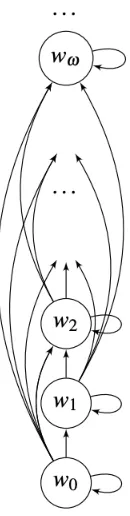
Figure 1.2: The potential hierarchy of sets
Moreover, Linnebo uses a plural logic in order to clearly show the relation between pluralities and sets. This means that, aside from our regular singular variablesx, ythat can be bound by the existential and universal quantifier, we also have plural variables xx, yy such that∀xx...and∃yy...should, respectively, be read as “given any thingsxx...” and “for some thingsyy...” (Linnebo, 2013, 210).
The plural logic is bound by the following few principles (Linnebo, 2013, 211-212):
u≺xx→(u≺xx) (STB+ ≺)
∀u(u≺xx→θ)→∀u(u≺xx→θ) (INEXT-ϕ)
The first two principles state that being one of some objects and not being of some objects is stable across worlds. These two axioms ensure that when we move from one world to a next, an object that was part of the thingsxxwill remain part of the things xxand an object that was not will still not be (Linnebo, 2013, 211). However, we want the plurality to be stable in a stronger way, we want to ensure that the objects that are amongxxstay exactly the same across worlds. This is done by the third axiom schema, INEXT-ϕ, above (Linnebo, 2013, 211-212).
We can also assign stableness to formulas just in case the following two principles hold:
ϕ(u)→ϕ(u) (STB+−ϕ)
¬ϕ(u)→¬ϕ(u) (STB−−ϕ)
The use of plural logic has two main contributions in the overall system: (i) it is a way of making arbitrary pluralities from the relevant domain available, and (ii) it provides a formalisation of the notionextensional definiteness (Linnebo, 2013, 212-213). The first is done by the unrestricted comprehension schema for pluralities:
∃xx∀u(u≺xx↔ϕ(u)) (P-Comp)
where xx is not free inϕ(u). Meaning that there are some things xxsuch that they are precisely those that satisfyϕ.
Linnebo (2013, 212) characterises the notion extensional definiteness with the help of “the idiom of possible worlds” as follows: “a formula ϕis extensionally definite at a world w just in case its extension remains the same at any later worldw0 ≥w.” and formalises it as:
∃xx∀u(u≺xx↔ϕ(u)) (ED-ϕ)
which entails the earlier seen principles (STB+−ϕ), (STB−−ϕ) and (INEXT−ϕ) (Linnebo, 2013, 212). These principles are used in the comparison of modal and nonmodal theories.
Aside from this, Linnebo (2013, 214-218) also formulates some principles about the nature of sets. As we discussed in section 1.2, Linnebo uses two core ideas about the nature of sets: (i) they are constituted by their elements, and (ii) there is a priority of the elements of a set
to the set itself.
This first idea motivates the axiom of extensionality (Linnebo, 2013, 215):
x=y↔ ∀u(u∈x↔u∈y) (EXT)
While the second idea, together with the assumption that the accessibility relation between states is well-founded, permits the adoption of the foundation axiom (Linnebo, 2013, 215):
Given this plural logic, Linnebo (Linnebo, 2013, 219) formulates the principle for set formation as
∀xx♦∃y∀u(u∈y↔u≺xx) (C) This means that for the objects that are available at a specific point in the process of set formation, there is a later stage that has sets with these objects as elements (Linnebo, 2013, 218-219).
To be able to compare his modal version of set theory and standard non-modal ZF, Linnebo (2013, 213) uses the following definition.
Definition 1.3.1. We refer to the complex strings ∀ and ♦∃ as modalised quantifiers. When Lis a nonmodal language of first or second order, let L♦ be the modal language that
results from adding the modal operatorsand♦toL. Given a nonmodal formula ϕofL, its potentialist translationϕ♦ is the fully modalised formula ofL♦ that results from replacing
each ordinary quantifier inϕ with the corresponding modalised quantifier.
By adding some further assumptions to the system, all potentialist translations of the axioms of ZF can be derived. Moreover, the overall structure of the potential hierarchy is isomorphic to the cumulative hierarchyVα and modal set theory and ZF are mutually
interpretable. An important theorem about the bridge between modalised quantifiers and ordinary quantifiers is the following (Linnebo, 2013, 214):
Theorem 1.3.1. Let`be the relation of classical deducibility in a languageL, although ifLis a plural language, we mean classical deducibility without the use of any plural comprehension axioms. Let `♦ be deducibility in L♦ by `, S4.2, and the stability axioms for L♦. Let
ϕ1, ..., ϕn andψ beL-formulas. Then we have:
ϕ1, ..., ϕn`ψ iffϕ♦1, ..., ϕ♦n `♦ψ♦
As Linnebo (2013, 214) explains, this theorem shows that modal set theory, as he has presented it, is compatible with Zermelo Fraenkel set theory since this implies that something is derivable in ZF if and only if its modalised version is derivable in Linnebo’s system.
1.4
The Problems of Potentialism
In the previous sections we have looked at an effort to answer the questionwhy the universe of sets is not a set itself, the why-question. In this section, we will discuss an argument against the potentialist account of set theory given by Soysal (2017). Soysal argues that Potentialism is not able to give an answer to the why-question beyond, what she calls, the minimal explanation. To understand the criticism, we will first discuss this minimal explanation and why some have found this explanation unsatisfying. Then, we will focus on the modalities involved in the potentialist account of the hierarchy of sets and why there is no interpretation of these that can push Potentialism beyond the minimal explanation.
1.4.1
The minimal explanation
While it is true that the assumption of having a universal set contradicts some of ZF(C)’s axioms, this minimal explanation has left many unsatisfied. In her paper, (Soysal, 2017, 2-4) quotes some of the expressions of unsatisfaction. Studd (2013, 699), for instance, asks: “What is it about the world that allows some sets to form a set, whilst prohibiting others from doing the same?”. We know that some sets cannot form a set since this would lead to contradictions butwhy is the case that in some instances these contradictions arise, whereas in others they does not? As Soysal (2017, 3) mentions, the minimal explanation is not outright rejected as an answer in general; the minimal explanation does form an answer to why the universal set is not a set in ZF(C). However, it fails to provide a more in-depth explanation on the nature of sets such that a universal set cannot exist. What the researchers who reject the minimal explanation seem to be asking for is an account of the nature of sets such that it motivates the axioms as well as the prohibition of a universal set.
Soysal (2017, 12-17), however, goes on to argue that Potentialism is not able to give such a deeper explanation either since there is no interpretation of the potentialist’s modalities that can ground an answer to thewhy-question. She divides attitudes towards the modal notions in Potentialism in two: (i) those that leave the modality as unexplained by taking it as a mathematical primitive and (ii) those that take the modality as “somehow tracking the practice of set theorists to accept the existence of larger and larger cardinals” (Soysal, 2017, 12). Eventually, neither of these interpretations are able to give a solution to the why-question that is somehow “deeper” than the minimal explanation.
Before we go on to discuss the two attitudes towards the modal notions in Potentialism and their problems, recall that a formulaϕis derivable in ZF if and only ifϕ♦ that results
from replacing each quantifier inϕwith its corresponding modal quantifier, can be proved in modal set theory (Linnebo 2013, 214; Studd 2013, 710). This means that there are no results that are provable in either ZF or the formulation of modal set theory we described that are not provable in the other. So, the complication of the language should in some other way pay off; otherwise, it is just unnecessary complication.
1.4.2
Modal notions unexplained
Views that leave the modality unexplained include, for instance, Parsons’ view (1977; 1983), in which the modality is taken to be a mathematical modality, Studd (2013, 707) who leaves it open how the modality has to be interpreted (within certain bounds), and also Linnebo (2010, 158) when he states that we do not need to specify a notion of the modality; any
whole community? The second option is problematic as well; if one can take an external perspective to the hierarchy of sets and quantify over all possible sets, then why can we not form a (possible) set of all possible sets? It appears that thewhy-question simply resurfaces in a potential setting in this case and one would have to resort to a potentialist version of the minimal explanation (Soysal, 2017, 13-14).
The second step in Soysal’s argument is to note that, since the potential and iterative hierarchies are isomorphic and the modal and non-modal version of set theory are mutually interpretable, we cannot turn to the set of true sentences that contain modalities to gain an understanding of the modality at work (Soysal, 2017, 14). Therefore, it seems that there is not really anything further added to set theory by modalising its quantifiers. And thus, no deeper explanation of thewhy-question can be given by Potentialism.
One thing to note is that this set of all potential sets referred to in the first step of Soysal’s argument would always be merely potential, even if the modality is taken as a primitive. For a set to be actual is taken to mean that the set has been produced by following a procedure similar to that of the iterative hierarchy; iterating the “set of” procedure. Since, following this procedure, we cannot reach the set of all potential sets, the universal set has to be merely potential. This is the difference that Linnebo (2013) sketched between the nature of the hierarchy of sets and sets themselves, namely that the hierarchy is never complete and thereby potential in character and thus intrinsically different than a set; a set being completed and actual in character. However, as Soysal (2017, 14) mentions, this does not give us a more in-depth answer to the why-question if we do not know what it means for sets or the universe of sets to be potential.
So, even with this side note, it seems that the potential view of the hierarchy of sets without an interpretation of the modal notions involved is not able to give a satisfactory answer to ourwhy-question that is deeper than an answer already available within ZF(C); the set of all sets simply does not occur in the hierarchy and its occurrence would be in contradiction with some of the axioms.
1.4.3
Modal notions track expansion of the universe
Different defenders of Potentialism that do not leave the modal notions unexplained use various interpretations of the modal notions such that they roughly track the universe of sets expanding. Two examples of such accounts can be found in Parsons (1983) and Linnebo and Rayo (2012).
Soysal (2017, 15) argues that, in general, interpretations of the modal notions are built on two considerations: (i)specifiability: potentialists claim that sets exist if and only if they are specified by a theory, and (ii)expandability: theories can always be expanded. From this, the potentialist deduces that, since sets exist if and only if they are specified by theories and theories can always be expanded, which means that it is never the case that all sets are specified by a certain theory, there is never completed totality of “all sets” which can form a set.
The second consideration,expandability, is clearly related to the open-ended and indef-initely extensible nature of sets in the Potentialist’s view. It matches the idea that it is always possible to form further sets.
modality in the potentialist’ account is tied to a process of building up larger and larger domains of mathematical objects. However, as earlier discussed in section 1.4, this modality is not metaphysical since mathematical objects exist of metaphysical necessity, if at all. As we will see in the next paragraph, it is instead linked to recognising additional ontology, which seems to differ from what Soysal callsspecifiability.
We will get into more details on problems with Soysal’s argument later this section and in section 4.3.1. Let us for now follow the rest of Soysal’s argument first. To show how we might get from these two considerations to Potentialism, Soysal (2017, 15) quotes the following passage:
[The potentialist] view makes it impossible to draw a clean separation between the question of how one might extend one’s expressive resources and the question of how many sets exist. By increasing one’s expressive resources in the right sort of way, one is led to recognize additional ontology. So in so far as one believes that the process of extending one’s expressive resources is essentially open-ended - and therefore that there is no definite fact of the matter about what sets are. (Linnebo and Rayo, 2012, 292)
The problem for this move fromspecifiability andexpandability to Potentialism, according to Soysal, is that the combination ofspecifiability andexpandability is not incompatible with the existence of a universal set. The example that Soysal (2017, 16) mentions of a form of set theory that has both a universal set and to which expandability applies is NFU+. NFU+
is a form of set theory derived from Quine’s system of axiomatic set theory called New Foundations (NF) (Quine, 1937). NFU+, formulated by Jensen (1969), adds the existence of
urelements and the infinity and choice axioms to NF (Holmes et al., 2012).
NFU+ contains a universal set by way of an axiom. Moreover,Expandability applies to
NFU+ as well, since the axioms of NFU+ allow for a never-ending expansion of the domain.
Lastly, although this form of set theory does not explicitly havespecifiability as a constraint, there is nothing, Soysal (2017, 16) argues, that contradicts it either. So, NFU+ with a specifiability constraint would form a counterexample to the idea that expandability and specifiability together do not allow for the existence of a universal set. Therefore, these constrants do not directly lead to an answer to thewhy-question.
Moreover, Soysal (2017, 16) argues that if we do not count this as a counterexample because of some specific property of NFU+, we have refrained from the generalwhy-question
and are left with a more specific form, asking why there is no universal set in a specific form of set theory. However, as we have already seen, the minimal explanation is equally able to give an answer to this question as Potentialism is. So, once again, Potentialism is redundant for giving an answer to thewhy-question and a merely “costly detour” (Soysal, 2017, 14).
Although this argument by Soysal does tell us something about the potentialist’s view and thewhy-question, it does not seem to warrant the conclusion that Soysal draws from it. First, as we have already mentioned, the specifiability constraint does not seem to clearly match or capture the potentialist’s view. However, it seems that the weaker claim that the potentialist makes instead, would not be in contradiction with NFU+ either, so this does not counter Soysal’s argument.
procedure. This way, we can still exclude NFU+, since it assumes certain things and misses certain other ideas about sets that do not fit the potentialist’s conception of sets.
What Soysal’s argument then shows is merely that one cannot base the argument against a universal set purely on expandability and specifiability since these criteria are not in incompatible with the existence of a universal set. However, there is a stronger version of Soysal’s argument that can be made which will be discussed in section 4.3.1, together with a more detailed discussion on what the potentialist conception of sets entails that does exclude NFU+ as an alternative.
1.4.4
The problems of Potentialism
The problem signalled by Soysal’s criticism is specifically directed at how the modalities involved in Potentialism should be interpreted, leading to the conclusion that a satisfactory interpretation seems impossible. If the modality is left unexplained, there is no way to give a further explanation of why the universe of sets is not a set itself than the minimal explanation does. On the other hand, if the modality is explained based onexpandability andspecifiability principles, the universal set cannot excluded.
Aside from the problems mentioned by Soysal, one could also argue that Potentialism as currently implemented still does not fully capture the potential nature of the hierarchy. This criticism towards Potentialism is related to the problems that were mentioned by Soysal concerning the interpretation of the modality, although it is more focussed on the purpose that the modality is supposed to fulfil.
Linnebo (2013, 207-208) mentions that the modality is not related to metaphysical existence since mathematical objects exist by metaphysical necessity if they exist. Rather, we should interpret the modality in Aristotelian terms; the modality has to do with the distinction between actual and potential infinity. However, this does not bring us much further since according to Aristotle, potential existence is to a certain extend undefinable (Theta, 6, 1048a37). In any case, the potentialist seems to want to express is that the hierarchy as a whole never actually exist, but comes about step-wise through the process of set formation. In Linnebo’s interpretation (see e.g. Linnebo (2013); Linnebo and Rayo (2012)), one could understand this process of set formation as building ontologies in a
step-wise manner.
Potentialism, as currently implemented, is not fully able to express the process of building ontologies or expanding the expressive resources since the modality cannot capture the set formation process. Within the current modal implementation of Potentialism, the relation between potential and actual existence is modelled, but not the process that is needed for going from being potential to being actual, thedynamicprocess of expansion. This does not mean, however, that Potentialism in general will be unable to provide a satisfactory solution to the why-question and cannot form a more justifiable conception of the foundations of mathematics. In the next section, we will briefly look at what options there are for solving these problems within Potentialism. For now, note that there are problems with the standard interpretations of the hierarchy of sets beyond thewhy-question that Potentialism did answer too, such as the issues with arbitrariness and indefinite extensibility. So, while Potentialism, as currently implemented, is not ideal, it is in certain aspects an improvement upon other interpretations of the concept of set.
not the case. There is at least one sense in which it exists for either interpretation, namely metaphysically (if at all). However, what further sense of existence of the hierarchy does the actualist commit to that the potentialist does not? The answer to this question would of course also answer how the modality in the potentialist account should be interpreted, however, stated like this, we can relate this question to more general work on whether there are different ways of existing and what it means to necessarily or possibly exist (see e.g. Gibson (1998)). We will come back to the notion of existence in section 4.2 in the context of the system proposed in the following chapters. However, for now, there is no precise way to define the difference between the potentialist and actualist depending on their notions of existence.
1.5
What’s next?
In this chapter, we have seen that the foundations of mathematics as currently most often used and implemented is not in line with some intuitions one might have about mathematics and the existence of its objects. The worry for the most commonly used interpretation of set theory is that it is ad hoc. Potentialism tried to answer to this worry by more closely capturing the open-ended nature of the hierarchy of sets. However, Potentialism is not able to offer a deeper explanation ofwhy there is no set of all sets. Moreover, it seems that it still does not fully capture the potential nature of the hierarchy.
The problem signalled by Soysal’s criticism is directed explicitly at how the modalities involved in the account should be interpreted, leading to the conclusion that a satisfactory interpretation seems impossible. There is, however, an intuitive way to change these modalities based on the conception of sets that Potentialism is trying to capture. To counter Soysal’s criticism that the why-problem simply moves from an actualist to a potentialist setting, we need a way to express that the whole model of possible worlds does not exist at once either and find a form of Potentialism that is not merely a “costly detour”.
A natural way to do so, is by using a modality that can capture the process of set formation, instead of merely the relation between potentially and actually existing. This way, there is also a more precise sense in which sets could be said to potentially or actually exist. There are, however, no tools available for this in standard modal logic since its operators are all static. In order to represent a process like the process of set formation, and change to our ontology or the extension of the word set, we need a dynamic setting that allows us to model change.
2
Dynamic Set Theory
In this chapter, we will propose a new implementation for Potentialism based on the problems that were discussed in the previous chapter. In section 1.5, it was mentioned that Potentialism still misses a move from a static to a dynamic setting and that to solve some of the earlier mentioned problems we need a way to express that the whole model of possible worlds does not exist at once. We will start by expanding the explanation on this by discussing the intuitions behind the system that will be proposed: dynamic set theory (DST). Then, in the following section, 2.2, we will formalise these intuitions by giving a new notion of set formation and proposing a semantics that fits the Potentialist views better. In order to do this, we will use a combination of plural logic, modal logic and dynamic semantics. After this, in section 2.3, we will discuss how to recover the axioms of ZF.
2.1
Intuitions
In order to explain the intuitions behind the system that will be proposed in this chapter, we will first highlight some details of the potentialist’s philosophical considerations. First, consider again the quote that was given in section 1.4 from Linnebo and Rayo (2012, 292).
[The potentialist] view makes it impossible to draw a clean separation between the question of how one might extend one’s expressive resources and the question of how many sets exist. By increasing one’s expressive resources in the right sort of way, one is led to recognize additional ontology. So insofar as one believes that the process of extending one’s expressive resources is essentially open-ended - and therefore that there is no definite fact of the matter about what sets are. (Linnebo and Rayo, 2012, 292)
Although it is debatable whether this quote represents the view of the potentialist in general, or even Linnebo’s own view, it might partially clarify the intuitions for the new system that will be proposed. In order to model the process of extending one’s expressive resources and thereby recognising additional ontology, we need to be able to model a processes. In the modal implementation of Potentialism, as presented in section 1.3, it is merely possible to represent what sets are possible to form from one stage to another. However, it is unable to represent the process of actually forming those sets.
that transform one model into a new one. The action operator should model the action of extending the model such that the outcome is a new model including the sets resulting from extending the old one.
A formal tool that fits this description quite closely is dynamic semantics. Dynamic semantics has primarily been used to model the growth of information over time. In natural language semantics, for instance, it is used to model a piece of discourse as potentially updating an information state with new information such that meaning is seen as the way the information state of the receiver would be changed by the new information (see e.g. Nouwen et al. (2016), Aloni et al. (1997),Groenendijk and Stokhof (1991),Groenendijk and Stokhof (1990)). In the case of natural language, dynamic semantics comes with a specific view on meaning and information.
Dynamic semantics is a perspective on natural language semantics that emphasizes the growth of information in time. It is an approach to meaning representation where pieces of text or discourse are viewed as instructions to update an existing context with new information, the result of which is an updated context. In a slogan: meaning is context change potential. (Nouwen et al., 2016)
These ideas match the conception of sets that we are trying to capture since we want to emphasise the growth of information, the process of set formation, over time. Moreover, as we will discuss in detail in section 4.2.2, we will model not the growth of objects in our ontology, but the growth of objects recognised by our language. This way, an update to an existing context, namely recognising certain sets as existing, will result in a new context with further sets recognised.
Note, however, that the kind of dynamic semantic that will be implemented here is in some aspect quite different from the kind used to model natural language. For instance, a rule that is common in dynamic semantics for natural language is the non-distributivity of disjunction, meaning that the order of disjuncts matter (Aloni, 2016). This rule does not make sense in the context of set theory since, as we will see in the rest of this chapter, the dynamic component in set theory only relates to the quantifiers. So, while we will use the general framework of dynamic semantics, we will not adopt the rules that are commonly associated with it within specific uses of the framework.
Another field, that is more closely related to the kind of dynamic semantics that will be adopted here, is dynamic epistemic logic. Dynamic epistemic logic is a family of logics that results from adding dynamic operators for model transformation to a logical language (Baltag and Renne, 2016). This model transformation is most often interpreted as an action, for instance, an agent making a move in a game or communicating a message to someone. Aside from this dynamic component, dynamic epistemic logic models information (Baltag and Renne, 2016). In the system that we aim to obtain here, the information consists of truths and falsities of set theory, while the dynamic component lies in recognising new sets, extending one’s expressive resources.
To explain the process of model transformation in more detail, consider the following example. Take two agents,aandb, and some propositionp. Agentadoes not know whether pis true or not, which means that acannot distinguish between pand¬p. Agentb does know whetherp. Moreover,pis actually true. This is represented in the following model:
Now, agent bpublicly announcesp, resulting inaupdating their knowledge withp. This is represented in the following model:
p ¬p
[image:28.612.230.382.106.145.2]a,b a a,b
Figure 2.1: Dynamic Epistemic model before update
p a,b
Figure 2.2: Dynamic Epistemic model after update
possible that¬p.
The details of how this system works are not relevant here, with the exception of the update. Formally this is represented with the dynamic operator !ϕ. This operator transforms a model to remove all states such that ¬ϕ. Although we are indeed interested in model transformations, we will use an operator that has an opposite working, namely, adding new states to the model.
While dynamic epistemic logic differs from the dynamic semantics we are looking for here, since the transformation seen deletes rather than adds states to the model, it is more similar to our dynamic semantics than the dynamic component in natural language semantics, for instance, in how it deals with the influence of information on an agent’s knowledge.
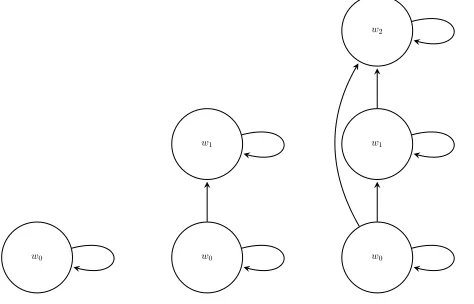
So, in general, dynamic semantics matches with potentialist’ perspective on the hierarchy of sets since in the potentialist’ view of the hierarchy of sets it is always possible to further extend the hierarchy, which can be seen as a form of growth of information. Dynamic semantics will make it possible to model this process of extending the hierarchy. This way of implementing the potentialist’s view of the hierarchy of sets will result in a hierarchy that will look more like figure 2.3, instead of the static model for modal set theory in figure 1.2.
w0
w1
w0
w2
w1
[image:28.612.160.397.467.619.2]w0 . . .
Figure 2.3: The dynamic hierarchy of sets
denoted withh in and [ ]n. Informallyh inϕand [ ]nϕ, respectively mean that there is a
state in the model resulting from a finite string of updates to the original model such that ϕand for any state in the model resulting from any finite string of updates to the model, ϕ. Finally, we will denote the model resulting from a finite string of updatesnto a prior modelMmasMm+n. The semantics of these operators and the details of how this process
functions will be worked out in more detail and more formally in the next section.
2.2
Dynamic Set Theory
In this section, we will formalise some of the intuitions mentioned in the previous section. Since the presentation of the formal side of Potentialism was largely focused on Linnebo (2013), we will prove analogue results in our dynamic setting. We will start with identifying the appropriate modal logic for our system, defining the plural logic used, outlining the semantics with a focus on our new dynamic operators, and finally looking at the notion of set existence in this setting. Let us first define models of dynamic set theory.
Definition 2.2.1 (Model of DST). Let M = hW, w0,≤,D,Ii be a model of
dynamic set theory, such that
• W is a non-empty set of states.
• w0 is the root of the model.
• R is a binary relation on W×W.
• D is a function that assigns to each state a domain, such that wRw0 → D(w)⊆ D(w0).
• I is a function that assigns for each atomicϕout ofΦa subsetI(ϕ)ofW, such that I: Φ→ P(W).
Before looking into the properties of R, we will first motivate the use of an initial state w0and the requirementwRw0→ D(w)⊆ D(w0) on the domain function.
Using a pointed model gives us the ability to, keep track of the updates done to the model thus far. Moreover, this state is present in any model of DST. So, instead of the point w0being used as the “actual state”, as is usually done with pointed models, it is used as the
initial state or the point of generation.
Our domain function requirement is based on the intuitions behind the expansion of the mathematical ontology recognised. A successor compared to the state it succeeds should contain all the mathematical ontology that was previously recognised and, additionally, the new mathematical ontology that became recognised following the update from which the successor state resulted.
Furthermore, note that the domain of the last state in any model is comprised of all the sets formed thus far. Or, more formally, forwn such that there is nown+16=wn for which
wnRwn+1,D(wn) contains all sets formed thus far.